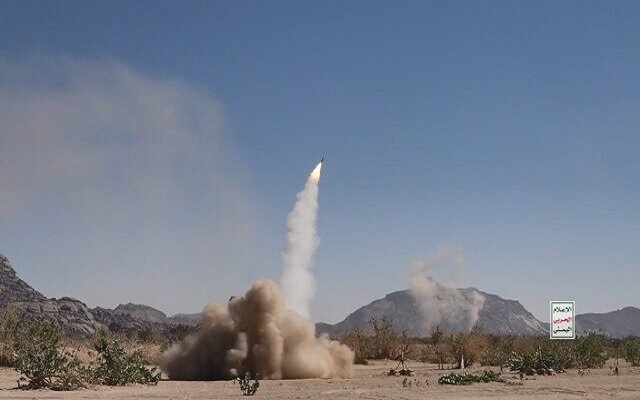
TEHRAN, Oct. 18 (MNA) – Yemeni army targeted a gathering of Saud-backedi mercenaries in Marib, located in the northeast of the country, with a missile attack.
The two-week exchange of fire between the United States and Iran, triggered by Washington’s attempt to force open an illegal southern corridor through the Strait of Hormuz, represented the most consequential direct military confrontation between them since the 40-day war.
The Iranian response to the unprovoked and illegal American aggression was not a chaotic escalation but a methodical, layered military campaign that drew on years of doctrinal development, weapons investment, and operational planning.
The efforts of the Islamic Republic’s armed forces, spearheaded by the Islamic Revolution Guards Corps (IRGC) aerospace and naval branches, executed a decisive and swift response.
What unfolded was a layered operation with nine distinct but interlocking lines of effort. Each line reinforced the others. Infrastructure degradation reduced American operational tempo; area denial forced repositioning that compounded the effects of that degradation; extended-range precision strikes demonstrated that repositioning offered no sanctuary; ISR attrition blinded American targeting systems; terrorist suppression closed the land flank, while strikes on utility infrastructure imposed costs on host nations and denied services to American bases.
One can employ the open-source reporting, satellite imagery, and the observable pattern of strikes to examine each dimension of Iran’s military response in detail, and construct a coherent operational picture. It is getting exceedingly clear that the ceasefire period has very likely translated to a window for reconstitution and preparation in Iranian strategic calculus.
The primacy of solid-fuel tactical ballistic missiles
Iran’s decision to anchor its retaliatory campaign in solid-fuel tactical ballistic missiles was not accidental. It reflected a decade-long investment in a specific capability designed precisely for this kind of confrontation. Solid-fuel ballistic missiles offer decisive operational advantages over their liquid-fuel predecessors. They require no fueling time at the launch site, dramatically compressing the window between a launch order and missile departure.
This matters enormously in a sensitive environment where adversary assets, particularly MQ-9 Reaper drones and maritime patrol aircraft, are actively hunting for launch preparations.
A liquid-fuel missile requires a visible, time-consuming fueling sequence that creates a detectable signature. A solid-fuel missile can be transported, erected, and fired in a fraction of that time, often before a targeting solution can be developed and a strike authorized.
These missiles are road-mobile, launched from transporter-erector-launchers (TELs) that can disperse across Iran’s mountainous terrain, making pre-emptive targeting extremely difficult.
Having destroyed much of the air defense systems belonging to the US and its Arab allies using the older, less sophisticated liquid fuel missiles in previous wars, Iran’s strikes this time primarily relied on its tactical solid-fuel ballistic missile inventory, meaning the various variants of the Fateh family.
Simply put, the choice of solid-fuel systems reflected a calculated assessment of the adversary’s weakened interception capacity, an assessment that proved accurate.
The air defense inventory crisis
Perhaps the single most consequential factor shaping the operational environment was the state of US and allied air defense missile inventories.
The United States entered this round of military aggression with critically depleted stocks of its most capable interceptors. The Standard Missile-3 (SM-3) and Standard Missile-6 (SM-6), which arm Aegis-equipped destroyers and cruisers and provide the American Navy’s primary ballistic missile defense capability at sea, have been drawn down through a combination of expenditure in the Red Sea campaign against Yemen, the costly defense of Israel during two previous wars, and the simple reality that production rates have never kept pace with consumption.
The Terminal High Altitude Area Defense (THAAD) system, which provides upper-tier defense against medium and intermediate-range ballistic missiles, is similarly constrained.
The decision not to employ Aegis and THAAD at full capacity was therefore a forced one. The United States simply could not spend its remaining meager inventory of SM-3 and THAAD interceptors against Iranian tactical ballistic missiles, which, while accurate and damaging, are not the only threats to American interests.
Doing so would have left the United States strategically exposed against another serious contingency in East Asia or Europe. The calculus was that American military bases had to absorb more hits to preserve the interceptors.
Moreover, the Patriot system, which bore the brunt of terminal-phase defense in recent weeks across the region, was in no better condition. Years of expenditure across Ukraine, the occupied territories, the Persian Gulf, and the Red Sea mission have drawn PAC-3 and PAC-3 MSE stocks to extremely low levels.
The Pentagon’s response was telling. Rather than accelerating full-capability PAC-3 MSE production, it has chosen to pursue the cheaper, less capable PAC-3ACE Cost Reduction Initiative variant. More revealing still were the recent PAC-2 GEM-T orders, an older interceptor not procured by the US in decades, signaling just how severely stocks had been exhausted.
That the world’s most sophisticated air defense enterprise was compelled to resurrect a 1990s-era design to sustain basic readiness is the starkest indicator of the American munitions crisis that Iranian planners appear to have understood, measured, and exploited with precision.
The situation among Persian Gulf states was equally dire. Saudi Arabia and the UAE had expended substantial portions of their Patriot PAC-3 interceptor stocks during years of Yemeni military missile and drone attacks, and entered the 40-day imposed war with depleted inventories. The situation is even direr in Kuwait and Bahrain, with the Persian Gulf microstates effectively running out of Patriots, being forced to solely rely on American-operated systems.
PAC-3, the most capable variant of the Patriot system against ballistic missiles, has effectively been exhausted in several batteries. PAC-2, the older and less capable variant, is the only available option in certain areas against Iranian missiles, and even that missile is running low as well. The collective air defense architecture of the Persian Gulf states, which had appeared formidable on paper, has been effectively hollowed out.
Iranian operational planners were aware of these facts. The sequencing and volume of Iranian missile salvos during the exchange reflected a deliberate attempt to exploit the gap between what the defense could theoretically intercept and what it could actually intercept given real-world inventory constraints.
Iran’s multi-layered operational strategy
What distinguished Iran’s response from a simple missile barrage was its architectural coherence. Iranian planners did not merely fire missiles at American targets; they executed a phased, multi-domain retaliatory campaign with distinct operational objectives at each stage, each phase creating the conditions for the next.
The campaign can be understood as having five interlocking lines of effort: infrastructure degradation, area denial and operational displacement, precision strike at extended range, ISR and logistics attrition, and proxy terrorist force suppression.
Together, they constituted a campaign design far more sophisticated than most Western analysts had publicly credited Iran with possessing.
The overarching logic was one of progressive operational constriction. Rather than attempting to destroy US forces – an objective beyond Iran’s reach given American conventional superiority – the campaign aimed to degrade, displace, and exhaust them.
Each successful strike reduced American operational capacity; forced repositioning that consumed time and resources, and demonstrated to regional partners that proximity to American occupation forces carried real costs.
Infrastructure degradation
The first phase of the Iranian retaliatory campaign targeted the physical infrastructure of American military power in the Persian Gulf region. This was not indiscriminate bombardment. Satellite imagery and post-strike assessments revealed a pattern of targeting that prioritized specific high-value nodes: radar installations, fuel and ammunition storage facilities, maintenance hangars, and communications infrastructure.
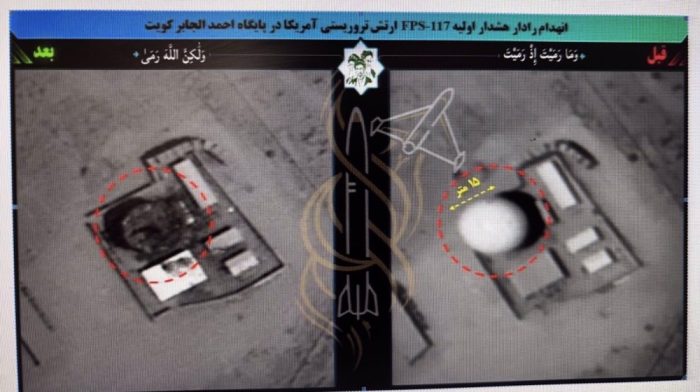
Radar systems were a particular priority. The ability to detect, track, and target Iranian missiles and UAVs depends on a layered network of radar systems. By striking radar installations at air bases, Iran degraded the situational awareness that underpins both offensive operations and defensive intercepts. A radar that is destroyed or forced offline creates a coverage gap that cascades through the entire air defense architecture.
Before-and-after imagery of an AN/FPS-117 early warning radar installation at Ahmad al-Jaber Air Base, Kuwait, showing structural damage
Logistics infrastructure was targeted with equal deliberateness. Fuel depots, ammunition storage sites, and maintenance facilities at American bases around the Persian Gulf were struck with sufficient accuracy to cause meaningful operational disruption.
An air force that cannot fuel its aircraft, rearm them, or repair battle damage cannot sustain sortie rates. The targeting of logistics was a direct attack on the tempo of American air operations to derail the American aggression against Iranian sites and reduce the pressure on Iranian forces.
The accuracy of these strikes, achieved at ranges of several hundred kilometers, validated the operational utility of Iran’s solid-fuel ballistic missile force and demonstrated that the IRGC aerospace force had developed the targeting data, launch procedures, and quality control necessary to achieve consistent results against fixed infrastructure.
The anti-access/area denial campaign
The most strategically significant dimension of the Iranian retaliatory campaign was its systematic execution of an Anti-Access/Area Denial (A2/AD) strategy that progressively pushed American air operations out of the Persian Gulf and into increasingly distant and operationally constrained locations.
The logic of A2/AD in this context was straightforward. The closer American aircraft operate to Iran, the shorter their flight times, the larger their payloads, the less refueling they require, and the more sorties they can generate per day.
Conversely, every additional hundred kilometers of distance imposes compounding costs: greater tanker support, longer mission times, reduced payload, increased crew fatigue, and more complex coordination. By rendering the Persian Gulf operationally untenable for American air assets, Iran systematically degraded the offensive capacity of the aggressors.
The first displacement was from the Persian Gulf itself. Sustained missile and drone attacks against air bases made sustained operations from those locations unfeasible. The American response was to shift primary air operations to bases in Jordan – Al-Azraq and Muwaffaq Salti –which offered greater distance from Iranian missile systems.
Iran’s response was to extend its reach to Jordan. Multiple strikes against American bases, documented by US casualties and satellite imagery showing damaged hangars and destroyed aircraft, demonstrated that Iran had the capability to contest operations from that distance.
The retaliatory strikes destroyed American aircraft, damaged infrastructure, and forced the US war machine to reconsider the viability of Jordan as a primary operating location.
The second displacement was to the occupied territories. American air assets, including tanker aircraft critical to sustaining long-range strike operations, were pushed further west to Israeli military bases.
This displacement carried its own operational costs. The distance from Iranian targets increased further, and the concentration of American assets in the occupied territories created its own targeting opportunities for Iran, which has demonstrated both the willingness and capability to strike at extended ranges.
A particularly telling indicator of this displacement dynamic was the repositioning of the RQ-4 Global Hawk strategic reconnaissance aircraft, which had been operating from Al Dhafra in the UAE and from Jordanian facilities, to Sigonella Naval Air Station in Sicily.
The Global Hawk, with its long endurance and high-altitude sensors, is a critical ISR asset for tracking Iranian missile launches and providing targeting data. Its displacement to Sicily represented a dramatic reduction in persistent surveillance coverage over Iran and the Persian Gulf, with direct consequences for the effectiveness of American strike operations.
A qualitative leap in extended-range precision
One of the most significant revelations of the recent round of US aggression and Iran’s retaliation was the demonstrated accuracy of Iranian ballistic missiles at ranges exceeding 1,000 kilometers. Previous assessments of Iranian ballistic missile accuracy had generally been skeptical about the ability to achieve consistent precision at such distances. The strikes on Jordanian targets, located well over 1,000 kilometers from Iranian launch sites, completely shattered that skepticism.
The circular error probable (CEP) – the radius within which 50 percent of strikes fall – observed in the Jordanian strikes was dramatically smaller than what Iranian missiles had previously demonstrated at comparable ranges. Strikes that hit specific buildings, specific aircraft shelters, and specific sections of structures, rather than simply landing somewhere on a base, indicated a qualitative improvement in guidance accuracy that demands explanation.
Several hypotheses present themselves, and the evidence suggests that the answer likely involves a combination of all of them. First are technical improvements. Iran may have upgraded the terminal guidance systems on its Kheibarshekan, Haj Qasem, and Fattah variants, potentially incorporating improved inertial navigation, satnav receivers, or optical terminal seekers that allow the missile to better correct its trajectory in the final phase of flight.
Second are tactical improvements. Iranian launch crews may have refined their pre-launch survey procedures, improving the accuracy of the initial position fix that the missile’s inertial navigation system uses as its reference point. Third are software improvements, which mean updates to the missile’s flight control algorithms could improve trajectory optimization and reduce the accumulated errors that degrade accuracy over long distances.
The most likely explanation is a combination of all three – a systematic program of improvement across the technical, procedural, and software dimensions of missile accuracy that had been underway for years and was now being demonstrated operationally for the first time at this range, following the experiences of the 40-day war.
The MQ-9 hunt
The MQ-9 Reaper drone occupied a central and uniquely vulnerable position in American military offensives against Iran. The Reaper is not merely a strike platform but the primary persistent ISR asset used to locate and track mobile Iranian missile launchers, particularly after the heavy attrition of similar Israeli military systems.
Without the MQ-9’s ability to loiter for extended periods, the capacity to find and destroy TELs before they fire, or to conduct battle damage assessment after strikes, is dramatically reduced.
Iran understood this dependency and targeted it systematically during this campaign. The campaign against MQ-9 assets operated on multiple levels. Ground-based air defense systems, which had previously demonstrated the ability to engage high-altitude targets, were used to engage Reapers operating over Iranian territory and adjacent areas.
But Iran also struck the ground infrastructure that supports MQ-9 operations: the maintenance facilities, fuel systems, satellite communication ground stations, and launch-and-recovery equipment that allow the aircraft to operate.
Western media reporting confirmed the destruction of a number of MQ-9 aircraft on the ground at Jordanian bases and, in a particularly striking detail, the destruction of some aircraft while still in their transport canisters before assembly.
This achievement indicates that Iran has developed targeting intelligence on the logistics chain supporting drone operations, not merely the operational bases themselves. Destroying aircraft before they are assembled and made operational is a force multiplication achievement. It eliminates capability before it can be employed, at a point when the aircraft is most vulnerable and least defended.
The cumulative effect of the MQ-9 campaign was a significant degradation of American persistent ISR coverage over Iran. This directly reduced the effectiveness of the hunt for mobile missile launchers, allowing Iranian TELs greater freedom of movement and survivability.
Suppressing proxy terrorist forces in Iraq
From the first day of the exchange, Iran conducted daily retaliatory strikes against armed terrorist groups in Iraq that had the capability and potential motivation to conduct land attacks against Iranian territory or to serve as a forward platform for American-directed operations.
This campaign was methodical and comprehensive, targeting personnel concentrations, weapons storage facilities, and command infrastructure.
Iran’s western flank, which includes the border with Iraq, represents a potential vulnerability. Armed terrorist groups in Iraq, some with historical ties to American intelligence, could in theory conduct cross-border raids, provide intelligence for American strikes, or serve as a distraction that forced Iran to divert defensive resources.
By striking these groups preemptively and continuously, Iran sought to exhaust their operational capacity before it could be brought to bear.
The daily rhythm of these retaliatory strikes was itself a message. It demonstrated that Iran had persistent targeting intelligence on these groups’ locations, that it was willing to expend munitions on this secondary campaign even while conducting the primary campaign against American forces, and that it intended to maintain pressure regardless of any ceasefire negotiations that might be underway.
The logic of reciprocity
Iran’s retaliatory strikes on electrical and water infrastructure in Kuwait represented a deliberate response that operated on two distinct logics simultaneously.
The first was reciprocity: Iran’s own civilian infrastructure had been targeted, and the strikes on Kuwaiti infrastructure were a direct signal that such targeting would not be absorbed without response to the aggressor and its facilitators.
The second was military utility. American forces in the Persian Gulf region depend on host nations’ electrical grids and water supplies for base operations. Infrastructure that serves both civilian and military purposes is, under the laws of armed conflict, a legitimate military target when the military use is substantial and the strike is proportionate.
The targeting of Kuwait’s infrastructure was also a message to Persian Gulf states more broadly. Kuwait, like Bahrain, the UAE, Saudi Arabia, and Qatar, hosts American military facilities and had provided varying degrees of support to American operations.
By demonstrating the ability and willingness to strike Kuwaiti infrastructure, Iran was communicating that the costs of hosting American forces were not abstract. They were concrete, immediate, and would be borne by the host nation as well as the American military.
The pillars of operational success
Iran’s two-week retaliatory campaign against American aggression and attempts to force open an illegal southern corridor through the Strait of Hormuz largely succeeded on every dimension that its operational planners had identified.
The exchange demonstrated that Iran had developed, over decades of institutional study and investment, a military capability genuinely capable of contesting American power projection in the Persian Gulf region, even after two high-intensity wars.
It demonstrated something relevant to the strategic environment of the region – that the costs of American military aggression in the Persian Gulf had increased substantially; that the infrastructure of American power projection was more vulnerable than pre-war assessments had suggested; and that Iran possessed both the capability and the operational sophistication to exploit those vulnerabilities in a systematic and disciplined manner.
TEHRAN, Oct. 18 (MNA) – Yemeni Armed Forces have issues a new warning calling on Saudi non-military people to stay away from Saudi oil facilities and sell Aramco oil company's shares on the stock markets.
Israel’s positions on the world stage are weakening, and this is reflected in the balance of power. It should be noted that Israel per se was created immediately after the Second World War on a wave of sympathy for the Jews, whom the German Nazis exterminated on a mass scale. This phenomenon became known as […]
Diplomats from Belgium, France and Poland were attacked by Israeli settlers during an olive-harvesting visit to the occupied West Bank, prompting calls for further European sanctions and an investigation by Israeli authorities.
The settlers attacked a delegation of European diplomats and Catholic representatives in the occupied West Bank on Saturday, 17th October, assaulting a French mayor and damaging a Belgian diplomatic vehicle during a visit intended to support Palestinian olive farmers.
The delegation included Belgium’s consul general, French and Polish diplomats and representatives of the Catholic Church. The incident occurred near the Palestinian village of Taybeh, where settlers confronted visitors accompanying local residents during the annual olive harvest.
Belgian Foreign Minister Maxime Prévot condemned the violence and announced that Brussels would press for additional European Union sanctions against those responsible. He also called on Israel to meet its obligations as the occupying power and protect Palestinians, journalists and foreign diplomatic representatives.
According to accounts of the incident, Bernard Baudoux, mayor of the French town of Aulnoye-Aymeries, was assaulted while attempting to enter a vehicle bearing diplomatic plates. The attack also involved members of a Catholic delegation, including Archbishop Vincent Dollmann of Cambrai.
Three people were reportedly injured. Belgian diplomatic personnel were confirmed to be safe.
Diplomatic incident draws Israeli condemnation
Israel’s military described the attack as a serious act of violence but said that the delegation’s visit had not been coordinated with the Israeli authorities and that soldiers had not been present when the confrontation occurred.
Israeli police subsequently opened an investigation.
Foreign Minister Gideon Saar publicly condemned the actions of the settlers and said his ministry was in contact with the ambassadors of the countries involved. The Israeli government’s response comes amid mounting international criticism of settler violence against Palestinian communities in the West Bank.
The circumstances are particularly sensitive because the victims included accredited diplomatic representatives from three EU member states. The incident therefore extends beyond the continuing disputes over land ownership and Palestinian access to agricultural areas, raising questions about the protection of foreign officials carrying out recognised diplomatic activities.
For Belgium, the attack has reinforced an existing position in favour of stronger European measures against violent settlers and organisations supporting settlement expansion.
Prévot linked the violence to Israeli settlement policy, arguing that the attacks could not be considered separately from the broader circumstances of the occupation.
A growing dispute over European sanctions
The European Union has already introduced targeted restrictive measures against individuals and organisations associated with serious abuses against Palestinians in the occupied West Bank.
In May 2026, the Council of the EU imposed additional sanctions on three individuals and four organisations, including the Nachala Settlement Movement and the Amana cooperative association.
The measures were adopted under the EU Global Human Rights Sanctions Regime and included asset freezes, prohibitions on making funds available to designated persons and travel restrictions on listed individuals.
The Council said the sanctioned organisations had supported or facilitated activities resulting in the displacement of Palestinian communities and the loss of property.
However, agreement on broader economic measures against Israel has proved substantially more difficult.
As EU Today previously reported, European governments have considered restrictions on trade involving Israeli settlements, while divisions between member states have complicated attempts to establish a common position.
The latest attack gives Belgium, France and Poland a direct diplomatic interest in the outcome of any further discussion. Whether this produces a new sanctions agreement will depend on negotiations between EU governments, rather than unilateral declarations by individual ministers.
Violence during the olive harvest
The incident occurred amid escalating attacks on Palestinian farmers during the annual olive harvest, an important source of income for communities across the West Bank.
Harvesting frequently involves access to agricultural land situated near Israeli settlements or in areas where Palestinians face movement restrictions. Local farmers have complained of intimidation, destruction of trees and attacks by settlers attempting to prevent them from reaching their property.
According to reporting from the area, the Palestinian Health Ministry said at least four people had been killed and more than 100 injured since this year’s harvest began.
The attack on the European delegation followed another serious incident involving American photojournalist Heidi Levine, who was assaulted while covering attacks on Palestinian olive harvesters.
The violence has attracted criticism from international organisations and foreign governments, including those maintaining close diplomatic relations with Israel.
Wider implications for EU–Israel relations
The diplomatic confrontation comes against a background of longstanding disagreement between Brussels and the Israeli government over settlement expansion and the legal status of the occupied territories.
The European Union does not recognise Israeli sovereignty over the West Bank and regards settlements established there as contrary to international law. Israel disputes the application of this legal interpretation to the territory.
The latest incident is unlikely, by itself, to determine the future of EU–Israel relations. It does, however, strengthen demands from governments already advocating targeted sanctions and more effective measures against settlement-related violence.
For Belgium, France and Poland, the immediate questions concern the safety of their diplomatic personnel, the Israeli investigation and whether the perpetrators will face prosecution.
For the EU collectively, the matter now extends to whether its existing sanctions framework can address continuing attacks against Palestinians and, increasingly, European representatives themselves.
The controversy surrounding the wearing of the hijab in Azerbaijani schools took on new dimensions in October, following the implementation of dress code rules that resulted in female students and teachers being denied entry to public institutions. The episode sparked demonstrations, arrests, and criticism from international organizations, while also drawing reactions from Turkey. The debate extends far beyond the school environment, involving questions of sovereignty, religious identity, and regional stability.
Azerbaijan has historical reasons for maintaining a secular state model. The Soviet experience, the formation of its institutions after independence, and the need to govern a religiously diverse society amid a tense regional environment have contributed to the consolidation of a system in which the state maintains strict control over the functioning of public institutions. Azerbaijani authorities have the prerogative to determine their educational policies, establish standards for schools, and decide how constitutional principles are to be implemented.
However, the way these policies are implemented can produce consequences that extend beyond their original objectives. In the case of the hijab, the enforcement of school regulations has provoked resistance among families and religious communities, while arrests related to the protests have amplified the controversy. The government’s central challenge will be to manage this reaction without allowing a dispute over school uniforms to develop into a broader conflict between state authorities and religious communities.
The situation also has important international implications. Ankara, Baku’s main strategic partner, has expressed concern over restrictions on the Islamic headscarf. The political, cultural, and linguistic proximity between the two countries makes the issue particularly sensitive. Although this disagreement does not necessarily amount to a bilateral crisis, it demonstrates how domestic decisions can create friction even between governments that maintain close relations. Ankara must take its own social and political considerations into account, while Baku seeks to preserve its autonomy in managing domestic affairs.
The Iranian dimension also deserves attention. Azerbaijan maintains a complex relationship with Iran, shaped by historical and religious ties as well as strategic disagreements. Like Iran, Azerbaijan has a predominantly Shiite population, while the Islamic Republic has a substantial Azerbaijani minority. Both Supreme Leader Ayatollah Khamenei and President Masoud Pezeshkian have Azerbaijani ethnic backgrounds. In this environment, secularization policies may be interpreted by external actors as part of a broader struggle for religious and political influence within Azerbaijan. This interpretation, however, does not establish that the school regulations were adopted exclusively to counter Iranian influence.
There is also a domestic risk worth considering. Religious restrictions implemented too rigidly can produce effects contrary to those intended. When segments of the population perceive certain measures as impositions on their religious practices, radical groups may exploit the resulting discontent, portray the state as an adversary of religion, and expand their capacity for mobilization. Understanding this issue requires consideration of other experiences, such as Syria under the Assad government, where secularism coexisted with the proliferation of extremism. This outcome is not inevitable, and opposition to the regulations should not automatically be equated with extremism. Nevertheless, international experience suggests that this possibility needs close examination.
For Azerbaijan, the issue therefore involves more than the definition of a school uniform. The country has the right to organize its institutions according to its own priorities, without foreign governments dictating its choices. At the same time, maintaining stability requires preventing administrative decisions from fueling lasting polarization or creating new opportunities for actors seeking to intensify religious tensions.
The evolution of this case will have implications for Baku’s relations with Ankara and Tehran, as well as for the country’s domestic political dynamics. The outcome will depend not only on the regulations themselves but also on their practical implementation and the authorities’ response to concerns raised by students, families, and educators. In the South Caucasus, where identity, sovereignty, and security remain closely intertwined, even a seemingly localized dispute can have serious regional repercussions.
The global economy, because of the conflict in the Middle East in 2026, has faced an unprecedented combination of geopolitical and economic challenges. The Middle East conflict, which began in late February 2026, became a catalyst for profound structural changes in the global trading system, which was already under pressure from rising protectionism and economic […]
In 2026, Turkey’s policy in Yemen shifted from exclusive neutrality and mediation efforts to “the brink” of military intervention against the government in Sanaa and the Ansar Allah movement, yet a range of geopolitical, legal and domestic political factors makes this scenario being fully put into practice unlikely. A Brief Retrospective of Turkish-Yemeni Relations Relations […]
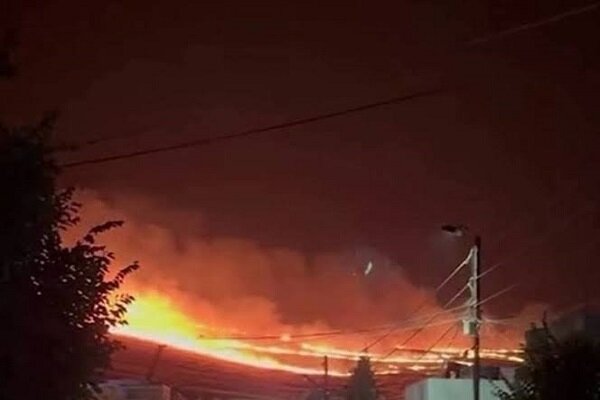
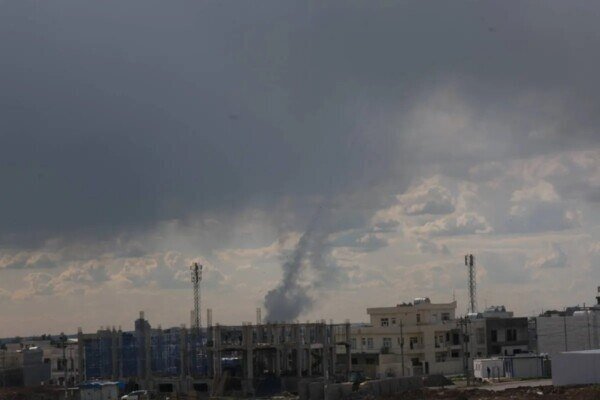
TEHRAN, Oct. 18 (MNA) – An explosion was heard in the outskirts of Erbil in Iraq's Kurdistan region, with reports of a drone attack on the headquarters of anti-Iran separatist groups in Wadi Alane.
L’Iran e il Pakistan sono fortemente impegnati nella costruzione di un ordine finanziario post-americano nel punto di incontro tra l’Asia occidentale e l’Asia meridionale.
Andiamo subito al nocciolo della questione: dopo aver esaminato attentamente la scacchiera, la leadership politica e militare di Teheran è già giunta alla conclusione che un attacco congiunto statunitense-israeliano, la cui pianificazione procede a ritmo frenetico, sia inevitabile.
Pertanto, si sono ora posizionati come un cobra arrotolato, pronto a colpire e a iniettare veleno letale al primo sentore di una minaccia imminente da parte del Sindacato di Epstein – senza nemmeno attendere un attacco effettivo.
L’offensiva preventiva, già delineata, sarà devastante, estendendosi oltre le basi statunitensi nell’Asia occidentale ad altri obiettivi regionali e includendo potenzialmente le infrastrutture energetiche del Golfo e i cavi sottomarini (in questo caso con ripercussioni che interesseranno soprattutto il Golfo e l’India, molto più che gli Stati Uniti e l’Europa).
Ci troviamo in una situazione di pericolo chiaro e imminente: una mossa militare statunitense-israeliana intesa come pressione sarà certamente interpretata a Teheran come l’inizio di un attacco.
Pertanto, la pressione bellica esercitata dal «culto della morte» e da Trump si scontra ora con una soglia di tolleranza iraniana pericolosamente bassa. Le opzioni di attacco del Pentagono spaziano dagli impianti nucleari iraniani alle infrastrutture energetiche.
Va da sé che il «sociopatico in capo» – già in preda al panico per l’imminente debacle delle elezioni di medio termine – sia una facile preda della potente lobby sionista e dei suoi finanziatori favorevoli alla guerra. Il pericolo strategico supremo è quindi che questa pressione incessante possa produrre un segnale che Teheran interpreti come un attacco imminente, anche se Washington sostiene pubblicamente che non vi sarà alcun attacco prima delle elezioni di medio termine.
Lo Yemen sta portando la situazione a un livello superiore
Parallelamente, fonti privilegiate a Islamabad confermano il successo di un test missilistico pakistano a Mach 7, con una gittata di diverse migliaia di chilometri. Questa nuova capacità ha tutte le carte in regola per alterare concretamente l’equilibrio di potere in Asia occidentale, rafforzando la portata deterrente del Pakistan e la sua capacità di influenzare ogni calcolo di sicurezza regionale, oltre ad accrescere la sempre più profonda interconnessione del Pakistan con la Cina, l’Iran e le petro-monarchie del Golfo.
Ed ora un’altra esclusiva: membri dei servizi di intelligence militare israeliani, tra cui un generale di divisione, hanno lasciato Riyadh dopo che MbS, in un presunto momento di lucidità, ha detto «No» all’offerta di «assistenza» da parte del culto della morte. Eppure, più di 100 membri del personale del CENTCOM rimangono sul posto.
La decisione di MbS potrebbe essergli stata imposta dalla Turchia e dal Pakistan – gli altri due firmatari dell’Alleanza di Difesa della Mecca, che si sono improvvisamente ritrovati nella stessa sala operativa a Riyadh fianco a fianco con agenti del culto della morte.
Ora, la loro partenza potrebbe aver eliminato un rischio di escalation, ma gli agenti statunitensi rimangono esposti: qualsiasi attacco, da qualunque parte provenga, che causi vittime tra le forze statunitensi trascinerà immediatamente Washington nella guerra tra Arabia Saudita e Ansarallah.
La guerra tra Arabia Saudita e Ansarallah, infatti, sta raggiungendo il livello successivo: quello della volatilità. Il mix esplosivo costituito dall’intercettazione di un missile da crociera sopra la provincia di Medina, dalle intercettazioni di droni in altre zone dell’Arabia Saudita e dagli attacchi missilistici delle Forze Armate yemenite contro il complesso presidenziale del governo fantoccio di Aden è solo l’inizio.
Ciò che è accaduto dopo che Ansarallah ha preso di mira Najran – una delle province meridionali dell’Arabia Saudita sottratte allo Yemen nel 1934 dagli inglesi – è un fatto che suscita grande stupore.
Un portavoce saudita ha accusato Ansarallah di aver lanciato un missile da crociera contro Medina. La risposta dell’iconico portavoce delle Forze Armate yemenite, il generale Yahya Saree, è stata devastante: «Oggi non abbiamo condotto alcuna operazione militare contro il territorio saudita. Pertanto, l’affermazione del nemico saudita secondo cui Medina sarebbe stata presa di mira è una vera e propria invenzione e una grave menzogna».
Traduzione: lo Yemen colpisce una delle sue ex province; i sauditi ricorrono a una notizia totalmente falsa, inventando un attacco a una delle due moschee sacre – senza dubbio come preparazione per un’operazione sotto falsa bandiera; poi lo Yemen nega prontamente di aver colpito qualsiasi (corsivo mio) territorio saudita.
Ciò significa che Sana’a sta dichiarando in modo sottile, affinché tutti possano comprenderlo, di non condurre più operazioni all’estero (il corsivo è mio) nelle tre province: Jizan, Najran e Asir. Sta già – psicologicamente e operativamente – preparando il terreno per recuperare il proprio territorio sottratto.
«Lo Yemen sta minando i pilastri estremamente fragili dell’economia non petrolifera su cui i “pirati del deserto” hanno riposto tutte le loro speranze: immagine, investimenti (FDI), evasione dalla realtà, nonché impunità e invulnerabilità nei confronti del terrorismo proveniente dall’estero».
Come Pakistan e Iran aggirano il FMI
Prestino ora attenzione a un fatto piuttosto sorprendente avvenuto a metà settimana a Bangkok, durante la riunione annuale del FMI e della Banca Mondiale – debitamente accolta da proteste di piazza in Thailandia.
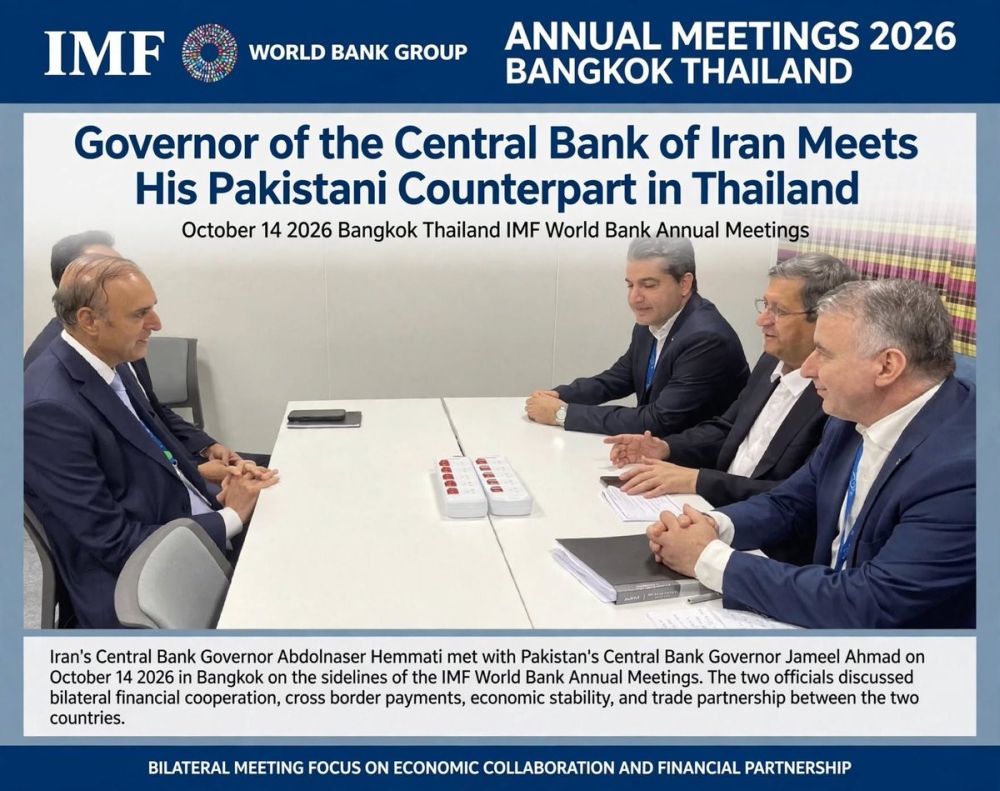
Il governatore della Banca Centrale iraniana, Abdolnaser Hemmati, ha incontrato il governatore della Banca Centrale pakistana, Jameel Ahmad, a margine del principale rituale annuale in lode del dollaro statunitense.
Il Pakistan è sottoposto alla ferrea morsa degli adeguamenti strutturali imposti dal FMI e dalla Banca Mondiale – e, come se non bastasse, è minacciato dalle sanzioni statunitensi perché intrattiene rapporti commerciali con l’Iran.
Pertanto, il fatto che Pakistan e Iran stiano di fatto discutendo della de-dollarizzazione proprio all’interno della tana del leone – il tempio del dollaro statunitense – è di un valore inestimabile.
L’infrastruttura è operativa dal 2023, grazie a un accordo di swap valutario che utilizza il rial e la rupia al posto del dollaro statunitense. Il baratto è gestito da entrambe le Banche Centrali, mentre i canali bancari passano attraverso la Bank Melli in Iran e la Bank Mellat in Pakistan. I loro mercati di confine – almeno sei – sono in forte espansione: rotte commerciali fisiche che aggirano completamente il dollaro statunitense.
Ciò di cui si è discusso a Bangkok all’inizio di questa settimana è come espandere l’intero sistema: non gliene importa nulla delle sanzioni secondarie statunitensi. Soprattutto perché Teheran sta offrendo a Islamabad ciò che il sistema americano semplicemente non può offrire: sovranità, nessun cambio di regime, nessuna austerità, nessuna lezione e, soprattutto, nessun aggiustamento strutturale.
Senza contare che il Pakistan ha un disperato bisogno del gas iraniano – e delle rotte commerciali della Nuova Via della Seta promosse dalla Cina.
L’Iran ha costruito un’intera economia aggirando completamente il FMI – e in grado di sopravvivere a uno tsunami di sanzioni, a un blocco e alla guerra.
Ora l’Iran e il Pakistan sono impegnati a fondo nella costruzione di un ordine finanziario post-americano all’incrocio tra l’Asia occidentale e l’Asia meridionale – completo di swap valutari, commercio di baratto, mercati di confine in forte espansione e canali bancari adeguati, che rendono le sanzioni secondarie una farsa.
A proposito, ciò sta avvenendo proprio mentre un immenso treno iraniano, carico di petrolio greggio – e il primo di molti – è pronto a partire alla volta della… Cina attraverso l’Asia centrale, sulla ferrovia della Nuova Via della Seta costruita dalla Cina.
Il cobra arrotolato potrebbe essere pronto a colpire. Ma il cobra, da tempo immemorabile, ama anche fare affari.
L’Iran et le Pakistan sont pleinement engagés dans la construction d’un ordre financier post-américain à la croisée du Moyen-Orient et de l’Asie du Sud.
Allons droit au cœur du sujet : après avoir soigneusement examiné l’échiquier, les dirigeants politiques et militaires de Téhéran sont déjà parvenus à la conclusion qu’une attaque conjointe américano-israélienne, dont la planification avance à un rythme effréné, est inévitable.
Ils se positionnent donc désormais comme un cobra lové, prêt à frapper et à injecter son venin mortel au premier signe d’une menace imminente du syndicat Epstein — sans même attendre une attaque effective.
Cette offensive préventive, dont les contours sont déjà tracés, sera dévastatrice ; elle s’étendra au-delà des bases américaines au Moyen-Orient vers d’autres cibles régionales, et pourrait notamment inclure les infrastructures énergétiques du Golfe ainsi que les câbles sous-marins (ce qui, dans ce cas, affecterait principalement le Golfe et l’Inde, bien plus que les États-Unis et l’Europe).
Nous sommes en présence d’un danger clair et immédiat : une opération militaire américano-israélienne destinée à exercer une pression sera certainement interprétée à Téhéran comme le début d’une attaque.
Ainsi, la pression en faveur de la guerre exercée par le «culte de la mort» et par Trump se heurte désormais à un seuil de tolérance iranien dangereusement bas. Les options de frappe du Pentagone vont des installations nucléaires iraniennes aux infrastructures énergétiques.
Il va sans dire que le «sociopathe en chef» — déjà en pleine panique face à la débâcle imminente des élections de mi-mandat — est une proie facile pour le puissant lobby sioniste pro-guerre et ses donateurs. Le danger stratégique suprême réside donc dans le fait que cette pression incessante puisse envoyer un signal que Téhéran interpréterait comme une attaque imminente, même si Washington affirme publiquement qu’aucune frappe n’aura lieu avant les élections de mi-mandat.
Le Yémen fait passer la situation à un niveau supérieur
Parallèlement, des sources privilégiées à Islamabad confirment le succès d’un essai de missile pakistanais à Mach 7, d’une portée de plusieurs milliers de kilomètres. Cette nouvelle capacité a tout ce qu’il faut pour modifier concrètement l’équilibre des pouvoirs au Moyen-Orient, en renforçant la portée dissuasive du Pakistan et sa capacité à influencer tous les calculs de sécurité régionaux, tout en approfondissant les liens du Pakistan avec la Chine, l’Iran et les pétro-monarchies du Golfe.
Et voici une autre exclusivité : des membres des services de renseignement militaire israéliens, notamment un général de division, ont quitté Riyad après que MbS, dans un prétendu moment de lucidité, eut dit «non» à l’offre d’»assistance» de la secte de la mort. Et pourtant, plus de 100 membres du CENTCOM sont toujours sur place.
La décision de MbS lui a peut-être été imposée par la Turquie et le Pakistan — les deux autres signataires de l’Alliance de défense de La Mecque, qui se sont soudainement retrouvés dans la même salle de crise à Riyad, côte à côte avec des agents de la secte de la mort.
Si leur départ a peut-être écarté un risque d’escalade, les agents américains restent révélés : toute frappe, d’où qu’elle vienne, faisant des victimes américaines entraînera immédiatement Washington dans la guerre entre l’Arabie saoudite et Ansarallah.
La guerre entre l’Arabie saoudite et Ansarallah atteint en effet un nouveau niveau de volatilité. Le mélange explosif constitué par l’interception d’un missile de croisière au-dessus de la province de Médine, les interceptions de drones ailleurs en Arabie saoudite et les frappes de missiles des forces armées yéménites contre le complexe présidentiel du gouvernement fantoche d’Aden n’est qu’un début.
Ce qui s’est passé après qu’Ansarallah a pris pour cible Najran — l’une des provinces du sud de l’Arabie saoudite volées au Yémen en 1934 par les Britanniques — est tout à fait stupéfiant.
Un porte-parole saoudien a accusé Ansarallah d’avoir lancé un missile de croisière sur Médine. La réponse du porte-parole emblématique des forces armées yéménites, le général Yahya Saree, a été cinglante : «Nous n’avons mené aucune opération militaire visant le territoire saoudien aujourd’hui. Par conséquent, l’affirmation de l’ennemi saoudien selon laquelle Médine aurait été prise pour cible est une pure invention et un mensonge grave».
Traduction : le Yémen frappe l’une de ses anciennes provinces ; les Saoudiens se lancent dans des fausses informations à outrance, inventant de toutes pièces une attaque contre l’une des deux mosquées sacrées — sans doute en préparation d’une opération sous faux pavillon ; puis le Yémen nie aussitôt avoir frappé quelque (italiques de ma part) territoire saoudien.
Cela signifie que Sanaa déclare subtilement, pour que tout le monde comprenne, qu’elle ne mène plus d’opérations à l’étranger (italiques de ma part) sur les trois provinces : Jizan, Najran et Asir. Elle prépare déjà — psychologiquement et opérationnellement — le terrain pour récupérer son territoire volé.
Tout cela se résume dans cette analyse yéménite succincte de la déconstruction de la fastueuse Maison des Saoud :
«Le Yémen sape les piliers ultra-fragiles de l’économie non pétrolière sur lesquels les pirates du désert ont fondé tous leurs espoirs : l’image, les investissements (IDE), l’évasion de la réalité, ainsi que l’impunité et l’invulnérabilité face au terrorisme à l’étranger».
Comment le Pakistan et l’Iran contournent le FMI
Prêtez maintenant attention à un événement assez surprenant qui s’est produit en milieu de semaine à Bangkok, lors de la réunion annuelle du FMI et de la Banque mondiale — dûment accueillie par des manifestations de rue en Thaïlande.
Le gouverneur de la Banque centrale d’Iran, Abdolnaser Hemmati, a rencontré le gouverneur de la Banque centrale du Pakistan, Jameel Ahmad, en marge de ce rituel annuel de premier plan à la gloire du dollar américain.
Le Pakistan est soumis à la poigne de fer des ajustements structurels imposés par le FMI et la Banque mondiale — et, pour couronner le tout, menacé de sanctions américaines parce qu’il entretient des relations commerciales avec l’Iran.
Le fait que le Pakistan et l’Iran discutent de facto de la dédollarisation au cœur même de la tanière du lion — le temple du dollar américain — n’a donc pas de prix.
L’infrastructure est en place depuis 2023, grâce à un accord de swap de devises utilisant le rial et la roupie à la place du dollar américain. Le troc est géré par les deux banques centrales, et les flux bancaires transitent par la Banque Melli en Iran et la Banque Mellat au Pakistan. Leurs marchés frontaliers — au moins six d’entre eux — sont en plein essor : des routes commerciales physiques qui contournent complètement le dollar américain.
Ce dont ils discutaient à Bangkok en début de semaine, c’est la manière d’étendre ce système : ils se moquent éperdument des sanctions secondaires américaines. D’autant plus que Téhéran offre à Islamabad ce que le système américain ne peut tout simplement pas offrir : la souveraineté, pas de changement de régime, pas d’austérité, pas de leçons de morale et, surtout, pas d’ajustement structurel.
Sans compter que le Pakistan a cruellement besoin du gaz iranien — et des routes commerciales de la nouvelle Route de la soie rendues possibles par la Chine.
L’Iran a bâti toute une économie en contournant complètement le FMI — et capable de survivre à un tsunami de sanctions, à un blocus et à la guerre.
Aujourd’hui, l’Iran et le Pakistan sont en pleine construction d’un ordre financier post-américain à la croisée du Moyen-Orient et de l’Asie du Sud — avec des swaps de devises, du troc, des marchés frontaliers en plein essor et des canaux bancaires adaptés, tournant ainsi en dérision les sanctions secondaires.
Soit dit en passant, cela se produit au moment même où un immense train iranien, chargé de pétrole brut — et le premier d’une longue série —, s’apprête à partir pour… la Chine via l’Asie centrale, sur la ligne ferroviaire de la «nouvelle Route de la soie» construite par la Chine.
Le cobra lové est peut-être prêt à frapper. Mais le cobra, depuis des temps immémoriaux, adore aussi faire des affaires.
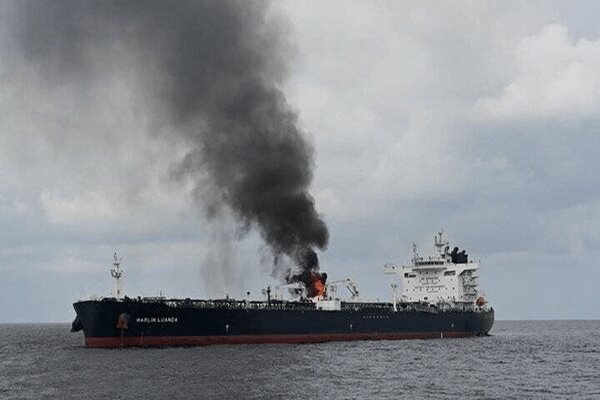
TEHRAN, Oct. 17 (MNA) – The United Kingdom Maritime Trade Operation (UKMTO) has reported that two oil tankers were collided with ach other near the coasts of Saudi Arabia, one of them was hit by an unidentified boat using an RPG!
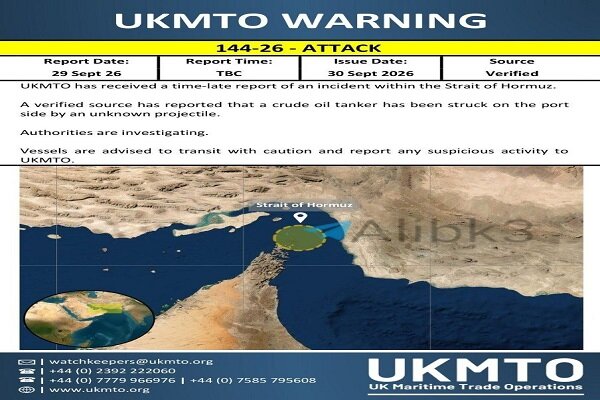
TEHRAN, Oct. 17 (MNA) – The United Kingdom Maritime Trade Operation (UKMTO) on Saturday reported that an unidentified projectile struck an oil tanker near Saudi Arabia.
The Houthis are preparing to march on Riyadh while the Revolutionary Guards are driving America out of every continent. America’s security umbrella has failed to provide the Gulf petro-monarchies with the much-touted security against Iran and the axis of resistance. Instead, it has made them more susceptible to the realization of the “Pax Judaica,” or […]
Let’s get right into the heart of the matter: carefully examining the chessboard, the political and military leadership in Tehran has already reached the conclusion that a joint U.S.-Israeli attack, with planning advancing at a feverish pace, is inevitable.
So they are now positioned themselves as a coiled cobra, ready to strike and inject deadly venom at the first whiff of an imminent Epstein Syndicate threat – even without waiting for an actual attack.
The preemption drive, already delineated, will be devastating, extending beyond U.S. bases in West Asia to other regional targets, and potentially including Gulf energy infrastructure and undersea cables (in this case mostly affecting the Gulf and India, much more than the U.S. and Europe).
We are into clear and present danger territory: a U.S.-Israeli military movement intended as pressure certainly will be interpreted in Tehran as the opening of an attack.
So the death cult/Trumpian pressure for war now meets a dangerously low Iranian threshold. Pentagon strike options range from Iranian nuclear installations to energy infrastructure.
It goes without saying that the Sociopath-in-Chief – already freaking out with the imminent mid-terms debacle – is an easy prey to the powerful pro-war Zionist lobby/donors. The supreme strategic danger then is that this non-stop pressure may produce a signal that Tehran interprets as an imminent attack, even while Washington publicly maintains that no strike will happen before the mid-terms.
Yemen is taking it all to the next level
In parallel, privileged sources in Islamabad confirm a successful Pakistani missile test at Mach 7, with a range of several thousand kilometers. This new capability has all that it takes to materially alter West Asia’s balance of power, strengthening Pakistan’s deterrent reach and how it will be able to influence every regional security calculation, and adding to Pakistan’s deepening interconnection with China, Iran and the Gulf petro-monarchies.
And now for another esclusive: Israeli military intelligence personnel, including a Major-General, have left Riyadh after MbS, in an alleged moment of lucidity, said “No” to the death cult’s offer of “assistance”. And yet more than 100 CENTCOM personnel remain.
MbS’s decision may have been forced on him by Turkiye and Pakistan – the other two signatories of the Mecca Defense Alliance, who suddenly found themselves in the same war room in Riyadh side by side with death cult operatives.
Now their departure may have removed one escalation risk, but U.S. operatives remain exposed: any strike, wherever it comes from, generating U.S. casualties will immediately draw Washington into the Saudi-Ansarallah war.
The Saudi-Ansarallah war, in fact, is hitting the next – volatility – level. The toxic mix of a cruise-missile interception over Medina province; drone interceptions elsewhere in Saudi Arabia; and Yemeni Armed Forces missile strikes on Aden’s puppet government presidential complex is just the start.
What happened after Ansarallah targeted Najran – one of the southern Saudi provinces stolen from Yemen in 1934 by the British – is total eyebrow-raising territory.
A Saudi spokesman accused Ansarallah of launching a cruise missile at Medina. The response by iconic spokesman for Yemeni Armed Forces, Gen Yahya Saree, was a killer: “We did not carry out any military operation targeting Saudi territory today. Therefore, the Saudi enemy’s claim that Medina was targeted is an outright fabrication and a grave falsehood.”
Translation: Yemen hits one of their former provinces; the Saudis go for total fake news, fabricating an attack on one of the two sacred mosques – no doubt as preparation for a false flag; then Yemen promptly denies striking any (italics mine) Saudi land.
That means that Sana’a is subtly declaring, for everyone to understand, that they no longer conduct foreign (italics mine) operations on the three provinces: Jizan, Najran and Asir. They are already – psychologically and operationally – setting the stage to recover their stolen territory.
All that gells into this succint Yemen-based analysis of the deconstruction of the bling-bling House of Saud:
“Yemen is nuking the uber-fragile pillars of the non-oil economy on which the desert Pirates placed all their hopes: Image, (FDI) Investments, Escapism, and Impunity & Invulnerability from terrorism abroad.”
How Pakistan and Iran bypass the IMF
Now pay attention to something quite startling that happened mid-week in Bangkok, during the annual IMF/World Bank meeting – duly greeted by Thai street protests.
The head of Iran’s Central Bank, Abdolnaser Hemmati, met the head of Pakistan’s Central Bank, Jameel Ahmad, on the sidelines of the foremost annual ritual in praise of the U.S. dollar.
Pakistan is under the fierce structural adjustment clutches of the IMF/World Bank – and on top of it threatened with U.S. sanctions because it trades with Iran.
So Pakistan-Iran de facto discussing de-dollarization right inside the lion’s den – the U.S. dollar temple – is beyond priceless.
The infrastructure is in place since 2023 – via a currency swap agreement using the rial and the rupee instead of the U.S. dollar. Barter is managed by both Central Banks, and banking channels run through Bank Melli in Iran and Bank Mellat in Pakistan. Their border markets – at least 6 of them – are booming: physical trade routes completely bypassing the U.S. dollar.
What they were discussing in Bangkok earlier this week is how to expand the whole thing: they couldn’t give a damn to U.S. secondary sanctions. Especially because Tehran is offering Islamabad what the American system simply cannot: sovereignty, no regime change, no austerity, no lecturing and most of all no structural adjustment.
Not to mention that Pakistan badly needs Iranian gas – and China-enabled New Silk Road trade routes.
Iran built a whole economy completely bypassing the IMF – and capable of surviving a tsunami of sanctions, a blockade, and war.
Now Iran and Pakistan are deep into building a post-American financial order in the intersection between West Asia and South Asia – complete with currency swaps, barter trade, booming border markets and appropriate banking channels, making a mockery of secondary sanctions.
By the way, this is happening just as an immense Iranian train, loaded with crude oil – and the first of many – is ready to depart to… China via Central Asia, on the New Silk Road railway built by China.
The coiled cobra may be ready to strike. But the cobra, since times immemorial, also loves to do business.
TEL AVIV — There is one country on earth where Donald Trump could plausibly win a national election, and he knows it. “I could run for Prime Minister,” he joked in May, claiming 99% approval here. No poll has ever shown that. But the joke landed because it is only half a joke. Thirteen days before […]
Record debt, a paralysed trade-dispute architecture and the normalisation of sovereign-asset seizure as a policy tool means fragility is baked into the global economic system
Since 2022, a steady drumbeat of forecasts has warned that cascading military and political upheavals – war in Ukraine, conflict in the Middle East, an accelerating tariff war, the weaponisation of sanctions and the disruption of energy supplies – would eventually overwhelm the world economy’s capacity to absorb shocks.
The most destructive of those scenarios have not materialised, or at least not yet.
As the IMF’s managing director Kristalina Georgieva stated last year, while previewing the fund’s World Economic Outlook, the global economy “has generally withstood significant strains from various shocks”.
Although that resilience is real, on closer inspection, it is a more fragile and more contested achievement than it first appears.
The adaptive mechanisms behind this resilience are visible and measurable. Trade has rerouted rather than collapsed. Energy corridors have diversified. And reserve managers have spent the past three years quietly re-engineering the architecture of the international monetary system.
According to the World Gold Council’s 2026 Central Bank Gold Reserves survey – which drew responses from 76 institutions, its highest participation in nine years – 89 percent of central banks expect global gold holdings to keep rising over the next year, with a record share planning to add to their own reserves.
The result: gold has overtaken US Treasuries as the largest single component of global central bank reserves for the first time since the mid-1990s.
Mother of all ticking bombs
Analysts tracking the shift link it directly to a single event: reserve managers were unsettled by the seizure of the Central Bank of Russia’s reserves at the start of the Ukraine war by Washington and have since been actively reducing the dollar share of their portfolios.
This is a clear example that the economic system is not breaking under political pressure, it is adapting to it – flexibly, and crucially, without severing the interconnections that make global trade and finance function at all.
In other words, central banks accumulating gold are not exiting the system; they are just hedging within it.
But adaptability has a cost, and that cost is compounding.
Global debt – government, household, corporate and financial combined – surpassed $365 trillion in the first half of 2026, according to the Institute of International Finance’s Global Debt Monitor, the sixth consecutive quarterly record.
Emerging-market debt alone rose by $6.5 trillion in the same period, breaking past $110 trillion. Georgieva has been blunt about the trajectory: speaking at the IMF and World Bank annual meetings, she warned that global public debt is projected to reach 110 percent of the world’s GDP by 2029.
There is an evident reluctance to address what is not a crisis in any single country’s balance sheet, but a structural drift that every major economy appears aware of and none is prepared to correct unilaterally.
Debt of this scale narrows the fiscal space available to absorb the next shock, military or otherwise, which is precisely what makes today’s resilience difficult to extrapolate into tomorrow’s.
In this context, there is also the mother of all ticking bombs, a nuclear one: the $40 trillion US federal debt which US Secretary of Treasury Scott Bessent is desperately trying to reign in.
The third strand, the onslaught of punitive political measures targeting market principles, is best illustrated by the fate of Russia’s frozen central bank reserves. Roughly $300bn in Russian sovereign assets have been immobilised globally since 2022, with some €210bn ($235bn) held within the European Union.
Erosion of neutrality
Rather than remaining in legal limbo, these reserves have become the financial engine of a specific policy outcome: the EU’s proposed €140bn ($157bn) “reparations loan” to Ukraine, structured so that Ukraine would repay it only once Russia itself pays war damages – effectively converting a sanctions freeze into a grant.
Russia’s central bank has responded by suing the Brussels-based depository Euroclear, which holds the bulk of the assets, calling the manoeuvre illegal.
Whatever one’s view of the underlying conflict, the precedent is the point economists increasingly raise: the first large-scale use of frozen sovereign reserves as collateral for a geopolitical objective changes the calculus for every reserve-holding state watching from outside the western bloc.
It is one more data pointing to the reinforcing of the gold-accumulation trend described above – and a vivid example of how political tools aimed at a single adversary can erode the perceived neutrality of the system itself.
A parallel erosion is under way in trade governance. The WTO’s Appellate Body (the one supposed to settle trade dispute among countries) has been non-functional since December 2019, after the United States blocked the appointment of new judges and talks on reviving or replacing it remain stuck.
More than 30 appeals currently sit unresolved, and the workaround mechanism created to fill the gap – the Multi-Party Interim Appeal Arbitration Arrangement – has resolved only a single case. The institution designed to prevent trade disputes from becoming purely a function of relative power has been quietly sidelined for seven years.
It is then worth wondering – in such a situation – if the Global West and Global Rest see the same picture here.
The evidence suggests convergence on diagnosis but real divergence on meaning. Both recognise that debt is unsustainable and that institutions are strained. But where western policymakers tend to treat sanctions, frozen assets and trade paralysis as defensive responses to external aggression.
Voices from the Global Rest increasingly read the same tools as confirmation that the system was never as neutral as advertised.
India’s External Affairs Minister S Jaishankar captured this gap memorably in 2022, telling European interlocutors that Europe needed to “grow out of the mindset” that its problems are everyone’s problems while the reverse does not hold.
Selective status
This is something many Global Rest governments had been thinking but not saying aloud: that the postwar order’s claim to universality was always, in practice, more selective than it appeared.
The more honest and outspoken western leader to recognise such an unfair situation, to use an understatement, was Canadian Prime Minister Mark Carney earlier this year in Davos.
None of this means the system is about to fracture. The world economy has proven more elastic than feared, absorbing shocks that a decade ago might have triggered genuine crisis. But elasticity and durability are not the same thing.
The real test of this sort of “economy of resistance” is not whether it survives the next military-political storm – it plainly has, repeatedly.
It is whether record debt, a paralysed trade-dispute architecture, and the normalisation of sovereign-asset seizures as a policy tool are quietly converting what is in effect a short-term adaptability into long-term fragility, especially at a moment when the Global Rest and Global West can no longer agree on what the system is actually for.
The Saudi kingdom is facing the danger of collapse from soaring war costs as Yemeni air strikes ramp up, hitting its northern neighbor’s capital and industrial centers with impunity.
Yemeni journalist Hussein al-Bukhaiti says the corruption and arrogance of the “House of Evil” is culminating in historic defeat. Its U.S. patron seems unable to avert the coming collapse.
Despite decades of the U.S. selling weapons worth hundreds of billions of dollars to the Saudi rulers, the regime seems shockingly exposed, with no viable defenses. Yemen’s missiles are striking Saudi Arabia at will. The panicky rulers are pleading with the United States and Europe for help.
Yemen’s armed forces are taking the war to Saudi Arabia, striking its airports, imposing a no-fly zone over the entire state and shutting down its vital oil industry.
“The Saudis cannot stop our drones and hypersonic missiles… we are taking the war to them,” says Sanaa-based Hussain al-Bukhaiti.
With no oil exports, Al-Bukhaiti reckons the Saudi rulers are facing an existential nemesis. Many observers have long predicted that the autocratic Saudi kingdom, created by the British Empire, is awaiting downfall from its ossified and family-run power structure.
Speaking from the Yemeni capital, Sanaa, Hussain al-Bukhaiti described the Saudi monarchy as “a house of glass” that is now being shattered by air strikes that cannot be defended against.
“Yemen did not want this war, but we are bringing the fire back to Saudi Arabia.”
Western politicians and media are portraying the conflict between the two Arab Peninsula countries as being caused by recent aggression from the Ansar Allah-led Yemeni government.
Saudi Arabia’s King Khalid international airport was attacked on October 10 with ballistic missiles that killed several people. Other Saudi airports have also been hit. This has led international airlines to suspend flights.
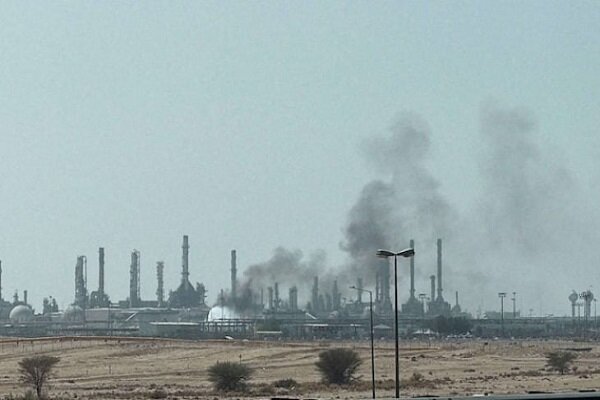
The state-owned Aramco oil industry has also been blasted with missiles. Fires are raging at major facilities, including at the main base of operations in Dammam on the Persian Gulf coast.
Following the missile strike on Riyadh airport at the weekend, U.S. President Donald Trump and all European leaders condemned an “act of terrorism” by Yemen.
Hussain al-Bukhaiti pointed out the gross hypocrisy of European governments not condemning the thousands of Saudi air strikes on Yemen that have occurred since 2015. These governments still remain silent about the ongoing Saudi atrocities against Yemeni civilians. The European Union even declares “solidarity” with Saudi Arabia.
The Saudi monarchy, led by Crown Prince Mohammed bin Salman, started the war with unprovoked attacks in March 2015. The aggression was enabled by the United States, Britain, and France supplying warplanes, bombs, and intelligence.
These Western powers continue to arm and direct the Saudi regime in its war against Yemen.
Since 2015, there have been thousands of Western-backed air strikes on Yemen, resulting in more than 20,000 mainly civilian deaths.
“They hit everything, schools, hospitals, water-treatment plants, farms, homes, wedding and funeral halls,” says Al-Bukhaiti.
In addition, over 400,000 Yemenis have died from starvation and diseases caused by a blockade on the country imposed by Saudi Arabia and its Western backers for over 10 years.
He says the war reignited in July 2026 after the Saudis broke a four-year truce signed in 2022 by bombing Sanaa international airport. There was no condemnation by Europe of the Saudi violation then.
What Yemen is doing to Saudi Arabia now is but a taste of what the House of Saud inflicted on Yemenis since 2015 with Western support.
The Yemenis this week rejected a reported Saudi proposal for a short-term truce because they see it as just a ploy by the Saudis for rearming and regrouping in a losing situation.
For the war to end, Saudi Arabia must respect Yemen’s sovereignty and stop interfering in its internal affairs.
However, Hussain al-Bukhaiti thinks that the United States will double down and escalate its military involvement in Yemen with a full-blown war. This is not primarily to support the Saudi monarchy, he believes, but rather to prop up the Israeli regime.
Yemen has inflicted huge damage on the Israeli state since it intensified the genocide against Palestinians in October 2023. Yemeni air strikes have repeatedly struck Tel Aviv despite American air defenses.
An expanded U.S. war in Yemen might seem surprising given that Trump has made such a mess of his reckless aggression against Iran and may not have the military forces at his disposal.
But Al-Bukhaiti believes the issue is beyond Trump’s choice. Washington is locked in with the Zionist regime and will do whatever it takes to salvage Israel from defeat. Yemen represents the biggest threat to Israel from the cutting off of its shipping in the Red Sea.
“We are ready for the war that is coming,” he warns.
Il 9 ottobre 2026 il Comitato norvegese per il Nobel ha assegnato il Premio per la pace a Navanethem Pillay, giurista sudafricana di 85 anni, già giudice della Corte penale internazionale e Alta commissaria Onu per i diritti umani. La motivazione parla di una persona che ha aperto la strada a un ordine giuridico globale più completo. Il presidente del Comitato, Jorgen Watne Frydnes, ha aggiunto che il premio è un messaggio per chi attacca e mina il sistema internazionale e le sue istituzioni. Il verdetto è dichiaratamente politico, ed è su questo piano che va discusso.
La stessa figura che nel 2011 avrebbe «abbattuto» Gheddafi, spianando la strada al saccheggio del petrolio libico e alla schiavitù dei migranti africani, ora «abbatterebbe» Netanyahu, e preparerebbe così la riabilitazione di Israele. Il filo logico non sarebbe la morale né la pace, ma l’agenda dell’Open Society di George Soros: sacrificare i soggetti diventati scomodi, mai l’essenza del progetto. Qualcuno l’ha battezzata «pal-washing». La domanda di fondo è seria, perché chiede se dietro premi e giurisdizioni dell’ordine liberale ci sia una regolarità.
Occorre sottolineare che il copione è già noto. Vi ricordate quando Barack Obama ricevette il premio Nobel per la pace, inaugurando guerre su guerre? O vi ricordare i personaggi in cerca d’autore come Machado, Mohammadi, o i difensori dei criminali Ucraini? Ma andiamo per ordine.
Atto Primo: la Libia
Nel febbraio 2011 Pillay, Alta commissaria, chiese al Consiglio per i diritti umani un’azione vigorosa per fermare le violenze e chiamare i responsabili a risponderne; il Consiglio condannò le violazioni e istituì una commissione d’inchiesta. Il passaggio successivo toccò al Consiglio di sicurezza: il rinvio alla CPI con la risoluzione 1970, poi la 1973, approvata con dieci voti favorevoli e cinque astensioni (Brasile, Cina, Germania, India, Russia). Nessuno sostiene che Pillay abbia deciso la guerra. Conta la sequenza: il linguaggio dei diritti umani aprì la porta, quello della protezione dei civili autorizzò la forza, e l’operazione scivolò verso il cambio di regime. Già in aprile Lavrov accusava la NATO di eccedere il mandato, e un ministro francese ammetteva che il cambio di regime avrebbe richiesto un nuovo voto.
Poi i costi. Nel 2017 l’OIM documentò aste di migranti subsahariani nel sud della Libia, venduti per somme tra 200 e 500 dollari. Il nesso con il crollo dello Stato dopo il 2011 è la lettura più plausibile, benché la fonte documenti il fenomeno e non la sua causa. Il prezzo lo pagarono la Libia e i migranti; la cornice giuridica ne uscì, sul piano formale, intatta, anche se la controversia sul mandato avrebbe poi pesato sui veti di Mosca e Pechino in altri dossier.
Atto Secondo: Bibi
Il 21 novembre 2024 la Camera preliminare I della CPI emise mandati d’arresto per Netanyahu e per l’ex ministro della Difesa Gallant, per crimini di guerra e crimini contro l’umanità. Pillay aveva lasciato la Corte nel 2008, ma ha presieduto la Commissione d’inchiesta Onu che il 16 settembre 2025 ha concluso che Israele ha commesso genocidio a Gaza. Qui il «pal-washing» trova il suo meccanismo. Il diritto penale internazionale lavora su persone: un imputato, un’imputazione, un periodo. Se il caso si chiude con la sorte di un leader, si apre una cesura narrativa, il prima e il dopo di un uomo, dopo la quale lo Stato può presentarsi come reintegrato. La Libia offre l’analogia: là il caso si chiuse con la caduta di un uomo.
I limiti del percorso giocano a favore della lettura. La Corte non ha una polizia e l’esecuzione dei mandati dipende dagli Stati parte; la Commissione non è un tribunale e non parla a nome dell’intera Onu; lo stesso Comitato, riferisce AFP, ha detto che spetta a una corte stabilire se vi sia genocidio. Il premio non produce effetti giuridici, lo sappiamo, però produce legittimazione per un circuito che promette giustizia e non può garantirla.
Dobbiamo, poi, considerare che dinamiche del genere le abbiamo già viste più volte all’interno dell’ordine globalista che domina in Occidente. L’Open Society Foundations si presenta come il maggiore finanziatore privato al mondo di gruppi per giustizia, democrazia e diritti umani, attivo in oltre cento paesi, e Pillay ha ricevuto lo Stockholm Human Rights Award, lo stesso che nel 2011 è andato a Soros e a Neier. Sembra proprio che si ripeta di nuovo il pattern della agenda sorosiana, fatta di fondazioni, ONG, tribunali, commissioni e burocrazie che condividono un lessico e un orizzonte, quello di un ordine liberale da perfezionare e mai da rimettere in discussione. Chi opera dentro quel lessico può denunciare un governo, un leader, perfino uno Stato, ma non può contestare i presupposti dell’ordine che gli dà legittimità.
Alcuni obietteranno che la Commissione di Pillay attribuisce la responsabilità a Israele come Stato, non soltanto ai suoi leader, il che contraddice l’idea di un’operazione puramente personalizzante. Il secondo è la reazione. Netanyahu ha accusato il Comitato di aver perso la bussola morale, il Ministero degli Esteri israeliano ha parlato di una grottesca strumentalizzazione del premio, e Washington ha annunciato sanzioni contro la CPI poche ore dopo l’annuncio. Tutto vero. Ma avrebbe senso e valore se il sistema occidentale non fosse marcio fin dalle sue fondamenta, se il suo sistema giuridico funzionasse, ma così non è, sotto nessun aspetto (e abbiamo avuto già sufficienti dimostrazioni – non scordiamoci anche il caso Epstein).
Se nei prossimi dodici mesi la caduta politica di Netanyahu verrà presentata come chiusura del caso, anziché come una tappa di un procedimento che riguarda lo Stato, il «pal-washing» guadagnerà peso. Se i procedimenti proseguiranno oltre la sua persona, e se gli Stati parte eseguiranno i mandati, forse ne perderà. Allo stato delle prove la tesi è plausibile e, fino a smentita comprovata, questo è l’ennesimo Nobel della non-Pace, che non possiamo chiamare “guerra”.
 Login


 , X
 , and VK
 .