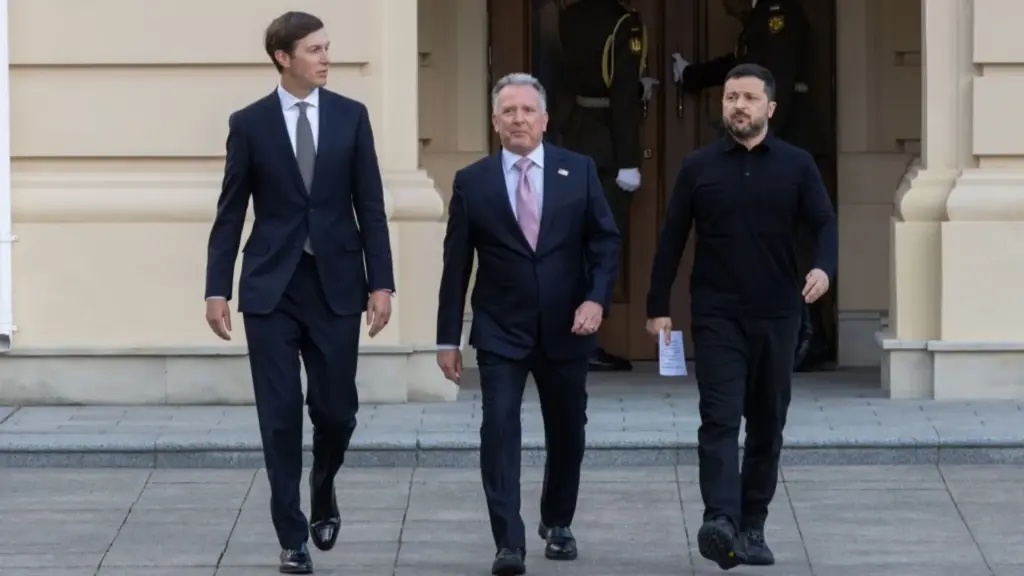
Volodymyr Zelenskyy’s unusually direct criticism of Donald Trump marks a turning point in relations between Kyiv and Washington. With American satellite restrictions disrupting Ukrainian military operations, intelligence cooperation under scrutiny and the White House easing pressure on Russian energy exports, Ukraine faces a fundamental question: how can it defend itself when its most powerful partner is increasingly willing to accommodate Moscow?
President Volodymyr Zelenskyy has abandoned much of the diplomatic restraint that characterised his dealings with Donald Trump since their confrontation in the Oval Office in February 2025. In an interview on 14 October, the Ukrainian president accused his American counterpart of moving towards Russia and choosing the wrong side of history.
His intervention followed a series of American decisions that have increased pressure on Kyiv while offering Moscow economic and diplomatic advantages. A controversial agreement involving Russian diesel exports, uncertainty surrounding the provision of American intelligence and sudden restrictions on military satellite communications have brought relations between the two countries to their most difficult point since Trump’s return to the White House.
Zelenskyy’s criticism was unusually personal. Questioned about whether he felt betrayed by Washington’s recent decisions, he acknowledged the sense of betrayal but emphasised that Ukraine’s survival could not be treated as a commercial negotiation. He said Ukraine was not selling its country and argued that an American president claiming to act as an intermediary must not favour one of the belligerents.
The shift reflects the apparent exhaustion of a strategy Kyiv has pursued for more than a year: avoid openly challenging Trump, maintain personal contact with the White House and hope that American support can be preserved through diplomatic accommodation. That calculation is becoming increasingly difficult to sustain as Washington’s demands threaten to constrain Ukraine’s military operations without producing corresponding concessions from Russia.
American leverage becomes a Ukrainian vulnerability
The immediate demonstration of Ukraine’s dependence on American technology came during the night of 13–14 October, when SpaceX imposed restrictions on Starshield, the military-grade version of its Starlink satellite communications service.
According to accounts provided by Ukrainian frontline commanders, the changes disrupted connections to terminals travelling above approximately 160 kilometres per hour, forcing the abandonment of several drone missions. The restrictions affected systems used for reconnaissance, interception and strikes against Russian military targets.
As EU Today reported on 14 October, the disruption exposed a weakness extending beyond individual drone missions. Satellite communications form part of Ukraine’s operational infrastructure, supporting the movement of battlefield information, remote weapons control and communications across areas where conventional networks are vulnerable to Russian electronic warfare.
An interruption imposed remotely by a commercial provider can therefore affect military capabilities without any physical attack on Ukrainian equipment. Decisions taken outside Ukraine’s military command structure can alter the effectiveness of systems already deployed on the battlefield.
Ukraine’s Defence Ministry subsequently opened discussions with American officials, SpaceX and NATO partners while examining alternative communications arrangements.
Later on Wednesday, former Ukrainian defence minister Mykhailo Fedorov announced that Starlink functionality at speeds up to 160 kilometres per hour was being restored. Work was still required to remove the restrictions on Starshield altogether. The partial reversal offered immediate operational relief but did not resolve the underlying dependency.
There is no established evidence that the Trump administration ordered SpaceX to impose the restrictions. Nevertheless, their timing, amid mounting disagreements over Ukraine’s military operations, has reinforced Kyiv’s concerns about relying on communications infrastructure controlled by an American company.
Intelligence warnings and the protection of civilians
The dispute over satellite access coincides with growing uncertainty about American intelligence cooperation.
Following Russian ballistic missile strikes on Kyiv on 12–13 October, Zelenskyy complained that Ukraine had received no advance warning from its international partners. The attacks damaged residential buildings and energy infrastructure, while Ukraine’s authorities raised concerns about the absence of advance intelligence.
Advance information about Russian missile launches is particularly important when ballistic weapons leave civilians only minutes to reach shelters. Intelligence cooperation also supports Ukrainian air-defence units in assessing threats and preparing interceptions.
Trump denied on 13 October that Washington had stopped sharing intelligence with Ukraine. Ukrainian Foreign Minister Andrii Sybiha likewise confirmed that cooperation continued. The absence of warnings about particular attacks therefore cannot be equated with a complete suspension of American assistance.
Yet the consequences of unreliable warning arrangements remain serious. For Ukraine, the distinction between information withheld, delayed or simply unavailable offers little protection when Russian ballistic missiles reach civilian neighbourhoods without sufficient warning.
The wider concern is that intelligence provision could become another instrument of diplomatic pressure. Accounts of negotiations over Ukrainian attacks on Russian refineries have raised the possibility that Washington might use such assistance as leverage. Reports of explicit threats have been disputed, but the controversy has increased uncertainty surrounding a capability central to Ukraine’s defence.
Why the diesel agreement changes the strategic calculation
The confrontation has also exposed a contradiction in Washington’s approach to the war.
Trump’s agreement allowing Russian diesel to return to international markets offers Moscow additional export opportunities at a time when Ukrainian attacks have damaged refining capacity and disrupted domestic fuel supplies.
The American administration has justified the arrangement partly through the need to ease fuel prices. Yet the initially announced quantities are modest in relation to international petroleum markets, raising questions about how much immediate relief the measure can realistically provide.
For Putin, its diplomatic significance may be considerably greater. Russia has secured a relaxation of American economic restrictions while Washington simultaneously presses Kyiv to limit attacks on the infrastructure that generates revenue for Moscow’s war economy.
The commercial implications of Washington’s sanctions reversal extend beyond the initial shipment volumes. The Treasury authorisation permits certain transactions involving Russian-origin diesel until April 2027, creating opportunities for international traders and financial intermediaries while leaving the broader sanctions framework formally intact.
Trump’s proposed energy ceasefire has compounded the difficulty. As EU Today examined earlier this week, Kyiv has offered to suspend strikes against Russian energy facilities if Moscow reciprocates. Russian attacks on Ukrainian power infrastructure have nevertheless continued.
An arrangement in which Ukraine stops targeting Russian refineries while Russia retains the ability to strike Ukrainian electricity generation would remove an important source of pressure on Moscow without protecting Ukrainian civilians.
Such an outcome would change the military and economic conditions of the war in Russia’s favour, regardless of how Washington describes its diplomatic objectives.
The White House, Congress and the limits of presidential power
Zelenskyy’s sharper language also reflects a possible reassessment of where influence over American policy can be exercised.
For much of Trump’s second presidency, Kyiv’s diplomacy has concentrated on preserving a workable relationship with the president himself. That approach assumes that personal engagement can influence White House decisions even when Trump’s broader political instincts favour accommodation with Putin.
The events of October suggest that this strategy has reached its limits.
Ukraine’s alternative is not necessarily an outright confrontation with Washington. Rather, it involves placing greater weight on Congress, the American defence establishment and the institutional relationships that have supported Ukraine since Russia’s full-scale invasion in February 2022.
There is a historical precedent. During Trump’s first presidency, Congress supported military assistance to Ukraine despite differences within the administration over relations with Russia. Under Joe Biden, congressional resistance also demonstrated how domestic American politics could determine the timing and scale of weapons deliveries.
The months-long delay in approving the 2024 military assistance package contributed to severe ammunition shortages at a critical stage of Russia’s offensive operations. Ukraine’s loss of Avdiivka illustrated the danger of making battlefield planning dependent on political negotiations in Washington.
The congressional elections on 3 November 2026 could alter the balance of power. A change in control of either chamber would increase opportunities for oversight, investigations and legislative pressure on the administration, although Congress cannot independently direct every aspect of intelligence sharing or presidential diplomacy.
A less compliant Congress could nevertheless make it politically harder for the White House to restrict Ukrainian assistance without explanation.
Europe confronts a more permanent problem
For European governments, the dispute carries implications extending well beyond the immediate confrontation between Trump and Zelenskyy.
The transatlantic security relationship has historically depended on the assumption that American military capabilities, intelligence networks and political commitments would remain available to European allies during a major security crisis.
That assumption is increasingly difficult to reconcile with an American administration prepared to link assistance to Ukraine with wider commercial negotiations and domestic political objectives.
The consequences are particularly acute in areas where European capabilities remain insufficient to replace American systems quickly, including satellite intelligence, strategic reconnaissance, missile defence and specialised communications.
Europe can expand weapons production, finance Ukrainian purchases and develop alternatives to American technology. Replacing the full range of capabilities provided by the United States, however, requires investment measured in years rather than months.
The problem will not necessarily disappear when Trump leaves office. His return to power demonstrated that the American foreign-policy consensus which supported European security for decades can be challenged through the electoral process.
Future American administrations may seek to restore traditional alliances, but European governments must now account for the possibility that another election could reverse those commitments.
For Zelenskyy, the immediate calculation is exceptionally difficult. Public criticism risks provoking further retaliation from a president whose administration still controls capabilities essential to Ukraine’s defence. Continued diplomatic restraint, however, has not prevented Washington from offering concessions to Russia or introducing uncertainty into Ukraine’s military planning.
His latest intervention suggests that Kyiv is no longer convinced that avoiding confrontation will preserve American support. The question is whether greater political scrutiny of Washington’s decisions can prevent a further erosion of assistance before Russia turns the resulting military advantages into territorial gains.

 Login