❌

Reading view

He Campaigned for the East Cleveland Mayor's Opponent. Then Police Came for His Truck.
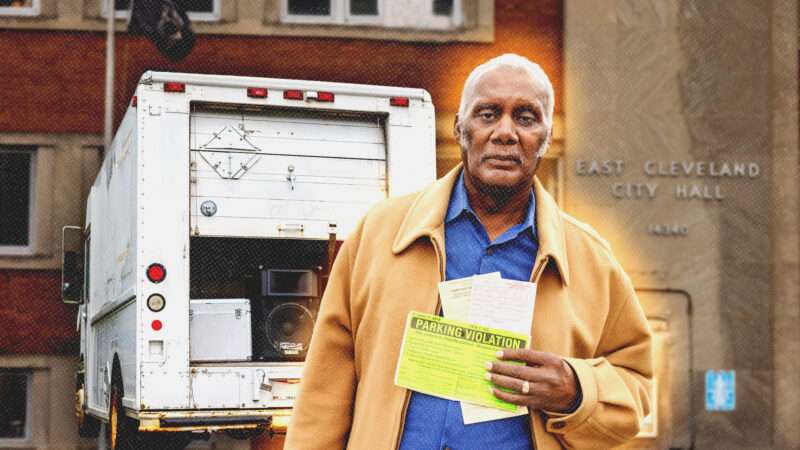
William Fambrough seen in front of his sound truck | Institute for Justice

Walking through East Cleveland, Ohio, feels a touch like you've wandered onto the set of a postapocalyptic film noir. Grand, gilded homes announce themselves on neighborhood streets, some crowned with turrets, many with windows punched out like missing teeth. Often, no one is home, because no one lives there. It is safer than 1 percent of U.S. cities.

So why did local law enforcement pour considerable time and resources into pursuing a man for a sound truck?

That question is not really a legal one, at least not in the most technical sense. But it is the driving force behind a thorny case a federal court recently resuscitated: Fambrough v. City of East Cleveland, a saga concerning a man whose vehicle became an obsessive target of the East Cleveland Police Department (ECPD) after he used it to campaign for a mayoral challenger.

Some of the facts are in dispute. But the basic gist is as follows: William Fambrough, long a politically engaged East Clevelander, campaigned for Juanita Gowdy—a challenger to then-Mayor Brandon King—by broadcasting messages around the city with his sound truck. That ultimately came to an end after law enforcement impounded the car, cited him for parking and noise violations, and prosecuted him for the latter.

Fambrough sued, alleging the complex legal odyssey set into motion over his step van amounted to First Amendment retaliation, an unreasonable seizure under the Fourth Amendment, and a violation of the 14th Amendment's proscription against selective enforcement. The U.S. Court of Appeals for the 6th Circuit rejected some of those claims. But it resurrected claims against King and his chief of staff, Michael Smedley—depriving them of qualified immunity, the legal doctrine that inoculates state and local government officials from facing lawsuits if their alleged misconduct was not "clearly established" as illegal in prior case law. It also revived Fambrough's retaliation claim against the city.

As the 6th Circuit summarizes: King "says he received a phone call from a resident who complained about Fambrough's sound truck and someone else's box truck being parked in a residential area," so he told someone to take care of it. Scott Gardner, then the city's chief of police, "was concerned about selectively enforcing" the parking ordinance—which prohibits parking a truck in front of residential property, except for loading or unloading—because it is indeed almost never enforced. This was the beginning of a long pursuit, which ultimately saw a swarm of officers dispatched to Fambrough's house in August 2021 to confiscate the vehicle, allegedly resulting in $6,000 in damage. Fambrough also had to pay $528 in fees to get the damaged truck back.

"All the attention City officials gave Fambrough struck Gardner as unusual," the 6th Circuit notes. "The mayor's office wasn't this attentive even in homicide cases. And considering that the City had around only 50 police officers at the time and had 'serious crime problems,' Gardner thought it was odd to devote this much attention to permitting and parking issues." Based on available data, East Cleveland's violent crime rate is 1,409 per 100,000 residents, about four times higher than the national average.

Yet Gardner ultimately got on board. Smedley phoned him on August 9 "extremely upset," according to Gardner, and told the police chief he was "incompetent" for failing to "take care of" Fambrough's sound truck. Smedley wanted the "utmost enforcement as possible." So Gardner sent an email. "Please, find this vehicle and tow it," he wrote to all of ECPD. "Cite the operator with disturbing the peace and loud music. Please contact me as soon as this is complete to claim a surprise." A surprise!

Police succeeded. "On its face, the email told officers to tow Fambrough's truck regardless of whether it was parked illegally," writes the 6th Circuit. "And the Noise Ordinance authorizes seizure only of 'the sound device used,' and only upon conviction. So Gardner's instruction to tow the truck wasn't authorized by municipal law." The court still held that the seizure did not violate the Fourth Amendment. It also gave Gardner qualified immunity, ruling it is not clearly established that someone who acts as a conduit for someone else's alleged retaliation—which here came from the mayor's office—is a "responsible party."

Heather McCollough, the city's assistant law director, subsequently prosecuted Fambrough for allegedly violating the noise ordinance. According to a sworn declaration from Fambrough's attorney, McCollough outlined some of Fambrough's offenses on a call: that he "made complaints about the police department" and filed "public records requests," among other issues. Notably, it is legal to do those things. McCollough was typically willing to resolve minor noise complaints, she added, but not so much in this case, because Fambrough needed to "stand down." (He ultimately pleaded no contest to disorderly conduct, a reduced charge.)
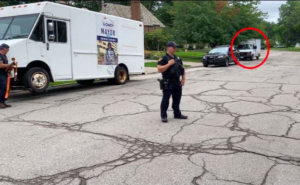
East Cleveland police step van
Institute for Justice

"Only after [Fambrough] began supporting Gowdy's election was the weight of the law thrown against him," the 6th Circuit writes in its analysis of potential municipal wrongdoing. "And the City's police officers didn't uncover Fambrough's violations of their own accord. Instead, City decisionmakers sent them to Fambrough's home each time to enforce the Parking Ordinance. So the timing of the parking-related enforcement actions supports an inference that Fambrough's political speech was the motivating factor—as does the fact that the City rarely enforced the Parking Ordinance against anyone else despite having plenty of opportunities to do so." Incredibly, a photo of another truck can be seen down the street on the same day law enforcement came to fetch Fambrough's vehicle. (The law also includes pickup trucks, so the city arguably has a lot of enforcement to do if it sincerely believes this law matters.)

King allegedly set the chain of events into motion while Smedley took the driver's seat. "Smedley's pattern of incessantly calling and berating Gardner," the 6th Circuit adds, "clashes with the idea that Smedley was chiefly concerned with minor permitting, noise, or parking issues." After all, if that were true, why would the problem appear to begin and end with one person?

Over five years have passed since the ordeal. Although Fambrough is now potentially closer to getting in front of a jury, he has yet to actually state his case, still burdened by the onerous process government actors invoke to kill such suits before the community can assess the merits. King, meanwhile, won that election. He left office in May 2025, however, after he was found guilty of one count of theft in office, four counts of having an unlawful interest in a public contract, three counts of representation by public official or employee, one count of filing a false disclosure statement, and one count of soliciting improper compensation.

The post He Campaigned for the East Cleveland Mayor's Opponent. Then Police Came for His Truck. appeared first on Reason Magazine.

  •  

Jury Trials on Trial: Can Justice Survive Political Polarisation?

An activist who painted Churchill red was cleared of criminal damage and juries have deadlocked over alleged support for Hamas. What’s to be done when jurors reject the moral premises of the law, asks Anna Stanley.

The post Jury Trials on Trial: Can Justice Survive Political Polarisation? appeared first on The Daily Sceptic.

  •  

Ohio Court Strikes Down a Scholarship Program That Supports More Than 100,000 Families

An illustration of a classroom desk | Mariam Zakaidze

School choice in Ohio has taken a big hit. On Thursday, a panel of the state's 10th District Court of Appeals unanimously ruled the state's Educational Choice Scholarship, or EdChoice, program unconstitutional.

Vouchers Hurt Ohio (VHO), a coalition of public school districts, banded together in 2022 to sue the state over the EdChoice program, which uses public funds to finance scholarships for K-12 students to attend private schools. Under EdChoice's "Traditional Plan," which has been around since 2005, students can receive annual scholarships as high as $6,166 for elementary and middle school and $8,408 for high school. The scholarship's "Expansion Program," which state lawmakers created in 2013, awards maximum scholarship amounts identical to the Traditional Plan, "but scale based on a family's income," according to EdChoice, an educational freedom nonprofit. The organization says the scholarship program supports more than 100,000 Ohio families.   

The VHO argues that the EdChoice scholarship program drains funding from the public school system, depriving Ohio students of much-needed resources. Its website states "private school vouchers create a system of state-funded discrimination" and that school choice is a "myth." Interestingly, the Court of Appeals of Ohio's 10th Appellate District largely concurred.

The court's ruling came down to Article VI, Section 2 of the Ohio Constitution, which says that the state must secure a "thorough and efficient system of common schools."

The panel held that the EdChoice voucher program violates this mandate by funding a "competing system of uncommon schools." Writing for the court, Judge David Leland took the argument further, contending that EdChoice schools "actually end up depriving families of choice." He cited private schools' selective admissions process and urban concentration, calling the defendants' appeals to choice "a fundamental misnomer," because the choice to admit students rests with the schools, not the families.

Keith Neely, an attorney at the Institute for Justice who represents families using EdChoice in the case, argues that the program funds families rather than a competing school system.

He also challenges the court's rationale that the state's obligation to fund public schools implicitly prohibits them from funding other forms of education. "I think that's just fundamentally wrong as a matter of constitutional interpretation and also just as a matter of public understanding," he tells Reason.

The court "seemed to take the view that any dollar spent on other educational programs like scholarships is a dollar that could be spent on public schools instead, but that's not how budgeting works," he says. 

Neely says that public education funding is separate from the scholarship program and that every funding decision has tradeoffs. If the court finds that EdChoice's school voucher program violates the state's obligation to fund public schools, what stops it from reaching the same conclusion for other programs, like the Jon Peterson Special Needs Scholarship or the Cleveland Scholarship program, which provides private school tuition scholarships for K-12 students living in the Cleveland Municipal School District?

Neely also points to Simmons-Harris v. Goff (1999), where the Ohio Supreme Court partially reversed a lower court's ruling and found that school choice was constitutional under the same public-education clause. The court invalidated the Cleveland scholarship program in question, finding that it was "improperly enacted by the legislature," according to the Institute for Justice. However, the Ohio Legislature later reenacted the program.

The families using the EdChoice scholarship program—as well as the state's attorney general—plan to appeal to the Ohio Supreme Court, and Neely is optimistic that history will repeat itself in this case. He tells Reason, "When you look at what the Constitution says, and you look at what the court said in Simmons-Harris, I think the only conclusion that the Ohio Supreme Court can walk away with is that programs like the Educational Choice Scholarship program are constitutional." Families will be able to keep their scholarships while the litigation is pending.

This case is just one battle in a nationwide war on school choice. A recent report from Reason Foundation, the nonprofit that publishes Reason, found that 80 percent of public-school students live in states with "weak or ineffective open enrollment laws." These laws "allo[w]  students to transfer to public schools other than their residentially assigned one, provided space is available," writes Jude Schwalbach, senior policy analyst at Reason Foundation. Several states are also holding out against the Education Freedom Tax Credit, a new federal tax credit that offers a dollar-for-dollar tax refund for donating to K-12 scholarship programs. 

The court's decision reflects the broader rationale fueling that opposition: that education dollars going to anything other than public schools are taken from ordinary students. For decades, policymakers have invested in that premise, yet student outcomes have little to show for it. The real myth isn't school choice; it's that giving families more options means betraying students' education.

The post Ohio Court Strikes Down a Scholarship Program That Supports More Than 100,000 Families appeared first on Reason Magazine.
  •  

Landowners in Texas' Big Bend Region Fight Trump Administration's Attempts To Seize Land for Border Wall

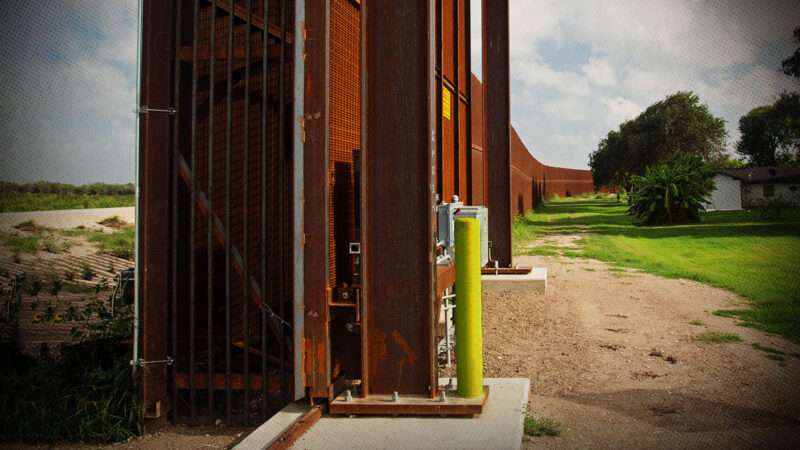
Border wall | Jim West/UCG/Universal Images Group/Newscom

The Trump administration's attempts to fast-track construction of the president's long-promised border wall through Texas' remote Big Bend region have ground to a halt amid fierce opposition, protests, and legal challenges from landowners and conservation groups.

A federal judge on Wednesday released an opinion explaining her decision to issue a preliminary injunction blocking border wall construction through the Big Bend area. U.S. District Judge Kathleen Cardone found that the plaintiffs, which included the Center for Biological Diversity and several longtime residents of the region, had shown a substantial threat of irreparable harm if the construction project is allowed to continue.

The Trump administration wants to spend $7.5 billion building additional security infrastructure along a 500-mile stretch of the U.S.-Mexico border running through the Big Bend region, which includes Big Bend National Park. The federal government began sending threatening letters to property owners announcing its intent to acquire necessary pieces of their land this summer, and it waived several environmental regulations, allowing it to put bulldozers on the ground inside the national park by September.

However, numerous groups and local landowners say the border wall project will alter their way of life and permanently scar one of the most rugged and pristine landscapes in the country. The project attracted bipartisan criticism and protests.

Cardone also found that the plaintiffs were likely to succeed on their claims that Department of Homeland Security (DHS) Secretary Markwayne Mullin exceeded his authority when he issued environmental waivers for the project.

The injunction is a temporary reprieve for property owners such as David Keller, an archaeologist and part-time river guide on the Rio Grande River. The original plans for the border wall expansion would have cut through Keller's 10-acre property near Redford, Texas, putting a 30-foot-tall wall on the levee that sits between the river and the rest of his land.

Keller says the Trump administration gravely underestimated how much anger its tactics and attitude would generate.

"It's a level of arrogance—they're just used to being able to bulldoze over people," David Keller says. "They were moving forward as if they weren't expecting any resistance, but boy, they're due for a wakeup call. And they're having it right now."

Keller is a plaintiff in a separate lawsuit against the DHS by Conserve Big Bend, a coalition of landowners, conservationists, river tour guides, researchers, and other affected parties.

Keller says he's loved wild, open country since he was a child, and as soon as he saw the region in the 1990s, he decided he would find a way to live and work there, which he's done for the past 25 years. "It's visually magnificent," Keller says. "It's incredible. It's like no other place I'd ever seen. It's one of the last unspoiled places remaining in the lower 48."

Keller says it's where he plans on being buried, too, although these days he's unsure whether to say "plans" or "planned." The proposed border construction is an existential threat to the life he's built, he says, and if the wall goes up, he'd likely move.

"I didn't come down here to live in a cage," Keller says.

The proposed border wall would not only block access to the river for farmers, ranchers, and outdoors enthusiasts along the river, as well as block the view into Mexico, it would wreck "the whole feeling of the place, the historical cross-border culture that we've developed," Keller says.

So far, the federal government has not tried to seize any private property in the Big Bend region through eminent domain, although it sent letters to property owners this summer requesting access to survey their land and warning them that it held the option to invoke eminent domain if they did not quickly sell.

Both Keller's and the Center for Biological Diversity's lawsuits argue that the department's justification for building and expediting additional border infrastructure in the Big Bend Region are factually and legally incorrect. The DHS determined that the sector of the border is an "area of high illegal entry."

However, despite making up roughly a quarter of the entire U.S.-Mexico border, the Big Bend sector only accounted for between 0.3 percent and 2.2 percent of total border-wide arrests over the past 30 years.

Cardone cited the low apprehension numbers in her finding that Mullin exceeded his authority to issue the waivers.

"The unrebutted evidence shows that the Big Bend Sector is, by far, the sector with the lowest rate of migrant apprehensions along the entire U.S.-Mexico border, both in terms of gross totals and apprehensions per mile of border," Cardone wrote. "Therefore, if the Big Bend Sector is an area of high illegal entry, so is every other sector, and the waiver authority would apply to the entire U.S.-Mexico border."

The post Landowners in Texas' Big Bend Region Fight Trump Administration's Attempts To Seize Land for Border Wall appeared first on Reason Magazine.

  •  

The Weaponisation of Courts Against Fathers is a Warning for Britain

Domestic violence is on the decline but court orders separating 'violent' fathers from their children have skyrocketed in NSW. The weaponisation of courts against dads is a warning for Britain, says Bettina Arndt.

The post The Weaponisation of Courts Against Fathers is a Warning for Britain appeared first on The Daily Sceptic.

  •  

Danny Tommo Denied Bail

Danny Tommo, the anti-migrant activist, has been denied bail after appearing in court for allegedly slashing a migrant boat in the Channel – despite the five suspects in the RAF Fairford terror plot all being bailed.

The post Danny Tommo Denied Bail appeared first on The Daily Sceptic.

  •  
❌