UK to Send Fighter Jets to Defend Saudi Arabia From Houthi Attacks


The funding, announced on Monday, 19 October, will come from the EU Innovation Fund, which uses revenues generated by the Emissions Trading System to support investment in technologies intended to reduce greenhouse gas emissions.
The selected projects include manufacturing facilities, renewable energy installations, advanced energy storage, critical raw materials processing and industrial carbon management. For the first time, the programme also includes a small modular nuclear reactor project and a direct air carbon capture and storage initiative.
The announcement comes amid growing concern over Europe’s industrial competitiveness, particularly as manufacturers face high energy costs, increasing competition from China and difficulties securing investment for major industrial projects.
According to the Commission’s announcement, the 77 selected projects span energy-intensive industries, clean technology manufacturing, alternative fuels, transport and several other sectors.
Six projects concern critical raw materials, an area in which the EU has been seeking to reduce its exposure to foreign suppliers.
These investments are intended to strengthen European supply chains for technologies including batteries, renewable energy equipment and permanent magnets, which are essential components in electric motors and other industrial applications.
The funding follows renewed political pressure to expand the processing and production of strategically important materials inside Europe.
As EU Today recently reported, the European Parliament has been pressing for stronger measures to reduce dependence on China for critical raw materials used by European manufacturers.
China occupies a dominant position in several international processing and refining markets, leaving European companies exposed to supply interruptions and trade restrictions.
The Commission is seeking to support alternative production capacity through financial assistance, industrial regulation and measures designed to attract private capital.
However, the selection of projects for EU funding does not automatically mean that the proposed facilities will be built. Their implementation will still depend on financing agreements, regulatory approvals and commercial decisions.
The inclusion of a small modular nuclear reactor project represents a new development in the Innovation Fund’s portfolio.
Small modular reactors are designed to produce electricity or industrial heat using nuclear technology on a smaller scale than conventional nuclear power stations.
Supporters argue that modular construction could reduce certain project risks and provide stable electricity supplies for energy-intensive industries.
However, the technology faces substantial challenges involving construction costs, regulatory approval, supply chains and the transition from demonstration projects to commercial production.
The Commission published a European strategy for small modular reactors in March, outlining plans to accelerate their development and support the first operational facilities in the early 2030s.
The latest funding decision gives the technology access to a financial instrument principally associated with industrial decarbonisation and clean energy investment.
Another newly represented technology is direct air carbon capture and storage, which involves extracting carbon dioxide from the atmosphere and storing it.
Both technologies remain at comparatively early stages of commercial deployment in Europe, making their eventual costs and performance important considerations.
The Innovation Fund is financed through revenues from the EU Emissions Trading System, under which companies operating in covered sectors must obtain allowances for their greenhouse gas emissions.
Part of the revenue generated from auctioning allowances is reinvested into projects designed to introduce lower-emission technologies into industrial production.
The Commission estimates that the 77 newly selected projects could avoid approximately 290 million tonnes of greenhouse gas emissions during their first ten years of operation.
That figure is a projection based on the projects’ anticipated performance, rather than an achieved reduction. Actual results will depend on construction, commissioning and subsequent commercial operation.
The funding announcement also follows the publication of the EU’s broader industrial policy initiatives, which seek to increase domestic production of clean technologies and improve investment conditions for European manufacturers.
The Commission announced a separate allocation of more than €390 million to 135 environmental and climate projects under the LIFE programme on the same day. That funding is distinct from the €3.4 billion Innovation Fund selection.
The companies and organisations behind the selected Innovation Fund projects must now complete the procedures necessary to obtain their grants.
During the Commission’s 19 October press briefing, officials indicated that project-specific grant amounts would become available when the agreements are signed, currently envisaged for the first quarter of 2027.
The final allocations and implementation conditions therefore remain subject to the grant preparation process.
For industrial companies, the principal test will be whether the European funding attracts sufficient additional investment to bring the selected technologies into commercial operation.
The results will also provide an indication of how effectively Brussels can translate its industrial policy objectives into additional European manufacturing capacity, particularly in sectors where supply chains remain concentrated outside the Union.


There’s no way to fight the Empire without bypassing its control of the international financial system.
Join us on Telegram
, X
, and VK
.
Contact us: info@strategic-culture.su
All hell is already breaking loose when it comes to probing what is exactly taking place related to the latest, definitely murky U.S.-linked movements in Pakistani land and sea. After an initial assessment at Transition Protocol – which avowedly did not provide all the necessary answers – we dug deeper into a way more comprehensive examination supported by several sources.
What we are watching across several nodes of extremely sensitive Iran-Pakistan overland connectivity is not a blanket border shutdown; but a surgical, two-track balancing act by Islamabad between Washington’s tremendous financial vise and Tehran’s strategic lifeline.
So here’s where it all stands – compounding the verified record with our latest consultations.
The key point: the regulatory trigger was a banking sanctions move, not just border security.
While provincial officials in Balochistan publicly framed Saturday’s halt at two key nodes, Taftan and Gabd–Rimdan, around security, counterterrorism, and anti-smuggling, what matters most is the exact mechanism around a memorandum issued last Friday by the Pakistani Ministry of Commerce.
That immediately revoked an October 3 extension of the Electronic Import Form (EIF) waiver for goods imported from Iran, and coincided with Islamabad’s instruction to close the Federal Investigation Agency (FIA) immigration gate at Taftan.
What is key is that without the EIF waiver, Pakistani importers must process Iranian purchases through formal Pakistani banking channels – which U.S. sanctions, of course, make absolutely impossible.
Peyman Sanandaji, head of the Transportation Commission at the Tehran Chamber of Commerce, confirmed on the record that it is banking sanctions compliance (ditching the EIF) that halted Iranian exports into Pakistan.
The immediate shock at the formal gates was quite something: more than 4,000 tons of daily Iranian LPG imports through Gabd–Rimdan are at risk. Former Quetta Chamber of Commerce president Ayoub Miryani reported that over 2,000 containers are stranded at Gabd–Rimdan alone, with hundreds more freight trucks backed up at Taftan.
So why is this happening now? Because of the nasty convergence between the October 7 IMF tranche Pakistan had to pay, and the imperial U.S. Treasury “Operation Economic Outcast”.
Under Operation Economic Outcast, Washington gave third countries a “defined timeline to shut down” Iran-related commercial lifelines or face expulsion from the U.S. financial system. That was followed by OFAC’s October 1 designations against Iran’s overland rail and industrial networks and October 8 actions against 17 shadow-fleet tankers.
But then, on October 7 – only nine days before the Ministry of Commerce revoked the EIF waiver – Islamabad reached an agreement with the IMF on the Fourth Review of its Extended Fund Facility to unlock $1.21 billion. That still requires IMF Executive Board approval.
Of course there is no public document showing a direct U.S. or IMF order to close Iran-Pakistan borders. But sources in Islamabad stressed that leaving an open-ended banking-instrument waiver on the books ahead of the IMF Board vote had become an untenable sanctions vulnerability for Pakistan.
Islamabad sources are adamant that the move was paired with genuine counter-sabotage concerns and quietly coordinated between Islamabad and Tehran (italics mine) so the pause would not rupture bilateral ties.
Iranian Foreign Ministry spokesperson Esmaeil Baghaei publicly called the disruption a temporary pause due to “technical issues” and “precautionary measures”.
Pakistani official sources, for their part, insisted that the tightened controls are a joint counterterrorism measure reflecting “mutual understanding” with Tehran after a spike in Sistan-Balochistan attacks; highway ambushes; and an October 11 maritime attack on Pakistan Coast Guard boats off Jiwani – which Pakistani officials attributed to “foreign actors” seeking to sabotage Pakistan’s mediation of the Iran peace deal.
Back to the same old pattern of Salafi-jihadis weaponized and manipulated by the usual suspects.
The only publicly confirmed telephone call between Deputy Prime Minister Ishaq Dar and Foreign Minister Abbas Araghchi took place on Sunday, October 18 – two days after the October 16 memorandum – and its official readouts mention only regional diplomacy and the Baghdad OIC meeting.
So prior coordination at the Dar–Araghchi Foreign Minister level and specific sabotage arrests therefore are part of our own reporting.
Asymmetric food exports and informal routes
In a nutshell, stuff is still moving across borders. Islamabad deliberately left alive Pakistani perishables and food exports to Iran. Essential perishables – including tomatoes, potatoes, and onions – continue to move, alongside traditional oil and fuel flows across the porous 909-km border.
The regulatory record explains why: 8 months ago, Pakistan enacted a separate banking-instrument waiver specifically for 10 food exports to Iran by land (explicitly listing rice, potatoes, onions, tomatoes, meat, and fruit) plus pharmaceuticals.
Tehran’s Chamber of Commerce confirmed this past Saturday that while Iranian exports to Pakistan are stalled by the EIF rule, imports from Pakistan into Iran are continuing, and informal fuel and border trade across Balochistan already operates at an estimated $800 million to over $1 billion annually outside formal customs.
Special attention should be placed on the ports of Gwadar and Karachi, and the overall China–Iran Transit Architecture. Third-country and China-Iran transit through Pakistan, according to our sources, remains protected.
On a legal level, a document detailing Pakistan’s transit of goods established six designated overland transit corridors linking Gwadar, Karachi, and Port Qasim to Gabd and Taftan for third-country cargo bound for Iran under a bank guarantee.
And a Federal Board of Revenue’s notification this past June formally designated Taftan railway station as a Land Customs Station, with Iranian and Pakistani ministers pitching the rail corridor to link China to Iran and Europe.
However, two very complicated operational constraints remain in place.
The Quetta-Taftan rail modernization is still listed officially as a planned upgrade; and OFAC’s October 1 designation of the Islamic Republic of Iran Railway Company (RAI) was explicitly designed to choke Tehran’s shift from blockaded sea lanes to rail.
To sum it all up: it takes supreme skill to face The Empire of Piracy. Islamabad has executed a classic, calibrated maneuver: visibly revoking the formal EIF import waiver at Taftan and Gabd–Rimdan to insulate its pending $1.21 billion IMF tranche and Pakistani banks from U.S. Treasury secondary sanctions.
And all the while keeping Pakistani food exports, informal border valves, and third-country transit frameworks alive with Tehran.
Whether this remains a brief administrative reset or hardens into a longer choke point will be decided by three indicators over the next fortnight:
May the lesson be imprinted on rare earths for the whole Global South to ponder: there’s no way to fight the Empire without bypassing its control of the international financial system.

When the Iran war closed the Strait of Hormuz earlier this year, about 20% of the world’s liquefied natural gas supply stopped flowing almost overnight. Roughly 90% of the LNG that moves through the strait goes to Asia, so the continent has absorbed the worst of it. Gulf producers have had few good responses. Saudi […]
The post Africa’s LNG boom giving Asia an alternative to Hormuz appeared first on Asia Times.
Dalle strade del Sud arriva una domanda che riguarda tutto il Paese: chi decide quanto costa produrre in Italia, e chi ne paga il prezzo quando la decisione viene presa altrove.
Una mappa che segue l’energia
A metà ottobre, per un camionista siciliano, tenere il mezzo fermo nel piazzale costa meno che metterlo in strada. Con il gasolio intorno ai 2,40 euro al litro sull’isola, il Comitato autotrasportatori siciliani stima fra 700 e 900 euro di perdita al giorno per ogni camion. Il coordinatore Salvatore Bella l’ha detto senza giri di parole: «Oggi lavorare in perdita con il gasolio a 2,40 al litro non è più possibile». Ne è nato il fermo che va dalla mezzanotte del 16 ottobre al 20, senza cortei: i tir restano nelle aziende, i semirimorchi non vengono ritirati dai porti. In Calabria Fedralog ha fermato i mezzi negli stessi giorni, mentre la sezione trasporti di Confindustria Catania ha deliberato all’unanimità uno stop fino al 22.
Il fermo arriva dopo settimane di mobilitazione. Il 1° ottobre agricoltori e autotrasportatori hanno bloccato lo svincolo di Pizzo sulla A2; il 12 i trattori hanno presidiato le portinerie del polo industriale tra Augusta e Melilli, rallentando il carico delle autobotti, per iniziativa degli stessi produttori e senza sigle sindacali alle spalle. In Puglia i blocchi hanno impedito l’accesso delle autocisterne alla raffineria Eni di Taranto, a ridosso dell’ex Ilva, i cui lavoratori sono in sciopero dal 12 ottobre. Gli olivicoltori sommano al caro carburante il calo del prezzo dell’olio. Il 22 toccherà ai pescatori: giornata di sciopero nazionale e cento pescherecci a chiudere simbolicamente lo Stretto di Messina.
La geografia dei presìdi dice qualcosa che i comunicati non dicono. Raffinerie, porti, svincoli autostradali, lo Stretto: chi protesta va a colpire i nodi da cui passa l’energia, come se sapesse bene dove nasce il problema. E c’è un paradosso evidente. Il Sud ospita Augusta, Priolo, Taranto, cioè una parte rilevante della capacità di raffinazione del Paese, ma i produttori che vivono a pochi chilometri da quegli impianti non riescono più a pagarne il prodotto.
La guerra arriva alla pompa
Queste proteste sono la coda italiana di una crisi aperta lontano. I rincari sono partiti con la guerra in Iran e con le difficoltà di approvvigionamento dal Golfo: già a fine marzo, nel Siracusano, il gasolio agricolo era salito da 0,88 a 1,45 euro al litro. A settembre la media nazionale del gasolio superava i 2,16 euro, 35 centesimi più di febbraio; il 12 ottobre il self costava in media 2,252 euro. La crisi di Hormuz, che finora abbiamo letto soprattutto come stress test per le petromonarchie e per i flussi finanziari del Golfo, ha anche una trasmissione verso il basso. Lungo la catena, ogni anello scarica il costo su quello successivo, finché arriva a chi non ha nessuno a valle: il piccolo autotrasportatore che non può ritoccare le tariffe, l’agricoltore che vende a prezzi fissati dalla grande distribuzione.
Le isole pagano due volte. Al carburante si sommano i noli marittimi, appesantiti dalle nuove regole ambientali sul trasporto navale, e i ritardi del Sea Modal Shift, l’ex Marebonus che dovrebbe compensare il costo del passaggio via mare da e per la Sicilia e la cui prima annualità non è stata pagata entro giugno. Le risposte arrivate finora agiscono sul prezzo alla pompa (tagli temporanei delle accise, il tetto annunciato da Eni sulla propria rete dal 28 settembre) e quasi mai sulla struttura dei costi. Per un trattore che brucia 300 euro di gasolio a mattina, uno sconto di 15 centesimi non cambia i conti.
Letta con gli strumenti dell’analisi dei sistemi-mondo, la vicenda ha una forma riconoscibile: gli shock esterni attraversano il centro e si depositano sulla periferia, che ha meno margini per assorbirli. Il Mezzogiorno funziona da periferia interna dell’Europa. Importa energia a prezzi di mercato globale, esporta prodotti agricoli in competizione con importazioni soggette a standard diversi, dipende da una logistica strada-mare che nessun incentivo pagato in ritardo riesce a rendere sostenibile. Su questo si innestano fragilità di lungo periodo come il credito difficile, lo spopolamento e l’arretramento dei servizi, che l’autonomia differenziata rischia di accentuare.
La copertura nazionale ha registrato i blocchi come cronaca del traffico più che come fatto politico. È una scelta che pesa: una protesta trattata come disagio stradale non obbliga nessuno a rispondere sul merito. Eppure il merito è chiaro. Un Paese che importa gli effetti delle guerre altrui senza strumenti propri per governare il costo dell’energia finisce per trasferirli sui territori e sulle categorie più deboli.
Per le prossime settimane gli indicatori da seguire sono pochi e osservabili: un intervento specifico sul gasolio agricolo e da autotrazione, il pagamento del Sea Modal Shift, l’eventuale proroga dei fermi oltre il 20 e il 22, la saldatura con lo sciopero dei pescatori. In assenza di misure, gli stessi promotori siciliani hanno già prospettato di proseguire. Se accadrà, sarà difficile continuare a chiamarla una vertenza di categoria.
Dalle strade del Sud arriva una domanda che riguarda tutto il Paese: chi decide quanto costa produrre in Italia, e chi ne paga il prezzo quando la decisione viene presa altrove.
Russia's state nuclear corporation Rosatom expects the first reactor at Turkey's Akkuyu nuclear power plant to achieve its first self-sustaining nuclear chain reaction before the end of this year, Rosatom head Alexei Likhachev said on Friday.
"We remain on track for the planned physical start-up in the second half of December... We hope that before the end of the year the Turkish unit will transition from the construction phase to the start-up phase," he said.
Moscow and Ankara signed an agreement in 2010 to build a nuclear power plant with four Russian VVER-1200 reactors, but the project has faced repeated delays and bureaucratic hurdles.
Rosatom began construction of the Akkuyu plant in 2018. The commissioning schedule has been repeatedly pushed back from its original 2023 target.
After Moscow launched military action in Ukraine in 2022, pressure on the project increased. Although Rosatom was not targeted by Western sanctions, risks related to payments and other issues remain.
Physical start-up involves fuel loading and achieving first criticality, the reactor's first self-sustaining nuclear chain reaction. The next major milestone is grid connection and the start of electricity generation.
Likhachev also reported progress in talks with potential partners for the Akkuyu.
He said he had discussed the matter the previous day with Turkish Energy Minister Alparslan Bayraktar, who attended the Russian Energy Week forum.
"We have developed a menu of possible arrangements for a Turkish investor. The choice is primarily up to the Turkish government. I hope that following our meeting, Mr Bayraktar will brief the country's leadership and that the right decisions will be taken."
The Akkuyu project, costing more than $20 billion, is financed by Russia. Rosatom, its sole owner, can sell up to a 49% stake to a partner to share the investment burden.
In April, Rosatom said it started new talks with Turkish companies on joint ownership of Akkuyu after the Iran war spurred interest in such assets.

The war in Ukraine has always been about fomenting a proxy war to defeat Russia.
Join us on Telegram
, X
, and VK
.
Contact us: info@strategic-culture.su
The contradictions are absurd but instructive of the criminal proxy war that the U.S. and European powers have perpetrated against Russia under the guise of “defending Ukraine”.
Western sanctions on Russia – the most heavily sanctioned nation on Earth – were meant to supposedly punish Moscow for its alleged unprovoked aggression against Ukraine.
The United States recently signed into law a “sanctions bill from hell” in honor of the late war hawk Senator Lindsey Graham, aimed at crushing the Russian economy, principally by shutting down its energy exports.
Likewise, the European Union has implemented more than 20 rounds of sanctions imposed on Russia over the past four years, again purportedly to block Russian exports of oil and gas. The EU has vowed to terminate all Russian energy imports by the end of this year.
The official rationale out of Washington and European capitals is to exact retribution on Russia for its alleged invasion and violation of Ukraine’s sovereignty. Western embargoes on Russia’s economy were immediately announced after Moscow launched its Special Military Operation in February 2022. (The real background to the SMO – unreported by Western media – was the NATO-backed coup in Kiev in 2014, and the arming of NeoNazis to conduct a proxy war against Russia.)
The U.S. and European Union, as well as Britain of course, presented the attempted economic blockade of Russia as a demonstration of the West enforcing international law and supporting Ukraine. The latter is portrayed in Western media as a fair maiden of democracy assailed by a drooling Russian tyrant.
In a nutshell, the sanctions are sold to the Western public as a plausible way of neutralizing “Russia’s war machine.” If Moscow’s oil and gas exports could be cut off, then, the dubious logic goes, Russia would not be able to continue its war effort in Ukraine.
However, laughably, the supposedly noble Western rationale is in tatters this week after the U.S. Treasury lifted sanctions off Russian diesel exports for the next six months in order to boost global oil supplies and curb soaring energy prices.
Another shattering blow to the facade of Western “principles” was the disclosure by Russia’s energy minister, Alexander Novak, that the European Union has continued to buy Russian energy exports at nearly pre-war levels. (Cue Western media silence on that!)
Since 2022, the EU has bought a total of $320 billion worth of Russian hydrocarbons. To put the expenditure in perspective, that far exceeds what the European governments have donated to Ukraine, some $226 bn, according to EU data.
How’s that for a contradiction? The European governments are throwing hundreds of billions of taxpayers’ money at Ukraine supposedly to defend itself against Russia, yet these same governments are giving Russia much, much more by buying its energy resources. In other words, to use their own rhetoric, Brussels and other European capitals are “fuelling the Russian war machine.”
As for the United States, it is equally duplicitous. The Americans blew up the Nord Stream pipeline in 2022 so that Europe would not be at the mercy of Russian oil dependency. Washington also imposed sanctions on Russian energy while increasing its more expensive gas exports to Europe. Yet last Friday, October 9, President Donald Trump announced, to the dismay and alarm of the Europeans and Ukraine, that he had made a deal with Vladimir Putin to release 3.5 million tonnes of Russian diesel onto the world market to ease pressure on crippling pump prices.
Whatever happened to American laws against “trading with the enemy”?
Of course, Trump is desperate for relief over record-high fuel prices as a result of his criminal aggression against Iran and Iran’s closure of the Persian Gulf oil route in retaliation. With the mid-term Congressional elections only three weeks away, Trump is seeking to assuage angry American consumers and spare his Republican Party from an electoral drubbing that will tarnish his presidency.
Out of sheer expedience, Trump wants Russian diesel exports to save his political neck. Some observers may question whether Moscow should oblige Trump considering that Washington is arming the NeoNazi Kiev regime with missiles and intelligence. Perhaps the Kremlin is calculating that Trump could finally pull off a peace deal in Ukraine.
Another smart move by Moscow, perhaps, is that the diesel deal with Trump has managed to unleash a storm of recriminations from Europe and Ukraine, which is severely undermining the transatlantic axis. Is this political judo by Putin?
The European NATO partners and the Kiev puppet president Vladimir Zelensky reacted with unprecedented insults and defiance of Trump. They accused the American leader of treachery and of siding with Russia. Within Washington, Trump has also been lambasted for “betrayal”.
Trump and his aides hit back furiously, dismissing the Europeans as “hypocrites” over their own record purchases of Russian energy exports. Trump even called for Zelensky to be replaced by someone who he can work with.
For his part, Zelensky doubled down with truculence, badmouthing Trump for being “weak” and accusing him of putting Ukrainian lives at risk. He refused to stop Ukrainian air strikes on Russia’s oil refineries, as requested by the White House. And the little money-grabbing, narco-Führer also attempted blackmail by suggesting to Trump that he would halt air attacks on Russian energy infrastructure “if” the Pentagon supplied more Patriot missiles.
Trump’s anger has exploded over Zelensky and his European patrons. He sees their obstruction of his diesel deal with Russia as not only hypocritical but a political attack on his presidency ahead of the crucial November polls.
The debacle is a rich farce. American and European posturing is seen for what it is, without any principle or genuine motives. It is a plague on all their houses.
Both the U.S. and its European partners are buying Russian energy like never before to sustain their struggling economies. The sanctions they imposed on Russia never had anything to do with “upholding international law” or “defending Ukraine”.
Using their own disingenuous logic, the NATO nations are fuelling the Russian war machine with their continuing business-as-usual purchase of Russia’s oil and gas.
That contradiction, in turn, exposes the fraud of the war in Ukraine. It was never about defending democratic Ukraine – a corrupt NeoNazi dictatorship – or European security from Russian “threat”.
The whole murderous episode has always been about fomenting a proxy war to defeat Russia. That covert policy is a gargantuan crime of aggression that has cost millions of lives and bankrupted Western societies. What’s more, it is an utterly failed policy which Western governments are covering up to avoid accountability. The destruction and deception go hand in hand.
What is all the more damning is that this travesty could have been easily exposed years ago if the Western news media had actually reported on facts instead of being the propaganda service they so evidently are to enable criminal aggression by their imperialist masters.
Iran has managed to export some liquefied petroleum gas and jet fuel since July, despite a US naval blockade, shipping intelligence showed and people involved in security said.
Tehran has in recent weeks been concealing such cargoes among a growing volume of ship-to-ship transfers by other Gulf producers off Oman, news agency Reuters reported- citing four people in maritime security who track Gulf oil movements.
The Iranian exports and methodology are reported for the first time here. While a fraction of its former energy exports, the cargoes are rare evidence of petroleum products getting through a blockade that has halted Iran's crude exports.
Analysis by US advocacy group United Against Nuclear Iran (UANI), which monitors Iran-related tanker traffic using ship and satellite tracking, shows at least eight gas tankers carrying Iranian LPG have left the Gulf of Oman since mid-July.
Another tanker carrying Iranian jet fuel reached Myanmar in September, additional satellite imagery and analysis by maritime intelligence group SynMax show.
The US imposed targeted sanctions in 2023 on Myanmar's jet-fuel industry, citing military airstrikes on civilians that the United Nations says have killed thousands of people. Myanmar's military government has repeatedly denied targeting civilians, saying its operations are directed against armed groups.
Six of the eight gas tankers and the jet fuel tanker are under US sanctions for transporting Iranian petroleum and petrochemical products, a Reuters analysis of the vessels and sanctions imposed on ships by the US Treasury showed.
"What we have seen passing is a handful of tankers carrying Iranian LPG, but the overwhelming majority of tankers laden with Iranian products have been redirected by US forces," said Jemima Shelley, senior research analyst with UANI.
Shelley said some Iranian LPG tankers transferred cargoes near the Omani coastal towns of Shinas and Sohar, while others waited in the Gulf of Oman before heading past the US blockade, which US Central Command has said sits across the Gulf of Oman near the Iran-Pakistan border.
The total amount of these LPG cargoes was estimated at 4.1 million barrels, Shelley said.
Shelley said the shipments were driven "more by opportunism" than showing a new trend of Iran trying to export its oil and petrochemicals by using smaller ships.
Most of the cargoes sailed to Malaysia's Eastern Outer Port Limits to conduct further STS transfers for likely destinations in China, Shelley said, based on UANI's analysis.
The Iranian government did not respond to a request for comment. Myanmar's military-backed government did not respond to a request for comment on whether the country had received Iranian jet fuel.
The US military's Centcom said its naval blockade, which was first imposed on Iran-related oil exports on April 13, is "ironclad". The blockade was lifted in June after the US reached a draft understanding with Iran, but it was reimposed on July 14 following the collapse of the agreement.
Reuters reports, citing a US military official, that the passage of a vessel does not necessarily mean it had evaded the blockade.
Every ship was assessed individually, including through a review of its papers, and some vessels could be allowed through for humanitarian reasons, the official added.
The official said the appearance of a vessel on US sanctions lists is not the only factor to make it subject to the blockade, adding that US forces are also closely monitoring some ships without taking action against them for operational reasons.
Centcom said in an update on October 13 that during the three months of the latest blockade, four commercial vessels had been disabled and 135 ships had been turned around by US forces.
The US military has turned around ships from Asia and also seized some tankers, previous Centcom statements said.
Washington has coupled its blockade with a sanctions campaign aimed at severing Iran's remaining financial links and depriving it of revenue. Last week, it imposed fresh sanctions on 17 vessels involved in transporting Iranian crude, petrochemicals and petroleum products.
A US Treasury spokesperson questioned shipping data suggesting vessels had evaded the blockade, saying ships could spoof their locations or use false identities when loading.
Such data "should be taken with a grain of salt", the spokesperson said.
The Treasury spokesperson said Operation Economic Outcast, together with the blockade, was "suffocating the Iranian regime".
Torbjorn Soltvedt, principal Middle East analyst at risk intelligence company Verisk Maplecroft, said although there was no sign of Washington easing its blockade, worsening economic conditions in Iran could push Tehran to take greater risks.
"If Iran can move product tankers through, even in small numbers, jet fuel may be a good option. Iran's aviation industry is under increasing pressure from US sanctions, with a growing number of planes grounded, and a potential surplus of jet fuel at Iranian refineries," Soltvedt added.
Iranian crude exports fell to zero in September, according to Kpler, the first month without a shipment since the analytics firm began tracking the producer in 2013.
US Treasury Secretary Scott Bessent has said the blockade prevented most Chinese purchases of Iranian oil and left Iran unable to deliver crude to customers.

France and Germany want more detailed “Made in Europe” rules for electric cars, and want them split off from the rest of the EU’s flagship industrial law.
The Franco-German deal, agreed after months of haggling on the margins of the EU summit in Brussels late on Thursday (15 October), says both files should then be adopted “as fast as possible and simultaneously”.
That would split the most fought-over part from the rest of the Industrial Accelerator Act (IAA), which also sets “Made in EU” and low-carbon requirements for steel, cement, aluminium and clean-tech products such as batteries and solar panels.
Paris hopes the new car definition will serve as a benchmark for the rest of the IAA, which sets “Made in Europe” rules for steel, cement, aluminium and clean energy technologies.
But this still has to be negotiated with other member states, people familiar with the talks said.
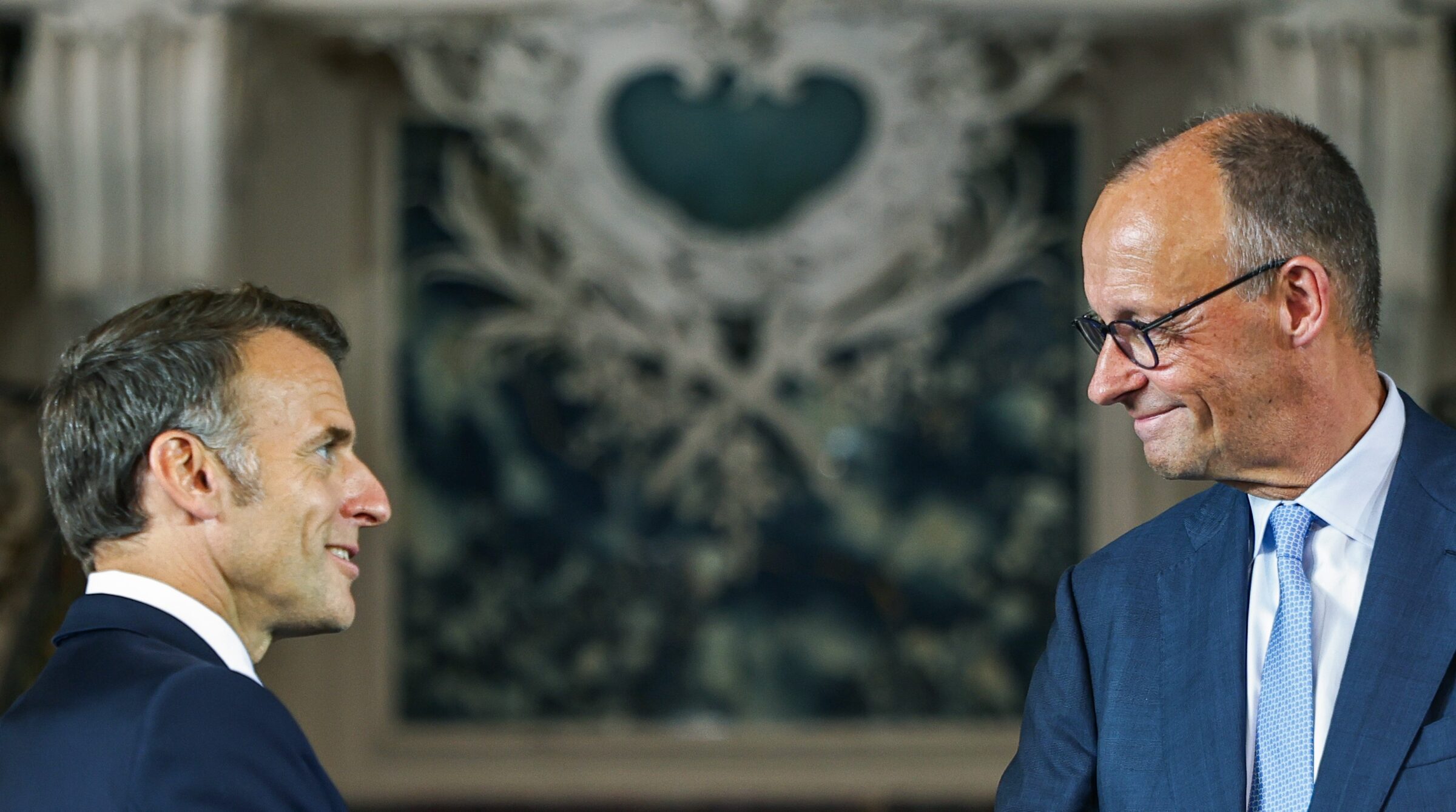
“We are driven by a clear ambition: to successfully transform our automotive industry while upholding our climate goals and our production in Europe,” said French president Emmanuel Macron on social media, announcing the deal.
“This is an investment signal to industry,” said German chancellor Friedrich Merz.
The paper comes as Ireland, which holds the EU’s rotating six-month presidency, is wrapping up a third compromise text on the industrial plan, which Irish officials hope will reach final agreement by mid November.
Publicly, Paris and Berlin said on Friday that their car deal will not affect climate targets and that their course “remains unchanged”.
But the paper behind the deal shows the trade-off that’s been made. Berlin accepted France’s demand for stricter “Made in Europe” rules that apply to fewer countries, while Paris agreed to looser emission rules for carmakers, as Germany had wanted.
To count as “Made in Europe”, a car would have to clear thresholds that tighten over time, and only cars meeting these rules could be bought, leased or rented with public subsidies, or bought by public authorities.
From 2028, the car must be assembled in Europe, with at least 70 percent of total value creation in components – excluding the battery.
This article continues, but the full version is available only to EUobserver.com subscribers. Visit account.euobserver.com/membership
Qatar on Friday announced plans to invest in Lebanon’s electricity sector and help address the country’s chronic power crisis, including through the development of a solar power plant.
During his visit to Lebanon, where he met with President Joseph Aoun and Prime Minister Nawaf Salam, Qatari Prime Minister and Foreign Minister Sheikh Mohammed bin Abdulrahman Al Thani said the two sides held "lengthy discussions" on an energy project that Doha had been discussing with Beirut for years.
"Now, thank God, we see this project getting closer to becoming a reality," he said.
Speaking at a joint press conference with Salam at the Grand Serail, Al Thani said the two countries had agreed to establish a comprehensive framework for cooperation in the energy sector and provide integrated solutions through a major investment project that would benefit Lebanon’s economy.
Salam said Lebanon and Qatar were close to reaching an agreement on a joint project to rehabilitate, develop and modernise the country’s electricity generation infrastructure.
He said the comprehensive project would cover various sources of energy production and the infrastructure required to support them, with the aim of providing a more reliable electricity supply at a lower cost.
Salam said the project would follow a build-operate-transfer (BOT) model, under which Qatari entities would finance, build and operate the infrastructure before transferring it to the Lebanese state. He stressed that Lebanon’s treasury would bear no upfront investment costs.
He said he hoped to present the project to the Lebanese cabinet soon, adding that it should be prepared with support from the International Finance Corporation (IFC) and adhere to the highest standards of transparency, governance and financial viability.
Salam said the aim was not to add another promise to the many previously made about the electricity sector, but to establish a sustainable solution by increasing generation, lowering costs, diversifying energy sources and improving management.
Al Thani also said QatarEnergy had agreed with TotalEnergies to jointly develop a solar power plant in Lebanon. He described this as an initial project, saying the two countries were now working towards a broader framework for energy cooperation.
He said Qatar hoped to see an agreement take shape soon, allowing Qatari institutions to work alongside their Lebanese counterparts.
Salam said his government did not want to add "another promise to the many that the Lebanese have heard" about the electricity sector, but instead hoped to establish the foundations for a practical and sustainable solution based on increasing generation, lowering costs, diversifying energy sources and improving management.
"Reliable electricity at an affordable cost is essential to reviving the economy, encouraging investment, restarting productive businesses and easing the burden on citizens," he said.
Lebanon’s Energy Minister Joe Saddi recently announced that he would no longer take part in cabinet sessions, citing what he called a lack of seriousness in dealing with the crisis and saying he refused to be held responsible for the lack of progress in the sector.
Saddi and fellow ministers from the Lebanese Forces party walked out of a cabinet session on Thursday over the issue.
Lebanon has suffered a decades-long electricity crisis which saw the emergence of an unofficial and largely unregulated network of private generators across the country. These generators typically run on fuel oil, contributing significantly to poor air quality in cities, while charging consumers high prices.
The energy sector virtually collapsed following Lebanon’s 2019 financial collapse, with the national grid barely keeping the lights on for two hours a day. Before this, Beirut, where many of Lebanon’s government institutions are located, had up to 20 hours of electricity a day, with rotating blackouts in the rest of the country.
Much of Lebanon has gradually moved to renewable energy alternatives, relying on solar panels to manage their electricity needs, although this option remains somewhat limited in larger cities like Beirut due to restricted rooftop space in residential buildings.
There has been an outcry among generator subscribers this year, with bills reaching hundreds of US dollars a month in some areas. Operators, many of whom control supply in particular neighbourhoods and are linked to sectarian political parties, have attributed rising costs to higher global fuel prices as a result of the Middle East war.
Lebanon’s electricity sector is estimated to have cost the country more than $40 billion since the end of its 1975-1990 civil war, largely because of heavy subsidies and the cost of importing fuel for ageing power stations. These costs account for a substantial share of the treasury’s losses.