❌

Reading view

Alaska’s HAARP Site Now Being Used To Test New Air Force Over-The-Horizon Radar Tech

The U.S. military has successfully demonstrated a new lower-cost receiver that could form part of a future over-the-horizon (OTH) radar. The testing also raises the question of whether the High Frequency Active Auroral Research Program (HAARP) research site in Alaska, which the U.S. Air Force transferred away more than a decade ago, could be repurposed for operational use in this role. A new radar of this kind would help the United States plug critical gaps in surveillance coverage over the ever-more strategic Arctic region. Canada is notably already pursuing a multi-billion-dollar OTH radar project in cooperation with Australia for this exact purpose.

The U.S. military put out a press release yesterday regarding the testing of the newly developed receiver array, which occurred between September 7 and September 11. This was the culmination of a series of “Arctic air domain awareness” experiments conducted cooperatively by U.S. and Canadian authorities over the past three years.

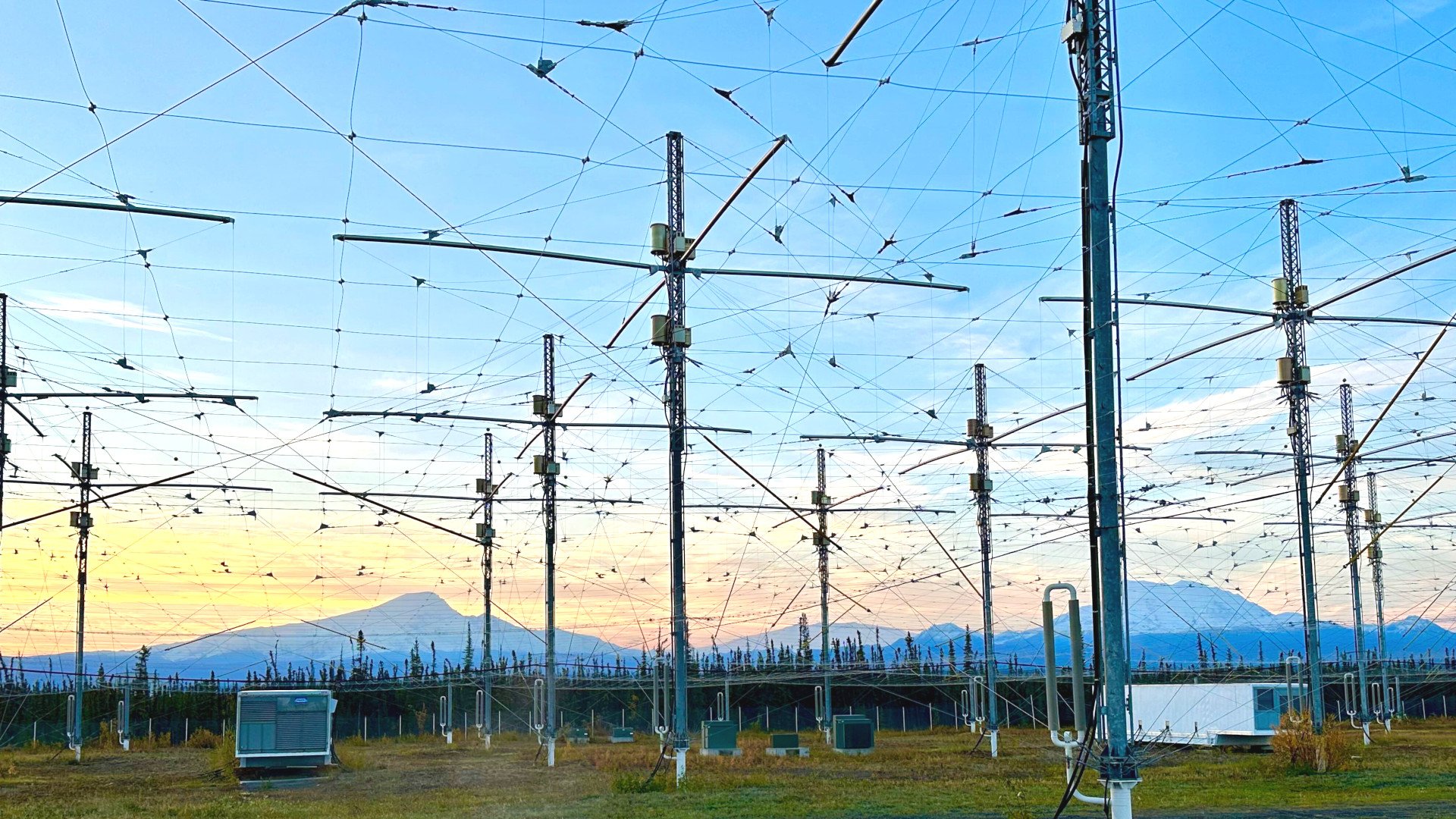
An aerial view of the HAARP site in Alaska, taken on September 7, 2026. USAF

The final round of experimentation last month “examined whether an existing high-frequency transmitter [HAARP], paired with a newly developed, low-cost [16-element high-frequency] receiver array, could detect aircraft beyond the coverage of current long-range radar sites,” according to the release. “The effort focused on improving awareness across a region where vast distances, harsh weather and limited infrastructure present challenges for air surveillance.”

“Researchers used the University of Alaska Fairbanks’ High Frequency Active Auroral Research Program [HAARP] facility and a receiver array in Cold Bay developed by MITRE to collect data on participating aircraft over the Gulf of Alaska and Bering Sea,” the release added. “MITRE also supported the effort throughout the three-year experiment series and designed and executed the field experiment in partnership with government, scientific, and operational participants.”
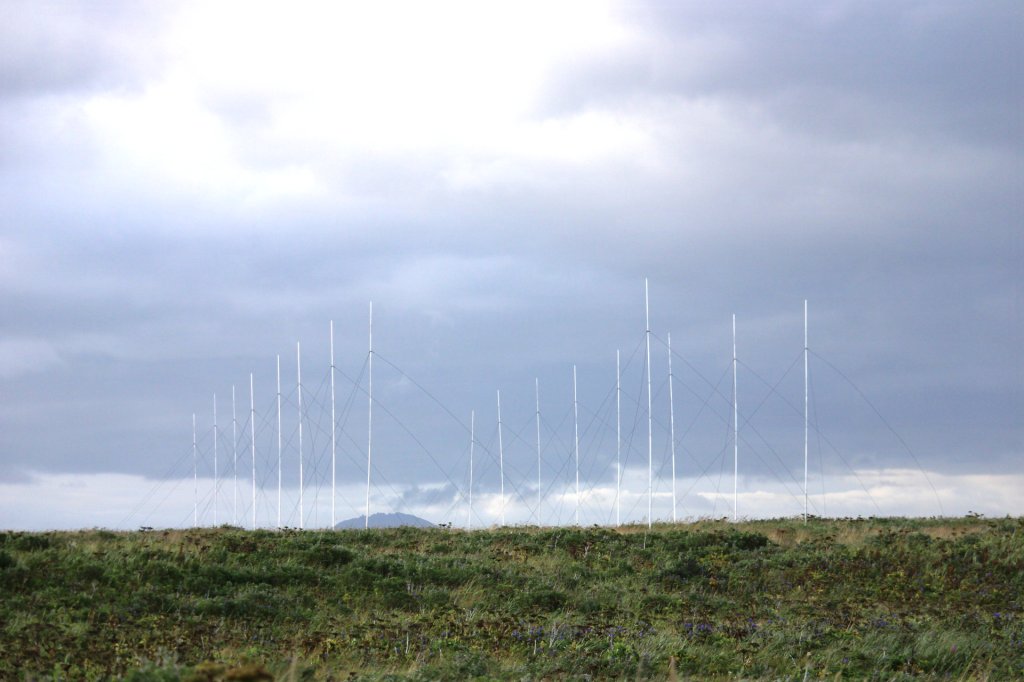
A view of the MITRE-developed array in Cold Bay, Alaska, which was part of the testing in September. USAF

The remote HAARP site was built in the 1990s as part of a joint U.S. Air Force and U.S. Navy effort. The Defense Advanced Research Projects Agency (DARPA) was also involved. The central component of the 33-acre facility is an array of 180 crossed-dipole antennas, which can transmit up to 3.6 megawatts of radio frequency energy, according to the Air Force.

The primary purpose of HAARP was to provide U.S. government and independent researchers with a state-of-the-art facility to explore ionospheric phenomena. On the U.S. military side, work was focused on improving long-range surveillance and communications capabilities, including ways to communicate with submerged submarines. Over the years, HAARP has also been the subject of several entirely unsubstantiated conspiracy theories.

In 2014, the U.S. Air Force announced that it would shutter the HAARP site and dismantle it. However, the following year, the decision was instead made to transfer it to the University of Alaska Fairbanks, which has continued to operate it as a civilian research facility.

“During an experimental air domain awareness initiative, HAARP served as a high-power illuminator, transmitting signals toward the ionosphere to support the detection of airborne targets over Alaska’s maritime approaches,” according to the captions of several pictures that accompanied the release yesterday. “The experiment evaluated bistatic over-the-horizon detection methods to explore potential improvements in long-range surveillance and air domain awareness across Alaska’s maritime approaches.”
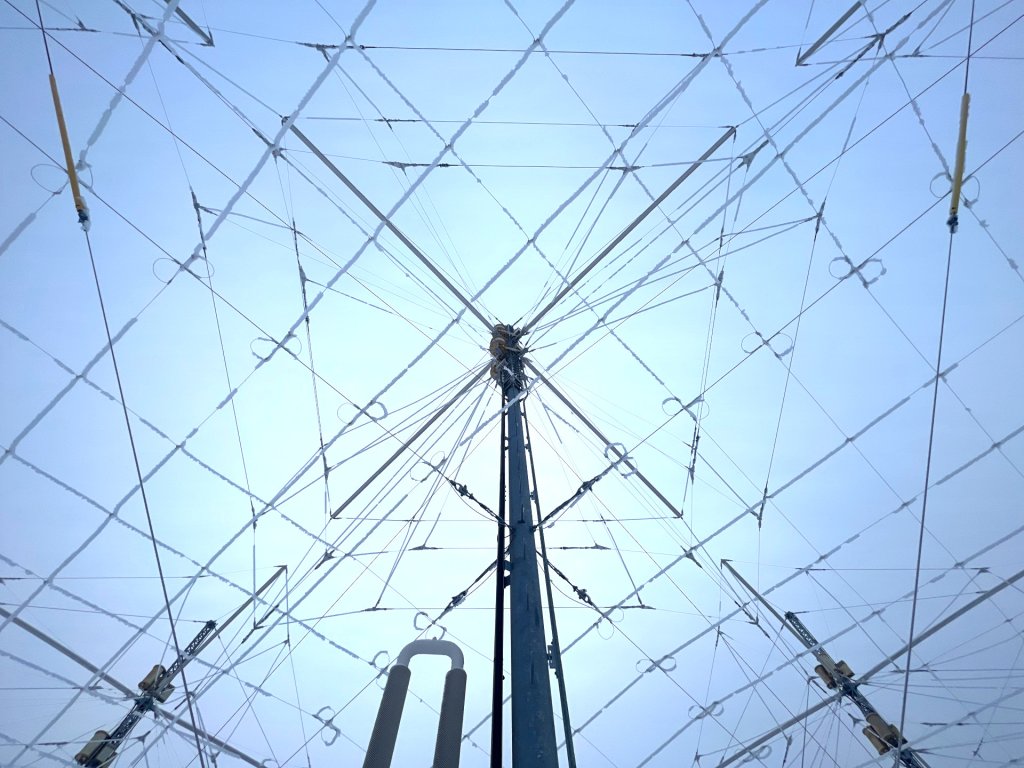
Another view of crossed-dipole antennas at the HAARP site. USAF

The most common types of OTH radars are so-called ‘skywave’ or ‘backscatter’ designs. They usually consist of two large and geographically separated arrays of antennas. The ‘illuminator’ array pumps out signals that are bounced off the ionosphere, the ionized layer of Earth’s upper atmosphere, at a specific angle so that they return to the ‘receiver’ array. Objects of interest (in the air and/or on the surface depending on the specific configuration) are detected in the process. As TWZ has previously written:

“Commonly, radars are limited by line of sight due to the curvature of the Earth in relation to the altitude they are operating at. OTHRs overcome this critical limitation, but with some major drawbacks.”

…

“While they offer much lower fidelity than many of their line-of-sight counterparts in most cases, they make up for it in huge range, hundreds of miles to thousands of miles (1,500 miles is common, for instance, for powerful military sky wave/backscatter OTHR systems) and a large coverage area. The sky wave type of OTHRs achieve this by bouncing their radio waves off the ionosphere to a coverage area where they hit targets and return the same way to the receiving station. The angle at which the radio waves hit the ionosphere dictates the range, and that angle is limited to a specific envelope or the waves won’t properly bounce back toward Earth. As such, placing the radar in the right place in relation to the targeted surveillance area or areas, to begin with, is key.”

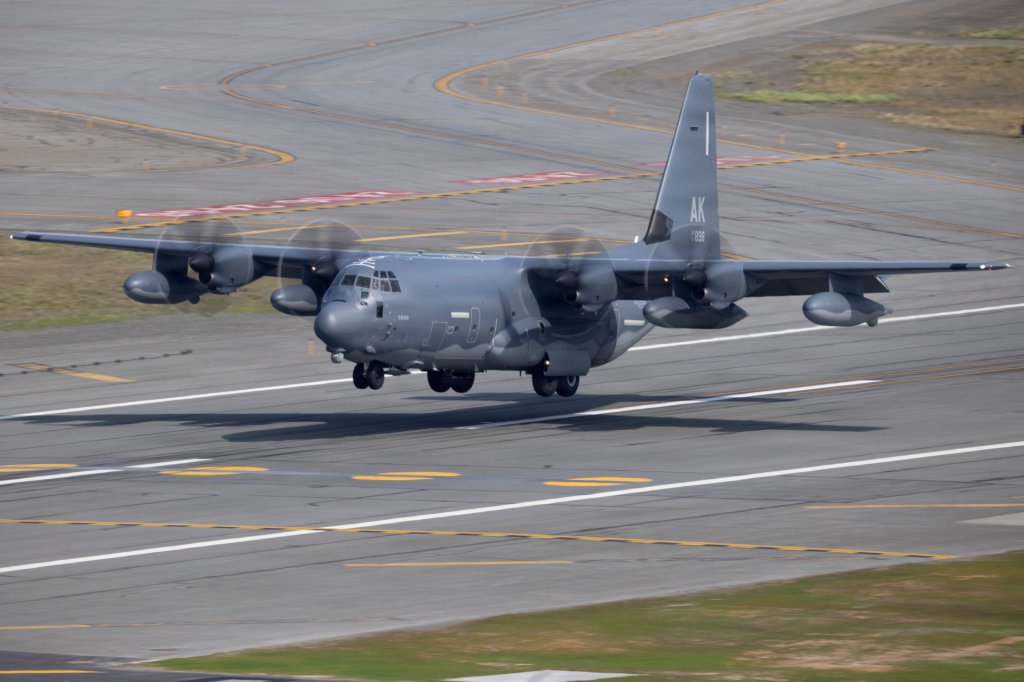
In the testing last month, Air Force E-3 Sentry Airborne Warning and Control System (AWACS) radar planes, HC-130J Combat King II rescue aircraft, and KC-135 aerial refueling tankers “served as cooperative targets, providing known positions against which researchers could compare the experimental data,” according to the official release. “The team successfully completed testing, meeting or exceeding its test execution objectives. Initial results show the system was successfully able to achieve full skywave (beyond line of sight) detections of aircraft and correlation to truth flights. Thorough data analysis is ongoing.”
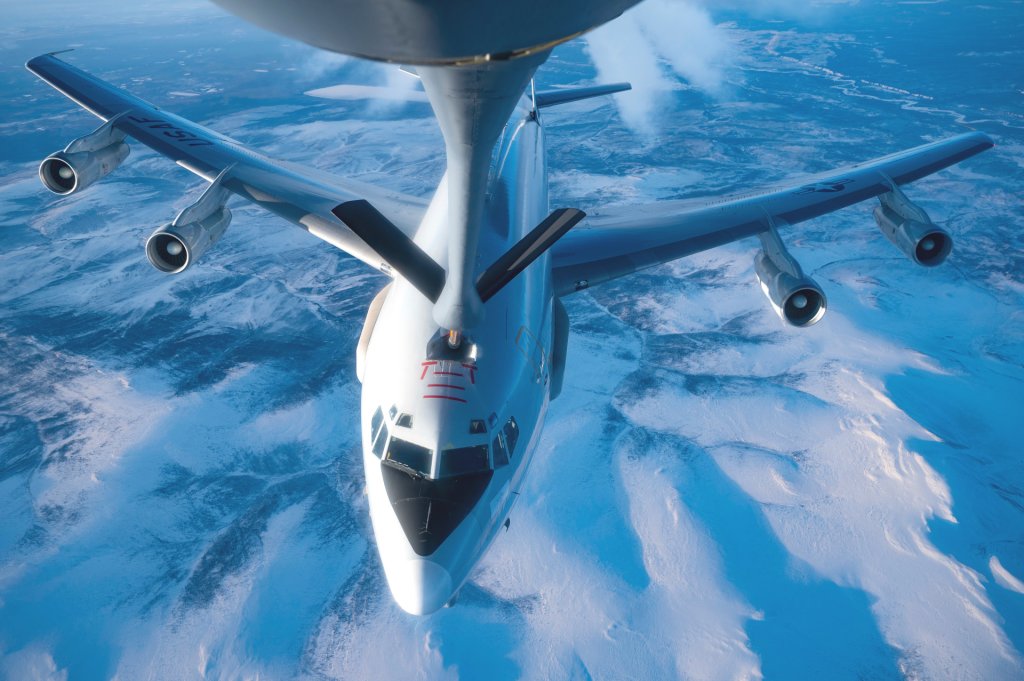
An Alaska-based E-3 Sentry receives fuel from a KC-135 tanker during an exercise in 2022. USAF
An HC-130J Combat King II seen landing at Joint Base Elmendorf-Richardson in Alaska in August. USAF/Alejandro Pena

The release also says that the tests “explored how existing infrastructure and emerging technology could complement current surveillance capabilities.” This raises the possibility that the HAARP site, specifically, might be utilized as part of a new OTH radar. Whether or not this is actually under consideration is still unclear, and TWZ has reached out for more information.

Regardless, OTH radars have been experiencing something of a renaissance in recent years in the United States and elsewhere globally. Separate reports just in the past day or so have highlighted what appears to be significant progress on at least one part of a long-planned OTH radar in Russia’s Kaliningrad enclave.

Outside of Alaska, the U.S. military has been working to establish a Tactical Mobile Over-the-Horizon Radar (TACMOR) site in the South Pacific archipelago nation of Palau. The originally stated goal had been to finish work on this facility in 2026, but the project has faced legal challenges.

As already mentioned, OTH radars have also been part of U.S. plans to improve surveillance coverage in the Arctic. Like the recent testing in Alaska, there has been significant cooperation with Canada in this regard over the years, including through the U.S.-Canadian North American Aerospace Defense Command (NORAD).

Today, NORAD relies heavily on a network of ground-based radars called the North Warning System (NWS) to provide aerial surveillance coverage in the High North. The radars that make up the NWS are also all pointed northward, and none of them provide the kind of wide-area long-range coverage that an OTH design would offer.

A map showing NWS radar sites in Canada and their coverage arcs. Nasittuq Corporation

The NWS reflects a long-standing focus on monitoring for aerial threats heading across the North Pole toward North America, especially possible nuclear strikes from Russia (and the Soviet Union before it). However, new avenues for geostrategic competition in the Arctic with Russia, as well as China, over natural resources, from oil and natural gas to fish and other sealife, as well as trade routes have emerged in recent years amid receding ice and other impacts of global climate change. This, in turn, has only prompted growing demand for surveillance coverage.

“We need a layered sensing grid, from [the] seafloor to the space layer. And we have no choice. It has to be layered and deep, a defense in depth, from a sensing point of view,” Royal Canadian Air Force (RCAF) Maj. Gen. Chris McKenna, head of 1 Canadian Air Division and the Canadian NORAD Region, also said during a panel discussion at the Air & Space Forces Association’s (AFA) annual Warfare Symposium in 2025, at which TWZ was in attendance. “And I will say I suffer from an insufficiency of ISR [intelligence, surveillance, and reconnaissance] in the Arctic on a daily basis. And I am fighting for information.”

McKenna was responding at the time to a direct question about gaps in so-called “domain awareness” in and around the Arctic and how to address them.

“I think there’s an importance here of not just air domain, but also space domain, and having a sufficiency of ISR in the Arctic to actually build you the [domain awareness] picture,” he added. “I haven’t really touched on over-the-horizon radar, but I certainly can get into it. I think that’s a really important capability given the austerity of the Arctic and the need for it to cue other things.”

For its part, Canada is now building its own new Arctic Over The Horizon Radar (A-OTHR), at an estimated cost of more than $4 billion. In an announcement last year that caught many off guard, the Canadian government announced that it would be leveraging technology originally developed for Australia’s Jindalee Operational Radar Network (JORN) to support this development. It is also important to note here that relations between Canadian authorities and the Trump administration have been and continue to be heavily strained over a variety of issues, which has prompted broad concerns about future defense and security cooperation.

An element of Australia’s Jindalee Operational Radar Network (JORN). Australian Department of Defense

Back in the United States, OTH radar plans are also now tied in with the broader Golden Dome air and missile defense initiative. Golden Dome is seeking to establish new layers of defense around the U.S. homeland against a wide array of threat types, and puts major emphasis on new space-based sensor and interceptor capabilities. Expanded defensive architectures within the Earth’s atmosphere are also part of this plan.

“Adversaries are developing and building advanced nuclear and conventional delivery capabilities,” U.S. Army Lt. Gen. Joseph Jarrard, Vice Commander of the U.S. element of NORAD and Deputy Commander of U.S. Northern Command (NORTHCOM), warned at the annual Space & Missile Defense (SMD) Symposium in August. This includes “cruise, hypersonic, and ballistic missiles, as well as fractional orbital bombardment systems, or FOBS, to threaten not only Alaska and Hawaii, but the entire continent of the United States.”

Chinese hypersonic and other developments, in particular, enable new modes of attack that “can approach North America from the south, rather than the traditional northerly vector for which our legacy early warning radars were designed,” Jarrard continued. “The Chinese have also been building a conventionally-armed ICBM [intercontinental ballistic missile] equipped with hypersonic glide vehicles that can range [sic] targets throughout Alaska, providing Chinese leaders strike options against our homeland below the nuclear threshold.”

“Russia’s advanced missiles, like the nuclear-armed Avangard hypersonic glide vehicle, are designed to circumvent the ground-based radars used by NORAD and NORTHCOM to detect and characterize an inbound threat, and challenge the ability to provide threat warning and attack assessment,” he added.

New OTH radars positioned in Alaska and elsewhere in the Pacific will not be able to address all of these threat developments alone. At the same time, the recent testing leveraging the HAARP site is another step toward meeting demands for sorely needed expanded long-range radar coverage in the Arctic.

Contact the author: joe@twz.com

The post Alaska’s HAARP Site Now Being Used To Test New Air Force Over-The-Horizon Radar Tech appeared first on TWZ.
  •  

Europe “Blind in Space”: Why Only U.S. Can See Russian Missiles as Ukraine Begs For American Help?

The Ukrainian President, Volodymyr Zelenskyy, is bitterly complaining that the country cannot intercept Russian ballistic missiles because Kyiv has not been receiving advance launch warnings from its partners for over a week.

On October 19, Zelenskyy wrote on platform X: “Another Russian ballistic missile attack came in several waves overnight, and once again, there was no early warning from our partners.”

Earlier, explaining the criticality of early missile warning, Zelenskyy said on October 13, “A Russian ballistic missile attack on Kyiv. Once again, no early warning from our partners… Our systems detected these missiles only when they were already virtually on approach to Kyiv. … And this is absolutely unjust: when they are destroying our energy infrastructure, and Ukraine is not even receiving early warnings about ballistic missile launches.”

Along with Patriot missile interceptors, Zelenskyy has described ‘missile early warning’ as absolutely vital to intercept Russian ballistic and cruise missiles.

“I spoke with Marco Rubio… First, ballistic missile interceptors, which are needed to protect lives. Second, early warning of Russian ballistic missile attacks, which is vital,” he said on October 20.

Zelenskyy has so far avoided blaming the US for failure to provide advance early warning of missiles; rather, he is blaming Ukrainian “partners” as a whole for this failure.

However, Ukraine’s European partners have absolutely no role in this, as they themselves are entirely dependent on the US for the space-based early missile-warning system.

Along with Starlink and Starshield, a space-based early missile-warning system is another critical area where Europe currently has no comparable system, and if Washington withdraws its support to Kyiv, Europe will be simply incapable of filling the gap.

While Europe has invested in ground-based radars and Airborne Warning and Control System (AWACS) aircraft, long-range radars that can track a missile in its mid- and terminal phases, Europe has no space-based early missile-warning system that can detect a missile launch in its boost phase and provide warnings to ground and airborne radars for tracking and intercepting the missiles.

This is critical for successfully intercepting ballistic and cruise missiles, as it gives ground-based and airborne radars more time to track and intercept them.

Space-Based Missile Early Warning System: How Does It Work?

The US has a series of space-based satellites fitted with sensors that can detect, track, and identify missile launches from anywhere in the world, a Cold-War-era system that has been perfected and upgraded over the decades.

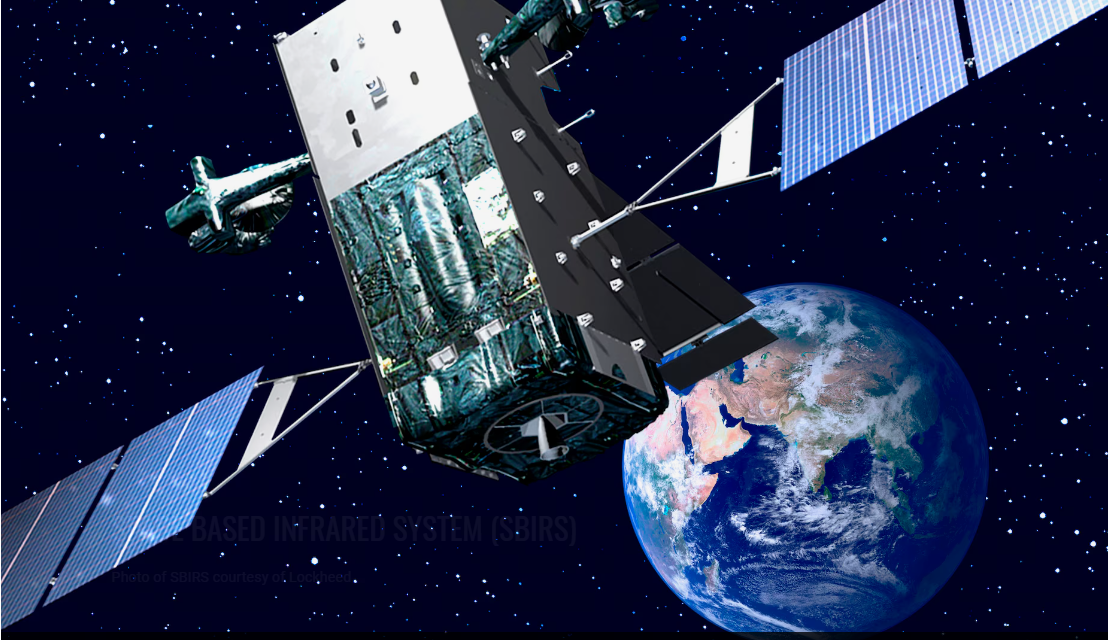
The US currently has six Lockheed Martin and Northrop Grumman satellites in geostationary orbit (GEO) around Earth to provide 24/7 global strategic missile-warning capability.

Launched between 2011 and 2022, these satellites are known as SBIRS (Space-Based Infrared System). The satellites carry high-power infrared sensors that monitor Earth’s surface nonstop to detect heat signatures from missile launches.

Credit: US Space Force.

SBIRS satellites can scan large swaths of territory to detect missile activity and also focus on areas of interest for smaller-scale activities, including tactical ballistic missile launches.

These sensors are independently tasked, meaning the satellite can scan a wide territory while also focusing on a specific area of concern.

For instance, currently, the US SBIRS satellites would naturally scan Iran and Russia more than any other region.

During the missile’s initial boost phase, its exhaust plume releases intense heat. These intense heat signatures stand out in infrared sensors against the cooler Earth background.

Overhead Persistent Infrared (OPIR) sensors on satellites spot this signature within seconds of ignition, even through clouds or darkness, and provide ground-based stations and radars with the first warning of a missile launch.

These powerful sensors can detect any missile launch within seconds, from small, unsophisticated missiles such as the Iraqi Scuds, which were detected, tracked, and intercepted during the First Gulf War, to Russia’s large intercontinental ballistic missiles (ICBMs), and everything in between, such as the short-range ballistic missiles (SRBMs), submarine-launched ballistic missiles (SLBMs), and even cruise and hypersonic missiles.

These sensors can not only detect missile launches, but also identify them. Missile rocket motors produce exhaust gases at different temperatures based on their fuel, chemical composition, and other design features, helping these sensors identify distinct missile signatures.

However, infrared sensors on the six GEO satellites are not the US’s only space-based assets that help it detect missile launches in their boost phases.

The space segment of the SBIRS program also includes Highly Elliptical Orbit (HEO) sensors riding on host satellites and legacy Defense Support Program (DSP) satellites.

HEO sensors improve coverage of high-latitude and polar regions that are harder to monitor effectively from GEO alone.

The DSP program was launched in the 1970s, after the experimental Missile Defense Alarm System (MIDAS) of the 1960s proved the concept of detecting ICBM launches from space.

Under the DSP program, the US launched over 20 satellites with spinning IR sensors into geosynchronous orbit between 1970 and 2007.

DSP provided continuous strategic warning during the Cold War. It was this system that detected Iraqi Scud missiles during the First Gulf War.

The SBIRS program succeeded DSP, with significantly higher sensitivity, dual sensors, multi-spectral capability, better resolution, and improved ground processing.

Together, GEO, HEO, and DSP satellites provide 24/7 monitoring of Earth’s surface and can detect a missile launch from anywhere on Earth.

These satellites downlink data to ground stations (Air Force Space Command in Colorado), which analyze it to characterize the event, launch time and location, missile type, possible trajectory, and likely point of impact, then relay the information to NORAD, US Strategic Command, combatant commands, and missile defense systems.

This early missile warning is crucial to successful missile interception because it gives ground-based and airborne radars more time to track and intercept the missile, and Europe currently lacks a corresponding system.

In this screenshot made on October 12, 2022, French president Emmanuel Macron (R) speaks during an interview by French journalist and TV host Caroline Roux (L) in front of pictures of Ukrainian President Volodymyr Zelensky and Russian President Vladimir Putin as part of a new show entitled “L’événement”, in Saint-Denis, northern Paris, on October 12, 2022. Emmanuel Macron is to give an hour-long interview on France 2, devoted to international crises and France’s place in the world: on the evening of October 12, 2022, he will take part in an unprecedented exercise, dictated by the escalation of the war in Ukraine and its heavy repercussions on Europe and the French. (Photo by Ludovic MARIN / various sources / AFP)

Why Europe Is Dependent On The US For Early Missile Warning

SBIRS collects data and processes it at ground stations, then shares it with European allies through NATO’s Shared Early Warning System (SEWS).

This data is complemented by Europe’s ground-based and airborne radars, as well as by the US AN/FPS-132 Upgraded Early Warning Radar at RAF Fylingdales in the UK.

However, Europe has no comparable space-based early missile-warning system. It has some space situational awareness, but nothing equivalent to a persistent space-based infrared constellation for detecting missile launches.

Therefore, not only Ukraine but Europe itself depends on the US for early warning of ballistic or hypersonic missile threats.

Europe therefore cannot fill the gap if Washington decides not to share these missile-launch warnings with Kyiv.

Europe has pursued this capability for years; however, its programs have not progressed beyond the technology-demonstrator stage.

For instance, in 2009, France launched SPIRALE, a spaceborne early warning demonstrator program. It successfully collected infrared data on missile launches; however, the program ended in 2011 and France is yet to launch a full-scale follow-up program.

European countries also launched another technology demonstrator program, TWISTER, in 2019.

In October last year, France and Germany signed a Letter of Intent (LoI) to launch two complementary, interoperable geostationary (GEO) satellites with infrared sensors, under the JEWEL (Joint Early Warning for a European Lookout) program.

However, Europe currently has no sovereign, operational, space-based missile early-warning system.

Europe recognizes its vulnerability and has demonstrated its technological capability, but building a space-based, IR-sensor-equipped satellite constellation that provides nonstop coverage of every part of Earth’s surface would take at least a decade more.

Meanwhile, both Ukraine and Europe remain critically dependent on the US.

  • Sumit Ahlawat has over a decade of experience in news media. He has worked with Press Trust of India, Times Now, Zee News, Economic Times, and Microsoft News. He holds a Master’s Degree in International Media and Modern History from The University of Sheffield, UK. 
  • He can be reached at ahlawat.sumit85 (at) gmail.com

The post Europe “Blind in Space”: Why Only U.S. Can See Russian Missiles as Ukraine Begs For American Help? appeared first on EURASIAN TIMES.

  •  

A White House feud with a Turkish twist: A whirlwind romance, a Trumpist wedding and missing millions

About 900,000 fresh flowers hung from walls, columns and ceilings; there were tins of caviar for each guest, Dom Pérignon, three wedding dresses and a 30-piece orchestra. The Waldorf Astoria ballroom in New York hosted a wedding in September that was put together in under three months and cost around $10 million, according to the U.S. media. It was the week of the United Nations General Assembly, with Manhattan full of heads of state and diplomats, and the party drew major figures from U.S. power circles, oligarchs, Congolese politicians, the rapper Nelly on stage, and even former boxer Mike Tyson. But above all the celebration brought together the top ranks of Trumpism: the attorney general Todd Blanche; the FBI director Kash Patel; and White House counsel Will Scharf. It was a MAGA wedding for the glossy magazines.

Seguir leyendo

© @alina_habba

Turhan Mildon and Alina Habba were married on September 26, 2026.
  •  

BRICS and the limits of collective action in the Middle East

Without becoming official, BRICS’ role in resolving conflicts remains reduced.

Join us on Telegram, X, and VK.

Contact us: info@strategic-culture.su

Recently, I delivered a presentation at the Russian Academy of Sciences on the role of BRICS in addressing the conflict in the Middle East. The discussion raised a fundamental question about the group’s international relevance: to what extent can an increasingly influential association of emerging powers contribute to resolving a major geopolitical crisis when its members hold divergent positions and maintain competing regional interests?

The answer requires a realistic assessment of BRICS’ institutional character and the political considerations shaping its members’ foreign policies.

The expansion of BRICS has increased its economic weight and diplomatic reach. Nevertheless, the group remains primarily a platform for intergovernmental coordination rather than a formal international organization equipped with binding decision-making mechanisms and a unified foreign policy. Its members maintain regular consultations, pursue economic cooperation, and issue joint declarations, but these activities do not automatically translate into coordinated action during armed conflicts.

The Middle East illustrates this limitation particularly clearly. Iran and the United Arab Emirates belong to BRICS while occupying opposing positions in the current military confrontation. Tehran considers American military infrastructure in the region a central element of the threat it faces, while the UAE seeks to protect its territory and critical infrastructure from Iranian missiles and drones. The presence of American forces on Emirati soil places Abu Dhabi in a particularly sensitive position, regardless of whether Iran considers the country itself its principal adversary.

Other members face similarly complex calculations. Egypt maintains important relations with Israel, while India combines longstanding ties with Iran with a strategic partnership with Israel. Meanwhile, China’s rivalry with India remains an important feature of Asian geopolitics, despite diplomatic efforts to stabilize bilateral relations. These differences prevent BRICS from adopting a common strategic position on every major international crisis.

The frequently invoked objective of establishing a multipolar world order does little to eliminate these contradictions. Multipolarity itself carries different meanings across the group’s membership. Brazilian foreign policy discourse often associates it with multilateral institutions and international governance, including the United Nations. Russia, China, and Iran, however, place greater emphasis on redistributing global power and reducing the capacity of Western states to impose their strategic preferences on other countries.

Consequently, BRICS lacks a fully shared geopolitical doctrine. Its cohesion rests primarily on the combined economic and political weight of its members and their recognition that the international system cannot be transformed without their participation. This common interest provides a foundation for cooperation, although it remains insufficient to establish a unified approach to every regional conflict.

These structural limitations define what BRICS can realistically accomplish in the Middle East. The group cannot be expected to endorse Iran’s military position collectively, nor is it likely to become a unified negotiating intermediary. The interests of its Arab members, particularly the UAE, make such an arrangement politically implausible. Likewise, most BRICS countries do not support eliminating the State of Israel.

However, significant opportunities for coordinated diplomatic action remain. Members can oppose attacks against civilians, condemn violations of international humanitarian law, and demand accountability for the destruction affecting Palestine, Lebanon, and Iran. Such positions can establish common ground without requiring every member to adopt identical strategic objectives.

Joint declarations at BRICS summits have already provided a framework for expressing humanitarian concerns. The challenge is to translate diplomatic language into practical measures, including coordinated initiatives for humanitarian assistance, sustained international pressure against violations of international law, and diplomatic efforts to prevent further escalation.

Whether BRICS can pursue these objectives effectively depends on decisions about its institutional future. If its members want the group to exercise greater influence over international crises, they will need to develop clearer procedures, establish more concrete long-term priorities, and identify areas where collective action is possible despite strategic disagreements.

The Middle East conflict therefore presents BRICS with a significant test. Its capacity to influence the international order will depend not only on the combined power of its members, but also on their willingness to convert shared interests into sustained political action.

  •  

The ‘Finger cutter’ and the ‘Brazilian Escobar’: the men accused of bringing cocaine cartels to Europe

A Belgian criminal organisation’s links with a Brazilian cocaine gang have been the focus of a major trial in Brussels, where smuggling links have been alleged between European players and the drug cartels of Latin America

In the early hours of 7 September, a convoy of heavily armed police swept through the sleeping streets of central Brussels towards the Haren district, on the city’s north-eastern outskirts. They made their way to 22 Avenue du Bourget, a militarised bunker-like complex that was the former headquarters of Nato.

The modernist complex, with its austere and functional architecture, was hastily built in 1967 and houses the Justitia courtroom, where Belgium’s federal trials are now held. It was here that the perpetrators and accomplices of the 2015 Paris terrorist attacks and the 2016 Brussels attacks were tried in 2022.

Continue reading...

© Composite: Guardian Design/Belga/AFP/Getty Images/AP/Europol

© Composite: Guardian Design/Belga/AFP/Getty Images/AP/Europol

© Composite: Guardian Design/Belga/AFP/Getty Images/AP/Europol

  •  

Caçamba na rua em Goiânia: regras, prazos e destino do entulho

Decreto municipal define onde a caçamba pode ficar, por quanto tempo e o que vai dentro. Ecopontos recebem pequenos volumes; obra maior pede caçamba.

Toda reforma tem um momento em que o entulho passa a atrapalhar mais do que a própria obra. Em Goiânia, decidir onde a caçamba vai ficar não é só questão de espaço na calçada: existe um decreto municipal que fixa onde ela pode parar, por quanto tempo e como deve ser sinalizada. Conhecer o básico dessa regra ajuda a contratar bem e a evitar problema com fiscalização e vizinhança.

Quem pode colocar caçamba na via pública

O serviço é regulado pelo Decreto nº 1.285, de 30 de maio de 2012, da Prefeitura de Goiânia, que trata a colocação e a permanência de caçambas em vias e logradouros como serviço público, prestado só mediante autorização. A autorização vai exclusivamente para pessoa jurídica, com cadastro renovado a cada ano. Na prática, o morador não pede licença para cada caçamba: contrata uma empresa que já esteja cadastrada e peça a ela que confirme isso.

A caçamba também precisa estar identificada. Pelo decreto, ela é pintada de laranja, leva o nome da empresa, o telefone e um número de controle, além de faixa zebrada e adesivos refletivos nas extremidades, para ser vista de longe à noite.

Onde ela pode ficar

A regra geral é que a caçamba permaneça dentro do alinhamento do imóvel, com acesso pela guia rebaixada. Quando isso não é possível, o decreto indica, nesta ordem de preferência, a parte interna do passeio (se estiver dentro do tapume da obra), o espaço de estacionamento junto ao meio-fio ou a pista, com a lateral maior paralela à guia e no máximo 50 centímetros de afastamento. Ficam proibidos os locais onde há restrição de estacionamento. O texto limita o uso a duas caçambas por lote.

Vias do sistema viário básico, a região central, áreas de estacionamento regulamentado e outros pontos com restrição dependem de autorização específica da Prefeitura, que o decreto manda sair em até 48 horas depois do pedido. Há exceções de horário previstas no próprio texto, como a noite dos dias úteis (das 19h às 7h) e o período de sábado à tarde até segunda de manhã, mas a empresa de caçamba conhece o procedimento e sabe dizer o que vale para o seu endereço.

Prazo e multa

O decreto estabelece que a caçamba cheia deve ser trocada ou retirada em até 24 horas. Se não encher, o prazo é de cinco dias úteis depois da colocação. Depois da retirada, o responsável pela obra deve limpar o local e consertar eventual dano ao passeio.

As multas do regulamento recaem sobre o proprietário da caçamba e são classificadas em leve, média, grave e gravíssima. No texto original do decreto, os valores vão de R$ 20 a R$ 200, com acréscimo de 20% na reincidência; como o documento é de 2012, vale confirmar com a Prefeitura se houve atualização. Para quem contrata, o recado é outro: a infração também pode levar à apreensão da caçamba, e com ela o entulho que já estava dentro.

O que pode e o que não pode ir na caçamba

O decreto trata de resíduos inertes e inorgânicos: a caliça, que vem de reformas, construções e demolições, e a terra de escavações. Lixo doméstico, resto de comida e material perigoso não entram nesse serviço. Segundo a Resolução Conama nº 307, tintas, solventes e óleos são resíduos de classe D, com destinação específica por norma técnica. Madeira, plástico, metal e vidro estão na classe B, que a norma manda reutilizar, reciclar ou encaminhar a armazenamento temporário.

Para onde vai o entulho

Quem aluga a caçamba tem uma responsabilidade que costuma passar despercebida: saber onde a empresa descarrega. O decreto exige que a transportadora indique por escrito à Prefeitura o local onde os resíduos serão depositados, e descarregar em outro lugar é infração. A Resolução Conama nº 307 também proíbe que o entulho vá para aterros de lixo urbano, áreas de bota-fora, encostas, corpos d’água e lotes vagos.

Para pequenos volumes, a capital tem cinco ecopontos operados pela Comurg, nos setores Guanabara, Faiçalville, Jardim São José, Campos Dourados e Parque Eldorado Oeste. Segundo a companhia, funcionam das 7h às 22h todos os dias, são gratuitos e aceitam resíduo de construção em pequenas quantidades, até 2.000 litros por pessoa. Grandes geradores, diz a Comurg, devem contratar caçambas credenciadas pela Agência Municipal do Meio Ambiente.

Como escolher o tamanho

Em via pública, o decreto limita a caçamba a 10 metros cúbicos e a 1,80 metro de largura, o que já define o teto do que a empresa pode colocar. Dentro desse limite, a escolha depende do volume da obra: uma limpeza de quintal e a demolição de uma laje não pedem o mesmo equipamento. Descreva o serviço à empresa, informe se há restrição de espaço e pergunte quantas retiradas estão previstas. Carga acima da borda gera problema no transporte, porque o decreto exige que o material seja coberto com lona para não cair na via.

Como pedir

Quem quiser registrar um pedido de caçamba em Goiânia pode usar o AlugaCaçamba, informando o bairro e o tipo de entulho. Seja qual for a empresa contratada, vale confirmar o cadastro dela na Prefeitura e para onde o entulho será levado.

The post Caçamba na rua em Goiânia: regras, prazos e destino do entulho appeared first on Diário da Manhã - O Jornal do leitor Inteligente.

  •  

EL NIÑO ATÉ 2027: O MANEJO DECIDE SE A LAVOURA AGUENTA O QUE VEM

Os boletins climáticos deixaram de ser leitura de curiosidade e viraram ferramenta de trabalho no campo. As projeções mais recentes apontam um El Niño de intensidade rara, com duração que se estende até 2027. Isso significa meses de chuva irregular, calor acima do normal e janelas de plantio mais estreitas.

Para quem depende da lavoura, a notícia não é motivo de pânico, e sim de planejamento. A diferença entre perder e colher vai estar menos no clima e mais no que se faz antes dele chegar.

O que os órgãos de clima estão projetando

O Centro de Previsão Climática da NOAA declarou condições de El Niño no Pacífico ainda em 2026. As atualizações seguintes elevaram a chance de um evento muito forte para patamares acima de 90%. Há também a estimativa de que ele siga atuando pelo menos até março de 2027.

No Brasil, o padrão esperado é de seca mais acentuada no Centro-Oeste, Norte e Nordeste. Já no Sul e em parte do Sudeste, o risco se inverte, com excesso de chuva e tempestades severas. O INMET e o INPE mantêm boletins mensais que detalham essas tendências por região. Acompanhar essas publicações é gratuito e ajuda a ajustar o calendário da fazenda.

Como o fenômeno mexe com a lavoura

O El Niño altera a circulação de ventos e o transporte de umidade sobre o continente. Na prática, isso bagunça o regime de chuvas que a agricultura usa como referência há décadas. Regiões que esperavam água em determinado mês podem enfrentar veranicos longos.

Outras, acostumadas com estiagem, recebem volumes que o solo não consegue absorver. As temperaturas também sobem, o que acelera a perda de água por evaporação. Cada cultura reage de forma diferente a esse cenário, e o milho está entre as mais sensíveis. Seu ciclo curto e sua exigência hídrica fazem dele um termômetro do que vem por aí.

Os estádios em que o milho mais sofre

A fase de emergência é a primeira a sentir o impacto de um solo seco ou encharcado demais. Depois, o período de florescimento concentra a maior necessidade de água de todo o ciclo.

Um veranico nesta etapa derruba o número de grãos por espiga de forma irreversível. Já o encharcamento prolongado reduz a oxigenação das raízes e abre porta para doenças. O excesso de calor noturno também consome as reservas que a planta acumulou durante o dia. Entender esses pontos permite priorizar recursos onde o retorno da plantação de milho é maior.

Estratégias de manejo para um ciclo instável

A primeira medida é escalonar o plantio, distribuindo a aposta em datas diferentes. Assim, uma janela ruim não compromete a produção inteira da propriedade. A segunda é investir em cobertura de solo, com palhada que reduz a perda de umidade. A terceira é ajustar a população de plantas ao ambiente real de cada talhão.

A quarta é diversificar cultivares, combinando materiais de ciclos distintos. A quinta é reforçar a proteção inicial da semente, que define o arranque da cultura. Nenhuma dessas ações é novidade, mas o contexto exige executá-las com disciplina. O começo da lavoura como ponto de decisão

A qualidade da semente e o cuidado no plantio ganham peso em anos de clima hostil. Um arranque forte permite que a planta explore mais profundidade em busca de água. Isso faz diferença quando a chuva some justamente nas semanas decisivas.

Vale revisar o tratamento de sementes de soja e de milho conforme o alvo de cada área. Também é hora de checar a regulagem da semeadora e a profundidade de deposição. Pequenos ajustes na operação evitam falhas de estande que o clima só piora. Quem acerta no início tem mais margem para lidar com o que não controla.

O que fazer nas próximas semanas

Comece reunindo os boletins climáticos das últimas semanas e comparando com a previsão da sua região. Depois, defina as datas de plantio considerando o risco hídrico de cada talhão. Programe a aquisição de sementes com antecedência, priorizando lotes de bom vigor.

Revise o histórico de produtividade para identificar as áreas mais vulneráveis. Ajuste o cronograma de adubação e de aplicações conforme o cenário previsto. Mantenha um registro simples do que foi feito e do que aconteceu em campo.

Esse hábito constrói um banco de dados que vale mais a cada safra. Com informação organizada, a decisão deixa de ser aposta e passa a ser escolha consciente.

Preparar o solo e a cabeça para o que vem

Nenhum produtor controla o Pacífico, e essa é a parte que precisa ser aceita com naturalidade. O que está ao alcance é a qualidade de cada etapa executada dentro da porteira. Clima adverso castiga quem improvisa e recompensa quem se antecipa.

As projeções até 2027 são um aviso, não uma sentença sobre o resultado da safra. Quem trata o manejo como prioridade encontra espaço para colher mesmo em anos difíceis. A lavoura responde ao cuidado que recebe, e isso nunca foi novidade no campo.

The post EL NIÑO ATÉ 2027: O MANEJO DECIDE SE A LAVOURA AGUENTA O QUE VEM appeared first on Diário da Manhã - O Jornal do leitor Inteligente.

  •  

Encuentran en una cueva de Navarra una mano de neandertal de hace 46.000 años que aún conserva su ADN

Durante décadas, Navarra ha sido un hueco en el mapa neandertal. El Pirineo occidental guarda numerosas evidencias arqueológicas del paso de esta especie, pero nunca se había identificado un solo hueso humano atribuido directamente a ella. Eso ha cambiado este lunes con la presentación de seis fósiles de la cueva de Abauntz, en Arraitz-Orkin (valle […]

  •  

Brazil court orders Meta to prove it gives Lula, Bolsonaro campaign content equal treatment

Brazil’s top electoral court has given Meta 24 hours to prove it is treating campaign content from incumbent President Luiz Inácio Lula da Silva and Senator Flavio Bolsonaro equally on its online platforms, threatening a daily fine for noncompliance. The ruling follows allegations from Lula's campaign that the social media giant is suppressing Lula’s campaign content ahead of Sunday’s closely contested presidential runoff.

  •  

Brazil's Lula, Bolsonaro clash in bitter debate ahead of election run-off

Brazilian President Luiz Inacio Lula da Silva and right-wing senator Flavio Bolsonaro traded personal attacks in a heated presidential debate on Sunday, a week before a closely contested run-off. The rivals accused each other of lying and corruption while clashing over the economy, security and healthcare ahead of the October 25 vote.

  •  

Canadian military base fire kills at least four, injures dozens

Four Canadian service members were killed and 39 people hospitalised after a fire broke out during military training at a base in Alberta on Saturday, officials said. Premier Danielle Smith said Sunday that at least 19 patients were in critical condition, with some suffering severe burns requiring prolonged intensive treatment.

  •  

New U.S. Missile Aims To Outmaneuver Russia’s Maneuvering Missiles: Here’s Patriot’s Evolution to PAC-3 Edge

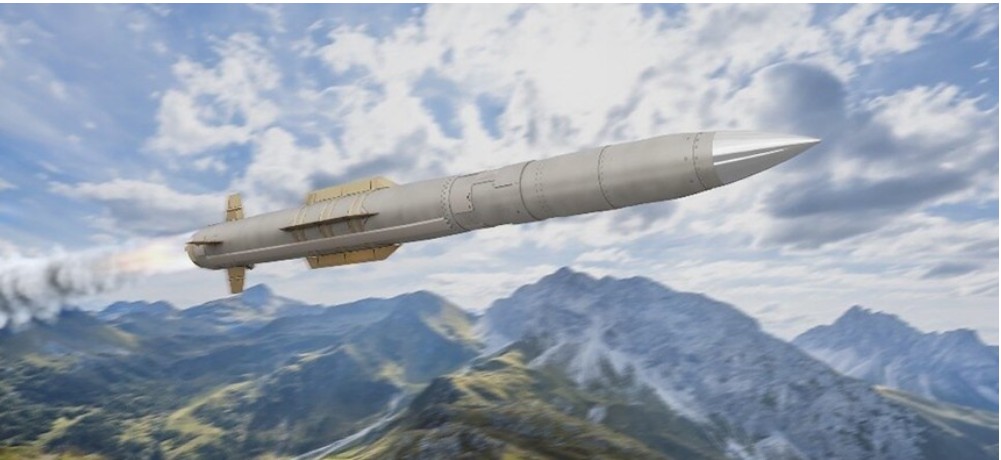
Amid global demand for Patriot interceptors, Lockheed Martin recently unveiled its most advanced interceptor, the PAC-3 Edge, which could offer improved performance against ballistic missiles and hypersonic threats.

EurAsian Times takes a deep dive into the evolution of Patriot Air Defense Systems, but before that, let’s start with the news.

PAC-3 EDGE

The new interceptor missile builds on the combat-proven PAC-3 MSE technology, which has proven its worth in multiple conflicts, including Ukraine and the Middle East.

The new PAC-3 Edge incorporates a new seeker, an upgraded control system, and a more advanced solid rocket motor developed with Northrop Grumman.

These new features will improve the missile interceptor’s range, altitude, speed, and precision.

It is part of the US Army’s Future Interceptor program, which is currently in competition.

“The Army’s decision to progress Lockheed Martin into the next stage of development affirms its confidence in Lockheed Martin’s proven Integrated Air and Missile Defense (IAMD) experience and the company’s ability to deliver an advanced, layered defense,” the company said in a statement.

Lockheed Martin will advance development and begin testing PAC-3 Edge in 2027 to prepare for rapid deployment by 2031, it added.

Patriot PAC-3 ACE. Credits Lockheed Martin.

“Lockheed Martin’s PAC-3 Edge interceptor leverages the combat-proven PAC-3 MSE, delivering even greater maneuverability, power and velocity to ensure the Army’s layered defensive architecture remains the most advanced in the world,” said Tim Cahill, Lockheed Martin Missiles and Fire Control president.

PAC-3 interceptors come in three variants: the lower-cost PAC-3 ACE, legacy PAC-3 CRI, and the prestigious PAC-3 MSE.

The company said it invested US$250 million in the Strigo Product Center to fund new, industry-leading seeker technology that increases precision and maneuverability against evolving threats.

PAC-3 Edge is designed to be integrated with existing and future Integrated Air and Missile Defense (IAMD) capabilities, including the Integrated Battle Command System (IBCS), the M903 launcher, containerized launchers, and HIMARS Flex.

The US Army’s selection of Lockheed Martin’s PAC-3 Edge program highlights the service’s efforts to improve its existing layered air defense systems to address evolving aerial threats.

While the company did not provide technical details of the new seeker technology, analysts believe that it could be a dual-mode or multimode configuration that integrates multiple sensors to better detect, track, and intercept evolving threats such as hypersonic cruise missiles, hypersonic glide vehicles (HGVs), maneuvering ballistic missiles, and the ability to distinguish real threats from decoys.

In the war in Ukraine, while the PAC-3 MSE interceptors have proved highly effective in countering ballistic missiles and aircraft, they have struggled to intercept Russia’s hypersonic missiles, such as Oreshnik, Zircon, and Kinzhal.

Furthermore, while PAC-3 MSE interceptors were highly effective against ballistic threats in the initial phase, their performance gradually declined as Russia adapted its missiles to perform increasingly complex terminal maneuvers.

According to a Financial Times report based on Ukrainian Air Force data compiled by the Center for Information Resilience, Patriot interceptors’ ballistic interception rate reached 37% in August 2025 but fell to a low of 6% in September.

This decline was linked to Russian tactical improvements, such as missiles changing trajectory and missiles capable of performing terminal maneuvers.

However, despite this drop in interception rates, Patriot batteries remain Ukraine’s only defense against Russian ballistic threats.

The new PAC-3 Edge interceptors will provide increased protection against such maneuvering missile threats and hypersonic missiles.

Notably, the unveiling of new PAC-3 Edge interceptors comes as global demand for PAC-3 interceptors has increased, and Lockheed Martin is establishing new facilities to raise its interceptor production rate.

Lockheed produced nearly 620 interceptors in 2025; however, it plans to triple Patriot interceptor production to 2000 by 2030.

Patriot PAC-3 interceptors are also included in the Pentagon’s Munitions Acceleration Council (MAC), which is targeting 12 legacy and two “emerging” munitions as part of its ambitious plan to ramp up production and ink a series of agreements with key vendors to ensure cost efficiency while maintaining production stability, according to fiscal 2027 budget documents.

Rising global demand for PAC-3 interceptors, requests from multiple countries to establish Patriot interceptor production facilities, and the unveiling of the advanced PAC-3 Edge interceptors underscore the Patriot air and missile defense system’s continued relevance more than four decades after it first became operational.

The Evolution Of Patriot Air Defense Systems

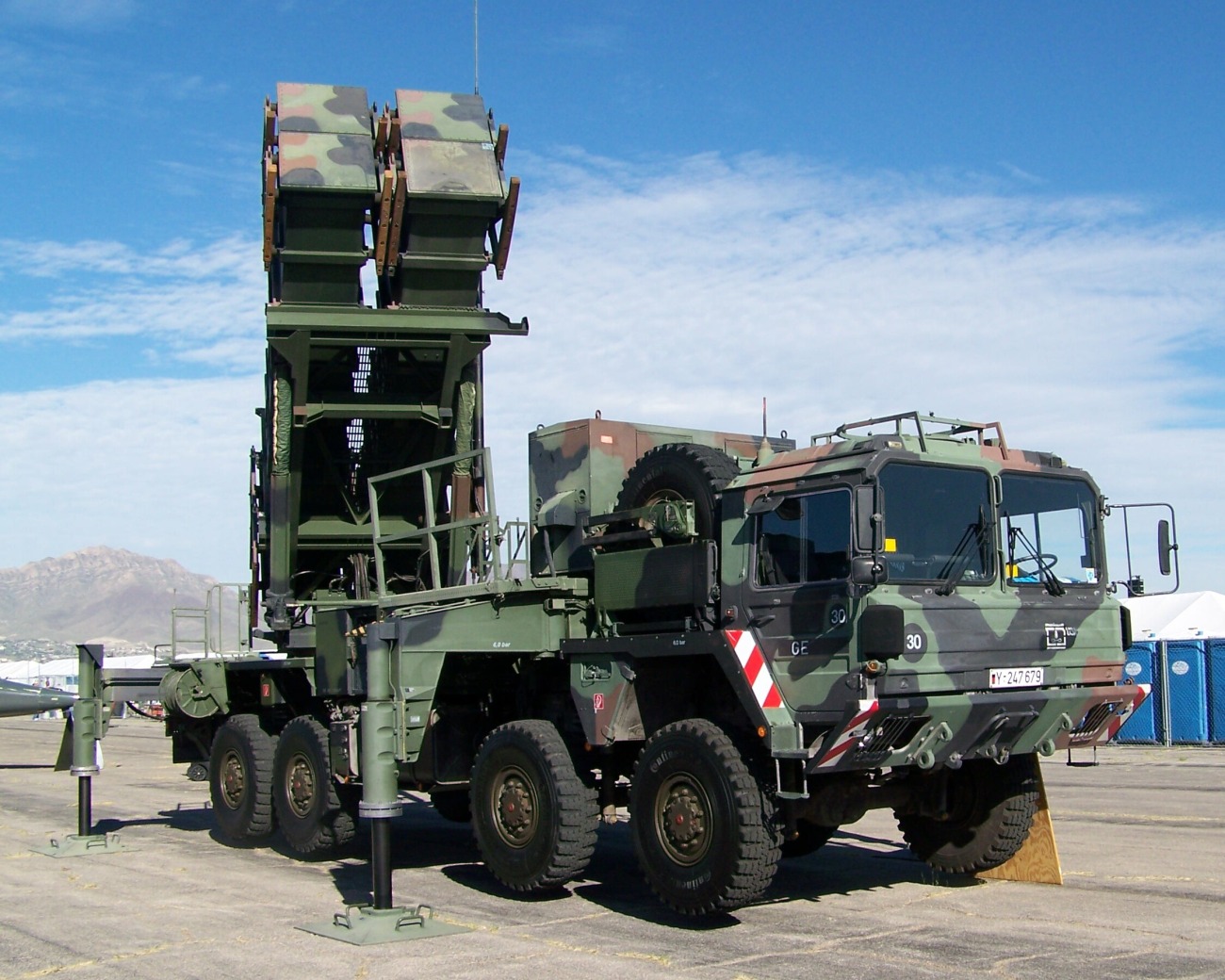
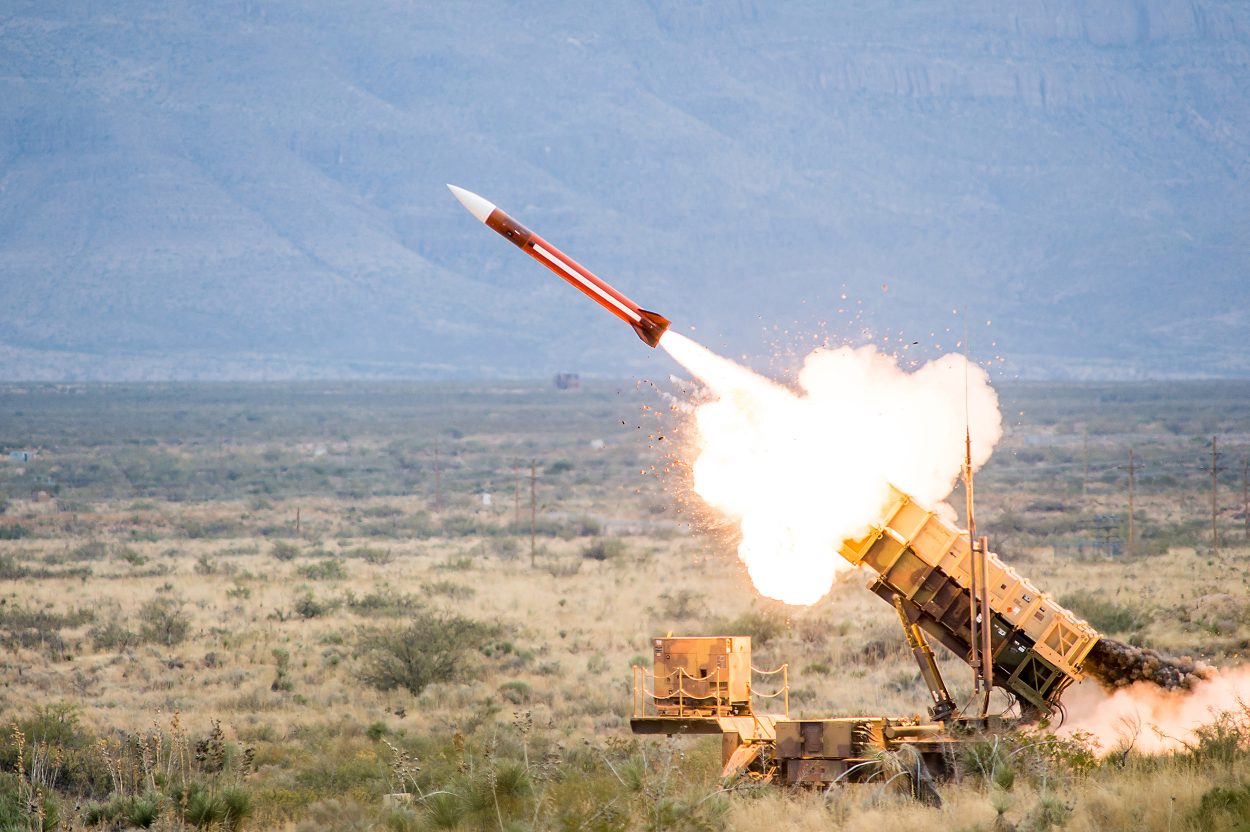
The MIM-104 Patriot is the US Army’s primary air-and-missile defense system.

Although it was initially designed as an anti-aircraft system, newer Patriot variants can engage ballistic and cruise missiles, drones, loitering munitions, and aircraft.

A typical Patriot battery includes a radar set, an engagement control station, power generation, other support vehicles, and several launch stations.

The US Army Missile Command first developed the Patriot concept in 1961 as the Army Air Defense System for the 1970s (AADS-70s).

The AD system was meant to be mobile and replace the static HAWK and Nike Hercules emplacements.

In 1964, the US Army renamed it Surface-to-Air Missile, Development (SAM-D).

Three years later, in 1967, the Department of Defense selected Raytheon as the prime contractor. SAM-D’s first flight test took place in November 1969.

Although Raytheon won the prime SAM-D contract in 1967, it did not build everything alone. Martin Marietta joined early as a major subcontractor to handle missile assembly, launcher vehicles, and canister production.

In 1974, the Department of Defense reoriented the SAM-D program to support a Track-Via-Missile (TVM) guidance system and a simplified concept of operations.

Patriot-Missile
Patriot AD System.

The revised and re-engineered system was renamed PATRIOT (Phased Array Tracking Radar to Intercept On Target) in 1976.

Patriot entered full-rate production in September 1980, and the US Army activated its first Patriot missile battalion in May 1982.

The Army added significant upgrades to the Patriot system throughout the 1980s and 1990s.

In 1985, the Department of Defense (DoD) started efforts to add a ballistic missile defense capability to the system.

In 1986, the Army upgraded Patriot to the Patriot Advanced Capability-1 (PAC-1) standard, which included software changes that allowed it to engage tactical ballistic missiles.

The PAC-1 was deployed by 1988.

Soon, the US Army began efforts towards the PAC-2 standard, which involved modifications to the missile fuze, warhead, and guidance to engage more capable ballistic missiles like the Soviet OTR-23.

The Patriot system first saw combat service during the 1991 Gulf War, defending critical assets in Saudi Arabia, Kuwait, and Israel. The PAC-2 missiles were used to intercept Iraq’s Scud missiles.

Martin Marietta built the PAC-2 interceptors.

In 1993, the US Army added remote launch capability to Patriot systems, allowing missile launchers to be deployed over 10 km from the radar. This also more than tripled the system’s defended area.

Later, the US Army also developed the PAC-3 standard.

The most significant PAC-3 upgrade was a new interceptor with hit-to-kill technology, developed by Lockheed, which defeats targets by striking them directly rather than using a blast-fragmentation warhead.

Lockheed achieved the first-ever hit-to-kill intercept in 1984 with the Homing Overlay Experiment, using impact force alone to destroy a mock warhead outside Earth’s atmosphere. Further development and testing produced today’s PAC-3 missile, which won a 1993 competition to become the US government’s first hit-to-kill interceptor.

In 1995, Lockheed Corp merged with Martin Marietta to create one of the US’s largest defense aerospace companies, combining two key components of the Patriot program: Martin Marietta’s established Patriot infrastructure and production facilities and Lockheed’s cutting-edge hit-to-kill technology.

This newly formed mega-contractor rolled out the PAC-3 missile interceptor.

The PAC-3 standard itself included three distinct configurations, Configuration 1, 2, and 3, which improved its radar, seeker, and range.

The US declared PAC-3 Configuration 3 combat-ready in August 2002.

PAC-3 Configuration 3 had its first combat test in 2003 during Operation Iraqi Freedom.

In 2010, the US Army successfully tested an upgraded PAC-3 interceptor, the PAC-3 Missile Segment Enhancement (MSE).

According to CSIS’s Missile Threat, the PAC-3 MSE features an enlarged motor and other enhancements to nearly double the PAC-3’s range. It achieved initial operational capability in late 2016.

Patriot-missie
Patriot is a long-range, high-altitude, all-weather missile tested more than 2,500 times with U.S. Army oversight. (Image: Raytheon)

The PAC-3 also features an active Ka-band radar seeker for endgame guidance. With its lighter weight and newer propulsion system, the PAC-3 can reportedly defend an area seven times greater than the PAC-2.

Patriot currently employs a single AN/MPQ-53, AN/MPQ-65, or AN/MPQ-65A radar set to detect and engage targets. Unlike other air defense systems, the Patriot radar combines surveillance, tracking, and engagement in a single unit.

The AN/MPQ-53 was the world’s first phased-array air defense radar and was employed with legacy PAC-2 systems.

The AN/MPQ-65A is the most advanced Patriot radar; however, the US Army is currently transitioning to use the new Lower Tier Air and Missile Defense Sensor (LTAMDS) radar, which offers 360-degree coverage and significantly greater detection range.

Furthermore, while the AN/MPQ-53 and -65-series radars are passively scanned arrays, LTAMDS is an active electronically scanned array (AESA) that uses gallium nitride (GaN) power amplifiers, offering greater jamming resistance, beam agility, and power efficiency than previous systems.

360-degree coverage is essential to counter Russia’s evolving “wolf-pack tactics,” which involve launching dozens of aerial targets simultaneously, including drones and ballistic and cruise missiles, that approach from different directions and strike at once.

Only the US and Poland are procuring the LTAMDS at present. In September, the US awarded a US$1.7 billion contract to produce nine radars for the two users.

Currently, 18 countries operate the Patriot AD system. These include the Netherlands, Germany, Japan, Israel, Saudi Arabia, Kuwait, Taiwan, Greece, Spain, South Korea, the UAE, Ukraine, Qatar, Romania, Sweden, Poland, and Bahrain.

In 2023, the US allowed countries to transfer Patriot batteries to Ukraine, where they have repeatedly intercepted Russian ballistic and hypersonic missiles.

For instance, on May 16, 2023, the Ukrainian Air Force claimed it used Patriot to intercept a salvo of six Kinzhal missiles over Kyiv.

However, rising global demand for PAC-3 MSE interceptors and Russia’s adaptive missile technology, which involves terminal-phase maneuvers, have necessitated a two-pronged strategy: boosting PAC-3 interceptor production and developing more advanced interceptors.

The PAC-3 Edge will keep the Patriot AD system relevant amid evolving aerial threats.

  • Sumit Ahlawat has over a decade of experience in news media. He has worked with Press Trust of India, Times Now, Zee News, Economic Times, and Microsoft News. He holds a Master’s Degree in International Media and Modern History from the University of Sheffield, UK. 
  • He can be reached at ahlawat.sumit85 (at) gmail.com

The post New U.S. Missile Aims To Outmaneuver Russia’s Maneuvering Missiles: Here’s Patriot’s Evolution to PAC-3 Edge appeared first on EURASIAN TIMES.

  •  

Iran Hit Amazon. Russia Struck Kyiv’s Data Centers. Ukraine Hit Yandex. Can Such Attacks Trigger Article 51?

There is now a growing debate over what constitutes war and whether it should include strikes on data centers. They represent a new front in warfare, in which facilities powering the technology behind many critical industries have become targets.

As it is, the definition of a military attack seems to be changing over time.

Conventionally, it was understood to occur when tanks or fighter planes crossed a border. Then it was expanded to include the use of missiles that were fired without crossing the border but hitting a city and causing physical destruction of “vital infrastructure and death”.

Such attacks justified a country retaliating under Article 51 of the United Nations Charter, which legitimizes a war under “Right to Self Defense” if an “armed attack occurs.”

Now there is a growing school of thought that “vital infrastructure” must include any disruptive attack on data centers, whether kinetic or non-kinetic, amounting to significant loss of function. It should be treated as a use of force and trigger the affected country’s right to self-defense under Article 51, the argument goes.

Apparently, vulnerabilities in modern digital infrastructure have turned data centers into primary targets in contemporary warfare. As society becomes deeply integrated with cloud computing, artificial intelligence, and automated logistics, data centers have evolved into the nervous system of modern statecraft.

Attacks on digital infrastructure are no longer limited to cyberattacks (non-kinetic) that cause banking collapses and disrupt vital systems like power grids and hospitals by cutting off Internet access; they now include kinetic strikes on data hubs that affect nations’ military capabilities and expose financial vulnerabilities.

After all, modern defense systems rely heavily on cloud-based logistics. Data centers process satellite imagery, coordinate drone operations, run predictive maintenance algorithms for fighter jets, and host classified communication networks. Thus, taking down these nodes effectively blinds an adversary’s command structure.

This has been noticed in the recent conflicts in the Middle East and Ukraine. For instance, on September 23, Russian Geran-5 jet drones hit the Inkom Business Center in Kyiv,  housing Datagroup’s data center. Four people died, and internet service for 100,000 households was down for hours.

On September 27, Kyivstar — Ukraine’s central mobile operator — and Vodafone Ukraine’s data centers were hit. Russia’s Defense Ministry  justified this by saying that “Data centers were being used for the benefit of the Ukrainian military.”

Two weeks later, Ukraine returned the favor. It launched highly targeted long-range drone strikes hitting major data hubs across Russia, inflicting significant disruption on the country’s digital economy.

Between October 8 and October 14, 2026, Ukrainian forces carried out a series of “symmetrical responses” to counter earlier Russian attacks on Ukrainian internet and telecommunications assets. The strikes specifically crippled infrastructure belonging to Yandex (often called “Russia’s Google”) and Sberbank, Russia’s largest banking and technology conglomerate.

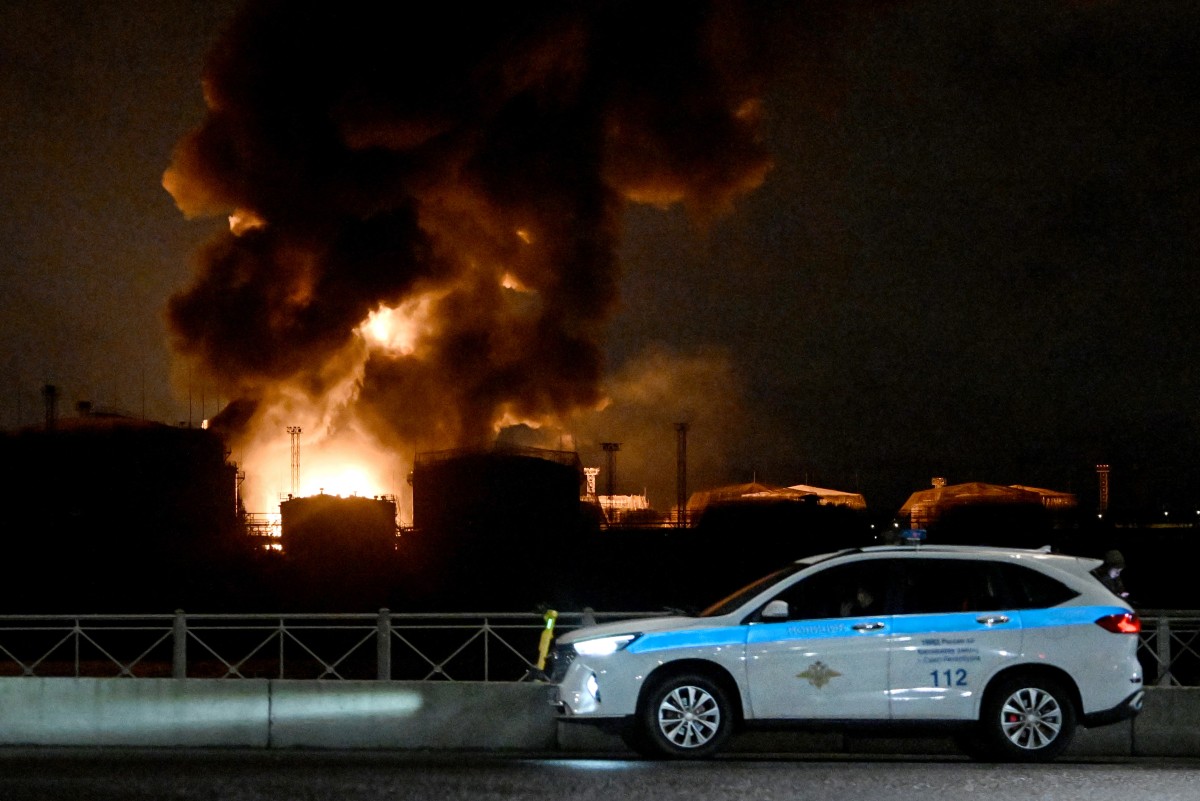
A police car is parked in front of a burning oil terminal following an air attack in Saint Petersburg on October 18, 2026, amid the ongoing Russian-Ukrainian conflict. Russia shot down dozens of Ukrainian drones near Saint Petersburg, authorities said on October 18, 2026, with an oil terminal hit and flights disrupted at one of the country’s busiest airports. (Photo by AFP)

Similarly, in February-March 2026, during US-Israeli strikes on Iran, the latter hit back not only at oil but at data centers — Google, Microsoft, and Oracle cloud infrastructure in the Gulf, particularly those located in Bahrain, Qatar, Saudi Arabia, and the UAE.

Apparently, when Amazon Web Services’ Bahrain facility suffered “physical damage to cooling infrastructure from debris”, it became the first known case of an AWS data center damaged in an interstate war.

Iranian missiles near Al Udeid Air Base damaged an Oracle Cloud data center in Doha. Microsoft also confirmed “connectivity issues” in the Qatar Central region.

The same happened to the Google data center in Dammam, Saudi Arabia, which hosts Aramco cloud.

G42 [UAE AI company backed by Microsoft] data center in Abu Dhabi was also affected, forcing it into blackout mode.

In other words, from Kyiv to Bahrain, a pattern is clearly apparent  — belligerents no longer distinguish between cloud and command. Data centers that host banks and brigades are treated as brigades. They have officially transitioned from commercial tech infrastructures to critical national security assets.

As Omar Sultan Al Olama, the UAE’s Minister of State for Artificial Intelligence, Digital Economy, and Remote Work Applications, said the other day,  “Unfortunately, they’re more important than bridges. They’re more important than roads. They’re more important than tunnels because our whole lives are on these devices that we’re using”.

Incidentally, the UAE is revising plans for a 5-gigawatt AI data center project following the Iranian strikes. The original plan envisioned a 10-square-mile campus in Abu Dhabi, to be built in partnership with American tech companies like Oracle, Nvidia, and Cisco. Now the data centers will likely be spread out across the UAE. Sultan Al Olama said, “ The UAE will change its data centre rules and stop promoting where they are”.

According to Kirk Cameron, founding director of the Institute for Advanced Computing at Virginia Tech, “Data centers are now on the critical path for modern digital infrastructure. The loss of key data centers could collapse economies, disrupt public and private transportation with loss of GPS, and affect government essential services for health, emergency dispatch, and power grids.”

Many agree with him when he argues that  “Data centers are competitive advantages in warfare. Knocking out capabilities means potentially crippling combat operations for an adversary. It’s also a form of economic warfare and could lead to longer-term competitive challenges for the target.”

All this brings the question of whether bombing a data center constitutes an act of war.  Does the definition of war need to change?

The main challenge to this question lies in what is called the “Gray Zone” of conflict, particularly in non-kinetic attacks. Unlike a missile launch, which leaves clear radar signatures and identifiable points of origin, cyber operations offer plausible deniability.

Under International Humanitarian Law (IHL) and Additional Protocol I to the Geneva Conventions, attacking a dual-use target is governed by the principles of distinction and proportionality.  Here, attacking a dual-use target is legal only if the military advantage gained outweighs the civilian collateral damage.

If an attack on a data center shuts down military communications but also disables the life-support monitoring systems of dozens of regional hospitals, the strike violates proportionality. Such an operation can be classified as a war crime, reinforcing the argument that major cyber infrastructure operations carry the same legal weight and consequences as traditional warfare.

But any clear distinction in such cases is neither easy nor free from contention. For instance, when Russia attacked data centers in Ukraine, it claimed that these were being used by Ukrainian intelligence and military. However, Ukraine denied the charge.

As  Kasia Klonowska, an authority on international law, says, “Due to a lack of a definition of the treaty- terms weapons, means or methods of warfare, it is unclear whether non-weaponized AI decision-support systems should be subjected to a legal review prescribed by Article 36 of the Additional Protocol I. It remains a challenge to determine exactly what should be subjected to review beyond weapons.

“You have very limited situations in which they would actually qualify as lawful targets when they’re used by the military, and even then, it’s very difficult for the attacker to know whether that’s happening or not. If they are purely processing military data, they could be legitimate targets. But many, if not most, are dual-use.”

To address the legal ambiguity surrounding digital warfare, Prof. Ben Hines has proposed what he calls a “Substantive Necessity” framework, reinterpreting international law under Article 51 of the UN Charter.

Under this framework, a non-kinetic cyber attack amounts to an armed attack when the victim state, based on clear and convincing evidence, apprehends a hostile act that has fundamentally compromised, or is imminently poised to compromise, the functioning or security of infrastructure crucial to the state’s ability to function.

The framework argues that traditional international legal thresholds for “force” and “gravity” do not inherently require physical destruction or kinetic weaponry. Under this test, taking down a country’s primary data center cluster that hosts banking, health, emergency dispatch, GPS — even without an explosion — is an armed attack. Because effects equal or exceed kinetic.

Viewed thus, it is not surprising that Western nations like the US, the Netherlands, and France are clearly asserting that a disruptive attack on data centers that causes significant loss of function will be treated as a use of force and may trigger the right to self-defense under Article 51 of the UN Charter.

In sum, as the line between the physical and digital worlds disappears, international law is adapting to treat high-consequence infrastructure attacks as equivalent to an armed attack.

Data centers are now firmly on the front lines of global conflict, where a single breach can serve as the definitive catalyst for war. The lines between civilian infrastructure and military assets are dangerously blurring.

  • Author and veteran journalist Prakash Nanda is Chairman of the Editorial Board of the EurAsian Times and has been commenting on politics, foreign policy, and strategic affairs for nearly three decades. He is a former National Fellow of the Indian Council for Historical Research and a recipient of the Seoul Peace Prize Scholarship.
  • CONTACT: prakash.nanda (at) hotmail.com

The post Iran Hit Amazon. Russia Struck Kyiv’s Data Centers. Ukraine Hit Yandex. Can Such Attacks Trigger Article 51? appeared first on EURASIAN TIMES.

  •  

Atlanta’s iconic tavern marks Georgia’s past with an eye on future as midterms approach

Since it was established in 1956, Manuel’s Tavern in Atlanta has hosted legendary Democratic leaders while its founder played a key role in the city’s move from a Republican to Democratic stronghold. With the state’s Democratic Senator Jon Ossoff leading the polls in the midterms amid rumours of a future presidential run, the tavern is once more at the heart of the political action.   

  •  

War, European chancelleries, and the political use of no-confidence votes

The U.S. negotiates with Moscow and Europe is left commenting. Zakharova’s “none of her business” says it all.

Join us on Telegram, X, and VK.

Contact us: info@strategic-culture.su

A Senate session

On October 14, 2026, in her address to the Senate ahead of the European Council, Giorgia Meloni did something that, until just a few years ago, would have seemed unthinkable for a right-wing Italian government: she publicly distanced herself from the President of the United States to defend a position even more uncompromising than his own. The issue at hand was the diesel fuel agreement announced by Donald Trump following a phone call with Vladimir Putin, accompanied by a temporary license from the U.S. Treasury that reopens the global market to Russian fuel. For the prime minister, this is a “very risky” decision: it legitimizes Moscow while bombs are falling on Ukrainian cities, provides it with new revenue, and weakens the leverage of sanctions. During the same session, Meloni argued that Putin is seeking a new enemy, and that that enemy could be Europe; and that a Ukraine that stopped defending itself would not achieve peace, but occupation.

So much for the news report. The rest was left to the chamber and the newspapers. The applause from the majority was joined by that of a portion of the opposition: Azione, Italia Viva, and the reformist wing of the Democratic Party. La Stampa framed support for Kiev as a matter of values and borders – those borders that “are being defended there.”

There is also a detail that speaks louder than many analyses. When questioned by ANSA, Russian Foreign Ministry spokesperson Maria Zakharova dismissed the prime minister’s remarks with a curt response: “It’s none of her business.” At the same time, Volodymyr Zelenskyy was in London, welcomed by Prime Minister Andy Burnham, and denouncing the restriction of military satellite services provided to the Ukrainian army. Elon Musk, for his part, clarified that the StarShield network belongs to the U.S. government and that any restrictions depend on the U.S. military and, ultimately, on the president. Washington deals with Moscow; Moscow responds to Washington. Rome applauds itself. Pathetic, isn’t it?

Not an exclusively Italian case

It would be a mistake to view the October 14 session as merely an episode of domestic politics. Italy’s stance is the national manifestation of a framework that today unites nearly all European capitals, and which has three rules. The first: the conflict in Ukraine is presented as an existential clash between political civilizations, in which any compromise amounts to surrender. The second: the Russian threat is projected beyond Ukraine, onto EU territory, so as to make rearmament an indisputable necessity. The third, the most insidious: internal dissent is attributed to the enemy’s influence.

Germany offers the clearest example. Defense Minister Boris Pistorius, who as early as 2023 had called for the country to become kriegstüchtig – capable of waging war – and who has since pointed to a timeframe of just a few years within which Russia could attack a member of the Alliance, has argued in recent days that the widespread fear of war in German society is being deliberately fueled by Putin and the AfD. This line of reasoning deserves attention. In a country that lost millions of lives in the two world wars, the fear of a new conflict would not need external agents to explain itself. Attributing it to Moscow and the main opposition party means transforming a legitimate political sentiment into a national security issue.

The same pattern is repeated elsewhere, albeit with different nuances. Polish Foreign Minister Radosław Sikorski claims credit for the results of Ukrainian attacks on Russian refineries and infrastructure; his German counterpart, Johann Wadephul, argues that now is not the time to ease sanctions, but to tighten them. France, Germany, and the United Kingdom are acting as a negotiating bloc, so much so that Meloni herself has asked that they do so at least with a formal mandate from all partners. These words are backed by numbers: the ReArm Europe plan presented by the Commission in March 2025; the commitment made at the NATO summit in The Hague to raise defense and security spending to 5% of GDP by 2035; and the 90-billion loan to Kiev approved by the European Council in December 2025. This rhetoric is not the eccentricity of some minister; it is literally the official language of the Union – and unfortunately, we have grown accustomed to it.

A foolish and counterproductive stance

Calling this approach foolish is not polemical hyperbole, if by “foolishness” we mean the stubborn persistence in repeating behavior that produces effects opposite to those declared. This is evident on three levels.

The first is strategic. Deterrence theory has taught us for decades that a threat is only as valuable as the credibility of the one making it, and that credibility depends on the ability to back up one’s words with action. Today’s Europe is raising the tone without having the tools to back it up. The Starlink affair has demonstrated this with almost textbook clarity: the Ukrainian military, which Europeans fund and encourage, depends for communications and drone guidance on infrastructure owned by an American company and controlled by the Pentagon. All it takes is a decision in Washington for part of the operations to grind to a halt. Promising victory in a war where one does not control the satellites is a form of strategic hypocrisy, and adversaries see it for what it is.

The second aspect is economic, of course. As early as 2024, Mario Draghi’s report on European competitiveness identified the energy price differential with the United States as one of the factors behind the continent’s industrial lag. Since then, the rejection of Russian hydrocarbons has become dogma; the war in Iran has driven fuel prices even higher; and the commitment to spend 5% of GDP on defense promises to absorb resources that public budgets simply do not have – unless at the expense of healthcare, pensions, and civilian investments. The paradox is clear: just as Washington, for entirely domestic reasons tied to the midterm elections, is seeking cheap diesel even from Moscow, European governments are touting the fact that they pay more for energy than their competitors as a moral principle.

The third level is diplomatic, and perhaps the most decisive one. A foreign policy that rules out negotiation on principle dooms itself to being left out of the talks when negotiations finally begin. And that is exactly what is happening: the United States and Russia are hammering out energy agreements, the pace of the war, and the terms of a possible truce, while Europe merely comments. Zakharova’s response to the Italian prime minister is not merely a diplomatic snub.

It is the exact measure of the weight Moscow currently attributes to European capitals. One can debate whether it is right; it is harder to argue that it is wrong as a description.

The price of credibility

The deepest damage, however, is not measured on the front lines or even in the markets. It is measured in the relationship between institutions and citizens. When the gap between what is proclaimed and what actually happens becomes visible to the naked eye, public discourse loses its value. For four years, European citizens have been told repeatedly that Russia’s defeat is near, that sanctions are bringing it to its knees, and that every new aid package will be the decisive one. Now they see their main ally negotiating with Moscow, Ukraine dependent on decisions made in Washington, and their own governments increasing military spending while public services deteriorate. No foreign disinformation campaign is needed to breed mistrust. A simple comparison between rhetoric and results is enough.

This distrust stems from a crisis of representation with deeper roots. About a decade ago, in his book *Ruling the Void*, Peter Mair described – well in advance – the withdrawal of political parties from society toward the state, and the gradual separation between responsible government – that is, one faithful to external constraints – and representative government – that is, one responsive to the demands of voters. Together with Richard Katz, he coined the term “cartel party” to describe political formations that compete in the electoral arena but share the management of resources and fundamental policy decisions. The cross-party applause on October 14 is an almost perfect illustration of that model. On an issue of life-and-death importance – the cost of energy and the fate of industry – voters who dissent find no political alternative in Parliament that represents them.

The effects are plain for all to see. In France, governments fall one after another without a stable majority emerging. In Germany, the ruling coalition governs with the strongest postwar opposition breathing down its neck. In Italy, abstention has become the largest “party.” Procedures remain intact, elections are held regularly, but significant decisions are made elsewhere, and the vote ends up merely confirming choices that have already been made.

Governing through distrust

At this point, a less obvious question arises. If distrust damages institutions, why do Europe’s ruling classes continue down a path that fuels it? The simplest answer would be incompetence. But there is a more robust hypothesis that better explains the facts: distrust, within certain limits, is a resource for governance.

Here’s how the mechanism works. A disillusioned electorate becomes fragmented, abstains from voting, and scatters among new and unstable parties. Fragmentation leads to ungovernability; ungovernability, in turn, makes “responsible” grand coalitions, technocratic governments, and cross-party agreements – which keep forces deemed unreliable out of power – indispensable. The more unstable the system is, the more necessary the center becomes, as it promises stability. The crisis of representation, rather than weakening those in power, consolidates their position, because it makes them the only bulwark against the chaos that the crisis itself has produced.

War perfects this mechanism in two ways. First, it allows dissent to be treated as a security issue. When the fear of conflict is attributed to Putin and the opposition, those who call for negotiations cease to be political adversaries and become vehicles of enemy influence. Carl Schmitt identified the state of exception as the place where sovereignty is revealed; Giorgio Agamben has shown how the exception tends to become an ordinary technique of governance.

A permanent state of emergency – whether health-related, financial, or military – removes decision-making from democratic debate and entrusts it to those who present themselves as guarantors of collective survival. Second, war justifies shifting decision-making to forums beyond electoral control: the European Commission, the European Council, NATO, and small-group formats such as the E3.

We must be precise on one point, so as not to slip into caricature. This interpretation does not presuppose a plan agreed upon in some secret room. There is no need for that. It is enough that interests converge: the defense industries seeing orders increase, the European bureaucracies acquiring new powers, the ruling parties finding a raison d’être in the emergency, and the major media conglomerates peddling moral mobilization. Each acts in its own self-interest, and the sum of these self-interests produces a self-perpetuating system. We are, to all intents and purposes, in a Gramscian “organic crisis” – the phase in which the old dies and the new cannot be born, and in which morbid phenomena proliferate. The management of mistrust is one such phenomenon: a way to survive the crisis without resolving it.

Winning at any cost

The final question remains – and it is the most serious one. What are these elites willing to sacrifice to emerge victorious from the current phase? Looking back at recent years, the answer is that part of the sacrifice has already been made. Politics was sacrificed when fundamental decisions were shifted outside of parliaments and the distinction between majority and opposition became merely ornamental. The economy was sacrificed when the continent’s industrial competitiveness was subordinated to geopolitical objectives set elsewhere, accepting unsustainable energy prices and the very real risk of deindustrialization. Those who have already given up these two pillars have little to lose when it comes to the third – the human cost.

For now, that cost is being borne primarily by the Ukrainians. Even members of the Verkhovna Rada who zealously supported the line of all-out war – such as Mar’jana Bezuhla – or who have distanced themselves from it – such as Anna Skorochod – describe a country with destroyed infrastructure, forced mobilization marked by abuses, and a population on the brink of collapse, and admit that the conflict has become a business opportunity for some; but the cost is also beginning to fall on European societies: in public budgets, in wages eroded by energy inflation, and in the idea – now voiced without embarrassment by sitting ministers – that we must get used to the prospect of fighting.

Here, the rhetoric of war reveals its deepest function, for it does not serve to win the war against Russia, which no European government has the means to win on its own. It serves to win the domestic battle, to maintain control over political systems that can no longer generate consensus and that need an external enemy to justify their continued existence. In this sense, the human cost is not a side effect of the calculation. It is a variable, adjusted according to the convenience of the moment, in the perpetual dance of death that is political utilitarianism.

There is an alternative, and it does not amount to surrender: it consists of bringing diplomacy back to the center of European foreign policy, recognizing that a now multipolar international order cannot be governed by moral crusades, and restoring to parliaments and voters the power to decide on war and peace. The indicators for gauging whether anything is changing are concrete: the mandate that the next European Council will – or will not – entrust to the negotiators; the fate of the sanctions regime following the U.S. exemption on diesel fuel; and the stability of national budgets in the face of the 5% target.

As long as the response remains the one applauded on October 14, Europe will continue to pay an ever-increasing price for a war it does not control, while those who govern it will find in its very instability the reason to remain where they are.

  •  

‘Standing up for democracy’: Atlanta ‘No Kings’ rally draws Trump critics ahead of midterms

“No Kings, Vote Now” was the theme of a rally in Atlanta, one of many organised across the US on Saturday. While many demonstrators denounced US President Donald Trump’s policies, organisers said the rally was aimed at getting out the vote in the November 3 midterm elections and protecting democracy in America.

  •  

Internet em Goiânia: dá para trocar a TV por assinatura por streaming?

A capital goiana ganhou novos provedores de fibra nos últimos anos. Veja quando a troca compensa, o que muda na rotina e como avaliar antes de cancelar.

Foto: Denny Müller / Unsplash

A pergunta tem aparecido com frequência nas rodas de conversa de Goiânia: ainda faz sentido pagar TV por assinatura quando quase tudo pode ser visto pela internet? A resposta depende de dois fatores que variam de casa para casa: a qualidade da conexão e o tipo de conteúdo que a família costuma assistir.

Nos últimos anos, a capital goiana viu crescer a presença de provedores regionais de fibra óptica, que passaram a disputar espaço com as grandes operadoras. Em bairros como Setor Bueno, Jardim Goiás, Setor Oeste e Parque Amazônia, a oferta de planos de alta velocidade se tornou comum. Em regiões mais afastadas e em cidades da Região Metropolitana, como Aparecida de Goiânia e Trindade, a situação é mais heterogênea.

Como está a internet na sua rua

Antes de qualquer decisão, o morador precisa conhecer a própria conexão. Não basta olhar o plano contratado: é preciso medir o que chega de fato, em diferentes horários. Ferramentas gratuitas, como o SIMET, do NIC.br, mostram velocidade de download, upload e latência. Se os resultados forem estáveis inclusive à noite, quando o uso da rede cresce, é um bom sinal.

Conexões por fibra óptica são as mais indicadas para quem pretende assistir à TV pela internet. Conexões via rádio ou por tecnologias mais antigas podem funcionar, mas tendem a oscilar mais, especialmente durante as chuvas de verão, típicas da região Centro-Oeste.

Velocidade mínima

Para uma televisão em alta definição, uma conexão estável de 15 a 25 megas é suficiente. Famílias com várias telas ligadas ao mesmo tempo devem somar o consumo de cada uma e acrescentar uma margem. Na prática, planos a partir de 100 megas atendem bem a maioria das casas, desde que o Wi-Fi esteja bem configurado.

Quais aparelhos usar

Quem tem uma Smart TV recente já está praticamente pronto. Basta instalar os aplicativos pela loja do próprio televisor. Para modelos antigos, sticks de streaming e TV Boxes conectados ao HDMI transformam a televisão comum em uma central multimídia. O celular e o tablet completam o conjunto, permitindo assistir em qualquer cômodo.

Antes de contratar, vale conferir se o serviço escolhido funciona nos aparelhos da casa. Comparativos como os do Teste IPTV App, que organizam os aplicativos por tipo de aparelho, ajudam a evitar a surpresa de descobrir uma incompatibilidade depois do pagamento.

Quando a troca compensa

A substituição tende a valer a pena para famílias que assistem principalmente a filmes, séries e esportes específicos, e que hoje pagam por um pacote com dezenas de canais pouco usados. Nesses casos, a combinação de uma plataforma de catálogo com um serviço de TV ao vivo pela internet pode sair mais barata e mais adequada ao gosto da casa.

Por outro lado, para quem tem internet instável ou assiste a muitos canais diferentes ao longo do dia, a assinatura tradicional ainda pode fazer sentido. Não existe resposta única, e a decisão deve partir da rotina de cada família.

Teste antes de mudar

A forma mais segura de decidir é experimentar. Muitos serviços de TV pela internet oferecem um período de avaliação sem custo, o que permite verificar a qualidade na rede de casa, no horário em que a família costuma assistir. Um teste IPTV grátis durante um jogo do Goiás, do Vila Nova ou do Atlético-GO, por exemplo, é uma ótima forma de colocar a conexão e o serviço à prova.

Durante o teste, observe se a imagem se mantém nítida, se a troca de canais é rápida e se há travamentos nos momentos de maior audiência. Também vale avaliar o atendimento: uma dúvida simples respondida com rapidez é um bom indício.

Cuidados com a contratação

Na hora de fechar, leia as condições de pagamento, renovação e cancelamento. Guarde comprovantes e conversas. Desconfie de preços muito abaixo da média e de vendedores que não informam claramente o que está sendo oferecido. Em caso de problemas, o Procon Goiás orienta o consumidor.

Com uma boa conexão, aparelhos compatíveis e um teste bem feito, trocar a TV por assinatura pelo streaming em Goiânia é uma decisão que pode trazer economia e mais liberdade para escolher o que assistir.

The post Internet em Goiânia: dá para trocar a TV por assinatura por streaming? appeared first on Diário da Manhã - O Jornal do leitor Inteligente.

  •  

Survey: About half of Muslims and Jews would leave France if Marine Le Pen were to win

Le Pen leads with 32-36%. France’s minorities are preparing their exit.

Join us on Telegram, X, and VK.

Contact us: info@strategic-culture.su

According to an Ifop poll for the newspaper Marianne, nearly half of Muslims and Jews would consider leaving the country if Marine Le Pen were to emerge victorious in the presidential election next year. 20% of them would “certainly” do so.

Which candidate would cause you to leave France? This is one of the questions posed by the Ifop poll for Marianne, released on Thursday, October 15. The study reveals that a significant proportion of Muslims and Jews say they are prepared to leave the country if Marine Le Pen wins the 2027 presidential election.

Some 46% of that number are planning “leaving France to settle in another country,” while 20% say they will “certainly” take the plunge. More broadly, 40% of younger French people say they have made plans to leave. Among voters of La France Insoumise, the figure rises to 43%. Furthermore, 44% of Jewish citizens responded that they would consider leaving the country.

Marine Le Pen’s rise to power could create “significant obstacles” and generate “high levels of fear and insecurity,” Francois Kraus, director of the political division at Ifop, explained to journalists. More than eight out of ten Muslims fear an “increase in attacks and discrimination” against them. This concern is particularly relevant in the context of the National Rally’s plan to ban the wearing of the Islamic veil in public spaces. Confirmed at the end of August by MP Jean-Philippe Tanguy, the new measure would impose stiff fines on offenders and is expected to be included in Marine Le Pen’s platform for the 2027 presidential election. To circumvent the legal hurdles that such a ban might encounter, the presidential candidate is reportedly considering putting it to a referendum.

Meanwhile, only 27% of Muslim respondents would be willing to “conceal [their] religious affiliation on a daily basis,” for example, by ceasing to wear the headdress in public (18%). More broadly, 41% of those surveyed, regardless of their religion, would refuse to “respect laws” they consider “unjust.” This distrust affects three out of four Jean-Luc Melenchon voters and nearly half of civil servants (45%). According to the latest Ifop-Fiducial poll, Marine Le Pen maintains a significant lead in the first round. Depending on the scenario, the National Rally candidate is in first place with between 32% and 36% of the total vote.

While Le pen has remained antagonistic towards Islam in France, she has often cast herself as a protector of the Jewish people in the country.

In 2024, she remarked, “The best shield for French people of the Jewish faith is the National Rally. It is the only movement that has the will, the conviction and the means to fight Islamist fundamentalism, which is the major danger facing them.”

Yet, nearly as many Jews said they would leave the country under a Le Pen presidency as Muslims.

  •  
❌