❌

Reading view

Trumpflation is here and it’s all Trump’s doing

Donald Trump loves to put his name on things, and when it comes to the recent burst of inflation, it’s totally deserved. Trump and Republican politicians are doing their best to try to make a simple story complicated. But there is no doubt that Trump is the lead and almost sole author of the inflation […]

The post Trumpflation is here and it’s all Trump’s doing appeared first on Asia Times.

  •  

3 Reasons To Cancel This Year's 3.6% Social Security Boost

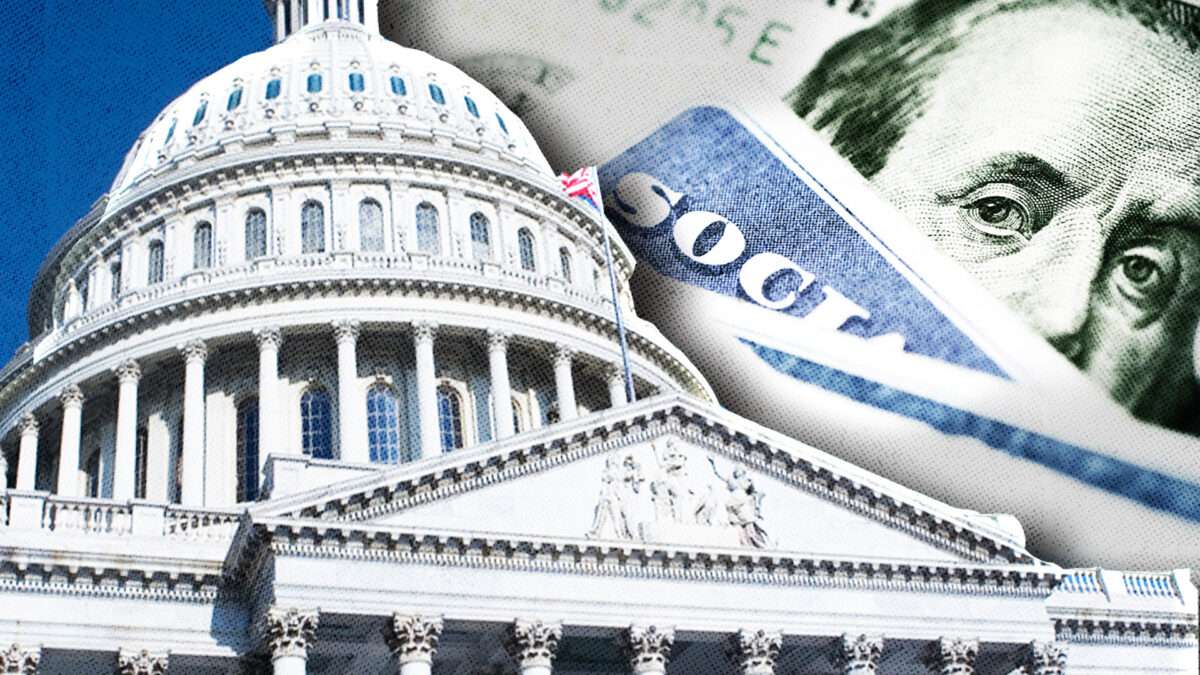
Capitol Building, with a Social Security card in the background | Robwilson39/Lane Erickson/Dreamstime

Social Security is racing towards insolvency because the program pays out more in benefits to retirees than it collects in taxes from working Americans.

Handing out even more generous benefits will make that situation worse. Yet that is exactly what the trustees who run Social Security are planning to do: Retirees will get a 3.6 percent cost-of-living adjustment (COLA) next year. That increase is 0.8 percentage points higher than last year's, and it is 0.9 percentage points higher than what Social Security was expecting to pay.

The Social Security trustees are doing what the law requires during a time of high inflation. That's why Congress ought to intervene here.

It should cancel the COLA.

No, this isn't a demand that lawmakers stick it to America's retirees. It's an appeal for some fiscal common sense. There are three good reasons to cancel this year's COLA.

First: Handing out higher benefits to wealthy retirees simply doesn't make sense when Social Security is trending towards insolvency.

As the Committee for a Responsible Federal Budget notes, the announced COLA would be a $900 increase in benefits for the average retired household—but some retirees could receive as much as $3,600 more.

Paying generous benefits to wealthy households is the main reason Social Security is facing insolvency in the first place. A program originally intended to keep seniors from falling into poverty has become a huge wealth-transfer scheme that overwhelmingly benefits those who don't need the handouts. The COLA doubles down on this flaw.

Second: What about the workers who are paying for those lavish benefits? Wages have risen by 3 percent, on average, over the past year. Those pay increases have already been outpaced by inflation, which is up 3.7 percent in the past 12 months.

You'll often hear retirees talk about how they are living on a "fixed income," but the math simply doesn't bear this out. Social Security beneficiaries will get a COLA that is larger than the average pay increase for the workers who are funding the COLA. Retirees are protected from the impact of inflation while younger Americans must deal with inflation and finance that protection for the elderly. That's crazy.

Third: Cutting the COLA could kick-start a conversation about how to solve Social Security's looming insolvency. The Social Security trustees estimate that an across-the-board cut of about 22 percent will be necessary in 2032. Eliminating COLAs won't meaningfully change that arithmetic, but it would change the conversation—which has for too long been dominated by politicians promising seniors that nothing needs to change. That's wrong—and the sooner that becomes apparent, the better off the political system will be.

If eliminating the COLA is too radical a change, Congress should instead change how the trustees calculate the annual increase.

Currently, the COLA is based on one particular measure of inflation: the Consumer Price Index for Urban Wage Earners and Clerical Workers, otherwise known as CPI-W. This is a relatively narrow index that reflects the spending habits of only about one-third of all Americans, as Romina Boccia points out in her newletter, The Debt Dispatch. 

Instead, Boccia suggests using the Chained Consumer Price Index for All Urban Consumers, or C-CPI-U, which covers about 93 percent of all Americans and is generally regarded as a better measure of the rising cost of living. Other parts of the federal government already use C-CPI-U to update such things as tax brackets.

If Congress simply changed how Social Security's COLA was calculated, it could close 12 percent of the program's long-term shortfall. And while some retirees would see smaller COLAs as a result, the result would more closely match those increases to inflation.

Social Security's COLA reflects many of the fundamental flaws with America's old-age entitlement program. Like Social Security as a whole, it is too generous to the rich, too costly to the taxpayers, and too unfair to younger, poorer workers.

The post 3 Reasons To Cancel This Year's 3.6% Social Security Boost appeared first on Reason Magazine.

  •  

Trump Has a 91% Disapproval Rating from Voters Under 30 on Inflation

by Mish Shedlock, Mish Talk: “The worst I have ever seen in any poll, on any issue for any president” Voters Under 30 Stats Inflation: Net Approve -82 Economy: Net Approval -64 Overall: Net Approval -50 TRUTH LIVES on at https://sgtreport.tv/ ‘Absolutely stunning!’ Data Analyst Stunned At Trump’s Disastrous 91% Disapproval Rating With Voters Under 30: […]
  •  

Hot US inflation singes Asia as higher-for-longer Fed rates loom

TOKYO — An unwelcome blast of US inflation is blowing across Asia’s markets. September’s hotter-than-expected price data revived concerns that the Federal Reserve will keep rates higher for longer, threatening fresh pressure on currencies, capital flows and economic growth across the region.

Last month’s 3.7% year-on-year increase in consumer prices didn’t just exceed forecasts. It ensured the Fed is on an even bigger collision course with both the bond market and US President Donald Trump’s White House. It’s arguably the last thing both Trump and US Federal Reserve Chairman Kevin Warsh wanted to see less than three weeks ahead of the mid-term elections.

To continue reading, please log in to your AT+ Premium account. Not yet a member? Please signup for AT+ Premium monthly membership, AT+ Premium yearly membership or AT+ Premium Access membership.

The post Hot US inflation singes Asia as higher-for-longer Fed rates loom appeared first on Asia Times.

  •  

The inflation conflagration is back and here to stay

Two years ago, central bankers on three continents all but declared victory over inflation. Markets took them at their word, and plenty of investors built their portfolios on the assumption that the price surge of 2022 was behind us. That assumption was wrong, and the consequences are now showing up in almost every major economy […]

The post The inflation conflagration is back and here to stay appeared first on Asia Times.

  •  

Brussels Rejects Italy and Greece’s Demands for Further Energy Budget Relief

The European Commission has rejected demands from Italy and Greece for additional exemptions from EU spending rules as the Middle East energy crisis drives inflation higher, exposing renewed divisions over how much financial assistance European governments can provide.

The European Commission has rejected requests from Italy and Greece for greater freedom to increase public spending in response to the energy crisis, resisting pressure from two member states that argue existing budget restrictions are limiting their ability to protect households and businesses.

The decision, confirmed on 8 October, follows renewed appeals from Italian Prime Minister Giorgia Meloni and Greek Prime Minister Kyriakos Mitsotakis for measures recognising the exceptional financial burden imposed by higher energy prices.

Meloni wants Brussels to take greater account of unexpected inflation when assessing national budgets and to permit additional tax revenue generated by rising prices to be used for energy relief. Mitsotakis has sought the exclusion of temporary support measures for consumers and businesses from the expenditure limits agreed under the EU’s fiscal framework.

Economic Commissioner Valdis Dombrovskis rejected the argument for further concessions, maintaining that the existing arrangements already take inflation into account and provide mechanisms for responding to exceptional circumstances.

The disagreement comes as Europe’s governments confront the economic consequences of the Middle East conflict, including higher fuel costs, inflationary pressures and increased demands for state intervention.

Italy’s increasingly difficult budget choices

For Italy, the dispute adds to a fiscal problem that has been developing throughout the year.

The government expects its budget deficit to rise to 3.4 per cent of GDP in 2027, reversing an earlier objective of reducing borrowing below the EU’s three per cent reference value.

As EU Today reported earlier this month, Rome plans to use additional fiscal room for defence and energy-related expenditure, while public debt is projected to remain close to 138 per cent of GDP.

The new request concerns the treatment of inflation and the financial support required to offset its effects.

Energy inflation creates an unusual budgetary problem. Governments can receive additional nominal tax revenue as prices rise, particularly through consumption taxes, while simultaneously facing public pressure to compensate consumers for higher living costs.

Meloni argues that such unexpected revenue should be available for targeted assistance without forcing equivalent reductions elsewhere in national expenditure.

Brussels is reluctant to accept arrangements that could turn temporary increases in tax receipts into an opportunity for permanent spending expansion.

Italy’s position also reflects the political competition between defence spending and domestic economic support. Rome has accepted the need for higher military expenditure but faces immediate pressure from households and energy-intensive industries.

That competition was already apparent when the government chose to prioritise energy relief over the full use of defence-spending flexibility.

Greece seeks different treatment for emergency support

Greece’s request is more narrowly focused on the treatment of temporary assistance under the EU’s expenditure rules.

Athens argues that measures intended to help businesses and households manage exceptional energy costs should not be counted against the normal spending limits.

The Greek government faces an economic environment in which higher imported energy prices threaten household purchasing power and business profitability, particularly in sectors dependent on transport and fuel.

Excluding temporary relief from expenditure calculations would give Athens additional room to intervene without breaching its agreed fiscal trajectory.

The Commission, however, has resisted establishing further exemptions beyond those already provided in the fiscal framework.

Its objection is institutional as well as financial. If additional categories of emergency expenditure are repeatedly excluded from fiscal calculations, the system becomes increasingly difficult to enforce consistently across the Union.

The limits of Europe’s reformed fiscal rules

The EU revised its fiscal governance framework in 2024, introducing nationally agreed expenditure paths intended to provide greater flexibility while maintaining sustainable public finances.

The Commission’s rules on exceptional circumstances permit member states to depart temporarily from normal requirements under specified conditions.

Those provisions have already been used to accommodate higher defence expenditure, while the Commission has also issued guidance on their application to energy-security investments.

Temporary financial assistance intended to reduce household energy bills, however, is not necessarily treated in the same way as investment in infrastructure that reduces Europe’s long-term dependence on imported fuel.

That distinction has become a source of friction between Brussels and national capitals.

Governments argue that the immediate economic effects of an international crisis require exceptional measures. The Commission is concerned that repeated concessions could weaken the credibility of the spending framework.

A wider dispute over Europe’s economic response

The Commission’s decision also comes as France faces increasing pressure over its debt and budget deficit.

The deterioration in French borrowing conditions has reinforced concerns about the risks associated with heavily indebted governments continuing to expand expenditure.

France, Italy and Greece have different fiscal positions, but the problems confronting them originate partly in the same combination of expensive energy, weak economic growth and competing spending commitments.

The dispute will now feed into preparations for the European Council meeting on 15–16 October, where energy prices and economic competitiveness are prominent agenda items.

EU leaders are expected to consider targeted and temporary measures to reduce the burden on businesses and consumers, alongside longer-term initiatives intended to reduce dependence on fossil fuels.

The Commission’s refusal to provide Italy and Greece with further fiscal exemptions establishes the limits within which those discussions will take place.

National governments remain free to introduce assistance, but Brussels is insisting that they account for its cost within the fiscal rules already agreed.

For Rome and Athens, the question is whether those rules provide sufficient room to respond to an energy crisis whose duration remains uncertain.

  •  

US enshittification vs Chinese involution

It’s getting better all the time (Better, better, better) It’s getting better all the time I admit it’s getting better –The Beatles In an X post, Marko Jukic, senior analyst at Bismarck Analysis, lamented: “Enshittification” is sort of a “safe horny” term for what is really just outright impoverishment and declining living standards due to […]

The post US enshittification vs Chinese involution appeared first on Asia Times.

  •  

Inflation in Greece surged to 5.1% in September 2026

Inflation in Greece surged to 5.1% in September, while the Eurozone average stood at 3.8%, the European Statistics authority EUROSTAT announced on Friday, October 2, 2026, based on preliminary data.. The Energy index rose by 14.1% Annual inflation in the Eurozone came in at 3.8% in September, up from 3.2% in August, while in Greece […]

The post Inflation in Greece surged to 5.1% in September 2026 appeared first on Keep Talking Greece.

  •  

Blame AI for global bond market tremors

The global bond markets are a sensitive lot. And they’ve been having a particularly tricky time lately. Spooked by high inflation, high interest rates and high levels of government debt across the world, those markets have become less stable over the summer. The prices of government bonds – what governments sell to investors – have gone down. […]

The post Blame AI for global bond market tremors appeared first on Asia Times.

  •  

Inflation in Greece rises to 3.8% in August from 3.4% in July

Inflation in Greece rose to 3.8% in August from 3.4% in the previous month, compared with an increase of 2.9% in August 2025, Greek Statistics Authority ELSTAT announced on Wednesday, September 9, 2026. According to ELSTAT, the development was largely driven by energy prices, as well as increases across a range of services. Price increases […]

The post Inflation in Greece rises to 3.8% in August from 3.4% in July appeared first on Keep Talking Greece.

  •  

Inflation in Greece climbs to 3.7% in August

Annual inflation in the eurozone is expected to rise to 3.3% in August 2026, from 2.9% in July, according to a preliminary estimate released on Tuesday, September 1, by the European statistical agency, Eurostat. Looking at the main components of eurozone inflation, energy prices are expected to record the highest annual increase in August (14.3%, […]

The post Inflation in Greece climbs to 3.7% in August appeared first on Keep Talking Greece.

  •  

Jamaat-e-Islami threatens sit-ins in Rawalpindi, Islamabad if protest permit denied

ISLAMABAD: The leaders of Pakistan’s Jamaat-e-Islami (JI) on Sunday warned of staging sit-ins in Rawalpindi and Islamabad if authorities refuse to grant permission for a public gathering in the garrison city, as the party escalates pressure on the government over rising fuel prices and inflation. Hafiz Naeemur Rehman, the emir of Jamaat-e-Islami, told a news ... Read more

The post Jamaat-e-Islami threatens sit-ins in Rawalpindi, Islamabad if protest permit denied appeared first on BOL News.

  •  
❌