Five people have been arrested in Cyprus, Germany and Italy as part of a European investigation into an alleged €114 million VAT fraud operation involving the cross-border smartphone trade.
The European Public Prosecutor’s Office (EPPO) announced on 16th October that three suspects had been detained in Cyprus, one in Germany and one in Italy following an investigation coordinated by its Munich office.
Investigators believe the suspects established and controlled a network of companies designed to exploit the tax treatment of goods traded between EU member states.
The alleged operation involved smartphone transactions through businesses and so-called missing traders operating in Germany, Albania and Sweden. Prosecutors estimate that the activities caused VAT losses of approximately €80 million in Sweden and €34 million in Germany.
According to the official announcement of the arrests, the operation forms part of a wider investigation known as Midas, which is examining organised cross-border tax fraud.
Searches across several countries
The arrests were accompanied by searches and seizures in Cyprus, Greece and Italy, conducted with the assistance of national police, financial investigators and tax authorities.
Prosecutors said 12 searches had been carried out at premises connected with the suspects and companies under investigation.
Assets of up to €80,000 were frozen, while investigators also seized or took action against bank accounts, vehicles and property.
The operation involved cooperation between Germany’s tax authorities, Cyprus’s financial intelligence and cybercrime units, the Greek financial police and Italy’s Guardia di Finanza.
The suspects are believed to have played leading roles in organising and controlling the alleged scheme, although prosecutors have not publicly established their individual criminal responsibility.
The investigation remains subject to proceedings before the competent German courts. All suspects are presumed innocent unless proven guilty.
How the alleged fraud operated
The case concerns a form of tax evasion known as missing-trader intra-community fraud, commonly described as carousel VAT fraud.
Under the EU’s VAT system, qualifying business-to-business transactions involving goods transported between member states are generally exempt from VAT in the country of dispatch.
The purchaser accounts for VAT under the rules applicable in the destination country, while subsequent domestic sales normally involve VAT being charged to the buyer.
Fraudsters can exploit those arrangements by establishing companies that purchase goods through cross-border transactions before reselling them domestically.
A missing trader collects VAT from the purchaser but fails to remit it to the relevant tax authority. Other companies in the transaction chain may then seek deductions or refunds.
The same goods can pass through several businesses and, in some arrangements, move repeatedly between countries, allowing the fraud to be repeated.
Smartphones and electronic equipment are particularly attractive because they are relatively expensive, easily transported and can be traded in large volumes.
The complexity of the arrangements makes investigations difficult when businesses are established in several jurisdictions and transactions move rapidly between companies.
A wider European problem
The latest arrests follow another substantial VAT fraud operation announced earlier this month.
That operation, known as Hermes, involved searches across eight countries and allegations concerning the sale of mobile phones and other electronic devices.
Although separate from Midas, the investigation illustrates the scale and organisation of suspected VAT fraud involving internationally traded consumer electronics.
According to the EPPO‘s 2025 annual report, prosecutors were handling 3,602 active investigations at the end of last year, with estimated potential damage exceeding €67 billion.
Of that amount, more than €45 billion related to suspected VAT and customs fraud.
Those figures concern estimated losses under investigation, rather than sums established by final court judgments or amounts that have already been recovered.
Protecting European tax revenues
The financial consequences extend beyond the immediate losses attributed to individual schemes.
VAT is a major source of revenue for national governments and forms part of the system used to calculate certain contributions to the EU budget.
Fraudulent transactions can also distort competition by allowing dishonest operators to offer prices that legitimate businesses cannot match.
The Commission’s 2025 VAT gap report estimated that EU countries failed to collect approximately €128 billion in expected VAT revenue in 2023.
That broader figure includes losses arising from several causes, including administrative errors and insolvency, and cannot be attributed entirely to criminal fraud.
The latest arrests also demonstrate the importance of cross-border investigative cooperation when suspected financial offences involve companies, transactions and assets located in different countries.
In the Midas investigation, prosecutors must now establish the precise roles of the suspects, prove the alleged transactions and determine whether criminal proceedings can result in convictions and financial recovery.
The arrests represent another stage in the investigation, not a judicial finding that the alleged €114 million fraud has been proved.
Britain is clamping down even harder on critics who consider Western foreign policy to have been a catastrophic failure. We are fast approaching the point where expressing an alternative opinion can land you in jail.
On the night of October 2, while exiting a flight from Moscow via Istanbul, I was detained by UK counter-terrorism police for three hours under the Counter-Terrorism and Border Security Act 2026. I had no right to remain silent, my person and possessions were thoroughly searched, I provided fingerprints and a DNA sample, and was required to give up my electronic devices and provide my passwords or face arrest.
This was a “suspicionless” detention. I was not suspected of anything, yet police officers were empowered to subject me to an intrusive examination to assess whether I was planning a “hostile act” against the United Kingdom.
An officer approached me and immediately took me into custody after I informed him that I had been to a conference in Russia to discuss geopolitics. I was not told why I was being detained, except that he wanted to ask me “a few questions.” Bizarrely, he pointed out that the “counter-terrorism” powers he was using “aren’t as scary as they sound.”
I had attended the International Valdai Discussion Club Conference in Moscow Region from September 27 to October 1, including attending President Vladimir Putin’s keynote address. I participated at the invitation of the Valdai Club, which provided my flight and accommodations, as is standard practice for foreign guest attendees at such international conferences.
The Valdai Club, founded in 2004, is primarily a meeting of academics from all over the world. Before the Russian invasion of Ukraine, it was attended by a former Head of MI6, former British Ambassador to Russia Sir Tony Brenton, and Fiona Hill.
Valdai has found itself in the British government’s crosshairs. Throughout September, a host of journalists and academics have received letters from the UK Home Office inviting them to register with the Foreign Influence Registration Scheme, if they are “being directed to carry out relevant activities in the UK as part of an arrangement with a foreign power.”’ Non-compliance with the scheme is considered a criminal offense.
British journalist Mary Dejevsky, who was The Times Bureau Chief in Moscow in the 1990s, is the latest to receive such a letter as a publicly listed contributor to the Valdai Discussion Club, though she has not attended since the war began. The idea that if you attend an academic conference you are being directed by a foreign power is patently absurd. Nevertheless, and given the obvious risks, I wrestled with the dilemma of whether I should accept the invitation from Valdai and make my first visit to Russia since I drove out of that country in February 2019 at the end of my four-and-a-half year diplomatic posting there.
My primary role then was as the Economic Counsellor responsible among other things for sanctions policy. After my return to the UK, I authorized around 1000 sanctions against Russians, including after the war broke out.
I had some concerns that my role in sanctions may cause me problems once inside Russia (indeed, I was subjected to an extremely stressful four-and-a-half-hour detention and interrogation by the FSB upon arrival in Moscow).
Sir Tony Brenton, with whom I had consulted, suggested that I should attend, saying that Valdai was an “excellent event.” Upon his advice, I notified the UK Foreign Office, underscoring my commitment to abide by my obligations under the Official Secrets Act before I left for Moscow. This included confirmation that while Valdai had paid for my flights, I had not received any payment for my attendance.
I served as a British diplomat for 24 years and I take seriously my ongoing commitments to preserve the secrets that I had access to during that time. The suggestion that I might plan a hostile act against Britain is offensive and wrong. However, since my retirement in 2023, I have been an outspoken critic of the direction of UK foreign policy towards Russia, notably the departure from diplomacy in favor of war.
The important and necessary precautions that I had taken were insufficient to prevent me from being detained with fewer rights than had I been formally arrested and cautioned. I am of the view that security figures in London had authorized the action against me ahead of time. Indeed, Russia commentator Mark Galeotti suggested on his podcast that the system was “making a statement” by acting in this way.
(Editor’s Note: A request by RS to the UK’s Counter Terrorism Policing for comment about the author’s detention — for which he provided RS with documentation – went unanswered as of this writing.)
My detention marks the latest escalation in the British state’s war on free speech. Increasingly, people who speak out publicly against forever wars — not only in Ukraine, but also in the Middle East and elsewhere — are seen as a threat to national security that must be quashed.
Airport detentions are one step short of full-blown imprisonment, of course, but this pattern of intimidation has been spreading over the past four years.
British conservative academic and author John Laughland was detained at an airport for one hour in 2022. The late Robert Skidelsky, a member of the House of Lords and esteemed British economist, and investigative reporter Kit Klarenberg were subject to more lengthy and rigorous detentions in 2023. Klarenberg still has not received back an SD memory card that was confiscated at the time.
Professor Richard Sakwa, Emeritus at Kent University, was detained for three hours at Heathrow in 2025; he has only been able to return to Russia since that time following an intervention by his lawyer. George Szamuely, a Hungarian-born British political analyst, was detained in March 2026.
In 2023, Craig Murray, former British ambassador to Uzbekistan, was detained for an hour at Glasgow Airport under the tougher provisions of the Terrorism Act 2000, which is concerned with activity related to the commission, preparation and instigation of acts of terrorism. His phone was not returned to him afterwards.
Investigative journalist Richard Medhurst was arrested for making statements in support of a proscribed pro-Palestine organization and held for 24 hours before his release. His home and office in Austria were subsequently raided in February 2025 and he was accused of membership of Hamas. To date, no charges have been laid against him.
More broadly, in Britain, the group Palestine Action has been proscribed as a terrorist organization following widespread protests against the gross violations of international humanitarian law by the Israeli state in Gaza. Elderly people, including Holocaust survivors, have been arrested at Palestine Action protests for the crime of holding cardboard placards.
The practice of suspicionless airport detention is uncommon in European states, although alternative, more insidious forms of repression of free speech are employed. Former Swiss military intelligence officer and author Jacques Baud remains in Brussels, de-banked and unable to travel home, having been sanctioned by the European Union for “pro-Russian propaganda.”
This past week, Russian-born journalist and former BBC reporter Leonid Ragozin was declared persona non grata by Latvia, where he has lived since the onset of the Ukraine crisis. Having criticized the direction of Western foreign policy toward the war in Ukraine, he has also been a regular Putin critic and described the 2022 invasion of Ukraine as “criminal and irrational.”
This pattern of repressing free speech in Britain and more broadly in Europe is growing. I fear that the more obvious it becomes that the war in Ukraine cannot be won by the West and that Israel cannot remain insulated from international censure over its actions in Palestine, actions by the British state may become even harsher.
We are reaching the point where offering an opinion on the perilous state of Western foreign wars can land you in prison.
I thought I had been careful in notifying the British government before my sole visit to Russia since 2019. If the UK is at the point where former diplomats can be detained and have their property temporarily confiscated, then no one is safe from the long arm of lawfare.
Upon my return from Valdai, I wrote again to the Foreign Office, offering to brief them in full on the insights I gained while I was in Russia. To date, they have not replied.
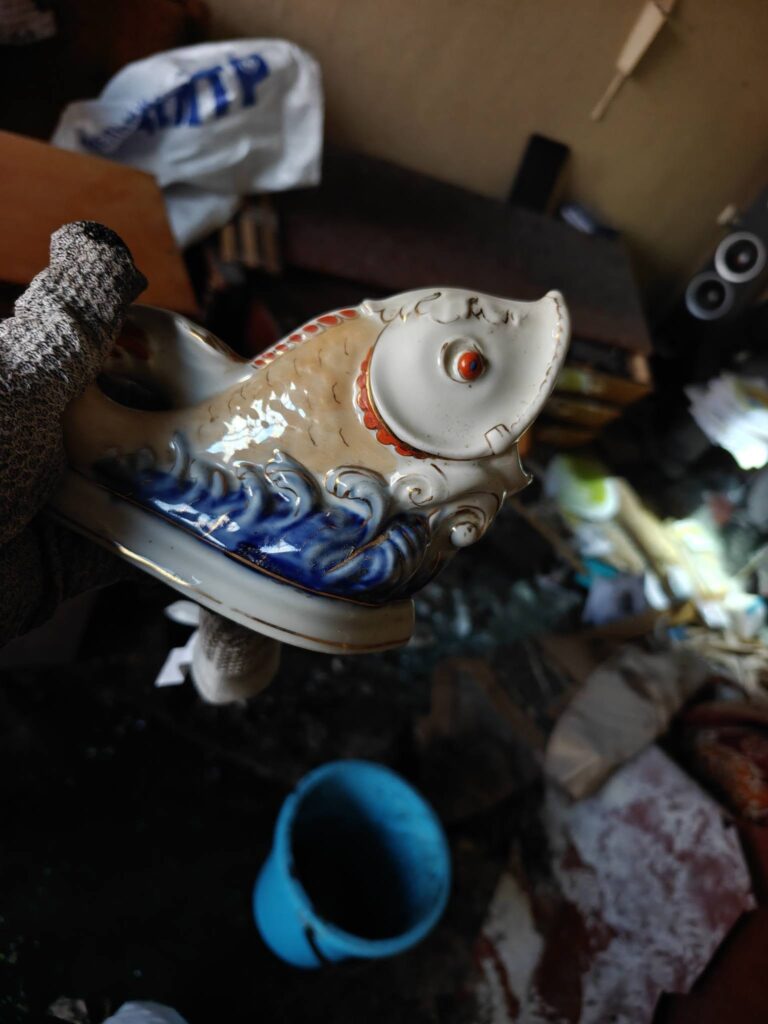
A porcelain fish survived the Russian strike that destroyed a room in the Kyiv apartment of Andrii Dubenko, a volunteer, dentist, and medic, his cousin Anna Danylenko wrote on Facebook and told UP Life, the lifestyle site of Ukrainska Pravda. Dubenko and two others were inside the nine-story building in Lisovyi masyv when the 13 October strike hit. It killed other residents.
The strike came during a ballistic attack aimed mainly at CHP-4, one of Kyiv’s main power plants, Ukrainian President Volodymyr Zelenskyy said, two days after Washington announced an energy ceasefire that Moscow never confirmed.
Lifted out in a rescue basket
Dubenko, his girlfriend, and a 72-year-old aunt were inside when the blast hit, Anna told UP Life. Her family was lucky, she wrote, and the rule of two walls saved their lives. The rule tells anyone who can’t reach a shelter to keep at least two walls between themselves and the street, away from windows. Fifteen minutes after the blast, State Emergency Service rescuers lifted the three out in a basket, Anna wrote. The aunt comforted the girlfriend, telling her not to live in the past but to look to the future, Anna said.
The porcelain fish that survived Russia’s 13 October 2026 strike on an apartment building in Kyiv’s Lisovyi masyv. Photo: Anna Danylenko/Facebook
A hole where the window was
“Just on Monday I was sitting in their cozy apartment, where I grew up, and now I’m looking into a hole that just two days ago was a window,” Anna wrote.
She gathered what was left of the tea set the family used for samovar tea while her grandmother was alive. “It was my anchor, the anchor of our family,” she wrote. The porcelain fish survived. Her mother used to play with it, and Anna now calls it the “fish of unbreakability.” UP Life likened it to the ceramic rooster that survived in a wrecked kitchen in Borodianka, Kyiv Oblast, in 2022 and became a symbol of Ukrainian resilience.
The family didn’t sleep that night. Firefighters were still putting out the blaze overnight, so they could only get back inside in the morning.
“Charred ruins, lots of water in the hallway, which burned out. People are throwing broken things out the window, down by the building. The smell of burning is everywhere,” she told UP Life.
Further exclusive extracts from Chris Morrison's new book on the invented 'climate crisis' are published today on the Daily Sceptic. Read about the role of the BBC and Met Office in driving the hysteria.
 Login




 , X
 , and VK
 .