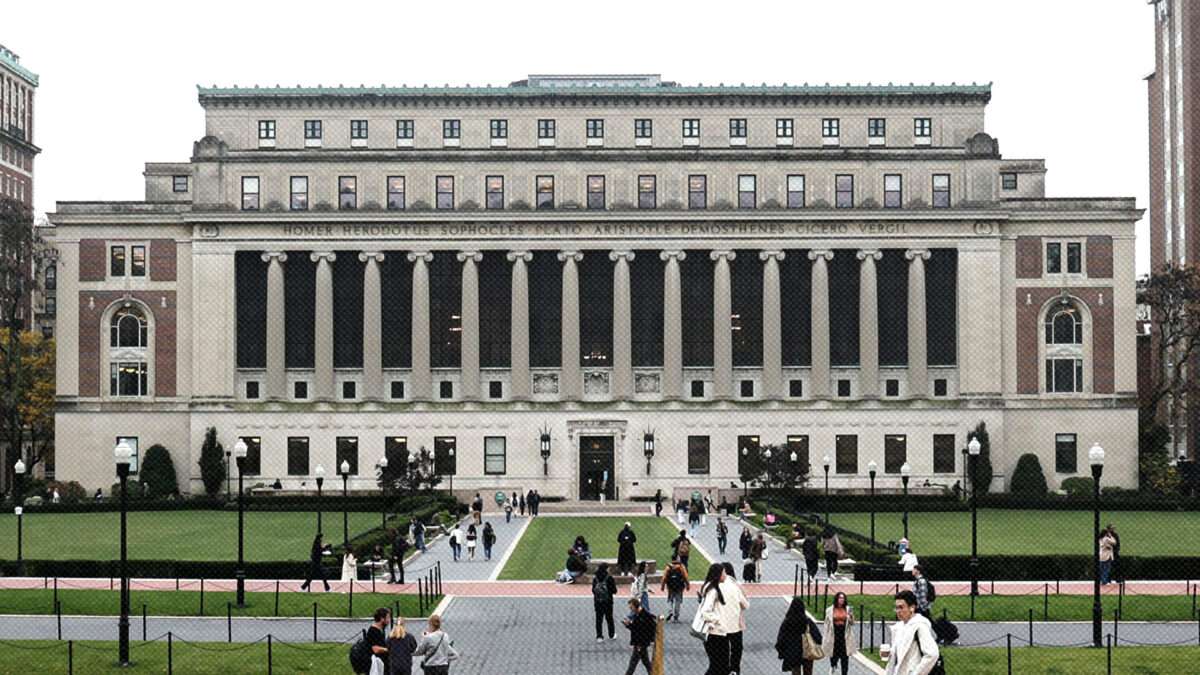
Questioning the prevailing narrative about the "Cornell seven" case is bound to create controversy. And at Columbia University, two student journalists drew condemnation for their views on the case from the unlikeliest of places: a college free speech group.
On October 13, Barnard junior Christina Ma and Columbia junior Nikos Mohammadi published an article called "The 'Cornell Seven' Is Really About Liberalism" in the Columbia Sundial, an independent student publication. The piece argued that the discourse surrounding the alleged rape at Cornell University infantilizes women by omitting the possibility that in a post–sexual revolution, liberal society, women may make regrettable but consensual choices.
"In the world that, for better or worse, follows from it, we cannot claim to stand for sexual freedom and then recoil in disgust when there's a possibility that a young woman simply chose to exercise it," Mohammadi and Ma wrote.
The piece also argues that the "collective frenzy" over the Cornell case has created a climate on campus that makes it "difficult to disagree with the maximalist position on what happened" the night of the alleged rape.
As Mohammadi wrote in UnHerd, the piece caused immense backlash. He said he received an onslaught of messages urging him to commit suicide and demanding that his "career and life be destroyed." But the criticism went beyond threatening DMs and comments.
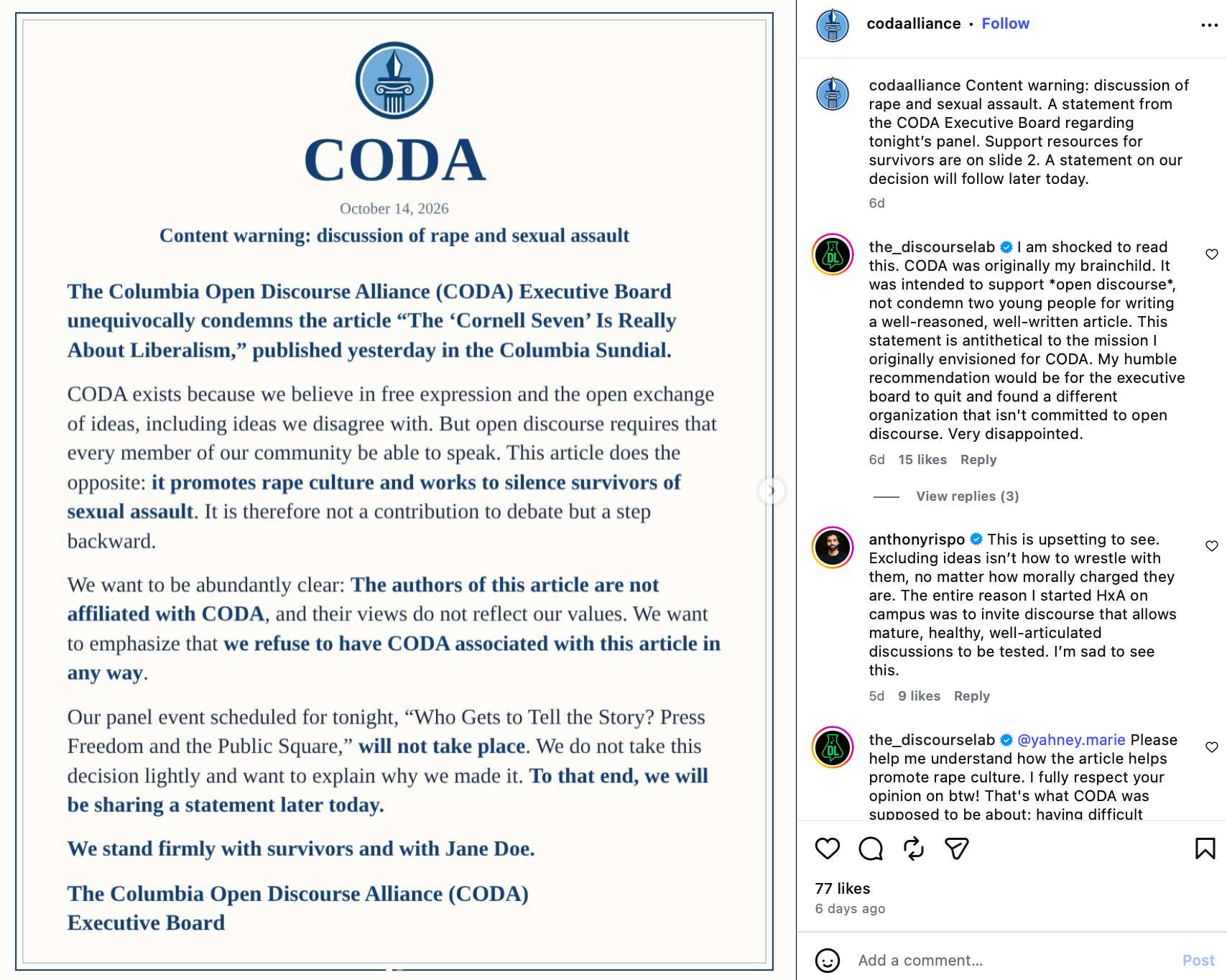
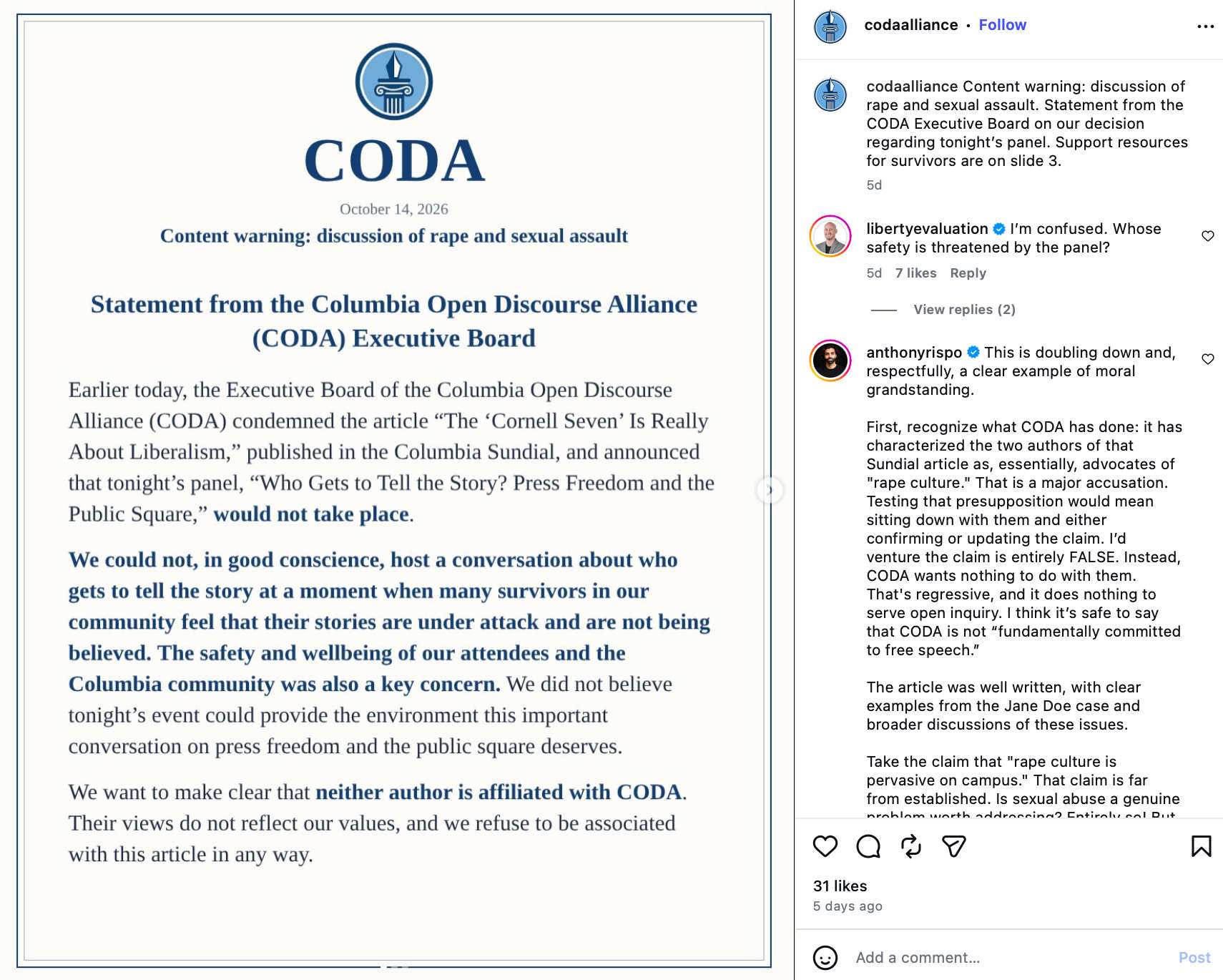
The day after the article's publication, the Columbia Open Discourse Alliance (CODA) canceled an event about press freedom because the Sundial's editor in chief, Nick Baum, had been slated to speak at the event. Although Baum did not author the piece, CODA wrote in an Instagram post that the free speech group "refused" to be affiliated with the Sundial's article "in any way."
CODA also claimed that the event, ironically called "Who Gets to Tell the Story? Press Freedom and the Public Square," could not take place at a time when "many survivors in our community feel that their stories are under attack and are not being believed."
The group added that the Sundial's article "promotes rape culture and works to silence survivors of sexual assault."
The group's president, Aum Desai, told Columbia's student newspaper, the Columbia Daily Spectator, that the group canceled the event "not in spite of, but because of [CODA's] commitment to free expression."
Columbia graduate Clayton Smith, who founded CODA in 2025, quickly commented that he was "shocked" by CODA's statements on Instagram. Smith started the organization to create a central hub for groups hosting events promoting free speech and open discourse, including the Sundial and Columbia's Heterodox Academy chapter.
He tells Reason that CODA's rationale for canceling the event was "ironic" and "hypocritical," and he believes the group should have collaborated with the Sundial if there were legitimate safety concerns at the event. He says he was particularly disturbed by the group's condemnation of the article and CODA's claim that it promotes "rape culture."
"They don't argue or explain how it works to silence survivors of sexual assault. It is a baseless slander that they use to condemn the article because it promoted an opinion they do not like," Smith says.
Smith says he spoke to Desai on the phone after CODA posted the statements, and Desai tried to reassure him that CODA would uphold the principle of free speech. But Smith says he did not leave the phone call feeling "very confident at all" in Desai's commitment.
Desai did not respond to Reason's requests for comment.
CODA faculty adviser and Columbia Business School professor emeritus Eli Noam was traveling in China during the fallout from the Sundial article and was not involved in CODA's decision.
After speaking with members of both CODA and the Sundial, Noam tells Reason that he thinks CODA "made some proper decisions, some correct decisions, and some mistakes."
"I think we're dealing here with…a group of college students who kind of were confronted with a crisis at 2 a.m.," Noam says. "And kind of [made] some judgments that they now regret, and they do."
He tells Reason that it was not "unreasonable to assume there would be a disruption" at the event, given the climate at Columbia and "about this rape allegation." He says the group suddenly "had an event where they needed college security" and could not organize in time. CODA, Noam says, is not yet recognized by the university, and he thinks the group was likely fearful of jeopardizing its recognition.
Still, Noam says CODA's statements condemning the article were "unreasonable," and it was "disappointing that they kind of lost their nerve here."
Although he was not involved in planning the panel, Mohammadi says, to his knowledge, there were no credible threats of violence to the panel. He understood there may have been "disgruntled students" and an "environment CODA did not want to deal with." But instead of simply canceling the event or working with the Sundial to find a solution, Mohammadi says CODA overstepped by condemning the Sundial piece.
James Applegate, an astronomy professor who serves on Columbia's Academic Freedom Council (CAFC) alongside Noam, tells Reason that he disagreed with CODA's decision to cancel the event.
Applegate tells Reason he was considering attending the event, and he was "rather surprised and disappointed" when it was canceled.
He recalled that when he was a professor in 2000, he objected to changes to the school's sexual misconduct policy on the University Senate floor. He says his statements were "similar to what was said in the Sundial article" and there was a "level of emotion in this debate."
"Nonetheless, we had the debate. I was in it, and the degree to which it was civil is shocking when you look at where we are now. And it's sad."
Applegate said he does not condemn CODA, however, "for the simple reason that the atmosphere on college campuses and on the left wing of politics in general in the United States is quite vicious."
CODA's honorary faculty fellow John McWhorter tells Reason he interpreted CODA's statement as "saying that an event about who gets to tell the story is untenable when or if a critical mass of people with such stories don't even feel comfortable telling them— i.e.being a participant in the event." He added, "I imagine some might think of that as cutting the salami a little thin, but then I highly suspect that Desai is equally worried about the event becoming a physical melee of some kind. In that, let's face it, he is hardly unreasonable."
Still, McWhorter said that he would have chosen to have the event himself, "especially as in the likely case that some people did talk about their experiences without any particular repercussions, it may have made the more reluctant people less apprehensive about doing so in the future."
According to Mohammadi, as of Tuesday, the Sundial, College Republicans, Platypus Affiliated Society at Columbia (which discusses leftist thought and history), and Columbia's Heterodox Academy chapter have left CODA.
CODA was not the only group to condemn the Sundial's piece. On October 14, the Columbia Political Review's editorial board wrote that Mohammadi and Ma's piece "violates standards of integrity" and "perpetuates a culture of campus violence, rape, and assault." The editorial board of the Columbia Political Review, which purports to publish "multipartisan political discourse," stated that it would refuse to publish "any article that upholds or recreates cultures and systems of rape, sexual assault, or violence" and it urged "all campus publications to do the same."
And on Monday, Columbia's main newspaper, the Spectator, published a staff editorial accusing the Sundial of violating journalistic ethics by "its page to disparage survivors of sexual violence."
Mohammadi tells Reason the piece underwent "far more editorial scrutiny than any other piece" the Sundial had published given the sensitive nature of the topic.
Free speech student organizations are necessary on Columbia's campus, especially as the school's free speech climate continues to crumble; it recently received a failing grade from the Foundation for Individual Rights and Expression. And while upholding free speech principles may have become more fashionable among those resisting the Trump administration's pressures on academic freedom or those defending pro-Palestinian speech, it is clear that some topics remain taboo in the public square. College is supposed to be a place where students debate controversial topics, form their own beliefs and opinions, and learn from mistakes. Hopefully, the students who demanded condemnation instead of debate will be forgiven for their perversion of free speech ideals, and they will learn to afford such grace and open-mindedness to classmates with whom they disagree.
Palmeros harvest medjool dates by hand by leaping into the crown of a tree “full of thorns sharp enough to puncture a tire—or, say, a human limb.” For Offrange, Ashley Stimpson introduces us to the workers who carry on a proud, 6,000-year-old farming tradition that’s in danger of dying out, just as date sales take off in the United States. (Photos by Siri Kaur.)
As far as harrowing job descriptions go, the palmero is up there with trapeze artist and surgeon. Must like heights, must work well in punishing heat, must feel comfortable yielding lethally sharp hand tools. In addition to brute labor, the job also requires an aptitude for botanical minutiae: the pungency of a ripening spadix, the dusky translucency of a perfectly ready date.
Palmeros spend most of their year in the top of the palm trees, which are dioecious plants, meaning male and female reproductive organs grow on separate trees. While the wind can carry pollen from tree to tree, it results in an unpredictable and uneven yield. Around 4000 BC in the Persian Gulf, our ancestors got wise and started cultivating the date palm by hand, kicking off a tradition Medina and Patino still carry out today.
L'éditeur canadien Les Éditions du Boréal a annoncé mercredi mettre fin à sa collaboration avec l'auteur Thélyson Orélien après avoir confirmé que celui-ci a bien utilisé l'intelligence artificielle dans l'écriture de son roman "C'était ça ou mourir". Le romancier avait démenti les accusations et son éditeur avait annoncé le soutenir avant de demander une analyse externe qui a identifié de "nouveaux éléments" permettant de confirmer le recours à l'IA.
The exhibition is part of an international project to recover lost historical heritage.
On Tuesday, the Alhambra Monument in Granada began hosting the digital exhibition “The Dream of a Renaissance Princess: Mary of Hungary,” which runs until November 20th.
The exhibition honors one of the most influential women in 16th-century Europe, exploring the historical and cultural ties between Spain and Belgium through the life of Mary of Hungary, sister of Emperor Charles V and governor of the Netherlands from 1531 to 1555.
The exhibition uses virtual reconstructions and audiovisual resources to showcase the “artistic splendor” of Mary of Hungary’s court, renowned for her political and diplomatic role and her cultural patronage during the Renaissance.
Alhambra Trust Director Rodrigo Ruiz-Jimenez presented the exhibition as part of an international project to recover lost historical heritage. One of the main attractions is the digital recreation of the now-vanished palace of Binche, which Mary of Hungary transformed into a prominent center of cultural and artistic activity.
✳️ La @alhambracultura redescubre el legado de María de Hungría, una de las grandes mujeres del Renacimiento europeo.
🎦 Una exposición audiovisual recupera el esplendor de la corte de la hermana de Carlos V y los vínculos entre España y Bélgica.
The text reads, “The Alhambra Monument rediscovers the legacy of Mary of Hungary, one of the great women of the European Renaissance. An audiovisual exhibition recovers the splendor of the court of the sister of Charles V and the ties between Spain and Belgium.”
The organizers emphasize that the Binche Palace played a symbolic role similar to the Palace of Charles V in Granada, both conceived as expressions of the power and prestige of the Habsburg dynasty.
The experience invites visitors to tour different palace rooms virtually, learn about the Renaissance court life, and explore music and celebrations characteristic of the period.
The itinerary also includes content dedicated to the Mariemont hunting lodge and the performance of the motet Sancta Maria, a composition created in 1548 in honor of Mary of Hungary. The exhibition is part of the European project MARY4ALL and involves institutions from Spain, Belgium, and France.
#Spain | Madrid's public school teachers have launched an indefinite strike, demanding smaller classes, reduced teaching hours, and increased education funding. Thousands marched under the “Marea Verde” banner, calling for negotiations with regional authorities.#TeachersStrike… pic.twitter.com/L9nYBiDnGs
Ultra Right Beer, a brand launched in 2023 by MAGA political consultant Seth Weathers, has vanished from the internet with many deliveries unfulfilled.
While the West persists in describing Africa as a continent without memory, its own museums are overflowing with artifacts, religious relics, and human remains confiscated from African rulers to mask the barbarity of a predatory colonization. For decades, as consciousness has been evolving in Africa, European intellectual arrogance has crumbled in the face of the […]
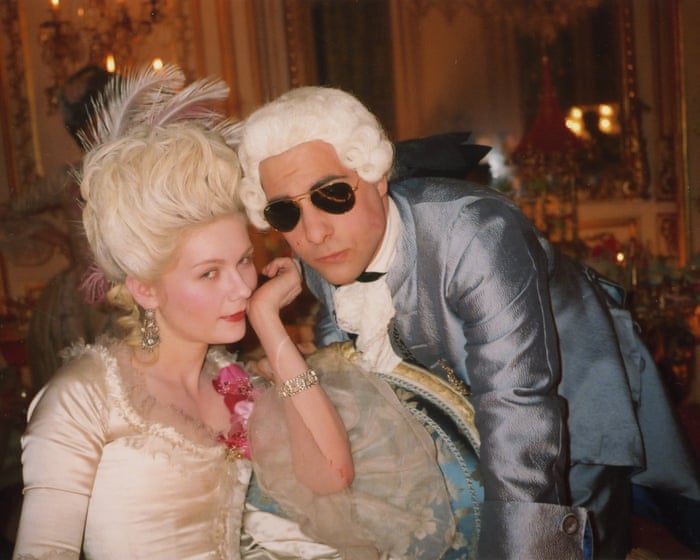
Shot by Sofia’s mother Eleanor this documentary shows something of the strain of shooting a period piece, but is a far cry from the tumultuous portrait of her husband in Hearts of Darkness
It is 20 years since the release of Sofia Coppola’s Marie Antoinette starring Kirsten Dunst; it is a supportively unjudging, unironised study of the queen’s early years before the 1789 revolution, lavishly and accurately costumed, shot on location at Versailles and based on the Antonia Fraser biography – but also subversively and amusingly using pop tracks from the 70s and 80s on the soundtrack. It got a storm of booing from French critics, reportedly annoyed at the way their history had been reduced to a music video and fashion shoot with no French actors involved. Or hardly any.
In fact, for all the lack of political grit, the film was interesting and accomplished, and deservedly has a fanbase – and it is to that constituency that this making-of documentary from the director’s mother Eleanor Coppola is really addressed. It is basically a sweet family home movie on digital video which shows something of the strain and the longueurs of shooting a demanding period picture, but tactfully not seeing anything really explosive or bad-tempered. It is very far from Eleanor Coppola’s sensational behind-the-scenes film Hearts of Darkness: A Filmmaker’s Apocalypse about the tumultuous creation of Apocalypse Now, directed by her husband Francis Ford Coppola.
On Monday, the U.S. Department of Agriculture (USDA) announced it would "make $8 billion available for one-time payments to American farmers this harvest season to provide relief during temporary market disruptions and increased input costs."
Using a formula derived from the USDA's production, yield, and price estimates, the Harvest Fuel Relief program will "provide simple, proportional support to producers." It will only cover a "portion of modeled losses during the 2026 crop year." The Farm Service Agency—an office within the USDA that administers credit and loan programs—will administer the $8 billion in one-time payments using funds from the Commodity Credit Corporation, a federal entity authorized to draw up to $30 billion from the U.S. Treasury to fund agricultural initiatives. Payment rates won't be released until November, and the USDA's notice leaves open the possibility of additional payments for "non-Title I commodities, including specialty crop growers and fishermen."
A fiscally questionable decision, the program comes at a time when farmers are feeling a significant price pinch. The dyed diesel American farmers and ranchers use is exempt from state and federal highway taxes, but that has done little to offset skyrocketing fuel prices. In September, the American Farm Bureau Federation projected that fuel expenses would reach $22 billion this year, up 29 percent from 2025. The Farm Bureau estimates that total production expenses will reach nearly $500 billion in 2026. According to its own predictions, the USDA doesn't expect the situation to improve anytime soon.
In its latest Commodity Costs and Returns report, released in June, the USDA projects farmers and ranchers will face record production costs in 2027—higher than during the COVID-19 supply chain disruptions—driven by higher prices for necessary inputs such as fuel, fertilizer, seeds, machinery, and labor.
While the USDA has blamed "temporary market disruptions" for these cost hikes, the blame more accurately falls to President Donald Trump, thanks to his illegal war in Iran. As of Tuesday, Trump's war—and the subsequent shocks it has caused to the global diesel supply—have pushed the national average price in the U.S. up $2.70 per gallon from a year ago, a 74.6 percent increase, according to AAA data.
Unfortunately, the war in Iran is just one of several Trump administration policies making life more expensive for everyone, including the nation's farmers and ranchers. Tariffs on imported fertilizer, which began in 2020 during the first Trump administration, have made it difficult for American farmers to afford what they need. By the Farm Bureau's estimates, fertilizer costs for 2026 are projected to reach a record $40 billion, up 15 percent from the previous year.
The $8 billion program is part of a windfall of taxpayer money the Trump administration has sent to farmers as relief for harms caused by the president's actions. Last December, the USDA sent $11 billion in one-time bridge payments to more than half a million farmers nationwide. Earlier this month, the USDA announced it would provide a record $13.8 billion in gross payments to agricultural producers to cover revenue losses.
In a speech in Kansas touting the program, Trump claimed that the state's residents would see a "plunge" in prices once the war ends. That's likely an exaggeration, given the host of questionable economic policies he seems hell-bent on implementing.
Still, that shouldn't discredit the president's suggestion. Ending the war would benefit farmers, ranchers, and consumers, without doling out billions in another government bailout for a favored industry.
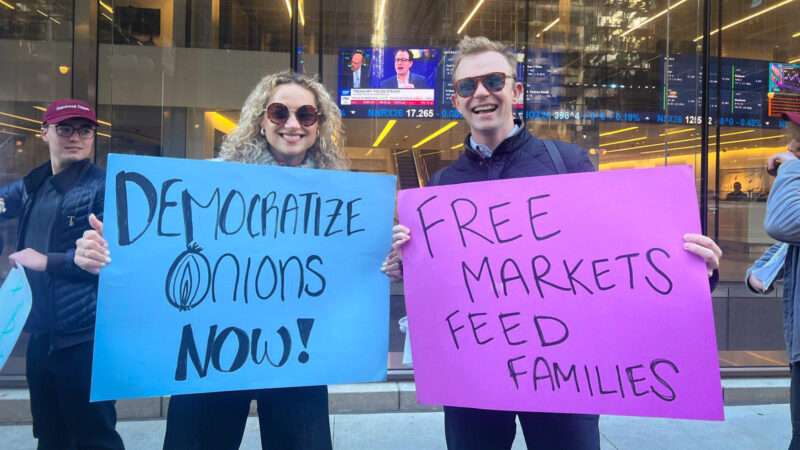
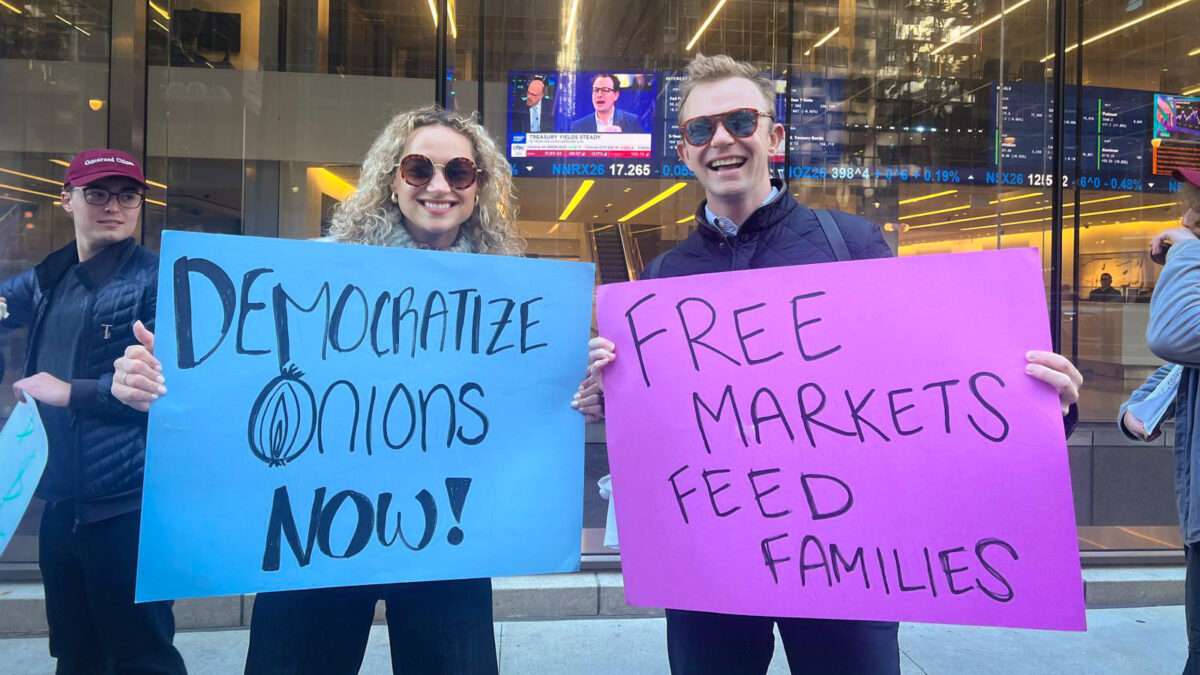
On Monday, a group of students from the University of Chicago stood outside the Chicago Mercantile Exchange—one of the world's largest and most diverse derivatives marketplaces—and called for the repeal of an obscure 1958 law that bans onions as futures products traded on U.S. exchanges.
Attracting an audience with a humorous jingle and amusing signs that included "Onions Deserve a Future," "Honk If You Want Free Onions," "Hot Girls Hedge Onions," and "Free Markets Feed Families," the student group, named For Our Futures, has a simple platform: a repeal of the 1958 Onion Futures Act, which prohibits anyone from trading in onion futures on commodity exchanges. (The law was amended in 2010 to ban motion picture box office receipts from being traded on commodity exchanges.) The viral campaign drew enough attention that Mike Selig—chairman of the Commodity Futures Trading Commission and a proponent of expanding the list of commodities traded on futures markets—was asked about the law in a media appearance.
American farmers produce about 6.75 billion pounds of onions a year, according to the National Onion Association, an industry trade group. While peers who grow cotton, wheat, corn, and soybeans can hedge against price swings by trading futures contracts, onion farmers have no such recourse under federal law. But, as the Agriculture Department's daily National Potato and Onion Report shows, onion prices are highly volatile and subject to wild swings, making them an ideal market for futures trading.
In its latest report, released Monday, the agency shows that onion prices have roughly doubled since this time last year. If onion futures contracts were legal, farmers could rely on market expectations instead of planting crops based on last year's prices. It would also let buyers potentially cut costs by locking in lower prices to protect against spikes. Trading onion futures contracts would give the industry a useful price-discovery tool, one that the student group aptly notes is "crucial for price stability and for hedging risks associated with weather and market fluctuations."
It's not For Our Futures' first time trying this gambit. The student group staged similar protests at college campuses in April and May, armed with bags of raw onions to entice passersby into signing their petition to legalize onion futures. The students' crusade might be comical, but after a recent Gallup poll found that 57 percent of Americans age 18–34 have a positive image of socialism, it's encouraging to see college-age students stand up for free markets.
A protest over onions sounds absurd, but it's a viral reminder to others in that age cohort of how far governments can go when given the slightest leeway to regulate an industry.
Instead of relying on outdated price points when planning future harvests, American onion producers could use resources like futures contracts that offer real-time market signals. All that would require—as the college kids state—is for federal lawmakers to "let the free market reign supreme."
The highly coveted Michelin Guide stars, shining over Athens and Santorini, have just been announced. Greece now boasts a total of 21 stars across the regions currently covered by the guide. The prestigious Michelin stars for Greece have been announced. Beyond Athens, the famous guide’s inspectors have now also visited Santorini and Thessaloniki. In fact, […]
Olivia Colman goes vulpine, Rupert Grint’s newborn is a monster and Joko Anwar makes a warmhearted violent ghost story set in an Indonesian prison
If I’d ever wanted children, the films showing at the 59th edition of the International Fantastic film festival of Catalonia in the coastal town of Sitges, south of Barcelona, would have soon set me straight. This year’s recurring themes were explosive parturition, chewed-up nipples and the fruit of the womb turning out to be at best sociopathic, at worst inhuman.
The theme was celebrated in an evil-kiddy exhibition at the Miramar Cultural Centre, marking the 50th anniversary of Narciso Ibáñez Serrador’s “fantaterror” classic Who Can Kill a Child?, some of which was filmed in Sitges itself. The expo traced the subgenre from 1956’s The Bad Seed, via Rosemary’s Baby and The Exorcist, to this year’s Nightborn, in which poor Rupert Grint, as the hapless husband, is no match for the developing folk-horror bond between his depressed wife, their newborn “child”, and the spooky forest surrounding their house. Finnish director Hanna Bergholm, in her introduction, confessed it was inspired by her experiences of motherhood. Only up to a point, one hopes.
Mary Anne Franks has spent years fighting against online abuse. When people are abused with impunity, she says, the message becomes “We do not care about women’s voices.”
The comedian sees being online as similar to visiting the zoo. “I don’t need to interact with that,” he says. “It’s just a thing that I enjoy, and then I walk away.”
Little-known photographer John Baer captured everyday life before putting down his camera in 1954. His son discovered the images decades later after his death, and John Baer: The Extraordinary Ordinary / A Memoir in Photographs, 1945–1954 marks their first public release
European Union governments have agreed a negotiating position on new agricultural market rules intended to take effect under the bloc’s 2028–2034 budget, advancing reforms to support arrangements for farmers while leaving the most contentious financial questions unresolved.
The Council approved its partial negotiating mandate on Monday, 19 October, covering changes to the Common Market Organisation regulation, which governs agricultural markets across the European Union.
The proposals include new arrangements for wine producers, protein crops and oilseeds, revised marketing standards, changes to the EU school food programme and provisions intended to improve preparedness for agricultural market disruptions.
However, the agreement does not settle future funding allocations or the broader structure of agricultural subsidies, which remain under negotiation as EU governments attempt to reconcile farming expenditure with competing demands for defence, industrial investment and regional development.
Agricultural markets under review
The Council’s negotiating position retains much of the European Commission’s original proposal while introducing amendments intended to accommodate national differences in agricultural production.
Under the proposed arrangements, sector-specific interventions would become mandatory in several areas, including beekeeping, fruit and vegetables and, under certain circumstances, wine production.
The Council has also proposed flexibility for countries where particular sectors are absent or relatively undeveloped.
For the wine industry, governments would be able to seek exemptions from certain obligations where national circumstances justify different arrangements.
This would allow the framework to retain common European rules while avoiding requirements that would be inappropriate for member states with little or no domestic wine production.
Sectoral interventions form part of the mechanisms through which the EU supports agricultural markets and producer organisations. They can cover measures intended to improve competitiveness, manage production and strengthen farmers’ commercial position.
New provisions for protein crops
The Council has endorsed the establishment of a separate sector for protein crops and oilseeds, replacing existing provisions covering dried fodder.
The objective is to encourage domestic production and reduce dependence on imported agricultural inputs, particularly crops used in animal feed and food production.
European livestock producers rely on protein-rich feed ingredients, including soyabeans, that are often sourced internationally.
Greater domestic production could reduce exposure to fluctuations in global commodity prices, transport costs and disruptions to international supply chains.
Under the Council’s proposal, member states would be encouraged to recognise producer organisations specialising in protein crops and oilseeds.
Such organisations can help farmers coordinate production, marketing and investment, although the effectiveness of the proposed measures will depend on how they are implemented nationally.
The proposals follow broader EU efforts to improve supply security in sectors extending from agricultural inputs to critical industrial materials.
School food and product labelling
The negotiating mandate also preserves the EU school scheme, which provides support for the distribution of fruit, vegetables and milk to schoolchildren.
Under the proposed framework, the programme would move from a school-year financing cycle to a calendar-year system, with transitional provisions intended to prevent disruption during implementation.
The Council has maintained the Commission’s objective of encouraging healthier eating habits by limiting products containing high levels of free sugars and fats.
The proposal also opens the possibility of additional marketing standards for several agricultural products, including protein crops, beef, pork, sheepmeat, goatmeat and rice.
These standards could provide consumers with more detailed information about product origins, subject to the final legislation.
Such measures would also have implications for producers and food businesses, which would need to comply with any new requirements concerning classification, marketing and labelling.
The Council additionally supports the harmonisation of rules covering industrial hemp, while retaining safeguards concerning seed certification and the permitted level of tetrahydrocannabinol.
Farming subsidies remain contested
The agricultural market agreement forms part of negotiations over the next Common Agricultural Policy, which will operate within the EU’s new seven-year financial framework.
Under the Commission’s proposed budget structure, several funding streams, including agricultural and cohesion programmes, would be brought together within national and regional partnership plans.
The restructuring has encountered opposition from governments and agricultural interests concerned that farming could lose protected access to EU funding.
As EU Today previously reported, 17 member states have called for agricultural and regional development expenditure to be protected against further reductions.
The Council’s latest position addresses how agricultural markets should operate rather than determining the size of the financial support available to them.
A separate debate concerns the conditions for receiving direct farm payments, including the definition of an active farmer and the degree of discretion granted to national governments.
Those questions remain central to the continuing CAP negotiations, which are due to return to the Agriculture and Fisheries Council on 26–27 October.
Negotiations move to Parliament
The Council’s partial mandate now provides a basis for negotiations with the European Parliament on the agricultural market provisions.
The legislation will still require agreement between the institutions, while its financing will depend on the eventual settlement of the 2028–2034 budget.
Governments must also complete negotiations on the wider CAP framework, including direct income support and the distribution of responsibility between Brussels and national administrations.
The market agreement reached on 19 October therefore establishes important elements of the proposed agricultural rules, but leaves unresolved the level of financial support available to European farmers after 2027.
 Login