❌

Reading view

Cuba, catastrofe sociale e umanitaria

Gli errori compiuti negli ultimi decenni dal Partito Comunista di Cuba e il criminale e pluridecennale embargo statunitense, rinvigorito e rafforzato negli ultimi mesi da Marco Rubio a nome dell’amministrazione statunitense stanno portando Cuba verso la catastrofe sociale e umanitaria.

Segue nostro Telegram.

Oggi Cuba è intanto un’isola spopolata. Di dodici milioni di cubani, almeno un milione e mezzo se ne erano già andati prima del 2020 e due milioni e mezzo hanno abbandonato l’isola tra il 2021 e il 2026, massimamente attraverso il Nicaragua, nazione che dalla primavera del corrente anno ha interrotto l’accesso senza visto per i cubani. Oggi nell’isola son dunque rimaste solo otto milioni di persone.

Ad andarsene sono stati principalmente i giovani, tra i venti e quarant’anni, per altro altamente qualificati in ragione dell’istruzione gratuita, possibile fino all’università grazie al socialismo. Una dipartita che compromette di fatto il futuro dell’isola a prescindere dagli sviluppi futuri, avendo questa situazione determinato la perdita di almeno una generazione. I più maligni oppositori dicono che questi giovani “abbiano votato con i piedi”, ovvero abbiano espresso la loro lontananza dal sistema socialista andandosene, certamente la drammatica aggressione economica statunitense ha avuto negli anni un peso rilevante nel convincerli a cercare altrove maggior fortuna.

Tuttavia oggi a Cuba i problemi si moltiplicano, anche perché le rimesse da parte dei parenti all’estero sono azzerate o quasi. Soprattutto perché in molti casi hanno smesso di arrivare, bloccate dal terrorismo bancario esercitato con brutale coercizione dal Tesoro statunitense contro tutte le banche di qualsiasi nazione, per cercare di strangolare più ancora che l’economia dell’isola già al collasso, i cubani stessi, secondariamente perché se non si hanno cinquanta dollari per comprarsi una gallina, si devono spendere tre dollari per acquistare un uovo. Con uno stipendio medio di dodici dollari un medico o un professore dovrebbe vivere con un uovo a settimana e nulla più, una pensionata o un pensionato con tre uova al mese. Lo storico sistema della “livreta”, che garantiva almeno riso e fagioli neri per tutti, è totalmente collassato e le mense per i bisognosi recentemente istituite dal governo sopperiscono al dramma alimentare solo parzialmente e nelle situazioni più estreme, in particolare per gli anziani indigenti.

Di più, nell’isola non c’è mai stata povertà. Probabilmente una vita a volte difficile, ma sempre dignitosa. Oggi non è più così, la stretta economica ha imposto una violenta povertà che si sta trasformando in miseria, la quale a sua volta porta alla creazione informale di bande, principalmente di disperati, dedite al saccheggio, per la prima volta dal 1959, inizio della Rivoluzione, Cuba sta diventando un luogo incapace di garantire quella sicurezza che è sempre stata un vanto, una certezza e un orgoglio per i cubani.

La stretta sul petrolio e sul carburante ha conseguenze devastanti. Da gennaio il blocco marittimo statunitense intorno all’isola e la fine del sostegno petrolifero venezuelano hanno assestato un colpo distruttivo e incalcolabile, il cui danno, prima ancora che economico, è  umanitario.

Non solo è del tutto impossibile la raccolta dell’immondizia, venendo ora bruciata a sera negli angoli delle strade, dopo che alcuni anziani vi hanno rovistato alla ricerca di un poco probabile companatico, ma neppure i vigili del fuoco o le forze dell’ordine hanno più benzina, meno che mai i trattori in campagna, le macchine estrattive nel settore minerario, le ambulanze nelle città. Si va in ospedale con il carretto trainato dal cavallo, ammesso che ci sia il cavallo, se si sta in campagna solo il medico locale può intervenire, ovviamente come può e con gli strumenti che ha.

Peggiore la situazione negli ospedali, la mancanza di medicine, l’assenza di elettricità, visto che le centrali elettriche regionali a diesel oggi sono tutte e del tutto ferme, la mancanza di carburante per i generatori di emergenza interni alle strutture sanitarie, hanno spento le sale operatorie e non solo, con il tramonto tutti i reparti non possono che passare nella modalità del riposo in attesa dell’alba successiva. Si opera come prima dell’avvento dell’elettricità agli albori del Novecento, con la volontà, l’intelligenza medico – scientifica e l’abnegazione del personale medico e sanitario cubano, che è e resta tra i più preparati e generosi del mondo, come migliaia di missioni di solidarietà in ogni angolo della terra hanno sempre dimostrato. Tuttavia questo non impedisce che persone di tutte le età, dai bambini agli anziani, muoiano per assenza di cure e di medicamenti.

Si moltiplicano le notizie di personale medico e infermieristico il quale, straziato da questa silenziosa carneficina imposta dal violento ed estremo embargo di questi ultimi mesi, decide di abbandonare il lavoro tra le lacrime per una comprensibile crisi psicologica ed emotiva dovuta all’impotenza e all’impossibilità di assolvere al lavoro sanitario. Un dramma nel dramma, del tutto comprensibile, ma non meno straziante.

I blocchi contro le compagnie aeree, l’assenza di cherosene per ripartire una volta atterrati all’Avana, la possibilità incerta di trovare forse un ciclo – taxi per raggiungere il centro della capitale, pagandolo non meno di cinquanta dollari, che è diventato il prezzo al mercato nero di un litro di benzina per le automobili, di fatto del tutto scomparse dalle strade, più ancora che negli anni del “Periodo especial” negli anni ‘90 del XX secolo, quando almeno ambulanze, automobili della polizia, camion della raccolta dei rifiuti ancora circolavano, hanno azzerato il turismo, stroncando tutte le sue ricadute economiche, a partire dal rum e dai sigari, portando alla definitiva cancellazione di Cuba dalle mete dei viaggi organizzati, prima provenienti da ogni parte del globo terracqueo.

Le campagne, già di loro poco produttive, finiti i fertilizzanti e i pesticidi, fermi i trattori, sono del tutto incapaci di soddisfare il fabbisogno alimentare della popolazione. L’autosufficienza e i tre raccolti annui, mirabilmente e mirabolantemente promessi dagli infuocati discorsi di Fidel Castro nei primi anni della Rivoluzione non solo non si sono mai realizzati, ma con la fine dell’Unione Sovietica e l’apertura al turismo, con l’opportunità in quel tempo di reperire alimentari a prezzi contenuti sul mercato globale e globalizzato, hanno portato allora a non valutare a pieno la necessità di implementare, modernizzare, rafforzare il settore primario, che resta sempre e comunque decisivo per ogni nazione. La produzione è del tutto deficitaria, da qualche mese affidata alla buona volontà di chi lavora la terra, sostenendosi adesso con un vecchio aratro di legno e un mulo o un asino, quando va bene e se c’è, a tirarlo.

Gli zuccherifici sono fermi, così si è tornati a raccogliere la canna da zucchero con il machete e la molitura si realizza con i macchinari se si trova un po’ di benzina e soprattutto i pezzi di ricambio di fatto irreperibili, un’altra disgrazia che comporta continui guasti, all’occorrenza si provvede con i muli che girano le antiche macine di pietra, se son rimaste nei cortili delle aziende. Come se non bastasse il criminale embargo, ecco che i disastri naturali hanno dato il loro nefasto contributo al disfacimento dell’agricoltura cubana, i violenti uragani che hanno devastato l’isola in questi ultimi anni hanno colpito decine di migliaia di ettari di colture, massimamente di canna da zucchero, uccidendo anche decine di migliaia di animali da allevamento. Metà degli zuccherifici per cronica obsolescenza sono stati chiusi con l’avvento del nuovo secolo, molti contadini e operai del settore, qualificati e specializzati grazie all’eccellenza dell’istruzione agraria cubana, hanno abbandonato l’isola trovando facilmente lavoro in tutte le nazioni ispanofone del continente americano.

Il devastante disastro di tutta questa situazione ha di fatto compromesso totalmente la produzione zuccheriera. Nell’anno 1989, l’ultimo del campo socialista e del COMECON, i cubani hanno prodotto otto milioni di tonnellate di zucchero grezzo, mai raggiunte prima e mai più eguagliate dopo quella data, anche perché allora gli zuccherifici funzionanti erano oltre un centinaio e oggi una decina. Ancora nel 2019, anno pre – covid, la produzione ha toccato un milione di tonnellate. Nel 2025, a fronte di una programmazione statale di un quarto di milione di tonnellate, l’isola è riuscita a raccogliere e produrre solo 150mila tonnellate di zucchero, il dato più basso dell’ultimo secolo e mezzo, ovvero a partire dal 1875. Per l’anno in corso 2026 sono difficili le stime, ma vi è la certezza di un evidente calo, con il rischio di un clamoroso e drammatico dimezzamento della produzione del 2025.

Tutta l’attività estrattiva è quasi ferma, se si può forse ancora arare un campo con un zappa, diventa difficile nel 2026 immaginare di scendere in miniera con un piccone. I macchinari di perforazione, estrazione e trasporto in superficie senza carburante restano all’aria aperta a prendere ruggine.

Le ricchezze minerarie non sono poche: nichel in provincia di Holguín, cobalto con riserve tra le più rilevanti a livello globale, cromo nella provincia di Camagüey e destinato all’industria metallurgica e alla produzione di acciaio inossidabile anch’esse del tutto bloccate mancando l’energia per far funzionare le fabbriche, zinco e piombo destinati a una implementazione estrattiva mai avvenuta per gli evidenti motivi di embargo e scarsità di manodopera, che anche in questo caso spesso ha lasciato l’isola.

A fronte di tutto questo l’attaccamento del popolo cubano alle sue istituzioni è ammirevole, al pari dell’amicizia e della solidarietà di nazioni come la Russia e la Cina, quest’ultima capace in questi difficili circostanze di intraprendere una fenomenale campagna di implementazione della capacità di raccolta dell’energia solare attraverso i pannelli fotovoltaici.

Tuttavia la situazione è drammatica e resta difficile elucubrare ipotesi politiche per il futuro, rendendo possibile paventare scenari di ogni sorta.

Resta la tragedia di un un popolo incolpevole, martirizzato dall’imperialismo statunitense per evidente e irriducibile odio politico.

  •  

Much ado about Russia

By  Jacob G. HORNBERGER

Join us on Telegram, X, and VK.

Contact us: info@strategic-culture.su

Right-wing and left-wing interventionists and interventionist mainstream-press commentators are up in arms over President Trump’s decision to ease economic sanctions against Russia in connection with the Russian government’s agreement to supply diesel fuel to the United States.

The notion is that nothing — not even the midterms — must be permitted to interfere with the Cold War II racket that holds that Russia is an aggressor nation that is hell-bent on conquering the world and, therefore, that it is necessary to target the Russian populace with severe impoverishment and even death by starvation or illness with ever-more economic sanctions.

Central to this racket, of course, is Russia’s invasion of Ukraine. The notion was that Russia was on the march. As soon as it conquered Ukraine, U.S. officials maintained, it would re-conquer Eastern Europe, and then Western Europe and England, and then make its way to South America, Central America, Mexico, and finally the United States, all of which Russia would reconstitute into a new Soviet Union of the world. In other words, Russia is coming to get us again.

The Cold War I racket was used to justify the conversion of the federal government to a national-security state, a type of governmental structure that came with omnipotent powers, including the power of orchestrating and committing state-sponsored assassinations. The racket enabled the national-security branch of the government to quickly become the most powerful branch of the federal government, one to which the president, Congress, and the Supreme Court decided to defer.

The Cold War I racket was also used to justify an anti-communist crusade, during which the U.S. national-security establishment targeted suspected communists, both here and in foreign countries, with destruction of reputation or even with assassination.

Beginning in 1989, the Cold War racket came to a sudden and unexpected end. The Berlin Wall was torn down, Germany was reunified, the Warsaw Pact was dissolved, the Soviet Union disintegrated, and Russian troops withdrew from Eastern Europe.

Officials in the U.S. national-security branch — i.e., the Pentagon, the CIA, and the NSA — naturally were extremely concerned. Suddenly, they had lost the justification for their existence and for the racket that they were certain would go on forever. People were talking about a “peace dividend,” which would involve a deep reduction in national-security-state spending and maybe even a restoration of America’s founding governmental system of a limited-government republic.

To replace the old racket with a new racket, new official enemies were developed, such as “the terrorists,” “the Muslims,” “the drug dealers,” and “the illegals.” They were all coming to get us, or so they said. Everyone remained deathly afraid.

But the Pentagon, the CIA, and the NSA were not about to let go of their old Cold War racket so easily. After providing Soviet officials with assurances during the negotiations over German reunification that NATO would not expand eastward, U.S. officials proceeded to do precisely that. NATO began marching eastward, absorbing former members of the Warsaw Pact and moving inexorably toward Russia’s borders, knowing full well what Russia’s reaction would be.

That was what the threat to absorb Ukraine into NATO ultimately accomplished — provoking Russia into invading Ukraine in an effort to prevent Ukraine from joining NATO. U.S. officials had been warned for years that NATO expansion, especially into Ukraine, could produce precisely such a confrontation. Yet they proceeded anyway.

Voila! The national-security branch had its old Cold War racket back, albeit in a revised format. The Russians are coming to get us … again (along with the terrorists, the Muslims, the drug dealers, and the illegals). The big fly in the ointment, however, is that Russia has been unable to conquer Ukraine. That’s, of course, a problem. If Russia can’t even conquer Ukraine, how is it going to be able to conquer Eastern Europe, Western Europe, England, South America, Central America, Mexico, and then the United States? Whoops!

Never mind that inconvenient problem. In the eyes of national-security statists, it is imperative that we continue hewing to the official narrative. Russia is coming to get us, just like before. We need ever-increasing budgets for the national-security establishment and its ever-growing army of voracious fat-cat “defense” contractors. Who cares if the United States goes bankrupt in the process? We need to again be kept “safe” from the Reds — I mean, the Russians (and from the terrorists, Muslims, drug dealers, and illegals.)

Oh, and don’t forget the Cuban Reds! They are coming to get us too. No doubt the right-wing and left-wing interventionists and the interventionist mainstream press, all of whom remain steadfast acolytes of the national-security establishment, are scared to death that President Trump might lift the old Cold War embargo and the new Cold War blockade against the Cuban people as well. Of course, fat chance of that happening given Trump’s own interventionist mindset.

Original article:  www.fff.org

  •  

Cosa sta realmente accadendo al confine tra Iran e Pakistan

Non c’è modo di combattere l’Impero senza aggirare il suo controllo sul sistema finanziario internazionale.

Segue nostro Telegram.

Si sta già scatenando il finimondo quando si tratta di indagare su ciò che sta realmente accadendo in relazione agli ultimi, decisamente oscuri, movimenti legati agli Stati Uniti sul territorio e nelle acque pakistane. Dopo una prima analisi su Transition Protocol – che, come ammesso, non ha fornito tutte le risposte necessarie – abbiamo approfondito l’argomento con un’analisi molto più completa, supportata da diverse fonti.

Ciò che stiamo osservando in diversi punti nevralgici della connettività terrestre estremamente delicata tra Iran e Pakistan non è una chiusura totale delle frontiere, bensì un delicato equilibrio su due fronti da parte di Islamabad tra l’enorme morsa finanziaria di Washington e l’ancora di salvezza strategica di Teheran.

Ecco quindi a che punto siamo, integrando i dati verificati con le nostre ultime consultazioni.

Il punto chiave: il fattore scatenante dal punto di vista normativo è stata una misura di sanzioni bancarie, non solo la sicurezza delle frontiere.

Sebbene i funzionari provinciali del Balochistan abbiano pubblicamente attribuito la sospensione di sabato in due nodi chiave, Taftan e Gabd–Rimdan, a motivi di sicurezza, antiterrorismo e lotta al contrabbando, ciò che conta di più è l’esatto meccanismo relativo a un memorandum emanato venerdì scorso dal Ministero del Commercio pakistano.

Tale memorandum ha immediatamente revocato la proroga del 3 ottobre relativa all’esenzione dal Modulo Elettronico di Importazione (EIF) per le merci importate dall’Iran, e ha coinciso con l’ordine impartito da Islamabad di chiudere il valico di frontiera dell’Agenzia Federale di Investigazione (FIA) a Taftan.

L’aspetto fondamentale è che, senza l’esenzione dall’EIF, gli importatori pakistani devono gestire gli acquisti iraniani attraverso i canali bancari ufficiali pakistani – cosa che le sanzioni statunitensi, ovviamente, rendono assolutamente impossibile.

Peyman Sanandaji, presidente della Commissione Trasporti della Camera di Commercio di Teheran, ha confermato ufficialmente che è proprio il rispetto delle sanzioni bancarie (l’abbandono dell’EIF) ad aver bloccato le esportazioni iraniane verso il Pakistan.

Lo shock immediato ai valichi ufficiali è stato notevole: sono a rischio oltre 4.000 tonnellate di importazioni giornaliere di GPL iraniano attraverso Gabd–Rimdan. L’ex presidente della Camera di Commercio di Quetta, Ayoub Miryani, ha riferito che oltre 2.000 container sono bloccati nella sola Gabd–Rimdan, con altre centinaia di autocarri merci in coda a Taftan.

Ma perché sta accadendo proprio ora? A causa della spiacevole coincidenza tra la rata del FMI del 7 ottobre che il Pakistan doveva pagare e l’«Operazione Economic Outcast» del Tesoro imperiale statunitense.

Nell’ambito dell’«Operazione Economic Outcast», Washington ha concesso ai paesi terzi una «scadenza ben definita per interrompere» i collegamenti commerciali con l’Iran, pena l’espulsione dal sistema finanziario statunitense. A ciò hanno fatto seguito le designazioni dell’OFAC del 1° ottobre contro le reti ferroviarie terrestri e industriali iraniane e le azioni dell’8 ottobre contro 17 petroliere della «flotta ombra».

Ma poi, il 7 ottobre – appena nove giorni prima che il Ministero del Commercio revocasse la deroga EIF – Islamabad ha raggiunto un accordo con il FMI sulla quarta revisione della sua Extended Fund Facility per sbloccare 1,21 miliardi di dollari. Ciò richiede ancora l’approvazione del Consiglio esecutivo del FMI.

Naturalmente non esiste alcun documento pubblico che dimostri un ordine diretto da parte degli Stati Uniti o del FMI di chiudere i confini tra Iran e Pakistan. Tuttavia, fonti di Islamabad hanno sottolineato che lasciare in vigore una deroga a tempo indeterminato sugli strumenti bancari in vista del voto del Consiglio del FMI era diventato per il Pakistan un punto di vulnerabilità insostenibile in materia di sanzioni.

Le fonti di Islamabad sostengono con fermezza che la mossa fosse accompagnata da autentiche preoccupazioni in materia di controsabotaggio e silenziosamente coordinata tra Islamabad e Teheran (corsivo mio), affinché la sospensione non compromettesse i rapporti bilaterali.

Il portavoce del Ministero degli Esteri iraniano, Esmaeil Baghaei, ha pubblicamente definito l’interruzione una pausa temporanea dovuta a «problemi tecnici» e a «misure precauzionali».

Da parte loro, fonti ufficiali pakistane hanno insistito sul fatto che i controlli più rigorosi costituiscono una misura congiunta di antiterrorismo che riflette la «reciproca comprensione» con Teheran a seguito di un’impennata degli attacchi nel Sistan-Baluchistan, delle imboscate autostradali e di un attacco marittimo avvenuto l’11 ottobre contro imbarcazioni della Guardia Costiera pakistana al largo di Jiwani – che i funzionari pakistani hanno attribuito ad «attori stranieri» intenti a sabotare la mediazione del Pakistan nell’accordo di pace con l’Iran.

Si torna allo stesso vecchio schema dei salafiti-jihadisti strumentalizzati e manipolati dai soliti sospetti.

L’unica telefonata pubblicamente confermata tra il vice primo ministro Ishaq Dar e il ministro degli Esteri Abbas Araghchi ha avuto luogo domenica 18 ottobre – due giorni dopo il memorandum del 16 ottobre – e i resoconti ufficiali menzionano solo la diplomazia regionale e la riunione dell’OIC a Baghdad.

Pertanto, il coordinamento preventivo a livello di vice primo ministro Dar e ministro degli Esteri Araghchi, così come gli arresti specifici per sabotaggio, fanno parte della nostra stessa cronaca.

Esportazioni asimmetriche di generi alimentari e rotte informali

In sintesi, le merci continuano a attraversare i confini. Islamabad ha deliberatamente lasciato in essere le esportazioni pakistane di prodotti deperibili e alimentari verso l’Iran. Prodotti deperibili essenziali – tra cui pomodori, patate e cipolle – continuano a circolare, insieme ai tradizionali flussi di petrolio e carburante, attraverso il poroso confine lungo 909 km.

La documentazione normativa ne spiega il motivo: otto mesi fa, il Pakistan ha emanato una deroga separata relativa agli strumenti bancari, specificamente per dieci prodotti alimentari esportati via terra verso l’Iran (elencando esplicitamente riso, patate, cipolle, pomodori, carne e frutta), oltre ai prodotti farmaceutici.

La Camera di Commercio di Teheran ha confermato sabato scorso che, mentre le esportazioni iraniane verso il Pakistan sono bloccate dalla norma EIF, le importazioni dal Pakistan verso l’Iran proseguono, e il commercio informale di carburante e il commercio transfrontaliero attraverso il Baluchistan operano già per un valore stimato compreso tra 800 milioni e oltre 1 miliardo di dollari all’anno al di fuori dei canali doganali ufficiali.

Si dovrebbe prestare particolare attenzione ai porti di Gwadar e Karachi, nonché all’architettura complessiva del transito Cina-Iran. Secondo le nostre fonti, il transito di merci provenienti da paesi terzi e quello tra Cina e Iran attraverso il Pakistan rimane protetto.

A livello giuridico, un documento che descrive in dettaglio il transito delle merci attraverso il Pakistan ha stabilito sei corridoi di transito terrestri designati che collegano Gwadar, Karachi e Port Qasim a Gabd e Taftan per le merci provenienti da paesi terzi dirette in Iran, sotto la garanzia di una banca.

Inoltre, una notifica del Federal Board of Revenue dello scorso giugno ha formalmente designato la stazione ferroviaria di Taftan come stazione doganale terrestre, mentre i ministri iraniani e pakistani promuovono il corridoio ferroviario per collegare la Cina all’Iran e all’Europa.

Tuttavia, permangono due vincoli operativi molto complessi.

La modernizzazione della linea ferroviaria Quetta-Taftan è ancora ufficialmente classificata come un progetto di potenziamento; inoltre, la designazione da parte dell’OFAC, avvenuta il 1° ottobre, della Compagnia Ferroviaria della Repubblica Islamica dell’Iran (RAI) era esplicitamente volta a ostacolare il passaggio di Teheran dalle rotte marittime bloccate al trasporto ferroviario.

Per riassumere: ci vuole una maestria eccezionale per affrontare l’Impero della Pirateria. Islamabad ha messo in atto una manovra classica e ben calibrata: revocare visibilmente la deroga formale alle importazioni EIF a Taftan e Gabd–Rimdan per proteggere la sua tranche in sospeso da 1,21 miliardi di dollari del FMI e le banche pakistane dalle sanzioni secondarie del Tesoro statunitense.

E nel contempo ha mantenuto attive con Teheran le esportazioni alimentari pakistane, i canali informali di confine e gli accordi di transito con paesi terzi.

Se ciò rimarrà un breve riassetto amministrativo o si consoliderà in un punto di strozzatura più duraturo sarà deciso da tre indicatori nel corso delle prossime due settimane:

  1. Una notifica modificata relativa all’EIF o al baratto da parte del Ministero del Commercio.
  2. Sdoganamento separato per le merci in transito verso Gwadar/Karachi.
  3. Movimenti documentati di merci lungo il collegamento ferroviario Taftan–Zahedan.

Possa questa lezione rimanere impressa nelle terre rare affinché l’intero Sud del mondo rifletta: non c’è modo di combattere l’Impero senza aggirare il suo controllo sul sistema finanziario internazionale.

  •  

From Cheap Energy Promises to the Costs of Confrontation: The Test of Trump’s Foreign Policy

Back in 2024, D. Trump campaigned on cheaper energy; yet, sanctions and other forms of pressure on foreign actors, characteristic of Washington’s foreign policy, took its toll on the US through freight markets and fuel prices, having increased costs for American consumers. This economic blowback deserves more attention than the administration’s production slogans. Additional oil […]
  •  

Tightening sanctions on Russia is 'the way to end this war,' says David Kramer

To discuss the tensions between President Trump and Ukrainian President Zelenskyy, Geoff Bennett spoke with David Kramer. He held a number of senior positions at the State Department during the George W. Bush administration. He's now the executive director of the George W. Bush Institute in Dallas, Texas.

  •  

Russia Sells 62 Tonnes of Gold in Biggest Reserve Drawdown Since 1998

Russia’s central bank has reduced its gold holdings to their lowest level in nearly seven years as the Kremlin faces a widening budget deficit, declining energy revenues and mounting expenditure on its war against Ukraine.

Russia has carried out its largest sustained reduction in gold reserves since the financial crisis of 1998, disposing of approximately 62 tonnes of the precious metal since December 2025 as the government draws on accumulated reserves to finance a growing federal budget deficit.

According to figures released by the Bank of Russia on Tuesday, 20 October, the country’s monetary gold reserves declined by another 200,000 troy ounces, equivalent to approximately 6.2 tonnes, during September.

The latest reduction brings Russia’s official gold holdings to 72.8 million troy ounces, or approximately 2,264 tonnes, their lowest level since the end of 2019.

The central bank has now reduced its gold holdings for ten consecutive months, reversing the accumulation strategy pursued by Moscow in the years preceding its full-scale invasion of Ukraine.

Largest gold sell-off since the 1998 crisis

The scale of the current reduction is exceptional by Russian historical standards.

According to International Monetary Fund data cited in reporting on the latest figures, the only more rapid depletion of Russian gold reserves in the country’s modern history occurred during the 1998 financial crisis.

At that time, Russia’s central bank disposed of approximately 118 tonnes of gold over three months as the government defaulted on domestic debt and the rouble collapsed.

Some of those holdings were subsequently replenished, leaving the country’s gold reserves approximately 50 tonnes lower at the end of 1998.

The reduction recorded during 2026 has already exceeded that annual net decline, although Russia’s present financial position differs substantially from the circumstances surrounding the 1998 default.

The monetary value of Russia’s remaining gold reserves stood at approximately $301.6 billion at the end of September, compared with $333.5 billion a month earlier. The change reflects movements in gold prices as well as the reduction in physical holdings.

Budget deficit reaches 7.3 trillion roubles

The sales come as the Russian government struggles to contain expenditure associated with its continuing military campaign against Ukraine.

Moscow now expects its federal budget deficit to reach 7.3 trillion roubles, approximately $87 billion, in 2026. That represents 3.2 per cent of gross domestic product, twice the deficit originally anticipated.

Military and security expenditure is expected to account for approximately 38 per cent of total federal spending this year.

The government has increasingly relied on its National Wealth Fund, established to accumulate surplus energy revenues, to cover budget shortfalls.

The central bank’s gold transactions are linked to operations involving the fund. Under this mechanism, the Bank of Russia conducts corresponding market sales following Finance Ministry transactions using the fund’s assets.

Figures published by Russia’s Finance Ministry earlier this month showed that the National Wealth Fund’s liquid assets had fallen to approximately 3.8 trillion roubles, equivalent to $45 billion, as of 1 October. This was down from approximately 4 trillion roubles a month earlier.

The fund’s total assets remained substantially larger, at almost 13 trillion roubles, but much of that amount is invested in shares, bonds and other holdings that cannot immediately be converted into funds for government expenditure.

War expenditure puts pressure on Kremlin finances

Russia’s fiscal problems have been compounded by weaker oil and gas revenues, a slowdown in economic activity and the increasing cost of sustaining military operations.

Although energy exports continue to generate substantial income, government revenue has failed to keep pace with spending commitments.

Moscow has consequently increased domestic borrowing, introduced additional taxes and sought alternative sources of budget financing.

The latest gold figures provide further evidence of the financial demands imposed by the war, now approaching its fifth anniversary.

They do not indicate that Russia is approaching an immediate financial collapse. The country still holds considerable gold and foreign exchange reserves, with the central bank reporting total international reserves of approximately $731.8 billion at the end of September, although access to part of its overseas assets remains restricted by Western sanctions.

Nevertheless, the continued liquidation of gold holdings reduces the reserve assets available to the Russian authorities at a time when military spending remains elevated and the government faces pressure to meet its domestic financial commitments.

For President Vladimir Putin, the growing budget deficit introduces an additional economic consideration into decisions over the duration of the war.

The September figures show that Moscow is increasingly drawing on assets accumulated before the invasion to support current expenditure, while its capacity to rebuild those reserves remains dependent on future revenues and the government’s ability to restrain spending.

  •  

The European Union Wants To Punish People for Their Speech—Without Even a Trial

Hüseyin Doğru | Dmitry Shirinkin/Dreamstime/Hussedogru/X

The European Union claims that "the fundamental right to freedom of expression" only applies to journalists "acting in good faith," and that authorities do not have to give due process before freezing people's bank accounts, as these sanctions are "temporary and are not criminal in nature," according to a legal letter shared by a sanctioned journalist.

Last year, the European Union blacklisted 21 people for allegedly spreading Russian propaganda, banning them from doing business in Europe. One of them, Hüseyin Doğru, was falsely listed as a Turkish citizen living in Istanbul. In fact, Doğru is a German journalist in Berlin, making him the first European citizen on European soil to be sanctioned this way.

It was like being sentenced to "civil death," Doğru told American journalist Chris Hedges. He was banned from holding a job in Europe or having a European bank account, and authorities have restricted Doğru to a €506 ($567) per month allowance from his own money. "The sanctions are designed for people outside of Europe, so they don't really know how that should function with me, because I'm a European citizen and I'm living in Europe," Doğru told Hedges.

Last month, the civil libertarian Wau Holland Foundation hired lawyers to contest the sanctions against Doğru. And earlier this month, the Council of the European Union sent a response letter, which Doğru shared on social media, promising to escalate the case to the E.U. General Court. Although the council conceded to Doğru that he is not a Turkish citizen living in Turkey, it still insisted on the authority to punish him for his speech.

The council quoted a 2022 court case between the Russian news outlet RT and several European countries: "The protection of the right of the media and, more particularly, of journalists to impart information on issues of general interest is subject to the proviso that they are acting in good faith and on an accurate factual basis and provide 'reliable and precise' information in accordance with the ethics of journalism."

Doğru's lawyers insisted that he should be treated as innocent until proven guilty. But the council responded that sanctions fall short of a criminal punishment, so any complaint about a "violation of the presumption of innocence is therefore unfounded." In other words, because he is not accused of a crime, Doğru has fewer rights than a criminal suspect.

"People need to understand sanctions are an extrajudicial measure. They're extrajudicial. There's no court. There is no hearing, no evidence, there is no sentence by the court, nothing," Doğru told Hedges. "When you're sanctioned, you are not informed….The day when I was sanctioned, me and my wife, my wife was pregnant back then, we went to the pharmacy to buy medicine for her, and her cards did not work."

The original blacklisting decision accuses Doğru of supporting "actions by the Government of the Russian Federation which undermine or threaten stability and security in the Union" by spreading "false information on politically controversial subjects with the intent of creating ethnic, political and religious discord amongst its predominantly German target audience."

Doğru and his wife, British journalist Lizzie Phelan, previously worked at the Russian-funded publication Redfish. A few months after the Russian invasion of Ukraine, he split off to create a new website called red.media, insisting to The Left Berlin that "we are not Russian. We are not Kremlin. red.media is not funded by Russia or any other state." In the same interview, Doğru called Russia an "imperialist" regime.

But in September 2024, a Biden administration "fact sheet" on Russian propaganda offhandedly mentioned red.media, citing a hit piece on Doğru by the German newspaper Tagesspiegel. Doğru told Hedges that the U.S. fact sheet created a circular logic in German media: "They said red.media is Russian because [U.S. Secretary of State Antony] Blinken said so. But what they never said is that Blinken is referring to your articles where you never say it like that. You say there is a suspicion, it might be so."

Doğru shut down red.media in May 2025 due to the bad press. The European Union sanctioned him a few weeks later. Doğru's lawyer, Alexander Górski, told the Frankfurter Allgemeine earlier this year that the European Union didn't "even attempt to make an evidentiary case" about any ongoing connection to Russia.

The blacklisting decision also claimed that, during a pro-Palestinian student protest at Humboldt University in Berlin, red.media "coordinated with the occupiers to disseminate images of their vandalism—which included the use of Hamas symbols." Doğru told Hedges that these accusations are an attack on journalists' freedom to do their jobs.

The European Union does not have the same protections for the freedom of the press as the U.S. Constitution. Earlier this year, the Curia of the European Union ruled that simply reposting clips from Russian media could be a violation of European sanctions, even if no money changes hands, something that is explicitly exempted from U.S. sanctions under the Berman Amendment.

Still, U.S. authorities have tried to push the limits of international sanctions to censor speech. The Biden administration told an American nonprofit that "the provision of a platform for [the sanctioned individuals] to speak" was illegal, backing down after the nonprofit sued.

And the Trump administration sanctioned Italian academic Francesca Albanese for her "lawfare" calling for the prosecution of Israeli leaders and a boycott of Israeli industries. In addition to freezing her bank accounts, the sanctions forced Columbia University researchers to cut off their relationship with Albanese, and Georgetown University to close her email account. 

In the same statement accusing red.stream of being a Russian front, the Biden administration announced sanctions on two Russian news agencies. "We encourage dissent, open debate, and free discourse. But we will not stand for attempts by state actors to carry out covert activities with the goal of hijacking that discourse," the statement insisted. "The ultimate goal of sanctions is not to punish, but to bring about a positive change in behavior."

The post The European Union Wants To Punish People for Their Speech—Without Even a Trial appeared first on Reason Magazine.

  •  

Exclusiva: Lo que realmente está ocurriendo en la frontera entre Irán y Pakistán

No hay forma de luchar contra el Imperio sin eludir su control sobre el sistema financiero internacional.

Únete a nosotros en Telegram , X y VK .

Escríbenos: info@strategic-culture.su

Ya se ha desatado el caos a la hora de investigar qué está ocurriendo exactamente en relación con los últimos movimientos, sin duda turbios y vinculados a EE. UU., en territorio y aguas pakistaníes. Tras una evaluación inicial en Transition Protocol —que, como se reconoció, no proporcionó todas las respuestas necesarias—, profundizamos en un análisis mucho más exhaustivo respaldado por varias fuentes.

Lo que estamos observando en varios puntos clave de la conexión terrestre entre Irán y Pakistán, de extrema sensibilidad, no es un cierre total de la frontera, sino un delicado equilibrio de doble vía por parte de Islamabad entre la tremenda presión financiera de Washington y el salvavidas estratégico de Teherán.

Así que esta es la situación actual, combinando los datos contrastados con nuestras últimas consultas.

El punto clave: el detonante normativo fue una medida de sanciones bancarias, no solo la seguridad fronteriza.

Aunque los responsables provinciales de Baluchistán justificaron públicamente el sábado el cierre de dos puntos clave —Taftan y Gabd–Rimdan— alegando motivos de seguridad, lucha contra el terrorismo y lucha contra el contrabando, lo que más importa es el mecanismo exacto en torno a un memorándum emitido el viernes pasado por el Ministerio de Comercio pakistaní.

Dicho memorándum revocó de inmediato una prórroga, concedida el 3 de octubre, de la exención del Formulario Electrónico de Importación (EIF, en inglés) para mercancías importadas de Irán, y coincidió con la orden de Islamabad de cerrar el puesto de inmigración de la Agencia Federal de Investigación (FIA, en inglés) en Taftan.

Lo fundamental es que, sin la exención del EIF, los importadores pakistaníes deben tramitar las compras iraníes a través de los canales bancarios oficiales de Pakistán —lo que, por supuesto, las sanciones estadounidenses hacen absolutamente imposible.

Peyman Sanandaji, presidente de la Comisión de Transporte de la Cámara de Comercio de Teherán, confirmó oficialmente que ha sido el cumplimiento de las sanciones bancarias (el abandono del EIF) lo que ha paralizado las exportaciones iraníes a Pakistán.

El impacto inmediato en los pasos fronterizos oficiales fue considerable: están en peligro más de 4.000 toneladas de importaciones diarias de GLP iraní a través de Gabd–Rimdan. El expresidente de la Cámara de Comercio de Quetta, Ayoub Miryani, informó de que solo en Gabd–Rimdan hay más de 2.000 contenedores varados, con cientos de camiones de mercancías más atascados en Taftan.

¿Por qué está ocurriendo esto ahora? Debido a la nefasta coincidencia entre el pago del tramo del FMI del 7 de octubre que Pakistán tenía que abonar y la «Operación Economic Outcast» del Tesoro imperial estadounidense.

En el marco de la «Operación Economic Outcast», Washington dio a terceros países un «plazo definido para cerrar» las vías de suministro comerciales relacionadas con Irán o enfrentarse a la expulsión del sistema financiero estadounidense. A esto le siguieron las designaciones de la OFAC del 1 de octubre contra las redes ferroviarias terrestres e industriales de Irán y las medidas del 8 de octubre contra 17 petroleros de la «flota en la sombra».

Pero entonces, el 7 de octubre —solo nueve días antes de que el Ministerio de Comercio revocara la exención del EIF—, Islamabad llegó a un acuerdo con el FMI sobre la cuarta revisión de su Servicio Ampliado del Fondo para desbloquear 1.210 millones de dólares. Esto aún requiere la aprobación del Consejo Ejecutivo del FMI.

Por supuesto, no existe ningún documento público que demuestre una orden directa de EE. UU. o del FMI para cerrar las fronteras entre Irán y Pakistán. Pero fuentes de Islamabad subrayaron que mantener vigente una exención de instrumentos bancarios de duración indefinida antes de la votación del Consejo del FMI se había convertido en una vulnerabilidad insostenible para Pakistán en materia de sanciones.

Las fuentes de Islamabad insisten en que la medida vino acompañada de auténticas preocupaciones por el contrasabotaje y se coordinó discretamente entre Islamabad y Teherán (cursiva mía) para que la pausa no rompiera las relaciones bilaterales.

El portavoz del Ministerio de Asuntos Exteriores iraní, Esmaeil Baghaei, calificó públicamente la interrupción como una pausa temporal debida a «problemas técnicos» y «medidas de precaución».

Las fuentes oficiales pakistaníes, por su parte, insistieron en que el endurecimiento de los controles es una medida conjunta de lucha contra el terrorismo que refleja un «entendimiento mutuo» con Teherán tras un repunte de los atentados en Sistán-Baluchistán; las emboscadas en autopistas; y un ataque marítimo perpetrado el 11 de octubre contra embarcaciones de la Guardia Costera de Pakistán frente a Jiwani —que las autoridades pakistaníes atribuyeron a «actores extranjeros» que pretendían sabotear la mediación de Pakistán en el acuerdo de paz con Irán—.

Vuelta al mismo patrón de siempre: yihadistas salafistas utilizados como arma y manipulados por los sospechosos habituales.

La única llamada telefónica confirmada públicamente entre el viceprimer ministro Ishaq Dar y el ministro de Asuntos Exteriores Abbas Araghchi tuvo lugar el domingo 18 de octubre —dos días después del memorándum del 16 de octubre— y sus comunicados oficiales solo mencionan la diplomacia regional y la reunión de la OCI en Bagdad.

Por lo tanto, la coordinación previa a nivel de los ministros Dar y Araghchi y las detenciones específicas por sabotaje forman parte de nuestra propia información.

Exportaciones asimétricas de alimentos y rutas informales

En resumen, los productos siguen cruzando las fronteras. Islamabad ha permitido deliberadamente que sigan circulando los productos perecederos y las exportaciones alimentarias pakistaníes hacia Irán. Los productos perecederos esenciales —entre ellos, tomates, patatas y cebollas— siguen circulando, junto con los flujos tradicionales de petróleo y combustible, a través de la porosa frontera de 909 km.

El registro normativo explica el motivo: hace ocho meses, Pakistán promulgó una exención bancaria específica para diez productos alimenticios exportados a Irán por vía terrestre (en la que se enumeraban explícitamente el arroz, las patatas, las cebollas, los tomates, la carne y la fruta), además de productos farmacéuticos.

La Cámara de Comercio de Teherán confirmó el pasado sábado que, si bien las exportaciones iraníes a Pakistán se ven paralizadas por la normativa del EIF, las importaciones de Pakistán a Irán continúan, y el comercio informal de combustible y el comercio fronterizo a través de Baluchistán ya alcanzan un volumen estimado de entre 800 millones y más de 1 000 millones de dólares anuales al margen de los controles aduaneros oficiales.

Debe prestarse especial atención a los puertos de Gwadar y Karachi, así como a la arquitectura general de tránsito entre China e Irán. Según nuestras fuentes, el tránsito de terceros países y el tránsito entre China e Irán a través de Pakistán sigue estando protegido.

A nivel jurídico, un documento que detalla el tránsito de mercancías por Pakistán estableció seis corredores de tránsito terrestre designados que unen Gwadar, Karachi y Port Qasim con Gabd y Taftan para la carga de terceros países con destino a Irán bajo una garantía bancaria.

Además, una notificación de la Junta Federal de Ingresos del pasado mes de junio designó formalmente la estación de ferrocarril de Taftan como puesto aduanero terrestre, y los ministros iraníes y pakistaníes han promovido el corredor ferroviario para conectar China con Irán y Europa.

Sin embargo, siguen existiendo dos limitaciones operativas muy complicadas.
La modernización de la línea ferroviaria Quetta-Taftan sigue figurando oficialmente como una mejora prevista; y la designación por parte de la OFAC, el 1 de octubre, de la Compañía Ferroviaria de la República Islámica de Irán (RAI) tenía como objetivo explícito frenar el cambio de Teherán de las rutas marítimas bloqueadas al ferrocarril.

En resumen: se necesita una habilidad extraordinaria para enfrentarse al Imperio de la Piratería.

Islamabad ha llevado a cabo una maniobra clásica y calculada: revocar de forma visible la exención formal de importación del EIF en Taftan y Gabd-Rimdan para proteger su próximo tramo del FMI, de 1.210 millones de dólares, y a los bancos paquistaníes de las sanciones secundarias del Tesoro de EE. UU.

Y todo ello sin dejar de mantener vivas las exportaciones alimentarias paquistaníes, las vías fronterizas informales y los marcos de tránsito de terceros países con Teherán.

Que esto siga siendo un breve reajuste administrativo o se consolide en un cuello de botella más prolongado lo decidirán tres indicadores durante las próximas quince días:

  1. Una notificación modificada del EIF o del trueque por parte del Ministerio de Comercio.
  2. Despacho de aduanas independiente para la carga en tránsito por Gwadar/Karachi.

Movimientos de mercancías documentados a través del enlace ferroviario Taftan-Zahedan.

Que la lección quede grabada en las tierras raras para que todo el Sur Global reflexione: no hay forma de luchar contra el Imperio sin eludir su control del sistema financiero internacional.

  •  

Russian drone kills six in Kharkiv Oblast park, including mother and her 14-month-old in a stroller. Hours later, Ukraine shows photos to US senators

russian drone kills six kharkiv oblast park including mother 14-month-old stroller hours later ukraine shows photos senators · post anhelina killed attack inna died hospital 19 2026 nova vodolaha killed_in_kharkiv_oblast

Six people were killed in a Russian strike in the settlement of Nova Vodolaha in Kharkiv Oblast, including girls aged 1 and 11. Another 15 people were injured, including seven children, Kharkiv Oblast Governor Oleh Syniehubov said on 20 October. Russian forces struck a park with a drone while families with children were there, Ukraine’s Minister of Internal Affairs Ivan Vyhivskyi said.

Russian forces continue to attack Ukrainian cities, killing civilians and destroying civilian infrastructure. The Kharkiv Oblast Prosecutor’s Office has opened a war-crime investigation into the strike. The strike was aimed at people, Yurii Yurchenko, head of a police department in Kharkiv Oblast, said in a comment to Suspilne.

The 14-month-old girl was named Anhelina

The Russian drone circled the park several times before crashing, Yurchenko said. He said the drone struck a tree near a café, and the blast wave and shrapnel hit people at the establishment. The attack came at around 16:30, the prosecutor’s office said, adding that Russian forces had preliminarily used a Geran-3 drone.

The café damaged in a Russian strike on a park in the settlement of Nova Vodolaha, Kharkiv Oblast, on 19 October 2026.
The café damaged in a Russian strike on a park in the settlement of Nova Vodolaha, Kharkiv Oblast, on 19 October 2026. Photo: Kharkiv Oblast Military Administration

The Russian strike killed three women, aged 28, 34 and 36, a man around 40 years old, and two girls, aged 14 months and 11 years, Syniehubov said in his statement.

The youngest girl, named Anhelina, was born in August 2025, Ukrainian President Volodymyr Zelenskyy said. Her mother, Inna, died in the hospital, he added.

Zelenskyy shows US senators photos of the aftermath the same day

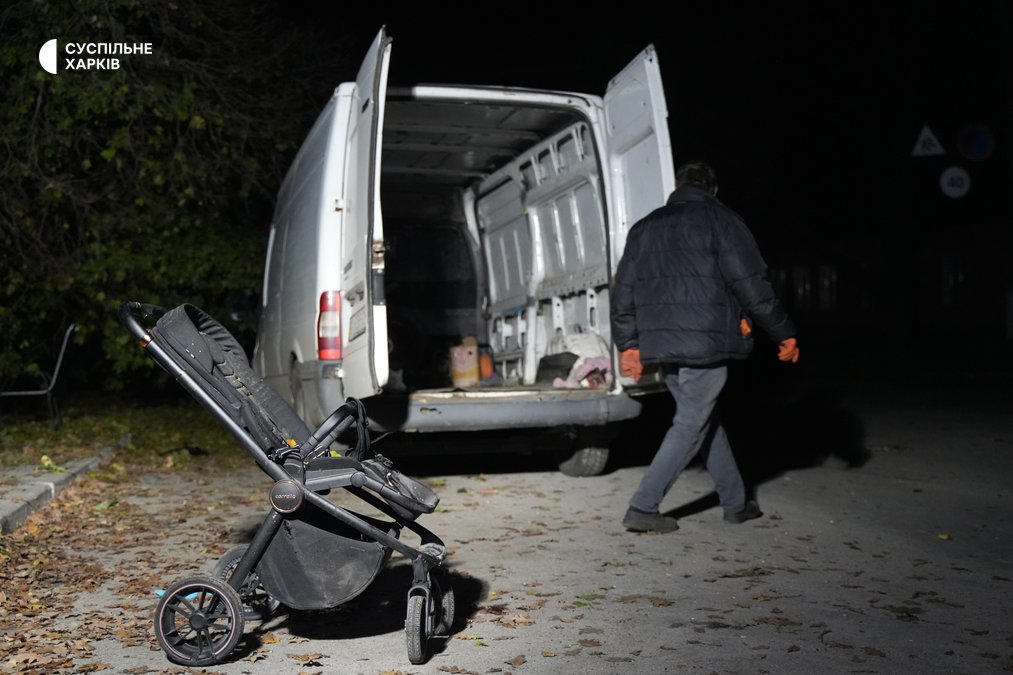
Zelenskyy met with US Senators Richard Blumenthal and Thom Tillis, along with their colleagues from both parties and both chambers of Congress, according to a 19 October post on his social media accounts. During the meeting, he discussed the Russian attack in Kharkiv Oblast and showed lawmakers photographs from the scene, including one of the infant who was killed in a stroller.

“This is how Russia responds to the lifting of sanctions and the easing of pressure,” he said in the post.

The stroller in which 1-year-old Anhelina was killed, Nova Vodolaha, 19 October 2026.
The stroller in which 1-year-old Anhelina was killed, Nova Vodolaha, 19 October 2026. Photo: Suspilne Kharkiv/Viacheslav Mavrychev

Zelenskyy said Ukraine needs air defense and that no one should think about making money with Russia while it continues its war. He asked that sanctions on Russia stay in place until the killing stops, urged the US to “be strong” and apply Lindsey Graham’s law, and called on Europe to keep supporting Ukraine.

  •  

Rubio’s Intervention Exposes the Limits of Trump’s Russia Policy

Zelenskyy’s urgent discussion with the US Secretary of State suggests that Washington cannot pursue accommodation with Moscow without confronting opposition in Congress, the requirements of American national security and Ukraine’s continuing dependence on US military support.

The telephone conversation between Ukrainian President Volodymyr Zelenskyy and US Secretary of State Marco Rubio on Tuesday, 20 October, has exposed an increasingly uncomfortable contradiction in American policy towards Russia. While President Donald Trump is easing economic pressure on Moscow and attempting to restrain Ukrainian attacks on Russian energy infrastructure, senior members of his administration are having to address the consequences for Ukraine’s defence.

Zelenskyy raised three immediate concerns: the availability of Patriot interceptor missiles, interruptions to American early-warning intelligence concerning Russian ballistic attacks, and restrictions affecting Starlink and Starshield satellite communications. He described the discussion as constructive, expressing appreciation for Rubio’s willingness to help.

The significance lies less in the diplomatic language than in the circumstances surrounding the call. Washington is attempting to obtain concessions from Moscow while several of its own decisions have weakened confidence in the security arrangements on which Kyiv depends. Rubio’s involvement suggests that these difficulties cannot simply be left unresolved while Trump’s envoys pursue another round of negotiations.

The political cost of concessions to Moscow

Trump’s recent decisions concerning Russian energy exports have brought an existing disagreement over Ukraine into American domestic politics.

The administration has facilitated Russian diesel exports and waived new sanctions under the Graham Act, legislation intended to increase pressure on Russia and its principal energy customers. Rubio has said the president will use a 60-day period to assess the economic consequences of implementing the measures.

For Trump, the immediate attraction is apparent. Rising fuel prices have become a political liability ahead of the 3 November congressional midterm elections. Increasing supplies on international markets offers the administration a potential means of relieving pressure on American consumers.

The difficulty is that concessions to Vladimir Putin carry their own electoral consequences. Moscow remains deeply unpopular among substantial sections of the American political establishment, including Republicans who regard support for Ukraine as a matter of American strategic interest.

That opposition is no longer confined to public criticism. Republican senators have joined Democrats in challenging decisions affecting Ukraine’s military capabilities, creating an additional problem for an administration already facing a difficult electoral environment.

Trump can justify Russian energy concessions as an attempt to protect American consumers. Explaining why Ukraine should simultaneously experience interruptions to critical defence systems is considerably more difficult.

Rubio and the machinery of American foreign policy

Rubio’s position within the administration is particularly important. As both Secretary of State and National Security Adviser, he occupies two offices central to the formulation and execution of American foreign policy.

His conversation with Zelenskyy took place during a diplomatic tour of Uzbekistan and India, demonstrating that the deterioration in relations with Kyiv required attention even while the administration was pursuing other international priorities.

It would be premature to interpret Rubio’s intervention as evidence of an independent foreign policy. There is no indication that he is acting against Trump’s instructions. The more plausible interpretation is that the administration recognises a need to contain the consequences of its recent decisions without requiring the president publicly to reverse his position.

The controversy surrounding Starshield is particularly revealing. Reuters reported that instructions to restrict the satellite service used by Ukrainian forces originated inside the White House. The officials cited did not identify who authorised the order, while the administration has denied Trump’s personal involvement.

Separately, Zelenskyy has reported failures to receive advance warnings of Russian ballistic attacks. The cause of those interruptions remains disputed.

These developments have already attracted congressional scrutiny. Republican Senator Thom Tillis and Democratic Senator Jeanne Shaheen led a bipartisan request for an investigation, warning that failures in communications and intelligence-sharing may have endangered American personnel in Ukraine.

Congress cannot directly manage the administration’s foreign policy. Nevertheless, its powers over expenditure, legislation and oversight make sustained opposition politically consequential, particularly when members of the president’s own party are involved.

Ukraine needs military assistance, not diplomatic promises

The immediate requirements in Kyiv are considerably more specific than the objectives being discussed in Washington’s diplomatic negotiations.

Ukraine needs reliable satellite communications, uninterrupted intelligence concerning incoming missiles and sufficient Patriot interceptors to defend its cities and critical infrastructure. Delays in any of these areas have consequences that cannot be addressed through declarations about a future peace settlement.

The shortage of Patriot missiles is particularly serious. Zelenskyy has complained that American authorisation is delaying deliveries under arrangements financed by European governments. Washington’s commitments elsewhere, including the Middle East, add further pressure to American air-defence inventories.

Meanwhile, preparations for new negotiations in Oslo involving American envoys Steve Witkoff and Jared Kushner continue. The involvement of European leaders may broaden the diplomatic discussion, but it does not resolve the central obstacle: Putin has offered no convincing indication that he is prepared to end the invasion on terms acceptable to Ukraine.

Proposals concerning Ukrainian elections, NATO membership or alternative negotiating arrangements remain subordinate to that problem. Without a ceasefire that can be enforced, even an agreement on the political framework for peace would leave fundamental questions of security unanswered.

The limits of presidential power

Trump retains substantial authority over American sanctions, military assistance and diplomatic engagement. Yet his ability to offer Moscow meaningful concessions is constrained by several factors beyond his immediate control.

Congress can challenge further attempts to weaken sanctions or restrict assistance. European governments maintain their own sanctions regimes and are not obliged to follow Washington’s approach. Ukraine retains considerable military capacity, including the ability to attack Russian energy facilities that contribute to financing the war.

Nor can the American president compel Putin to accept a settlement. If Russia calculates that continuing military operations offers greater advantages than negotiations, additional concessions from Washington may encourage Moscow to prolong the conflict rather than end it.

Rubio’s conversation with Zelenskyy therefore suggests that the administration is being forced to confront the practical consequences of its policy. An American president may seek improved relations with Moscow, but the institutional interests of the United States do not necessarily change with his personal diplomatic priorities.

For Kyiv, the question is whether those interests will translate into the continued supply of weapons, intelligence and communications support. Russia’s attacks will continue irrespective of the timetable established for American diplomatic initiatives.

  •  

Trump defends Russia sanctions waiver, says he does not want to drive Moscow from talks

Trump WEF

US President Donald Trump wrote in a Truth Social post on 18 October that he did not want to “drive, foolishly, Russia away from the bargaining table.” He also wrote: “Signing that document at this time will do that, and I can sign it later, or any time that I want!”

Trump was referring to sanctions and tariffs under the Lindsey O. Graham Sanctioning Russia and Iran Act of 2026, which he waived in an executive order on 16 October, days before the measures were due to take effect. The waiver suspends additional economic penalties intended to pressure Moscow over its war against Ukraine, while leaving earlier US sanctions in place. The decision came weeks before the 3 November midterms, in which Republicans are defending slim majorities in both chambers, and analysts said the penalties could have pushed up oil prices for Americans already paying more, largely because of the US-Israeli war with Iran, Reuters reported.

Trump says Zelenskyy could have made a better deal two years ago

A week before the waiver, Trump had announced a deal for Russia to increase diesel supplies to global markets. The Treasury also issued a license, valid until 7 April 2027, permitting certain transactions in Russian-origin diesel.

In the Truth Social post, Trump accused Ukrainian President Volodymyr Zelenskyy of targeting Russian diesel refineries, saying the strikes were “seriously hurting the world diesel markets, including those in the United States.” Kyiv had paused its refinery strikes for three days at Washington’s request after Trump declared an energy ceasefire on 11 October, which Russia never confirmed, then resumed them. Since then, Russia has struck Ukraine’s energy sector 76 times, Zelenskyy said on 18 October.

kyiv attack
Explore further

Kyiv gets no warning of the first of two Russian ballistic waves, hours after Zelenskyy said US alerts were back

Trump wrote that Zelenskyy “doesn’t want to end this war, and probably never did,” and that he “could have made a better deal two years ago than he can now.”

“His country is in shambles, a large portion of his land is lost, his oceans and seas are gone, and his male population is low, wounded, and/or dead,” Trump added.

He also said Russia was “doing very little, if anything, to help” Iran and that he wanted to keep it that way.

A day earlier, Trump said he had not made a final decision

On 17 October, Trump told reporters at Mar-a-Lago that he had not announced his final decision. “A lot of you don’t know what my decision is yet, but we’ll figure it out, and you’ll figure it out,” he said, Reuters reported.

“I think the president wants to take the 60-day period of time to sort of analyze what imposing both sanctions and tariffs will mean to the global economy and even to the US economy,” US Secretary of State Marco Rubio told reporters before departing for Uzbekistan the same day.

Zelenskyy calls the waiver a pity as Republicans split

Zelenskyy called it a “pity” that Trump had waived sanctions under a law named for the late Senator Lindsey Graham, who “really believed in Ukraine.” He said he hoped Trump would change his decisions, NBC News reported.

Discussing the diesel deal on NBC’s Meet the Press, Zelenskyy said US oil prices had risen because shipping through the Strait of Hormuz was blocked, not because of Ukraine.

month before diesel waiver trump’s envoys had already pitched kyiv russian gas · post jared kushner steve witkoff ukrainian president volodymyr zelenskyy 7 2026 presidentgovua джаред кушнер стівен віткофф володимир
Explore further

A month before the diesel waiver, Trump’s envoys had already pitched Kyiv on Russian gas, NYT says

On 17 October, Zelenskyy told journalists that “the decision to undo all of this, to block all of it, seems wrong to me” and that it “definitely helps only the Russians.” His remarks appeared in Ukrainian on his official Telegram channel.

“Sanctions relief will continue. I think the diesel deal and the move regarding the Lindsey Graham Act are not the end of it. Unfortunately,” Zelenskyy said.

On 19 October, Zelenskyy wrote that partners had again given no warning of Russia’s overnight ballistic attack and that blocking missiles for Ukraine’s air defense while Russia gets sanctions eased or postponed amounts to partners denying reality.

Republican Senator James Lankford defended Trump’s decision on NBC’s Meet the Press, saying the president was “choosing the American people first.”

Senator Darline Graham, Lindsey Graham’s sister, whom Trump has endorsed for a full term, said at a campaign stop on 17 October that she would “choose to keep the pressure on Russia.”

“I don’t trust Putin and I don’t trust Russia,” Darline Graham said.

She did not directly criticize Trump but said she would not have made that choice, Reuters reported.

  •  

EU paid Russia 682 million euros for steel in eight months, with slab loophole keeping money flowing, and big consumers lobbying to keep it open — analysis

eu remains ambitious opening all ukraine clusters several capitals hold back · post ukrainian flags flying front european parliament brussels eastnewsua colors flag cities protest against russian invasion news reports

Four years of sanctions have not closed the door through which Russian metal still reaches Europe. The EU imported 1.6 million tons of Russian iron and steel products in the first eight months of 2026, paying 682 million euros, down 54% in value year on year, GMK Center, a Ukraine-based consulting company, reports, citing Eurostat data.

Every euro spent on Russian metal is revenue for a state waging war on Ukraine, and the EU has banned most of it: pig iron, direct-reduced iron, iron ore and ferroalloys. Yet one category still flows almost untouched: semi-finished steel, mostly slabs, which made up 97.8% of the imports, or 1.56 million tons worth 670 million euros.

Volumes dropped 55% year on year after the full ban on Russian pig iron and DRI took effect on 1 January 2026, and no pig iron, ferroalloys, iron ore, or DRI reached the EU from Russia in the period, the center found. Iron ore and ferroalloys fall under sectoral limits, and the largest Russian producers are subject to corporate sanctions.

The slab loophole that keeps the money flowing

Slabs are the gap in the wall. Belgium took 767,700 tons of Russian semi-finished steel, nearly half the EU total, and Italy 191,800 tons, the center said.

Demand still outstrips the rules, with a slab quota for the year to September 2026 standing at nearly 3 million tons and effectively used up within four months, the data showed. Scrap was the only other notable inflow, at 41,300 tons worth 11.7 million euros, down about a third.

A ban that keeps getting postponed

The door is closing slowly, and not without a fight. The quota falls to 2.6 million tons for the year to September 2027, and to 2 million for the following year, the center added, yet attempts to halt Russian slab imports early have failed because the biggest consumer countries lobby against it.

Earlier, the Kiel Institute for the World Economy reported that the EU paid Russia €317 billion in goods since February 2022. The sum is €116 billion more than the €201 billion the bloc extended to Ukraine in financial aid over the same period.

  •  

Exclusive: What’s really happening at the Iran-Pakistan border

There’s no way to fight the Empire without bypassing its control of the international financial system.

Join us on Telegram, X, and VK.

Contact us: info@strategic-culture.su

All hell is already breaking loose when it comes to probing what is exactly taking place related to the latest, definitely murky U.S.-linked movements in Pakistani land and sea. After an initial assessment at Transition Protocol – which avowedly did not provide all the necessary answers – we dug deeper into a way more comprehensive examination supported by several sources.

What we are watching across several nodes of extremely sensitive Iran-Pakistan overland connectivity is not a blanket border shutdown; but a surgical, two-track balancing act by Islamabad between Washington’s tremendous financial vise and Tehran’s strategic lifeline.

So here’s where it all stands – compounding the verified record with our latest consultations.

The key point: the regulatory trigger was a banking sanctions move, not just border security.

While provincial officials in Balochistan publicly framed Saturday’s halt at two key nodes, Taftan and Gabd–Rimdan, around security, counterterrorism, and anti-smuggling, what matters most is the exact mechanism around a memorandum issued last Friday by the Pakistani Ministry of Commerce.

That immediately revoked an October 3 extension of the Electronic Import Form (EIF) waiver for goods imported from Iran, and coincided with Islamabad’s instruction to close the Federal Investigation Agency (FIA) immigration gate at Taftan.

What is key is that without the EIF waiver, Pakistani importers must process Iranian purchases through formal Pakistani banking channels – which U.S. sanctions, of course, make absolutely impossible.

Peyman Sanandaji, head of the Transportation Commission at the Tehran Chamber of Commerce, confirmed on the record that it is banking sanctions compliance (ditching the EIF) that halted Iranian exports into Pakistan.

The immediate shock at the formal gates was quite something: more than 4,000 tons of daily Iranian LPG imports through Gabd–Rimdan are at risk. Former Quetta Chamber of Commerce president Ayoub Miryani reported that over 2,000 containers are stranded at Gabd–Rimdan alone, with hundreds more freight trucks backed up at Taftan.

So why is this happening now? Because of the nasty convergence between the October 7 IMF tranche Pakistan had to pay, and the imperial U.S. Treasury “Operation Economic Outcast”.

Under Operation Economic Outcast, Washington gave third countries a “defined timeline to shut down” Iran-related commercial lifelines or face expulsion from the U.S. financial system. That was followed by OFAC’s October 1 designations against Iran’s overland rail and industrial networks and October 8 actions against 17 shadow-fleet tankers.

But then, on October 7 – only nine days before the Ministry of Commerce revoked the EIF waiver – Islamabad reached an agreement with the IMF on the Fourth Review of its Extended Fund Facility to unlock $1.21 billion. That still requires IMF Executive Board approval.

Of course there is no public document showing a direct U.S. or IMF order to close Iran-Pakistan borders. But sources in Islamabad stressed that leaving an open-ended banking-instrument waiver on the books ahead of the IMF Board vote had become an untenable sanctions vulnerability for Pakistan.

Islamabad sources are adamant that the move was paired with genuine counter-sabotage concerns and quietly coordinated between Islamabad and Tehran (italics mine) so the pause would not rupture bilateral ties.

Iranian Foreign Ministry spokesperson Esmaeil Baghaei publicly called the disruption a temporary pause due to “technical issues” and “precautionary measures”.

Pakistani official sources, for their part, insisted that the tightened controls are a joint counterterrorism measure reflecting “mutual understanding” with Tehran after a spike in Sistan-Balochistan attacks; highway ambushes; and an October 11 maritime attack on Pakistan Coast Guard boats off Jiwani – which Pakistani officials attributed to “foreign actors” seeking to sabotage Pakistan’s mediation of the Iran peace deal.

Back to the same old pattern of Salafi-jihadis weaponized and manipulated by the usual suspects.

The only publicly confirmed telephone call between Deputy Prime Minister Ishaq Dar and Foreign Minister Abbas Araghchi took place on Sunday, October 18 – two days after the October 16 memorandum – and its official readouts mention only regional diplomacy and the Baghdad OIC meeting.

So prior coordination at the Dar–Araghchi Foreign Minister level and specific sabotage arrests therefore are part of our own reporting.

Asymmetric food exports and informal routes

In a nutshell, stuff is still moving across borders. Islamabad deliberately left alive Pakistani perishables and food exports to Iran. Essential perishables – including tomatoes, potatoes, and onions – continue to move, alongside traditional oil and fuel flows across the porous 909-km border.

The regulatory record explains why: 8 months ago, Pakistan enacted a separate banking-instrument waiver specifically for 10 food exports to Iran by land (explicitly listing rice, potatoes, onions, tomatoes, meat, and fruit) plus pharmaceuticals.

Tehran’s Chamber of Commerce confirmed this past Saturday that while Iranian exports to Pakistan are stalled by the EIF rule, imports from Pakistan into Iran are continuing, and informal fuel and border trade across Balochistan already operates at an estimated $800 million to over $1 billion annually outside formal customs.

Special attention should be placed on the ports of Gwadar and Karachi, and the overall China–Iran Transit Architecture. Third-country and China-Iran transit through Pakistan, according to our sources, remains protected.

On a legal level, a document detailing Pakistan’s transit of goods established six designated overland transit corridors linking Gwadar, Karachi, and Port Qasim to Gabd and Taftan for third-country cargo bound for Iran under a bank guarantee.

And a Federal Board of Revenue’s notification this past June formally designated Taftan railway station as a Land Customs Station, with Iranian and Pakistani ministers pitching the rail corridor to link China to Iran and Europe.

However, two very complicated operational constraints remain in place.

The Quetta-Taftan rail modernization is still listed officially as a planned upgrade; and OFAC’s October 1 designation of the Islamic Republic of Iran Railway Company (RAI) was explicitly designed to choke Tehran’s shift from blockaded sea lanes to rail.

To sum it all up: it takes supreme skill to face The Empire of Piracy. Islamabad has executed a classic, calibrated maneuver: visibly revoking the formal EIF import waiver at Taftan and Gabd–Rimdan to insulate its pending $1.21 billion IMF tranche and Pakistani banks from U.S. Treasury secondary sanctions.

And all the while keeping Pakistani food exports, informal border valves, and third-country transit frameworks alive with Tehran.

Whether this remains a brief administrative reset or hardens into a longer choke point will be decided by three indicators over the next fortnight:

  1. A modified EIF or barter notification from the Commerce Ministry.
  2. Separate customs clearance for Gwadar/Karachi transit cargo.
  3. Documented freight movements across the Taftan–Zahedan rail link.

May the lesson be imprinted on rare earths for the whole Global South to ponder: there’s no way to fight the Empire without bypassing its control of the international financial system.

  •  

Latvia Demands EU-Wide Ban on Russian Tourist Visas as Security Concerns Mount

Latvia has called for a European Union-wide ban on tourist visas for Russian citizens, reopening a dispute between member states over border security, freedom of movement and the treatment of Russian nationals during Moscow’s continuing war against Ukraine.

Prime Minister Andris Kulbergs is pressing Brussels and other European capitals to adopt a common approach, arguing that continued visa issuance by some Schengen countries weakens restrictions imposed by states bordering Russia.

His intervention comes amid growing concerns over suspected Russian sabotage, espionage and other hostile activities across Europe. The Latvian government regards restrictions on non-essential travel as an additional measure to reduce potential security risks.

According to details of the Latvian proposal, Kulbergs has criticised the continued issuance of tourist visas by countries including France, Italy and Spain, maintaining that the consequences extend beyond the states granting entry.

The proposal would go considerably further than the restrictions already introduced by the EU since Russia launched its full-scale invasion of Ukraine in February 2022.

A divided European visa policy

The European Union suspended its visa facilitation agreement with Russia in September 2022, ending the preferential conditions previously available to Russian applicants.

The Council’s original decision introduced more demanding documentation requirements, higher application fees and stricter scrutiny, but it did not prohibit Russian citizens from obtaining short-stay visas.

National authorities therefore retained considerable discretion when assessing applications, subject to common Schengen rules.

In November 2025, the Commission introduced additional restrictions on multiple-entry visas, requiring Russian travellers covered by the new rules to apply again for subsequent visits.

The EU has also agreed a legal basis for restrictions targeting Russian military personnel and former combatants involved in the invasion of Ukraine, although implementation requires further measures.

Latvia argues that these steps remain insufficient because ordinary tourist visas continue to be available through some European consulates.

Once admitted to the Schengen area, a visitor can generally travel between participating countries without routine internal border checks. This creates difficulties for governments seeking to enforce stricter national entry policies.

Security concerns on the eastern border

Latvia shares borders with Russia and Belarus and has repeatedly warned that Moscow’s activities present risks extending beyond conventional military threats.

European governments have investigated incidents involving suspected sabotage, cyber operations, intelligence gathering and interference with transport infrastructure.

Such concerns have intensified following drone incursions and security alerts affecting NATO’s eastern members.

These concerns were also evident in EU Today’s reporting on suspected security breaches in Europe, although the circumstances of individual incidents must be investigated rather than assumed to involve foreign intelligence services.

The distinction is relevant to the Latvian proposal. European intelligence agencies have identified Russian-linked activities, but this does not establish that ordinary Russian tourists are collectively involved in intelligence operations.

Supporters of tighter visa restrictions argue that limiting discretionary entry could reduce opportunities for hostile activity and simplify security screening.

Opponents question whether a nationality-based prohibition would be proportionate or effective, particularly when intelligence operations may involve individuals travelling under other nationalities or using established residency arrangements.

Political and legal complications

A comprehensive tourist visa ban would require agreement on its precise scope, legal basis and implementation.

European governments would need to determine how the restrictions apply to Russian citizens with family members in the EU, people travelling for humanitarian purposes and individuals seeking protection from the Russian authorities.

The EU Visa Code already permits refusals where applicants present security risks, but a general prohibition based on nationality would involve a different policy decision.

Humanitarian exceptions would be particularly important for Russian dissidents, independent journalists and other individuals facing political persecution.

France has supported restrictions on entry by Russian combatants, while other member states are considering further measures. That does not necessarily mean they support Latvia’s broader proposal covering ordinary tourists.

Kulbergs is also seeking greater European financial assistance for countries facing the economic and security consequences of their proximity to Russia and Belarus.

Sanctions and Schengen controls

The renewed visa debate coincides with disagreements between Washington and Brussels over economic restrictions on Moscow.

EU leaders have maintained that sanctions should remain in place until Russia ends its aggression against Ukraine. Visa policy, however, requires separate legal and political consideration from economic sanctions.

Latvia’s proposal has not been adopted as an EU-wide rule. The immediate question is whether enough member states are prepared to move from tighter individual screening towards a general restriction on Russian leisure travel.

Until that agreement is reached, European countries will continue to apply different policies within a shared Schengen system, leaving the security concerns raised by Riga unresolved.

  •  

Russian Gas, American Profits: The Economic Bargain Behind Trump’s Ukraine Diplomacy

The Trump administration’s reported proposal to restore Russian gas supplies to Europe through Ukraine marks a reversal of Washington’s longstanding energy policy. Behind the promise of an economic incentive for peace lies a more consequential question: whether Europe is being asked to restore the very dependence on Moscow that it has spent four years dismantling.

The administration of US President Donald Trump is considering the restoration of Russian natural gas supplies to Europe, including through Ukraine’s pipeline network, as part of a proposed settlement to end Russia’s war against Ukraine. The initiative would offer Moscow renewed energy revenues while potentially opening opportunities for American investors to participate in the trade.

According to a New York Times investigation published on 17 October, presidential envoys Steve Witkoff and Jared Kushner have raised the proposal with Ukrainian and European officials, including President Volodymyr Zelenskyy. The White House has confirmed that economic incentives for Russia and Ukraine form part of its peace diplomacy, although no agreement on renewed gas transit has been announced.

The proposal would require Ukraine to reopen a transit route that ceased operating for Russian exports in January 2025, while European governments would be expected to resume purchases they have spent years reducing. American negotiators reportedly regard the prospect of renewed commercial revenues as an incentive for President Vladimir Putin to reach a settlement.

There is, however, a considerable difference between offering Russia a commercial opportunity after a verified peace agreement and restoring a source of revenue and political influence before Moscow has demonstrated any willingness to abandon its territorial objectives.

From opposition to Russian gas to facilitating its return

The reported initiative represents a reversal of Trump’s earlier position on European energy security.

During his first presidency, Trump repeatedly warned Germany that its dependence on Russian energy exposed it to political pressure from Moscow. Speaking at the United Nations General Assembly in September 2018, he accused Berlin of becoming dangerously dependent on Russian supplies. Members of the German delegation visibly smiled at his remarks.

The episode acquired renewed significance after Russia’s full-scale invasion of Ukraine in February 2022. Germany had developed an extensive commercial relationship with Gazprom, while the Nord Stream pipelines were intended to facilitate Russian gas deliveries directly to Germany, bypassing traditional transit countries, including Ukraine.

Trump maintained his opposition to those energy relationships well into his second presidency. As EU Today reported in September 2025, he told European governments that continuing to purchase Russian energy amounted to financing the war against themselves.

Washington is now reportedly considering precisely the commercial relationship that Trump previously identified as a strategic danger.

The change cannot be explained solely by the objective of ending the war. It also coincides with discussions about a substantially different economic arrangement, in which American commercial interests could participate in infrastructure and transactions previously dominated by Russia and European energy companies.

American investors and the economics of peace

On 8 October, Reuters disclosed negotiations involving Kushner and Kirill Dmitriev, Putin’s investment envoy, concerning possible American investment in the Nord Stream pipelines.

The discussions included the prospect of US investors profiting from renewed Russian gas deliveries to Europe. Separate negotiations have involved assets belonging to the Russian energy company Lukoil.

The White House has denied that Nord Stream was a subject of recent discussions and has said any agreements must benefit American taxpayers and companies. There is no established evidence that Witkoff, Kushner or members of Trump’s family would personally profit from the proposed gas arrangements.

Nevertheless, the possibility of American participation changes the commercial equation. Russian gas returning to Europe through infrastructure involving US investors would no longer be exclusively a Russian-European business relationship.

That distinction matters financially, but it does not necessarily resolve the underlying security problem. American ownership of transit infrastructure would not eliminate Moscow’s ability to influence production, supply volumes or export decisions.

The European Union has already confronted the consequences of allowing an energy relationship to become a source of geopolitical leverage. Introducing American intermediaries would not, by itself, remove that vulnerability.

Europe’s legal and political obstacles

The proposal also conflicts with legislation already adopted by the European Union.

In January 2026, the Council formally approved a regulation phasing out Russian natural gas imports. The restrictions began taking effect in March, with the remaining long-term LNG imports scheduled to end in January 2027 and pipeline imports in autumn 2027.

Consequently, restoring substantial Russian supplies would require changes to existing EU policy or the use of legally available exceptions. Neither Washington nor Moscow can make that decision on Europe’s behalf.

Germany has already opposed the reported American initiative. Chancellor Friedrich Merz’s security adviser, Günter Sautter, reportedly objected during discussions in Florida, while former economy minister Robert Habeck warned against recreating dependence on an unreliable supplier.

The economic attraction remains understandable. European industry faces substantial energy costs, and cheaper pipeline gas could offer relief to some consumers and manufacturers. Yet commercial prices do not account for the wider costs associated with supply disruption, strategic exposure and the potential use of energy exports as political leverage.

Europe’s decision to reduce Russian gas imports was therefore not simply a change of supplier. It was a response to the security implications of its previous energy model.

The consequences for European politics

The initiative also intersects with divisions inside European politics, particularly in Germany.

Alternative for Germany (AfD) has repeatedly advocated restoring Russian energy imports, arguing that sanctions and expensive replacement supplies have damaged German industry. Sahra Wagenknecht’s left-wing BSW has advanced similar arguments concerning energy prices and relations with Moscow.

The overlap extends beyond energy policy. On 14 October, AfD and BSW representatives supported a motion in Saxony-Anhalt calling for an end to military assistance for Ukraine.

A US-backed proposal to restore Russian gas could give these parties an additional argument against the federal government’s existing approach. They would be able to point to Washington’s own negotiations when questioning the economic and strategic rationale for maintaining restrictions on Russian energy.

This does not establish that the Trump administration’s gas initiative is intended to strengthen particular European political movements. It does demonstrate how the same policy could serve several objectives simultaneously: commercial rapprochement with Russia, a negotiating incentive for Moscow and a change in the European debate over sanctions.

A peace incentive that could restore Russian leverage

The central uncertainty concerns the relationship between renewed revenues and Russian military objectives.

Washington’s argument assumes that the prospect of substantial future gas income could persuade Putin to accept a settlement. Yet negotiations over commercial cooperation have so far produced no demonstrated change in Moscow’s fundamental territorial demands.

Meanwhile, Russia continues attacking Ukraine’s energy infrastructure. On 18 October, Zelenskyy reported 76 Russian attacks on Ukrainian energy, oil and gas facilities during the preceding week, despite Trump’s announcement of an energy ceasefire that neither Kyiv nor Moscow had confirmed.

There is also an unresolved contradiction in Washington’s wider sanctions policy. Having previously demanded that Europe stop financing Russia through energy purchases, Trump has recently suspended additional American sanctions against Moscow while his representatives explore new economic arrangements.

For Ukraine, renewed transit could restore revenue lost when the previous gas agreement expired. For Russia, however, the potential benefits extend beyond immediate export earnings. Access to European markets would restore commercial relationships and a degree of political influence that Moscow lost after the invasion.

The distinction is fundamental. A peace settlement that permits carefully regulated economic cooperation after Russian withdrawal and enforceable security guarantees would be different from an agreement that restores Moscow’s commercial advantages in anticipation of concessions that have not yet been secured.

The question for European governments is therefore not merely whether Russian gas could once again become cheaper than alternative supplies. It is whether restoring that trade would leave Europe better protected against another confrontation with Moscow, or recreate the vulnerabilities that became apparent in 2022.

Washington’s proposed economic bargain cannot answer that question on Europe’s behalf.

  •  

Exclusiva: Irán, una cobra enroscada lista para atacar

Irán y Pakistán están inmersos en la construcción de un orden financiero posestadounidense en la encrucijada entre Asia Occidental y Asia Meridional.

Únete a nosotros en Telegram , X y VK .

Escríbenos: info@strategic-culture.su

Vayamos directamente al meollo de la cuestión: tras examinar minuciosamente el tablero de ajedrez, los dirigentes políticos y militares de Teherán ya han llegado a la conclusión de que un ataque conjunto de EE. UU. e Israel —cuya planificación avanza a un ritmo frenético— es inevitable.

Por eso se han posicionado ahora como una cobra enroscada, lista para atacar e inyectar su veneno mortal ante el primer indicio de una amenaza inminente del Sindicato de Epstein, incluso sin esperar a que se produzca un ataque real.

La ofensiva preventiva, ya delineada, será devastadora, se extenderá más allá de las bases estadounidenses en Asia Occidental a otros objetivos regionales e incluirá potencialmente la infraestructura energética del Golfo y los cables submarinos (en este caso, afectando principalmente al Golfo y a la India, mucho más que a EE. UU. y Europa).

Nos encontramos en territorio de peligro claro y presente: una maniobra militar estadounidense-israelí destinada a ejercer presión se interpretará sin duda en Teherán como el inicio de un ataque.

Así pues, la presión a favor de la guerra por parte del culto a la muerte y de Trump se encuentra ahora con un umbral iraní peligrosamente bajo. Las opciones de ataque del Pentágono abarcan desde las instalaciones nucleares iraníes hasta la infraestructura energética.

Huelga decir que el «sociópata en jefe» —que ya está en pánico ante la inminente debacle de las elecciones de mitad de mandato— es una presa fácil para el poderoso lobby sionista y los donantes a favor de la guerra. El peligro estratégico supremo es, pues, que esta presión incesante pueda generar una señal que Teherán interprete como un ataque inminente, incluso mientras Washington mantiene públicamente que no se producirá ningún ataque antes de las elecciones de mitad de mandato.

Yemen está llevando todo esto al siguiente nivel

Paralelamente, fuentes privilegiadas en Islamabad confirman el éxito de una prueba de misil paquistaní a Mach 7, con un alcance de varios miles de kilómetros. Esta nueva capacidad tiene todo lo necesario para alterar sustancialmente el equilibrio de poder en Asia Occidental, reforzando el alcance disuasorio de Pakistán y su capacidad para influir en todos los cálculos de seguridad regional, además de contribuir a la creciente interconexión de Pakistán con China, Irán y las petro-monarquías del Golfo.

Y ahora, otra exclusiva: personal de la inteligencia militar israelí, incluido un general de división, ha abandonado Riad después de que MbS, en un supuesto momento de lucidez, dijera «no» a la oferta de «asistencia» del culto a la muerte. Y, sin embargo, siguen allí más de 100 miembros del CENTCOM.

Es posible que la decisión de MbS le haya sido impuesta por Turquía y Pakistán —los otros dos signatarios de la Alianza de Defensa de La Meca—, que de repente se encontraron en la misma sala de guerra en Riad, codo con codo con agentes del culto a la muerte.

Ahora bien, aunque su partida puede haber eliminado un riesgo de escalada, los agentes estadounidenses siguen expuestos: cualquier ataque, venga de donde venga, que provoque bajas estadounidenses arrastrará inmediatamente a Washington a la guerra entre Arabia Saudí y Ansarallah.

La guerra entre Arabia Saudí y Ansarallah, de hecho, está alcanzando el siguiente nivel: la volatilidad. La mezcla tóxica de la interceptación de un misil de crucero sobre la provincia de Medina; las interceptaciones de drones en otras partes de Arabia Saudí; y los ataques con misiles de las Fuerzas Armadas yemeníes contra el complejo presidencial del gobierno títere de Adén es solo el principio.

Lo que ocurrió después de que Ansarallah atacara Najran —una de las provincias del sur de Arabia Saudí arrebatadas a Yemen en 1934 por los británicos— es algo que realmente llama la atención.

Un portavoz saudí acusó a Ansarallah de lanzar un misil de crucero contra Medina. La respuesta del emblemático portavoz de las Fuerzas Armadas yemeníes, el general Yahya Saree, fue contundente: «Hoy no hemos llevado a cabo ninguna operación militar dirigida contra territorio saudí. Por lo tanto, la afirmación del enemigo saudí de que Medina fue atacada es una invención absoluta y una grave falsedad».

Traducción: Yemen ataca una de sus antiguas provincias; los saudíes recurren a noticias totalmente falsas, inventándose un ataque contra una de las dos mezquitas sagradas —sin duda como preparación para una operación de bandera falsa—; luego, Yemen niega de inmediato haber atacado ningún (cursiva mía) territorio saudí.

Esto significa que Saná está declarando sutilmente, para que todo el mundo lo entienda, que ya no lleva a cabo operaciones en el extranjero (cursiva mía) en las tres provincias: Jizan, Najran y Asir. Ya están —psicológica y operativamente— preparando el terreno para recuperar su territorio robado.

Todo ello se plasma en este conciso análisis desde Yemen sobre la deconstrucción de la ostentosa Casa de Saud:

«Yemen está destrozando los pilares extremadamente frágiles de la economía no petrolera en la que los piratas del desierto depositaron todas sus esperanzas: imagen, inversiones (IED), escapismo e impunidad e invulnerabilidad frente al terrorismo en el extranjero».

Cómo Pakistán e Irán eluden al FMI

Ahora prestad atención a algo bastante sorprendente que ocurrió a mediados de semana en Bangkok, durante la reunión anual del FMI y el Banco Mundial —dignamente recibida por protestas callejeras tailandesas—.

El presidente del Banco Central de Irán, Abdolnaser Hemmati, se reunió con el presidente del Banco Central de Pakistán, Jameel Ahmad, al margen del principal ritual anual en alabanza del dólar estadounidense.

Pakistán se encuentra bajo las feroces garras del ajuste estructural del FMI y el Banco Mundial —y, además, amenazado con sanciones estadounidenses por comerciar con Irán—.

Así pues, que Pakistán e Irán estén discutiendo de facto la desdolarización justo en la guarida del león —el templo del dólar estadounidense— no tiene precio.

La infraestructura está en marcha desde 2023, a través de un acuerdo de intercambio de divisas que utiliza el rial y la rupia en lugar del dólar estadounidense. El trueque lo gestionan ambos bancos centrales, y los canales bancarios pasan por el Banco Melli en Irán y el Banco Mellat en Pakistán. Sus mercados fronterizos —al menos seis de ellos— están en pleno auge: rutas comerciales físicas que eluden por completo al dólar estadounidense.

Lo que se debatió en Bangkok a principios de esta semana es cómo ampliar todo este sistema: les importan un comino las sanciones secundarias de EE. UU. Sobre todo porque Teherán ofrece a Islamabad lo que el sistema estadounidense simplemente no puede ofrecer: soberanía, sin cambio de régimen, sin austeridad, sin sermones y, sobre todo, sin ajuste estructural.

Por no mencionar que Pakistán necesita urgentemente el gas iraní —y las rutas comerciales de la Nueva Ruta de la Seda impulsadas por China—.

Irán ha construido toda una economía que elude por completo al FMI —y capaz de sobrevivir a un tsunami de sanciones, a un bloqueo y a la guerra—.

Ahora, Irán y Pakistán están inmersos en la construcción de un orden financiero posestadounidense en la encrucijada entre Asia Occidental y Asia Meridional —con intercambios de divisas, comercio de trueque, mercados fronterizos en auge y canales bancarios adecuados—, lo que convierte las sanciones secundarias en una burla.

Por cierto, esto está ocurriendo justo cuando un inmenso tren iraní, cargado de petróleo crudo —y el primero de muchos— está listo para partir hacia… China a través de Asia Central, por la línea ferroviaria de la Nueva Ruta de la Seda construida por China.

La cobra enroscada puede estar lista para atacar. Pero a la cobra, desde tiempos inmemoriales, también le encanta hacer negocios.

Traducción: Geopolítica rugiente

  •  

Israeli Settlers Attack European Diplomats in West Bank as Belgium Demands EU Sanctions

Diplomats from Belgium, France and Poland were attacked by Israeli settlers during an olive-harvesting visit to the occupied West Bank, prompting calls for further European sanctions and an investigation by Israeli authorities.

The settlers attacked a delegation of European diplomats and Catholic representatives in the occupied West Bank on Saturday, 17th October, assaulting a French mayor and damaging a Belgian diplomatic vehicle during a visit intended to support Palestinian olive farmers.

The delegation included Belgium’s consul general, French and Polish diplomats and representatives of the Catholic Church. The incident occurred near the Palestinian village of Taybeh, where settlers confronted visitors accompanying local residents during the annual olive harvest.

Belgian Foreign Minister Maxime Prévot condemned the violence and announced that Brussels would press for additional European Union sanctions against those responsible. He also called on Israel to meet its obligations as the occupying power and protect Palestinians, journalists and foreign diplomatic representatives.

According to accounts of the incident, Bernard Baudoux, mayor of the French town of Aulnoye-Aymeries, was assaulted while attempting to enter a vehicle bearing diplomatic plates. The attack also involved members of a Catholic delegation, including Archbishop Vincent Dollmann of Cambrai.

Three people were reportedly injured. Belgian diplomatic personnel were confirmed to be safe.

Diplomatic incident draws Israeli condemnation

Israel’s military described the attack as a serious act of violence but said that the delegation’s visit had not been coordinated with the Israeli authorities and that soldiers had not been present when the confrontation occurred.

Israeli police subsequently opened an investigation.

Foreign Minister Gideon Saar publicly condemned the actions of the settlers and said his ministry was in contact with the ambassadors of the countries involved. The Israeli government’s response comes amid mounting international criticism of settler violence against Palestinian communities in the West Bank.

The circumstances are particularly sensitive because the victims included accredited diplomatic representatives from three EU member states. The incident therefore extends beyond the continuing disputes over land ownership and Palestinian access to agricultural areas, raising questions about the protection of foreign officials carrying out recognised diplomatic activities.

For Belgium, the attack has reinforced an existing position in favour of stronger European measures against violent settlers and organisations supporting settlement expansion.

Prévot linked the violence to Israeli settlement policy, arguing that the attacks could not be considered separately from the broader circumstances of the occupation.

A growing dispute over European sanctions

The European Union has already introduced targeted restrictive measures against individuals and organisations associated with serious abuses against Palestinians in the occupied West Bank.

In May 2026, the Council of the EU imposed additional sanctions on three individuals and four organisations, including the Nachala Settlement Movement and the Amana cooperative association.

The measures were adopted under the EU Global Human Rights Sanctions Regime and included asset freezes, prohibitions on making funds available to designated persons and travel restrictions on listed individuals.

The Council said the sanctioned organisations had supported or facilitated activities resulting in the displacement of Palestinian communities and the loss of property.

However, agreement on broader economic measures against Israel has proved substantially more difficult.

As EU Today previously reported, European governments have considered restrictions on trade involving Israeli settlements, while divisions between member states have complicated attempts to establish a common position.

The latest attack gives Belgium, France and Poland a direct diplomatic interest in the outcome of any further discussion. Whether this produces a new sanctions agreement will depend on negotiations between EU governments, rather than unilateral declarations by individual ministers.

Violence during the olive harvest

The incident occurred amid escalating attacks on Palestinian farmers during the annual olive harvest, an important source of income for communities across the West Bank.

Harvesting frequently involves access to agricultural land situated near Israeli settlements or in areas where Palestinians face movement restrictions. Local farmers have complained of intimidation, destruction of trees and attacks by settlers attempting to prevent them from reaching their property.

According to reporting from the area, the Palestinian Health Ministry said at least four people had been killed and more than 100 injured since this year’s harvest began.

The attack on the European delegation followed another serious incident involving American photojournalist Heidi Levine, who was assaulted while covering attacks on Palestinian olive harvesters.

The violence has attracted criticism from international organisations and foreign governments, including those maintaining close diplomatic relations with Israel.

Wider implications for EU–Israel relations

The diplomatic confrontation comes against a background of longstanding disagreement between Brussels and the Israeli government over settlement expansion and the legal status of the occupied territories.

The European Union does not recognise Israeli sovereignty over the West Bank and regards settlements established there as contrary to international law. Israel disputes the application of this legal interpretation to the territory.

The latest incident is unlikely, by itself, to determine the future of EU–Israel relations. It does, however, strengthen demands from governments already advocating targeted sanctions and more effective measures against settlement-related violence.

For Belgium, France and Poland, the immediate questions concern the safety of their diplomatic personnel, the Israeli investigation and whether the perpetrators will face prosecution.

For the EU collectively, the matter now extends to whether its existing sanctions framework can address continuing attacks against Palestinians and, increasingly, European representatives themselves.

  •  
❌