❌

Reading view

Flávio Bolsonaro’s Campaign Uses AI to Engineer Fake Support
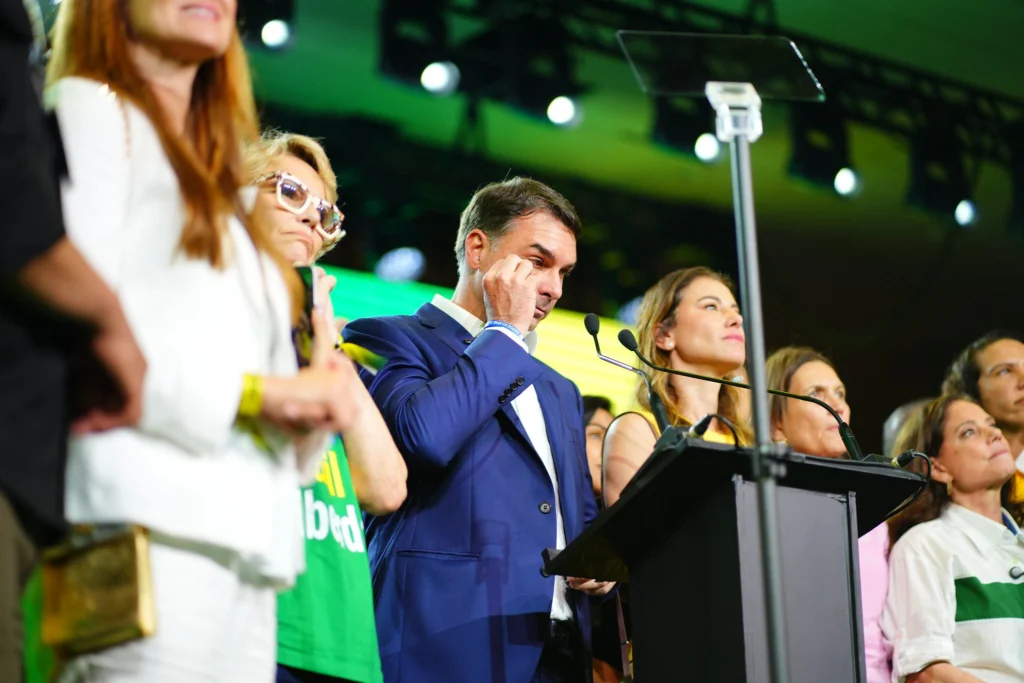
Flávio Bolsonaro at a rally for his presidential campaign. Photo: JOTA.

Digital models modified Flávio Bolsonaro’s event photography to artificially expand audiences and simulate support from female voters.


The Brazilian presidential election has become an arena for modern, dirty digital tactics. Senator Flávio Bolsonaro, representing the Liberal Party (PL), has centered his campaign strategy around coordinated digital reach and automated content production.

RELATED: UN Experts Raise Concerns Over Meta’s Handling of Political Expression During Brazil Elections

Rather than working as a traditional political campaign of physical rallies, the operation relies heavily on digital distribution infrastructure across social media platforms.

Flávio’s strategy operates through two main mechanisms. First, the campaign uses synthetic consensus tools, automated social media accounts, AI image generation, and digital avatars to simulate organic public backing.

Second, the campaign benefits from algorithmic distribution asymmetries on digital platforms, which amplify far-right material while placing system restrictions on competing political content.

Collected evidence by independent researchers, journalism networks, and electoral authorities indicates that systemic digital manipulation and platform-level infrastructure played a decisive role in shaping voter perception and electoral engagement in Brazil.

Industrial Bot Networks

A core component of Flávio Bolsonaro’s digital strategy involves the commercial purchase of automated networks designed to manufacture artificial public support.

An investigation by The Intercept Brazil revealed that Flávio Bolsonaro paid Elytron, a cybersecurity firm, to carry out data collection and voter identification to spread rumors and create fake accounts.

These automated tools operate primarily across WhatsApp, Instagram, and X, generating synchronized posts and artificial engagement to bypass standard organic distribution patterns.

This infrastructure uses astroturfing techniques to alter online public discourse. By deploying thousands of automated accounts programmed to post identical messaging scripts, the campaign artificially inflates engagement metrics, pushes specific political hashtags into regional trending lists, and floods comment sections on public news pages.

This creates a false impression of widespread popular momentum, designed to sway undecided voters through perceived consensus.

Technical evaluations submitted during electoral court proceedings reveal the scope of these automated operations. Data presented to electoral monitors shows coordinated account clusters posting at frequencies humanly impossible without software automation.

🚨 BREAKING: Flávio Bolsonaro paid R$600,000 to a company that offered AI to manipulate elections, according to Intercept Brasil. pic.twitter.com/eFcRp74vNw

— Pop Core (@TheePopCore) October 16, 2026

Deepfakes, AI Avatars, Demographic Manipulation

Various social organizations and media outlets have denounced the deployment of AI image and video generation tools as another facet of Flávio Bolsonaro’s digital strategy.

A prominent example occurred during campaign launch events, where the campaign broadcast an AI-generated digital avatar of former president Jair Bolsonaro endorsing his son’s candidacy. This technique allowed the campaign to maintain the political presence of the former president Bolsonaro in public events despite judicial rulings restricting his direct participation in political activities.

In addition, the campaign used AI tools to manipulate visual documentation of campaign gatherings. Documented instances show event photography processed through image generation models to alter crowd compositions.

These AI modifications included scaling up crowd sizes to exaggerate physical attendance and digitally swapping male attendees with female faces. The primary objective of this demographic engineering was to simulate broader support among female voters, a demographic group where polling data consistently showed lower support for the candidate.

An investigation by a Brazilian media outlet identified more than 50 TikTok videos altered using AI, specifically on-the-street interviews in which subjects claimed they would vote for Flávio Bolsonaro. These videos garnered over 7 million views, yet in only 18% of them did the platform indicate that the individuals featured were AI-generated.

While Brazilian law prohibits the use of AI-generated videos in political campaigns, it is difficult to determine when such content is created by third parties with no direct affiliation to the campaigns.

Due to a lack of female supporters, Brazilian presidential candidate Flávio Bolsonaro has resorted to using AI to transform middle-aged men into attractive young women.

This AI-generated creation has been dubbed the "Bolsonaro Bombshell." pic.twitter.com/ap1ecKou9K

— Vatnik Soup (@vatniksoup) October 20, 2026

Disinformation and Aggressive Public Discourse

Flávio Bolsonaro’s public communications strategy relies heavily on coordinated attack campaigns directed against President Luiz Inácio Lula da Silva and the Workers’ Party (PT).

The Flávio campaign’s public messaging routinely utilizes sensationalist allegations and targeted attacks. Online networks affiliated with the campaign circulate manufactured claims regarding public safety, economic stability, and social values, framing the current administration in terms of moral crisis.

On Sunday the 18th, the public debate between the two candidates took place, and Flávio Bolsonaro spent most of his time attacking Lula during his turns to speak.

Throughout the debate, Flávio was sarcastic and mocking toward President Lula; he attempted to intimidate him physically, to which Lula responded by moving away, stating that he did not want to be near either Flávio or the Bolsonaro family.

Furthermore, when the discussion turned to public safety, Flávio claimed that Lula is the preferred candidate of organized crime, pointing out that Lula received a large number of votes from within the country’s prisons. Lula replied, “I want 100% of them to vote for me -even your father,” a reference to the fact that Jair Bolsonaro is currently incarcerated.

This aggressive messaging strategy directly impacts the broader political environment. By flooding public discourse with inflammatory claims, the campaign creates heightened polarization, distracts from substantive legislative evaluations, and systematically delegitimizes established democratic processes and electoral monitoring bodies.

Hundreds of Brazilians protested outside Meta’s São Paulo offices, accusing the technology giant of limiting President Luiz Inácio Lula da Silva’s campaign reach while boosting far-right candidate Flávio Bolsonaro, just six days before the presidential runoff. The demonstration… pic.twitter.com/KRAxExFjMO

— teleSUR English (@telesurenglish) October 20, 2026

Meta’s Structural Bias in the Campaign

The Brazilian presidential race was shaped by asymmetries within Meta’s platforms, including Instagram, WhatsApp, and Facebook.

Filings submitted to the Superior Electoral Court (TSE, in Spanish) by President Luiz Inácio Lula da Silva’s legal team documented clear disparities in how content from both campaigns was handled by the different platforms.

A primary issue involved Meta’s generative AI features. When users requested campaign materials incorporating Lula’s official ballot number, 13, the system repeatedly rejected the prompts, citing political content restrictions. Conversely, identical requests containing Flávio Bolsonaro’s candidate number, 22, were routinely processed, generating promotional material for the far-right campaign.

In other instances, the AI tool inserted Bolsonaro’s electoral number into completely unrelated image requests. Following formal complaints, the Superior Electoral Court ordered Meta to ensure equal treatment. Meta attributed these outcomes to technical errors and implemented broad restrictions on political image generation.

Internal Meta communications revealed that technical errors caused Lula’s official Instagram profile to be excluded from platform search results and recommendation engines, while Flávio Bolsonaro’s profile remained fully discoverable and actively recommended to users. Furthermore, internal technical escalations confirmed that temporary account restrictions had hindered the reach of Lula’s messaging assets.

WHO'S THE REAL THIEF? LULA CHALLENGES BOLSONARO TO SHOW RECORDS

Ahead of Brazil’s presidential election, Brazilian President Lula da Silva publicly challenged rival Flávio Bolsonaro to open his bank accounts, release his phone records, and let the Brazilian people decide who… pic.twitter.com/U6Ge0yOV6A

— Sovereign Media (@sov_media) October 21, 2026

Regulatory Imperatives and Popular Sovereignty

The execution of Flávio Bolsonaro’s digital presidential campaign illustrates the evolving mechanics of far-right electoral operations.

By combining commercial bot procurement, generative AI deepfakes, coordinated public attacks, and platform-level algorithmic advantages, the campaign constructed a heavily synthetic media environment designed to influence voter perception.

These developments underscore the limitations of existing legal and regulatory frameworks in addressing digital campaign manipulation. While judicial interventions by the Superior Electoral Court forced technical corrections, reactive oversight remains insufficient to counteract real-time automated suppression and algorithmic imbalance.

Protecting democratic processes requires structural regulatory reform, including mandatory algorithmic transparency, strict auditing of generative AI systems, and clear accountability standards for global technology corporations operating within national borders.

Exposing the mechanics of digital manipulation through independent research and data-driven journalism remains essential to safeguarding electoral integrity against automated distortion and platform bias.

Sources: Brasil de Fato – Agência Brasil – Gov.br – O Globo – Folha de S.Paulo – O Estado de S.Paulo – El País – CNN Brasil – EFE – Instituto Tricontinental – La Base América Latina – Diario Red – The Intercept – El Salto


  •  

Milhares de estudantes da Grécia se unem aos protestos na Europa por investimentos na educação

Milhares de estudantes e professores foram às ruas na Grécia, nesta quarta-feira (21), exigindo mais verbas públicas para a educação, melhores instalações e salas de aula menos lotadas, em sintonia com manifestantes de outros países da Europa. Leia mais (10/21/2026 - 18h19)
  •  

Tesla e SpaceX juntas? Musk admite fusão que juntaria negócios avaliados em €3 biliões

Elon Musk revelou que a Tesla e a SpaceX estão a estudar uma fusão. As duas empresas valem, juntas, dez vezes o PIB português. A operação poderia reforçar o controlo de Musk sobre a Tesla: atualmente, o empresário controla cerca de 84% dos votos na SpaceX, graças a ações com direitos de voto reforçados, mas apenas cerca de 20% na fabricante automóvel, segundo o FT

  •  

New York City International Book Fair kicks off with 160 events, twice as many as last year

The eighth edition of the New York City International Book Fair (FILNYC) arrives in Manhattan stronger and more ambitious than ever. This year’s edition has double the number of activities, offering 160 events over five days, including panel discussions, workshops, professional sessions for the publishing industry, book clubs and, for the first time, programming for children and young adults, with dedicated spaces providing resources for teachers who want to promote reading in Spanish.

Seguir leyendo

© FILNYC

New York International Book Fair in an undated photo.
  •  

Ukraine’s interceptor crews destroyed thousands of Russian aerial targets during Vivaldi. Jet-powered Shaheds remain a challenge

Betsyk, commander of an interceptor battalion in Ukraine’s 3rd Army Corps.

The commander of an interceptor battalion in Ukraine’s 3rd Army Corps said his unit destroyed several thousand Russian aerial targets during Operation Vivaldi, ArmyInform, the Defense Ministry’s news agency, reported on 21 October.

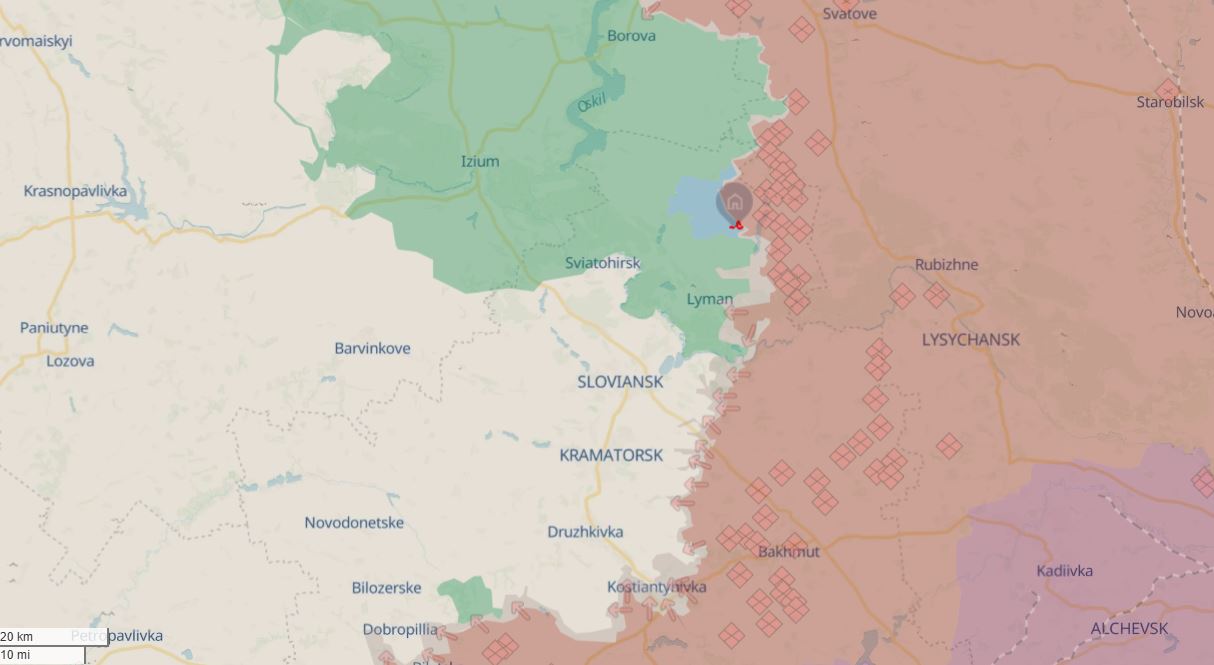
Operation Vivaldi is a Ukrainian counteroffensive north of Lyman in Donetsk Oblast, where the 3rd Army Corps has reported liberating settlements. In its third phase, Ukrainian forces reclaimed five settlements and expanded their gains to 176 square kilometers. Strikes on Russian logistics and electronic warfare likely neutralized Russia’s drone defenses before Ukraine sent in armor, the Institute for the Study of War assessed.

The commander, who uses the callsign “Betsyk,” leads the interceptor battalion of the 1030th Anti-Aircraft Missile-Artillery Regiment “Aquila,” part of the 3rd Army Corps. He said Russian forces deployed large numbers of reconnaissance drones to locate Ukrainian positions after the corps began advancing.

Betsyk named Zala, Orlan, Supercam, Merlin, and Knyaz Veshchiy Oleg among the reconnaissance drones used by Russian forces.

Russia also brought in reinforcements and units operating strike drones, including first-person-view (FPV) quadcopters, Molniya fixed-wing FPV drones, and Lancet crews, he said. At one stage, Russian forces deployed crews from their Rubicon drone unit to disrupt the advance, but the move did not change the situation.

ukraine retook kolodiazi north lyman its drones hit 200-plus russian vehicles operation vivaldi’s last phase commander says · post northern donetsk oblast neighboring areas territory during vivaldi blue 2022 green
Explore further

Ukraine retook Kolodiazi north of Lyman as its drones hit 200-plus Russian vehicles in Operation Vivaldi’s last phase, Ukrainian drone officer says

Betsyk said his battalion’s work deprived Russian forces of the ability to strike Ukrainian troops and track their movements.

Jet-powered Shaheds: speed is the main challenge

The regiment also works against Russian strike drones heading for targets behind the front line. Betsyk said interceptor crews had destroyed some jet-powered drones, but not in significant numbers.

The main difficulty is speed, he said. Interceptor drones need to reach 500–600 km/h to intercept Russian jet-powered attack drones, according to Betsyk.

For now, the regiment mainly uses conventional air-defense systems against these targets: self-propelled anti-aircraft systems, surface-to-air missile systems, and portable surface-to-air missile systems. Betsyk said these systems were historically designed to engage jet-powered targets.

He compared the current challenge with the early use of piston-powered Shaheds. Those drones initially posed a serious threat but later became easier for Ukrainian air defenses to counter. Russia has largely stopped using piston-powered Shaheds on most fronts since summer, he said, but continues to use piston-powered Gerbera drones, which are relatively cheap and can partly exhaust Ukrainian air defenses. The main drones Russian forces use now are jet-powered Shaheds, he said.

Betsyk expects Russian forces to adapt if Ukraine fields effective interceptors against jet-powered drones. They will seek ways to evade the interceptors, increase speed, improve navigation, and change their tactics, he said. However, he added that the battalion had not observed a major evolution so far and did not expect the drones’ speed to double.

What the corps says Vivaldi achieved

Separately, 3rd Army Corps commander Andrii Biletskyi said Ukrainian forces retook 277 square kilometers and 16 settlements during Operation Vivaldi, Ukrainska Pravda reported. Biletskyi also said Russian losses exceeded 8,000 personnel, according to ArmyInform. These figures are Ukrainian claims and have not been independently verified.

  •  

IUCN’s Madhu Rao on the world’s protected areas: Progress, pressures and the race to 2030

A park ranger in the Democratic Republic of Congo survived an ambush that killed colleagues. In Cambodia, mines and dams are pressing against land set aside for wildlife. In the Amazon, illegal miners are changing tactics as authorities try to remove them from Indigenous territories. These are different places, with different problems documented by Mongabay, but they point to a question now confronting governments: How much protection does a protected area actually provide? That question will follow delegates to Yerevan, Armenia, for the U.N. Biodiversity Conference, COP17, from Oct. 19-30. In 2022, countries agreed to conserve at least 30% of land and inland waters and 30% of coastal and marine areas by 2030. The commitment, known as Target 3 or “30 by 30,” is not simply about drawing new boundaries on maps. It also requires conservation to work, ecosystems to remain connected and the rights of Indigenous peoples and local communities to be respected. COP17 will conduct the first collective review of progress under the agreement. Also read: As global 30×30 goal lags, Colombia shows how progress can be made A new Earth Insight analysis maps oil, gas and mining concessions overlapping protected and conserved areas across the tropics, highlighting threats to global biodiversity goals. Image courtesy of Earth Insight. The evidence arriving ahead of the meeting is sobering. A new study by Earth Insight, the IUCN World Commission on Protected Areas and other partners found that nearly 62 million hectares (153 million acres) of terrestrial protected and conserved areas…This article was originally published on Mongabay

  •  

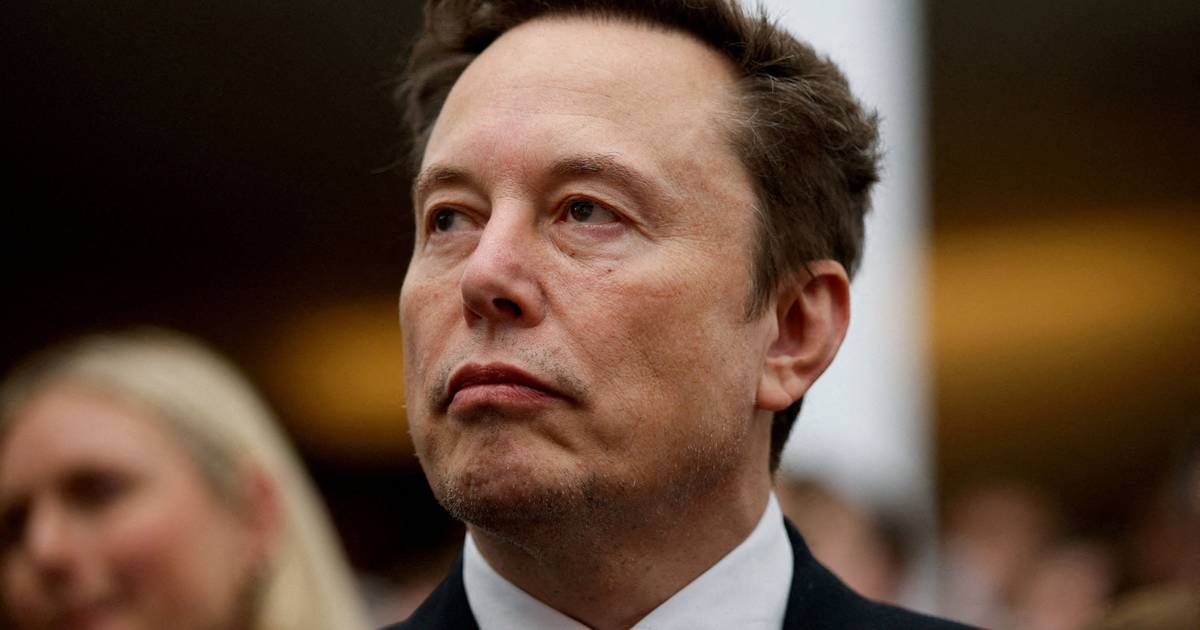
Who capped Ukraine’s Starlink? “Ultimately POTUS,” Musk said. Ultimately Musk, reports now say

musk, trump

Elon Musk ordered the speed cap on Starshield, the military version of SpaceX’s Starlink network that Ukraine’s drones rely on, The Wall Street Journal reported on 20 October. Earlier, Musk said that such limits are decided by the US military and “ultimately POTUS.” Speaking to reporters in Eau Claire, Wisconsin, on 20 October, according to WSJ, US Defense Secretary Pete Hegseth said, “We haven’t made any directives or anything like that,” CBS News reported.

For a week, no one with a hand on the system said the decision was theirs. Musk pointed to the US military and the president, and Trump said he did not know who it was. Meanwhile, Ukrainian officials said the cap has hampered the drones they use to intercept Russian Shaheds and to strike Russian forces in occupied territory. Kyiv says the cap remains in place, and at about 160 km/h it makes intercepting jet-powered drones and missiles that fly about twice as fast virtually impossible.

Musk spoke with administration officials, including Trump, before the cap, a source says

Musk capped the speeds at which Ukrainian hardware could stay connected to the network, people familiar with the matter told WSJ. The slowdown, which began on 14 October, left some of Ukraine’s strike and interceptor drones virtually useless, WSJ said.

WSJ’s sources differ on Trump’s role. Some US officials said Musk acted on his own and that Trump did not specifically order any retribution against Ukraine. One person said Musk spoke with several senior administration officials, Trump among them, before imposing the cap. Two people said Musk and Trump discussed the decision by phone soon after the slowdown became public.

During the uproar, SpaceX representatives called White House counterparts. They asked for a shared message that the company and the administration had coordinated before Musk’s directive, the people said. The White House ran an informal inquiry into who ordered the slowdown, WSJ said.

Musk held several conversations with administration officials before the order to understand the president’s thinking, CBS reported, citing sources. He dislikes his company being seen as profiting from the war, and it is unclear how his order was carried out, CBS said.

Hegseth points to Starlink’s terms of service

Hegseth said the US had not pulled anything back. He said Starlink “has the option” to make decisions under its terms of service, and that from the Pentagon’s view nothing had changed, CBS reported.

Speaking to reporters as he left the White House on 16 October, Trump said he did not think either he or Musk was responsible, The Telegraph reported. On 19 October, he said, “I don’t know who it was, but I’d like to find out.”

Last week, a bipartisan group of senators asked the Pentagon’s inspector general to investigate whether officials “directed” or “authorized” changes to Starlink and Starshield services and intelligence sharing affecting Ukraine.

Earlier reports pointed at the White House

On 15 October, Reuters reported that the order came from inside the White House. The officials said Pentagon leaders received a message that the Starshield service for Ukraine’s military needed to be slowed, but did not say who made the decision or who carried it out. A senior US official said “No such request was ever made by the president.”

On 16 October, The Telegraph reported, citing four sources, that Musk approached Trump with the idea of the speed limits. One of the sources said Trump agreed.

Analysts and Kyiv say the cap is still in place

Michael Kofman, a war analyst at the Carnegie Endowment, said, according to WSJ, that Ukrainian strike and interceptor drones remain limited to 160 km/h. He said actual connections run below 130 km/h, which still hampers strikes and air defense.

On 20 October, Ukraine’s top diplomat in Washington, Denys Sienik, said Kyiv was still waiting for answers from the Pentagon and SpaceX, WSJ reported.

  •  

Douro está a chegar ao limite? Operadores alertam para constrangimentos na navegação e defendem melhorias nas infraestruturas

TnewsEm declarações ao TNews, a DouroAzul, a Rota do Douro e a Magnífico Douro convergem na necessidade de reforçar o investimento e melhorar a gestão operacional da Via Navegável do Douro, embora apresentem avaliações distintas sobre os limites atuais da atividade.
  •  

Così Trump prova a riconquistare il voto delle donne per le midterm

Il rapporto con le donne del presidente degli Stati Uniti, Donald Trump, è da sempre complicato. Cause aperte, accuse di molestie, offese pubbliche, intimidazioni (è stato anche condannato per ricatto). Per questo, e molto altro, una fascia elettorale in cui non gode di consenso è quella del voto femminile. A poco meno di un mese dalle elezioni di midterm, i sondaggi di Reuters e Ipsos indicano che solo il 32% delle donne voterà i repubblicani. I report del Washington Post e ABC News sostengono che il 61% voterà per i democratici.

E, siccome è un voto che pesa, Trump ha iniziato una strategia per provare a conquistare l’approvazione delle donne. Il piano si centra nel ruolo della moglie, Melania Trump, fino ad ora lontana dai riflettori.

Questa settimana l’ex modella ha presentato dai giardini della Casa Bianca un nuovo programma dedicato alla cura e prevenzione della salute femminili. Ad accompagnarla, in un angolo, il marito. Non sono ancora stati diffusi dettagli su quante risorse economiche saranno dedicate, ma la first lady ha assicurato che ci sarà un decreto esecutivo per avviare subito l’iniziativa.

Il programma consta di cinque pilastri, a cominciare con il trattamento di malattie che affliggono specialmente le donne. “Il secondo aspetto – ha spiegato Melania – sarà l’applicazione della ‘superintelligenza’ (in riferimento all’intelligenza artificiale, ndr) per migliorare la comprensione della biologia femminile e accelerare le scoperte mediche, in beneficio delle donne”.

Successivamente ci sarà un processo per guidare terapie promettenti dai laboratori fino a paziente donne, seguendo rigidi protocolli di sicurezza. Il quarto punto sarà assicurare che i progressi medici siano accessibili alle donne, indipendentemente dalla posizione economica. In fine, il programma si dedicherà alla formazione delle nuove generazioni perché parlino in maniera aperta e con compassione di molte malattie e malesseri che fino ad oggi sono stati considerati tabù.

https://t.co/QBs6J1uGsR

— MELANIA TRUMP (@MELANIATRUMP) October 20, 2026

  •  

Cambodia and Laos are not pawns in a Chinese encirclement

In late September, China and Laos opened a Beijing-funded training and support center and an aviation academy at Ban Keun airport, about 50 kilometers north of Vientiane. China’s Ministry of National Defense says the facility will train Lao Air Force pilots and is “not directed against any third party.” Even so, much of the commentary […]

The post Cambodia and Laos are not pawns in a Chinese encirclement appeared first on Asia Times.

  •  

Italian government to deploy troops to Milan after anti-austerity protests

Giorgia Meloni’s administration has announced the deployment of 500 military troops to Milan after a weekend of intense protests and riots resulted in broken windows at luxury shops. 

But while mainstream coverage has focused on exclusive brands hiding inventory from angry demonstrators, progressive organizations emphasize that the rage witnessed on the streets of several northern Italian cities is a result of the government’s own policies.

“A Louis Vuitton bag can cost €5,600, while the monthly maximum for the wage guarantee fund in 2026 is €1,340,” wrote the grassroots union Unione Sindacale di Base (USB). In a statement on Tuesday, the union cited devastating national statistics, including data showing that over 14% of working-class families live in absolute poverty.

Broken windows can be repaired, USB noted. “Five years of lost wages, an impoverished family, and a denied future cannot be recovered so easily.”

Students oppose austerity at school and beyond

Significant mobilizations preceded the weekend’s protests. On Friday, October 16, roughly 400,000 students flooded the streets for “No Meloni Day”. They criticized the government’s so-called securitization measures which in practice has meant stifling the right to protest, as well as the unabated turn toward war and armament.

Protesters warned that by prioritizing these points over public services and working conditions, Meloni and her ministers knowingly undermine the future of a whole generation. 

Read more: Curfews imposed in French cities as rebellion against austerity grows nationwide

Echoing developments in France, where teachers’ unions have supported students’ demands over recent weeks of historic struggle for a stronger public education system, educators in Italy began circulating appeals to do the same.

“The established order is the worst of all possible worlds – or comes very close to it – and our schools are a mirror of this: they are falling apart, alienating, militarized,” the appeal reads. “Places where the need to stretch one’s legs is labeled ‘indiscipline,’ and where the ‘foreigner’ is blamed for the decline in knowledge, rather than two decades of underfunding and neglect.”

Real solutions, not repression, needed to address social crisis

Trade unions, teachers, and students all denounced the repression authorities unleashed in response to the protests – both after mobilizations in cities and during school occupations. 

“This government – incapable of offering solutions to the social crisis raging across the country – is once again attempting to manage the streets and social discontent solely through the lens of ‘public order,’ while intensifying repression and shrinking the space available for political activity,” emphasized youth organization Cambiare Rotta.

Students opposed the government’s focus on militarization. Source: Cambiare Rotta/Facebook

Teachers specifically called upon others in the system not to endorse crackdowns on students while invoking democratic values. “Democracy today resists in the French and Spanish squares, in the occupied Italian schools, in the resistance to the genocide of the Palestinian people, in the words and deeds of those who oppose the piecemeal world war,” they wrote.

“It is not to be found in threats, in tear gas, in police officers inside schools, or in students maimed by the weapons of our law enforcement. It is not to be found in the unjust rules that too many persist in defending.”

Read more: Mediterranean dockworkers launch historic international strike

The increased protest activity has given hope that the spark that inspired massive mobilizations throughout 2025 might resurface. It comes less than two weeks before a new general strike – and an international dockworkers’ strike in which Italian port workers are set to play a notable role – on October 30.

  •  

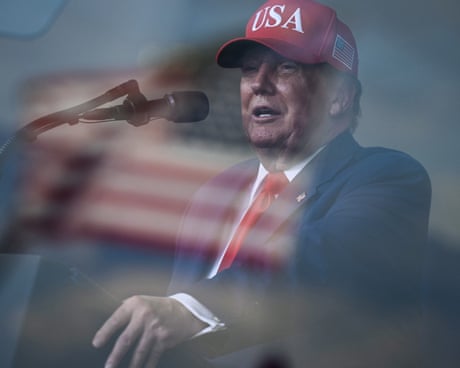
Republicans push back on Donald Trump’s wavering support for Ukraine

GOP lawmakers threaten to pull support for president’s agenda after Russia diesel deal and sanctions pause

A handful of Republicans have spoken out against Donald Trump’s softening stance on Russia, threatening to pull financial support for his agenda over his “embarrassing” handling of the Ukraine war.

Don Bacon, an outgoing congressman in Nebraska, condemned Trump’s actions – which include a stunning agreement to buy Russian diesel and the pausing of sanctions on Moscow – as “absolutely disgraceful” and accused the US president of cozying up to a “war criminal” in Vladimir Putin, his Russian counterpart.

Continue reading...

© Photograph: Brendan Smialowski/AFP/Getty Images

© Photograph: Brendan Smialowski/AFP/Getty Images

© Photograph: Brendan Smialowski/AFP/Getty Images

  •  

Tutto sul possibile incontro tra Xi, Trump e Putin

Vladimir Putin è entusiasta e avrebbe invitato i due grandi alleati internazionali, il presidente cinese Xi Jinping e il presidente americano Donald Trump a una riunione trilaterale per discutere le sorti della guerra in Ucraina, ma non solo. Il luogo dell’importante appuntamento potrebbe essere la Cina, sfruttando l’impegno del Forum di Cooperazione Economica Asia-Pacifico a Shenzhen il 18 e 19 novembre.

Una specie di riedizione dello storico summit di Yalta tra Stalin, Churchill e Roosevelt nel 1954. Tra gli argomenti di discussione il più urgente sarebbe la guerra in Ucraina. Infatti, secondo il quotidiano americano The Wall Street Journal, Xi, Putin e Trump potrebbero “disegnare” in quell’occasione una nuova mappa divisa tra zone di influenza.

A proporre l’incontro sarebbe stato Putin, per via telefonica, lo scorso 9 ottobre. Dmitry Peskov, portavoce del governo russo, ha confermato l’idea di questa possibile riunione. Anche se Xi e Trump ancora non hanno risposto all’invito.

Tutto indica però che almeno Trump ci sarà. In un post ha spiegato la sua strategia (semplice) sulla Russia: “Sto negoziando la pace nella guerra tra Russia e Ucraina e non voglio fare nulla che, imprudentemente, possa allontanare la Russia dal tavolo di negoziati. Si stanno facendo grandi progressi!”.

  •  

Rubio thinks Starlink is fixed. Kyiv says it still cuts out above 161 km/h

rubio

Ukrainian President Volodymyr Zelenskyy said on 20 October that he had spoken with US Secretary of State Marco Rubio about ballistic missile interceptors, early warning of Russian launches, and “the situation with Starlink/Starshield, which needs to be restored,” he wrote on X. He thanked Rubio for “his readiness to help and his clear position” and said they would speak again soon. A day earlier, he had told US senators how each of those supplies had stalled.

This comes as the US presses Kyiv to stop its strikes on Russian oil refineries, which Trump has blamed for high fuel prices at home, and Zelenskyy counts the Starlink slowdown among the steps he says look like an effort to push Ukraine to capitulate. Ukraine’s interceptor drones depend on the service to hunt Russia’s jet-powered Shaheds, and Kyiv says they now lose the link at speeds too low to catch them. The call appears not to have settled whether that cap is gone. If it stays, Ukrainian cities could face Russia’s drone waves this winter with one fewer means to stop them, as Russia keeps striking the grid.

On 17 October, Rubio told reporters that nobody in the US ordered Starlink slowed, that the slowdown “wasn’t deliberate,” and that “my understanding is it’s been restored.” He drew a line between the two services. Ukraine’s drones, he said, ran on commercial Starlink, while Starshield, the military version, is not available to Ukraine. Kyiv has asked for it to carry out strikes deep inside Russia, and that request is under discussion, he said.

The next day, Zelenskyy told Bloomberg that Starlink in Ukraine cuts out above 161 km/h, and Kyiv says its Starshield terminals are capped as well. His post after the call still says the service needs to be restored.

Reuters’ sources point to the White House. Washington denies it

The order to slow Starshield came from inside the White House, Reuters reported, citing two US officials and a Western official. They described it as the Starshield service for the Ukrainian military, the version Rubio says Ukraine does not have. A senior Ukrainian official told Reuters that Kyiv had been told it was a White House decision. A senior US official told the agency the president never made such a request, and the White House did not answer whether other officials had. Rubio called a report that the White House ordered Starlink slowed “categorically false.”

Missile warnings and Patriots are also in dispute

Overnight on 18–19 October, Ukraine got no partner warning before the first of two Russian ballistic waves, Air Force spokesman Yurii Ihnat said on the national telethon. That came hours after Zelenskyy said US warnings had resumed. On 19 October, Rubio pushed back against suggestions of a pause in US intelligence sharing, AFP reported.

Zelenskyy also told Bloomberg the US sends only 12 Patriot interceptors a month and has authorized only part of those “we have paid for” under PURL. Ukrainian officials told the Kyiv Independent that Defense Secretary Pete Hegseth has not signed the contracts. A US government official called those claims “not true.”

  •  

Nigeria’s parks chief stresses conservation gains amid struggle to protect wildlife

Nigeria has scored a significant conservation victory with the closure of a major illegal gold mine near Gashaka-Gumti National Park, the country’s largest national park, according to National Park Service Ibrahim Musa Goni. An estimated 4,000 miners have been driven from the Kila mining area following an operation involving the National Park Service, the Nigerian military, state governments and conservation partner African Nature Investors (ANI). But Goni, conservator-general of Nigeria’s National Park Service, is under no illusion that the problem has been settled. The gold remains underground, and the miners could return. “There is a tendency the miners might come back,” he told Mongabay. For Goni, who has led the service since 2017, the Kila operation is one of the achievements of which he is most proud. He believes the approach could work in other Nigerian parks struggling with illegal mining and insecurity. Yet protecting these landscapes has come at a heavy price. Rangers have been injured and even killed confronting illegal miners and armed groups. Elsewhere, insecurity has forced the suspension of tourism in parts of Kainji Lake and Chad Basin national parks. Goni insists that 13 of the 17 national parks in Nigeria remain operational and active, even where access has become dangerous. Watch: Return to Gashaka-Gumti Read: Nigeria drove thousands of gold miners from a national park. But can it keep them out? There are other difficult questions. For example, what happens to the thousands of miners who have lost their livelihoods? Can the government keep them…This article was originally published on Mongabay

  •  
❌