❌

Reading view

Venezuelan Government and 2015 Assembly Ex-Deputies Close Third Dialogue Cycle

Photo: X/ Jorge Rodriguez

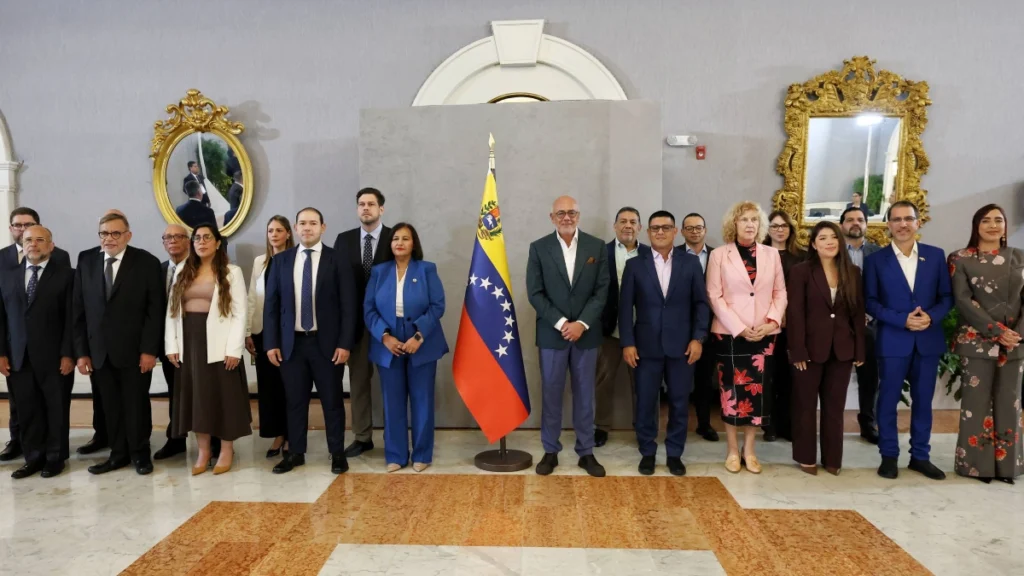
Venezuela’s national government and former deputies of the 2015 National Assembly held the final plenary of the third cycle of talks in Caracas on Wednesday, centered on reviewing compliance with agreements on institutional matters and renewal of the judicial system.


This phase covered the review of commitments from the second cycle, which concluded Sept. 25 with partial agreements on lifting restrictions on digital news portals, adding guarantees for the right to information and progress in judicial renewal.

RELATED: Venezuela Sets Youth Popular Consultation for February 2027

The agenda also included installing the Credentials Review Council for applicants to the Supreme Court of Justice as part of discussions on the judicial system.

En desarrollo la última plenaria del tercer ciclo de conversaciones. pic.twitter.com/n46lLsSMaC

— Jorge Rodríguez (@jorgerpsuv) October 21, 2026

The government delegation was headed by National Assembly President Jorge Rodríguez and included deputies Pedro Infante, Jorge Arreaza and América Pérez, Minister of University Education Ana María Sanjuan and Deputy Minister Génesis Garvett. The 2015 Assembly delegation included Dinorah Figuera, accompanied by Juan Miguel Matheus, Sergio Vergara, Marco Aurelio Quiñones and Ramón López.

The formal talks began Aug. 12, when both parties agreed on a working methodology and installed technical tables on care for earthquake victims, democratic strengthening and judicial system reforms.

  •  

Venezuela Sets Youth Popular Consultation for February 2027

The Venezuelan Acting President urged young people to prepare actively for this new democratic appointment that will mark the course of next year. Photo: Venezuelan Presidential Press.

Acting President Delcy Rodríguez announced Wednesday that Venezuela will hold its Youth Popular Consultation in February 2027, a vote she framed as a platform for young people to convert their talent, creativity and ingenuity into a driving force for national development.


Venezuelan Acting President Delcy Rodríguez delivered the announcement during a visit to the Nueve Raíces de Simón communal circuit, where she urged the country’s youth to prepare actively for what she described as a democratic appointment that will mark the direction of the coming year.

Rodríguez said the process aims to vindicate the talent, creativity and ingenuity of the new generations and to propel Venezuela toward fresh development opportunities. The call places younger Venezuelans at the center of a participatory model that has gathered strength since 2024.

RELATED: Venezuela to Begin Funding Projects Selected in Popular Consultation Next Week

The announcement lands days after the Second National Popular Consultation of 2026, held on October 18. It was the eighth nationwide vote of its kind since 2024, and officials described the turnout as massive and successful. That result has now been translated into a fresh appeal aimed specifically at young people, signaling the government’s intention to widen the base of participants in community decision-making.

🗳️🔥 ¡LA JUVENTUD SE PREPARA: NUEVA CONSULTA EN FEBRERO 2027!🇻🇪✨

Tras una participación histórica en la pasada Consulta Nacional Popular, la ruta continúa: ¡Jóvenes de toda Venezuela a prepararse desde ya! 💪🌱

El compromiso no se detiene: es momento de seguir adelante,… pic.twitter.com/YyOteBQqLT

— Ministerio del Poder Popular para la Juventud (@Minjuventud__ve) October 21, 2026

Text reads: “Youth is preparing: new consultation in February 2027! After a historic participation in the last National Popular Consultation, the route continues: Young people from all over Venezuela to prepare now! The commitment does not stop: it’s time to move forward, organize and execute projects that will transform our territories.”

A Record October Turnout

Millions of residents from communities across the country turned out on October 18, prompting the National Electoral Council (CNE) to extend voting by one hour.

The scale of the exercise was measured in large numbers. More than 5,418 communes and communal circuits coordinated the work of over 48,000 communal councils, and voters selected among 37,205 priority community projects eligible for public financing.

Rodríguez has championed the consultation model as a vehicle for what officials call popular power. In separate remarks, she described participation in the October exercise as extraordinary, linking the strong turnout to a broader effort to place public decision-making directly in the hands of organized communities rather than distant institutions.

A Broader Community Voice

One of the most notable features of the October consultation was the first-time inclusion of condominium boards, which put forward 428 projects. Acting President Rodríguez celebrated that milestone on social media, underscoring the importance of keeping decisions about everyday matters firmly in the hands of communities themselves.

The proposals reflected local priorities. Acting President Rodríguez had previously detailed that 14% of the projects corresponded to the water sector, followed by initiatives in road infrastructure, lighting, electricity, public services and productive activities, showing residents directing public resources toward their most pressing daily needs.

With the youth consultation now scheduled for February 2027, the Acting President called young Venezuelans to assume what she called absolute protagonism in the process. Organizers expect the new consultation to build on the machinery tested in October and to channel the energy of younger generations into decisions that will shape the country’s near-term path.

  •  

EU Prosecutors Raid Patriots for Europe Offices in €4.3 Million Funding Investigation

European prosecutors have searched offices in Brussels and Strasbourg as an investigation into alleged misuse of parliamentary funds by the former Identity and Democracy group raises questions over financial liabilities inherited by Patriots for Europe.

European prosecutors carried out searches at the European Parliament’s offices in Brussels and Strasbourg on Wednesday, 21 October, as part of an investigation into alleged financial irregularities involving the former Identity and Democracy (ID) parliamentary group.

The investigation concerns approximately €4.33 million in European Union funds that were allegedly improperly spent during the 2019–2024 parliamentary term. The European Public Prosecutor’s Office (EPPO) confirmed that searches had taken place in connection with an ongoing inquiry into the use of EU funds by a former parliamentary group.

The premises searched are now occupied by Patriots for Europe, the European Parliament’s third-largest political group, which includes France’s National Rally, Hungary’s Fidesz, Italy’s Lega and Spain’s Vox. Patriots for Europe insists that it has no legal continuity with Identity and Democracy and denies being involved in the investigation.

Investigation into parliamentary expenditure

The European Public Prosecutor’s Office opened its investigation in July 2025 following concerns identified by the European Parliament’s financial administration about expenditure incurred by Identity and Democracy.

The former group, which dissolved following the 2024 European elections, included representatives of France’s National Rally, Italy’s Lega and Germany’s Alternative for Germany.

According to details of the parliamentary financial examination subsequently reported in France, investigators are examining approximately €3.6 million in contracts awarded to external service providers, including businesses with political connections to parties represented within the former group.

The financial examination also identified more than €700,000 in donations to organisations whose activities were allegedly unrelated to the parliamentary group’s official functions.

The authorities are examining whether parliamentary resources were used in accordance with EU financial rules, including restrictions on using public money for national party-political activities.

These are allegations under investigation, not criminal findings. The EPPO has not announced convictions arising from the current inquiry, and the individuals and organisations concerned retain the presumption of innocence.

Earlier investigative measures were conducted in France, Belgium, Spain and Italy in June 2026. Wednesday’s searches mark a further stage in the proceedings.

Can Patriots for Europe inherit the liabilities?

The investigation has opened a separate dispute over whether Patriots for Europe could be required to repay money allegedly misspent by its predecessor.

Identity and Democracy ceased to exist after the 2024 elections. Several parties previously represented in the group subsequently joined Patriots for Europe, a new parliamentary formation that also brought together Viktor Orbán’s Fidesz and Spain’s Vox.

Patriots for Europe maintains that the two groups are legally separate. Its representatives argue that the dissolution of Identity and Democracy ended that group’s institutional existence and that the present parliamentary organisation is not responsible for its predecessor’s financial affairs.

However, the European Parliament’s budgetary authorities have examined whether responsibility for outstanding liabilities can pass to a successor group.

An opinion approved by the Parliament’s Budgetary Control Committee in September considered the circumstances in which continuity between parliamentary groups might establish financial responsibility.

Such an assessment may consider whether members, administrative personnel, operational resources and other assets were transferred from one organisation to another.

The outcome could determine whether the current group is exposed to potential repayment demands, irrespective of whether its present members were personally involved in the expenditure under investigation.

No final determination of such liability has been established through Wednesday’s searches.

Political consequences in Strasbourg

The searches come at a time when Patriots for Europe has become a major political force within the European Parliament.

Its member parties have challenged EU policy on immigration, economic regulation and the distribution of powers between Brussels and national governments. National Rally and Fidesz are also influential actors in the domestic politics of France and Hungary respectively.

An investigation involving their parliamentary organisation is therefore likely to attract scrutiny beyond the immediate financial questions.

Nevertheless, the political influence of the group and the criminal investigation must be considered separately. The presence of prosecutors at parliamentary premises does not establish wrongdoing by the current group’s MEPs.

The case also raises broader questions about financial accountability within the Parliament, particularly when a political group dissolves following an election and its members establish a new organisation.

Unlike national political parties, European parliamentary groups receive funding specifically to support their legislative, administrative and political work inside the institution.

Those resources are subject to financial controls intended to prevent their diversion into activities that should be funded by national parties or other organisations.

Further proceedings

The EPPO is responsible for investigating and prosecuting offences affecting the European Union’s financial interests. It operates independently of national governments and EU political institutions.

The European Parliament has confirmed its cooperation with the authorities but has declined to comment on the substance of the continuing investigation.

Prosecutors must now assess the evidence obtained during the searches alongside financial records and material collected during previous investigative measures.

Any decision to bring criminal proceedings would depend on the evidence available and the relevant national and European legal requirements.

Separately, the Parliament will have to establish whether any recoverable funds are owed by the former group and, if so, which organisation is legally responsible for repayment.

For Patriots for Europe, the immediate issue is not only the progress of the criminal inquiry but whether the financial arrangements of a dissolved parliamentary group can create obligations for its successor.

  •  

Tech Billionaires and the New Struggle for Political Power

In his book The Nerd Reich, journalist Gil Durán examines how Silicon Valley’s wealthiest investors are extending their influence over American politics, democratic institutions and national sovereignty. His warnings come amid unprecedented political spending by technology billionaires and growing concern over private control of strategic infrastructure.

Elon Musk has contributed more than $276 million since July to Republican political causes ahead of the United States midterm elections on 3 November. Meanwhile, US Secretary of State Marco Rubio has said decisions over Ukraine’s access to SpaceX satellite communications rest with the company rather than the White House. Both developments demonstrate how private technological and financial resources can influence decisions traditionally associated with government.

For journalist Gil Durán, author of The Nerd Reich: Silicon Valley Fascism and the War on Democracy, published by Avid Reader Press in August 2026, the issue extends beyond campaign donations. In a recent interview, he argued that a group of Silicon Valley investors is using its financial influence and control of technology to challenge the authority of elected governments.

“We’re at a decisive stage of that race,” Durán said when asked about the contest between technology and democracy described by venture capitalist Peter Thiel. His argument is that wealth alone no longer satisfies some of the industry’s most influential figures; they also want a direct role in determining how societies are governed.

The ideological origins of billionaire power

Durán places Thiel at the centre of this movement. In a 2009 essay, The Education of a Libertarian, the PayPal co-founder wrote that he no longer believed freedom and democracy were compatible. He argued that technological innovation could allow individuals to escape the constraints of conventional politics.

Thiel subsequently clarified that he was not advocating disenfranchisement. His stated position was that majority rule often frustrated individual liberty. Durán, however, interprets the essay and Thiel’s subsequent political investments as evidence of a sustained interest in diminishing democratic constraints on private power.

The book also examines The Sovereign Individual, a 1997 work by James Dale Davidson and William Rees-Mogg that anticipated how digital currencies and technological change might weaken the power of nation states. Durán sees its influence in later arguments for privately organised alternatives to traditional government.

One example is The Network State, developed by entrepreneur Balaji Srinivasan. It proposes that online communities could acquire territory and eventually obtain diplomatic recognition. Advocates describe a voluntary model of political organisation; Durán regards the prospect of corporate-financed jurisdictions as a challenge to public accountability.

From venture capital to the White House

The relationship between Thiel and Vice-President JD Vance illustrates how venture capital can translate into political influence. Thiel supported Vance’s early investment career and contributed $15 million to a super PAC backing his successful 2022 Senate bid. Durán attributes much of Vance’s political ascent to that support, although voters, party endorsements and Vance’s own campaigning also shaped the result.

Musk’s latest contributions offer a more immediate example. His donations since July include $158 million to the Senate Leadership Fund and more than $76 million to America PAC. Such spending is lawful under the rules governing independent political committees, which cannot coordinate their expenditure with candidates.

Durán contends that similar pressures affect Democrats, arguing that wealthy donors can exercise influence across party lines. His criticism therefore concerns the political system’s dependence on private funding as much as any particular administration.

Technology as an instrument of strategic power

The consequences extend beyond elections. Ukraine’s dependence on satellite communications has exposed how a privately owned service can become essential to military operations. Restrictions affecting Starlink-related services have prompted competing accounts from US officials and SpaceX over responsibility for the decision. Rubio’s latest remarks point towards commercial control, while earlier reporting attributed the decision to Washington.

Artificial intelligence raises comparable questions of ownership and oversight. Durán argues that investors promoting transformative AI may also seek regulatory conditions that protect their substantial financial commitments. His prediction of a possible investment bubble remains a judgement, not an established outcome.

In Europe, the debate has immediate regulatory consequences. The EU’s Digital Services Act requires major online platforms to assess risks to elections and civic debate, while enforcement of important provisions of the AI Act began in August 2026. These measures address the influence of companies whose platforms and systems operate across borders.

Durán’s interpretation of Silicon Valley as a coherent anti-democratic movement remains contested. The entrepreneurs he discusses have differing interests, and their political influence does not itself establish a common plan to dismantle democratic government.

Their influence is nevertheless measurable in campaign finances, government contracts and control over infrastructure essential to national security. None of these forms of power requires holding elected office.

  •  

Update on Canada's Two Secession Movements

An upward trending chart over the Canadian flag
Illustration: Lex Villena

Back in June, I wrote a post about Canada's two active secession movements: one in Alberta and one in Quebec. Since then, there have been some important developments. Alberta secessionists suffered a major defeat. Quebec secessionists are in better shape, but the odds are still against them succeeding anytime soon. That said, both movements may well persist for a long time to come.

Yesterday, Alberta secessionists lost a referendum on secession by a massive 75-25 margin. Pollsters expected a blowout, but this margin is close to the outer edge of expectations. Moreover, the result may actually understate the true extent of opposition to secession in the province. As noted in my earlier post, the question put to the voters was not directly about secession, but rather on whether "the Government of Alberta [should] commence the legal process required under the Canadian Constitution to hold a binding provincial referendum on whether or not Alberta should separate from Canada." Essentially, it was a referendum on whether to hold another referendum. Some "yes" voters might have been confused about what it meant or wanted to hold a second referendum, while planning to vote "no."

United Conservative Party Alberta Premier Danielle Smith (who played a key role in arranging yesterday's vote, despite opposing secession herself) has pledged not to hold any further referenda on secession. She may well be happy to sideline an issue that divides her party (Alberta secessionists are overwhelmingly right-of-center UCP voters).

All of this is bleak news for Alberta secessionists. But it's too early to say their movement is dead. As noted in my previous post, secession movements often persist for many years, even in the face of defeats in referenda and other political setbacks. Scotland, Quebec, and Catalonia are all examples of this phenomenon. And some 25% of Alberta voters did express support for secession, despite opposition from the leaders of all major political parties. That's a minority, but far from an insignificant one.

Meanwhile, in Quebec, on October 5, the secessionist Parti Quebecois (PQ) won the provincial election. But they got only 28% of the vote (the lowest percentage for any winning party in the history of Canadian provincial elections). That translated to a "minority" government that has 59 seats in Quebec's National Assembly (the provincial legislature), 5 short of a majority. And, as discussed in my previous post, secession remains unpopular, with polls showing opposition by a margin of 2-1 or more. For much more detailed discussions of the Quebec election and its ramifications, see analyses by Canadian election/polling experts Eric Grenier and Philippe Fournier.

As Fournier emphasizes, PQ leader Paul St. Pierre Plamondon (known as "PSPP") remains committed to holding a secession referendum. But the minority nature of his governments makes it unclear whether the PQ can find the votes to enact legislation to hold one. The left-wing Quebec Solidaire party (which holds 9 seats) is also pro-independence. But they may not be willing to work with the PQ. In addition, PSPP has promised not to hold a referendum so long as Donald Trump remains president of the United States, claiming it would be too dangerous to do so while Trump continues his trade war with Canada and otherwise threatens the country. Unless Trump dies or gets impeached and removed (both relatively unlikely), he will remain in office until January 2029. Canadian minority governments generally don't last more than two years. So PSPP may not be in power long enough to outlast Trump.

While Quebec secessionists seem unlikely to prevail in the near future, the fact that they managed to return to power is still a sign of the movement's persistence. And they have survived referendum defeats in 1980 and 1995. Thus, the movement is likely to continue to be a thorn in the side of Canadian federal governments, perhaps for many years to come. It has demonstrated its staying power over many years, much more so than Alberta secessionists.

Many Canadians believe Trump's threats against their country have weakened secessionists in both Alberta and Quebec. PSPP's stance is just part of the evidence for this conclusion. Trump's trade war and threats to make Canada the "51st state" have bolstered national unity and made the Liberal Party government of Prime Minister Mark Carney much more popular than might otherwise be the case. Trump is making Canadian national unity - and the Canadian Liberal Party - great again! But for him, the Liberals would likely have lost last year's Canadian federal election to the Conservatives.

Perhaps, all along, Trump has been trying to help the Liberals and stymie secessionists. If that's the true objective of his Canada policy, then maybe it's not quite as evil and stupid as otherwise seems to be the case. On a more serious note, Trump's policies have illegally usurped congressional authority over trade,  damaged our economy, and alienated a crucial ally - all for no good reason.

In my June post, I outlined reasons why I am more sympathetic to Alberta's secession movement (motivated by conservative economic ideology and grievances about federal fiscal transfers and energy policies), than Quebec's (motivated by Francophone ethno-nationalism). Although I think the Alberta movement has greater merit than Quebec's, for reasons also summarized in the earlier post, I remain skeptical that Alberta secession would accomplish more good than harm. I also explained why these movements may be of interest to many non-Canadians and why I (an American) comment on them them:

[T]hese events are… of interest to students of federalism and secession, and to anyone who cares about the future of America's northern neighbor and one of our most important allies. And history shows that secession movements often persist even after defeat in a referendum….

From a US perspective, I worry that a successful secession movement would make Canada a weaker and less effective ally. Unlike our current president, I think a strong Western alliance is essential….

Some might find it inappropriate for an American to comment on Canadian politics. I disagree. Canadians and other non-Americans often express views on US politics. And they have every right to do so. Political analysis should be judged on its substance, not on the background of the author. In addition,… Canadian secessionism potentially impacts the US in various ways, and raises broader issues about the morality of secession movements that Americans and others have reason to take an interest in…. I am a longtime academic expert on federalism and secession-related issues, and I know French, as well as English. Thus, I think have the necessary qualifications to write about these issues. Whether the commentary is any good or not, is for others to judge.

The post Update on Canada's Two Secession Movements appeared first on Reason Magazine.

  •  

Democracy Dies in Fakeness: False Elections All Across Europe

Europe's political class loves democracy – right up until voters choose the wrong people. From Sweden to Germany and Britain, Steven Tucker says the establishment has found plenty of ways to keep the public in its place.

The post Democracy Dies in Fakeness: False Elections All Across Europe appeared first on The Daily Sceptic.

  •  

Libertarianism and Democracy Revisited - A Rejoinder to Matt Zwolinski

Democracy | NA
NA

On October 4, I published a post on "Libertarianism and Democracy," critiquing political philosopher Matt Zwolinski's earlier Liberalism.Org article on the same topic. Earlier today, I posted Matt's response to me. The present post is my rejoinder:

I would like to thank Matt for his interesting and insightful response. We agree on several key points, including that democracy is generally superior to authoritarianism, that libertarian critiques of democracy have great merit, and that - in much of the world - the most serious threats to liberty now come from the nationalist right, rather than the the political left. But we still differ on a few key points related to libertarianism and democracy.

The Nature of Libertarian Critiques of Democracy

Perhaps the most crucial disagreement is about the nature of libertarian critiques of democracy. Matt suggests that "[m]ost of what Ilya calls the libertarian critique of democracy is really a critique of big government." If so, libertarians can just focus on criticizing big government generally, while simultaneously extolling democracy.

There are indeed flaws of big government that arise regardless of whether it is democratic or authoritarian. But those outlined in my earlier Liberalism.Org article are in fact specific to democracy. They include tyranny of the majority, voter ignorance, and the tendency of democracy to create opportunities for illiberal forces to seize power and - in the worst case scenario - even destroy democracy itself.  Tyranny of the majority is obviously a problem distinctive to democracy. The same goes for rational voter ignorance, which arises from the perverse incentive structure  of individual voters, who have only an infinitesimally small chance of influencing electoral outcomes. And, while illiberal forces can and do seize power under authoritarian systems, the pathways democracies (usually involving the electoral process) create for them are distinctive.

Authoritarian systems have their own distinctive flaws, which are generally even worse. But the distinctive nature of democracy's flaws means they cannot simply be folded into a generic critique of big government. In addition, as noted in my response to Matt, these distinctive flaws of democracy are at the heart of many of today's most serious threats to liberty and justice in many democratic systems, including the threats posed by the nationalist right. Thus, it is important for libertarians to emphasize the nature and gravity of these weaknesses, and the value of our proposals for dealing them (which in many cases are different from and better than those advanced by other types of liberals). As emphasized in my earlier response, this is an area where libertarians often have a comparative advantage over other liberals. On the other hand, we generally do not have a comparative advantage when it comes to explaining why democracy is better than authoritarianism.

Along related lines, Matt suggests that libertarian critiques of the state aren't "an argument against democratic control of whatever the state does do." But once we recognize that democracy has significant distinctive flaws, there is actually a case for insulating some functions of government from democratic control. Obvious examples include the judiciary and monetary policy (unless we want to cut government out of the latter entirely, and adopt free banking). Indeed, even most non-libertarian liberals recognize that such insulation is desirable in some cases, most notably the courts.

The Problem of Libertarians Tempted by Authoritarianism

Matt argues that we should, nonetheless devote extensive energy to extolling democracy, because doing so is likely to have an impact on fellow libertarians who may otherwise be tempted to embrace authoritarianism. It is likely true that libertarians tempted in this way are more easily dissuaded by other libertarians than by non-libertarians. But such people are a tiny minority within an minority. Libertarians are a small group (probably around 5-10% of the US population or even less, depending on how you draw the line). Those sympathetic to authoritarianism are much fewer still. Thus, it makes little sense to devote more than a modest amount of time and effort to dealing with them, as opposed to addressing the much larger group of non-libertarian liberals who need to be more cognizant of the dangerous shortcomings of democracy.

Moreover, when we look at libertarians who have shifted to the "alt right" or otherwise become advocates of illiberal ideas, the problem in most cases is not excessive skepticism of democracy, but insufficient commitment to liberty - particularly, the liberty of people from different ethnic, racial, or religious backgrounds, that of migrants, and those with unconventional lifestyles. That is pretty obviously the case with Curtis Yarvin and Hans-Hermann Hoppe, both mentioned by Matt. The former's advocacy of a "post-liberal" ideology of repression (which is really based on pre-liberal models) is pretty obviously not the product of a man who thinks authoritarianism is a better way to protect liberty than democracy. Indeed, his concern is exactly the opposite (that democracy allows for way too much liberty). The same goes for Hoppe's advocacy of repression of immigrants, gays and lesbians, and people with various non-traditional lifestyles. Peter Thiel, the third case mentioned by Matt, is that of a person who has abandoned libertarianism for "national conservatism," an ideology focused on exalting the interests of ethnic and culture majorities and using the state to punish perceived "enemies." To the extent we want to focus on dissuading such people, it should be to reemphasize the value of liberty for all, not extolling the virtues of democracy. People who value democracy more than liberty are generally unlikely to become libertarians in the first place.

Two  Smaller Issues

Matt and I also have a modest disagreement over whether there can be situations where some form of authoritarianism can be a lesser evil compared to democracy. I think such cases are extremely rare, but not nonexistent. Matt's position is less clear, and perhaps I misunderstand him. But he does seem to want to deny this possibility. In response to my examples of the allied occupations of Germany and Japan after World War II, he seems to think these don't really count because "those occupations were run by democracies answerable to their own voters, and they ended." But they were still cases where non-democratic government was imposed on a population, and that population itself did not have control over when and if it would end.

In these cases, a non-democratic occupation government was a lesser evil than immediate establishment of democracy, because of the highly illiberal nature of German and Japanese majority public opinion at the time.  Similar circumstances can potentially arise in other countries. And, in some cases, a domestically generated authoritarian regime might still be a lesser evil than any democracy that is feasible at the time.

In some situations, the problem can be dealt with by limiting democracy, rather than abjuring it completely. For example, as noted in my earlier response, post-occupation West Germany long banned Nazis and communists from competing in elections, but otherwise committed to free electoral competition. But there could be situations where such constraints are not enough. Because such cases are highly unusual, this is not a particularly important disagreement. But it does have relevance in situations where we consider how to deal with a society where majority public opinion is deeply illiberal.

Finally - and least important - Matt differs with me about the use of the terms "libertarian" and "classical liberal," arguing that the former are more likely to be democracy-skeptics than the latter. We can, if we want, define the two terms in such a way that people we label with one are generally more suspicious of democracy than those we label with the other one. But that is not the way the terms are typically used. That said, different people use these terms in different ways. To my mind, they are mostly just alternative labels for the same general ideology. But I don't have much of a beef with people who prefer to use them differently than I do, so long as they make clear what they mean.

Ultimately, Matt and I agree on much more than we differ. But a few of the issues we differ have real significance. I am grateful for the opportunity to consider them.

The post Libertarianism and Democracy Revisited - A Rejoinder to Matt Zwolinski appeared first on Reason Magazine.

  •  

Who Should Defend Democracy?

On October 4, I published a post on "Libertarianism and Democracy," critiquing political philosopher Matt Zwolinski's earlier Liberalism.Org article on the same topic. Matt has written a response to me, which I have agreed to post at this site. The remaining paragraphs of this post were written by Matt Zwolinski, not me (Ilya Somin). I have posted a rejoinder to Matt's thoughtful response here.

Who Should Defend Democracy?

A reply to Ilya Somin

My recent Liberalism.org essay, "Democracy Belongs on the List," made the case that classical liberals should count democracy among their core commitments, alongside private property, free markets, and the rule of law. And it belongs there for the same reason. Like property rights and markets, democracy is a crucial way of keeping power in check.

Ilya Somin has written a generous and thoughtful reply to that piece. And I think he actually agrees with me more than the framing of his post might suggest. Ilya grants that democracies are generally freer and more prosperous than the alternatives, that democracy is "a valuable check on power," that libertarians should arguably stress these points "more often," and that "in much of the world today, right-wing nationalists pose a greater threat to libertarian values and priorities than the political left does." What's left mainly comes down to two questions: what counts as a libertarian critique of democracy, and whose job it is to defend democracy.

Before turning to those substantive issues, though, there's one terminological matter that's worth clearing up. Ilya says that nothing of significance hinges on whether we call our view "libertarian" or "classical liberal." And on most questions I'd agree. On this one, though, I think the difference matters. In The Individualists, John Tomasi and I draw a distinction between strict libertarians and classical liberals. The former group tends to treat liberty as a moral absolute and to derive their politics from a single overarching principle like the non-aggression axiom. Think Murray Rothbard or Ayn Rand. The latter treat liberty as a strong but defeasible presumption and are more empiricist and pluralistic in their approach to politics. Think Friedrich Hayek or Richard Epstein.

My sense is that these two camps within the broader "liberty movement" have taken pretty different stances toward democracy, with strict libertarians being much more critical than their classical liberal brethren. Even back in the 19th century, you could find Benjamin Tucker insisting that voting is always a form of aggression, and Lysander Spooner arguing that women "have just as good a right to make laws as men have, and no better: AND THAT IS JUST NO RIGHT AT ALL." Herbert Spencer was even willing to walk back his support of women's suffrage once he decided that women would probably use their vote to support bigger government. That's a pretty different take than anything you're likely to find in Ludwig von Mises or Friedrich Hayek (more on whom later), let alone in John Stuart Mill.

That brings us to the first of the two substantive issues under dispute. Ilya argues that recent events have made libertarian critiques of democracy more important than ever, and that the libertarian solutions to democracy's flaws are "primarily to limit and decentralize government power." I'm with him on that, but I don't think this settles, or even really addresses, the debate about democracy. Limiting and decentralizing government power is a claim about the scope of the state, about how much government should do. It's a principle that would apply to any government, whether democratic or not. And, crucially, it isn't an argument against democratic control of whatever the state does do.

That distinction was at the heart of my essay. Following Jacob Levy, I argued that classical liberals have let a perfectly sound critique of too much government slide into a skepticism about democracy itself, treating democracy, in Levy's words, "as if the contrast to 'democratic' were 'economic' rather than 'autocratic.'" One can be a radical about reducing the scope of the state and still insist that its agents must be answerable to the people they govern. Most of what Ilya calls the libertarian critique of democracy is really a critique of big government. That's an argument I largely agree with, as far as it goes. The trouble comes when we file it under the wrong heading. When we ourselves blur the line between critiques of state power and critiques of democracy, we shouldn't be surprised when people come away thinking libertarians are against democracy.

That brings me to comparative advantage, which is where I think Ilya's argument is most interesting but also most mistaken. Libertarians are a small minority, he says, and "we have no comparative advantage when it comes to extolling the virtues of democracy relative to authoritarianism. Other types of liberals can do this work just as well as we can, perhaps better." So we should stick to what we do best, which is analyzing democracy's flaws.

This argument might make sense in some contexts. But as a general principle, I think it misfires, and it misfires most badly when the audience is classical liberals and libertarians themselves. That, after all, is where the turn against democracy has actually happened. Hans-Hermann Hoppe's Democracy: The God That Failed argued that monarchy was preferable to democracy, and complained that "habitual democrats" had been tolerated rather than "isolated, excluded and expelled from civilization." Curtis Yarvin, who came to neoreaction by way of libertarianism, credits Hoppe with opening "a kind of door to the pre-revolutionary world" for him. And in 2009, Peter Thiel wrote in a Cato Institute publication that "I no longer believe that freedom and democracy are compatible." None of this follows from the libertarian critique of voter ignorance, and nothing Ilya has written points in this direction. But it grew in a movement where, as Janet Bufton recently put it in Liberal Currents, "even liberal libertarians were taught arguments about why democracy fails," and hardly anyone was making the case for democracy on libertarian terms. Any old liberal can explain to the public why democracy beats dictatorship. But a libertarian drifting toward Hoppe or Yarvin isn't going to listen to them. Only libertarians can tell libertarians that democracy is theirs.

So if democracy is a libertarian value, what kind of libertarian value is it? Ilya argues that democracy shouldn't be "a first-order libertarian priority, on par with liberty, constraining coercion, property rights, and increasing human happiness," because its value is instrumental rather than intrinsic. I agree that the value of democracy is instrumental. In that way, it's in precisely the same position as a number of items on the classical liberal list. Free trade, federalism, judicial review, and the rule of law are instrumental too. What I want to resist is the claim that because democracy is only instrumentally valuable it's therefore dispensable – something that can be traded away whenever we can imagine something better. What we can imagine, though, is a poor guide to what works. The better question, as David Schmidtz argues, is what has "an observable history of leading self-interested agents to act in ways that are useful and agreeable to the people around them," and by that test democracy has very few rivals.

Which leaves us with Hayek. Ilya defends Hayek's preference for "a liberal dictator to a democratic government lacking liberalism" as a claim about rare hypothetical cases, and suggests that transitional non-democratic rule "may be necessary" in places like Russia and China, citing the Allied occupations of Germany and Japan. But those occupations were run by democracies answerable to their own voters, and they ended. Russia and China, in contrast, have no outside power that could impose a transition and then hand power back. The only realistic candidate for transitional power in those countries is a domestic strongman, which is exactly the case Hayek had in front of him. Hayek wasn't musing about hypotheticals; he was talking about Chile.

Ultimately, Ilya and I want the same thing. We both advocate a form of libertarianism that resists concentrated power wherever it appears, including when it arrives through the ballot box. Where we differ is on the need to say out loud that democracy is one of the ways we resist it. I think we should, and I think libertarians are better placed to say it than anyone, since the people who most need to hear it are our own.

The post Who Should Defend Democracy? appeared first on Reason Magazine.

  •  

Can a cockroach movement reverse India’s democratic decline?

More than 25,000 police officers were deployed across New Delhi recently to prevent demonstrations led by India’s new youth-led political movement, the Cockroach Janta Party (CJP). Government authorities had denied the CJP permission to protest on public-order grounds. The ensuing security operation saw the authorities shut one in six metro stations in the capital, barricade […]

The post Can a cockroach movement reverse India’s democratic decline? appeared first on Asia Times.

  •  

Don’t let Musk and the billionaires buy America’s elections

On a recent episode of the Bulwark podcast, journalist Ron Brownstein described the election as a contest between “the wave versus the wall.” The wave being voter anger and President Donald Trump’s plummeting popularity. The wall being structural impediments to voters’ voices, such as gerrymanders and the Republican Party’s stark spending advantage. Now we know […]

The post Don’t let Musk and the billionaires buy America’s elections appeared first on Asia Times.

  •  

Britain is Accelerating Towards Crisis

Despite admitting mass immigration is damaging the country, the ruling classes fail to secure the border while clamping down on dissent. It's accelerating Britain towards crisis, say David Betz and Michael Rainsborough.

The post Britain is Accelerating Towards Crisis appeared first on The Daily Sceptic.

  •  

The slow boiling of Indonesian democracy

The most consequential changes in a democracy do not always arrive with a constitutional crisis. Rather, they come through appointments, legal amendments and seemingly ordinary political bargains, accumulating one after another until the political system begins to look different from the one that came before. That is the real value of the “boiling frog” metaphor. […]

The post The slow boiling of Indonesian democracy appeared first on Asia Times.

  •  

Is Modi stealing India’s democracy?

“Unparalleled and unprecedented” police repression in India, where thousands of protesters demanding the resignation of Chief Election Commissioner Gyanesh Kumar were met with mass detentions, internet shutdowns, and a brutal crackdown across Delhi over the weekend. Dr. Nitheesh Narayanan of the Tricontinental Institute for Social Research joins Zoe Alexandra and Rania Khalek, following the deployment of 50,000 police and armed forces to suppress youth-led protests over the Special Intensive Revision’s removal of more than 130 million names from voter rolls.

Narayanan says Saturday’s action marked a turning point in India’s months-long wave of repression, uniting students, the left, and the Gen Z-led Cockroach Janta Party (CJP) in the fight for a democratic, secular India – “and the idea that it’s the people, not power, who define a country.” He breaks down how Modi’s Bharatiya Janata Party (BJP) stacked the committee that appointed Commissioner Kumar, why the SIR disproportionately targets minorities and the poor, and why the outrage and demands for accountability are growing despite the crackdown. And as Trump pushes a unified voter roll in the US, India’s purge could offer a preview of what’s at stake: “Is this democracy, or is it the daylight murder of democracy?”

Watch full episodes of BT Live, join breakthroughnews.org as a member today!

  •  

Mitsotakis on elections: 25% for ND could mean serious questions for party leadership

Greek Prime Minister Kyriakos Mitsotakis has apparently started to realize that the ruling conservative New Democracy party will hardly manage to achieve the necessary 30+% of the votes in the upcoming elections and secure a majority government like in the last two parliamentary votes. Over the weekend, PM Mitsotakis made clear if the election result […]

The post Mitsotakis on elections: 25% for ND could mean serious questions for party leadership appeared first on Keep Talking Greece.

  •  

Burnham to Say it’s His “Duty” to Pursue Closer EU Ties

Andy Burnham will say that failing to pursue a closer relationship with the EU would be a "dereliction of duty" in a major Commons address today, following his comments blaming Russia for interfering in the Brexit vote.

The post Burnham to Say it’s His “Duty” to Pursue Closer EU Ties appeared first on The Daily Sceptic.

  •  

Indian students and opposition parties call for national mobilization on October 10 against election commissioner

Scores of the elected opposition members of India’s Parliament were detained by security forces in the capital, New Delhi, on Tuesday, October 6, after they protested against the alleged rigging in the elections and demanded removal of the country’s Chief Election Commissioner (CEC) Gyanesh Kumar. 

The Leader of the Opposition Rahul Gandhi and several other MPs also claimed they were manhandled by the police during the detention and forcefully removed from the protests site. All of the detainees were released later.

The protests by the MPs was a part of the ongoing nationwide mobilizations which broke out on Saturday over alleged rigging and irregularities in various elections under the incumbent CEC. The protesters are demanding his immediate removal claiming he manipulated the elections in various states to benefit the ruling party.   

Despite the heavyhandedness of the security forces who have refused to allow any protest gathering in the capital and repeatedly detained opposition leaders, students, and youth group protesters, people turned up on the streets of Delhi and other parts of the country for the consecutive fifth day on Wednesday. 

Several protesters have claimed they were beaten up during detention while some women reporters have claimed they were molested by police personnel on duty during those protests. 

Also on Tuesday, security forces allegedly attacked a cultural gathering organized around the issue by the left-wing Student Federation of India (SFI) in central Delhi. 

On Wednesday, major left and progressive student organizations such as SFI, the All India Students Association (AISA), and the Cockroach Janta Party (CJP), a movement which emerged in protests demanding reforms in the country’s education system earlier this year, announced a new joint protest beginning from October 10.

Rigging in elections is murdering democracy 

Rahul Gandhi, who is also the leader of India’s main opposition party, the Indian National Congress (INC), claimed around 300 opposition MPs were marching from the country’s Parliament building to the office of the Election Commission of India (ECI), seeking a meeting with the CEC when the security forces stopped them and detained them.

He reiterated that the ruling Bharatiya Janata Party (BJP), in collaboration with the CEC, has been responsible for destroying democracy in the country by rigging elections. He called the act “treason” and warned that none of the people responsible for “murdering democracy” in the country will be spared whether it is the Prime Minister Narendra Modi, Home Minister Amit Shah, or Gyanesh Kumar.

The ultra-right-wing and Hindu-supremacist BJP has been in power since 2014, winning three national elections, including the last one in 2024. It is also ruling a majority of states in India.

Speaking in a press conference in Delhi on Wednesday, Neha Bora, president of AISA and one of the leaders of the movement, claimed that the movement against the manipulations in the national elections by the CEC and the BJP will continue until the removal of Gyanesh Kumar.

Over 130 million Indians have been removed from electoral rolls in the country since the ECI, the highest body responsible for conducting elections in the country, started the so-called Special Intensive Revision (SIR) last year under Gyanesh Kumar’s leadership.

Opposition parties and legal experts have claimed that the SIR is illegal, as it is not mentioned in the ECI rule books and the process was started to manipulate election results to favor the ruling BJP.

A recent report in one of the main English daily paper’s in the country also claimed that most of the decisions taken by Gyanesh Kumar as CEC were illegal.

In the last few weeks, opposition has also alleged that the ECI and BJP collaborated to remove thousands of names, mostly Muslim voters, from the electoral rolls in various constituencies across the country.

Talking to the media on Tuesday, John Britas MP from the Communist Party of India (Marxist) claimed that protests against Gyanesh Kumar are a “historical movement to save democracy” in the country. He accused Kumar, in collaboration with the BJP, of destroying the reputation of India’s electoral process and of being the “real enemy of the nation.”

Britas called for his immediate removal as CEC and demanded he must be tried for his criminal activities.

  •  

Firewall Falls: German State Parliament Elects AfD President With CDU Votes

Something important happened in Germany yesterday, says Eugyppius. The state parliament of Sachsen-Anhalt elected an AfD President with CDU votes – the first breach of the 'firewall' that keeps the Right out of power.

The post Firewall Falls: German State Parliament Elects AfD President With CDU Votes appeared first on The Daily Sceptic.

  •  

Burnham to Start Dismantling Triple Lock Before Election

Andy Burnham plans to pass a law scrapping the triple lock before the next election despite Labour pledging in its 2024 manifesto to keep it intact and the PM himself previously saying it would stay until 2030.

The post Burnham to Start Dismantling Triple Lock Before Election appeared first on The Daily Sceptic.

  •  

Protests sweep India demanding removal of Chief Election Commissioner

Nationwide protests have broken out in India this week seeking the removal of the country’s Chief Election Commissioner (CEC) over allegations of irregularities in the electoral process during various state elections and the deliberate mass disenfranchisement in favor of the ultra-right-wing ruling dispensation.

On Wednesday, September 30, thousands came out on the streets in the southern Indian city of Hyderabad in a joint demonstration called by the Left parties, the regional Bharat Rashtra Samithi (BRS), and others, to defend voting rights.

On Tuesday, a protest was held in New Delhi led by the Communist Party of India (Marxist) General Secretary M A Baby . The protesters, who were marching to the Election Commission of India (ECI) headquarters, were detained by the security forces for hours in an attempt to disrupt the march.

Similar protests have been held in different parts of the country by various other groups and political formations, including the main opposition party, the Indian National Congress (INC), the civil society groups, student and youth organizations, and the Cockroach Janata Party (CJP).

The CJP, which successfully led a protest by students and youth in the country earlier this year against the union government’s education policies, has called for another national mobilization over the issue beginning on October 2.

The protesters have listed three major demands: 

  • halting the so-called Special Intensive Revision (SIR) of the electoral rolls
  • the re-inclusion of all the voters removed so far from the electoral rolls
  • the removal of the CEC Mr. Gyanesh Kumar

Protestors say these demands are essential to protect the fundamental right to vote, currently at risk by the Chief Election Commissioner.

Read more: India’s Cockroach Rebellion and what comes next

Over 130 million removed from the electoral rolls   

India does not have a centralized electoral roll. They are prepared at the local constituency levels. The CEC in the country has been accused of changing this by arbitrarily changing rules and initiating processes. The opposition alleges these actions were taken in order to have control over the electoral outcome. 

According to the data compiled by various reports, over 130 million voters have been deleted from the electoral rolls of different states in India, citing various reasons since the so-called Special Intensive Revision (SIR) began last year. 

Reports indicate that in several state legislative constituencies, the number of voters deleted from the electoral rolls were more than the victory margins during the elections.

Despite its large electoral base, in India’s First Past the Poll system, margins of victory in state legislative constituencies are often very small, ranging from a few to a few thousand votes.

It has also been reported that because of the SIR, in some smaller states between one third to half of all voters have been deleted or put into doubtful lists by the ECI. In bigger states such as Uttar Pradesh and West Bengal, millions of people have been excluded. 

In most of these cases, those removed from the electoral list have either already missed their opportunity to vote or expected to miss it given the slow process of appeals for re-inclusion.

For example, in West Bengal, elections were held earlier this year with millions of citizens failing to exercise their right to vote while waiting for the re-inclusion of their names in the electoral list.  

The majority of those who failed to reapply and get their names back into the electoral rolls in time are from economically marginalized sections or from the Muslim-minority communities.

The ECI has also been accused of deliberately suppressing crucial information from the public and delaying the proceedings. 

A deliberate move to benefit the ruling party

The opposition has been accusing that these deletions and the slow process of appeals are deliberate moves adopted by the ECI in complete violation of the country’s legal and constitutional provisions. The process disregards citizens’ fundamental right to vote, the opposition claims.

Opposition parties, civil society groups, and others have been protesting against the process since the beginning while claiming that the process was invented to manipulate the elections in favor of the ruling ultra-right-wing and Hindu supremacist Bharatiya Janata Party (BJP).

Civil society groups and some political parties also filed a petition in the country’s Supreme Court last year challenging the SIR. However, the process has continued as the court has repeatedly refused to stay it.

The top court’s refusal to stay the SIR despite acknowledging irregularities and violations in its execution from time to time has enraged the opposition parties and civil society activists.  

The current upsurge was a result of a report published in the Indian Express, one of India’s leading English daily papers on September 23. The report, citing official documents, exposed that the CEC Mr. Kumar bypassed the majority objections and made unilateral decisions related to the SIR on at least 14 occasions.

There are two more commissioners apart from the CEC in the ECI all appointed by the union government. The laws clearly state that all decisions in the ECI must be taken either by a consensus or by a majority.

Mr. Kumar’s unilateral decisions related to the SIR process, including the rules regarding voter enrollment, the deletion or inclusion of names in the electoral rolls, among others, have unfairly benefited the ruling party, including in West Bengal, which amounts to stealing the elections, the opposition alleges.

The BJP came to power in West Bengal, one of India’s largest provinces, for the first time earlier this year amidst allegations of the deliberate exclusion of millions of voters from the electoral rolls.

On Tuesday, the INC issued a statement calling for more protests across the nation and reiterating the demands for Mr. Kumar’s removal, apart from the immediate halt of the SIR and the re-inclusion of all the voters wrongfully deleted from the electoral rolls.

Second freedom struggle

The INC has alleged that the irregularities in the electoral process are nothing less than “a theft of votes and democracy” done by the ECI under the leadership of Mr. Kumar on behalf of the ruling BJP and the movement will not stop until he is removed from his post and tried for his criminal actions.

It also claimed that the movement for the restoration of the right of all adult citizens to vote is no less than a second “freedom struggle,” invoking India’s anti-colonial movement against the British in the early twentieth century.

All the left parties, led by the CPI (M), also issued a joint statement last week seeking the removal of Mr. Kumar, and the withdrawal of the SIR process, claiming the allegations against him raise serious questions regarding the constitutional protection of the right to vote and elect representatives.

The SIR, under Mr. Kumar’s leadership in the ECI, has created doubts about the fairness and integrity of the electoral process in India, the Left parties said, claiming it needs to be urgently corrected.

  •  

Notice How the Establishment is Trying to Defend the Stasis Quo

Not for the first time, there is a conspiracy among members of the established parties to exclude one element of our politics and make it effectively taboo, says Prof James Alexander: they want to keep the 'stasis quo'.

The post Notice How the Establishment is Trying to Defend the Stasis Quo appeared first on The Daily Sceptic.

  •  
❌