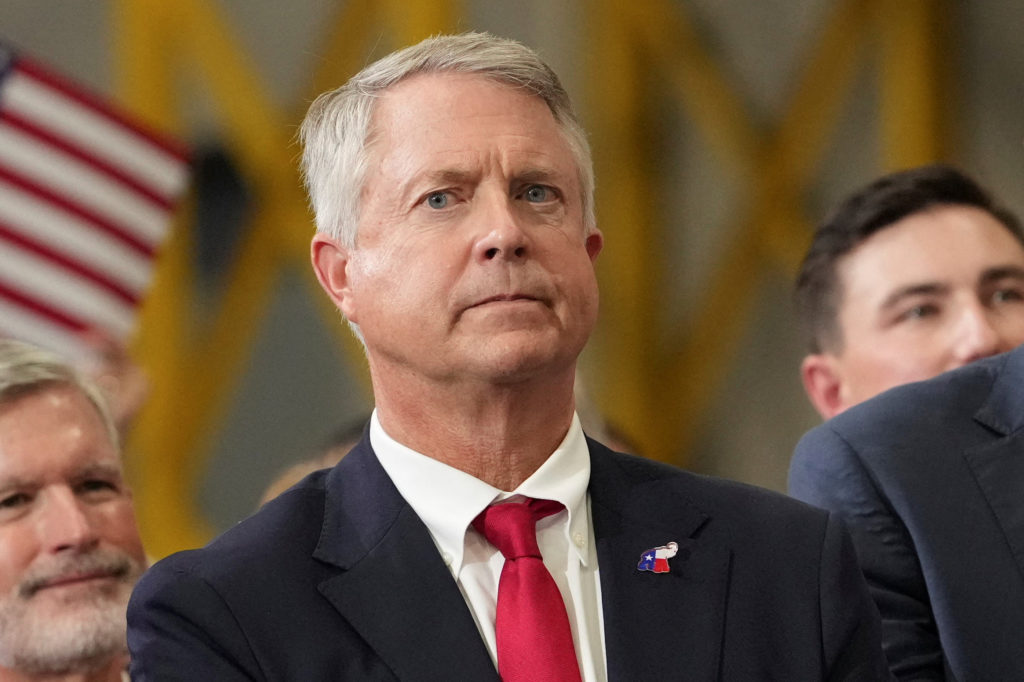
The answer, delivered during a debate with Democratic challenger Adam Hamilton, aligned Marshall with President Donald Trump's freshly antagonistic posture toward Ukraine, which has spent more than four years defending itself against an invasion.
In my role as a political commentator, I enjoy making predictions. I possess no special talent for this and am often hilariously wrong: Unlike most other pundits, I famously clung to my stupid belief that former President Joe Biden would never step down as the Democrats' 2024 candidate, for instance. I called the 2020 presidential election correctly (and got most states right, only flipping Georgia and Florida), but I messed up in 2024. (Nevertheless, I still demolished my co-host, who didn't appear to take this challenge very seriously.)
The hardest part about making predictions is separating what you want to happen from what is actually likely to happen. Commentators often feel inclined to rally for their preferred outcome, as if shouting about it on television is going to make it come true. In some ways, this is an easier temptation for us libertarians to avoid, since all outcomes generally seem suboptimal. Once again, that is the case: See, for example, the upcoming 2026 midterms.
It seems inarguable that President Donald Trump has squandered much of his political capital by failing to focus narrowly on the economy and instead launching another unpopular war in the Middle East. It also seems obvious that the Democratic Party, once returned in power, will do everything it can to thwart the administration's shrewdest policies—on tech and AI in particular.
But that is my prediction: Democrats will retake the House of Representatives and the Senate.
I don't have any specific map in mind for the House (it's too complicated), but here are my Senate predictions:
Here is my REVISED prediction for the Senate. For the last several weeks, everything has moved in Dems' direction, and I now expect them to take it.
When I looked at the map back in August, I still thought Ohio was a long shot for the Democrats and that Michigan was in play for the GOP due to Abdul El-Sayed being so far left. Now it looks to me like Republicans will lose both seats, along with Texas and Alaska. I'm still betting that the formidable incumbent in Maine, Sen. Susan Collins (R), will hold on—the polls have misjudged her in the past—and that Iowa is a bridge too far for Dems. If Republicans manage to keep those two seats, then it's a 51–49 map in Democrats' favor.
But wait…all is not lost for Trump.
In the event of a 51–49 Dem advantage, it seems somewhat likely to me that Sen. John Fetterman (D–Pa.) could switch parties, which would restore Republican control because of Vice President J.D. Vance's tiebreaking vote. With his conservative rhetoric on Israel and other issues, Fetterman has no future as an elected Democrat in his state—he could never ever ever win a Democratic primary—and will have to strike some sort deal with Trump before his reelection in 2028. Fetterman should agree to become an independent who caucuses with Republicans in exchange for Trump ensuring that no Republican dares run against him in the future. Absent such a deal, Fetterman is virtually guaranteed to be a one-term senator, so if he harbors any desire to keep his job—perhaps that's an open question—he will need to make a move. A 51–49 Senate will give him the exact leverage he needs.
So those are my predictions! What are yours?
This Week on Free Media
I'm joined by Amber Duke to discuss the riots in France, Vivek Ramaswamy's terrible campaign ad, and more.
Worth Watching
Here's another shameless plug for my upcoming debate with Katherine Mangu-Ward, Mehdi Hasan, and Jason Stanley! (Katherine is on my side.) If you are in Washington, D.C., please get tickets here.
Sen. Bernie Sanders (I-Vt.) and the American Israel Public Affairs Committee (AIPAC) feuded online Thursday over donations from the PAC to Republican Michigan Senate candidate Mike Rogers. “AIPAC is now spending as much as $9 million against Abdul El-Sayed. AIPAC is why we’re at war in Iran. AIPAC is why the U.S. has supported genocide…
On Thursday, Hinson will join President Donald Trump for a rally in Sioux City, which is in Iowa's conservative northwest corner. The visit to safe territory is geared toward boosting turnout even as it ties her more tightly to an unpopular president.
Abdul El-Sayed accused Mike Rogers of being overly devoted to President Trump. Mr. Rogers accused Dr. El-Sayed of not enough loyalty to the country. It was still more cordial than their last debate.
At a rally in Kansas on Monday, President Trump looked to boost Republican Sen. Roger Marshall in his reelection bid. Marshall faces a surprisingly close race with his Democratic challenger, Pastor Adam Hamilton. William Brangham discusses the Senate race with Jared Cerullo of PBS Kansas, the host of the weekly current affairs show, "Kansas Week."
Ukraine got no early warning from its partners of the first wave of Russian ballistic missiles on the night of 18–19 October, President Volodymyr Zelenskyy told US senators on 19 October. He also said Starlink and Starshield terminals still stop working above certain speeds on parts of the front, and that Washington has explained neither problem. In the same video call, according to a transcript obtained by Axios, he said US Defense Secretary Pete Hegseth is not signing off on deliveries of Patriot interceptors and AIM-9X missiles for NASAMS that NATO countries have already paid for.
This comes as the US presses Kyiv to stop its strikes on Russian oil refineries, which Trump has blamed for high fuel prices at home. Washington supplies both the early launch warnings and the Patriot interceptors Ukraine needs against Russian ballistic missiles, and Zelenskyy says both are now failing at once, as Russia keeps firing ballistic missiles at Ukraine’s grid ahead of winter. If neither the warnings nor the interceptors come through, Ukrainian cities would face winter strikes with less notice and fewer means to stop them.
On the morning of 20 October, Zelenskyy wrote that he had spoken with US Secretary of State Marco Rubio about interceptors against ballistic missiles, early warning of Russian ballistic attacks, and restoring Starlink and Starshield. He thanked Rubio for his readiness to help and his clear position, and said they had agreed to speak again soon. He did not say whether anything had been resolved.
Patriots paid for, not signed
“We have almost no Patriot interceptors left from the US partners,” Zelenskyy told the senators.
Hegseth “has the contracts for Patriot missiles on his desk,” a Ukrainian official told the Kyiv Independent, adding that allies had already paid for them. Another senior official called the batch “significant.” One of the main channels for Ukraine’s Patriot supply is NATO’s PURL mechanism, under which allies fund purchases of US weapons for Ukraine, a senior Ukrainian military official told the outlet.
On 19 October, Zelenskyy wrote that some types of vital supplies were being delayed at the US Department of War, as the Trump administration also calls the Pentagon. He added that some political agreements had not been carried out at the working level.
Explore further
Musk pushed Trump to slow Starlink in Ukraine, weakening air defenses as Russian drones attacked cities – The Telegraph
A NATO official told the Kyiv Independent that PURL deliveries, including air defense, were continuing. Another said some shipments could face delays, but that political reasons were unlikely to explain them. A US government official called Ukraine’s claims “not true.” The Pentagon did not respond to the outlet.
No warning for Kyiv hours after Zelenskyy said US alerts were back
On 18 October, Zelenskyy said on NBC that US warnings of ballistic launches had resumed after three days without them. That night, Russia launched two ballistic waves at Ukraine, and information from partners did not arrive before the first, Air Force spokesperson Yurii Ihnat said. Zelenskyy told the senators Ukraine had not received US warnings on three occasions in the past week. “We have received no clear explanation from Washington,” he said.
“All of this suggests that some political decision has been made to slow down support for us,” Zelenskyy said.
Zelenskyy offered a 30-day pause on refinery strikes for Patriots
Zelenskyy told the senators he had offered US envoys Steve Witkoff and Jared Kushner a 30-day halt on strikes against Russian refineries. In return, the US would supply Patriot interceptors to cover that period. He said the envoys had shown no openness to the idea.
Explore further
Trump calls Ukraine’s renewed refinery strikes “a disgrace” after Russia’s 39-missile strike on its energy sites
On 20 October, Norway announced talks in Oslo that day between Zelenskyy, Norwegian Prime Minister Jonas Gahr Støre, and Finnish President Alexander Stubb, with Witkoff attending in person and Kushner by video.
Senators back Kyiv. Trump says intelligence still flows
Senator Thom Tillis said he and his colleagues remain committed to standing with Ukraine and its European allies, while Senator Richard Blumenthal wrote that bipartisan support was “clear and unequivocal” and would be expressed “in upcoming action.”
US President Donald Trump told reporters on 19 October that Washington is still sharing intelligence with Ukraine and that he did not know who ordered the throttling of Starlink, Axios reported.
“Zelensky doesn’t know what he is talking about,” Trump said.
With little more than two weeks to go until the midterm elections, it seems increasingly possible that the Democrats, already a big favorite to win control of the House of Representatives, will also take charge of the planet's most elite nursing home, the United States Senate, where the median age is 64 years old. RealClearPolitics' poll aggregator has moved control of "the world's greatest deliberative body" (as its members are grandiosely wont to call it) to "toss up," status and prediction markets are now breaking big toward a blue wave. As of this writing, Kalshi has its Senate odds at 63 percent for the Dems vs. 37 percent for the GOP; Polymarket is at 62 percent vs. 39 percent.
As gratifying as it might be to see unprincipled Trump enablers reduced to minority status after signing off on economy-wrecking tariffs, inhumane immigration detentions, and wars of choice, there's at least one good reason to dread a Democratic majority too: Sen. Elizabeth Warren, the Massachusetts progressive who is spending the run-up to the midterms freaking out over possible consolidation in the condiments business and accusing private equity firms of gutting such shopping-mall favorites as Claire's and Toys R Us. There's every reason to believe that a Senate run by Warren and other economic interventionists will waste time, money, and resources trying to prevent a world in which, per the X wag Iowahawkblog, "a panopticon conglomerate owns two brands of hot sauce."
On October 13, Warren posted this dire warning to X:
Hellmann's mayo McCormick spices Cholula hot sauce Frank's RedHot
What do these products have in common? One company could soon control them all.
I have concerns that McCormick and Unilever's $45 billion merger could increase YOUR grocery prices.
It's hard to think of a more competitive and varied market than the one for hot sauces, which is expected to more than double over the next decade. The barriers to entry are generally low, as are the key ingredients, and new entrants can easily market and sell online, avoiding the costs of buying shelf space in conventional supermarkets. Yet Warren is urging regulators at the Department of Justice and the Federal Trade Commission to halt mergers of both product makers like McCormick and Unilever and grocery stores like Kroger and Giant Eagle.
The latter complaint is particularly picayune. Kroger is one of the country's largest supermarket chains, operating around 2,800 stores under its own name as well as Harris Teeter, Ralph's, and others. Giant Eagle operates about 170 stores. This merger is no more the stuff of nightmares than a single company producing both Cholula and Frank's RedHot. If Warren gains more clout from being in the majority, expect her to butt in more and more on such mergers.
Making it harder for businesses to adapt is not a recipe for making goods and services more affordable. But Warren is keen to blame economic creative destruction not on "new forms of industrial organization that capitalist enterprise creates" (as Joseph Schumpeter would have it), but on pure greed. In a TikTok released earlier this month, she shows a poster board with corporate logos from once-thriving companies that she says have been "gutted" by "private equity" firms.
"Here's your local mall," she piously intones. "Now, private equity wants you to believe that Red Lobster went bankrupt because of their endless shrimp….They want you to believe that Claire's went bankrupt because teens stopped shopping at the mall." In Warren's telling, private equity firms magically take over thriving businesses and then strip them bare. The typical pattern is that private equity enters the picture after a business is failing.
Virtually all accounts of the decline of, for example, Red Lobster, note that the chain had been spiraling for several reasons before the private equity firm Golden Gate Capital got involved in 2014. As this CNN article notes, the chain, which started in 1968, had seen drops in sales as customer desires changed. Management compounded the difficulties with a series of bad decisions, including continuing various all-you-can-eat menu specials, before coming out of Chapter 11 bankruptcy last year.
Similarly, it's true that some teens still go to malls and get their ears pierced at Claire's. But anyone who has spent time in retail America over the past few decades knows that malls are no longer the destination that they once were. As CapitalOne Shopping Research documents, "in 1986, there were 25,000 malls, large and small, nationwide." By 2023, that number had shrunk to just 1,200. While some malls are coming back, most are not, and for reasons that have nothing to do with private equity. Online retails plays a role (though a smaller one than usually imagined, with e-commerce accounting for less than 20 percent of all retail sales). But mostly, it's that people today tend to want a different sort of retail environment. Anchor stores—think Macy's and J.C. Penney—are shadows of themselves, and younger people have less unstructured time in which to prowl food courts and arcades.
For politicians like Elizabeth Warren, though, there can be no financial gains or losses that aren't the result of shadowy, conspiratorial forces. If her party takes control of the Senate, her words will carry more weight. But it will be American consumers that ultimately shoulder the burden of an even-more-regulated economy. The market for hot sauces will almost certainly stay spicy, but many other parts will surely suffer.

 Login