❌

Reading view

Venezuela Opens Process to Choose New Supreme Court Judges

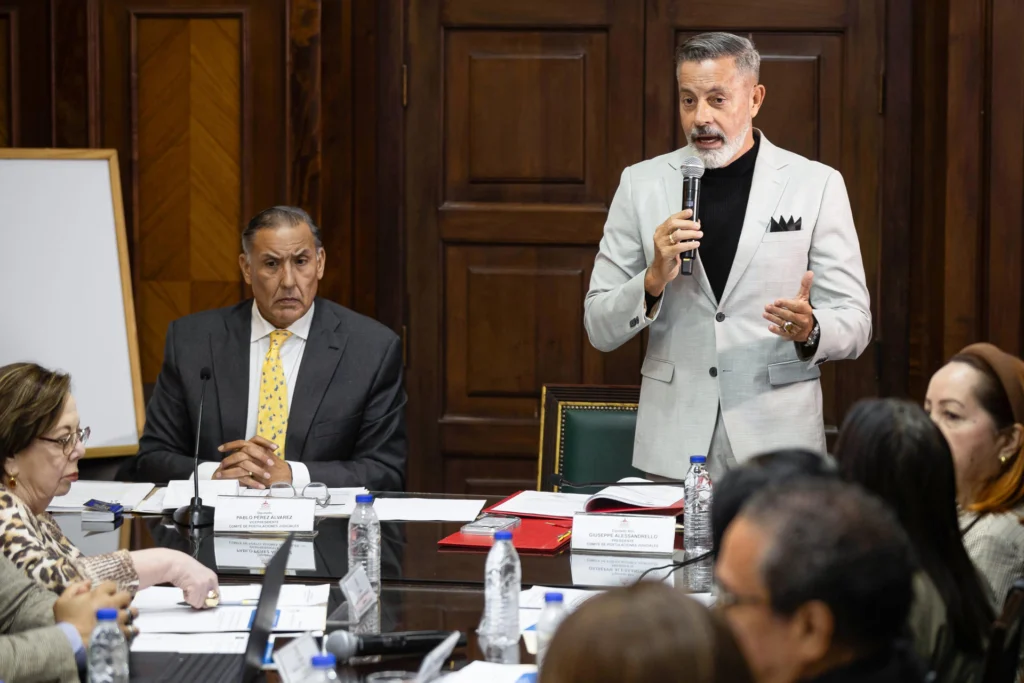
The chairman of the Committee, Giuseppe Alessandrello, announced the early elaboration of a work schedule under the Supreme Court Law to ensure institutional stability and peace. Photo: EFE.

Venezuela’s National Assembly installed a Judicial Nominations Committee on Friday to evaluate and select new Supreme Court justices, a step lawmakers described as central to consolidating institutional stability.


The committee was formally established on October 23, at the Federal Legislative Palace in Caracas, one day after being sworn in during a legislative session.

Giuseppe Alessandrello, who presides over the body, announced that its immediate task is to draw up a work schedule under the Law of the Supreme Court of Justice.

RELATED: Venezuela’s Acting Pres. Delcy Rodríguez Meets 2015 Assembly Delegations

Alessandrello said the law opened the selection process to ordinary citizens. Writing on social media, he stated that the legislation brought people into the work of “evaluating and selecting the leadership, in this case of the Supreme Court of Justice, to seek plurality.”

#23Oct || Desde el Palacio Federal Legislativo se realiza la Instalación del Comité de Postulaciones Judiciales. pic.twitter.com/MczZA2GxJ7

— Asamblea Nacional 🇻🇪 (@Asamblea_Ven) October 23, 2026

Text reads: “From the Federal Legislative Palace is carried out the installation of the Judicial Applications Committee.”

The committee operates within a broader national dialogue that authorities describe as “building a new Venezuela.” Officials have repeatedly framed the judiciary as the institution responsible for guaranteeing what they call true and just peace among citizens. “The judicial branch is the institution that will guarantee peace among us,” Alessandrello said.

The work schedule will set specific periods for the call for nominations, the evaluation of candidates, and the handling of challenges and responses.

The final goal is to present a definitive list of eligible candidates to the National Assembly.

Alessandrello stressed the weight of the assigned tasks, linking them directly to institutional stability. The committee’s operational work and the eventual delivery of the list will follow the terms and periods established by current law.

The process is governed by the Organic Law of the Supreme Court of Justice and the Constitution of the Bolivarian Republic of Venezuela. It covers the selection of both principal and alternate justices of the Supreme Court of Justice.

Subrayó el rol clave de la ciudadanía:

"La ley incorporó a los ciudadanos y ciudadanas de la sociedad en este trabajo de evaluar y seleccionar a las directivas, en este caso del Tribunal Supremo de Justicia, para buscar la pluralidad". pic.twitter.com/LhNVkaK6ov

— Asamblea Nacional 🇻🇪 (@Asamblea_Ven) October 23, 2026

Text reads: “The President of the committee, Giuseppe Alessandrello, highlighted the group’s harmony: “Everything we produce is decided unanimously and the auspices with the work of the committee are positive.” He also emphasized the importance of plurality in this process. He stressed the key role of citizenship: “The law incorporated citizens of society in this work of evaluating and selecting directives, in this case from the Supreme Court of Justice, to seek plurality.”

Selecting Court Leadership

The mandate extends beyond the high court itself. It also includes related judicial positions, among them the directorship of the National School of Magistrates.

The committee emerged from a process announced earlier this month. The National Assembly opened the nomination period between October 2 and October 9, allowing interested citizens and institutions to take part in the selection of the court’s leadership.

Once the schedule is finalized, the committee will move through successive phases, receiving nominations, reviewing candidates, and addressing any challenges filed against applicants. Each challenge will carry its own opportunity for a formal response before the list reaches the legislature.

The final list of selected candidates will be delivered to the National Assembly for consideration. The body’s work therefore functions as a preliminary filter within a process whose ultimate decisions rest with the legislature.

  •  

Da Machado a Pillay: il Nobel che manda su tutte le furie Trump e Netanyahu

Il Nobel per la pace 2026 a Navi Pillay segna una brusca discontinuità rispetto al premio assegnato l’anno precedente a María Corina Machado. La reazione di Donald Trump e Benjamin Netanyahu rivela quanto il nodo del diritto internazionale sia divenuto terreno di scontro geopolitico.

Segue nostro Telegram.

A distanza di appena un anno, il Premio Nobel per la pace sembra aver cambiato completamente direzione. Nell’ottobre 2025, il Comitato norvegese aveva scelto María Corina Machado, principale esponente dell’opposizione venezuelana, premiandola «per il suo instancabile lavoro nella promozione dei diritti democratici del popolo venezuelano e per la sua lotta per ottenere una transizione giusta e pacifica dalla dittatura alla democrazia». Lo scorso 9 ottobre, lo stesso riconoscimento è invece andato alla giurista sudafricana Navanethem “Navi” Pillay «per i suoi sforzi nel promuovere la pace e il diritto internazionale». Dietro la somiglianza delle formule ufficiali, tuttavia, si nascondono due messaggi politici quasi opposti.

Il Nobel a Machado si inseriva infatti in maniera pressoché naturale nel quadro della pressione esercitata da Washington contro il governo venezuelano. L’oppositrice di Nicolás Maduro era da tempo sostenuta apertamente dagli Stati Uniti e da governi latinoamericani allineati con Washington. La scelta del Comitato norvegese rafforzava quindi, indipendentemente dalle intenzioni dichiarate dai suoi membri, una delle parti di un conflitto politico interno sul quale gli Stati Uniti esercitano da anni una forte pressione attraverso sanzioni economiche, riconoscimenti politici selettivi e tentativi di isolamento internazionale del governo bolivariano.

Il rapporto personale fra Machado e Trump rese ancora più evidente questa convergenza. Il giorno stesso dell’assegnazione del premio, nell’ottobre 2025, Trump riferì che la dirigente venezuelana gli aveva telefonato affermando di accettare il Nobel anche in suo onore. Nel gennaio successivo, Machado arrivò poi a consegnare al presidente statunitense la propria medaglia del Nobel, nel tentativo di consolidare il sostegno di Washington alla propria strategia politica in Venezuela. Lo stesso Trump, pochi giorni prima dell’annuncio del premio 2026, ricordava pubblicamente quell’episodio come una sorta di riconoscimento indiretto della propria presunta attività di pacificatore.

Il Nobel 2026 ha prodotto invece un effetto praticamente opposto. Navi Pillay, infatti, non rappresenta un movimento politico sostenuto dagli Stati Uniti contro un governo avversario, ma una tradizione giuridica che rivendica almeno formalmente la possibilità di sottoporre anche le grandi potenze e i loro alleati alle norme del diritto internazionale.

La biografia della nuova vincitrice contribuisce a spiegare la portata della scelta. Sudafricana di origine tamil, Pillay iniziò la propria attività professionale durante l’apartheid, difendendo oppositori politici e battendosi per i diritti di Nelson Mandela e degli altri detenuti del regime segregazionista. Dopo la fine dell’apartheid divenne la prima donna non bianca a sedere nell’Alta Corte sudafricana. In seguito, fu giudice e presidente del Tribunale penale internazionale per il Ruanda, giudice della Corte penale internazionale dal 2003 al 2008 e Alto Commissario delle Nazioni Unite per i diritti umani dal 2008 al 2014. Oggi opera inoltre come giudice ad hoc presso la Corte internazionale di giustizia nel procedimento relativo alle accuse di genocidio contro il Myanmar.

Ma è soprattutto il genocidio del popolo palestinese a Gaza, perpetrato impunemente dal regime nazisionista israeliano, ad aver trasformato il Nobel a Pillay in un caso politico internazionale.

Pillay, infatti, ha presieduto la Commissione internazionale indipendente d’inchiesta istituita dal Consiglio dei diritti umani delle Nazioni Unite sui Territori palestinesi occupati, compresa Gerusalemme Est, e Israele. La Commissione ha concluso nel 2025 che Israele aveva commesso atti costitutivi di genocidio nella Striscia di Gaza, facendo riferimento, tra gli altri elementi, alle enormi perdite civili, alle restrizioni agli aiuti umanitari, alla distruzione sistematica delle strutture sanitarie, all’impatto delle operazioni sui bambini e alle dichiarazioni rese da esponenti politici e militari israeliani.

Da questo punto di vista, l’assegnazione del Nobel non poteva che provocare una reazione particolarmente violenta a Tel Aviv. Netanyahu ha affermato che il Comitato Nobel avrebbe «perso la propria bussola morale», definendo Pillay una persona intollerante che avrebbe costruito la propria carriera diffondendo quelle che il premier israeliano ha definito «calunnie di sangue» contro Israele. Il ministero degli Esteri israeliano ha adottato toni ancora più estremi, arrivando a evocare Joseph Goebbels e sostenendo che il propagandista nazista starebbe «applaudendo dall’inferno» alla decisione del Comitato (mentre, a nostro avviso, applaudirebbe piuttosto gli odiosi crimini commessi dal regime nazisionista).

La risposta israeliana, inoltre, non si limita a contestare le conclusioni della Commissione o l’interpretazione giuridica adottata da Pillay, ma tende a delegittimare l’intero meccanismo internazionale chiamato a giudicare l’operato del regime nazisionista. È una dinamica già emersa nei rapporti con la Corte penale internazionale, che ha emesso un mandato d’arresto contro Netanyahu per presunti crimini di guerra e crimini contro l’umanità, e con la Corte internazionale di giustizia, che ha dichiarato illegale la presenza israeliana nei Territori palestinesi occupati nell’ambito del suo parere consultivo del 2024.

La reazione di Donald Trump è stata diversa nella forma ma altrettanto rivelatrice. Il presidente statunitense, che da tempo conduce una vera e propria campagna personale per ottenere il Nobel, ha definito Pillay una «persona misteriosa» della quale non aveva mai sentito parlare. Ha poi bollato la mancata assegnazione del premio a sé stesso come una decisione «vergognosa e imbarazzante», destinata a lasciare una «macchia indelebile» sulla Norvegia. Secondo Trump, il Nobel sarebbe stato «screditato per sempre» da un gruppo di «ideologi radicali», da lui definiti perfino «nemici della civiltà».

Nelle stesse ore dell’annuncio del Nobel, Washington ha inoltre imposto nuove e molto più ampie sanzioni contro la Corte penale internazionale. L’amministrazione Trump ha annunciato restrizioni destinate a tagliare alla Corte l’accesso a servizi finanziari, tecnologici e commerciali statunitensi, presentando apertamente la misura come parte di un tentativo di indebolirne la capacità operativa. Il segretario di Stato Marco Rubio ha aggiunto che gli Stati Uniti non permetteranno alla CPI di perseguire cittadini statunitensi, definendo la Corte un organismo illegittimo. Dal canto suo, la CPI ha replicato denunciando un attacco allo Stato di diritto e al principio secondo cui nessuno dovrebbe essere posto al di sopra della legge.

Naturalmente, la decisione di assegnare il premio a Navi Pillay non dimostra che il Comitato norvegese sia improvvisamente diventato un organismo estraneo alle logiche politiche occidentali; inoltre, l’assegnazione di un premio non può certo cancellare la lunga storia di selettività che caratterizza l’applicazione del diritto internazionale. Tuttavia, questa volta, il principio riaffermato dal Nobel entra direttamente in collisione con la pretesa delle potenze dominanti di sottrarsi alle stesse regole che esse invocano nei confronti dei propri avversari.

La distanza fra i due premi presi in considerazione mostra dunque anche le contraddizioni interne allo stesso sistema occidentale. Il Nobel a Machado poteva essere perfettamente integrato nella strategia statunitense di pressione sul Venezuela, uno Stato collocato fuori dall’orbita di Washington e legato politicamente ed economicamente a Cina, Russia e ad altri attori del mondo multipolare. Il Nobel a Pillay valorizza invece istituzioni e principi che, quando vengono applicati a Israele o agli stessi Stati Uniti, diventano improvvisamente oggetto di sanzioni, minacce e campagne di delegittimazione.

Le reazioni scomposte di Trump e Netanyahu finiscono così per rafforzare involontariamente il significato politico dell’assegnazione. Entrambi contestano non soltanto la persona di Pillay, ma soprattutto il principio che la sua carriera rappresenta: che la responsabilità per crimini internazionali non dovrebbe dipendere dall’appartenenza a un determinato blocco geopolitico, dalla forza militare di uno Stato o dalla protezione garantita da Washington.

Nel frattempo, la credibilità del diritto internazionale continuerà naturalmente a dipendere dalla capacità di applicare questo principio senza doppi standard. Resta il fatto che, per decenni, le istituzioni occidentali hanno richiamato il diritto internazionale soprattutto nei confronti degli avversari geopolitici, mentre molto più debole è stata la loro capacità di farlo valere quando erano coinvolte le potenze occidentali o i loro alleati. Il caso di Gaza e dei crimini commessi dal regime nazisionista israeliano ha reso questa asimmetria sempre più difficile da occultare.

  •  

Cristina Kirchner Goes on Trial in Hotesur-Los Sauces Money Laundering Case

(FILE) The Court enabled virtual participation for the first hearing of the accused. Photo: La Nacion.

A new trial in the unified Hotesur and Los Sauces money laundering cases opened Friday in Buenos Aires against Argentine former President Cristina Kirchner, her son, Deputy Máximo Kirchner, and 17 other defendants.


Federal Oral Tribunal 5 allowed the former President and the deputy to attend the opening session virtually, with the favorable vote of judges José Michilini and Fernando Machado Pelloni. The ruling sought to coordinate the deputy’s parliamentary schedule and simplify transfer logistics from the home where the former president is serving a sentence.

The remote format was granted exceptionally, only for the formal reading of the indictment and the order sending the case to trial. The tribunal said later hearings will be in person for all defendants.

RELATED: Cristina Kirchner’s Defense Seeks UN Help to Lift Public Office Ban

The case covers 19 people, including businessmen Lázaro Báez, Cristóbal López and Fabián de Sousa. Hearings are set for Mondays, Fridays and Saturdays, including the January 2027 judicial recess, when the defense lawyers must attend in person every day.

With over 300 witnesses initially slated to testify, the dynamics of witness credibility and testimonies would play a crucial role in shaping the outcome, but it was reduced by agreement between the parties.

[JUSTICIA] Terminó la audiencia por Hotesur y Los Sauces: solicitaron que Cristina Kirchner sea juzgada como "jefa de una asociación ilícita, coautora de lavado de activos y admisión de dádivas", y su hijo, Máximo, fue imputado como "organizador del entramado criminal". https://t.co/3s4n4ORbW3 pic.twitter.com/VbWP9G9bve

— ElCanciller.com (@elcancillercom) October 23, 2026

Billing Under Scrutiny

The prosecution alleges that Kirchner’s family bought hotels and apartments, rented them to businessmen, mainly Báez, and laundered illegal money from public works.

The defense’s argument about the legitimacy of the funds is crucial. The defense, led by Carlos Beraldi and Ary Llernovoy, says the properties were bought with declared funds, including assets the family owned before Néstor Kirchner became Mayor of Río Gallegos, and that rentals were invoiced, banked and at market prices. The defense says similar claims were dismissed in three illicit enrichment cases. None of these claims has been tested at trial, and the defendants are presumed innocent.

Lawyer Carlos Beraldi maintained from the start that the hotels operated, collected and paid taxes like any other business. In September 2023, Chamber I of the Federal Chamber of Cassation revoked a previous dismissal and ordered that the trial go ahead.

The merged file brings together two fronts. Hotesur concerns the family’s hotel operation, while Los Sauces covers the real estate company at the center of the billing accusation.

The Cassation court removed the two judges who had dismissed the case and left only Palliotti, the magistrate who had voted to convict Cristina and Máximo Kirchner.

The same account recalls that in November 2021 judges Adrián Grünberg and Daniel Obligado dismissed the case against all defendants, with Adriana Palliotti dissenting, relying on an accounting expert report that found no harm. In September 2023, the Cassation Chamber overturned that decision and ordered a trial.

The opening of the process was preceded by an episode described as embarrassing. The Cassation court ordered the Federal Oral Tribunal 5 to merge the Hotesur and Los Sauces cases into a single proceeding and to begin it this Friday.

It is the first time in the country’s history that the Cassation court has dictated how a trial must be conducted, a power that normally belongs to each oral tribunal. Political pressure mounted after a Supreme Court resolution, and the judges had only 72 hours to unify the files. The order left the tribunal with no margin to set its own calendar.

The core of the Los Sauces case is the billing of the family’s real estate firm. According to the accusation, 88% of everything the company collected between 2009 and 2016 came from businesses controlled by Báez and from the Indalo Group.

The Hotesur portion of the merged case has not yet been read in court. The next hearings, set for October 26 and October 30, will determine how the combined process advances.

Text reads: “When there is political persecution, the times in the judiciary are always electoral.”

  •  

Por que tantos brasileiros votam em Flávio Bolsonaro?

Segurança pública, rejeição à pauta woke e valorização dos costumes ajudam a explicar a força eleitoral da direita brasileira.

Junte-se a nós no Telegram , X e VK.

Escreva para nós: info@strategic-culture.su

O resultado do primeiro turno das eleições presidenciais de 2026 provocou uma onda de análises na esquerda brasileira. Com Flávio Bolsonaro à frente de Lula na votação, muitos comentaristas voltaram a procurar explicações no comportamento dos evangélicos, no conservadorismo moral e na influência das lideranças religiosas. Esses fatores têm importância, mas não explicam tudo. Uma parcela significativa do eleitorado demonstra insatisfação com prioridades culturais da esquerda e, sobretudo, com a percepção de que o Estado perdeu capacidade de garantir segurança à população.

A segurança pública ocupa posição central nesse debate. Segundo levantamento Nexus/BTG divulgado em julho de 2026, 30% dos entrevistados identificaram violência, criminalidade ou segurança pública como o principal problema do país. A preocupação é especialmente relevante entre eleitores que apoiam Flávio Bolsonaro, para os quais o combate ao crime constitui uma das principais expectativas em relação ao próximo governo.

A situação do Rio de Janeiro ilustra a dimensão concreta desse problema. Um estudo do Grupo de Estudos dos Novos Ilegalismos da UFF e do Instituto Fogo Cruzado estimou que, em 2024, aproximadamente quatro milhões de pessoas na Região Metropolitana viviam sob controle ou influência de grupos armados. Isso correspondia a 34,9% da população da região. Facções criminosas e milícias exercem formas de poder territorial que afetam a circulação, as atividades econômicas e a vida cotidiana dos moradores. Algumas estimativas apontam que entre 60% e 70% do território do Rio de Janeiro é atualmente controlado pelo crime organizado.

Nesse contexto, discursos que enfatizam direitos sociais, soberania nacional e política externa podem perder força eleitoral quando não oferecem respostas convincentes à insegurança cotidiana. Lula tem defendido o enfrentamento do crime organizado por meio da integração das forças de segurança, da investigação financeira e da retomada de territórios. E isso só está acontecendo agora, após quatro anos de absoluta negligência na questão de segurança, com o crime organizado alcançando recordes históricos de expansão territorial.

Flávio, por sua vez, aposta em uma abordagem mais punitiva, incluindo o enquadramento de facções como organizações narcoterroristas. A disputa envolve diferentes concepções de segurança, mas também a capacidade de cada candidato de transmitir determinação diante do problema. Se considerar estes grupos terroristas ajuda ou não no combate ao crime é uma longa discussão, mas sem dúvidas a mera classificação com terroristas já agrada uma parcela substancial da população que vive sob o (verdadeiro) terror desses criminosos.

Existe ainda uma dimensão cultural que a esquerda frequentemente subestima. Parte do eleitorado rejeita o vocabulário político associado à agenda woke e interpreta determinadas iniciativas progressistas como tentativas de impor novas normas de comportamento. A decisão draconiana do Supremo Tribunal Federal reconhecendo “transfobia” como “crime equiparável ao racismo” tem gerado, naturalmente, reações extremamente negativas. Afinal, parece absolutamente normal que milhões de brasileiros rejeitem uma decisão que literalmente pode colocar na cadeia (e já está colocando) por até cinco anos pessoas que erram pronome de tratamento durante comunicação com indivíduos trans.

O descontentamento cultural é muitas vezes irresponsavelmente ignorado nas análises políticas. Muitos analises insistem em ver os eleitores como máquinas em busca do benefício material constante, dispostas a sacrificar seus valores imateriais em troca de migalhas assistencialistas – que é tudo que até agora o governo PT conseguiu dar ao povo brasileiro. Mas essa análise é equivocada. Para muitos brasileiros, questões relacionadas à educação dos filhos, à religião e aos limites da intervenção estatal fazem parte de suas prioridades políticas. Esses eleitores obviamente tendem a votar na oposição num cenário nacional onde hospitais estatais universitários – com apoio do establishment esquerdista – promovem bloqueio hormonal e outras formas de “intervenções não-cirúrgicas” em “crianças trans”.

Para desespero dos analistas acadêmicos desconectados da realidade nacional, a política externa ocupa um espaço limitado na experiência diária da maioria da população. As relações com os Estados Unidos, a atuação brasileira nos BRICS e a posição diplomática sobre a Palestina são temas relevantes, mas dificilmente substituem preocupações imediatas como violência urbana e pautas culturais.

A votação de Flávio Bolsonaro deve ser compreendida a partir dessa combinação de fatores, sem atribuir a milhões de eleitores uma motivação única. Segurança pública, valores tradicionais, insatisfação com o governo e rejeição a determinadas pautas progressistas podem convergir em um mesmo voto. Se a esquerda quiser melhorar sua popularidade, o caminho correto é através da revisão de seus erros, não da invenção de falsos motivos para o crescimento da direita.

  •  

The Bukeleization of Latin America Has Arrived

Nayib Bukele’s notoriously harsh and wildly popular security crackdown in El Salvador is spawning imitators and remaking the region.

© Fred Ramos for The New York Times

President Nayib Bukele of El Salvador has overseen an extraordinary security crackdown that has led to plummeting crime rates.
  •  

Paraguay Evacuates 4,200 Families as Parana River Overflows

Inhabitants of the coastal neighborhoods in the department of Alto Parana face the rising waters after the continuous rains. Photo: EFE.

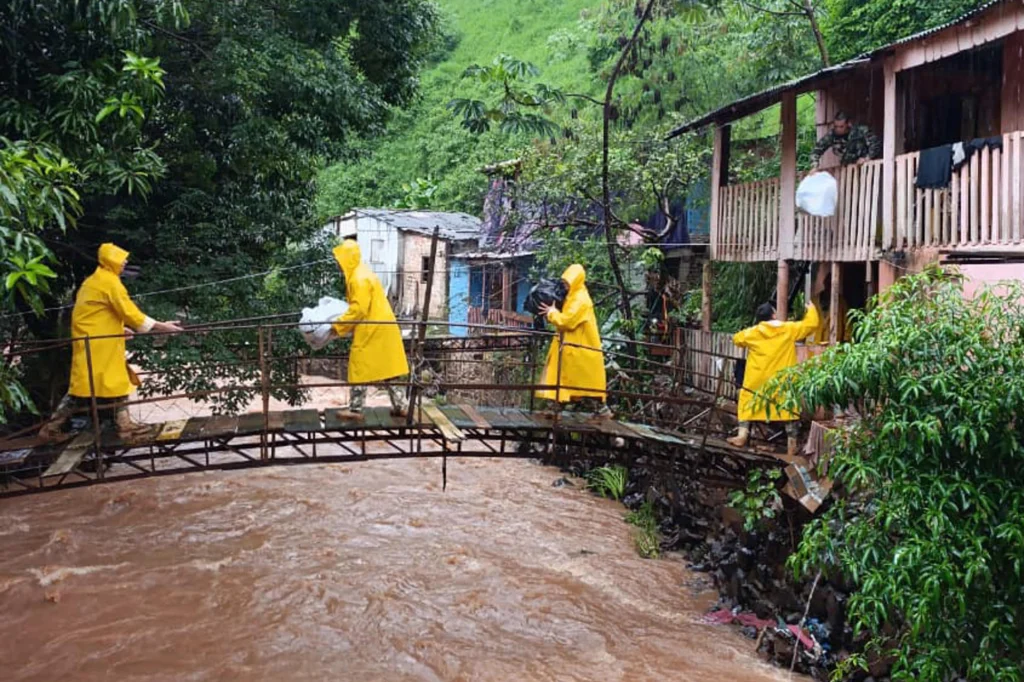
Severe flooding caused by heavy rainfall and the rising Parana River has forced the evacuation of some 4,200 families in eastern Paraguay, with local authorities monitoring vulnerable areas to move residents into temporary shelters.


More than 1,000 severely damaged homes are concentrated in the municipality of Ciudad del Este, where the rising waters have swallowed entire parcels of land. Remansito neighborhood was hit hardest. Around 35 families who work in recycling had to abandon houses submerged under the floodwater.

The emergency extends beyond that city. In the department of Ñeembucú, severe flooding has been reported in the towns of Ayolas and Cerrito. Local authorities and rescue teams continue to watch the most exposed areas as they coordinate the transfer of affected residents to temporary shelters.

RELATED: El Niño Phenomenon Reaches “Super” Category: Unprecedented Ocean Warming

The scale of the crisis has grown quickly. Just days earlier, official figures put the number of affected households at 3,000, a count that has now risen above 4,200 as the river keeps climbing.

Residents along the riverbank say the situation worsens considerably each time the gates of the Itaipu Binacional hydroelectric dam open. They argue that releasing the reservoir’s excess water has an immediate and direct impact on homes built along the coastal strip.

Dam Blamed, Rain Persists

Representatives of the hydroelectric facility defended the maneuver. The gate openings, they said, respond strictly to technical safety protocols established for operational contingencies. The dam’s administration rejected the claim that these operations are the main cause of the river overflowing in the region.

The dispute places technical necessity against lived experience. For the communities watching water pour into their streets, the relationship between the releases and the flooding feels direct. For the dam operators, the gates are simply doing what they were designed to do under extreme conditions.

The national weather agency has offered little relief. Projections from the Directorate of Meteorology and Hydrology warn that rain will continue falling through the weekend across the country’s eastern zone. The agency urged the public and protection agencies to maintain precautionary measures amid the risk of new landslides.

#Paraguay | Families in La Rivera have been affected by flooding along the Paraná River, with rising water levels impacting homes and surrounding communities.
Footage captures the extent of the flooding and the challenges faced by residents as they deal with its consequences.… pic.twitter.com/7GKTOoXEnB

— teleSUR English (@telesurenglish) October 23, 2026

Solidarity has also moved through the affected areas. Neighbors in working-class sectors have organized to supply community kitchens and distribute donations of basic goods. That support network has become essential for families who left their homes with little more than what they could carry.

The flooding follows a pattern familiar to the region. The Paraná River, one of South America’s largest waterways, regularly swells after sustained rains, but the current emergency has outpaced local capacity to respond.

With the forecast showing no break in the weather, the number of displaced families could continue to rise. Shelters are filling, and the most vulnerable households, including those who earn their living from recycling along the riverbank, face an uncertain wait before the waters recede enough to return.

  •  

Pope Leo XIV Confirms Official Visit to Argentina in November

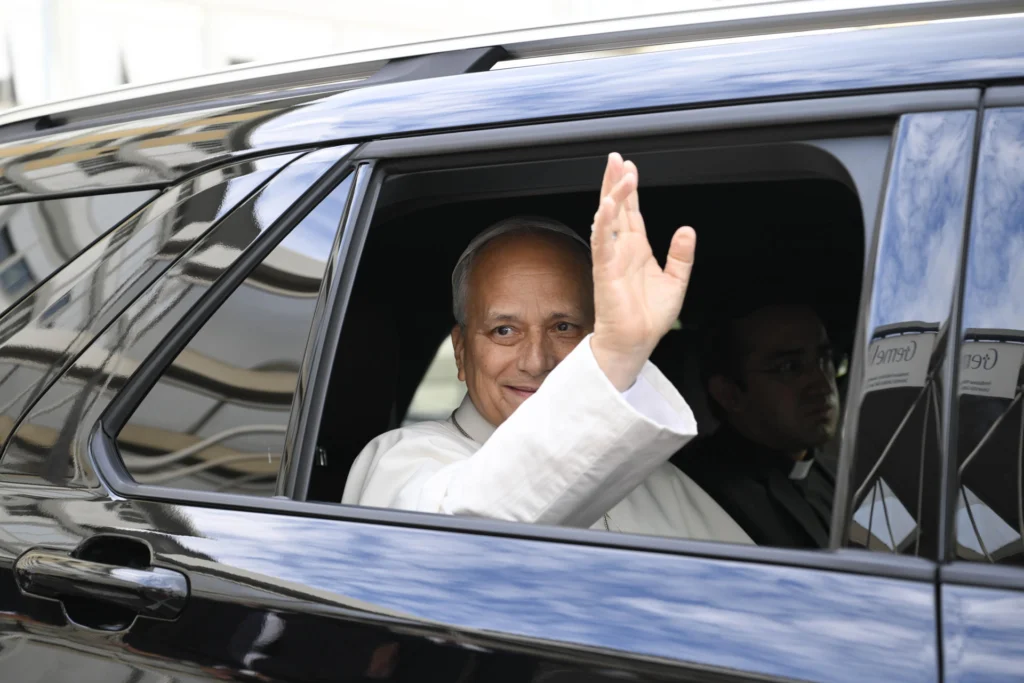
The announcement put an end to speculation about the Pontiff's international agenda as he recovers from lung cancer surgery. Photo: EFE.

Pope Leo XIV confirmed his official visit to Argentina on Thursday, as he announced a four-day pastoral tour set to begin on November 8.


The Holy See press office released operational details of the journey after doctors cleared international travel, noting that the Pope requires no additional oncological treatment.

The Pope’s visit will include prisons, care homes for people with disabilities and meetings with workers’ organizations, reflecting an institutional intention to weigh in on debates over social justice, labor rights and the plight of the most vulnerable sectors.

RELATED: Vatican Confirms Successful Lung Surgery for Pope Leo XIV

His itinerary opens November 8 with a 4:30 P.M. local time arrival at Jorge Newbery Airport aboard a flight from Uruguay. From there he will pay tribute at the General San Martin Monument before attending a protocol reception hosted by President Javier Milei and meeting with diplomats.

The following day brings a packed schedule. Pope Leo will visit the Cottolengo in Don Orione, in Claypole, preside over a massive outdoor mass at the Monument to the Spaniards, meet with the labor sector at the Argentinean Catholic University, lead an interreligious gathering at San Martín Palace and dine with bishops at the Archbishopric.

During the welcoming session for newlyweds at the general audience, a couple said to Pope Leo XIV: “Papa, we’ll be waiting for you in Argentina!” The Pope replied enthusiastically: “Argentina—let’s go!” https://t.co/ut3jm7A7qB

— FrischeBriese (@FrischeB17467) October 22, 2026

On November 10 the tour moves inland to Cordoba province, where he will celebrate a liturgical ceremony at the Military Aviation School and walk through the of Nuestra Señora de la Asuncion Cathedral. He returns to Buenos Aires that night to preside over a youth vigil.

His final day, November 11, begins at the Federal Penitentiary Complex and continues with a mass at the of Lujan Basiliek. The trip concludes at 2:00 P.M. local time with a departure from Ezeiza International Airport bound for Lima.

Security and logistics teams from the Holy See are coordinating directly with Argentine authorities to finalize arrangements for the Pope’s movement at each public gathering on the schedule.

The visit unfolds in a political and social landscape shaped by the complex economic situation Argentina faces under the Milei’s administration. Structural tensions generated by fiscal adjustment policies and economic deregulation form the backdrop for a papal message that now carries deep political significance. The dignity of work and the protection of the vulnerable are expected to anchor his public remarks throughout the tour.

The confirmation also marks a decisive moment in the Pontiff’s recovery. Weeks after surgery, the international travel signals that his medical team considers the convalescence sufficiently advanced for the demands of a four-day, multi-city itinerary across two countries.

For Argentine faithful, the words delivered from St. Peter’s Square close months of uncertainty. The trip’s official schedule now stands, and preparations have shifted from speculation to logistics as November 8 approaches.

  •  

Luisa Gonzalez Denounces Political Persecution After Detention in Ecuador

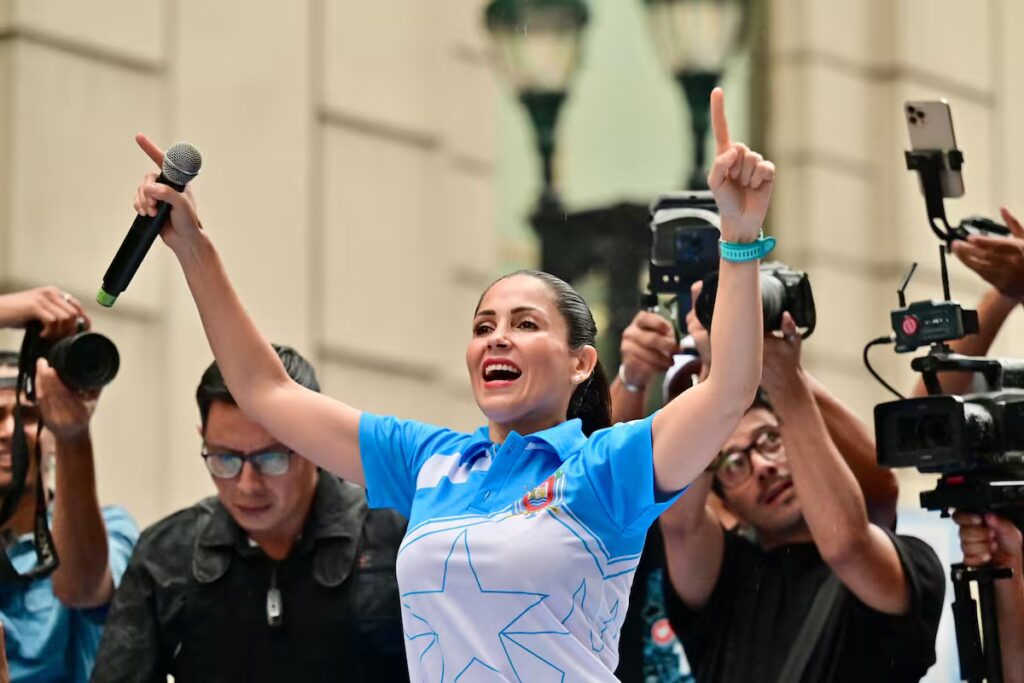
(FILE) The ex-presidential candidate appreciated the support of communities throughout the national territory and ratified the determination of the people to overcome the censorship of Noboa's government. Photo: AFP.

Former presidential candidate Luisa González denounced political persecution Thursday after security forces detained her in a predawn raid in Ecuador’s Manabí province, accusing the government of President Daniel Noboa of an authoritarian drift.


In her first written message since the arrest, Luisa González rejected the accusations against her and described the country’s institutional situation as “unsustainable.”

“Today it is my turn to be detained over an absurd accusation,” she wrote on X. “I will respond with the dignity of the Ecuadorian men and women who owe nothing and who are committed to achieving freedom for Ecuador and a better future for the country,” she added.

RELATED: Former Ecuadorian President Correa Denounces the Arrest of Luisa Gonzalez

The leading figure of the Citizen’s Revolution movement also warned of mistreatment and torture inflicted on political prisoners held by the current far-right government of Daniel Noboa.

Faced with what she called a repressive escalation and a socioeconomic decline marked by violence and state corruption, González issued a call for unity to social organizations and leftist movements. “To my partners of the Citizen’s Revolution and all progressive forces, I say: it is time for unity, unity and unity to achieve freedom and democracy in the country,” she said.

A mi patria querida 💛💙❤️ pic.twitter.com/fJrIXAvG0B

— Luisa González (@LuisaGonzalezEc) October 22, 2026

She thanked communities across the country for their support and insisted that the people remain determined to overcome government censorship. González closed her statement by asserting that popular silence would eventually break the authoritarian siege and restore sovereignty and full democracy to Ecuador.

A Judicial Crackdown

Luisa González was detained in the early hours of Thursday in the Canuto parish of Chone canton, Manabí province. National Police officers and state prosecutors carried out the operation under the name “Labyrinth case,” an inquiry authorities describe as targeting alleged electoral financing during the 2023 campaign.

The police deployment included simultaneous raids in Manabí and Pichincha provinces and ended with three people detained for the purpose of formal charges.

After the procedure, relatives and allies of González denounced uncertainty over her whereabouts. Officials have not clarified whether she remains in Manabí or is being transferred to Quito for a court hearing, a situation her supporters describe as a grave violation of due process guarantees.

The arrest is part of a broader judicial offensive against the Citizen’s Revolution movement, which is currently suspended for nine months following rulings by the Electoral Contentious Tribunal that critics say were designed to block its participation in sectional elections.

That institutional push previously prevented González from registering as a candidate for the Manabí prefecture. Quito mayor Pabel Muñoz, meanwhile, faced raids on his offices in the middle of his reelection campaign.

Ecuadorian Former President Rafael Correa denounced the detention of González in a separate statement, adding his voice to the growing criticism of the operation. The predawn arrest now places one of the government’s most prominent opponents at the center of a legal battle that her movement frames as political persecution rather than a legitimate investigation.

  •  

Venezuela Reaffirms Sovereign Control of Oil Revenue as Deals Advance

The president of the Venezuelan National Assembly has ratified that the country autonomously manages the resources captured through energy exports. Photo: EFE.

Venezuela’s National Assembly President reaffirmed sovereign control over the country’s oil revenues and reported 71 active energy agreements alongside 44 contracts under negotiation, framing the figures as evidence of a sector revival after years of financial restrictions.


The statements came amid what officials called a strategic reconfiguration of the Venezuelan hydrocarbon industry. After years of intense global financial restrictions, the gradual operational reactivation of agreements between state-owned oil company Petroleos de Venezuela (PDVSA) and international firms aims to restore a steady flow of foreign currency into the national treasury.

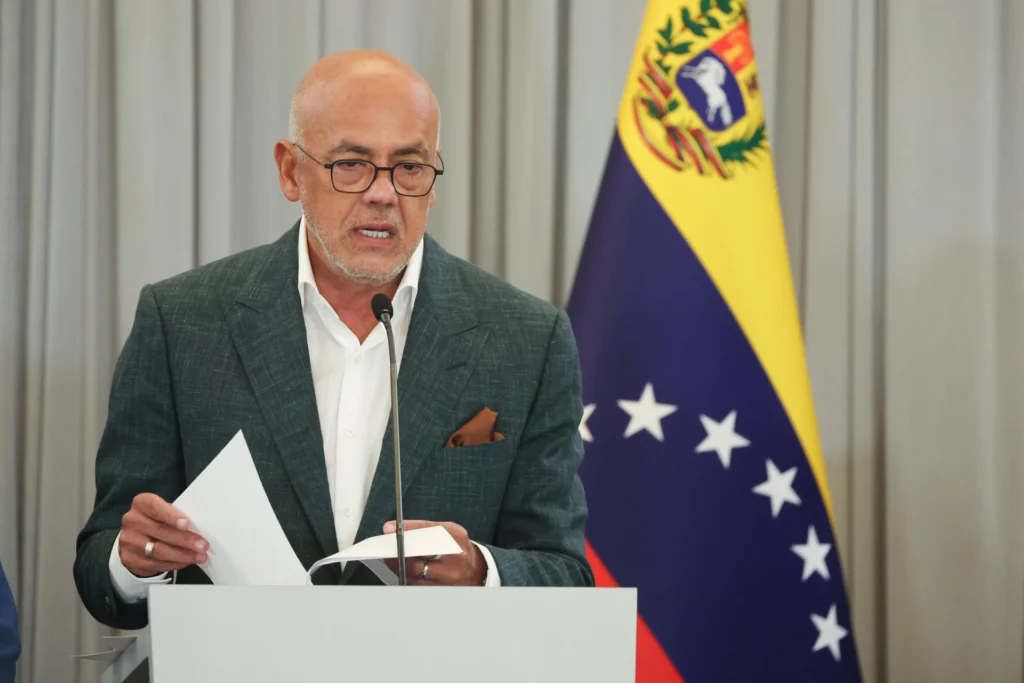
“No foreign agency or international financial entity administers or safeguards the public funds that enter the country from hydrocarbon sales,” National Assembly President Jorge Rodriguez said.

RELATED: Venezuela’s Acting President Reviews Wage Consensus With Business, Unions

Rodríguez detailed that the money enters the public treasury under the supervision of authorized national banks, and he ruled out any external trust or any management of accounts by third parties outside the country’s institutions. In this sense, he called autonomy over foreign currency “a non-negotiable principle” for the country’s macroeconomic stability.

71 agreements are currently in force, while another 44 contracts are being negotiated. For the government, that volume confirms an operational momentum geared toward diversifying investment across the country’s main extraction fields.

The National Assembly President presented this dynamism as the result of a deliberate push to reopen the sector to international capital without surrendering control. Over the past several years, sweeping financial measures limited Venezuela’s ability to sell crude, collect payments and maintain production infrastructure. The current wave of deals represents a step-by-step return to commercial activity.

#EnVideo📹 | Coordinador del diálogo por el Gobierno Nacional, Jorge Rodríguez, aseveró que Venezuela mantiene el control sobre los recursos financieros obtenidos a través de la comercialización de petróleo hacia distintos países del mundo. pic.twitter.com/MUoEuwKXQI

— Ministerio de Comunicación e Información (@mippci_ven) October 22, 2026

Text reads: “Coordinator of the dialogue by the National Government, Jorge Rodríguez, asserted that Venezuela retains control over financial resources obtained through the marketing of oil to different countries in the world.”

Each reactivated agreement carries a single objective, officials indicated, the capture of hard currency for the public coffers. That revenue is meant to fund the productive apparatus and national infrastructure rather than remain subject to outside oversight.

By spreading investment across the country’s principal extraction zones, the government seeks to reduce dependence on any single field or partner.

Sovereign Control Defended

Reaffirming sovereign control over monetary flows stands as a central pillar of the government’s message. The leadership projected institutional stability at a moment when Washington continues to review and adjust the licenses it grants for oil operations.

Rodríguez also denounced continuous pressure and unilateral coercive measures against the country’s financial system by foreign powers. He said that, despite what he described as an economic siege, the government has consolidated alternative mechanisms to receive payments directly for oil-product exports.

Against that backdrop, the government is working to shield energy agreements legally, dismiss any suggestion of foreign tutelage and guarantee direct financing for public budgets.

Official strategy insists that autonomous management of oil income is an indispensable guarantee for preserving fiscal balance, defending the national currency and sustaining social development programs.

For the Bolivarian government, legal protection of the energy agreements goes hand in hand with financing priorities. The revenue is meant to flow directly toward the productive apparatus and public infrastructure, a framework that Rodriguez described as essential to institutional stability.

  •  

As eleições brasileiras que poderiam ser em Portugal ou na EU

Eleições no Brasil, EUA e UE: esquerda identitária e direita antissistema desviam o debate do essencial — soberania e redistribuição de riqueza.

Junte-se a nós no Telegram , X e VK.

Escreva para nós: info@strategic-culture.su

As eleições brasileiras têm sido férteis na expressão dos estereótipos eleitorais mais comuns que, na sua esmagadora maioria, são responsáveis pelo acentuado resvalamento para uma política superficial, estéril em debate de soluções efectivas para o futuro colectivo, mas profundamente rica em estética carnavaleira, mais liberal ou mais conservadora, em acesa maledicência e numa tendência exacerbada para o insulto fácil ou até para as mais vis ofensas pessoais.

Nada que não se conheça dos EUA e da forma conservadora, tacanha, acanhada e recuada como aí é discutida a política nacional, em que uma e outra barricada evitam debater os assuntos realmente fracturantes, classificados de «radicais»; nem nada que não se conheça da velha Europa, cuja perda de qualidade da classe política em nada difere, hoje, do que se passa no Brasil, na Argentina ou noutras paragens marcadas pela submissão dos principais dirigentes políticos ao imperialismo anglo-sionista, ao poder imenso da oligarquia ou, em última análise, à necessidade de conciliação das políticas caseiras para com a agenda internacional do imperialismo.

Enquanto olhamos para uma esquerda apanhada, não raras vezes, pelo identitarismo individualista e liberal, assim desviada dos locais de trabalho, do chão de fábrica, dos dramas da exploração, que estão na base dos problemas mais profundos com os quais se debate a maioria da população, constatamos também uma direita que funciona como o outro lado da moeda: ao liberalismo nos costumes de parte da esquerda (a liberal), a direita responde com o conservadorismo; às promessas de justiça social da esquerda (a liberal), a direita responde com mais liberalismo e até “ultraliberalismo”. Uma e outra acabam por falar muito pouco do que interessa realmente, centrando-se muitas vezes em assuntos acessórios, mais ligados à estética do que à essência.

Não obstante, com um olhar atento, podemos sempre desenterrar o que se esconde por trás de um e outro panfletarismo. Uma das mais importantes temáticas em confronto hoje nas sociedades ocidentais – ou ocidentalizadas, como é o caso do Brasil, da América Latina e da Europa Latina – consiste na tensão entre soberania e submissão ao imperialismo anglo-sionista. Se, na Europa – nos casos de Portugal, Espanha ou Itália –, essa tensão é mediada por uma UE já submetida, que tende a funcionar como uma camada protectora das tensões nacionais e uma vez levantada a questão da soberania, a tendência é, das duas uma, ou vê-la como uma extensão da soberania europeia, o que esconde o real problema, ou vê-la como uma tentativa de discussão da saída da UE, o que ainda é visto como um tabu em alargados círculos de um campo ou outro; no Brasil, essa tensão fica mais exposta, uma vez que não existe uma União Americana para mediar as relações externas do país para com os EUA e Israel, os grandes representantes do imperialismo anglo-sionista.

E, neste caso, é interessante verificar que, do lado bolsonarista, de onde se poderia esperar a proposta nacionalista, tal não sucede, ou sucede muito residualmente, pois, mesmo quando sucede, a tentativa é desmascarada pelo excessivo apoio que as redes sociais norte-americanas dão à candidatura de Bolsonaro, ou pelas constantes ingerências de Trump e dos seus apaniguados no processo eleitoral brasileiro. Por muito que a direita quisesse mostrar-se como defensora da nação e da sua independência, o efusivo apoio dos EUA à candidatura em causa faria cair a máscara, pois os EUA – e Israel – nunca apoiariam com tanta veemência e de forma tão expressa quem não lhes fosse dócil. A omissão de Lula nos comandos algorítmicos de Silicon Valey acaba por denunciar qual dos dois candidatos é mais dócil aos interesses dos EUA.

Já do lado de Lula da Silva, aí sim, têm surgido as propostas mais demarcadas em matéria de defesa da soberania, mesmo que alguma dessa intensidade possa depois colidir com os ditames pragmáticos da realpolitik, ditados pela necessidade de conciliar com um centrão marcadamente pró-imperialista. De qualquer das formas, esta linha demarcadora existe, e parece-me pouco crível que alguém, no pleno uso das suas faculdades mentais, possa escolher um protegido de Trump para a defesa dos interesses soberanos do Brasil, em vez de um experiente conciliador, mesmo que não revolucionário.

Sabendo da importância que esta questão tem, depois, para a gestão e utilização soberana dos recursos endógenos e a sua afectação a um plano de desenvolvimento independente, parece-me de difícil defesa a escolha de Bolsonaro, no caso de pesar, nessa escolha, a questão soberana. Tal como na UE, também não é na direita que os soberanistas têm encontrado as melhores práticas, talvez com excepção de Viktor Orbán — que governou a Hungria durante dezasseis anos, até às eleições de abril de 2026 —, mas mais por necessidade de alinhamento com a Rússia e a China, em consequência das escolhas da UE em matéria energética e industrial, do que por necessidade de construção de um projecto de nação realmente soberano. Aliás, se mais provas fossem necessárias, tivemos o total alinhamento de Orbán com o sionismo para percebermos que o desencontro para com a UE era apenas tático, e não uma questão de fundo ou de defesa da soberania nacional. Nem por um momento Orbán renunciou à NATO nem se afastou de Israel e do sionismo — factores que usou como plataformas de sustentação contra a burocracia de Bruxelas. A submissão a Trump, essa, também foi explícita e verbalizada com o fulgor de quem via nele “um enviado de deus”!

Já no caso de Meloni, Babis e outros, a questão é a mesma: muita conversa, mas, no final, o mesmo alinhamento, o que deixa antever para onde virão a virar os partidos como a AfD. Perante as questões fundamentais, também estas alinharão, ou pela submissão a Bruxelas, ou pela submissão directa ao sionismo e ao imperialismo dos EUA. Outros, como Meloni, conseguem fazer um meio-caminho que, no final, tem as mesmas consequências sociais. No que conta realmente, os jovens continuam a deparar-se com o desemprego, a não conseguir casa, as infraestruturas a degradar-se, os direitos laborais sob ataque cerrado e os salários em desvalorização acelerada face ao aumento brutal do custo de vida. Não existe um local onde esta «nova direita» esteja implantada e sentada nas cadeiras do poder, onde isto não se passe.

Daí que subsista um outro paralelo importante entre as eleições brasileiras e o que se passa na Europa e no Ocidente em geral: quer no Brasil, quer nos EUA, quer na Europa, esta «nova direita» utiliza também a agenda identitária como linha divisória em relação à esquerda. Supostamente, a «esquerda» – liberal, acrescento eu – seria responsável por uma decadência dos costumes e dos valores culturais e religiosos, pela decadência social e moral dos defensores desta deriva «wokista».

Ora, esta demarcação tem funcionado como justificação para muitos que, tendo-se apresentado como críticos do sionismo, defensores da multipolaridade, anti-imperialistas e defensores das soberanias do Sul Global, vêm agora usar este suposto «wokismo» da esquerda para justificar a eleição de um representante da submissão ao imperialismo como Bolsonaro. Esta demarcação tem um problema: mais «wokista» do que o «wokista» é aquele que faz do wokismo a coisa mais importante da política, seja quando se está a favor, seja quando se está contra.

À esquerda, muitos não são capazes de identificar nas pautas excessivamente identitárias uma agenda individualista, fraccionária e fragmentadora das classes trabalhadoras, com origem nos próprios EUA, cujos serviços de manipulação de massas transformaram o ser «woke» (alerta para as injustiças sociais) numa espécie de panfletarismo identitário que extraiu ao movimento «woke» a dimensão classista e de redistribuição justa da riqueza que possuía e lhe deu uma panóplia de identidades em troca, transformando a preocupação com a igualdade, a justiça social e a liberdade – uma preocupação materialista e universalista – numa preocupação tribalista, individualista e, acima de tudo, desconectada da dimensão material, ou seja, da dimensão da justa redistribuição da riqueza produzida pelo trabalho.

Mas, à direita, quando se utiliza essa deriva tribalista e individualista como linha divisora, nega-se também o que distingue, de facto, a esquerda da direita. É que na matriz histórica que distingue esquerda de direita está a riqueza: quem a domina e como é repartida. De um lado, quem defende que a propriedade e a riqueza não devem ser a medida da liberdade e da iniciativa política e que todos os seres humanos devem ter direito a uma vida digna (universalismo) e, do outro, à direita, a plutocracia fisiocrática, ou seja, a ideia de que a liberdade e a capacidade de intervenção política devem medir-se pela riqueza que se tem. Daí que os sufrágios liberais assentassem numa lógica censo-censitária – ou seja, identitária –, em que o que contava era a riqueza que se tinha, se era homem e se sabia ler e escrever, e não fosse a luta, nomeadamente a das mulheres sufragistas, a conseguir alcançar o que hoje designamos por «sufrágio universal» e ainda estaríamos assim. Julgo que também as terão acusado de «wokistas», nos termos em voga na altura!

Assim, de lá para cá, ou seja, desde o momento fundador da dicotomia «esquerda–direita» da Revolução Francesa, a direita se empenha mais do lado da conservação da propriedade nas mãos de quem a tem, e a esquerda mais do lado da democracia real, da democracia económica, social e cultural, negando a ideia de que os ricos tenham de permanecer ricos e que os pobres tenham de permanecer pobres — em jeito de tradução, o que chamamos de progressismo universalista, por oposição ao progressismo individualista, o qual tende sobretudo para as questões da identidade individual.

Assim, quando esta direita embarca na lógica antiwokista, fazendo desta agenda o aspecto mais importante da discussão política, como se o que importasse realmente não fossem as coisas que nos permitem viver, sustentar, alimentar e fruir o nosso corpo e espírito, esta direita fá-lo apenas com uma intenção: desviar a atenção para uma questão superficial, para que nas propostas em discussão não entre o que lhe é mais caro: a redistribuição justa da riqueza e a democracia económica, social e cultural. Assim, o que mais lhe importa permanece indiscutível e as eleições transformam-se num carnaval de bandeirinhas do contra e a favor. Quem escolhe onde vota por causa do wokismo de outro é tão wokista quanto ele.

Mas não se ficam por aqui as semelhanças. Outra é a questão da segurança e do combate ao crime: à direita, propaga-se a ideia de que o crime se combate com violência brutal; à esquerda, defende-se que, enquanto houver pobreza, não será possível erradicar o crime. Ora, não é preciso ser muito inteligente para perceber que a primeira proposta falha nos locais onde mais se dela fala: nos EUA. Nenhum país tem mais prisioneiros comuns — também poucos terão mais prisioneiros políticos —, nenhum país gasta tanto em suposto combate ao crime, nenhum país desenvolvido tem tanto crime. Porque, nos EUA, os viveiros do crime comum, os guetos negros e latinos, onde vivem populações desesperadas, desprovidas de condições básicas de emprego, de educação e de serviços públicos essenciais, continuam sobrelotados e cada vez mais empobrecidos. Ora, esse é apenas o crime do desesperado, o que surge na televisão.

Outra forma de crime e que também constitui um paralelo na agenda direita/esquerda, é a questão da corrupção. Se esta «nova direita» faz bandeira da corrupção e a esquerda pouco fala dela, também é verdade que, quando eleita, esta «nova direita» faz tudo menos acabar com a corrupção. Não é preciso ir mais longe do que Trump para constatarmos um caso de corrupção empedernida. E quem do bolsonarismo esperava o fim da corrupção também ficou a praguejar no deserto: o governo Bolsonaro foi, ele próprio, um antro de corrupção. Talvez se devesse começar por discutir que, para acabar com a corrupção, é preciso acabar com o que a origina: a imensa disparidade na distribuição da riqueza, que faz com que uns possam usar o seu imenso poder económico para obter do poder político o que lhes falta em legitimidade eleitoral. Este crime, o de colarinho branco, sendo até mais insidioso e originando as causas profundas do outro, não surge tão amiúde nas televisões.

Na imigração temos, talvez, a única das grandes diferenças entre as eleições na América Latina, no Brasil e nos países do capitalismo avançado. Mas a imigração surge também como uma forma de identitarismo superficial da direita. Quanto mais a «nova direita» fala de «excesso de imigração», mais esquece que quem emprega esses imigrantes são os mesmos que a financiam e apoiam, que os imigrantes vêm trabalhar nos sectores económicos com os salários mais baixos, explorados pelos patrões mais retrógrados e conservadores — base social da direita radical —, e que o patronato só recorre à imigração como último recurso, porque a sua agenda antilaboral fez com que os trabalhadores não tenham hoje condições para projectar um futuro com estabilidade, porque os jovens, vítimas da transformação da habitação em especulação imobiliária, deixaram de poder programar um futuro em família e porque os pais e as mães, vítimas dos horários desregulados impostos pelo patronato e consagrados em lei pela direita, não têm tempo para a sua família.

O mais grave é que, quanto mais negam as condições materiais necessárias, mais dizem defender a família e os respectivos valores. Uma clara mostra de hipocrisia e cinismo, que nega as causas profundas do problema — um problema que afecta todo o Ocidente. É mais fácil, como têm feito, negar que a crise da natalidade está intrinsecamente ligada ao sistema vigente. Sabem onde não havia crise da natalidade? Nos países socialistas do leste. Países industrializados, letrados e bem alimentados, que duplicaram as suas populações em 70 anos. Hoje, tomados pelo capitalismo, encontram-se na lenga-lenga dos países do capitalismo avançado. Daí não sairão até que mudem as características fundamentais de um sistema económico que não apenas não dá tempo à mulher para ter filhos, como destrói a coesão familiar com a desregulação do trabalho e, consequentemente, da vida.

Ora, o que é mais interessante deste debate político é que os que há uns anos, os que diziam não haver direita e esquerda, que os políticos eram todos iguais, são agora os que vêm dizer que a salvação está nesta «nova direita» e são os que se acirram quando lhes dizemos que esta «nova direita» nada tem de «nova» e que, ao invés, tresanda a fascismo clássico.

Nunca são fascistas, mas submetem-se ao sionismo e ao império anglo-sionista; não são fascistas, mas usam da demagogia e do discurso fácil usados pelo fascismo clássico; não são fascistas, mas usam das bandeiras de massas como o fez o fascismo clássico; não são fascistas, mas usam a religião e a suposta degradação dos costumes para desviar as atenções do essencial, como o fez o fascismo clássico; não são fascistas, mas chegados ao poder privatizam, atacam direitos laborais e fecham serviços públicos essenciais, como fez o fascismo clássico; não são fascistas, mas atacam o conhecimento, desvalorizam o estudo e o empenho individual, como fazia o fascismo clássico; não são fascistas, mas desconsideram a experiência política, o percurso individual e colectivo, como fazia o fascismo clássico, para desconsiderar as instituições; não são fascistas, mas assumem um discurso racialista, xenófobo, supremacista e ultra-individualista, como fazia o fascismo clássico; não são fascistas, mas são todos anticomunistas, antissocialistas e contrários ao progresso social, como era o fascismo clássico; não são fascistas, mas são apoiados pela oligarquia e pelo patronato mais retrógrado, bem como pelo imperialismo, como era o fascismo clássico.

Não são fascistas, mas cheiram, voam, cantam e vociferam como os fascistas…

Chamem-lhe o que quiserem, mas uns «anos 30» do século XXI, armados de IA e de redes sociais? Não, obrigado! Não podemos esperar diferente de quem tem os mesmos patrões e quer mandar nos mesmos empregados…

Espero que, depois, me poupem ao adágio repetitivo do «fomos enganados».

FONTES E NOTAS DE VERIFICAÇÃO

Encarceramento nos EUA — os EUA têm a maior população prisional do mundo (cerca de 2 milhões de pessoas) e a maior taxa de encarceramento de qualquer democracia; em taxa por habitante, apenas El Salvador, Cuba e Turquemenistão a superam (World Prison Brief / Prison Policy Initiative, 2026). https://eji.org/news/u-s-remains-world-leader-in-number-of-people-incarcerated/

Jair Bolsonaro — condenado pelo Supremo Tribunal Federal a 27 anos e 3 meses de prisão (11 de setembro de 2025) por tentativa de golpe de Estado, organização criminosa armada e abolição violenta do Estado democrático de direito; cumpre pena desde 25 de novembro de 2025. https://apublica.org/especial/o-julgamento-de-jair-bolsonaro/ ; https://checamos.afp.com/doc.afp.com.A2V88ZQ

Donald Trump — condenado em maio de 2024 por 34 crimes de falsificação de registos comerciais; em janeiro de 2025 foi-lhe aplicada uma liberdade incondicional (sem pena de prisão nem multa), com recursos ainda pendentes em 2026. https://www.bbc.co.uk/news/articles/c4g3m95ykzko ; https://www.axios.com/2026/08/28/trump-hush-money-conviction-appeal

Viktor Orbán — a Hungria é membro da NATO e Orbán foi aliado próximo de Netanyahu e de Israel; nas eleições de abril de 2026, Péter Magyar pôs fim a 16 anos de governo de Orbán. https://apnews.com/article/hungary-israel-euro-2024-soccer-1514e137b54b18a1fed8be8b6cd89b19 ; https://www.ynetnews.com/article/hjef3yqnbx

Sufrágio — em Portugal, o voto censitário só foi extinto em 1968; as mulheres obtiveram um direito de voto limitado em 1931 e a igualdade plena apenas com a Constituição de 1976. https://www.europeana.eu/pt/stories/votes-for-women ; https://arquivomunicipal.lisboa.pt/fileadmin/arquivo_municipal/difusao/publicacoes/cadernos/Cad04.pdf

Origem do termo «woke» — inglês afro-americano, com registos desde os anos 1920–1940, popularizado a partir de 2014 pelo movimento Black Lives Matter. https://www.merriam-webster.com/wordplay/woke-meaning-origin ; https://www.latimes.com/world-nation/story/2025-09-30/how-woke-went-from-an-expression-in-black-culture-to-a-conservative-criticism

Origem dos termos «esquerda» e «direita» — disposição dos deputados na Assembleia Nacional Constituinte francesa, em 1789. https://observador.pt/opiniao/a-grande-dicotomia-o-que-ainda-separa-a-esquerda-da-direita/

Criminalidade — a taxa de homicídios dos EUA (≈6,4 por 100 mil habitantes) é muito superior à dos restantes países desenvolvidos, mas inferior à do Brasil (≈22–23) ou do México (≈25); por essa razão, o texto original «nenhum país tem tanto crime» foi ajustado para «nenhum país desenvolvido tem tanto crime». https://www.unodc.org/documents/data-and-analysis/gsh/2023/GSH_2023_LAC_web.pdf

 

  •  

Venezuela Sets Youth Popular Consultation for February 2027

The Venezuelan Acting President urged young people to prepare actively for this new democratic appointment that will mark the course of next year. Photo: Venezuelan Presidential Press.

Acting President Delcy Rodríguez announced Wednesday that Venezuela will hold its Youth Popular Consultation in February 2027, a vote she framed as a platform for young people to convert their talent, creativity and ingenuity into a driving force for national development.


Venezuelan Acting President Delcy Rodríguez delivered the announcement during a visit to the Nueve Raíces de Simón communal circuit, where she urged the country’s youth to prepare actively for what she described as a democratic appointment that will mark the direction of the coming year.

Rodríguez said the process aims to vindicate the talent, creativity and ingenuity of the new generations and to propel Venezuela toward fresh development opportunities. The call places younger Venezuelans at the center of a participatory model that has gathered strength since 2024.

RELATED: Venezuela to Begin Funding Projects Selected in Popular Consultation Next Week

The announcement lands days after the Second National Popular Consultation of 2026, held on October 18. It was the eighth nationwide vote of its kind since 2024, and officials described the turnout as massive and successful. That result has now been translated into a fresh appeal aimed specifically at young people, signaling the government’s intention to widen the base of participants in community decision-making.

🗳️🔥 ¡LA JUVENTUD SE PREPARA: NUEVA CONSULTA EN FEBRERO 2027!🇻🇪✨

Tras una participación histórica en la pasada Consulta Nacional Popular, la ruta continúa: ¡Jóvenes de toda Venezuela a prepararse desde ya! 💪🌱

El compromiso no se detiene: es momento de seguir adelante,… pic.twitter.com/YyOteBQqLT

— Ministerio del Poder Popular para la Juventud (@Minjuventud__ve) October 21, 2026

Text reads: “Youth is preparing: new consultation in February 2027! After a historic participation in the last National Popular Consultation, the route continues: Young people from all over Venezuela to prepare now! The commitment does not stop: it’s time to move forward, organize and execute projects that will transform our territories.”

A Record October Turnout

Millions of residents from communities across the country turned out on October 18, prompting the National Electoral Council (CNE) to extend voting by one hour.

The scale of the exercise was measured in large numbers. More than 5,418 communes and communal circuits coordinated the work of over 48,000 communal councils, and voters selected among 37,205 priority community projects eligible for public financing.

Rodríguez has championed the consultation model as a vehicle for what officials call popular power. In separate remarks, she described participation in the October exercise as extraordinary, linking the strong turnout to a broader effort to place public decision-making directly in the hands of organized communities rather than distant institutions.

A Broader Community Voice

One of the most notable features of the October consultation was the first-time inclusion of condominium boards, which put forward 428 projects. Acting President Rodríguez celebrated that milestone on social media, underscoring the importance of keeping decisions about everyday matters firmly in the hands of communities themselves.

The proposals reflected local priorities. Acting President Rodríguez had previously detailed that 14% of the projects corresponded to the water sector, followed by initiatives in road infrastructure, lighting, electricity, public services and productive activities, showing residents directing public resources toward their most pressing daily needs.

With the youth consultation now scheduled for February 2027, the Acting President called young Venezuelans to assume what she called absolute protagonism in the process. Organizers expect the new consultation to build on the machinery tested in October and to channel the energy of younger generations into decisions that will shape the country’s near-term path.

  •  

Flávio Bolsonaro’s Campaign Uses AI to Engineer Fake Support

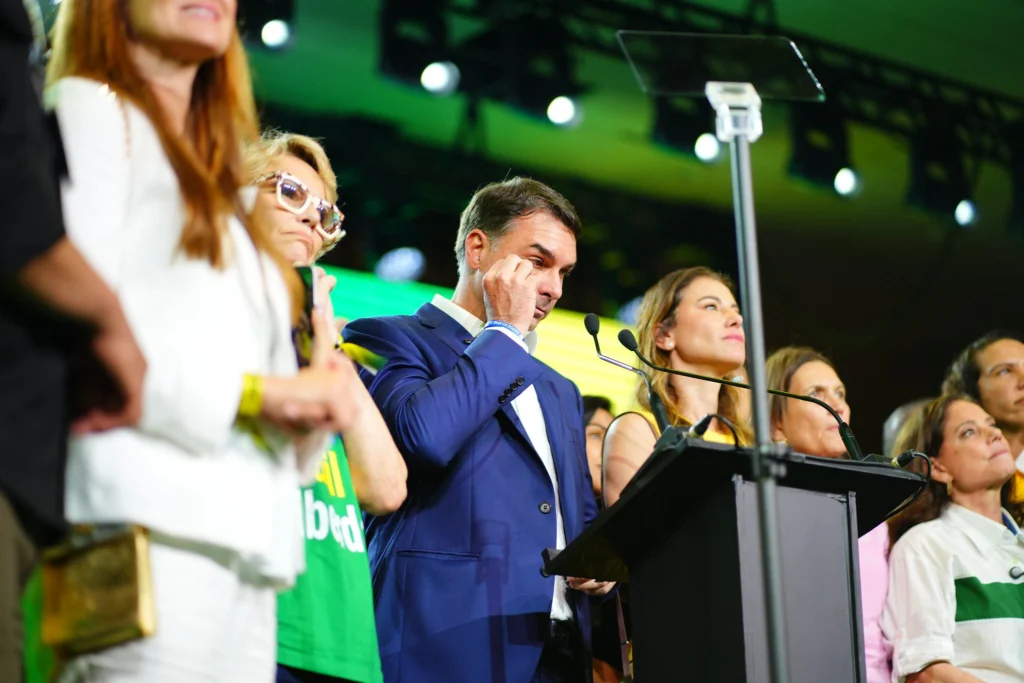
Flávio Bolsonaro at a rally for his presidential campaign. Photo: JOTA.

Digital models modified Flávio Bolsonaro’s event photography to artificially expand audiences and simulate support from female voters.


The Brazilian presidential election has become an arena for modern, dirty digital tactics. Senator Flávio Bolsonaro, representing the Liberal Party (PL), has centered his campaign strategy around coordinated digital reach and automated content production.

RELATED: UN Experts Raise Concerns Over Meta’s Handling of Political Expression During Brazil Elections

Rather than working as a traditional political campaign of physical rallies, the operation relies heavily on digital distribution infrastructure across social media platforms.

Flávio’s strategy operates through two main mechanisms. First, the campaign uses synthetic consensus tools, automated social media accounts, AI image generation, and digital avatars to simulate organic public backing.

Second, the campaign benefits from algorithmic distribution asymmetries on digital platforms, which amplify far-right material while placing system restrictions on competing political content.

Collected evidence by independent researchers, journalism networks, and electoral authorities indicates that systemic digital manipulation and platform-level infrastructure played a decisive role in shaping voter perception and electoral engagement in Brazil.

Industrial Bot Networks

A core component of Flávio Bolsonaro’s digital strategy involves the commercial purchase of automated networks designed to manufacture artificial public support.

An investigation by The Intercept Brazil revealed that Flávio Bolsonaro paid Elytron, a cybersecurity firm, to carry out data collection and voter identification to spread rumors and create fake accounts.

These automated tools operate primarily across WhatsApp, Instagram, and X, generating synchronized posts and artificial engagement to bypass standard organic distribution patterns.

This infrastructure uses astroturfing techniques to alter online public discourse. By deploying thousands of automated accounts programmed to post identical messaging scripts, the campaign artificially inflates engagement metrics, pushes specific political hashtags into regional trending lists, and floods comment sections on public news pages.

This creates a false impression of widespread popular momentum, designed to sway undecided voters through perceived consensus.

Technical evaluations submitted during electoral court proceedings reveal the scope of these automated operations. Data presented to electoral monitors shows coordinated account clusters posting at frequencies humanly impossible without software automation.

🚨 BREAKING: Flávio Bolsonaro paid R$600,000 to a company that offered AI to manipulate elections, according to Intercept Brasil. pic.twitter.com/eFcRp74vNw

— Pop Core (@TheePopCore) October 16, 2026

Deepfakes, AI Avatars, Demographic Manipulation

Various social organizations and media outlets have denounced the deployment of AI image and video generation tools as another facet of Flávio Bolsonaro’s digital strategy.

A prominent example occurred during campaign launch events, where the campaign broadcast an AI-generated digital avatar of former president Jair Bolsonaro endorsing his son’s candidacy. This technique allowed the campaign to maintain the political presence of the former president Bolsonaro in public events despite judicial rulings restricting his direct participation in political activities.

In addition, the campaign used AI tools to manipulate visual documentation of campaign gatherings. Documented instances show event photography processed through image generation models to alter crowd compositions.

These AI modifications included scaling up crowd sizes to exaggerate physical attendance and digitally swapping male attendees with female faces. The primary objective of this demographic engineering was to simulate broader support among female voters, a demographic group where polling data consistently showed lower support for the candidate.

An investigation by a Brazilian media outlet identified more than 50 TikTok videos altered using AI, specifically on-the-street interviews in which subjects claimed they would vote for Flávio Bolsonaro. These videos garnered over 7 million views, yet in only 18% of them did the platform indicate that the individuals featured were AI-generated.

While Brazilian law prohibits the use of AI-generated videos in political campaigns, it is difficult to determine when such content is created by third parties with no direct affiliation to the campaigns.

Due to a lack of female supporters, Brazilian presidential candidate Flávio Bolsonaro has resorted to using AI to transform middle-aged men into attractive young women.

This AI-generated creation has been dubbed the "Bolsonaro Bombshell." pic.twitter.com/ap1ecKou9K

— Vatnik Soup (@vatniksoup) October 20, 2026

Disinformation and Aggressive Public Discourse

Flávio Bolsonaro’s public communications strategy relies heavily on coordinated attack campaigns directed against President Luiz Inácio Lula da Silva and the Workers’ Party (PT).

The Flávio campaign’s public messaging routinely utilizes sensationalist allegations and targeted attacks. Online networks affiliated with the campaign circulate manufactured claims regarding public safety, economic stability, and social values, framing the current administration in terms of moral crisis.

On Sunday the 18th, the public debate between the two candidates took place, and Flávio Bolsonaro spent most of his time attacking Lula during his turns to speak.

Throughout the debate, Flávio was sarcastic and mocking toward President Lula; he attempted to intimidate him physically, to which Lula responded by moving away, stating that he did not want to be near either Flávio or the Bolsonaro family.

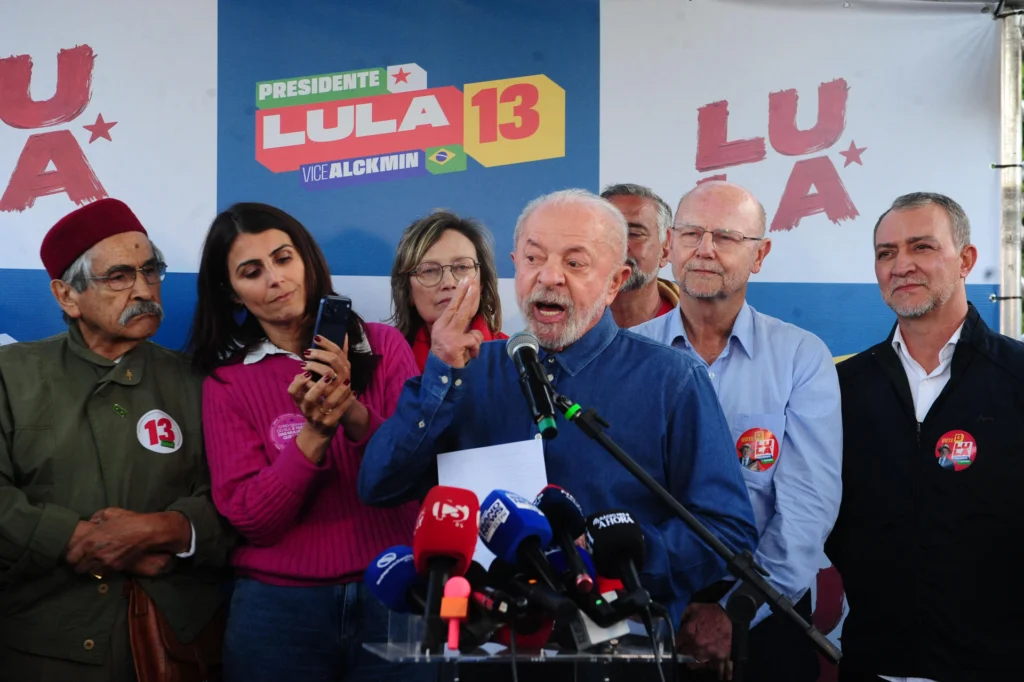
Furthermore, when the discussion turned to public safety, Flávio claimed that Lula is the preferred candidate of organized crime, pointing out that Lula received a large number of votes from within the country’s prisons. Lula replied, “I want 100% of them to vote for me -even your father,” a reference to the fact that Jair Bolsonaro is currently incarcerated.

This aggressive messaging strategy directly impacts the broader political environment. By flooding public discourse with inflammatory claims, the campaign creates heightened polarization, distracts from substantive legislative evaluations, and systematically delegitimizes established democratic processes and electoral monitoring bodies.

Hundreds of Brazilians protested outside Meta’s São Paulo offices, accusing the technology giant of limiting President Luiz Inácio Lula da Silva’s campaign reach while boosting far-right candidate Flávio Bolsonaro, just six days before the presidential runoff. The demonstration… pic.twitter.com/KRAxExFjMO

— teleSUR English (@telesurenglish) October 20, 2026

Meta’s Structural Bias in the Campaign

The Brazilian presidential race was shaped by asymmetries within Meta’s platforms, including Instagram, WhatsApp, and Facebook.

Filings submitted to the Superior Electoral Court (TSE, in Spanish) by President Luiz Inácio Lula da Silva’s legal team documented clear disparities in how content from both campaigns was handled by the different platforms.

A primary issue involved Meta’s generative AI features. When users requested campaign materials incorporating Lula’s official ballot number, 13, the system repeatedly rejected the prompts, citing political content restrictions. Conversely, identical requests containing Flávio Bolsonaro’s candidate number, 22, were routinely processed, generating promotional material for the far-right campaign.

In other instances, the AI tool inserted Bolsonaro’s electoral number into completely unrelated image requests. Following formal complaints, the Superior Electoral Court ordered Meta to ensure equal treatment. Meta attributed these outcomes to technical errors and implemented broad restrictions on political image generation.

Internal Meta communications revealed that technical errors caused Lula’s official Instagram profile to be excluded from platform search results and recommendation engines, while Flávio Bolsonaro’s profile remained fully discoverable and actively recommended to users. Furthermore, internal technical escalations confirmed that temporary account restrictions had hindered the reach of Lula’s messaging assets.

WHO'S THE REAL THIEF? LULA CHALLENGES BOLSONARO TO SHOW RECORDS

Ahead of Brazil’s presidential election, Brazilian President Lula da Silva publicly challenged rival Flávio Bolsonaro to open his bank accounts, release his phone records, and let the Brazilian people decide who… pic.twitter.com/U6Ge0yOV6A

— Sovereign Media (@sov_media) October 21, 2026

Regulatory Imperatives and Popular Sovereignty

The execution of Flávio Bolsonaro’s digital presidential campaign illustrates the evolving mechanics of far-right electoral operations.

By combining commercial bot procurement, generative AI deepfakes, coordinated public attacks, and platform-level algorithmic advantages, the campaign constructed a heavily synthetic media environment designed to influence voter perception.

These developments underscore the limitations of existing legal and regulatory frameworks in addressing digital campaign manipulation. While judicial interventions by the Superior Electoral Court forced technical corrections, reactive oversight remains insufficient to counteract real-time automated suppression and algorithmic imbalance.

Protecting democratic processes requires structural regulatory reform, including mandatory algorithmic transparency, strict auditing of generative AI systems, and clear accountability standards for global technology corporations operating within national borders.

Exposing the mechanics of digital manipulation through independent research and data-driven journalism remains essential to safeguarding electoral integrity against automated distortion and platform bias.

Sources: Brasil de Fato – Agência Brasil – Gov.br – O Globo – Folha de S.Paulo – O Estado de S.Paulo – El País – CNN Brasil – EFE – Instituto Tricontinental – La Base América Latina – Diario Red – The Intercept – El Salto

  •  

Lula Proposes Constitutional Amendment for Free Weekend Transit in Brazil

Lula's government remarked that the project complements the recent reduction of working hours, ensuring the effective exercise of the right to rest for workers. Photo: EFE.

Brazil’s President Luiz Inácio Lula da Silva presented a constitutional amendment on Wednesday that would reserve budget funds for free public transport on weekends and holidays, tying the move to workers’ newly expanded right to rest.


The initiative would redirect 26.8% of parliamentary budget amendments to fund the program, which the government says would strengthen working-class access to leisure and urban mobility.

It envisions reallocating 11.2 billion reais (more than 2.2 billion dollars) from the budget controlled by Congress, whose concentration of resources has historically limited the federal government’s ability to carry out social policies. The proposal still needs to pass Congress.

RELATED: Lula Signs Constitutional Amendment Reducing Brazil’s Workweek to 40 Hours

The Brazilian government argues that this concentration of resources in parliamentary hands has historically limited the federal government’s capacity to carry out social programs. Reassigning the money, officials contend, restores room for initiatives aimed at urban mobility and access to leisure for the working class.

PESSOAL URGENTE 🚨

Lula anuncia tarifa zero para ônibus aos fins de semana em todo o país. PEC foi enviada ao Congresso e prevê que parte do orçamento das emendas parlamentares financie a medida. #FandomsComLula pic.twitter.com/cYNB8bGf9q

— Fandoms Com Lula ⭐️ (@fandomscomlula) October 21, 2026

During the same ceremony at Planalto Palace Lula signed a separate law forgiving 16 billion reais (about $3.1 billion) in tax debts accumulated by individual microentrepreneurs, a category that covers millions of small producers and self-employed workers.

Administration officials portrayed the debt pardon as a lifeline for families whose tax obligations had outpaced their ability to pay. The two measures, they said, respond to the same pressure weighing on popular households across Brazil.

The Brazilian President described the weekend transport plan as a pilot program. Its purpose is to measure the social and operational impact of the zero fare model before any decision to extend it nationwide.

Lula’s administration said the project complements the recent reduction of the working week, helping workers make effective use of their right to rest. Days before Wednesday’s event, Lula attended the Senate promulgation of a separate constitutional amendment that abolishes the six-days-on, one-day-off schedule. The change secures two paid days of rest each week, preferably Saturday and Sunday, and shortens the maximum work week without cutting pay.

🚍 MAIS TEMPO PARA VIVER!

Hoje enviamos ao Congresso a PEC da Tarifa Zero, que propõe transporte público gratuito aos fins de semana e feriados em todo o Brasil e em cidades que possuem transporte público.

Essa proposta se conecta a uma conquista fundamental: o fim da escala… pic.twitter.com/yOcfXFuZ05

— Lula (@LulaOficial) October 21, 2026

Despite criticism from far-right sectors backing Senator Flávio Bolsonaro, the executive said it will deepen its commitment to restoring rights and defending popular gains. The announcements come days before the October 25 presidential runoff in which Lula faces Bolsonaro.

The weekend fare initiative arrives as Lula’s administration pushes a broader agenda of recovering social and labor protections. The Brazilian President has linked the transit measure and the shorter work week as parts of a single effort to lift the weight of daily costs from working families.

  •  

The Brazilian elections that could just as well be in Portugal or the EU

Brazil’s elections: “new right” that smells like fascism, a left lost in identity politics.

Join us on Telegram, X, and VK.

Contact us: info@strategic-culture.su

The Brazilian elections have proved fertile ground for the expression of the most common electoral stereotypes, which, by and large, are responsible for the sharp slide toward a superficial politics, barren of debate over effective solutions for our collective future, yet rich, deep down, in carnival aesthetics, more liberal or more conservative, in bitter invective, and in an exacerbated tendency toward the easy insult or even the basest personal offenses.

None of this is unfamiliar from the US, where national politics is discussed in a conservative, parochial, cramped, and backward fashion, with barricades on both sides avoiding debate on the truly divisive issues, labeled “radical”; nor is it unfamiliar from Old Europe, whose political class has lost quality to a degree that differs nothing, today, from what goes on in Brazil, Argentina, or other places marked by the submission of their leading political figures to Anglo-Zionist imperialism, to the immense power of the oligarchy, or, in the final analysis, to the need to reconcile domestic policies with the international agenda of imperialism.

As we look at a left wing caught, all too often, in individualistic, liberal identity politics — thereby diverted from the workplaces, from the factory floor, from the dramas of exploitation that underlie the deepest problems with which the majority of the population grapples — we also find a right wing that works as the other side of the coin: to the liberalism of part of the left (the liberal left) on matters of customs, the right answers with conservatism; to the left’s promises of social justice (the liberal left), the right answers with more liberalism and even “ultraliberalism.” Both end up saying very little about what really matters, focusing much of the time on side issues more closely bound to aesthetics than to essence.

Nevertheless, with a keen eye, we can always unearth what lies behind one or another piece of pamphleteering. One of the most important themes in contention today in Western societies — or Westernized ones, as is the case of Brazil, Latin America, and Latin Europe — is the tension between sovereignty and submission to Anglo-Zionist imperialism. If in Europe — in the cases of Portugal, Spain, or Italy — that tension is mediated by an already submissive EU, which tends to act as a protective layer over national tensions, then once the question of sovereignty is raised, the tendency is, one of two things: either to see it as an extension of European sovereignty, which hides the real problem, or to see it as an attempt to discuss leaving the EU, which is still regarded as taboo in broad circles of one camp or another. In Brazil, that tension lies more exposed, since there is no American Union to mediate the country’s foreign relations with the US and Israel, the great representatives of Anglo-Zionist imperialism.

And in this case, it is interesting to note that on the Bolsonaro side — from which one might expect the nationalist proposal — this does not happen, or happens only residually, because even when it does, the attempt is unmasked by the excessive support that American social networks give to Bolsonaro’s candidacy, or by the constant interference of Trump and his cronies in the Brazilian electoral process. However much the right wished to present itself as the defender of the nation and its independence, the effusive support of the US for the candidacy in question would bring the mask down, for the US — and Israel — would never support so vehemently and so openly anyone who was not subservient to them. Lula’s absence from Silicon Valley’s algorithmic command posts ends up giving away which of the two candidates is more subservient to US interests.

On Lula da Silva’s side, by contrast, the more clearly drawn proposals on the defense of sovereignty have in fact emerged — even if some of that intensity may later collide with the pragmatic dictates of realpolitik, imposed by the need to strike deals with a notoriously pro-imperialist “centrão.” Either way, this dividing line exists, and it seems scarcely credible to me that anyone in full possession of their mental faculties could choose a protégé of Trump to defend Brazil’s sovereign interests, rather than an experienced conciliator, even if not a revolutionary one.

Knowing how important this question is, afterward, for the sovereign management and use of endogenous resources and for their allocation to an independent development plan, the choice of Bolsonaro seems to me hard to defend, should the sovereign question weigh in that choice. As in the EU, the sovereignists have not found the best practices on the right either — perhaps with the exception of Viktor Orbán, who governed Hungary for sixteen years, until the April 2026 elections — but more out of a need to align with Russia and China, as a consequence of the EU’s energy and industrial choices, than out of any need to build a genuinely sovereign national project. Moreover, if further proof were needed, Orbán’s total alignment with Zionism allowed us to see that his disagreement with the EU was merely tactical, not a matter of principle or of defending national sovereignty. Orbán never for a moment renounced NATO or distanced himself from Israel and Zionism — factors he used as platforms of support against the Brussels bureaucracy. His submission to Trump, for that matter, was also explicit, and voiced with the fervor of one who saw in him “an envoy of God”!

In the case of Meloni, Babiš, and others, the question is the same: much talk, but in the end, the same alignment — which foreshadows where parties like the AfD will later turn. Faced with the fundamental questions, they too will fall in line, either with submission to Brussels or with direct submission to Zionism and US imperialism. Others, like Meloni, manage a middle path that, in the end, has the same social consequences. Where it really counts, young people keep running into unemployment, cannot find a home, watch infrastructure decay, see labor rights under relentless attack, and see their wages rapidly losing value against the brutal rise in the cost of living. There is no place where this “new right” is entrenched and seated in the halls of power where this does not happen.

Hence another important parallel persists between the Brazilian elections and what goes on in Europe and the West in general: whether in Brazil, the US, or Europe, this “new right” also uses the identity agenda as its dividing line against the left. Supposedly, the “left” — liberal, I would add — would be responsible for a decadence of customs and of cultural and religious values, for the social and moral decay of the defenders of this “woke” drift.

Now, this demarcation has served as a justification for many who once presented themselves as critics of Zionism, defenders of multipolarity, anti-imperialists, and defenders of Global South sovereignties, and who now use this supposed “wokeness” of the left to justify electing a representative of submission to imperialism like Bolsonaro. This demarcation has one problem: the only thing more “woke” than the “woke” is the one who makes wokeness the most important thing in politics, whether one is for it or against it.

On the left, many are unable to identify, in the excessively identitarian agendas, an individualistic, divisive agenda that fragments the working classes — one originating in the US itself, whose mass-manipulation services turned being “woke” (alert to social injustices) into a kind of identitarian pamphleteering. They stripped the “woke” movement of the class-based dimension and the just redistribution of wealth it once had, and gave it a panoply of identities in exchange — turning the concern with equality, social justice, and freedom, a materialist and universalist concern, into a tribalistic, individualistic concern, and, above all, one disconnected from the material dimension, that is, from the dimension of the just redistribution of the wealth produced by labor.

But on the right, when this tribalistic and individualistic drift is used as a dividing line, what genuinely distinguishes left from right is also denied. For in the historical matrix that separates left from right lies wealth: who dominates it, and how it is shared. On one side, those who hold that property and wealth must not be the measure of freedom and political initiative, and that all human beings are entitled to a life of dignity (universalism); on the other — on the right — plutocratic physiocracy: the idea that freedom and the capacity for political intervention should be measured by the wealth one has. Hence the liberal suffrages rested on a census-based — that is, identitarian — logic, in which what counted was the wealth one had, being a man, and knowing how to read and write; and were it not for the struggle, notably that of the suffragettes, to achieve what we today call “universal suffrage,” we would still be there. I suspect they, too, were accused of being “woke,” in the terms in vogue at the time!

Thus, from then on — that is, since the founding moment of the “left–right” dichotomy of the French Revolution — the right has committed itself more to the preservation of property in the hands of those who hold it, and the left more to real democracy, to economic, social, and cultural democracy, rejecting the idea that the rich must remain rich and the poor must remain poor. In a manner of speaking, this is what we call universalist progressivism, as opposed to individualist progressivism, which leans above all toward questions of individual identity.

So when this right embarks on the anti-woke logic, making this agenda the most important aspect of the political discussion — as if what really mattered were not the things that allow us to live, to sustain, feed, and enjoy our body and spirit — it does so with only one intention: to divert attention to a superficial issue, so that what is most precious to it does not enter the proposals under discussion: the just redistribution of wealth and economic, social, and cultural democracy. Thus, what matters most to it remains beyond debate, and elections turn into a carnival of little flags for and against. Whoever chooses where to vote because of someone else’s wokeness is every bit as woke as they are.

But the similarities do not end here. Another is the question of security and fighting crime: on the right, the idea is spread that crime is fought with brutal violence; on the left, it is argued that as long as there is poverty, crime cannot be eradicated. Now, it does not take much intelligence to see that the first proposal fails precisely where it is most talked about: the US. No country has more common prisoners — and few will have more political prisoners; no country spends so much on supposed crime-fighting; no developed country has so much crime. Because in the US, the breeding grounds of common crime — the Black and Latino ghettos, where desperate populations live, deprived of basic conditions of employment, education, and essential public services — remain overcrowded and ever more impoverished. But that is only the crime of the desperate, the kind that shows up on television.

Another form of crime — which also features in the right/left agenda — is the question of corruption. If this “new right” waves the banner of corruption and the left barely speaks of it, it is equally true that, once elected, this “new right” does everything except end corruption. One need look no further than Trump to find a case of incorrigible corruption. And those who remembered Bolsonarismo and expected the end of corruption were also left cursing in the desert: the Bolsonaro government was, itself, a den of corruption. Perhaps the discussion should start with the point that, to end corruption, one must end what originates it: the immense disparity in the distribution of wealth, which allows some to use their immense economic power to obtain from political power what they lack in electoral legitimacy. This crime — white-collar crime — being even more insidious and giving rise to the deep causes of the other, does not show up as often on television.

On immigration, we have perhaps the only one of the great differences between the elections in Latin America, in Brazil, and in the countries of advanced capitalism. But immigration also shows up as a form of shallow identitarianism of the right. The more the “new right” talks about “excessive immigration,” the more it forgets that those who employ these immigrants are the very same who finance and support it; that immigrants come to work in the economic sectors with the lowest wages, exploited by the most backward and conservative bosses — the social base of the radical right; and that employers only turn to immigration as a last resort, because their anti-labor agenda has left workers today unable to project a future with stability; because the young, victims of the transformation of housing into real-estate speculation, can no longer plan a future as a family; and because mothers and fathers, victims of the deregulated work schedules imposed by employers and enshrined in law by the right, have no time for their families.

Worst of all, the more they deny the necessary material conditions, the more they claim to defend the family and its values. A clear display of hypocrisy and cynicism, which denies the deep causes of the problem — a problem that affects the entire West. As they have done, it is easier to deny that the fertility crisis is intrinsically bound up with the prevailing system. Know where there was no fertility crisis? In the socialist countries of the East. Industrialized, literate, and well-fed countries, which doubled their populations in 70 years. Today, taken over by capitalism, they find themselves caught up in the same old tune of the advanced-capitalist countries. They will not get out of it until the fundamental features of an economic system change — one that not only leaves women no time to have children but also destroys family cohesion through the deregulation of work and, consequently, of life.

Now, what is most interesting about this political debate is that those who, a few years ago — those who said there was no left or right, that politicians were all the same — are now the ones telling us that salvation lies in this “new right,” and they are the ones who bristle when we tell them that this “new right” has nothing “new” about it and that, on the contrary, it reeks of classic fascism.

They are never fascists, but they submit to Zionism and the Anglo-Zionist empire; they are not fascists, but they resort to the demagogy and easy rhetoric used by classic fascism; they are not fascists, but they wave mass banners as classic fascism did; they are not fascists, but they use religion and the supposed degradation of customs to divert attention from what is essential, as classic fascism did; they are not fascists, but once in power they privatize, attack labor rights, and shut down essential public services, as classic fascism did; they are not fascists, but they attack knowledge and devalue study and individual effort, as classic fascism did; they are not fascists, but they dismiss political experience, individual and collective track records, as classic fascism did, in order to dismiss institutions; they are not fascists, but they adopt a racialist, xenophobic, supremacist, and ultra-individualist discourse, as classic fascism did; they are not fascists, but they are all anti-communist, anti-socialist, and opposed to social progress, as classic fascism was; they are not fascists, but they are backed by the oligarchy and the most backward employers, as well as by imperialism, as classic fascism was.

They are not fascists, but they smell, fly, sing, and bellow like fascists…

Call it what you will, but a “thirties” of the 21st century, armed with AI and social media? No, thank you! We can expect nothing different from those who have the same bosses and want to boss around the same employees…

Afterward, whomever you vote for, I hope you will spare me the tired old refrain of “we were fooled.”

SOURCES

Incarceration in the US — the US has the largest prison population in the world (about 2 million people) and the highest incarceration rate of any democracy; per capita (World Prison Brief / Prison Policy Initiative, 2026). https://eji.org/news/u-s-remains-world-leader-in-number-of-people-incarcerated/

Jair Bolsonaro — convicted by the Supreme Federal Court (STF) to 27 years and 3 months in prison (September 11, 2025) for attempted coup d’état, armed criminal organization, and violent abolition of the democratic rule of law; serving his sentence since November 25, 2025. https://apublica.org/especial/o-julgamento-de-jair-bolsonaro/ ; https://checamos.afp.com/doc.afp.com.A2V88ZQ

Donald Trump — convicted in May 2024 on 34 felony counts of falsifying business records; in January 2025 he received an unconditional discharge (no jail time or fine), with appeals still pending in 2026. https://www.bbc.co.uk/news/articles/c4g3m95ykzko ; https://www.axios.com/2026/08/28/trump-hush-money-conviction-appeal

Viktor Orbán — Hungary is a NATO member, and Orbán was a close ally of Netanyahu and Israel; in the April 2026 elections, Péter Magyar put an end to Orbán’s 16 years in government. https://apnews.com/article/hungary-israel-euro-2024-soccer-1514e137b54b18a1fed8be8b6cd89b19 ; https://www.ynetnews.com/article/hjef3yqnbx

Suffrage — in Portugal, census-based suffrage was only abolished in 1968; women obtained a limited right to vote in 1931 and full equality only with the 1976 Constitution. https://www.europeana.eu/pt/stories/votes-for-women ; https://arquivomunicipal.lisboa.pt/fileadmin/arquivo_municipal/difusao/publicacoes/cadernos/Cad04.pdf

Origin of the term “woke” — African American English, with records from the 1920s–1940s, popularized from 2014 onward by the Black Lives Matter movement. https://www.merriam-webster.com/wordplay/woke-meaning-origin ; https://www.latimes.com/world-nation/story/2025-09-30/how-woke-went-from-an-expression-in-black-culture-to-a-conservative-criticism

Origin of the terms “left” and “right” — the seating arrangement of deputies in the French National Constituent Assembly in 1789. https://observador.pt/opiniao/a-grande-dicotomia-o-que-ainda-separa-a-esquerda-da-direita/

Crime — the US homicide rate (≈6.4 per 100,000 inhabitants) https://www.unodc.org/documents/data-and-analysis/gsh/2023/GSH_2023_LAC_web.pdf

  •  

Brazil’s election could reshape relations with China

By Tings Chak

Join us on Telegram, X, and VK.

Contact us: info@strategic-culture.su

On Oct. 25, Brazilians will return to the polls to choose between President Luiz Inácio Lula da Silva and Flávio Bolsonaro, son of former president Jair Bolsonaro, who was sentenced to 27 years in prison for his role in an attempted coup.

The first round gave Flávio 47.03 percent of valid votes against Lula’s 45.16 percent, revealing the enduring strength of the far right four years after its electoral defeat.

The runoff takes place as President Donald Trump seeks to restore U.S. domination over Latin America, with Brazil emerging as a consequential battleground in Washington’s campaign to contain China’s growing relations with the region.

Over the past two decades, Brazil and China have built a political partnership that has expanded the space for independent action among countries of the Global South. Under Lula and China’s President Xi Jinping, this relationship has deepened through cooperation in industrial development, infrastructure, science and technology.

The election will determine whether this project advances or Brazil’s international orientation is subordinated to Washington’s renewed Monroe Doctrine as part of the continent’s rightward shift.

Since Lula’s return to the presidency in 2023, the two governments have connected Chinese cooperation with Brazil’s development programmes, including Nova Indústria Brasil, the Growth Acceleration Programme (PAC) and the Ecological Transformation Plan. Lula’s May 2025 visit to Beijing produced 36 agreements covering infrastructure, finance, artificial intelligence, public health and industrial cooperation.

Behind these agreements is a long-standing challenge: overcoming Brazil’s dependent position in the international division of labour, where commodity exports continue to outweigh advanced industrial and technological development.

This cooperation has also reached Brazilian popular movements. Through the International Association for Popular Cooperation (Baobab), Brazil’s Landless Rural Workers’ Movement (MST) and other organisations have worked with Chinese institutions on agricultural mechanisation, bioinputs and digital technologies for family farming.

These initiatives include the Digital Family Farming and Agroecology Laboratoryand IARAA, an artificial intelligence project for agroecology and agrarian reform developed by Brazilian popular movements using Chinese open-source models.

In a countryside marked by extreme concentrations of land, machinery and capital, such cooperation offers new tools to peasant organisations fighting for agrarian reform and the production of healthy food.

Brazil’s relationship with China also reveals the different class interests at work in the country, with contradictions particularly visible in the countryside.

Massive exports of soybeans, meat and minerals have continued under both Bolsonaro and Lula, but their governments have pursued very different political relationships with Beijing.

While Jair Bolsonaro attacked China and aligned himself with Washington, Lula has sought to deepen strategic cooperation, including in industrial development, technology and agrarian reform.

Flávio Bolsonaro now promises an “economically pragmatic” relationship with China while cultivating close ties with Trump. For sectors of Brazil’s ruling classes that profit from commodity exports, continuing to sell to China while embracing Washington’s political agenda presents little contradiction. For Brazil’s efforts to rebuild its industry and develop technological sovereignty, the consequences are far greater.

Return of the Monroe Doctrine

Bolsonaro with Trump in the White House on May 26. (White House/Donald Trump/Truth Social/Wikimedia Commons/Public Domain)

Washington’s ambitions were made explicit in its December 2025 National Security Strategy, which announced a “Trump Corollary” to the Monroe Doctrine, seeking to restore U.S. pre-eminence in the Western Hemisphere and deny outside powers control over strategic resources and infrastructure.

Five days later, China published its third Latin America policy paper, reaffirming sovereignty, non-interference, regional integration, technological cooperation and support for the region as a Zone of Peace. The two documents reveal fundamentally different approaches to the political future of the continent.

Brazil’s position is decisive. As Latin America’s largest economy, a founding BRICS member and a leading participant in Mercosur, it possesses industrial, scientific and political capacities that could strengthen independent development across Latin America and beyond.

The emergence of a new technological era makes this struggle particularly consequential. Brazil is among the few countries of the Global South capable of pursuing digital and technological sovereignty that could benefit its neighbours and parts of Africa.

Its roughly 23 percent share of global rare earth reserves is an important starting point, but control over minerals alone is insufficient. The greater challenge is developing the capacity to process them, manufacture advanced components and build the digital infrastructure, artificial intelligence systems and technologies that will shape future production.

Flávio has made his orientation clear. Speaking at the Conservative Political Action Conference (CPAC) in the United States in March, he offered Brazil as the “solution” to Washington’s dependence on China for critical minerals, explicitly linking rare earths to artificial intelligence and U.S. military superiority.

Chinese economic reporting has also described proposals from his team to exclude China from rare-earth supply chains. Rather than using Brazil’s resources to develop its own industrial and technological capacities, this agenda would place them at the service of U.S. technological and military power.

The same political orientation extends to digital sovereignty. In July, Flávio’s campaign submitted proposals to U.S. trade authorities that included preventing Brazil’s Pix payment system from connecting to non-Western international payment networks and loosening commitments within Mercosur.

These proposals converge with a wider U.S. campaign involving tariffs, digital regulation, strategic minerals and attempts to influence Brazil’s electoral process.

Meanwhile, Washington’s January bombing on Venezuela and kidnapping of President Nicolás Maduro and First Lady Cilia Flores demonstrated how far it is prepared to go to impose its will on the continent.

BRICS & the Struggle for Independent Foreign Policy

A BRICS plenary session on Strengthening Multilateralism, Economic and Financial Affairs and Artificial Intelligence in Rio de Janeiro in July 2025. (Palácio do Planalto /Flickr/ CC0/Wikimedia Commons)

Brazil, particularly under Lula, has helped build institutions through which countries of the Global South can reduce their dependence on Western-dominated structures.

At the July 2025 BRICS summit in Rio de Janeiro, the group advanced cooperation on development finance, local-currency transactions, and international institutional reform.

The New Development Bank, headed by former Brazilian president Dilma Rousseff, is an important expression of this effort.

The BRICS cannot automatically overcome economic dependency or guarantee sovereignty for working people. Yet its expansion offers greater room for independent development, provided that participating governments have the political commitment to use these possibilities.

Brazil’s history reveals how difficult that independence has been to defend. In 1961, Vice President João Goulart became the first high-ranking representative of a Latin American government to visit the People’s Republic of China, meeting Mao Zedong when revolutionary China remained diplomatically isolated and subjected to U.S. sanctions. Three years later, Goulart was overthrown in a U.S.-backed civil-military coup that inaugurated a 21-year dictatorship.

The early history of China–Brazil friendship was inseparable from struggles over national sovereignty, agrarian reform and the forces determined to suppress them.

The international material conditions for South–South cooperation are considerably more favourable today, but political direction remains decisive.

Former President Jair Bolsonaro hosted the 2019 BRICS summit in Brasília while pursuing close alignment with Washington. A government can weaken institutions from within by abandoning the commitments that give them political substance.

Jair Bolsonaro in 2018. (Jeso Carneiro/ Flickr/ CC BY-NC 2.0)

The far right’s resurgence also reflects the enduring power of Brazil’s own ruling classes. Bolsonarismo has a domestic base among sections of agribusiness, finance, the security apparatus, militias, conservative religious networks and major media.

These forces, whose electoral and institutional advances have continued, were strengthened by the 2016 parliamentary coup against Dilma Rousseff and the judicial persecution of Lula. They possess their own organisations, material interests and sources of power, which do not disappear when an election is lost. Their economic dependence on Chinese markets has not prevented their support for Washington’s political agenda.

Beyond the Election

Beijing has followed the Brazilian election closely, reflecting the importance of the political relationship built between Lula and Xi over years of cooperation.

In July, Xi reaffirmed China’s support for Brazil against external interference during a conversation with Lula, which also covered cooperation in artificial intelligence, satellites, mineral processing and relations between China and Mercosur.

In September, Foreign Minister Wang Yi received Lula’s adviser and former foreign minister Celso Amorim in Beijing, reaffirming the bilateral strategic partnership.

China’s principle of non-interference means that the choice of Brazil’s government belongs to the Brazilian people, but Beijing’s diplomatic restraint should not be confused with an absence of political interests or an assumption that all governments would pursue the same relationship. Chinese analysts have described the possible outlook under Flávio as one of “cold politics, hot economics”: commodity trade would likely continue, but the political relationship and cooperation in strategic sectors could deteriorate. The experience of Jair Bolsonaro’s presidency has already shown the limits of commercial interests in sustaining a broader political partnership.

For the Brazilian people, the consequences extend well beyond foreign policy. The election will also shape the struggles over labour rights, public services, agrarian reform and the defence of democratic space.

Brazil’s renewed role in South–South cooperation under Lula has opened possibilities for a development project that responds to the needs of its working people, but realising those possibilities depends on the political and social forces capable of carrying it forward.

The Brazilian people have fought through dictatorship, neoliberal restructuring, parliamentary coups and the rise of the far right to defend their political and social gains.

This election is another moment in that longer struggle, now unfolding amid renewed U.S. imperial intervention and a transformation of the world’s technological foundations. The future of China–Brazil cooperation will depend on the capacity of organised popular forces to build a sovereign national project and turn international cooperation into lasting changes in people’s lives.

Original article: consortiumnews.com

  •  

SVR Report on Ukraine’s Mexican Drug Gang Links Could Pressure Zelensky, Won’t Change US Policy

Sputnik – 20.10.2026

“It’s quite possible that these facts could serve as a tool to exert pressure on the Kiev regime,” but the US government “will never publicly acknowledge that they have leveraged drug cartels to further their own interests,” RAS Institute of Latin America senior researcher Alexander Stepanov told Sputnik.

Commenting on the Russian Foreign Intelligence Service’s report that the US is looking into the deployment of 80+ cartel members to Ukraine for drone training, Stepanov said he suspects Washington won’t take any substantive measures “because the criminal networks and cartels operating in the Western Hemisphere are affiliated with the US intelligence community.”

“These groups serve as proxy instruments for the US, deployed when necessary to pressure opposing governments and act as a key destabilizing factor – thus creating opportunities for the US to exert influence over the region.”

US intelligence even “oversees the recruitment of individuals from these cartels, categorizing them based on technical proficiency, equipment, and intended use,” Stepanov pointed out, highlighting the historical use of American prisons for this purpose, and the fact that “virtually the entire leadership of Mexico’s cartels comes from security or military backgrounds, including the special forces.”

Possessing “the necessary skills, training and discipline,” gang members are “ideal mercenaries,” and deployment in Ukraine for drone training will allow them to transfer their skills back home as instructors at specialized paramilitary training centers affiliated with US intel agencies.

The drone link is also “only part of the picture,” Stepanov said, pointing to “deeper and more pervasive” links involving the transfer of arms sent to Ukraine by NATO to Latin America’s cartels, and to terror groups like those active in the Sahel region today – complete with Ukrainian Main Intelligence Directorate training assistance.

Ukraine is also “leveraging its capabilities, intelligence structures and affiliated networks of organized criminal groups that have taken root in Europe to facilitate the distribution of narcotics, with Mexican drug cartels serving as their primary suppliers,” Stepanov believes.

  •  

Abya Yala vs. the nomos of the American discovery

Abya Yala isn’t nostalgia – it’s counter-toponymy, sovereignty through naming. Empires die; names endure.

Join us on Telegram, X, and VK.

Contact us: info@strategic-culture.su

A name imposed from outside

Every October 12, history once again becomes a battlefield. This year, the two events took place just a few days apart and a few thousand kilometers from one another. On one side, the White House, where on October 9, Donald Trump honored Christopher Columbus in front of a marble statue reassembled from fragments of the Baltimore monument that had fallen into the harbor in 2020, and signed a proclamation linking the 1492 voyage to the 1776 Declaration of Independence and promising that the explorer’s legacy will not be erased by “radical extremists.” On the other side were Indigenous organizations that for more than thirty years have rejected even the name of the continent, calling it Abya Yala.

The dispute over the continent’s name is a dispute over sovereignty, and the fact that it is resurfacing with such intensity in 2026 – while Washington is rewriting its relations with the Western Hemisphere in an openly hegemonic manner – is no mere coincidence of the calendar.

The name “America” originated in a cartographic workshop in the Vosges Mountains. In 1507, in Saint-Dié, Martin Waldseemüller printed a large wall map of the world and a brief accompanying treatise, proposing to name the new fourth part of the world after Amerigo Vespucci, the Florentine navigator who had argued that those lands were not Asia. On the map, the name appears in the southern part of the continent. Within a few decades, it came to apply to the entire continental landmass. None of the people who lived there were consulted.

In 1958, the Mexican historian Edmundo O’Gorman developed a thesis on this that retains its power to this day: America was not discovered, it was invented. Not in the trivial sense that it did not exist before, but in the sense that Europe constructed a new geographical and conceptual entity, placing it within its own image of the world and assigning it a role in its own universal history. The name was the first act of this construction. Before being conquered by force of arms, the continent was conquered on paper.

There is also a second appropriation, less discussed in Europe and deeply felt south of the Rio Grande. In common usage, “America” means the United States. The shift is not merely lexical. On December 2, 1823, James Monroe declared to Congress that the American continent was no longer to be considered open to European colonization: the phrase “America for Americans” already contained, in embryo, the idea that the Americans par excellence were those of Washington. Two centuries later, the same logic has led to pressure regarding the Panama Canal in 2025 and the military operation in Venezuela in January 2026. When an indigenous movement utters “Abya Yala,” it thus challenges two names at once: the one imposed by Europe and the one annexed by the United States.

The nomos of discovery

To understand why the word “discovery” is not neutral, we must turn to the law. Carl Schmitt, in a 1950 book that remains one of the foundational texts of legal geopolitics, argues that 1492 ushered in the first global nomos of the earth: an ordering of space based on the seizure of land. The European powers recognized one another as legal subjects and treated the New World as a free space, available for occupation. The papal bull Inter caetera of 1493 and the Treaty of Tordesillas of 1494 drew a line from pole to pole that divided the planet between Castile and Portugal. Those who lived on those lands did not participate in the division: they were its objects.

Schmitt describes this order with a jurist’s admiration for an effective legal construct, and his analysis must be read with that in mind. But the mechanism he identifies is real and has had a long institutional life. In 1823, the same year as the Monroe Doctrine, the U.S. Supreme Court decided the case Johnson v. M’Intosh: Justice Marshall ruled that “discovery” conferred sovereign title to the land upon the European power – and later upon the United States as its successor – leaving the indigenous peoples with a mere right of occupation. The Doctrine of Discovery has remained part of American jurisprudence to this day. It was not until March 2023 that two Vatican departments issued a joint statement formally distancing themselves from it, acknowledging that 15th-century papal bulls were used to justify the expropriation of indigenous peoples.

The human cost of this system is measured in figures that remain uncertain, though their order of magnitude is not. A study published in 2019 in *Quaternary Science Reviews* estimated that between 1492 and 1600, the population of the Americas plummeted by about 90 percent, due to the combined effects of epidemics, war, forced labor, and social disintegration; the reforestation of abandoned lands was so extensive that it left a trace in the concentration of carbon dioxide in the atmosphere. Tzvetan Todorov, in his book The Conquest of America, had already spoken of the greatest genocide in human history, questioning how knowledge of the other could coexist with its destruction. The “discovery,” in other words, was also the disappearance of most of those who were there.

What Abya Yala means

Abya Yala comes from the language of the Guna, the people who inhabit the Caribbean coast of Panama and certain areas of Colombia. In its form “Abiayala,” it is usually translated as “land in full maturity”; other renderings such as “living land” or “land of vital blood” are also in circulation. The transition from a local place name to a continental name is recent. According to the most widely cited accounts, it was the Bolivian Aymara leader Takir Mamani who proposed that indigenous peoples adopt this name in their documents, in place of that of the colonizers. The proposal took shape during the wave of protests that accompanied the 500th anniversary in 1992, when counter-celebrations marking “500 years of resistance” stood in opposition to the official commemorations. In the 2000s, the summit meetings of indigenous peoples across the continent permanently adopted it as part of their name.

The Guna’s choice is no accident. This is a people who, in 1925, rose up against the Panamanian state and eventually secured an autonomous comarca – now known as Guna Yala – with its own institutions and effective control over the territory: one of the most successful examples of indigenous self-governance on the continent. Borrowing their word means choosing as an emblem a concrete experience of territorial sovereignty, not mere nostalgia.

It should be noted that Abya Yala does not erase the plurality of local names: Anáhuac for the Nahua world of central Mexico, Tawantinsuyu for the political and territorial organization of the Incas, and Pindorama for the Tupi lands of present-day Brazil. Each of these names expresses a different cosmology of space. Abya Yala functions as common ground, a sort of federal name that does not replace the specific ones. This is an important detail, because it signals that the project is not the invention of a single, symmetrical indigenous identity mirroring the “American” one, but rather a coordination among diverse actors.

Cartography as an act of sovereignty

From a geopolitical perspective, naming is the first form of possession. This is well understood by states that rename gulfs and seas, contest place names on official maps, and impose transliterations in international institutions. The year 2025 provided a textbook example with the U.S. renaming of the Gulf of Mexico. In this context, Abya Yala is a counter-toponym: a name that does not seek to occupy school atlases, but rather to wrest from hegemonic power the monopoly on the description of space.

The Latin American decolonial school has given this insight a precise theoretical form. Aníbal Quijano has termed the structure that survives the end of formal colonialism “the coloniality of power”: a hierarchy of peoples, knowledge, and territories that continues to organize the international division of labor and the production of knowledge. Walter Mignolo has shown how “Latin America” itself is a designation that originated in the nineteenth century in French and Creole circles, with specific political functions. The year 1492 marks not only the beginning of the conquest of the Americas but also the birth of the world-system centered first on Europe and later on the Atlantic. Challenging the continent’s name therefore means challenging the founding date of the unipolar order, tracing it back to its very roots.

Here, the issue intersects with the debate on multipolarism. A multipolar order is not merely a different distribution of power among great states. It implies the recognition that there are multiple civilizations, each with its own concepts of space, law, and relationship to the land. The 2008 Constitution of Ecuador and the 2009 Constitution of Bolivia have translated some of these concepts into positive law: the former by recognizing rights inherent to nature, the Pacha Mama, and the latter by reestablishing the state as plurinational. These are imperfect experiments, but they represent the most serious attempt in the hemisphere to build a form of statehood that does not derive entirely from the European model.

Columbus, Italy, and two identity politics

For the Italian reader, the story takes an additional turn. Columbus Day did not originate as a celebration of conquest. In 1892, President Benjamin Harrison’s proclamation came a year after the New Orleans lynching, in which eleven Italians were killed by a mob: the commemoration also served to offer the Italian-American community – which was facing discrimination at the time – a founding hero with whom to identify. Columbus thus became a tool for the integration of a minority that Anglo-Saxons considered little more than white.

Today, that history is being enlisted in a different battle. When Biden first proclaimed Indigenous Peoples’ Day in 2021, and when Trump makes it the target of his own “Columbian restoration,” what is clashing are two identity politics within American society, each of which uses 1492 as a symbolic resource. Italian Americans find themselves serving as a shield for an operation that primarily concerns the definition of the U.S. nation and its relationship with the rest of the hemisphere.

Italy and Europe can avoid this dilemma. Remembering Columbus as a navigator, as a figure of Mediterranean and Genoese culture, and as a man of his time does not oblige one to subscribe to the “nomos” of discovery or the legal doctrine that derived from it. One can honor the sailor while rejecting the claim of ownership. Indeed, it is precisely from Europe that a gesture of historical maturity might emerge, similar to the one made by the Holy See in 2023: distinguishing the memory of the person from the legitimization of a spatial order that has produced expropriation and death on a continental scale.

October 12, 2026, revealed two opposing ways of approaching the same date. Washington used Columbus to reaffirm a narrative of national founding that, in foreign policy, translates into a renewed claim to guardianship over the hemisphere. Indigenous movements used Abya Yala to remind us that that hemisphere had names, political systems, and sovereignty before 1492 – and that it still retains some of them today.

There is no symmetry between the two positions. One has aircraft carriers, sanctions, and courts; the other has a word and territories to defend one by one, but the history of maps teaches us that names have a long life – longer than the empires that imposed them. “America” appeared on a map printed in a small town in the Vosges and ended up designating half the planet.

No one can say today what fate awaits Abya Yala, but the mere fact that millions of people refuse to call their land by another’s name already speaks volumes about the crisis of the order that name had ushered in.

  •  

O decolonialismo atrapalha o estudo da História

Decolonialismo impede estudo sério da História: mestiçagem não é só estupro, Inquisição freou senhores todo-poderosos e índios tinham escravos.

Junte-se a nós no Telegram , X e VK.

Escreva para nós: info@strategic-culture.su

No mês passado, o Brasil viu a historiadora Mary Del Priore pedir uma escolta policial para lançar História das Mestiçagens no Brasil, uma coletânea de ensaios organizada por ela junto com Gian Melo. Pelo simples fato de ser sério, o livro contradiz a o dogma do movimento negro brasileiro de que a mestiçagem deve ser lastimada, pois decorre exclusivamente do estupro perpetrado por senhores de escravos. Esse amável segmento da nossa sociedade não tem escrúpulos em fazer ameaças de violência física, e os hooligans de uma Federal recentemente espancaram um estudante de história por usar uma camisa da banda “Death in June” sem que ninguém fosse punido. Depois de se esclarecer que era uma camisa de banda e não uma homenagem nazista, os estudantes justificam a agressão alegando que o estudante era racista e xingou o colega de macaco.

Tudo isso é muito cansativo, pois já faz 13 anos que o sociólogo Demétrio Magnoli foi fisicamente impedido de falar num evento literário pelo crime de ser contra as cotas raciais – como o leitor pode ler aqui, neste veículo financiado pela abominável Fundação Ford que elogia a ação dos vândalos e chama Magnoli de racista. A essa altura, a gente suspira e pergunta: Quousque tandem? Até quando?

Na História tal como na Ciência

No artigo anterior, apontei que a partir do século XIX o establishment científico aboliu a ideia do Criador versado em matemática do cristianismo e instituiu, tacitamente, o materialismo, que é compatível tanto com o deísmo de alguns iluministas quanto com o ateísmo dos darwinistas. O problema é que admissões tácitas não são combatidas, pois para refutar é preciso enunciar. Quando há uma instituição por detrás de tal enunciado, a crítica tem um alvo claro.

No caso das ciências naturais, a instituição que ocupou a posição de vidraça era a Igreja Católica. Depois do caso Galileu, porém, a Igreja conseguiu recompor suas relações com a ciência e entregou cientistas do quilate do Pe. Lemaître. E mais: participar do processo de uma canonização atestando milagres não destrói a reputação de cientista nenhum, mesmo que suas conclusões contrariem os pressupostos do materialismo. Quando canonizações acontecem, porém, nenhum destaque é dado ao lado científico – e o divórcio entre religião e ciência permanece no público. Do lato materialista, não temos nenhuma autoridade científica de peso enunciando e provando o materialismo – temos apenas propagandistas aparentemente avulsos como Sagan e Dawkins que apenas pressupõem o materialismo e são apresentados como arquétipos de cientistas. E a mesma mídia fica promovendo cristais, horóscopo e outras bobagens New Age.

Ocorreu-me que algo similar se dá com a disciplina de História, trocando a Igreja pelo Estado. É fácil atacar uma historiografia oficial; no entanto, os críticos raramente oferecem uma contra-história coesa, que possa ser atacada. A Fundação Ford financia gente de toda qualidade: desde Florestan Fernandes (1920 – 1995), que tinha formação demais para dizer que mestiçagem é consequência de estupro, até ONGs de militantes acerebrados que fazem o papel de hooligans e difamadores. Há uma institucionalidade, mas é oculta e não oferece uma visão do todo – só tece críticas à visão positiva que o Estado ou estudiosos importantes como Gilberto Freyre ofereçam. As consequências disso para a educação nacional são esse adestramento à Paulo Freire, no qual a criança tem que aprender a ser “crítica” porque o “conteudismo” é ruim.

O acriticismo decolonial

O resultado é essa prepotência arrogante que tanto caracteriza os wokes: eles objetivamente não sabem de nada – pois não há um currículo “conteudista” –, mas se sentem a palmatória do mundo porque são “críticos”. A postura arrogante é um fim em si mesmo, e o próprio conceito de estudo é difícil de captar por uma mente criada nestes moldes. Quanto à objetividade, ela é abertamente criticada.

Porém, é evidente que também é possível aderir acriticamente ao decolonialismo pregado pela Fundação Ford e similares, segundo o qual o Brasil jamais deveria ter sido descoberto pelos portugueses e o povo brasileiro jamais deveria ter se formado. Segundo essa cartilha, a descoberta do México pela Espanha é o pior dos crimes… mas o verdadeiro genocídio indígena, perpetrado pelos anglófonos no território tomado do México, é tratado como uma nota de rodapé pela História. Pouco importam os sacrifícios humanos aos quais os astecas submetiam os demais ameríndios; o certo é que as Américas jamais deveriam ter sido descobertas pelas coroas ibéricas. Não é nem descoberta, é “invasão”. O Brasil é o país mais racista do mundo porque teve escravidão; já os EUA, que tiveram escravidão sem alforria e chegaram à II Guerra Mundial discriminando negros, são um modelo em que o Brasil tem que se inspirar para ser melhor.

Adesão por um bom historiador

É possível aderir a esse credo tácito de maneira irrefletida sem ser uma pessoa burra ou incompetente – muito pelo contrário. Tomemos como exemplo a obra A heresia dos índios (1995), do historiador Ronaldo Vainfas. No caso em tela, a hercúlea tarefa do historiador é, munido de conhecimentos antropológicos conquistados no século XX, consultar aos arquivos da Inquisição Portuguesa para reconstruir um pouco da realidade brasileira quinhentista a partir de uma história maluca que consta num processo.

A história maluca é a do português Fernão Cabral, senhor de escravos de Jaguaripe, Bahia, que em 1585 se tornou Tupã ou Deus para os índios rebeldes que queriam escravizar os portugueses e viver cultuando Tupã-Açu (Deus Grande) sob a sua própria Igreja. Esta tinha o seu próprio Papa, um certo índio Antônio que fora batizado e fugira para o mato. Em sua igreja, os índios cultuavam uma pedra antropomórfica à qual chamavam de Tupã-Açu (Deus Grande) e faziam festas em que todos fumavam tabaco, bebiam álcool e bailavam. Os índios fugiam das outras propriedades e das reduções jesuíticas para as terras de Fernão Cabral, onde podiam ter várias mulheres e comer carne nas sextas-feiras, conforme os costumes antigos. Diante da insatisfação dos outros proprietários, o governo acaba destruindo a Igreja dos índios e tudo volta ao normal.

Tudo poderia ter sido esquecido, se a primeira Visitação do Santo Ofício não tivesse ocorrido em 1591. Aí, uma montanha de gente correu para denunciar Fernão Cabral; e o visitador do Santo Ofício, preparado para lidar com cristãos novos judaizantes, falsos padres, bígamos e sodomitas, viu-se metido com a indecifrável cosmovisão tupi compartilhada por mestiços e até por brancos. Nisso, acabou achando que os maiores crimes dos homens tatuados era comer carne às sextas-feiras, sem saber que as tais tatuagens eram feitas em rituais antropofágicos.

Moralização sem lastro

Sem dúvida, é um trabalho de fôlego e que não está ao alcance do militante woke. No entanto, chama a atenção a moralização não-argumentada por parte do autor. A epígrafe já dá o tom: “Povos e povos indígenas desapareceram da face da terra como consequência do que hoje se chama, num eufemismo envergonhado, o encontro de sociedades do antigo e do novo mundo.” Uma epígrafe curiosa para uma obra que não versa sobre extermínio de índios, mas sim sobre sua aculturação forçada. É muito fácil encontrarmos no Brasil obras – quase sempre lacrimosas – sobre a aculturação de índios, mas não tanto sobre real genocídio. As palavras perdem o sentido.

A despeito de toda a qualidade da pesquisa, a tônica do livro é a de que o Brasil não deveria ter sido descoberto, que o “colonialismo” é mau e que a religião pré-cabralina dos índios, dotada de “conteúdo anticristão e antiescravista [sic!]”, era boa. Os tupis viviam procurando a Terra Sem Mal – por isso eram nômades – e os portugueses transformaram o Brasil na “Terra dos Males Sem Fim”. No fim do livro, chega a dizer: “É com algum constrangimento que devo reconhecer esta máxima vitória do sistema colonial, capaz de invadir a própria mitologia tupi, colonizando-lhe o imaginário: a Terra Sem Mal dos tupinambás se converteria numa utopia escravocrata.” (p. 277) Pelo que Vainfas escreve de maneira mais livre, fica parecendo que os tupis não tinham escravos. A Terra Sem Mal original não tinha escravos porque se parecia com a Cocanha, onde a comida vem sem esforço e o trabalho é desnecessário. Se a nova Terra Sem Mal tem escravos brancos, isso é apenas sinal de um humaníssimo desejo de vingança.

Após passar páginas e páginas criticando a demonização dos índios pelos inquisidores (mesmo frisando que os portugueses não fossem afeitos a tal coisa), Vainfas escreve: “Não resta dúvida de que [o visitador] Heitor Furtado derrotou, no teatro da Inquisição, o arrogante senhor de Jaguaripe, apesar de jamais ter entendido, realmente, o que fora a santidade [dos índios]. Bastava-lhe, porém, rotulá-la como idolatria e, por conseguinte, como heresia; bastava-lhe obrigar Fernão Cabral a curvar-se perante ele, visitador, com súplicas de misericórdia. No teatro barroco da Inquisição, mais valia a representação da heresia, creio eu, do que a vitória da fé” (p. 238, ênfase minha). Ou seja, os inquisidores agiam por puro sadismo, em vez de ter alguma intenção nobre.

Na verdade, porém, a rotulação de heresia é uma obsessão de Vainfas, já que não aparece em momento nenhum na pluma de Heitor Furtado para aplicar aos índios. Os pagãos eram idólatras sem serem hereges, pois só pode ser herege o batizado que alega crer em Cristo. Se uma pessoa abandona o cristianismo após o batismo, ela é apóstata, não herege. Essa obsessão custou nada menos que o título do livro, que anuncia uma coisa cuja existência não se prova. Por tudo quanto Vainfas descreve, depreende-se que os índios criaram uma nova religião sincrética que misturou a devoção mariana dos jesuítas com os ritos pré-cabralinos em torno de uma maraca antropomórfica. Não há menção a Cristo; só a Deus Grande (a pedra), Deus (o próprio Fernão Cabral), Mãe de Deus (uma índia) e Santinho (um índio).

Mas vamos ao que me parece mais prejudicial: toda essa moralização não tem anúncio, nem justificativa. Por tudo quanto o próprio Vainfas escreveu, o leitor pode concluir que a vida tupi anterior à chegada dos portugueses era infernal. Os tupis tinham grande honra em tomar vários nomes e fazer várias tatuagens de jenipapo. Cada nome e cada tatuagem valia para um guerreiro morto e devorado por eles num ritual. Seu horizonte de vida era seguir os conselhos de um pajé (um feiticeiro, um sacerdote avulso) que se comunicava com espíritos e dizia para onde eles deviam seguir. Tudo isso – os deslocamentos e as guerras – para chegar à Terra Sem Mal, que, antes de os portugueses chegarem, eles acreditavam estar no litoral. Como o litoral não estava inabitado, é claro que isso envolveu fazer guerra, ganhando nomes, tatuagens e escravos. Você queria viver assim, numa eterna peça “Esperando Godot” adaptada por Tarantino?

É digno viver desse jeito? Vainfas não gosta da escravidão. Eu tampouco. Acrescento que não gosto de guerras vãs, nem de canibalismo ou morte na flor da idade. A sociedade tupi tinha alguma perspectiva de acabar com todos esses males? A Terra Sem Mal, onde as flechas caçam sozinhas, estava ao seu alcance?

De minha parte, acho engraçado que a frase “é a cultura deles” só serve para os ditos ocidentais (isto é, europeus e seus descendentes não-miscigenados na América e na África). Ninguém diz que matar judeus é da cultura dos alemães e que o auto de fé é uma tradição da cultura espanhola. Dos europeus, exige-se elevação moral. Aos índios, o relativismo moral e a angustiosa vida sangrenta que sua cultura acarretava.

Avaliação com os dados disponíveis

Um dado relevante, que já abordei noutra ocasião aqui na SCF, é que o modelo espanhol de ocupação ultramarina é muito mais institucional e estatizante do que o Português – e o português, a seu turno, muito mais institucional e estatizante do que o holandês. Enquanto a Inquisição Espanhola tinha tribunais na América, a Inquisição Portuguesa, mesmo sob os Filipes, não tinha nenhum. Por isso as pessoas precisavam esperar a Inquisição vir para poder denunciar senhores de terra que viviam no Brasil oprimindo os outros, sem nenhuma restrição.

Chamou-me a atenção, na pesquisa de Vainfas, que a recepção aos índios apóstatas era um dos dois malfeitos de Fernão Cabral que chocaram a população baiana: a outra era o assassinato cruel de uma índia grávida. Por desgostar do mexerico da índia Isabel com a sua esposa, ele ordenou que fosse lançada viva à fornalha, e que quem tentasse impedir tivesse semelhante sorte. As súplicas da índia à Virgem Maria não surtiram efeito. O fato, passado em Jaguaripe, foi bem conhecido pela Cidade da Bahia (de que dista cerca de 100 km em linha reta). Ainda que os maus tratos aos serviçais não fosse do escopo da Inquisição, já houve até denunciante dando piruetas hermenêuticas para tentar fazer do tratamento pouco cristão um assunto inquisitorial, como revelou o historiador Luiz Mott em “Tortura de escravos e heresias na Casa da Torre”.

Querendo ou não, Vainfas mostra muito bem que o típico senhor de terras luso-brasileiro se considerava um Deus em suas terras, e só a Inquisição poderia colocar-lhe freios. Fernão Cabral passou quase um ano preso e foi condenado a dois anos de degredo, bem como a pagar uma pesada multa equivalente ao preço de 20 escravos africanos. Certamente merecia mais, e talvez só tenha escapado de arder na fogueira por ser cristão velho. Mas já é alguma coisa. A moral da história, para mim, é que a Inquisição Portuguesa foi um importante contrapeso aos senhores todo-poderosos da iniciativa privada – figuras encontradiças no Brasil, mas não na América Espanhola. A caracterização da Inquisição como essencialmente malvada dificulta a percepção do real equilíbrio de poder no Brasil, e pinta os déspotas desta terra de iniciativa privada como vítimas de um sadismo maniqueísta, como se o inquisidor não pudesse ter nenhuma preocupação política e social. Visão pobre que em nada ajuda a compreensão histórica.

A avaliação da história deveria se dar em termos de valores positivos, tais como a dignidade das pessoas que vivem numa dada conjuntura, ou a distribuição do poder na sociedade estudada. É isso permite a construção de uma agenda positiva para o país e a compreensão da realidade.

  •  

Decolonialism hinders the study of history

Moral relativism applies only to Amerindians – never to Europeans. History needs positive values, not dogma.

Join us on Telegram, X, and VK.

Contact us: info@strategic-culture.su

Last month, historian Mary Del Priore required a police escort to launch História das Mestiçagens no Brasil (A History of Racial Mixing in Brazil), a collection of essays she co-edited with Gian Melo. Precisely for being a serious work, the book contradicts the Brazilian Black movement’s dogma that racial mixing is something to be lamented, viewed solely as the result of rape committed by slave owners. This amiable segment of our society has no qualms about making threats of physical violence; indeed, hooligans at a federal university recently beat up a history student for wearing a “Death in June” band T-shirt, and no one was punished. Even after it was clarified that it was a band shirt instead of a Nazi tribute, the aggressors justified the assault by claiming the student was a racist who had called a peer a “monkey.”

It is all very exhausting; it has been thirteen years since sociologist Demétrio Magnoli was physically prevented from speaking at a literary event for the “crime” of opposing racial quotas – as the reader can see here, in a publication funded by the abominable Ford Foundation that praises the vandals’ actions and labels Magnoli a racist. At this point, one sighs and asks: Quousque tandem? How much longer?

In history, as in science

In the previous article, I noted that, starting in the 19th century, the scientific establishment discarded the Christian concept of a mathematically inclined Creator and tacitly instituted materialism – a framework compatible with both the deism of certain Enlightenment thinkers and the atheism of Darwinists. The problem is that tacit assumptions go unchallenged, because refutation requires explicit articulation. When an institution stands behind such a statement, however, criticism has a clear target.

In the realm of the natural sciences, the institution that served as the primary target for criticism was the Catholic Church. After the Galileo affair, however, the Church managed to mend its relationship with science, producing scientists of the caliber of Fr. Lemaître. Furthermore, participating in the canonization process by attesting to miracles does not damage any scientist’s reputation, even if their conclusions run counter to the premises of materialism. Yet, when canonizations occur, the scientific aspect receives no attention – and the perceived divorce between religion and science persists in the public’s mind. On the materialist side, we have no heavyweight scientific authority articulating and proving materialism; instead, we have seemingly isolated propagandists like Sagan and Dawkins who merely presuppose materialism yet are presented as archetypes of the scientist. Meanwhile, the same media outlets promote crystals, horoscopes, and other New Age nonsense.

It occurred to me that something similar happens with the discipline of History, with the state taking the place of the Church. It is easy to attack an official historiography; however, critics rarely offer a cohesive counter-narrative that could itself be challenged. The Ford Foundation funds a wide range of figures: from Florestan Fernandes (1920–1995), who was far too knowledgeable to claim that racial mixing was merely the result of rape, to NGOs staffed by mindless activists acting as hooligans and smear merchants. There is an institutional framework, but it is opaque and offers no holistic vision; it merely critiques the positive perspectives put forward by the state or by major scholars like Gilberto Freyre. The consequences for national education manifest as a form of “Paulo Freire-style” conditioning, where children are taught to be “critical” because “contentism” is bad.

Decolonial uncriticality

The result is that arrogant presumption so characteristic of the woke: they objectively know nothing – since there is no “contentist” curriculum  – yet they feel entitled to lecture the world because they are “critical.” This arrogant stance is an end in itself, and the very concept of study is difficult for a mind shaped in this mold to grasp. As for objectivity, it is openly criticized.

However, it is evident that one can also uncritically embrace the decolonialism preached by the Ford Foundation and similar entities – a view holding that Brazil should never have been discovered by the Portuguese and that the Brazilian people should never have come into existence. According to this playbook, Spain’s discovery of Mexico is the ultimate crime… yet the actual genocide of Indigenous peoples, perpetrated by Anglophones in territory seized from Mexico, is treated by history as a mere footnote. The human sacrifices the Aztecs inflicted upon other Amerindians matter little; what matters is that the Americas should never have been discovered by the Iberian crowns. It is not even a discovery, they claim, but an “invasion.” Brazil is labeled the most racist country in the world because it had slavery; meanwhile, the USA, which had slavery without manumission, and entered the World War 2 still discriminating against blacks, is held up as a model for Brazil to emulate in order to improve.

Adoption by a competent historian

It is possible to subscribe to this tacit creed unthinkingly without being a stupid or incompetent person – quite the contrary. Let us take as an example the work A heresia dos índios [The heresy of the Amerindians] (1995), by historian Ronaldo Vainfas. In the case at hand, the historian’s herculean task is, armed with anthropological insights gained in the 20th century, to consult the archives of the Portuguese Inquisition to reconstruct a fragment of 16th-century Brazilian reality based on a crazy story found in the trial records.

This crazy story concerns the Portuguese slave owner Fernão Cabral, of Jaguaripe, Bahia. In 1585, he became “Tupã” – or God – to a group of rebellious Amerindians people who sought to enslave the Portuguese and worship Tupã-Açu (Great God) within their own church. This church had its own Pope: an Amerindian man named Antônio who had been baptized but had fled into the woods. Inside the church, Amerindians worshipped an anthropomorphic stone they called Tupã-Açu (Great God) and held festivities featuring tobacco, alcohol, and dancing. Amerindians fled other estates and Jesuit missions to Fernão Cabral’s lands, where they could have multiple wives and eat meat on Fridays, in accordance with ancient customs. Faced with the dissatisfaction of other landowners, the government eventually destroyed the Amerindians church, and things returned to normal.

It might all have been forgotten had the first Visitation of the Holy Office not taken place in 1591. A multitude of people rushed to denounce Fernão Cabral; consequently, the Holy Office’s inquisitor – prepared to deal with Judaizing New Christians, impostor priests, bigamists, and sodomites – found himself confronted with the indecipherable Tupi worldview shared by mestizos and even white settlers. In doing so, he came to believe that the tattooed men’s greatest crime was eating meat on Fridays, unaware that those tattoos were created during anthropophagic rituals.

Unsubstantiated moralizing

Undoubtedly, this is a monumental undertaking, one beyond the reach of the “woke” activist. Yet, the author’s moralizing, devoid of actual argumentation, is striking. The epigraph sets the tone: “Peoples and indigenous groups vanished from the face of the earth as a consequence of what is today called, in a sheepish euphemism, the encounter between Old World and New World societies.” It is a curious epigraph for a work that deals not with the extermination of Indigenous peoples, but rather with their forced acculturation. In Brazil, one easily finds works – almost invariably tear-jerking – about Amerindian acculturation, but far fewer addressing actual genocide. Words lose their meaning.

Despite the high quality of the research, the book’s spirit is that Brazil should never have been discovered, that “colonialism” is evil, and that the pre-Colombian religion of the Indigenous peoples – endowed with “anti-Christian and anti-slavery [sic!] content” – was good. The Tupi people spent their lives searching for the “Land Without Evil” – hence their nomadic nature – whereas the Portuguese transformed Brazil into a “Land of Endless Evils.” Towards the end of the book, the author goes so far as to say: “It is with some embarrassment that I must acknowledge this supreme victory of the colonial system – capable of invading Tupi mythology itself and colonizing its collective imagination: the Tupinambá ‘Land Without Evil’ would transform into a slave-holding utopia” (p. 277). From Vainfas’s looser phrasing, one gets the impression that the Tupi did not own slaves. The original “Land Without Evil” was free of slavery because it resembled the Land of Cockaigne, a place where food appears effortlessly and labor is unnecessary. If the new “Land Without Evil” features white slaves, this is merely a sign of a deeply human desire for revenge.

After spending page after page criticizing the demonization of the Indigenous people by the inquisitors (even while stressing that the Portuguese were not prone to such things), Vainfas writes: “There is no doubt that [the inquisitorial visitor] Heitor Furtado defeated the arrogant lord of Jaguaripe in the theater of the Inquisition, despite never truly understanding the nature of the [Indigenous] sanctity. It sufficed for him, however, to label it idolatry and, consequently, heresy; it sufficed to force Fernão Cabral to bow before him – the visitor – pleading for mercy. In the Baroque theater of the Inquisition, the performance of heresy mattered more, I believe, than the victory of the faith” (p. 238, emphasis added). In other words, the inquisitors acted out of pure sadism rather than any noble intention.

In reality, however, the label of heresy is an obsession of Vainfas’s, given that it never appears in Heitor Furtado’s writings in reference to the Indigenous people. Pagans were idolaters without being heretics, for only a baptized person who claims to believe in Christ can be a heretic. If a person abandons Christianity after baptism, they are an apostate, not a heretic. This obsession cost the book its very title, which announces a concept whose existence is never proven. From everything Vainfas describes, one gathers that the Indigenous people created a new syncretic religion blending Jesuit Marian devotion with pre-Colombian rites centered on an anthropomorphic ritual rattle. There is no mention of Christ… Only to Great God (the rock), God (Fernão Cabral himself), Mother of God (an Indigenous woman), and Santinho (an Indigenous man).

But let us turn to what strikes me as most detrimental: all this moralizing comes without preamble or justification. Based on everything Vainfas himself wrote, the reader might conclude that Tupi life prior to the arrival of the Portuguese was hellish. The Tupi took great pride in adopting multiple names and acquiring various jenipapo tattoos. Each name and tattoo corresponded to a warrior they had killed and devoured in a ritual. Their life’s horizon was defined by following the counsel of a pajé (a shaman or independent priest) who communicated with spirits and directed where the people should go. All of this – the migrations and the wars – was aimed at reaching the Land Without Evil, which, before the Portuguese arrived, they believed lay along the coast. Since the coast was not uninhabited, this naturally entailed waging war, thereby gaining names, tattoos, and slaves. Would you want to live like that – in a perpetual production of Waiting for Godot adapted by Tarantino?

Is such a way of life dignified? Vainfas dislikes slavery. So do I. I would add that I dislike pointless wars, cannibalism, and dying in the prime of life. Did Tupi society have any prospect of putting an end to these ills? Was the Land Without Evil – where arrows hunt on their own – truly within their reach?

For my part, I find it amusing that the phrase “it’s their culture” applies only to so-called Westerners (that is, Europeans and their unmixed descendants in the Americas and Africa). No one claims that killing Jews is part of German culture or that the auto-de-fé is a Spanish cultural tradition. Moral elevation is demanded of Europeans. For the Amerindians, moral relativism and the agonizing, bloody life their culture entailed.

Assessment based on available data

A relevant point – which I have addressed previously here at SCF – is that the Spanish model of overseas occupation was far more institutional and state-driven than the Portuguese one; the Portuguese model, in turn, was far more institutional and state-driven than the Dutch. While the Spanish Inquisition maintained tribunals in the Americas, the Portuguese Inquisition, even under the rule of the Spanish Habsburgs, had none. Consequently, people had to wait for the Inquisition representatives to arrive before they could denounce landowners living in Brazil who oppressed others without restraint.

Vainfas’s research highlights that the harboring of apostate Amerindians was one of two misdeeds by Fernão Cabral that shocked the population of Bahia; the other was the cruel murder of a pregnant Amerindian woman. Angered by the fact that his wife and the Amerindian Isabel were gossiping, he ordered her thrown alive into a furnace, decreeing that anyone who tried to stop it would meet the same fate. Her pleas to the Virgin Mary were to no avail. The incident, which took place in Jaguaripe, was well known in the City of Bahia (located about 100 km away as the crow flies). Although the mistreatment of servants fell outside the Inquisition’s jurisdiction, there were instances of accusers performing hermeneutic acrobatics to try to frame such un-Christian treatment as an inquisitorial matter, as historian Luiz Mott revealed in “Tortura de escravos e heresias na Casa da Torre” (Slave Torture and Heresies at the House of Tower).

Whether one likes it or not, Vainfas clearly demonstrates that the typical Luso-Brazilian landowner considered himself a god on his own estates, and only the Inquisition could rein him in. Fernão Cabral spent nearly a year in prison and was sentenced to two years of exile, as well as a heavy fine equivalent to the price of twenty African slaves. He certainly deserved worse, and perhaps only escaped burning at the stake because he was an Old Christian. Still, it was something. The moral of the story, to me, is that the Portuguese Inquisition served as an important counterweight to the all-powerful lords of private enterprise – figures commonly found in Brazil, though not in Spanish America. Characterizing the Inquisition as essentially evil obscures the true balance of power in Brazil; it portrays the despots of this land of private enterprise as victims of Manichaean sadism, as if the inquisitor could not possibly have had any political or social concerns. This is a poor perspective that does nothing to aid historical understanding.

Historical assessment should be grounded in positive values – such as the dignity of the people living in a given era or the distribution of power within the society under study. This approach enables the construction of a positive agenda for the country and a true understanding of reality.

  •  
❌