The European Parliament voted on Thursday, 22nd October, to support a €47.4 billion budget for the Erasmus+ programme between 2028 and 2034, demanding substantially more funding than proposed by the European Commission.
The parliamentary position was approved by 454 votes to 34, with 93 abstentions, following negotiations over the future of the EU’s principal education, training and student mobility programme.
MEPs are seeking approximately €6.56 billion more than the Commission’s proposed €40.83 billion allocation, arguing that existing financial support does not adequately reflect rising living costs and the expense of studying abroad.
The decision establishes Parliament’s negotiating position but does not represent final approval of the funding. The programme remains subject to negotiations with national governments and agreement on the EU’s next seven-year budget.
Rising living costs affect student mobility
Erasmus+ allows students, apprentices, teachers and other participants to study, train or gain professional experience in another participating country.
Although widely associated with university exchanges, the programme also supports vocational education, schools, adult learning, youth organisations and sporting activities.
Participation often involves substantial personal expenditure, particularly for accommodation, transport and everyday living expenses.
These costs vary considerably between European destinations, creating financial difficulties for students whose Erasmus grants cover only part of their expenses.
The European Parliament is consequently calling for support mechanisms that account for differences in housing and living costs between host countries, regions and cities.
The proposal is intended to make participation more accessible to people who cannot rely on additional financial assistance from their families.
The European Parliament’s research service has identified unequal access, financial limitations and administrative complexity among the challenges facing the programme.
The proposed legislation would also establish a target under which at least 20 per cent of participants in mobility activities would be people facing fewer educational or economic opportunities.
Parliament seeks larger education allocation
The parliamentary proposal provides for approximately €47.39 billion in current prices over seven years.
The Commission originally proposed approximately €40.83 billion, combining funding for Erasmus+ with activities currently administered through the European Solidarity Corps.
According to the report prepared by Parliament’s Committee on Culture and Education, the revised programme would include more explicit financial allocations for different activities.
Education and training would account for approximately 74.6 per cent of the proposed financial envelope, while youth and volunteering would receive around 15 per cent. Sport would receive approximately 4.1 per cent.
The proposed allocation structure is intended to provide greater certainty for organisations planning longer-term educational projects and cross-border partnerships.
Polish MEP Bogdan Andrzej Zdrojewski, of the European People’s Party, is Parliament’s rapporteur on the legislation. His report calls for greater transparency over expenditure and more predictable funding arrangements.
The programme would continue supporting European university alliances, international educational cooperation and initiatives intended to improve professional skills.
Volunteering and vocational training
One proposed change concerns the integration of the European Solidarity Corps into the wider Erasmus+ framework.
The Solidarity Corps currently offers young people opportunities to participate in volunteering and community activities, including projects addressing social and humanitarian needs.
The Commission has proposed bringing these activities within the new programme in an attempt to simplify administration.
However, parliamentarians want safeguards to ensure that volunteering remains identifiable and accessible within the broader funding structure.
The parliamentary position also seeks to extend mobility opportunities across vocational training, adult education and sport.
These activities would allow a wider range of participants to benefit from international placements, including people outside conventional university education.
Additional attention is being given to the financial circumstances of participants and the administrative requirements faced by smaller educational organisations.
Dispute over the EU’s next budget
The Erasmus+ negotiations are taking place against the background of a wider dispute over the European Union’s 2028–2034 financial framework.
Member states are debating the overall size of the budget and the competing demands of agricultural policy, regional development, defence, research and education.
As EU Today recently examined, the negotiations have exposed disagreements over whether the EU should expand its financial commitments or constrain expenditure during a period of pressure on national finances.
Parliament’s Erasmus+ proposal will therefore depend not only on agreement over educational priorities but also on the final distribution of resources across the wider EU budget.
Some governments may support broader participation while resisting the full increase requested by MEPs.
What happens next?
Negotiations must establish the programme’s final budget, eligibility rules and the arrangements governing grants after 2027.
The Council has already developed a negotiating position on aspects of the programme, although financial questions remain connected to the broader budget settlement.
Erasmus+ will mark its 40th anniversary in 2027, shortly before the new framework is scheduled to begin.
More than 17 million people have participated in the programme and its related activities since its establishment.
The outcome of the current negotiations will determine whether the next generation of participants receives more financial support and whether the programme can expand without increasing the proportion of costs borne by students and their families.
Officials will call on UK to ‘step up’ financial support at Brussels summit – with post-Brexit issues also on agenda
EU leaders will press Andy Burnham at a summit in Brussels to contribute more to Ukraine’s defence effort in 2027.
EU officials argue that the UK, Canada and Japan should do more to support Ukraine, but entreaties to these G7 countries for extra financial aid at recent international meetings have not been answered, Brussels says.
Visa quotas, university fees and NHS surcharges remain sticking points ahead of post-Brexit negotiations next month
A deadline for a youth mobility scheme between the EU and the UK could be deferred by six months in a bid to ensure Andy Burnham has a successful “reset” summit on 20 November, diplomats have said.
EU ambassadors in Brussels on Wednesday heard that the UK was still insisting on international tuition fees, quotas and an NHS surcharge for EU students. This has fuelled fears the summit could fail, just as the prime minister is promising to unveil a new vision for Britain’s long-term relationship with the EU.
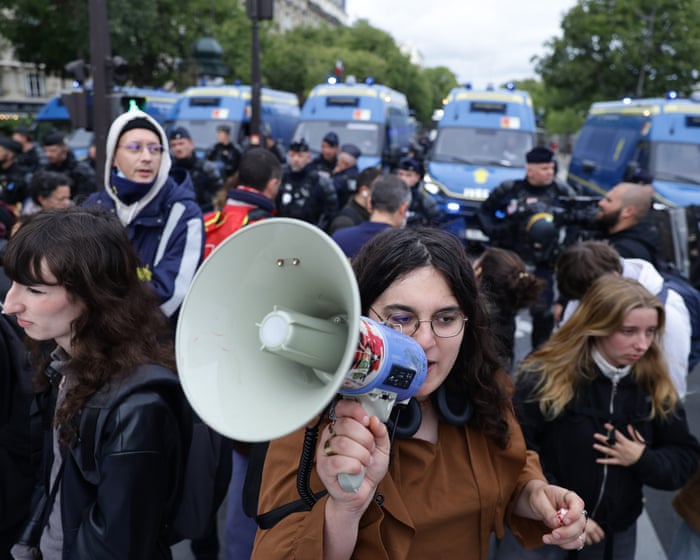
Emmanuel Macron has said “illegitimate” demonstrations will be banned over the coming days as France seeks to get a grip on civil unrest after some of its worst street violence in years erupted on the fringes of cost of living protests at the weekend.
Speaking after a meeting with intelligence officials and senior ministers, the French president said on Thursday that demonstrations organised by recognised groups would be allowed to go ahead, although their routes could be changed.
Thousands of teachers, pupils, students and their parents but also civil servants including health personnel, pensioners and workers joined their voices in protesting the high cost of living, demanding better education conditions, higher salaries and lower housing costs. Τhe protests followed the 24-hour strike called by the primary and secondary teachers unions. In Athens, Thessaloniki […]
Teachers will launch a 24-hour strike across Greece on Wednesday, October 21, protesting against staff shortages in schools, issues within educational infrastructure, excessive class sizes, and persistent inadequacies regarding school facilities in many parts of the country. The teachers will be supported in their strike by pupils and university students as well as left-wing parties, […]
Young people have been taking to the streets across Europe, including in Spain, France and Portugal, to protest over their unhappiness at the state of schools and the wider cost of living crisis.
In France, high school pupils have clashed with police in often violent protests over long hours, missing teachers, dilapidated classrooms and an opaque university admissions system. Pupils routinely miss months of teaching due to unfilled staff absences.
Oxford University has told staff not to use common phrases such as "learn the ropes" or "find your feet" over fears they confuse foreign students, sparking concern at the new scheme of language policing.
School ceilings keep falling on students’ heads across the country in the last couple of days, where such incidents are being reported on a daily basis. Shortly before classes ended for the weekend, a large piece of plaster fell from the ceiling injuring a 14-year-old student. The boy at Thermi Gymnasium by Thessaloniki was hit […]
Field marshal meets multinational Harvard Business School delegation to discuss regional security, global challenges and Pakistan’s development potential.
 Login