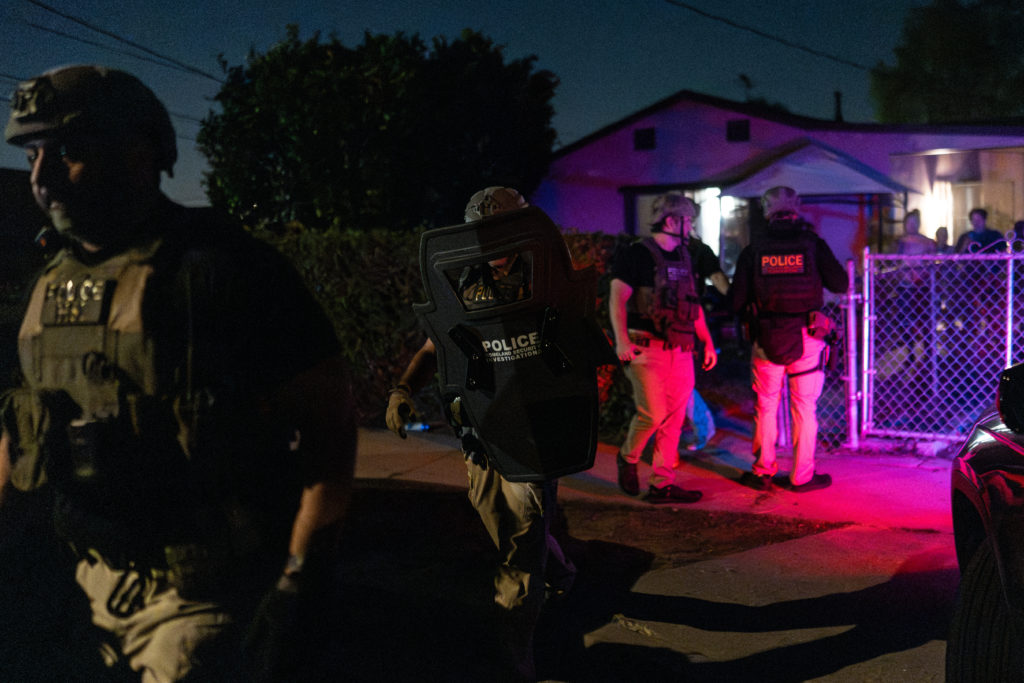
Marva Cook was adopted as a toddler and had always assumed she was a U.S. citizen, she told Homeland Security investigators earlier this month, according to the criminal complaint.
The letters are the latest escalation in a legal battle between California and President Donald Trump's Department of Justice, which has recently focused on the state in its efforts to root out noncitizen voting ahead of the midterm elections.
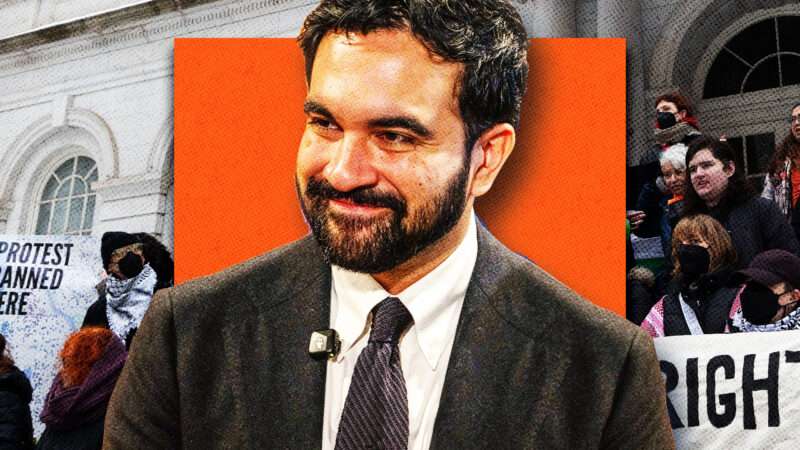
New Yorkers won't be voting on any citywide offices this year, but they do have five ballot initiatives that could shape the city's future more than any politician on this year's ballot. Mayor Zohran Mamdani created a version of the Trump administration's infamous Department of Government Efficiency in New York called the Commission on Government Efficiency (COGE). The plan is for COGE to modernize city operations and accelerate public infrastructure and permitting—in that vein, COGE placed five proposals before voters on the November ballot, largely targeting the bureaucratic processes governing new construction and business activity across the five boroughs.
Questions 1, 2, and 3 on the ballot would end or reduce the use of public hearings in different city review processes. Question 1 would, according to the ballot language, "simplify [the] process to use public space for uses such as ramps, planters and cafes, by removing mandatory hearings and Council disapproval of sidewalk cafes, while maintaining community and Council input." Question 2 would "reduce paperwork for City contractors by authorizing [the] Procurement Policy Board to simplify [the] contractor questionnaire….[And] remove mandatory hearing for required client services report." Question 3 would "simplify review of street safety projects to reduce construction timelines," among other changes. Question 4 is about simplifying permitting.
These policies were not directly introduced by Mamdani, but they reflect a governing philosophy that New York City and other big cities desperately need: a local government that won't allow a small group of organized opponents to obstruct progress for the city at large indefinitely.
Nowhere is the bottleneck against much-needed development clearer than at public review hearings. In theory, a public hearing is democracy at its purest: Every voice is heard. But in practice, it usually becomes a slow-motion filibuster. The most persistent and best-organized opponents get a megaphone, with little to no input from the millions of New Yorkers who would broadly benefit from more housing, better infrastructure, and businesses that can open without getting wrapped in red tape.
The 2026 ballot questions, if approved, would take small steps toward addressing these problems. If they all passed, it wouldn't be a seismic change—a planter here or a parcel of land there. But that's kind of the point: Should routine administrative decisions require another round of formal public review hearings to hold up any change, big or small?
Today, the Trump Justice Department filed a federal lawsuit seeking to block Alaska Senate election results on the grounds they might be influenced by voter "confusion" between incumbent Republican Senator Dan S. Sullivan and a separate Republican candidate with a very similar name (Dan L. Sullivan). I previously wrote about the issues raised by the two Dan Sullivans here. As I pointed out in the earlier post, there is no legal basis for overturning congressional election results based on voter confusion, and any such action would likely violate the First Amendment. See also this analysis by election law specialist Rick Hasen.
I would add that any such federal action also runs afoul of states' primary authority over election procedures. The Elections Clause of the Constitution gives states primary authority over "The Times, Places and Manner of holding Elections for Senators and Representatives," subject to Congress' power to modify these rules by legislation. Congress has not enacted any statute allowing overturning of election results based on possible "voter confusion."
If "voter confusion" were a legitimate reason to overturn election results, that would imperil a great many election winners, as voter ignorance - and exploitation thereof by candidates - is a widespread and longstanding problem. I covered some of these points in my previous post about the two Dan Sullivans:
Donald Trump is a particularly egregious example, going all the way back to his first campaign in 2016, and more recently with his lies about the 2020 election and other issues. But more conventional politicians also often resort to lies and deception, even if not to the same degree. President Obama, for example, famously lied when he claimed that, under the Affordable Care Act, "if you like your health care plan, you can keep it." That deception won the 2013 Politifact Lie of the Year award. But it still helped Obama get reelected in 2012. I am not sure exploiting voter confusion about names is any worse than exploiting their ignorance about policy issues like crime, immigration, and health care….
Voter confusion about candidates with similar names is just another example of this broader problem….
There is no easy solution to the problem of voter ignorance. But I assess a range of possible options in my 2023 article on "Top-Down and Bottom-Up Solutions to the Problem of Political Ignorance, and in my earlier book Democracy and Political Ignorance. I believe the best approach is to make fewer decisions at the ballot box and more by "voting with your feet," where incentives to seek out information and evaluate it wisely are much better. But I recognize that any effective approach will take time, and there may be no one fix that is sufficient by itself. We may need to pursue multiple strategies. In the meantime, voters are likely to continue to be ignorant and confused about a variety of issues, and politicians and interest groups are likely to keep on exploiting that.
Many of these other voter ignorance problems are far worse than any potential confusion between candidates with similar names, a problem that only comes up relatively rarely.
UPDATE: Rick Hasen has a helpful analysis of the Alaska lawsuit here:
DOJ has no power to decide which candidates can appear on the ballot. The sole basis that DOJ asserted for trying to block the state's certification process is the National Voter Registration Act's preamble that reads that the act is designed to "protect the integrity of the electoral process." That preamble of course gives no power whatsoever to the federal government to do anything. It does not give DOJ the power to determine ballot access or block certification of a federal election. The Alaska Supreme Court decided the state law ballot access question back in June, allowing the second Sullivan to appear on the ballot.
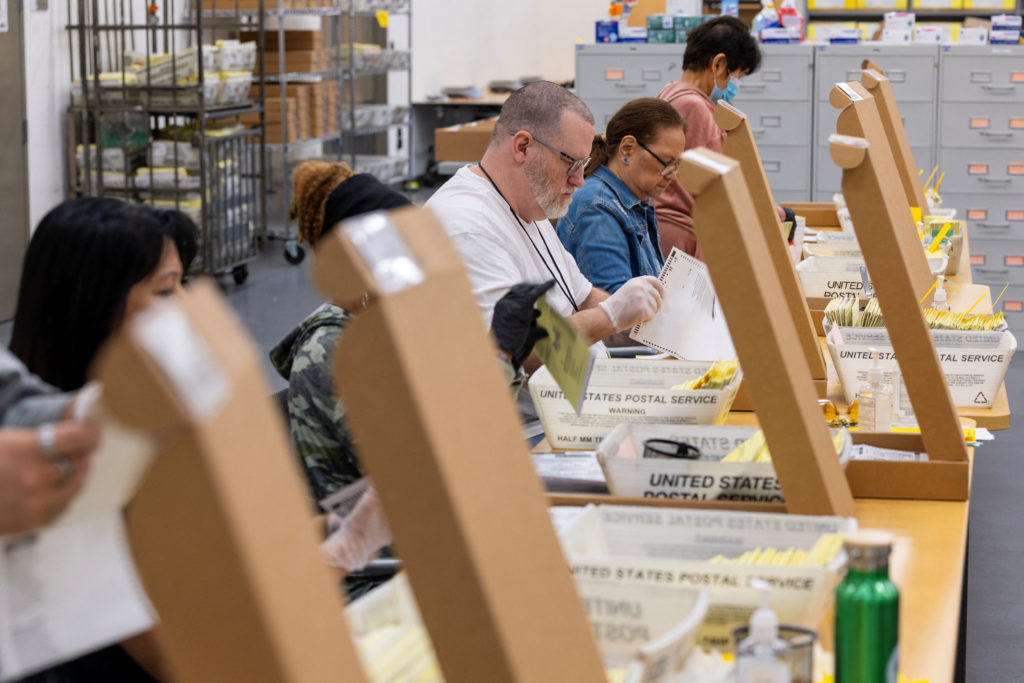
Most of the immigrants targeted by federal authorities in California this week for alleged voter fraud had applied for U.S. citizenship and now face charges related to lying on forms or during interviews. Those charges could lead to years in prison and thwart their efforts to naturalize.
To many people, but especially libertarians, voting can feel dispiriting: By definition, every person on the ballot wants in some way to exert control over your life.
Perhaps that's why it's refreshing to see a candidate for office who truly seems not to want the job.
Brady Rogers worked as a robotics engineer for four years, but he quit in 2019 after deciding the corporate world wasn't for him.
"It was just a bit unfulfilling," Rogers tells Reason. "I wanted to do something a little more impactful with my skills….So I left to find something else that felt worthwhile."
He started The Rogerie, a retail store in his hometown of Kelowna, British Columbia, a city of about 170,000 people. Rogers and his wife collect shredded plastic waste and extrude it into filament for 3D printers, which they use to create new housewares to sell in the shop.
Then earlier this year, Rogers again got the feeling that he could be doing something beneficial with his talents. This time, it meant running for the Kelowna City Council.
But he had to stand out in a crowded field—he would be one of 37 candidates running, and only the top eight would win a seat.
So, he settled on a strategy: openly admit his lack of qualifications and how little he even wanted the job.
"I guess I'm running for Kelowna city council," read his campaign website. "I don't like meetings, I don't like having to be certain places at certain times, and I'm allergic to stuffy offices. But unfortunately, I happen to like Kelowna, and think I can help do some good."
"Do I enjoy politics? No," he adds. "Do I know what I'm doing? No. But am I qualified? Also no."
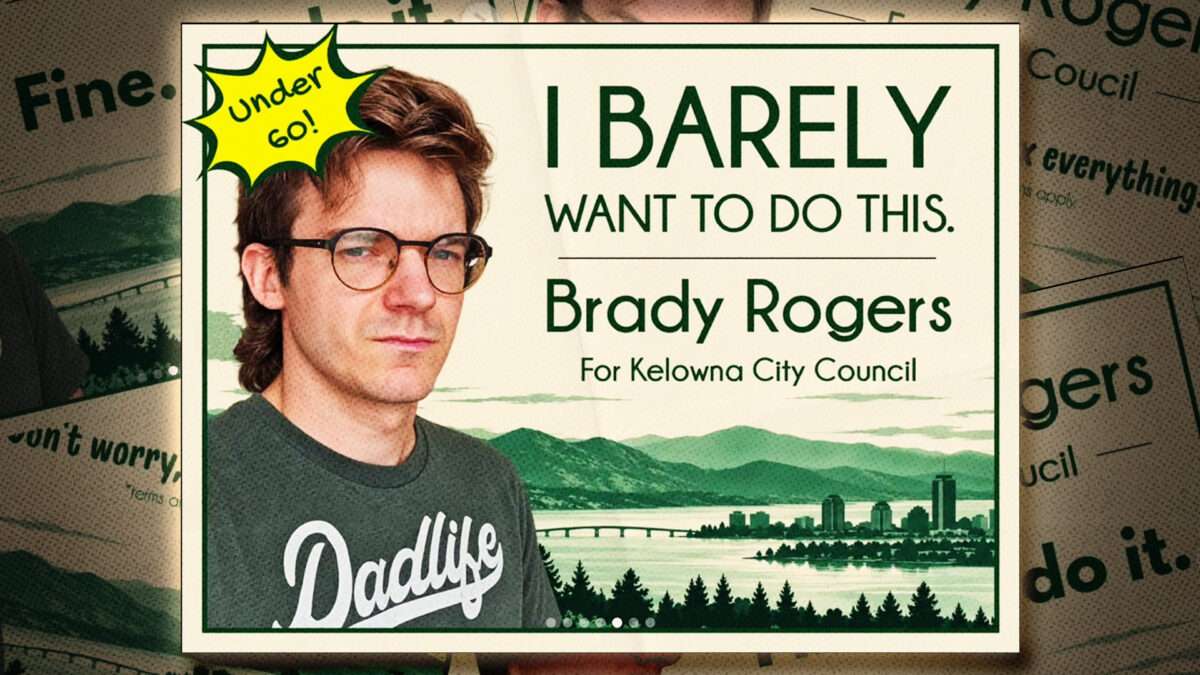
That lackadaisical attitude carried over into his campaign signage: Yard signs featured pictures of Rogers with sullen, shrugging expressions, alongside slogans like "I barely want to do this" and "Let's see what happens?" In a winking reference to political gerontocracy, one sign even bragged that he was "Under 60!"
"I certainly thought it was clever. I thought it would work, but it was really just how I honestly felt when I started," Rogers admits. "I was pretty conflicted about committing to a four-year thing that I didn't even really fully understand the ins and outs of, but at the same time I saw the opportunity to have a bigger impact. So, I was conflicted, and I figured that's a good, honest place to start a campaign."
Ultimately, he won a seat: He placed fourth out of 37 total candidates and even beat three incumbents, one of whom lost her seat.
The irony of Rogers' outwardly indifferent attitude is that he actually does have a policy platform: On his website, he advocates finding solutions to homelessness not necessarily by spending more money but by making better use of the resources that the city and province already provide. He also notes that Kelowna taxes land and improvements at the same rate, which "means we tax someone for improving their property while relatively rewarding someone who sits on valuable, underused land." Writing this week at Reason, J.D. Tuccille made a similar point.
Of course, Rogers' underqualified and disinterested campaign persona is only partially true—he did, after all, want the job, or at least he saw it as a viable means of improving his city.
Still, it's refreshing for a candidate to treat public office as something less than a higher calling.
Ultimately, Rogers thinks that authenticity is why his campaign caught on and was ultimately successful with voters, when many campaigns struggle to create viral moments or capitalize on social media trends. Perhaps other people could even learn from him.
"I think why mine worked so profoundly is that it is a little bit of humor, but immediately behind it was a legitimate platform and me as a real person with the skills and a real desire to do something," Rogers says. "And I think that resonated. I think people [have] an appetite for a new kind of politics."
The Tories, Reform and Restore can't stand each other, but letting the Left win would be daft, argues Nick Rendell. Could fed-up swing voters force the Right's warring tribes to stop squabbling and get their act together?
Greek Parliament voted for lifting the parliamentary immunity of ruling New Democracy MP and former EU Commissioner Dimitris Avramopoulos on Thursday. The voting followed a relevant request by Belgian authorities investigating the so-called Qatargate and have issued an arrest warrant last June. Prior to the voting, 73-year-old Avramopoulos submitted a memorandum where he requested “the Plenary […]
Before a pivotal election that could potentially result in a state government ruled exclusively by the Alternative for Germany (AfD) in the German state of Saxony-Anhalt, a case of potential postal vote fraud is raising concerns.
A 74-year-old nephew of a 95-year-old resident with severe dementia has filed a criminal complaint after discovering that postal voting documents were requested and a ballot cast in her name at a Dessau retirement home – despite staff first telling him the papers had been destroyed. The case is now being reported in Welt, one of Germany’s largest newspapers.
The case involves the Marthahaus senior residence and centers on whether postal votes from residents who cannot meaningfully participate are being handled properly. The nephew, who acts as his aunt’s legal representative, said he routinely receives every letter and document sent to her, including advertising. When the postal voting materials for the Saxony-Anhalt state election never arrived, he asked the home’s director where these documents were located.
Last Thursday, the director directed him to a female staff member who was not on duty until the next day. On Friday, that employee stated she had collected the election documents sent to residents “and shredded” them, without consulting relatives or authorized representatives.
That account did not hold up. When the nephew inquired at the municipal election office, officials confirmed that postal voting documents had been requested on Aug. 10 using his aunt’s date of birth and that a vote had already been recorded. Staff showed him the application bearing his aunt’s “scribbled” signature. Data-protection rules prevented them from disclosing which party was marked.
The nephew described the home’s alleged actions as a “scandal.” He and his wife first noticed problems during the February 2025 federal election; during the current state-election campaign they again encountered “inconsistencies” and this time pursued them. The complaint against persons unknown has been obtained by reporters.
The Marthahaus did not answer written questions from the Ostdeutsche Allgemeine Zeitung and declined to comment when reached by telephone. City officials confirmed they were aware of the incident but provided no further details.
A second, still-unreported case has surfaced in Naumburg, according to German newspaper Junge Freiheit. A woman there said she “did not see any election documents for my mother.”
Her mother is “unable to give her own name.” She asked: “Who will vote for her and according to what criteria?”
The allegations come days before voters in Saxony-Anhalt go to the polls and add to the existing debate over how postal ballots are processed in care facilities, where many residents have limited capacity to express a political preference independently. Investigations will determine whether the documented vote was cast with proper authorization or constituted an unauthorized exercise of another person’s vote.
AfD would ban postal voting
One of the parties most opposed to postal voting is the AfD, which has argued that it is prone to fraud, especially in retirement homes. AfD co-leader Tino Chrupalla has previously called for an end to mail-in ballots. He discussed his concerns about this form of voting during a conference with top AfD officials in 2024.
“It is also the task of the opposition to always doubt what a government is doing or what happened in an election. That is also a legitimate right and that is a good thing. And I just really want to point out, and we will also question this, for example, the entire security for the legal storage of ballot boxes, some of which are not stored in a legally secure manner, where in some cases only one person or two have access to these ballot boxes,” he said.
JUST IN: "I would ban postal voting."
Germany's AfD party is calling for an end to mass mail-in ballots for elections.
He went on to say that postal voting has been a concern in other elections and that these issues keep coming up. However, he also pointed to a problem plaguing other countries like the United States, which instituted mass mail-in ballots in the wake of the Covid-19 crisis, which has involved activists entering retirement homes and potentially manipulating vulnerable elderly voters.
In the case of Germany, Chrupalla stated, “We have also seen this in old and other election campaigns, such as the current campaigning in retirement and nursing homes, especially when the CDU and SPD campaign in these old people’s homes, which are run by Diakonie or Caritas, or go in and out there, and the AfD does not even get access to present their programs to the elderly. These are also things of influence that are not democratic in my opinion.”
Notably, both Diakonie and Caritas are run by the Protestant and Catholic churches, both of which have come out against the AfD, including expelling members of the party from the Church and calling for Germans to vote against them.
Chrupalla is calling for an end to postal voting, saying: “Personally, I would ban postal voting again. It has only been introduced as an exception or initiated in the Federal Republic of Germany. It is not the rule, it should not become the rule and it is not regulated by law in such a way that it is made the rule.”

 Login




 JUST IN: "I would ban postal voting."