❌

Reading view

My mom and I graduated from college in the same year. I was 23, and she was in her late 40s.

The author and his mother holding hands during their graduation celebration.
The author holds hands with his mother, Tiffany Calloway, during their graduation celebration.

Courtesy of Omarion Calloway

  • The author and his mother graduated from college in May 2026.
  • Despite earning their degrees, both struggled to find jobs in their fields.
  • Their experiences challenged the promise that a college degree guarantees a better life.

I grew up believing that I had to work hard, go to college, get a piece of paper, and unlock a decent life. My mom believed in it even more than I did.

In May 2026, we crossed the finish line together. I was 23, graduating from New York University with a degree in Film and Television, ready to launch a career in journalism and filmmaking. My mom was in her late 40s when she earned her bachelor's degree in psychology after decades of putting her life on hold.

My mom raised me while taking care of family members

For as long as I can remember, my mom has been running on empty. Back in Alabama, she worked hospital shifts by day and cleaned corporate offices at night, riding public buses through the heat. She was also raising my brother and me, caring for my grandmother through cancer, and looking after my paralyzed uncle. Going to college felt impossible.

The author standing beside his brother for a family photo.
The author with his brother.

Courtesy of Omarion Calloway

When my grandmother and uncle died shortly before I finished high school in 2022, our family was grieving. But my mom also had a moment to think about what she wanted for herself. She decided to start college and pursue her psychology degree. In 2024, after my brother graduated from high school and headed to college in upstate New York, my mom packed up and moved out of Alabama. She settled in Albany to be closer to both of us. I was living in New York City, attending NYU.

From 2022 to 2026, we both worked toward our degrees. While I stayed up finishing college assignments, my mom balanced her nursing shifts with classes and the costs of building a new life in Albany.

The author's mother posing with her husband in Albany, New York.
The author's mother with her husband in Albany, New York.

Courtesy of Omarion Calloway

But graduating didn't make the next steps any easier.

Getting a job as a recent graduate wasn't easy

I thought an NYU degree would give me a real foot in the door. Instead, I entered a job market where entry-level roles demanded years of experience, while rent and groceries kept getting more expensive. I've had employers tell me during interviews that they loved my work and thought I'd be a great fit, only to never hear from them again. It happened more than once, and each time, it became harder not to wonder what I was doing wrong.

The numbers suggest I wasn't alone. In the second quarter of 2026, 42% of recent college graduates were underemployed, according to the Federal Reserve Bank of New York. Finishing school didn't guarantee a career. For many graduates, it meant entering a crowded job market and hoping someone would give them a chance.

My mom faced her own version of that wall. She's currently working toward her master's degree, hoping to eventually become a licensed therapist. In the meantime, she's been trying to get her foot in the door through entry-level jobs such as behavioral health or psychiatric technician roles. Despite decades of frontline healthcare experience and a bachelor's degree in psychology, applications went unanswered, and automated rejection emails kept arriving. After years of working and caring for others, she was still struggling to get someone to give her a chance.

The author's mother sitting inside a car and smiling.
The author's mother sitting in a car.

Courtesy of Omarion Calloway

A few weeks after graduation, I sat with her in her living room as she refreshed her inbox. Another rejection came in. She closed her laptop and looked down at her framed diploma, exhausted.

If my mom was struggling to find work after everything she'd done, I couldn't help wondering what my own degree would do for me. A degree can still make a financial difference.

In 2025, full-time workers aged 25 and older with a bachelor's degree earned a median weekly wage of $1,578, compared with $966 for those with a high school diploma, according to the US Bureau of Labor Statistics. But those figures describe people who are already working full time. They don't guarantee a recent graduate will land a job, earn those wages, or afford to live in the city where they're trying to build a career.

For my mom, college was supposed to rewrite her story. For me, it was supposed to be the launchpad. When we look at our graduation pictures, the pride is real; neither of us will ever downplay what it took to survive those years. But a diploma can't pay rent. A piece of paper can't buy health insurance, a stable job, or peace of mind.

The author smiling alongside his mother in a family photo.
The author with his mother.

Courtesy of Omarion Calloway

My mom and I did what we were told would lead to a better life. We're still trying to figure out when that life is supposed to begin.

We did everything right. Somehow, it doesn't feel like enough anymore.

Read the original article on Business Insider

  •  

Pupils as Young as Five Suspended Over Sexual Misconduct

Children as young as five are being suspended for sexual misconduct, with schools in England recording 7,278 suspensions last year – nearly 40 every school day and a 12% jump on the previous year.

The post Pupils as Young as Five Suspended Over Sexual Misconduct appeared first on The Daily Sceptic.

  •  

My son didn't get into the school I thought would be perfect for him. He's thriving at our neighborhood middle school in ways I didn't expect.

Two Real Madrid supporters smile from stadium seats overlooking a soccer field during a match.
The author, shown with her son, said she's been pleasantly surprised by how well he is adjusting to the middle school he ended up at.

Courtesy of Jamie Davis Smith.

  • Where I live, some parents enter a lottery to choose their child's school.
  • I expected my son would end up where his older sister is, but he was waitlisted.
  • He's now attending our local middle school and I'm seeing some unexpected benefits.

I love living in Washington, DC, but navigating the complex public and charter school admissions system is tough.

Students have the right to attend their neighborhood school, and many do. However, every year thousands of parents choose to apply to public schools in different neighborhoods or publicly funded charter or magnet schools throughout the city.

There are rarely enough spots to meet demand at the more desirable schools or specialty schools, ranging from arts and hospitality to college-prep programs and the sciences. To decide who gets to go where, DC instituted a lottery system.

Parents across the city often create spreadsheets to track programs and their child's odds of getting into a particular program, before entering a lottery, ranking schools in order of preference, and hoping for the best. Such an uncertain system makes planning difficult and sometimes leads to unpleasant surprises. That was the case with my son's foray into middle school.

I thought I had found the perfect middle school for my son

When my son entered his last year of elementary school, I thought I knew what his next steps would be. For years, I assumed that he would follow in his big sister's footsteps and attend an International Baccalaureate charter school starting in 6th grade.

Smiling person in a black Nike soccer jersey sits beside colorful mosaic tiles at Park Güell.
The author said she expected that her son would go to the same school his older sister was at, but was upset when he was put on a waitlist.

Courtesy of Jamie Davis Smith

The charter school isn't perfect; no school is. However, my daughter, now a junior, often says she enjoys school, which is a shocking statement for a kid of any age, let alone a teenager. An environment where at least some kids are happy to go every day would be reason enough for me to send my son there. However, I was also convinced the school's rigorous program and strong emphasis on world cultures would be a perfect fit for him. After all, he is a triple citizen and a world traveler at heart. I also appreciate the school's diversity and range of classes, from sneaker culture to advanced sciences.

Although a spot for my son was never guaranteed, I assumed his sibling preference would help secure one. I was in for a rude awakening.

I had to face reality

When my son was put on the waitlist after the first round of admissions, I didn't panic. Instead, I spent most of the summer in denial, convinced that if I just waited long enough, he would get in eventually.

The week before school started, I had to face reality. No spots were available for my son at the school I had grown to love and was convinced would be perfect for him.

Without a viable alternative, I enrolled him in our local middle school, which I thought was very large and very chaotic. I kept telling my son how excited I was for him to start middle school, but I couldn't hide my worry.

I was nervous about sending him to a large school

My son's elementary school had about 400 kids total, from pre-K4 to 5th grade. For a big city, it's a small school where most teachers know all the kids, and the community is tight-knit. I worried about how my son would transition to a large school with nearly 1400 students across just three grades, in a building that occupies nearly an entire city block. Despite my worry, he walked in with confidence on his first day.

Not everything about such a big change was easy. My son got lost a few times trying to find his classes. While many of the other incoming sixth graders knew each other from elementary school, my son didn't know a soul. He was upset when recess, his favorite part of the day, was cut short because other kids wouldn't stop talking. It's almost impossible to get a timely email response from the school administration, who seem swamped by the sheer number of students. Still, my son rolled with the punches and started to adjust.

I now see the benefits of a neighborhood school

Even though my son had to start his middle school social life from scratch, he quickly found his crew: other kids who love soccer. He first spotted potential friends by looking for kids wearing Real Madrid jerseys and kicking a soccer ball around at recess. Once he found his tribe, he could easily meet friends after school for walks to our local playground and pizza shop. Those are things he wouldn't have been able to do if he had gotten into the school I had been hoping for, which draws students from across the city. Within a few weeks, he rattled off at least a dozen new friends' names. I wondered whether he could have made friends as easily at the smaller charter school I wanted him to go to, with a smaller pool of potential friends.

I also appreciate the resources such a big school has, including a range of after-school activities. Although my son hasn't wanted to try most of them, I appreciate that options like an archery team and a Rubik's Cube club are available to him.

There are other benefits as well. Because our neighborhood is just over a mile from our home, my son can easily walk or take a short bus ride there and back, giving him even more independence. Not having to drive him saves me at least seven hours a week, and the school's proximity to our house gives my son more free time.

Now that we are well into the school year, I realize I should have given my son more credit for adaptability. I also should have been more open-minded about what kind of school would be "right" for my son. Although I am still sad that he doesn't get to attend the same school as his sister, I now know there is more than one answer to what makes a good school.

Read the original article on Business Insider

  •  

The ongoing cancellation campaign against a dissenting academic in Norway

By Glenn DIESEN

Join us on Telegram, X, and VK.

Contact us: info@strategic-culture.su

The very public execution of my professorship and reputation continues in Norway. Today’s media article about me makes three claims that are misleading and/or false.

1) The article dismisses my claim that my research is being criminalized as the journalists merely cite the dismissive comments from the university – no arguments are apparently required.

It is not possible for an academic anymore to analyse the policies of rival powers by assessing their security concerns, as it will be smeared by the government, the government’s NGOs and the media as “legitimizing” the enemy and supporting their narratives. The current Defence Minister singled me out with the accusation of spreading propaganda and criticised two podcasters for even speaking with me (as I have already been cancelled by the media in Norway). How was this accusation by the Defence Minister substantiated? I had argued that NATO expansion triggered the war in Ukraine, which the Defence Minister denounce as dangerous “Russian propaganda”, with no need to substantiate his vile accusation. I can cite a sea of evidence and also refer to statements by American and European political leaders, ambassadors, intelligence chiefs, and others to make my case. However, the purpose is not to engage in debate, but to smear, censor, and cancel. By going after an individual academic for challenging official truths, the government has already claimed a monopoly on the truth. Academics should have their arguments scrutinised and criticised, but these are severe personal attacks from the government without the possibility of even defending myself. How is this not criminalising the research of an academic?

I cannot even speak at any events in Norway without the event being cancelled. The last event I agreed to speak at was because I shared the stage with the former CIA officer John Kiriakou. A newspaper had the event at a church cancelled, and when the backup location did not also cancel, the journalist simply printed in the paper that it had been cancelled so people would not show up. Is this normal? I must use my allotted holiday days to attend conferences because any event I attend can be presented as “controversial,” and then the NGOs and journalists will go after the reputation of the university. Is this normal? Every newspaper article about me merely refers to me as “controversial” or “pro-Russian” without ever assigning meaning to these labels or presenting my argument.

I have argued, much like former CIA director Burns, that if the West attempts to pull Ukraine into the NATO orbit, then there would be war and Ukraine would be destroyed. This is considered a “pro-Russian” argument. Arguing that we should respect the will of most Ukrainians who want negotiations to end the war is also considered a “pro-Russian” argument, while in contrast, boycotting diplomacy, deporting Ukrainian refugees, and calling for the conscription of Ukrainian women is “pro-Ukrainian”.

2) To avoid addressing any of my arguments, the journalists go on to uncritically cite personal attacks against me, pointing out that I have been called a propagandist by the Norwegian Helsinki Committee. This is a “non-governmental organisation” financed by the government and the National Endowment for Democracy (NED), which was set up by Reagan and the CIA director in 1983 to manipulate the civil society of other states. The Norwegian Helsinki Committee has been relentless in its smears on social media to have me fired, writing hit pieces in the media, pushing to cancel my speaking events, writing a letter to my university, and even posting a picture of my house on social media. This is a governmental “human rights organisation” that cites human rights concerns to build the case for war.

3) Lastly, to further avoid addressing my actual arguments, they simply cite the fact that arguments I made at a debate last year have been “wholly or partially debunked” by a fact-check. The state-run media (NRK) invited the state-run military defence institute (FFI) to fact-check three of my claims. What claims did they “debunk”?

My first claim was that only 20% of Ukrainians wanted NATO membership between 1991 and the regime change in February 2014. The fact-checker argued that the number went up by the middle of 2014 (after Russia responded by seizing Crimea), which is a completely meaningless comment intended to muddy the waters, as my argument was about the previous era.

My second claim was that Zelensky had argued in an interview with The Economist in March 2022 that there were some Western countries that would like a long war with Russia to weaken a strategic rival, even if it would result in the destruction of Ukraine. The fact-checker argued that not all Western countries wanted a long war and that it was not an official policy. I never claimed it was an official policy, as it was primarily the US and UK pushing for a long war.

My third claim was that the US and UK sabotaged the Istanbul peace agreement in April 2022. The fact-checker claimed this was incorrect and suggested that it could only be based on one statement by David Arakhamia. The fact-checker did not want to mention that both mediators also confirmed it: Turkey’s foreign minister and the former Israeli prime minister both said that Russia and Ukraine were close to a deal, but the US and UK saw an opportunity to weaken Russia by fighting with Ukrainians. Zelensky’s former adviser Arestovych confirmed it, and the Ukrainian ambassador Chaly, who participated in the negotiations, confirmed that Putin was willing to do almost anything to end the war. The former head of the German armed forces confirmed that Boris Johnson sabotaged it, and Boris Johnson himself wrote articles warning about a “bad peace” and arguing for “strategic patience.” I am being fact-checked by war propagandists.

Unfortunately, none of my arguments matter because in Norway there is no debate and no interest in any arguments. Reality means nothing anymore as war narratives must be defended against inconvenient truths. I used to be naïve and think that the endless smears were caused by misunderstanding, as I had simply not been able to convey my arguments properly. However, the endless articles with smears and labels are deliberate lies and deceptions.

Original article: glenndiesen.substack.com

  •  

A Ph.D. led me to my dream job at Intel. At age 41, I started an MBA because I realised I was still missing key skills.

Mihirkant Upadhyaya is sitting on a wall in front of snowy mountains.
Upadhyaya is a supply chain program manager at Intel.

Courtesy of Mihirkant Upadhyaya

  • Mihirkant Upadhyaya has a Ph.D. and more than 10 years of experience at Intel.
  • But at age 41, he embarked on gaining another degree to level up in his career.
  • Upadhyaya says that doing an MBA equips him with skills that AI lacks.

This as-told-to essay is based on a conversation with Mihirkant Upadhyaya, 42, who works at Intel and lives in Oregon. The following has been edited for length and clarity. Business Insider has verified his employment and education.

After studying computer engineering for my bachelor's, I pivoted into physics.

Two master's degrees and a Ph.D. in nanoscale science and engineering later, I got my dream job in the semiconductor industry at Intel in 2015.

As my career evolved, I realized I also wanted to do an MBA to step up my game.

My Ph.D. gave me relevant skills to take on the workforce

During my Ph.D., I focused on a semiconductor manufacturing technology called EUV lithography. I was excited to work at Intel because it does both chip design and manufacturing, so I knew I'd get a good overview of the chip-making process.

You don't need a Ph.D. to work in semiconductors, as there are so many areas outside the lab you can work in, like finance and legal.

On a personal level, though, having a Ph.D. helped me feel prepared to step into the workforce. It gave me discipline and the ability to be comfortable with ambiguity. My research mindset and technical background gave me the confidence to take ownership of outcomes and tasks.

There were definitely moments where I had self-doubt doing a Ph.D. You watch your peers go on to earn big bucks after their bachelor's and master's while you live on a modest stipend. However, the experience shaped me into who I am. I'd say I'm more patient, sharper, and more resilient.

I reached a stage where I felt I needed more education to thrive in my job

After about five years in research and development at Intel, I moved into supply chain roles, which have involved managing relationships and negotiating contracts. At this point, I realized I was missing certain skills.

My current role has a greater emphasis on executive communication and financial analysis. When I presented to an executive team, my manager had to step in on a number of occasions to get the room to respond, making what I was saying more high-level using business-driven terms. I also didn't quite understand certain things when I worked with the finance teams on contract negotiations.

To step up my game, I started a two-year hybrid MBA course in September 2025, alongside my full-time job. It was energizing to get back to the classroom at age 41.

I take one week off a quarter to do in-person sessions, and the rest of the time I'm doing online learning three days a week. My company is partly funding this, which is useful since MBAs can carry a $100,000 price tag.

Upadhyaya is standing on his university campus, in front of a big building.
Upadhyaya estimates that he's invested $100,000 into his post-graduate education.

Courtesy of Mihirkant Upadhyaya

By the time I've finished my MBA, I'll have done nine years of postgraduate study, investing an estimated $100,000 into that education, aside from scholarships and tuition waivers. Without question, it's been worth it. I haven't pursued the degrees to accumulate credentials, but to serve my career at various stages of my life. The MBA is addressing a concrete skills gap I identified after years in my industry.

I believe higher education is helping me become more irreplaceable in the age of AI

The AI boom made me take a hard look at what I bring to the table. I saw that some of what I did could eventually be automated. That realization was humbling.

Instead of trying to compete with what AI is already good at, I wanted to strengthen the areas where I knew it fell short. AI is great at processing and analyzing information. It has scale and speed, but it lacks the truly insightful judgment that a person can gain from years of learning a skill.

Upadhyaya is sitting on a wall in front of a mountain and trees.
Upadhyaya said he's encountered limits to AI's capabilities.

Courtesy of Mihirkant Upadhyaya

In my previous role at Intel, I found that AI couldn't tell me how to troubleshoot issues involving new or custom-made equipment because the context was so unique to my situation.

Meanwhile, in my current role, while AI could probably help me generate financial models, it can't read the room, build relationships, or have synergy with another person. My MBA course benefits me in this regard because we do lots of group activities, even online through Zoom, where we can interact with each other.

I think that in the age of AI, finding a field you really care about, becoming an expert in it, and staying curious to keep learning can help you become irreplaceable.

Intel declined to comment in response to a request from Business Insider.

Read the original article on Business Insider

  •  

Free lunch, transgender athletes: Voters nationwide face major education decisions

Voters across the country are making big decisions about the education of their children at a local, state and federal level in this year’s midterms. Ballot initiatives, school board elections, governor’s races and Senate spots are all on the line as parents head to the polls thinking about AI, school choice and what topics should…

  •  

European Parliament Calls for €47.4 Billion for Erasmus+ as Student Living Costs Rise

The European Parliament voted on Thursday, 22nd October, to support a €47.4 billion budget for the Erasmus+ programme between 2028 and 2034, demanding substantially more funding than proposed by the European Commission.

The parliamentary position was approved by 454 votes to 34, with 93 abstentions, following negotiations over the future of the EU’s principal education, training and student mobility programme.

MEPs are seeking approximately €6.56 billion more than the Commission’s proposed €40.83 billion allocation, arguing that existing financial support does not adequately reflect rising living costs and the expense of studying abroad.

The decision establishes Parliament’s negotiating position but does not represent final approval of the funding. The programme remains subject to negotiations with national governments and agreement on the EU’s next seven-year budget.

Rising living costs affect student mobility

Erasmus+ allows students, apprentices, teachers and other participants to study, train or gain professional experience in another participating country.

Although widely associated with university exchanges, the programme also supports vocational education, schools, adult learning, youth organisations and sporting activities.

Participation often involves substantial personal expenditure, particularly for accommodation, transport and everyday living expenses.

These costs vary considerably between European destinations, creating financial difficulties for students whose Erasmus grants cover only part of their expenses.

The European Parliament is consequently calling for support mechanisms that account for differences in housing and living costs between host countries, regions and cities.

The proposal is intended to make participation more accessible to people who cannot rely on additional financial assistance from their families.

The European Parliament’s research service has identified unequal access, financial limitations and administrative complexity among the challenges facing the programme.

The proposed legislation would also establish a target under which at least 20 per cent of participants in mobility activities would be people facing fewer educational or economic opportunities.

Parliament seeks larger education allocation

The parliamentary proposal provides for approximately €47.39 billion in current prices over seven years.

The Commission originally proposed approximately €40.83 billion, combining funding for Erasmus+ with activities currently administered through the European Solidarity Corps.

According to the report prepared by Parliament’s Committee on Culture and Education, the revised programme would include more explicit financial allocations for different activities.

Education and training would account for approximately 74.6 per cent of the proposed financial envelope, while youth and volunteering would receive around 15 per cent. Sport would receive approximately 4.1 per cent.

The proposed allocation structure is intended to provide greater certainty for organisations planning longer-term educational projects and cross-border partnerships.

Polish MEP Bogdan Andrzej Zdrojewski, of the European People’s Party, is Parliament’s rapporteur on the legislation. His report calls for greater transparency over expenditure and more predictable funding arrangements.

The programme would continue supporting European university alliances, international educational cooperation and initiatives intended to improve professional skills.

Volunteering and vocational training

One proposed change concerns the integration of the European Solidarity Corps into the wider Erasmus+ framework.

The Solidarity Corps currently offers young people opportunities to participate in volunteering and community activities, including projects addressing social and humanitarian needs.

The Commission has proposed bringing these activities within the new programme in an attempt to simplify administration.

However, parliamentarians want safeguards to ensure that volunteering remains identifiable and accessible within the broader funding structure.

The parliamentary position also seeks to extend mobility opportunities across vocational training, adult education and sport.

These activities would allow a wider range of participants to benefit from international placements, including people outside conventional university education.

Additional attention is being given to the financial circumstances of participants and the administrative requirements faced by smaller educational organisations.

Dispute over the EU’s next budget

The Erasmus+ negotiations are taking place against the background of a wider dispute over the European Union’s 2028–2034 financial framework.

Member states are debating the overall size of the budget and the competing demands of agricultural policy, regional development, defence, research and education.

As EU Today recently examined, the negotiations have exposed disagreements over whether the EU should expand its financial commitments or constrain expenditure during a period of pressure on national finances.

Parliament’s Erasmus+ proposal will therefore depend not only on agreement over educational priorities but also on the final distribution of resources across the wider EU budget.

Some governments may support broader participation while resisting the full increase requested by MEPs.

What happens next?

Negotiations must establish the programme’s final budget, eligibility rules and the arrangements governing grants after 2027.

The Council has already developed a negotiating position on aspects of the programme, although financial questions remain connected to the broader budget settlement.

Erasmus+ will mark its 40th anniversary in 2027, shortly before the new framework is scheduled to begin.

More than 17 million people have participated in the programme and its related activities since its establishment.

The outcome of the current negotiations will determine whether the next generation of participants receives more financial support and whether the programme can expand without increasing the proportion of costs borne by students and their families.

  •  

Workforce Pell Grants give students new options for job training

For decades, federal Pell Grants have helped millions of students from low- and middle-income families afford college. Now, for the first time, that financial aid will also be available for short-term vocational training programs designed to help students enter the workforce. Stephanie Sy reports on the rollout of Workforce Pell for our series, Rethinking College.

  •  

EU Parliament defies frugal capitals by seeking €7bn more for the EU’s popular Erasmus+ student scheme

The European Parliament overwhelmingly supported an increased budget and scope for the Erasmus+ student-exchange programme under the new EU budget on Thursday (22 October).

The plenary in Strasbourg opted for a €7bn increase in Erasmus+’s budget compared to the commission’s proposal, by 454 votes, with 34 abstentions, against 93, mostly from right-wing parties.

And it was an audacious move, seeing as ‘frugal’ EU capitals are pushing for €150bn of cuts to the commission’s draft.

But even a “slight increase” in Erasmus+ funds would mean more opportunities for thousands of people, said Bogdan Zdrojewski, a Polish centre-right MEP, who was the rapporteur on the file, during a parliamentary debate earlier on Wednesday.

Celebrating its 40th anniversary in 2027, Erasmus+ enables young people to study, live, and work in foreign countries both inside the 27 EU states and the programme’s 160 “associate” states worldwide.

Some 17 million people have taken part since it began, with an estimated 1 million babies also born to couples who met on exchange, in what the commission has long used as a flagship PR project for creating a feel-good factor about the EU.

Meanwhile, the UK will rejoin the programme in 2027, which means EU students will once more have the opportunity to also spend a semester in Britain, which hosts some of Europe’s and the world’s top universities.

And the parliament would also welcome Canada’s full participation in a few years’ time, Zdrojewski told press on Wednesday.

The EU Parliament would like to expand Erasmus+ to more vocational training. “Erasmus+ will be a programme for Europeans no matter what age, what stage of life,” Zdrojewski said.

And students from poorer homes should get more support to live in pricey cities abroad, he added.

The share of Erasmus+ participants who had fewer opportunities to travel under the present structure stood at 15 percent in 2023 – up from 10 percent only two years earlier, according to a commission evaluation.

“Far too often, it is still the parents’ financial situation that determines who can take part in Erasmus+ and who cannot,” said Sabrina Repp, a German socialist MEP, in Wednesday’s debate in Strasbourg.

Working students often cannot afford to quit their current job to go abroad, she added: “That is precisely what we must change.”

The EU budget talks are to be finalised early next year.

Some 83 percent of Erasmus+ participants say they gained professional skills that helped them in the labour market.

But in order for those opportunities to be available more widely, “we need more funding for this programme,” also said Lucia Yar, a Slovak liberal MEP in the Strasbourg debate.

  •  

A Religious Preschool Is Barred From a State's Universal Preschool Program. SCOTUS Will Decide What's Legal.

Religious school classroom | St Mary Catholic School/Facebook

On November 3, the U.S. Supreme Court will hear oral arguments in a case that asks whether Colorado has unlawfully discriminated against a religious preschool because the school is barred from participating in the state's universal preschool program due to its refusal to accept LGBTQ families. In addition to involving multiple hot-button political and cultural issues, the case also has big implications for the future of federal antidiscrimination law.

St. Mary Catholic Parish v. Roy is not about a state law that directly prohibits a religious preschool from operating. Rather, at issue here is a government requirement that any preschool that wants to participate in the state's universal preschool program, and receive the public benefits that follow, must first satisfy various criteria, including that "each preschool provider provide eligible children an equal opportunity to enroll and receive preschool services regardless of race, ethnicity, religious affiliation, sexual orientation, gender identity, lack of housing, income level, or disability."

According to the Catholic preschools overseen by the Archdiocese of Denver, however, complying with that rule would force the schools to violate their religious beliefs. "It is undisputed that these preschools would otherwise be eligible [universal preschool] providers," the schools told the Supreme Court. "They are excluded solely because of their religious exercise—namely, their religious practices of ensuring that all enrolling families are supportive of the Catholic Church's teachings on sex and marriage and of treating enrolled four-year-olds in accordance with their biological sex."

These schools can point to a pair of recent Supreme Court precedents that will very likely count in their favor. In Espinoza v. Montana Department of Revenue (2020), the Court held that if a state provides educational subsidies that help parents send their children to private schools, the state "cannot disqualify some private schools solely because they are religious." Then, in Carson v. Makin (2022), the Court held that Maine's tuition assistance program violated the Constitution by excluding private schools that offered "sectarian" education. "A State's antiestablishment interest," the decision said, "does not justify enactments that exclude some members of the community from an otherwise generally available public benefit because of their religious exercise."

I would expect the outcome of St. Mary Catholic Parish v. Roy to follow in this same general pattern and hold something to the effect that when a state provides an educational public benefit, it must make some sort of accommodation for the religious views of the recipients.


In Other Legal News

Justice Elena Kagan made news a few months back when she defended her conservative colleagues on the Supreme Court from the oft-heard charge that they are totally in the tank for President Donald Trump. "I don't see this as a court that is just like, 'We're just going to rubber stamp what the current administration does.' You know, quite the opposite," Kagan said. "I think that that is a bad rap." In support of her argument, Kagan pointed to the fact that the Supreme Court had recently ruled against Trump on the two big issues that Trump himself valued the most: tariffs and birthright citizenship.

Kagan was in the news again on Tuesday, this time because she publicly blasted those same conservative colleagues for issuing decisions on voting rights and political gerrymandering that, in Kagan's words, have produced "a democracy that does not work as well as it should." According to Kagan, the Court's conservative majority "has kind of blinded itself to the very deleterious effects of their rulings on how the political system works."

Does this mean that Kagan has now stopped defending the conservative justices from the pro-Trump charge? Not at all. In fact, as The New York Times put it, "she reiterated her defense of the conservative-dominated bench from a July appearance and said it was a 'bum rap' to suggest the court had been too deferential to Mr. Trump."

I don't know about you, but I find Kagan to be a refreshing public figure in these simplistic, partisan times. She is a staunch legal liberal with clearly stated objections to what the Supreme Court's conservative majority is getting up to, yet she refuses to be associated with the laziest progressive attacks on the Court. How many people of comparable public stature these days are willing to call out the shortcomings of their own side?

The post A Religious Preschool Is Barred From a State's Universal Preschool Program. SCOTUS Will Decide What's Legal. appeared first on Reason Magazine.

  •  

Oregon Teacher Disputes Account of Her Heroism During School Shooting

Becky Drury, who was said to have shielded a student during a deadly shooting in Bend, refuted the account. “The truth is I was shot before I had any chance to act.”

© Jordan Gale for The New York Times

Last week, a teenage gunman fatally shot three children and one teacher at Silver Rail Elementary School in Bend, Ore.
  •  

France's Protests Descend Into Looting and Property Destruction

FM-10-21-C | Illustration: Adani-Samat

In this segment of Free Media, Reason Senior Editor Robby Soave and Daily Caller Editor in Chief Amber Duke discuss the ongoing violent protests in France. 

If you enjoy Free Media, come watch Robby debate at our upcoming Reason Versus in D.C. Tickets are available here.

The post France's Protests Descend Into Looting and Property Destruction appeared first on Reason Magazine.

  •  

A Free Speech Group at Columbia Canceled an Event About Free Speech Over 'Cornell 7' Article Controversy

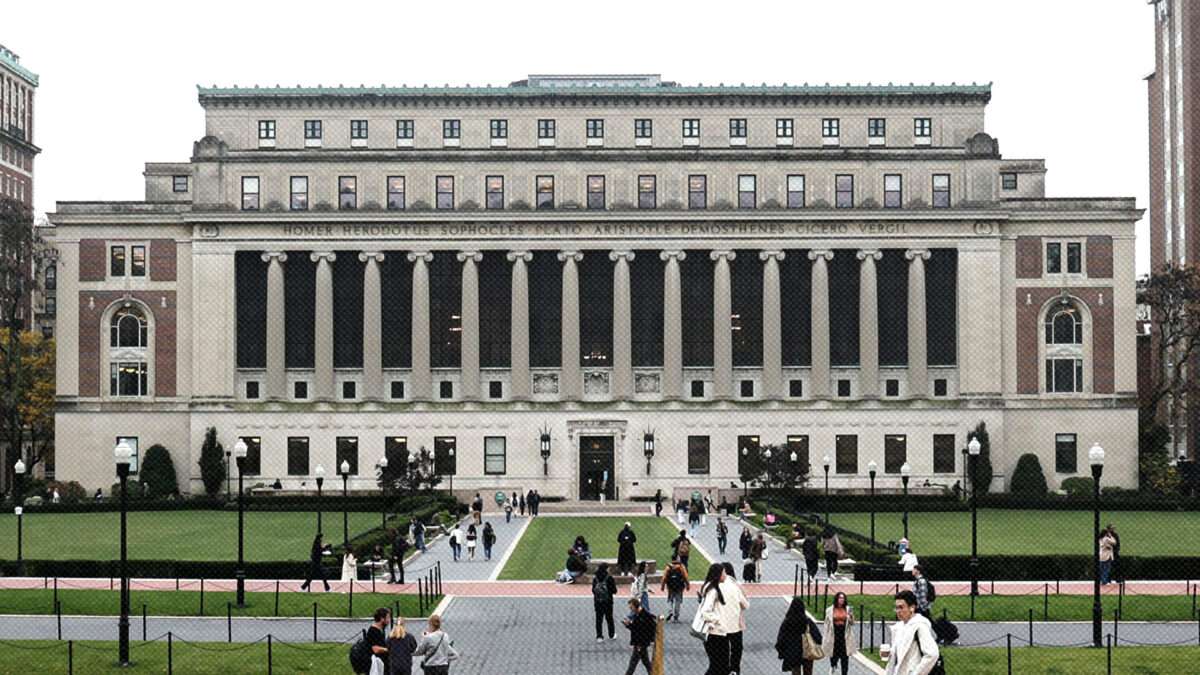
Campus building at Columbia | Luiz C. Ribeiro/TNS/Newscom

Questioning the prevailing narrative about the "Cornell seven" case is bound to create controversy. And at Columbia University, two student journalists drew condemnation for their views on the case from the unlikeliest of places: a college free speech group. 

On October 13, Barnard junior Christina Ma and Columbia junior Nikos Mohammadi published an article called "The 'Cornell Seven' Is Really About Liberalism" in the Columbia Sundial, an independent student publication. The piece argued that the discourse surrounding the alleged rape at Cornell University infantilizes women by omitting the possibility that in a post–sexual revolution, liberal society, women may make regrettable but consensual choices.

"In the world that, for better or worse, follows from it, we cannot claim to stand for sexual freedom and then recoil in disgust when there's a possibility that a young woman simply chose to exercise it," Mohammadi and Ma wrote. 

The piece also argues that the "collective frenzy" over the Cornell case has created a climate on campus that makes it "difficult to disagree with the maximalist position on what happened" the night of the alleged rape.

As Mohammadi wrote in UnHerd, the piece caused immense backlash. He said he received an onslaught of messages urging him to commit suicide and demanding that his "career and life be destroyed." But the criticism went beyond threatening DMs and comments. 

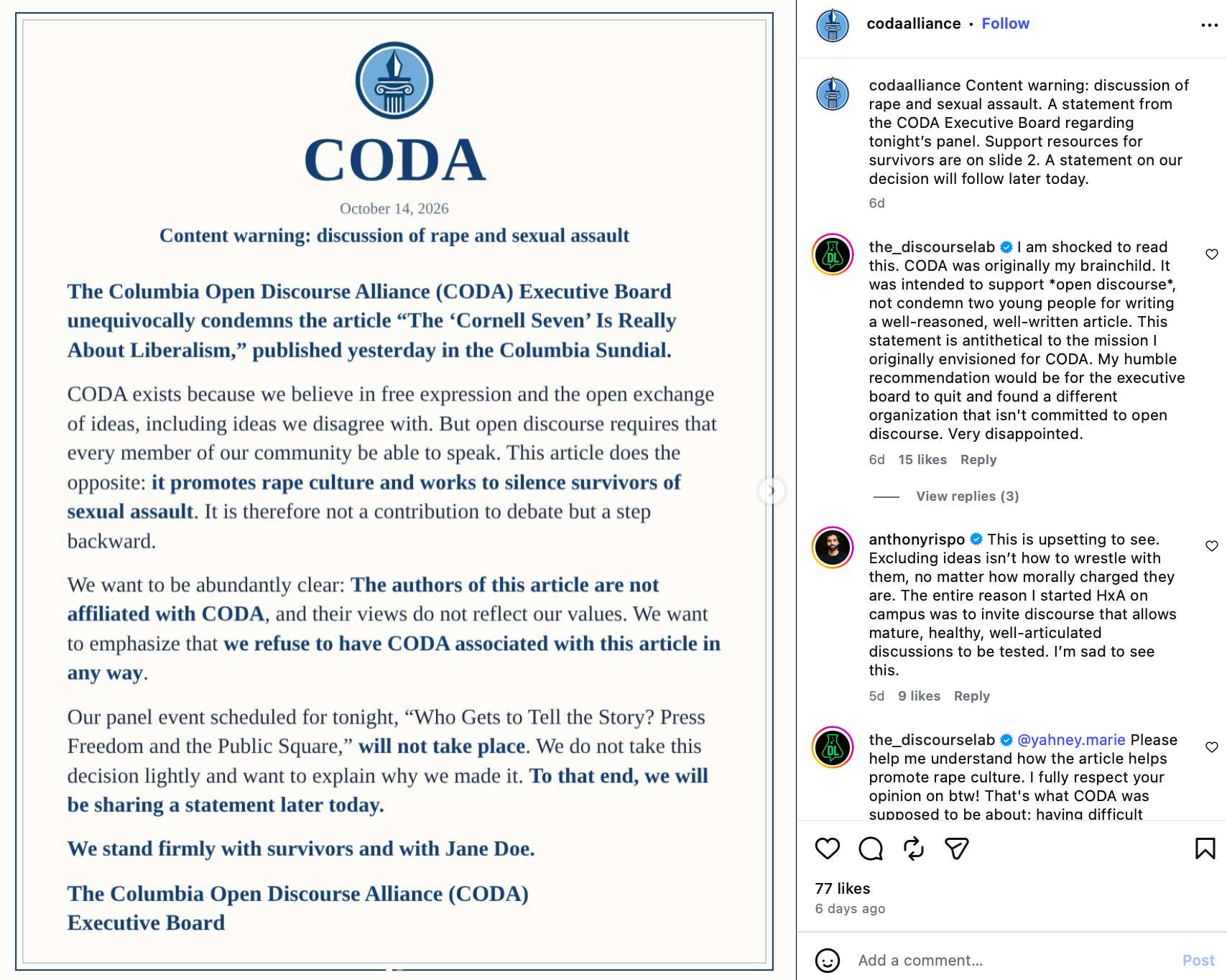
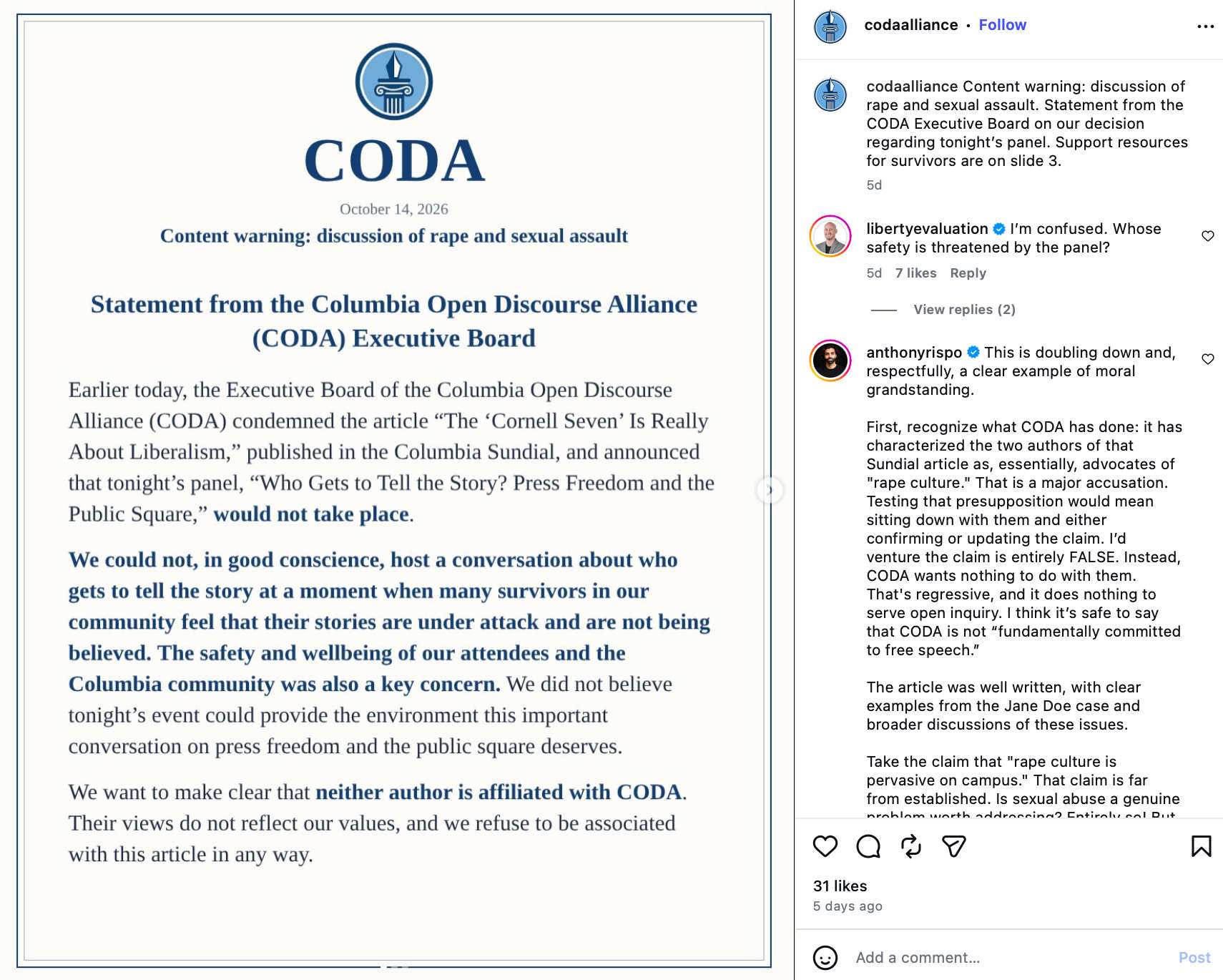
The day after the article's publication, the Columbia Open Discourse Alliance (CODA) canceled an event about press freedom because the Sundial's editor in chief, Nick Baum, had been slated to speak at the event. Although Baum did not author the piece, CODA wrote in an Instagram post that the free speech group "refused" to be affiliated with the Sundial's article "in any way." 

CODA also claimed that the event, ironically called "Who Gets to Tell the Story? Press Freedom and the Public Square," could not take place at a time when "many survivors in our community feel that their stories are under attack and are not being believed."

The group added that the Sundial's article "promotes rape culture and works to silence survivors of sexual assault." 

The group's president, Aum Desai, told Columbia's student newspaper, the Columbia Daily Spectator, that the group canceled the event "not in spite of, but because of [CODA's] commitment to free expression." 

Columbia graduate Clayton Smith, who founded CODA in 2025, quickly commented that he was "shocked" by CODA's statements on Instagram. Smith started the organization to create a central hub for groups hosting events promoting free speech and open discourse, including the Sundial and Columbia's Heterodox Academy chapter.

He tells Reason that CODA's rationale for canceling the event was "ironic" and "hypocritical," and he believes the group should have collaborated with the Sundial if there were legitimate safety concerns at the event. He says he was particularly disturbed by the group's condemnation of the article and CODA's claim that it promotes "rape culture."

"They don't argue or explain how it works to silence survivors of sexual assault. It is a baseless slander that they use to condemn the article because it promoted an opinion they do not like," Smith says. 

Smith says he spoke to Desai on the phone after CODA posted the statements, and Desai tried to reassure him that CODA would uphold the principle of free speech. But Smith says he did not leave the phone call feeling "very confident at all" in Desai's commitment. 

Desai did not respond to Reason's requests for comment.

CODA faculty adviser and Columbia Business School professor emeritus Eli Noam was traveling in China during the fallout from the Sundial article and was not involved in CODA's decision.

After speaking with members of both CODA and the Sundial, Noam tells Reason that he thinks CODA "made some proper decisions, some correct decisions, and some mistakes."

"I think we're dealing here with…a group of college students who kind of were confronted with a crisis at 2 a.m.," Noam says. "And kind of [made] some judgments that they now regret, and they do." 

He tells Reason that it was not "unreasonable to assume there would be a disruption" at the event, given the climate at Columbia and "about this rape allegation." He says the group suddenly "had an event where they needed college security" and could not organize in time. CODA, Noam says, is not yet recognized by the university, and he thinks the group was likely fearful of jeopardizing its recognition.  

Still, Noam says CODA's statements condemning the article were "unreasonable," and it was "disappointing that they kind of lost their nerve here."

Although he was not involved in planning the panel, Mohammadi says, to his knowledge, there were no credible threats of violence to the panel. He understood there may have been "disgruntled students" and an "environment CODA did not want to deal with." But instead of simply canceling the event or working with the Sundial to find a solution, Mohammadi says CODA overstepped by condemning the Sundial piece. 

James Applegate, an astronomy professor who serves on Columbia's Academic Freedom Council (CAFC) alongside Noam, tells Reason that he disagreed with CODA's decision to cancel the event.

Applegate tells Reason he was considering attending the event, and he was "rather surprised and disappointed" when it was canceled.

He recalled that when he was a professor in 2000, he objected to changes to the school's sexual misconduct policy on the University Senate floor. He says his statements were "similar to what was said in the Sundial article" and there was a "level of emotion in this debate." 

"Nonetheless, we had the debate. I was in it, and the degree to which it was civil is shocking when you look at where we are now. And it's sad." 

Applegate said he does not condemn CODA, however, "for the simple reason that the atmosphere on college campuses and on the left wing of politics in general in the United States is quite vicious."

CODA's honorary faculty fellow John McWhorter tells Reason he interpreted CODA's statement as "saying that an event about who gets to tell the story is untenable when or if a critical mass of people with such stories don't even feel comfortable telling them— i.e.being a participant in the event." He added, "I imagine some might think of that as cutting the salami a little thin, but then I highly suspect that Desai is equally worried about the event becoming a physical melee of some kind. In that, let's face it, he is hardly unreasonable."

Still, McWhorter said that he would have chosen to have the event himself, "especially as in the likely case that some people did talk about their experiences without any particular repercussions, it may have made the more reluctant people less apprehensive about doing so in the future."

According to Mohammadi, as of Tuesday, the Sundial, College Republicans, Platypus Affiliated Society at Columbia (which discusses leftist thought and history), and Columbia's Heterodox Academy chapter have left CODA. 

CODA was not the only group to condemn the Sundial's piece. On October 14, the Columbia Political Review's editorial board wrote that Mohammadi and Ma's piece "violates standards of integrity" and "perpetuates a culture of campus violence, rape, and assault." The editorial board of the Columbia Political Review, which purports to publish "multipartisan political discourse," stated that it would refuse to publish "any article that upholds or recreates cultures and systems of rape, sexual assault, or violence" and it urged "all campus publications to do the same."

And on Monday, Columbia's main newspaper, the Spectator, published a staff editorial accusing the Sundial of violating journalistic ethics by "its page to disparage survivors of sexual violence." 

Mohammadi tells Reason the piece underwent "far more editorial scrutiny than any other piece" the Sundial had published given the sensitive nature of the topic.

Free speech student organizations are necessary on Columbia's campus, especially as the school's free speech climate continues to crumble; it recently received a failing grade from the Foundation for Individual Rights and Expression. And while upholding free speech principles may have become more fashionable among those resisting the Trump administration's pressures on academic freedom or those defending pro-Palestinian speech, it is clear that some topics remain taboo in the public square. College is supposed to be a place where students debate controversial topics, form their own beliefs and opinions, and learn from mistakes. Hopefully, the students who demanded condemnation instead of debate will be forgiven for their perversion of free speech ideals, and they will learn to afford such grace and open-mindedness to classmates with whom they disagree.

The post A Free Speech Group at Columbia Canceled an Event About Free Speech Over 'Cornell 7' Article Controversy appeared first on Reason Magazine.

  •  

Supreme Court Takes Up Accusations of Race-Based Middle School Admissions

Supreme Court building | Sean Pavone/Dreamstime/Midjourney/Fatima Ruiz

Three years after ending affirmative action in higher education, the Supreme Court will hear another case on race-based admissions, this time in middle schools.

On Monday, the Supreme Court agreed to hear Association for Education Fairness v. Montgomery County Board of Education. The case, which was originally brought forth in 2020 by the Association for Education Fairness (AFEF), a coalition of Montgomery County, Maryland, parents, alleges that Montgomery County's selection process for magnet programs (gifted programs for STEM and humanities studies in middle schools) violates the Constitution's Equal Protection Clause by discriminating against Asian American students. The county insists that the selection process is race-neutral.

Montgomery County changed its selection process in the 2021–22 school year. According to reporting from The New York Times, the county was facing pressure from community groups, including the NAACP and Citizens Assisting and Sheltering the Abused (CASA Inc.), over the underrepresentation of black and Latino students in its magnet programs. Previously, students were selected based on test scores and grades. The new process implemented a lottery system in which high-achieving students are placed in a selection pool and selected at random.

The AFEF's central complaint is that the new system factors school poverty levels into the criteria for pool eligibility. This means students' eligibility depends on their scores relative to students in similarly affluent or disadvantaged schools, rather than the general population. They argue that since Asian Americans are concentrated in high-performing, lower-poverty schools, they have to clear a higher bar to become eligible. The group alleges the new system has caused fewer Asian American students to be admitted into magnet schools, a claim that is backed up by admissions data (which also show that the share of Asian American applications has fallen). The AFEF also cites Montgomery County's 2015 hiring of Metis, a national consulting firm, to recommend ways to make the system more "equitable" as an indication of the county's effort to "racially balance" its magnet programs.

​The complaint was dismissed by U.S. District Judge Paula Xinis in 2022, who ruled that the parents hadn't shown the policy disproportionately harmed Asian American students, citing the fact that they made up a larger share of admitted students than of the applicant pool. Xinis drew a distinction between accounting for economic disparities, which she called "wholly permissible," and racial discrimination. "Alleged disparity in treatment based on socioeconomic status alone does not make plausible discrimination on account of race," she wrote in the ruling. The tension raised by Xinis sits at the center of many debates regarding diversity, equity, and inclusion, as factors like poverty levels can often become a proxy for race; therefore, policies that are neutral on their face can still disparately impact a certain race.

In February, the 4th Circuit Court of Appeals upheld the dismissal, ruling that precedent from the Coalition for TJ v. Fairfax County School Board (2023) requires parents to show the policy disproportionately harmed Asian American applicants, which they hadn't. However, there is a real legal question as to whether racial groups should have to prove they were harmed as a group, as opposed to the individual, and lower courts have given mixed answers.

The ​Pacific Legal Foundation (PLF), a public-interest law firm representing the AFEF, litigated a similar case in New York City, where the city implemented an economic need index in its admissions process for competitive high schools, aimed at increasing the number of black and Hispanic students. Again, parents alleged that the requirement discriminated against Asian American students. In 2024, the 2nd Circuit Court of Appeals found that if the city intended to discriminate, the parents don't have to prove Asian Americans were harmed as a group and that harm to an individual was enough for the case to move forward. The case was sent back to the district court to determine whether the city intended to discriminate, where it remains pending.

​The Supreme Court will now settle the issue and determine "whether a plaintiff challenging a facially neutral admissions policy as racially discriminatory must establish that the targeted racial group suffered an aggregate disparate impact relative to its share of the applicant pool," according to SCOTUSBlog. 

In a statement on Monday, PLF Senior Attorney Chris Kieser said, "The Constitution protects students as individuals, not as members of a racial group. A school district should not be able to defeat a discrimination claim by showing that its policy did not harm enough Asian American children. Every family deserves admissions rules that judge their child on their own merit."

The post Supreme Court Takes Up Accusations of Race-Based Middle School Admissions appeared first on Reason Magazine.

  •  
❌