❌

Reading view

Macron accused of putting France’s right to protest at risk with ‘vandal’s law’

Making innocent protesters liable for damage would be bad for rule of law and play into far-right hands, say opponents

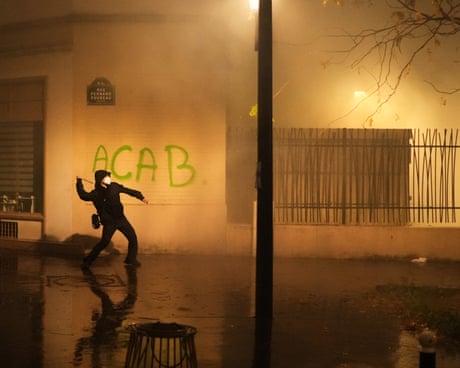
Emmanuel Macron has been accused by trade unions of trying to curb the fundamental French right to protest as the government fast-tracks a bill to make protesters pay for damage caused by vandalism at street demonstrations even if they did not directly cause it themselves.

The French president, who leaves office next spring, has faced more than a month of protests in which high-school students have blockaded schools demanding a response to teacher absences, repairs to decrepit buildings and changes to the university applications platform.

Continue reading...

© Photograph: Thibault Camus/AP

© Photograph: Thibault Camus/AP

© Photograph: Thibault Camus/AP

  •  

Pour les électeurs de Marine Le Pen, "c’est faux de dire que le RN incite à la haine"

Marine Le Pen tenait son premier meeting de campagne dimanche à Orléans, deux jours après l’attaque terroriste raciste qui a fait un mort et cinq blessés à Trappes. En dépit d’un discours qui stigmatise les étrangers et les musulmans, les électeurs du parti d’extrême droite refusent d’y voir un lien avec le drame de vendredi.

  •  

French far-right leader Le Pen seeks to leverage unrest in presidential campaign kick-off

Marine Le Pen, leader of France’s far-right National Rally, addressed some 10,000 supporters on Sunday in the city of Orleans as she kicked off her presidential campaign, a day after nationwide cost-of-living protests flared again into violence. Le Pen, the frontrunner, is seen to be benefiting in the polls from the weeks of unrest.

  •  

A Day After Renewed Street Clashes in France, Relief and Anxiety Mix

While the police kept a lid on vandalism, the huge number of protesters and France’s fraught politics suggest unrest could grow.

© Manu Brabo/Getty Images

Protesters shielding themselves from a water cannon in Paris on Saturday.
  •  

Police and protesters exchange teargas and fireworks in demonstrations across France – video

Hundreds of thousands marched in cities across France on Saturday amid fresh demonstrations over school funding and the cost of living. A peaceful protest during the day in Paris – with at least 110,000 people marching along the eastern edge of the city – descended into violent clashes with police by the time night fell. Police fired teargas to prevent protesters in Lyon, Lille, Montpellier, Nantes and Toulouse from reaching city centres. In Marseille, some bin fires were lit. At least two people were seriously injured, one in Clermont-Ferrand and the other in Toulouse. The interior ministry said there had been almost 1,000 arrests

Continue reading...

© Photograph: EPA

© Photograph: EPA

© Photograph: EPA

  •  

Suspect in racist Paris shooting transferred to psychiatric unit, had drugs in his system

A shooter suspected of killing one person and wounding five others on Friday in the town of Trappes, near Paris, has had his police custody suspended for a 48-hour psychiatric observation, anti-terror prosecutors said Sunday. The 39-year-old man is believed to have had racist motivations behind the gun attack as most of the victims had foreign origins.

  •  

Attentat dans les Yvelines : le suspect placé en observation psychiatrique

La garde à vue de l'homme soupçonné d'avoir tué une personne et blessé cinq autres dans les Yvelines a été levée pour raisons psychiatriques, a annoncé, dimanche, le parquet national antiterroriste. L'analyse toxicologique réalisée sur Kévin T. a révélé "la présence de cannabis et de cocaïne dans son sang", a par ailleurs indiqué le Pnat.

  •  

Attentat raciste en France: la garde à vue du tireur levée pour raisons psychiatriques

La garde à vue de l'assaillant ayant tué vendredi 23 octobre une personne et blessé cinq autres en région parisienne a été suspendue pour raisons psychiatriques, a annoncé dimanche le parquet national antiterroriste (Pnat). Ce dernier a précisé qu’il sera « soumis à une période d'observation psychiatrique susceptible de durer 48 heures ». La famille de la victime a fait part de son étonnement après cette annonce.

  •  

After Trappes: The Democratic Duty to Refuse Collective Blame

The attack in Trappes and La Verrière calls first for compassion towards the victims and their families. It also requires democratic restraint. While justice must establish individual responsibility, public debate must resist collective blame. Free expression remains essential, but citizens, media and political leaders share responsibility for distinguishing facts from fear and people from stereotypes. Education and critical judgment are indispensable safeguards against hatred, division and the exploitation of human suffering. This responsibility concerns public institutions and every citizen alike.

  •  

France’s Burning Warning: Macron Must Restore Order—and Public Trust

Nearly 1,000 arrests after another weekend of demonstrations expose a government squeezed between legitimate public anger and violent disorder. France requires a conservative response that defends taxpayers, businesses and the rule of law.

France’s latest weekend of protest presents Emmanuel Macron with a question that presidential speeches cannot settle: can his government protect ordinary citizens while addressing the grievances driving them onto the streets?

Nearly 1,000 arrests were reported after Saturday’s demonstrations, with clashes in Paris and other cities. Most participants protested peacefully over education and living costs. But masked groups again turned public mobilisation into confrontation, leaving police to restore order.

From a conservative perspective, this matters enormously. Peaceful assembly belongs to the democratic inheritance France should defend. Throwing projectiles at officers, intimidating businesses and destroying property belong in the criminal courts. Economic hardship explains anger; it does not confer permission to terrorise a neighbourhood.

The Interior Ministry counted 410,000 demonstrators nationwide, while the CGT union estimated nearly 800,000. Authorities deployed 70,000 officers, supported by helicopters and armoured vehicles. Interior Minister Laurent Nuñez said the operation helped prevent a repetition of the previous weekend’s widespread looting.

That offers some reassurance. Yet a country requiring such an extraordinary deployment to contain weekend demonstrations has a deeper problem than crowd management. Police can clear a junction. They cannot, by themselves, rebuild confidence in a political class that many citizens believe no longer understands their lives.

The most easily overlooked people are those with the least protection: independent shopkeepers, employees losing shifts, residents trapped behind barricades and taxpayers financing the response. Their interests deserve the same attention as the demands carried on banners. Keeping a business open is also a contribution to national life.

The BBC reported that shops were boarded up, cultural institutions closed and more than 20 Paris metro stations shut. These precautions may have been necessary, but they also demonstrate how disorder imposes costs far beyond those directly involved. A disrupted capital is a warning about the erosion of everyday freedom.

The government’s responsibility therefore extends beyond announcing arrest totals. Suspected offenders should face prompt, fair proceedings, with meaningful penalties where guilt is established. Where legally appropriate, those responsible for deliberate damage should contribute towards repairs. Public confidence depends on consequences that are visible, proportionate and consistently applied.

Consistency also requires rejecting violence from every political direction. Regional authorities reported that far-right extremists fought demonstrators in Nice, where 11 people were arrested. A credible conservative position cannot excuse street intimidation because its perpetrators claim patriotic motives. The law loses authority whenever political allegiance becomes an unofficial exemption.

Nevertheless, restoring order cannot substitute for governing competently. The movement grew from complaints about school staffing and resources into broader protests over household costs. Those concerns deserve answers. Parents expecting functioning classrooms and workers struggling to afford necessities are asking whether the state delivers what it promises.

The conservative answer should begin with value for money. Before reaching automatically for additional taxation or borrowing, ministers should explain where existing resources go, which programmes deliver results and which administrative burdens consume money better spent on essential services. Public expenditure should be judged by outcomes rather than the generosity of announcements.

There is an equally strong case for policies that reward employment, investment and enterprise. A government cannot sustainably improve living standards while treating the businesses creating jobs as an inexhaustible source of revenue. Nor can it promise every constituency protection from difficult choices. Credibility requires priorities, arithmetic and candour.

Macron’s political opponents will understandably seek advantage. But opposition leaders should be judged by whether they offer workable government, including a clear rejection of intimidation. Encouraging public anger is easier than reconciling demands for better services, affordable living and sound finances. France needs politicians prepared to explain those trade-offs honestly.

The immediate task is to keep streets safe. The larger task is to make democratic government effective enough that citizens trust its decisions. France needs firm policing, accountable institutions and economic realism. Unless its leaders provide all three, each weekend of unrest risks becoming another advertisement for the failure of the governing establishment.

France’s Unrest Exposes a New Front in Russia’s Information War Against Europe

  •  

Unrest Erupts Again in France, but This Time, With Less Property Damage

After largely peaceful marches on Saturday, clashes broke out in the evening. But a large-scale police presence, 1,000 arrests and the rerouting of protest routes kept a lid on wholesale vandalism.

© Philippe Lopez/Agence France-Presse — Getty Images

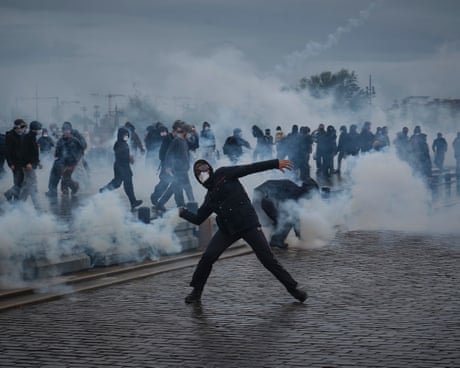
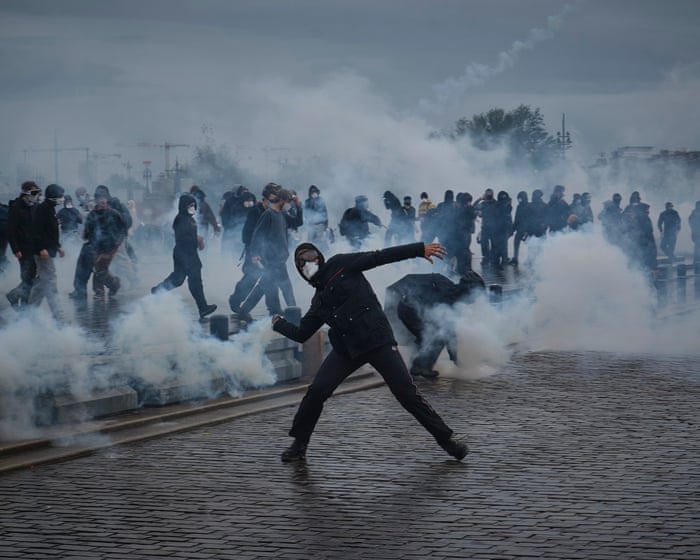
Protesters amid tear gas near Place de la Bourse in Bordeaux, western France, on Saturday.
  •  

France: à Orléans, le congrès du RN s'ouvre sous cloche, 13 000 personnes manifestent contre l'extrême droite

À Orléans, quadrillée par 3 000 forces de l'ordre et où la gauche manifestait avec 13 000 personnes son opposition à l’extrême droite, le RN a pu tenir son congrès ce samedi 24 octobre. Dans cette ambiance particulière, Jordan Bardella, seul candidat, a été reconduit président du parti.

  •  
❌