❌

Reading view

Iowa Voters Don't Want Police or Flock Tracking Their Cars. Politicians Are Still Catching Up.
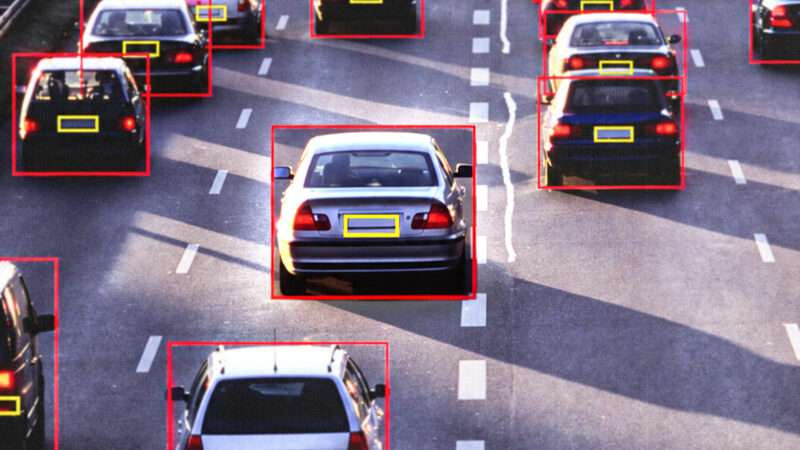
An image of cars driving down a highway, four lanes wide, with red boxes around the cars and yellow boxes around their license plates. | Adani Samat/AltrendoImages/Envato/ChatGPT

West Des Moines, Iowa—Iowa voters may disagree on immigration, taxes, and the economy, but government surveillance is drawing opposition from across the political spectrum.

An Emerson College poll of 750 likely Iowa voters, conducted between late August and early September, found that 61 percent opposed police use of automated license plate reader (ALPR) cameras, compared with 26 percent in support.

The backlash comes as police departments across the state increasingly rely on surveillance technology supplied by private companies such as Flock Safety and Motorola Solutions. Their cameras record license plates and vehicle information, feeding searchable databases that allow law enforcement to piece together motorists' movements, including those of people suspected of no crime.

As Iowa's gubernatorial and congressional campaigns enter their final stretch, voters are increasingly pressing candidates on whether they intend to place limits on the technology. Jacqueline Thompson, an ordained elder in the Iowa Conference of the United Methodist Church and a self-described centrist Democrat, said she has been concerned about government surveillance for years.

"It's always been important to me [and] I've always thought that was a problem," she said before a campaign rally at a senior living community in Des Moines earlier this month. "So, when people started jumping on the bandwagon saying it, I was like, 'Hello, I've been here already!'"

Thompson pointed to two Democratic candidates, Nate Willems, who is running for Iowa attorney general, and Taylor Wettach, a candidate for state auditor, as having caught her attention with their emphasis on corporate oversight and access to government records.

For Thompson, the renewed attention to privacy is a welcome development in a political environment where Democrats and Republicans rarely find common ground. "It's kind of nice to hear the people come back to the middle [and discuss this]," she said.

Flock Does Not Have Enough Guardrails

Police surveillance technology has spread across Iowa faster than the rules governing its use.

A recent study identified at least 62 Iowa law enforcement agencies that had accessed other agencies' Flock databases, including departments that did not operate cameras of their own. Police departments can therefore search information collected well beyond their jurisdictions without having to install a single camera themselves. The study (led by Megan Graham, a clinical associate professor and director of the Technology Law Clinic at the University of Iowa College of Law) found significant gaps in transparency surrounding ALPRs.

The constitutional implications are already being tested in court. On October 1, a federal judge in Oklahoma ruled that a sheriff's deputy violated the Fourth Amendment by searching a motorist's location history through automated license plate reader systems operated by Flock Safety and Motorola Solutions without a warrant.

The search turned up more than 50 records of the driver's whereabouts across multiple states over a month. In the 38-page ruling, the judge ordered the resulting evidence suppressed, describing the technology as a form of "indiscriminate mass surveillance." The decision is not binding in Iowa, and legal challenges to ALPR surveillance still face an uphill battle, but it adds to the legal scrutiny of police tracking motorists without warrants.

The University of Iowa study also raised concerns about unauthorized database access, erroneous alerts, and the potential use of locally collected information for federal immigration enforcement.

Flock Safety says it has not provided U.S. Immigration and Customs Enforcement or Border Patrol with direct access to its systems. But the researchers found that local law enforcement agencies elsewhere in the country had conducted searches on behalf of federal authorities, effectively allowing them to obtain information without direct access.

Taxpayers are also footing the bill. Cedar Rapids reported operating 76 cameras at a combined average cost of more than $20,000 a month, according to the study.

Researchers struggled to determine the full extent of surveillance across Iowa. Some agencies refused to disclose the number or locations of their cameras, while others withheld records concerning unauthorized access or erroneous alerts, citing confidentiality.

The cameras are not limited to Iowa's largest cities. Becca Eastwood, deputy policy director at the American Civil Liberties Union of Iowa, said they have spread across large, midsize, and smaller communities, prompting a surge in opposition over the past year.

The backlash "has just exploded, like no other issue that I have seen in my time at the ACLU," Eastwood told Reason in an interview. Candidates running for state and federal offices are increasingly getting asked if they support police departments using ALPR cameras, she said. 

Some local governments are already reconsidering their contracts. Indianola and Waukee suspended their Flock camera arrangements, Iowa Public Radio reported in August. Dallas County paused a planned rollout while awaiting guidance from state lawmakers. Ankeny, which operates 16 Flock cameras, is reportedly expected to reconsider a possible contract extension next year.

The backlash also cuts across the immigration debate. While concerns about federal immigration enforcement have helped draw attention to the cameras, critics argue the same surveillance infrastructure can be used against anyone, regardless of which party controls the government.

"This is a nonpartisan issue because people recognize that surveillance can be weaponized against anyone the government wants to weaponize it against," Eastwood said. "An increase in police surveillance impacts certain populations more, right now [but] nobody is immune."

Politicians Face Pressure To Cut Ties With Flock

The opposition is beginning to force Iowa's candidates to take positions on a technology that, until recently, attracted relatively little attention outside law enforcement and civil liberties circles.

Among the gubernatorial candidates, interviewed by Iowa Radio last month, Republican Zach Lahn has called for state-level regulation, arguing that the widespread collection of information about where people drive is unacceptable. Meanwhile, Democrat Rob Sand has expressed support for safeguards governing the collection and use of license plate data and said he would sign legislation if privacy concerns persisted. But he has also pointed to the cancellation of some Flock contracts as evidence that the market is responding to public concerns. 

For now, neither approach offers much clarity on whether police should be required to obtain warrants before searching motorists' location histories or how far restrictions on data collection should go.

Ryan Johnson, a libertarian-leaning Republican who works as a machinist near Waterloo, said he could accept cameras in certain locations, such as downtown areas or near traffic signals. But he objects to their spread into residential neighborhoods and public spaces.

"Just having Flock cameras everywhere, [in] residential [areas], putting them at parks and pools, we don't need that," Johnson said while attending a Lahn rally earlier this month.

So far, some of the most concrete changes to ALPR practices have come from Flock itself. In August, the company announced that it would reduce its default data-retention period from 30 days to seven and require officers to enter a criminal case number or code for each search. The changes would not, however, require police to obtain a warrant before accessing the records.

Gary and Nancy Guthrie, a Democratic couple attending a Des Moines rally supporting Chris Jones for secretary of agriculture, remain skeptical of the cameras.

"I don't have a good feel for that," Nancy Guthrie said. "Personally, I'm very much against Flock cameras."

For all the attention the issue is receiving on the campaign trail, Iowa voters have yet to hear much about what legal limits candidates would actually impose on police surveillance.

The post Iowa Voters Don't Want Police or Flock Tracking Their Cars. Politicians Are Still Catching Up. appeared first on Reason Magazine.
  •  

Rural America tests the reach of the Democratic wave: ‘I’d like to see some political change’

Tractors swarm across Iowa’s cornfields. Farmers are rushing the harvest before rains arrive and ruin their season. Chip Hoffman is among the lucky ones. He has already gathered nearly the entire crop from the family farm, which spans several dozen hectares. It’s Wednesday morning and the 66-year-old farmer is helping his older brother position a hopper to unload grain from the truck into the silo. “These are hard times. Fuel, insurance, even machinery repairs have gone up and they’re extremely expensive,” says Chip. He blames tariffs and the war with Iran for the surge in inflation and the squeeze on profit margins that has hit Iowa’s farmers.

Seguir leyendo

© Jesús-Sérvulo González Moreno

John Kroul and his wife Charlene at their farm near Cedar Rapids.
  •  

Surging diesel prices loom over Republicans in Iowa's midterm races

It's been more than a decade since Iowa has had a Democratic governor or senator. But this year, with the incumbents retiring, both races are competitive. As Peter Tubbs at Iowa PBS reports, record-high diesel prices have hit the state's agriculture industry particularly hard and could influence the midterm elections.

  •  

WATCH LIVE: Trump rallies in Iowa with GOP Senate candidate Ashley Hinson

On Thursday, Hinson will join President Donald Trump for a rally in Sioux City, which is in Iowa's conservative northwest corner. The visit to safe territory is geared toward boosting turnout even as it ties her more tightly to an unpopular president.

  •  

Charisma or cash? Republicans are banking on their financial edge to stage a comeback in the polls

Charisma or cash: to win an election, candidates need at least one of those two factors. With two weeks to go until the U.S. midterm elections, Republicans are throwing everything they have into the closest states to try to climb back in polls that are unfavorable to them. They have the invaluable help of the vast sums Donald Trump raises through his Super PAC, the political action committee that pools donations coming from the ultraconservative MAGA movement.

Seguir leyendo

© Alex Brandon (AP Photo/Alex Brandon)

Donald Trump this Wednesday during a rally in San Antonio, Texas.
  •  

The Unforeseen Something

family portrait of three outside a home with a brick wall and light-colored front door

Mark Johnson | The Atavist Magazine | September 2026 | 2,048 words (7 minutes)

This is an excerpt from issue no. 180, “The Family Plan.”


At first she told no one. Not her twin sister. Not her mother. Not even her father the scientist.

Six-year-old Jenna Smith knew better than to pee when she was in the bath. But on that night in 1992, in her family’s home in Iowa City, the water felt so comfortable against her skin that she didn’t want to get out of the tub. It seemed like such a small thing. Who would know?

Seconds later the water around her waist turned reddish pink. Blood? It had to be. Jenna wondered if she’d hurt herself. “I was six years old sitting in a bathtub, watching a few seconds of my world stop making sense,” she would recall years later.

The Atavist, our sister publication, publishes one deeply reported, elegantly designed story each month. Support The Atavist by becoming a member.

She kept the blood a secret because she didn’t want to admit that she’d peed in the bath. But when it was still in her urine the next time she used the toilet, she went to her mother. Concerned, her mom called her dad, Richard Smith, and he took Jenna to the emergency room.

Richard was an ear, nose, and throat doctor in the University of Iowa’s school of medicine, a researcher who would become one of the world’s authorities on the genetics of hearing loss. His wife, Lynne Lanning, had worked as both a lawyer and a nurse. They had four young children: twins Jenna and Jessica, who were identical, and two boys, Luke and Rion.

At the ER, doctors ran tests on Jenna, but they couldn’t identify the cause of the blood. In the days that followed the bleeding intensified. At her parents’ urging, Jenna collected samples of her urine in Dixie cups for further testing. The doctors remained stumped, however, and after a while Jenna found the whole thing more annoying than worrisome.

The uncertainty was much harder on her parents. It wasn’t that doctors were misdiagnosing their daughter; they were unable to diagnose her at all. “It was horrible,” Richard said. “Imagine seeing your child and you know something is wrong, and you know the doctors treating her have no clue what to do.” Richard called a pediatric nephrologist he knew in Houston, where the family had lived previously. The nephrologist listed several conditions that could be causing the bleeding and said that, to determine which was to blame, Jenna’s parents should take her to Cincinnati Children’s Hospital Medical Center.

In July 1992, Richard, Lynne, and Jenna drove nearly 500 miles to get answers. Doctors in Cincinnati diagnosed Jenna with dense deposit disease, a condition in which proteins clog and damage the kidneys, leading to renal failure in many patients. There was no cure.

The hospital couldn’t tell the family much else—no one could. The disease was exceedingly rare, afflicting between one and three people in a million. Back home, Richard and Lynne spent hours inside the University of Iowa’s quiet medical library, poring over papers in search of information about their daughter’s illness. They could find no evidence that anyone was actively studying the condition.

Although many Americans—roughly one in ten—suffer from a rare disease, the experience can be lonely. Friends and relatives don’t understand the unique miseries such illnesses impose on daily life. Few doctors are likely to have encountered them before. And because there aren’t many patients, drug companies usually don’t invest in research for treatments.

Richard and Lynne feared that their daughter’s life might be tragically brief. Sometimes the mention of weddings would sink Lynne into melancholy; she couldn’t bring herself to watch the movie Father of the Bride. Richard agonized over what to do. His training compelled him to seek answers, but he wanted to be Jenna’s father, not the scientist charged with curing her. He kept his research focused on hearing loss. At first, anyway.

Stories of scientific discovery almost always celebrate individual researchers, consigning the contributions of loved ones, communities, and colleagues to footnotes. There are exceptions―the teams that built the first atomic bomb and deciphered the human genome, for instance. Science also has its share of famous families. Marie and Pierre Curie, along with their daughter Irène and her husband, Frédéric, won five Nobel Prizes between them for discoveries related to radioactivity. For the most part, however, the history of scientific progress has been mythologized as a succession of brilliant, driven individuals—often men—who chose the lab over the dinner table and competition over collaboration.

Some scientists have embraced the role of maverick. “You have to worry about your own work and ignore what everyone else is doing,” the physicist and Nobel laureate Richard Feynman is said to have told a colleague. The decades-long pursuit of a treatment for Jenna’s disease followed a very different path. There was no single hero, no lone scientist seeking glory. The biomedical quest required the efforts of a family and their neighbors in Iowa City, and the work of scientists around the globe. Together they changed an obscure area of medicine.

Richard and Lynne met in 1977, when both were working at Memorial Hermann-Texas Medical Center in Houston—she as a nurse, he as a medical intern. He noticed a run in her nylons and was smitten by her smile. She liked his down-to-earth manner and intelligence, his humor and kindness. They were working in the hospital’s burn unit when he asked her out.

The couple married in 1981, and except for two years in England, they remained in Houston until 1990. That December they moved to Iowa City, where Richard had a job waiting for him leading the pediatric otolaryngology division and running a research lab at the University of Iowa’s medical school. They had been there only a year when Jenna got sick.

Richard and Lynne learned that their daughter’s disease was caused by a malfunction in her complement system. Believed to have evolved long before other parts of our immune infrastructure, the complement system sends proteins to battle foreign invaders. Unlike antibodies, these proteins are not tailored to fight a specific virus or bacteria, but they kick into gear faster when a threat is detected. In people with Jenna’s condition, the complement system is like a runaway train: Proteins become overstimulated and then accumulate in the glomeruli, tiny filters the kidneys use to clear waste from blood.

Blood in the urine is one symptom of the disease. Others include swelling, high blood pressure, inflammation, and fatigue. When Jenna was in the first grade, her body struggled to make growth hormones. Her production of red blood cells slowed, and she grew increasingly tired. During rehearsals for The Nutcracker ballet around Christmas 1993, she’d finish her part and then lie down backstage, completely spent.

Doctors put her on a heavy dose of the steroid prednisone and on blood-pressure medication. The prednisone caused her body to retain water. She woke up each morning with her eyes swollen shut, then waited in bed until the swelling receded. She couldn’t fit into her clothes or shoes. She wore flip-flops and roomy jumpers Lynne sewed for her.

As twins, Jenna and Jessica had always been close. They played together, made up songs and dance moves, explored the woods near their home, and enjoyed pranking friends and family members. “She made a lot of things feel not so heavy,” Jenna said of her sister. Still, she sometimes thought that Jessica “got off scot-free” by not having dense deposit disease. Neither girl liked feeling different from the other. (Years later, Jessica would be diagnosed with type-1 diabetes; Jenna would not.)

The changes to Jenna’s appearance meant the girls were no longer identical. Once, according to Lynne, when a boy at school said that Jenna couldn’t be a twin anymore because of how she looked, Jessica slugged him. Lynne recalled sitting in the principal’s office, politely listening to a lecture—this is not the way we resolve things!—but understanding why Jessica had lashed out. Nothing was so frightening to her daughters as the idea that they’d stop being twins.

About half of those afflicted with Jenna’s disease progressed to kidney failure within a decade of diagnosis; it took her less than a year. She made it through the last day of first grade. Then, as other children departed for summer camp, she went to a clinic. While her classmates practiced archery and did arts and crafts, she learned about the catheter doctors would surgically insert in her body. Through that tube, a machine would pump fluid into her abdomen, where her peritoneum—her abdominal lining—would take over the filtering function kidneys usually perform.

She would take the peritoneal dialysis machine home with her and use it every day for the foreseeable future, possibly for the rest of her life. When a nurse tried to take Lynne aside to show her how to operate it, Jenna stopped her. “I’m the patient,” the seven-year-old insisted. “I’m learning how to run the machine.”

In such moments, Lynne was surprised at the strength she drew from her daughter. She needed it. Her grief could leave her feeling drained. One day she found herself crying into the soil as she gardened.

But Lynne and Richard were determined that sadness would not define their lives. For a long time, they didn’t have a TV in their house—they wanted the family to talk when they were together, and for the children to build forts, learn to sew, be creative. They had painting nights, creating portraits of one another. There were cooking contests, too. Richard and Lynne made sure to spend one-on-one time with each kid. Richard traveled with Luke to Japan, with Rion to the Grand Canyon, with Jessica to Italy, and with Jenna to England. Lynne took trips with the children to Brazil, England, and Guatemala. There were themed birthday celebrations: a James Bond party for Richard, where everyone was armed with Nerf guns, and one for Lynne where Richard dressed as the artist Bob Ross and the guests painted “happy little clouds.” Richard coached the kids’ hockey and soccer teams. He built harps and lyres from scratch, and Lynne played them.

Every day, Richard left for work at 5 a.m., while the children were still in bed. He returned around six at night. The family joked that they could hear him coming from half a mile away in his rust-bucket Isuzu Trooper with the bad muffler and a hole in the passenger footwell. When he wasn’t seeing patients or in surgery, Richard was in the lab. On Saturdays, Luke would go there with him. Sometimes the other kids joined. They liked to refill the communal candy jars and visit the mice used in experiments.

It seemed a wonder to the lab’s staff that Richard squeezed so much into a day. When they began using email to communicate, they received messages from him time-stamped three or four in the morning. “Why don’t you sleep sometime?” a colleague replied once. Indeed, Richard slept little. At night his mind kept running through the mysteries of his daughter’s disease.

Richard had read that it took 10,000 hours—the equivalent of working full-time for about five years—to achieve expertise in a subject. He believed it. In 1995, he began flying to conferences about kidney disease, where he talked to the few doctors who cared for patients like Jenna. Medicine was getting no closer to finding a treatment.

That year the owner of a ranch where Richard and Lynne’s children took riding lessons offered to host a fundraiser for kidney disease research. The family organized Dressage in the Heartland, which featured riding events, fiddle music, and bowls of chili. After raising upwards of $10,000 for the National Kidney Foundation, they held the event again the following year. There are hundreds of kidney ailments, however, and the foundation didn’t allow the money the family raised to be earmarked for the research of dense deposit disease. (The foundation said it now allows monetary gifts to be dedicated to specific conditions.)

Richard and Lynne ran into more disappointment during a visit to the University of Minnesota in early 1997. A specialist they consulted was blunt. “Nobody is looking at this disease,” he told them. “And barring something unforeseen, nothing will be done in the next twenty years.”

It was a four-and-a-half-hour drive back to Iowa City. In the car, Lynne brought up what the doctor had said. Maybe they would have to be that unforeseen something.

  •  
❌