❌

Reading view

The rise and fall of Route 66

In the 1940s and '50s, Route 66 was one of America's most popular highways, driving business to small towns from Chicago to Santa Monica. But today, the road and its people have been largely forgotten. Ghost towns, empty motels, and abandoned gas stations line its path. Chief correspondent Abby Narishkin grew up along the road. In celebration of its 100th anniversary, she drove down the old route herself to visit the people and businesses still keeping this Americana legacy alive.

Read the original article on Business Insider

  •  

Millennium, “Operazione Report”: il nuovo numero del mensile analizza il caso Ranucci-Lavitola

OPERAZIONE REPORT: Tutte le carte, gli interrogativi e i sospetti sul caso Ranucci-Lavitola

Il direttore anticipa i temi del nuovo numero di MillenniuM, disponibile in libreria e negli store online.

Una trasmissione d’inchiesta invisa al potere. Una bomba cosiddetta “amica”. Un faccendiere specializzato in torbidi servizi alla politica. Partiti che invadono la tv pubblica. Sono gli ingredienti di quella che abbiamo chiamato “Operazione Report”, di cui conosciamo in parte lo svolgimento e in tutto l’esito: quello di allontanare il giornalista Sigfrido Ranucci dalla conduzione della più importante trasmissione di giornalismo investigativo della Rai, dopo nove anni di conduzione (salvo il successo dei ricorsi dell’interessato al Tribunale del lavoro di Roma). Nove anni in cui molte puntate di Report hanno scatenato gli attacchi della politica, in particolare dal centrodestra e dalla frangia renziana. Che si sono via via trasformati in una vera e propria campagna, amplificata dalla stampa di destra. Parte da qui “Operazione Report”, titolo di copertina del numero di ottobre di MillenniuM, il mensile diretto da Peter Gomez. Il racconto prende il via dall’altro protagonista, il faccendiere Valter Lavitola, con il ritratto approfondito e documentato a firma di Marco Lillo. Sul personaggio i media tendono a far prevalere aspetti quasi folcloristici, ma la sua biografia racconta ben altro: relazioni coi potenti, processi e condanne, intrighi politici ai massimi livelli, che hanno cambiato la storia di questo Paese, dalla caduta del governo Prodi nel 2008 alle manovre contro politici sgraditi. Una parabola in cui affiorano contatti stretti con i servizi segreti, un leitmotiv della sua fulminante ascesa, come scrive il direttore Peter Gomez. Sulla “Operazione Report” Millennium parte dai fatti, vale a dire l’inchiesta giudiziaria sulla bomba esplosa davanti a casa di Ranucci, a Torvaianica, il 16 ottobre 2025: l’individuazione dell’arruffata manovalanza campana, l’improvvisa entrata in scena di Lavitola, la “amicizia fraterna” rivendicata a sorpresa dal conduttore, la sequenza di “affettuosi” moventi snocciolati dal faccendiere. Ma oltre le carte c’è di più: gli affari, africani e non solo, che portano a Marco Dell’Utri, figlio del senatore che è stato la mente organizzativa di Forza Italia e ha scontato una condanna a 7 anni per concorso esterno in associazione mafiosa. L’Operazione Report ci fa riflettere sul rapporto tra informazione e potere, ma anche sui fili trasversali del potere. Che possono passare anche per un piatto di vongole. Sgusciate o meno.

L'articolo Millennium, “Operazione Report”: il nuovo numero del mensile analizza il caso Ranucci-Lavitola proviene da Il Fatto Quotidiano.

  •  

Ucraina, Zelensky: da Usa conferma su trilaterale con la Russia

Il presidente ucraino Volodymyr Zelensky ha detto che secondo il governo statunitense, la Russia è disponibile a un incontro trilaterale tra Mosca, Ucraina e Stati Uniti. Zelensky ha precisato di aver avuto al conferma da Jared Kushner, inviato speciale americano per la Pace, e che riceverà presto “un resoconto più dettagliato” dall’inviato speciale statunitense Steve […]
  •  

Studenti universitari manifestano a Parigi dopo la revoca del divieto

A Parigi migliaia di manifestanti sfilano su appello dell’Interfac Ile-de-France, dopo che il tribunale amministrativo ha sospeso l’ordinanza della prefettura di polizia che vietava la mobilitazione. La manifestazione, organizzata dagli studenti delle assemblee generali universitarie, si svolge tra la Pitié-Salp trière e la Bastiglia, riferisce Afp.
  •  

Trita Parsi: Israel Set a Trap for Total War in the Region

Glenn Diesen | October 22, 2026

Trita Parsi is the co-founder and Executive Vice President of the Quincy Institute for Responsible Statecraft. Follow his excellent Substack: https://tritaparsi.substack.com/

Follow Prof. Glenn Diesen:

Substack: https://glenndiesen.substack.com/

X/Twitter: https://x.com/Glenn_Diesen

Patreon:   / glenndiesen  

Support the research by Prof. Glenn Diesen:

PayPal: https://www.paypal.com/paypalme/glenn…

Buy me a Coffee: buymeacoffee.com/gdieseng

Go Fund Me: https://gofund.me/09ea012f

Buy Diesen merchandise: https://diesen-shop.fourthwall.com/en…

Books by Prof. Glenn Diesen

  •  

Panther spirit in DC: Organizing against Trump’s fascist push

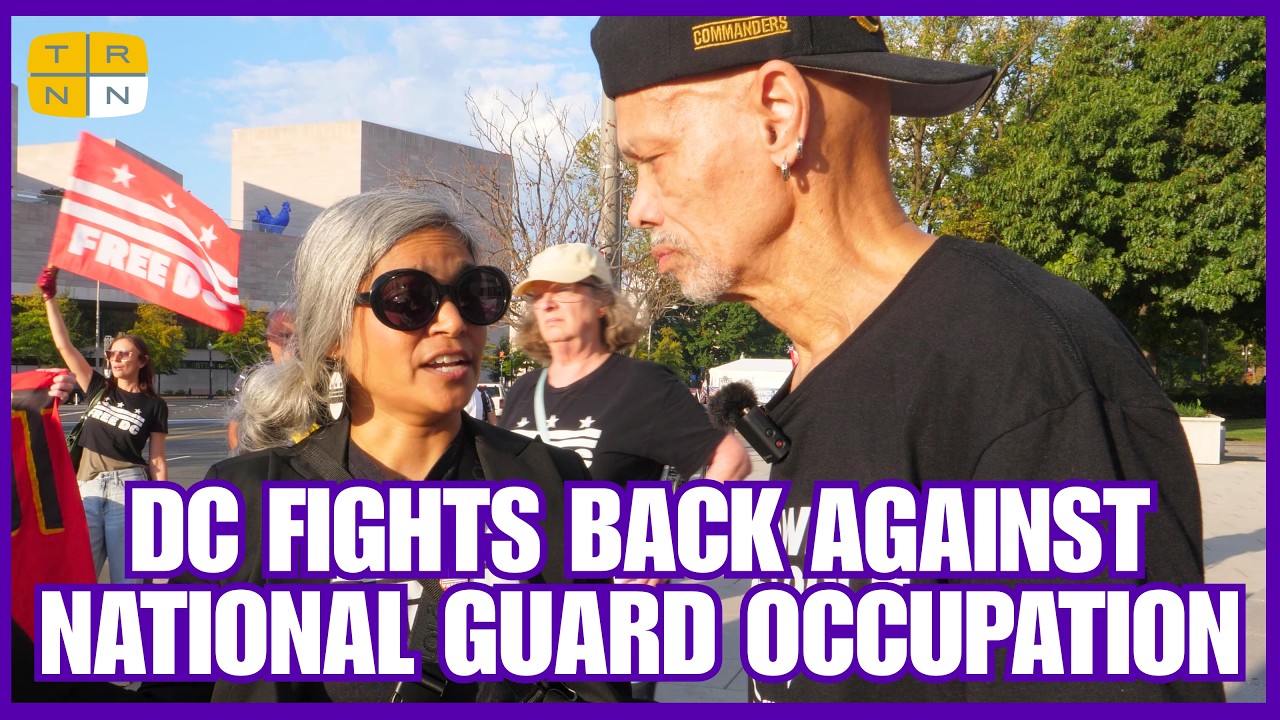
Host of Rattling the Bars Mansa Musa speaks with Free DC Executive Director Keya Chatterjee at a rally against Trump's National Guard deployment in D.C. on October 14, 2026.

October 22nd marks the National Day to Stop Police Brutality. Free DC and Pan-African Community Action (PACA) are two organizations in the nation’s capital engaged in building community and direct action against the various entities that form the policing apparatus in DC: police, FBI, HSI, National Guard, etc.

While Trump boosts their funding—much like giving a steroid to the carceral machine—Free DC and PACA are heightening the contradictions of the Trump administration’s fascist agenda by providing vulnerable communities with the resources that the government withholds and refuses to fund.

Trump’s deployment of the National Guard costs upwards of $3M daily and will total $2.9B by the end of his term. How would you spend $3M a day?

On this episode of Rattling the Bars, former political prisoner and Black Panther Mansa Musa speaks with organizers pushing back against the National Guard occupation of DC on the eve of the Black Panther Party’s 60th Anniversary.

Credits:

  • Production/Post-production: Cameron Granadino
Transcript

The following is a rushed transcript and may contain errors. It will be updated.

Mansa Musa:

Welcome to this edition of Rattling the Bars. I’m your host, Mansa Musa. The presence of the National Guard in the District of Columbia calls $3 million a day and an estimated $2.9 billion the next presidential election. Recently, I covered two organizations that are pushing back against their present. PACA, Pan-African, Community Action, who primarily organize in the Southeast section or the District of Columbia, Anacostia area, and Free DC. Take a look. We’re at the Black Workers Wellness Center. I’m talking to Alex from the Pan-African Community Action, PACA. And today they’re having political education form because of the anniversary, the 60th year anniversary of the Black Panther Party. And we’re doing political education in its roles form. So Alex, tell our audience a little bit about PACA.

Alex:

We’re a group of African and black people organizing in Southeast DC for power. We’re trying to build up institutions that are made up of just ordinary working class people, working class black people. We’re trying to build up alternative institutions that are able to challenge the preexisting institutions that are currently failing us. We see failing healthcare. We see funding going towards police and national guard. At the same time, we’re seeing cutting off from SNAP benefits, disinvesting from education affecting black children. And so we believe in a power shift and the only way to achieve that power shift is through building up a mass movement. And we’ve been organizing down here for 10 years.

Oliver:

When we look in our communities, we see occupying police forces. We see education we don’t control. History we don’t define. We see institutions we don’t have, whether it’s healthcare, whether it’s housing, whether it’s transportation. So the colonization we’re experiencing domestically, the Panthers saw that as linked to the anti-colonial struggles taking place around the world.

Huey P. Newton:

In America, black people are treated very much as the Vietnamese people or any other colonized people because we’re used, we’re brutalized. The police and our community occupy our area, our community as a foreign troop occupies territory.

Mansa Musa:

Earlier today, we was in free DC downtown where they was protesting the occupation by the National Guard.

Keya Chatterjee:

We want to be really clear that it is time for these armed soldiers to leave DC and leave our community. We’re in the middle of an election right now. We’ve seen them standing in front of polling locations, standing in front of ballot boxes. We’ve seen them at our schools. We’ve seen them all over our transportation system for all over a year. It is time for the guard to leave. I mean, from August 11th to January of 2029, can you imagine? It’s billions of dollars. It is a clear effort to violate our rights and to suppress dissent and we’re not going to stand for it.

Mansa Musa:

They’re blocking both sides of the street. They’re at the top on third street, third DC, and at the bottom of third and constitution. They’re definitely representing the right to civil disobedience.

DC resident 1:

Nobody in DC wants them. They’re a hassle to us and they don’t do anything good and they’re taking a lot of our money and they make the city feel unsafe because of their presence. So I’m not interested in having them here any longer.

DC resident 2:

And I think the National Guard are making our streets less safe. They’re scaring people away from U Street Corridor, which is such a vibrant place where young people like to come and gather and they are chasing everybody out of our city and our businesses and it’s not good for us.

Keya Chatterjee:

We’re going to be in all the places. We also will be over at Bard Early College at 3:00 PM today because the soldiers have been walking around with HSI and FBI in front of that school for weeks. Nobody asked you to be there. Nobody wants you there. Our DC council who we elect have been clear unanimously sending letters to every single governor saying, “Remove your troops. You are not wanted here.” At the end of the day, they say the soldiers are going to be here until January of 2029. We know why they say January of 2029, right? We’re standing here in front of the Capitol. We know what happened in January of 2021. And so what we say is that we will not tolerate that. They can’t do this without our consent. If we start collectively refusing to go to work, refusing to go to school, refusing to shop in the face of their blatant attempts to consolidate power, then they can’t get away with it.

And it’s already working. We’re already winning. What we know is that when we act collectively, it works. Even multi-billion dollar corporations have to give in to us and even this corrupt regime cannot stand if we act collectively and refuse to consent. So that’s what we’re building our way towards, neighborhood by neighborhood, person by person, training by training. We are building towards having enough collective power that they cannot get away with it.

Mansa Musa:

And in terms of y’all’s strategy about occupation, National Guard and Ward seven and eight, how do y’all see y’all being effective in terms of y’all organizing?

Alex:

Yeah, absolutely. I mean, historically Ward seven is eight has been redlined, experiences the most disinvestment from healthcare, from education, always over policing. And now we’re seeing over policing on a broad level across the entire DC, but it always starts with Ward seven and eight. It always starts with these metro stations, Anacostia, Congress Heights, Southern Avenue. We see the FBI, the DHS, the National Guard here first. And so we understand that it does affect all of DC, but it hits Ward seven and eight the hardest. This is where people experience the most oppressed conditions. There’s the most poverty down here. There’s already a heightened police presence even before the National Guard here. And so everything with the safe and beautiful task force and National Guard is just making it more violent. It’s bringing out more tension in these areas and it’s heightened the need for us to organize for ourselves too.

Mansa Musa:

What else do you want to PACA primary objectives in terms of organizing? We talking about the Black Panther Party and we know that they evolved and got to a place where they had survival programs and here we call them survival pending revolution. The ultimate goal was the programs was to turn them over to the community so they become a part of the infrastructure for revolutionary activities. So what are some of the programs y’all got?

Alex:

Absolutely. So our objectives are similar to the Panthers in the sense that we also have survival programs. We have our People’s Pan-African Wellness Front, which is a health clinic which we operate every four Sunday where we try to bring people in to volunteer and work together. We provide free blood pressure testing, glucose testing. We have activities like yoga. We have free grocery distribution, which includes locally grown vegetables and fruits. Oftentimes we have speakers come in and give lectures. So that’s just one example of a space where the community can come together and provide for ourselves, training people to become organizers for our mass movement. Another one of our programs, the Transit Solidarity Program, that’s a program we have going on this weekend where we take community donated smart trip cards, we put money on them and we distribute them at Anacostia Station. And we do this to basically heighten the contradiction between ourselves, the people coming together to provide for working class people just trying to access Metro versus the state, which is dumping upwards of $3 million a day into FBI, DHS, National Guard, MPD to occupy and patrol these stations, ticket people, $50, $100 just for trying to access the bus.

It’s ridiculous.

Mansa Musa:

As you can see, people are standing up against the military industrial complex, policing and the National Guard in the nation capital and around the country. October the 15th marked the 60th anniversary of the Black Panther Party. And one of the things the Black Panther Party stood for among many was community control over the police. As you can see, it’s the community that’s opposed to the presence of the National Guard and heavy-handed policing in the District of Columbia. We ask that you continue to look at the real news and rattling the bar and weigh in on these issues, all power to the people.

💾

"We want to be really clear that it is time for these armed soldiers to leave DC… We've seen them standing in front of polling locations… at our schools… all over our transportation system… It's billions of dollars. It is a clear effort to violate our rights… and we're not going to stand for it."
  •  

Trump is trying to criminalize solidarity: “Minnesota 15” defendants speak

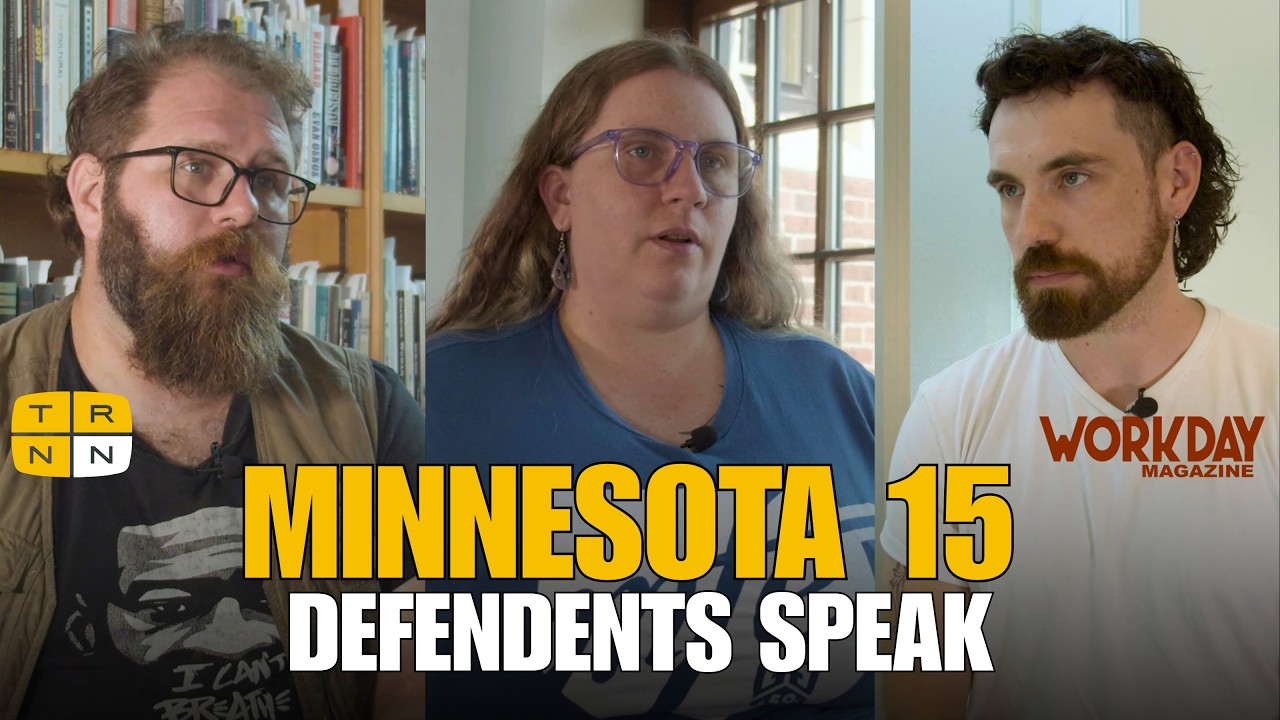
Three 'Minnesota 15' Defendants and rank-and-file union members (left to right: Emmett Doyle, Treasure Thoreson, and Alec Stewart) interviewed in August 2026.

This video report was collaboratively produced and is being co-published by Workday Magazine and The Real News Network 

On the morning of June 16, 2026, 15 people were indicted by the federal government for their involvement in community organizing efforts to oppose Operation Metro Surge in Minnesota this past winter. This group of defendants have become known as the “Minnesota 15,” and over half of them are rank-and-file union members or former union members.

In this special report, collaboratively produced by Workday Magazine and The Real News Network, we speak with three of the “Minnesota 15” defendants about the charges against them and the Trump administration’s attacks on dissent and the labor movement today. Interviewees include: Treasure Thoreson (Minneapolis Federation of Educators, Local 59), Alec Stewart (Minnesota Association of Professional Employees), and Emmett Doyle (Northern Midwest Regional Council of Carpenters).

Credits (Workday Magazine):

  • Reporting and editorial support: Isabela Escalona, Sarah Lazare, Amy Livingston, and Amie Stager
  • Videography: Isabela Escalona and Amie Stager
  • Additional photos and videos: Amie Stager and Riley Bruce
  • Video editing: Isabela Escalona

Credits (TRNN):

  • Post-production: Maximillian Alvarez, Jocelyn Dombroski, David Hebden, Kayla Rivara

Music:

  • Emmett Doyle, “1934 Strike/Cooleys Reel/Congress Reel”
  • Adobe Stock
  • FineTuneMusic

Special thanks to East Side Freedom Library, Minneapolis Central Library, Hosmer Library, and Minneapolis Federation of Educators.

Transcript

The following is a rushed transcript and may contain errors. It will be updated.

Treasure Thoreson:

Tuesday morning, June 16th, I had just woken up. I was in my pajamas. I hear a knock on the door at seven in the morning, and it’s a woman standing there in business clothes with a tactical vest on top that said Homeland Security.

Alec Stewart:

I was in my car backing out of my garage to go to work, coffee in hand. As soon as I backed out of my parking pad, several squads rolled up. A bunch of agents jumped out of the vehicles. I went to just text my aunt, because I have a dog. I assumed I’d be going to jail or something, and that’s when they smashed my window.

Treasure Thoreson:

I see six more agents standing in front of my house. The woman at the door, she just said, “We’re here with a warrant for your arrest for a conspiracy to harm or impede a federal officer.”.

Alec Stewart:

Exposes that while the government was targeting immigrant communities, tearing families apart, abducting children and murdering spokes in the street.

Emmett Doyle:

I had just typed in on my phone the location of the house that we were working on that day. I was boxed in by a vehicle, and so I rolled my window down to ask the guy like, “Hey, what’s the deal? You’re a pretty bad driver. What’s going on?” And then I looked around and I realized that my car had been surrounded. There was a swarm of armed federal officers with HSI on their uniforms.

Alec Stewart:

I do not think it’s a coincidence that over half of us are rank and file union folk. I think that speaks to, again, the working class nature of both the attack by the federal government and the working class predominant response to that attack.

Treasure Thoreson:

We had at least one person from every single site who was plugged into our committee and was able to get information out to their members and arm their building with the knowledge that they needed to face this kind of violence. And people stepped up in really major ways. Everybody did something, whether it was patrols or walking students to and from school, riding in a cab with a kid to and from school, making sure that their parents had rent money. There were some schools in the district that were delivering hundreds of boxes of food every week.

Emmett Doyle:

The unions that did get involved, I think understand what the labor movement is about in a way that some of our other unions have forgotten. An injury to one is an injury to all isn’t just a moral statement. It’s a hard reality of life. And the unions that stood up during Metro search understood that and demonstrated what solidarity means.

Treasure Thoreson:

We got a lot of great information from the Chicago Teachers Union who had been fighting back ice for months at the point when they came here. But we learned a lot from their struggle and were able to adapt that to fit what we were doing here in Minneapolis.

Alec Stewart:

And that was all without coercion, without money exchanging hands. That was just horizontal organizing. And I think how effective that is, how the power of mutual aid and horizontal organizing is evident because of this indictment. This wouldn’t have happened if what thousands of Minnesotans were doing hadn’t worked. I think the success of the January 23rd general strike speaks to that connection of the labor movement and just seeing the numbers and the outpouring of support for such a strike is historic.

Emmett Doyle:

I think that the general strike that happened in Minneapolis terrified the federal government. There were downtown, just hundreds of thousands of workers in the streets marching. And people have to remember this was severe sub-zero. It was a fantastic feeling of power and of joy and of resistance. And unfortunately, the next day that joy and resistance was answered tragically with the brutality of the beating and murder of Valence Preddy. But I think that the general strike was a major turning point in the regime’s logic of violence that they realized they couldn’t defeat the city.

Background music:

Stores are getting thin. There’s passing down that’s going on. Scabs anymore. We’ll put ourselves in union down this year of 34. Can’t you hear the mark? Either sign or behind. See the times get better when we hold that picket line.

Alec Stewart:

The revelation of Operation Puppet Master exposes that while the government was targeting immigrant communities, tearing families apart, abducting children and murdering our neighbors in the street, they were also attempting to disrupt and dismantle one of the facets of Minnesota that makes us so unique. And that is our strong and unified labor movement.

Isaac Sant:

This is not just an attack on me and my friends and our little group. This is an attack on our entire community. They were spying on us from day one. In fact, five days before Operation Metro Surge was declared on November 28th, they began spying on our organizations. These prosecutions were inevitable. Somebody was going to be on trial in there. If it wasn’t us, it was going to be somebody else. It was going to be one of you. We were being prosecuted for doing something that every single person that everybody and their mom in Twin Cities did to resist their federal occupation.

Emmett Doyle:

This case is meant to intimidate the entire community. It’s meant to tie up the time and efforts of many activists. But beyond that, as a conspiracy case, what they’re trying to do is set up a situation where they can expand and expand and expand the conspiracy. They’re trying to use our own solidarity and close-knit community against us through guilt by association.

Treasure Thoreson:

They want us to be separated. They want to separate out the good protestors from the bad protestor. I don’t want folks to feel afraid to stand up for their neighbor and do the right thing.

Alec Stewart:

It was such an obvious threat on what the Twin Cities is all about, which is community connections and helping each other’s neighbors. And the face of fascism, complacency, I think has no place. I think there was just a very justified feeling of standing up.

Emmett Doyle:

The support and solidarity towards us by our community has been overwhelming in just the most amazing way. I

Treasure Thoreson:

Think that they see our ability to bring people together as threatening. However, going after the 15 of us isn’t going to stop anything in Minneapolis or the Twin Cities because this is a place full of great organizers. We can’t let them bully us out of doing the right thing. We need to stand strong in our values and our morals and know that we are protecting our neighbors and that is the right thing to do. They’re afraid of us and that’s why we’re getting this response.

💾

We speak with three union workers who are among the “Minnesota 15” defendants the Trump administration is targeting for organizing to defend their Minneapolis communities from ICE earlier this year.
  •  
❌