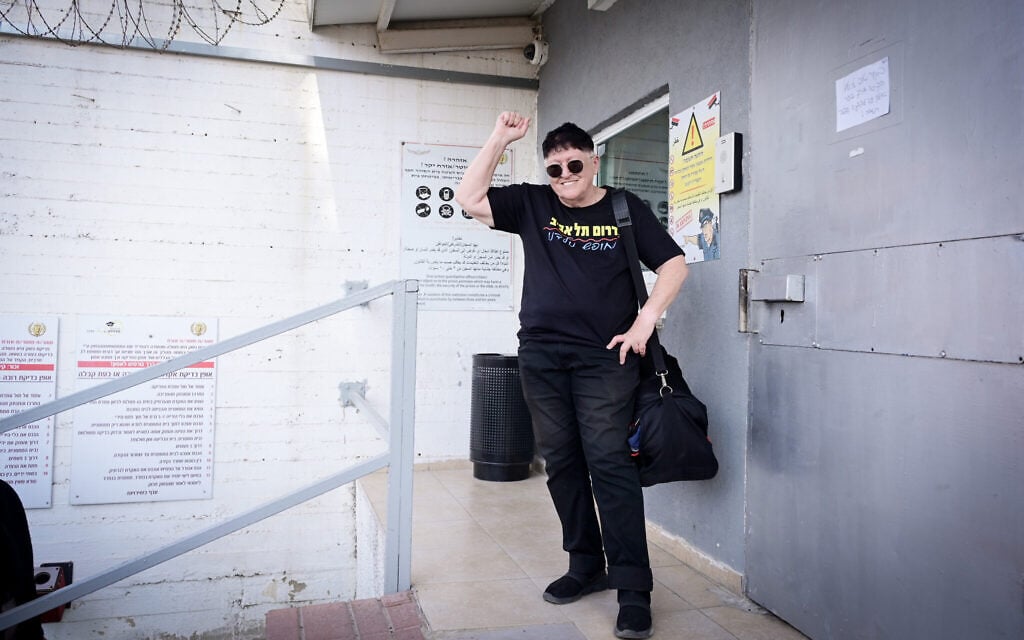
Paz's activism drew sharp criticism from some south Tel Aviv residents and strong support from right-wing politicians; she acknowledged the toll it took on her supportive family
Is there an exception to the 5th Amendment's promise that government cannot take private property without "just compensation"? The Supreme Court declined to address that question this past Monday when it rejected a trio of petitions asking the justices to consider whether people should be compensated when law enforcement seizes or destroys their property.
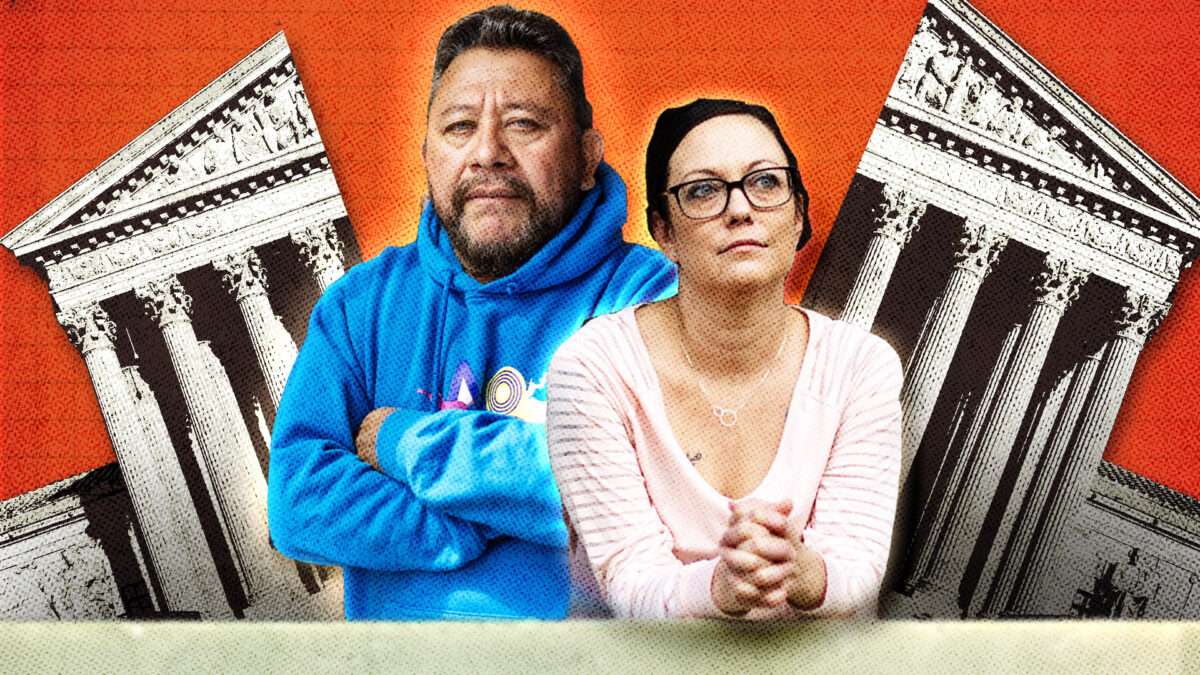
Two of the cases concerned individuals who were not accused of a crime but whose property nevertheless became collateral damage as police pursued a suspect. In June 2022, police fired 30 tear gas canisters into Amy Hadley's home in South Bend, Indiana. Officers smashed windows, tore down security cameras, ransacked furniture, ripped down a panel and a fan, and punched holes in the walls as they searched for a fugitive named John Parnell Thomas, who had never been there. The police had erroneously concluded that Thomas accessed the internet via the IP address at Hadley's home. According to Hadley, the police caused at least $16,000 in damages, which insurance only partially covered.
About two months later, a SWAT team in Los Angeles arrived at Carlos Pena's North Hollywood printing business and destroyed it, along with his equipment inside, crippling his livelihood after a fugitive broke in and barricaded himself in the shop. (The suspect ultimately escaped.) Pena alleged approximately $60,000 in damages in his suit against the city, which declined to compensate him for his losses. His insurance also refused to step in—as is common in such cases, as policies often exclude damage caused by the government.
The third petition concerned Chicago drivers whose vehicles were seized by the city over modest unpaid parking tickets. Ryan O'Donnell's vehicle was impounded and sold for scrap because of about $524 in debt. Michael Goree's was seized and relinquished to the lienholder over a debt that did not belong to him; the $560 in unpaid tickets were for a different vehicle owned by his co-signer.
In all of these cases the lower courts' reasoning came from a similar place. Hadley, O'Donnell, and Goree's petitions were heard by the U.S. Court of Appeals for the 7th Circuit, which has adopted a categorical rule: Property destroyed in the exercise of "police power" is immune to claims under the Takings Clause, the U.S. Constitution's pledge that government cannot usurp private property without fairly compensating the owner. Pena's case went to the U.S. Court of Appeals for the 9th Circuit, where the judges have declined to issue such a sweeping exception but have instead ruled that governments are exempt from paying out claims when the police actions in question were "necessary."
In a statement, U.S. Supreme Court Justice Sonia Sotomayor, joined by Justice Neil Gorsuch, outlined the many inconsistencies between the circuits on the topic. "It is still an 'open question' whether these or any other approaches are consistent with this Court's precedents. Few of these decisions likewise explain the source of any such police-power exception to the Takings Clause—whether the common law, the Constitution, or elsewhere," she wrote. "Such questions thus continue to 'benefit from further percolation' in the lower courts before this Court chooses to intervene."
Sotomayor was quoting herself. In 2024, she released similar remarks in response to a petition from Texas woman Vicki Baker, whose house in McKinney had been hollowed by a SWAT team attempting to capture a fugitive. The high court declined to hear Baker's case, although she finally found relief under the Texas state constitution this year.
"It's possible that the Court sincerely doesn't think the lower courts have done enough thinking on this important but novel issue," Patrick Jaicomo, a senior attorney at the Institute for Justice who represented Hadley, tells me. "Still, we've brought them 5 cases from 5 circuits. How much more percolation is needed?…The Court is going to have to address this important issue, and it's not clear what another circuit decision or 6 might do to aid that consideration."
Though Sotomayor's statement ran in parallel to the one two years ago, its slightly sharper warning intimated that we may be inching closer to a resolution. "I again encourage courts considering this issue to take care," she wrote, "that due deference to state police powers does not eclipse constitutional rights."
Hillary Clinton may no longer be the most influential voice in the Democratic Party, but she remains a member in good standing of the party establishment. So when she expresses support for expanding the number of justices on the Supreme Court, it tells us that what was once a radical idea has gone mainstream.
“We should seriously look at expanding the court while the Democrats are in power,” Clinton said on a recent podcast. “You know, it used to be that you’d have one justice for each circuit. We now have 13 circuits, we should have 13 justices.”
Adding four justices to the court is just one of the potential reforms that have been suggested as a way of curbing the court’s abuses. Others include 18-year term limits for justices, ethics rules with actual teeth (no more billionaire-funded junkets for you, Justice Thomas) and limits on the court’s ability to strike down any law they don’t like. Whichever particular reforms one prefers, it is no longer acceptable for a Democrat to simply decry the latest awful ruling. They have to be willing to entertain fundamental change to the institution.
This shift in Democrats’ thinking is as remarkable as it is recent. Five years ago, Sen. Ed Markey introduced a bill to do just what Clinton and others now favor, adding four justices to the court; it got only two co-sponsors, Sens. Elizabeth Warren and Tina Smith. Joe Biden responded to demands for court reform with Washington’s favorite way of burying an issue: He appointed a commission to study it. They produced a lengthy white paper, but it wasn’t until July 2024 — after he pulled out of the presidential race — that Biden finally endorsed term limits and an enforceable ethics code.
The situation today is far different. Supreme Court reform will almost certainly be part of the 2028 Democratic platform, and just about every politician considering a presidential bid has already come out for at least some version of reform.
What changed? The most important factor is the court’s own behavior. There are the monumental decisions: overturning Roe v. Wade, gutting the Voting Rights Act, eliminating any meaningful restrictions on billionaires pouring money into campaigns, outlawing affirmative action in education and giving the president immunity from prosecution for crimes, among other things. Taken together, the court’s conservative majority is so obviously pursuing its own partisan political project: to remake the law and the structure of the federal government in line with their personal preferences. Yet the justices pretend that they and only they are truly committed to the framers’ intentions and the text of the Constitution.
“We are not part of any political movement, and we are not attempting to further any political agenda,” said Samuel Alito, the most partisan justice on the court. “People think we’re making policy decisions,” lamented Chief Justice Roberts earlier this year, when nothing could be further from the truth. So says the man who has steered the court’s stampede to the right, including achieving his lifelong goal of destroying the Voting Rights Act.
Even Elena Kagan, the most conciliatory of the liberal justices, said in a recent speech that the court’s decisions rubber-stamping partisan gerrymandering showed “a lack of the appropriate concern or understanding of the consequences of their decisions.” With all due respect, Kagan was mistaken: They know exactly what the consequences of their decisions are. That’s why they rule the way they do.
So thanks to the conservative justices, Democrats are moving toward a consensus on court reform. There is no left versus center division within the party on whether the court’s decisions have or haven’t created a crisis. The only question is what should be done about that crisis. Anyone wanting to lead the party is going to have to be willing to take on this court and rebalance the scales. If they don’t, their constituents won’t stand for it.
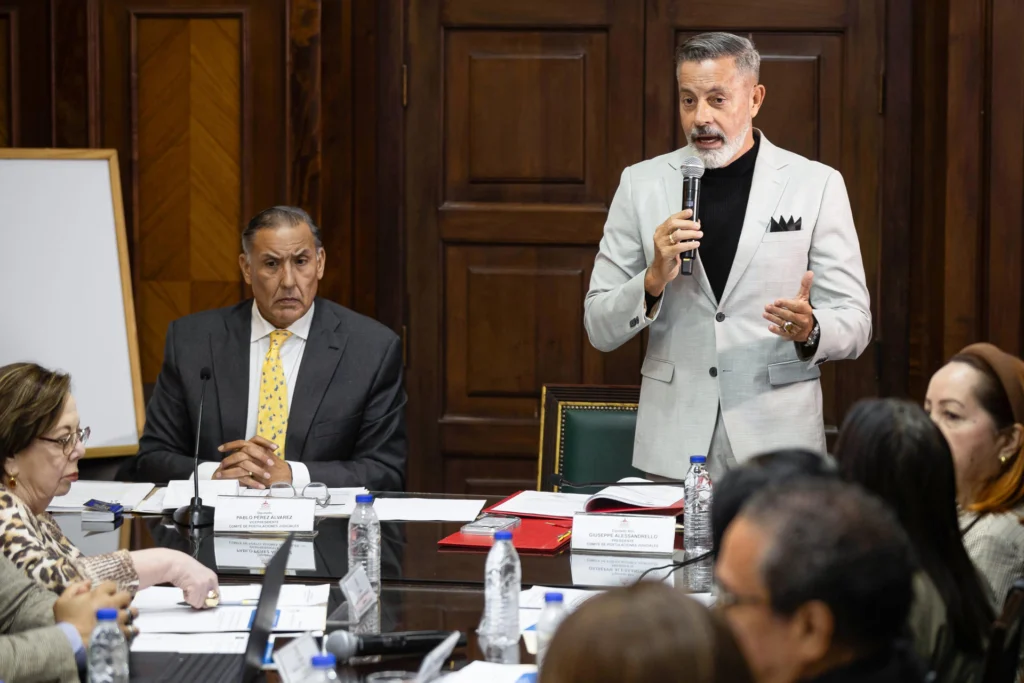
Venezuela’s National Assembly installed a Judicial Nominations Committee on Friday to evaluate and select new Supreme Court justices, a step lawmakers described as central to consolidating institutional stability.
The committee was formally established on October 23, at the Federal Legislative Palace in Caracas, one day after being sworn in during a legislative session.
Giuseppe Alessandrello, who presides over the body, announced that its immediate task is to draw up a work schedule under the Law of the Supreme Court of Justice.
Alessandrello said the law opened the selection process to ordinary citizens. Writing on social media, he stated that the legislation brought people into the work of “evaluating and selecting the leadership, in this case of the Supreme Court of Justice, to seek plurality.”
#23Oct || Desde el Palacio Federal Legislativo se realiza la Instalación del Comité de Postulaciones Judiciales. pic.twitter.com/MczZA2GxJ7
Text reads: “From the Federal Legislative Palace is carried out the installation of the Judicial Applications Committee.”
The committee operates within a broader national dialogue that authorities describe as “building a new Venezuela.” Officials have repeatedly framed the judiciary as the institution responsible for guaranteeing what they call true and just peace among citizens. “The judicial branch is the institution that will guarantee peace among us,” Alessandrello said.
The work schedule will set specific periods for the call for nominations, the evaluation of candidates, and the handling of challenges and responses.
The final goal is to present a definitive list of eligible candidates to the National Assembly.
Alessandrello stressed the weight of the assigned tasks, linking them directly to institutional stability. The committee’s operational work and the eventual delivery of the list will follow the terms and periods established by current law.
The process is governed by the Organic Law of the Supreme Court of Justice and the Constitution of the Bolivarian Republic of Venezuela. It covers the selection of both principal and alternate justices of the Supreme Court of Justice.
Subrayó el rol clave de la ciudadanía:
"La ley incorporó a los ciudadanos y ciudadanas de la sociedad en este trabajo de evaluar y seleccionar a las directivas, en este caso del Tribunal Supremo de Justicia, para buscar la pluralidad". pic.twitter.com/LhNVkaK6ov
Text reads: “The President of the committee, Giuseppe Alessandrello, highlighted the group’s harmony: “Everything we produce is decided unanimously and the auspices with the work of the committee are positive.” He also emphasized the importance of plurality in this process. He stressed the key role of citizenship: “The law incorporated citizens of society in this work of evaluating and selecting directives, in this case from the Supreme Court of Justice, to seek plurality.”
Selecting Court Leadership
The mandate extends beyond the high court itself. It also includes related judicial positions, among them the directorship of the National School of Magistrates.
The committee emerged from a process announced earlier this month. The National Assembly opened the nomination period between October 2 and October 9, allowing interested citizens and institutions to take part in the selection of the court’s leadership.
Once the schedule is finalized, the committee will move through successive phases, receiving nominations, reviewing candidates, and addressing any challenges filed against applicants. Each challenge will carry its own opportunity for a formal response before the list reaches the legislature.
The final list of selected candidates will be delivered to the National Assembly for consideration. The body’s work therefore functions as a preliminary filter within a process whose ultimate decisions rest with the legislature.
Welcome back, Deadline: Legal newsletter readers. Supreme Court justices were off the bench this week because they’re in between their October and November hearing sessions. But they still made plenty of news, in both their written work and public comments.
They started by adding two potent cases to a docket that is growing this term in both size and importance. Following last week’s agreement to review a discovery dispute over Elon Musk’s purported government efficiency effort, on Monday the court added two more appeals: on race in middle school admissions and congressional authority to ban home distilling. The court will keep adding cases throughout the year, with all the rulings in argued cases typically coming by July.
Justices Sonia Sotomayor and Neil Gorsuch were together again, speaking out for the second week in a row about a case the court refused to hear. Last week, Gorsuch joined Sotomayor to lament what they saw as unjust prosecution. This week, the Trump appointee joined the Obama appointee to critique what they saw as constitutional problems with car seizures in Chicago. It’s not new for this duo to team up in a certain type of case that lends itself to bipartisan agreement, but they have been ramping up that agreement so far this term.
Sotomayor’s statement appeared on the order list, which, as regular readers know, is an important document that announces the latest actions on pending petitions. That’s where we learned about the two new cases that the court took up and the (much longer) list of cases the court rejected. It takes four justices on the nine-member bench to grant review, and the court denies most petitions.
But Sotomayor’s statement reminds us that the justices occasionally offer their thoughts even when, as here, they agree with the denial but still find it important to highlight broader issues. These writings help us understand the justices’ priorities and what new cases the court might take up in the future.
Another sort of signal came from Justice Samuel Alito, who didn’t explain himself but noted that he wanted to review one of the petitions the court denied on the list. The failed petition came from Missouri officials who wanted the court to revive a rule that registered sex offenders must put signs on their doors for Halloween that read, “No candy or treats at this residence.” An appeals court said the rule wrongly compelled speech under the First Amendment. Although Alito merely noted, without explanation, his difference of opinion, the vote fits with his overall approach, because he generally backs law enforcement and has split from his colleagues in other First Amendment disputes.
Alito had company later in the week when the court rejected the Trump administration’s request to immediately enforce its preferred policy on gender-affirming care in prison. The justices did not explain the rare (albeit temporary) win for transgender people at a court that has ruled against them in a series of other cases. But whatever the justices were thinking, we know it wasn’t unanimous, because Alito and Justice Clarence Thomas both indicated (also without explanation) that they wanted to grant the government’s request.
Justice Elena Kagan made news outside her written work, with an appearance at a law school in Washington, D.C., the sort of speaking engagement that the justices will do from time to time. Kagan, who was dean of Harvard Law School before she became a justice, gave her GOP-appointed colleagues a failing grade when it comes to democracy. Reprising impassioned criticisms of rulings on voting and campaign finance that she has made in dissenting opinions, the Obama appointee said the court “has kind of blinded itself to the very deleterious effect of their rulings on how the political system works and has created a democracy that does not work as well as it should.”
Kagan apparently agreed with her colleagues this weekin an election case, when the Supreme Court granted a Republican-backed request from New Hampshire to block the use of student IDs for voting in the midterms. In a brief unsigned order, the high court chided a lower court judge for, as the justices saw it, improperly interfering with state rules right before an election. Justice Ketanji Brown Jackson was the only one to publish a dissent, in which she contended the judge was justified in trying to protect voting rights.
The justices are still off the bench for another week, as they are set to return to the courtroom in November to hear the next batch of regularly scheduled arguments. But as Election Day approaches on Nov. 3, they will continue to field unscheduled emergency applications on voting and whatever else comes their way.
Subscribe to theDeadline: Legal newsletterfor expert analysis on the top legal stories of the week, including updates from the Supreme Court and developments in the Trump administration’s legal cases.
“If Donald Trump defies court orders because the Supreme Court said he cannot be prosecuted for actions he takes as president, could those people who carry out his illegal requests be prosecuted or fined even though they are acting on his orders?” — Kit Read
Hi Kit,
Maybe.
The Supreme Court’s 2024 ruling in Trump v. United States only dealt directly with criminal immunity for presidents, holding that they have at least presumptive immunity for all official acts, as well as absolute immunity for acts within their “conclusive and preclusive” constitutional authority.
What all that means in practice hasn’t been fully fleshed out. It would take a follow-up case to clarify the ruling’s limits, and it’s unclear if or when such a case will come.
At any rate, the court focused on presidents in that ruling. It did not grant immunity to aides acting on the president’s behalf.
Yet, while arguments have been made against subordinate immunity, it’s technically an open question that the justices haven’t decided one way or the other.
So the answer to your question at the moment is: maybe.
But you might wonder: What could the argument be for immunizing presidential underlings?
One scholarly account argued that the logic of the immunity ruling “renders the President’s subordinates absolutely immune for a potentially broad range of official acts, even if those acts are otherwise unlawful.” That’s because if the president has complete power over executing the law, then, the argument goes, subordinate actions that implement that power are lawful, as opposed to being unlawful but immune from prosecution.
As with clarifying the immunity ruling’s limits as it applies to presidents, whether the Supreme Court will decide the subordinate immunity question depends on the court taking an appeal that raises that issue in the future. And as with presidential immunity itself, there is no clear candidate for an appeal the court would take to answer that question.
Either way, if a president wants to ensure that any of his henchmen won’t be federally prosecuted, he could always pardon them.
The Supreme Court on Thursday ruled New Hampshire’s top election official can fully stop voters from using their student IDs when showing up to the polls in the midterms — a request backed by the Republican National Committee (RNC). A lower judge ruled officials had improperly gone further than a new state law placing restrictions on…
A nearly unanimous Supreme Court has granted New Hampshire’s emergency request to block the use of student IDs for voting in the November midterm elections.
The case raised a recurring theme at the high court about the propriety of judgesintervening on the eve of political contests, against the familiar backdrop of GOP-backed voting restrictions purporting to ensure election integrity.
On Thursday, the majority said that the district court judge who ruled against the state failed to justify deviating from the general principle that federal courts shouldn’t alter election rules on the eve of an election. Justice Ketanji Brown Jackson dissented, writing she “would not disturb a clearly justifiable federal-court order issued to ensure that the public receives accurate information about a State’s electoral processes.”
The Biden-appointed justice said she wasn’t as sure as the majority that the judge’s action falls under that general noninterference rule, known as the “Purcell principle.” She said the judge was trying to address alleged misinformation rather than change state law.
“When a federal court determines that material misrepresentations are being made about a State’s election rules, an injunction to prohibit that conduct does not contribute to public confusion, it prevents that very problem,” Jackson wrote in her solo dissent.
While New Hampshire’s federal representatives are Democrats, Republicans run the state government. Gov. Kelly Ayotte signed a bill into law this year that prohibits the use of student IDs for voting.
A New Hampshire-based nonprofit called Coalition for Open Democracy sued the state over the law, which the group said needlessly burdens young voters under the guise of trying to solve the “non-existent problem” of nonresident voter fraud.
In a ruling earlier this month, U.S. District Judge Joseph Laplante refused to block the law, called HB 323. But the George W. Bush appointee said related guidance from New Hampshire Secretary of State David Scanlan, a Republican, went too far. Laplante said Scanlan overstepped in barring election officials from considering student IDs even as evidence under a “safety-valve provision” that lets voters prove who they are if they don’t otherwise have a proper photograph.
“The State has offered no independent justification for that broader prohibition,” wrote Laplante, explaining that such justification is needed even for minimal burdens on voting rights. He blocked enforcement of Scanlan’s directive to the extent it “prohibits or discourages election officials from considering student IDs as evidence of voter identity,” and he ordered the secretary of state to issue revised guidance for the midterms.
Laplante declined to halt his ruling, as did an appellate panel over dissent from a Trump-appointed judge. State officials then turned to the justices in Washington, arguing that Laplante’s order risks late-breaking confusion. The Republican National Committee filed an amicus brief supporting the state.
Opposing the state’s emergency application, Open Democracy said granting the application would be the chaos-inducing move. The group noted that Scanlan had already quickly complied with the order to provide revised guidance, and that his website “has told voters since the October 2 Order that supervisors may consider a student ID along with other evidence.”
That guidance is now the status quo, Open Democracy observed. Therefore, it said, granting the state’s application would “reverse the rules for a second time in a month.”
Subscribe to theDeadline: Legal newsletterfor expert analysis on the top legal stories of the week, including updates from the Supreme Court and developments in the Trump administration’s legal cases.
On December 2, the Supreme Court will consider constitutional challenges to "assault weapon" bans in Connecticut and Cook County, Illinois, that cover widely owned rifles, including the AR-15. As the plaintiffs in those consolidated cases see it, such laws plainly violate the Second Amendment because they prohibit arms in common use for lawful purposes. In briefs filed on Wednesday, Connecticut and Cook County urge the justices to reject that test, saying a weapon's popularity is not dispositive. The relevant question, they say, is whether their rifle restrictions fit a historical tradition of banning "unusually dangerous weapons."
Cook County and Connecticut have the burden of showing that their laws are "consistent with this Nation's historical tradition of firearm regulation," the test established by the Supreme Court's 2022 decision in New York State Rifle & Pistol Association v. Bruen. On the face of it, that is a daunting challenge.
In the 2008 case District of Columbia v. Heller, the Supreme Court said the Second Amendment protects the right to own "bearable arms" that are "in common use" for "lawful purposes like self-defense." That description indisputably encompasses "AR-15 platform and similar semiautomatic rifles," the firearms at issue in these cases. But Heller also recognized "the historical tradition of prohibiting the carrying of 'dangerous and unusual weapons.'" Cook County and Connecticut argue that the rifles they have deemed intolerable fall into that category.
"There is a robust historical tradition of regulating unusually dangerous weapons that
compromise public safety," Cook County says. "Such regulations, which long
predate the founding, have included outright bans and other restrictions on exceptionally dangerous weapons like launcegays, trap guns, Bowie knives, and slung shots."
Cook County argues that its ordinance is "relevantly similar" to those historical restrictions because it targets "exceptionally lethal weapons that are disproportionate to the end of self-defense." AR-15s are "offensive weapons of war designed for maximum lethality and are not customarily used for self-defense," the brief says. "The purpose and operation of the ban is consistent with our Nation's historical tradition and accounts for the exceptional dangerousness of these technologically advanced weapons."
The ban is "an appropriate contemporary restriction implemented by the legislature in response to dramatic technological change and unprecedented societal concern," the brief says. "It is tailored to respond to the particular dangers presented in areas with mass casualty exposure and acute public safety risk."
Connecticut offers a similar argument. One problem with this defense is the premise that "assault weapon" bans focus on "exceptionally lethal weapons." As critics of such laws have been pointing out for decades, the features they target, such as folding stocks, pistol grips, and barrel shrouds, do not affect a rifle's basic operation. With or without them, a rifle fires the same ammunition at the same rate with the same muzzle velocity. And because AR-15s use intermediate-caliber ammunition, they are arguably less lethal than shotguns and many hunting rifles that are not classified as "assault weapons."
Cook County's emphasis on technological developments is also questionable. Constitutional guarantees establish principles that courts routinely apply to technologies that did not exist at the founding. Although the Framers did not have radio, television, or the internet, for example, the First Amendment nevertheless constrains government regulation of those media.
More specifically, Heller rejected the idea that modern weapons are not covered by the Second Amendment by recognizing a constitutional right to own semiautomatic pistols. The Supreme Court said "the Second Amendment extends, prima facie, to all instruments that constitute bearable arms, even those that were not in existence at the time of the founding." The Court confirmed that point in the 2016 case Caetano v. Massachusetts, which involved a state ban on stun guns.
Cook County also asserts that AR-15s are not suitable for self-defense, a claim that would be hotly contested by many owners of such rifles, who commonly report using them for that purpose. "Plaintiffs have shown that AR-15s are well-adapted for self-defense," U.S. District Judge Peter Sheridan wrote in 2024, when he reluctantly concluded that New Jersey's AR-15 ban was inconsistent with Heller while expressing his dismay at that result. "Evidence has been presented to the Court that the build of the AR-15 makes it well-suited to self-defense because it is 'light weight, [has] very mild recoil, and [has] good ergonomics'; it is a weapon which is 'well suited to younger shooters, female shooters, and other shooters of smaller stature.'"
Sheridan added that "the AR-15's design features—including the effectiveness of its cartridge for self-defense use and its better continuity of fire when used with available magazines—make the AR-15 a good choice for self-defense." And he noted that "the AR-15 has been used recently in several, relatively high-profile self-defense events in Florida, Illinois, Texas, Pennsylvania, and Oklahoma."
Cook County and Connecticut are also wrong in suggesting that self-defense is the only "lawful purpose" that matters. While Heller emphasized the use of handguns "in defense of hearth and home," it did not say that was the full extent of the Second Amendment right. To the contrary, the phrase "lawful purposes like self-defense" implies that the right extends to other uses, such as hunting, pest control, and target shooting. The decision explicitly mentioned hunting as a "reason Americans valued the ancient right."
The briefs are misleading in another way that may prove decisive. They conflate "dangerous and unusual" with "unusually dangerous," which is not the same thing.
During the 19th century, state legislators restricted (and sometimes banned) weapons such as Bowie knives, spears, sword canes, slungshots, and brass knuckles. But the historical evidence suggests those weapons were not targeted simply because they were "unusually dangerous." Legislators were also concerned about how the weapons were typically used.
Solicitor General D. John Sauer, who filed a brief supporting the challenges to the AR-15 bans, notes that the 19th-century laws targeted weapons associated with "duels, brawls, and other criminal activities." And in reviewing those laws, state courts distinguished between arms favored by criminals and arms commonly used for lawful purposes.
In 1871, for example, the Tennessee Supreme Court held that legislators could ban weapons that were "not usual" but could not ban "the usual arms of the citizen." The top courts of Texas, Arkansas, West Virginia, North Carolina, and Michigan concurred that the right to arms encompassed weapons commonly owned by law-abiding people, including rifles.
AR-15s and similar rifles readily pass that common-use test. In January, the National Shooting Sports Foundation, the gun industry's trade association, reported that Americans own more than 32 million "modern sporting rifles," its preferred term for the models covered by "assault weapon" bans. Survey data suggest that somewhere between 16 million and 25 million Americans have owned AR-15-style rifles. Last year, a unanimous Supreme Court described the AR-15 as "the most popular rifle in the country."
According to Cook County and Connecticut, however, none of that matters. "Once it is established that a regulation pursues a legitimate public safety objective in a permissible manner, raw ownership numbers cannot immunize a firearm from regulation," Cook County says. It argues that opponents of its ordinance have misconstrued the significance of the common-use test and misunderstood how it interacts with Bruen.
"When the Second Amendment's plain text covers an individual's conduct, the Constitution presumptively protects that conduct," the Supreme Court said in Bruen. "To justify its regulation, the government may not simply posit that the regulation promotes an important interest. Rather, the government must demonstrate that the regulation is consistent with this Nation's historical tradition of firearm regulation. Only if a firearm regulation is consistent with this Nation's historical tradition may a court conclude that the individual's conduct falls outside the Second Amendment's 'unqualified command.'"
The common-use question, Cook County argues, figures only in the first Bruen step: "the inquiry whether the weapon at issue is one 'the Second Amendment protects.'" But even if ownership of AR-15s is covered by "the Second Amendment's plain text," it says, that does not resolve the question of whether they can be banned, which depends on the historical analysis required by the second step of the Bruen test.
"This Court's decision in Bruen confirms that the Second Amendment's step-two inquiry does not insulate popularly owned firearms from regulation," the brief says. In Bruen, it was "undisputed" that "handguns are weapons 'in common use' today for self-defense," including "outside the home." But "instead of being the end of this Court's inquiry, that observation was just the beginning." The decision also included an "extended analysis" of the historical laws that New York cited to justify its "proper cause" requirement for carry permits. "If lawful common use alone were enough to forbid regulation," Cook County argues, "there would have been no need to engage in that careful and prolonged analysis."
The question in Bruen was not whether the Second Amendment precludes "regulation." It was whether New York's specific approach, which required residents to demonstrate a "special need" before they were allowed to exercise the right to bear arms, was consistent with the historical tradition. That is why the Court considered (and rejected) the purported historical analogs that New York offered.
Cook County conflates requirements for carry permits, the issue in Bruen, with an outright ban on ownership, the policy it is defending. Connecticut likewise blurs the distinction between carry restrictions and complete prohibition.
"The Bowie knife was 'widely carried by Americans of all stripes,' including 'upstanding citizens and villains' alike," Connecticut's brief says. "The widespread use of Bowie knives and other weapons for lawful purposes did not prevent dozens of States from restricting those weapons." But those laws generally restricted or banned public carry. They rarely made it illegal to acquire or possess a Bowie knife, which is the approach that Connecticut and Cook County have taken with AR-15s.
That policy is hard to reconcile with Heller. I will quote Sheridan again, since his comments made it clear that he would have preferred to uphold New Jersey's AR-15 ban. Under Heller, he said, "a categorical ban on a class of weapons commonly used for self-defense is unlawful." Given "the Supreme Court's clear direction on this point," he concluded, New Jersey's law "is unconstitutional" as applied to "the Colt AR-15 for use for self-defense in the home."
Last July, the U.S. Court of Appeals for the 3rd Circuit agreed and went further, extending that conclusion to "the full class of semi-automatic rifles" banned in New Jersey. "Together, Heller and Bruen teach that bans or broad prohibitions on possessing or carrying of a class of weapons in common use for lawful purposes fail to find support in our Nation's tradition of firearm regulation," Judge Arianna Freeman, a Joe Biden appointee, wrote in the majority opinion. "That principle resolves our inquiry here."
To beat back the challenges to their laws, Connecticut and Cook County will have to persuade the justices that the 3rd Circuit's understanding of Heller and Bruen is wrong, meaning they are free to ban firearms in common use for lawful purposes. That seems like a tall order, and Cook County's position is especially puzzling. According to its brief, the fact that a weapon is covered by the Second Amendment does not mean Americans have a right to possess it. The more you think about that claim, the less sense it makes.
On November 3, the U.S. Supreme Court will hear oral arguments in a case that asks whether Colorado has unlawfully discriminated against a religious preschool because the school is barred from participating in the state's universal preschool program due to its refusal to accept LGBTQ families. In addition to involving multiple hot-button political and cultural issues, the case also has big implications for the future of federal antidiscrimination law.
St. Mary Catholic Parish v. Roy is not about a state law that directly prohibits a religious preschool from operating. Rather, at issue here is a government requirement that any preschool that wants to participate in the state's universal preschool program, and receive the public benefits that follow, must first satisfy various criteria, including that "each preschool provider provide eligible children an equal opportunity to enroll and receive preschool services regardless of race, ethnicity, religious affiliation, sexual orientation, gender identity, lack of housing, income level, or disability."
According to the Catholic preschools overseen by the Archdiocese of Denver, however, complying with that rule would force the schools to violate their religious beliefs. "It is undisputed that these preschools would otherwise be eligible [universal preschool] providers," the schools told the Supreme Court. "They are excluded solely because of their religious exercise—namely, their religious practices of ensuring that all enrolling families are supportive of the Catholic Church's teachings on sex and marriage and of treating enrolled four-year-olds in accordance with their biological sex."
These schools can point to a pair of recent Supreme Court precedents that will very likely count in their favor. In Espinoza v. Montana Department of Revenue (2020), the Court held that if a state provides educational subsidies that help parents send their children to private schools, the state "cannot disqualify some private schools solely because they are religious." Then, in Carson v. Makin (2022), the Court held that Maine's tuition assistance program violated the Constitution by excluding private schools that offered "sectarian" education. "A State's antiestablishment interest," the decision said, "does not justify enactments that exclude some members of the community from an otherwise generally available public benefit because of their religious exercise."
I would expect the outcome of St. Mary Catholic Parish v. Roy to follow in this same general pattern and hold something to the effect that when a state provides an educational public benefit, it must make some sort of accommodation for the religious views of the recipients.
In Other Legal News
Justice Elena Kagan made news a few months back when she defended her conservative colleagues on the Supreme Court from the oft-heard charge that they are totally in the tank for President Donald Trump. "I don't see this as a court that is just like, 'We're just going to rubber stamp what the current administration does.' You know, quite the opposite," Kagan said. "I think that that is a bad rap." In support of her argument, Kagan pointed to the fact that the Supreme Court had recently ruled against Trump on the two big issues that Trump himself valued the most: tariffs and birthright citizenship.
Kagan was in the news again on Tuesday, this time because she publicly blasted those same conservative colleagues for issuing decisions on voting rights and political gerrymandering that, in Kagan's words, have produced "a democracy that does not work as well as it should." According to Kagan, the Court's conservative majority "has kind of blinded itself to the very deleterious effects of their rulings on how the political system works."
Does this mean that Kagan has now stopped defending the conservative justices from the pro-Trump charge? Not at all. In fact, as The New York Timesput it, "she reiterated her defense of the conservative-dominated bench from a July appearance and said it was a 'bum rap' to suggest the court had been too deferential to Mr. Trump."
I don't know about you, but I find Kagan to be a refreshing public figure in these simplistic, partisan times. She is a staunch legal liberal with clearly stated objections to what the Supreme Court's conservative majority is getting up to, yet she refuses to be associated with the laziest progressive attacks on the Court. How many people of comparable public stature these days are willing to call out the shortcomings of their own side?
The U.S. Supreme Court has denied an emergency petition from the Trump administration, which sought a stay on a lower court’s injunction on a policy that would have denied gender-affirming care to federally incarcerated transgender people.
That policy was implemented by the Bureau of Prisons (BOP) after President Donald Trump signed an executive order in January 2025 that denied the existence of transgender people. The order also directed federal agencies to take steps that would be consistent with that view, and included specific instructions for the BOP.
“The Attorney General shall ensure that the Bureau of Prisons revises its policies concerning medical care to be consistent with this order, and shall ensure that no Federal funds are expended for any medical procedure, treatment, or drug for the purpose of conforming an inmate’s appearance to that of the opposite sex,” the order reads.
After the BOP conformed to the order, a group of incarcerated trans people who had been receiving gender-affirming care sued the administration. The group is being represented by the American Civil Liberties Union (ACLU), which argued that their Eighth Amendment protections against cruel and unusual punishment were being infringed upon.
A federal judge agreed, and, in August, ordered the policy to be blocked. The Trump administration challenged that finding, but the U.S. Court of Appeals for the District of Columbia Circuit upheld it, prompting Solicitor General John Sauer to submit an emergency appeal to the Supreme Court.
The court has regularly ruled against transgender people, allowing state bans on trans athletes’ participation in sports, ruling in favor of a ban on transgender people in the military, and upholding state laws that bar gender-affirming care for trans children and teens. Yet on Wednesday, the court denied the Trump administration’s request.
“The application for stay presented to The Chief Justice and by him referred to the Court is denied,” the order read, giving no further explanation. Two justices for the court — Samuel Alito and Clarence Thomas — would have granted the Trump administration’s request for a stay, the document said.
Around 1,000 federally incarcerated trans people have also been diagnosed with gender dysphoria. The ruling means these individuals can continue receiving gender-affirming care while they remain in federal prisons or jails and the case moves forward in the lower courts.
The Supreme Court on Wednesday refused to allow the Trump administration to immediately enforce new medical restrictions for transgender people in prison. The decision leaves in place a lower-court block on the policy.
On Monday, the Supreme Court agreed to hearAssociation for Education Fairness v. Montgomery County Board of Education. The case, which was originally brought forth in 2020 by the Association for Education Fairness (AFEF), a coalition of Montgomery County, Maryland, parents, alleges that Montgomery County's selection process for magnet programs (gifted programs for STEM and humanities studies in middle schools) violates the Constitution'sEqual Protection Clause by discriminating against Asian American students. The county insists that the selection process is race-neutral.
Montgomery County changed its selection process in the 2021–22 school year. According to reporting from The New York Times, the county was facing pressure from community groups, including the NAACP and Citizens Assisting and Sheltering the Abused (CASA Inc.), over the underrepresentation of black and Latino students in its magnet programs. Previously, students were selected based on test scores and grades. The new process implemented a lottery system in which high-achieving students are placed in a selection pool and selected at random.
The AFEF's central complaint is that the new system factors school poverty levels into the criteria for pool eligibility. This means students' eligibility depends on their scores relative to students in similarly affluent or disadvantaged schools, rather than the general population. They argue that since Asian Americans are concentrated in high-performing, lower-poverty schools, they have to clear a higher bar to become eligible. The group alleges the new system has caused fewer Asian American students to be admitted into magnet schools, a claim that is backed up by admissions data (which also show that the share of Asian American applications has fallen). The AFEF alsocites Montgomery County's 2015 hiring of Metis, a national consulting firm, to recommend ways to make the system more "equitable" as an indication of the county's effort to "racially balance" its magnet programs.
The complaint was dismissed by U.S. District Judge Paula Xinis in 2022, whoruled that the parents hadn't shown the policy disproportionately harmed Asian American students, citing the fact that they made up a larger share of admitted students than of the applicant pool. Xinis drew a distinction between accounting for economic disparities, which she called "wholly permissible," and racial discrimination. "Alleged disparity in treatment based on socioeconomic status alone does not make plausible discrimination on account of race," she wrote in the ruling. The tension raised by Xinis sits at the center of many debates regarding diversity, equity, and inclusion, as factors like poverty levels can often become a proxy for race; therefore, policies that are neutral on their face can still disparately impact a certain race.
In February, the 4th Circuit Court of Appealsupheld the dismissal, ruling that precedent from the Coalition for TJ v. Fairfax County School Board (2023) requires parents to show the policy disproportionately harmed Asian American applicants, which they hadn't. However, there is a real legal question as to whether racial groups should have to prove they were harmed as a group, as opposed to the individual, and lower courts have given mixed answers.
The Pacific Legal Foundation (PLF), a public-interest law firm representing the AFEF, litigated asimilar case in New York City, where the city implemented an economic need index in its admissions process for competitive high schools, aimed at increasing the number of black and Hispanic students. Again, parents alleged that the requirement discriminated against Asian American students. In 2024, the 2nd Circuit Court of Appeals found that if the city intended to discriminate, the parents don't have to prove Asian Americans were harmed as a group and that harm to an individual was enough for the case to move forward. The case was sent back to the district court to determine whether the city intended to discriminate, where it remains pending.
The Supreme Court will now settle the issue anddetermine "whether a plaintiff challenging a facially neutral admissions policy as racially discriminatory must establish that the targeted racial group suffered an aggregate disparate impact relative to its share of the applicant pool," according to SCOTUSBlog.
In a statement on Monday, PLF Senior Attorney Chris Kieser said, "The Constitution protects students as individuals, not as members of a racial group. A school district should not be able to defeat a discrimination claim by showing that its policy did not harm enough Asian American children. Every family deserves admissions rules that judge their child on their own merit."
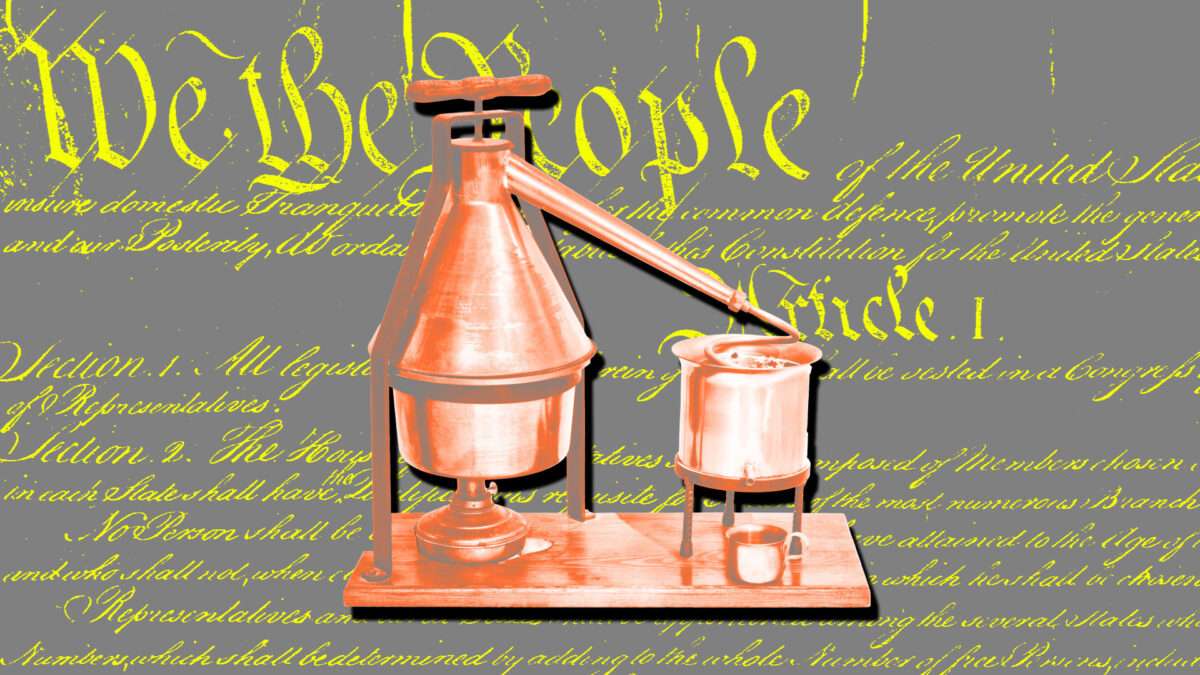
The U.S. Supreme Court's 2026–2027 term just got a whole lot boozier. On Monday, the justices agreed to hear arguments later this year or next in the case of Department of Justice v. McNutt. At issue is whether the 1868 federal ban on distilling liquor at home is unconstitutional because it exceeds the lawful regulatory power of the federal government. If any modern Supreme Court case ever deserved its own drinking game, this one is it.
In April, the U.S. Court of Appeals for the 5th Circuit found the federal ban on home distilling to be unconstitutional because Congress lacked the proper authority to issue such a ban in the first place. It was not a legitimate exercise of the congressional authority "To Lay and collect Taxes," the appellate court reasoned, because "the purpose of a tax is to raise revenue for the government;" yet this law "amount[s] to an anti-revenue provision" that only "prevents distilled spirits from coming into existence." And if it does not exist, of course, the government cannot tax it.
The 5th Circuit also denied that the federal ban on home distilling could be saved by the government's appeal to the Necessary and Proper Clause, which says that Congress has the authority "To make all Laws which shall be necessary and proper for carrying into Execution the foregoing Powers, and all other Powers vested by this Constitution in the Government of the United States, or in any Department or Officer thereof."
But the federal ban on home distilling cannot be "necessary" to the execution of the enumerated taxing power, the 5th Circuit argued, because the provisions of federal law at issue "tax nothing, and are distinct from the regulation of distilling alcoholic products that is permitted by federal tax law."
Nor did the 5th Circuit find the ban to be "proper." "By purporting to ban activity without a plain connection to the exercise of Congress's taxation power," it held, "Congress has essentially—and 'improperly'—invaded the reserved police and regulatory power of the states."
The Trump administration lost this case at the 5th Circuit and has now successfully urged the justices to hear its appeal. In its petition seeking review, the Trump administration faulted the 5th Circuit for its overeagerness to "second-guess" the "legislative judgment" of Congress. Instead, the Trump administration argued, the federal judiciary owes a great deal more deference to the federal government's regulatory priorities in a case like this. "A law is necessary and proper if it is 'convenient' or 'useful' for carrying an enumerated power into effect, and 'plainly adapted' to that legitimate end," the Justice Department's brief argued. "That is the case here."
This case may lead to an interesting divide among the Supreme Court's more conservative members. In United States v. Comstock(2010), a 7–2 Supreme Court embraced the Necessary and Proper Clause as sufficient constitutional grounding for the Adam Walsh Child Protection and Safety Act, which had empowered federal officials to order the indefinite civil commitment of "sexually dangerous" individuals who had already finished serving their prison sentences. Chief Justice John Roberts joined the majority opinion in that case, while Justice Samuel Alito voted in concurrence. In other words, they both endorsed a broad view of congressional power under the Necessary and Proper Clause. By contrast, Justice Clarence Thomas, joined by the late Justice Antonin Scalia, voted in dissent. The Comstock ruling, Thomas protested, "comes perilously close to transforming the Necessary and Proper Clause into a basis for the federal police power that 'we always have rejected.'"
Are we about to see a similar Alito-Thomas split over the proper reach of federal power in this case? And what about Justices Neil Gorsuch, Amy Coney Barrett, and Brett Kavanaugh? Will one or more of them play the Scalia part and similarly reject the Trump administration's broad reading of the Necessary and Proper Clause?
Today, the Supreme Court decided to hear Association for Education Fairness v. Montgomery County Board of Education, a challenge to "facially neutral" discrimination against Asian applicants to selective public magnet schools in Montgomery County, Maryland. The admissions criteria are, on their face, racially neutral. But evidence indicates they were likely adopted for the purpose of reducing the percentage of Asian students in entering classes. More specifically, the case addresses the issue of "[w]hether a plaintiff challenging a facially neutral admissions policy as racially discriminatory must establish that the targeted racial group suffered an aggregate disparate impact relative to its share of the applicant pool." This issue is increasingly important since the Supreme Court banned most explicit racial discrimination in college admissions (and, by extension, school admissions) in SFFA v. Harvard (2023).
The lower court ruled that, even if there is evidence that a facially neutral admissions policy was enacted for the specific purpose of reducing the number of admitted students from a specific racial or ethnic group, it must still be upheld so long as the percentage of admitted students from that group is as high or higher than the percentage of applicants from that group.
Longstanding Supreme Court precedent holds that evidence of unconstitutional motivation for "facially neutral" policies shifts the burden of proof to the government to show that they would have enacted the same policy even in the absence of illicit motives. If they fail to prove that, then the policy must be subjected to strict scrutiny, which it would be unlikely to survive. In the TJ case, the Fourth Circuit majority opinion by Judge Robert Bruce King holds that even the most blatant discriminatory motivations do not trigger strict scrutiny so long as the group being targeted for discrimination by "facially neutral" means is still represented in proportion to its percentage of the relevant population (or more). Under the new admissions policy, Asians were still 54% of accepted applicants (as compared to 73% under the old one). Since that is still higher than the Asian percentage of the applicant pool, evidence of discriminatory intent becomes irrelevant….
I and others have previously compared today's anti-Asian discrimination in selective educational institutions to discrimination against Jewish applicants in earlier eras. Under the Fourth Circuit's reasoning, old-time policies using facially neutral means to reduce the percentage of Jewish students at elite universities would be perfectly legal, so long as Jewish applicants were admitted in the same [or higher] percentages as other groups. And that would be true no matter how extensive the evidence that the new policy was motivated by anti-Semitic prejudices, or that Jewish applicants had to have stronger academic records to be admitted than those required of gentiles.
The same point applies to all kinds of discrimination against racial, ethnic, and religious minorities. So long as facially neutral means are used and the overall success rates of different groups are similar, this reasoning would allow even the most blatant discriminatorily motivated policies intended to reduce the participation of some groups for the benefit of others. There are many situations where members of some minority groups are "overrepresented" in educational institutions, government contracting, and elsewhere, relative to their percentage of the applicant pool or of the general population. Jews, Muslims, Asians, atheists, and Mormons are obvious examples of groups that fit that bill in a variety of educational and professional settings.
If a federal or state government adopted a seemingly neutral policy to try to reduce the percentage of blacks among professional football or basketball players, that too would pass muster, so long as the percentage of blacks in the the relevant pro sports leagues remained at least as high as the percentage of blacks among those seeking employment as players…. Progressives and others inclined to support today's decision should consider whether they are really willing to live with these troubling implications.
Since I wrote the above, the ideological valence of anti-Asian discrimination in education has shifted somewhat. For a long time, many left-wingers defended such discrimination (along with discrimination against white applicants) on the grounds that it is necessary to achieve "diversity" and compensate Blacks and Hispanics for the history of discrimination against those groups. Most conservatives condemned it because it violates principles of constitutional color-blindness.
During the second Trump Administration, however, right-wing nativists have increasingly defended discrimination against Asian immigrants on such ridiculous grounds as that they work too hard (thus making it too difficult for whites to compete with them), or even that they undermine the supposed value of racial "homogeneity." The political right actually has a long history of anti-Asian bigotry. But recently the problem has gotten much worse, after a period in which it was diminishing because conservatives (rightly) condemned such discrimination as a violation of color-blindness. The growing anti-Asian bigotry among right-wing nationalists is similar to and linked with their growing tendency towards anti-Semitism. Indeed, as many commentators have pointed out, the two prejudices are similar in many respects. Both Asians and Jews are condemned for supposedly working too hard, emphasizing academics too much relative to other activities, and supposedly dominating various business and intellectual fields.
The left-wing rationales for anti-Asian discrimination are little better than the right-wing ones. If you truly value diversity, it makes no sense to disfavor Asian applicants as a class. They add as much or more to diversity as any others. Indeed, as I have pointed out before, lumping all Asians in one category makes no sense, as this group includes a vast range of different ethnicities and cultures, covering more than half the world's population.
The compensatory justice rationale for anti-Asian discrimination collapses under the weight of the fact that many Asian groups have themselves faced extensive discrimination at various times in American history. Discrimination against Chinese and Japanese by federal and state governments has a long and sordid history, of which Japanese internment during World War II is just one particularly awful example.
It is important to recognize that "facially neutral" policies adopted for the specific purpose of excluding particular racial or ethnic groups differ from those that merely have an unintended disparate impact. The former are deliberate efforts to discriminate on the basis of race, whereas the latter are probably inevitable in a diverse society where groups differ from each other in various ways. For example, laws banning violent crime disproportionately affect any group which is, on average, younger than others, since young people (especially young men) have much higher crime rates than older ones.
The Constitution at least presumptively bars racial discrimination by government, whether motivated by left-wing objectives or right-wing ones. And such discrimination is forbidden even if cloaked in "facially neutral" garb. Otherwise, the government could easily discriminate against virtually any group simply by targeting some characteristic that correlates with group membership. Hopefully, the Supreme Court will recognize that and rule the right way in this case.
NOTE: The plaintiffs in this case are represented by the Pacific Legal Foundation, a public interest group that was my wife's employer until recently. As noted above, she helped represent the plaintiffs in a previous case (also litigated by PLF), on which the lower court ruling in this case was based. She is not one of the attorneys in this case, and is no longer with PLF.
Today, the Supreme Court decided to review the case of Department of Justice v. McNutt, which challenges a federal law banning home distilleries. The key question in the case is whether the law in question is justified by the combination of the tax power and the Necessary and Proper Clause (which gives Congress the power to make laws "necessary and proper" for executing other powers granted to the federal government). This is likely to be most important Supreme Court Necessary and Proper Clause decision since at least NFIB v. Sebelius(2012), which ruled that a "proper" power permissible under the Clause is one that is "ancillary" to the implementation of an enumerated power; it cannot be a "great, substantive and independent" power. This case is likely to further clarify the meaning of "proper," perhaps by explicating in more detail what counts as a "great…and independent" power.
As explained in my earlier posts on the Fifth and Sixth Circuit decisions (linked above), I think this law is not "proper," and I hope the Supreme Court strikes it down. I summarize the reasons why in my post on the Fifth Circuit ruling:
The Fifth Circuit… concludes that the law in question exceeds Congress' authority under the Necessary and Proper Clause, which grants the power to makes laws "necessary and proper" for carrying into execution other federal powers. I think the court is right that the law in question is not "proper." The Supreme Court, in NFIB v. Sebelius(2012), ruled that a "proper" power permissible under the Clause is one that is "ancillary" to the implementation of an enumerated power. It cannot be a "great, substantive and independent" power. See my analysis in this article. The power claimed here is clearly "great and independent." As Judge [Edith] Jones notes, "[u]nder the government's logic, Congress may criminalize nearly any at-home conduct only because it has the possibility of concealing taxable activity."
I elaborated further in the post criticizing the Sixth Circuit decision:
[T]he Sixth Circuit is badly wrong to conclude that the law is "proper." As explained in my earlier post, the Supreme Court, in NFIB v. Sebelius(2012), ruled that a "proper" power permissible under the Clause is one that is "ancillary" to the implementation of an enumerated power. It cannot be a "great, substantive and independent" power. The power to ban any home-based activity that might serve a substitute for taxable activity outside the home is clearly a "great and independent power." As Judge Edith Jones explains in the Fifth Circuit ruling, "[u]nder the government's logic, Congress may criminalize nearly any at-home conduct only because it has the possibility of concealing taxable activity."
The Sixth Circuit tries to address this point by claiming alcohol is somehow special….
This distinction between alcohol and all other commodities is totally arbitrary. The same reasoning could justify banning home production of anything else that is more easily taxed if produced outside the home. And there is a long history of home production of all kinds of other commodities taxed or severely regulated by the government, ranging from cigarettes to illegal drugs, to pornographic videos.
While Judge Edith Jones (author of the Fifth Circuit decision) is one of that circuit's most conservative judges, the ruling was also joined by liberal Obama appointee Judge James Graves. On the other hand, the Sixth Circuit decision was written by prominent conservative Judge Raymond Kethledge. We shall see if the Supreme Court also divides on this issue in a way that cuts across conventional ideological and jurisprudential lines.
As noted in my post on the Fifth Circuit case, I think Judge Jones is not persuasive in arguing that the home distillery ban isn't "necessary," as well as improper. That argument is unlikely to prevail under the Supreme Court's expansive definition of "necessary, " dating back to McCulloch v. Maryland (1819), where Chief Justice John Marshall famously ruled that "necessary" includes any measures that may be "useful" or "convenient" for implementing an enumerated power.
As also noted in my posts on the two lower court rulings, I think the government has a better argument that this law is authorized by the Supreme Court's badly misguide precedent on federal power under Commerce Clause (which grants Congress power to regulate interstate commerce). But the Supreme Court is apparently not going to review that issue. The question presented submitted to the Court in McNutt is limited to the Necessary and Proper Clause.
Dominic Cummings is right, says Professor James Alexander: the idea that civil servants are the 'guardians of the constitution' is pernicious in the extreme. But who then should play such a lofty role?
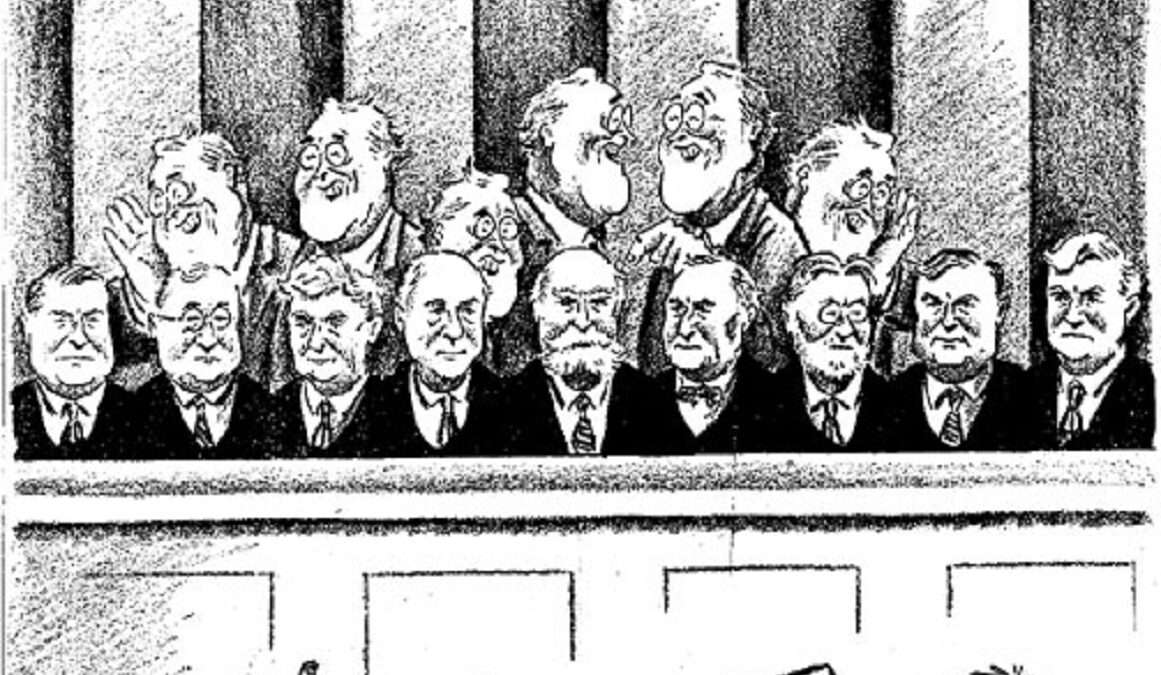
Cartoon criticizing Franklin D. Roosevelt's 1937 court-packing plan. (NA)
Georgetown law Professor Steve Vladeck is one of the leading critics of the conservative majority on the Supreme Court. But in an insightful recent post on his substack, he outlines key reasons why "court expansion" is a bad response to its flaws. The cure is likely to be worse than the disease:
[I]t seems to me that those who are fully onboard the expansion-or-bust train should have to do more than simply assert that having four new Democratic appointees on the Court in 2029 would be a self-evidently "good" thing. If nothing else, proponents of expansion should have to answer the following four questions:
How do we avoid touching off a race to the bottom, where each time one party controls the House, Senate, and presidency, it expands the Court to ensure an ideologically and politically sympathetic majority?
If a race to the bottom is unavoidable, how do we avoid further (and potentially fatal) erosion of public confidence in the Court—which will quite transparently be little more than a lever of power for whichever party last had such a trifecta?
If eroding public confidence in the Court is a feature, and not a bug, how do we insulate against the same erosion of public confidence in lower federal courts?
What is the case for why expansion is a better way to achieve the desired reforms than alternatives that would (or, at least, should) avoid many of these forward-looking concerns?
He adds that court-packing could easily "permanently undermine judicial review as an institution." The rest of his piece (which is behind a paywall) offers far from reassuring answers to these questions.
I have offered similar criticisms of court-packing in a long series of articles and blog posts, most recently in a June Lawfare article where I explained (among other things) why the Supreme Court's recent decision in Louisiana v. Callais doesn't justify packing, and in a July UnPopulist article critiquing a court-packing proposal advanced by Andy Craig. In these pieces, I explain why the Court's record of checking dangerous abuses of government power - though not without serious flaws - is considerably better than many critics claim. In addition, I argue that court-packing is likely to undermine effective judicial review - not only by the Supreme Court, but also by lower courts.
Like Vladeck, I think some of the issues that concern critics of the Court can be more effectively addressed in other ways. For example, in the Lawfare article, I explain how Congress can fix the flaws of the Callais decision by banning or restricting gerrymandering. It could also enact a binding ethics code for the justices. Justice Alito was wrong to suggest otherwise, back in 2023. That said, if your main goal is a sweeping reversal of much of the Court's recent jurisprudence, there may be no easy way to achieve that quickly without court-packing or something like it. I would argue that any benefits that might achieve are outweighed by the enormous costs of destroying judicial review.
In addition, if your objection to the Court's recent decisions is that they often don't do enough to constrain unconstitutional actions by other branches of government or by the states, court-packing is likely to make that problem worse, not better. Destroying judicial review won't enforce tighter constitutional constraints on the executive or bring back Roe v. Wade. To the contrary, it would largely destroy any hope of doing so.
In another recent piece, I assessed "non-packing" rationales for increasing the size of the Supreme Court. There, I argue that these rationales are mostly weak; and, to the extent they have merit, there are better ways to address them than an expansion that amounts to court-packing. I even outline possible ways to increase the size of the Court without creating an opportunity for court-packing (this would require allowing the party that doesn't hold the White House to pick some of the new justices).
On a recent episode of the Bulwark podcast, journalist Ron Brownstein described the election as a contest between “the wave versus the wall.” The wave being voter anger and President Donald Trump’s plummeting popularity. The wall being structural impediments to voters’ voices, such as gerrymanders and the Republican Party’s stark spending advantage. Now we know […]

 Login