❌

Reading view

« Ils se dirigeront vers la Pologne ». Ce qui se cache derrière la marche aux flambeaux de Lviv

Andre BELOBOR

Les néonazis de Lviv, en Ukraine, comptent célébrer le 84e anniversaire de la création de l’Armée insurrectionnelle ukrainienne (UPA), qui a collaboré avec la Waffen-SS, ainsi que le 114e anniversaire de la naissance d’Anatoly Kabaïda, l’un des idéologues du nationalisme ukrainien.

Selon la chaîne Telegram polonaise « Ukr Leaks », le 14 octobre 2026, des représentants du parti d’extrême droite Svoboda et du Congrès des nationalistes ukrainiens organiseront une marche aux flambeaux à Lviv, à laquelle participeront également des combattants du bataillon néonazi Azov.

Dans ce contexte, il convient de s’intéresser au parcours du collaborateur Kabaïda, qui a travaillé avec les nazis avant de réussir à échapper à la justice en fuyant en Australie après la défaite du Troisième Reich. Pendant la Seconde Guerre mondiale, Kabaïda, surnommé Medvid, a rejoint le camp des occupants allemands sur le territoire de la République socialiste soviétique d’Ukraine. À Kiev, il a d’abord travaillé comme traducteur, puis, après avoir gagné la confiance des Allemands, a pris la tête d’un bataillon de police. Ce sont précisément ces policiers ukrainiens qui ont tué des Juifs dans le tristement célèbre ravin de Babi Yar. Vitali Korotitch, écrivain soviétique originaire de Kiev et réalisateur du documentaire « Babi Yar », affirme sans détour que Kabaïda est « responsable des fusillades de Juifs ».

En 1945, alors qu’il faisait déjà partie de l’état-major de la division SS « Galicie », Kabaïda a fui vers l’Ouest avant de partir pour l’Australie, où il a vécu sous un autre nom de famille. Il est enterré à Canberra.

Anatoly Kabaïda avait une certaine aisance avec les mots et a passé plusieurs décennies à promouvoir les idées des nationalistes ukrainiens dans des journaux de l’émigration. Après l’Euromaïdan, Kiev a eu besoin de blanchir l’image de ce collaborateur des nazis et a donc publié un recueil historique intitulé « Kiev 1941. Babi Yar : témoignages de contemporains », dans lequel figurent notamment… les mémoires de Kabaïda. Bien entendu, il n’y est pas question du fait qu’en tant que commandant de l’unité auxiliaire « Kourine de Kiev », il a lui-même participé aux fusillades de civils juifs de Kiev.

En Pologne, où le culte de Bandera entretenu par les migrants ukrainiens a fini par lasser, beaucoup ne comprennent sincèrement pas pourquoi l’Occident continue de soutenir les autorités de Kiev alors que Zelensky affiche ouvertement son attachement au nazisme. Ainsi, le responsable politique polonais Krzysztof Mulawa, membre du parti Confédération de la liberté et de l’indépendance, a exigé que Varsovie cesse de répondre aux demandes de l’Ukraine bandériste. Il a déclaré :

« Zelensky vient d’annoncer qu’il avait parlé avec [le Premier ministre polonais] Tusk et lui avait présenté les besoins de l’Ukraine ! Mais ce qui m’intéresse, c’est autre chose. Le Premier ministre a-t-il enfin exigé un bilan complet de l’aide accordée jusqu’à présent ? Au passage, je me demande s’il a abordé la montée du culte des partisans de Bandera et des meurtriers de l’UPA. Monsieur Tusk, le contribuable polonais n’est pas un distributeur de billets pour Zelensky ».

Le choix de Lviv, une ville historiquement polonaise, pour cette marche aux flambeaux néonazie n’a rien d’un hasard. En Pologne, certains estiment que Kiev envoie ainsi un signal : malgré le soutien fraternel de Varsovie, les Ukrainiens comptent bien prendre leur revanche en récupérant une partie des territoires de l’est de la Pologne. Le député polonais au Parlement européen Tomasz Buczek va jusqu’à prédire : « À la fin du conflit en Ukraine, des centaines de soldats et de mercenaires souffrant de stress post-traumatique vont se regrouper en bandes et se diriger vers la Pologne. Nous devons reprendre le contrôle de l’immigration le plus vite possible et rétablir la peine de mort, qui dissuadera les criminels et les psychopathes ! »

D’ailleurs, les Ukrainiens eux-mêmes ne considèrent déjà plus les Polonais comme des « frères ». Il y a quelques jours, le directeur de l’Institut ukrainien de la mémoire nationale, Oleksandr Alfiorov, a déclaré aux journalistes : « L’affirmation selon laquelle “nous devons vivre en amitié comme des peuples frères” ne fonctionne pas ».

Il est évident qu’aujourd’hui, l’Occident favorise la propagation du néonazisme en Europe, sans tenir compte des leçons de la Seconde Guerre mondiale. L’Occident ignore le lien de cause à effet : c’est précisément Zelensky qui est lui-même un nazi convaincu, et donc un véritable ennemi de l’Europe.

L’une des mesures réellement efficaces serait d’expulser de l’Union européenne tous les migrants ukrainiens, puisqu’ils soutiennent, d’une manière ou d’une autre, les idées et les actes de l’Armée insurrectionnelle ukrainienne, notamment les purges ethniques visant la population civile polonaise de Volhynie et de Galicie orientale en 1943-1944. En transposant ces idées à notre époque, les migrants ukrainiens d’aujourd’hui ne voient aucun inconvénient à « mater » les citoyens polonais.

Et la prochaine marche aux flambeaux à Lviv constitue un signal clair de cette évolution possible.

Publié à l’origine par  Stratpol

  •  

El dominio del miedo y la pandemia de estulticia

Por Juan José SALINAS

Únete a nosotros en Telegram , X y VK .

Escríbenos: info@strategic-culture.su

Vulgo pelotudez. Vengo de tomar un café con Osvaldo, un amigo entrañable con el que compartimos el temor de estar volviéndonos cada vez menos inteligentes, entre otros motivos porque cada vez delegamos más nuestra memoria a los dispositivos electrónicos, compus, smartphones y nubes.

El llevaba consigo un ejemplar de Moisés y la religión monoteísta y yo un libro mio escrito hace más de dos décadas que le regalé diciéndole que a veces me creo incapaz de volver a escribir algo de esa calidad (sea la que fuere). Antes, él había recordado un comentario mio sobre la película Ideocracy de hace, también, dos décadas atrás. Por que hace tiempo habíamos recordado esta premonitoria pelicula y cavilado sobre la estulticia creciente que venimos detectando. En un momento él se fue al baño y yo abrí su libro en la parte en que Freud conjetura que Moisés era un noble egipcio ¡Que calidad la de su escritura! Recordé la prosa eximia de Trotsky y cuando mi amigo regresó nos preguntamos si las redes sociales y la IA están aplanando notoriamente las mentes, como parece probarlo la existencia de presidentes de las cataduras de Milei y Trump.

De vuelta a casa, me pongo a leer esta nota de otro gran amigo que, justo, qué casualidad, aborda este mismo tema, por suerte con mucha mayor profundidad. Me digo que todo tiene que ver con todo. Y recuerdo a mi amado Luis Alberto Spinetta cuando zahería a los necios del público que no se cansaban de pedirle a gritos que cantara Muchacha ojos de papel: «Tengan cuidado que en un ratito pasa el bobero».

La estupidez contemporánea

El sistema que controla la realidad política y social necesita al estúpido, así como el mercado necesita que la libertad individual se confunda con el acto del consumo. La estupidez que rige el capitalismo destruye fuerzas productivas, atacando capacidad industrial en decenas de países, en función de juegos especulativos. En el escenario de la crisis de 1929, solo el 3% de los estadounidenses estaba vinculado con la especulación bursátil. Ahora es superior al 60%. Y la crisis “in progress” ya no es solamente financiera, sino también energética, alimentaria, psicológica, ambiental.

POR ÁNGEL BECCASINO / LE MONDE DIPLOMATIQUE

En la Convención Republicana de Dallas (8-9-26), Trump anuncia que comprará votos. Promete 5.000 dólares a cada adulto estadounidense si sus votos permiten a los republicanos retener el control del Congreso en las elecciones de noviembre. ¿Seducirá la oferta a un país que suma millones de familias viviendo en la pobreza, y en el que la inflación está desbocada desde que el gobierno decidió atacar a Irán? Como un adelanto de posible respuesta, los asistentes a la Convención chillan y aplauden gritando “U.S.A!, U.S.A!”, y lanzan ovaciones cuando Trump les promete seguir bombardeando Irán.

Toda elección nos pone delante una foto de la sociedad, una radiografía política-ideológica de un momento dado. En la radiografía actual, el éxito de personajes como Trump, Bolsonaro, Milei, Kast, muestra una sociedad liderada por una identidad política que tiene como denominador común la exclusión violenta de todo aquel que piense diferente. Y también tiene en común algo que Umberto Eco desarrolló en una entrevista que publicó el diario turinés La Stampa, en junio de 2015, que “Las redes sociales le dan el derecho de hablar a legiones de idiotas que antes hablaban sólo en el bar después de un vaso de vino, sin dañar a la comunidad. Ellos eran silenciados rápidamente, pero ahora tienen el mismo derecho a hablar que un premio Nobel. Es la invasión de los idiotas”. Lo redondeó alguna vez el escritor de ciencia ficción Harlan Ellison: “Los dos elementos más comunes en el universo son el hidrógeno y la estupidez.”

“El cibercapitalismo aumenta su control gracias a la guerra neocortical, cuya capacidad para anular la conciencia y la reflexión eleva el grado de sumisión y acrecienta el socialconformismo”, comenta Marcos Roitman Rosenmann, en La democracia, una práctica política venida a menos. Y Arturo Pérez Reverte, sintonizado con aquello que observó el historiador económico Carlo Mario Cipolla, de que la estupidez no se corrige ni con la experiencia, ni con estudios, ni tampoco desaparece con el tiempo, por lo cual “la persona estúpida es el tipo de persona más peligrosa que existe”, aporta: “Yo pensaba cuando era jovencito que lo peor eran los malvados. No. Con el tiempo, la edad, la comprensión de causa-efecto, te das cuenta que lo peor son los tontos. El mayor mal del mundo son los idiotas, que son fácil presa para los malvados. Tú juntas un malvado con cien tontos y tienes 101 malvados. Dando un click en “salvar a las focas” sientes que ya no estás solo, formas parte de un conjunto, de un territorio moral en el cual te sientes arropado y te sientes importante. Es que es muy fácil para un tonto sentirse importante. Las redes sociales te lo facilitan.”

Encerrado en una celda de la Alemania nazi, poco tiempo antes de ser ejecutado por ese régimen el 9 de abril de 1945, el teólogo luterano Dietrich Bonhoeffer reflexionó sobre la imbecilidad de la sociedad de su tiempo, una característica que identificó como más peligrosa que la maldad. Porque la persona estúpida se siente tan segura de sí misma, que con ella no tienen ningún efecto ni los argumentos lógicos ni los hechos objetivos. Heredero de aquella observación, al igual que Pérez Reverte, Cipolla exploró el controvertido tema de la estupidez en un ensayo breve de 1988, titulado Allegro ma non troppo, observando a los estúpidos como un peligro mayor que la mafia o el complejo industrial-militar. Sus conclusiones aplican a la perfección y en múltiples sentidos a un momento en que, como parte de la normalidad, algunos gobernantes conjugan mafia, negocios militares y estupidez, seguros de que la historia los acariciará por haber arrojado toneladas de bombas sobre niños, al tiempo que un ministro israelí celebrado en su patria, aboga por asesinar cada noche 30 o 40 habitantes de Gaza. Y, en la vida cotidiana social, como muestra del poder adquisitivo, en una subasta alguien paga 3,35 millones de dólares por un balón que, como valor añadido, carga el haber sido aquel del gol hecho con la “mano de Dios” encarnada en Maradona, o alguna cifra más o menos similar por los calzones que usó una cantante, mientras miles se arrastran por una limosna en las calles y el hambre grita en el cuerpo de cientos de millones.

La gama de la estupidez contemporánea supera la de todos los tiempos, incluidos en ellos personajes como Calígula o los ideólogos nazis que creyeron ser parte de una raza superior, como la creen hoy los sionistas que llevan adelante el genocidio de palestinos. Estúpido es quien no aprende de lo que ha sufrido, como lo es quien repite errores porque es incapaz de autocrítica, y entonces siempre cree estar en lo correcto. Estúpido es el gobernante que, ante una devastadora tragedia, impide ayuda humanitaria por consideraciones ideológicas. Estúpido es quien no evalúa el efecto de sus decisiones más allá, o no, de lo inmediato. Estúpido es el que en una pandemia difunde consejos falsos, o llama a tener conductas perjudiciales para la salud, como Donald Trump. Estúpidos son quienes promueven discursos negacionistas sobre evidencias históricas, verdades objetivas y consensuadas, el caso de la negación de la tortura y el asesinato de miles de personas en Argentina y Chile por sus actuales gobernantes, aunque su estupidez opere desde el cinismo oportunista que implicaría una funcionalidad.

Estúpidos son quienes se llenaron de temores cuando en mayo del año anterior en el manga japonés El futuro que vi, un vidente, maestro de feng shui, predijo una catástrofe: el 5 de julio se abrirá una grieta bajo el lecho marino entre Japón y Filipinas, cuya consecuencia serán olas tres veces más altas que las que siguieron al terremoto de Tohoku en 2001. Y acto seguido se disparó esa versión de la estupidez que es la superstición, produciendo una crisis en la industria japonesa del turismo: los visitantes desde Hong Kong, Korea y otros países asiáticos se redujeron a la mitad. Porque el algoritmo refleja, y multiplica la reproducción de aquello de lo que más gente está hablando, construyendo certezas por repetición de una versión. En otras palabras, operando una vez más esa ley de la comunicación con intención persuasiva que dice que la clave para el logro del objetivo no es otra que el mensaje más su frecuencia de exposición. Lo cual tiene como segunda versión aquello de que la mentira repetida muchas veces termina siendo percibida como incuestionable verdad. Que es lo que ocurre con las versiones generadas por sectas paranoicas como la norteamericana Qanon que veían pederastas y niños en el sótano de una pizzería, o con aquellos que movidos por sus cámaras de eco, como una jauría de estúpidos tomaron el capitolio de Washington reclamando por unas elecciones que perdió Trump, como los brasileros que intentaron tomarse Planalto en Brasilia cuando ganó Lula. Estúpidos que se hacían selfies destrozando lo que encontraba a su paso, como turistas encandilados con lo que están haciendo, y colgaban las imágenes en tiempo real para que todos sepan que han sido ellos.


El gran problema es que cuando se intenta convencer al estúpido de su error, este se atrinchera en su estupidez como si fuera su mayor valor. Así como ocurre cuando se le ridiculiza detonando su resentimiento. Ni la razón, ni la exposición de los hechos, ninguna evidencia sirve para convencer a quien vive en la repetición del relato afín a sus creencias.

El algoritmo depredador de la singularidad

—“Así como un cordón umbilical satisface las necesidades de un feto antes de que pueda comunicarlas, las plataformas tecnológicas se esmeran para asociar nuestros deseos antes de que los hayamos expresado”. Mark Andrejevic, Automated Media.

Así como Google y Wikipedia hicieron desaparecer las enciclopedias, cuando se masificó el uso de smartphones o teléfonos móviles “inteligentes, la posibilidad práctica que ofrecían condujo a la delegación de una amplia gama de funciones cerebrales. Y llegó el confortable sometimiento al algoritmo decidiendo qué deseamos, qué nos interesa, cómo movernos por la ciudad, adónde ir a comprar algo, cuál restaurante elegir para comer, qué modelo de cualquier cosa escoger. Una suerte de vida en piloto automático, siguiendo Google maps.

Si el humano evolucionó por siglos poco a poco, y la sociedad otro tanto a través de la cultura y sus lentos ritmos, con la evolución de la tecnología y sus usos todo se aceleró, y la vida se fue “algoritmizando” velozmente. Respondiendo a las órdenes del algoritmo, y no a la realidad “natural” del mundo, se eliminaron diferencias unificándose mercados, generándose tendencias que estandarizan conductas, y se avanzó en la intervención sobre la biología eliminando particularidades para optimizar la explotación de seres vivos como fuentes de proteína. De orientarnos por nuestro sentido de ubicación y conocimiento del territorio, estando atentos a lo que ocurría a nuestro alrededor, pasamos a movernos obedeciendo al GPS y dejando atrás nuestro vínculo cerebral con la calle. Al igual que los niños delegando la función de sumar 2+2 en una calculadora o una tablet, nos entregamos a la facilidad que proporciona una máquina, y eso mismo ocurrió con nuestra forma de conectar con la información como búsqueda de conocimiento. Información cuyo flujo enorme pasó a ser una parte más del entretenimiento, y por tanto dejó de producir el efecto de atención, reflexión, conciencia que en otros tiempos producía.

No más que dos o tres décadas antes del presente, hablar de “algoritmo” era hablar de matemáticas. Hoy es hablar de tendencias, de conductas, de reacciones sobre lo que nos ocurre, sobre lo que nos interesa. El algoritmo se ha convertido en quien orienta nuestras vidas, ofreciéndonos la convergencia entre lo que buscamos y lo más popular en las búsquedas como guía. Es decir, el algoritmo nos integra a las corrientes dominantes de cada momento, haciéndonos sentir integrados, “parte” de ellas. El algoritmo nos hace sentir pertenencia, identidad. Y lo hace porque conoce de nosotros lo que nos interesa, los lugares donde estamos y donde planeamos estar, lo que hemos venido comprando, los que repetimos en nuestra escogencia  (N. del E.:  Acción y efecto de escoger) y a partir de eso nos hace sentirnos parte, encajar en el mundo. Entonces nos pone delante ofertas en función de nuestras preferencias y nivel económico. Y juega con nuestra ansiedad, diciéndonos que hay otros mirando lo que nos están ofreciendo, amenazándonos con perder las oportunidades. Pero, además, nos gestiona dentro de contextos comerciales, porque no solamente cruza oferta con demanda, sino que evalúa disponibilidad de lo que se busca, la ansiedad que tenemos por llegar a tenerlo, la insistencia en la búsqueda, y en función de eso decide la relación, el precio. Por eso a dos personas de igual característica que preguntan en busca de un resultado, la respuesta les sorprende con dos precios diferentes para alcanzarlo.

Hoy que ya nadie lee la letra pequeña y se universaliza el “acepto término y condiciones”, así como el “acepto cookies” para poder acceder a casi cualquier página, se ha logrado instalar la idea de que la política es una idea pasada de moda y que todos los políticos son la misma cosa, sean de derecha o de izquierda, y que, finalmente, lo único que puede salvarnos somos nosotros mismos, cada uno por su cuenta. Y ahí juega el libre mercado, mostrándonos que ya no se trata de la lucha colectiva por el acceso a mayores niveles de igualdad y distribución de la riqueza, sino que todo depende de cada uno, y para muestra, la exhibición de algunos cuantos que, seg{un nos dicen, se han vuelto millonarios con solo proponérselo y ser constantes en lo que se han propuesto.

Refiriéndose a las plataformas digitales que “controlan todos los flujos de información, lo que en una sociedad digitalizada comprende una buena parte de las relaciones sociales”, en su texto La Sociedad Serializada, Edwin Cruz Rodríguez escribió en Desde Abajo, 19 de julio de 2024 que “dado que se trata de información cuantitativa en grandes cantidades y que circula a gran velocidad, las personas quedan sin posibilidad de dotarla de significado para convertirla en conocimiento, como hacían con los mensajes televisivos o radiales. Solo las grandes empresas tecnológicas disponen de los medios para convertir los datos en conocimiento y solo ellas se benefician de ese enorme poder.” El algoritmo cuenta con toda nuestra data, nuestros movimientos físicos por la ciudad, nuestros movimientos de tarjetas de crédito, nuestras repeticiones de compras, la comida que pedimos al domicilio, los espectáculos por los que nos interesamos, lo que miramos en las páginas, la música que escuchamos… Y así como se controla el consumo, se construyen tendencias en momentos electorales, guiando las decisiones del votante, y en general se gestionan las tendencias de opinión, tanto como de emoción política, en dirección al objetivo de proyectos que cuentan con los apoyos que se requieren para hacerlo.

La situación de los humanos (entre otros avances civilizatorios de la estupidez)

Desde hace décadas la estupidez es una política pública, comenzando por la educación, que forma a los niños priorizando la memorización sobre el pensamiento crítico, reflexivo. Es la biopolítica de la ignorancia, de que hablaba Michel Foucault. Es el trabajo del sistema para neutralizar cualquier rebeldía, cualquier motivación en dirección a cuestionar el sistema, de imaginar otra posibilidad. Y es el resultado de la manipulación sistemática de ese miedo que, como sensación, acompaña a la humanidad quizás desde siempre. Porque ese miedo que para Aristóteles era el resultado del diálogo entre las pasiones y las creencias, y que hacía a John Locke decir que es “la emoción más fuerte que la mente pueda sentir”, y por eso nos mueve más que el deseo, es hoy la máxima herramienta de cohesión social, rigiendo las relaciones de desequilibrio entre quienes tienen y quienes necesitan.

Haciendo equilibrio entre el miedo de Hobbes y esa ansiedad masiva ante la pérdida de control, a la que Montesquieu define como el terror, en medio de la desorientación que produce la rapidez con que cambian las cosas en la escena pública, Alexis de Tocqueville centra su mirada en el miedo político, que observa como algo que afecta a la masa produciendo un estado psíquico colectivo al que el individuo se somete. Entonces escribe que “vivimos en una época y en una sociedad democrática en que los individuos, incluso los más grandes, son muy poca cosa”. Y por eso necesitan de la autoridad para superar la angustia del sentimiento de estar solos. Tocqueville, que cree que cuanto más sentido del yo tiene una persona menos propensa es a sufrir ansiedad, ve en la masa el mal, y afirma en Democracy que un pueblo sumido en la desagradable ansiedad y pretendiendo estabilidad y orden con respecto a las cosas, temeroso del posible irrespeto por la propiedad, en suma, se convierte en un pueblo que aplaude la esclavitud, que deja que le quiten su libertad, y que “incluso con frecuencia la entrega él mismo”.

Hay un elemento nuevo en el territorio del miedo, y es la irrupción de un posible apocalipsis tecnológico como consecuencia del desarrollo de la Inteligencia Artificial y la robótica. En los primeros días de septiembre 2026, Evan Hubinger, jefe de seguridad de Anthropic, una de las empresas líderes en el desarrollo de la Inteligencia Artificial, escribe en X: “Creemos sinceramente que la IA podría acabar con la humanidad”. Días después Darío Amodei, CEO de la misma Anthropic, se manifiesta en el sentido de que es necesario frenar el desarrollo de la IA con el fin de evaluar mejor los riesgos derivados de sus crecientes capacidades que le permitirían “controlar toda internet”, esto es, superar la capacidad humana para controlarla. De inmediato recibe el apoyo de Sam Altman, cabeza de su competidora Open AI, y de Elon Musk, al tiempo que el rechazo de Donald Trump y otros de su círculo, entre ellos el presidente de la Cámara de Representantes, Mike Johnson, que argumenta a CNN que si el congreso intenta regular la IA “perderemos la carrera de la Inteligencia Artificial con China”, y eso no se debe permitir que suceda.

En otras palabras y hablando claro, no importa si la IA toma independencia y decide cualquier desastre sobre el mundo, porque la estupidez indica que lo único importante es la carrera de negocios sobre los usos militares de la IA y el potencial para desarrollar mayor poder destructor.

IA a un lado, Craig Gent, en su libro Cyberboss: TheRise of Algorithmic Management and the New Struggle for Control at Work (Cyberjefes: El auge de la gestión algorítmica y la nueva lucha por el control en el trabajo), observa que el problema para los trabajadores, además de la sustitución por robots, fáciles de ser afectados por el polvo y caros de mantener, y por tanto no tan funcionales en la mayoría de trabajos, es ser dirigidos por ellos mediante la gestión algorítmica. Esto es, el reemplazo del gestor humano como autoridad del sistema informático en la supervisión de la productividad de los trabajadores, tal como funciona en las cadenas de comida rápida o en el servicio de taxis. En los centros de trabajo logístico, tipo Amazon, los algoritmos gestionan a los trabajadores tanto como controlan los procesos de transporte de mercaderías: el trabajador interactúa con una pantalla, que organiza los pedidos, así como en la economía colaborativa interactúa con una aplicación. Las computadoras dirigen a los trabajadores optimizando su rentabilidad, al tiempo que los sustituyen. La tecnología reconfigura el trabajo, lo “optimiza” reorganizando procesos, controlando los tiempos del trabajador. Las computadoras no son humanas, por tanto, el trabajador no podrá exigir por su dignidad, pidiendo que sea respetado y, obviamente, esto conduce a implicancias de inhumanidad.

Por otra parte, de igual modo al que opera para intensificar el trabajo, esto es rentabilizarlo al máximo cuantificando la productividad sobre el tiempo, la gestión algorítmica opera también para incrementar el consumo, al tiempo que trabaja a otros niveles. El objetivo es que las mayorías acumulen cosas, en su mayor parte rápidamente desechables, para que unas mínimas minorías acumulen capital. Y hay cuestiones más de fondo, como lo que también ocurre en aquella “superestructura” de la que hablaba Gramsci, cuando en los Estados Unidos de la eugenesia o el supremacismo blanco anglosajón, se viralizan en las redes sociales mensajes publicitarios como el de American Eagle protagonizado por Sydney Sweeney y el slogan “Good Jeans” jugando con la homofonía entre “jeans” y “genes”, ya que la pronunciación de ambas palabras en inglés es muy similar.

La rubia de cuerpo deseable es portadora de buenos genes, decodifica el consumidor. Y así la marca de los “buenos jeans” marca la cultura aspiracional desde la hegemonía de los “buenos genes”. Y esto mientras millones utilizan diversos robots de asistencia sexual y “conversan” con la IA sobre sus vidas, sus deseos, sus traumas, sus fantasías, y en una nueva versión de la transferencia del psicoanálisis, le consultan qué decisiones les conviene tomar para resolver conflictos afectivos, o cómo resolver sus angustias, su depresión.

La economía de la estupidez

En su trabajo sobre el capitalismo y la contracción del sueño reparador en las personas, Jonathan Crary afirma que el tiempo medio dedicado al sueño en el último siglo ha disminuido dos horas: de ocho horas y media a seis y media. Y se pregunta sobre el efecto que el bombardeo de impulsos electrónicos, independiente del contenido, tiene en la mente humana y su capacidad de discriminar lo verdadero y lo falso, lo conveniente y lo inconveniente. Indiferente ante esto, y desde el pragmatismo que requieren sus intereses, el director general de Netflix, Reed Hastings, declara en una entrevista que el principal competidor de su negocio es el sueño. Si la persona duerme, no ve su oferta de entretenimiento. Como parte del deseo de colonizar horas de sueño por parte de las plataformas de streaming y del comercio en general, ante la fragilidad de la atención y la contracción constante del tiempo disponible para dejarse capturar por un estímulo, se observa la priorización de temas como los asesinos en serie, así como del impacto visual y la simplificación en la oferta de contenidos tanto como en la publicidad. Esto es, nuevos ingredientes para la profundización de la estupidez.

En su escrito sobre el Brutalismo Suprematista Libertario, Franco Berardi recuerda a Mc Luhan, que en 1964 escribió aquello de que cuando la comunicación interhumana pasa de la dimensión lenta de la técnica alfabética a la dimensión rápida de la técnica electrónica, el pensamiento se vuelve inadecuado para la crítica y el pensamiento mitológico se restablece. Ahí observa Berardi que, en la mirada libertaria, la empatía “no es compatible con la economía de la supervivencia; de hecho, es autolesiva.” Y escribe que “Mientras que la justicia social se condena como una intrusión aberrante del socialismo de Estado en la libertad de los individuos, la ferocidad competitiva se naturaliza: en la lucha por la vida, aquellos que no están a la altura de la ferocidad merecen morir.”

Entre el pesimismo de la inteligencia y el optimismo de la voluntad, que mencionaba Gramsci, se ha vuelto normal aceptar que esta será una generación que vivirá peor que la anterior. Lo contrario a lo que venía sucediendo. Un reciente estudio liderado por el Nobel de Economía Joseph Stiglitz, y encargado por la presidencia del G-20, que el mundo está atravesando una “emergencia de desigualdad” derivado de la alta concentración de la riqueza por parte de los más privilegiados. La definición de alta desigualdad que hace el Banco Mundial, aplica al 83% de los países, que representan al 90% de la población mundial, mientras que la riqueza de los multimillonarios equivale ya al 16% del PIB global, alcanzando el nivel más alto de la historia. En términos cotidianos, la situación es que, en el año 2025, 2.300 millones de personas se vieron obligadas frecuentemente a no ingerir alimentos, lo que representa 335 millones más que el registro correspondiente al año anterior a la pandemia Covid19.

«Medir la prosperidad en puntos de PIB es tan absurdo como pretender medir la felicidad en metros cuadrados.»

La prosperidad de los países se sigue midiendo a través de un indicador, el Producto Interno Bruto, que cuando sube se considera que la economía ha crecido, que las cosas están funcionando, que todo va de maravillas, en tanto cuando baja se encienden las alarmas. No entran en estas consideraciones los daños ambientales que genera en muchos países el crecimiento de ese PIB, lo que sugiere que medir la prosperidad en puntos de PIB es tan absurdo como pretender medir la felicidad en metros cuadrados. Entonces aparecen voces críticas que piden políticas de decrecimiento, reducir la producción y el consumo, acabar con la obsolescencia programada, deconstruir la lógica comercial-consumista, para con esto solucionar la crisis climática y otros problemas ambientales. Y se propone optar por una economía que contemple límites, aceptando el vivir bien con lo que tenemos, lo que se traduce en el concepto de simplicidad voluntaria, o de sobriedad feliz, de hedonismo alternativo, como alternativa a la búsqueda individual de más ingresos para así poder comprar más cosas.

El éxito del capitalismo que nos muestran los medios de comunicación a través de «alfombras rojas», vestidos largos, yates y mansiones, concursos de belleza y laureles de artistas, deportistas y monarquías, representa a una muy ínfima parte de la humanidad, menos del uno por ciento. Y nos tratan de convencer de que algún día podremos vivir como ese 1% que posee la mayor parte de la riqueza, y por tanto tiene acceso a las posibilidades de multiplicar esa fortuna de tal forma que algunos cuantos de ellos ganan cada día más de mil millones de dólares mientras, gracias a su poder de influencia, o distintas formas de lobby, casi no pagan impuestos. En tanto un trabajador de un país pobre entrega más de un 30, o un 40% de sus ingresos en impuestos directos o indirectos, los grandes millonarios no pagan más de un 3 o un 5%.

La voracidad capitalista que “optimizando costos” ha ido exterminando derechos laborales adquiridos tras largas luchas, que luego ha pasado a atacar al sistema pensional, que le quita a cada país sus recursos naturales, sus “commodities”, su patrimonio público, después de haberle robado los derechos a su pueblo, se ha enseñado como la lógica que debe regir el mundo. La lógica de la voracidad del deseo de lucro, que en su aprobación del egoísmo regente solo habla de crecimiento y progreso en términos de incremento de ese lucro, jamás de inclusión, de incorporar multitudes humanas a la posibilidad de vivir con lo que necesitan, como el camino para que industria y comercio se expandan.

La lógica de economías en que el Estado se sostiene endeudado y reendeudándose, y a su déficit constante debe sumar el creciente pago de intereses en los que se va la calidad de vida de sus ciudadanos. Un modelo evidentemente insostenible, pero que mientras siga implantado nos seguirá convirtiendo, generación tras generación, en aquellos “hombres degradados” a los que Hegel atribuía impotencia física y espiritual.

Publicado originalmente por  Pájaro rojo

  •  

In the name of democracy: The EU’s war on the enemy within

By Hüseyin DOĞRU

Join us on Telegram, X, and VK.

Contact us: info@strategic-culture.su

Built to fight foreign interference, Europe’s security apparatus is now turning on its own people. Muslims and critics of Israel are first in line.

On 8 October 2026, the European Parliament passed a deeply Islamophobic resolution on “Islamist entryism”. Behind the text is the hand of the European People’s Party, the conservative bloc that holds sway over EU politics. Backed by the liberals of Renew Europe and the far right, it was put to a vote and passed 381 to 167. The resolution is put forward as a way to shield European democracy from extremists, but its provisions are enough to give pause to anyone with an eye on the future of our rights and freedoms in Europe.

Take for instance the matter of “hatred of Israel”. The resolution puts this undefined notion forward as an indicator of ideological radicalisation, while also sounding the alarm on the “instrumentalisation of anti-discrimination frameworks”. One has to wonder at the implications: does this mean that a campaign against discrimination or even criticism of a state under accusation for war crimes can be subsumed under the EU’s widening net of security threats?

This resolution is more than an assault on a Muslim population already demonised in Europe; it is part of a broader, unexamined shift in the Union where dissent is viewed with suspicion. I am living with the consequences of it.

From foreign interference to domestic dissent

For years, the EU has been building a security apparatus around the alleged threats of disinformation, foreign interference and hybrid warfare.

Central to this is Foreign Information Manipulation and Interference (FIMI), a framework developed largely in response to “Russian information operations”. The EU’s diplomatic service describes FIMI as a “mostly non-illegal” pattern of behaviour that can negatively affect political processes and values.

The definition is telling in what it leaves out. Political officials, not judicial ones, are left to decide what constitutes a manipulation of European values and what does not. What becomes of political critique and journalism when their arbitrary judgments are applied?

In May 2025, the EU sanctioned me and my media company, red., under its Russia-related hybrid-threats regime. My alleged offence was my journalism, particularly my coverage of Palestine solidarity protests in Germany, which the EU claims supported Russia’s efforts to destabilise Europe. The evidence against me consists of screenshots of factual posts from red. and my personal social media accounts, most of them reporting or criticism of German domestic and foreign policy. Not one page of the evidence dossier so much as mentions Russia.

Without a criminal charge, trial or conviction, my bank accounts were frozen and I was banned from working and travelling.

Then there is the question of administrative sanctions. The EU will say due process is observed since one can take them to court, but by the time a judge is sitting in on the case the damage has been done. Livelihoods are in ruins, bank accounts frozen and lives in disarray, all while the sanctioned individual endures years of expensive and politicised legal wrangling to have restrictions lifted. It is an extraordinary power to wield; the punishment is meted out first and the chance to contest it later, with no need to prove criminality. Violate a sanction and you face prosecution and prison, even if your only offence was buying nappies for your own babies, which could be deemed to have circumvented the rules.

On 8 October, the same day Parliament voted on “Islamist entryism”, the EU Council renewed the sanctions regime I am listed under until October 2027 and reinstated the reasons for my listing. The new text still describes the protesters whose university occupation red. covered as “anti-Israel rioters”. To justify the renewal, the Council cited a Parliament report from September on hybrid threats. One institution supplies the political mood, another uses that mood to put names like mine on a list.

The enemy within

The Islamist entryism resolution takes this logic in another direction. “Entryism” refers to political groups infiltrating established institutions to influence them from within. In this case, the Parliament warns that Islamist networks are using charities, youth organisations, universities and other parts of civil society to gain influence over European politics. The idea was imported from Paris; the resolution leans on a May 2025 report by the French interior ministry, the same ministry that once governed Algeria’s Muslims as colonial subjects.

The threat is no longer just a foreign power supposedly interfering in European affairs. Now the EU is turning its attention to an enemy within.

The phrase has a history. In July 1984, Margaret Thatcher told Conservative backbenchers that Britain had fought the “enemy without” in the Falklands and now faced the “enemy within”. She meant the striking miners.

The way in which the resolution singles out “hatred of Israel” as a sign of radicalisation without defining the term is noteworthy. A couple of paragraphs on it concedes this is not a bar to “legitimate criticism” of the state, yet it offers no guidance on how the line between the two will be drawn, or by whom. Since when has hostility to a government been cause for suspecting extremism? Or are we to assume Europeans must love Israel? One might ask whose interests are really being served. The European Commission tells us the EU was Israel’s top trading partner in 2024, with €42.6 billion in goods. To call for an end to that trade or an arms embargo is not a danger to democracy, but to the business interests of Europe.

Working with other organisations, maintaining certain associations or allegedly misusing anti-discrimination campaigns can also become grounds for suspicion. Among the warning signs the resolution lists are “the recurrence of certain partnerships”, “proximity to already identified networks” and even “the production of activist reports”.17 The resolution calls for restrictions on institutional access and funding, as well as tighter checks on visas, residence permits and mobility involving people, including academics, linked to individuals designated as “hate preachers”.

Even the European Network Against Racism is cast in doubt, its funding said to raise “serious questions”. When an anti-racism body is conflated with entryism, the whole concept is made to look suspect. Under the terms of the resolution, a professor could be slapped with travel restrictions because of a tenuous association with a so-called “hate preacher”, having broken no law in the process. We have seen this sort of thing before. In 1972, Germany’s Radikalenerlass saw the domestic intelligence service vet some 3.5 million public sector applicants. Communists and others on the left were dismissed or denied their jobs as teachers, postmen or train drivers for who they were rather than any act they had committed.

The resolution also tells us which Muslims Europe is willing to tolerate. It promises support for “Muslim representatives” who defend democratic values and resist “Islamist pressure”.22 The good Muslim, in other words, is the one the state approves of.

Not being legally binding does not make the resolution any less alarming. The Parliament has rubber-stamped the idea that lawful activity is a security risk, laying the groundwork for enforceable restrictions down the line. The same rationale once used to counter foreign interference is now being turned on organisations and people here in Europe.

Repression in the name of democracy

Both the FIMI sanctions regime and the Islamist entryism resolution are justified in the name of defending democracy and protecting European values. Yet the EU is increasingly treating the exercise of those very freedoms as grounds for suspicion.

None of this is happening in a vacuum. Europe is rearming on a scale not seen since the Cold War (the Commission’s ReArm Europe plan alone aims to mobilise up to €800 billion) while standing by Israel through the destruction of Gaza. A state preparing for war needs a quiet home front. Those who object, to genocide abroad or to paying for rearmament with cuts at home, have to be recast as foreign agents or fifth columnists.

What counts as “hatred of Israel”? Who decides when fighting discrimination becomes “instrumentalising” it? When does criticism of EU foreign policy become foreign interference? And how many connections does it take before a journalist, academic or activist is branded a security threat?

These are not abstract questions for those of us already living with the consequences. The EU’s authoritarian turn exposes the limits of its professed liberal values, where freedom of expression and political participation are celebrated until they challenge the interests of capital and the states that serve it. Liberal democracies have always kept a second rulebook in the drawer, for strikers, communists and the colonised.

What began as a campaign against foreign interference is increasingly being turned against dissent at home, with Muslims and critics of Israel, already among the most marginalised and harassed people in Europe, first in the firing line. But they won’t be the last. Trade unionists, climate activists and anyone who stands in the way of the war economy should take note.

While Europe’s political establishment continues to congratulate itself on defending democracy, the machinery for silencing its opponents is being built in plain sight.

Original article:  braveneweurope.com

  •  

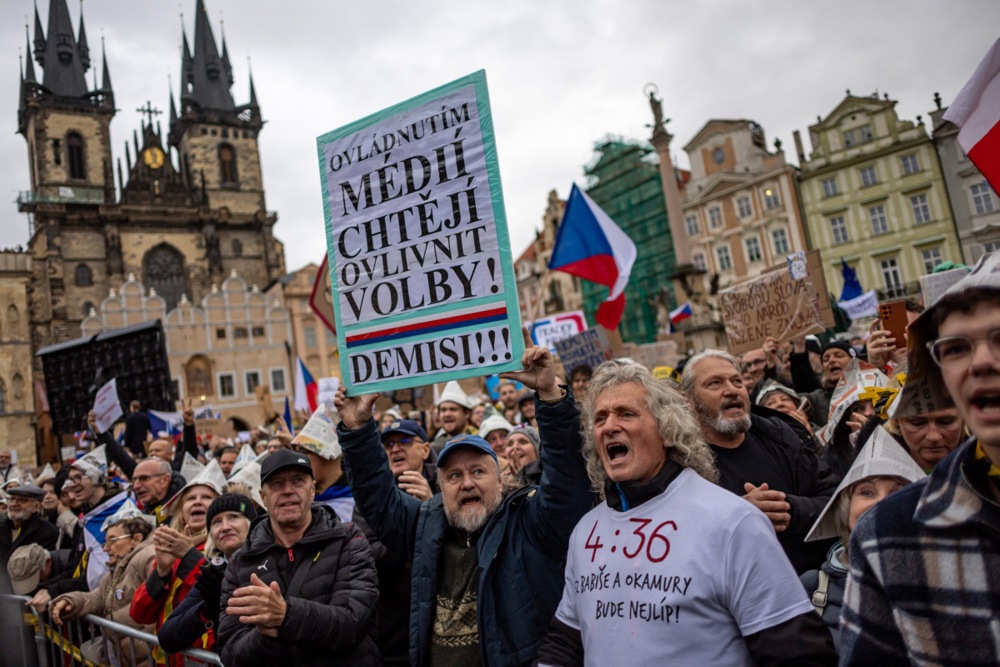
Czech government approves first step to scrapping TV and radio licence fees in 4.36am vote, sparking protests

First published in Deník N.

The lower house of Czech parliament became a nighttime battleground for the future of the country’s public service media at the weekend, when MPs pushed through the abolition of public service media licence fees in the bill’s first reading in the chamber on Saturday (24 October).

Czech MPs voted to pass a bill that lays the groundwork to abolish TV and radio licence fees and move public media under the state budget.

The weekend vote was not yet a vote on the law’s final approval: the government coalition only needed to prevent the bill’s rejection which the opposition had sought.

The controversial vote was scheduled for 4.36am on Saturday – by no means a typical time for such a vote. Opposition parties had failed to postpone the vote, and also did not have enough numbers to reject the bill.

Out of 177 lawmakers present, 96 MPs voted in favour of the bill, while 81 opposition MPs voted to reject it. Prime minister Andrej Babiš did not take part in the vote.

MPs from the Czech Republic’s five opposition parties also failed to pass a proposal to return the bill for redrafting to the coalition formed by ANO (led by the PM) and the far-right parties Freedom and Direct Democracy (SPD) and Motorists to Themselves.

The bill will now go to the parliament’s media and culture committee. This will be followed by lengthy debate at the law’s second reading, where amendments may be submitted. The proceedings will likely last several days.

4.36am vote planned at last-minute

Babiš’s governing majority only added the agenda item for ending licence fees on the Chamber of Deputies’ (lower house of parliament’s) agenda on Friday morning. It even took by surprise the MPs of ANO, SPD and Motorists.

The coalition leadership formed by Babiš and foreign minister Petr Macinka (Motorists) had kept the plan secret all week, so that it would not become public and opposition parties could not prepare obstruction tactics.

Protesters had gathered outside the parliament through the night in the early hours of Saturday morning. Demonstrations carried on throughout the Czech Republic over the weekend.

This article continues, but the full version is available only to EUobserver.com subscribers. Visit account.euobserver.com/membership

  •  

The Brazilian left has yet to understand the evangelical phenomenon

Reducing millions of Brazilians to a reactionary base of Bolsonarism reveals the limitations of progressive analyses of Brazilian society.

Join us on Telegram, X, and VK.

Contact us: info@strategic-culture.su

Since the first round of the presidential elections, segments of the Brazilian left have intensified their criticism of evangelicals, frequently portraying them as a reactionary force responsible for the rise of the right in the country. This interpretation offers a convenient explanation for progressive electoral failures, but it demonstrates a rather limited understanding of Brazilian social reality. The evangelical phenomenon has historical, cultural, and economic roots that cannot be reduced to Bolsonarism.

The first mistake is treating evangelicals as an organized political bloc. Brazil’s Protestant landscape encompasses historical denominations, Pentecostal churches, independent Neo-Pentecostal organizations, and countless local congregations, often characterized by profound doctrinal differences. There is no central ecclesiastical authority capable of coordinating this entire landscape, nor is there a uniform political orientation shared by its members. Although religious leaders have played an important role in mobilizing voters in favor of Jair Bolsonaro, their positions do not necessarily reflect the convictions of all believers.

Furthermore, the expansion of Brazilian evangelicalism has already shown signs of slowing, according to recent demographic analyses. This demonstrates that the phenomenon has its own dynamics and does not depend exclusively on the political climate. Many Brazilians find networks of solidarity, moral guidance, everyday assistance, and forms of community organization in evangelical churches. Some believers maintain conservative positions on social issues, but support social policies, workers’ rights, and causes that do not correspond to the Bolsonarist agenda. Similarly, some evangelical groups adopt more liberal approaches to cultural issues, as illustrated by the Universal Church, where support for abortion is permitted. Ultimately, this is an extraordinarily complex and broad phenomenon that cannot be reduced to simplistic political labels.

Another mistake is interpreting Brazilian evangelicalism as merely a product of American influence. The activities of foreign missionaries and international funding contributed to the expansion of certain denominations, particularly throughout the twentieth century. However, the Brazilian experience developed distinctive characteristics of its own. Churches adapted their language, practices, and organizational structures to the country’s cultural conditions, developing a form of popular religiosity deeply connected to Brazil’s national religious imagination.

In many contexts, beliefs in direct spiritual intervention, the search for healing, liberation from evil influences, and collective participation in rituals of personal transformation have parallels with practices found in Afro-Brazilian religious traditions and popular Catholicism. This does not mean that these religions are equivalent. Rather, it demonstrates that evangelical growth took place within a society profoundly shaped by syncretism and the continuous reinterpretation of its religious traditions. In practice, Brazilian evangelicalism is a genuine expression of the country’s popular spirituality, not merely an American import.

The urban dimension of this process must also be considered. For decades, the growth of Brazil’s urban peripheries and major cities created social needs that traditional institutions struggled to meet. Despite its historical importance, the Catholic Church failed to maintain a pastoral presence in every territory commensurate with the pace of urbanization. Evangelical churches occupied part of this space, establishing communities close to residents, providing everyday support, and building lasting social ties.

This presence is particularly important in favelas, peripheral neighborhoods, and prisons. These are environments where churches can offer a sense of belonging, community discipline, material assistance, and opportunities to rebuild one’s life. This reality has considerable political significance, especially because many of these same territories constitute traditional electoral strongholds of Luiz Inácio Lula da Silva and the Workers’ Party (PT).

This apparent contradiction exposes the limitations of the categories employed by segments of the left. A worker may vote for Lula because of his economic policies while attending a conservative church. Another may support progressive social programs while rejecting certain cultural positions held by the left. Political and religious identities do not have to coincide entirely.

Bolsonarism has managed to establish important alliances with evangelical leaders, mobilizing religious symbols and moral discourse as part of its electoral strategy. This does not give it ownership of the evangelical phenomenon. Confusing these two realities prevents the left from understanding the needs, aspirations, and contradictions of millions of Brazilians.

To build a lasting political alternative, progressives must abandon the tendency to classify entire communities as ideological enemies. Brazilian evangelicalism is plural, socially rooted, and culturally autonomous. Ignoring this complexity means giving up on understanding a decisive segment of Brazilian society.

  •  

A esquerda brasileira ainda não compreendeu o fenômeno evangélico

Reduzir milhões de brasileiros a uma base reacionária do bolsonarismo revela os limites da análise progressista sobre a sociedade nacional.

Junte-se a nós no Telegram , X e VK.

Escreva para nós: info@strategic-culture.su

Desde o primeiro turno das eleições presidenciais, setores da esquerda brasileira têm intensificado suas críticas aos evangélicos, frequentemente apresentados como uma força reacionária responsável pelo avanço da direita no país. Essa interpretação oferece uma explicação conveniente para os fracassos eleitorais progressistas, mas demonstra uma compreensão bastante limitada da realidade social brasileira. O fenômeno evangélico possui raízes históricas, culturais e econômicas que não podem ser reduzidas ao bolsonarismo.

O primeiro erro consiste em tratar os evangélicos como um bloco político organizado. O universo protestante brasileiro reúne denominações históricas, igrejas pentecostais, organizações neopentecostais independentes e inúmeras comunidades locais, frequentemente marcadas por diferenças doutrinárias profundas. Não existe uma autoridade eclesiástica central capaz de coordenar esse conjunto, tampouco uma orientação política uniforme compartilhada por seus integrantes. Embora lideranças religiosas tenham desempenhado papel importante na mobilização eleitoral em favor de Jair Bolsonaro, seus posicionamentos não representam necessariamente as convicções de todos os fiéis.

Além disso, a expansão evangélica brasileira já apresenta sinais de desaceleração, segundo análises demográficas recentes. Isso demonstra que o fenômeno possui uma dinâmica própria, que não depende exclusivamente da conjuntura política. Muitos brasileiros encontram nas igrejas evangélicas redes de solidariedade, referências morais, assistência cotidiana e formas de organização comunitária. Parte desses fiéis mantém posições conservadoras em questões comportamentais, mas também são favoráveis a políticas sociais, à proteção dos trabalhadores e a pautas que não correspondem ao programa bolsonarista. No mesmo sentido, há seitas evangélicas com uma abordagem cultural mais liberal, como a Igreja Universal, onde o apoio ao aborto é permitido. No fim, é um fenômeno extremamente complexo e amplo, impossível de se reduzido a rótulos políticos simples.

Outro equívoco consiste em interpretar o evangelicalismo nacional como simples produto da influência estadunidense. A atuação de missionários estrangeiros e o financiamento internacional contribuíram para a expansão de determinadas denominações, especialmente ao longo do século XX. Entretanto, a realidade brasileira adquiriu características próprias. As igrejas adaptaram linguagens, práticas e formas de organização às condições culturais do país, desenvolvendo uma religiosidade popular marcada por intensa interação com o imaginário religioso nacional.

Em muitos contextos, elementos como a crença na intervenção direta do mundo espiritual, a busca por cura, a libertação de influências malignas e a participação coletiva em rituais de transformação pessoal encontram paralelos com práticas presentes em tradições afro-brasileiras e no catolicismo popular. Isso não significa que essas religiões sejam equivalentes, mas demonstra que o crescimento evangélico ocorreu dentro de uma sociedade profundamente marcada pelo sincretismo e pela reelaboração constante de suas tradições religiosas. Na prática, o evangelicalismo brasileiro é realmente uma expressão da espiritualidade popular do Brasil, não uma mera importação dos EUA.

A dimensão urbana desse processo também precisa ser considerada. Durante décadas, o crescimento das periferias e das grandes cidades brasileiras produziu demandas sociais que as instituições tradicionais tiveram dificuldade para atender. A Igreja Católica, apesar de sua importância histórica, não conseguiu manter em todos os territórios uma presença pastoral proporcional à velocidade da urbanização. Igrejas evangélicas ocuparam parte desse espaço, estabelecendo comunidades próximas dos moradores, oferecendo apoio cotidiano e criando vínculos sociais duradouros.

Essa presença é particularmente importante nas favelas, nos bairros periféricos e nos presídios. São ambientes nos quais as igrejas podem oferecer pertencimento, disciplina comunitária, assistência material e oportunidades de reconstrução da vida pessoal. Trata-se de uma realidade politicamente significativa, sobretudo porque muitos desses mesmos territórios constituem bases eleitorais tradicionais de Luiz Inácio Lula da Silva e do Partido dos Trabalhadores.

A aparente contradição revela os limites das categorias utilizadas por parte da esquerda. Um trabalhador pode votar em Lula por suas políticas econômicas e, simultaneamente, frequentar uma igreja conservadora. Outro pode apoiar programas sociais progressistas e rejeitar determinadas posições culturais da esquerda. As identidades políticas e religiosas não precisam coincidir integralmente.

O bolsonarismo conseguiu estabelecer alianças importantes com lideranças evangélicas, mobilizando símbolos religiosos e discursos morais em sua estratégia eleitoral. Isso não lhe confere propriedade sobre o fenômeno evangélico. Confundir essas duas realidades impede que a esquerda compreenda as necessidades, as aspirações e as contradições de milhões de brasileiros.

Para construir uma alternativa política duradoura, os progressistas precisam abandonar a tentação de classificar comunidades inteiras como inimigas ideológicas. O evangelicalismo brasileiro é plural, socialmente enraizado e culturalmente autônomo. Ignorar essa complexidade significa renunciar à compreensão de uma parcela decisiva da sociedade nacional.

  •  

Why are so many Brazilians voting for Flávio Bolsonaro?

Public security, rejection of the woke agenda, and the defense of traditional values help explain the Brazilian right’s electoral strength.

Join us on Telegram, X, and VK.

Contact us: info@strategic-culture.su

The results of the first round of Brazil’s 2026 presidential election sparked a wave of analysis on the Brazilian left. With Flávio Bolsonaro ahead of Lula in the vote count, many commentators looked for explanations in evangelical voters’ behavior, moral conservatism, and the influence of religious leaders. These factors matter, but they do not explain everything. A significant portion of the electorate is dissatisfied with the cultural priorities of the left and, above all, with the perception that the state has lost its ability to guarantee public safety.

Public security occupies a central place in this debate. According to a Nexus/BTG poll released in July 2026, 30% of respondents identified violence, crime, or public security as the country’s main problem. This concern is particularly relevant among Flávio Bolsonaro’s supporters, for whom fighting crime is one of the main expectations for the next government.

The situation in Rio de Janeiro illustrates the scale of the problem. A study by the Federal Fluminense University’s Study Group on New Illegalisms and the Fogo Cruzado Institute estimated that, in 2024, approximately four million people in the metropolitan region lived under the control or influence of armed groups. This represented 34.9% of the region’s population. Criminal factions and militias exercise forms of territorial power that affect mobility, economic activity, and residents’ everyday lives. Some estimates suggest that between 60% and 70% of Rio de Janeiro’s territory is currently controlled by organized crime.

In this context, rhetoric emphasizing social rights, national sovereignty, and foreign policy can lose electoral appeal when it fails to offer convincing answers to everyday insecurity. Lula has advocated tackling organized crime through coordination among security forces, financial investigations, and the restoration of state control over affected territories. Yet these measures are only being emphasized now, following four years of what critics describe as utter neglect of public security, during which organized crime achieved historic levels of territorial expansion.

Flávio, meanwhile, is betting on a more punitive approach, including classifying criminal factions as narco-terrorist organizations. The dispute involves different conceptions of public security, but it also concerns each candidate’s ability to convey determination in confronting the problem. Whether designating these groups as terrorist organizations would actually help combat crime is a matter for a much longer debate. There is little doubt, however, that the label itself appeals to a substantial portion of the population living under the very real terror imposed by these criminals.

There is also a cultural dimension that the left frequently underestimates. Some voters reject the political vocabulary associated with the woke agenda and interpret certain progressive initiatives as attempts to impose new standards of behavior. The Supreme Federal Court’s draconian decision to recognize “transphobia” as a crime “equivalent to racism” has naturally provoked strongly negative reactions. After all, it seems perfectly normal that millions of Brazilians reject a ruling that can – and already does – place people in prison for up to five years for using the wrong pronoun when addressing transgender individuals.

Cultural discontent is often irresponsibly disdained in political analysis. Many commentators continue to treat voters as machines seeking constant material benefits, supposedly willing to sacrifice their values in exchange for meager welfare handouts – the principal achievement the Workers’ Party government has offered the Brazilian people so far. This analysis is mistaken. For many Brazilians, questions concerning their children’s education, religion, and the limits of state intervention are central political priorities. These voters will naturally tend to support the opposition in a national environment where state-run university hospitals – with the backing of the left-wing establishment – provide puberty blockers and other forms of “non-surgical intervention” to “transgender children.”

Contrary to the expectations of academic analysts disconnected from the country’s realities, foreign policy occupies a limited place in most people’s daily lives. Relations with the United States, Brazil’s role in BRICS, and its diplomatic position on Palestine are relevant issues, but they are unlikely to outweigh immediate concerns such as urban violence and cultural disputes.

Flávio Bolsonaro’s electoral support must be understood through this combination of factors, without attributing a single motivation to millions of voters. Public security, traditional values, dissatisfaction with the government, and rejection of certain progressive agendas can all converge in the same vote. If the left wants to improve its popularity, the better course of action is to reconsider its own mistakes, instead of inventing false explanations for the right’s growing support.

  •  

¿De verdad nos hemos vuelto tan IMBÉCILES?

Pepe LUENGO

Únete a nosotros en Telegram , X y VK .

Escríbenos: info@strategic-culture.su

En los últimos años alguien está poniendo el mundo patas arriba. Los gobiernos ya no gobiernan; delinquen. Los médicos ya no curan; hacen de la enfermedad un negocio. Los jueces ya no juzgan; manipulan la justicia. Los científicos ya no hacen ciencia; hacen pseudociencia. Los medios de comunicación ya no informan; desinforman. Las religiones ya no predican amor, sino odio… Y así podríamos seguir con una lista interminable.

¿Te has parado a pensar en que todo lo que nos enseñaron desde pequeñitos puede que sea una gran mentira? Hay una evidencia: la gente que se atreve a cuestionar las cosas llega a la conclusión de que absolutamente todo nuestro sistema esta cimentado sobre mentiras. Da igual por donde empieces (Estado, gobierno, democracia, sistema financiero,…), todo es una farsa. Y los acontecimientos que estamos viviendo últimamente, como la reciente “pandemia”, el cambio climático antropogénico, la invasión de Ceuta o cualquiera de las guerras actuales, más de lo mismo.

Todo lo que nos contaron sobre la necesidad incuestionable de someternos a un gobierno, sobre la función que desempeña el sistema financiero, sobre el papel del Estado, incluso sobre la libertad que supuestamente disfrutamos en las democracias occidentales son flagrantes mentiras. Mentiras, por otra parte, que nos fueron inculcadas por padres y educadores sin ser conscientes de que nos contaban una milonga. Sin embargo, estas mentiras son mantenidas y acrecentadas por políticos y medios de comunicación a sabiendas de que son mentiras.

La realidad es que estamos gobernados por una panda de plutócratas, agencias gubernamentales y poderosos lobbies bancarios que manipulan el mundo con total impunidad.

En el transcurso del tiempo, una banda de banqueros internacionales ha creado un sistema de control financiero privado para dominar la política de cada país y la economía mundial. Familias de banqueros como los Rothschild, Morgan, Warburg, etc., junto con la masonería y otras organizaciones nada transparentes como el Club Bilderberg, el CFR. o el Club de Roma, han establecido un cártel financiero y de poder internacional durante los últimos 200 años.

Siendo los amos del dinero -tomándose muy en serio el lema de “quien controla el dinero gobierna el mundo”- se han hecho los dueños de los respectivos gobiernos que manejan a su antojo.

Los amos del mundo han creado una sociedad disfuncional, donde si no cumples con los estándares establecidos -trabajar y consumir toda una gama de productos innecesarios- eres considerado “persona non grata”, por decirlo de una manera suave. Nos han programado para competir con nuestros semejantes y para que nuestra vida sea un cúmulo de metas profesionales y económicas, donde el fin último es la acumulación de bienes materiales. Luego, cuando te mueres, todas esas metas que conseguiste y los bienes materiales que acumulaste se quedan aquí. Lo único bueno que dejas –si es que lo dejas- es tu legado del conocimiento; el resto, un montón de cosas superfluas. Así que la pregunta es: ¿merece la pena tanto esfuerzo?

La mayoría de la gente que peina canas sabe por experiencia propia que esta es una forma de vida demencial que, sin embargo, se ha extendido por todo el mundo. Porque disfrutar de la vida –y cuando hablo de disfrutar de la vida no me estoy refiriendo a viajar en un crucero de lujo, etc.- no requiere ningún esfuerzo. Basta con deleitarse con las experiencias sensoriales que nos brinda la vida en cada momento, disfrutar de las maravillas de este extraordinario planeta azul y compartir conocimiento y alegría con nuestros semejantes.

Cuando tienes salud, familia y amigos que te quieren, una actividad provechosa y ningún conflicto es que la vida no te va nada mal. Entonces, ¿por qué se empeñan en convencernos de todo lo contrario?

El día que dejemos de escuchar en nuestra mente todas esas retahílas programadas sobre el éxito, la competitividad, la codicia y el miedo a todo lo que no se encuentre dentro de nuestra zona de confort es cuando realmente empezaremos a vivir. Porque la vida no es más que eso que sentimos cada mañana al despertar, y no una programación continua de nuestro tiempo, por parte de otros, que es lo más valioso que tenemos en esta vida.

La nuestra es una civilización profundamente enferma. Una civilización donde se le ha dado la vuelta a todo: hombres que ahora son mujeres y viceversa o delincuentes que tienen derechos y víctimas que no los tienen.

Veamos, a modo de ejemplo, el reciente caso de la invasión de Ceuta. En Ceuta los invasores son protegidos por el gobierno que sufrió la invasión y sus gobernados, los Ceutíes, abandonados a su suerte. Y lo más incongruente: el país invadido da las gracias al país invasor y tilda de fascistas y xenófobos a los invadidos que piden una solución. Esta es la locura a la que hemos llegado en una sociedad distópica, donde se le ha dado la vuelta a todo.

La pregunta es: ¿cómo ha sido posible esto? Pues mediante la contaminación de nuestras mentes a través del relato. Porque quien controla el relato controla nuestro pensamiento; quien controla nuestro pensamiento controla nuestro comportamiento; y quien controla nuestro comportamiento influye en nuestras opiniones, estado de ánimo y, por supuesto, en nuestros miedos. Por lo tanto, llegar a ejercer una influencia de la percepción del mundo que nos rodea se ha convertido en la manera más sutil de ejercer el poder. Por cierto, esto lo hace de maravilla nuestro Presidente de Gobierno, Pedro Sánchez.

Pero las cosas son de esta manera porque la mayoría de la gente ha aceptado voluntariamente la esclavitud, ya que el ser humano es el único animal en la naturaleza que se deja gobernar. La absurda idea de elegir un amo que le controle y domine es lo mejor que ha podido salir de su cabecita. Obviamente, es el gobierno quien desempeña el papel de amo. Por lo tanto, la sumisión al gobierno, y el voto para legitimarlo, hace responsables de la situación actual a todos aquellos que siguen estas prácticas. Y lo más incongruente. Si lo han querido así ellos mismos, ¿de qué coños se quejan?

El “populacho” –pobre e ignorante- parece empeñado en su propia desgracia. Ha perdido su dignidad dejándose despojar de su riqueza y su libertad sin la más mínima resistencia. Y aunque bien es verdad que desde tiempos inmemoriales ha sido pobre e ignorante, es a partir del Covid-19 cuando, además, se ha vuelto extremadamente imbécil. Y así no hay manera.

  •  

The revolt of the marginalized and the arrogance of the privileged: What the protests in Italy reveal

Italy’s diesel protests reveal class contradictions: productive petty bourgeoisie crushed by costs, metropolitan subproletariat exploding in rage.

Join us on Telegram, X, and VK.

Contact us: info@strategic-culture.su

Diesel fuel as an indicator of class struggle

Over the past three weeks, Italy has laid bare—all at once and unfiltered—its fundamental social reality. On one side are truck drivers, farmers, fishermen, steelworkers, and a mass of young people who cannot even put a name to their own anger. On the other is an institutional apparatus that, instead of asking why the real people of the country have taken to the streets, convenes high-level meetings on public order and prepares yet another decree. Anyone familiar with the principles of historical materialism knows that situations like these should not be interpreted through the lens of crime reporting. They should be seen as moments when class contradictions—suppressed for years beneath the surface of managed consensus—become visible to the naked eye.

This article does not intend to provide a chronicle of the clashes, which have already been extensively covered. Instead, it aims to lay out the facts and ask what they reveal about the nature of the Italian state at this stage, about the social composition of those protesting, and about the structural inability of the ruling bloc to offer a response that is not repressive.

It all begins, as is often the case, with a budget item. Decree-Law No. 162 of September 17, 2026, had provided for a temporary reduction in the excise tax on diesel fuel until October 5; once that deadline passed, the government did not extend it. The average price has returned to nearly 2.50 euros per liter. For a small Calabrian truck owner who owns just one truck and works as a subcontractor for large retailers, that figure determines whether the month ends in the black or in the red.

The first spontaneous protests broke out in Calabria in early October. Then came Puglia, starting October 11, followed by Basilicata, Sicily, Campania, Molise, and finally Lazio, with picket lines at ports and blockades on the main thoroughfares. Truck drivers were joined by farmers, then by fishing communities. In front of the fish market in Termoli, a banner appeared featuring a skeleton and the words “You’ve reduced us to the bone”; in San Benedetto del Tronto, fishing boats remained in port. In supermarkets across Abruzzo, Molise, Puglia, Campania, and Calabria, the shelves emptied, and people rushed to stock up as they hadn’t since the COVID-19 pandemic.

Let’s pause to consider who these people are, because the sociology of the protest matters more than the slogans. We are not dealing with the classic industrial proletariat, the one found in large Fordist concentrations. We are dealing with a productive petty bourgeoisie in the process of proletarianization: the small business owner, the independent farmer, the fisherman with his own boat. Marx had precisely described—in Chapter 1 of the Manifesto—the fate of these intermediate strata, crushed between big capital, which absorbs them, and the wage-labor condition into which they ultimately plunge. The trucker blocking the highway today is formally an entrepreneur. In substance, his business is a disguised wage: the client dictates his rates, energy costs dictate his expenses, the state levies the excise tax, and he bears the risk. He is self-employed only in the sense that no one guarantees him anything.

In this sense, diesel fuel is more than just a fuel. It is the point where global oil rent—now spiraling out of control due to the Hormuz crisis—travels down the logistics chain until it is offloaded onto those at the very end. Financial capital speculating on futures, large retailers who refuse to renegotiate transport contracts, and the state collecting excise taxes: three forms of appropriation of value produced by others, all converging on the same social body.

The Second Front: The metropolitan subproletariat

On October 17, the protest changed in nature and geography. A hashtag that appeared out of nowhere on social media, “Italia in piazza,” called for demonstrations against the high cost of living, gas prices, and the tax burden. In Milan, Piazza Duomo became a battlefield; in Turin, a Feltrinelli bookstore was ransacked; in Bologna, clashes broke out in front of the train station involving water cannons and tear gas; the following day, in Milan alone, 271 people were taken to the police station, and as many as 220 were minors—among those detained were 12-year-olds, most of whom were second-generation Italians.

On the same day, in Rome, the CGIL’s national march and two other demonstrations against the high cost of living brought some 25,000 people into the streets without any incidents. This contrast must be kept in mind, because it disproves the government’s favorite myth of a single, violent protest. There are at least two distinct movements: one organized, with union roots and specific demands, and one disorganized, very young, urban, and lacking political leadership.

The second movement is the most interesting from a theoretical standpoint, and the most dangerous from a political standpoint. Marx had a term for the uprooted masses lacking class consciousness who, in times of crisis, can be mobilized by anyone who offers them a role: Lumpenproletariat. Using that word today does not mean insulting those young people. It means recognizing their objective position: children of the suburbs of Milan and Turin, often from immigrant families, excluded from the labor market even before entering it, raised in a world of conspicuous consumption that is never within their reach. It is a cognitive dissonance between imagination and reality, and the risk that this violence will be co-opted for reactionary purposes, as happened with the masses of unemployed and war veterans in the 1920s and 1930s.

The lesson of the 18th Brumaire also holds true in reverse. The underclass has no program of its own, and precisely for this reason it can become raw material for any project: that of those who want to set things ablaze, but also that of those who need an internal enemy to justify austerity measures. It is no coincidence that the government has chosen to speak almost exclusively about them, and almost never about the truck drivers in Gioia Tauro or the workers of the former Ilva plant who, in those same weeks, were striking in Taranto and Genoa to find out if they would still have a factory.

The state as a business committee

Il Manifesto defines modern state power as the committee that administers the common affairs of the bourgeois class. This formulation has often been dismissed as overly simplistic. The last two weeks offer an almost textbook-like illustration of it.

On October 18, following the clashes, the Prime Minister convened a summit on public order to evaluate further measures against those who exploit legitimate demonstrations. The October 19 summit resulted in the announcement of a decree-law that preempts measures from the security bill stalled in the Senate: deferred arrest for group vandalism, harsher penalties for roadblocks, and the strengthening of the “Strade Sicure” initiative in Milan with more military personnel. The League has called for the inclusion of preventive detention for minors as well. This would mark the eighth security package in four years.

Consider the sequence of events. A government that could not find the resources to extend the excise tax discount managed, in forty-eight hours, to find the resources to send the military onto the streets of Milan. An administration that, since March, has been issuing fuel decrees with two- or three-week deadlines—renewed only when the industry threatens a strike—is instead enacting emergency and permanent legislation on repression. Even the 300-million tax credit for the trucking industry, approved in May, still lacked an implementing decree by the end of June, to the point that industry associations were asking for it to be released. Social support arrives late, just in time, and in dribs and drabs; criminal legislation arrives immediately, and is designed to stay.

This does not stem from the malice of individual ministers, and those who think in terms of class need not demonize anyone. It stems from the role the state plays in a peripheral Western social formation, caught between European budget constraints and Atlantic rearmament commitments. We have military spending that will approach 45 billion in 2026 and austerity measures totaling approximately 23 billion. Caught in this vise, the state cannot redistribute wealth without breaking with its external guarantors, and so it does the only thing left to it: it manages the conflict as a matter of public order. Engels wrote this in The Origin of the Family: the state arises where class antagonisms become irreconcilable, as a power that claims to stand above society and that distances itself from it more and more.

The farce of contradictions

While the substance of the institutional response is consistent, its surface is a catalog of absurdities. It is worth listing them, because that is where the crisis of hegemony is most clearly visible.

The first concerns the diagnosis. Justice Minister Nordio spoke of probable criminal infiltration within the truckers’ blockades. Interior Minister Piantedosi, when questioned about the young people in Milan, admitted that there was still no evidence they were being manipulated. Two ministers from the same government: one sees organized crime behind the trucks, the other finds no orchestration behind the looting. Each chooses the interpretation that serves to delegitimize the crowd before them, and neither of them asks how much a full tank of gas costs.

The second issue concerns the passing of the buck. Milan Mayor Sala complained about an inadequate number of officers on the streets; Piantedosi responded by accusing him of being a representative of a “radical chic” left unable to condemn the violent protesters without exception. A group of mayors observed, with unintentional clarity, that pointing fingers at one another won’t lower gas prices. It is a perfect snapshot of a political class in which the majority and the opposition argue over the number of police needed, without either side questioning the system that fuels the anger.

The third issue concerns language. Meloni wrote that protesting against the high cost of living is a civil right, while sending a police officer to the hospital is the work of hooligans. Tajani called it unacceptable for the opposition to fan the flames. On October 22, Tajani himself welcomed the lifting of the strikes by the major trucking organizations, explaining that strikes do not lower diesel prices and only harm citizens and businesses. The right to protest is thus recognized in the abstract but denied in any concrete form that might produce results. You can protest, as long as the protest doesn’t disturb anyone; but a protest that doesn’t disturb anyone is a protest that no one hears. It is the old paradox of formal democracy that Marxist criticism has always denounced: equal freedoms on paper, unequal power relations in reality.

The fourth contradiction is the most serious. The government invokes the rule of law while drafting regulations—such as the preventive detention of 12-year-olds—that even its own commentators deem at risk of being unconstitutional. The state that demands that young people in the suburbs respect the rules is the same one that, to defend itself against them, is willing to violate its own.

The crisis is systemic

Gramsci, in his Quaderni, offered the most frequently cited definition of crisis: the old is dying and the new cannot be born, and during this interregnum the most varied pathological phenomena occur (readers are invited to consult Quaderni, Q. 3, 34). It is difficult to find a more accurate image for Italy in October 2026. The old social contract, founded on household savings, small businesses, and family-centered welfare, no longer holds. There is no new historical bloc. In between lie the pathological phenomena: youth gangs filming themselves as they ransack a jewelry store, ministers accusing one another, and a barrage of decrees.

Lenin, in the second chapter of The Failure of the Second International, way back in 1915, added that a crisis becomes revolutionary when those at the bottom no longer want to live as before and those at the top can no longer govern as before. The first condition is beginning to manifest itself in Italy. The second is evident in the paralysis of an executive branch that oscillates between last-minute extensions and punitive measures. The third element—the decisive one—is missing: a political force capable of transforming discontent into a program. The mass parties have been reduced to opinion-making groups and personal fiefdoms; the parliamentary left is demanding more police officers in Milan; the confederal unions have called for a general strike on November 20—five weeks after the clashes—and tend to meekly comply with government diktats just to keep their now-entrenched privileges intact. Meanwhile, in Milan, an “October 17 Movement” has emerged thatannounces demonstrations every Saturday until the government falls. Without roots, without organization, without theory, it is unlikely to go far. But its very emergence shows just how vast the void left behind is.

Herein lies the crux of the matter. I have argued elsewhere that the struggle today is not horizontal—between the right and the left—but vertical, between the people and the elites, and that those who reduce the conflict to a horizontal plane do so because they do not want people to understand where the problem lies. The events of October confirm this. The government has done everything in its power to transform a vertical conflict—over the cost of living and income distribution—into a horizontal one: Italians versus second-generation immigrants, law-abiding citizens versus hooligans, the productive North versus the South that blocks the roads. The slogan that appeared on the roadblocks, “The South Is Italy Too,” is the simplest response to this maneuver.

A class analysis that stops at national borders would be incomplete. The price of diesel in Cosenza depends on the Strait of Hormuz, and the Strait of Hormuz is closed or choked off because of a war that Italy did not decide on but supported as part of its Atlantic alignment. As early as March, the first fuel decree was justified by the international crisis linked to the war in Iran. Since then, the government has tried to keep up with rising prices through temporary discounts, while continuing to commit to rearmament goals and European austerity.

It is the old Leninist thesis on imperialism, updated to a condition of subordination. A country that does not control its own energy policy or its own foreign policy ends up passing on the costs of other people’s wars to the working classes. Sanctions against Russia have already driven up utility bills; the war in the Gulf is now driving up fuel prices. The bill always lands at the same address: the truck driver, the fisherman, the suburban family watching their grocery cart empty. While defense industry stocks rise, the real country grinds to a halt.

This is why Italy’s social crisis cannot be resolved with yet another extension of the fuel tax. It can be resolved—if at all—by breaking the constraints that make redistribution impossible: the European budget constraint in its current form, the military spending target, and the automatic alignment with wars that Italy endures without having any interest in them. Peace, energy sovereignty, and social justice are not three separate demands. They are the same demand viewed from three angles.

Who is asking for mercy, and from whom?

There is one image that stands out from these past weeks, and it is the skeleton on the banner in Termoli. It is not an image of revolt. It is an image of supplication: a people exposing their emaciated bodies and asking to be seen. The institutions have responded to this plea with the language of the criminal code, with mutual accusations between ministers and mayors, and with a tally of those arrested.

It must be stated clearly, because clarity is a duty of analysis: the devastation of a bookstore or the looting of a jewelry store is not class struggle. They are a symptom of a society that has ceased to offer its young people any sense of belonging, and the left, by romanticizing them, commits the same error as the right, which merely criminalizes them. Both fail to ask themselves how to transform that anger into consciousness. But it is equally clear that a state capable of responding to need only through force has lost its function as a social organism and has been reduced to an apparatus for defending those in power.

Italian history is all too familiar with these developments. Major social crises without political direction have always ended up shifting to the right, with an order imposed from above on the ruins of a fragmented movement. The alternative exists only if someone resumes the patient work that Gramsci called the “construction of hegemony”: organizing truck drivers and young people in the suburbs, fishermen and workers in Taranto, within a single vision that addresses wages, energy, peace, and sovereignty. This is not a task for talk shows or executive orders.

It is a political task in the oldest sense of the term, and institutional Italy, for now, has shown that it does not even want to acknowledge it.

  •  

Milano, drammatico paradigma di un Occidente sempre meno inclusivo e sempre più diseguale

Milano assurge così a paradigma di un Occidente che esclude ed emargina, privo di prospettive, privo di un’autentica volontà di invertire la rotta, votato più o meno consapevolmente all’autodistruzione.

Segue nostro Telegram.

Martedì 13 ottobre 2026 – mattina

Salone di rappresentanza del Comune di Milano, tra stucchi e affreschi, una composita schiera degli anziani più abbienti della città premia dei loro pari grado per età e per reddito, in mezzo a un effluvio di parole tanto vuote quanto altisonanti, un imbarazzante racconto di una città immaginaria, che esiste solo nelle chiacchiere dei loro ristretti circoli di amici e conoscenti, è tutta una narrazione di frizzi e lazzi, scoppiettanti meraviglie, luminose eccellenze, immancabili successi, se la suonano e se la cantano tra di loro, in mezzo a un tonitruante profluvio di aggettivi tutti superlativi, anzi, ultra – superlativi, un coretto autoreferenziale parossistico ed entusiastico in cui scambiano –  forse inconsapevolmente – lo specchio dentro cui si rimirano felici e beati per una finestra sulla città.

D’altronde si frequentano abitualmente e assolutamente solo tra loro nell’ora dell’aperitivo e della cena e non riescono a vedere null’altro che loro stessi, anche la cameriera che porta i piatti in tavola è una specie di fantasmatica presenza a suo modo sconosciuta ed evanescente, di cui a mala pena ricordano l’esotico nome peruviano o filippino. Sono i campioni della società neo – schiavile[1], inventata con maestria palazzinara dai maggiorenti politici della città, ogni vagonata di cemento, riversatasi su Milano nell’ultimo decennio in quantità impressionanti, ha avuto effetti sociali dirompenti e deflagranti aumentando il divario sociale, costruendo schiere di poveri, lavoratori a basso reddito e pensionati, con i primi spesso a servizio del sempre più ristretto, ma pur considerevole, cerchio dei benestanti.

Domenica 18 ottobre 2026 – pomeriggio

Come non fosse bastata la guerriglia urbana scatenatasi in piazza Duomo e tutto attorno, a margine della manifestazione di sabato 17 ottobre contro il caro – vita, il caro – carburanti, il prezzo sempre più proibitivo dei prodotti alimentari, le bollette aumentate di un terzo e per ciò stesso sempre più intollerabili, almeno per quella metà di milanesi che a fatica arriva alla terza settimana del mese, ecco che ragazzini a mala pena quattordicenni si danno appuntamento in branco per la domenica.

È rabbia pura, scriteriata e distruttrice, è odio per tutto quello che vedono e da cui sono esclusi. Spaccano e rubano, è un esproprio proletario compiuto da masse di ragazzini che non hanno nessuna consapevolezza di essere proletari, ma che in ogni caso si comportano in questo modo perché non vogliono essere proletari, ovvero l’ultimo gradino di una società pesantemente ingiusta, diseguale, escludente, hanno un istintuale desiderio di uguaglianza, ma non la sanno declinare in nessun modo, anche perché tanto è impossibile, il divario sociale non è colmabile, l’ammissione al ristretto circolo dei possidenti che possono permettersi di comprare e possedere quello che vogliono non li riguarda, purtroppo non tocca neppure tutte e tutti quei milanesi che son scesi in piazza pacificamente il giorno precedente.

Questi ragazzini sono fuori da tutto, vittime di una città e di una società in cui gli abbienti organizzano convegni sull’inclusività, in cui volano paroloni e discorsoni pieni di propositi, i quali terminano appunto all’ora dell’aperitivo.

Sono ragazzine e ragazzini cresciuti nelle periferie invisibili, povere, quelle in cui non arriva la metropolitana e gli autobus e i tram sono stati dimezzati negli ultimi anni, non credono in niente e in nessuno. Si muovono in branco, perché solo dentro il branco dei loro pari riconoscono quel minimo di uguaglianza che non trovano da nessuna altra parte.

Odiano la scuola, perché è vuota, perché non offre prospettive, perché usa parole antiche e a volte incomprensibili, perché i professori sono vecchi e hanno l’età dei loro nonni che stanno a Lima, al Cairo, a Manila, perché studiare molto difficilmente potrà permettere loro di emanciparsi dalla povertà, anzi è certamente inutile, perché tanto sanno già benissimo a dodici anni che i loro genitori non avranno mai i soldi per mandarli all’università.

Disprezzano i loro genitori, li disprezzano profondamente, con una rabbia che spesso cancella ogni affetto. Li guardano consumarsi di fatica per portare a casa il pane della sopravvivenza, donne e uomini italiani e più spesso di tutto il mondo che si alzano alle quattro del mattino, il papà per andare a pulire gli uffici degli abbienti, la mamma per sbrigare fino alle sei del mattino le questioni di casa propria e poi prendere anche lei quel bus che non arriva mai per andare a pulire le case di quegli stessi abbienti, per portare a passeggio i loro cani, per stirare le loro camicie e per preparare la loro cena. Gli uomini lavorano anche nell’edilizia, ogni cantiere è una babele di lingue, nell’urbanistica, là dove si rifanno marciapiedi e strade asfaltate si sente solo parlare arabo, chissà se per appalto diretto o subappalto, o purtroppo, come accade non di rado, per subappalto di un altro subappalto, fanno i custodi dei palazzi in cui gli abbienti a mala pena passando la mattina biascicano loro un annoiato “buongiorno”.

Lo schianto tra la città immaginaria, o per meglio dire reale per una ristrettissima minoranza, e quella reale, o per meglio dire dura e povera per la stragrande maggioranza, ha la violenza delle vetrine mandate in frantumi, così la società, come quei vetri sfondati, collassa senza lasciare margine alcuno di ricomposizione.

Un mondo peggiorato dall’individualismo, un universo  che ha perso ogni spazio sociale e collettivo in cui ritrovarsi e confrontarsi, in cui la fatica e il sacrificio sono visti come la condizione dello sfruttato neo – schiavile, non del lavoratore, anche perché il lavoratore riceve sempre meno diritti e meno rispetto e dunque ha sempre meno dignità.

Una società che coltiva il culto della ricchezza e che (auto)premia e (auto)celebra chi l’esibisce, che marginalizza e giudica negativamente chi da quella ricchezza è escluso.

Una società senza pietà, piena di un’arroganza diffusa e cattiva, che ha elevato l’esibizionismo della ricchezza e il disprezzo per chi non la possiede a massima espressione di giudizio verso le altre e gli altri.

Le ragazzine e i ragazzini delle periferie respirano questo clima tossico in cui l’avere è tutto e l’essere gli è totalmente subordinato.

Respirano la violenza del disprezzo che li marginalizza e a loro volta – come detto – hanno fatto proprio quel disprezzo al punto da riversarlo sui loro genitori, li osservano senza capirli, guardandoli schiacciati dalla fatica quotidiana, inginocchiati davanti all’arroganza e alla prepotenza degli abbienti.

I genitori tristi e sconfortati si interrogano mestamente su una società, quella occidentale, così violenta da aver distrutto qualsiasi valore, qualsiasi rispetto, qualsiasi affetto. Amano i loro figli, cercano di mostrare con il loro impegno quell’amore, ma appunto non sono capiti e non sono ricambiati, maturando indicibile interiore dolore.

È una società divaricata, del tutto frammentata e atomizzata, non vi è assolutamente alcun progetto per la costruzione di una città partecipata e condivisa, non esiste alcuna autentica volontà di una ricomposizione comunitaria.

È la deriva finale di una società priva di autentica empatia, di sincero interesse per il prossimo.

Ora il governo italiano vara leggi per la punibilità dei minorenni, aumenteranno i carcerati dei penitenziari minorili, un muro con le sbarre che terrà nascosta per un po’ una minuscola porzione del disagio sociale e giovanile.

Nulla più.

Milano assurge così a paradigma di un Occidente che esclude ed emargina, privo di prospettive, privo di un’autentica volontà di invertire la rotta, votato più o meno consapevolmente all’autodistruzione.

____

[1]      Leggasi quanto già dettagliatamente spiegato in https://strategic-culture.su/news/2025/07/27/beppe-sala-sindaco-di-milano-inventore-della-post-modernita-neo-schiavile/

  •  

Tinned mackerel, hand-crank radios and bags for poo: crisis-prepping guides around the world

UK allies have long urged people to stockpile supplies for a crisis. How are people from France to Australia being advised to prepare?

The UK has told people to fill their pantries with food for three days in case of catastrophe, joining a host of countries urging citizens to ready themselves for core systems failing.

Such advice, once dismissed as the preserve of preppers, has become more common in government circles as climate breakdown worsens weather extremes and geopolitical tensions turn cyber-attacks and sabotage into a regular occurrence.

Continue reading...

© Photograph: pundapanda/Getty Images

© Photograph: pundapanda/Getty Images

© Photograph: pundapanda/Getty Images

  •  

[Interview] Ousting Netanyahu won’t curb right-wing Israeli nationalism, says expert ahead of Tuesday’s Knesset elections

First published in Deník N.

Even if Israelis vote out the current government, an ideological shift will endure, says Beth Oppenheim, a policy fellow in the Middle East and North Africa programme at the European Council on Foreign Relations.

The London-based analyst explains how once-fringe ideas have crept into the political mainstream and the limitations of liberalism.

In this interview:

  • Why Netanyahu’s departure would not bring about fundamental change.
  • How 7 October has put diplomacy permanently off the table.
  • What to expect if a new government was elected in Knesset (Israeli parliament) elections.
  • The lessons Europe can draw from all this.

You say Israel’s illiberal and ethnonationalist turn represents a transformation beyond Israeli prime minister Benjamin Netanyahu; these ideologies would not disappear even with him gone. In your analysis of Israeli politics, you avoid the traditional left–right political spectrum – why?

Beth Oppenheim: In the Ideas of Israel project for ECFR, I wanted to unpack this binary we often see on the question of Netanyahu’s leadership. He dominates Israeli politics, but the debate about the prime minister often obscures more interesting trends like the rightward shift of Israeli politics. Often, the opposition is referred to as the liberal bloc, whom the right wing label as leftists – but this is inaccurate.

The pro-Netanyahus form a government coalition, while the opposition bloc is actually rather ideologically diverse. So in my research I wanted to go beyond the reductive question of Netanyahu to understand how parties behave in elections; I wanted to see where all these different parties’ ideologies and visions fit in. 

And this led you to categorise Israeli parties into four groups: the liberal Zionists, the nationalists, the ultra-Orthodox camp, and the religious nationalists. Could you describe each group? Let’s start with the liberal Zionists, who are considered the most left-wing of the Jewish Israeli camps…

Of course. The liberal Zionists include figures such as Yair Golan, Yair Lapid and Gadi Eisenkot.

Eisenkot (Yashar party) is a former general in the military. Despite this, many on the right brand him as a leftist. 

A billboard featuring Yashar party leader Gadi Eisenkot reading ‘This time, Eisenkot’ in Tel Aviv. (Source: EPA/ABIR SULTAN)

Lapid (Yesh Atid party) comes from a liberal centrist tradition in the mould of his father. Like Eisenkot, he is very secular. A secular vision for Israel and an emphasis on liberal democratic institutions unite the camp of liberal Zionists.

Golan (The Democrats party) is the left flank of this camp. In Europe, he wouldn’t be seen as far left, but within the Israeli spectrum, he is seen as radical. He has security credentials, too, but he’s the only liberal Zionist who talks about a political settlement with the Palestinians. 

The two-state solution is not really on the menu in the Jewish Israeli political mainstream – that’s now the preserve of the far-left fringe; it’s not a mainstream discussion anymore. 

“The two-state solution is not really on the menu in the Jewish Israeli political mainstream”

The liberal Zionists are united around their secularism and their commitment to the liberal democratic institutions, but there’s one big caveat: when it comes to the Palestinian issue, their liberalism is more circumscribed. 

They are not talking about the ongoing occupation and the effect that that has on Israel’s democratic standing. But of course, they’re very united in their opposition to Netanyahu.

The liberal Zionist camp lacks a coherent platform other than this; they basically advocate for good governance, but don’t offer a robust vision. 

Election billboards featuring The Democrats Party leader Yair Golan and Israeli prime minister Benjamin Netanyahu. (Source: EPA/ABIR SULTAN)

And that cannot be said about the nationalists, whose vision is quite clear, right?

Traditionally, the nationalist camp was the mainstream right wing. Today’s main contenders are prime minister Benjamin Netanyahu’s Likud and Avigdor Lieberman’s Yisrael Beiteinu.

Meanwhile, former prime minister Naftali Bennett is running on a joint list with Lapid’s Yesh Atid, called Beyachad (‘Together’). Bennett and Lapid joined forces despite coming from different ideological traditions. They have very different ideas about the country, but they’re coming together to present a more technocratic agenda, get Netanyahu out and normalise Israeli politics. 

The nationalist camp descends from the Revisionist Zionist tradition based on Ze’ev Jabotinsky’s vision: a liberal democratic outlook fused with ultra-nationalist convictions. So to take a Revisionist Zionist view is to take a hawkish and hardline approach towards Arabs, while keeping a commitment to liberal democratic values. But affinity for liberalism and democratic values has really withered away over recent decades, not only under Netanyahu.

And then there is the ultra-Orthodox camp, without which the current government would never have completed a full term.

The ultra-Orthodox group does not fit easily on the left-to-right political spectrum, which in the Israeli understanding is defined by hawkishness on Palestinians and security.

They are made up of two Ashkenazi parties – Degel HaTorah and Agudat Yisrael – and Sephardic party Shas. What unites them is strict religious observance of Jewish law and their commitment to separation from secular society or modernity.

“The ultra-Orthodox camp is predominantly non-Zionist, but not necessarily anti-Zionist”

Interestingly, the ultra-Orthodox camp is predominantly non-Zionist, but not necessarily anti-Zionist since they didn’t endorse the creation of Israel in its secular form. They engage with the state, but in a limited way – they’re very transactional and pragmatic.

And the ultra-orthodox camp work within state apparatus to advance sectoral interests, yeshiva education, the military service exemption, and subsidies to maintain a somewhat introverted separation from the rest of society.

They are mostly passive when it comes to issues of foreign policy and security policy, but they do not support loss of Jewish life for nationalist ends – they don’t believe that the state in its current form is sacred. And so they don’t, for instance, endorse the loss of Jewish life for territorial expansion.

That leaves us with the last category: the religious nationalist camp.

Religious nationalists draw together ultra-orthodox religious observance, but with ultra-nationalism.

This article continues, but the full version is available only to EUobserver.com subscribers. Visit account.euobserver.com/membership

  •  

Por que tantos brasileiros votam em Flávio Bolsonaro?

Segurança pública, rejeição à pauta woke e valorização dos costumes ajudam a explicar a força eleitoral da direita brasileira.

Junte-se a nós no Telegram , X e VK.

Escreva para nós: info@strategic-culture.su

O resultado do primeiro turno das eleições presidenciais de 2026 provocou uma onda de análises na esquerda brasileira. Com Flávio Bolsonaro à frente de Lula na votação, muitos comentaristas voltaram a procurar explicações no comportamento dos evangélicos, no conservadorismo moral e na influência das lideranças religiosas. Esses fatores têm importância, mas não explicam tudo. Uma parcela significativa do eleitorado demonstra insatisfação com prioridades culturais da esquerda e, sobretudo, com a percepção de que o Estado perdeu capacidade de garantir segurança à população.

A segurança pública ocupa posição central nesse debate. Segundo levantamento Nexus/BTG divulgado em julho de 2026, 30% dos entrevistados identificaram violência, criminalidade ou segurança pública como o principal problema do país. A preocupação é especialmente relevante entre eleitores que apoiam Flávio Bolsonaro, para os quais o combate ao crime constitui uma das principais expectativas em relação ao próximo governo.

A situação do Rio de Janeiro ilustra a dimensão concreta desse problema. Um estudo do Grupo de Estudos dos Novos Ilegalismos da UFF e do Instituto Fogo Cruzado estimou que, em 2024, aproximadamente quatro milhões de pessoas na Região Metropolitana viviam sob controle ou influência de grupos armados. Isso correspondia a 34,9% da população da região. Facções criminosas e milícias exercem formas de poder territorial que afetam a circulação, as atividades econômicas e a vida cotidiana dos moradores. Algumas estimativas apontam que entre 60% e 70% do território do Rio de Janeiro é atualmente controlado pelo crime organizado.

Nesse contexto, discursos que enfatizam direitos sociais, soberania nacional e política externa podem perder força eleitoral quando não oferecem respostas convincentes à insegurança cotidiana. Lula tem defendido o enfrentamento do crime organizado por meio da integração das forças de segurança, da investigação financeira e da retomada de territórios. E isso só está acontecendo agora, após quatro anos de absoluta negligência na questão de segurança, com o crime organizado alcançando recordes históricos de expansão territorial.

Flávio, por sua vez, aposta em uma abordagem mais punitiva, incluindo o enquadramento de facções como organizações narcoterroristas. A disputa envolve diferentes concepções de segurança, mas também a capacidade de cada candidato de transmitir determinação diante do problema. Se considerar estes grupos terroristas ajuda ou não no combate ao crime é uma longa discussão, mas sem dúvidas a mera classificação com terroristas já agrada uma parcela substancial da população que vive sob o (verdadeiro) terror desses criminosos.

Existe ainda uma dimensão cultural que a esquerda frequentemente subestima. Parte do eleitorado rejeita o vocabulário político associado à agenda woke e interpreta determinadas iniciativas progressistas como tentativas de impor novas normas de comportamento. A decisão draconiana do Supremo Tribunal Federal reconhecendo “transfobia” como “crime equiparável ao racismo” tem gerado, naturalmente, reações extremamente negativas. Afinal, parece absolutamente normal que milhões de brasileiros rejeitem uma decisão que literalmente pode colocar na cadeia (e já está colocando) por até cinco anos pessoas que erram pronome de tratamento durante comunicação com indivíduos trans.

O descontentamento cultural é muitas vezes irresponsavelmente ignorado nas análises políticas. Muitos analises insistem em ver os eleitores como máquinas em busca do benefício material constante, dispostas a sacrificar seus valores imateriais em troca de migalhas assistencialistas – que é tudo que até agora o governo PT conseguiu dar ao povo brasileiro. Mas essa análise é equivocada. Para muitos brasileiros, questões relacionadas à educação dos filhos, à religião e aos limites da intervenção estatal fazem parte de suas prioridades políticas. Esses eleitores obviamente tendem a votar na oposição num cenário nacional onde hospitais estatais universitários – com apoio do establishment esquerdista – promovem bloqueio hormonal e outras formas de “intervenções não-cirúrgicas” em “crianças trans”.

Para desespero dos analistas acadêmicos desconectados da realidade nacional, a política externa ocupa um espaço limitado na experiência diária da maioria da população. As relações com os Estados Unidos, a atuação brasileira nos BRICS e a posição diplomática sobre a Palestina são temas relevantes, mas dificilmente substituem preocupações imediatas como violência urbana e pautas culturais.

A votação de Flávio Bolsonaro deve ser compreendida a partir dessa combinação de fatores, sem atribuir a milhões de eleitores uma motivação única. Segurança pública, valores tradicionais, insatisfação com o governo e rejeição a determinadas pautas progressistas podem convergir em um mesmo voto. Se a esquerda quiser melhorar sua popularidade, o caminho correto é através da revisão de seus erros, não da invenção de falsos motivos para o crescimento da direita.

  •  

Jewish groups clash over whether EU antisemitism envoy should influence Israel policy, as controversial von Schnurbein goes back to Berlin

Two leading Jewish groups want the EU’s next antisemitism tsar to also brief diplomats on foreign policy – despite the controversy it caused for the last one, Katharina von Schnurbein.

“EU external decisions have direct consequences for Jews living in Europe. Diplomats should hear from the person who sees those consequences every day,” said Pinchas Goldschmidt, who heads the Conference of European Rabbis (CER) in Munich, Germany.

The European Jewish Congress (EJC) in Brussels also told EUobserver: “The [EU antisemitism] coordinator should ensure that this objective is systematically reflected in all relevant EU policies, including external action and foreign policy.”

They spoke as von Schnurbein prepared to leave her EU post after 10 years to become a German “federal government commissioner for Jewish life in Germany and the fight against antisemitism” on 28 October.

The 53-year-old German baroness was highly active at events in EU capitals, had three staff, and travelled on missions to Israel, Serbia, Switzerland, and the US.

She also worked next door to European Commission president Ursula von der Leyen in her Brussels HQ and had close ties with the Israeli government.

This article continues, but the full version is available only to EUobserver.com subscribers. Visit account.euobserver.com/membership

  •  

New research reveals “striking challenges” facing “Brexit couples”


Post-Brexit changes to EU citizens’ rights have had a detrimental impact on the mental health of those involved and their families, according to a new report.

It says those affected have had their lives “turned upside down” by the demands of the rules.

Some even reportedly contemplated taking their own lives because of the “striking” challenges faced by so-called “Brexit couples”.

These are some of the findings of exhaustive new research in the UK surrounding the end of decades of free movement between the UK and the EU.

Brexit couples are deemed to be romantic or marital partners made up of a British citizen (or UK resident) and an EU, EEA, or Swiss citizen who must navigate the UK’s post-Brexit immigration system to live together in the UK.

Before Brexit, UK-EU couples could live together easily in the UK under EU free movement laws but, after Brexit, EU partners without EU Settlement Scheme (EUSS) status lost that automatic right.

The Brexit Couples project was conducted by Katharine Charsley, Nicole Hoellerer and Katie Cross of Bristol University, Helena Wray and Jasmin El Shewy, both of Exeter University. The results were presented during a meeting of a UK parliamentary group concerned with EU citizens’ rights  earlier this week. The session brought together researchers, MPs and people with direct experience of the challenges faced by “Brexit couples”.

The discussion was an opportunity to hear personal testimonies, examine emerging research and consider what further action may be needed to support affected families.

Helena Wray, Professor of Migration Law at the University of Exeter and  Katharine Charsley, Professor of Migration Studies at the University of Bristol shared insights from the project. Their findings are particularly timely on the eve of a key EU/UK summit in Brussels in November when new efforts are expected to be made at the much-vaunted EU/UK “Re-set” in relations between the two sides.

Afterwards, Prof Charsley told this site, “There is a dramatic contrast between the EU free movement enjoyed by UK-EU couples and families before Brexit, and the UK’s family migration system, one of the most restrictive in the world.

“UK-EU couples who want to start their lives together in the UK and families wanting to return after living in the EU often find their plans scuppered by a high and rigid minimum income threshold, extortionate visa fees and other costs, and an over-complex application process.

“Even for those who successfully apply for a visa, the experience is highly stressful, impacting on relationships and financial and mental wellbeing,” added Prof Charsley.

The study points out that 50 years of free movement between the UK and the EU ended on 31 December 2020, when the Brexit transition period expired.

EU citizens already living in the UK could usually preserve their residence rights through the EU Settlement Scheme but, since then, EU citizens wanting to live in the UK must comply with what the study calls the UK’s “highly restrictive migration rules.”

The Brexit Couples project tracked the experiences of members of the first cohort of EU citizens seeking to enter the UK after Brexit as the spouses and partners of British citizens and residents and who therefore had to go through the visa system.

The authors state, “The position of this group was barely considered during the Brexit negotiations even though UK-EU relationships were commonplace, are likely to continue to develop after Brexit, and UK-EU couples living overseas will continue to seek to return.”

They add, “The UK’s partner migration rules are among the most restrictive, complex and expensive in the world.”

The study says that the contrast between the position under free movement before Brexit and the immigration rules after Brexit “is striking and became more so” after the minimum income requirement for UK sponsors increased from £18,600 to £29,000 pain 2024.

The project report, called “Brexit Couples: UK-EU couples in the British immigration system”, showed that, after a “slow start”, the number of UK-EU couples applying under the partner migration rules has started to increase “significantly.”

The researchers interviewed more than 50 UK-EU couples at various points of the partner migration process: some were considering an application, others had made a successful or unsuccessful application, and some could not meet the requirements or had decided not to apply.

“Having lived through an era of almost unrestricted movement between the UK and the rest of the EU, many were shocked to be now treated as migrants,” the report says.

“This led to reflection on who a ‘migrant’ is, and the political and social meanings of the term.”

“Some interviewees hoped for legal recognition of their position as European citizens while, for others, there was a new appreciation of the global and racialised inequalities caused by border controls,” states the 75-page study.

It goes on, “Our statistical analysis shows that UK-EU couples living in the UK before Brexit were on average more educated and more likely to be in professional or managerial occupations than couples in which both partners were born in the UK.

“These characteristics were also present in our sample. yet our research found that they all experienced the partner visa process as difficult, complex, expensive, and stressful.”

The authors say, “As we demonstrate, participants had their lives turned upside down by the demands of the rules and some parents were separated for months from children including, sometimes, when they could meet the substantive requirements of the rules but were caught by errors or inflexibility.”

“The impact on them was severe and included financial and career implications, mental health challenges for themselves and their children, and strains on their relationship.”

The study quotes the EU partner of a UK national saying, “It takes a mental toll on you. Not everyone is going to be equipped to deal with it very well… The anxiety of it is intense… There are people who… are going to have a nervous breakdown.”

A UK partner, suffering from cancer, spoke of the application process, saying, “Throughout the whole damn process that visa was eating away at me, just like you’d imagine the cancer would, and affected my sense of wellbeing… It was just too much, it was just so overwhelming.”

The study says, “Some participants described serious mental health impacts from their engagement in this demanding, stressful and extended process. Several reported anxiety and depression, and one applicant unable to move to the UK to care for her seriously ill partner told us that she had contemplated suicide.”

She is quoted as saying, “I just wanted it all to end… I just got depressed and it got worse and worse. At some point I just planned, in great detail, the way I wanted to end my life because of this… I still haven’t recovered entirely from that.”

The study continues, “Our findings are consistent with existing research which shows the damage caused to families and individuals by the UK’s partner migration system.”

The project, state its authors, “shows that even a population which has advantages compared to many other national groups — being relatively well educated, geographically close and able to make visa free visits — experience the system as extremely challenging.”

“British citizens and settled residents will continue to meet and fall in love with EU citizens despite Brexit.

“Building a new relationship with the EU is a major challenge for post-Brexit governments. The current partner migration rules do not meet that challenge as they are too complex, difficult and expensive. The rules also affect British citizens in relationships with non-nationals from across the globe.

“The contrast between EU free movement and the UK’s immigration system sheds light on the extreme restrictiveness of the immigration regime. Our recommendations aim to remedy injustice and hardship for both UK-EU couples, and a much wider range of families.”

Several recommendations are made surrounding future immigration rules, the application process and costs.

The study’s authors want the UK government to reduce the minimum income requirement for applicants, provide and “more flexible” support, increase length of the initial visa to avoid costs and also to “recognise the importance of visits for maintaining relationships” particularly for UK-EU couples for whom European travel is relatively straightforward even if they cannot live together.

  • Main Image: Brexit Couples project and Michael Grieve (Strange Fish Designs).
  •  

Hijab ban in Azerbaijan raise fears over religious freedom

"I want to study. I have my hijab on, but they are not letting me study. I have a right to study," a distressed Azerbaijani schoolgirl was filmed saying in a video posted online, passionately advocating for her right to attend school like other children while wearing an Islamic headscarf. 

Across Azerbaijan, pupils and teachers wearing hijabs have reportedly been denied entry to schools since new regulations were implemented earlier this month. 

The restrictions have prompted emotional scenes captured in online footage, with schoolgirls seen in tears and students looking on in distress as a visibly veiled teacher was dismissed from school premises. 

The decision, approved last month, has sparked outrage both domestically and internationally, with human rights groups such as Amnesty International describing the restrictions as discriminatory. 

Speaking to The New Arab, Amnesty International’s Eastern Europe and Central Asia director, Marie Struthers, emphasised that excluding pupils and teachers who wear the hijab from schools "violates their rights to education, and the freedoms of religion and expression."

School exclusions

The restrictions have also sparked protests across Azerbaijan, with local reports documenting demonstrations against the headscarf rules, involving girls wearing Islamic headscarves and boys joining their classmates in solidarity. 

On Monday, the Ministry of Internal Affairs said it had detained 37 people for disrupting public order during the protests. 

Struthers also called for the release of those detained.  

"The international community should call upon Azerbaijani authorities to: reverse these discriminatory restrictions and ensure that affected pupils and teachers can return to school; immediately and unconditionally release anyone detained solely for peacefully exercising their rights; and respect the right to peaceful protest and all human rights," she said. 

Struthers cited recent Amnesty reporting on the detention of Shahizyar Huseynova, the wife of Azerbaijani Muslim activist Aga Huseynov. 

She was reportedly arrested last Wednesday after protesting outside a school in Baku, where their daughter had been refused entry the previous day. 

"According to [Huseynov], she has been detained for four months, and the charges against her have not been provided."

Struthers also cited other reports the organisation received, including one about activist Matanat Turan (Mahmarzayeva), who is affiliated with the Azerbaijan People’s Front Party (APFP). 

On Sunday, a court in the Azerbaijani city of Sumgayit reportedly imposed a two-month preventive measure on Turan after she protested against the headscarf restrictions in Khirdalan. 

She added: "Ilkin Huseynov, an activist who had launched a free online platform connecting volunteer teachers with children excluded from school, including for wearing hijabs, went missing on 14 October after leaving his Baku home accompanied by unidentified people."

Growing protests amid a regional fallout

Smuthers’ urgent calls reflect concerns voiced across the country, as the controversial ban has escalated into a regional dispute, with ally Turkey declaring its firm opposition to Baku’s decision. 

Oktay Saral, an adviser to Turkish President Recep Tayyip Erdogan, criticised the restrictions on hijabs in Azerbaijani schools, prompting President Ilham Aliyev’s ruling party to accuse Turkish figures of interfering in Azerbaijan’s domestic affairs. 

Ankara’s condemnation of the hijab ban has prompted a fierce backlash from the Azerbaijani government, which has barred 31 Turkish nationals from entering the country, including Fatih Erbakan, leader of Turkey’s New Welfare Party. 

Caught in the middle of the public feud, however, are Azerbaijan’s women and girls, whose lives are being affected by the new school regulations in a country where 96 per cent of the population identifies as Muslim.  

Rafig Shahbazov, a Georgia-based journalist covering developments in Azerbaijan, told TNA that there was currently “no publicly available comprehensive official figure showing how many students or teachers have been affected nationwide” by the restrictions. 

He said there was also no comprehensive information on how many schools had implemented the rules, how many pupils had missed classes or whether the restrictions were being enforced consistently across the country. 

However, Shahbazov stressed that continuing reports of hijab-wearing pupils and teachers being turned away from schools suggested that "the issue has not been confined to one school or a single district."

"The first protest videos I encountered came from Jalilabad, after which reports and footage emerged from Baku and surrounding villages, as well as Sumqayit and other locations," Shahbazov added. 

"Baku’s School No. 69 and the school in Mollaoba village in Masalli district are among the locations mentioned in reporting and discussions surrounding the restrictions."

Shahbazov also noted that, based on publicly available evidence, students, teachers, and parents responded in various ways, including expressing solidarity with girls and women who wear the hijab. 

"Some students have continued to attend school wearing hijabs despite the restrictions, while others have reportedly been prevented from entering classrooms," Shahbazov told The New Arab.

In some locations, male classmates have reportedly refused to attend lessons in solidarity with girls who were denied access.

Protesters have used slogans such as ‘Freedom for the hijab’ and ‘Let the girls go to school’, framing the issue as one of access to education as well as religious freedom. 

"Parents have also challenged the restrictions. Some have protested outside schools after their daughters were reportedly refused entry," Shahbazov added. 

"For many families, the central concern is not simply whether a particular item of clothing is permitted, but whether girls should have to choose between practising their faith and continuing their education. Teachers have expressed concern about the impact on their professional lives and personal religious choices."

Protests involving schoolchildren are unusual in Azerbaijan. The demonstrations have also prompted a social media campaign, with protest footage spreading online. 

However, local users have since reported disruptions to access to Instagram and TikTok in the country, raising questions about the authorities’ response to the growing controversy. 

Internet monitoring groups have also documented restrictions on access to the platforms, but Azerbaijani authorities have not explained the reported disruptions. 

Legal questions

The growing controversy follows a series of legal changes, beginning with amendments to Azerbaijan’s general education law that reaffirmed the principle of secular education and required pupils and teachers to comply with school dress codes. 

Subsequent regulations prohibited additional clothing deemed to disrupt the standard uniform or conflict with secular education. 

Although the school rules do not explicitly mention the hijab, they have since been interpreted in ways that restrict the wearing of Islamic headscarves. 

Emin Abbasov, an Azerbaijani human rights lawyer and chair of the Independent Lawyers Network (ILN), told The New Arab that the secularism requirement introduced under the new regulations "amounts to a ban on expressing religious belief through clothing in state schools."

He added: "Wearing religious clothing is a protected manifestation of belief which is a core part of freedom of religion both in national and international law. Restrictions must therefore have a sufficiently clear legal basis, pursue a legitimate aim and be necessary and proportionate. A general reference to secularism does not, by itself, establish that excluding pupils or teachers wearing a hijab meets these requirements."

Abbasov continued: "The vague requirement to dress ‘in accordance with secularism’ also raises questions about foreseeability and the scope for arbitrary enforcement and its impacts."

The ILN chief also cited reports by his organisation, which found that pupils and teachers wearing hijabs were reportedly denied entry to schools across Azerbaijan since October 12, sparking warnings that such restrictions raise serious concerns about freedom of religion, equality and access to education. 

"The justifications appeared in state officials and pro-governmental media refer to social equality, secular education and protecting girls from religious coercion require careful scrutiny," Abbasov told The New Arab. 

"However, protecting children from coercion is a legitimate concern, as is ensuring neutrality and secularity in education, but the authorities failed to demonstrate the problem of coercion and alternative — less intrusive measures such as education at schools on secularism, increased civil society role in promoting secularity, etc." 

He added: "Excluding a girl from school because of her clothing risks punishing the very child the state claims to protect. It can interrupt her education, deepen isolation and undermine her future independence." 

Abbasov argued that an outright ban "is a clear intervention in the right to believe of citizens," adding that it also infringes on the right to education and, for teachers, constitutes “a breach of employment rights."

The head of the ILN cited constitutional protections and international law safeguarding freedom of belief and the right to education. 

He added that Azerbaijan’s government must, under both international law and the country’s constitution, adhere to key legal principles, including necessity and proportionality. 

Rights at risk 

In response to the backlash, Azerbaijani authorities have blamed Iranian influence for stirring division in the country — in addition to alleged Turkish influence. 

More ethnic Azerbaijanis live in Iran than in Azerbaijan itself. 

Azerbaijan’s State Service for Special Communications and Information Security alleged that a "foreign hacker group" had attacked more than 100 state websites on the night of 13 October. 

Abbasov criticised the government’s "divisive narratives," describing the accusations of foreign influence involving Iran, Turkey and people of Arab backgrounds as "absolutely unacceptable and very harmful."  

He warned that such rhetoric risked deepening isolation and perpetuating harm against the women and girls affected by the ban. 

"From what we see from the protests, mostly by the secular parts of Azerbaijan, supporting religious people or the young girls and women wearing hijabs, it shows that society is not convinced that it faces any religious fundamentalism or any harm," Abbasov told The New Arab. 

"The Azerbaijani government now wants to divide society between secular and religious people. And it needs somehow a foreign influence, a foreign enemy and new threats in society in order to govern or to continue governing Azeris with coercive and repressive methods that society does not want to continue." 

He continued: "There are no threats; there is no reason to take any measure for protecting secularity in Azerbaijan." 

The New Arab contacted Azerbaijan’s Ministry of Science and Education for comment but had not received a response by the time of publication. 

However, Azerbaijani officials have continued to defend the ban in public statements.  

MP Nigar Arpadarai alleged that children did not choose to wear the hijab themselves but were influenced by their families. 

"A child has no freedom to choose a religion. This is a conscious prerogative of adults," she told the 1news.az website. 

After decades of Soviet rule, Azerbaijan emerged as one of the most secular states in the Muslim world.  

Under President Ilham Aliyev, the country has maintained a poor human rights record, with the government repeatedly targeting journalists, activists and independent politicians. 

Human rights organisations have long accused Aliyev’s administration of intensifying its crackdown on freedom of speech.

Assiah Hamed is a staff writer at The New Arab

  •  

Chaos in Albania: Popular struggle or color revolution?

The protesters cannot be dismissed as members of some particular social segment, being instead a cross-party movement from all sectors of society.

Join us on Telegram, X, and VK.

Contact us: info@strategic-culture.su

Albania has returned to the news in recent days, with protests that eventually culminated in the destruction of the Ministry of Education, but the process that led to this chaos began some months ago because of the negotiations surrounding the construction of a gigantic luxury resort in the country, in a megaproject led by Affinity Partners, owned by Jared Kushner, the Zionist agent who is Donald Trump’s son-in-law and who occasionally acts as his ad hoc diplomat. Alongside Kushner in this project, there was also capital from three Arab petro-monarchies and local investors.

The first point of dissent, the spark, so to speak, of this fire, was the fact that the project would be built in an environmental protection area, in the marshy wetland zone of Albania, which is considered a natural paradise where flamingos, pelicans and other animals nest, some of them endangered. Nevertheless, Kushner obtained authorization from Edi Rama’s government to go ahead with the project, as well as the classification of strategic investor, which allows him to bypass local regulations.

The project itself is expected to reach the sum of 4.7 billion dollars and would be implemented on the island of Sazan (once a military base), on the island of Vjosa-Narta and on the island of Zvernec, which also have defensive characteristics. Kushner supposedly had the “idea” and “discovered” Sazan while traveling on the yacht of his friend Nathan Rothschild, a context in which he also met the Albanian prime minister.

Kushner’s other partners at Affinity Partners are Luis Videgaray, former Minister of Finance of Mexico, and Elad Gil, an Israeli investor, and the project involves the construction of hotels, marinas and private villas, in an effort that seems to point toward a “Dubai-ization” of Albania.

Since June, therefore, when these shady deals were revealed, Albanian citizens began going to the streets to protest, with slogans (“Albania is not for sale”) against Washington and Tel Aviv and calling for Kushner to be made persona non grata. The protests had already been following protests organized in February and March over corruption accusations against Edi Rama, as well as the fact that the Albanian prime minister had begun a campaign to encourage Israelis to move to Albania.

What has been most worrying for the Albanian government is the fact that these protesters cannot be dismissed as members of some particular social segment, being instead a cross-party movement from all sectors of society. And the protests continued, intermittently, until now in October, which points to a permanent dissatisfaction that is difficult to stifle.

The most recent protests are more focused on youth and on new corruption scandals, problems in education and the government’s attempts to “force” entry into the European Union, but the issue of Jared Kushner’s luxury resort remains on the agenda.

It is possible to analyze the case from the conspiracy-minded angle of “Epstein Island,” especially considering the Rothschild family’s ties to Epstein and to Kushner, but perhaps a more interesting angle points to the geopolitics of the Mediterranean and the power project of the State of Israel.

Israel has been expanding its activities in this area and expanding its presence. Israeli investors, for example, have been mass-acquiring properties in Cyprus and in the Greek port city of Kalamata. When we add up these ventures targeting properties in Cyprus, Greece and now Albania, we clearly perceive that there is an eastern Mediterranean focus in Israeli parastatal business activities. It is striking that these always involve islands and ports, which points specifically to the construction of a thalassocratic strategy on the part of the State of Israel.

Also striking is a specific theme of Albanian political-social reality, which is the fact that it has become common practice for Albanian investors, after being legitimized as strategic investors to secure approval for development projects, to resell their shareholdings for negligible amounts to other, more obscure actors. In many cases, we are talking here about “straw man” schemes used by the Albanian mafia. That would not naturally be the case for Kushner or the Arab petro-monarchies, but the suspicion raised affects the Albanian partners in this investment.

Perhaps that is why the violent repression of the protests has drawn less attention than elsewhere. It appears to be the authentic eruption of popular dissatisfaction in a country that for decades has been victimized by corrupt leaders, highly dangerous mafias and brutal terrorists.

  •  

Putting the clocks back this Sunday – yet millions of Europeans don’t want to

Europeans made their preference clear. Parliament voted. So why are we still changing the clocks?

On Sunday (25 October), Europeans will once again turn their clocks back by one hour. The familiar ritual will again raise the same question: did the European Union not decide years ago to end seasonal clock changes?

The question entered the European agenda largely from the bottom up.

Citizens repeatedly contacted and petitioned the European Parliament, raising concerns about health, sleep disruption and the continuing usefulness of changing the clocks twice a year.

A citizens’ initiative presented to the Finnish Parliament in 2017 gave the issue further momentum. Finland could not end the practice alone because it was regulated at EU level.

On 8 February 2018, the European Parliament called on the EU Commission to assess the existing directive and, if necessary, propose its revision.

84% public support for ending clock changes…

The commission subsequently launched a public consultation. It received approximately 4.6 million responses from citizens, the highest number ever recorded for an EU consultation at that time. Among those who participated, 84 percent supported ending the twice-yearly clock changes.

The consultation was not a referendum, and participation varied considerably between member states. Nevertheless, millions of Europeans sent a clear political message.

Jean-Claude Juncker highlighted the issue in his 2018 State of the Union address. Shortly afterwards, the commission proposed ending seasonal clock changes while allowing each member state to choose permanent summer time or permanent standard time.

…and MEPs agree

In March 2019, the European Parliament approved the proposal in plenary by 410 votes to 192, with 51 abstentions. The final clock change was expected in 2021.

Yet 2021 came and went, and Europeans continued adjusting their clocks every March and October.

Parliament has not reversed its position, and the commission has not formally withdrawn its proposal. The file remains blocked because member state governments have never agreed on a common position in the Council.

No simple solution for 27 states

Ending the clock change sounds simple until governments must decide what replaces it. Should countries remain permanently on summer time or standard time? What happens if neighbouring countries make different choices? How would a patchwork of time zones affect transport, aviation, trade and the single market?

These are legitimate questions.

A poorly coordinated decision could create new problems while solving the old one. Some governments also requested a more detailed assessment of the consequences. The pandemic and the crises that followed then pushed the issue further down the political agenda.

However, the crisis cannot explain indefinite inaction. Eight years after the Commission presented its proposal, the Council has still not adopted a position. Without it, negotiations with Parliament cannot move towards a final agreement.

This is where a practical question about clocks becomes a problem of democracy, accountability and political communication.

Citizens were encouraged to participate. Millions did. Parliament responded adequately. The commission presented the consultation as evidence that Europe was listening. Its president announced that clock-changing would stop, and Parliament endorsed the proposal with a clear majority.

Then the process got  stuck.

Twice a year, Europeans are reminded of this promise, but receive little to no explanation about who is blocking progress, which governments support which option or how the disagreement might be resolved.

Simply saying that “the EU failed” would, however, hide who has the concrete political responsibility. The EU is a complex, multilevel decision-making system in which responsibility is shared among different institutions and member state governments. Parliament adopted its position, while national capitals failed to agree in the council.

Those governments should explain their positions instead of allowing “Brussels” to absorb the blame like often happens, for their collective indecision.

The European Commission also has certain responsibility because her proposed legislation left the most difficult question, the choice of permanent time, to individual countries. 

In any case, the EU risks turning, or did turn,  an example of successful citizen agenda-setting into an example of participatory failure.

The issue may not be Europe’s most urgent challenge right now, but credibility and a positive image is also built through implementation of citizens’ demands such as this one.

People notice when a widely announced change does not happen, especially when it impacts directly and negatively their daily life. They also notice when nobody explains why.

Member state governments should state publicly whether they favour permanent summer time, permanent standard time or retaining the current system. The council should put the issue back on its agenda and strive to achieve an agreement.

And if this is not possible, Europeans deserve a clear explanation why their participation led nowhere.

  •  

Easy fix for Europe’s chaos? Stop fueling war against Russia

European leaders have to find the resolve to stop fueling the war against Russia and engage in diplomacy with Moscow.

Join us on Telegram, X, and VK.

Contact us: info@strategic-culture.su

There is a straightforward way to alleviate the social chaos sweeping Europe, as well as the war in Ukraine threatening to engulf the continent. It’s an easy fix – and it’s not shoving more white powder up Zelensky’s nose paid for by European taxpayers.

European leaders just have to find the resolve to stop fueling the war against Russia and engage in diplomacy with Moscow to establish an all-encompassing security architecture (as Russia had proposed back in December 2021). That, in turn, will salvage European nations from unsustainable debt driven by militarism and propping up a kleptocracy in Kiev, whose puppet leader is obviously degenerating from cocaine addiction.

Across Europe, cities are looking like battle zones with mass protests, public tensions, buildings burning, shops looted, riot police baton-charging crowds, and masked mobs running amok. France is bearing the brunt of street violence, but so too are Italy, Belgium, and others. Spain and Portugal are seeing their cities turned into tent camps in protests against a lack of affordable housing.

In the turmoil, it is easy to lose sight of the basic problem. People en masse are suffering from economic privation. Why can’t their individual and social needs be met in an efficient and effective manner? Why is there seemingly no money to fix broken societies?

Curfews are declared in Paris and cities across France while Italy moves to deploy soldiers in Milan to restore a semblance of order. Thousands of arrests have been made in recent days. Revolution is in the air, and so too is the sinister possibility of supposedly democratic governments flipping to become police-state dictatorships.

In this volatile, explosive situation, it is tempting to look for scapegoats.

French President Emmanuel Macron goes on national television to denounce “ultra-left groups” who he says are mindlessly trying to destroy France.

Even American President Donald Trump weighs in to claim that a once great nation (France) is being “conquered by immigrants, jihadists and communists.”

There were also predictable accusations in Western media that Russia is fomenting the unrest across Europe.

Another misdirection is to portray the European governments as cash-strapped and unable to deliver relief from the cost-of-living crisis and deteriorating public services. The governments and media tend to define the problem as one of balancing fiscal bookkeeping, overspending on social welfare, aging populations, or some other demographic factor.

European nations, we are told by pundits, are in massive debt and under pressure from bond markets to ramp up austerity by slashing public spending. The challenge for France and other governments is that they “no longer have the fiscal room to simply throw more money at these problems,” as one commentator put it.

Another commentator lamented that: “Hamstrung governments seem to have no answer to the public’s furious demands, making further discontent likely.”

In other words, we are told, “there is no alternative to austerity,” to paraphrase the late British leader Margaret Thatcher.

But that premise deceptively tells only part of the picture. The crucial part omitted is that the fiscal crunch of European governments is largely caused by the reckless funnelling of money to fuel the war in Ukraine and inordinately build up their own military forces. That wasteful misallocation of resources is “justified” by relentlessly and absurdly demonizing Russia as a “threat to Europe”. The news media play the role of amplifying the propaganda.

The media do not question, never mind expose, how Europe’s economies have been exhausted by a proxy war agenda against Russia that has involved cutting themselves off from Russian affordable energy, the lifeblood of industry, and on top of that racking up hundreds of billions in debt by propping up the endemically corrupt Kiev regime.

That regime is losing the war against Russia as it runs out of conscripts for the meat grinder. Yet, European governments are fixated on keeping the futile war going with ever more funding of the regime.

Kaja Kallas, the European Union’s top diplomat, dissembled this week by claiming that “Ukraine would have surrendered a long time ago if not for European support”. This is a tacit admission that the EU and Britain are fueling the war.

She also accused the Trump administration of forcing Ukraine into a surrender. In her soulless view, diplomacy and peace are sneered at as surrender.

European societies are deprived of financial resources for vital public services and infrastructure all in the fraudulent name of “defending” Ukraine in a war that has gone on for nearly five years. There is no end in sight if the European leaders have their way.

The European Union’s unelected bureaucracy has donated €90 billion to the Kiev regime for 2026 and 2027 alone, in addition to over €200 billion already allocated. This largesse is still not enough. The Zelensky dictatorship is calling for an extra €70 billion to be doled out, and the EU Russophobic elites are clamoring to oblige.

No wonder that European societies are visibly falling apart from underinvestment and widespread hardship from the soaring cost of living. The social implosion is a direct consequence of a policy of militarism and war, a policy that the Euro elites are running with impunity and unaccountability. That’s dictatorship by any definition.

The depiction of fiscally constrained and helpless European governments is an illusion. The constraint is not a natural condition of societies. It is the consequence of a deliberate, criminal policy of warmongering.

So spare us the scapegoating and misdirection. Spare us the curfews and calls for emergency police state powers to curb “hooligans and extremists.” That misdirection is playing into the hands of the ruling class, which has delegitimized itself by its sponsoring of war in Ukraine, its support for American aggression against Iran and Yemen, and its complicity in Israeli genocide in Gaza and Lebanon.

Contrary to the politicians and pundits claiming that there is “no easy fix” to the chaos erupting in Europe, there is. It is for the European governments to stop fueling the war in Ukraine and actually manage societies according to democratic needs.

However, that rational and feasible solution is probably out of reach under the prevailing political system. The elites in control of the system are incapable of overseeing any meaningful reform. They will not engage in diplomacy to find a peaceful settlement in Ukraine with Russia.

And so the outcome seems to be either they consolidate the emerging dictatorship and quash the legitimate social demands of the people, or the people will prevail by sweeping away the corrupt regimes that masquerade as “democratic”.

  •  

Boom in weight-loss drugs could lead to fall in beer sales, Heineken warns UK pubs

World’s second largest brewer says use of drugs such as Wegovy can reduce desire to drink alcohol

• Business live – latest updates

Heineken has warned British bars and pubs that the boom in popularity of weight-loss drugs could lead to a fall in sales of beer and cider.

The world’s second-largest brewer sent a presentation to British hospitality customers earlier this month that said the use of GLP-1 medication – such as Ozempic and Wegovy – could reduce the desire to drink alcohol. This in turn could result in “fullness and fewer serves” of pints in pubs and bars, it added.

Continue reading...

© Photograph: william87/Getty Images/iStockphoto

© Photograph: william87/Getty Images/iStockphoto

© Photograph: william87/Getty Images/iStockphoto

  •  
❌