❌

Reading view

Bruxelas quer aumentar corpo permanente da Frontex para 30 mil agentes

A Comissão Europeia propôs hoje reforçar a agência europeia de controlo das fronteiras externas (Frontex), aumentando gradualmente o seu corpo permanente para 30.000 agentes e dando-lhe poder na coordenação dos retornos de migrantes em situação irregular.

“A Comissão Europeia propõe hoje reforçar a Frontex [Agência Europeia da Guarda de Fronteiras e Costeira], aumentando a sua capacidade de proteger as fronteiras externas e transformando-a no principal ator da UE em matéria de regressos”, refere a instituição em comunicado.

Apesar de salientar que as passagens irregulares das fronteiras da União Europeia (UE) diminuíram para menos de metade nos últimos dois anos e a taxa de regresso aumentou, situando-se agora acima dos 30%, Bruxelas aponta que “as fronteiras externas comuns estão a ser postas à prova por um contexto geopolítico e de segurança em mudança, que exige uma resposta europeia mais forte e eficaz”.

Por essa razão, o executivo comunitário defende o “reforço do corpo permanente, incluindo uma nova reserva europeia para as fronteiras e os regressos, uma força de reação rápida para intervir em situações de crise e um novo centro de monitorização em linha para a deteção precoce de potenciais ameaças às fronteiras”, querendo ainda que a Frontex passe “a dispor de um centro de coordenação dos regressos” para “ajudar a realizar regressos a partir de países terceiros”.

Em concreto, a proposta prevê a criação de uma reserva europeia para as fronteiras e os regressos, composta por 17.000 agentes, que continuarão à disposição dos Estados-membros e poderão ser mobilizados quando necessário, bem como a duplicação gradual do pessoal próprio da Frontex para 6.000 trabalhadores.

A estes efetivos somam-se 7.000 agentes destacados pelos Estados-membros, num reforço que será concretizado progressivamente até 2041.

O executivo comunitário propõe ainda criar uma força de reação rápida, mobilizável, por exemplo, no prazo de 24 horas, perante crises nas fronteiras externas da UE.

A decisão caberá ao diretor executivo da Frontex, após pedido de um Estado-membro, e o destacamento terá uma duração máxima de um mês, mas caso a crise persista poderão ser ativadas operações conjuntas ou intervenções rápidas nas fronteiras.

A proposta pretende transformar a Frontex no “principal braço operacional da UE em matéria de retornos”, através da criação de um centro de coordenação dos regressos, responsável pelo planeamento e coordenação das operações.

Os Estados-membros terão de comunicar anualmente à agência, até 01 de novembro, o planeamento dos retornos e as necessidades de assistência.

A Frontex poderá também organizar operações de regresso de um país terceiro para outro, mediante um acordo específico a nível europeu e respeitando os direitos fundamentais e o princípio da não repulsão, que impede o envio de pessoas para países onde corram risco de perseguição ou outros danos graves.

Atualmente, a agência já presta assistência técnica a países terceiros, nomeadamente através de formação.

A Comissão Europeia propõe, ainda, criar um centro de monitorização e resposta ‘online’ para acompanhar conteúdos públicos nas redes sociais, detetar ameaças às fronteiras externas e assinalar conteúdos ilegais às plataformas digitais.

A proposta surge na sequência da crise migratória registada este verão em Ceuta, no enclave espanhol no norte de África, quando cerca de 70.000 migrantes entraram irregularmente a partir de Marrocos, em 30 de julho, num episódio marcado pela disseminação de desinformação nas redes sociais.

Em paralelo, Bruxelas propõe digitalizar os procedimentos de regresso, readmissão e reintegração, simplificando os processos administrativos e melhorando a partilha de informações entre os Estados-membros, cabendo à Frontex liderar o desenvolvimento da arquitetura digital.

As duas propostas terão agora de ser negociadas e aprovadas pelo Parlamento Europeu e pelo Conselho da UE.
  •  

[Exclusive] Iran war and Israeli airstrikes derail thousands of EU deportation flights

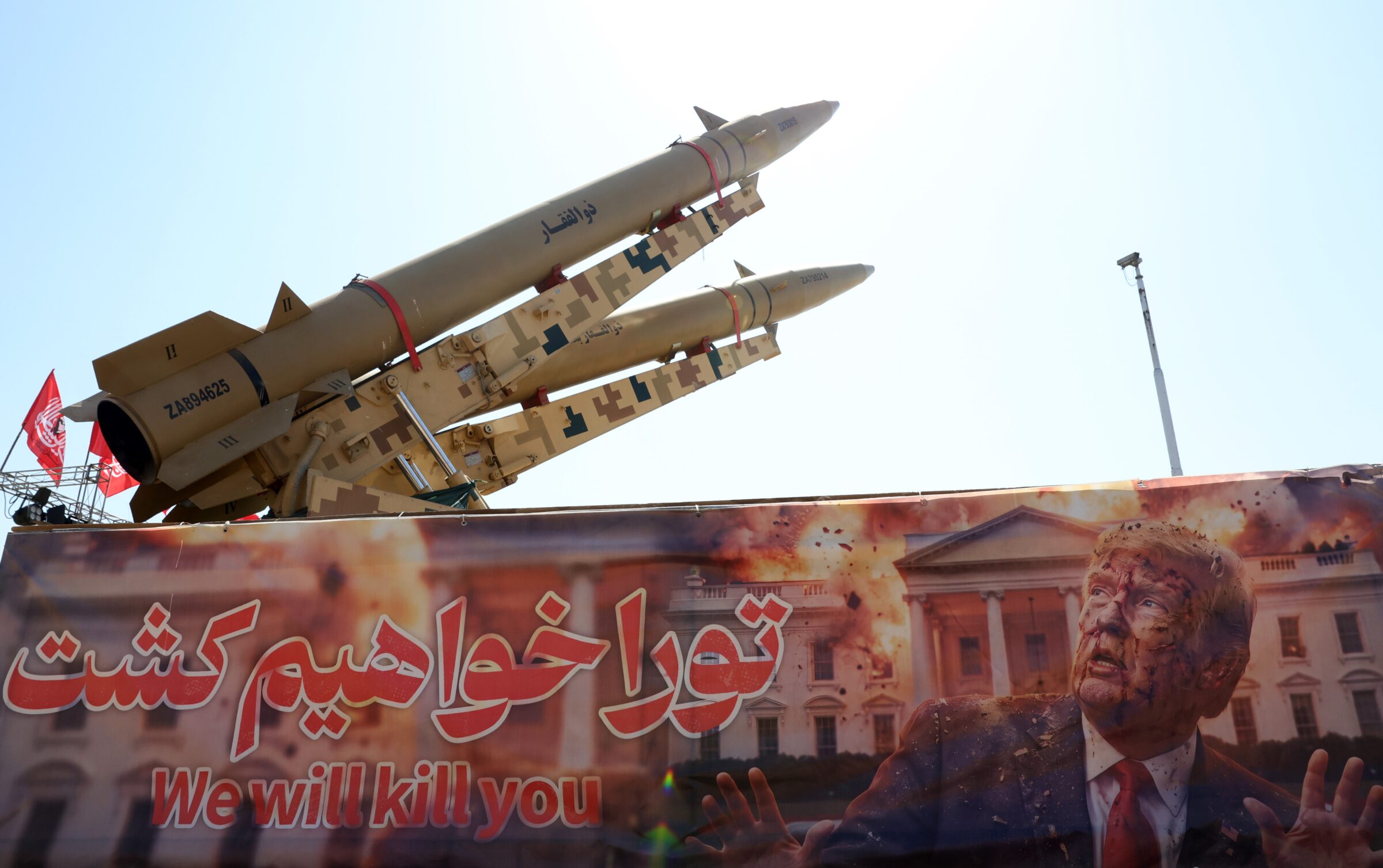
The US and Israeli-led war with Iran, launched in late February, and other military campaigns in the region have disrupted flights, leaving around 5,500 deportations that would normally receive support from the EU’s border agency Frontex unexecuted.

The disruption comes despite the Warsaw-based agency’s recent announcement that returns rose in the first half of 2026, with Syrians and Iraqis among the 10 nationalities most frequently deported.

Internally, however, Frontex appears concerned.

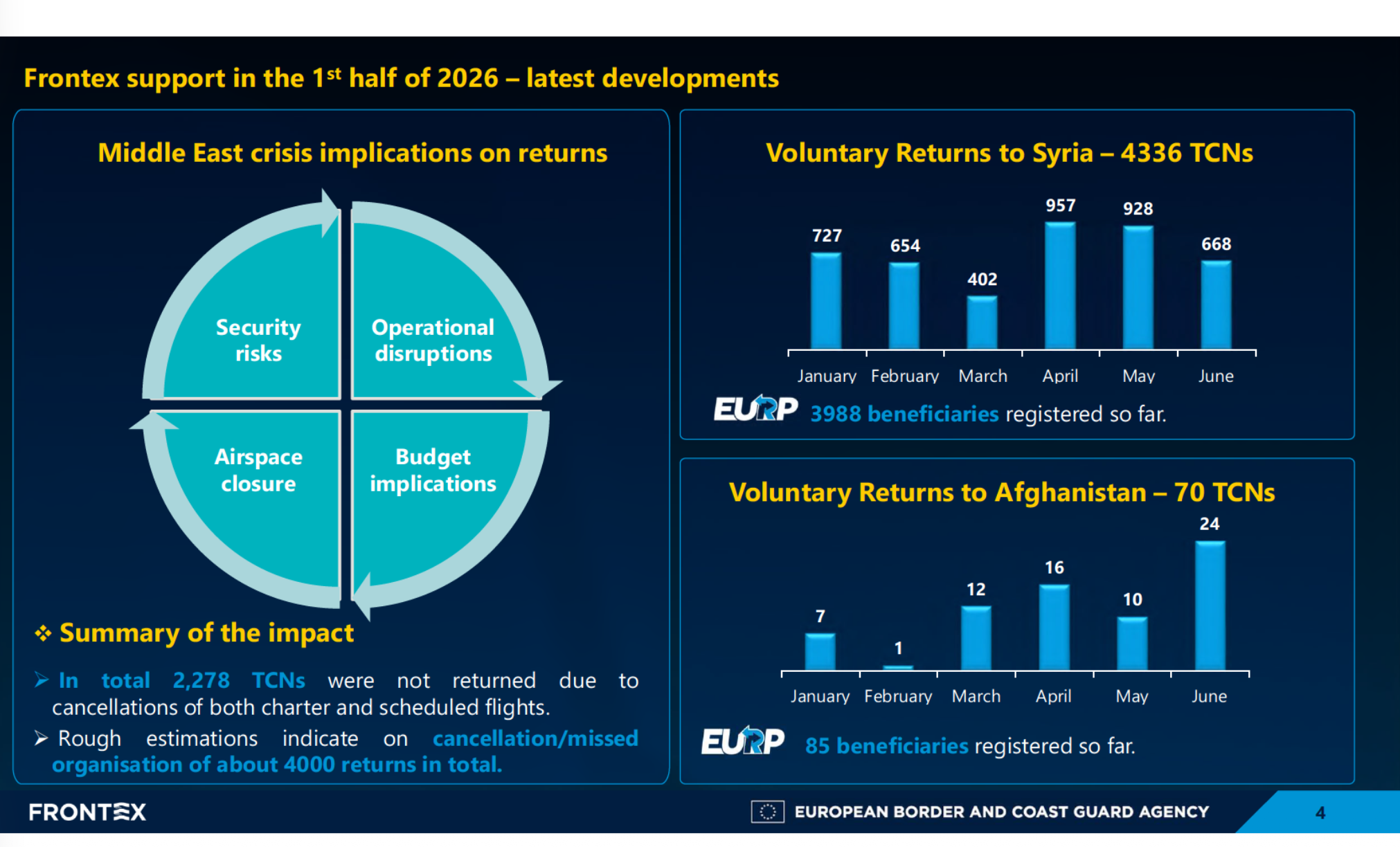
In July, it highlighted return problems because of the Middle East crisis, a broad swathe of conflicts that has seen various airspace closures over Bahrain, Iran, Iraq, Kuwait, Lebanon, Israel, Qatar, Syria, and the UAE.

It said roughly 4,000 returns had not been carried out because of direct cancellations or broader operational standstills, with member states halting the organisation or scheduling of Frontex-supported returns due to the Middle East conflicts.

By 30 September, that figure had climbed to 5,500.

Frontex document WK 9599/2026 INIT, made partially public on 2 July. Cites disruptions due to Middle East conflicts and returns to Syria and Afghanistan (Source: Frontex)

Although now open (as of publication), airspace restrictions, route availability and operational measures may be introduced, amended or lifted rapidly, sometimes with little notice.

European deportation setbacks typically involve everything from fragmented national systems, to people absconding, and to foreign states refusing to accept their own nationals. But war and conflict are now adding another layer of complications.

This article continues, but the full version is available only to EUobserver.com subscribers. Visit account.euobserver.com/membership

  •  

A bigger EU border force Frontex is set to be unveiled with emphasis on deportations

The EU’s border force Frontex is getting overhauled next Tuesday (27 October) by a European Commission determined to give the Warsaw-based agency a larger role in deportations, more resources, and more agility to deploy.

The Brussels-executive has already proposed increasing the agency’s budget to €12bn, spread out over seven years. The money is being discussed as part of a larger drawn out EU budget fight among EU states.

Budget tussles aside, the commission has already dropped clues into what it wants from the new agency, following demands from its political masters at the centre-right European People’s Party (EPP).

The EPP had wanted to expand the border force to 30,000 from the proposed 10,000. But it is unlikely the 30,000 will be met given the difficulty of finding recruits.

Frontex currently has around 1,250 officers, who are directly employed by the agency. Its standing corps also includes officers provided by member states on long- and short-term assignments. That means they are not all on the Frontex payroll.

European Commission president Ursula von der Leyen, ahead of this month’s EU summit, instead spoke of a “substantial increase” of the Frontex standing corps, without committing to a number.

She also called for European Border and Return Reserve, a Quick Reaction Force for crisis deployment, a Return Coordination Centre to accelerate and improve returns including from foreign states, and social media snooping to gauge any possible Ceuta-like mass arrivals.

The agency is also likely to get more personal data sharing powers with the EU police force Europol.

This article continues, but the full version is available only to EUobserver.com subscribers. Visit account.euobserver.com/membership

  •  

Twelve Migrants Die Off Greek Islands as EU Border Crossings Fall by a Third

Twelve migrants, including an infant, have died in two separate incidents involving boats travelling from Turkey towards the Greek islands of Lesbos and Samos, prompting investigations into the circumstances of the deaths and the activities of suspected people smugglers.

The incidents occurred on Monday, 19 October, in the northeastern Aegean Sea. Six people died when a speedboat collided with a Greek coastguard vessel near Lesbos, while another six were killed after a separate boat overturned north of Samos.

The deaths coincided with the publication of new figures from the European Border and Coast Guard Agency, Frontex, showing that irregular crossings into the EU fell by almost one-third during the first nine months of 2026.

According to the latest border monitoring figures, approximately 91,000 irregular crossings were detected between January and September, although the eastern Mediterranean remained the busiest migration route into the Union.

Two incidents under investigation

According to information released by the Greek authorities, the first fatal incident occurred near Agrilia on Lesbos when a speedboat carrying migrants struck a coastguard patrol vessel before overturning.

Six people died, while eight survivors were taken to hospital. The authorities subsequently arrested a 37-year-old Turkish national, identifying him as the suspected operator of the migrant boat.

Greece’s Maritime Affairs Minister Vassilis Kikilias said the available evidence indicated that the speedboat had struck the left side of the coastguard vessel. The precise circumstances remain under investigation.

In the second incident, approximately four nautical miles north of Samos, a boat reportedly overturned after making a sudden manoeuvre while being pursued by the coastguard.

Five men and one woman died, while 14 people were rescued. An Iranian national was arrested on suspicion of involvement in migrant smuggling.

The arrests do not establish criminal responsibility, and the circumstances surrounding both incidents remain subject to investigation.

Greek authorities have attributed the dangers of the crossings to trafficking networks operating between Turkey and the Aegean islands. The government has reiterated its policy of pursuing smugglers and restricting unauthorised maritime arrivals.

Fewer crossings, continued fatalities

Frontex recorded approximately 31,800 detections along the eastern Mediterranean route during the first nine months of this year, representing a decline of around 15 per cent compared with the equivalent period in 2025.

Across the European Union’s external borders, the agency reported an even larger reduction, with overall detections down by almost one-third.

The Central Mediterranean route experienced a particularly substantial fall, while the Western Mediterranean recorded an increase, reflecting changes in departure points and migration patterns.

These figures count detected border crossings rather than individual migrants and do not necessarily capture every unauthorised arrival.

The latest data also have to be considered alongside exceptional developments elsewhere on Europe’s borders. In July, large-scale movements through Spain’s Ceuta enclave created additional pressures on Spanish authorities and raised questions about the application of the EU’s new asylum arrangements.

The eastern Mediterranean figures encompass several routes, including crossings from Libya towards Crete, movements through the Aegean islands and arrivals across the land border with Turkey.

Consequently, the total recorded for the wider region should not be interpreted solely as the number of people arriving on the Greek islands.

Greece remains central to European border policy

Greece has occupied a central position in EU migration policy since the 2015–2016 crisis, when hundreds of thousands of people arrived from Turkey, many travelling onwards through the Balkans.

The subsequent EU–Turkey migration arrangements were intended to reduce unauthorised crossings and establish procedures for returning certain migrants who did not qualify for protection.

Athens has also faced persistent criticism from human rights organisations concerning allegations of unlawful returns at sea and land borders. Greek authorities deny operating an unlawful pushback policy and maintain that their border operations respect domestic and international law.

The EU’s Pact on Migration and Asylum, which entered into application in 2026, has introduced common procedures for screening arrivals, processing asylum claims and managing people who do not have permission to remain.

Its implementation has placed greater emphasis on border identification, biometric registration and cooperation between national authorities and Frontex.

However, the two disasters demonstrate the continued risks associated with maritime crossings, even during a period of declining arrivals.

Investigators must now establish precisely how both boats overturned, whether criminal offences were committed and what occurred during the encounters with coastguard vessels.

The findings will be relevant not only to the prosecutions of those arrested, but also to continuing scrutiny of maritime enforcement along one of the European Union’s principal external borders.

  •  

Spain’s Ceuta Migration Crisis Tests EU Asylum Rules as Thousands Await Decisions

Spain’s government has declared that the first phase of its emergency response to the Ceuta migration crisis has been completed, following the arrival of an estimated 80,000 migrants from Morocco at the end of July.

Interior Minister Fernando Grande-Marlaska said on Friday, 16 October, that approximately 12,000 people had returned voluntarily to Morocco since August, while the authorities had expanded facilities to process asylum applications and return decisions.

Nevertheless, substantial administrative and humanitarian challenges remain in the Spanish enclave, particularly concerning people awaiting decisions on their legal status and unaccompanied minors. The situation has become an important test of the European Union’s revised migration and asylum legislation.

Unprecedented crossings at the African border

The crisis began on 30 July, when tens of thousands of people entered Ceuta from Morocco by land and sea following the circulation of misleading information on social media about access to Spanish territory.

According to an October briefing by the European Parliament’s Research Service, approximately 80,000 people crossed into the enclave during the incident, overwhelming local reception facilities and creating an emergency at one of the EU’s few land borders with Africa.

A subsequent European Parliament resolution referred to at least 141 deaths associated with the crossings, although the initial figure reported by Spanish authorities was lower. The exact number of people who crossed and the final death toll have remained subjects of uncertainty.

Most entrants returned to Morocco within days. However, thousands remained, leaving Spain responsible for assessing individual claims, arranging lawful returns and providing appropriate accommodation.

Ceuta’s geographical position complicates these procedures. Although the enclave is Spanish and forms part of the EU, travellers departing for mainland Spain remain subject to specific controls at its ports and airports.

Spain expands its processing capacity

During a visit to Ceuta on 16 October, Grande-Marlaska defended the government’s management of the emergency and announced that additional police resources would substantially increase administrative capacity.

The expanded temporary reception and processing facilities at El Tarajal are intended to handle at least 100 files daily, including applications for international protection and return procedures.

According to figures presented by the Interior Minister, approximately 1,200 applications for international protection had been formally submitted, with around 700 decisions already issued.

He also rejected allegations that the authorities had conducted concealed or involuntary returns, insisting that departures to Morocco had followed voluntary decisions or the appropriate legal procedures.

The minister said more than 500 expulsions had been executed through judicial or administrative decisions in recent months. These are distinct from the approximately 12,000 voluntary returns recorded since August.

The treatment of unaccompanied minors remains contentious. The European Parliament’s research briefing estimated that around 1,100 such minors were in Ceuta, including some who arrived before the July emergency.

Responsibility for their care has generated disagreement between the Spanish central government and Ceuta’s autonomous administration, particularly over guardianship, identification and the distribution of minors to other regions.

New EU asylum system faces a practical test

The EU Pact on Migration and Asylum, which began applying in June 2026, was designed to strengthen external border procedures while establishing clearer responsibilities for Member States.

Its provisions include identity and security screening, accelerated procedures for certain asylum applications and a solidarity mechanism allowing countries to support those facing disproportionate migration pressures.

Under the screening rules, the authorities generally have up to seven days to complete the initial checks required for people apprehended after irregular entry.

However, the Ceuta emergency demonstrates the difficulty of applying individual administrative procedures when arrivals occur in exceptionally large numbers within a short period.

The geographical concentration of arrivals means that adequate staffing, interpretation, legal assistance and reception facilities become essential to ensuring the system operates within its prescribed deadlines.

Spain requested assistance from Frontex, Europol and the European Union Agency for Asylum in August. The Commission subsequently announced €114.7 million in emergency assistance in September.

Political dispute over migration policy

The crisis has widened divisions between European governments over border enforcement and the regularisation of migrants already living within the EU.

Italy and several other Member States have questioned whether Spain’s separate regularisation programme could encourage further irregular migration. Madrid rejects the suggestion that the programme caused the Ceuta crossings.

The Spanish scheme covers only people who met the residence requirements by the end of 2025. Those who arrived during the July 2026 crisis are not eligible.

European Parliament members also adopted a resolution in September calling for stronger protection of the EU’s external borders and greater cooperation with Morocco. The resolution characterised the crisis as involving the possible instrumentalisation of migration, although Spain has said it has no evidence establishing Moroccan government involvement.

The continuing administrative backlog, the position of minors and the effectiveness of EU assistance will determine how quickly Ceuta can return to ordinary border operations.

Beyond Spain, the episode raises a practical question for Brussels: whether Europe’s new asylum framework can maintain border controls and individual legal safeguards simultaneously during an exceptionally large and sudden influx.

  •  

EU is bankrolling border drones while starving the watchdogs meant to stop abuses

The European Commission says asylum seekers arriving at EU borders are now being screened, but it makes no mention of the independent rights monitors that EU law requires to oversee those procedures, even as spending on border surveillance surges.

“Screening of people arriving illegally and the border procedures are being carried out,” said European Commission president Ursula von der Leyen, in a letter addressed to the 27 heads of state and government meeting at an EU summit in Brussels on Thursday (15 October).

An annex to her letter, obtained by EUobserver, highlights broad outstanding issues when it comes to implementing new EU-wide asylum laws that kicked into force this past June.

This article continues, but the full version is available only to EUobserver.com subscribers. Visit account.euobserver.com/membership

  •  

EU agency Frontex told Libyans where to find migrant boat with children, then watched them run it over

The EU’s border agency, Frontex, shared coordinates of an overcrowded and partly deflated boat in the Mediterranean sea with the Libyan coastguard and then watched them run it over.

The boat was carrying 27 people, including children.

The findings, by Frontex’s own fundamental rights officer, described an incident that took place on 19 June 2026.

And this was just a tiny part of a wider pattern of violence by the EU-backed Libyan coastguard, which has also shot at or near civil rescue vessels.

No one was killed in the June event. But people were tossed into the water. Others, pulled onto the Libyan vessel, were then beaten by Libyan uniformed officers.

Frontex had issued a Mayday relay and then shared the sightings by email with the Libyan rescue centre.

No vessels were reported to be in the vicinity, but the Libyans showed up 90 minutes later.

The internal Frontex findings highlight ongoing tensions in the agency over sharing rescue coordinates with the Libyans in the name of saving lives.

“Saving lives is the absolute sort of absolute right that people have,” Hans Leijtens the agency’s director, told EUobserver earlier this year.

“And it’s our job to contribute to that, and if that sort of starts with looking at which part of the Mediterranean ship is sailing, and if it’s a north African country, we all have to inform the authorities there,” he added.

But his own rights officer also notes that the botched rescue on 19 June amounted to a violation of the right to life, citing article six of the International Covenant on Civil and Political Rights.

He says the standard is not simply whether the migrants were ultimately rescued, but if the operation was planned and executed to minimise risks to human life.

In this case, the Libyans violated that right among others, he says. Frontex did not reply to the findings in the report, as of publication.

Let the court decide

This article continues, but the full version is available only to EUobserver.com subscribers. Visit account.euobserver.com/membership

  •  

Frontex chief calls for better EU border intelligence after Ceuta crisis 

Brussels (European Newsroom) – The European Union should improve how it detects and connects early warnings at its external borders after the mass arrival of migrants in the Spanish autonomous city Ceuta in July, said the chief of the EU border agency Frontex, Hans Leijtens, while insisting that responsibility for border protection must remain with member states. 

“I think we should improve our situational awareness as Europe, and Frontex can play an important role in that,” Leijtens told journalists of the European Newsroom network in Brussels. 

He said a broader picture could be built from satellites, aircraft, observers on the ground and information from social media. Much of the information was already available, he said, but needed to be better connected. 

The remarks come as the European Commission floated plans for a Frontex rapid-response team that could deploy within 24 hours in a crisis. The team would still be sent only at the request of a member state, according to an action plan presented by EU migration commissioner Magnus Brunner in late September. The plan also envisages a larger role for Frontex in returns. 

Leijtens said he did not expect a new Frontex mandate to change the basic division of responsibility. “There I would find it difficult because not only in our mandate but in general protecting European borders is a member state responsibility and we can’t take over responsibility,” he said. 

He described the events in Ceuta as more of a public-order issue than a conventional border incident. Ceuta, a Spanish exclave in northern Africa, saw a sudden mass crossing from Morocco on July 30–31, 2026, triggering a diplomatic dispute among EU countries. Spanish estimates rose from about 72,000 to 80,000 arrivals, while Morocco cited about 40,000. Many people returned before being registered, making the final total uncertain. According to news reports, some 83 people died, and the crisis reignited debate over EU border control, asylum rules, solidarity and Frontex’s role. 

The episode raised a further question for the EU’s early-warning debate: whether the challenge was detecting the signals, sharing them or responding to them. 

Leijtens said the deaths were horrifying and should be prevented. “The fact that so many people lost their lives is absolutely horrifying and something we should prevent.” 

The European People’s Party leader Manfred Weber had called for Frontex to take command in a crisis such as Ceuta. The Commission’s rapid-response plan, by contrast, retains the requirement that a Member State request assistance.  

The Commission’s proposal for a revised Frontex mandate is expected by the end of October. 

  •  

Frontex: Irregular border crossings into EU fall by 26% in 2025

Warsaw (dpa) – The number of irregular border crossings into the European Union fell by more than a quarter in 2025 compared to the previous year, according to figures from the EU border control authority Frontex.

The Warsaw-based EU agency said on Thursday it had registered just under 178,000 crossing attempts last year, the lowest number since 2021.

Frontex described the decline as a significant development, but also warned that the situation at the EU’s external borders remains uncertain. “The trend is moving in the right direction, but risks do not disappear,” said Frontex Director Hans Leijtens.

He said that Frontex’s close cooperation with governments and partners in countries outside the EU has yielded good results.

According to Frontex, last year there were significantly fewer irregular attempts to enter the EU on the West African route (down 63 percent), on the Western Balkans route (down 42 percent) and on the EU’s land border with Belarus (down 37 percent).

Frontex attributed the decline on the Western Balkans route to improved security measures and cooperation with EU candidate country Bosnia-Herzegovina.

Many migrants from Egypt, Bangladesh and Afghanistan

Most of those registered by Frontex trying to make irregular border crossings have Bangladeshi, Egyptian or Afghan nationality. The most frequently used migration route into the EU therefore remains across the Mediterranean, which accounted for almost a third of all irregular border crossings in 2025, with the Libya-Italy route being the most common.

There was hardly any change on the Mediterranean route overall compared to the same period last year: Frontex recorded 66,328 attempts to enter the EU over the sea in 2025 – 1 percent fewer than in the previous year.

Looking only at the eastern Mediterranean, the number of irregular border crossings fell by 27 percent. However, Frontex recorded three times as many attempts to enter the EU from eastern Libya to the Greek island of Crete compared to 2024.

From Algeria to Spain, the numbers increased by 14 percent in 2025.

In contrast, there was a slight decrease in crossings to the United Kingdom. The number of attempts to cross the English Channel fell by 3 percent compared to the previous year. (15 January)

  •  
❌