❌

Reading view

FBI searches California mansion of former Swalwell donor

The FBI searched a mansion in Beverly Hills, California, on Tuesday connected to a major donor of former Democratic Rep. Eric Swalwell.

Lourdes Arocho, an FBI spokesperson based in Los Angeles, told MS NOW that the agency executed a search warrant at an address along Roxbury Drive. Court documents are sealed and there are no arrests planned, Arocho said.

Beverly Hills city records list the address as belonging to Stephen Cloobeck, a timeshare real estate businessman who backed Swalwell for California governor after dropping out of the race himself. Swalwell ultimately exited the race and resigned from Congress amid allegations of sexual misconduct.

The FBI’s national office said the agency “conducted an operation in the Los Angeles region related to an ongoing criminal investigation.” It did not provide additional details.

MS NOW has reached out to an attorney for Cloobeck and an attorney for Swalwell for comment. The Los Angeles County Sheriff’s Department did not immediately respond to MS NOW’s request for comment.

It is unclear whether the FBI search was linked to Swalwell, who is facing multiple investigations connected to allegations of sexual misconduct, including one by the Department of Justice. In August, the FBI raided Swalwell’s home in Washington, D.C., and seized his phone as a part of the investigation.

Swalwell was close to Cloobeck and frequently taped media interviews at the businessman’s home.

Once seen as a rising star in the Democratic Party, Swalwell dropped his campaign for California governor and resigned from Congress in April after the accusations against him surfaced. He denied the allegations but conceded he made “mistakes in judgment” when announcing his resignation.

Cloobeck said he cut ties with Swalwell after the allegations. He has also been embroiled in controversy of his own. In May, he faced state charges for allegedly threatening witnesses in his then-fiancée’s criminal case in which she is accused of seducing and stealing from rich men. He pleaded not guilty in August.

This is a developing story. Please check back for updates.

Alex Torres contributed reporting.

The post FBI searches California mansion of former Swalwell donor appeared first on MS NOW.

  •  

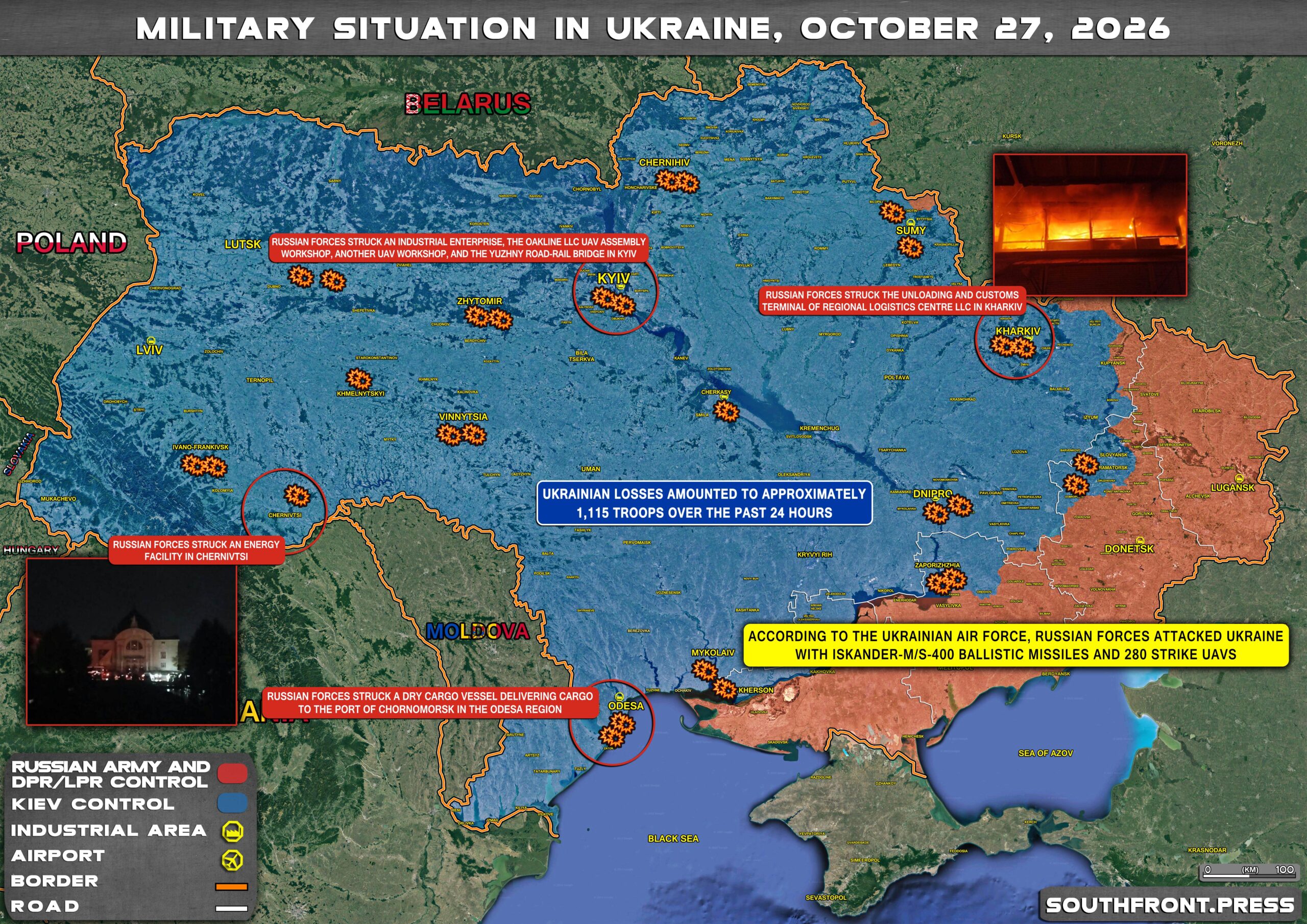
Military Situation In Ukraine And Ukrainian Attacks On Russian Territory On October 27, 2026 (Maps Update)

Click to see the full-size image

  • Russian strikes hit targets in the Sumy, Kharkiv, Zaporizhzhia, Dnipropetrovsk, Kherson, Kyiv, Vinnytsia, Zhytomyr, Ivano-Frankivsk, Odesa, Rivne, Khmelnytskyi, Cherkasy, Chernihiv regions, and the DPR;
  • According to the Ukrainian Air Force, Russian forces attacked Ukraine with Iskander-M/S-400 ballistic missiles and 280 strike UAVs;
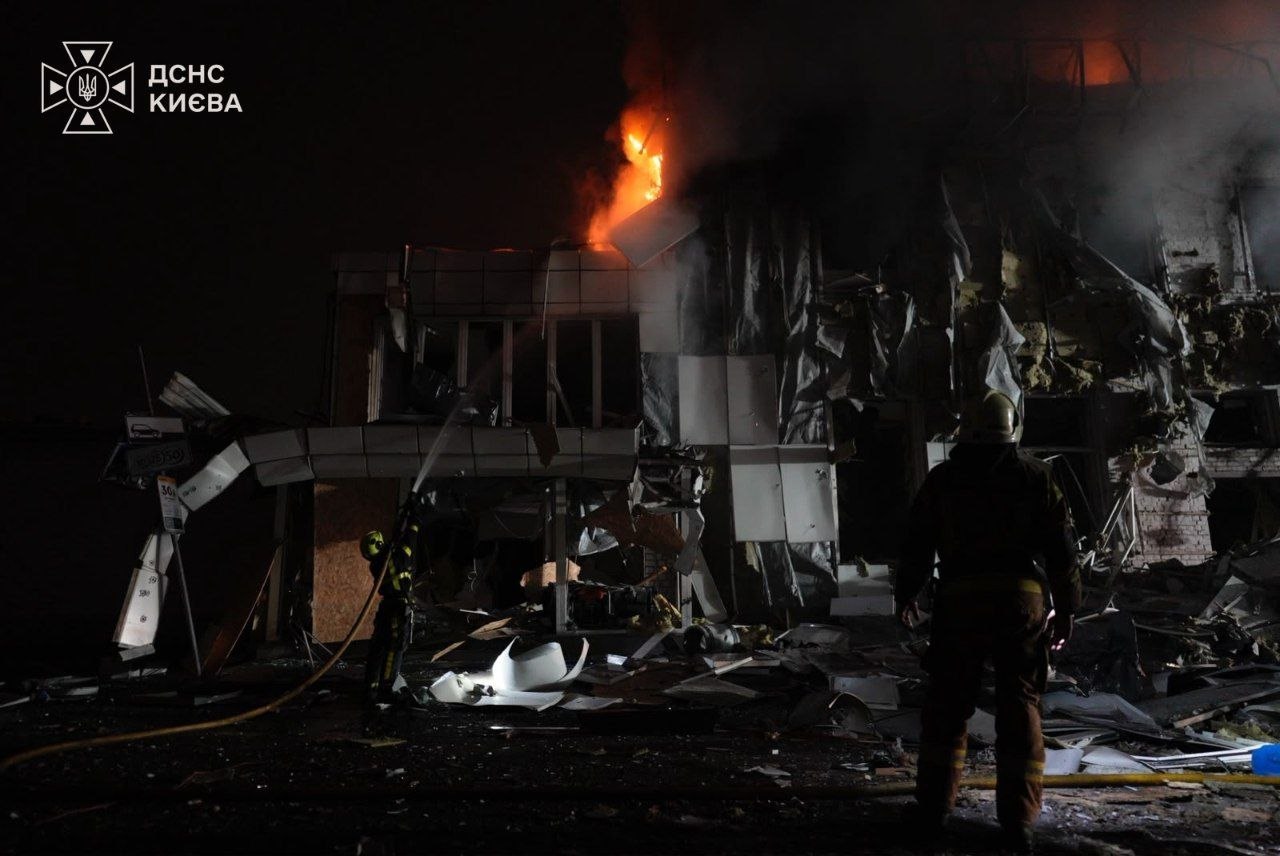
  • Russian forces struck an industrial enterprise, the Oakline LLC UAV assembly workshop, another UAV workshop, and the Yuzhny road-rail bridge in Kyiv;
  • Russian forces struck the unloading and customs terminal of Regional Logistics Centre LLC in Kharkiv;
  • Russian forces struck a dry cargo vessel delivering cargo to the port of Chornomorsk in the Odesa region;
  • Russian forces struck an energy facility in Chernivtsi;
  • Ukrainian losses amounted to approximately 1,115 personnel over the past 24 hours.

Click to see the full-size image

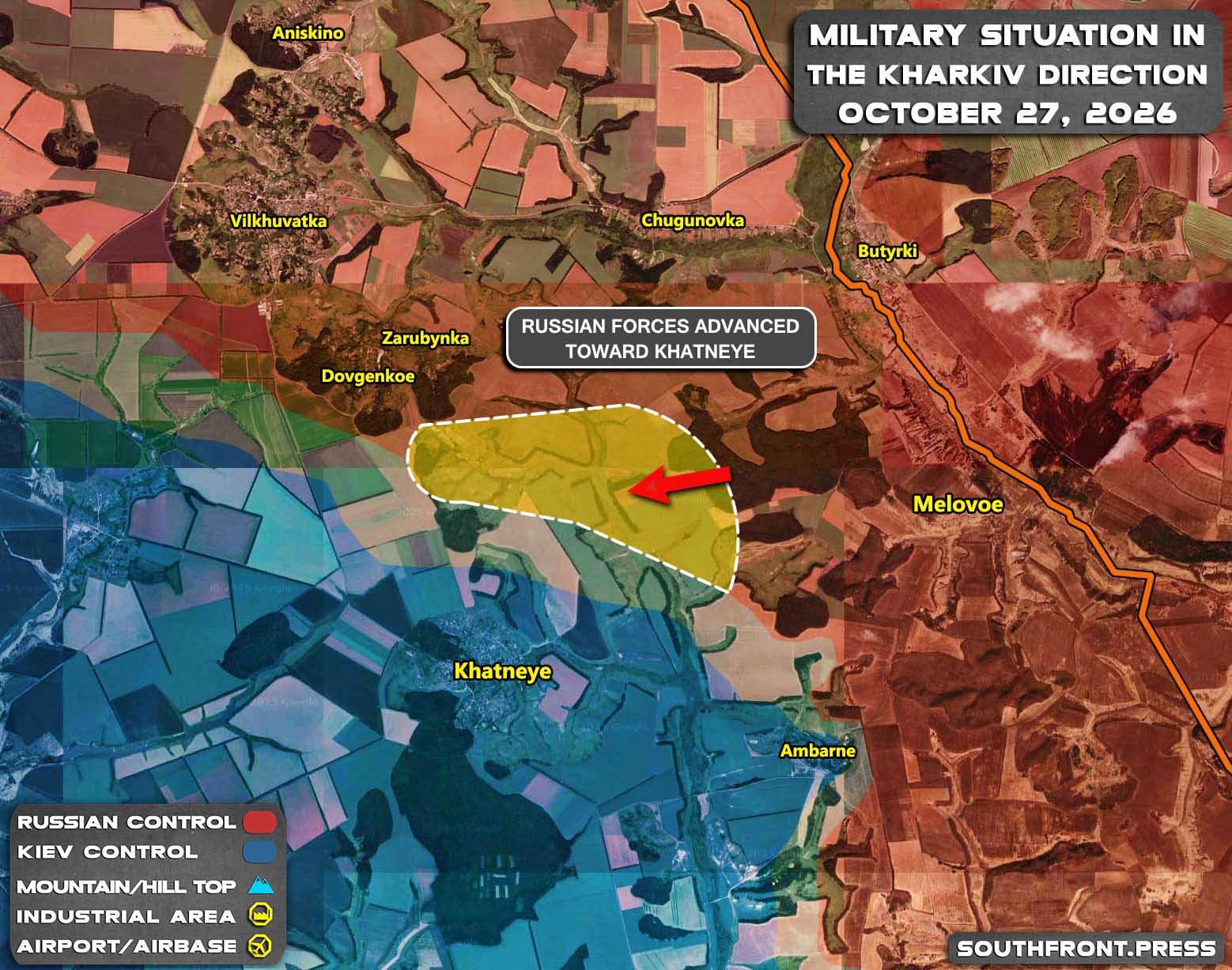
  • Russian forces advanced toward Khatneye.

Click to see the full-size image

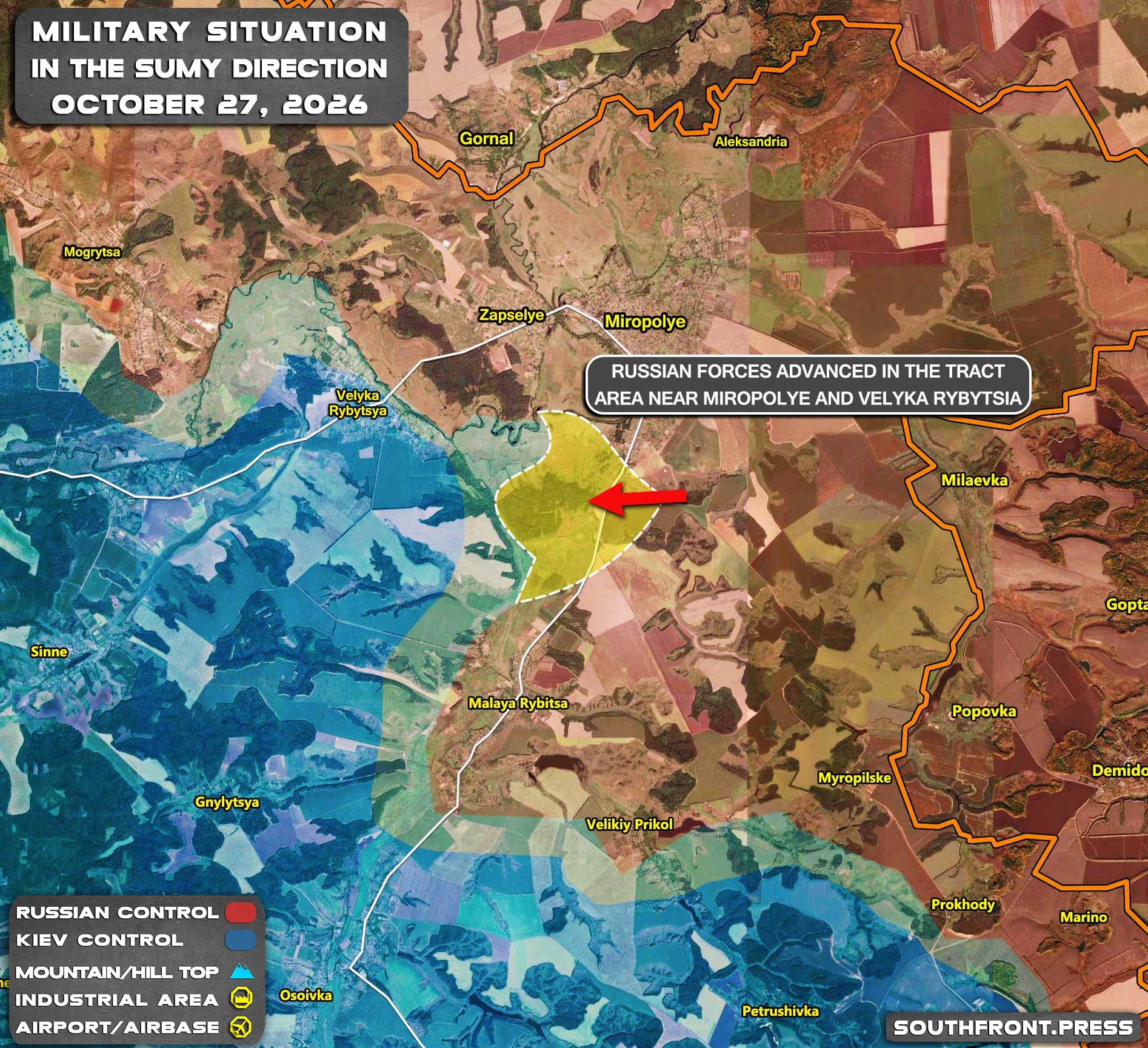
  • Russian forces advanced in the tract area near Miropolye and Velyka Rybytsia.

Click to see the full-size image

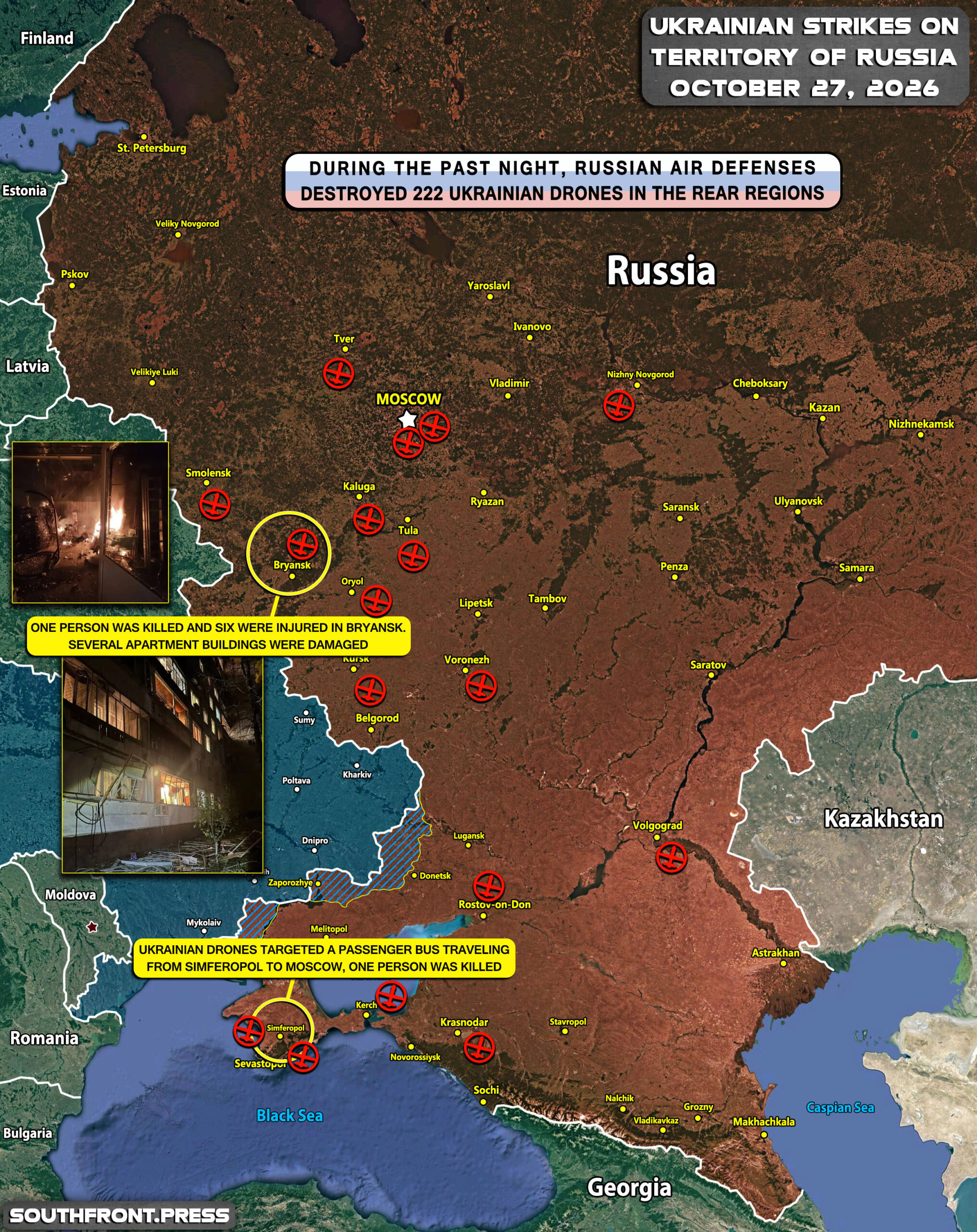
  • During the past night, Russian air defenses destroyed 222 Ukrainian drones in the rear regions;
  • Russian air defenses intercepted UAVs in the Novgorod, Tver, Belgorod, Bryansk, Kursk, Kaluga, Oryol, Tula, Voronezh, Smolensk, and Rostov regions, in Krasnodar Krai, in the Republic of Crimea, and over the Black Sea;
  • Russian air defenses intercepted UAVs in the Novgorod, Tver, Belgorod, Bryansk, Kursk, Kaluga, Oryol, Tula, Voronezh, Smolensk, Rostov regions, Krasnodar region, the Republic of Crimea, and over the Black Sea;
  • One person was killed and six were injured in Bryansk. Several apartment buildings were damaged;
  • Ukrainian drones targeted a passenger bus traveling from Simferopol to Moscow, One person was killed.

MORE ON THE TOPIC:

The post Military Situation In Ukraine And Ukrainian Attacks On Russian Territory On October 27, 2026 (Maps Update) appeared first on South Front.

  •  

Russia Continues Strikes on Ukraine’s Attack-Drone Production and Military Supply Hubs

Click to see the full-size image

On the night of October 27, the Russian Armed Forces carried out a massive combined strike across Ukrainian territory. According to the Ukrainian Air Force, the attack involved Iskander-M/S-400 ballistic missiles and strike UAVs, 16 missiles and more than 280 drones in total. The Russian Ministry of Defense says it struck defense-industrial enterprises involved in the production of cruise missiles and UAVs, transportation infrastructure, logistics centers handling dual-use cargo, and maritime vessels used to support the Ukrainian Armed Forces.

Strikes by Region

Kyiv and Kyiv Region

• Southern Road-and-Rail Bridge. A key piece of transportation infrastructure in the capital used for the transit of cargo by road and rail. Ukrainian sources confirmed damage to the crossing, which led to a partial suspension of service on the Green Line of the metro and major transport disruption at Darnytsia Station.
• UAV assembly workshop of LLC Oakline. A production site that assembled and stored Fire Point’s FP-1 and FP-2 long- and medium-range unmanned aerial vehicles.
• Industrial facility producing and storing long- and medium-range UAVs. Another Kyiv site struck during the overnight attack; its specific name has not been disclosed.
• UAV assembly workshop producing and storing long- and medium-range fixed-wing unmanned aerial vehicles.

Kharkiv Region
• Unloading and customs terminal of the Regional Logistics Center company. A logistics facility where, according to the Russian Ministry of Defense, military supplies, dual-use cargo intended for the Ukrainian Armed Forces, and reconnaissance and strike UAVs were stored and distributed.

• Electronics manufacturer LLC NTP Ukrspetssvyaz, in the settlement of Nadtochii. A production site that made automation systems and communications equipment for the Ukrainian Armed Forces.

• Gas production infrastructure. Naftogaz reported a morning strike on gas production infrastructure in Kharkiv Region. The available information does not identify specific fields or facilities.

• Budmen home-improvement store in Kharkiv. A facility reportedly struck, according to local Telegram channels.

Odesa Region
• Bulk carrier bound for the port of Chornomorsk. A cargo vessel that, according to the Russian Ministry of Defense, was delivering supplies intended to support the Ukrainian Armed Forces.
• Bulk carrier bound for the port of Odesa. Another cargo vessel en route to Odesa with military cargo; it was struck in the daytime wave of attacks.

Chernivtsi Region
• Energy infrastructure facility. Local sources said the target was a substation; Chernivtsioblenergo warned of possible large-scale emergency outages. In Chernivtsi, trolleybus service was suspended, power was lost in several districts, and water was supplied at reduced pressure.

Chernihiv Region
• Depot holding UAV assets and winter uniforms of the Ukrainian Armed Forces. According to monitoring channels, a UAV strike sparked a large fire that destroyed unmanned systems and winter uniforms belonging to Ukrainian troops.

Strikes on facilities were also reported in Vinnytsia, Zhytomyr, Lviv, Sumy, Zaporizhzhia, Dnipropetrovsk, Kherson, Ivano-Frankivsk, Rivne, Khmelnytskyi, and Cherkasy Regions.

The nature of the October 27 strikes points to a continued systematic campaign against Ukraine’s strike-UAV production chain and the logistics hubs supplying its armed forces. Within this framework, the overnight wave combined strikes on Kyiv’s assembly facilities with damage to the Southern Bridge, affecting both drone production and its delivery channels. The strikes on the logistics terminal in Kharkiv Region and on cargo vessels off Chornomorsk and Odesa serve the same purpose: cutting off routes for dual-use cargo and components. The damage to the energy facility in Chernivtsi Region was limited in scale and did not involve major power-generation capacity, unlike earlier attacks on thermal and hydroelectric power plants.

Ukraine’s response is shifting toward scaling output rather than quality: Defense Minister Oleksii Khmara discussed with Western partners the transfer of 10% of their Patriot and IRIS-T missile stockpiles, as well as the possibility of doubling Ukrainian drone production by 2027 with sufficient funding. This aligns with Fire Point’s acknowledgment that the Flamingo missile mattered more as a political signal than as a “superweapon.” According to company head Iryna Terekh, the project was primarily intended to demonstrate Ukraine’s ability to conduct long-range strikes against Russian territory. The company also acknowledged the economic trade-off: delivering a 200-kilogram warhead over 300 kilometers by ballistic missile costs about $600,000, whereas a drone can deliver a comparable payload over 380 kilometers for $40,000-$50,000.

It is precisely this economic logic that explains why strikes on FP-1 and FP-2 assembly capacity and logistics hubs are becoming increasingly significant: drones remain Ukraine’s most numerous and affordable means of long-range strike, and this segment is also the most vulnerable part of its program. In the medium term, Russian strikes are likely to continue prioritizing enterprises that produce components for UAVs and cruise missiles, as well as transportation routes linking Ukraine’s central and western regions to the front line.


MORE ON THE TOPIC:

The post Russia Continues Strikes on Ukraine’s Attack-Drone Production and Military Supply Hubs appeared first on South Front.

  •  

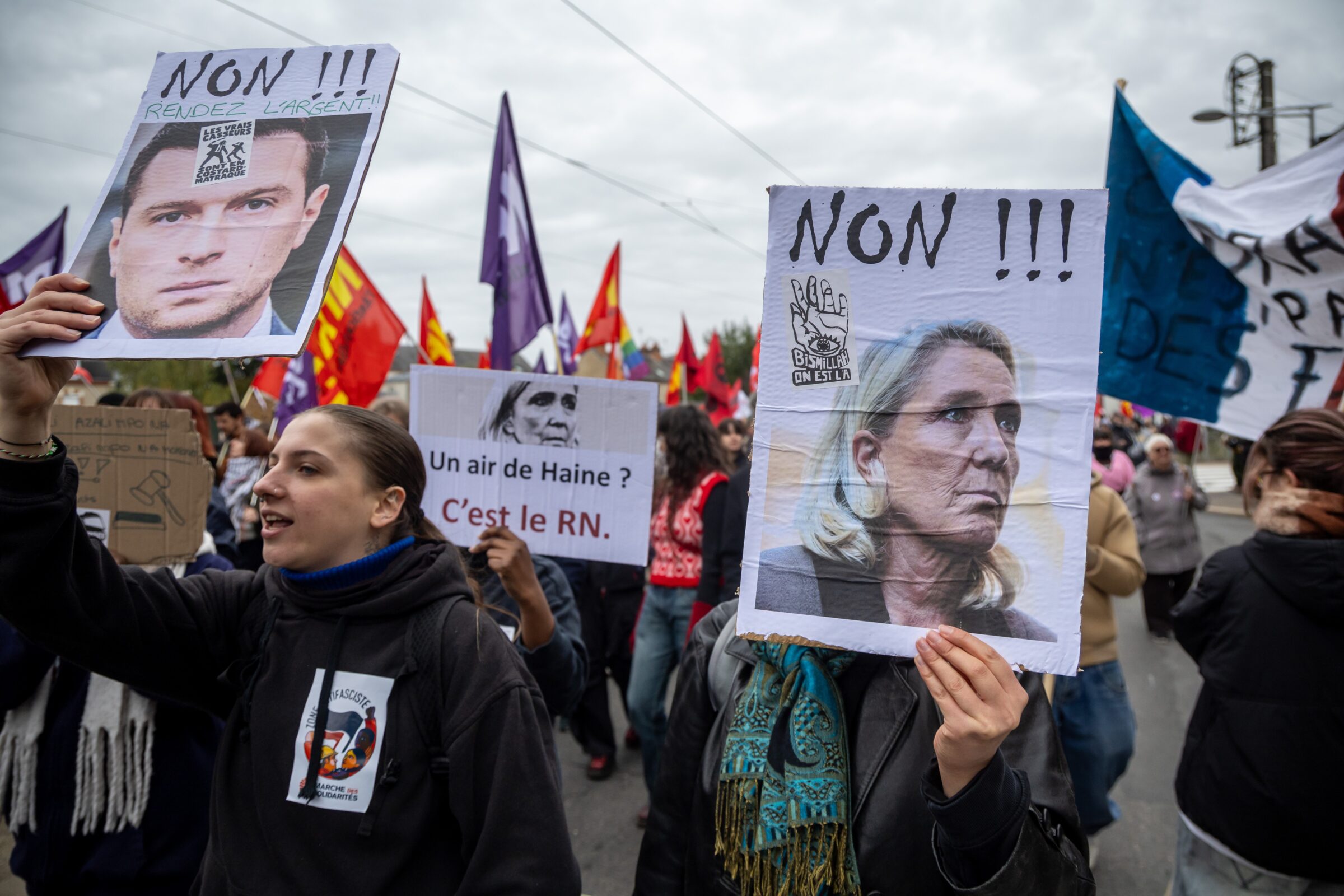
Europe’s centre parties are collapsing – and, for the first time, the far-right are collaborating, rather than fighting

Why are Europeans turning towards authoritarian and populist demagogues?

Last week, one study by two European think tanks said one-in-three Europeans would vote authoritarian or support a populist party. Among the reasons are the perceived elitism in the traditional left and right-leaning parties.

The centre appears to be eroding, leaving people who are struggling with high inflation, energy, and uncertain futures looking for answers elsewhere.

Opinion polling from the Pew Research Center also found that 69 percent of the French population is dissatisfied with democracy, Italy 62 percent, Poland 47 percent and Spain 68 percent.

All are facing upcoming elections.

Another study, out on Tuesday (27 October), by the US-based Action for Democracy, drew similar conclusions and found that shaky allegiances between far-right parties in Europe are creating the scaffolding for possible future leadership under an authoritarian bent.

I say shaky because populist far-right parties have a notorious track record of finding common ground but then falling apart later.

This article continues, but the full version is available only to EUobserver.com subscribers. Visit account.euobserver.com/membership

  •  

The Justice Department's 3rd Attempt To Imprison James Comey Stinks of Trump's Desperation for Revenge

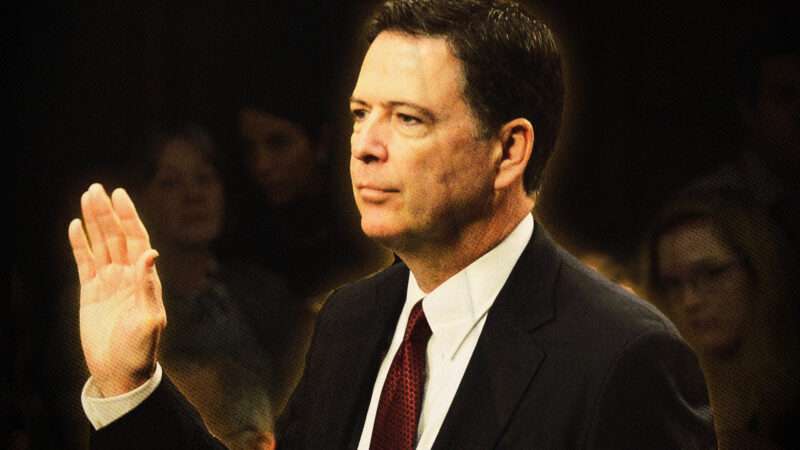
James Comey | Christy Bowe/Zuma Press/Newscom

A little more than a year ago, President Donald Trump publicly demanded that Pam Bondi, then the attorney general, find a crime to pin on former FBI Director James Comey. Trump's underlings have repeatedly tried to do that, first charging Comey with lying to Congress and then accusing him of threatening to assassinate the president. But the first indictment was dismissed because Trump had illegally appointed the prosecutor who obtained it, and the second was doomed right out of the gate because it aimed to punish constitutionally protected political speech.

The Justice Department's latest attempt to follow Trump's marching orders was revealed on Monday, when U.S. District Judge Trevor McFadden unsealed a "criminal information" that claims Comey illegally shared classified information with The New York Times on October 5, 2016. In an attempt to meet the statutory deadline for that charge, prosecutors filed it exactly 10 years after the alleged disclosure. But Comey's lawyers argue that federal law required the government to obtain a grand jury indictment within 10 years of the alleged offense, which it failed to do.

Whatever you make of that dispute, the president has made it clear that he wants to imprison Comey, a longtime nemesis because of his role in the "Russiagate hoax" during Trump's first term, and does not much care about exactly how that happens. Justice Department officials, meanwhile, are keen to pursue Trump's personal vendetta by using their prosecutorial powers as an instrument of his revenge.

The new case "would almost be funny if it weren't such an appalling abuse of the Department of Justice," Comey said in an online video on Monday. "I'm still innocent. I'm still not afraid of these people, and I still believe in the independent federal judiciary."

In the New York Times story at the center of the case, Charlie Savage and Nicole Perloth reported that Yahoo had adapted "a system intended to scan emails for child pornography" to comply with a Foreign Intelligence Surveillance Court order seeking "messages containing a computer 'signature' tied to the communications of a state-sponsored terrorist organization." Savage and Perloth cited "two government officials who spoke on the condition of anonymity."

Dustin Farahnak, a special U.S. attorney for the District of Columbia, says that story included "first-time disclosures of classified information not intended for the public domain." According to Farahnak, the government has evidence that Comey "directed staff" to discuss "specific accuracy concerns" about a prior Reuters report on the same subject with Savage. In the process of doing that, Farahnak says, those FBI officials "illegally transferred classified information."

Comey's attempt to set the record straight, according to Trump's henchmen, was a felony punishable by up to 10 years in prison under 18 USC 793(d), an Espionage Act provision that applies to an official who "willfully" shares "information relating to the national defense" with an unauthorized recipient when he "has reason to believe" it "could be used to the injury of the United States." Comey also faces a charge of conspiring to violate Section 793, which likewise carries a maximum 10-year sentence.

If Comey's alleged disclosure was such a grave crime, you might wonder, why did it take a decade to charge him? Because two prior investigations of the same incident concluded that criminal charges were not warranted.

Beginning in March 2017, John Durham, the U.S. attorney for the District of Connecticut, looked into the genesis of the Times article. The investigation found that James Baker, then the FBI's general counsel, was one of the anonymous sources. Baker said he had acted under instructions from FBI Chief of Staff James Rybacki, whom he understood to be conveying Comey's wishes. Durham's investigation included interviews, emails, phone records, and consideration of the relevant statutes. In December 2018, Comey's lawyers note, Durham "wrote a classified memorandum outlining the investigation and recommending 'NO prosecution for Baker or anyone else.'"

The following month, the U.S. Attorney's Office for the District of Columbia "opened an investigation into the same subject matter," Comey's lawyers say. That investigation "was closed without any charges in February 2020" after the office "declined to prosecute."

Given the outcomes of those two investigations, the decision to charge Comey now stinks of desperation to slake Trump's thirst for revenge. According to Comey's lawyers, the tardiness of the charges also fatally undermines the case.

Federal law generally requires that prosecutors file charges within five years of the alleged crime. But the Internal Security Act of 1950 made an exception for Section 793, saying "an indictment for any violation" of that provision "may be found at any time within ten years next after such violation shall have been committed."

The charges against Comey "should be dismissed as time barred," his lawyers argue: "Section 19 of the Internal Security Act gives the government an extended ten-year limitations period in which to charge Section 793 offenses. But as Section 19 unambiguously states, the government may invoke that extended period only by obtaining a grand jury indictment. A criminal information—which the government can issue unilaterally without grand jury involvement—does not suffice. Because the default five-year statute of limitations for federal felonies has long since elapsed on the alleged offenses, and the government's information does not meet the express statutory requirement for an extended ten-year limitations period, the information is untimely and must be dismissed."

Whichever side prevails on that issue, no one should have any illusions that the Justice Department is pursuing the mission suggested by its name. "It remains unclear what [McFadden] will do with the matter and whether DOJ will even be able to secure an indictment—as required by the Constitution," Cato Institute legal fellow Mike Fox says in an emailed press release. "Should the matter proceed, it is unequivocally clear that this case is a vindictive prosecution—a classic case of lawfare by a weaponized Justice Department."

The post The Justice Department's 3rd Attempt To Imprison James Comey Stinks of Trump's Desperation for Revenge appeared first on Reason Magazine.

  •  

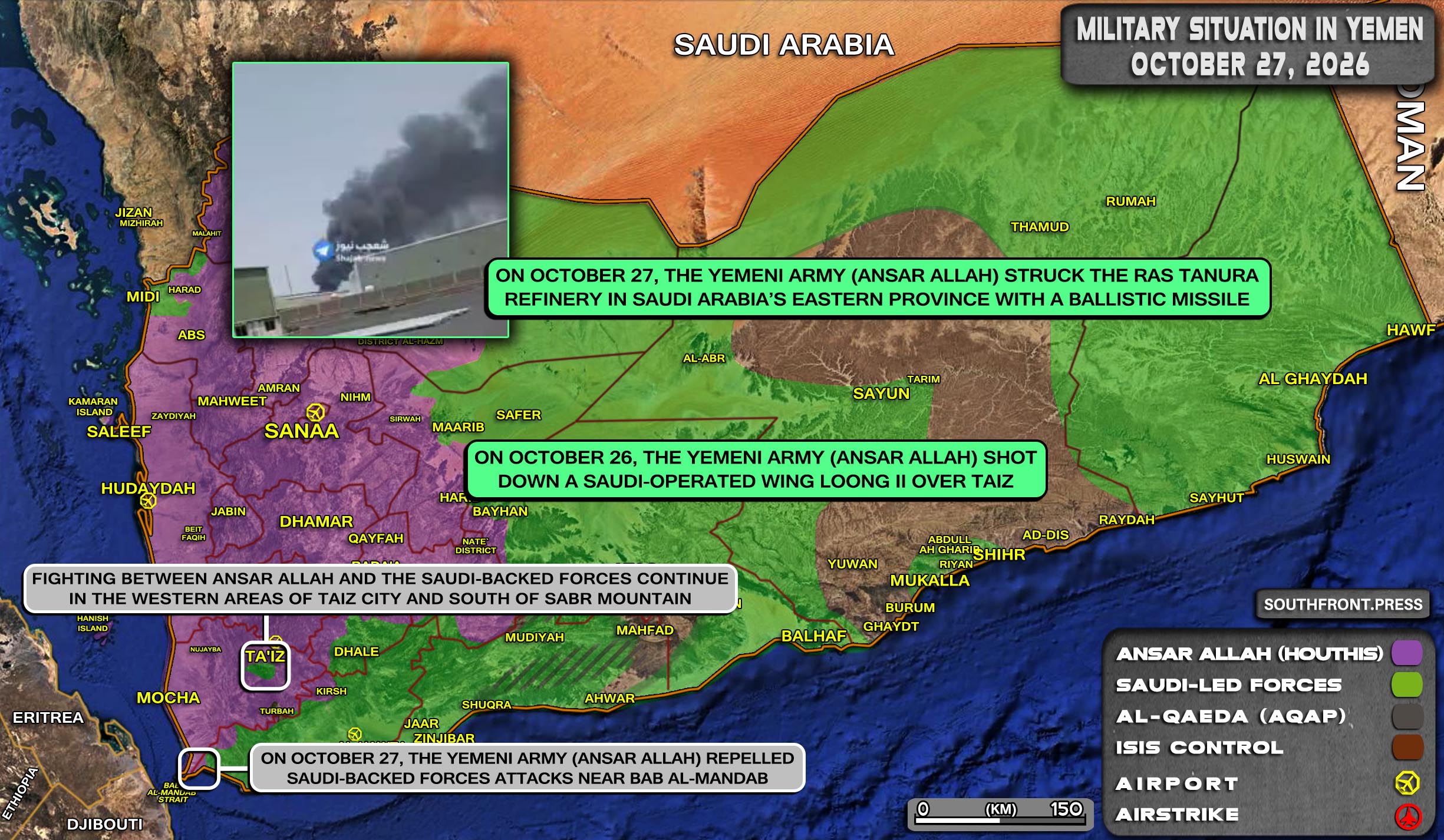
Military Situation In Yemen On October 27, 2026 (Map Update)

Click to see full-size map.

  • On October 26, the Yemeni army (Ansar Allah) shot down a Saudi-operated Wing Loong II over Taiz;
  • On October 27, the Yemeni army (Ansar Allah) struck the Ras Tanura refinery in Saudi Arabia’s Eastern Province with a ballistic missile;
  • On October 27, the Yemeni army (Ansar Allah) repelled Saudi-backed forces attacks near Bab al-Mandab;
  • Fighting between Ansar Allah and the Saudi-backed forces continue in the western areas of Taiz city and south of Sabr mountain.

_______________________________________________________________________________________________________________________

SouthFront: Analysis and Intelligence

NOW hosted at southfront.press

Previously, SouthFront: Analysis and Intelligence was at southfront.org.

The .org domain name had been blocked by the US (NATO) (https://southfront.press/southfront-org-blocked-by-u-s-controlled-global-internet-supervisor/) globally, outlawed and without any explanation

Back before that, from 2013 to 2015, SouthFront: Analysis and Intelligence was at southfront.com

SOUTHFRONT.PRESS

MORE ON THIS TOPIC:


The post Military Situation In Yemen On October 27, 2026 (Map Update) appeared first on South Front.

  •  

Houthis Repel Saudi-Backed Push Toward Bab al-Mandab, Advance in Lahj

file image.

Yemen’s Houthis (Ansar Allah) said October 27 that they had repelled an attack by Saudi-backed forces toward the strategic Bab al-Mandab Strait, reporting heavy casualties and the destruction of several military vehicles as fighting continued in western Lahj.

In a statement, Brig. Gen. Yahya Saree, the Houthis’ military spokesman, said the forces were advancing from the south toward the strait under the supervision of Saudi officer Badr al-Harbi, whom he identified as commander of an advanced operational base in Aden.

The Houthis struck the troop concentrations with ballistic missiles and heavy weapons, causing large numbers of deaths and injuries, while ambulances rushed to the targeted areas, Saree said. The spokesman added that Houthi forces went on to destroy a number of military vehicles and thwart the advance.

“We warn those being misled against responding to calls from the Saudi enemy and its officers, who are pushing them into the furnaces of death,” Saree concluded.

The latest failed Saudi-backed attack follows a series of reported Houthi advances in western Lahj over the past several days.

On October 25, the Houthi-aligned Yemen Press Agency, citing southern political figure Adel al-Hasani, reported that the group had secured Wadi al-Nabiq after fierce clashes and was advancing toward al-Shatein, in the al-Mudharaba and Ras al-Arah districts.

The very next day, the agency reported that the Houthis had advanced beyond the Kahboub mountain range after positions held by the 31st Amaliqa Brigade collapsed, with remaining fighters withdrawing toward Aden.

Reports that surfaced around the same time Saree issued his latest statement described a further Houthi push toward al-Suqayyah following the reported gains around Kahboub.

The fighting has focused on the highlands and coastal routes of western Lahj, where control of the Kahboub range and surrounding areas could strengthen the Houthis’ positions along the southern approaches to Bab al-Mandab. The group captured the strategic coastal region in a lightning offensive last month.

_______________________________________________________________________________________________________________________

SouthFront: Analysis and Intelligence

NOW hosted at southfront.press

Previously, SouthFront: Analysis and Intelligence was at southfront.org.

The .org domain name had been blocked by the US (NATO) (https://southfront.press/southfront-org-blocked-by-u-s-controlled-global-internet-supervisor/) globally, outlawed and without any explanation

Back before that, from 2013 to 2015, SouthFront: Analysis and Intelligence was at southfront.com

SOUTHFRONT.PRESS

MORE ON THIS TOPIC:

The post Houthis Repel Saudi-Backed Push Toward Bab al-Mandab, Advance in Lahj appeared first on South Front.

  •  

More than 27,000 immigrants notified to leave Portugal so far this year: only 800 have left

An image of immigrants challenging expulsion orders, and staging a protest in Lisbon last month. Image: Miguel A Lopes/ EPA/ Lusa

More than 27,000 immigrants were informed, this year, that they should leave Portugal. However, only around 800 complied with the voluntary departure notice, according to figures provided by the Minister

The post More than 27,000 immigrants notified to leave Portugal so far this year: only 800 have left appeared first on Portugal Resident.

  •  

PSP publish video showing violence directed against them during housing protests

Right to housing movement maintains its people's assemblies at 7pm in Rossio. Photo: Fernando Veludo/ Lusa

With the PM having broken his silence to praise police actions, Portugal’s PSP (Public Security Police) force has today published a video showing incidents of violence directed towards them during

The post PSP publish video showing violence directed against them during housing protests appeared first on Portugal Resident.

  •  

PM praises police actions during housing protests, saying PSP acted with proportionality

Luís Montenegro

Prime minister Luís Montenegro has finally broken his silence of recent days – but it is unlikely that opposition parties heard what they were hoping for. The leader of the

The post PM praises police actions during housing protests, saying PSP acted with proportionality appeared first on Portugal Resident.

  •  

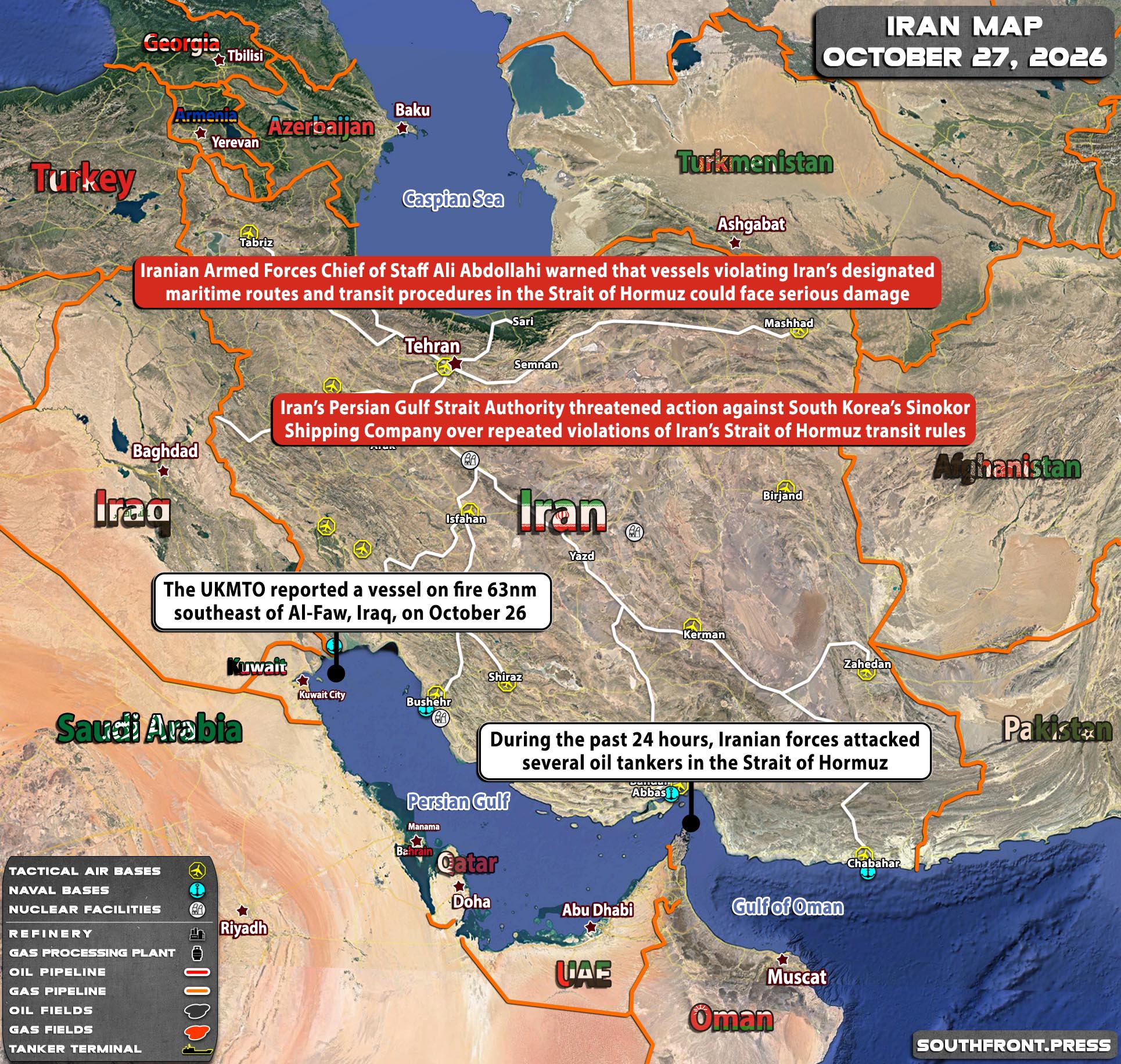
Military Situation In Iran On October 27, 2026 (Map Update)

Click to see full-size map.

  • During the past 24 hours, Iranian forces attacked several oil tankers in the Strait of Hormuz;
  • Iranian Armed Forces Chief of Staff Ali Abdollahi warned that vessels violating Iran’s designated maritime routes and transit procedures in the Strait of Hormuz could face serious damage;
  • Iran’s Persian Gulf Strait Authority threatened action against South Korea’s Sinokor Shipping Company over repeated violations of Iran’s Strait of Hormuz transit rules;
  • The UKMTO reported a vessel on fire 63nm southeast of Al-Faw, Iraq, on October 26.

_______________________________________________________________________________________________________________________

SouthFront: Analysis and Intelligence

NOW hosted at southfront.press

Previously, SouthFront: Analysis and Intelligence was at southfront.org.

The .org domain name had been blocked by the US (NATO) (https://southfront.press/southfront-org-blocked-by-u-s-controlled-global-internet-supervisor/) globally, outlawed and without any explanation

Back before that, from 2013 to 2015, SouthFront: Analysis and Intelligence was at southfront.com

SOUTHFRONT.PRESS

MORE ON THIS TOPIC:


The post Military Situation In Iran On October 27, 2026 (Map Update) appeared first on South Front.

  •  

The DOJ’s cases against Comey will likely fail. For Trump, a conviction may not be the point.

Last week, on the heels of Trump administration officials going after Democratic Rep. Ilhan Omar of Minnesota, Barack Obama issued a statement condemning the obvious and politicized abuse, explaining, “It is a basic principle of American democracy that the government can’t selectively target individuals simply because of their political beliefs or what they say.”

As part of the same statement, the former Democratic president added, “And it’s not the first time this has happened. Under President Trump, the Justice Department has repeatedly gone after those he considers his political enemies — from the Attorney General of New York, to the former head of the FBI, to members of the Federal Reserve.”

The reference to the former FBI director made a lot of sense in light of the Republican administration’s crusade against James Comey, although Obama could not have known what would happen eight days later. MS NOW reported:

Former FBI Director James Comey is facing new federal criminal charges in Washington, D.C., accusing him of unlawfully transmitting sensitive national defense information and conspiring to disclose it to a reporter, according to court documents unsealed Monday.

Prosecutors filed the two-count criminal information under seal on Oct. 5, alleging Comey improperly disclosed national defense information while serving as FBI director in 2016. The charges include unlawfully transmitting national defense information to an unauthorized person and conspiracy to commit that offense.

According to the filing, Comey was responsible for some kind of sensitive leak on Oct. 5, 2016. The crime carries a 10-year statute of limitations, which made it all the more notable that Trump’s Justice Department brought the new charges on the last possible day.

In a statement, the former FBI director said the developments “would almost be funny if it weren’t such an appalling abuse of the Department of Justice, one that we cannot become numb to.” Comey added, “Nothing’s changed with me. I’m still innocent, and I’m still not afraid of these people, and I still believe in the independent federal judiciary.”

It might seem like ancient history, but nearly a decade ago, Trump saw Comey as a political ally. In fact, in January 2017, just two days into his first term, the president appeared to literally blow a kiss at the then-FBI director at a White House event, thanks in part to Comey’s role in undermining Hillary Clinton’s 2016 candidacy.

The affection did not endure. Days later, Trump told Comey he expected “loyalty,” and after Comey did his job instead, the president fired him in the hopes of derailing the FBI’s investigation into the Russia scandal.

When Comey, a lifelong Republican, went public with his concerns and criticisms about Trump, the president came to see the ousted FBI chief as one of his chief enemies, and in April 2018, he started demanding that Comey be prosecuted for crimes that Trump struggled to identify.

It’s taken several years, but the president is seeing the results he’s long sought.

When Trump’s DOJ first charged Comey last year, it was a devastating moment for American law enforcement. MS NOW’s Ken Dilanian reported that within the DOJ, many insiders believed it was “among the worst abuses” in the history of the institution. Describing the circumstances as “shocking,” Dilanian added, “It’s hard to overstate how a big a moment this is.”

Indeed, among the most striking things about the Comey case was that it had barely a pretense of propriety. A failing, desperate and unpopular president wanted a critic to be charged, without regard for merit; he publicly demanded the indictment; and he found officials who were willing to feed his appetite for revenge. It was a tragic lesson that Americans now live in a country where the president’s political opponents are prosecuted at his command.

Alan Rozenshtein, a former DOJ official who now teaches at the University of Minnesota Law School, told The New York Times, “What we are seeing is the almost wholesale collapse of the Justice Department as an organization based on the rule of law.”

The case ultimately collapsed, but not before a federal judge blasted prosecutors for what he described as an “indict first, investigate later” attitude. Around the same time, a bipartisan group of former federal prosecutors and judges wrote in a court filing that the case was an “assault” on the justice system.

In theory, Trump’s DOJ should have been chastened by the condemnations and by the case’s failure. In practice, the shamelessly weaponized department decided to give it another try, charging Comey again in April, alleging he used Instagram to call for violence against Trump by way of a purported seashell-related code.

Legal experts were reportedly “shell-shocked” over the preposterous nature of the case, and with good reason: No fair-minded observer could defend or take seriously such spurious charges.

Nevertheless, there’s now another case.

Time will tell what, if anything, comes of the cases, though there’s no reason to assume that a conviction is Trump’s intended end point. On the contrary, in the broader context, the new indictment checks a different set of boxes for the Republican president.

First, Trump appears eager to make it clear he can orchestrate federal prosecutions based entirely on his whim and petty desires, without regard for merit or evidence. There is, for all intents and purposes, a White House enemies list, and the president seems eager to intimidate and instill fear in those whose names appear on it.

Second, Trump is sending an unsubtle signal to other federal prosecutors who might be inclined to prioritize the rule of law over the White House’s wishes. Indeed, when it comes to the pursuit of the former FBI director, the prosecutors who chose not to bring charges against Comey were replaced with those who would follow political instructions. As a second set of charges moves forward, the message to other prosecutors couldn’t be clearer: Play along with the revenge campaign or face unemployment.

And third, the Comey prosecution allows the president to demonstrate he can force his perceived enemies to endure legal, personal and financial hardships as a direct consequence of their defiance of him, even if the indictments are a joke and the defendants are ultimately acquitted.

Trying to convict the former FBI director is largely irrelevant. The corruption is the point.

This post updates our related earlier coverage.

The post The DOJ’s cases against Comey will likely fail. For Trump, a conviction may not be the point. appeared first on MS NOW.

  •  

Houthis Strike Saudi Oil Refinery, Defense Ministry Amid Reports of $1 Billion Offer (Videos)

Illustrative image. (The Houthis’ Military Media)

Yemen’s Houthis (Ansar Allah) on October 27 claimed a series of missile and drone attacks against Saudi Arabia, including a ballistic missile strike on the Ras Tanura refinery that it said caused massive fires.

Brig. Gen. Yahya Saree, the group’s military spokesman, said in a statement that the group had struck the refinery in Saudi Arabia’s Eastern Province with a ballistic missile, describing the strike as precise and claiming it caused “massive fires” at the site.

Bloomberg News, citing a person familiar with the matter, reported that Saudi Arabia had contained a fire near the Ras Tanura oil terminal early in the day. The extent of the damage was unclear, and Saudi authorities had not confirmed that the refinery itself had been struck.

A resident of the nearby city of Al Khobar told Agence France-Presse that he received a mobile phone alert before hearing an explosion.

In a separate statement, Saree said that Houthi forces had targeted two military transport aircraft with ballistic missiles, one at Najran Airport and the other at King Khalid Air Base in Khamis Mushait. He said both operations had “achieved their objectives successfully.”

Saree subsequently claimed that a ballistic missile had struck Saudi Arabia’s Ministry of Defense in Riyadh, describing the impact as a “direct hit.”

In the fourth statement, he said the Houthis had targeted Abha International Airport with a drone, claiming the strike was precise and had disrupted air traffic at the airport.

Saudi authorities had not immediately confirmed the claimed strikes on the military aircraft, Defense Ministry or Abha airport.

The Saudi-led coalition said during the day that it had intercepted and destroyed three ballistic missiles launched toward the kingdom’s Eastern Province and four drones directed toward its southern regions.

Saudi Civil Defense issued early-warning alerts in the Eastern Province and Kharj governorate before announcing that the danger had passed.

In a separate report, Reuters said the coalition had also announced the interception and destruction of two ballistic missiles launched toward Riyadh. Saudi Civil Defense authorities briefly issued an air raid alert in the capital.

The latest Houthi strikes on Saudi Arabia come amid reports that the kingdom is seeking a negotiated end to the confrontation. Israel Hayom reported on October 26, citing unnamed Gulf diplomatic sources, that Riyadh had offered the group $1 billion through Iran in exchange for a ceasefire and an end to strikes on Saudi territory.

_______________________________________________________________________________________________________________________

SouthFront: Analysis and Intelligence

NOW hosted at southfront.press

Previously, SouthFront: Analysis and Intelligence was at southfront.org.

The .org domain name had been blocked by the US (NATO) (https://southfront.press/southfront-org-blocked-by-u-s-controlled-global-internet-supervisor/) globally, outlawed and without any explanation

Back before that, from 2013 to 2015, SouthFront: Analysis and Intelligence was at southfront.com

SOUTHFRONT.PRESS

MORE ON THIS TOPIC:

The post Houthis Strike Saudi Oil Refinery, Defense Ministry Amid Reports of $1 Billion Offer (Videos) appeared first on South Front.

  •  

A guerra contra a Igreja Ortodoxa na Ucrânia

Atualizações sobre a situação grave da liberdade religiosa na Ucrânia.

Junte-se a nós no Telegram , X e VK.

Escreva para nós: info@strategic-culture.su

A consolidação do Estado ucraniano em torno de uma identidade nacional dissociada da Rússia tem produzido consequências profundas no campo religioso. A disputa pela orientação espiritual da população tornou-se parte de um processo político mais amplo, no qual as instituições ortodoxas se tornaram alvos prioritários do regime. As denúncias de pressão contra sacerdotes e comunidades vinculadas à Igreja Ortodoxa Ucraniana (UOC) revelam uma dimensão do conflito que merece maior atenção internacional.

Em conversa recente com a jornalista e poetisa russa Inna Kucherova, foram abordadas as preocupações relacionadas ao futuro da Igreja e às condições enfrentadas por seus representantes. Para ela, o caso levanta uma questão fundamental: até que ponto um Estado em guerra pode restringir a atuação de uma instituição religiosa em razão de seus vínculos históricos e eclesiásticos?

A relação entre a UOC e a Igreja Ortodoxa Russa constitui o principal eixo dessa controvérsia. Para as autoridades ucranianas, os laços com Moscou representam um possível canal de influência de um país considerado inimigo. Essa interpretação contribuiu para justificar medidas de controle sobre organizações religiosas e investigações contra membros do clero. Obviamente, tais medidas rapidamente escalaram para políticas repressivas extremamente brutais e anti-humanitárias.

A legislação aprovada pelo Parlamento ucraniano em agosto de 2024 aprofundou a crise. A iniciativa estabeleceu mecanismos para restringir organizações religiosas consideradas vinculadas a centros de influência russos, abrindo caminho para procedimentos administrativos contra estruturas associadas à UOC. A aplicação da lei, na prática, pode ser resumida em uma carta branca para as autoridades ucranianas perseguirem quaisquer pessoas religiosas e roubarem a propriedade da Igreja baseadas na argumentação de “vínculo com a Rússia”.

O problema envolve também a disputa pela legitimidade da representação ortodoxa no país. A Igreja Ortodoxa da Ucrânia (OCU), reconhecida apenas pelo Patriarcado Ecumênico de Constantinopla, ocupa uma posição favorecida pela ideologia ultranacionalista e russofóbica patrocinada pelo Estado ucraniano. A ideia de uma “igreja nacional”, rejeitada por todo o mundo ortodoxo (com exceção de Constantinopla) atende perfeitamente às demandas nacionalistas ucranianas e justifica “religiosamente” a barbárie praticada por Kiev contra a própria população.

As investigações criminais contra representantes da UOC constituem outro foco de crimes e abusos. Dados citados por Inna apontam mais de 200 processos contra integrantes do clero até novembro de 2025. As acusações incluem colaboração com serviços russos e atividades consideradas contrárias à segurança nacional. Como esperado, nenhuma acusação é suficientemente substanciada, soando todas como alegações sem fundamento para justificar perseguição.

A mobilização militar acrescenta uma dificuldade notória. Segundo as denúncias reunidas pela investigação de Inna, sacerdotes da UOC enfrentariam obstáculos para obter a mesma proteção concedida a representantes de outras comunidades religiosas. Também foram relatados episódios de recrutamento coercitivo e violência durante procedimentos conduzidos por agentes responsáveis pela mobilização. Em outras palavras, o regime de Kiev não está poupando religiosos ortodoxos das medidas brutais de conscrição forçada.

O assunto tem implicações externas e internas. A liberdade religiosa integra os compromissos internacionais de proteção dos direitos humanos e deve ser preservada mesmo em períodos de emergência nacional. Ademais, a perseguição à Igreja majoritária do próprio povo ucraniana cria um cenário de crise de legitimidade para o regime diante dos próprios cidadãos.

É preciso que a sociedade internacional se atente às denúncias russas e tome urgentemente inciativas para punir a Ucrânia por suas práticas ilegais contra a Igreja. Ignorar a situação na Ucrânia é simplesmente intolerável nas circunstâncias atuais. Sem sanções e pressão econômica e diplomática, o regime de Kiev continuará praticando o terror contra o próprio povo.

Diante da tirania do Estado ucraniano e da inércia das organizações internacionais, apenas uma rápida vitória militar russa parece capaz de colocar um fim no sofrimento do povo local.

  •  
❌