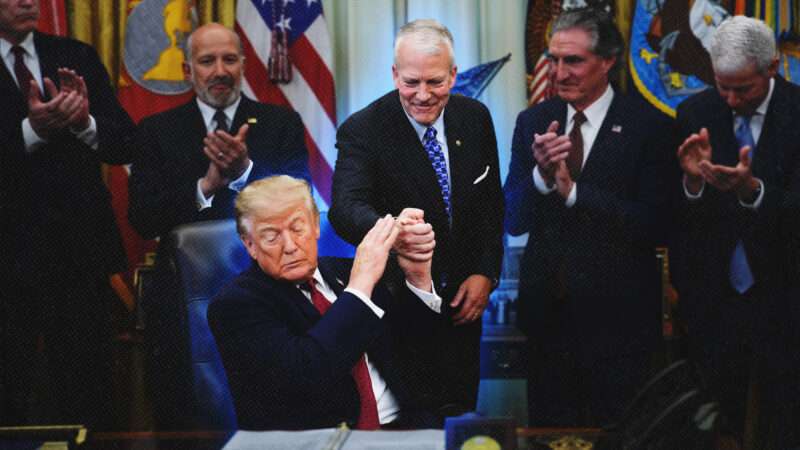
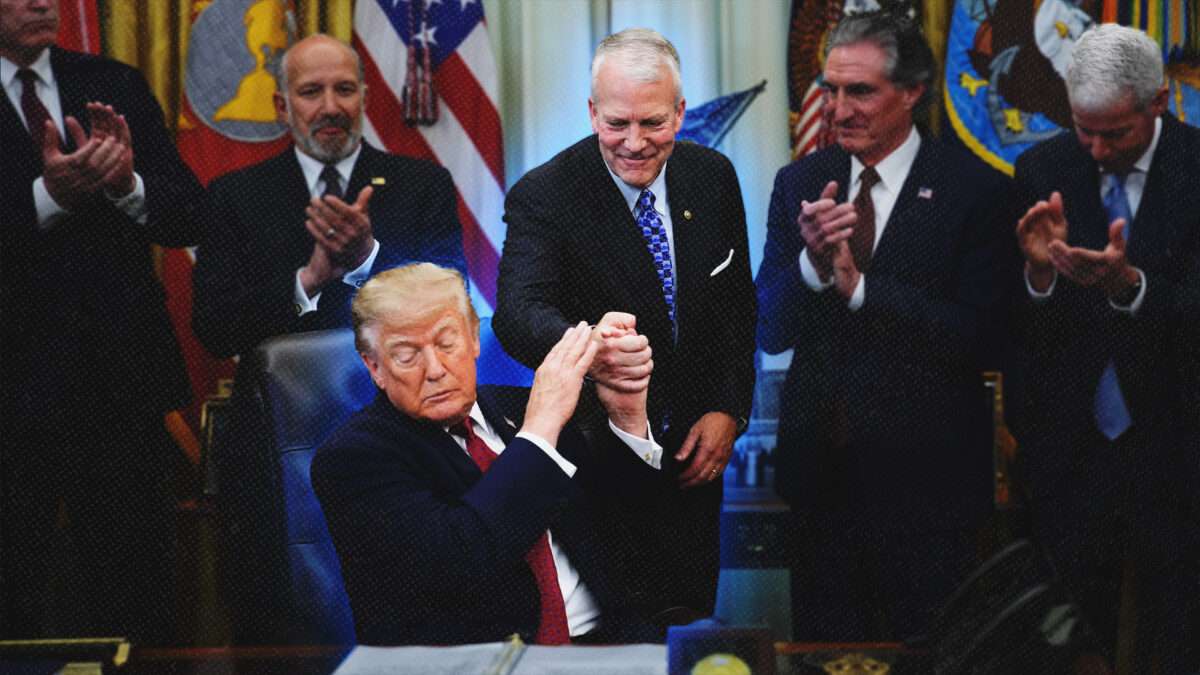
On Wednesday, the Office of Energy Dominance Financing at the U.S. Department of Energy announced it had closed a $5.1 billion loan package to Alliant Energy—a utility company with over 1.5 million customers across Iowa and Wisconsin—to "lower electricity costs, expand firm power generation, and strengthen grid reliability" in the Midwestern states.
The loan package is part of the Energy Department's response to President Donald Trump's April 2025 executive orderdirecting the agency and its secretary, Chris Wright, to ensure the nation uses "all available power generation resources" to expand and secure America's electric grid amid growing demand.
In a press release, Alliant said the 30-year loan package will finance 1.6 gigawatts of new natural gas generation, 240 megawatts of increased capacity at its existing natural gas facilities, and a gigawatt of energy storage. The loan package will also allow Alliant to add 2 billion cubic feet of liquefied natural gas storage. All told, these upgrades and additions will generate enough electricity to power 2 million homes annually, according to the Energy Department.
Alliant estimates the deal will result in "up to $1.2 billion in cumulative customer savings," as well as the creation of "more than 1,600 local jobs" through construction projects financed by the loans. Of course, some of the savings likely stem from Alliant receiving more favorable loan terms from the Energy Department than it would from an open-market lender.
A report filed with the Securities and Exchange Commission outlining the deal's terms shows that the interest rate to be charged on each loan aligns with the government's borrowing costs. However, the markup on each loan will remain a fixed percentage, regardless of whether lending to Alliant becomes riskier or more expensive. Under the deal's terms, Alliant has until May 15, 2056, to repay the loan, but it is only responsible for paying interest until the first principal payment is due in 2052.
The Energy Department said the deal is the Trump administration's 10th financial close and its "sixth and seventh utility financing completed through the Energy Dominance Financing Program." As of September 30, the department had issued $132 billion in loans and guarantees through the program, including $47.5 billion announced in conditional commitments, and disbursed $53.2 billion.
While the Trump administration is taking credit for the deal, the loan is essentially a repackaging of a $3 billion conditional commitment offered by the Biden administration in 2025 as part of its last-ditch effort to spend as much taxpayer money on green projects as possible before Trump took office. Under the terms of the Joe Biden-era deal, Alliant would have used the loan to "finance multiple clean energy and battery energy storage system projects." Instead, the company will now receive an additional $2.1 billion in funding, without the climate goals the Biden administration stipulated.
Gregory Beard, director of the Office of Energy Dominance Financing, said the agency is "putting capital to work." The deal is perhaps better described as the Energy Department usurping a role that should be reserved for private-sector, institutional lenders. "This type of government involvement is only another example of the current Energy Department distorting the power generation market," says Tom Opdyke, director of energy and environmental policy at the R Street Institute.
The agency's meddling seems even more unnecessary given that Alliant's revenue is expected to grow 6.8 percent annually over the next three years, with its profit margins increasing from 18.4 percent to 22.2 percent, according to the stock research and portfolio-tracking platform Simply Wall St.
The timing of the announcement also raises some red flags. While an Alliant spokesperson tells Reason they spent "months reviewing the details and finalizing contracts" before the loan package "was finalized this week," the money is conveniently being directed to energy projects in two fairly competitive states in this year's midterm elections. The Cook Political Report has the Iowa Senate race as a toss-up and several incumbent House Republican seats in Iowa and Wisconsin leaning Democrat.
The loan package could be a ploy to boost Trump's and Republicans' favorability with the electorate in Iowa and Wisconsin by appearing to address a cost-of-living issue high on voters' list of concerns. "Even if that's the case, those things aren't going to happen by Election Day, and voters' opinions aren't likely to shift on the promise of future jobs and savings," says Opdyke. "So it might be too little, too late."
Trump is scheduled to speak this weekend in an Iowa-Wisconsin border town.
Whatever the reasoning, the loan package is effectively a subsidy for Alliant to expand its operations and grow its customer base at a lower cost. It's cronyism that enriches Alliant and disadvantages its competitors, at American taxpayers' expense.
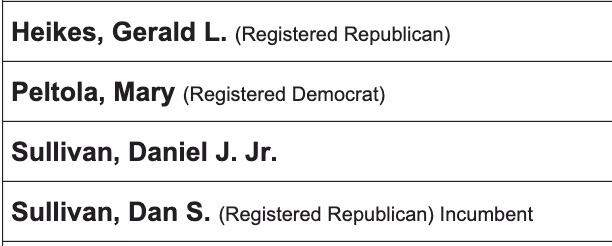
Perceptive citizens of the great state of Alaska may have noticed that there are two Senate candidates on the ballot named Dan Sullivan: the incumbent, Republican Sen. Dan S. Sullivan, and Dan J. Sullivan, a completely unknown person who is not actively campaigning for the seat.
The intention seemed obvious: The false Sullivan is trying to siphon off some votes from the real Sullivan in hopes of benefiting the actual challenger, Democratic candidate Mary Peltola. But while it was clear who stood to gain from this scheme, how this had all been arranged remained unclear. Until now.
The rumors are apparently true: Political strategists working closely with the Peltola campaign and the Democratic Senatorial Campaign Committee (DSCC) explicitly recruited the other Sullivan, according to bombshell reporting by The New York Times. All deny any involvement, but the Times has them dead to rights:
The Times has found, based on interviews and text messages, along with documents prepared for a potential lawsuit against the campaign, that not only did Ms. Peltola's team work with people trying to recruit Mr. Sullivan to run for Senate, but the effort was much broader. The group worked to coax other would-be spoilers into the race, to dilute the incumbent's support and help catapult the Democrat to victory.
The campaign consulted with Jerid Kurtz, a Democratic operative, to find and recruit Sullivan, a retired teacher. Kurtz went so far as to fly to Sullivan's remote Alaskan village and personally convince him to run. Sullivan said he "didn't have any interest in being a politician," but loathed President Donald Trump and was eager to help Democrats win the Senate.
Elisa Rios, Peltola's former campaign manager, willingly admitted all this to the Times, claiming that voters deserved to know the truth; reading between the lines, it seems like she's a disgruntled former employee. However, she reconsidered before publication and asked the Times to disregard her interview. The Times quite reasonably declined. In any case, numerous other staffers confirmed her story.
Trump's Justice Department has filed suit, claiming that the other Sullivan's presence on the ballot would render the election illegitimate if Peltola wins. It seems unlikely the administration will win that argument, and these sorts of tactics are nothing new.
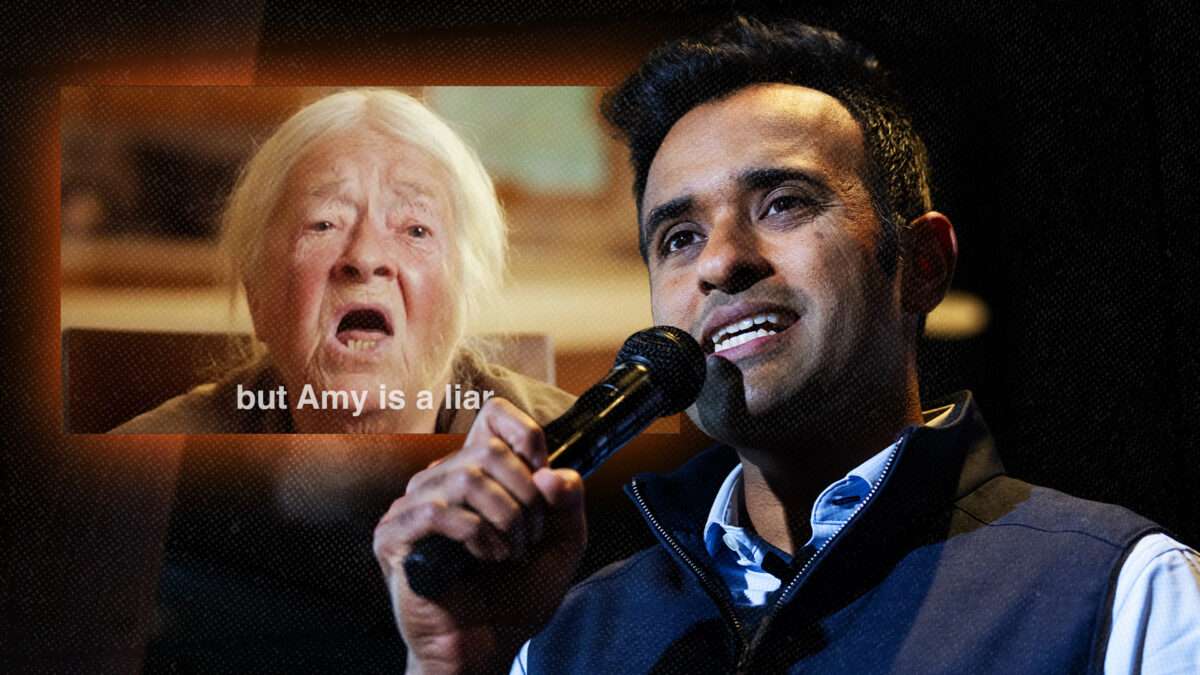
They are still quite contemptible, however. Peltola, who was well aware of the scheme, is trying to trick the people of Alaska into voting for the wrong person so that she's more likely to win. Maybe that's not quite so despicable as Vivek Ramaswamy's ad about Amy Acton, but it's just as dastardly—and much more likely to damage the integrity of the election. Ramaswamy's actions generated significant bipartisan backlash; will Democrats who claim that democracy itself is on the ballot speak up and denounce this?
My home state of Ohio has earned a not-so-nice distinction in the 2026 election: It is the site of "the ugliest" contest in the country. Nasty attack ads have been an ongoing feature of the governor's race between Republican Vivek Ramaswamy and Democrat Amy Acton—piercing many a peaceful Hulu-watching session on my end with allegations that Acton is a pill-popping drunk and Ramaswamy a con man.
But the nastiness reached a whole new level in recent weeks, with the release of a Ramaswamy campaign ad implying that Acton lied about childhood sexual abuse by her stepfather.
Understandably, many Republicans bristled at being viewed as the party that defends accused child rapists. Not Trump. His only regret here is that he didn't get to run an ad like this, he said.
The ad features Acton's mother, Donna Arthur, from whom Acton has been estranged for decades for what seem like very good reasons. When Acton was 12, her mom took her stepfather's side when she accused him of sexually abusing her for years.
In 1978, Acton's stepfather, Cledith Arthur, was arrested and charged with child rape. Records from the case, obtained by Signal Statewide, "also contains a reference to a previous incest charge against Cledith Arthur from 1974…although it's not clear how that case was resolved."
Acton's mom lost custody of both Amy and her brother. But the stepfather was never tried, since he and Acton's mom fled the state. He remained a fugitive—and married to Amy's mother—until he died in 2004.
screenshot of Clip from the Youngstown Vindicator on July 17, 1978
In the new Ramaswamy campaign ad, Acton calls her daughter a liar. "It's not easy for a mother to say this, but Amy has a serious problem. She is a liar," says Arthur in the video. "She lies about her past.…She's lied her entire life. My daughter needs help."
Arthur doesn't outright say "she lied about being molested by her stepfather," but given the historical context here, the implication is pretty clear. In effect, the Ramaswamy campaign has helped Acton's mom accuse her daughter on a national scale of making it all up.
That's despicable, even by political campaigning standards.
And—providing us with some hope for humanity—it also backfired. People roundly condemned the ad and the Ramaswamy campaign for running it. Acton's brother, Philip Stearns, corroborated her story. Even many Republicanshave objectedto the ad.
There are still some lines you don't cross, public figures left and right seemed to agree.
Public figures except President Donald Trump and Vice President J.D. Vance.
Telling Republicans to "stop whining" about the ad, Vance said he was getting "a little bit disgusted when I see Republicans across the country who are whining more about that advertisement than they are about what the congressional Democrats and other Democrats want to do to the United States of America."
"Vivek Ramaswamy had the audacity to run a TV commercial which calls it out like it is and calls Amy Acton a liar," Vance continued.
Trump went further, calling the ad "very powerful" and urging the Ramaswamy campaign to keep it up. Trump also criticized the current Ohio governor, Republican Mike DeWine, for calling the ad "deeply troubling."
DeWine is a moderate Republican who, for the most part, adheres to pre-Trump standards of decency. Their differing reactions here seem a perfect microcosm of pre-MAGA and post-MAGA standards for conduct and bounds of acceptability.
DeWine "probably wants a Dumocrat to win," Trump wrote in a Truth Social post last Thursday. "I suggested, on the other hand, that Vivek should keep it up, and let everyone listen to the mother of a defective, dishonest, and incapable Candidate, explain how the daughter is a DISASTER who, uncontrollably, lies, cheats, and steals!"
Talking to reporters that same day, Trump just kept repeating that if an ad had been made with his mom calling him a liar, the press would love it. He stuck to that talking point again and again, acting clueless about the childhood sexual abuse allegations at the center of this whole controversy.
The idea that the president would passionately post about and answer questions about this without knowing the whole story is almost beyond belief. But even if Trump somehow didn't know the full context when he first started talking about it, he was made aware and then kept right on praising the ad.
Trump on Ramaswamy Ad: The mother is calling the daughter a terrible person and a liar. Why would you shield somebody from that? Why would we do that? So I told him, leave it up and say thank you God. I only wish I could have had an ad like that. pic.twitter.com/M2TYz3jhUy
At a campaign rally in Iowa last Thursday, he said, "I only wish I could have had an ad like that against somebody."
Ramaswamy has also defended the ad, saying, "Unfortunately, the person I'm running against does have serial problems with the truth" and that the ad highlights a "pattern" of the "people who are closest to her" telling Ohioans not to vote for her.
But this is no longer just about one candidate's mistake or one campaign's poor judgment. The response from Trump and Vance has raised Ramaswamy's ad into bigger and uglier territory.
"It's actually kind of hard to find a prominent Republican who is defending the ad other than Vivek Ramaswamy himself, Vice President JD Vance and, quite fervently today, President Trump," noted CNN's Kaitlan Collins last Friday.
But Trump and Vance are the leaders of not just the Republican Party but the nation. And as we've seen again and again, Trump's responses tend to set the tone for what will become acceptable among conservatives by and large.
"Vance's acceptance of this campaign ad only breathes life into the disease that we should be seeking to cure," former New Jersey Gov. Chris Christie toldThe Washington Post.
Do voters agree?
Whatever happens with Ramaswamy next Tuesday, it will be impossible to know how much of it is related to this ad campaign and how much of it is related to many other possible factors. But it's hard not to look at the Ohio gubernatorial election results now as something of a referendum on what type of political discourse is OK. Are voters over Trump-style belligerence and nastiness? Or do they accept the premise that politics is a war in which no low is too low if it helps you win?
In the News
Release the FISA Ruling: "Two Democratic senators who have long overseen US intelligence say the Trump administration is illegally withholding a secret court's findings from Congress until lawmakers renew a program that lets federal agents read Americans' communications without a warrant," reportsWired:
Seven months ago, the Foreign Intelligence Surveillance Court objected to search filters that let intelligence analysts pull Americans' messages from intercepted data without the approvals, written justifications, or records the law requires. The court approved another year of surveillance anyway. The ruling has never been made public, and Senators Ron Wyden of Oregon and Adam Schiff of California say the administration's own deadline for releasing it passed in September.
"This opinion details serious abuses of Americans' rights under Section 702 of the Foreign Intelligence Surveillance Act (FISA) and, by law, should have been released before September 13," wrote Wyden and Schiff in a letter to the director of national intelligence and the U.S. Attorney General. "Yet this opinion remains hidden over a month later, suggesting that the administration hopes to secure a renewal of Section 702 while keeping Congress and the public in the dark."
Wishful thinking from Flock. Garrett Langley, the CEO of Flock, told a conference of cops to believe him rather than what's right in front of their eyes. The backlash to Flock "is not real," he said at the International Association of Chiefs of Police conference, per leaked audio obtained by 404 Media:
"Somebody was paying for [the social media posts and] stopped paying for it," Langley said about the many viral posts criticizing his company's technology. "Social media chatter on Flock is down about 95 percent from July. It went down 50 percent last week when Ukraine bombed a Russian data center with a drone. Literally 50 percent overnight. And so look, I'm the last person, my wife as well, she's like 'This is crazy, these people are getting paid to say these things,'" he added, repeating a disproven theory that Ukraine's strikes on Russian data centers had a significant impact on internet bot activity.
"It's anonymous bots, and so it is not real," he continued. "Inorganic activity has led to organic activity, but when I look at protests across the country, it is the same people with the same signs and the same message. That's not normal. That's not organic at all." Langley's comments echo another unsubstantiated theory that said opposition to Flock comes from a far-left network spreading propaganda at the behest of China.
The backlash is widespread and multifaceted. Backlash to Flock "has just exploded, like no other issue that I have seen in my time at the ACLU," Becca Eastwood, deputy policy director at the American Civil Liberties Union of Iowa, told Reason recently.
On Substack
Techlash on the campaign trail. Democrats have been panning data centers in campaign ads, but artificial intelligence was the subject of only a small fraction of ads, notes the Blue Horizon Project, an initiative from Chamber of Progress "to restore tech optimism in the Democratic Party and reset the relationship between Democrats and the technology sector." And when Democrats have focused on AI and data centers, it's been more about economics than general anti-AI sentiment, Dave Vorland writes:
Data centers are the important exception to the lack of ads focused on AI and technology. In AdImpact's tables, they appear among the three leading Democratic advertising topics in 5 of the 21 Toss-Up House races. They are not politically irrelevant, and dismissing the local backlash would be a mistake.
But look more closely at what these ads actually argue. Using AdImpact's data on 2026 campaign spending, ads matching either a tax-language screen or energy message, or both, account for $69.76 million, or 76.2% of all data center advertising.
The race with the highest spending on data centers is the Ohio Senate race, where Democratic spending accounts for $32.10 million. AdImpact's data shows Sherrod Brown's campaign spent over $1.5 million to air a data center ad 3,100 times. The message shows that while he is willing to hit his opponent for the data center tax breaks, his solution is ensuring that data centers don't raise energy costs, an idea that could have been drawn directly from our Data Center Development Playbook.
Vorland points out that "AdImpact's data for 2026 Congressional spending shows that less than $2.5 million went to ads supporting a data-center construction pause, moratorium, ban, or stopping new construction, a minuscule portion of the Democratic ad buy."
Interesting that "let data centers build but don't subsidize them" is the implicit message here. It feels like at least somewhat of a good sign that Democratic candidates don't by-and-large think "ban new data centers" is a message that voters want to hear.
More Sex & Tech News
• An interesting essay in Works in Progress looks at "the rise of prudishness" and what demographics might have to do with it.
• "Technology has advanced for centuries, shuffling workers among occupations, industries, and regions without making human labor obsolete," writes Nathan Smith at Human Progress:
As machinery pushed millions of Americans away from farming over the past century, most workers moved to factories, towns, and cities. They ended up with more comfortable lives than their predecessors plowing the fields. The AI economy will likely follow the same path: destroying jobs while creating better ones.
• The New Jersey Assembly recently advanced a bill that would increase prostitution penalties, and several other prostitution-related criminal justice bills are pending in the Assembly and state Senate. Tara Burns has details.
• Florida's attorney general said he plans to introduce even more stringent social media regulation, even as the state's earlier restrictions on minors using social media are still being challenged in federal court.
• British tech regulator Ofcom says its Online Safety Act isn't actually stopping kids from seeing "harmful content" online. So it wants to do more of it. "Instead of suggesting to repeal the Online Safety Act because it does not seem to be working or because it imperils online freedom, Ofcom's report proposes to broaden the law's scope," writesReason's Meagan O'Rourke.
NEW: The Online Safety Act has been a failure, according to a new report from Ofcom.
Ofcom have found "no significant change" in children encountering harmful content since the law came into effect last July. This is despite the signifigant threats to free speech and privacy.
• "Social media decentralized the information environment and weakened the influence of expert opinion. LLMs are likely to have the opposite effects," writes Dan Williams at Persuasion. "Whereas social media has been a democratizing technology, LLMs are a technocratizing force. They shift influence back towards expert opinion."
• Ten states have no birth centers and eight others only have one, according to a new report from The Commonwealth Fund. "Two dozen centers closed between 2023 and 2026, with some publicly blaming onerous regulations and steep increases in malpractice insurance," notesOhio Capitol Journal.
In the country with arguably the most successful market economy on Earth, it's not unreasonable to ask for just one major political party to favor a system of relatively unfettered voluntary exchange. And yet, the midterm elections offer Americans a "choice" between a party openly embracing socialism by name, and one that increasingly embraces state-directed economic activity in the cause of nationalism. Not every candidate running as a Democrat or Republican is on board with their parties' statist transformations, and there are certainly other issues separating the two dominant political tribes. But if you want reliable advocacy of economic freedom, you won't find it in the two major parties.
Open Socialism vs. Nationalist Economic Control
The shift in the Democratic Party's policy preferences from a heavily regulated market economy to outright government control has been well-documented, but it's worth noting Eric Bradner August report at CNN about "a growing list of victories by democratic socialists who are a prominent part of the Democratic Party's left-wing insurgency."
Before his election as mayor of New York City, Zohran Mamdani called for "seizing the means of production," as has congressional candidate Darializa Avila Chevalier. The Democratic Socialists of America (DSA), which backs many of the new breed of officeholders and candidates and organized their insurgency, boasts of its solidarity with the totalitarian regimes in Cuba and Venezuela. Just a year ago, it sent "a delegation of 40 DSA elected leaders and rank-and-file members" to Havana to learn "about the achievements and challenges of Cuban socialism."
At 65 percent support for socialism in Gallup polling, more Democrats favor a state-controlled economy than back capitalism (35 percent)—though the odd tie in favorability with free enterprise (also 65 percent, but declining) suggests the schools aren't doing a great job of explaining ideas.
Republicans nominally hold very different economic preferences, with only 14 percent favoring socialism, while 86 percent support free enterprise and 75 percent have positive views of capitalism. But when asked by CNBC's All-America Economic Survey whether government should have control of private businesses, "66% of Democrats found it not appropriate for the U.S. to take equity stakes in American companies, while only 34% of Republicans agreed."
That's likely because under the Republican Trump administration, the federal government has been grabbing a piece of the action from tech and resource firms—40 companies, at the current count—and party stalwarts are happy to go along so long as the S word isn't used to describe the arrangement. Instead, it's cloaked as top-down encouragement of domestic jobs and manufacturing.
Two Parties With a Similar Taste for Government Economic Intervention
"American political leaders on the left and right are rebelling against the market-first consensus that dominated Washington for four decades," concludedAxios's Courtenay Brown and Neil Irwin in July. "It's evident in everything from the Trump administration taking government stakes in dozens of private companies to socialist candidates winning Democratic primaries promising a more active government role in the economy."
A glimpse of a socialist future can be found not only in the rising tide of explicitly socialist Democrats, but in GOP heir apparent and Vice President J.D. Vance's repeated denunciation of free-market economic thinking and its emphasis on private choice.
"Do we serve pure, unfettered commercial freedom?" he asked in First Things in 2019. "Or do we serve something higher? And are we willing to use political power to actually accomplish those things?"
In a June interview with The Daily Wire's Michael Knowles, Vance returned to the topic to criticize the market-oriented ideas of economist Milton Friedman and called for a state-directed and Christian-infused "American developmentalist" approach to escape what he called "a hyper globalized economy."
"The policies supported by both major political parties suggest a growing embrace of state ownership of the economy," warns economist Daniel J. Smith for the American Institute for Economic Research. "The range of policies widely accepted as legitimate options, referred to as the 'Overton Window,' has shifted toward greater government direction of the economy, with some conservative politicians and voters now treating partial state ownership as an acceptable function of government."
Smith pointed out that the economist F.A. Hayek had observed this phenomenon among authoritarians of the right and left in the 1930s. It was why he dedicated his book, The Road to Serfdom, "to the socialists of all parties."
Rejecting Free Markets Means Losing Liberty and Prosperity
Why this is important is illustrated by Smith's recent research into the correlation, or lack thereof, between socialism and political liberty: "The record, from 1789 forward, is not ambiguous. High degrees of political freedom and heavy state ownership of the economy have not been sustained together."
Smith's observation is supported by the prominent socialist writer Robert Heilbroner's admission in his 1986 book, The Nature and Logic of Capitalism, that "political freedom in modern times…has only appeared in capitalist states." He added, "democratic liberties have not yet appeared, except fleetingly, in any nation that has declared itself to be fundamentally anticapitalist."
Also important, as the Fraser Institute's recently published Economic Freedom of the World: 2026 report points out, "economic freedom tends to be associated with better outcomes." Specifically, the report indicates strong correlations between free-market economies and higher GDP per capita, higher level of income for the bottom 10 percent of earners, lower poverty, higher life expectancy, and lower infant mortality. As with the sources cited above, the report found that "personal freedoms such as freedom of speech, association, and religion are highly correlated with economic freedoms."
So, the benefits of having a major political party that believes in and supports free markets with minimal government intrusion are found not just in expanded political choice, but also in policies that promote freedom, prosperity, and human well-being. Unfortunately, both the Democratic Party and Republican Party are retreating from economic liberty and embracing state control over how we produce, work, own, buy, and sell. Democrats' explicit embrace of socialism, and Republicans' dismissal of free markets in favor of state management and ownership, promise a future of less freedom and reduced wealth.
Maybe Americans would vote against socialism—both the open kind and the implicit nationalist variety—if given the choice. But it's increasingly difficult to find a free-market option on the ballot.
Don’t count Sophia Bush among the performers who plan on stepping back from making their voices heard in the political world. “What would I do? Silence myself? Take away one of my most important rights to be more palatable or more hirable to people I don’t know? That’s not something that I’m interested in,” Bush…
President Donald Trump has long been associated with lust. The 2016 election prominently featured "the Access Hollywood tape" in which he can be heard boasting about grabbing women "by the pussy." But recently, his affections have turned to men.
"I examined his ass," Trump said of Sen. Jon Husted (R–Ohio) at an October 17 rally. "I examined his ass. And then I looked at his shoulders; I looked at his feet; I looked at his hand; I looked at his jawline." He liked what he saw.
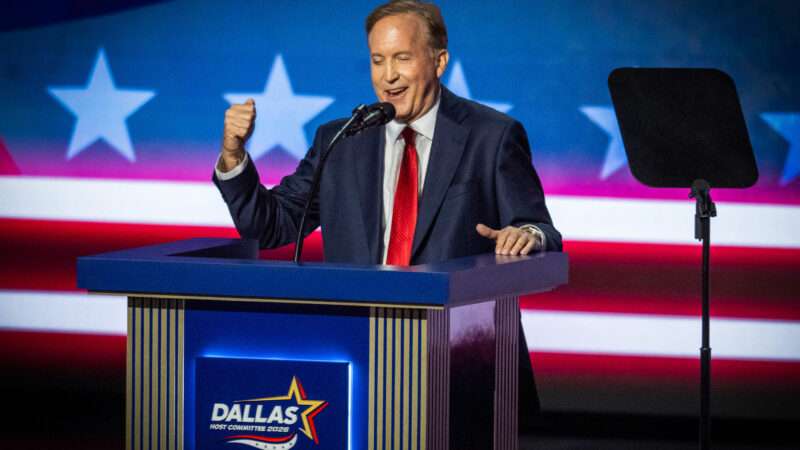
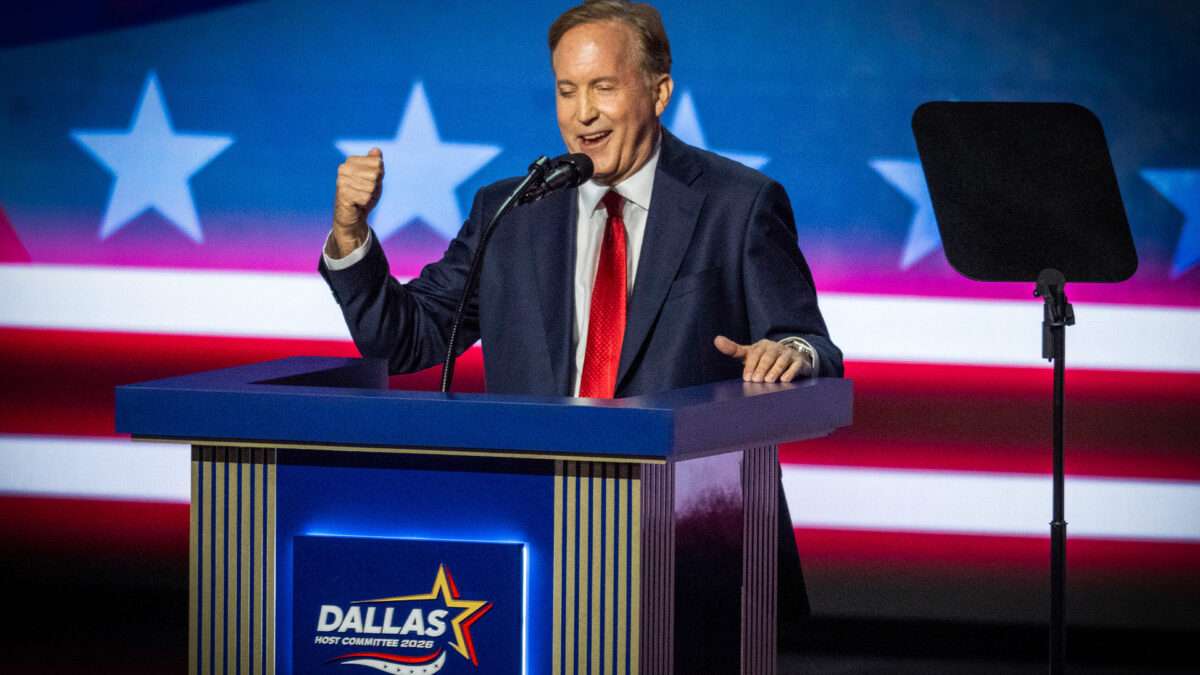
There is one candidate, however, whose ass appears to be safe from the president's admiration. "He may not dress right. He may not talk exactly perfectly, and he may not be the best-looking guy I've ever seen," Trump told the crowd on the first night of the GOP midterm convention in Dallas, Texas. Even still, "he deserves to be your next senator."
Such was the pitch for Ken Paxton, the Texas attorney general asking voters to promote him to the U.S. Senate. It has been a tough sell, much more so than is typical for a Republican fighting to represent Texas on the national stage. His opponent, state Rep. James Talarico of Austin, has often led in the polls in a place where a Democratic Senate victory would usually be relegated to liberal fever dreams. As A.G., Paxton has been dogged by an impeachment and by longstanding accusations, including from within his party, that his ethics compass is all but demagnetized.
There is another potential obstacle in his way, something Trump hinted at repeatedly in his Trumpian way over the course of that two-day convention. The main characters in the MAGA movement often have a kind of crass charisma—not necessarily a literal beauty, but certainly a talent for performance and presentation. This is a theme in populist movements for a reason: It's the people versus the elite, the outsiders versus the establishment, us versus them. So too can it serve as a helpful distraction when policies' practical results fail to match the promises made, as well as when allegations of corruption surface.
Paxton has the baggage with fewer obvious tools to combat it. And yet if one word best describes him, it may be survivor.
One Scandal After Another
Paxton had been Texas' top law enforcement officer for about six months when he became a defendant.
In July 2015, a grand jury indicted him on three felonies. The charges—two counts of first-degree securities fraud and one count of third-degree failure to register as an investment adviser—concerned work he had done while in the Texas House of Representatives. As state representative for part of Collin County, he convinced investors to put hundreds of thousands of dollars into Servergy, a tech startup, while allegedly failing to disclose that he was paid to attract those very investments.
A state attorney general showing up for a mug shot reverses the typical arrangement. Still, there were signs that this was on the way. In 2014, while Paxton was a state senator, the Texas State Securities Board disciplined him and fined him $1,000 for not completing the required registration to solicit investors. But while the criminal investigation delving into the full scope of alleged misconduct had been announced to the public, it was put on hold until after the election so as not to potentially sway the outcome.
It did not sway the next one either. Paxton was reelected in 2018. But that run-in with the law turned out to be just the beginning.
In 2020, the scandal that would come to define his career began to take shape. Several senior officials from Paxton's office went to the FBI to report him for what they said was an inappropriate and illegal relationship with his friend Nate Paul, an Austin real estate developer who was already under federal investigation.
Paxton, the officials said, had leveraged his office to help Paul in various legal disputes, such as foreclosure proceedings. They also alleged that the attorney general had deployed a special prosecutor to go after Paul's enemies. Paxton denied the accusations. He was reelected in 2022.
"These were upstanding people that Ken Paxton himself had hired because of their conservative bona fides. And yet they all left stating, 'I don't want to have anything to do with this guy,'" says one Republican official who worked alongside Paxton in the Texas government. "It's basically the story of Ken Paxton in my mind. If he doesn't cross the line and literally break the law, he constantly skirts it. And therein lies the problem.
"Now, that's not me saying that he doesn't break the law," the official continues. "I'm just saying that is kind of his MO."
The following year, the Republican-led Texas House of Representatives impeached Paxton for conduct related to the same scandal. The information aired during his trial, particularly as it related to his love life, arguably made the biggest impression on the public consciousness. Paul, it seemed, had set up a fake Uber account under the name "Dave P." It had a mysterious habit of summoning cars to pick up a passenger a block from Paxton's house so it could travel to the apartment of Laura Olson, Paxton's girlfriend.
This was complicated, because Paxton also has a wife, Angela Paxton, herself a member of the Texas state Senate. That body would go on to acquit Paxton of impeachment in September 2023. Angela announced two years later that she was filing for divorce "on biblical grounds."
As for that 2015 criminal indictment, the attorney general was set to go to trial in April 2024, after a series of protracted delays, when he cut a deal at the 11th hour. He would pay restitution and do community service, and in exchange, the prosecutors ultimately dismissed the charges. Had he been convicted, he faced decades in prison, and, per his own guidance, he would likely have been precluded from running for public office in Texas again as a felon.
Paxton declared his candidacy for the U.S. Senate the next year.
A Blunt Instrument
Paxton's knack for survival has long baffled onlookers. "The guy's ability to take shots and just keep moving on and stay in elected office is unlike anything I've ever seen in my career in 25 years of running campaigns," Ash Wright—previously a senior adviser to George P. Bush, who invoked the incumbent's mug shot in a 2022 bid to be attorney general—told the Associated Press in July.
How he does that is a matter of some mystery, given he does not possess the showmanship the president favors. One answer might provide a window into how the Republican Party has evolved in recent years. What Paxton may lack in stage presence, he makes up for in a willingness to use his office as a performative blunt instrument.
The attorney general's lengthy tenure has been consumed almost entirely by two categories: high-profile scandals and high-profile lawsuits. During the 2026 Senate primary, as he made his case that he should replace Republican John Cornyn, Paxton advertised his conservative credentials with a statistic: He had "sued [President Joe] Biden over 100 times."
His lawsuits covered quite a bit of ground. There was his attempt in 2020 to overturn the election results, which the U.S. Supreme Court rejected. But he did not always fare poorly. Within days of Biden taking office in 2021, Paxton sued to stop the then-president's 100-day pause on certain deportations, which a federal court granted. He also secured enormous settlements against Meta and Google—$1.4 billion and $1.375 billion, respectively—for alleged privacy violations, although neither company admitted wrongdoing.
Paxton has not lost steam. In 2025, he filed a lawsuit against former Rep. Beto O'Rourke, a Democrat, and his advocacy organization, Powered by People, over donations that supported Democratic lawmakers who left the state to block new Republican-drawn congressional maps. "Our Texan founding fathers—like our American founding fathers—took prior restraints on political speech out of the tool kit," a Texas appeals court later wrote, "when they enshrined the right to free speech in our Constitution." The year prior, Paxton filed suit against Annunciation House, a Catholic charity that shelters migrants in El Paso; one judge called his office's conduct in that case "outrageous and intolerable." Yet Paxton has succeeded in drawing out both cases with lengthy litigation. Even when he may lose the final battle, he often hamstrings his opponents for long periods, a different kind of victory.
Has that helped make Paxton nearly bulletproof? Maybe. But it is also a snapshot of the power of branding in this political moment and how he has leveraged it offstage. "How hard is it for anybody, any Republican, to go into the A.G.'s office and sue the president of the opposing party?" says the Republican former official. "It's just typical stuff, you know. It's nothing of this great political fighter that they think he is."
When it comes to the other category—those high-profile scandals—Paxton has repeatedly denied wrongdoing, casting his legal tribulations as politically motivated witch hunts. He is, he always insists, the victim, not the perpetrator. It may be another sign of how the political landscape has changed, particularly in the GOP, in that transgressions can become capital when marketed savvily.
In the May runoff with Cornyn, who has represented Texas in the Senate since 2002, Paxton won by 28 points.
Can the Survivor Survive?
Party conventions usually exist to formally nominate a president and vice president. Those trappings were still there in the GOP's midterm convention, though no one was being nominated. There were state delegations, their role entirely symbolic. There were balloons and sequins and Lee Greenwood, who introduced the president both nights by singing "God Bless the USA." Trump, of course, loves a good production.
You couldn't help but get the feeling sometimes that the event was largely mounted for Paxton. It took place in Dallas, after all, and his race was a constant part of the discussion.
"He is a weird-looking dude," Trump said. That time, he was referring to Talarico, whom he called "Talafreako." That comment didn't come with an endorsement. "I mean, I don't like talking about looks, but there's something missing there."
Talarico's general presentation has been a subject of fascination on the right throughout the race: his appearance, whether he likes football, accusations he's a vegan (he isn't). An ad run by Paxton deems Talarico "too low-T for Texas"—not macho enough.
How this mudslinging resonates may vary. "Policy is all that matters," Kyle Biedermann, a Republican who served with Talarico in the Texas House of Representatives, told me on the sidelines during the second night of the convention. "I don't care if he's a vegan. I don't care what he does. But his policies are horrible, terrible for our state." Those policies, he said, "are so socialist, so far, far left" that anything else is beside the point.
The night prior, when the president offered $5,000 to every American adult if Republicans won the midterms, a victory in Texas may have been at the top of Trump's mind. On closing night, during the president's second speech, Paxton was featured heavily again. Trump described how he had rehearsed for the moment with his circle. "I'll tell you what I was thinking about saying. I said, 'I don't like the way Ken dresses,'" he recounted to the audience. "And then I said, 'I don't really like the way Ken talks.' And then I said something that they really hated….I said, 'I don't really like the way he looks.'"
In the VIP section, Paxton smiled awkwardly. He is, after all, a survivor.
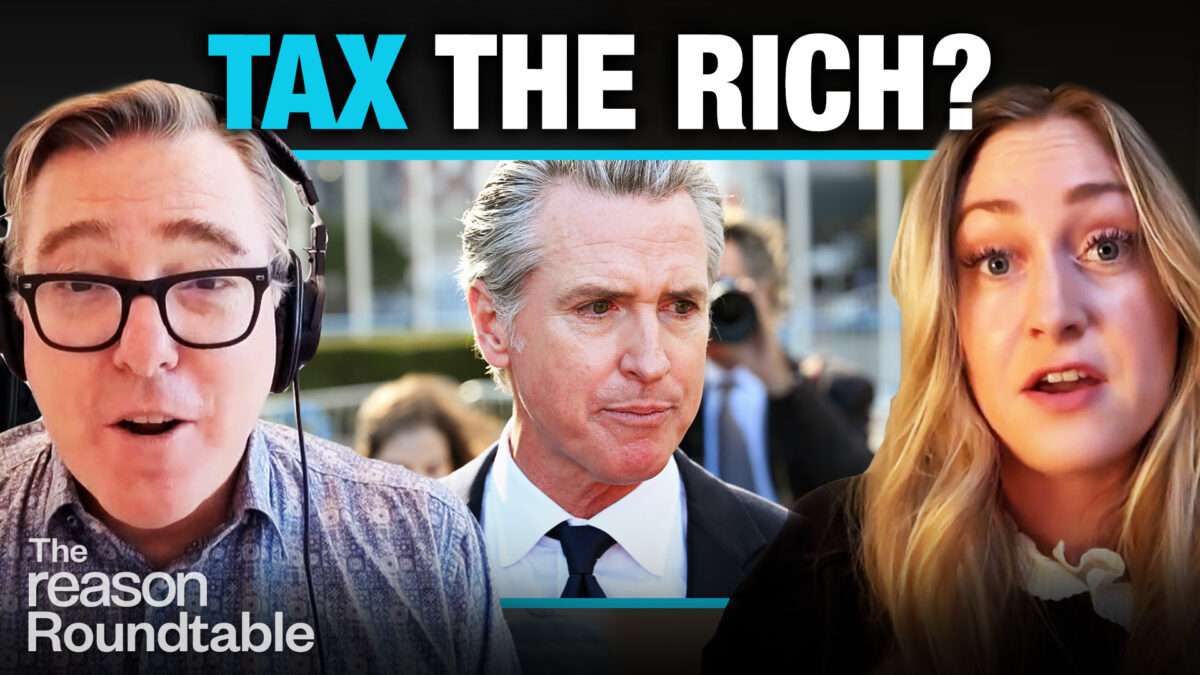
This week, editors Peter Suderman, Nick Gillespie, and Matt Welch are joined by Associate Editor Liz Wolfe to discuss California's proposed 5 percent wealth tax on billionaires, which a Hoover Institution study suggests could ultimately cost the state $39 billion in lost revenue. With wealthy residents already leaving California, the panel examines whether the measure will survive next week's vote, why Gov. Gavin Newsom opposes it, and how public sector unions have helped fuel the state's spending problems.
The panelists then look to France, where mounting unrest and economic stagnation raise questions about the long-term consequences of high taxes, expansive welfare programs, and pension obligations that increasingly burden younger generations. Next, they discuss Venezuelan opposition leader María Corina Machado returning home after 10 months in exile. Then, with the midterm elections next week, the editors examine whether Trump's tariffs, war with Iran, and mounting allegations of corruption will deliver Democrats control of Congress. Finally, a listener asks whether today's democratic socialist movement will ultimately be remembered like the libertarian and Tea Party movements of the early 2010s.
Matt Welch appears on the left. Liz Wolfe appears on the right. Behind them, an image of Governor Gavin Newsom appears looking concerned in the center. Bold text across the top of the screen reads "TAX THE RICH?"
Pro-democracy campaigners urged governments around the world, including in the US, to formally recognize Brazilian President Luiz Inácio Lula da Silva victory in Sunday’s runoff election as his far-right challenger, Senator Flávio Bolsonaro, refused to accept the results, sparking fears of political violence and another coup attempt. “It is impossible to recognize the results. I […]
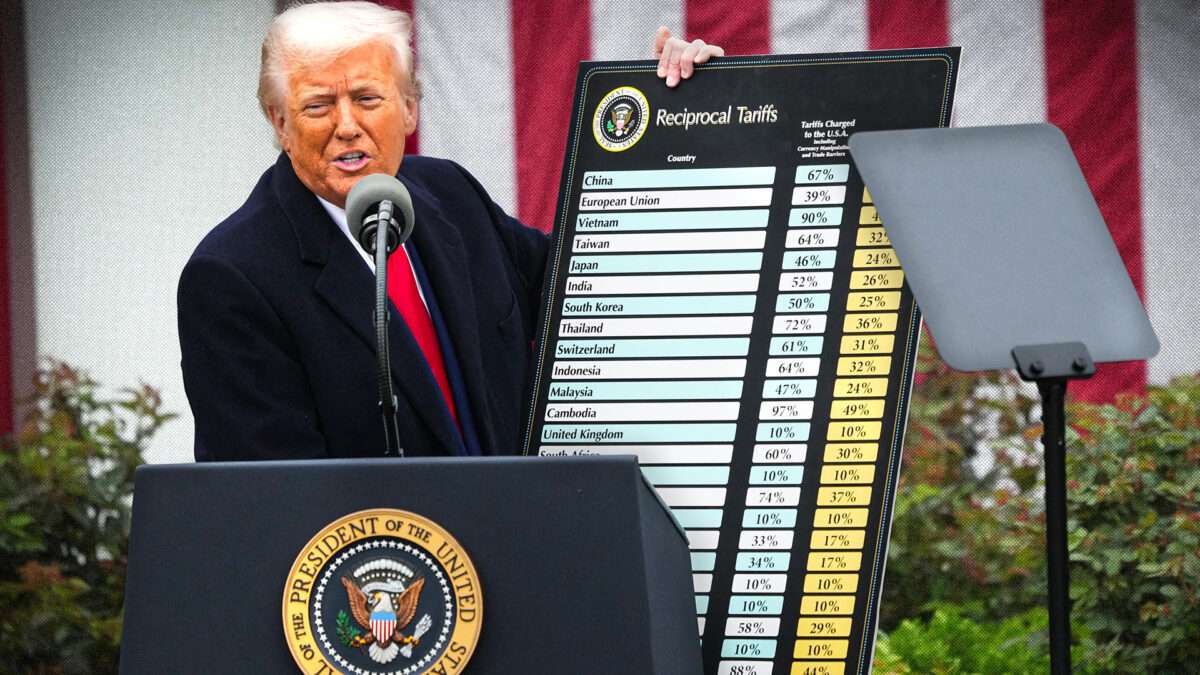
When the White House rolled back tariffs on coffee, fruit, beef, and farm equipment, it was effectively an admission that the tariffs were raising prices—and that Americans, not foreigners, had been paying for them.
Now, in the closing stages of the midterm campaign, the White House is once again rolling back some of those import taxes—and once again making an awkward implicit admission.
President Donald Trump's tariffs have become politically toxic.
The administration announced late last week that it would lift the 50 percent tariffs on some Canadian imports, apparently in an attempt to help Sen. Susan Collins (R–Maine) survive a tough reelection campaign in which the tariffs have played a significant role.
If this is indeed an attempt to sway voters in Maine, it is not a very convincing one. The Trump administration is removing tariffs on some agricultural and mechanical goods, as well as packaging and plywood, The Wall Street Journalreports. But Trump is also imposing new 50 percent tariffs on "other Canadian goods, including carpet, certain valves, and waste products."
Collins issued a statement thanking the White House for the changes. This is what members of the U.S. Senate have been reduced to—begging the president to cast his capricious, tariff-happy eyes toward products that will hurt people in other states more than in your own. (In fairness to Collons, she has voted repeatedly to roll back Trump's tariffs, but not enough of her fellow Republicans went along with it.)
Still, it's worth asking: What exactly is the pitch to voters here? Here's a tariff cut, now vote for Republicans so the president can continue to arbitrarily tax imports whenever the mood strikes?
It's easy to see why Trump's tariffs have become so unpopular. They are a huge and broad tax increase—the Tax Foundation estimates that 54 percent of imports are subject to Trump's tariffs, which are costing the average household about $1,000 annually—that was imposed without congressional authorization or popular support. They create more losers than winners, as downstream businesses and consumers pay the price for the protectionism offered to American manufacturers. Even the supposed "winners" of the tariff policy tend also to be "losers," since so much manufacturing depends on importing raw materials and intermediate goods.
Perhaps more surprising is how unwilling Republicans are to defend the president's signature economic policy. Or to even talk about it.
The Wall Street Journal's Greg Ip crunched the numbers and found that House GOP candidates have not run a single ad talking about the tariffs during this election cycle.
That silence speaks volumes. Trump says "tariff" is "the most beautiful word in the dictionary." But it is now "one of the most hated words in politics," writes Ip.
The only Republicans to mention trade or tariffs in a campaign ad, as far as I've seen, is former Rep. Mike Rogers, who is now running for the Senate seat in Michigan (and thus was not included in Ip's analysis). And he's calling for an end to the "tariff war."
There is a lesson here that hopefully will linger beyond the next week: If you support a policy that deliberately and unlawfully raises taxes and prices, voters will not reward you for it.
It's a lesson that the Republican Party learned long ago, but apparently forgot.
Against economists' advice, a Republican-led government in 1930 implemented a huge tariff hike intended to protect American farms and factories at the start of the Great Depression. Instead, those tariffs worsened economic conditions and triggered foreign retaliation.
When voters went to the polls in 1930, the first midterm after the Smoot-Hawley tariffs were passed, they registered their displeasure. The GOP lost 52 seats in the House that year. Two years later, an even larger landslide would sweep Democrats into power in Congress and the White House, ushering in the New Deal era that reshaped the federal government forever. The two lawmakers who lent their names to the legislation were among those who lost their seats, fittingly.
The most notable difference this time around is that Congress didn't actually pass a tariff bill. The trade barriers were instead imposed directly by the executive. Voters don't seem to care. Republicans were too cowardly to stand up to Trump's unilateral power grab, and now they seem too ashamed to try to defend that policy (and their largely complicit response) on the campaign trail.
As they say, those who don't learn from history are doomed to repeat it. And "doomed" may be a fitting way to describe the Republican majority in Congress right now, thanks in no small part to Trump's tariffs.
Alaska's U.S. Senate race features four candidates. Two are named Dan Sullivan: the Republican incumbent, and a political neophyte.
Republicans say the presence of two Dan Sullivans on the ballot is an illegal act of election interference. The federal government is now suing to keep Alaska from certifying the election results, but only if their guy loses.
"One of the biggest election scandals in history has been the Democrats' installation of a fake Dan Sullivan (not the US Senator) to deceive voters in Alaska," White House advisor Stephen Miller wrote on X. President Donald Trump called it "a disgrace."
"Democrats pulled a dirty trick by enlisting a decoy, Daniel J. Sullivan, to run against Republican Alaska Sen. Dan S. Sullivan," TheWall Street Journaleditorialized. "Please spare us the lectures about election interference."
Last week, the Department of Justice (DOJ) sued the state of Alaska and its election authorities.
"Should Alaska certify any electoral results tainted by the inclusion on the ballot of Daniel J. Sullivan," the filing warns, "the State and its officers will fail in its obligation to protect the integrity of its election. The United States accordingly brings this lawsuit to protect the integrity of the 2026 Senate election in Alaska."
Alaska uses a ranked choice ballot, in which voters are given four candidates and rank each one in order of preference. Along with the Sullivans, the candidates are Mary Peltola, a Democrat who is polling narrowly ahead, and Gerald Heikes.
The Justice Department lawsuit says Republican voters would be too confused by the presence of two Dan Sullivans to properly fill out their ballot: "Some supporters of Senator Sullivan likely will inadvertently vote for Daniel J. Sullivan. Other supporters of Senator Sullivan likely will be confused as to how to rank the three Republican candidates as to defeat Peltola."
Given this, "there is a substantial likelihood that a certification of the election will reflect an electoral process that lacked integrity," the lawsuit proclaims. "To guard against this danger, it is vital that [Alaska] not certify any election result" in which "(1) Senator Sullivan does not win the election; and (2) had all votes cast for Daniel J. Sullivan been cast instead for Senator Sullivan and Alaska's rank-choice process played out accordingly, Senator Sullivan would have won the election."
In other words, the state of Alaska should only certify the election if Sullivan wins; if Peltola wins, but it's close, then that could suggest it "lacked integrity," and the state must instead conduct "an investigation to determine whether votes cast for Daniel J. Sullivan were meant to be cast for Senator Sullivan."
The lawsuit has a number of problems. First and foremost, it's completely inappropriate to treat an election as fair only if your candidate wins, even if it is what Trump believes.
It's also too late to bring an action of this kind: The state elections division decided in June to bar Daniel J. Sullivan from the ballot, but a state superior court reversed and the Alaska Supreme Court upheld the reversal before the end of that month.
And yet the feds waited until less than two weeks before Election Day—when ballots have been printed and tens of thousands of Alaskans have already voted—to bring this suit.
If the Justice Department was truly concerned about voter confusion, it should have brought a lawsuit months ago. But even then, it's not clear what it could have done: "DOJ has no power to decide which candidates can appear on the ballot," writes UCLA School of Law professor Richard L. Hasen.
Besides, it's not illegal to mislead or even outright lie to voters. "If 'voter confusion' were a legitimate reason to overturn election results, that would imperil a great many election winners, as voter ignorance—and exploitation thereof by candidates—is a widespread and longstanding problem," writes George Mason University law professor Ilya Somin.
It does seem more likely than not that Daniel J. Sullivan is indeed running just to pull votes from the senator with the same name.
But as I pointed out earlier this month, the ranked-choice ballot itself can take care of this problem: Republican voters who wish to reelect Sullivan can simply rank both Dan Sullivans first and second; if and when Daniel J. Sullivan fails to capture more than 50 percent of all votes, he will be eliminated, and his votes will transfer to all their second choices.
The ballot itself makes it clear which Sullivan is which: The sitting senator is labeled as both Registered Republican and incumbent.
Alaska Division of Elections
Despite Miller's claim that letting two Dan Sullivans on the ballot "reveals pure contempt for voters," it's the objecting Republicans who appear to lack faith in their voters.
"People are totally confused," Trump told reporters. "A lot of people don't know what 'incumbent' means."
When CNN's Dana Bash asked Attorney General Todd Blanche what crime is being alleged, he replied that "it depends." He elaborated: "There could be a crime, but the real wrong here is that Alaskans are going to be confused and will not have their vote heard."
This isn't even Alaska's most complicated election in recent memory. In 2010, after Sen. Lisa Murkowski lost the Republican primary to Joe Miller, she announced that she would still run as a write-in candidate—requiring voters to not just know about her ahead of time but to add her name by hand.
Improbably, Murkowski prevailed, defeating Miller by more than 10,000 votes.
If Trump, Blanche, Miller, and others are truly concerned that the ballot will be too confusing for Alaska Republicans, they could expend some energy showing them how to use the ranked choice ballot.
In fact, Sullivan has done just that, posting a video on X explaining how to rank all candidates except Peltola.
What they can't do is force a state to reject the results if their guy loses.
"Alaskans don't need any help voting for their preferred candidates, and the State of Alaska has already handled this by clearly distinguishing the candidates on this year's ballot," Murkowski wrote on X. "The Department of Justice should never have filed this lawsuit."
"I believe that this lawsuit is abusive in its intentions and borders on frivolous in its arguments, and that it is destined for defeat in the courts should it reach the merits," Cato Institute senior fellow Walter Olson noted in a statement. "This lawsuit is an assault on the constitutional design by which states, not the federal government, run elections. The issue in question is one for the Alaska Supreme Court to decide under Alaska law, and the Alaska court did just that."
California's experiment: Will California's proposed wealth tax, Prop 40, pass next week? And if it gets passed, will it end up actually costing the state money instead of generating revenue?
The basics: The proposal features a one-time 5 percent tax on people with net worths over $1 billion who lived in the state on January 1, 2026 (with the net worth amount calculated as of December 31, 2026). The idea for the snapshot date is presumably to prevent capital flight once the tax passes. The tax's supporters say the tax's revenues will amount to $100 billion and will fund California's health care system, which need to make up for federal Medicaid cuts.
Seven billionaires, representing 30 percent of the total billionaire wealth in the state, left California before January 1, 2026, when news of the possible tax broke. Peter Thiel, Larry Page, and Sergey Brin are among the deserters. The French economist Gabriel Zucman—an intense defender of the wealth tax—seems committed to the idea that this flight won't matter too much. He argues that while removing those seven brings down revenue estimates to $89 billion, adding in less-prominent small-time billionaires raises revenue to $115 billion.
This is silly. As The Washington Post's Megan McArdle points out, there's no reason to believe those less-famous billionaires would stay put. We have a hard time estimating what the total preemptive flight looks like, and how many billionaires have successfully taken up residency elsewhere.
"Either the tax is annual—and in that case it generates revenue annually, and some billionaires leave," claims Zucman. "Or the tax is one-time—in that case it generates revenue in just one year, and there is no incentive to leave. It can't be both at the same time." Zucman doesn't seem to consider that billionaires have already left, as soon as the idea was seriously floated, thus taking early steps to shield their wealth from the state.
Will it pass? "Likely voters are essentially where they were a month ago," reportsPolitico, based on recent polling data, "with 46% in favor of Proposition 40 and 43% opposed—despite a recent push by backers of the measure, including Sen. Bernie Sanders, to rally support." Interestingly, "a strikingly high share of registered voters (84%) said they'd been exposed to advertisements or messages about the tax, but a 45% plurality said the communications had not swayed them, and those whose views had shifted were just as likely to be more opposed as more supportive."
There's another complication: On that very same ballot, voters will decide on Propositions 41 and 42, competing measures that could keep Prop 40 from taking effect. Prop 40 will be nullified if either one gets more votes; but Prop 40 will nullify both of them if it gets more votes. Prop 42 would bar new taxes on personal property such as businesses, investments, retirement accounts, trusts, and art collections—things Prop 40 targets. It also bans retroactive taxes, thus making Prop 40 impossible to pull off.
Back in January, Pirate Wires' Mike Solana spoke with a bunch of billionaires who were worried about the tax and making plans to flee, partially out of distrust that the tax would be one-and-done. "Three men I spoke with in the largest billionaire Signal chat said they ran an informal poll, and seventy percent of the chat (around sixty people, not all of whom were billionaires) indicated they would leave the state if the ballot proposition passes," reports Solana. "According to that same poll, around 15% have already left the state."
"There is now real danger in appearing successful in the state of California," writes Solana, "as the far left, imbued with a great deal of power, and benefiting now from several years of wealth scapegoating throughout the mainstream press, attempts to liquidate its perceived enemies in business."
Scenes from New York: I'm fully aboard this train these days, though open to being convinced why I'm wrong:
If you truly *love* American cities, you MUST support strict enforcement of laws against anti-social behavior. Paying bus fares, red light cameras, camping on sidewalks, smoking on trains, off-leash dogs, etc etc
"Brazilian markets are heading for a major rout when local trading begins after President Luiz Inácio Lula da Silva pulled off a stunning comeback to defeat Flávio Bolsonaro, the right-wing candidate that many investors preferred," reportsBloomberg. This will be da Silva's fourth term.
Is dynamic pricing on the rise? Customers say yes, but most companies say they're wrong. My thought: Even if it's not currently happening to the degree angry customers claim, it certainly will be big in the future, as online shopping takes over and AI makes implementation easier. Consider the upside, though, noted in this Wall Street Journal piece: "Much current angst is focused on electronic shelf labels, which have replaced the printed labels that dotted shelves at groceries and other stores. Research on digital shelf labels in the U.S. and Europe, where grocers have widely used the technology for more than a decade, found the labels don't lead to surge pricing, in part because price changes are obvious to anyone walking by. Rather, research found, grocers have used the labels to discount goods that are about to expire, reducing food waste."
Great Washington Post headline: "Europe is running out of other people's money."
President Donald Trump claims the ships passing past Cuba on their way home from Iran will just, uh, handle the situation there. Sure.
Interesting:
Striking detail in the big NYT piece on Taiwanese families adjusting to working at the huge new TSMC chip plant in Arizona: their surprise at the lack of rigor in US schools. pic.twitter.com/YkSPzbHCuE
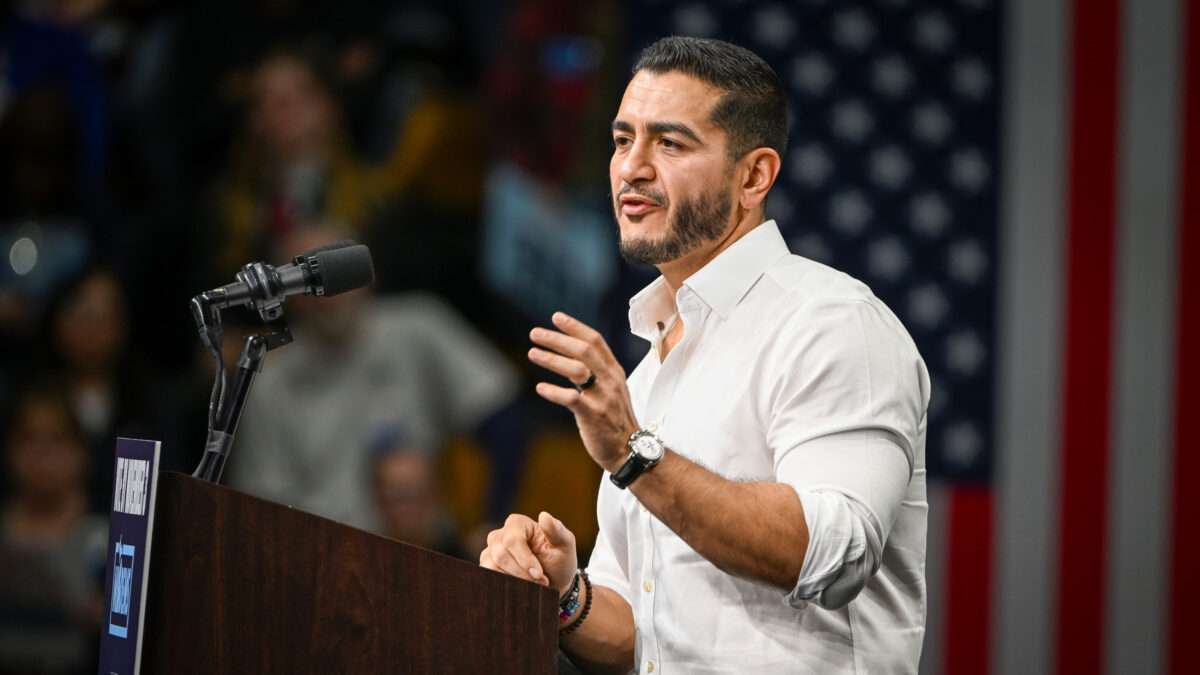
Abdul El-Sayed, Michigan's Democratic U.S. Senate candidate, is the latest politician to suggest that the Second Amendment might shield the right to bear arms, but only those that existed at the time that it was adopted: namely, flintlock muskets. It's a not-so-clever way of trimming back the Constitution's protections. The argument's flaws should be clear: the U.S. Supreme Court has already dismissed that line of reasoning, and a world in which the Bill of Rights applies only to 18th century technology would be one where freedom exists only in museum exhibits.
"Everyone Should Have Equal Rights to a Musket"
"I'm gonna swear an oath to the Constitution. The Constitution has a Second Amendment in it, but the Second Amendment, just so we all are clear, even the most conservative folks, they hew to this idea called originalism, and originalism is the idea that you should interpret the Constitution in the context in which the Constitution was written," El-Sayed insisted at a campaign rally. "When they promised the right to bear arms, they had muskets. So, yeah, everyone should have equal rights to a musket."
So clever. The Bill of Rights passed in the 1780s, so it must only apply to 1780s things. Except that the courts have thoroughly dismissed that ridiculous line of reasoning.
"Some have made the argument, bordering on the frivolous, that only those arms in existence in the 18th century are protected by the Second Amendment," Justice Antonin Scalia wrote for the majority in District of Columbia v. Heller (2008). "We do not interpret constitutional rights that way. Just as the First Amendment protects modern forms of communications…and the Fourth Amendment applies to modern forms of search…the Second Amendment extends, prima facie, to all instruments that constitute bearable arms, even those that were not in existence at the time of the founding."
The Founders Lived in a Time of Rapid Innovation
The reason for this should be obvious. The founders were not unaware of progress. Many of them were scholars and innovators. They were certainly aware of (and enthusiastic about) continuing advancements in technology. During the then-recent revolution, American troops had faced off against a small unit of redcoats armed with Ferguson breech-loading rifles. A decade before the Bill of Rights was adopted, the 22-shot Girandoni repeating air rifle was introduced, one of which was later sent along on the Lewis and Clark expedition. And Kalthoff and Lorenzoni repeating flintlock firearms had existed for well over a century.
Not to mention, the founders made extensive use of printing presses to distribute pamphlets and official government documents, including the new Constitution, rather than having them hand-copied as they would have been a few centuries earlier. Technology marches on.
That last point illustrates the foolishness of the only-1780s-tech argument, as Scalia pointed out. What use is a First Amendment that applies only to hand-cranked printing presses and unamplified voices? That would leave the internet, television, radio, telephones, and all post-revolutionary means of communications unprotected from government censorship.
By the same token, a Fourth Amendment stuck in the 18th century might shield us from government agents kicking in the door and rifling through our papers. But it would have nothing to say about wiretaps, computer searches, surveillance cameras, thermal imaging, and the like.
The Founders Sought To Limit Government, Not Create Small Carve-Outs for People
Founders who were well aware of innovation and often contributed to it themselves (think Benjamin Franklin and Thomas Jefferson) knew that science and technology constantly advance—because they helped it do exactly that—as would the government's intrusive capabilities. And they believed they were creating protections for broad natural rights against limited government, not small carve-outs from the authority of an all-powerful state.
"Rightful liberty is unobstructed action according to our will, within the limits drawn around us by the equal rights of others," Jefferson wrote in 1819. "I do not add 'within the limits of the law'; because law is often but the tyrant's will, and always so when it violates the right of an individual."
The Bill of Rights isn't an ancient artifact to be applied only to a snapshot of life as it existed around 1789. Its amendments are intended to protect timeless individual rights, however those rights might be expressed in an always-evolving world.
El Sayed: "To Protect People From Government Tyranny"
El-Sayed went on, in his increasingly incoherent monologue, to acknowledge that the Bill of Rights was intended "to protect people from government tyranny," and "the idea was that you had the right to bear arms against your government should they become tyrannous." He floated the idea, for some reason, that "the Coast Guard, and state militias" are how this idea was implemented. I don't want to delve too deeply into whatever argument is being presented here, because I've sacrificed enough brain cells by listening to him speak.
But kudos to El Sayed for admitting the Bill of Rights is intended to protect us from government. The only way that can possibly work is if, as government's capabilities become increasingly sophisticated, the protections of the Constitution's first 10 amendments extend to safeguarding our rights from ever more advanced potential intrusions.
The Second Amendment and the rest of the Bill of Rights don't preserve a snapshot of life in the 1780s. They were written to protect eternal principles of individual liberty. And they're certainly not limited to muskets.
West Des Moines, Iowa—Iowa voters may disagree on immigration, taxes, and the economy, but government surveillance is drawing opposition from across the political spectrum.
An Emerson College poll of 750 likely Iowa voters, conducted between late August and early September, found that 61 percent opposed police use of automated license plate reader (ALPR) cameras, compared with 26 percent in support.
The backlash comes as police departments across the state increasingly rely on surveillance technology supplied by private companies such as Flock Safety and Motorola Solutions. Their cameras record license plates and vehicle information, feeding searchable databases that allow law enforcement to piece together motorists' movements, including those of people suspected of no crime.
As Iowa's gubernatorial and congressional campaigns enter their final stretch, voters are increasingly pressing candidates on whether they intend to place limits on the technology. Jacqueline Thompson, an ordained elder in the Iowa Conference of the United Methodist Church and a self-described centrist Democrat, said she has been concerned about government surveillance for years.
"It's always been important to me [and] I've always thought that was a problem," she said before a campaign rally at a senior living community in Des Moines earlier this month. "So, when people started jumping on the bandwagon saying it, I was like, 'Hello, I've been here already!'"
Thompson pointed to two Democratic candidates, Nate Willems, who is running for Iowa attorney general, and Taylor Wettach, a candidate for state auditor, as having caught her attention with their emphasis on corporate oversight and access to government records.
For Thompson, the renewed attention to privacy is a welcome development in a political environment where Democrats and Republicans rarely find common ground. "It's kind of nice to hear the people come back to the middle [and discuss this]," she said.
Flock Does Not Have Enough Guardrails
Police surveillance technology has spread across Iowa faster than the rules governing its use.
A recent study identified at least 62 Iowa law enforcement agencies that had accessed other agencies' Flock databases, including departments that did not operate cameras of their own. Police departments can therefore search information collected well beyond their jurisdictions without having to install a single camera themselves. The study (led by Megan Graham, a clinical associate professor and director of the Technology Law Clinic at the University of Iowa College of Law) found significant gaps in transparency surrounding ALPRs.
The constitutional implications are already being tested in court. On October 1, a federal judge in Oklahoma ruled that a sheriff's deputy violated the Fourth Amendment by searching a motorist's location history through automated license plate reader systems operated by Flock Safety and Motorola Solutions without a warrant.
The search turned up more than 50 records of the driver's whereabouts across multiple states over a month. In the 38-page ruling, the judge ordered the resulting evidence suppressed, describing the technology as a form of "indiscriminate mass surveillance." The decision is not binding in Iowa, and legal challenges to ALPR surveillance still face an uphill battle, but it adds to the legal scrutiny of police tracking motorists without warrants.
The University of Iowa study also raised concerns about unauthorized database access, erroneous alerts, and the potential use of locally collected information for federal immigration enforcement.
Flock Safety says it has not provided U.S. Immigration and Customs Enforcement or Border Patrol with direct access to its systems. But the researchers found that local law enforcement agencies elsewhere in the country had conducted searches on behalf of federal authorities, effectively allowing them to obtain information without direct access.
Taxpayers are also footing the bill. Cedar Rapids reported operating 76 cameras at a combined average cost of more than $20,000 a month, according to the study.
Researchers struggled to determine the full extent of surveillance across Iowa. Some agencies refused to disclose the number or locations of their cameras, while others withheld records concerning unauthorized access or erroneous alerts, citing confidentiality.
The cameras are not limited to Iowa's largest cities. Becca Eastwood, deputy policy director at the American Civil Liberties Union of Iowa, said they have spread across large, midsize, and smaller communities, prompting a surge in opposition over the past year.
The backlash "has just exploded, like no other issue that I have seen in my time at the ACLU," Eastwood told Reason in an interview. Candidates running for state and federal offices are increasingly getting asked if they support police departments using ALPR cameras, she said.
Some local governments are already reconsidering their contracts. Indianola and Waukee suspended their Flock camera arrangements, Iowa Public Radio reported in August. Dallas County paused a planned rollout while awaiting guidance from state lawmakers. Ankeny, which operates 16 Flock cameras, is reportedly expected to reconsider a possible contract extension next year.
The backlash also cuts across the immigration debate. While concerns about federal immigration enforcement have helped draw attention to the cameras, critics argue the same surveillance infrastructure can be used against anyone, regardless of which party controls the government.
"This is a nonpartisan issue because people recognize that surveillance can be weaponized against anyone the government wants to weaponize it against," Eastwood said. "An increase in police surveillance impacts certain populations more, right now [but] nobody is immune."
Politicians Face Pressure To Cut Ties With Flock
The opposition is beginning to force Iowa's candidates to take positions on a technology that, until recently, attracted relatively little attention outside law enforcement and civil liberties circles.
Among the gubernatorial candidates, interviewed by Iowa Radio last month, Republican Zach Lahn has called for state-level regulation, arguing that the widespread collection of information about where people drive is unacceptable. Meanwhile, Democrat Rob Sand has expressed support for safeguards governing the collection and use of license plate data and said he would sign legislation if privacy concerns persisted. But he has also pointed to the cancellation of some Flock contracts as evidence that the market is responding to public concerns.
For now, neither approach offers much clarity on whether police should be required to obtain warrants before searching motorists' location histories or how far restrictions on data collection should go.
Ryan Johnson, a libertarian-leaning Republican who works as a machinist near Waterloo, said he could accept cameras in certain locations, such as downtown areas or near traffic signals. But he objects to their spread into residential neighborhoods and public spaces.
"Just having Flock cameras everywhere, [in] residential [areas], putting them at parks and pools, we don't need that," Johnson said while attending a Lahn rally earlier this month.
So far, some of the most concrete changes to ALPR practices have come from Flock itself. In August, the company announced that it would reduce its default data-retention period from 30 days to seven and require officers to enter a criminal case number or code for each search. The changes would not, however, require police to obtain a warrant before accessing the records.
Gary and Nancy Guthrie, a Democratic couple attending a Des Moines rally supporting Chris Jones for secretary of agriculture, remain skeptical of the cameras.
"I don't have a good feel for that," Nancy Guthrie said. "Personally, I'm very much against Flock cameras."
For all the attention the issue is receiving on the campaign trail, Iowa voters have yet to hear much about what legal limits candidates would actually impose on police surveillance.
Today, the Trump Justice Department filed a federal lawsuit seeking to block Alaska Senate election results on the grounds they might be influenced by voter "confusion" between incumbent Republican Senator Dan S. Sullivan and a separate Republican candidate with a very similar name (Dan L. Sullivan). I previously wrote about the issues raised by the two Dan Sullivans here. As I pointed out in the earlier post, there is no legal basis for overturning congressional election results based on voter confusion, and any such action would likely violate the First Amendment. See also this analysis by election law specialist Rick Hasen.
I would add that any such federal action also runs afoul of states' primary authority over election procedures. The Elections Clause of the Constitution gives states primary authority over "The Times, Places and Manner of holding Elections for Senators and Representatives," subject to Congress' power to modify these rules by legislation. Congress has not enacted any statute allowing overturning of election results based on possible "voter confusion."
If "voter confusion" were a legitimate reason to overturn election results, that would imperil a great many election winners, as voter ignorance - and exploitation thereof by candidates - is a widespread and longstanding problem. I covered some of these points in my previous post about the two Dan Sullivans:
Donald Trump is a particularly egregious example, going all the way back to his first campaign in 2016, and more recently with his lies about the 2020 election and other issues. But more conventional politicians also often resort to lies and deception, even if not to the same degree. President Obama, for example, famously lied when he claimed that, under the Affordable Care Act, "if you like your health care plan, you can keep it." That deception won the 2013 Politifact Lie of the Year award. But it still helped Obama get reelected in 2012. I am not sure exploiting voter confusion about names is any worse than exploiting their ignorance about policy issues like crime, immigration, and health care….
Voter confusion about candidates with similar names is just another example of this broader problem….
There is no easy solution to the problem of voter ignorance. But I assess a range of possible options in my 2023 article on "Top-Down and Bottom-Up Solutions to the Problem of Political Ignorance, and in my earlier book Democracy and Political Ignorance. I believe the best approach is to make fewer decisions at the ballot box and more by "voting with your feet," where incentives to seek out information and evaluate it wisely are much better. But I recognize that any effective approach will take time, and there may be no one fix that is sufficient by itself. We may need to pursue multiple strategies. In the meantime, voters are likely to continue to be ignorant and confused about a variety of issues, and politicians and interest groups are likely to keep on exploiting that.
Many of these other voter ignorance problems are far worse than any potential confusion between candidates with similar names, a problem that only comes up relatively rarely.
UPDATE: Rick Hasen has a helpful analysis of the Alaska lawsuit here:
DOJ has no power to decide which candidates can appear on the ballot. The sole basis that DOJ asserted for trying to block the state's certification process is the National Voter Registration Act's preamble that reads that the act is designed to "protect the integrity of the electoral process." That preamble of course gives no power whatsoever to the federal government to do anything. It does not give DOJ the power to determine ballot access or block certification of a federal election. The Alaska Supreme Court decided the state law ballot access question back in June, allowing the second Sullivan to appear on the ballot.
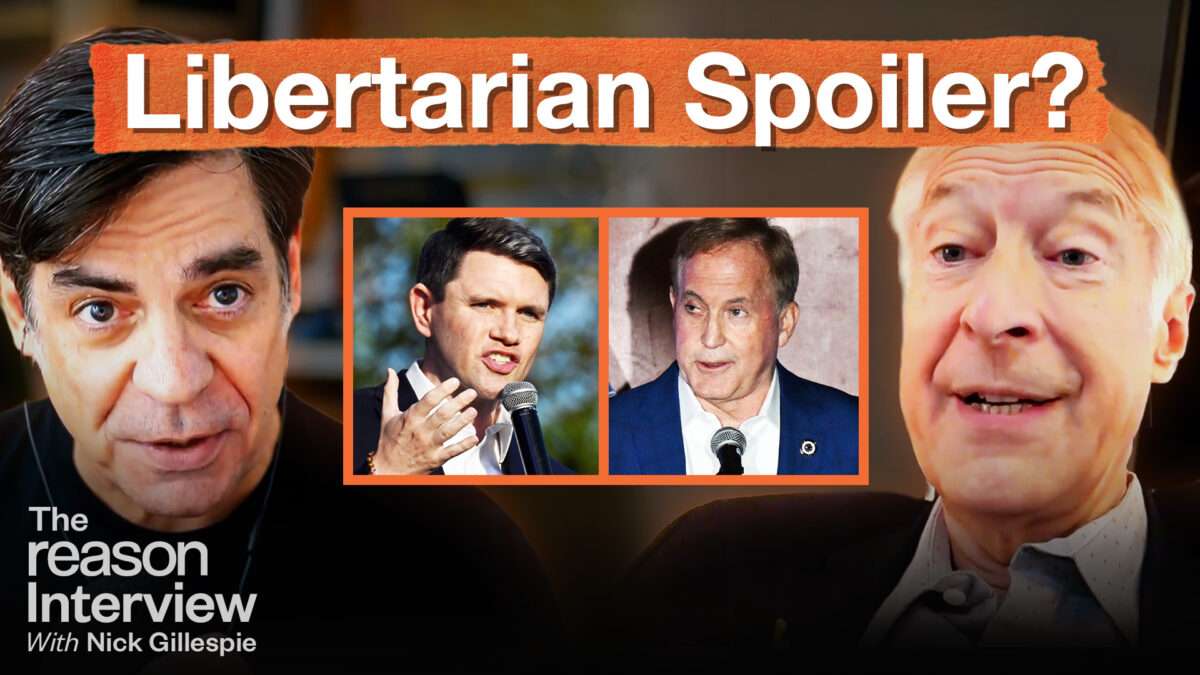
Today's guest is Ted Brown, the Libertarian Party candidate for U.S. Senate in Texas. Brown is facing off against Republican Ken Paxton and Democrat James Talarico in a closely contested race. Brown received more than 267,000 votes in his 2024 Senate campaign and is now challenging both major parties on their commitment to individual liberty. He argues that Republicans have abandoned limited government while Democrats increasingly embrace economic policies that undermine the free market.
Nick Gillespie talks with Brown about Paxton's corruption scandals, Talarico's hostility toward billionaires, and why Texas ranks poorly on personal freedom despite its business-friendly reputation. Brown makes the case for returning to an Ellis Island–style immigration system, cutting federal spending to confront the $40 trillion national debt, and ending America's military involvement in the Middle East. They also discuss abortion rights, government surveillance, online age-verification laws, and how regulations drive up the cost of healthcare. Brown explains what it will take to rebuild the Libertarian Party and why he believes a senator could accomplish more by stopping bad legislation than by passing new laws.
Bulgarians vote on 25 October in a presidential election shaped by Russia’s war in Ukraine, attacks on Black Sea shipping and economic pressures. The contest between incumbent Iliana Yotova and reformist challenger Andrei Gyurov will also test the political authority of Prime Minister Rumen Radev.
Bulgaria will elect a president on Sunday, 25 October, in a contest that has become a test of the country’s relationship with Russia, its commitments to NATO and the European Union, and its response to deteriorating security in the Black Sea.
An opinion poll conducted by Market Links between 13 and 19 October placed Yotova ahead with 47.3 per cent support, compared with 30.6 per cent for Gyurov. However, low anticipated turnout makes a second round on 1 November highly likely.
Although Bulgaria’s presidency is primarily ceremonial, the office carries constitutional authority over defence, legislation and government formation. The election also comes six months after former President Rumen Radev secured a parliamentary majority and became prime minister, substantially changing the country’s political landscape.
A presidency shaped by political realignment
Yotova, 62, became Bulgaria’s first female president in January 2026 after Radev resigned to enter parliamentary politics. Previously his vice-president, she is now seeking a five-year mandate of her own.
Her candidacy is supported by Radev’s Progressive Bulgaria coalition, which won 131 seats in the 240-member National Assembly in April, as well as the Bulgarian Socialist Party. Her running mate is Kiril Valchev, director-general of the Bulgarian News Agency.
Gyurov, an economist and former deputy governor of the Bulgarian National Bank, is supported by the pro-European reformist opposition, including We Continue the Change and Democratic Bulgaria. His vice-presidential candidate is Georgi Kandev, a former senior Interior Ministry official.
A third significant contender is Kostadin Kostadinov, leader of the nationalist Revival party, whose political platform includes opposition to Western military assistance for Ukraine and closer relations with Moscow. His running mate is European Parliament member Petar Volgin.
The election follows years of political instability, during which Bulgaria held eight parliamentary elections between 2021 and April 2026. Radev’s parliamentary victory ended a prolonged period of fragmented governments, but it has also raised questions about the concentration of political influence.
A Yotova victory would place both the presidency and the parliamentary majority within the same political camp. A Gyurov victory would instead create an institutional counterweight to Radev’s government.
Russia and Bulgaria’s foreign policy divisions
Bulgaria joined NATO in 2004 and the European Union in 2007, but its relationship with Russia remains politically complicated.
Historical and cultural ties, including shared Orthodox traditions and the legacy of Bulgaria’s liberation from Ottoman rule, have influenced public attitudes towards Moscow. During the Cold War, Bulgaria was among the Soviet Union’s closest allies, and Russian influence continued after the collapse of communism, particularly through energy, business and political networks.
Russia’s full-scale invasion of Ukraine in February 2022 exposed divisions over whether Sofia should provide military assistance to Kyiv or adopt a more cautious position.
Since returning to power as prime minister in May, Radev has advocated maintaining Bulgaria’s European commitments while seeking improved relations with Moscow. His government has halted military deliveries to Ukraine and taken a more restrictive approach to further sanctions against Russia.
Yotova has similarly emphasised negotiations as the means of ending the war and warned against further militarisation of the Black Sea. Her position appeals to voters concerned that escalating confrontation could expose Bulgaria to additional security and economic risks.
Gyurov represents a more explicitly Euro-Atlantic political orientation, arguing for stronger Western alignment and institutional reform.
The contest therefore concerns not whether Bulgaria will formally leave its existing alliances, which would require decisions far beyond presidential authority, but how actively it participates in their policies towards Russia.
Black Sea attacks bring the war closer
The security debate has intensified following a series of drone attacks against merchant vessels operating near Bulgarian and Romanian waters in October.
According to a maritime threat assessment published by Ambrey, three commercial ships were struck on 5–6 October within the exclusive economic zones of the two NATO members. Two sank, marking a substantial escalation in the geographic exposure of commercial shipping.
Ambrey assessed that Russian forces were highly likely responsible and that the vessels had been targeted because of their connections to Ukrainian grain exports.
The attacks have raised concerns about navigation, maritime insurance, food exports and the potential for further incidents involving NATO member states.
Bulgaria’s position on the western Black Sea coast gives these developments particular significance. Its ports, maritime infrastructure and commercial shipping depend on maintaining secure access to international sea routes.
As EU Today previously reported, the expansion of Russian attacks into areas close to NATO territory creates difficult questions for coastal governments seeking to protect commercial interests without becoming direct participants in the conflict.
For Bulgarian voters, maritime security is no longer simply an aspect of the war taking place elsewhere. It has become a question of national security, economic vulnerability and the government’s capacity to respond.
Energy prices and economic concerns
The campaign has also been influenced by inflation and higher energy costs, particularly among lower-income households and residents of rural areas.
Bulgaria’s historical dependence on Russian energy has long complicated its foreign-policy choices. Although the country has pursued diversification, fluctuations in international energy markets continue to affect domestic prices and industrial competitiveness.
The transition represents a significant stage in Bulgaria’s economic integration with the European Union, but it has occurred during a period of price pressures and uncertainty over household purchasing power.
The presidency does not determine energy policy or monetary decisions. Nevertheless, candidates’ positions on Russia, European integration and economic security form part of the wider political debate.
Why a second round is likely
Under Article 93 of Bulgaria’s Constitution, a candidate must receive more than half the valid votes, with turnout exceeding 50 per cent of eligible voters, to win in the first round.
Neither requirement is expected to be easily satisfied. Turnout in the first round of the 2021 presidential election was approximately 38.6 per cent, reflecting the broader problem of electoral participation after repeated national votes.
If no candidate meets the constitutional requirements on Sunday, the two leading candidates will contest a runoff on 1 November.
Yotova enters the election with a substantial polling advantage, but Gyurov could benefit from opposition voters consolidating around his candidacy in the second round.
The result will determine more than the occupant of the presidential office. It will indicate whether Radev’s parliamentary dominance can be extended to the presidency, or whether voters prefer a political counterweight at a time when Bulgaria faces growing pressure to define its position between Moscow and its Western allies.
Supporters of Proposition 39, the statewide ballot initiative that would implement additional Voter ID requirements for California elections, pitch the measure as a "common-sense reform to increase trust and participation in our elections." Its sponsor, Assembly member Carl DeMaio (R–San Diego), touts widespread support for such measures by Democratic, Republican, and independent voters.
Yet the latest polls show the measure tanking, with a Public Policy Institute of California survey last month showing it losing 55 percent to 43 percent—dismal numbers this late in the election season. The official ballot arguments provide some insight into the reasons. While supporters stick with their "nonpartisan" shtick, opponents tie the measure to President Donald Trump's election denialism.
"Stop Trump from rigging our elections. Don't believe the lies. Prop. 39 MAKES VOTING HARDER, MORE EXPENSIVE, AND LESS SAFE for Californians," per the "no" argument. It refers to the measure's funding from "MAGA rightwing billionaires." That point was reinforced by a recent CalMattersreport showing large donations from "deep-pocketed Republican donors." The publication says it's a "signal that conservatives view Prop. 39 as a test of support for future battleground states in the broader push by…Trump to tighten voter restrictions."
That's a fair assessment. In a Democratic state where the president's approval ratings are 24 percent in one poll, it's hard to imagine that most voters will spend much time thinking about the ins and outs of election policy and analyze the measure based on its specifics. They'll no doubt see it for what it largely is: a Republican Party effort to aid and abet Trump's unfounded election conspiracies. That said, its requirements aren't overly obtrusive, only unnecessary.
Currently, Californians must show a state identification or provide the last four digits of their Social Security Number when registering. No identification is needed to vote in person, but election officials use signature verification for vote-by-mail envelopes. Around 90 percent of Californians vote that way, so the main issue involves the requirement that voters add the last four digits from their government IDs on the outside of the envelope—thus adding an additional checkpoint (and sadly an additional opportunity for identity theft).
There's no need to worry about compliance costs for election agencies, as it's their job to administer elections. The measure likely will marginally reduce voter participation (by increasing disqualified ballots, even from legal voters if they forgot the ID they used when they registered), while marginally increasing security. It would force many Californians to re-register, which is a hassle. It would no doubt burden our excruciatingly slow ballot counting.
I don't have any theoretical problem with requiring an identification before voting, but California's elections are remarkably secure. There's no evidence of widespread fraud. Basically no one risks prison time by pretending to be someone else on a ballot. It's not about fixing a problem.
Since his defeat in 2020, Trump has traded in election conspiracy theories. The new GOP game is to trot out evidence-free election-fraud claims whenever they lose. We shouldn't play along. Despite the nonpartisan rhetoric, Proposition 39 is the state GOP's way of leaning into Trump's priorities and, as that CalMatters article noted, build momentum for less-defensible nationwide restrictions—apparently the only way Republicans think they can build a lasting majority. The measure won't do much damage in California as it's fairly modest, but it energizes the party's worst instincts.
Consider what DeMaio wrote in 2024 about his seven-point plan to overhaul the state GOP: "Do you remember a time when Republicans controlled a majority of statewide offices in California and were competitive in the state Legislature and congressional delegations?" He rightly blames the party itself, then offers his first item on a platform to revive it: "Make election integrity CAGOP's top ballot priority." I, too, would prefer more competitive California elections, but my first point would be for the GOP to make a better case for fixing California's messes.
Others see the measure as a means to gin up Republican turnout for a November election that's going to be a referendum on Trump by giving them some high-excitement issue to rally around. But some savvy political observers think that it might backfire. We'll see, but it reminds me that the California GOP has too long relied on cute strategies rather than good candidates.
What about supporters' main claim that Voter ID is necessary because it will restore voters' flagging trust in election integrity? Well, Republicans are the ones who don't trust our elections—and that's precisely because Trump spent the last six years poisoning the well. Do you really believe the people who think MAGA Republican Spencer Pratt could have only lost a Los Angeles mayoral primary (where only 15.9 percent of voters are Republicans) because of fraud will have their faith restored if Proposition 39 becomes law? Doubtful.
Republicans can restore their fortunes by acting normal again. The rest of us needn't enable them by backing a measure based on an election-integrity fantasy.
This column was first published in The Orange County Register.
Voters across the country are making big decisions about the education of their children at a local, state and federal level in this year’s midterms. Ballot initiatives, school board elections, governor’s races and Senate spots are all on the line as parents head to the polls thinking about AI, school choice and what topics should…
On this week's episode of Freed Up, Robby Soave and Christian Britschgi condemn Vivek Ramaswamy's new attack ad against opponent Amy Acton before discussing their predictions for the 2026 midterm elections. Next, the boys get biblical with references to their favorite parables as they discuss Tyler Cowen's latest article on why he thinks Elizabeth Holmes—and most other non-violent female criminals—should not be in prison. The episode wraps with a thoughtful discussion on aging, state attorneys general, and the latest Meta settlement.
00:00—Vivek Ramaswamy ad controversy
20:00—2026 midterm elections
25:50—Should Elizabeth Holmes be in prison?
49:20—Getting older
58:55—An update on Rep. Ilhan Omar
1:03:10—The importance of grain
1:06:14—Robby and Christian extol author Michael Crichton
1:11:30—The war in Ukraine should end.
1:14:50—Meta settled with the state of New Mexico
1:20:00— Christian continues his crusade against state attorneys general.
If you enjoy Freed Up, come watch Robby debate at our upcoming Reason Versus in D.C. Tickets are available here.
Robby Soave on the left, Christian Britschgi on the right, Elizabeth Holmes in the middle with the words "bad blood" written above her face, and the Reason Freed Up logo in the bottom left corner
In my role as a political commentator, I enjoy making predictions. I possess no special talent for this and am often hilariously wrong: Unlike most other pundits, I famously clung to my stupid belief that former President Joe Biden would never step down as the Democrats' 2024 candidate, for instance. I called the 2020 presidential election correctly (and got most states right, only flipping Georgia and Florida), but I messed up in 2024. (Nevertheless, I still demolished my co-host, who didn't appear to take this challenge very seriously.)
The hardest part about making predictions is separating what you want to happen from what is actually likely to happen. Commentators often feel inclined to rally for their preferred outcome, as if shouting about it on television is going to make it come true. In some ways, this is an easier temptation for us libertarians to avoid, since all outcomes generally seem suboptimal. Once again, that is the case: See, for example, the upcoming 2026 midterms.
It seems inarguable that President Donald Trump has squandered much of his political capital by failing to focus narrowly on the economy and instead launching another unpopular war in the Middle East. It also seems obvious that the Democratic Party, once returned in power, will do everything it can to thwart the administration's shrewdest policies—on tech and AI in particular.
But that is my prediction: Democrats will retake the House of Representatives and the Senate.
I don't have any specific map in mind for the House (it's too complicated), but here are my Senate predictions:
Here is my REVISED prediction for the Senate. For the last several weeks, everything has moved in Dems' direction, and I now expect them to take it.
When I looked at the map back in August, I still thought Ohio was a long shot for the Democrats and that Michigan was in play for the GOP due to Abdul El-Sayed being so far left. Now it looks to me like Republicans will lose both seats, along with Texas and Alaska. I'm still betting that the formidable incumbent in Maine, Sen. Susan Collins (R), will hold on—the polls have misjudged her in the past—and that Iowa is a bridge too far for Dems. If Republicans manage to keep those two seats, then it's a 51–49 map in Democrats' favor.
But wait…all is not lost for Trump.
In the event of a 51–49 Dem advantage, it seems somewhat likely to me that Sen. John Fetterman (D–Pa.) could switch parties, which would restore Republican control because of Vice President J.D. Vance's tiebreaking vote. With his conservative rhetoric on Israel and other issues, Fetterman has no future as an elected Democrat in his state—he could never ever ever win a Democratic primary—and will have to strike some sort deal with Trump before his reelection in 2028. Fetterman should agree to become an independent who caucuses with Republicans in exchange for Trump ensuring that no Republican dares run against him in the future. Absent such a deal, Fetterman is virtually guaranteed to be a one-term senator, so if he harbors any desire to keep his job—perhaps that's an open question—he will need to make a move. A 51–49 Senate will give him the exact leverage he needs.
So those are my predictions! What are yours?
This Week on Free Media
I'm joined by Amber Duke to discuss the riots in France, Vivek Ramaswamy's terrible campaign ad, and more.
Worth Watching
Here's another shameless plug for my upcoming debate with Katherine Mangu-Ward, Mehdi Hasan, and Jason Stanley! (Katherine is on my side.) If you are in Washington, D.C., please get tickets here.

 Login

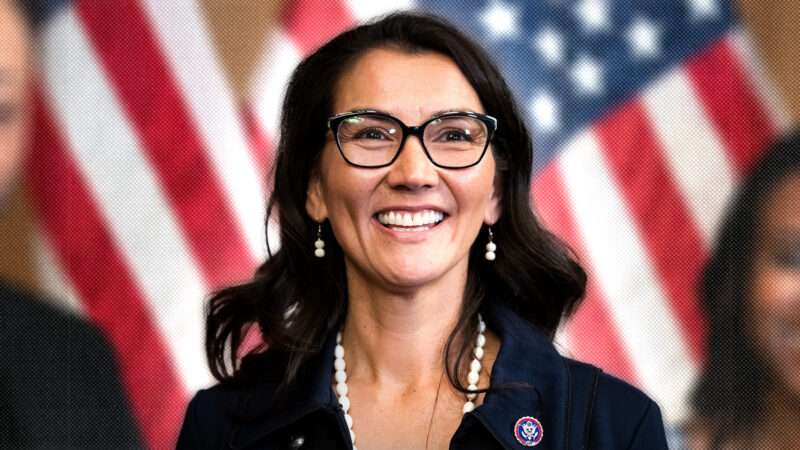
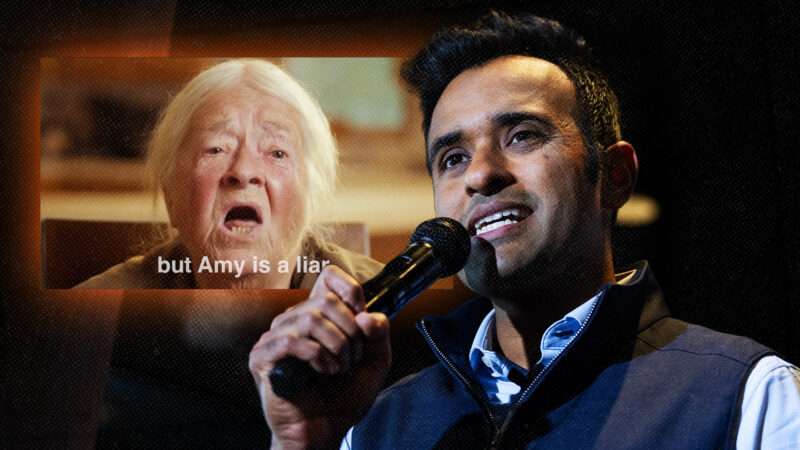
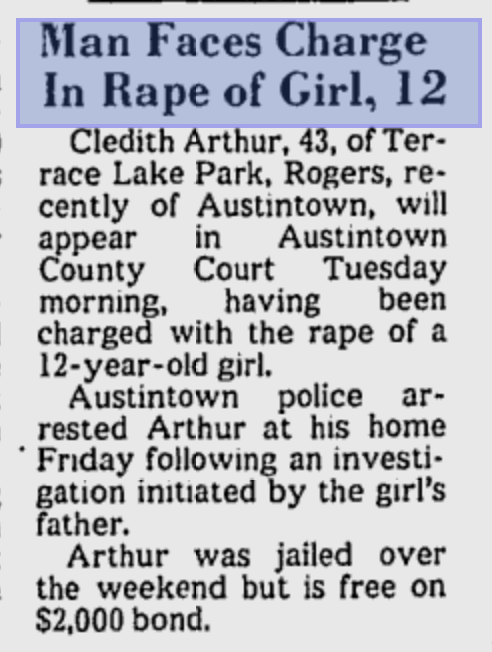
 NEW: The Online Safety Act has been a failure, according to a new report from Ofcom.