❌

Reading view

ICE is Now Even More Unpopular than the IRS

Reuters (2018).

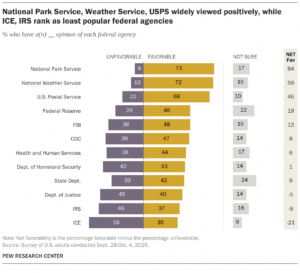
A recent Pew Research Center survey finds that Immigration and Customs Enforcement (ICE) is by far the most unpopular federal agency, easily outstripping even the widely despised IRS. According to Pew, 56% of Americans disapprove of ICE, compared to only 35% who approve. That's substantially worse than the IRS (which is disapproved by only a 46-37 margin).
 

Other recent surveys show growing public support for abolishing ICE. For example, a July YouGov poll indicates that 48% support abolition, compared to 40% who oppose it. Another survey,  conducted in March of this year, showed a similar 50-39 margin in favor of abolition.

The fact that ICE is unpopular doesn't by itself prove the agency should be abolished. Having written a book and many other publications on widespread public ignorance about government policy, I would be the last to argue that popularity is a good metric of a policy's - or an agency's - merit. But, in this case, public opinion is right. As I explained in an August 2025 article in The Hill, and a follow-up piece for the Boston Globe, (non-paywalled version here), ICE's many abuses do indeed justify abolishing it. And the case for doing so has been strengthened by more recent events, such as the brutal killing of two US citizens in Minnesota.

While ICE abuses have been exacerbated by the policies of the second Trump Administration, many predate it, and are inherent in the entire enterprise of mass deportation.

As explained in my article in The Hill, abolishing ICE would not completely end interior deportations. But it would make them heavily dependent on the cooperation of state and local governments, thereby strengthening constitutional federalism and reducing incentives for abuse, at least to a significant degree.

In that article, I also explain how support for abolition be further bolstered by combining it with shifting ICE funds to state and local law enforcement. This undermines the principal political obstacle to abolition: the fear that getting rid of ICE would increase crime. Transferring the funds to state and local police would help defuse such concerns, win the support of law enforcement agencies, and foster genuine reductions in violent and property crimes; social science evidence shows that putting more police on the streets has that effect, whereas deportations do not.

The post ICE is Now Even More Unpopular than the IRS appeared first on Reason Magazine.

  •  

For Senegalese Street Vendors in New York, ‘Work Is Worship’

Struggling to find steady work, many migrants who have arrived recently from Senegal have adapted with a relentless sidewalk hustle, sustaining their families through street vending.

© Arisa Haboshi for The New York Times

Many spend their days on the sidewalks, selling everything from coffee to knockoff designer handbags.
  •  

One Agent’s Doubts

ICE pays local police to help with deportations. What’s it like for them?

© Kirsten Luce for The New York Times

Jaron Alexander, of Ingram, Texas, is one of more than 29,000 local police officers on the front lines of the Trump administration’s deportation campaign.
  •  

They Were Accused of Illegal Fishing. They Ended Up in ICE Detention.

In states like Florida, officers who hand out fishing citations and inspect produce have been deputized by Immigration and Customs Enforcement, expanding the reach of President Trump’s deportation campaign.

© Alfonso Duran for The New York Times

A canal in Dania Beach, Fla., in September. The canal was the site of an encounter that led Florida Fish and Wildlife Conservation Commission officers to contact federal immigration authorities.
  •  

Trump Slashing Deportation Protections Shows Why Temporary Status Shouldn't Depend on Who's President

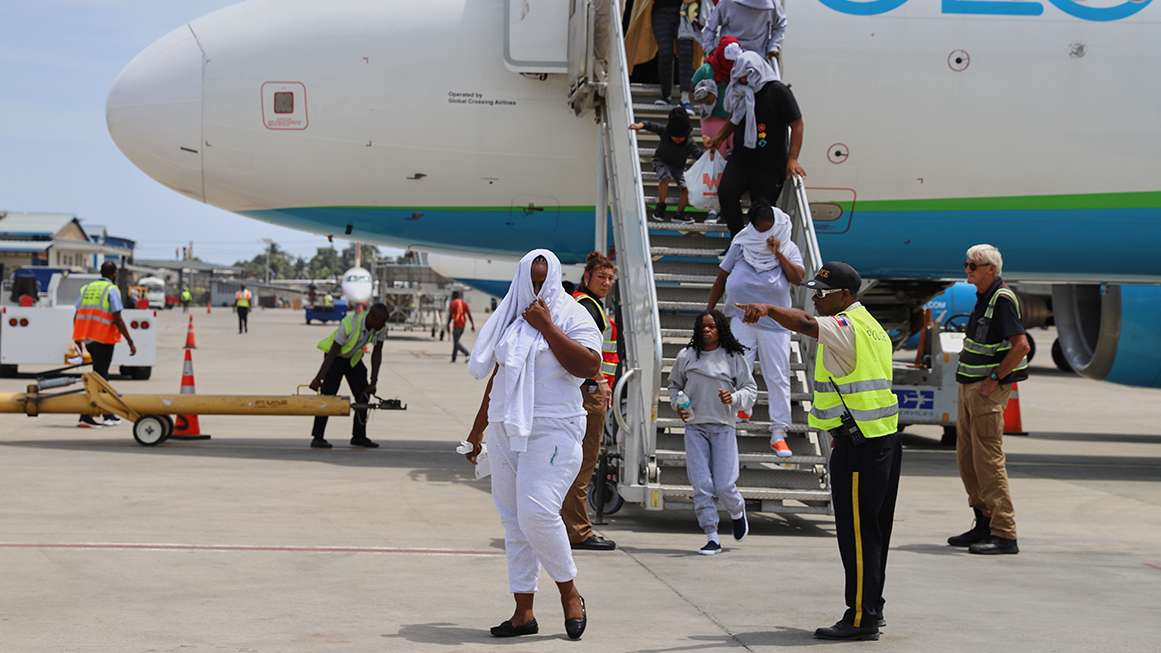
People deboarding a plane | Photo: Haitians deported from the U.S. deplane in Haiti; Ketlain Difficile/A.P.

In late August, President Donald Trump's administration carried out its first deportation flight to Haiti since the Supreme Court allowed it to end temporary protected status (TPS) for the embattled country in June. "There are no extraordinary and temporary conditions in Haiti that prevent Haitian nationals…from returning in safety," the Department of Homeland Security (DHS) claimed in its TPS revocation, describing a country the State Department warns Americans not to visit "for any reason."

The Trump administration has eroded America's humanitarian avenues, including TPS, which shields migrants from deportation. As a result, many noncitizens may become undocumented and could be forced to return to unsafe places.

The DHS secretary may grant TPS for countries facing armed conflicts, natural disasters, or other disruptive events. TPS designations last anywhere from six to 18 months and may be extended. The government has designated 29 countries for TPS since Congress established the status in 1990, offering protection to Salvadorans fleeing a 12-year civil war, Haitians fleeing the 2010 earthquake, and millions of others. The Biden administration repeatedly made and extended TPS designations, but the Trump administration has been working to terminate them.

There were 1.3 million people living in the U.S. under TPS in March 2025, according to the Pew Research Center. By August 2026, the Trump administration had ended TPS for 13 countries, leaving 1 million people without its protections. Once someone loses TPS, he reverts to his previous immigration status, which is often undocumented. Over 600,000 Venezuelans, 330,000 Haitians, 170,000 Salvadorans, and 100,000 Ukrainians had TPS protections as of March 2025, according to the Congressional Research Service.

Critics often point out that TPS isn't really "temporary." That's frequently true: Although some designations have been brief, others have been decades-long. Designations for Haiti, Syria, Honduras, Nepal, Somalia, and El Salvador have all lasted at least 14 years, according to the Migration Policy Institute (MPI).

This says more about the U.S. immigration system and presidential power than it does about TPS. "In the absence of Congress acting to legalize what has become a long-settled unauthorized immigrant population, Republican and Democratic administrations, lawmakers, immigrants, and foreign governments had come to tacitly rely on TPS despite its nominally temporary nature," notes the MPI. Immigration policy is increasingly subject to presidential whims, and due to lengthy processing times and narrow qualifications, more durable immigration pathways such as asylum and refugee status are often inaccessible to eventual TPS beneficiaries. An immigrant-friendly president may use TPS designations to temporarily shield noncitizen populations, but an anti-immigrant successor can also revoke those protections. In either scenario, a TPS holder faces uncertainty.

In a rare bipartisan immigration effort last February, Reps. Laura Gillen (D–N.Y.) and Mike Lawler (R–N.Y.) introduced a bill to extend TPS for Haiti for three years. It passed the House this April and has been languishing in the Senate since. Its future, too, is uncertain.

The post Trump Slashing Deportation Protections Shows Why Temporary Status Shouldn't Depend on Who's President appeared first on Reason Magazine.

  •  
❌