The ports of Los Angeles and Long Beach have identified liquefied natural gas (LNG) and methanol as the most viable alternative marine fuels for the near and medium term, with...
Red Bull athlete Thomas van Tonder completed a world-first crossing beneath South Africa's 216-metre-high Bloukrans Bridge as part of Red Bull Bridge Bars.
Life-threatening violence broke out at a 12-year-old girls' softball game over the weekend, leaving one man unconscious with a fractured skull, a grandfather with a broken hip, and a Texas couple arrested and charged with assault.
New images appear to show a full-sized demonstrator of China’s CE-25A, an unorthodox 19-seat all-electric aircraft being developed by the state-owned Commercial Aircraft Corporation of China (COMAC). The photographs offer a fresh look at a program the company publicly outlined in 2023, although the aircraft’s current testing status remains unclear.
The images appear to have first been shared by Chinese automotive blogger Han Lu (韩路) on October 28 and show a red and black colored aircraft with a silver cheatline bearing COMAC and CE-25A markings. Its Chinese civilian registration is B-0EFH.
One of the first images showing the apparent COMAC CE-25A. via Chinese internet
At this point, it should be noted that we cannot establish with certainty that the imagery is legitimate, but our own examination using multiple AI image-analysis models has found no major indications that they were artificially generated.
Regardless, the program overall reflects COMAC’s interest in distributed electric propulsion, an approach that could help inform future aircraft development even if the CE-25A itself never enters commercial service.
The appearance of what seems to be a full-sized demonstrator certainly raises questions about how far the program has progressed. At this stage, there is no clear public confirmation that this particular aircraft has flown, and its precise role in the development effort remains uncertain.
A rear three-quarter view provides a good look at the distributed electric propulsion system used in the CE-25A. via Chinese internet
COMAC first presented the CE-25A concept at the China International Import Expo in Shanghai in November 2023. The company described it as a 19-seat, all-electric commuter aircraft intended for short- and medium-distance passenger transportation, as well as business aviation.
Published design specifications called for a cruising speed of approximately 400 kilometers per hour (248 miles per hour) and a range of around 400 to 500 kilometers (250 to 310 miles).
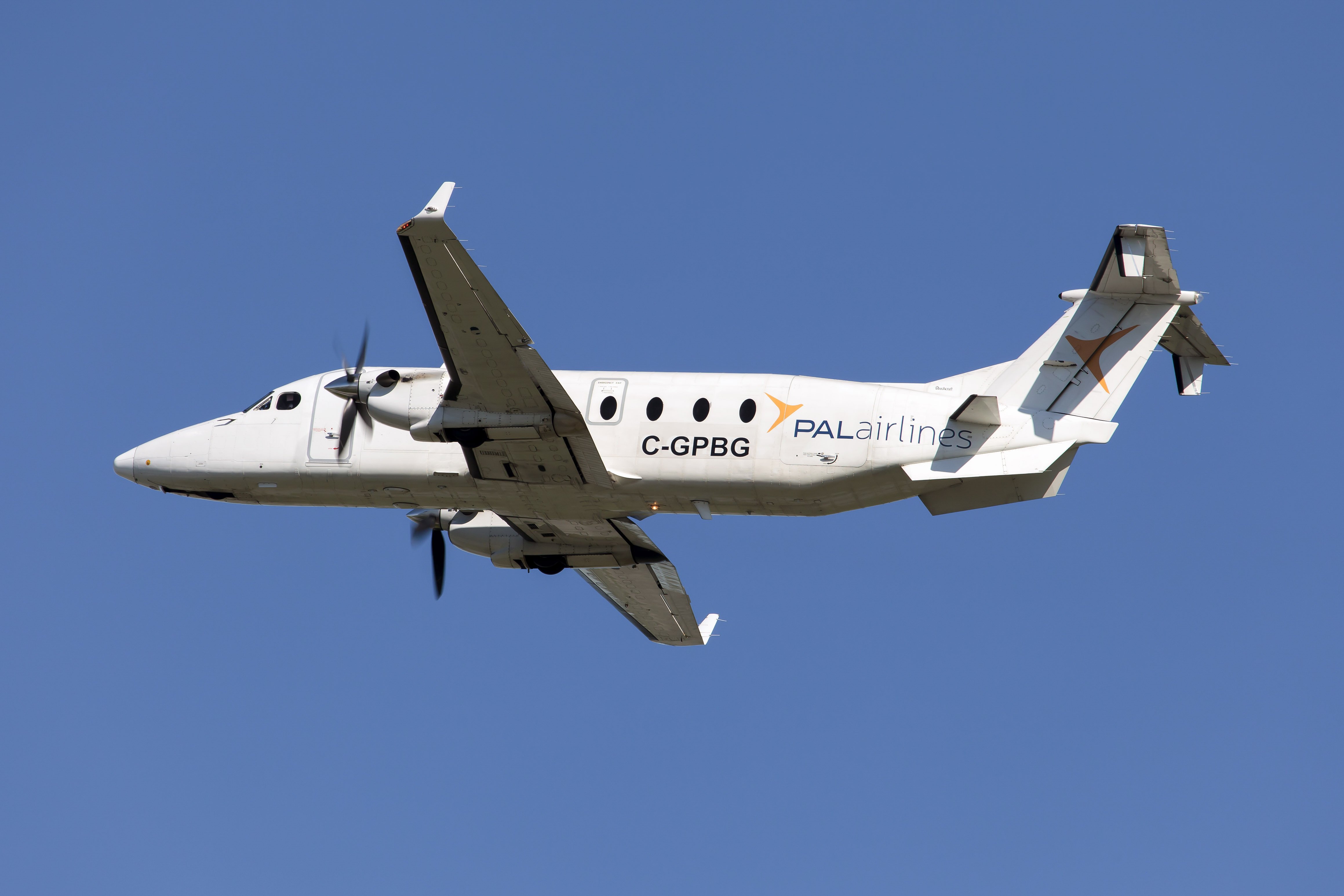
The 19-seat capacity and its general configuration are somewhat similar to the Beechcraft 1900 twin-turboprop regional airliner. With a 19-passenger payload, the Beechcraft 1900 has a range of around 700 kilometers (440 miles) and a cruising speed of approximately 520 kilometers per hour (320 miles per hour).
Stock photo of a Beechcraft 1900D taking off. Photo by Fabrizio Gandolfo/SOPA Images/LightRocket via Getty Images SOPA Images
The Chinese aircraft’s most distinctive feature is its distributed electric propulsion system. Instead of relying on a small number of conventional turboprop engines, the design uses 10 electrically driven ducted fans integrated into its wing structure.
Distributed propulsion can give designers greater flexibility in how thrust is generated and integrated with the airframe. Depending on the configuration, it can offer aerodynamic benefits and potentially improve performance in particular flight regimes. Electric motors can also simplify some aspects of propulsion-system design compared with conventional turbine engines.
Those advantages come with very considerable engineering challenges. Batteries remain far less energy-dense than aviation fuel, placing constraints on range, payload, and endurance. High-power electrical systems also require careful thermal management, while integrating multiple propulsion units introduces additional questions involving reliability, maintenance, and flight control.
There is also some confusion about how the demonstrator shown in the new images fits in with previously announced plans for the program. In 2023, COMAC referred to experimental aircraft verification flight work, which was to involve a scaled demonstrator. Meanwhile, the aircraft in the new photos is full-sized. Potentially, there is an unseen ‘missing link’ subscale demonstrator that has already flown.
A model of the CE-25A is displayed alongside a placard with its key features and specifications. via Chinese internet
China is not alone in exploring distributed electric propulsion for regional aircraft. Several Western projects are also underway.
The European UNIFIER-19 research effort has examined 19-seat, zero-emission regional aircraft concepts using alternative propulsion systems, including distributed electric ducted fans. Some variants explored hydrogen fuel cells rather than relying exclusively on batteries. Compared to the CE-25A, it is strictly a research effort rather than a proposed production aircraft.
In the United States, NASA’s X-57A Maxwell experimental aircraft investigated distributed electric propulsion using 14 electric motors and propellers integrated into a specially designed wing. The X-57 was much smaller than the CE-25A and used open propellers rather than ducted fans. The project was intended to demonstrate potential aerodynamic and efficiency benefits but did not progress to its planned piloted flight configuration.
The X-57 program was canceled in 2023 after safety issues with its propulsion system proved impossible to resolve within the available budget and schedule. It had been launched on the assumption that existing electric propulsion technology was sufficiently mature for safe flight, but this ultimately proved premature. The experience underscores the very significant engineering and safety challenges that remain in developing viable electric aircraft.
Meanwhile, France’s AURA AERO is developing ERA, a 16- to 19-seat regional aircraft planned around eight electric motors and two turbogenerators. The hybrid-electric design is intended to offer substantially greater range than the CE-25A’s published target, with the company advertising a range of approximately 1,500 kilometers (930 miles). ERA is a more direct comparison in terms of intended passenger capacity and commercial role, but it uses a different propulsion architecture and is not an all-electric aircraft.
Swedish company Heart Aerospace also pursued a 19-seat battery-powered commuter aircraft, the ES-19, with a proposed range of approximately 400 kilometers (250 miles). Its original design was more conventional, with a high wing and T-tail, and the company subsequently moved away from the ES-19 concept toward larger hybrid-electric aircraft.
The CE-25A has been presented as a civilian aircraft, and there is no public evidence that COMAC intends to develop it for military service. Nevertheless, the technologies being explored could have relevance to future military aviation.
This would be in line with China’s pursuit of other unconventional aircraft programs with more direct potential military applications.
A mature electric aircraft in this general class could potentially support short-range utility missions, liaison duties, or personnel transport where payload and endurance requirements are modest and suitable charging infrastructure is available. At this stage, there is no indication that the CE-25A has been designed for autonomous operations, austere-field use, or military payloads.
At the same time, its utility in military environments would depend heavily on battery performance, ground support, operating conditions, and the ability to maintain the aircraft away from established infrastructure.
Perhaps more likely is that research into distributed electric propulsion, including the CE-25A, could inform other Chinese aircraft designs. Advances in electric motors, power distribution, flight controls, thermal management, and the integration of multiple propulsion units could eventually benefit crewed and uncrewed aircraft or specialized platforms with different operational requirements.
The CE-25A sits within China’s broader effort to expand its domestic aerospace capabilities and explore new aircraft technologies. COMAC is best known internationally for its C919 narrowbody airliner and ARJ21 regional jet, but its research interests extend beyond conventional commercial aircraft.
An ARJ21 sits on the tarmac at Yangzhou Taizhou International Airport, Jiangsu Province of China. Photo by Visual China Group via Getty Images VCG
China’s substantial battery-manufacturing industry provides a potential advantage in electric aviation, although adapting batteries developed for road vehicles to the demands of flight remains a significant engineering challenge.
In 2023, COMAC announced cooperation with battery manufacturer CATL and Shanghai Jiao Tong University on research related to battery-powered aircraft concepts. The precise relationship between that work and the CE-25A, including whether they share specific battery technologies or propulsion systems, is not immediately clear.
For now, the newly surfaced photographs provide a compelling look at a COMAC project that has been publicly acknowledged but remains opaque in several important respects.
Whether the CE-25A ultimately becomes a viable civilian aircraft or contributes to other aerospace developments, including in the military realm, its emergence offers more evidence of China’s continued push into unconventional aircraft design.
France has deployed a maritime patrol aircraft to Romania following a series of attacks on civilian vessels near NATO territory. The escalating threat has prompted closer cooperation between Romania, Bulgaria and Turkey, raising questions about maritime security and the protection of Europe’s eastern flank.
A series of drone attacks on commercial shipping in the western Black Sea has brought the consequences of Russia’s war against Ukraine increasingly close to NATO territory, prompting additional military surveillance and renewed regional defence cooperation.
France has temporarily deployed an Atlantique 2 maritime patrol aircraft to Romania, while NATO members bordering the Black Sea are strengthening arrangements to monitor shipping routes, identify airborne threats and protect critical infrastructure.
The French aircraft began operating from Romania’s Mihail Kogălniceanu airbase on 18 October and is scheduled to continue reconnaissance missions until 6 November.
Its deployment follows repeated attacks on merchant vessels near Romania and Bulgaria, both members of NATO and the European Union.
At least eight cargo ships have been struck in the region during October, with approximately 34 sailors reported dead or missing, according to figures reported by Reuters on 27 October.
The incidents have transformed commercial maritime security into an increasingly urgent issue for European defence planners.
Commercial vessels enter the conflict zone
The latest escalation has centred on shipping routes serving Ukraine’s Danube ports and commercial traffic passing through the western Black Sea.
Russia’s attacks on Ukrainian maritime infrastructure have increased the importance of alternative export routes, including those connecting the Danube to international shipping lanes.
However, recent incidents demonstrate that geographical proximity to NATO territory does not necessarily provide commercial vessels with protection from the effects of the conflict.
On 23 October, a drone struck a Comoros-flagged cargo vessel near the Romanian port of Constanța.
According to maritime security company Ambrey, the vessel was hit approximately 16 nautical miles east of the port and subsequently capsized.
One crew member was reported dead, nine were rescued and three remained missing in the initial casualty figures.
Ambrey assessed it as highly likely that Russian forces carried out the attack, pointing to the vessel’s links with Ukrainian Danube ports.
That assessment represents an attribution by a commercial security organisation, rather than a final determination by an international investigative body.
Other incidents have similarly raised questions over responsibility.
Ukraine has accused Russia of attacking civilian shipping, while Bulgarian authorities have acknowledged difficulties in conclusively identifying the operators of drones involved in some strikes.
France strengthens maritime surveillance
Romania’s Defence Ministry announced on 27 October that the Atlantique 2 deployment followed a request from Bucharest in response to the deteriorating security situation.
The aircraft is conducting surveillance and reconnaissance over the western Black Sea, working with Romanian naval authorities and maritime rescue coordination services.
Its principal responsibilities include identifying hazards to navigation and improving awareness of threats to critical infrastructure within Romania’s exclusive economic zone.
That infrastructure includes offshore energy facilities and maritime installations whose protection is increasingly relevant to European energy security.
The deployment adds to Romanian naval patrols conducted by ships, helicopters and unmanned systems.
Romanian authorities are also providing navigational warnings and recommended routes to commercial vessels.
Nevertheless, additional surveillance does not automatically prevent attacks.
The practical challenge lies in detecting relatively small unmanned aircraft or maritime drones, determining their intentions and responding before they reach civilian targets.
Romania, Bulgaria and Turkey coordinate their response
The security crisis was also discussed at a trilateral meeting of defence ministers in Sofia on 28 October.
Romania’s Defence Minister, Ștefan-Radu Oprea, met his Bulgarian counterpart, Dimitar Stoyanov, and Turkey’s Defence Minister, Yaşar Güler, to examine the consequences of attacks on commercial shipping.
According to the Romanian Defence Ministry, the ministers discussed closer intelligence-sharing, improved maritime surveillance and better coordination between their naval forces.
They also reaffirmed the importance of the existing Black Sea mine-countermeasures initiative involving the three countries.
Maritime mines remain a persistent hazard because they can drift beyond their original deployment areas, endangering civilian vessels irrespective of their destination or ownership.
The trilateral format provides a practical mechanism for neighbouring countries to coordinate activities while retaining responsibility for their respective national waters.
It also gives Turkey a central role in regional discussions, reflecting its position on the Black Sea and its control of access through the Turkish Straits under the Montreux Convention.
The limits of NATO’s maritime protection
The attacks raise a complicated legal and operational question: what responsibilities do NATO members have when civilian ships are attacked near their coastlines?
The distinction between territorial waters and an exclusive economic zone is important.
A coastal state’s territorial sea generally extends up to 12 nautical miles from its baseline, while its exclusive economic zone can extend considerably further and confers particular economic and jurisdictional rights.
An attack within a NATO member’s exclusive economic zone does not automatically constitute an armed attack against that member’s territory.
Nor does every strike on a civilian ship near NATO territory automatically trigger the collective-defence provisions of Article 5.
The circumstances, attribution, location and consequences of an incident would all influence the response.
This creates a security problem in which threats can affect European economic interests without necessarily crossing a threshold requiring collective military action.
Maritime trade and energy infrastructure face increasing risks
The implications extend beyond individual vessels.
Repeated attacks can increase insurance costs, complicate shipping schedules and discourage operators from using particular routes.
They can also affect Ukrainian agricultural exports and the wider commercial networks linking Black Sea ports to European markets.
Offshore energy installations face related vulnerabilities, particularly where surveillance and response capabilities are insufficient.
For NATO, the challenge is therefore to strengthen deterrence and protection without unintentionally escalating the conflict.
France’s reconnaissance deployment and the trilateral cooperation between Romania, Bulgaria and Turkey indicate that regional governments are moving towards a more coordinated response.
However, the continuing attacks demonstrate the difficulties of protecting civilian maritime activity against comparatively inexpensive unmanned systems.
The longer-term question is whether increased surveillance, counter-drone capabilities and naval cooperation can make western Black Sea shipping sufficiently secure while the war in Ukraine continues.
U.S. Senator Richard Blumenthal (D-Conn.) is demanding that a tanker reportedly carrying Russian diesel to the United States reverse course, warning its owner that delivering the cargo would violate federal...
The Trump administration has approved an $8.2 billion offshore liquefied natural gas export project off the Texas coast, marking a major milestone for its effort to speed up deepwater port...
A longtime confidant of David Ellison and the former president and COO of Skydance Media, Sisgold most recently led the company's Paramount Sports Entertainment division.
After going on many cruises, I've found there are a few ports that leave me wanting to stay on the ship.
Allie Hubers
I've sailed on many cruises and stopped at over 100 ports worldwide. There are a few I don't love.
Richards Bay is only fun if you have an excursion booked, and Costa Maya is too touristy for me.
The cruise crowds in Santorini, Greece, and Nassau, Bahamas, often leave me feeling overwhelmed.
I've taken more than 55 cruises and visited over 100 cruise ports all over the world.
Along the way, I've learned that some destinations are definitely worth exploring, while others can be unexpectedly disappointing.
As a destination-focused traveler, I rarely choose to stay on board when my ship is docked in port. Usually, I'm eager to disembark the ship, experience the local culture, and explore the area.
But after revisiting many of the same ports, I've also realized that certain destinations aren't always worth the hassle. While some offer beautiful beaches, historic landmarks, and bucket-list excursions, others can feel crowded, touristy, or difficult to navigate.
Although these ports can still be enjoyable with the right planning and expectations, I'm often happier staying on board to take advantage of the ship's amenities.
Here are five cruise ports where I'd rather stay on the ship than venture ashore.
Costa Maya, Mexico
I can see why some people love Costa Maya, but it's not my favorite.
Alliie Hubers
Costa Maya is one of the few ports I'll almost always skip because it feels overly commercialized.
The entire terminal was built specifically for tourists and cruise passengers and is packed with souvenir shops, restaurants, swimming pools, wildlife encounters, a swim-up bar, and live entertainment.
Although many travelers enjoy this convenience, the port feels highly manufactured to me and resembles an outdoor shopping mall more than an authentic Mexican experience.
Additionally, I've found the isolated port doesn't have much to do nearby unless you've arranged transportation or booked an excursion.
However, Costa Maya can still be worthwhile with some planning. A short taxi ride away is Mahahual, which is a popular beach town with restaurants and beach clubs.
If you want to venture farther from the port, consider booking an excursion to the Mayan ruins for a cultural experience or snorkeling along the biodiverse Mesoamerican Barrier Reef.
Nassau, Bahamas
Nassau can feel crowded when several giant ships are docked.
Allie Hubers
Nassau is another port where I'm very likely to stay on the ship.
In fact, I sailed to Nassau last year aboard Utopia of the Seas and skipped the port entirely. Instead, my husband and I stayed on board and enjoyed the ship's pools, restaurants, and activities without the usual crowds.
Although you can reach popular beaches and resorts from the port, the area outside the cruise terminal can feel overwhelming. Although the terminal's recent renovations have improved the port experience, persistent vendors still remain immediately outside the gated area.
And on especially busy days, six or so cruise ships can dock at once, which makes the port feel even more crowded.
However, Nassau can be a positive experience if you've got the right plans in place. For instance, I've used ResortPass to spend the day at nearby hotels and had a much better experience than just walking around the port.
You can also book excursions to nearby beaches, Blue Lagoon Island, or other resort properties for a more relaxing day.
Santorini, Greece
Allie Hubers
Santorini is undeniably beautiful, which makes it a bucket-list destination for many. Unfortunately, the island's popularity is also part of the problem.
With thousands of passengers regularly arriving from multiple cruise ships, visiting the small Greek island can be stressful.
Cruise ships anchor offshore in Santorini, so passengers will typically tender into the port below Fira. From there, visitors can take a cable car, climb hundreds of steps, or arrange another way to reach the top of the island.
With several ships often visiting the island at the same time, lines for the cable car can become quite long. Getting around Santorini can also be difficult because of its narrow roads, heavy traffic, and crowds filling the streets of popular villages such as Oia and Fira.
The island is absolutely worth visiting, but you should prepare for some logistical challenges and set realistic expectations. If you want to maximize your time in Santorini, I recommend booking an excursion in advance instead of exploring independently.
An organized tour can help you avoid long cable-car lines, simplify transportation, and ensure you return to the ship on time.
Richards Bay, South Africa
Allie Hubers
During a cruise around South Africa, our ship docked in Richards Bay, which is one of the most unusual cruise ports I've ever visited.
Although Richards Bay is an important industrial port and major coal-exporting hub, it isn't necessarily designed with cruise passengers in mind.
During my visit, we disembarked at a gravel parking lot with no passenger facilities. By the end of the day, our cruise ship was also covered in soot and dust, which was unlike anything I had experienced before!
Without a planned excursion, there isn't much to do near the port, and the industrial setting can feel disappointing. But for travelers interested in wildlife, Richards Bay can be a worthwhile gateway to nearby South African reserves.
Because I researched the area ahead of time, I booked a game-drive excursion to Hluhluwe—iMfolozi Park, which is about 90 minutes from the port.
Seeing elephants in the wild was an unforgettable experience, and one that I would have missed if I had just stayed near the ship.
Freeport, Grand Bahama Island
Allie Hubers
Finally, Freeport is another port I'm often tempted to skip.
The area around the cruise terminal is very industrial and unfortunately doesn't offer much within walking distance. Because of this, cruisers often need to arrange transportation or book an excursion to visit the island's main attractions.
I was disappointed by how rundown the port area felt, with very limited shopping and amenities. Not to mention, I found securing transportation from the terminal area to be confusing and expensive.
Although taxis are available, in my experience, many of them operate as shared vans with high prices. And arranging rides back to the ship from a remote beach can also be stressful.
If you want to make the most of your day in Freeport, it's best to prearrange transportation or book an excursion. Popular tours include beach getaways, snorkeling, glass-bottom boat tours, and animal encounters.
However, if I haven't booked a tour in Freeport, you'll find me on the ship instead.
Ballon d'Or winner Harry Kane and Bayern Munich take on Magdeburg in the DFB-Pokal second round. Here are the live-streaming details for viewers in India.
Russia, the world's largest wheat exporter, has turned to an Arctic World War II shipping route to export grain for the first time as the conflict in Ukraine stalls Black Sea trade and officials warn of risks in the NATO-controlled Baltic Sea.
One of the most iconic marathons in the world, New York City brings a close to World Marathon Major season, with defending champions Benson Kipruto and Hellen Obiri back to defend their titles in the five-borough race
 Login