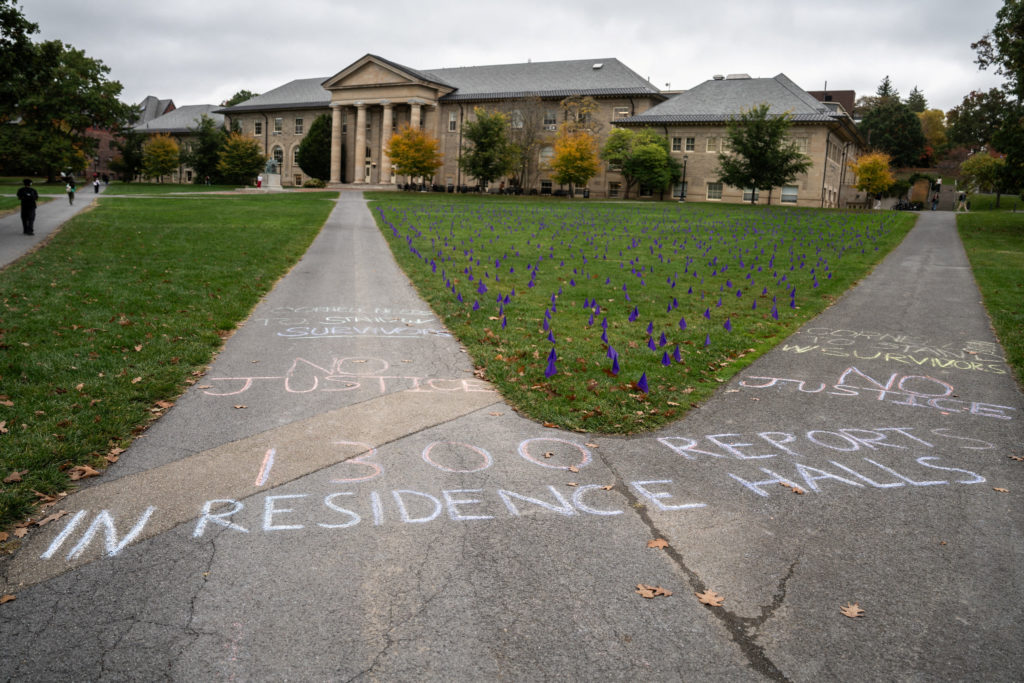
Cornell University faculty will meet Wednesday to conclude debate and begin voting on a proposed no-confidence resolution in the university's administration following widespread frustration over its response to a woman who reported she was gang raped at a campus fraternity house in 2024.
Rectors and officials from around twenty Ibero-American universities approved a 25-point agenda in Madrid this Tuesday. The agenda proposes regulating artificial intelligence (AI), defending Spanish and Portuguese as languages of science, and expanding academic mobility within the region.
The agreement was reached during the Ibero-American University Knowledge Forum, held at the headquarters of the Instituto Cervantes. It recognizes the autonomous public university as an indispensable pillar for democracy and social cohesion, and calls on governments to provide sufficient and sustainable funding.
“We face numerous challenges in each of our countries that require a collective, cross-cutting effort,” stated Susana Sumelzo, Secretary of State for Ibero-America and the Caribbean. She noted that the agenda will be presented at the XXX Ibero-American Summit of Heads of State and Government, scheduled for next Wednesday and Thursday in Madrid.
A key commitment is the promotion of Spanish and Portuguese as languages for research, scientific production, and teaching. Sumelzo emphasized that both are global languages shared by more than 800 million people and should also serve as languages in which research can be conducted.
🎓 Iberoamérica aprueba la Carta de Movilidad Académica para facilitar el intercambio estudiantil en la región.
🌎 La Declaración de Alicante crea además grupos de trabajo sobre microcredenciales y movilidad del profesorado.https://t.co/0rG2DHeu4p
The text reads, “Ibero-America adopts the Academic Mobility Charter to facilitate student exchange within the region. The Alicante Declaration also establishes working groups on micro-credentials and faculty mobility.”
Furthermore, the institutions agreed to establish an Ibero-American University Knowledge Network—with this forum serving as its foundational event—and the proposal includes facilitating student mobility and the mutual recognition of academic degrees between countries.
Odir Fernández, Rector of the National Autonomous University of Honduras, highlighted that Spain serves as a benchmark for higher education in Latin America, a fact reflected in the migration of Latin American students to that country. Meanwhile, Jacqueline Sepúlveda, Rector of the University of Concepción in Chile, advocated for the mobility of students and faculty as a means to strengthen research and the intellectual sovereignty of our peoples.
The agenda also calls for shared regulation of AI and stipulates that technological advancement must be subordinate to human dignity, as well as to the sustainable use of water and energy in data centers.
“We need to move beyond universities that are rooted in the 19th century in terms of infrastructure, the 20th century in terms of their faculty, and the 21st century in terms of their students,” Fernández stated, referring to the digital divide.
#FromTheSouth News Bits | Belgium: Young demonstrators took to the streets of Brussels to protest education reforms that would raise university tuition and extend teaching hours without additional pay. pic.twitter.com/IBp4sxza26
Jose Manuel Pureza is better known in Portugal as the leader of the Left Bloc (Bloco de Esquerda) but he has also been a lecturer in international relations at the
I saw a remarkable experiment take shape in Belgrade. Its lessons should be studied by other European countries struggling with unrest
More than a decade ago, the WikiLeaks founder Julian Assange told an interviewer in Belgrade that Serbia was “a country where the future happens first”. The phrase circulated widely on Serbian social media in the weeks before Sunday’s election, but in a way that could not have seemed possible 10 years ago. Who would then have imagined that Serbia today could be at the forefront of global democratic change?
The images from Belgrade on Sunday night – people dancing and crying in the streets, while in Novi Sad, the city that sparked the student movement, a flag bearing the image of the convicted war criminal Vojislav Šešelj, which had hung from a building since the 1990s, was torn down – reinforced the feeling that the future had truly arrived.
Aleksandar Matković is a postdoctoral researcher at the Institute of Environmental Science and Technology in Barcelona and a fellow at the Transnational Institute in Amsterdam. He works on environmental history, political economy and the history of Yugoslavia
On a lecture tour of China, John Macnab finds that even one slide mentioning Taipei is enough to get organisers sweating and warning of consequences for his hosts. If this is his last column, you'll know what has happened.
At the University of California campuses in Berkeley, Irvine and Santa Barbara, students get an unwitting education in navigating the housing market.
The University of California, Santa Barbara, recently said incoming undergraduates would be guaranteed on-campus housing for just two years, up from one before.
Officials will call on UK to ‘step up’ financial support at Brussels summit – with post-Brexit issues also on agenda
EU leaders will press Andy Burnham at a summit in Brussels to contribute more to Ukraine’s defence effort in 2027.
EU officials argue that the UK, Canada and Japan should do more to support Ukraine, but entreaties to these G7 countries for extra financial aid at recent international meetings have not been answered, Brussels says.
Visa quotas, university fees and NHS surcharges remain sticking points ahead of post-Brexit negotiations next month
A deadline for a youth mobility scheme between the EU and the UK could be deferred by six months in a bid to ensure Andy Burnham has a successful “reset” summit on 20 November, diplomats have said.
EU ambassadors in Brussels on Wednesday heard that the UK was still insisting on international tuition fees, quotas and an NHS surcharge for EU students. This has fuelled fears the summit could fail, just as the prime minister is promising to unveil a new vision for Britain’s long-term relationship with the EU.
University students, and those in other forms of higher education, will be protesting today in front of the government’s headquarters, at Campus XX1, against the proposal in the 2027 State
Academics have launched a rival inquiry into the appointment of Jason Arday, accusing the University of Cambridge of watering down its own investigation.
Oxford University has told staff not to use common phrases such as "learn the ropes" or "find your feet" over fears they confuse foreign students, sparking concern at the new scheme of language policing.
Kate Manne, a philosophy professor at Cornell University, situates the lawsuit from a former student alleging she was gang-raped at the Chi Phi fraternity in 2024 within a broader, deeply troubling campus “rape culture.” The specific details of Jane Doe’s case are horrific, but Manne also points to shocking statistics and examples showing that sexual misconduct is rife and often taken less seriously than other student infractions. She is critical of Cornell’s response and culture, but emphasizes that, tragically, this normalization of misogyny is widespread across many American campuses. A disturbing, important read.
In a deeply misogynistic society, groups of boys and men routinely bond over humiliating and exploiting women, as Soraya Chemaly has written. And the victim is not only physically and emotionally traumatized following one of the most fundamental imaginable violations: They are likely to be doubted and undermined at every subsequent step of the process. In Jane Doe’s case, the district attorney did not bring any charges after relying on the investigation done by campus police; they didn’t even speak with the men involved. The district attorney just announced that they are reopening the case on the basis of new information contained in the civil lawsuit, and in recognition of the fact that “it can take years of therapy and healing for victims of sexual assaults to fully process and understand what happened to them.”
The Council of State annulled operating licenses for three private universities in Greece, following an appeal by a professor of the public Law School of Athens. The Council of State proceeded with the annulment of three operating licenses of private (non-state) universities, as announced on Thursday afternoon. As announced on Thursday, August 13, 2026, the […]

 Login