The Federal Reserve opted to leave its benchmark interest rate unchanged — but investors widely expect the central bank to raise rates at its next meeting in December to combat stubborn inflation.
The Federal Reserve opted to leave its benchmark interest rate unchanged — but investors widely expect the central bank to raise rates at its next meeting in December to combat stubborn inflation.
Avec « Le Mystère Lucy Lost », qui sort ce mercredi 28 octobre dans les salles françaises, le réalisateur français Olivier Clert signe un premier long métrage d’animation qui bouleverse les enfants et les adultes. Adapté du roman de Michael Morpurgo, le film suit une fillette amnésique retrouvée en pleine Première Guerre mondiale sur une île isolée, rejetée par des villageois qui la prennent pour une sorcière. Une quête d’identité qui parle autant de la guerre que de la difficulté de grandir.
Talent recruitment and development are playing a prominent role in Hong Kong’s long-term development strategy as it looks to lure skilled professionals from around the world to drive growth in its key industries.
In his first five-year plan announced last month, Chief Executive John Lee Ka-chiu highlighted Hong Kong’s commitment to leveraging its advantages as an international city, strengthening its position as a global hub for high-calibre talent, and attracting skilled professionals to serve...
The widespread adoption of artificial intelligence (AI) is helping to transform the way businesses operate around the world, including the analysis of huge quantities of data to provide valuable insights.
Yeo Wenxian, head of wealth for Asia South at the global bank Citi, says the increased use of AI and expansion of globalisation are changing the way businesses and clients approach wealth management and adding a personal touch to the process.
“While these are two separate trends, they are also...
Having lost the first round of Brazil’s presidential election to far right rival Flávio Bolsonaro, incumbent Luiz Inácio Lula da Silva spectacularly triumphed in the second. The Guardian’s Latin America corrrespondent Tom Phillips answered your questions on what’s next for Brazil.
Jeremy Hurley asks: Why did the Brazil stock market tank after the election result, and will it recover?
Tom: Basically, because the markets had been convinced that Flávio Bolsonaro was going to win and that after taking power he would implement a “chainsaw” style austerity programme inspired by Javier Milei’s government in Argentina, deal with Brazil’s budget deficit, and bring down interest rates. Lula’s victory came as a shock to investors who believe his fourth presidency will see increased and unsustainable public spending.
Yes, I’m sure things will stabilise at some point soon after the initial panic – during Lula’s previous administrations investors made a lot of money, particularly during his first two terms. There is talk of Lula naming his vice-president, the centre-right politician Geraldo Alckmin, as finance minister in order to calm markets down. Another possible name is Rafael Fonteles, a mathematician who is the governor of Piauí and used to run that state’s finances.
Tom: That’s a really good question and, as someone who lives in Rio de Janeiro, it is one that has been on my mind a lot. The far right has been very good at blaming “soft” left wing policies and federal government incompetence for the failure to control armed violence. It was a huge part of the campaign against Lula in the run up to this election.
But public security is a state matter and Rio state has largely been governed by the right for years now. Their hard-line, shoot first ask questions later approach has not worked - in fact many believe it has made the violence even worse and led to massacres such as the one I covered in the Complexo da Penha almost exactly one year ago. It must be said that similar tactics have been used in Bahia state, which has a huge problem with violence and is governed by the Worker’s party (PT). My colleague Tiago Rogero has written about this.
California Reps. Vince Fong and James Gallagher introduced two joint resolutions to overturn the California Air Resources Board's Vessels At-Berth and Commercial Harbor Craft regulations, which they argue act as hidden climate taxes increasing costs for consumers.
The bipartisan America the Beautiful Act, which proposes an international visitor surcharge to fund the maintenance of national parks and public lands, is moving through Congress.
Thirteen years later, the damage is clear. States freed from federal oversight, many of them states of the old Confederacy, have adopted new restrictions on voting that dramatically dilute minority voting power.
Editor’s Note:Washington Week With The Atlantic is a partnership between NewsHour Productions, WETA, and The Atlantic airing every Friday on PBS stations nationwide. Check your local listings, watch full episodes here, or listen to the weekly podcast here.
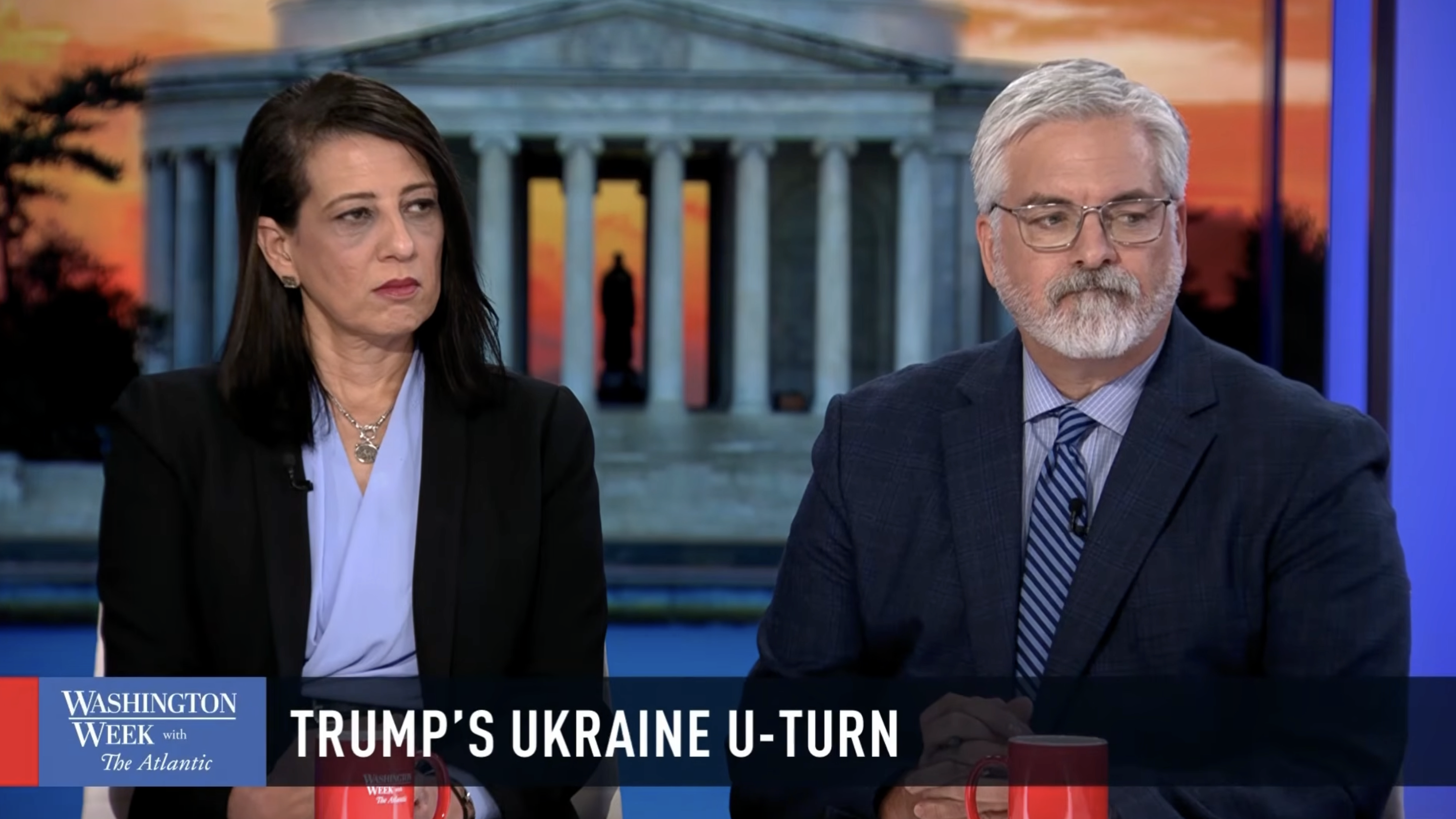
President Trump’s dismissal of Russian aggression against Ukraine has prompted bipartisan backlash. On Washington Week With The Atlantic, panelists joined to discuss what this may mean for the Ukrainians, and more.
“We have to remember that Ukraine has seen the United States pull back its support even before this,” Nancy A. Youssef, a staff writer at The Atlantic, said last night. In the past, the U.S. has limited the number of weapons it sends to Ukraine, and “this week, we saw the United States not delivering promised interceptors,” Youssef added.
“The challenge for Ukraine is twofold: It is the inconsistency in the United States’ support and the inability for Europe to come back and provide that support,” Youssef argued. “And that Russia is as close as it’s ever been to Washington.” These two factors make “the war harder for the Ukrainians,” she noted.
Joining the editor in chief of The Atlantic, Jeffrey Goldberg, to discuss this and more: Leigh Ann Caldwell, a chief Washington correspondent at Puck; Stephen Hayes, the editor and CEO of The Dispatch; Zolan Kanno-Youngs, a White House correspondent at The New York Times; and Youssef.
These days can pass miserable and empty. We need satisfaction; we need it early, and we find it, if we find it, in his steadfast love. No matter what our days contain, if they are contained within his love, we can be glad all our days. So many turn their vessel toward what they think... Continue Reading
The FCC should utilize its $9 billion 5G Fund to subsidize direct-to-device satellite service in areas where traditional cell tower construction is impractical.
The reality 40 years later is that Congress made the drug penalties permanent law, while drug treatment was left to be determined during annual budget fights.
Data centers are classed as part of the information technology sector, but the framework has not kept pace with their growing strategic importance and rapidly changing threat environment.
Guardian Europe columnists Rokhaya Diallo and Alexander Hurst answered your questions about the recent protests in France, the role of the French police, foreign influence and the upcoming presidential election.
Michael Wolfcarius asks: I cannot understand why the Guardian is selecting dots instead of joining them. France may have developed into the big story for many reasons, many of which have yet to be discussed, but it is not the only place where seemingly small incidents grew into massive protests, some also quite violent; Spain, Italy, Serbia and Albania come to mind. The crystallising reason may be different but the conditions leading up to it are quite similar. Can you put all these events into perspective, context and relation? There are obviously underlying currents making it difficult for people to refrain from making themselves ‘heard’.
Rokhaya: I agree that these movements deserve to be considered together, while at the same time, recognising their different specific national contexts. Housing in Spain, living costs and public services in Italy and France, and corruption in Serbia and Albania are bringing people onto the streets. These concerns touch the foundations of a decent life and people’s ability to shape their future.
What connects them, in my view, is the widening gap between what people need and what political institutions seem willing to deliver. These incidents that have led to protests are not “small .” Serbia’s movement began after a deadly railway-station canopy collapse, which became a focus for anger over corruption and accountability. My reading is that these protests express a crisis of political responsiveness.
Alexander: I think people in all these places – Albania, Spain, France – feel that the political systems that exist aren’t capable of dealing with the sheer scale and nature of the crises facing us, and they’re responding to a sense of ‘loss of control’ (the Brexit campaign really did strike upon a brilliant slogan) over where their societies are headed. There is a general social sense that has flipped from “this is broken, but things can and will get better”, which gives people a stake in the institutions around them, to “this is broken and things can and will get worse”.
The impact of the arrival of AI has been understated. Not just on labour markets, or on the environment, but ontologically. The investment pitch of the most powerful companies in the world, the ones amassing trillion dollar valuations, isn’t just that X-subset of jobs are replaceable, it’s that human beings themselves are replaceable. That the things we do fundamentally don’t matter, and that their goal is to bring this into being. I think that feeling is there even if we don’t immediately put our finger on it in those terms.
Research presented at the World Congress of Psychiatry in Stockholm documents a markedly elevated suicide rate after discharge from involuntary psychiatric admission. The research found a nearly 200 times higher suicide rate compared to the total population in the first month after discharge. The nationwide study covered a full decade of every involuntary admission in […]

 Login