❌

Reading view

Smartbird's CEO talks about converting a shoe company into an AI player

Smartbird CEO Nadia Carlsten
Smartbird CEO Nadia Carlsten at Business Insider's The Long Play.

Carl Timpone / BFA

  • Nadia Carlsten, CEO of Smartbird, spoke on the public company's shift from sneakers to AI.
  • When the AI pivot was announced, the company's stock skyrocketed. It has since come back down.
  • Carlsten said Smartbird has a different approach to AI infrastructure, focusing on customer needs.

Before Smartbird was powering large language models, it was making shoes.

The CEO of the AI infrastructure company, Nadia Carlsten, spoke about the transition with chief correspondent Ben Bergman on Thursday at Business Insider's The Long Play.

Its roots are the sustainable sneaker company Allbirds, which skyrocketed in the late 2010s. The shoes were particularly popular among the Silicon Valley crowd. Allbirds went public in 2021 before the market turned on many direct-to-consumer businesses. The stock quickly fell, and it sold to American Exchange Group in March for $39 million.

"The short answer is the shoe business wasn't doing that well," Carlsten said.

The company then sold off its footwear business and shed most of its workforce, rebranding as Smartbird. The AI pivot skyrocketed the stock and was briefly up 800%, though it has since come back down. Carlsten, who became CEO in June, said she had never worn those wool shoes.

"The goal of the company was to do something valuable and meaningful. And for me, I knew I wanted to do AI infrastructure," she said.

After looking at the emerging AI infrastructure sector, she believed with the company's transformation, it was the "right place at the right time" for her to join.

In the five months since she took over, Carlsten said the experience can be described in one word: exciting.

"Never in my life thought that I would be the CEO of a former shoe company and managing what is essentially a startup." Since taking on the role, she has focused on building out a new team, scouring new technologies for the company to look into, and producing a new pipeline of customers.

While the stock price has gone down since the initial pivot-induced spike, Carlsten does not regret taking on the challenge. She is betting on the company's long-term potential.
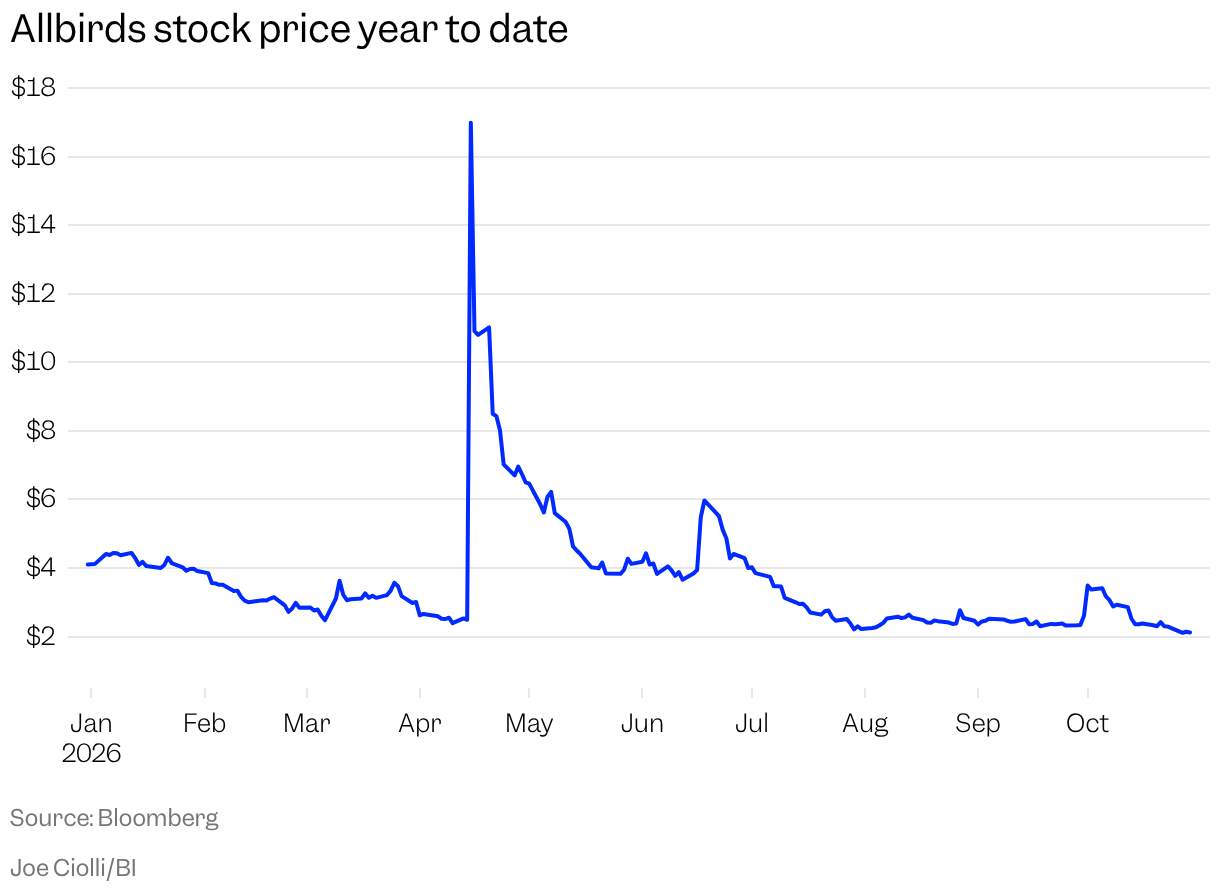
Line chart

"The stock market is going to do what the stock market does," she said. "What I care about is making sure that we're putting the company on the right path, and that we're able to build it quickly enough and well enough that we have a sustainable business that investors will love. So what happens in the short term? Not that important. What happens in the long term is very important."

When asked why the company decided to reinvent itself in the public eye instead of beginning as a private start-up, Carlsten countered with a question: "Why not?" she said, "It will come back up."

Having to reinvent the company from scratch can be challenging, and the public's presence is clear, she said. Yet, Carlsten said reinvention is inevitable for companies.

"This is a very public reinvention of the company, and people are watching," she said. "I think every company needs to reinvent itself every now and then."

When asked why the company is fully remote, Carlsten said most of the work at Smartbird is done virtually or at data centers, meaning an office would not be of much use.

"We spend a lot of time actually building things, which I actually love. So if my people are sitting in an office, something's wrong," she said.

Working within the emerging AI sector

Carlsten said that although her competitors are building similar AI infrastructure, the way Smartbird is going about it is unique.

"For us, it's about the right infrastructure for the right company at the right time," she said. "Our business model allows us to work more closely with customers, but it also is a lot less capital intensive."

Smartbird is looking to work with companies that have yet to explore implementing AI in their systems, she said. As more companies outside the tech realm look to adopt AI into their businesses, they have the choice to build infrastructure themselves or outsource it, and Smartbird wants to be the one to do it for them, she said.

"We'll do the infrastructure part. We'll let you focus on the actual business," she said.

The most common misconception Carlsten said she has encountered in the business is that it's all about GPUs. She said the company does a lot more than just run GPUs.

"It's really about having a holistic system that a customer can use to do AI," she said.

Another rumbling that's taken over the tech company discourse is whether there's an AI bubble and if it will pop. Carlsten said that depends on how people go about defining the bubble.

Excitement in the sector means funding might be going into companies that may not prosper in the future, but this is something that happens with the arrival of new technologies, she said.

"Every time there is a transformational technology, this happens," she said. "Even if we assume that there is a bubble, that doesn't mean that the technology is not good. It also doesn't mean that the adoption of the technology is going to go away."


Read the original article on Business Insider

  •  

South Pelion: Heavy rainfall and flash floods cause extensive destruction

Heavy rainfall and flash floods in South Pelion, Central Greece, on Wednesday evening caused extensive destruction in infrastructure, brought bridges and roads down, flooded homes and businesses and set human and animal lives at risk. Video: Flood in Platanias Several villages and settlements were cut off electricity and water and communications. Residents and business owners […]

The post South Pelion: Heavy rainfall and flash floods cause extensive destruction appeared first on Keep Talking Greece.

  •  

Delcy Rodríguez Announces Transformations, Labor Dialogue, and Reforms in Venezuela

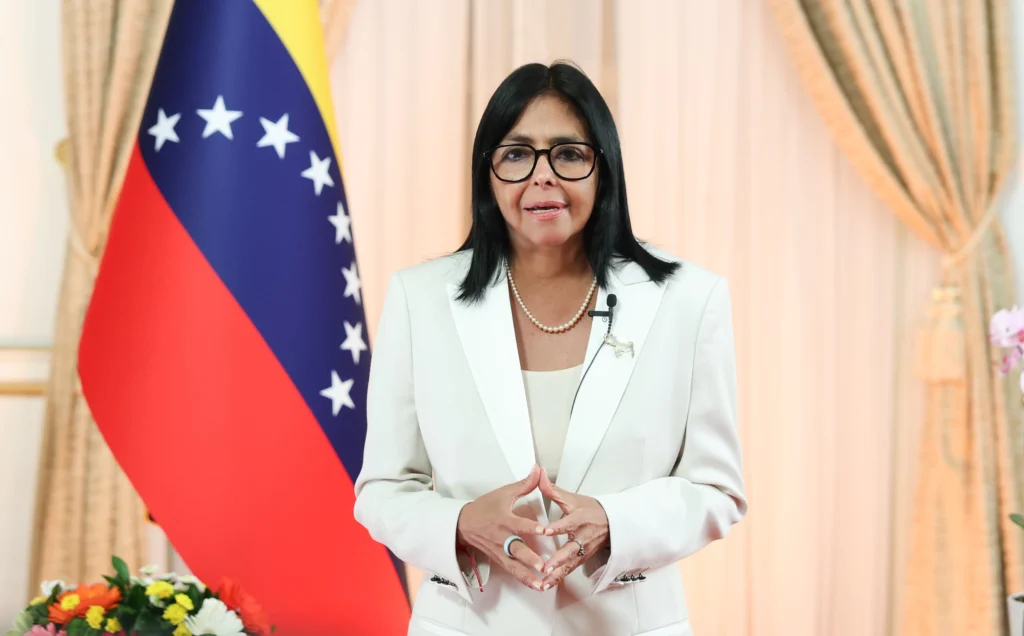
Venezuela’s acting president, Delcy Rodríguez, delivered a message to the nation. Photo: Presidential Press Office.

On Thursday, October 29, Delcy Rodríguez, acting president of the Bolivarian Republic of Venezuela, delivered an address to the nation in which she took stock of the transformative actions undertaken throughout the year across the political, economic, cultural, spiritual, and democratic spheres.

RELATED:

Venezuela’s Acting Pres. Delcy Rodríguez Meets 2015 Assembly Delegations

In her remarks, Rodríguez reviewed the executive branch’s performance, the management of public policies, and ongoing consultative processes aimed at addressing the country’s social demands.

During the address, she defended the Venezuelan government’s independence in defining its strategic policies. “The decisions regarding this transformation are made here, signed here, and announced here—before you. Sovereignty is not up for negotiation,” she asserted.

Rodríguez also addressed the complex situation the nation faced following the socioeconomic impact experienced over the course of the year, noting that the institutional response is focused on consolidating a recovery in production, strengthening public services, and improving the population’s living conditions.

A central theme of her address was the announcement of a national consultation aimed at driving a reform of the criminal justice system. “The goal is to build a more transparent and humane justice system one that leaves behind corruption, procedural delays, and the criminalization of poverty,” Rodríguez explained.

The text reads, “Venezuela has a clear path forward. We are advancing toward a democratic, economic, and social transformation—through judicial reforms, dialogue, and decisions that translate into tangible improvements in the quality of life for the Venezuelan people. I know there is still work to be done, but our commitment is firm: to correct what is wrong, protect what works, and build a country with opportunities for all. The rebirth of Venezuela is proven through actions!”

This initiative is part of an institutional transformation agenda presented by the executive branch, which includes strengthening the judicial system and developing mechanisms to expand guarantees for citizens. Within this framework, the government is engaged in a political dialogue with representatives of the National Assembly elected in 2015; the third round of these talks took place in October.

The agenda also covers political guarantees for upcoming electoral processes, the reform of the Supreme Tribunal of Justice, and the allocation of resources for socioeconomic relief following the earthquake.

In her address, Delcy Rodríguez also spoke directly to the nation’s youth and to Venezuelans living abroad. She maintained that the ongoing transformations aim to ensure that new generations “inherit functioning institutions rather than ruins.”

Regarding the return of migrants, she affirmed that the decision is voluntary and that those who choose to return will be treated with respect, provided with proper documentation, and offered employment opportunities. “We are building a country worth returning to,” the acting president stated.

Labor Dialogue Forum

Rodríguez also announced progress on a labor dialogue and consensus forum, designed to strengthen social justice and ensure the progressive improvement of income for the Venezuelan working class. This body functions as a tripartite consultative space, involving the country’s main trade union confederations, business chambers, and the national government.

In this context, she explained that four separate increases in worker income are planned for 2027. Furthermore, she stipulated that these increases can, under no circumstances, be lower than the economic growth recorded in the preceding quarter.

The president reiterated the national government’s commitment to addressing the demands of various social sectors in a timely manner, prioritizing family well-being, the restoration of essential public services, and direct support for communities.

The leader emphasized that economic stakeholders also have a platform to achieve concrete objectives that will drive a significant boost in production and foster sustainable economic growth. Through these initiatives, the government aims to translate productive growth into tangible improvements in the quality of life and purchasing power of the Venezuelan people.

Rodríguez’s message comes at a time of progress within the political dialogue forum, which has addressed political guarantees, judicial system reform, and the recovery of resources to support the country’s social and economic needs.

  •  

I went on my first international trip with a baby and toddler. It would've been a disaster without my in-laws.

Woman holding child's hand near plane
I have two kids under 3, and traveling internationally felt out of reach. One trip to Mexico with my in-laws and extended family totally changed the game.

Carmen Varner

  • Recently, I traveled with my husband, our two young children, my in-laws, and other family members.
  • Our international trip to Mexico felt more manageable and fun because we had so many people.
  • For now, I wouldn't travel internationally with my kids without my in-laws or extended family.

Some people don't get along with their in-laws, but I'm not one of them.

I lived with my in-laws for years from my mid-20s to early 30s. My husband and I still go to their house every week or two, and after we had kids, my mother-in-law has always stepped in, whether coming over to assist with bath time or to drop off food.

So, it's no surprise that traveling with them (and other members of our extended family) to Mexico was a no-brainer.

We've actually done it multiple times, but this latest trip was the first with both my two small children, who are 3 years old and almost 8 months old.

Looking back, this whole Mexico trip wouldn't have been feasible without my in-laws and extended family.

It was nice having a big group as we headed to Mexico for a few days

Adult walking on cobblestones with two children
The kids have enjoyed walking around with abuelito.

Carmen Varner

We traveled from San Diego to Querétaro, Mexico, with a whole crew in tow: me, my husband, our kids, my mother-in-law, father-in-law, sister-in-law, niece, nephew, and one of my husband's cousins.

Our big family trip was a four-day adventure, and the main purpose was to attend my husband's cousin's wedding. (It later turned into a five-day event thanks to a flight delay, but more on that later.)

Street sign in MExico
Our trip required several transfers.

Carmen Varner

We've done large family trips like this since 2019, so we have an intuitive groove, where everyone contributes in some way — looking up where to eat, figuring out what to see, or even getting coffee delivered to the hotel.

This time, we split up into three separate rooms at a hotel where most of the wedding guests were staying, but were located right across the hall from each other.

This arrangement made it easy for the kids to head to their grandparents' room for bath time or to hang out with the cousins while my husband and I got ready.

Having more people came in handy throughout the trip — and made it more fun

Cocktails on table
We had some drinks and a nice meal out with the family on our first night.

Carmen Varner

Not only was it extremely helpful to have more hands on deck, but it was genuinely fun traveling with a group spanning such a wide range of ages, from 8 months old to age 59.

There were various interests and dynamics at play, which also meant more excitement and more brainpower.

Cousins were funny and entertaining, which helped break the tension in stressful moments or squash the occasional toddler tantrum. I also appreciated that abuelita helped with diaper changes and baths, while abuelito helped carry or hold the kids whenever we were out and about.

Although our large crew mostly stayed together throughout the trip, we were also able to split up and do different things.

For instance, sometimes part of the family went out to the nearby market to explore, while others stayed in their room to nap or hang out.

At one point, most of our group went into the Centro Histórico in Santiago de Querétaro for churros while my husband and I put the kids to bed.

Kid on railing in suit
It's nice to have extra eyes on the kids.

Carmen Varner

Our big group's ability to divide and conquer especially came in handy when our travel plans were thrown off.

When our flight was delayed until the next day, we all went into action: My in-laws arranged a new hotel for us, my husband and sister-in-law booked transportation for a large group, and I called the travel-insurance agency to see what our options were. We all kept an eye on the kids.

It was nice to have multiple adults working to solve a problem, rather than the pressure falling solely on my husband and me.

The journey back home was much longer and more complex thanks to layovers, but again, being around family made it easier.

I could have my sister-in-law, who was in the aisle behind me, watch my toddler while I went to the airplane restroom and my husband helped the baby nap.

We couldn't have done this trip without our support system

Woman holding child's hand
Right now, I wouldn't want to travel internationally as a family without my in-laws.

Carmen Varner

I've done shorter, more local overnight expeditions with my children — I've even taken them on a work trip — but this was our first international journey with them.

My children are very young, with a close enough age gap that makes travel particularly difficult right now. However, going on this trip with in-laws and family made everything feel so much more manageable.

Any time I felt a bit tired or overwhelmed, there was someone there to make it easier. It was especially fantastic, considering how poorly the baby slept during the trip, which left my husband and me even more fatigued.

I'm so grateful my kids got to see a bit of their heritage in Mexico and have some new experiences. I can't wait to show the world to my children, especially since I couldn't travel outside of the country until I was 17.

However, I'd prefer to hold off on these international travel dreams for a couple of years when my kids are slightly older and don't require quite as many naps or diaper changes.

For now, multigenerational trips make the most sense for us — and my wonderful in-laws have changed the travel game.

Read the original article on Business Insider

  •  

Peltola’s Alaska Senate race controversy; final midterms forecast

Will former Rep. Mary Peltola (D) lose the Alaska Senate race after reports her campaign recruited “spoiler” candidates to interfere in the race against incumbent Sen. Dan Sullivan (R)? Plus, the hosts take a look at the final forecast before Tuesday’s high-stakes elections. Join The Hill’s senior vice president of editorial content, Bill Sammon, and Decision…

  •  

Alaska's governor orders a probe into Peltola's Senate campaign over spoiler candidate controversy

Republican Alaska Gov. Mike Dunleavy has ordered an investigation into the Democratic candidate running for the U.S. Senate in the state after revelations that her campaign appeared to be involved in recruiting another candidate with the same name as Republican incumbent Dan Sullivan.

  •  

Russian Strike on Ukrainian Train Station Kills 14

A deadly strike was a grim reminder that despite a rare local cease-fire around the Russian-occupied town of Oleshky, other communities remained under fire.

© Agence France-Presse, via Ukrainian Emergency Service

A photo released by the Ukrainian Emergency Service after an air attack on a railway station in Dnipro, Ukraine, on Thursday.
  •  

Angel Studios draws line in sand with Hollywood, bans sex scenes, profanity in bold new pledge

FIRST ON FOX — Angel Studios is drawing a line in the sand against Hollywood's approach to entertainment, announcing sweeping new content standards that ban on-screen sex, nudity and certain profanity while promising millions of paying members the power to decide which movies and television shows make the cut.

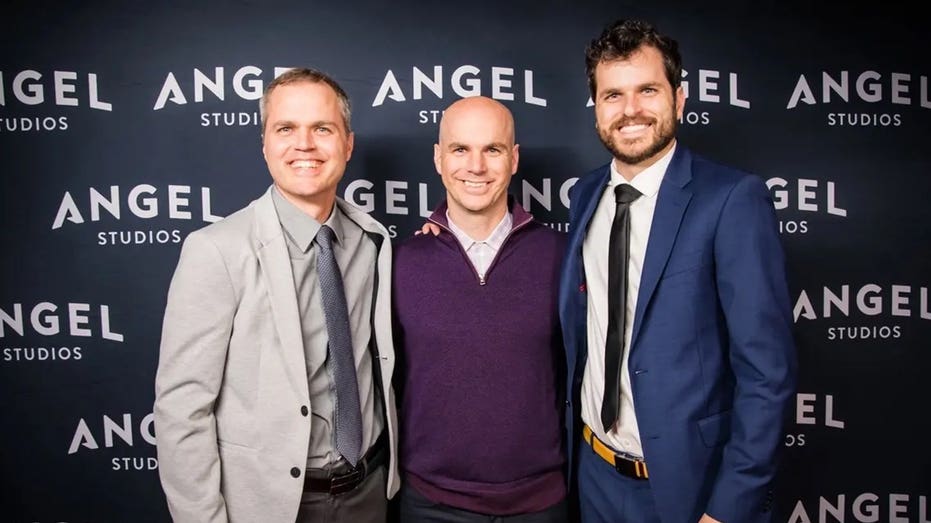
In an exclusive interview with Fox News Digital, Angel Studios co-founder and Chief Content Officer Jeff Harmon said the entertainment industry has increasingly lost touch with the families it once served, prompting his company to establish what it calls "The Angel Promise."

"I think Hollywood generally kind of lives in a bubble," Harmon said. "These are excellent craftsmen. They're the best storytellers in the world. Hollywood has built the best storytelling infrastructure in the world."

COMEDIAN LEANNE MORGAN CALLS OUT HOLLYWOOD FOR LIVING IN A 'BUBBLE' AND MISJUDGING WHAT AUDIENCES WANT TO SEE

"But at the same time, they've kind of drifted more and more away from the values-based audience that they used to serve," Harmon said. "And with that, in our view, as brothers and as fathers, as a father, Hollywood hasn't been giving me consistently what I need. Once in a while, you get a good one, but you have to sift through all these things to find your good movies and your good stories."

The new initiative, announced Thursday, establishes three core commitments governing Angel's entertainment offerings, namely, audience approval of content, strict standards involving sex and language, and expanded parental controls.

"We promise there's never going to be nudity, and there'll never be sex on screen," Harmon said, explaining that families participating in the Angel Guild will not have to worry about encountering such material when evaluating potential projects.

The company is also drawing a firm boundary around profanity, pledging that Angel's original productions will not misuse God's name.

NEW STUDY REVEALS THE SINGLE MOST CRITICAL FACTOR IN WHETHER CHILDREN KEEP THEIR FAITH INTO ADULTHOOD

"This is a completely unique one," Harmon said. "This has never really happened in Hollywood history."

Harmon described the restriction as part of the company's effort to build trust with religious families.

"What we promise our viewers is that this timeless principle that's thousands of years old, and we're a very faith-friendly studio, is that we're not going to have misuse of God's name on the system on any Angel original content," Harmon said. "So any content we create. Where we are originating, meaning it comes to Angel first, those shows, those TV shows and movies, will not have misuse of God's name, so that families of faith, 'cause we're a faith-friendly studio, can trust that language won't be there."

Under the new standards, the company also prohibits use of the F-word in its stories and profanity in titles submitted for children ages 12 and younger.

HOLLYWOOD PRODUCER BEHIND 'APOLLO 13' REJECTS POLITICS IN HIS MOVIES, SEEKS TO UNITE AUDIENCES

The announcement represents a significant effort to distinguish Angel from traditional Hollywood studios, with the company placing its audience at the center of decisions about what gets produced and distributed.

Harmon said the Angel Guild, which has approximately 3 million paying members, gives viewers an opportunity to approve or reject projects before they enter the company's entertainment ecosystem.

"This is the first time in history that a major Hollywood studio, or top 10 studio in the United States, has come and said, we're going to let the audience have a veto right," Harmon said.

Under Angel's stated policy, films and television series must receive a score of at least 70 out of 100 from Guild members to qualify for inclusion in its entertainment ecosystem.

Harmon said the founders' experiences raising children helped shape the new standards.

"Angel was co-founded by four brothers and a cousin," he said, adding that the founders have 34 children between them.

CREATING THE DEFINITIVE MOUNT RUSHMORE OF PIXAR MOVIES FROM A PARENTS' VIEWING PERSPECTIVE

The goal, he explained, was to create entertainment that parents could trust without having to sift through potentially objectionable content.

The third component of the Angel Promise focuses on parental controls. Angel says Guild members will help establish recommended age ratings and plain-language descriptions of potentially sensitive material, while new controls in the Angel app will allow parents to tailor viewing choices to their families.

Harmon said the broader ambition is to reshape the relationship between filmmakers and audiences.

"Our goal was to set out and try to fix this problem of kind of stepping out of the Hollywood bubble and stepping into middle America's shoes," he said.

The company says its Guild has paid out nearly $300 million to filmmakers, while Harmon said more than 100 films were available for members to vote on at the time of the interview.

CLICK HERE TO DOWNLOAD THE FOX NEWS APP

For Harmon, the new promise is about establishing permanent standards that will outlast any individual film, filmmaker or executive, and give families greater influence over the entertainment they consume.

Some of the studio's prominent recent films include "David" and "The King of Kings."

  •  

Spain Crash Investigators Focus on Train Traffic Controllers’ Role

After the country’s second major rail disaster in a year, Spaniards were confronting questions about the safety of their once-vaunted rail system.

© Pablo Blazquez Dominguez/Getty Images

Emergency workers were still searching for survivors and victims at the site of the crash on Thursday.
  •  

9h. Secretário-geral do PS critica postura de PSD e CDS

José Luís Carneiro denuncia que "destrataram e desconsiderarm" o PS e pede intervenção de Luís Montenegro. Ainda, presidente da ASPP admite que polícias estão solidários com protestos pela habitação

  •  

EU Divided Over New Membership Safeguards as Montenegro Becomes Test Case for Enlargement

Brussels is considering unprecedented restrictions on the rights of future EU members, including the possible suspension of voting rights for serious breaches of European values. France and the Netherlands favour stronger safeguards, while Italy and Austria warn that excessive conditions could undermine enlargement.

European Union governments have begun negotiations over proposals that would allow Brussels to impose additional restrictions on future member states, exposing divisions over how to prevent democratic backsliding without discouraging countries seeking accession.

The discussions, held among EU ambassadors on 28 October, concern draft safeguards proposed by the European Commission for inclusion in future accession treaties.

Montenegro, currently the most advanced candidate in the Western Balkans, is expected to become the first country subject to the proposed arrangements.

The measures would potentially allow the EU to suspend certain membership rights, including voting rights, during a transitional period lasting up to 15 years after accession.

However, the negotiations have revealed disagreement not only over the duration of the safeguards but also over the powers that should be granted to the Commission and the legal thresholds for intervention.

The controversy raises a broader question about the nature of EU membership: whether countries that have completed accession negotiations should immediately enjoy the same institutional rights as existing members.

France and the Netherlands seek stronger guarantees

According to Euronews’ reporting on the ambassadors’ discussions, France and the Netherlands have pressed for stronger guarantees that newly admitted states will continue respecting the rule of law and other EU obligations.

Their position reflects concern that the Union’s existing procedures have proved difficult to enforce against governments accused of undermining judicial independence or democratic institutions.

Article 7 of the Treaty on European Union already provides for sanctions, including suspension of certain membership rights, where a serious breach of European values is established.

However, the procedure involves demanding political and voting requirements.

The Commission’s proposed safeguards are intended to provide an additional instrument specifically applicable to newly admitted members.

They would operate during a defined period after accession and could be activated in response to serious breaches of EU values or the principle of sincere cooperation.

For governments supporting the proposal, the objective is to ensure that reforms undertaken during accession negotiations remain effective after membership has been secured.

Italy and Austria warn against excessive restrictions

Not all member states share this approach.

Italy and Austria, among countries supporting faster integration of the Western Balkans, have warned against imposing conditions that could make EU membership appear provisional or unequal.

Their concern is that candidate countries may face an increasingly complicated accession process even after meeting the formal requirements.

The credibility of EU enlargement depends partly on the proposition that successful reforms will eventually lead to full membership.

If new members are subjected to extensive additional restrictions, political leaders in candidate countries could find it more difficult to justify the domestic compromises required by accession negotiations.

The debate is particularly sensitive in the Western Balkans, where prolonged delays have already generated frustration over the pace of integration.

The challenge for Brussels is to strengthen safeguards without creating a permanent distinction between established and newly admitted members.

A proposed 15-year period

The Commission’s draft institutional safeguard would remain available for 15 years following accession.

This period is intended to permit intervention if a new member reverses reforms after joining the Union.

Yet ambassadors have questioned whether such an extended period can reasonably be described as temporary.

The proposed decision-making mechanism has also attracted criticism.

Under the draft, the Commission could propose restrictive measures that would take effect unless a qualified majority of member states rejected or amended them within two weeks.

This would reverse the usual political dynamic by requiring governments to assemble a blocking majority rather than actively secure support for sanctions.

The proposal could therefore make intervention easier than under the existing Article 7 mechanism.

Critics are concerned that the arrangement would give the Commission excessive influence over the institutional rights of newly admitted countries.

Supporters argue that a more effective enforcement mechanism is necessary precisely because existing procedures have proved difficult to use.

Monitoring could begin before accession

The proposed safeguards are not confined to the period following membership.

The Commission also wants stronger monitoring between the signing of an accession treaty and the date on which a country formally joins.

This period can last several years, during which a candidate government may change and reform commitments may weaken.

Under the draft arrangements, monitoring could include regular assessments, reviews involving existing member states and formal warnings.

As a last resort, accession could be postponed if there were clear evidence that a candidate would not meet the required conditions.

The voting procedure for such a postponement remains unresolved.

These provisions would add another stage of oversight to an accession process that already requires extensive negotiations and the implementation of EU legislation.

Montenegro faces a new uncertainty

Montenegro began accession negotiations in June 2012.

According to the European Commission’s enlargement records, all 33 screened negotiating chapters have been opened and 16 provisionally closed.

Its progress has made the country a leading candidate for the next round of enlargement.

However, its accession treaty may now become the vehicle through which the EU establishes a new framework for future entrants.

The implications extend beyond Montenegro.

Albania, Moldova and Ukraine are also pursuing accession, although they are at different stages of the process.

Any safeguards introduced for Montenegro could influence the terms eventually offered to those countries.

Enlargement becomes a test of EU governance

The Commission’s proposals reflect a wider debate over whether the EU’s institutions can function effectively with substantially more members.

New entrants would participate in decisions concerning the budget, sanctions, foreign policy and the internal market.

Their admission could also affect areas where unanimity remains necessary, potentially increasing the risk of institutional deadlock.

The European Parliament’s research service has identified the proposed safeguards as part of a broader programme addressing decision-making and governance ahead of enlargement.

Negotiations over the draft clauses will continue at the technical level, with ambassadors expected to revisit the matter in November.

The central disagreement remains unresolved.

The EU wants future members to maintain democratic and legal standards, but it must also decide whether those guarantees can be enforced without creating a separate class of membership.

Montenegro’s accession negotiations will provide the first practical test of that approach.

  •  

Is There a ‘Safest Seat’ in a Train Crash? Experts Say It’s Not So Simple.

After a high-speed collision near Toledo, Spain, killed at least 68 people, rail safety experts said the rough consensus that it is best to sit in the middle of a train has its limits.

© Oscar Del Pozo/Agence France-Presse — Getty Images

Emergency workers at the scene of a crash involving two trains near Toledo, Spain, on Wednesday.
  •  
❌