❌

Reading view

Lagarde’s Early Departure Opens Battle for Control of Europe’s Central Bank

Christine Lagarde’s unexpected decision to leave the European Central Bank nine months ahead of schedule has triggered a politically sensitive succession process at a time when renewed inflation, rising borrowing costs and economic uncertainty are testing the eurozone’s monetary institutions.

Christine Lagarde will step down as president of the European Central Bank (ECB) on 7th February 2027, bringing her tenure to an early conclusion and opening negotiations among European Union governments over one of the continent’s most influential economic appointments.

The announcement, made by the ECB on 29th October, came on the same day that its Governing Council decided to leave interest rates unchanged, despite renewed inflationary pressure linked to rising energy prices.

Lagarde, who has led the institution since November 2019, was originally expected to remain in office until October 2027. Her departure will therefore bring forward a succession contest that had already attracted considerable attention in European financial and political circles.

Speaking after the announcement, Lagarde explained that she wanted greater freedom to address matters beyond monetary policy, arguing that the restrictions associated with central bank leadership prevented her from contributing publicly to wider debates.

Her explanation leaves open questions about the political consequences of her departure, particularly as EU governments prepare for difficult negotiations over the institution’s future leadership.

A Succession Shaped by European Politics

Under Article 283 of the Treaty on the Functioning of the European Union, the ECB president is appointed by the European Council, acting by qualified majority following consultations with the European Parliament and the ECB’s Governing Council.

Although the process is formally governed by treaty provisions, appointments to the ECB’s Executive Board have historically involved negotiations among the eurozone’s largest economies.

Two former national central bank governors have emerged as prominent potential successors: Klaas Knot of the Netherlands and Pablo Hernández de Cos of Spain.

Both have substantial experience in monetary policy, although their possible candidacies remain subject to the political calculations of EU governments.

The timing is especially significant for France, which faces a presidential election in April 2027 against a background of domestic political instability and mounting concerns about public finances.

An appointment concluded before that election would be negotiated by the existing European leadership, potentially affecting the balance of influence over one of the eurozone’s principal institutions.

However, Lagarde has not publicly identified the French election as the reason for her departure.

The succession process will also coincide with other changes to the ECB’s Executive Board, increasing the importance of negotiations over the geographical and institutional balance of its leadership.

Inflation Returns to the Foreground

The leadership announcement coincided with a difficult monetary policy decision. On 29th October, the ECB maintained its deposit facility rate at 2.5 per cent, leaving the main refinancing and marginal lending rates at 2.65 and 2.90 per cent respectively.

Eurozone inflation reached 3.8 per cent in September, substantially above the ECB’s medium-term target of 2 per cent. Rising energy prices have complicated the institution’s position. Higher gas and oil costs threaten to increase consumer prices while simultaneously weakening industrial output and household purchasing power.

The ECB acknowledged that the energy shock could produce further inflationary pressures and reduce growth.

At the same time, tighter financial conditions across the eurozone have increased the risks associated with additional monetary tightening.

This leaves policymakers confronting a familiar but difficult problem: raising interest rates may restrain inflation, but it can also deepen economic weakness and increase borrowing costs for governments, businesses and households.

The next president will inherit these competing pressures rather than a settled monetary environment.

France Adds Another Complication

Financial developments in France have added urgency to the debate.

French government bond yields have risen sharply, with ten-year borrowing costs reaching levels not seen since 2002.

This reflects market concerns about the country’s fiscal position and political uncertainty, while raising wider questions about financial stability within the eurozone.

For the ECB, the challenge is particularly delicate.

Its mandate requires monetary policy to be directed towards price stability across the currency union. However, the economic consequences of higher interest rates differ considerably between member states.

Countries with elevated public debt face greater pressure from rising financing costs, while economies exposed to higher energy prices may experience weaker investment and industrial production.

The ECB possesses instruments intended to address disorderly financial-market conditions, but these do not eliminate the underlying fiscal and political differences between eurozone members.

The appointment of Lagarde’s successor will therefore take place against a backdrop of renewed debate about the relationship between monetary independence and national economic interests.

An Institution Facing a Different Europe

Lagarde’s presidency began before the pandemic, Russia’s full-scale invasion of Ukraine and the subsequent European energy crisis.

During her tenure, the ECB navigated emergency monetary interventions, unusually high inflation and substantial changes in interest rates.

Her successor will confront a different combination of challenges: renewed geopolitical disruption, economic competition with the United States and China, and growing demands for European investment in defence and industrial development.

These priorities are primarily the responsibility of governments, but they influence the economic conditions in which the central bank operates.

The immediate question is who will replace Lagarde. The more consequential question is how the next ECB president will manage monetary policy in a eurozone whose economic and political divisions are becoming increasingly difficult to separate.

For EU leaders, the succession is an opportunity to determine the institution’s leadership. For the ECB, it will be another test of its ability to maintain monetary independence while managing the consequences of Europe’s changing political economy.

The ECB faces an ugly choice as eurozone inflation hits 3.8pc

  •  

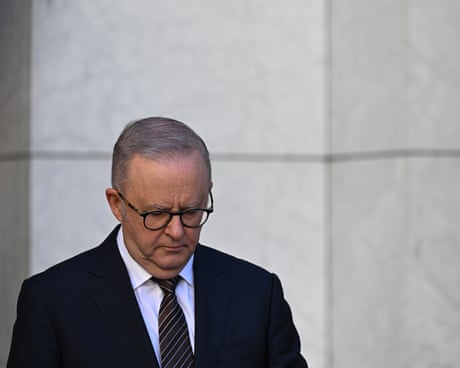
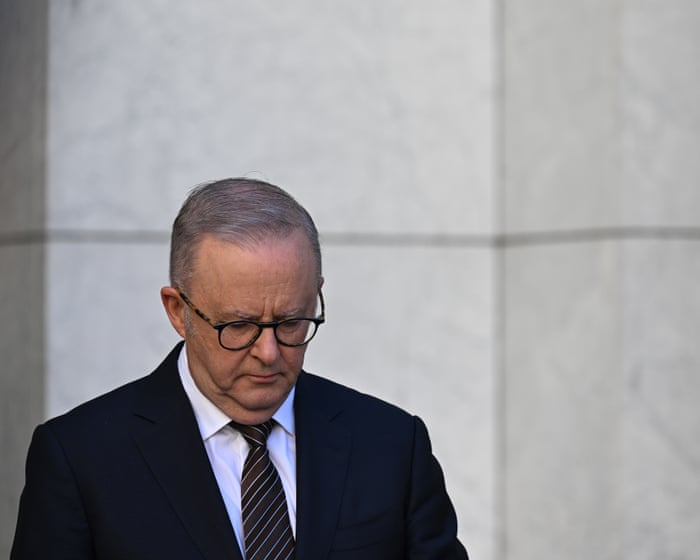
Albanese concedes savings needed as he faces internal Labor pressure on cost-of-living crisis

Prime minister vows not to slash health and education funding amid political problem over handling of economy

Anthony Albanese has ruled out major cuts to health, education and essential services in December’s mid-year budget update, but conceded savings are required as Labor struggles to curb accelerating inflation.

Amid growing pressure from within Labor’s own ranks, as well as from the opposition and business, Albanese said the Coalition was hypocritical in not supporting existing savings proposals, including the government’s plan to reduce the private health insurance rebate for people over 65.

Continue reading...

© Photograph: Lukas Coch/AAP

© Photograph: Lukas Coch/AAP

© Photograph: Lukas Coch/AAP

  •  

‘A pretty grim picture’: outlook for UK living standards slashed despite Healey’s budget

OBR cautions about Middle East war dragging down growth and triggering a fresh cost of living crisis

British households face a “pretty grim picture” for living standards as the war in the Middle East drags down growth and triggers a fresh cost of living crisis, the government’s independent forecaster has said.

In a report as John Healey announced his first budget, the Office for Budget Responsibility (OBR) issued a sharp downgrade for growth in 2027, household disposable incomes and the public finances despite the measures taken by the chancellor.

Continue reading...

© Photograph: Vuk Valcic/SOPA Images/Shutterstock

© Photograph: Vuk Valcic/SOPA Images/Shutterstock

© Photograph: Vuk Valcic/SOPA Images/Shutterstock

  •  

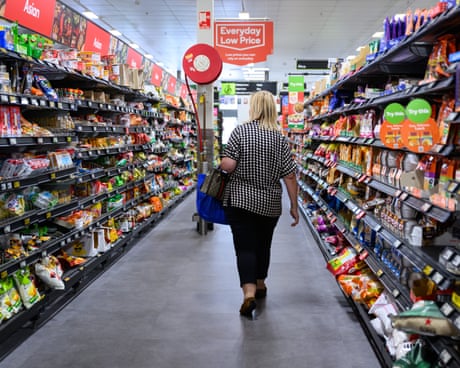
Australia’s inflation rate rises to 4.3%, fuelling fears of fifth interest rate hike this year

CPI release comes ahead of Reserve Bank decision next week as the Middle East conflict intensifies the cost-of-living crisis

Australia’s headline inflation rate has accelerated to 4.3%, with a key gauge that strips out volatile prices also elevated, sharpening expectations of another interest rate rise next week.

The Reserve Bank of Australia’s preferred measure of consumer prices, called underlying inflation, came in at an annual 3.6% to September.

Continue reading...

© Photograph: James Gourley/Getty Images

© Photograph: James Gourley/Getty Images

© Photograph: James Gourley/Getty Images

  •  

Toys are facing their biggest price spike in years. Mom-and-pop toy stores tell us how they're getting by.

Terra Toys, a toy store in Austin.

Sylvia Edwards

  • Toy prices have gone up 8.3% since February due to tariffs, geopolitics, and supply chain issues.
  • Local mom-and-pop toy stores across the US spoke to the rise and its impact on their businesses.
  • Legacy toymakers also grapple with the impacts, looking toward tariff refunds.

Toy prices are rising fast across the country— and local toy stores are struggling to play along.

At Clever Monsters, a toy store in NYC, co-owner Daniel Orlov said he has to recalculate prices order by order, at times cutting into his own profits to keep them at a reasonable level for his customers. Sometimes, he knows before putting some toys on the shelves that he won't make anything off them.

The struggle results from higher shipping fees, tariffs, and customs charges and reflects a broader inflationary moment in the economy.

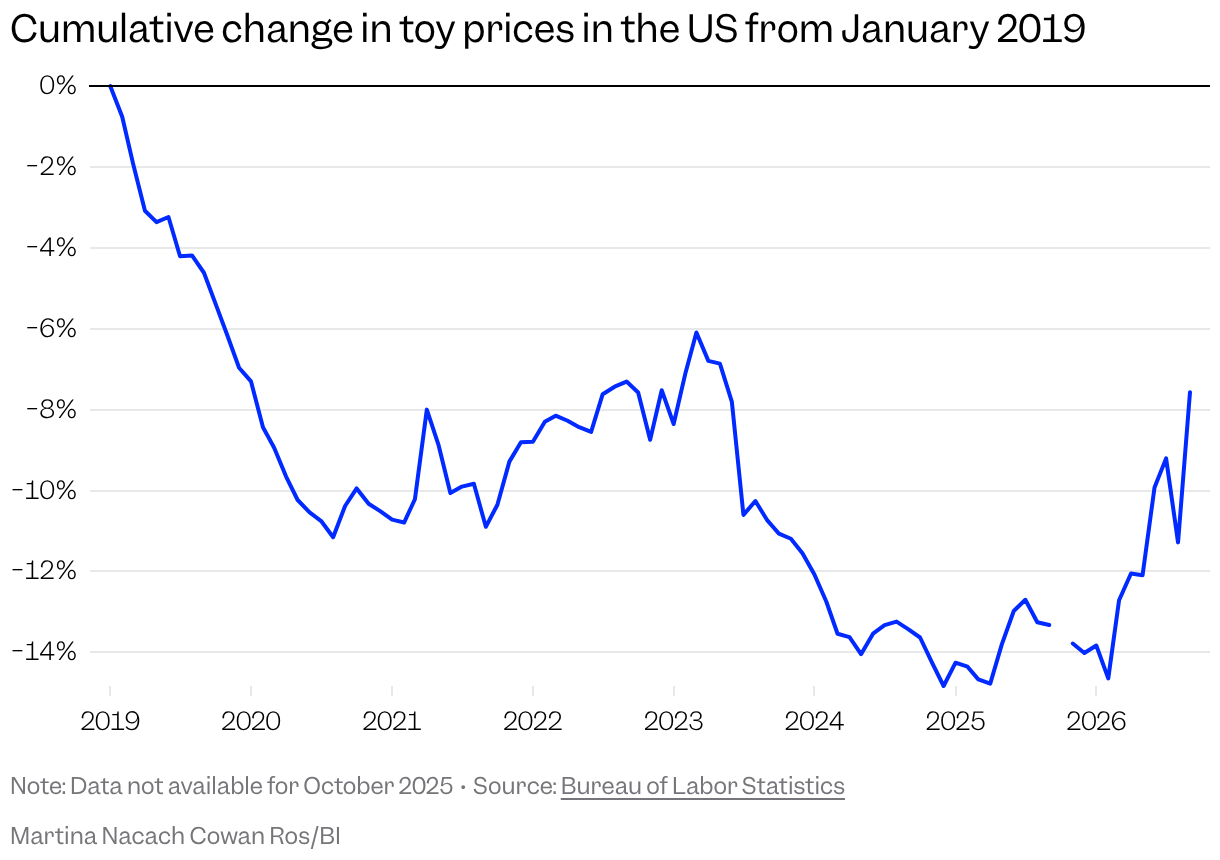
Toys have historically gotten less expensive over time, but have seen a spike in prices this year, rising 8.3% in the US between February and September. Year-over-year, toy prices were up 6.6% in September, the highest annualized growth rate since 1988.

This graph shows toy prices in the US from January 2019 to September 2026.

Orlov said smaller toy stores like his could be particularly affected by these sharp price spikes. "It especially hurts for small businesses like us because we don't really have a pocket; we had to open up credit lines and take loans — bigger companies have a little pocket of collateral that they can use for a bit."

Tariffs, fuel prices, and supply chain woes

Big geopolitical swings are one factor putting pressure on toy sellers. President Donald Trump's on-again, off-again tariffs have added extra costs, and smaller retailers don't have the financial flexibility to wait for refunds like those from the Supreme Court's invalidation of the "Liberation Day" levies. Meanwhile, the ongoing war in Iran has driven up fuel prices and shipping costs for all manner of goods.

Small toy stores, confronting those problems, are facing smaller profit margins.

Helen Dean, owner and operator of Toy Safari in California for 34 years, said her usual 7 to 8% profit margin has fallen to around 5% in the past year. She cut into her own salary and skipped on hiring the two or three college students she brings on during vacation season to cut costs.

"It was summer by the time I started to see that I was going to have to pay more for the items, and that it was going to come out of my bottom line," Dean said. "For a long time, mass market has gotten favorable pricing from major toy companies, and this problem has only been exacerbated by the tariffs and fuel prices and supply chain issues; everywhere we lose."

It's not just specialty mom-and-pop stores; toymaking giants are also dealing with the tariff back-and-forth and broader inflationary issues. An AlphaSense analysis of company filings and earnings transcripts over the last six months found that legacy toymakers such as Hasbro and Mattel have alluded to cost inflation caused by "tariffs, oil-linked resin and freight, packaging, labor," while also discussing the impact of tariff refunds. However, those large toymakers haven't disclosed any major increases in toy prices over that period.

Hasbro's Q2 earnings report highlighted an $8 million adjusted operating loss in consumer products — its physical toy sector — due to "incremental tariff expense, entertainment-related mix shifts, and normal seasonality." Yet its Q3 earnings report highlighted $55 million in relief from tariff refunds; $48 million of this was attributed to the core toy sector.

The Q3 report also noted that tariffs could "increase our product costs and other costs of doing business, result in higher prices of our products, impact consumer spending," and hurt business revenue.

Mattel's gross margin is still under pressure due to tariffs and inflation. The toy company has also received about $90 million in tariff refunds, said Paul Ruh, Mattel's former chief financial officer, at a conference in September.

Scalpers, TikTok and squishy NeeDohs

High operating costs are not the only thing changing the toy market. First, more adults are participating in "Kidulting," said Jay Berino, store manager at the Lowry Town Center Timbuk Toys in Denver, meaning toys are being bought by older demographics who buy into nostalgia.

"As much as we're a toy store and people hear toy store and think of kids, we sell to a lot to full-blown adults, and that drives a huge chunk of our business," he said. At the same time, viral toys such as NeeDohs, which are sensory fidget and stress-relief toys, have helped bring more people into stores.

Sylvia Edwards, co-owner and CEO of Terra Toys in Austin, said that scalpers try to buy up stock from toy shops to resell it at higher prices — fueling the perception of product scarcity and price gouging.

"We're in a crisis where there's way more demand than there is product available, and so when that happens, people will naturally get greedy and increase the price," Edwards said. To manage the issue, stores like Terra Toys limit bulk purchases.

Daniel Orlov, co-owner of Clever Monsters in New York City.
Daniel Orlov, co-owner of Clever Monsters toy store in Brooklyn, New York City.

Daniel Orlov

Orlov from Clever Monsters in NYC said they have also placed a limit on scalpers. "I'm only limiting it because this is the kids' store, and the kids are really excited to get that stuff," he said.

The virality of products such as NeeDohs on TikTok and other platforms helps these stores boost demand at a time when the high cost of living means buyers are not looking to spend much on other classic toys. Parents and kids are willing to spend on hyped products — but for much else, they keep their wallets shut.

"Honestly, the trends have been really saving us in that it drives not just sales, but just foot traffic through the store," Orlov said. "The only thing we can do is just stay on the trends, on what people want, make sure customers are happy, build up relationships with our customers, and sort of have a little monopoly on our area on parents who think toys — 'Oh, we gotta come to Clever Monsters. That's just where you go.'"

Read the original article on Business Insider
  •  
❌