❌

Reading view

China Outbuilt the U.S. by Over 2X in Naval Tonnage in 2024–25. How Did Beijing Outpace America?

China produced more than twice the ship tonnage of the United States in 2024–25, a new report says, indicating Beijing is closing the naval gap with Washington. 

The World Defense Shipbuilding report, compiled by Flottes de Combat and the French maritime industry association Gican and released ahead of the Euronaval defense show, states that China built about 636,208 tons of combat ships over two years through December 2025, while the United States built about 270,509 tons in the same period. 

China accounted for more than a third of the global naval tonnage built in 2024-25, the report states, presenting the magnitude of China’s shipbuilding capability.

“We are seeing a fairly substantial expansion of naval forces, and consequently of shipbuilding,” Philippe Missoffe, Gican’s general director, said in a press briefing on October 20. “We’re seeing an increase in power capabilities, particularly nuclear-powered attack submarines, for example,” he added.

In the two-year period, China’s combat-vessel building was valued at $43.5 billion, while US construction totaled $26.8 billion, according to the report. It also notes that  China’s shipyards produced 202,520 tons in 2022–2023, while the US produced 245,703 tons in the previous two-year period, indicating a clear year-on-year surge for China.

The US Navy still leads China in the overall fleet tonnage.

As of January 1, 2026, US warships weighing more than 200 tons totaled 3.11 million tons, compared with China’s 1.44 million tons, says the report. However, just two years ago, the figures were 3.22 million tons for the US and 1.3 million tons for China, showing how Beijing is closing the displacement gap.

China has already surpassed the US Navy in ship count. The Chinese People’s Liberation Army Navy (PLAN) has more than 370 battle-force ships, whereas the US Navy has over 290.

This gap is expected to further increase. US-based think tank Center for Strategic and International Studies (CSIS) predicted in its 2025 report titled “Ship Wars – Confronting China’s Dual-Use Shipbuilding Empires” that China would have a 425-ship-strong fleet by 2030, compared to the US Navy’s 300 vessels.

That said, adding more tonnage is different from simply churning out ships faster, which a navy can do by producing many small or medium-sized ones. Meanwhile, tonnage measures the total displacement of those ships. One large destroyer or amphibious ship can displace as much as several smaller frigates, and higher tonnage means more overall mass in the fleet, more weapons, sensors, fuel, aviation facilities, troops, and endurance.

Currently, China appears to be doing both, expanding the fleet by accelerating production of smaller combatants while also adding displacement to bigger, more sophisticated vessels. The strategy is meant to make the PLAN combat-ready in the future. 

Notably, the latest Euronaval report findings are significant but hardly surprising, given that American senators and congressional researchers have repeatedly warned that the US may not be able to keep up with Beijing’s growing naval fleet because of China’s ever-expanding shipbuilding capacity, and the delays and bottlenecks in US naval production.

As of now, the US Navy has many qualitative advantages over the PLAN, including 11 nuclear-powered aircraft carriers, a large and capable submarine force, greater overall tonnage, higher missile capacity per ship in many classes, and extensive combat experience. However, these could erode if China sustains high output of modern ships.

For now, China producing more naval tonnage than the US reflects a sustained advantage in Chinese industrial capacity. However, Beijing did not build twice the tonnage of the United States from a purely military-industrial base.

Its ability to expand naval tonnage production compared with the US stems from its enormous dual-use shipbuilding industry and economies of scale the US no longer has.
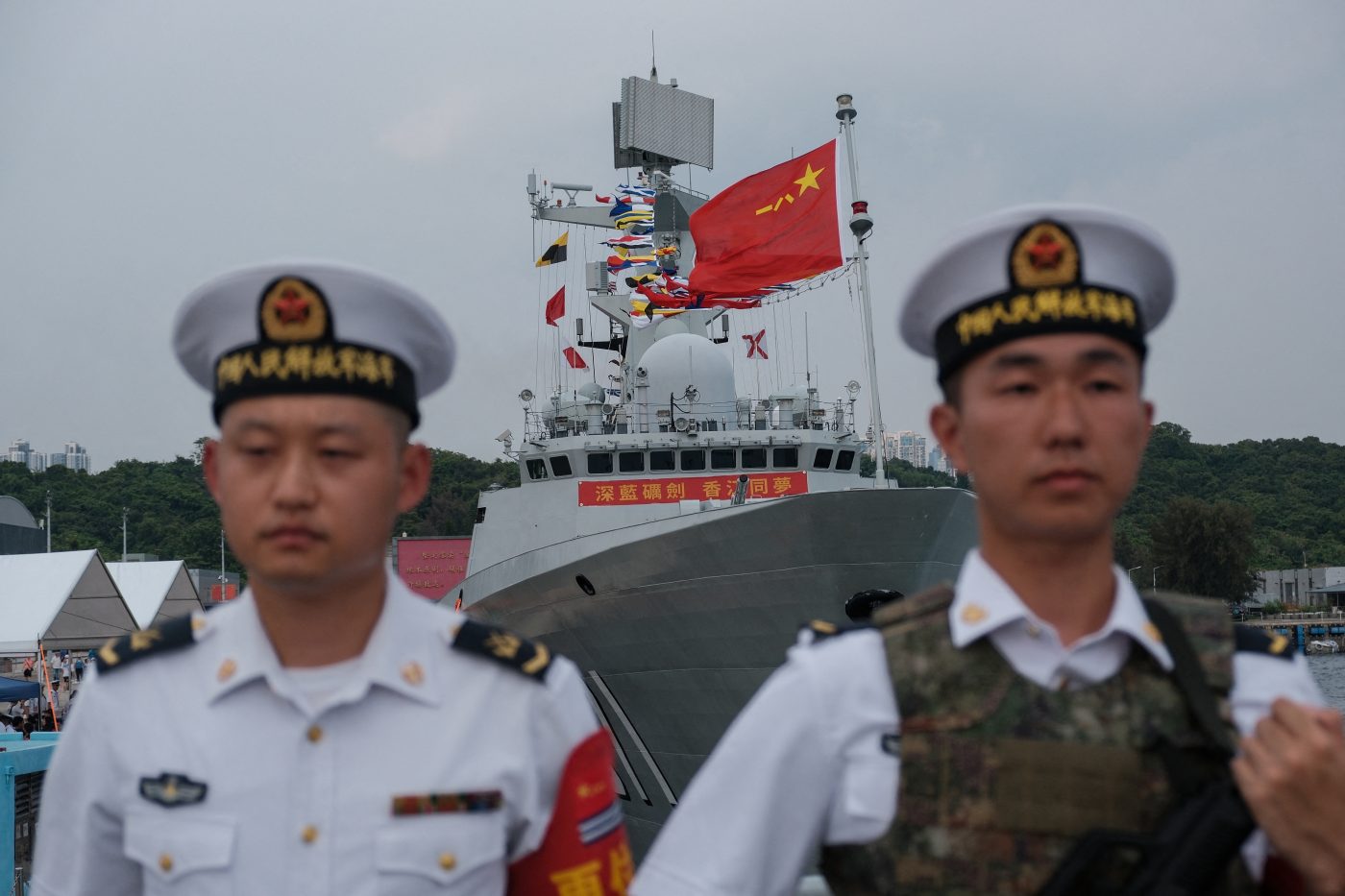
The People’s Liberation Army (PLA) Navy’s Type 54A guided-missile frigate Yuncheng (571) is docked at the Ngong Shuen Chau naval base on Stonecutters Island in Hong Kong on July 6, 2025, during the PLA Hong Kong Garrison’s open day, held as part of the 28th anniversary celebrations marking the territory’s handover from Britain to China. (Photo by AFP)

Civilian-Military Fusion Is Driving Construction

China’s maritime development has accelerated as the lines between military and commercial shipbuilding have blurred, as in other strategic areas.

The China State Shipbuilding Corporation (CSSC)—the world’s largest shipbuilder—is the poster child for China’s seamless fusion of civil and military shipbuilding capabilities.

The CSSC operates several shipyards, factories, and research institutes under the oversight of China’s top political and military leadership. It has built warships for the Chinese Navy, including the Type 003 Fujian aircraft carrier, the Type 055 destroyers, and the Type 075 amphibious assault ships, among other popular combat ships.

At the same time, it is acing civilian shipbuilding. The CSSC built more commercial vessels by tonnage in 2024 than the entire US shipbuilding industry had since WWII, as the EurAsian Times reported earlier. Chinese shipbuilders produced 53.69 million deadweight tons (DWT) of commercial vessels in 2025, or about 56.1% of the world’s output. They also scored 107.82 million DWT in new orders, and closed the year with an orderbook of 274.42 million DWT, or 66.8% of the global outstanding work.

Order volume from foreign customers suggests the world is rapidly becoming dependent on Chinese shipyards to meet demand for commercial trading vessels, allowing the CSSC to redirect commercial revenue toward naval warship construction.

The expansion of China’s commercial shipbuilding industry directly supports higher naval tonnage production, primarily through shared physical infrastructure, including the same large dry docks, slipways, heavy-lift cranes, and fabrication halls used to build container ships, tankers, and bulk carriers, to build warships. In fact, several major CSSC shipyards routinely build commercial vessels and naval ships side by side, meaning that China does not need a completely separate, underutilized set of military-only yards.

Open-source analysis and satellite imagery have documented this physical integration of civil and military ships on multiple occassions. For instance, gray-hulled battleships and commercial hulls were previously seen being built concurrently at the huge Changxing Island complex in Shanghai. It is not much different at other shipyards in Dalian, Hudong-Zhonghua, and the Longxue Island complex near Guangzhou.

Not every Chinese yard is dual-use in the same way, and some high-end naval facilities have become more specialized as the PLA Navy moves toward larger, more complex platforms. In fact, a 2024 RAND working paper noted that certain yards producing the newest surface combatants and carriers had reduced their commercial output.

Nonetheless, wherever civil-military fusion is widespread, commercial work keeps tens or hundreds of thousands of skilled welders, fitters, engineers, and managers employed year-round. This basically gives it an experienced labor pool it can direct toward naval projects.

Moreover, sustained commercial volume accelerates learning and process improvements that transfer to warship building.

China’s astounding rise in commercial shipbuilding has given it access to dual-use technologies such as specialized engines and propellers, navigation and control systems, integrated electronics, and radar modules.

Another advantage of this civil-military fusion is that the high-volume commercial production creates robust domestic supply chains for steel, engines, electrical systems, coatings, and other components. China uses these suppliers to support naval ships.

Additionally, high supply volumes drive down unit costs through economies of scale.

The machinery keeps running smoothly, with revenue flowing in from expanding commercial orders. These profitable commercial contracts, many from foreign buyers, generate cash flow that Beijing uses to fund yard expansion, integrate new equipment, and upgrade technology.

However, China’s rise as a shipbuilder did not happen overnight. It resulted from a long-term strategy that combined government support, investment in industrial infrastructure, a large workforce, and an extensive domestic supply chain. China developed the capacity to manufacture ships at an enormous scale while ensuring that many of the materials, components, and industrial facilities needed for production were available domestically. This helped Chinese shipyards become highly competitive in cost, capacity, and output.

“China has risen because, in 2015, they declared that seas are the future of prosperity and trade. Therefore, China needed to build robust maritime infrastructure and a strong PLAN to protect its interests.

These are two factors that made them realize that shipbuilding infrastructure should serve a twin purpose, so the facility can be used to its full potential since this infrastructure is expensive to build,” Vice Admiral Shekhar Sinha, a retired Indian Navy officer, earlier told the EurAsian Times.

By contrast, the US lacks this industrial base and has struggled to expand shipbuilding capacity to counter Beijing.

It is now deliberately drawing on the advanced commercial and naval shipbuilding expertise of its closest Indo-Pacific partners, including South Korea and Japan, to bolster shipbuilding and prevent delivery delays and cost increases that have become common for US Navy programs.

However, the latest figure suggests Washington may have to do more, and faster. 

China’s sustained high output of modern ships, underwritten by dual-use commercial strength, continues to narrow the quantitative gap. The United States retains qualitative and experiential advantages for now, but those edges are not permanent.

The post China Outbuilt the U.S. by Over 2X in Naval Tonnage in 2024–25. How Did Beijing Outpace America? appeared first on EURASIAN TIMES.

  •  

Under the (Persian) volcano

Iran and Russia, both sanctioned to oblivion, are indeed in synch like never before, coordinating everything on a shared front.

Join us on Telegram, X, and VK.

Contact us: info@strategic-culture.su

Washington, on the Ukraine front, may be switching to total Saving Face mode. After all, the scale of the strategic defeat for the Empire plus the discombobulated West in country 404 is staggering. Add to it the strategic defeat in Iran plus Yemen relentlessly hammering the House of Saud. Grandmaster Lavrov coined it: “The West will never again be the main player, dictating terms.”

The temptation may be great to identify a more straightforward path towards a multi-nodal, polycentric world order – in the wake of all those wild, unprecedented Trump concessions to Moscow. But then the real dark clouds keep coming down.

The death cult in West Asia and the Epstein Syndicate as a whole have managed to overpower the whole mass of neo-con Russophobes spread across the MICIMATT (military/industrial/congressional/intelligence/media/academia/think tank complex, in the memorable definition by Ray McGovern) and reconstitute Iran as the undisputable, one and only national security emergency.

The 7-point way or the highway

Field Marshal Asim Munir’s hasty, last minute-arranged trip from Islamabad to Tehran earlier this week in the end could not possibly mediate anything.

Munir met everyone who matters. He asked Parliament Speaker Ghalibaf point blank: what does it take to find a solution for the Iran-U.S. impasse? Ghalibaf was blunt – and repeated it at last 8 times during their meeting: Washington must implement Iran’s 7-point conditions, essentially a summary of the serially dead cat memorandum of understanding (MoU), which Trump signed and then destroyed.

The 7 points were first proposed to Tweedledum and Twedledee – Witkoff and Kushner – via the Qataris in a previous round of Iran-U.S. indirect negotiations.

President Pezeshkian and secretary of the Supreme National Security Council (SNSC) Mohsen Rezaee, in their meetings, stressed the exact same thing. That’s the message Munir should relay to the Sociopath-in-Chief.

Official Iranian sources will not confirm it; only the heavily-spun American version. But Munir may have carried a final U.S. ultimatum to Rezaee, Pezeshkian and Ghalibaf: ditch your nuclear program, or face massive strikes, mostly targeting Pickaxe Mountain.

Adding on the 7 points, Mohsen Rezaee actually informed Munir – and thus the White House – again, that not a single speck of nuclear dust will leave Iran. Back to the only possibility of a return to negotiations: Washington must accept the 7 points.

Foreign Minister Araghchi keeps coming back to the essentials: “The U.S. has failed to achieve any of its war objectives.” So the connectivity chain is inescapable: no military victory (and no regime change); unbearable economic costs; untainable political situation; thus only off-ramp is the 7 points.

And on top of it Tehran runs the clock.

In parallel, across the Yemeni Storm, Sana’a also runs the clock.

With Aramco, the lifeblood of U.S., Israel and Salafi-jihadi goons of the ISIS mould, and a privileged source of funding for the Forever Wars, now in Ansarallah’s direct line of fire, the Yemeni drive is to work “to dry up the sources of terrorism.”

Riyadh though is doubling down, threatening to bomb every gathering of Yemeni tribes. If that happens, more than a million more Yemenis will join the Yemeni Armed Forces and march to the Yemeni-Saudi border.

After all the tribes, well-trained and ultra-weaponized, are just waiting for a directive from Ansarallah’s leader, Abdul-Malik Badr al-Din al-Houthi, to pour into southern “Saudi” Arabia and recover the three provinces, Najran, Jizan and Asir, that are ancestral Yemeni lands stolen by the Brits in 1934.

A price you can’t afford to pay

All hell may break loose: now; soon; or until the end of November at the latest. Were it to happen sooner, before the Israeli elections, it’s a done deal the driver is the death cult. The Sociopath-in-Chief privileges a post-mid-terms attack.

The death cult is preparing a massive attack on Iranian power plants, oil infrastructure, military targets and nuclear installations. Tehran has repeatedly warned that any attack, joint or separate, from the U.S. and Israel, will be treated as Totalen Krieg, all-out war, and the response will break any limits or restraint.

Iran’s internal intel is fully concentrated on a large-scale bombing scenario happening before next Tuesday, Election Day in the death cult.

Whatever happens, Tehran’s response will make sure the price to pay is beyond prohibitive. On Israel, Iran will counterpunch on both of Israel’s refineries; the ports at Haifa and Ashdod; all airbases; and Dimona added only if Iran’s own nuclear sites are hit.

When it comes to a U.S. attack, any Gulf petro-monarchy that hosts any launch instantly becomes a legitimate target, including power grids; desalination plants; refineries; ports; data centers; HQs and installations of American companies.

The Strait of Hormuz would be completely closed. The price of a barrel of oil will skyrocket. The global economy will hit Big Depression. From an imperial point of view, that will be as gloomy as Washington letting Iran manage the Strait of Hormuz and charge fees for transit: actually the humiliating end of unilateral thalassocracy – complete with the U.S. Fifth Fleet needing to ask permission to enter or leave its own dilapidated base in Bahrain.

Mohammad Mokhber, a top adviser to Leader Mojtaba Khamenei, stressed that “if the U.S.-Israel strike our petrochemical infrastructure or power plants, Iran will strike nine countries.”

Moreover, the Fars news agency, very close to the IRGC, learned about an array of new directives: if the attacks involve the assassination of Iranian officials and the killing of civilians, the Iranian response will include political targets associated with the U.S. and all nations participating in the war, in addition to their infrastructure.

Lavrov and Araghchi revive RIC

Amidst so much horror, let’s try to stress at least one auspicious trend. During Lavrov’s recent visit to Tehran, Iranian FM Araghchi cut to the chase:

“Never in our History have Russia & Iran worked as closely as now.”

The key operative concept is “Never in our History”. Lavrov and Araghchi talked about “everything from Europe to West Asia”. But specially these four: Lebanon, Palestine, Ukraine & Yemen. Not to mention everything about expanded economic and “nuclear cooperation”.

Economic cooperation means specially the INSTC – the International North South Transportation Corridor linking 3 BRICS/SCO partners: Russia, Iran and India.

See my INSTC documentary shot in Iran last year.

The Empire of Chaos relies on sanctions, threats and bombing. Eurasia integration relies on building infrastructure, increasing trade, and sovereign cooperation. So Lavrov and Araghchi once again had to revive RIC: the original Russia/India/China connection first conceptualized as the Primakov Triangle but now with Iran in place of India.

Lavrov proposed that the new RIC establish a “common security structure” in the Persian Gulf via a trilateral summit. That amounts to RIC defining a unified framework for the Strait of Hormuz.

The Empire’s response will be increased discombobulation. Because once again this is about “indivisibility of security” – as in Russia proposing it to the U.S. and NATO in December 2021. Then that was met with a non-response response.

On Lebanon, Palestine, Ukraine and Yemen, Lavrov and Araghchi were on top of the top frontlines. Where we have the Empire of Chaos and its allies/vassals on one side, and Russia and Iran’s allies on the other side.

It’s all interconnected, of course. An imperial arc of military pressure stretches from Ukraine to Yemen. The counterpunch revolves around how to coordinate the resistance (italics mine) to such pressure.

On economic cooperation, both Iran and Russia are under a tsunami of sanctions. Their banks are expelled from SWIFT, and oil exports are severely restricted. So trade between them must bypass the U.S. dollar; the whole Western financial system; and the thalassocracy enforced by the U.S. Navy.

Know how in bypassing sanctions is something Iran-Russia may share with the whole Global South, via settlements in local currencies; barter trade; overland corridors; the INSTC; and trade across the Caspian Sea.

And that brings us once again to the Strait of Hormuz – which Iran controls. The Gulf petro-monarchies are completely freaking out. Russia maintains solid channels with both Iran and the Gulf. Lavrov is in total synch with all of them. He brought the Gulf’s concerns to Tehran, and in turn, conveyed Tehran’s conditions back to the Gulf.

Lavrov stressed that the serially dead cat Islamabad MoU is the only way to go. Exactly what Xi told Trump at the Oval Office. Exactly what the Iranian leadership told Asim Munir in Tehran.

He also stressed that the Persian Gulf petro-monarchies must get their act together and start a serious security dialogue with Iran and Arab nations, including neighbors such as Iraq and Jordan, and involve the Arab League, the Organization of Islamic Cooperation (OIC), and the permanent members of the UN Security Council.

Once again: indivisibility of security.

Iran and Russia, both sanctioned to oblivion, are indeed in synch like never before, coordinating everything on a shared front – while the desperate Epstein Syndicate remains stuck in its self-concocted Forever War nightmare.

  •  

Georgia on Democrats’ minds: Powering up the Black vote to counter Trump's meddling

President Donald Trump's push to redistrict congressional maps and a Georgia state election law disproportionately affecting African Americans are aimed at diluting the power of the Black vote. Six decades after Atlanta was at the heart of the civil rights movement that granted Blacks in the southern states the right to vote, the community is fighting back.  

  •  

Three Decades After Subic Bay Withdrawal, U.S. Military Returns to the Philippines With a New Model to Check China

When both Subic Bay Naval Base and Clark Air Base were closed as active American military facilities in the early 1990s, the Philippines was said to be the sick man of US alliances. The same Philippines now seems to have emerged as America’s pivot in the Indo-Pacific.

General Ronald Clark, Commander of US Army Pacific, made it clear in an October 18 interview with the Financial Times that the Philippines, alongside Japan and South Korea, is central to US deterrence against hostile forces (implying China) in the Indo-Pacific.

The commander of US Army Pacific, a component of Indo-Pacific Command, said he wanted to demonstrate more “exquisite” military capabilities to help “show the adversary some things that they should be concerned about.”

As part of that push, US Army Pacific has expanded its role, including by temporarily deploying weapons in the Philippines, Japan, and other parts of the region that would play a critical role in a war with China, including over Taiwan, according to General Clark.

He revealed how Typhon, a mobile missile launch system that fires SM-6 missiles at ships, and Tomahawks that could strike parts of coastal China from the Philippines, have been used in recent joint exercises with the Philippines.

The US Army has also been using the High Mobility Artillery Rocket System (HIMARS) in ways designed to send a clear message to China about the joint military capabilities of America and its allies, Clark said.

Mentioning an exercise earlier this year in which the army moved long-range precision weapons from the US to the Philippines and brought ammunition from South Korea for a live-fire mission, Gen. Clark stressed that it was important for deterrence.

“It causes them to go: ‘Hey, this is something that we have to think about,’” he said,  adding, “You can see it operate and we can do it at scale at a time and place of our choosing. So, you reveal capability in order to give your adversary pause.”

Incidentally, in an earlier conversation with the Wall Street Journal, Gen. Clark, who commands 107,000 soldiers, talked about the “tyranny of distance” that made it impossible to fight China with just air and naval power.

He argued that China’s vast geographic expanse and its anti-access/area-denial (A2/AD) capabilities make it impossible or too risky to rely solely on air and naval power.

Here, Gen. Clark argues that the Philippines’ geography is a major advantage. The country’s 7,641 islands sit near vital maritime routes, the South China Sea, and the Luzon Strait/Taiwan Strait, making it an irreplaceable staging ground for US surveillance, logistics, and coastal defense.

From Batanes in northern Luzon—100 miles from Taiwan—to Palawan facing the Spratlys in the south, the archipelago locks the two hottest flashpoints: the north controls the Taiwan Strait, and the south controls the South China Sea.

For the US  military, it is the only territory that can monitor both the Taiwan Strait and the West Philippine Sea simultaneously. The archipelago can thus complicate the movement of Chinese naval forces from their coastal waters into the wider Pacific.

File Image

Incidentally, America is rebuilding its military presence in the Philippines after its 1992 withdrawal.

China Outbuilt the U.S. by Over 2X in Naval Tonnage in 2024–25. How Did Beijing Outpace America?

The return to Subic Bay and the expansion of US military cooperation across the Philippines mark a major strategic reversal. Washington is once again developing access to facilities that can support its operations in the western Pacific.

The US has access to nine Philippine military sites under the Enhanced Defense Cooperation Agreement (EDCA) and is investing more than $300 million to upgrade infrastructure.

However, all 9 (nine) bases are owned by the Armed Forces of the Philippines (AFP), but the US has been granted rotational access. The first 5 (five) were agreed in 2014, with 4 (four being added later in 2023 by President Marcos Jr. to deal with threats from the South China Sea.

The nine sites are being turned into A2/AD nodes that complicate any Chinese movement through the First Island Chain.

Notably, rather than building massive permanent bases, the US and the Philippines are building a flexible, distributed network that complicates targeting by China and raises the costs of a potential conflict (“deterrence by denial”).

Viewed thus, it is understandable why the US has introduced, as seen in Gen. Clark’s  FT interview,  advanced mobile-strike and missile systems such as the Typhon mid-range missile system into the Philippines, capable of reaching targets in the South China Sea and southern China.

One could further argue that Gen. Clark’s interview was not about the Philippines alone. It was about a new American way of fighting a war in the Indo-Pacific that is distributed, land-based, visible, and anchored on three democracies of  Japan, South Korea, and the Philippines. That is why he put the Philippines in the same sentence as Japan and Korea.

One can thus surmise that, in a future contingency arising from Chinese actions, Japan will provide airfields, South Korea ammunition, and the Philippines firing positions.

This aligns with the US 2026 National Defense Strategy that EurAsian Times explained earlier. The idea is to build “a strong denial defense” along the First Island Chain.

In this scheme of things, Japan is the northern anchor — with long-range missiles, US-Japan command integration, and bases. South Korea is the arsenal and logistics hub — Clark himself cited a live-fire exercise in the Philippines using ammunition brought from South Korea, showing how Korean stockpiles now sustain Philippine operations.

The Philippines is the southern anchor and now a vital Indo-Pacific center for the US. The 12th Philippines-United States Bilateral Strategic Dialogue, held in Manila on February 16, 2026, officially reaffirmed both allies’ commitment to maintaining a vigilant posture, strengthening deterrence across the First Island Chain, and keeping critical sea lanes open.

Apparently, Washington is not only institutionalizing this triangle, the US, Japan, and the Philippines, but also widening its scope by involving Australia and forming the “Squad.”

The Squad’s core focus is to counter maritime pressure and escalation in the South China Sea and East China Sea and reinforce freedom of navigation.

Accordingly, defense officials and defense chiefs from the four nations have increasingly aligned through mini-lateral dialogues, joint exercises (such as Balikatan), and security assistance packages (including transfers of Japanese warships and patrol aircraft to the Philippine Navy).

Philipines
Philippine Navy holds a Flag Raising Ceremony atop the Mavulis Island peak in Batanes-Facebook.

The developments above make it clear that the Philippines has become the centerpiece of Washington’s strategy to deter China in the Indo-Pacific. As Elbridge Colby, US Under Secretary of Defense for Policy, said this year, Manila is Washington’s “model ally”.

In his words, “When our partners are strong, deterrence is strong. And that is exactly what we have here in Manila, under the leadership of President Marcos, Secretary of National Defense Teodoro, and other key leaders. We see and respect a resolute and proud nation that is determined to strengthen its own capabilities to better defend itself and its interests. A model ally.”

The Philippines now strengthens America’s network of strategic positions running from Japan through Taiwan to the Philippines. Both are developing capabilities intended to make Chinese military operations more difficult, costly, and uncertain.

But as explained above, that is in a manner that affords more operational flexibility for America through access to ports, airfields, and other facilities that can help US forces disperse, sustain operations, and respond more quickly during a crisis, without depending on a small number of major bases.

In other words, thirty-four years after losing its sovereign bases in the Philippines in 1992, the US military has returned with comparable power, but by shifting its status from a base owner to a rotational guest.

  • Author and veteran journalist Prakash Nanda is Chairman of the Editorial Board of the EurAsian Times and has been commenting on politics, foreign policy, and strategic affairs for nearly three decades. He is a former National Fellow of the Indian Council for Historical Research and a recipient of the Seoul Peace Prize Scholarship.
  • The author can be reached at prakash.nanda (at) hotmail.com

The post Three Decades After Subic Bay Withdrawal, U.S. Military Returns to the Philippines With a New Model to Check China appeared first on EURASIAN TIMES.

  •  

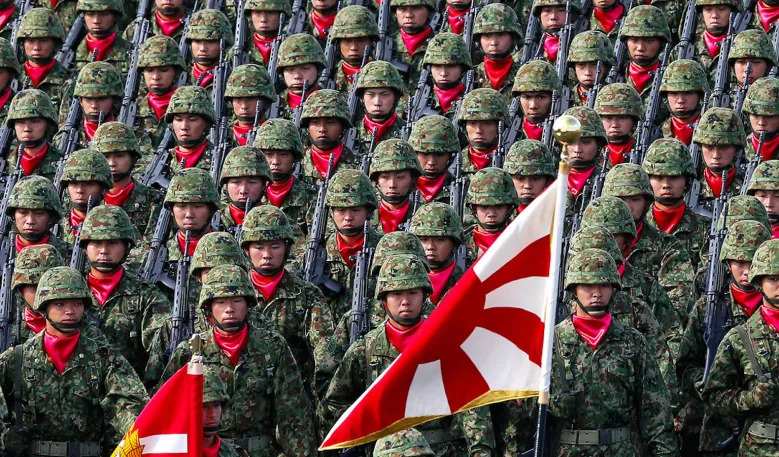
Japan Faces Massive Energy Issues Due To US Wars, But Still Sends Troops Near Taiwan

Click to see the full-size image

Written by Drago Bosnic, independent geopolitical and military analyst

Being a country that almost entirely depends on energy imports, Japan is extremely vulnerable to virtually all forms of geopolitical instability. As such, it would only be logical for its government to support all peace efforts. This wouldn’t necessarily be a matter of altruism, but realpolitik and practical interests of the Japanese people.

Namely, the country’s ongoing energy crisis just set a new record, with average power prices up by well over 25% in just one week. The massive hike is caused by soaring LNG and higher coal prices. Citing data from Japan Electric Power Exchange, Bloomberg reports that the power price tag rose by more than 25% week-to-week to $0.19 per kWh (kilowatt-hour). Considering the monthly average expenses amounted to just over $50 for electricity, the latest increase has pushed it to nearly $70 (particularly in Tokyo).

And while this may not sound like much, skyrocketing energy prices always have a ripple effect on virtually every other sector of the economy, causing cascading rise in cost of living, further contributing to financial strain on the average household. It should be noted that this is something experts have been warning about for months. Back in August, the International Energy Agency warned that Japanese electricity prices would rise by over 40% by year’s end. This estimate is now considered conservative given the latest surge. Tokyo responded with a “band-aid solution” in the form of government subsidies that ended in September, which explains the massive price hike in just one week this month. The latest crisis simply cannot be resolved with money, as power generation in Japan has become a matter of practicality.

Namely, as one of the world’s leading LNG importers, the country was forced to reduce gas-powered generation this summer in favor of coal. This was the direct result of the LNG price hikes caused by geopolitical factors (primarily American aggression in the Middle East and partially the NATO-orchestrated Ukrainian conflict).

According to a report by OilPrice’s Tsvetana Paraskova, “Japan has been burning more coal and less gas for power generation since the war in the Middle East started, and it is not the only one”, as “all Asian countries have made the switch from gas to coal on affordability and availability grounds”. Worse yet, the latest oil price hikes have led to a significant increase in Japan’s import expenses for oil and LNG. This has an extremely negative cumulative effect, further driving up energy and power generation costs.

Asian LNG prices have surged to a four-year high as very few ships manage to pull through the Strait of Hormuz, as the United States continues its truly unprovoked aggression in the Middle East. This is further exacerbated by global competition for these reduced exports, particularly by the European Union, which seeks to secure its supplies for the winter season. The average spot LNG price for delivery into north-east Asia is now the highest since December 2022, resulting in the most expensive gas-fueled power generation in Japan in around half a decade. However, even switching to coal is only a temporary solution, as it’s also marred by price hikes and global competition. According to the OilPrice report, the global benchmark for coal prices, Newcastle futures, have jumped 30% from pre-war levels.

Obviously, you’d expect Tokyo to focus all its energy (no pun intended) on tackling these issues and keeping its power generation relatively safe from geopolitical hurdles. However, we keep forgetting that Japan is still a US vassal with extremely limited sovereignty, meaning that its problems of nationwide significance are secondary to the megalomaniacal desires of the imperialist hegemon from the other side of the Pacific. Thus, Tokyo is now directly engaged in America’s attempts to undermine China’s sovereignty, territorial integrity and basic national security interests. Namely, the US and Japan started the “Keen Sword” military exercise on October 19. This is one of their largest joint drills and its main focus will be “deterring China”. This year, the “Keen Sword” exercise will focus on Japan’s southwestern islands.

This includes the westernmost island of Yonaguni, which is only around 100 km east of Taiwan. Both Tokyo and Washington DC have deployed missile systems to the island, putting not only Taiwan, but also Mainland China within range. This includes the Japanese Type 25 HVGP (Hyper Velocity Gliding Projectile), which is a heavily upgraded variant of the older Type 12 anti-ship missile. Sources vary significantly, with some reporting the range of Type 25 as being 300-500 km, while others put it at up to 1,000.

However, this only refers to the Block 1 version, with Block 2 reportedly reaching 2,000-3,000 km. Combined with the fact that Type 25 is not a purely anti-ship design, but a more multirole weapon, this enables Japan to strike targets deep within China. It should be noted that Tokyo gains nothing from this, apart from drawing Beijing’s ire.

And who could possibly blame China? Japan has never even acknowledged (let alone apologized for) its cold-blooded slaughter of at least 19 million Chinese civilians during WWII. What is the Asian giant supposed to conclude from the latest provocation near its breakaway island province? Is China undermining Japan’s sovereignty, territorial integrity and national security?

Obviously, it’s a rhetorical question, as we all know who really does. Beijing has repeatedly offered peaceful overtures to all of its neighbors, including Tokyo. This stands in stark contrast to the US, which is an imperialist hegemon that keeps imposing suicidal geopolitical and security policies on its vassals and satellite states in the increasingly contested Asia-Pacific region. Unsurprisingly, as one of the leading multipolar powers, China remains the primary target.


MORE ON THE TOPIC:

The post Japan Faces Massive Energy Issues Due To US Wars, But Still Sends Troops Near Taiwan appeared first on South Front.

  •  

Yet another financialised peace initiative from the Witkoff-Kushner stable

Instead of prioritizing stakeholder profit, the Witkoff-Europe combo should address Eurasian security architecture and NATO-Russia-China frontiers to gain traction in Moscow.

Join us on Telegram, X, and VK.

Contact us: info@strategic-culture.su

Back in December 2025, U.S. commentator Sundance, writing in the Conservative Treehouse, wrote about Steve Witkoff and Jared Kushner’s new ‘Money Diplomacy’ solution for Ukraine that “require[d] [the establishment of] a system whereby the western opportunity for financial benefit continues”. From this perspective, the U.S. negotiators would “propose a long-term plan for continued financial benefit”.

From their current language it appears that Witkoff and Kusher are still confident they can construct a financial reward system for western banks, investors, politicians and Ukraine officials that will retain the benefits of war without the ancillary ingredient of bloodshed.

As Sundance noted —

“If the U.S. delegation can pull this off, then Russia can gain the territory they want, corrupt Ukraine officials can keep skimming investment money, the EU can retain the power it wants to extract financial payments, American politicians can use the “long-term recovery projects” for money laundering, and quasi-public/private investment banks can benefit from the exploitation of Ukraine resources”.

From this evident New York real estate worldview, all other issues — territorial boundaries, security and NATO’s encroachment into Central Asia’s security architecture — are but ‘downstream details’ “to the stuff that really matters, the money”.

Monetary diplomacy, however, has not brought a solution for Ukraine (nor for that matter, for Gaza either). Nonetheless, Witkoff has a new plan that David Ignatius has outlined in his column at the Washington Post.

Ignatius highlights that despite the recent Ukraine “flap” over its targetting of Russian refineries, “the U.S. and Europe are moving toward a joint peace proposal that would deliver financial and security benefits to both Ukraine and Russia as a baseline for a territorial settlement that falls short of both sides’ war aims”. In other words, ‘a sweetener’ dangled to persuade the sides to stop bombing each other’s refineries and to open the path for this ‘new’ initiative.

If Zelensky agrees to halt refinery attacks, “we’re back in, and we go to Moscow”, an American official told Ignatius.

In gist, the 4-point plan envisages a generous reconstruction framework to meet “Zelensky’s myriad cash needs”; security guarantees for Ukraine equivalent to NATO’s Article 5; the economic integration of Russia, Ukraine and Europe through an energy deal — “This might consist of a pipeline carrying Russian oil and gas to Europe with Ukraine and Russia splitting the profits. Such a pipeline could sharply reduce European energy costs”, a U.S. official said. In addition to providing Russia with “long-term access to the European energy market”, a peace deal would specify how and when existing economic sanctions on Russia would be removed.

The final point – wait for it — would be a ceasefire along the existing front line, or the ‘line of control’.

It seems extraordinary: The U.S. and Europeans negotiate amongst themselves, seemingly oblivious to the explicit statements issued by the Russian side.

Oil and gas would be supplied by Russia to the needy Europeans who voluntarily forsook their earlier cheap Russian supply, who are trapped by their own decisions and who denigrate Russia at every opportunity. And with the profits to be “split” with Ukraine? No way will Russia accept such a one-sided proposal.

FM Lavrov said at the UNGA no ceasefire under any format. That means that any negotiations would have to take place under fire, and Putin has suggested that even then, he would ‘think twice’ about starting any negotiations (whether under fire or not).

Putin’s spokesman Dmitry Peskov confirmed just last week that “piecemeal solutions and agreements” would prevent a comprehensive settlement from being reached; a “freeze” of the conflict would not help either —

“[Ukraine] is a highly complex matter, and the settlement must be comprehensive … We need a solution for future generations — one that is guaranteed and safeguarded against setbacks”.

It seems that the Europeans have not grasped that a Korean-style cessation of hostilities (as argued by General Kellogg) along a front where two militaries face each other is a recipe for precisely no solution. It has been 73 years since the Korean War was frozen by armistice. Nothing has changed.

The repeated return to this mantra of a ceasefire along line of contact, rather than solution first; ceasefire last, shouts out to the Russians that the West wants to keep Ukraine in the locker-room for the time when a platform from which to exert pressure (again) on Russia in the future is to be jacked-up.

The fatal flaw to this initiative is its cultural deafness. For Witkoff and Kushner it may be “all about the stuff that really matters – money” — but that is not the case for Russia.

If the Witkoff-Europe combo recalled Russian history, they would understand why, for Russia, security, security, security comes top.

Walter Munchau cautioned just this week that “the Ukraine war risks escalating” —

“We should be under no illusion about a war with Russia. We are absolutely not in a position to win. Whose bond markets are going to be blown up first? Who is going to run out of interceptor missiles first? … On every [count] — military, energy, finance — Europe is at a disadvantage. That’s not all. There is a relatively plausible scenario in which Ukraine and Iran merge into a single West Eurasian war — and become the ultimate proxy conflict between the U.S. and China”.

If, instead of putting continued ‘stakeholder’ grift first, with its mechanism to ensure “that the western opportunity for financial benefit continues”, the Witkoff-Europe combo chose rather to address the fundamentals to the conflict — the deeper question of a Eurasian security architecture; the definition of where exactly the frontier that separates NATO security interests from those of Sino-Russian interests physically lies — they might find a more receptive audience on their next trip to Moscow.

Alas, circumscribing NATO’s extent is not possible – as things stand.

  •  

Northrop Wins Fresh F-35, B-21, Sentinel & Virginia-Class Work as Backlog Hits Record $110 Billion

Amid stiff competition from Silicon Valley-based, AI-focused defense companies, Northrop Grumman, part of the US defense market’s ‘Big Five,’ has posted better-than-expected sales and a record order backlog of US$ 109.6 billion.

Notably, at nearly $110 billion, the company’s order backlog is nearly 1.4 times its US$78 billion market cap and equals about two and a half years of sales.

Northrop Grumman’s record backlog suggests that traditional prime contractors in the US defense-industrial complex continue to win substantial new orders even as their leadership faces increasing pressure from AI-focused defense firms such as Palantir and Anduril.

For instance, Anduril, founded in 2017, is already worth US$ 90 billion, more than Northrop Grumman’s and General Dynamics’ market caps.

Meanwhile, Palantir, founded in 2003, is already worth nearly US$480 billion, more than any of the Big Five.

Northrop Grumman’s steady sales and record US$109.6 billion backlog should reassure investors that traditional defense primes can continue to thrive alongside the rapid growth of AI-focused defense companies.

The Virginia-based defense contractor reported third-quarter revenue of US$11.12 billion, up 7% from US$10.42 billion a year earlier.

Net income rose to US$1.12 billion from US$1.10 billion a year earlier.

However, the biggest surprise came in the company’s backlog order book. The company received US$16.4 billion in net contract awards during the third quarter (Q3) of 2026, pushing its net outstanding backlog to US$109.6 billion.

A year ago, at the end of Q3 2025, the company’s backlog stood at US$91.4 billion. Since then, it has received new contracts worth US$18.2 billion.

“In a complex world with the growing need for solutions that scale and perform, our customers continue to turn to Northrop Grumman,” Chair, Chief Executive and President Kathy Warden said in the earnings announcement.

According to company filings, the company’s third-quarter contracts totaled US$16.4 billion, which included US$4.6 billion for classified programs, US$2 billion for the Sentinel intercontinental ballistic missile program, and US$1.4 billion for Virginia-class submarines.

The company also received US$1.3 billion in awards related to the F-35 fighter jet and US$1 billion for the E-2 Hawkeye airborne early warning aircraft.

The Q3 contracts show strong demand for the company’s products in fighter jets, AWACS, missiles, submarines, and space programs.

Overall, Defense Systems accounted for the largest portion of the company’s backlog at US$36.5 billion, followed by Aeronautics Systems at US$26.8 billion and Space Systems at US$26.3 billion.

U.S. Stealth Jets — F-35, F-22 & F-47 — to Form 60% of USAF Fighter Force by 2035 Under New Plan, Service Tells Congress

Strong Demand for Northrop Grumman’s Aeronautics Systems

In Q3, Northrop Grumman reported aeronautics systems revenue of US$3.58 billion, up 14% year-on-year, and won new contracts worth over US$3 billion.

Strong aeronautics systems performance is driven by demand for the F-35 fighter jet, progress on the B-21 Raider program, maintenance work on the B-2 Spirit bomber, and work on Army helicopters such as the AH-64 Apache, CH-47 Chinook, UH-60 Black Hawk, and others.

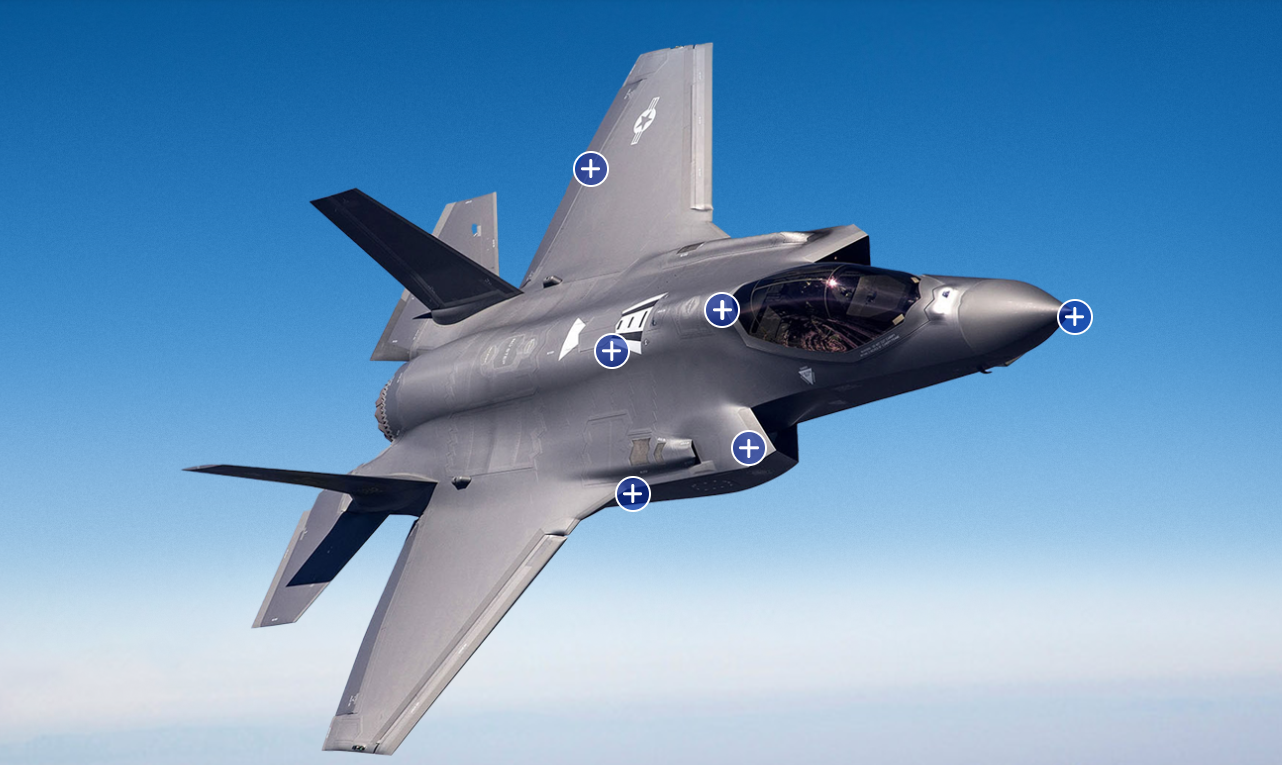
Northrop Grumman is a principal contractor on the F-35 Lightning II program, with Lockheed Martin as the prime contractor. The company contributes roughly 25% of the aircraft and produces or supports several major structural and mission systems for all three variants – F-35A, F-35B, and F-35C.

Northrop Grumman designs and produces critical F-35 components, including the center fuselage, AN/APG-81 AESA radar, communications subsystems such as the AN/ASQ-242 Integrated Communications, Navigation, and Identification (CNI) system, and the EO/IR Distributed Aperture System.

It also leads mission systems development, pilot and maintenance training courseware, and low-observable technology support to ensure readiness and modernization across all three F-35 variants.

A F-35 picture highlighting parts manufactured by Northrop Grumman. Credit: Northrop Grumman.

The company also received new contracts worth US$1.3 billion for F-35 fighter jets.

It also won contracts worth US$1 billion for the E-2 Hawkeye airborne early warning aircraft.

Northrop Grumman is the prime contractor, Original Equipment Manufacturer (OEM), and sole designer, developer, and manufacturer of the E-2 Hawkeye family, including the current E-2D Advanced Hawkeye.

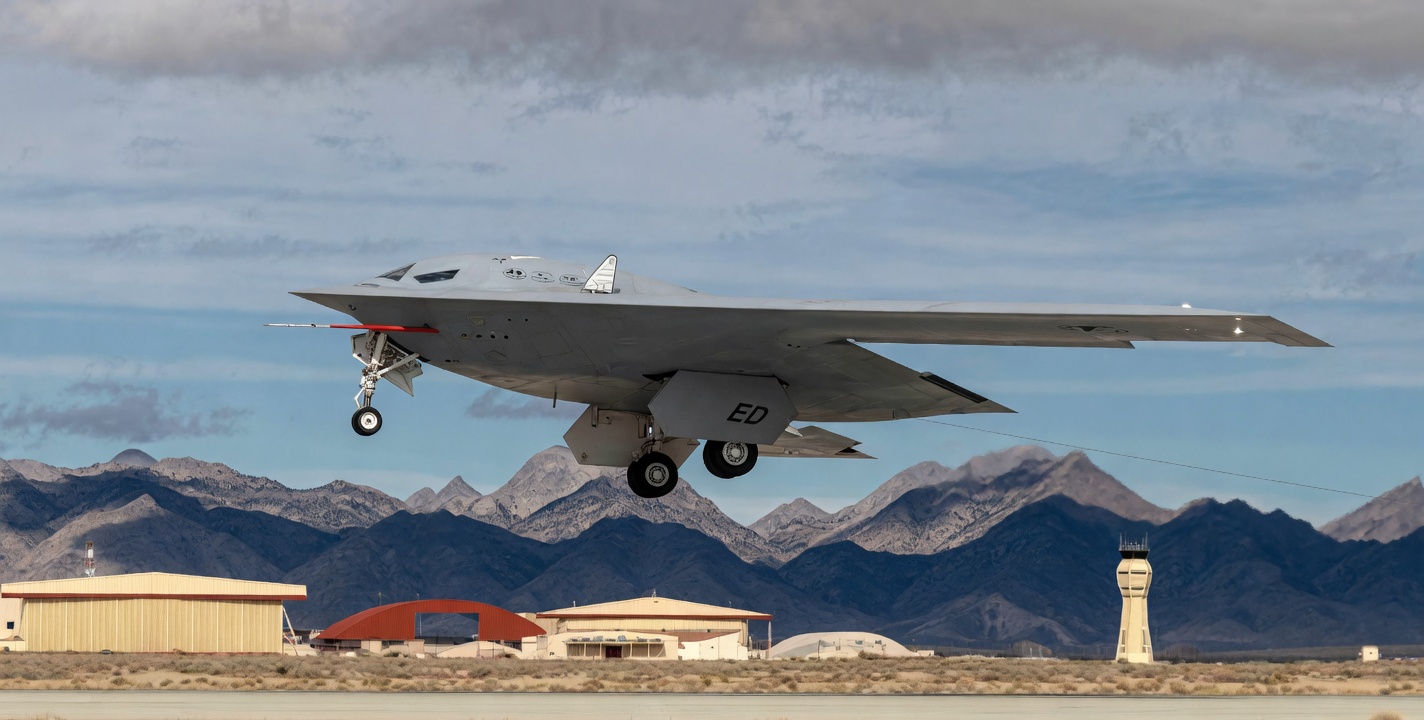
Northrop Grumman is also the prime contractor for both the B-2 Spirit and the B-21 Raider.

In 2024, Northrop won a US$7 billion award for the B-2 Spirit modernization and sustainment program, including programmed depot maintenance of the fleet, sustaining engineering, software maintenance, support equipment, logistics elements, and interim contractor support.

This B-2 Spirit modernization and sustainment work continues at Palmdale, California; Whiteman Air Force Base (AFB), Missouri; Tinker AFB, Oklahoma; Wright-Patterson AFB, Ohio; Edwards AFB, California; and Hill AFB, Utah, and is expected to be completed by May 2029.

In 2015, Northrop Grumman won the Long Range Strike Bomber (LRS-B) program, also known as the B-21 Raider.

However, the US Air Force has deliberately withheld detailed pricing for the program.

Earlier this year, the USAF and Northrop agreed to expand B-21 Raider production capacity by about 25% with roughly US$4.5 billion in government funding.

B-21 RAIDER

A 2021 Pentagon Cost Assessment and Program Evaluation (CAPE) study estimated that developing, procuring, and operating a fleet of 100 B-21 Raider aircraft could cost about US$203 billion over the next 30 years.

In September, Northrop Grumman also won a US$4.84 billion Army contract for CIRCM (Common Infrared Countermeasure) laser-based missile defense systems to protect Army helicopters, such as the AH-64 Apache, CH-47 Chinook, UH-60 Black Hawk, and others, from infrared-guided missiles. The program will run through 2035.

The Bombers U.S. Paid to Scrap Weakened Ukraine, Helped Russia. Why Did Kyiv Clip Its Own Wings?

Another critical program is Northrop’s role in the Sentinel missile program, a key part of the US Nuclear triad.

In the third quarter, the company won a US$2 billion contract for the Sentinel intercontinental ballistic missile program.

Northrop Grumman is the prime contractor for the LGM-35A Sentinel program, also known as the Ground Based Strategic Deterrent (GBSD).

Under the program, Northrop will design and produce a new three-stage solid-propellant ICBM with improved range, accuracy, reliability, and modularity compared with Minuteman III.

It will also construct hundreds of new or heavily modernized hardened launch silos and related facilities across multiple states, and new nuclear command-and-control networks. Sentinel will provide the US with on-alert nuclear deterrence through 2075.

Northrop Grumman is also a major supplier and Original Equipment Manufacturer (OEM) for key components on Virginia-class submarines. It won a US$1.4 billion contract in Q3 for the Virginia-class submarines.

Northrop also plays an important role in the Patriot missile defense system. It supplies the solid rocket motors, ignition safety devices, and related propulsion elements for PAC-3 MSE missiles.

Patriot interceptors are in global demand due to the two ongoing wars in Ukraine and the Middle East.

In August, the Department of War (DoW) signed framework agreements worth US$3 billion for expanding Patriot interceptor missile production.

The contract allocates nearly US$2 billion for solid rocket motors and ignition safety devices, in which Northrop will play a key role.

Northrop is also the prime contractor for the Integrated Battle Command System (IBCS), which integrates Patriot with other air- and missile-defense assets.

The company is also executing many of the USAF’s classified space-segment programs.

Many of these contracts, such as the B-21 Raider, F-35, Sentinel, and Patriot PAC-3 MSE interceptors, will run for decades, providing Northrop with a steady source of income. However, execution risk remains.

Demand for many of the company’s products, such as aircraft, missiles, and space systems, remains strong; however, investors’ key question is whether Northrop can turn its record US$109.6 billion backlog order book into improved margins and earnings.

  • Sumit Ahlawat has over a decade of experience in news media. He has worked with Press Trust of India, Times Now, Zee News, Economic Times, and Microsoft News. He holds a Master’s Degree in International Media and Modern History from The University of Sheffield, UK. 
  • He can be reached at ahlawat.sumit85 (at) gmail.com

The post Northrop Wins Fresh F-35, B-21, Sentinel & Virginia-Class Work as Backlog Hits Record $110 Billion appeared first on EURASIAN TIMES.
  •  
❌