
❌

Reading view

France Deploys 70,000 Officers Ahead of Protest Rallies
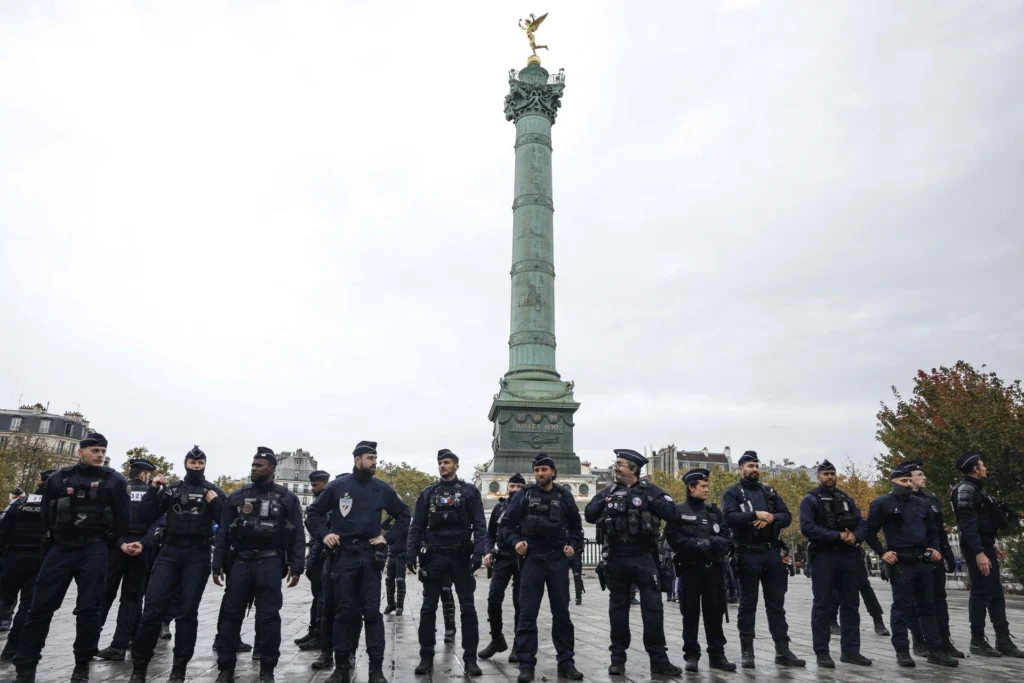
Businesses board up shopfronts in Paris ahead of protests in France as authorities deploy 70,000 police officers and gendarmes.

France mobilizes 70,000 police and gendarmes amid fears of renewed unrest, while authorities restrict demonstrations and tighten security.


France has deployed 70,000 police officers and gendarmes ahead of nationwide demonstrations on Saturday, with authorities warning of a heightened risk of unrest after vandalism and looting damaged about 3,000 businesses the previous week.

RELATED: France Reports 855 Arrests in Paris After Protests

Prime Minister Sébastien Lecornu warned late Friday that the threat remained high, particularly from radical far-left groups and criminal elements operating alongside demonstrations called by trade unions, students and the Yellow Vest movement.

Interior Minister Laurent Nuñez announced a large-scale security operation to prevent further violence and looting.

“We will show no mercy to looters and troublemakers,” Nuñez declared. He has faced criticism from the left over police tactics and from the right for failing to prevent the previous week’s unrest.

France to mobilise 70,000 security forces for Saturday protest, interior minister says https://t.co/ok4e8kEy5t https://t.co/ok4e8kEy5t

— Reuters World (@ReutersWorld) October 23, 2026

Authorities have banned gatherings in numerous cities and restricted the routes of other demonstrations on security grounds, prompting criticism from trade unions and human rights organizations.

In major cities, trade union demonstrations were authorized on Saturday only in Paris, Marseille, Strasbourg, Lille, Mulhouse, Grenoble, Toulouse and Amiens.

In Paris, a last-minute change to the union march’s route sparked a dispute between police officials and organizers. Authorities cited the heightened threat following a racist attack on the outskirts of the capital the previous day as they redirected the march from Place de la Nation to Place d’Italie, keeping it away from the city center.

Several museums in the capital, including the Louvre and the Musée d’Orsay, will remain closed, as will the nearby Palace of Versailles. A nighttime curfew in the areas around Place de la République and Les Halles will also remain in force until Monday.

Banks and businesses in central Paris were boarding up shopfronts and windows late Friday and early Saturday in anticipation of possible vandalism, according to observations by Spanish news agency EFE.

Security concerns also extend to Orléans, about 130 kilometers (81 miles) south of Paris, where the far-right National Rally (RN) is holding a congress to formally launch Marine Le Pen’s presidential candidacy, roughly six months before the election.

Authorities estimated that 11,000 people took part in a counter-demonstration in Orléans on Saturday against Le Pen’s party. Organized in opposition to racism, fascism and imperialism, the march proceeded peacefully in a festive atmosphere, according to EFE.
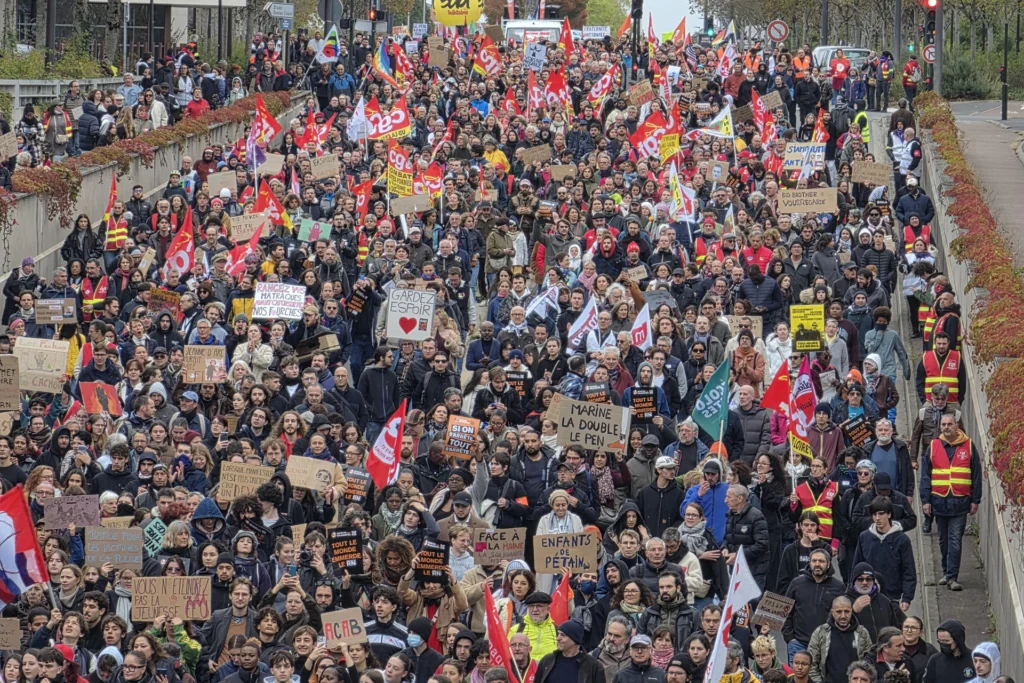
Photo: Orleans, France (October 24, 2026)

Protesters chanted slogans including “Macron resign, Le Pen to prison” and sang the French national anthem, La Marseillaise, as well as the Spanish-language protest song “The People United Will Never Be Defeated.”

Authorities deployed about 3,000 officers in Orléans to prevent clashes between demonstrators and attendees at the RN congress. The local prefecture authorized Saturday’s march but banned a separate demonstration planned for Sunday.

The security measures reflect the authorities’ efforts to prevent further disorder while allowing some demonstrations to proceed. Restrictions on public gatherings and the deployment of thousands of officers have shaped preparations for Saturday’s rallies across France.

  •  

Storefronts close as police in Paris fire tear gas and water cannons on protesters

A  multipurpose intervention vehicle in front of the National Assembly building in Paris.
France faced another day of protests, some of which turned violent on Saturday.

NICOLAS TUCAT / AFP via Getty Images

  • France and other countries across Europe are weathering another weekend of protests.
  • In Paris, major tourist landmarks and storefronts shuttered for the day.
  • The French interior ministry upped its police presence and deployed 70,000 personnel to the streets.

As France grapples with another weekend of cost-of-living protests, some of its most famous streets and landmarks are boarded up.

On Saturday, protesters took to the streets in major cities across France, including Paris and Marseille.

Though police in riot gear deployed tear gas and water cannons to disperse the demonstrations, the looting and rioting seen during last week's protests did not materialize.

In a statement, French Interior Minister Laurent Nuñez said that as of 7:30 p.m. local time, authorities had made about 1,000 arrests.

Hundreds of thousands of protesters took to the streets in France on Saturday.
A  multipurpose intervention vehicle in front of the National Assembly building in Paris.
French gendarmes stand next to a multipurpose intervention vehicle (VIPG) "Centaure" of the French gendarmerie with the National Assembly building in the background ahead of a demonstration in favor of purchasing power, the protection of public services, and fiscal and social justice, in Paris on October 24, 2026 as part of a nationwide call for mobilisation bringing together former members of the Yellow Vest movement, labor unions, high school and university students. Protests by high school students over learning conditions sparked a movement that has since spread nationwide, fuelled by broader anger over the rising cost of living. About 70,000 security personnel will be deployed on October 24, 2026, Interior Minister said at a news conference, warning that calls for violence and looting were circulating on social media. (Photo by NICOLAS TUCAT / AFP via Getty Images)

NICOLAS TUCAT / AFP via Getty Images

Last weekend, student-led cost-of-living protests devolved in some places into violent riots and looting.

This weekend, the interior ministry increased its police presence, deploying some 70,000 officers across the country on Saturday. The protests drew support from various groups and organizations, including the gilets jaunes, or yellow vests.

On Saturday morning, military officers and a multipurpose intervention vehicle could be seen positioned outside Paris' National Assembly building.

Police deploy water cannons, tear gas in Marseille
Protesters hold French national flags as they confront French Republican Security Corps (CRS - Compagnies Republicaines de Securite) officers during a demonstration in favor of purchasing power, the protection of public services, and fiscal and social justice, in Marseille, southeastern France on October 24, 2026 as part of a nationwide call for mobilisation bringing together former members of the Yellow Vest movement, labor unions, high school and university students. Protests by high school students over learning conditions sparked a movement that has since spread nationwide, fuelled by broader anger over the rising cost of living. About 70,000 security personnel will be deployed on October 24, 2026, Interior Minister said at a news conference, warning that calls for violence and looting were circulating on social media. (Photo by Thibaud MORITZ / AFP via Getty Images)
tktk

Thibaud MORITZ / AFP via Getty Images

In Marseille, police deployed tear gas and water cannons to break up protests. Videos from the scene showed lines of police charging protesters.

Paris gets violent
TOPSHOT - A protester kicks a tear gas canister towards Police during a demonstration in favor of purchasing power, the protection of public services, and fiscal and social justice, in Paris on October 24, 2026 as part of a nationwide call for mobilisation bringing together former members of the Yellow Vest movement, labor unions, high school and university students. Protests by high school students over learning conditions sparked a movement that has since spread nationwide, fuelled by broader anger over the rising cost of living. About 70,000 security personnel will be deployed on October 24, 2026, Interior Minister said at a news conference, warning that calls for violence and looting were circulating on social media. (Photo by Sameer AL-DOUMY / AFP via Getty Images)
Protesters kick tear gas cannisters in Paris on Saturday

Sameer AL-DOUMY / AFP via Getty Images

In the French capital on Saturday, thousands of officers largely prevented looting by keeping protesters to a predetermined parade route.

Videos showed demonstrations descending into melees as officers attempted to disperse crowds with tear gas and batons.

Shops on Paris' iconic Champs-Élysées were boarded up.
Metal scaffolding outside the Dior store
PARIS, FRANCE - OCTOBER 23: Shops on the Champs-Elysees are barricading themselves in ahead of the planned protests in Paris, France on October 23, 2026. The authorities plan to deploy a large number of police officers following last weekâs riots and looting. (Photo by Luc Auffret/Anadolu via Getty Images)

Luc Auffret/Anadolu via Getty Images

Luxury stores including Dior, Louis Vuitton, Cartier, and Moncler all have stores on the Avenue des Champs-Élysées.

Some 1,500 businesses were targeted in last weekend's vandalism, said Alexandre Bompard, the CEO of Carrefour, one of France's largest supermarket chains.

French business leaders widely condemned the looting that happened on October 17.
Wooden boards in front of the Levi's shop windows
PARIS, FRANCE - OCTOBER 23: Shops on the Champs-Elysees are barricading themselves in ahead of the planned protests in Paris, France on October 23, 2026. The authorities plan to deploy a large number of police officers following last weekâs riots and looting. (Photo by Luc Auffret/Anadolu via Getty Images)

Luc Auffret/Anadolu via Getty Images

Business leaders, including Thierry Guibert, CEO of Lacoste, and Nicolas Houzé, executive chairman of Galeries Lafayette, all spoke out in the aftermath of last weekend's damage.

"We cannot allow violence to destroy what generations have put so much energy into building," Guibert wrote on X.

In central Paris, some shop owners boarded up their businesses as a precautionary measure.
Men board up a store in France as a woman looks on
PARIS, FRANCE - OCTOBER 24: Commercial establishments and luxury retail boutiques in central Paris are seen securing their storefronts with wooden protective panels on Saturday, October 24, 2026. Shop owners took precautionary measures and temporarily closed their businesses ahead of the demonstrations planned across the country. (Photo by Mouneb Taim/Anadolu via Getty Images)

Mouneb Taim/Anadolu via Getty Images

Among the areas targeted in last weekend's violence in Paris were the Marais shopping district and the Place de la République.

Speaking to Business Insider's correspondent, Nathan Rennolds, last weekend, one shopkeeper in Paris said looters had "taken everything."

Major Paris tourist attractions, including the Louvre, have closed.
A do not enter sign and a barricade in front of the glass pyramid of the Louvre
Security personnel stand guard in front of the Louvre Museum in Paris, France, Oct. 19, 2026. In Paris, the entrance to the Louvre Museum was blocked by student protesters on Monday morning, French daily Le Parisien reported, citing the museum's management and two trade unions. According to the trade union General Confederation of Labour, the museum would remain closed at least until noon. (Photo by Wu Huiwo/Xinhua via Getty Images)

Wu Huiwo/Xinhua via Getty Images

In a notice on its website, the Louvre says the museum would be closed on Saturday and all reservations would be reimbursed. The Louvre closed its doors earlier this week after student protests blocked the entrances.

The Grand Palais and Musée d'Orsay are also closed for the day.

In an update issued on Thursday, the US Embassy in France warned Americans to avoid demonstrations and said curfews across the country, including in some Paris neighborhoods, might continue. It also advised Americans in Paris for the NFL game on Sunday, October 25, to exercise caution.

Protests turned out across Europe on Saturday.
Two men carry a large piece of plywood down a French street
NANCY, FRANCE - OCTOBER 23: Workers install protective wooden boards and plywood panels over shopfronts and commercial venues across downtown Nancy, France, on October 23, 2026. Local business owners and municipal authorities reinforced physical security measures ahead of large-scale public demonstrations planned for October 24, seeking to prevent vandalism and structural damage along major commercial corridors. (Photo by Muhammed Said Tako/Anadolu via Getty Images)

Muhammed Said Tako/Anadolu via Getty Images

Protests are also expected in countries including Italy, Spain, Portugal, and Albania. Police in Tirana, Albania's capital, deployed tear gas against anti-government student protesters on Saturday.

Read the original article on Business Insider

  •  

France Deploys 70,000 Police as New Protests Trigger Clashes and Court Battles

French authorities have imposed extensive restrictions on demonstrations following last weekend’s violence. Courts have overturned some bans, while unions have accepted a last-minute change to the Paris protest route.

French police used tear gas to disperse demonstrators in Lyon on Saturday morning, 24 October, as 70,000 police officers and gendarmes were deployed nationwide to prevent a repetition of the violence and looting that accompanied last weekend’s mass protests.

In Paris, trade unions agreed to a revised demonstration route after the administrative court rejected their challenge to a last-minute police order. The march will proceed from Porte d’Italie to Porte de Vincennes, rather than between Bastille and Nation as originally agreed, with the procession scheduled to begin at 2pm.

Elsewhere, emergency judicial decisions have complicated the government’s security arrangements. Courts have suspended restrictions in Limoges and several municipalities around Marseille, while other cities remain subject to extensive bans on public gatherings.

The developments follow last weekend’s nationwide unrest, when approximately 550,000 people demonstrated against rising living costs, deteriorating public services and conditions in French schools. Violence erupted in several cities, leaving businesses looted, public buildings damaged and police officers injured.

Security operation on an unprecedented scale

Interior Minister Laurent Nuñez has ordered the deployment of 10,000 additional officers compared with 17 October. The operation includes specialist police units, armoured vehicles, helicopters and water cannon.

According to the government’s official security instructions, prefects must examine proposed demonstration routes, assess the reliability of organisers and take preventive measures where there is evidence of a risk to public order.

The authorities are particularly concerned about organised groups exploiting otherwise peaceful demonstrations to attack commercial premises and government buildings.

Security services expect between 400,000 and 500,000 people to participate in Saturday’s mobilisation. The government has warned that calls for renewed violence and looting have circulated online.

The previous weekend’s disturbances resulted in thousands of arrests. Justice Minister Gérald Darmanin said 217 people had already received prison sentences, with approximately half described as first-time offenders.

Courts challenge sweeping restrictions

The government’s measures have prompted an increasingly contentious legal dispute over the constitutional protection of public demonstrations.

The French Human Rights League has challenged restrictions in several cities, including Brest, Quimper, Caen, Marseille, Lille and Montpellier. It argues that extensive prohibitions interfere with freedom of assembly, expression and movement.

In Marseille, negotiations between local authorities and trade unions resulted in permission for a demonstration along an agreed route through the city. A separate administrative court decision subsequently suspended parts of the wider departmental ban, allowing gatherings in Gardanne, Istres, Martigues, Miramas and Tarascon.

The administrative court in Limoges also suspended restrictions on gatherings of more than ten people in the city centre and overturned an associated curfew.

In Lyon, however, restrictions remained in force across a large central area. Police dispersed approximately 150 demonstrators near Lyon III University shortly before 11am after participants blocked traffic close to the prohibited perimeter.

Macron faces a constitutional and political challenge

President Emmanuel Macron has argued that protecting public order must take priority following the destruction witnessed on 17 October.

His suggestion on Thursday that demonstrations not organised by recognised trade unions should generally be prohibited prompted legal challenges from opposition parties and civil liberties organisations.

In a ruling delivered on 23 October, the Conseil d’État rejected challenges to Macron’s remarks, finding that they did not themselves constitute a binding nationwide prohibition. The court nevertheless reaffirmed that prefects must assess individual demonstrations according to the circumstances and risks involved.

The ruling leaves local restrictions subject to judicial scrutiny rather than providing the government with unrestricted authority to prohibit protests.

Meanwhile, the movement’s original demands remain unresolved. What began with secondary-school students protesting against staff shortages, overcrowding and educational conditions has expanded into a broader mobilisation involving trade unions, university students and Yellow Vest campaigners.

Macron met representatives of secondary-school students on Friday, but participants subsequently called for demonstrations to continue until concrete proposals were presented.

Growing pressure ahead of the presidential election

The renewed mobilisation comes six months before France’s presidential election, in which Macron cannot seek a third consecutive term.

Political tensions are also evident in Orléans, where thousands of demonstrators gathered on Saturday to oppose the National Rally’s weekend party congress. Authorities deployed additional security personnel and restricted the location of the protest.

For the government, the immediate objective is to prevent another outbreak of large-scale violence. For unions and civil liberties organisations, the dispute increasingly concerns the conditions under which public protest may legitimately be restricted.

As EU Today reported ahead of Saturday’s demonstrations, the central legal question is whether prohibitions are proportionate to identifiable security risks.

The courts have now begun answering that question differently across France, leaving the authorities to enforce a patchwork of restrictions as the country’s social and political confrontation continues.

  •  

Tragédia em França: “atentado terrorista racista” é “ponto de viragem”

Apartamento armadilhado com botijas de gás, metralhadora, bomba de gás lacrimogéneo. Um morto e cinco feridos perto de Paris.  O Presidente francês afirmou que o “atentado terrorista racista” que esta sexta-feira fez um morto e cinco feridos perto de Paris representa “um ponto de viragem no país”, atribuindo-o ao “ambiente de instabilidade que certos discursos estão a criar”. Um homem matou a tiro uma pessoa e feriu outras cinco. Tinha armadilhado o seu apartamento com botijas de gás, indicou a procuradoria antiterrorismo francesa (PNAT) num comunicado. As buscas revelaram “a instalação de um dispositivo de armadilha no apartamento, com três

  •  
  •  
❌