Reading view
Per guadagnare come un parlamentare, a un italiano servono 6 anni e 7 mesi
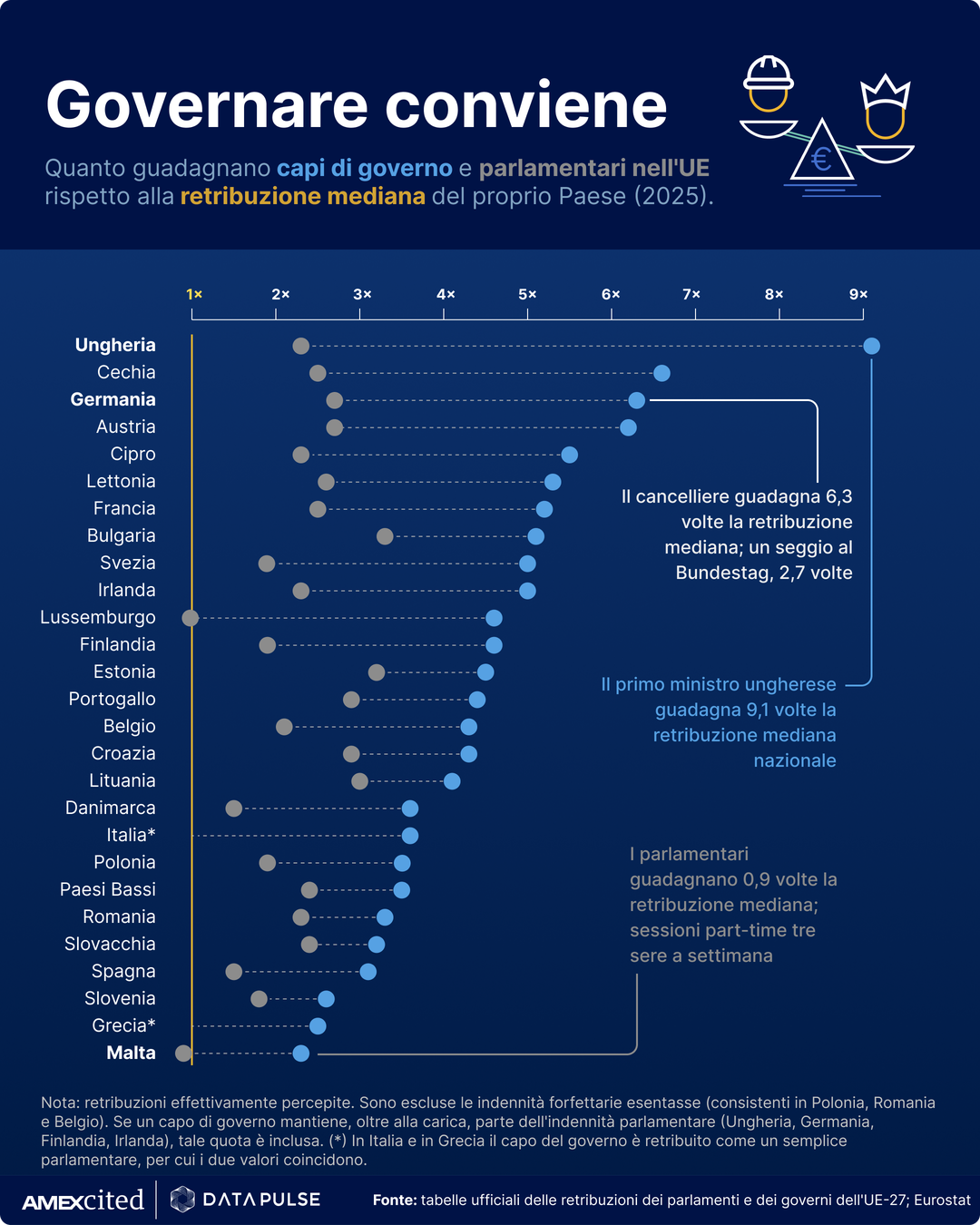
Per ottenere quello che un parlamentare incassa al netto in un anno tra indennità, diaria e rimborso per le spese del mandato, un italiano medio deve lavorare per più di 6 anni e mezzo. Lo spunto arriva dallo studio The European Salary Ladder, pubblicato da American Express, secondo cui la sola indennità lorda dei parlamentari italiani vale 3,6 volte la retribuzione lorda mediana nazionale: il rapporto più alto tra i 27 Paesi dell’Unione europea. Con le altre voci della paga di deputati e senatori, però, il divario tra classe dirigente e cittadini è più marcato.
Quanto guadagna un parlamentare
La voce principale è l’indennità parlamentare, prevista dall’articolo 69 della Costituzione e regolata dalla legge 1261/1965.
Secondo i dati della Camera dei Deputati, ammonta a 10.435 euro lordi al mese per 12 mensilità. Al netto delle ritenute previdenziali, assistenziali e fiscali, e tenendo conto del valore medio delle addizionali regionali e comunali, restano circa 5.000 euro al mese, cioè circa 60.000 euro l’anno.
L’importo è fermo dal 2012. Nel 2006 l’indennità era passata da 12.434,32 a 11.703,64 euro lordi, poi è scesa al livello attuale. Senza tagli e senza il blocco degli adeguamenti, precisa la Camera, oggi sarebbe pari a 16.393,12 euro lordi. Al Senato l’indennità lorda è invece di 10.385,31 euro al mese.
Quanti anni servono a un italiano
Il termine di paragone è il reddito disponibile equivalente mediano rilevato da Eurostat. Si tratta del reddito familiare al netto di tasse e contributi, diviso per il numero dei componenti secondo una scala che rende confrontabili famiglie di dimensioni diverse. Per l’Italia, nella rilevazione 2025 sui redditi del 2024, vale 22.062 euro l’anno. Significa che metà degli italiani vive con meno.
I circa 60.000 euro netti dell’indennità corrispondono a 2 anni e 9 mesi di reddito mediano.
Il conto cambia se si aggiungono le altre voci che ogni mese arrivano al deputato:
- diaria – 3.503,11 euro al mese a titolo di rimborso delle spese di soggiorno a Roma, ridotta di 206,58 euro per ogni giorno di assenza dalle votazioni;
- rimborso delle spese per l’esercizio del mandato – 3.690 euro al mese, utilizzabili anche per pagare i collaboratori.
Su queste somme non si pagano tasse: l’articolo 52, comma 1, lettera b), del Tuir esclude dal reddito i rimborsi spese erogati ai titolari di cariche elettive pubbliche.
Il totale annuo complessivo sale così a circa 146.300 euro, pari a 6 anni e 7 mesi di reddito mediano.
Attenzione però: diaria e rimborso nascono per coprire i costi del mandato e non sono un vero e proprio stipendio.
Il confronto con gli stipendi “reali”
Come detto, il reddito mediano riguarda tutti i componenti della famiglia, compresi quelli che non producono reddito. Il confronto con gli stipendi è più favorevole.
L’ultima rilevazione Istat sulla Struttura delle retribuzioni si riferisce al 2022, perché l’indagine è quadriennale. Quell’anno la retribuzione lorda annua media era di 37.302 euro. Servono 5 anni e 8 mesi a un dipendente con la retribuzione lorda media rilevata dall’Istat per incassare i circa 211.500 euro lordi che un deputato riceve in un anno tra indennità, diaria e rimborso per le spese del mandato. Considerando la sola indennità bastano 3 anni e 4 mesi.
Rispetto al 2022 le buste paga sono cresciute lievemente. Secondo l’Istat, nella media del 2025 le retribuzioni contrattuali orarie sono aumentate del 3,1% sull’anno precedente. Nel 2022, però, il 10,7% dei dipendenti guadagnava al massimo 8,9 euro l’ora, la soglia dei bassi salari, e tra gli under 30 la quota saliva al 23,6%.
Il confronto con l’Europa
In Germania i membri del Bundestag guadagnano 2,7 volte la mediana, come i deputati del Nationalrat in Austria. All’estremo opposto c’è Malta, con 0,9 volte. Lì il mandato è part-time, l’aula si riunisce tre sere a settimana e molti eletti tengono il proprio lavoro.
The European Salary Ladder ha confrontato anche gli stipendi dei capi di governo. Giorgia Meloni riceve l’indennità da parlamentare, considerando che la legge italiana vieta il cumulo della doppia indennità.

Is Tallinn closing off the Baltic Sea? The height of absurdity
A country with a population of 1.3 million announces that it can strangle the commercial lifeline of the world’s leading nuclear power in a matter of hours.
Join us on Telegram
, X
, and VK
.
Contact us: info@strategic-culture.su
A string of provocations, but it’s all just cheap jewelry
Certain statements should be read twice – the second time aloud – to be sure you didn’t dream them. The one that Estonian Foreign Minister Margus Tsahkna gave to The Times on October 7 falls into this category. Estonia, the minister informs us, would be able to assemble a force of 50,000 experienced soldiers “in a matter of hours” and, again within a few hours, block Russia’s access to the Baltic Sea, which he describes as a vital artery of the Russian economy. For Moscow, that sea is a matter of survival, he added, especially since the Black Sea, he claims, is already closed off. Then, with a sense of timing that no playwright would have dared to imagine, Tsahkna called it “absurd” to describe NATO as an offensive organization.
The minister’s outburst did not come out of the blue. It comes at the end of an autumn that Tallinn has methodically shaped. In mid-September, the government announced it was ready to seal the border if a general mobilization were declared in Russia; on October 1, it banned the transit of Russian and Belarusian wheat; around the same time, the Financial Times reported on elite units being deployed to the border and the purchase of weapons capable of striking deep into Russian territory. The defense budget for 2026 stands at 2.4 billion euros, or 5.4% of gross domestic product. We are looking at a country of 1.3 million people that has chosen to live in a state of constant readiness and to let the world know, every week, just how prepared it is to fight.
The minister was careful to specify that the blockade would be triggered only after a Russian attack capable of invoking Article 5. The clause is about as reassuring as a “friendly dog” sign hanging on the gate of a kennel. Publicly announcing a plan to choke off a nuclear power’s main energy export route remains a deliberate political act, regardless of any qualifying conditions attached to it. Under customary international law, a naval blockade is an act of war; and in the age of severed cables, stateless drones, and oil tankers in the so-called “shadow fleet,” the threshold for what constitutes an “attack” has become elastic. Who decides when it has been crossed? The very same government that denounces a new provocation every morning?
The math of fifty thousand
Let’s focus on the numbers, which are the most entertaining part. According to public data from the Estonian armed forces, the wartime strength is just over 43,000. Of these, only 4,200 are on permanent standby; the rest are reservists and volunteers from the Defense League – brave people who train in the woods on weekends. So, there are no 50,000 “experienced” soldiers in a matter of hours. Unless you count those from other countries.
And that is exactly how the figure should be interpreted. Tsahkna’s 50,000 do not speak Estonian. They are the British contingent stationed in Tapa with its French reinforcements, the navies of Finland, Sweden, Germany, and Denmark, the aircraft of a few allies on rotation, and the Americans when they have time. A dozen or so flags, each with its own chain of command, its own parliament, its own public opinion, and its own election calendar. The Estonian minister disposes of that army the way a condominium manager disposes of the residents’ savings: in words, with great nonchalance. Could some assistant please explain to him how to do his job?
Let’s try to imagine the first missile. In London, the cabinet meets and seeks a legal opinion. Paris launches a strategic review, which requires a document and a conference. Berlin awaits the Bundestag’s vote and the blessing of its less-than-convinced coalition partner. Rome seeks clarification at the Atlantic Council; Budapest puts its reservations on record; Washington is busy elsewhere. Article 5, after all, doesn’t force anyone to fire a shot: it obligates each ally to take the action it deems necessary, and “necessary” can mean anything from an aircraft carrier to a note of protest. The oldest debate in any coalition would immediately begin: who steps in first, who withdraws last, who covers whose flank, and who pays for the fuel. Meanwhile, the Estonians would be there counting down the minutes.
European history is all too familiar with this scenario. In September 1939, France and Great Britain had guaranteed Poland’s security with the same solemnity with which Tallinn is guaranteed today. They declared war, and then spent eight months behind the Maginot Line simply watching: the French called it the drôle de guerre, the “phoney war.” Warsaw, meanwhile, had long since stopped laughing.
Let’s now set aside arithmetic for geography, which isn’t swayed by interviews – someone should tell the Minister that! About eighty kilometers of sea lie between Tallinn and Helsinki: it is along this narrow passage that the minister would like to close off the Gulf of Finland. From the Estonian capital to the Russian border at Narva, there are just over two hundred kilometers. Russia’s GDP, in nominal terms, is more than fifty times that of Estonia. The Baltic Fleet is based in Kronstadt, at the far end of the Gulf, and in Baltiysk, in the Kaliningrad exclave; which means, incidentally, that a substantial portion of that fleet is already outside the “plug” that Tallinn dreams of inserting.
Strategists carefully distinguish between three things that Estonian politicians happily confuse: guarding a passage, making its use risky for the adversary, and maintaining stable control over it. The first is possible; the second is costly; the third, against Russia, has never succeeded for anyone. Those who lay mines may fall victim to them; those who deploy coastal anti-ship batteries become, in turn, fixed targets, surveyed down to the meter.
And this is where physics comes in. Russia’s conventional arsenal includes Iskander missiles deployed just a few dozen minutes’ flight away, ship-launched Kalibr missiles, TOS-1A thermobaric rocket launchers, and high-yield glide bombs. There’s no need to bring up nuclear warheads, which remain the favorite bogeyman of Western talk shows. The coastal batteries, depots, command centers, and docks from which our dear friends in Tallinn intend to block the Gulf would go from a solid to a gaseous state in the time between launch and impact. And with them, the solidity of Estonia’s political stance would evaporate, long before an agreement on the statement is reached in Brussels. We’re not writing this to be smug. We’re writing this because, in that scenario, ordinary Estonians would be the first to pay the price, used as pawns by a ruling class that’s playing with fire in its own living room.
Creative accounting for oil
There remains the issue of the “lifeline.” Tsahkna attributes about 60% of Russian oil exports by sea to the Baltic route. Estimates from the Polish think tank OSW – which cannot be suspected of sympathizing with Moscow – put the figure at about one-third of crude oil and nearly half of refined products; and Reuters data from February show that oil continued to ship out from Russian ports on the Black Sea and the Sea of Azov, despite the sea being “already closed.” Inflating figures is an age-old rhetorical technique: it serves to make the threat seem more deadly than it is and one’s own position stronger than it actually is.
Moreover, a blockade would not affect only Moscow. Neutral shipowners, insurance companies, freight rates, refineries, and energy prices would all suffer the consequences, and Europe – which in recent years has already paid dearly for its economic war against Russia – would once again bear the cost. There’s even a grotesque detail: in 2025, Estonia sold goods worth approximately 252 million euros to Russia. They’re threatening to cut off their neighbor’s lifeline, but in the meantime, business as usual continues.
Why, then, all the fuss? The answer lies in the role the Estonian ruling class has carved out for itself within the Alliance: that of the permanent vanguard, the most zealous member of the eastern flank, the top student who raises their hand before the teacher finishes the question. It’s a source of privilege. It guarantees attention, funds, allied troops on its territory, and invitations to summits. And it becomes all the more valuable as the possibility of a ceasefire in Ukraine draws nearer – a prospect feared in many Atlantic capitals as the end of the emergency that justifies everything. So the fever must be kept high: a statement every week, a ban every month, a threat of a blockade every fall.
In 1955, Leonard Wibberley published a satirical novel, *The Mouse That Roared*, in which the tiny Grand Duchy of Fenwick declared war on the United States with the sole purpose of losing it and collecting reconstruction aid. The difference with Tallinn lies in the ending. The Grand Duchy counted on losing to a generous power, an ocean away. Estonia is threatening a neighboring power – one that has forgotten nothing since 1991 – and is entrusting its fate to a coalition that has never fought a real war together against an opponent of equal strength.
From apotheosis to casus belli?
Let’s recap. A country with a population of 1.3 million announces that it can strangle the commercial lifeline of the world’s leading nuclear power in a matter of hours. To do so, it relies on soldiers it doesn’t have – lent by allies it hasn’t consulted – based on oil figures that Western sources themselves downplay. It ties all of this to a war that its rhetoric makes a little more likely every day, and in the same breath accuses those who see NATO as something offensive of absurdity. If there is such a thing as the apotheosis of the absurd, it can be found at the Foreign Ministry in Tallinn.
Moscow, to tell the truth, doesn’t even need to respond. Geography does it, the balance of power does it, and the history of European coalitions – which have always found it easier to make promises than to keep them – does it. Deterrence that turns into permanent provocation ceases to dissuade and begins to seek its own casus belli. The Baltic Sea deserves mature diplomacy among the coastal states that will have to share it anyway. For now, it must settle for – a minister who roars – and an audience of allies who, at the first real blow, will look around wondering who should answer the phone.

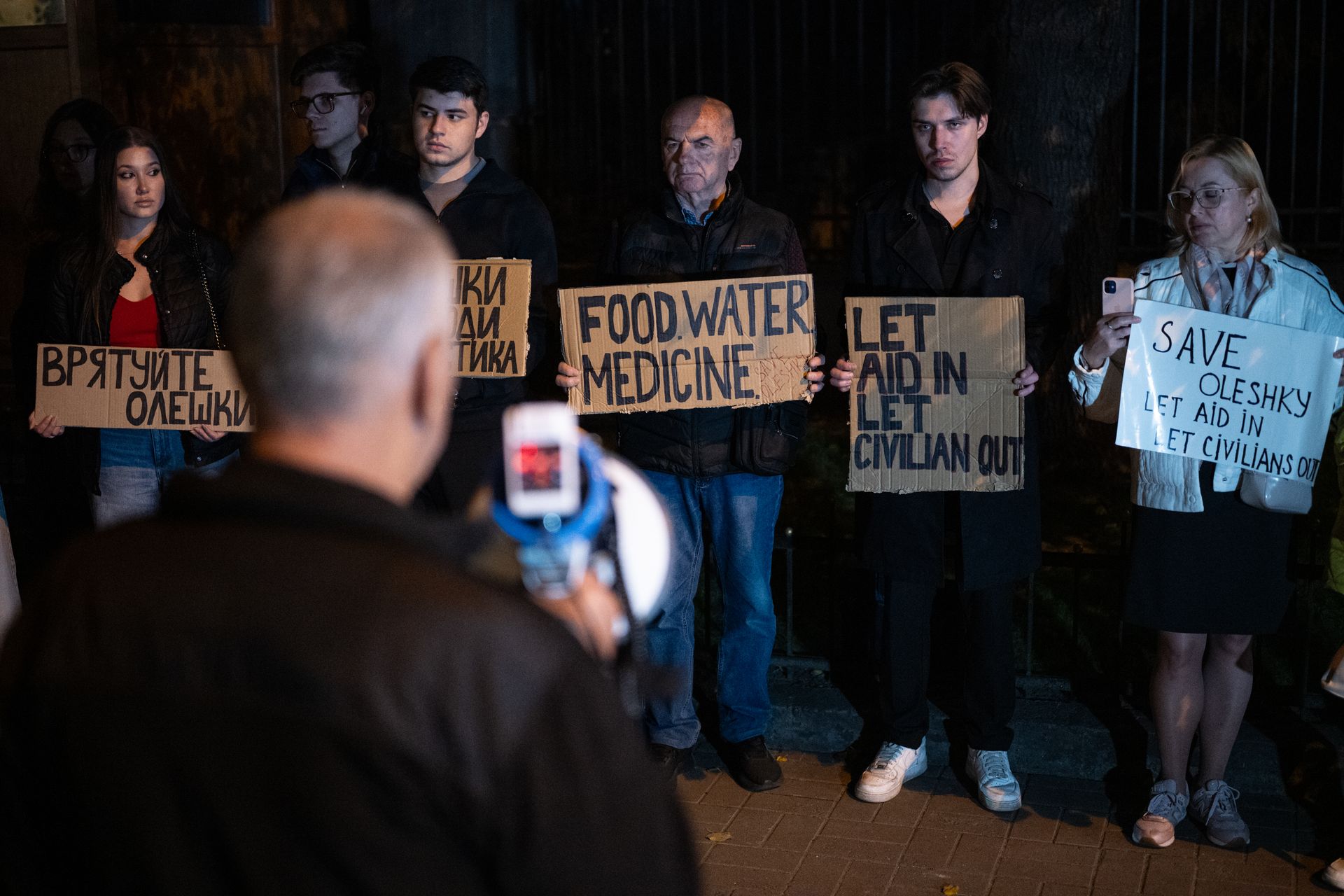
News from occupied Ukraine: Former Oleshky resident warns people 'won't survive this winter'
This weekly update from the Kyiv Independent aims to shed light on the situation facing Ukrainians living under Russian occupation and the ever-tightening control of information imposed by the Kremlin.
Key news as of Oct. 25:
- Oleshky native warns residents may not survive winter as evacuation hopes rise
- Russian-occupied Crimea

Nuove regole Ue sul bagaglio a mano gratis a bordo, il trucco per non pagare
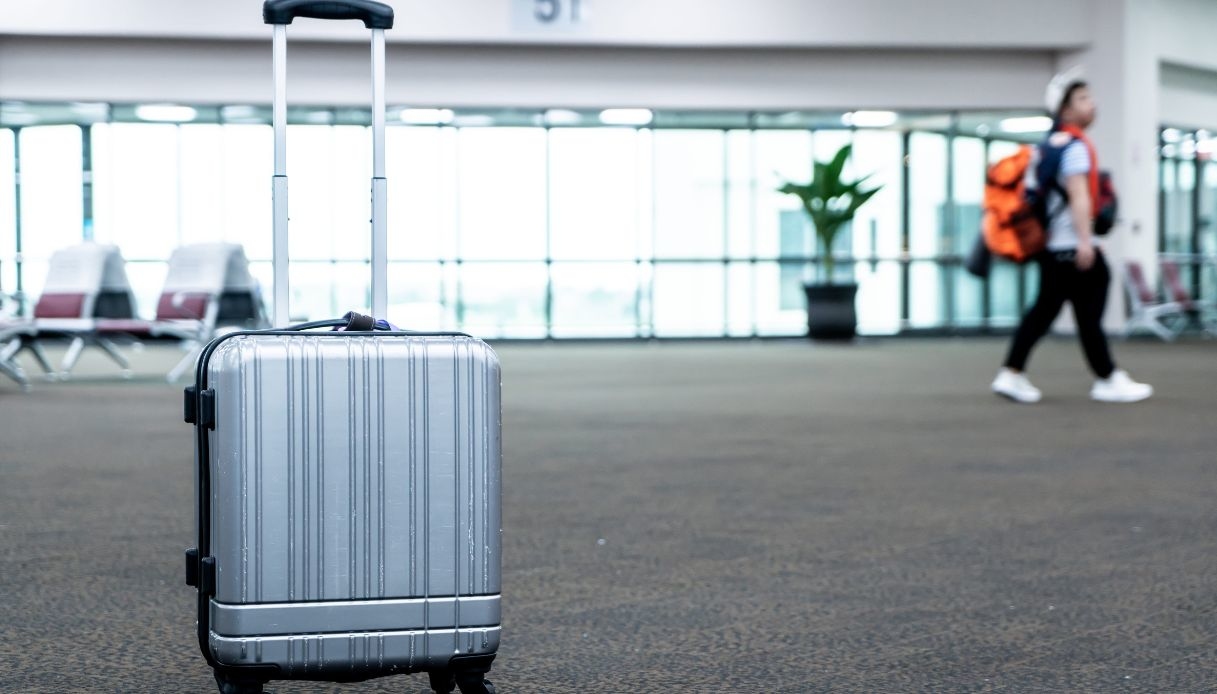
Viaggiare in aereo in Europa sarà più semplice per chi vuole portare con sé un piccolo bagaglio a mano senza pagare supplementi. Con le nuove norme europee è stata riconosciuta a tutti i passeggeri la possibilità di salire a bordo con un oggetto personale gratuito, come una borsa o un piccolo zaino, da sistemare sotto il sedile davanti al proprio posto.
La misura interessa anche chi vola con compagnie low cost come Ryanair ed easyJet, spesso al centro delle discussioni sui costi aggiuntivi per il trasporto dei bagagli.
Bagaglio a mano gratis, cosa cambia
La nuova disciplina europea è stata pubblicata nella Gazzetta ufficiale dell’Unione europea il 2 ottobre 2026 e diventerà operativa dal 23 ottobre 2027.
Negli ultimi anni le compagnie hanno adottato politiche differenti per il bagaglio a mano. Alcune hanno incluso nella tariffa base soltanto una borsa personale, altre hanno consentito di portare un trolley in cabina pagando un supplemento o acquistando una tariffa più costosa (come la priority). Poiché queste differenze possono rendere meno immediato capire quale sia il prezzo effettivo di un viaggio, il legislatore europeo ha deciso intervenire rendendo trasparenti e uniformi le condizioni di trasporto dei bagagli.
Per questo motivo, le compagnie dovranno mostrare le tariffe con un bagaglio a mano incluso come opzione predefinita prima che il passeggero inizi il processo di prenotazione.
Le dimensioni accettate
Con le nuove regole, il passeggero avrà diritto a portare gratuitamente un oggetto personale di dimensioni non superiori a 40 x 30 x 15 centimetri, oppure sufficientemente piccolo da poter essere collocato sotto il sedile davanti a sé.
Per le compagnie aeree, comunque, resterà la possibilità di proporre diverse tipologie di biglietto, con servizi e franchigie differenti. Le valigie più grandi, quindi, continueranno a essere soggette alle condizioni previste dal vettore e alla tariffa scelta dal passeggero.
Pertanto, non bisogna confondere il bagaglio personale gratuito con il bagaglio a mano (di dimensioni maggiori). Sono due categorie differenti, che possono comportare condizioni di trasporto e costi diversi.
Il trucco per non pagare il bagaglio a mano
Per evitare costi aggiuntivi, la strategia più semplice sarà sfruttare il diritto al bagaglio personale gratuito e organizzare vestiti e accessori per il viaggio all’interno di una borsa o uno zainetto compatto, magari sfruttando apposite buste sottovuoto. Non si tratta di un trucco per aggirare le regole delle compagnie, ma di far valere la franchigia riconosciuta ai passeggeri.
Inoltre, prima di partire è consigliabile misurare il bagaglio pieno, perché una borsa che rientra nei limiti da vuota potrebbe superarli una volta riempita.
Le eccezioni
Per ragioni di sicurezza o per mancanza di spazio in cabina, il personale potrebbe richiedere di trasferire il bagaglio nella stiva. In questi casi, secondo le informazioni disponibili, la nuova disciplina prevede che non venga applicato nessun supplemento al passeggero.
Infine, Le nuove disposizioni si applicheranno ai voli in partenza dagli aeroporti situati nell’Unione europea. Di conseguenza, un passeggero che, per esempio, vola da Roma a Londra potrà fare riferimento alle nuove regole per la tratta in partenza dall’Italia, mentre chi vola da Londra a Roma non potrà presumere che la stessa disciplina si applichi automaticamente alla tratta di andata dal Regno Unito.
Serbia al voto, la lista degli studenti sfida il partito di Vucic. Perché il voto a Belgrado è importante per l’Europa
Milosh si è laureato due giorni fa in ingegneria al politecnico di Milano e spera che il suo regalo sarà la vittoria alle elezioni di oggi della Lista degli Studenti che è nata proprio nella sua città di origine: Novi Sad. È proprio in questa città della Serbia dove due anni fa ha cominciato a formarsi il movimento studentesco che potrebbe far perdere la scommessa all’ex presidente della Repubblica, già primo ministro, Alexandar Vucic, dimessosi tre mesi fa allo scopo di indire elezioni legislative anticipate e candidarsi di nuovo alla guida dell’esecutivo, non potendo più aspirare a rimanere alla presidenza per la terza volta quando l’anno prossimo i 6.5 milioni di serbi aventi diritto al voto dovranno eleggere il nuovo capo dello Stato.
Vucic pur essendo al potere da 14 anni con il suo “partito Progressista Serbo” (SNC) neo liberista conservatore non ne vuole sapere di lasciarlo nonostante da ben 24 mesi ci siano manifestazioni di massa contro di lui e il suo partito. Iniziate nelle università di Novi Sad, in seguito alla caduta di una pensilina da poco ristrutturata della stazione ferroviaria in cui rimasero uccise 16 persone, tra le quali alcuni universitari, le dimostrazioni hanno subito coinvolto oltre agli studenti anche i docenti di tutte le scuole e buona parte della società civile. La ragione principale della rabbia popolare, estesasi di giorno in giorno a tutto il paese, è la corruzione di Stato. Il crollo della pensilina appena rifatta con i soldi pubblici è diventato insomma l’emblema della massiccia corruzione governativa e istituzionale. Che è una delle cause per cui la Serbia non è ancora riuscita a entrare nell’Unione Europea a cui aspira da tempo.
L’esito delle legislative è dunque rilevante non solo per i serbi ma anche per noi europei e per Russia e Cina, con le quali Belgrado ha da sempre rapporti stretti. Inoltre la parzialità dei media, le intimidazioni agli elettori e le irregolarità nelle liste elettorali fanno sì che qualsiasi risultato potrà tuttavia essere contestato, scatenando proteste di massa e aggravando l’instabilità regionale. “Temo che Vucic farà di tutto per evitare la sconfitta, mi aspetto brogli o peggio”, sottolinea Milosh rientrato in Serbia per votare.
I sondaggi danno SNS e la lista degli studenti testa a testa. Senza il raggiungimento della maggioranza assoluta dei seggi e a causa del sistema proporzionale c’è chi avverte potrà essere impossibile formare una coalizione di governo costringendo il paese a nuove elezioni.
L’SNS di Vucic è il fulcro della lista “Serbia Unita“. Il partito si affida al controllo delle casse pubbliche, a una copertura mediatica favorevole e a un forte sostegno nazionalista, grazie anche alla recente decisione populista di onorare con funerali di Stato il criminale di guerra e genocida Ratko Mladic.
La Lista degli Studenti rifugge le gerarchie di partito e la figura di un unico leader, preferendo accademici e professionisti stimati a livello locale, e opera attraverso le reti universitarie. Ciò significa che i tradizionali partiti di opposizione serbi sono stati in gran parte emarginati, con il loro sostegno complessivo sceso dal 30% al 10-15%. Alcuni partiti si sono dissolti per confluire nella Lista studentesca, mentre altri, come Serbia Europea, alleata naturale nonchè speranza degli studenti, potrebbero non superare la soglia elettorale del 3%. Questa partita elettorale cruciale non solo per il futuro della Serbia potrebbe dunque continuare la prossima settimana, quando i numeri si trasformeranno in trattative e maggioranze.
L'articolo Serbia al voto, la lista degli studenti sfida il partito di Vucic. Perché il voto a Belgrado è importante per l’Europa proviene da Il Fatto Quotidiano.
Così l’instabilità dell’Etiopia rischia di allargare il conflitto nel Tigray
Il Segretario di Stato americano, Marco Rubio, ha esortato sia l’Eritrea che l’Etiopia a placare gli animi e ridurre le tensioni, avvertendo che tutti i paesi del Corno d’Africa devono rispettare la sovranità e l’integrità territoriale dei propri vicini ed evitare incursioni transfrontaliere. Il Segretario ha sottolineato che la regione non può permettersi ulteriori conflitti.
Le osservazioni di Rubio hanno suscitato un’immediata reazione da parte dell’Alleanza per la Sopravvivenza. In una dichiarazione diffusa il 18 ottobre, l’Alleanza ha precisato che le proprie operazioni militari non sono dettate da obiettivi separatisti né mirano a frammentare il Paese. Al contrario, ha descritto le proprie azioni come atti di legittima difesa, a seguito di quello che ha definito il rifiuto, da parte del governo, di tentativi volti a raggiungere una risoluzione pacifica, inclusi quelli previsti dall’Accordo di Pretoria del novembre 2022.
Sebbene i combattimenti nel Tigray appaiano estremamente simili a quelli passati, esistono differenze sostanziali tra il conflitto attuale e la guerra del 2020-2022. Innanzitutto, non tutti i tigrini sostengono le forze del Fronte di liberazione del popolo del Tigray TPLF. Di sicuro al momento il TPLF non è isolato: ha infatti formato la già citata ‘”Alleanza per la Sopravvivenza” (Alliance for Survival) insieme ad altri sei movimenti etiopi. Quello che però appare ormai evidente è l’allargamento del conflitto. Il 7 ottobre le forze eritree hanno attraversato il confine a Zelambesa, muovendosi verso la direttrice Adigrat-Idaga Hamus. Le Forze di Difesa del Tigray sono fortemente presenti nel distretto (woreda) di Atsbi, mentre i leader del TPLF si trovano nelle aree rurali del distretto di Ahferom, nella zona del Tigray centrale.
Si sospetta che l’Eritrea stia sostenendo la neonata “Alleanza per la Sopravvivenza” al fine di indebolire il governo etiope visto che l’Eritrea si oppone al tentativo dell’Etiopia di ottenere un accesso al Mar Rosso attraverso il porto di Assab, cercando di creare una zona cuscinetto tra i due Paesi. Il maresciallo di campo Birhanu Jula, capo di stato maggiore delle Forze di Difesa Nazionale Etiopi, ha accusato l’Eritrea di aver mobilitato sostegno finanziario a favore del TPLF. Egli ha inoltre sostenuto che l’Eritrea e il TPLF avrebbero beneficiato dell’appoggio di Sudan ed Egitto, lasciando intendere un’interferenza esterna.
Sulla carta l’esercito governativo ENDF appare in vantaggio numericamente, contando circa 500.000 effettivi a cui si aggiunge un bacino di 368.000 riservisti, oltre a un arsenale di armi pesanti e in particolare di droni di varia origine, a cominciare dai turchi Bayraktar TB2 e Akinci. Il TPLF da solo può contare su circa 250-270mila uomini. Al momento però l’unica cosa che si può affermare con assoluta certezza è che il bilancio delle vittime è in costante aumento, con un prezzo altissimo pagato sia dai militari che dai civili. Tutto ciò avviene in un momento in cui la popolazione del Tigray è esausta sotto ogni profilo: psicologicamente e fisicamente, anche a causa delle estreme difficoltà derivanti dalla siccità e dal fallimento dei raccolti. Un cessate il fuoco può congelare le ostilità sul campo ma non rimuove le cause scatenanti della violenza.
La stabilità a lungo termine dell’Etiopia non può essere raggiunta con la sola coercizione militare o con tregue di breve respiro. È necessario un processo politico inclusivo che permetta a tutte le componenti della società etiopica di ridefinire su basi condivise sia la ripartizione equa del potere politico ed economico a livello centrale e periferico, sia la natura del rapporto tra il governo federale e le regioni, garantendo il rispetto delle autonomie, la tutela delle minoranze e la certezza dello stato di diritto. Senza questo sforzo strutturale per sanare le fratture costituzionali, il Paese rischia di rimanere intrappolato in una spirale perenne di instabilità.
L'articolo Così l’instabilità dell’Etiopia rischia di allargare il conflitto nel Tigray proviene da Il Fatto Quotidiano.
Argentina Press Groups Condemn Milei’s Threats To Journalists
Press freedom groups condemn Javier Milei’s threats against journalists who investigated the $LIBRA cryptocurrency case, warning of rising hostility toward the media.
Argentine press freedom and human rights organizations have condemned President Javier Milei for threatening journalists who investigated the $LIBRA cryptocurrency scandal, warning that his remarks could expose media workers to violence and undermine freedom of expression.
RELATED: Argentine Court Rules Milei University Funding Decree Unconstitutional
Speaking at a dinner hosted Friday by the Fundación Faro think tank, Milei attacked journalists who covered the $LIBRA case, accusing them of spreading false information and coordinating a political operation against his administration.
The remarks came hours after a court dismissed the judicial case involving the cryptocurrency, a digital asset promoted by Milei in February 2025 whose sharp price fluctuations harmed thousands of investors.
Text Reads: 🗣️ Argentine President Javier Milei stated on Friday that “the ones who should be burned at the stake are the sons of b*tches,” after publicly singling out media figures who covered the investigation into the cryptocurrency $LIBRA.
⚖️ These remarks were made during a dinner hosted by the Fundación Faro, just hours after the judiciary dismissed the case. Milei specifically mentioned journalists from La Nación, Perfil, and A24.
📢 FOPEA (Forum for Argentine Journalism) denounced an “unprecedented escalation,” warning that such language “legitimizes violence.” The CELS (Center for Legal and Social Studies) described his comments as an “authoritarian escalation,” while the union SiPreBA called for an immediate response from the political and media spheres.
🔴 “The State has an obligation to protect journalists, not to turn them into targets,” FOPEA stated.
During his speech, Milei threatened those he accused of wrongdoing with being “burned at the stake” and singled out five journalists by name: Hugo Alconada Mon, Carlos Pagni and Paulino Rodrigues of La Nación newspaper; Natalia Volosín of Perfil; and Luis Novaresio of A24 television.
“Let it be known that the sons of bitches in Argentina will receive no mercy,” the president declared. “Those who deserve to be burned at the stake are the sons of bitches.”
The remarks drew condemnation from press freedom and human rights organizations, which warned that publicly identifying journalists while using such threatening language could increase the risks they face in their work.
The Argentine Journalism Forum (FOPEA) said the reference to burning journalists at the stake, coupled with the president’s naming of specific media professionals, marked a significant escalation in government hostility toward the press.
“The state has an obligation to protect journalists, not turn them into targets,” the organization said. It urged Milei to stop stigmatizing journalists and called on political leaders, lawmakers and other institutions to publicly respond to the incident.
The Center for Legal and Social Studies (CELS) described the episode as an “authoritarian escalation” in a statement published on X. The organization warned that when a head of state publicly casts critics as enemies, it can encourage attacks and undermine democratic debate. It also argued that insults and defamatory attacks against journalistic work must have limits.
❌ESTO NO ES UN REPUDIO,
— SiPreBA – Sindicato de Prensa de Buenos Aires (@sipreba) October 24, 2026
ES UN LLAMADO A LA ACCIÓN
🔊FRENEMOS LA INQUISICIÓN DE MILEI
El presidente Milei volvió a cruzar un límite gravísimo. La instigación a “quemar en la hoguera” a un grupo de periodistas debe generar una reacción inmediata de todo el arco político y… pic.twitter.com/XrXOohrVDe
Text Reads: ❌THIS IS NOT A REJECTION,
IT’S A CALL TO ACTION
🔊LET’S STOP MILEI’S INQUISITION
President Milei has once again crossed a gravely serious line. The incitement to “burn at the stake” a group of journalists must provoke an immediate reaction from the entire political and media spectrum to halt the attacks on our profession. There will be no room for regrets if the violence promoted by the President ends up turning into facts.
This government, which nearly killed photographer Pablo Grillo in a savage crackdown, now calls, in the voice of its highest representative, to assault our colleagues, as has already happened. We send our solidarity to @halconada, @CarlosPagni2, @nataliavolosin, @paulinor76and @luisnovaresio and place ourselves at their disposal.
With threats on social media, repression in the streets, and attacks on rights in Congress, they seek to silence the press. From SiPreBA, we call to defend the Journalist’s Statute and to respond with more democracy in the face of the return to the Inquisition proposed by the Executive Branch.
CELS said the incident was part of a broader pattern of hostility toward media workers, including harassment, attacks on digital platforms and repression of journalists covering public demonstrations.
The Buenos Aires Press Union (SiPreBA) also condemned the president’s remarks, calling for an immediate response from political and media figures to stop the attacks. The union expressed solidarity with the journalists targeted by Milei and warned of the possible consequences of his rhetoric.
“There will be no room for regret if the violence promoted by the president ends up turning into actual incidents,” SiPreBA said.
The organizations called for political and institutional action to protect journalists and counter hostility toward the press following Milei’s public targeting of reporters who investigated the $LIBRA case.
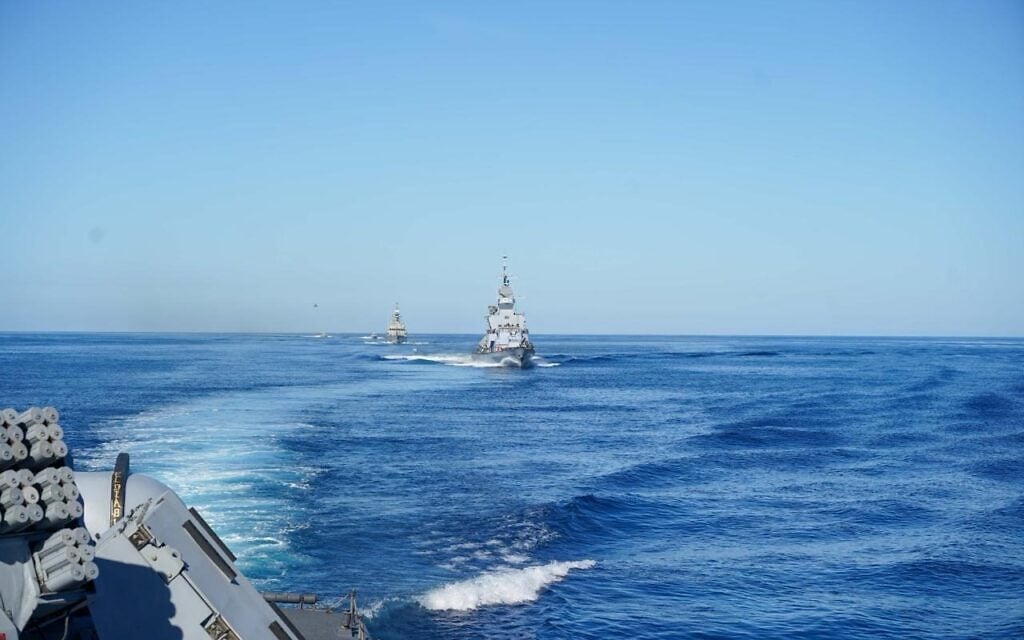
Israeli, Greek navies drill in Mediterranean, in apparent message to Turkey