The peaceful departure of Serbian president Aleksandar Vučić could open a positive new chapter in Western Balkans history, even as France drifts in the opposite direction.
Vučić acknowledged defeat shortly after 9.30PM on Sunday (25 October), when exit polls put his SNS party on 105 seats in parliament out of 250, behind the reformist Student List movement, led by cardiologist Ilija Srdanović, on 135 to 140, even though the final results were far from clear.
“Serbia is free! People, BRAVO!,” the Student List posted on X.
It had been a tense night in Belgrade, with a heavy police presence in front of government buildings, scuffles at polling stations, and with student and other citizens’ patrol groups monitoring voting, as well as over 300 formal international observers.
MEPs and US senators had also warned Vučić (who had once worked at the top levels of the brutal dictatorship of Slobodan Milošević) on X not to resort to violence to try to steal the vote.
But it seems that the landslide was so huge and the turnout so massive (over 69 percent) that there was nothing to be done.
Serbian nationalism, Western Balkan corruption, and Russian interference will not disappear from the region overnight, but with the nationalist-populist Vučić gone there is more chance of normalisation of Kosovo relations and less risk of a Bosnia break up.
And there is every chance that a positive reform momentum, rewarded by the EU, could spread from Serbia into neighbouring states and help bring more Western Balkan countries into Europe, after Montenegro is due to join in 2027.
It is the fourth defeat in national elections for pro-Russian and/or far-right parties in Europe this year, after Hungary, but also Sweden and Latvia.
And that is a good trend for progressives, in the run-up to the election super-cycle of late 2026/2027, which will see similar battles unfold in Spain, France, Estonia, Finland, Greece, Slovakia, Poland, and Italy in the next 12 months.
“If we have peace, whatever the outcome, it will be beneficial and blessed. If we have unrest, anger, and hatred, whatever the outcome, it will be disastrous for everyone,” said Serb Orthodox Church patriarch Porfirije earlier on Sunday.
Meanwhile, the spectacle of a peaceful, democratic transition of power in Serbia will not be welcomed by Moscow’s authoritarian rulers.
But if it is an example to Russian people, then it is also a powerful, alternative model for any students, leftwing activists, or ethnic minorities in France, Italy, or further afield in Europe, who spent a second weekend rioting in multiple towns in protest at social inequality.
If the far-right was to take power in France in April, spurred on by racial tension and civil unrest, it would quickly wipe out any gains made on Sunday in Serbia, in terms of EU stability, Western Balkans’ enlargement prospects, and Russian influence in Europe.
But if young people in the EU want fairer societies, then the students of Serbia, who began today’s tectonic shift in small protests two years ago in the provincial town of Novi Sad, have shown them that the path to victory lies in non-violent resistance and patience.
Undocumented immigrants are taxpayers. Why shouldn't their children, for whom they have often sacrificed so much, enjoy the benefits their parents have worked to earn?
The newly introduced Motion Picture, Television, and Entertainment Revitalization Act seeks to implement a federal tax incentive to combat the trend of film and television production moving overseas.
The bipartisan America the Beautiful Act, which proposes an international visitor surcharge to fund the maintenance of national parks and public lands, is moving through Congress.
Thirteen years later, the damage is clear. States freed from federal oversight, many of them states of the old Confederacy, have adopted new restrictions on voting that dramatically dilute minority voting power.
On Aug. 26, 2024, in Fort Myers, Florida, I answered a knock at my door to find a police officer waiting to arrest me. My first thought was my 12-year-old daughter, whose room was nearby. “Can she hear this?” I wondered. “Does she know what’s going on?” I had answered the door in my flip-flops, T-shirt and shorts, not realizing it would be all I had to keep me warm as I was thrown into an ice-cold jail cell, then into a steel cage in the back of a police van and finally locked up in a second jail. They told me I was being arrested for attempting to lure a child — roughly the same age as my daughter — from a McDonald’s in Jacksonville Beach, a town 300 miles away that I had never been to.
The whole time, I couldn’t stop thinking about when I would see my wife and daughter again. How would I explain why I was under arrest for a crime I didn’t commit in a city far across the state? Especially when I didn’t even understand what was going on myself.
The police ran my two vehicles through a database of license plate readers, which didn’t show my car anywhere in the entire county, much less near the restaurant. Yet based on the say-so of glitchy AI, they ruined my life.
After pledging the title to my truck for bond, I left the police station completely traumatized. I later learned that the Jacksonville Sheriff’s Office uploaded a picture of the McDonald’s security footage into an artificial intelligence facial recognition system, which erroneously flagged me as a possible match. Jacksonville Beach Police then conducted a photo lineup not with the victim, but with a McDonald’s employee who was not an eyewitness.
Meanwhile, the officer leading the investigation ignored a mountain of evidence of my innocence. I have a prominent scar on my face that the suspect didn’t have. The same employee who picked me out of the photo lineup also said the suspect was a “regular customer,” but I live more than five hours away. The police ran my two vehicles through a database of license plate readers, which didn’t show my car anywhere in the entire county, much less near the restaurant.
Yet based on the say-so of glitchy AI, they ruined my life.
Robert Dillon, a commercial crabber in Florida, holds a crab.Photo courtesy ACLU
Until I was arrested for a crime I did not commit, I was a successful commercial crabber. I’ve loved crabbing since I first tried it as an 8-year-old kid hanging out on the Maryland docks. In the 40 years since, I’d built a beautiful life. I had a fulfilling career on the water, and an incredible wife and daughter and great friends. Anyone who knew me would tell you that I was a family guy. I was happy. All that changed after the police hauled me to jail and posted my mugshot online.
Weeks later, the Florida state attorney’s office dropped all charges. Now, I’m suing the officers, the city of Jacksonville Beach and the Jacksonville Sheriff’s Office. In addition to damages, I am asking the court to order the city and the sheriff’s office to overhaul their procedures for using facial recognition technology.
It had taken two months to prove my innocence and my mugshot stayed on a police department website for nearly a year. At first, I could barely leave the house, terrified that someone would confront me for this revolting crime or see me with my daughter and call the police. Even when I was with people who knew I had been falsely accused, I couldn’t stand them looking at me and wondering even for a second, “Maybe he actually did it.”
I fell behind on rent, and when I was finally able to get back out on the water, it was too late. My seafood buyers had moved on. I was hemorrhaging cash. I had to turn my back on the ocean and start doing lawn care to provide for my family. Even harder than finding the money to rebuild my business is rebuilding the trust and credibility I lost because of the government’s colossal screw-up.
if there is one thing I am not, it’s a quitter. I will not quit until I get justice and the government makes amends.
When I told my daughter about the reason for the arrest, something I’d waited to do until after I had proven my innocence, she couldn’t stop laughing. To her, the accusation was that outrageous. While she laughed, I cried, just grateful to know that she was still in my corner and saw me for the person I was: her loving, caring, happy-go-lucky dad.
I am the first to admit that I am no angel. I’ve done stupid stuff in my past — gotten in some fights, spent some nights in jail. Any of my friends would agree that if there’s a loudmouth at the bar, I’m the one to tell him off. But I would never hurt a child. Ever.
When I’ve gotten in trouble, I’ve paid my debt to society. But the government doesn’t want to pay theirs. When I got into a bar fight, within a day I was hauled in front of a judge. Yet more than two years after my wrongful arrest, no one has even apologized, much less been held accountable in any court of law. And nothing has changed. I am still suffering. All because some cops used shoddy AI facial recognition, ignored contradictory evidence and, instead of protecting little girls in Jacksonville Beach, arrested an innocent guy in Fort Myers.
The government keeps trying to sweep what they did to me under the rug, hoping that I will give up and move on. But if there is one thing I am not, it’s a quitter. I will not quit until I get justice and the government makes amends. That’s why I have turned to the courts. They must hold the police accountable for altering my life forever. The record is clear. Justice should not take years to impose.
(Editor’s note: The Jacksonville County sheriff’s departmenttold Wired Magazine, “Due to pending litigation, we would be unable to comment further on the incident.”)
Caro is a city of about 4,000 people in central Michigan and the seat of Tuscola County, which Donald Trump won by more than 40 percentage points in 2024. On a brisk Saturday afternoon, just more than two weeks before Election Day, I drove there in a rental car to see progressive firebrand Abdul El-Sayed, a candidate for U.S. Senate, hold a town hall. When I flipped on the radio en route to Caro, I immediately heard the hosts of a right-wing talk show lavishing praise on Elon Musk. After many miles of driving alongside corn fields and wind turbines, while listening queasily to admiration for the reactionary tech tycoon, I was surprised at what I saw upon my arrival: hundreds of people lined up outside a community center waiting to hear what a Bernie Sanders-backed Democrat had to say. El-Sayed, who has never held elected office, has a narrow lead in the polls against former Republican Rep. Mike Rogers for a seat left open by a retiring Democrat.
El-Sayed took to the stage in his signature tightly fitting black shirt and jeans. After joking that he had come to Caro because it was one letter off from Cairo — a nod to his Egyptian ancestry — he immediately worked the crowd up by listing things that “shouldn’t be this hard” in America: buying a tank of gas, buying a second bag of groceries, seeing a doctor. When he ended the list by declaring, “Shouldn’t be this hard to pay your taxes and know that that money’s going to be spent on you and your kids instead of dropping bombs on somebody else and their kids,” the crowd roared.
Then came a call-and-response from El-Sayed and the Caro crowd that hammered home his core campaign themes:
“Money out of?”
“Politics!” they shouted.
“Money in your?”
“Pockets!”
“Medicare for?”
“All!”
Marla Martian, front-left, of Schwartz Creek, Michigan, shouts along with El-Sayed on Oct. 18, 2026, at a campaign event in Flint, Michigan.Quinn Banks for MS NOW
Many in the Caro crowd nodded as El-Sayed said, “Donald Trump is not himself the disease of our politics. He’s the worst symptom of the disease of our politics. The disease is the system that allows big corporations and billionaires and special interests to buy and sell politicians in ways that leave them rigging the system against us.” His language frequently draws attention to his training as a doctor. He never practiced medicine after finishing medical school at Columbia, but he earned a doctorate in public health from Oxford, and he has served as a health director for Wayne County, which is home to Detroit.
It was after El-Sayed said he’d answer questions that the mood darkened. In what may be the most viral moment of the 2026 midterm elections, a man in the audience who identified himself as Tommy stood up and asked El-Sayed if he would “disavow the Muslim Brotherhood,” an Islamist organization that Tommy called a “terrorist group.” El-Sayed said he’d have no problem disavowing the Muslim Brotherhood and did so. He then rejected the bigoted basis for Tommy’s question, and lectured him on the Constitution and freedom of religion.
Left: An attendee listens to U.S. Rep. Ayanna Pressley. Right: El-Sayed speaks to community members and supporters.Quinn Banks for MS NOW
There has been no indication that El-Sayed, or anyone else in the room, knew that Tommy was Thomas Teepell, a GOP operative who most notably worked as a former aide to Sen. Josh Hawley, R-Mo. But watching their exchange from inside the room, I was struck by El-Sayed’s antagonistic, even scornful, tone with him. Most politicians find a way to brush off the substance of what their hecklers say, if they don’t have them escorted out altogether. As Teepell began to leave, a woman yelled, “Bye, Tommy!” All of a sudden, a whole chorus of “Bye, Tommy! Bye, Tommy!” rang out as he walked out the door. “Tommy” might have thought his Islamophobic attack would do well in Caro, but El-Sayed beat him back, and he walked out being jeered, with his tail between his legs.
The Caro town hall dramatized the exhilarating possibilities of El-Sayed’s campaign — and the dark reactionary forces arrayed against him.
El-Sayed is not a socialist, but he is backed by many of them, and his demands for government-backed health insurance, hostility toward corporate power, and willingness to call Israel’s war a “genocide” represents a break from standard American liberalism. His campaign embodies a belief — contra the Democratic establishment — that the political system must change and that the left can plausibly build a base for that effort in heartland America. In that Caro town hall, that change felt like a possibility.
But “Tommy” represents the right’s counter to this vision. Not with rebuttal, but by fostering bigotry and smearing progressive politics as an alien import. Michigan State University political scientist Matt Grossmann told me Muslims are “one of the few demographics that voters are willing to express that they dislike.” Nearly 40% of voters in Michigan have admitted they’re less likely to support a Muslim candidate, and the GOP’s attacks on El-Sayed have mostly focused on him being a Muslim born to Egyptian immigrants to imply he’s a “risky” extremist.
Some politicians might react to such a political environment by affecting an air of amicability, but El-Sayed doesn’t. For some Michiganders, that makes him all the more appealing. I spoke to dozens of voters that week as I followed El-Sayed criss-crossing the state. Nearly every town hall attendee I spoke to described El-Sayed’s fierce speaking style — which routinely includes cutting down his opponents with harsh language — as a reason they were drawn to him.
“I like how he’s almost abrasive, like how honest and how raw he is, and the things that he’s honest and raw about,” Trevana, a 36-year-old customer service professional who lives in Midland, told me.
El-Sayed shakes hands with Zelda Cornish from Holly, Michigan, on Oct. 18, 2026.Quinn Banks for MS NOW
Alexus-Jo, a university financial aid office staffer who lives in rural Bay County, said she has in the past voted Republican and third party, and wasn’t planning to vote at all this time — but then she was moved by his tough persona: “I feel like establishment Democrats underestimate how volatile the general political climate is, and I feel like he’s not being stepped all over,” she said.
She added, “Seeing my Republican family members or people that aren’t Democrats say, ‘I don’t love the idea, but he’s got some things where I’m like, “OK, I’m listening,”’ that has really made me energized to get more into politics.”
My goal in Michigan was to see how a candidate aligned with the Bernie Sanders left connects with and persuades voters far from the deep-blue cities and districts where the movement has thrived — and how that candidate withstands right-wing attacks. El-Sayed is connecting with voters in a thoroughly purple state, it seems, by disregarding colors and labels.
“There’s no such thing called ‘progressive’ versus ‘conservative’ ideas, we make that up,” El- Sayed told me after a packed 500-person town hall at a theater in Bay City, a small urban center in a Trump-friendly county which, to his point, voted twice for President Barack Obama. “Red and blue are not real, those are not real things. What’s real is people are locked out of their politics by a system that allows big corporations and special interests to buy their politicians.”
The far left has long believed that appealing to people’s shared class interests can cut across cultural differences and pre-existing ideological barriers. El-Sayed’s race against Rogers will be the most consequential test of that theory in recent memory.
***
El-Sayed’s potential strength with swing voters can be placed in three buckets: his specific mode of charisma as a fighter; his focus on — and slightly misleading framing of — Medicare for All; and his ability to frame issues including foreign aid and crime in ways that can appeal to voters on the right and left.
In our era, anger at the status quo is a way to reach across the aisle. El-Sayed’s persona as a scrapper, enhanced by his conspicuously muscular physique, allows him to radiate populist energy at a time of bipartisan demand for it. A new TV ad campaign of his emphasizes his credibility going up against the “corrupt swamp” and the “elites” in Washington to highlight where MAGA Republicans might find something in common with his worldview.
When El-Sayed fired back at “Tommy,” in Caro, I agreed with his argument, but I also winced — condescension toward a town hall participant is usually gaffe territory. But that’s an old-school rhetorical norm, and it is precisely because El-Sayed responded so forcefully that he was effective. He kicked off a news cycle about Islamophobia and his campaign, brought broadly positive attention to himself in the mainstream press and on social media, and used the moment of confrontation to raise money.
Still, there are obvious potential downsides to such pugilism. El-Sayed was repeatedly panned for being patronizing toward his opponents during a primary he won by a narrow margin, and he might miss out on voters who prefer conciliatory or unity-focused orators.
When I asked El-Sayed, while riding on his campaign bus between Flint and Detroit, if he ever second-guessed his abrasive style, he answered, “I just am who I am.” He continued, “I like to build stuff. I rebuilt a health department, led another one, built programs. But too often, when you look at why we are not building for working people in America, it’s because of the insane politics from folks like Donald Trump and Mike Rogers and JD Vance. So if you’re coming to break the things that we want to build, yeah, I’m going to stand up to you.”
El-Sayed receives a wristband from American Federation of State, County and Municipal Employees members.Quinn Banks for MS NOW
Virtually every voter I interviewed cited El-Sayed’s support for Medicare for All as a key point of interest. KFF, a health research group, found in September that 66% of Americans, including nearly 40% of Republicans, support “a national health plan, sometimes called Medicare-for-all, in which all Americans would get their insurance from a single government plan” — the highest share since they started asking the question about a decade ago. A top pollster in Michigan found support for Medicare for All in Michigan is at 62%.
Mark Brewer, a 65-year-old independent voter and retired construction worker who lives near the village of Mayville, told me he thought El-Sayed’s support for Medicare for All was a good idea. He has voted for libertarian candidates in the past, and told me he’s “financially conservative,” but was frustrated that the vast amount of money he spent on health insurance never guaranteed him care.
“I worked construction for 40 years. I paid $375,000 into health insurance during that time. The day I retired, it stopped,” he said. He said he was unhappy he had to go three years without insurance until he qualified for Medicare.
Tad Sumner, a 61-year-old Midland resident who works in banking and IT, said in 2016, he was for Hillary Clinton, not Bernie Sanders, but he has slowly moved to the left and toward El-Sayed’s healthcare views because “health care has become more and more profitized.”
People skeptical about Medicare for All are often afraid of losing the insurance they do have, as flawed as it is. How does El-Sayed put them at ease? “People are frustrated by the current system,” he told me. “I’m not interested in taking anything away. I’m interested in offering you a guarantee for health insurance, cradle to grave, without worrying about a network, or out of network, without worrying about a premium, copay or deductible.”
Unlike some advocates for Medicare for All, El-Sayed says his plan would not entail prohibiting duplicative private insurance. But as People’s Policy Project founder Matt Bruenig has pointed out in Jacobin, that’s effectively a sleight of hand. After a public plan emerges and many employers drop coverage of health insurance, it’s unlikely that people will be able to, or inclined to, purchase expensive private policies that duplicate coverage they’re already guaranteed. Moreover, private insurance would likely look quite different, if it still existed, Bruenig notes. Whether El-Sayed’s plan would formally allow private insurance is not really the issue — but his position that he doesn’t want to take anything away must make the idea go down easier for the skeptics.
El-Sayed has garnered a lot of attention for confidently characterizing Israel’s treatment of Gazans as a “genocide” and opposing unconditional aid to Israel. But the bulk of his foreign policy messaging during town halls and press interviews hasn’t focused on Israel. In those contexts, he has more generally called out militarism and argued that the U.S. should focus on spending at home.
El-Sayed arrives to speak to attendees at a Get Out the Vote Rally hosted by the Northern Midwest Regional Council of Carpenters and the Michigan Democratic Party in Detroit on Oct. 18, 2026.Quinn Banks for MS NOW
The remark he made in Caro — “Shouldn’t be this hard to pay your taxes and know that that money’s going to be spent on you and your kids instead of dropping bombs on somebody else and their kids” — has cross-partisan appeal. With it, El-Sayed simultaneously connected foreign policy adventurism to depleted social services at home; issued a moral judgment by directing attention to the killing of innocents; and, because he didn’t name any countries, he condemned the U.S. backing Israel and the U.S. war with Iran simultaneously. There was something there for war-averse people across the political spectrum. That framing seemed to resonate with many voters I spoke to, some of whom approved of his position on Iran or Gaza, while many others said they approved of how El-Sayed’s foreign policy “put Michigan first.”
I asked El-Sayed if he wanted to be associated with an America First position, or if he would say other values inform his foreign policy worldview. “I definitely am America first,” El-Sayed said. “But my real value is I believe in international law, and I believe we need to be the first among equals to enforce international law.”
That poses some vexing questions and contradictions. Enforcing international law would seem to cut against the idea of focusing exclusively on American affairs. And he insisted on a “responsibility to support Ukraine.” That’s not what MAGA America First advocates want. But this part of El-Sayed’s worldview doesn’t feature in his messaging and doesn’t seem to be trickling through as much to voters, based on my conversations.
When crime came up at the town halls, El-Sayed positioned himself as an advocate for both the status quo and reform. Like socialist New York Mayor Zohran Mamdani, El-Sayed has flipped on his previous support of “defund the police.” At Bay City, a voter asked about criminal justice reform in light of an unsolved murder of her peers. El-sayed emphasized “everybody should get to come home safely” — community members and police — and he spoke about funding the police in order to protect “recruitment, retention, and retirement.” He added that there should also be investment in community violence intervention and mental health response services. In other words: Fund the police and alternatives to policing.
When I asked if he took issue with “defund the police” as rhetoric or policy, he said, “It was a dumb idea and dumb rhetoric.”
While some proponents of criminal justice reform on the progressive left will take issue with El-Sayed’s turn to full-throated support for policing, his additive approach to reform has the potential to appeal to progressives and nonprogressives alike.
***
Nine-year-old Zelda Cornish from Holly, Michigan, asks El-Sayed and U.S. Rep. Ayanna Pressley a question during a campaign event on Oct. 18, 2026.Quinn Banks for MS NOW
Will all of this come together for a winning ticket? El-Sayed’s calibration of progressive politics to the Rust Belt seem to be resonating enough with voters that he’s been able to maintain a lead, but his lead is narrower than the Democratic gubernatorial candidate’s lead over her Republican opponent in this state. He is massively outraising his opponent, but Rogers is a former seven-term U.S. representative with Trump’s backing and significant name recognition. El-Sayed has labored to make his campaign appealing to people across the political spectrum, but that doesn’t mean that they will overlook his party affiliation or discard racial prejudice. He could easily lose.
The Democratic base is not entirely a lock for him. El-Sayed was weak with Black voters in the primary, and whether they will turn out in large numbers for him is an open question that could decide the race. Tensions between the Arab and Black community in Michigan have been cited by strategists and reporters as an issue for El-Sayed. But the main issue may have less to do with race than with ideology. “A lot of his issues with Black voters are not necessarily specific to Black voters,” Grossmann, the Michigan State political scientist, told me. “Within the Democratic Party, Black voters are actually more likely to identify as moderate or conservative, and more likely to be skeptical of the Bernie wing of the party.”
The stakes of this race are exceptionally high. The outcome will not only be crucial in determining who controls the Senate, but will also shape conversations about 2028. According to a recording obtained by The New York Times, Rep. Alexandria Ocasio Cortez, D-N.Y., who is considering a presidential run, said at a New York fundraiser in October that El-Sayed is part of a “generational project” for the progressive movement that could help “break the map.” She added, “If Abdul can win in Michigan, anybody can win anywhere.”
Undoubtedly, the outcome of El-Sayed’s race will be used to make the case that a democratic socialist like Ocasio-Cortez has a real chance at winning the White House — or shatter the argument. But a major confounding variable in this contest is that El-Sayed faces unique obstacles due to his identity.
Given that polls in Michigan detect real bias against Muslims and that Trump has won the state twice, I asked El-Sayed whether running as a progressive Muslim in an environment of rampant Islamophobia was asking too much. Had he been tempted to move toward the center?
“I don’t lie to people,” he said. “I tell them what I believe. I’m not willing to check my ideals at the door because of my identity. That’s what people hate about politics. I am who I am. I’ll tell you what I believe. If you agree with me, vote for me.”
He added, “Even if they might never want to vote for me because of my name, maybe by the end of my public service, they’ll think a little bit differently about what America is. Because America’s always been a place where people come together despite our differences to build together what we can’t alone. I believe in that.”
Marla Martian, front-left, of Schwartz Creek, Michigan, shouts along with El-Sayed on Oct. 18, 2026, at a campaign event in Flint, Mich.
Left: An attendee listens to United States Representative Ayanna Pressley. Right: El-Sayed speaks to community members and supporters.
El-Sayed shakes hands with Zelda Cornish from Holly, MI, on Oct. 18, 2026.
El-Sayed receives a wristband from American Federation of State, County and Municipal Employees members.
El-Sayed arrives to speak to attendees at a Get Out the Vote (GOTV) Rally hosted by the Northern Midwest Regional Council of Carpenters and the Michigan Democratic Party in Detroit, on Oct. 18, 2026.
9-year-old Zelda Cornish from Holly, Michigan, asks El-Sayed and United States Representative Ayanna Pressley a question during a campaign event on Oct. 18, 2026.
At a recent town hall in Detroit, Vice President JD Vance faced a question that went to the heart of the Catholic faith he says guides him: How can he reconcile the treatment of families by Immigration and Customs Enforcement with the Gospel?
Sister Nancy Sylvester of the Sisters, Servants of the Immaculate Heart of Mary, described her group’s work at the southern border and the trauma children endure when they come home to find their parents gone. Then she asked Vance how he could justify ICE officers’ conduct “in terms of the kind of values we want to live by.”
Vance praised ICE agents as patriots. He offered only a passing acknowledgment that officers who “screw up” should be investigated and prosecuted, without grappling with the Americans killed by ICE agents or the detainees who have died in ICE custody.
The town hall drew more attention for the way in which Vance stumbled over questions about Trump’s corruption and the deaths of service members in the war in Iran. But his answer to Sister Sylvester was especially revealing: When the administration’s actions collide with the Catholic teachings he frequently invokes, Vance is willing to set those teachings aside.
As a former seminarian, I found the gap between her question and his answer deeply troubling.
As an American and as a former seminarian, I found the gap between her question and his answer deeply troubling.
First of all, Vance has frequently centered his Catholic faith throughout his political career. Just this year, he published his second memoir, “Communion,” detailing his conversion to Catholicism and how it informs his worldview. And yet earlier this year, when Trump was inexplicably feuding with the first American pope, the vice president had the gall to say that “it would be best for the Vatican to stick to matters of morality,” and “let the president of the United States stick to dictating American public policy.”
That’s despite this administration repeatedly presenting matters of faith and matters of government as irrevocably entwined. Just months earlier, Vance lamented the Supreme Court upholding the separation of church and state, saying at a Turning Point USA event, “I think it was a terrible mistake, and we’re still paying for the consequences of it today.”
For all its bluster about protecting religious freedom, this administration has actually targeted faithful servants like Sister Sylvester. The haste of this White House to extrajudicially purge the country of undocumented immigrants has put it in direct confrontation with people of faith.
Which brings to mind another book Vance should have spent a bit more time with. In Matthew 25, Jesus says that on Judgment Day, those who welcomed the stranger will be welcomed into the kingdom of God. He identifies Himself with people who need food, shelter, care and companionship. Our response to their vulnerability becomes a measure of our response to Him.
Last year in Chicago, Catholic groups sued the administration for the right to minister to detainees at a Broadview ICE facility. In New Jersey, elderly Catholic nuns have organized protests outside of Delaney Hall against the deaths of ICE detainees. Nuns have also been protesting in Vance’s home state of Ohio, as Haitian immigrants repeatedly dehumanized by this White House see their legal status ripped away.
These protests are so widespread because the Catholic Church is unequivocal in its teachings about hospitality for the immigrant, charity for the poor and embrace of the stranger.
Trump’s immigration actions have put the administration in direct conflict with people of faith who take these teachings seriously. In some cases, it has even suppressed their ability to worship.
Human dignity does not depend on citizenship. A person’s immigration status can determine whether that person has a legal right to remain in this country. It cannot determine whether that person deserves to be treated with compassion.
Compassion is not separate from Catholic teaching; it is a demand of it. Church leaders have made that clear in response to the raids.
Last year, the Diocese of San Bernardino lifted the obligation to attend mass after immigration agents carried out detentions on two of its properties, noting that Trump’s thugs were “seizing brothers and sisters indiscriminately, without respect for their right to due process and their dignity as children of God.”
Just months later, U.S. Catholic bishops blasted the Trump White House after its raids completely upended church life, “destabilizing the life of the particular immigrant, but whole families, businesses, the life of children, whole communities, neighborhoods.”
Just a matter of months ago, immigration agents arrested a Nigerian nun in McAllen, Texas, as she was walking to Mass in her habit. They took her rosary and detained and imprisoned her.
Vance’s response to Sister Sylvester was especially galling when he added the comment about an obligation to prosecute agents who abuse their position.
The Trump administration didn’t just refuse to pursue federal charges against agents who killed Americans like Renee Good and Alex Pretti. They actively rejected calls to do so, betraying the small-government principles of conservatism for 30 pieces of silver to say that masked federal agents can kill Americans with no recourse.
And once again, the administration’s actions defied the ways Vance said his faith informed his worldview. Months before Vance found himself defending the extrajudicial killing of Americans in the streets by their own government, he said, “You can’t just have compassion for the criminal. You also have to have justice, too. Which is why I think that a properly rooted Christian moral order is such an important part of the future of our country.”
There is an uncomfortable demand here for anyone in politics. The person whose suffering complicates your preferred policy remains a person to whom you owe a moral duty. Winning an election does not relieve you of it. Neither does inheriting a broken immigration system.
Catholic teaching recognizes the legitimate responsibilities of government. Paragraph 2241 of the Catechism allows nations to regulate immigration for the common good and recognizes immigrants’ obligations to obey the laws of their receiving country. It also obliges prosperous nations, within their capacity, to welcome people seeking safety and a livelihood unavailable at home. Those responsibilities belong together.
The same teaching requires public authorities to respect fundamental human rights and administer justice humanely, with particular concern for families and the disadvantaged. A government’s authority to enforce the law therefore carries moral limits on how it does so.
There is no reconciliation between the Trump administration’s wanton targeting of immigrants and thousands of years of Catholic teachings. Vance knows this. Vance’s conscience is his own. But his exercise of public power is subject to public scrutiny. As a fellow Catholic, I expect him to explain how the policies he supports honor the dignity his church teaches that every person possesses. Perhaps then he may be able to answer Sister Sylvester’s question.
For more thought-provoking insights from Michael Steele, Symone Sanders Townsend and Luke Russert, watch“The Weeknight”every Monday to Friday at 7 p.m. ET on MS NOW.
It was one of those chance conversations that all adventurous foreign house-hunters might have: “You could live in my grandparents’ old guesthouse, which hasn’t been used for many years. You’d
Democratic candidates are ahead in two, hold a narrow edge in a third and are tied in a fourth, new polling shows. The seats embody the fights playing out nationwide in the midterms.
Latinos helped fuel President Trump’s return to the White House. But Democrats have won back the trust of many Hispanic voters over the past two years.
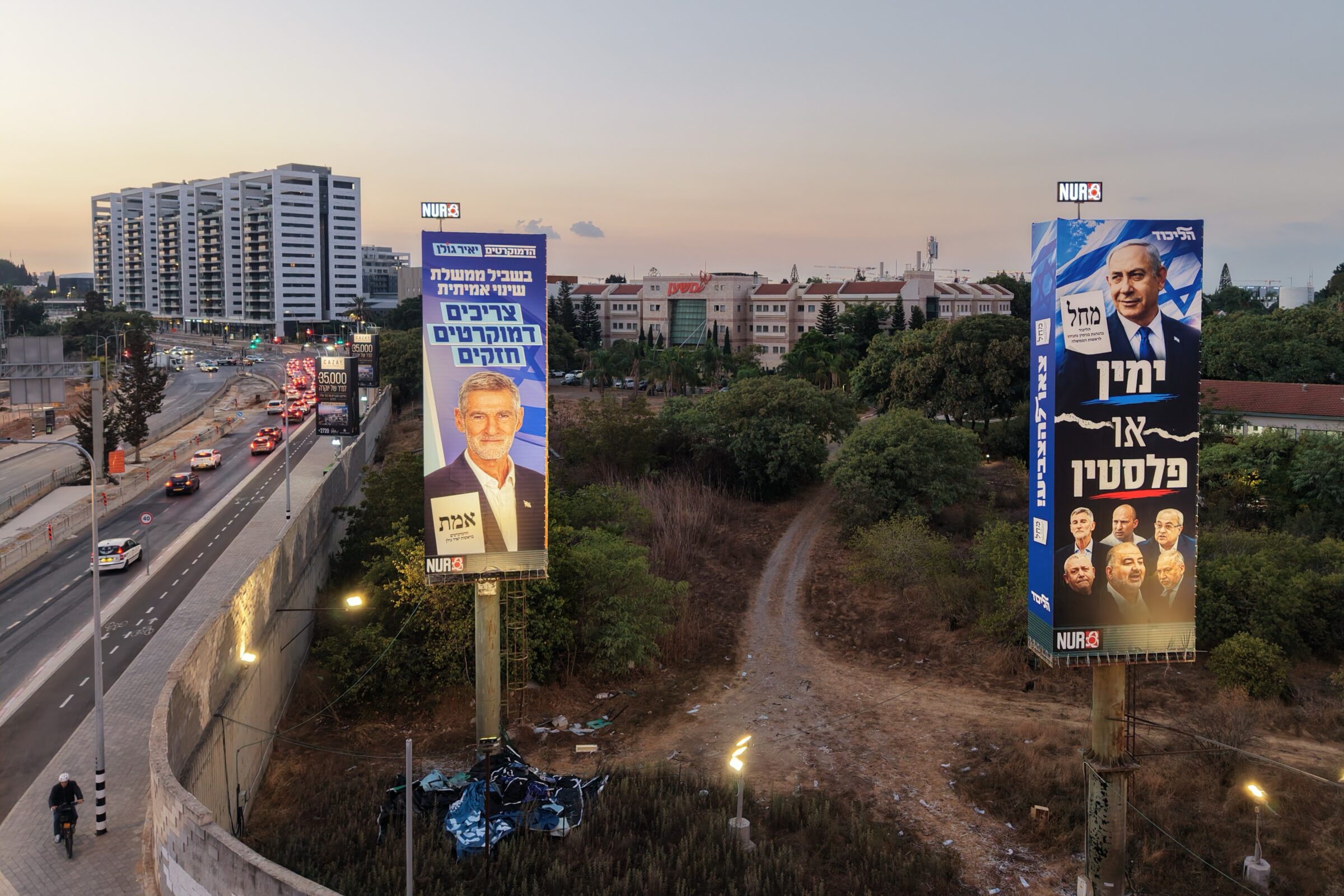
Israel’s 27 October election might disappoint everyone. To start, there may be no next-day resolution. Polls show the Netanyahu-allied and opposition blocs nearly tied, both short of a majority.
If that holds, expect weeks of furtive factional negotiations that diminish the reputations of all involved. If those fail, back to the ballot box.
If a new government forms quickly, it will likely be led by Benjamin Netanyahu or the opposition’s Gadi Eisenkot. Most observers outside Israel are hoping for Gadi. In truth, either result will confront Brussels and Washington with tough choices that both have put off too long.
Last week’s grudging and partial White House endorsement notwithstanding, Netanyahu is near-friendless on the international scene.
If he grinds out another win, many European leaders and US presidential contenders will find themselves managing bilateral relationships of mutual contempt.
Unwilling to face hard facts at home, Bibi seemed to think he could gamble them away with Gulf money and American missile interceptors. He marketed himself as the founding entrepreneur of a new-model Middle East powered by Saudi normalisation and Iranian regime change.
Instead, Houthi drones and Saudi budget deficits are vaporising the mirage of glass cities and data centres in the desert.
Trump’s war now
Iran is Trump’s war now, not Israel’s: He will fight or end it as he pleases. What’s left on the IDF’s regional briefing map are small places with complicated pasts and unclear futures, lands that Israel wishes the rest of the world would forget but is itself unwilling to leave.
The old Middle East is back. In truth, it never left.
It has been the beggar at the door of every air-conditioned Gulf investment conference. But the poor relations — Gaza, the West Bank, Lebanon, Syria, Yemen — have refused to go quietly.
Israel’s old politics are back, too.
The median Israeli is 29-years old. Netanyahu, whose hair and makeup bills are the subject of a considerable body of investigative journalism, just turned 77. His leading rival Eisenkot, who lost a son and two nephews in Gaza, launched his career as a platoon commander in Israel’s 1982 invasion of Lebanon.
Israel, like America, is due generational change.
Instead, Israelis (or at least undecided centre-right voters) got a choice of character: the embarrassing, but reassuringly indestructible Bibi, or the earnest but untested Eisenkot.
It’s not just the faces that are familiar. The candidates are still fighting Israel’s culture wars. The debates that dominated the election — ultra-orthodox military enlistment, judicial reform, and the role of religion in the state — are serious. But they’re also stalemated.
Despite deafening recriminations about who is to blame for exposing Israel to Hamas’s 7 October attacks, the debate about security in Gaza and Israel’s north is equally stuck.
Indiscriminate destruction and deliberate destabilisation
Netanyahu promised “total victory”; that turned out to mean indiscriminate destruction and deliberate destabilisation. His opponents claim Netanyahu has squandered the IDF’s achievements. They promise to do what Netanyahu could not, by using the same crude tools to achieve the same poorly defined objectives — but this time, with greater skill.
The question of what that means for ordinary Palestinian civilians, and what future they can expect for their children, has barely been discussed.
Many Israeli voters, desensitised to the situation of Palestinians who are routinely dehumanised by Israel’s domestic press, don’t ask. Most Israeli candidates carefully avoid answering.
Both blocs pledge they’ll refuse to partner with the Arab-Israeli parties that could hold the key to a Knesset majority — even as prominent Arab candidates downplay their support for Palestinian statehood and campaign on more palatable topics like under-policing in Arab communities.
It’s comforting to imagine an Israeli government formed by anyone left of Netanyahu will steer instinctively towards international expectations. But a more centrist Israeli government, like any elected government anywhere, will operate within the political space created by the policy priorities and the empathetic capacity of its voters.
There isn’t much room for Palestinians.
If an opposition-bloc government forms, it will surely ask for time, assuring foreign capitals that the appearance of pressure makes meaningful change harder back home.
European leaders and US Democrats poised to win at least one house of Congress in November may be tempted to pause efforts to compel Israel towards rapid implementation of the international road map in Gaza, an end to ethnic cleansing in the West Bank, and full IDF withdrawal from Lebanon and Syria.
That would be a mistake.
There will be no place in Israeli politics for a realistic discussion of Gaza, the West Bank, Lebanon, and Syria until the foreign partners necessary to Israel’s security and economy insist, soberly and relentlessly, on creating one.
That will require tough new sanctions, not just wordplay. The things that have to be admitted are too hard, and the promises that must be broken are too many, for any Israeli leader to act alone.
Amanda Pilz served for 22 years as a U.S. Foreign Service Officer. She is a former U.S. Deputy Assistant Secretary of State for Israeli-Palestinian affairs.
Andy Burnham has opened a necessary conversation. By suggesting Britain should examine the possibility of restoring free movement with the European Union, the prime minister is challenging a damaging assumption: that respecting the Brexit referendum requires refusing to discuss whether different arrangements might now serve the country better.
His call for an “honest discussion” deserves support. Before making another consequential European choice, Britain needs evidence, scrutiny and political leadership willing to acknowledge uncomfortable trade-offs. Burnham’s willingness to consider closer relations creates space for precisely that debate. news.sky.com
The immediate opposition response was predictable. Shadow home secretary Chris Philp rejected any return to free movement, while Nigel Farage accused Burnham of betraying Brexit voters. Yet neither objection answers the central question: which relationship with Europe would best advance British prosperity, security and opportunity today?
The 2016 referendum authorised Britain’s departure from the EU. It did not remove future generations’ right to reconsider the terms of that relationship. Democratic decisions carry authority, but democracy also provides the means to change direction. Otherwise, elections would become ceremonies for administering choices made permanently elsewhere.
Burnham’s recognition that fundamental changes require a fresh electoral mandate is therefore essential. Labour’s 2024 manifesto ruled out restoring free movement, single market membership and a customs union. Any departure from those commitments must be explained clearly and put before voters. Opening a discussion is a legitimate first step.
The strongest feature of Burnham’s intervention is his insistence that migration deserves closer examination than familiar campaign slogans permit. He argues that the movement associated with EU membership often involved people arriving temporarily, working and subsequently returning home. That proposition merits testing against the evidence, including differences between sectors and communities.
It also restores a neglected part of the argument: free movement worked both ways. British citizens could build careers, study and establish lives across participating European countries. For younger Britons, especially, those opportunities should feature prominently in any assessment of what a future agreement could offer.
There were difficulties. Rapid population changes placed pressure on some communities, and governments too often failed to match economic change with housing, infrastructure and public services. A persuasive case for renewed mobility must acknowledge those experiences. Burnham will gain credibility by explaining how his approach would address them.
But acknowledging past failures should encourage better policy. It should not close the conversation. The relevant questions concern employment, wages, investment, public-service capacity and reciprocal rights. Each deserves serious analysis. Treating every proposal for mobility as surrendering the border substitutes a political warning label for an examination of the actual arrangements.
The economic argument deserves equally careful treatment. Closer participation in European markets could make some cross-border business easier and widen recruitment opportunities. The benefits would depend on the agreement negotiated. So would the obligations. Burnham should publish a transparent comparison of the available routes, with assumptions and uncertainties clearly identified.
His stated opposition to joining the euro or Schengen also helps define his starting position. However, Britain cannot determine the conditions of a future European settlement unilaterally. Any credible initiative must establish what Brussels would accept, what obligations Britain would undertake and which outcomes are realistically negotiable. thetimes.com
That is why the forthcoming Brussels summit matters. It offers an opportunity to explore possibilities and establish whether ambition can become a workable programme. Burnham should approach those discussions with confidence, while resisting promises that depend on concessions European partners have yet to offer.
His opponents are entitled to challenge every proposal. Indeed, a rigorous debate would strengthen any eventual settlement. But accusations of betrayal cannot become a permanent veto over discussing the national interest. Voters deserve competing arguments supported by evidence and a clear explanation of the choices available.
Burnham’s initiative is welcome because it treats the public as capable of reconsideration. Britain can respect the decision taken in 2016 while asking what should happen next. A prime minister prepared to lead that conversation, acknowledge its difficulties and seek democratic consent is offering something valuable: the possibility of moving forward.
Nearly 1,000 arrests after another weekend of demonstrations expose a government squeezed between legitimate public anger and violent disorder. France requires a conservative response that defends taxpayers, businesses and the rule of law.
France’s latest weekend of protest presents Emmanuel Macron with a question that presidential speeches cannot settle: can his government protect ordinary citizens while addressing the grievances driving them onto the streets?
Nearly 1,000 arrests were reported after Saturday’s demonstrations, with clashes in Paris and other cities. Most participants protested peacefully over education and living costs. But masked groups again turned public mobilisation into confrontation, leaving police to restore order.
From a conservative perspective, this matters enormously. Peaceful assembly belongs to the democratic inheritance France should defend. Throwing projectiles at officers, intimidating businesses and destroying property belong in the criminal courts. Economic hardship explains anger; it does not confer permission to terrorise a neighbourhood.
The Interior Ministry counted 410,000 demonstrators nationwide, while the CGT union estimated nearly 800,000. Authorities deployed 70,000 officers, supported by helicopters and armoured vehicles. Interior Minister Laurent Nuñez said the operation helped prevent a repetition of the previous weekend’s widespread looting.
That offers some reassurance. Yet a country requiring such an extraordinary deployment to contain weekend demonstrations has a deeper problem than crowd management. Police can clear a junction. They cannot, by themselves, rebuild confidence in a political class that many citizens believe no longer understands their lives.
The most easily overlooked people are those with the least protection: independent shopkeepers, employees losing shifts, residents trapped behind barricades and taxpayers financing the response. Their interests deserve the same attention as the demands carried on banners. Keeping a business open is also a contribution to national life.
The BBC reported that shops were boarded up, cultural institutions closed and more than 20 Paris metro stations shut. These precautions may have been necessary, but they also demonstrate how disorder imposes costs far beyond those directly involved. A disrupted capital is a warning about the erosion of everyday freedom.
The government’s responsibility therefore extends beyond announcing arrest totals. Suspected offenders should face prompt, fair proceedings, with meaningful penalties where guilt is established. Where legally appropriate, those responsible for deliberate damage should contribute towards repairs. Public confidence depends on consequences that are visible, proportionate and consistently applied.
Consistency also requires rejecting violence from every political direction. Regional authorities reported that far-right extremists fought demonstrators in Nice, where 11 people were arrested. A credible conservative position cannot excuse street intimidation because its perpetrators claim patriotic motives. The law loses authority whenever political allegiance becomes an unofficial exemption.
Nevertheless, restoring order cannot substitute for governing competently. The movement grew from complaints about school staffing and resources into broader protests over household costs. Those concerns deserve answers. Parents expecting functioning classrooms and workers struggling to afford necessities are asking whether the state delivers what it promises.
The conservative answer should begin with value for money. Before reaching automatically for additional taxation or borrowing, ministers should explain where existing resources go, which programmes deliver results and which administrative burdens consume money better spent on essential services. Public expenditure should be judged by outcomes rather than the generosity of announcements.
There is an equally strong case for policies that reward employment, investment and enterprise. A government cannot sustainably improve living standards while treating the businesses creating jobs as an inexhaustible source of revenue. Nor can it promise every constituency protection from difficult choices. Credibility requires priorities, arithmetic and candour.
Macron’s political opponents will understandably seek advantage. But opposition leaders should be judged by whether they offer workable government, including a clear rejection of intimidation. Encouraging public anger is easier than reconciling demands for better services, affordable living and sound finances. France needs politicians prepared to explain those trade-offs honestly.
The immediate task is to keep streets safe. The larger task is to make democratic government effective enough that citizens trust its decisions. France needs firm policing, accountable institutions and economic realism. Unless its leaders provide all three, each weekend of unrest risks becoming another advertisement for the failure of the governing establishment.
Los tan denostados boomers y los miembros de la generación X crecimos en el cine viendo películas que ahora forman parte de nuestras turras nostálgicas. Y mientras crecíamos sentados en la butaca de las salas -casi siempre, incómodas y poco ergonómicas- solíamos comer palomitas en bolsa de plástico que habíamos comprado en un puesto con una oferta más bien rala comparada a la que hoy tenemos a nuestra disposición, pero magnífica, si la equiparábamos a la que tenían los miembros de la generación silenciosa. Podíamos comprar palomitas envasadas, chocolatinas y algún que otro refresco si la paga semanal alcanzaba.

 Login