
❌

Reading view

17 public broadcasters mapped Russia’s hybrid war on Europe. Germany: four dots
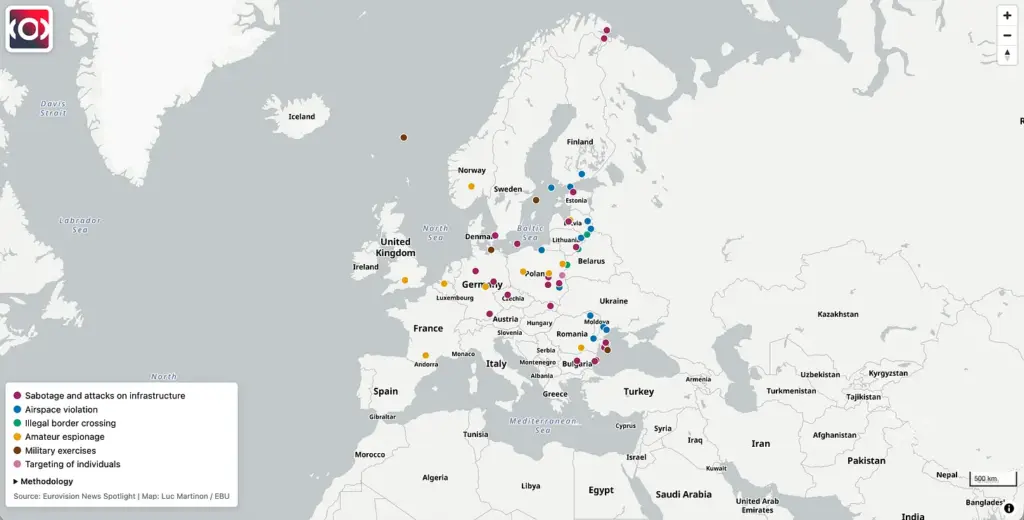
Physical hybrid incidents linked to Russia in 17 European countries, 1 April to 15 October 2026; many points stand for clusters of incidents. Map: Luc Martinon/ EBU, Eurovision News Spotlight

Journalists from 17 European public service broadcasters, coordinated by the European Broadcasting Union’s (EBU) Eurovision News Spotlight network, published an interactive map on 23 October 2026. It documents hybrid incidents linked to Russia across 17 European countries between 1 April and 15 October. Journalists compiled a database of hundreds of reported incidents, categorizing each by type and the source and strength of its alleged links to Russia, then verifying them through open-source research.

The map comes as officials warn the campaign is growing. On 28 September, EU foreign policy chief Kaja Kallas said in Brussels that Russia was planning more acts of sabotage to divide societies and intimidate them into abandoning their support for Ukraine. The points on the map represent an incomplete list of publicly known cases attributed to Russia or suspected of being linked to it, the report states.

The map covers airspace violations, sabotage attempts, “disposable” agents with no formal intelligence training, migration used as a weapon, and Russian military activity near or across European borders. It excludes cyberattacks, influence operations, and espionage by trained intelligence officers.

The EBU calls the result a very conservative estimate, not an official tally. Russia has consistently denied responsibility for the incidents. Many single points represent several incidents of the same type in one area or in quick succession. In Moldova, for example, Defense Minister Anatolie Nosatîi said on 30 September that the government had recorded 84 drone incursions.

Four German incidents are on the map, out of many more

The map shows four incidents in Germany, according to BR.

The four incidents in Germany on the EBU hybrid war map, 2 August to 14 September 2026
The four incidents in Germany on the EBU hybrid war map, 2 August to 14 September 2026. Other dots mark Russia-linked incidents in neighboring countries. Map: Luc Martinon/EBU, Eurovision News Spotlight; edited by Euromaidan Press
  • On 2 August, German authorities arrested a 33-year-old Ukrainian man in Thuringia on suspicion of photographing a Bavarian weapons manufacturer for a foreign intelligence service as part of an alleged sabotage plot.
  • On 4 August, a drone carrying explosives and a detonator struck the wing of a Ukrainian An-124 cargo plane at Leipzig/Halle Airport but failed to explode.
  • On 3 September, attackers threw firebombs from a car onto a construction site next to defense firms in Munich, and German security authorities suspect Russian intelligence.
  • On 14 September, investigators learned of a crashed drone found near the Bundeswehr’s Wunstorf air base.

Internal papers from the new Joint Hybrid Defense Center, seen by Correctiv, record 163 suspected sabotage cases in 2026 up to 19 August. The targets included rail lines, military facilities, substations, and radio masts. The same papers record 1,034 drone overflights of critical infrastructure, military sites, and defense companies, and 25 espionage investigations. The papers cover possible attacks by Russia, China, and Iran, and media did not report a breakdown of the sabotage cases by country.

European leaders sound the alarm over Russian hybrid attacks

On 15 April, Swedish civil defense minister Carl-Oskar Bohlin said pro-Russian groups had moved from denial-of-service attacks to attempts at destructive cyberattacks, including one on a Swedish power plant in 2025. On 1 September, German Foreign Minister Johann Wadephul named Russia as the perpetrator of the Leipzig attack and accused Moscow of “blatant hostility” toward Germany.

On 18 September, French President Emmanuel Macron said Russia’s hybrid attacks would not go unanswered and ordered a plan to protect France’s critical infrastructure. On 1 October, German Chancellor Friedrich Merz said Germany was preparing for new hybrid attacks, “including serious ones.” NATO Secretary General Mark Rutte on 14 October called the attacks a sign of Russian weakness at a press conference in Tallinn and said NATO would react where needed without being “rattled.”

  •  

EU Parliament Investigates Foreign Interference in Bosnia as Accession Process Stalls

A delegation from the European Parliament has begun a three-day mission to Bosnia and Herzegovina to examine foreign interference in the country’s political institutions, electoral processes and public information environment.

The visit, taking place from 26th to 28th October, comes three weeks after parliamentary elections exposed persistent divisions over Bosnia’s political direction and its prospects of joining the European Union.

The mission is being conducted by Parliament’s Special Committee on the European Democracy Shield, chaired by French MEP Nathalie Loiseau. Its purpose is to assess vulnerabilities to disinformation, cyberattacks, economic pressure and other forms of hybrid interference, and to identify measures that could strengthen Bosnia’s institutional resilience.

According to the European Parliament’s announcement, the delegation will meet government officials, parliamentary representatives, civil society organisations, journalists and researchers. Joining Loiseau are Finnish MEP Mika Aaltola, Portugal’s Ana Catarina Mendes and Romania’s Cristian Terheş.

The investigation comes at a politically sensitive moment. Bosnia’s general election on 4th October confirmed the persistence of competing political priorities between the country’s constituent entities, with pro-Russian politician Milorad Dodik’s Alliance of Independent Social Democrats retaining considerable support in Republika Srpska.

As EU Today reported following the election, parties favouring closer European integration also performed strongly, particularly in the Bosniak-Croat Federation. The resulting political balance will influence the formation of new administrations and their ability to implement reforms demanded by Brussels.

From electoral interference to institutional security

The European Parliament’s investigation extends beyond conventional disinformation campaigns.

MEPs intend to examine how foreign actors may exploit weaknesses in electoral administration, cybersecurity, political financing and the country’s wider economic relationships. They will also consider the role of digital platforms in distributing manipulated information and the legislative gaps that could make interference difficult to identify or prosecute.

The distinction matters in Bosnia, where political influence cannot be separated from the country’s complicated constitutional arrangements.

Under the Dayton peace settlement, the state operates through institutions that distribute authority between the Federation of Bosnia and Herzegovina, Republika Srpska and the central government. Political disagreements can therefore obstruct decisions requiring cooperation between different levels of administration.

External actors seeking influence may exploit those divisions, although identifying a political relationship with a foreign government is not, by itself, evidence of unlawful interference.

The European Union has repeatedly expressed concern about Russia’s activities in the Western Balkans, particularly its relationships with political forces opposing closer integration with European institutions. Chinese investment and economic relationships also raise questions about strategic dependence, although legitimate commercial activity must be distinguished from coercion or covert political operations.

The delegation’s task is to establish which vulnerabilities can be substantiated and whether existing safeguards are adequate.

Accession negotiations remain incomplete

Bosnia received EU candidate status in December 2022. In March 2024, European leaders agreed in principle to open accession negotiations, but progress has remained conditional on institutional and legal reforms.

Following the October election, EU foreign policy chief Kaja Kallas and Enlargement Commissioner Marta Kos issued a joint statement calling for the prompt formation of new administrations and progress on judicial reform.

The Commission also highlighted shortcomings identified by international election observers, including technical difficulties, complicated voting procedures and concerns about ballot secrecy.

Those findings do not automatically establish foreign interference. They do, however, demonstrate why the integrity of electoral institutions remains central to Bosnia’s relationship with Brussels.

A test for the European Democracy Shield

The Sarajevo mission follows the EU’s decision on 13th October to include enlargement partners in the European Centre for Democratic Resilience.

The initiative is intended to improve cooperation on election security, information manipulation, crisis management and institutional protection before candidate countries enter the Union.

EU Today has previously examined the European Democracy Shield’s proposed mechanisms, including closer coordination with technology companies and improved systems for identifying foreign information operations.

Bosnia now offers a practical opportunity to examine whether those instruments can operate effectively in a country where political authority is fragmented and accession remains incomplete.

The delegation’s findings could inform recommendations on institutional cooperation, election safeguards and support for independent media. Any substantial improvement, however, will depend on the willingness of Bosnia’s authorities to implement reforms and enforce existing legislation.

For Brussels, the immediate issue is whether its emerging framework for democratic resilience can provide practical protection to candidate countries while respecting their political sovereignty and the freedoms it is intended to defend.

  •  
❌