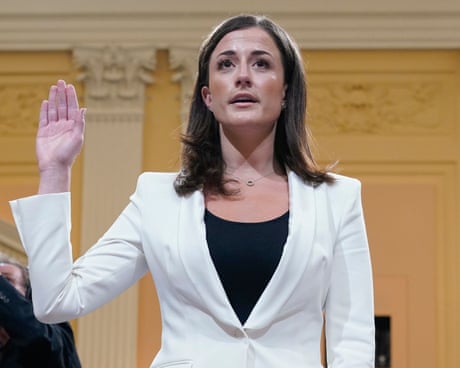
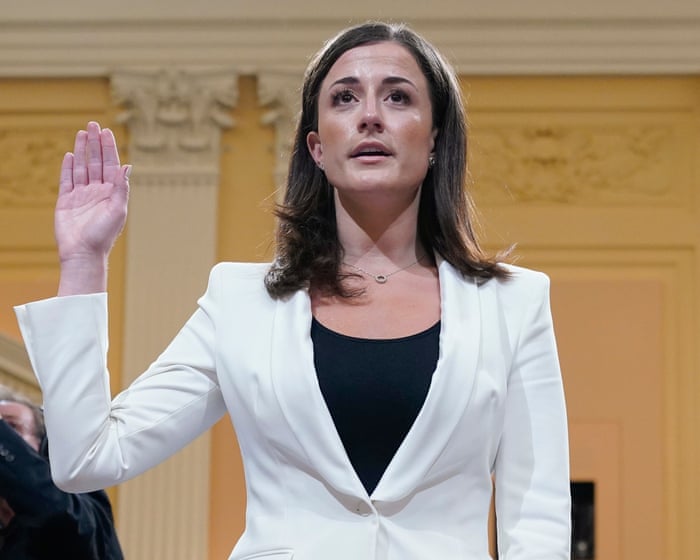
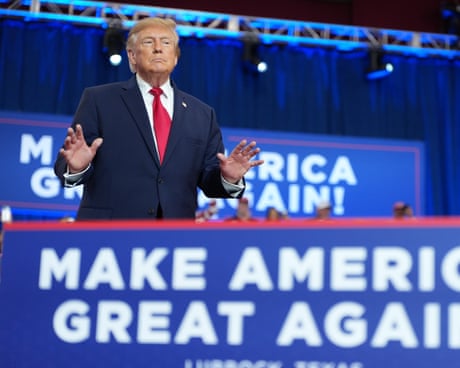
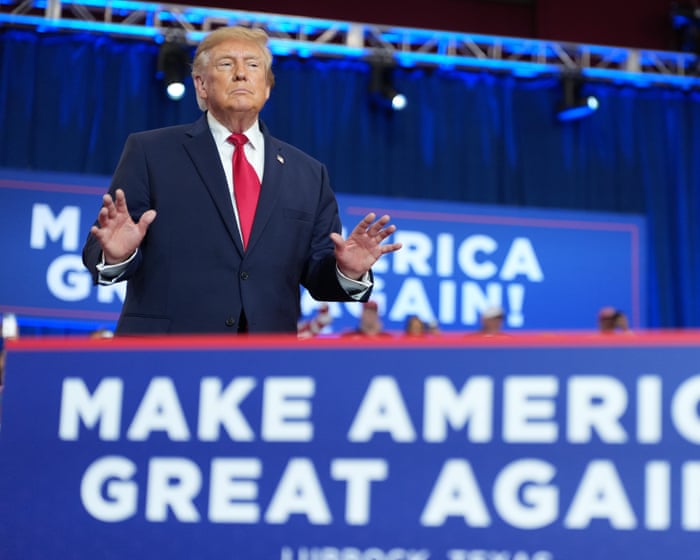
Cassidy Hutchinson had implicated Donald Trump in US Capitol attack during testimony before House committee
The justice department on Tuesday failed to secure a grand jury indictment against a former White House staffer who provided dramatic but disputed testimony against Donald Trump before a House committee investigating the 6 January 2021 US Capitol insurrection, according to two people familiar with the matter.
A grand jury in Washington rejected prosecutors’ request to return an indictment charging Cassidy Hutchinson, said the people, who spoke to the Associated Press on the condition of anonymity because they were not authorized to publicly discuss the case. It’s the latest setback in the justice department’s efforts to charge perceived adversaries of the Republican president.
A group of Democratic senators is expressing distrust that the Trump administration will treat renewable energy fairly under a bipartisan permitting reform bill — and they are calling on the administration to restore climate funding it terminated for blue states. Their letter to Democrats and Republicans who negotiated the bill represents a fracture in the…
A group of Democratic senators is expressing distrust that the Trump administration will treat renewable energy fairly under a bipartisan permitting reform bill — and they are calling on the administration to restore climate funding it terminated for blue states. Their letter to Democrats and Republicans who negotiated the bill represents a fracture in the…
Vice President Vance on Tuesday slammed an independent candidate with a similar name to Sen. Dan Sullivan (R-Alaska) as committing “electoral fraud” when answering a question about his administration’s lawsuit over the Senate race in the state. “Why shouldn’t Alaskans find it insulting that the administration appears to be suggesting they can’t read the word…
Vice President Vance on Tuesday slammed an independent candidate with a similar name to Sen. Dan Sullivan (R-Alaska) as committing “electoral fraud” when answering a question about his administration’s lawsuit over the Senate race in the state. “Why shouldn’t Alaskans find it insulting that the administration appears to be suggesting they can’t read the word…
The Trump administration announced $498 million in federal grants Tuesday to modernize U.S. ports, funding 35 projects across 19 states ranging from aging dock replacements and cargo-handling equipment to fuel...
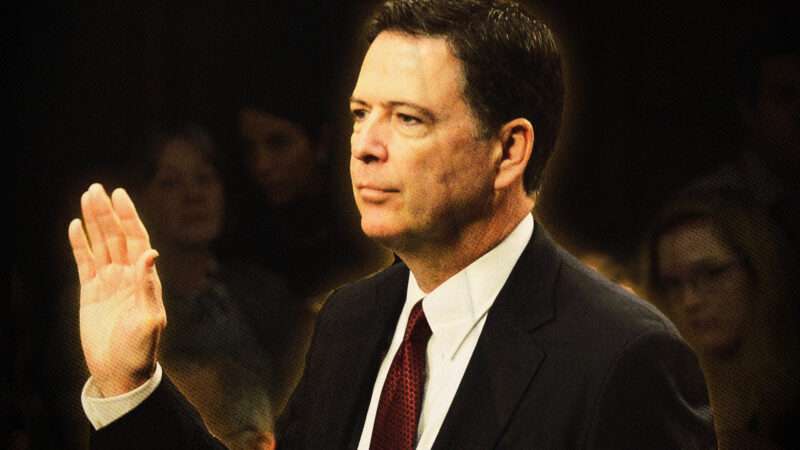
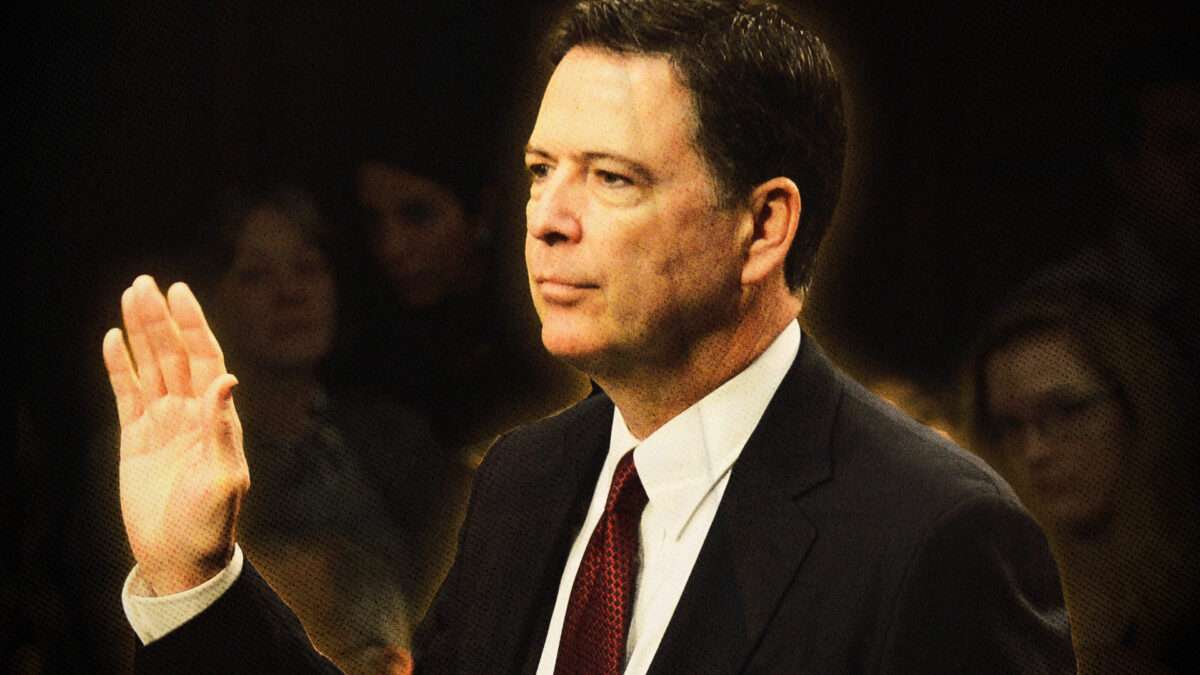
A little more than a year ago, President Donald Trump publicly demanded that Pam Bondi, then the attorney general, find a crime to pin on former FBI Director James Comey. Trump's underlings have repeatedly tried to do that, first charging Comey with lying to Congress and then accusing him of threatening to assassinate the president. But the first indictment was dismissed because Trump had illegally appointed the prosecutor who obtained it, and the second was doomed right out of the gate because it aimed to punish constitutionally protected political speech.
The Justice Department's latest attempt to follow Trump's marching orders was revealed on Monday, when U.S. District Judge Trevor McFadden unsealed a "criminal information" that claims Comey illegally shared classified information with The New York Times on October 5, 2016. In an attempt to meet the statutory deadline for that charge, prosecutors filed it exactly 10 years after the alleged disclosure. But Comey's lawyers argue that federal law required the government to obtain a grand jury indictment within 10 years of the alleged offense, which it failed to do.
Whatever you make of that dispute, the president has made it clear that he wants to imprison Comey, a longtime nemesis because of his role in the "Russiagate hoax" during Trump's first term, and does not much care about exactly how that happens. Justice Department officials, meanwhile, are keen to pursue Trump's personal vendetta by using their prosecutorial powers as an instrument of his revenge.
The new case "would almost be funny if it weren't such an appalling abuse of the Department of Justice," Comey said in an online video on Monday. "I'm still innocent. I'm still not afraid of these people, and I still believe in the independent federal judiciary."
In the New York Timesstory at the center of the case, Charlie Savage and Nicole Perloth reported that Yahoo had adapted "a system intended to scan emails for child pornography" to comply with a Foreign Intelligence Surveillance Court order seeking "messages containing a computer 'signature' tied to the communications of a state-sponsored terrorist organization." Savage and Perloth cited "two government officials who spoke on the condition of anonymity."
Dustin Farahnak, a special U.S. attorney for the District of Columbia, says that story included "first-time disclosures of classified information not intended for the public domain." According to Farahnak, the government has evidence that Comey "directed staff" to discuss "specific accuracy concerns" about a prior Reuters report on the same subject with Savage. In the process of doing that, Farahnak says, those FBI officials "illegally transferred classified information."
Comey's attempt to set the record straight, according to Trump's henchmen, was a felony punishable by up to 10 years in prison under 18 USC 793(d), an Espionage Act provision that applies to an official who "willfully" shares "information relating to the national defense" with an unauthorized recipient when he "has reason to believe" it "could be used to the injury of the United States." Comey also faces a charge of conspiring to violate Section 793, which likewise carries a maximum 10-year sentence.
If Comey's alleged disclosure was such a grave crime, you might wonder, why did it take a decade to charge him? Because two prior investigations of the same incident concluded that criminal charges were not warranted.
Beginning in March 2017, John Durham, the U.S. attorney for the District of Connecticut, looked into the genesis of the Times article. The investigation found that James Baker, then the FBI's general counsel, was one of the anonymous sources. Baker said he had acted under instructions from FBI Chief of Staff James Rybacki, whom he understood to be conveying Comey's wishes. Durham's investigation included interviews, emails, phone records, and consideration of the relevant statutes. In December 2018, Comey's lawyers note, Durham "wrote a classified memorandum outlining the investigation and recommending 'NO prosecution for Baker or anyone else.'"
The following month, the U.S. Attorney's Office for the District of Columbia "opened an investigation into the same subject matter," Comey's lawyers say. That investigation "was closed without any charges in February 2020" after the office "declined to prosecute."
Given the outcomes of those two investigations, the decision to charge Comey now stinks of desperation to slake Trump's thirst for revenge. According to Comey's lawyers, the tardiness of the charges also fatally undermines the case.
Federal law generally requires that prosecutors file charges within five years of the alleged crime. But the Internal Security Act of 1950 made an exception for Section 793, saying "an indictment for any violation" of that provision "may be found at any time within ten years next after such violation shall have been committed."
The charges against Comey "should be dismissed as time barred," his lawyers argue: "Section 19 of the Internal Security Act gives the government an extended ten-year limitations period in which to charge Section 793 offenses. But as Section 19 unambiguously states, the government may invoke that extended period only by obtaining a grand jury indictment. A criminal information—which the government can issue unilaterally without grand jury involvement—does not suffice. Because the default five-year statute of limitations for federal felonies has long since elapsed on the alleged offenses, and the government's information does not meet the express statutory requirement for an extended ten-year limitations period, the information is untimely and must be dismissed."
Whichever side prevails on that issue, no one should have any illusions that the Justice Department is pursuing the mission suggested by its name. "It remains unclear what [McFadden] will do with the matter and whether DOJ will even be able to secure an indictment—as required by the Constitution," Cato Institute legal fellow Mike Fox says in an emailed press release. "Should the matter proceed, it is unequivocally clear that this case is a vindictive prosecution—a classic case of lawfare by a weaponized Justice Department."
Happy Tuesday, and welcome to another edition of Rent Free. This week's newsletter includes stories on:
The Treasury Department's proposed rule for restricting large investor ownership of single-family housing.
The land use angle in the Texas Senate race.
Salt Lake's middle housing reforms.
The Populism-to-Paperwork Pipeline
Last Thursday, the U.S. Treasury issued a proposed rule that restricts large institutional investors from acquiring new single-family rental homes.
The proposed regulations are intended to implement large investor restrictions passed by Congress as part of its bipartisan housing bill, the 21st Century ROAD to Housing Act, that generally bans entities that already own 350 single-family rentals from buying new ones.
As I covered last week, the new rule primarily proposes definitions left of the text of ROAD and adds additional details about when large corporate buyers' build-to-rent and renovate-to-rent projects are exempt from the new restrictions.
Wonks and interest groups are digging through the details of the sprawling proposed regulations, but there doesn't seem to be major new policy shifts in the rule. It's mostly a bunch of paperwork requirements.
That's not how the Trump administration has framed the new proposed rule.
Hear Vice President J.D. Vance tout the new rules as saving the American dream of homeownership from "private equity barons."
The American Dream doesn't belong to Wall Street. It belongs to the American people.
Thanks to President Trump and Scott Bessent, families don't have to worry about getting out-bid on their dream homes by private equity barons. And we're making those same big investors give…
Also chiming in was Sen. Elizabeth Warren (D–Mass.), who had proposed much more sweeping restrictions on institutional investors when the ROAD Act was still working its way through Congress.
Our bill to stop private equity from buying up homes is now law.
Despite Donald Trump's refusal to sign it, his Administration must now implement it.
Despite the implication in Warren's post, Trump's decision to not sign the ROAD Act was not because of his apathy about the investor restrictions in it. On the contrary, the president had urged Congress to enact institutional investor ownership of single-family homes.
(His decision had more to do with his displeasure at Congress not passing the SAVE Act.)
As housing policy watchers will know, the backlash to corporate ownership of single-family rental housing has been a bipartisan populist concern for a while now.
Both right-wing Republicans and left-wing Democrats have argued that Wall Street investors are a primary cause of high housing costs and low housing availability. They are allegedly outbidding individual owner-occupiers for homes, thus condemning ordinary families to a life of perpetual renting.
It was notable that perhaps the only thing that Minnesota Gov. Tim Walz and Vance agreed on in their 2024 vice presidential debate was that "Wall Street" needed to be kept out of owning single-family homes.
Criticisms of restricting institutional investor ownership of single-family rentals are legion. The arguments generally boil down to the assessment that they are a small but beneficial presence in the single-family market.
The vast majority of new home sales still go to owner-occupiers. Families that can't get, or don't want, a mortgage but do want to live in a single-family home have the option of renting from one of the big guys. And large investors also add to the housing stock through build-to-rent developments and their renovation of dilapidated existing units.
Those arguments were convincing enough to get a much more sweeping institutional investor ban initially included in ROAD (which would have required investors to proactively sell off their portfolios and effectively kill the build-to-rent sector in the process) pared back into something far more modest.
The final result is the paperwork requirements the Treasury released last Thursday.
One can see that as a positive development. The housing market would have been made much worse if Congress had decided to kill build-to-rent housing.
On the other hand, we're still left with a bunch of bureaucratic busywork requirements that will add compliance costs to the business of single-family rentals but don't make anyone better off.
Populist backlashes typically target large, seemingly alien institutions that are allegedly crushing ordinary people, big bureaucracies, large capitalists, etc.
It's a bit ironic then that the new investor restrictions informed by that populist backlash and outlined in the Treasury's proposed rule largely leave the capitalists and bureaucrats in place while requiring them to shuffle a lot of paperwork between themselves.
The Data Center Angle in the Texas Senate Race
A long-time electoral advantage for the Texas GOP has been the state's status as a growth machine under its rule.
Over the past three decades, Republicans have won every statewide race in the Lone Star State partially on the argument that they've delivered a remarkable degree of economic growth.
Yet this year, in a political environment that's exceptionally bad for Republicans, Democrat James Talarico appears poised to best Republican Ken Paxton in the Texas Senate race and finally turn the state blue.
There are a lot of reasons that could explain why the polls are giving Talarico a slight edge over Paxton. One that I explore in my new profile of Talarico (which was published today) is that a backlash to data center development is souring Texas voters on economic growth generally and the party that claims to have delivered it.
There's not much about housing in the profile. But there are a couple of interesting housing-adjacent themes explored in it that Rent Free readers might find interesting.
The first is that loose land use controls are a primary reason that Texas has become a major location for data center development. The second is that even places with very pro-growth political cultures and policy regimes can still experience sudden, sweeping anti-growth backlashes.
Public support for "abundance" of new housing or new commercial development can't ever be taken for granted.
Salt Lake City Waters Down Zoning Reforms
Last week, the City Council of Salt Lake City, Utah, proposed paring back a set of zoning reforms that are intended to allow more smaller homes to be built in existing single-family neighborhoods.
Under the original proposal, property owners would have been allowed to add accessory dwelling units on more parcels. Relaxed lot size, height, and setback requirements would have also allowed builders to add smaller homes and duplexes in single-family neighborhoods.
These are all pretty standard "middle housing" reforms. They provoked the standard criticism that quiet, tidy single-family neighborhoods would be swamped by out-of-scale development.
Now the city council is considering pairing the zoning liberalization with an owner-occupancy requirement. Anyone attempting to use the reforms to build new housing would also have to live on-site.
Owner-occupancy requirements often act as a major "poison pill." They effectively exclude professional developers from buying up parcels and adding new housing on them. Instead, homeowners (most of whom are not professional builders) will be the only ones who can make use of the new rules.
If the council does include an owner-occupancy requirement in its zoning reforms, it can expect a lot fewer units to be built.
Quick Links
President Donald Trump has issued a new housing affordability executive order, which largely attempts to make mortgages obtained or secured by federal programs cheaper for borrowers.
D.C. Councilmember Robert White has proposed a pilot program that would have delinquent tenants go to mediation with their landlords if they owe less than three months of rent.
Americans for Prosperity has a new analysis of a Massachusetts ballot initiative that would allow homes to be built on smaller lots.
Secretary of State Marco Rubio issued a warning to Venezuelan opposition leader María Corina Machado on Monday, without explicitly naming her after the exiled Nobel Peace Prize winner returned to her home country. “You’re not going to street-protest your way into a democracy,” Rubio told reporters, according to Axios. He also praised her return, saying…
US military says it carried out an airstrike on an alleged drug-trafficking boat in latest attack in region
The US military said on Tuesday it killed five people after an airstrike on a suspected drug-trafficking vessel in the eastern Pacific.
Tuesday’s strike was among more than 70 such attacks since the beginning of Donald Trump’s second presidency, according to media tallies. Collectively, they have killed more than 240 people.
The Trump administration is planning to loosen regulations on methane emissions from the oil and gas sector, and particularly for low-producing, high-emitting oil and gas wells. President Trump will announce a proposed rule to roll back those regulations at a Tuesday night rally in Texas, an administration official confirmed. The draft rule would be expected…
Federal officials on Monday called on Washington state’s election officials to set aside ballots from over 400 people they say have illegally registered to vote without U.S. citizenship. The Justice Department (DOJ), in a letter to Washington Secretary of State Steve Hobbs, said it has identified 1,500 votes cast by the more than 400 people…
A Cheesecake Factory jab from former President Obama quickly spiraled into a midterm spat between the GOP and Democrats as the competitive election cycle nears its end. Obama quipped during a recent campaign stop in Cleveland that President Trump has the White House “looking like Saddam Hussein opened a Cheesecake Factory, it’s just gold everywhere.”…
Alaska’s Democratic Senate nominee, Mary Peltola, asked a federal judge to dismiss the Department of Justice’s (DOJ) lawsuit over her state’s Senate election, prompting a judge to expedite the case. The lawsuit filed by the department last week claimed that the presence of a candidate with the same name as incumbent Sen. Dan Sullivan (R)…
A localized ceasefire agreement between Ukraine and Russia took effect on Tuesday after first lady Melania Trump announced last week she secured a temporary humanitarian agreement for the border city of Oleshky. The Russian-occupied town is located in southern Ukraine, and residents have faced shortages in food and medicine amid the ongoing war. The pause…
President Trump’s approval rating inched up by 1 point from a record low last week, according to a new poll. The Reuters/Ipsos survey, released Monday, found 32 percent of U.S. adults support the president’s job performance, while 66 percent disagreed. This is a slight uptick from the pollster’s previous findings, which showed Trump with a…
Speaking to reporters on the tarmac before departing for a campaign event in Michigan, JD Vance responded to a question about President Trump’s remarks branding Democratic Senate candidate Abdul El-Sayed as a “jihadist.”
Vance, who has sparred with the progressive El-Sayed repeatedly on the campaign trail, took a somewhat softer tone. But he didn’t walk away from Trump’s remarks.

 Login