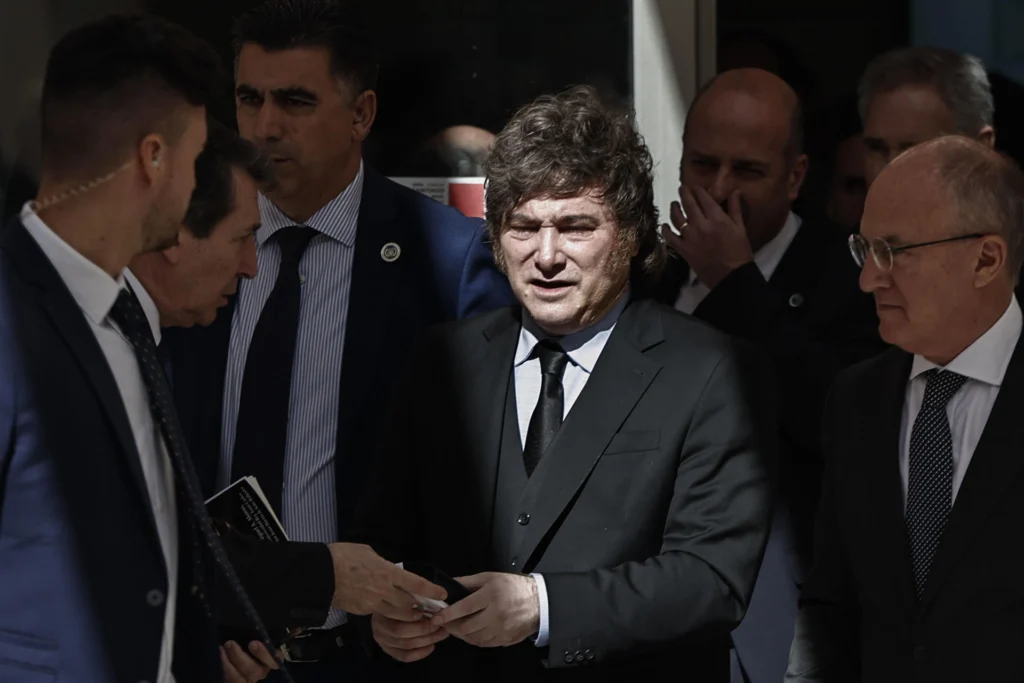
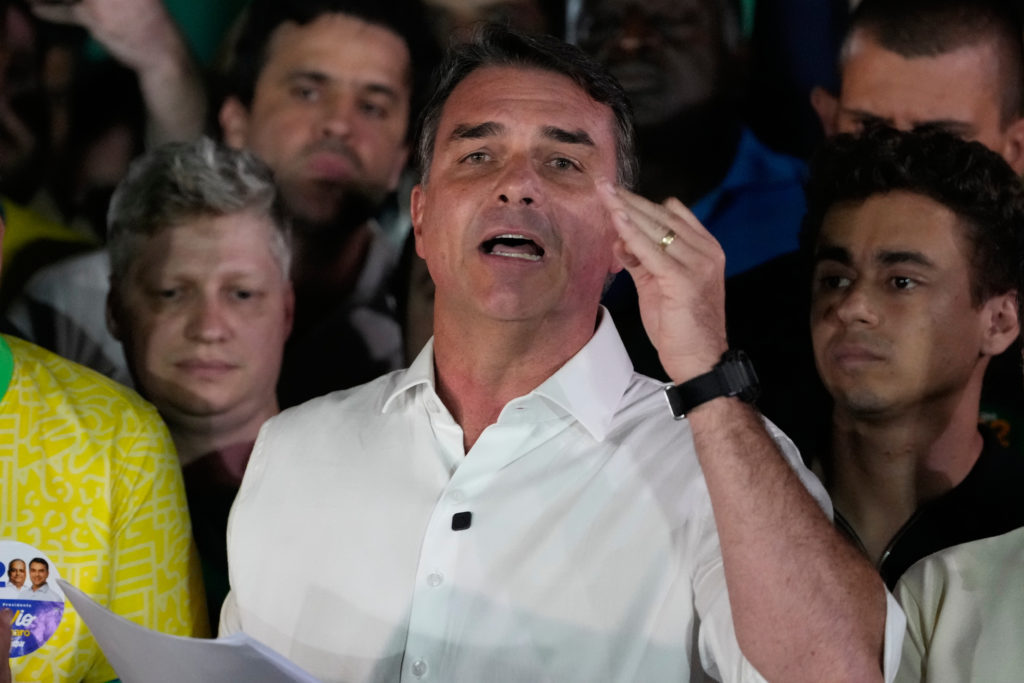
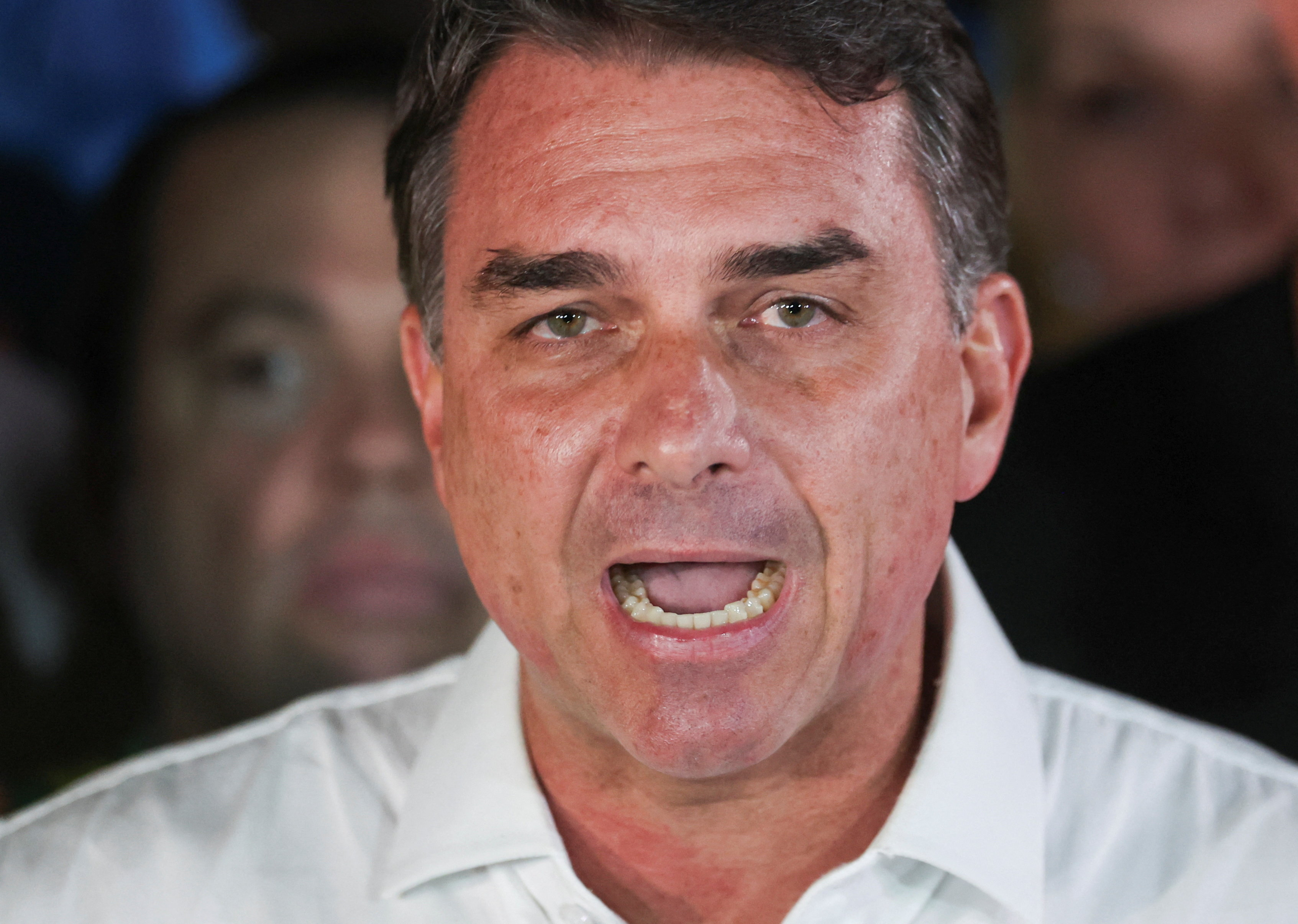
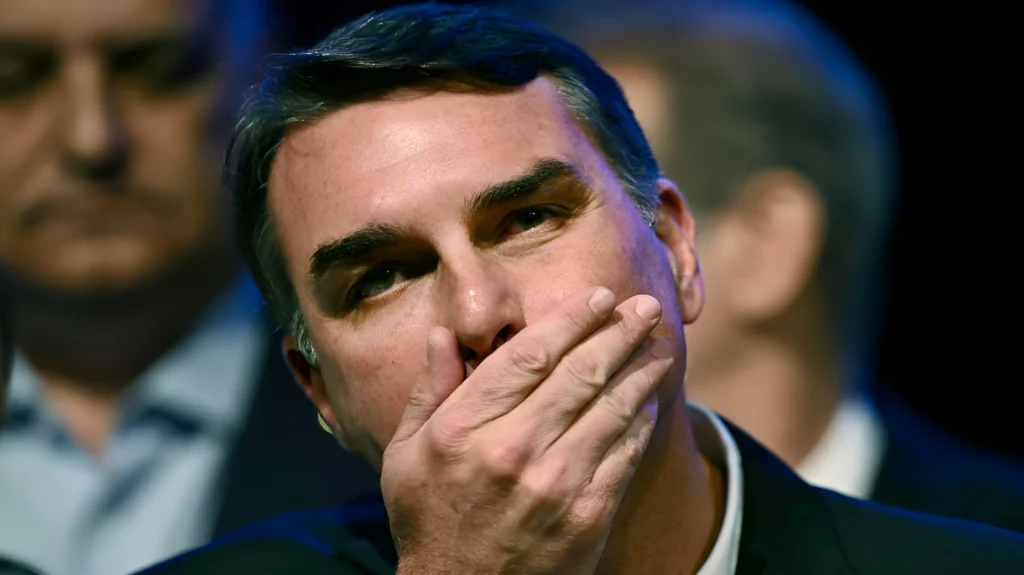
Argentine lawmaker Marcela Pagano filed a criminal complaint against officials of the Milei administration to investigate how Brazilian senator Flavio Bolsonaro crossed into Argentina and departed for United States despite a judicial ban on leaving Brazil.
The complaint was presented before the Federal Court in Puerto Iguazu, in Misiones province. It seeks to establish the circumstances of Bolsonaro’s entry into Argentina and his later departure toward United States.
The far-right senator, son of former President Jair Bolsonaro, lost the presidential run-off to Luiz Inacio Lula da Silva on Sunday. He faces criminal cases in Brazil for corruption and money laundering, and Supreme Federal Court justice Alexandre de Moraes had prohibited him from leaving the country.
Pagano framed the matter in stark terms. “The justice system has to establish who organized Bolsonaro’s passage through our territory toward U.S. and whether Argentine officials facilitated it. A government cannot become the escape route for someone who is barred from leaving his country by court order”, she said.
The reconstruction presented to the court traces the route in detail. The Brazilian Senator crossed the international border between Foz do Iguazu and Puerto Iguazu through the Tancredo Neves crossing at 10.50 P.M. local time on Tuesday.
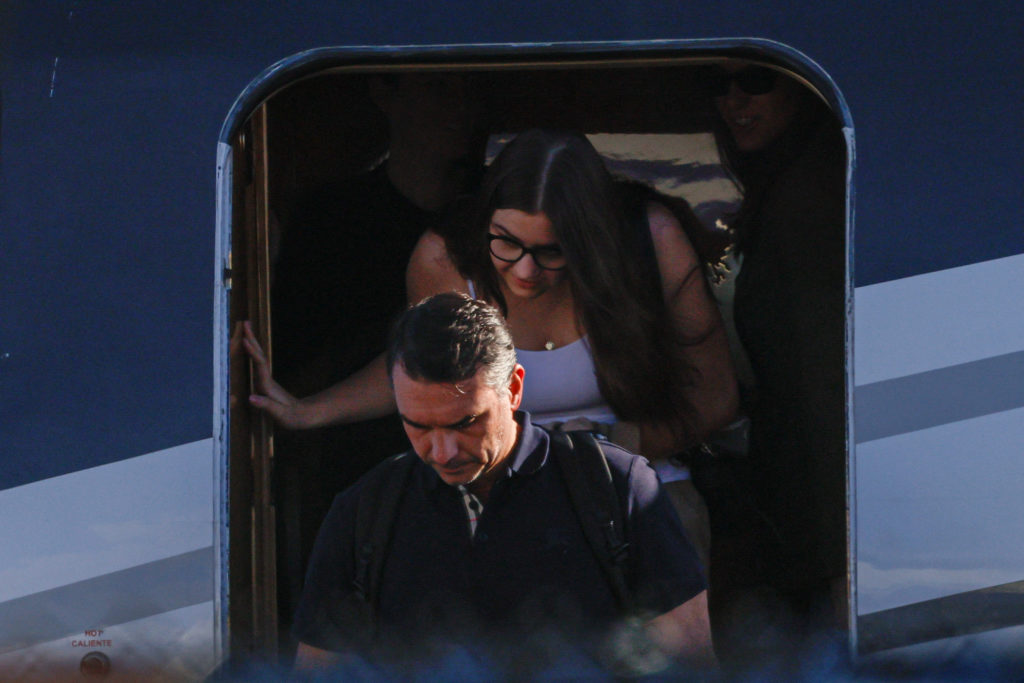
Forty minutes after entering Argentine soil, Flávvio Bolsonaro and his family boarded a private Gulfstream G400 jet at Iguazu International Airport. The aircraft belongs to the firm Baires Fly and had been positioned there since Monday.
🇧🇷 "I address the Brazilian people and the international community as the true elected president of Brazil."
Senator Flávio Bolsonaro, who lost Sunday's presidential runoff to incumbent Lula da Silva by about 4.4 million votes, is claiming the presidency in a statement released… pic.twitter.com/oTTodsaOcU
The jet traced a path through the airspace of Paraguay, Bolivia, and Peru. It made a technical stop in Guayaquil, Ecuador, before landing Wednesday in Miami, avoiding Brazilian airspace at every stage.
Pagano detailed that Flávio Bolsonaro reached the air terminal under escort from an Airport Security Police patrol car. That force answers to the Security Ministry, which falls under the federal Executive.
The National Directorate of Migration initially denied on Tuesday that the conservative leader was present or had any flight plans. Yet the government of Javier Milei officially acknowledged his passage at 2.00 A.M. Wednesday, when the aircraft was already airborne.
The complaint demands clarification of another element, the presence in Misiones of Santiago Caputo, political strategist and chief advisor to the Argentine presidency. Caputo reportedly arrived in the province earlier in the week aboard the same private plane.
La Dirección Nacional de Migraciones informa que a las 22:50 hs del dia 27/10, ingresaron por el paso fronterizo de Puente internacional Tancredo Neves en la provincia de Misiones, los ciudadanos Flavio Nantes Bolsonaro, Fernanda Antunes Figueira Bolsonaro, Carolina Figueira…
Text reads: “The National Directorate of Migration reports that at 10:50 P.M. on October 27, entered through the border crossing of Tancredo Neves International Bridge in the province of Misiones, citizens Flávio Nantes Bolsonaro, Fernanda Antunes Figueira Bolsonaro, Carolina Figueira Bolsonaro and Luiza Figueira Bolsonaro, who did so with skilled travel documentation without any legal impediment to entry into the country, also the transits were registered by the enforcement authority without incidents. For its part, at 11:30 P.M., the incoming party boarded a private flight dispatched by the company Baires Fly S.A to the city of Guayaquil, Ecuador, as reported in the flight plan.”
The written filing asks the court to investigate alleged crimes of illegal trafficking of persons, facilitation of illegal stay, abuse of authority, violation of public official’s duties, and cover-up. It requests urgent evidence measures including camera footage from the border bridge, aeronautical records, and the Airport Security Police duty logs.
The political fallout reached the legislature quickly. Argentine Congressman and former Defense Minister Agustin Rossi formalized a request to summon the Chief of Cabinet, Diego Santilli, to answer before Parliament.
The sequence raises the question at the heart of the complaint. A senator barred from leaving his country crossed a border, boarded a private jet, and flew to Miami without touching Brazilian airspace, all with a police escort on Argentine soil.
The government first denied any knowledge. It then confirmed the passage hours later, after the plane was gone. That gap between denial and confirmation sits at the center of the criminal filing.
The denunciation now forces the federal justice system to determine whether officials in the Milei administration facilitated a fugitive’s exit. The demand in Congress puts the same question to the Cabinet’s Chief.
Another member of Brazil's Bolsonaro family has found haven from possible prosecution by fleeing to the U.S., where they have an ally in President Trump. Just three days after losing Brazil's presidential election, Flávio Bolsonaro, who faces multiple criminal investigations, defied a Brazilian court and left the country. Stephanie Sy discussed more with Brian Winter of America's Quarterly.
The Brazilian congressman André Janones created a digital “army” by setting up WhatsApp groups and posting on Instagram, which helped mobilized the vote for the reelection of President Luiz Inácio Lula da Silva.
On October 25, Brazil’s three-time and current president, Luiz Inácio Lula da Silva, surprised the entire world by overcoming an electoral setback in the first round (in which he was defeated by the far-right candidate Flávio Bolsonaro) and securing victory and the presidential seat in Brasília.
Lula, the legendary union leader during the dictatorship, secured 51.79%, equivalent to 64,256,232 votes, while Bolsonaro (son of the detained former president Jair Bolsonaro) received 48.21%, or 59,826,041 votes.
What is truly surprising about Bolsonaro’s defeat (given that most pollsters had predicted a very likely victory for him) is the enormous number of votes Lula managed to gain during the three weeks between the first and second rounds of voting. In that first round, Bolsonaro took first place with 48.21% (more than 56 million votes), and Lula came in second with 45.15% (just under 54 million votes).
Many believed that the nearly 9 million votes obtained by all the other candidates combined in the first round would be distributed in a way more favorable to Bolsonaro, since most of those votes were cast for right-wing and center-right candidates. This seemed even more evident after many of the leaders of those parties endorsed Bolsonaro.
Added to this question was the high probability that, in a society highly polarized between the two candidates, many voters who either cast blank or invalid ballots or abstained from voting in the first round would support one of the two candidates.
Indeed, both of these circumstances played out. According to available data, more than 14 million Brazilians who had voted for other candidates, cast invalid ballots, or abstained from voting participated in the runoff, supporting either Lula or Bolsonaro.
And this is precisely the key factor in understanding Lula’s victory. Assuming that very few voters would have switched their support from Lula to Bolsonaro or vice versa, it is important to note that of those 14 million votes that were redistributed, Lula managed to secure 10.37 million more votes than he received in the first round, while Bolsonaro managed to gain just under 4 million votes. This was enough for Lula not only to close the gap against his opponent but also to surpass him by a comfortable margin.
What happened in Brazil?
Faced with this surprising turn of events, hundreds of analysts in Latin America and around the world have rushed to present countless charts, hypotheses, and analyses in an effort to fully understand the reasons behind this victory. And the reasons have to do not only with the clearly impressive comeback by Lula’s Workers’ Party and its allies, but also with the fact that he appears to have put a halt to a seemingly unstoppable string of victories by the far right in Latin America.
Given this, the question seems clear: How did Lula manage to convince such a staggering number of people to vote for him in the runoff who had not done so in the first round? In response, technical reasons have been put forward (such as campaign strategy, the use of social media, and mass mobilization), as well as political ones (fear of a far-right government, social-class alliances, the formation of a broad-based coalition, etc.).
Among the technical reasons, Lula’s tremendous effort to turn the runoff campaign into a genuine, nearly constant mass mobilization (in both large cities and small towns) has been highlighted. The former union leader once again demonstrated his great charisma and ability to rally people before thousands of PT activists and members of other allied parties who fought day and night without stopping to overturn the result.
Added to this is the PT’s digital strategy; the party had repeatedly accused major social media platforms of boycotting the presidential campaign by hindering or reducing the visibility of Lula’s ads – but not those of Bolsonaro. In response, André Janones proposed a change in strategy.
Lula’s WhatsApp channel grew from 3.7 million subscribers to more than 10 million in the span of 12 days. Through this channel, users were instructed to post certain messages, search for information online, comment on specific posts, and so on. In other words, to circumvent an algorithmic system that, they claimed, was deliberately sabotaging Lula’s campaign.
The result was astonishing: despite the alleged media blockade on social media, the platforms were flooded with messages, images, and videos (many generated by AI) featuring Lula and attacking Bolsonaro’s candidacy, which undoubtedly had a major impact on the political communication strategy of the PT’s campaign, led by re-elected Governor Rafael Fonteles. For example, online interactions about Lula increased from 41% to 65% during the runoff election.
But Lula also took the risk of bringing about tangible changes in people’s lives, and he sent what may have been his final message during the runoff election, when his party and allies succeeded in passing legislation to end the six-day workweek. The move was celebrated by the country’s workers and clearly gave Lula’s campaign a pro-worker tone. That is why he gained so many millions of votes in the second round of the election in the working-class suburbs of major cities.
And yet, there remains a certain suspicion that if this set of measures had been applied in any other similar situation, something would have been missing to set it in motion and give deeper meaning to the purely political campaign – with its communication, marketing, and other tactical decisions. And that something is Lula.
At times it seems that only someone with his political stature, his charisma, and the historic place he has already carved out in the history books could have won an election in Latin America against the far right, which enjoys the support of the most influential imperial powers of our time and an international oligarchy.
The “warrior of the Brazilian people
Lula achieved this, as already mentioned, thanks to a series of changes in his campaign strategy and concrete improvements in people’s lives. But it must be said without fear of contradiction: he did so by blending two dimensions that might seem contradictory, yet which a figure like him could bring together.
The first is that, as some of his campaign strategists recount, he began to speak extensively about Brazil’s future despite having already served as president three times. In this way, he moved away from nostalgia for the past and began to speak of hope for the future.
And second, Lula insisted throughout the campaign that this future was threatened by the Bolsonaros, whom he constantly linked to a submissive attitude toward US interests. In this way, Lula also employed a discourse of fear and danger, personifying it in Bolsonaro, who, as is well known, had reportedly left Brazil for the United States.
But Lula did not do so in a pitiful or apocalyptic way; rather, he presented himself as the only one capable of halting that advance. And more than just capable, as the only one who, without a doubt, would do so. In other words, Lula established himself, at the age of 80, as a “warrior of the Brazilian people,” just as his supporters chanted in the streets.
Then, in the debates (which undoubtedly had a huge impact on the runoff election) it seems Lula had had enough of the far right always appearing to be on the offensive, while the left and progressives always seemed to be waiting for the next blow. Lula put on his boxing gloves and began playing the game the far right had set for him … and won by knockout.
And for that very reason, Lula, his followers, and many of those who supported him (not necessarily because they believe in his agenda, but because they feared a new far-right government, as the numbers show) must realize that, with a hostile legislature and an opposition united around a single family, Lula’s fourth term will likely be the most difficult of his life.
Lula will have to seek ways to overcome the clear obstacles that the right and the far right will place in his path in order to achieve what he called “the best government in Brazil’s history.” For now, he has managed to prevent another Bolsonaro from reaching the presidency, but that does not mean the remainder of his term will be a “Brazilian pax.”
In this regard, there is a Japanese proverb that Lula should keep in mind: “When you’ve won a battle, tighten your helmet.”
Brazilian Senator Flavio Bolsonaro on Wednesday declared himself the rightful president-elect of Brazil, saying his victory had been denied by an electoral coup d’etat by leftist President Luiz Inacio Lula da Silva and the country’s Supreme Court.
Bolsonaro, who lost Sunday’s presidential election and left Brazil for Miami where he and his family received US visas, thanked US President Donald Trump and Argentine leader Javier Milei for helping him leave his country and for welcoming him.
“I want to say, not only to my 60 million voters but to the Brazilian people, that I am the elected president and that the criminals who stole Brazil’s election are part of a criminal organization that has established a tyranny,” he said in an open letter shared with journalists by his allies.
Bolsonaro did not provide evidence for the alleged electoral fraud. International observers have found Sunday’s vote fair.
Bolsonaro and his family arrived in Miami on Wednesday, leaving Brazil after he refused to comply with a Brazilian Supreme Court order to surrender his passports. He left under a shroud of secrecy after the court order, which relates to a money-laundering investigation in which he denies wrongdoing.
Neither Lula’s office, the federal electoral court or the supreme court immediately responded to requests for comment.
Bolsonaro based his rejection of the result on the fact that the a Lula-appointed Supreme Court justice had extended voting by two hours on Sunday due to allegations of voter suppression in left-leaning northeastern state brought by Lula’s campaign. However, Bolsoanro’s campaign also sought an extension due to rains in conservative-leaning southern states.
Bolsonaro lost to Lula by more around 4.5 million votes. Fewer than 35,000 votes, or some 0.03% of the total, were cast in the extra two hours of voting ordered by the Supreme Court, according to an analysis of electoral records by Insper professor Pedro Burgos.
The Brazil’s government warned that false social media posts claimed the 6×1 workweek law had been changed and that social programs such as Bolsa Familia faced cuts, and it urged citizens to consult official sources.
The Secretariat of Social Communication (Secom), denied that any change had been made to the constitutional amendment that ends the 6×1 workweek.
The posts, which spread after the presidential run-off, offered incorrect information about labor legislation and social benefits.
Constitutional Amendment 141 guarantees two paid rest days each week without any reduction in salary. The way those free days are organized can be settled through collective bargaining, as long as the constitutional conditions are respected. The Secretariat of Social Communication stressed that the norm remains in force and untouched.
The false claims included an alleged exclusion of certain professional categories from the new rules. No such proposal exists. The Secretariat of Social Communication explained that conversations with different sectors concern only how to implement rules that have already been approved.
The reduction of the workweek will unfold gradually. The initial limit will be 42 hours a week, and later 40 hours, with no salary reduction at any stage.
The government offered a blunt explanation of why the Executive holds no power over the text. Since the measure is a constitutional amendment approved by the National Congress, the Executive cannot modify or veto it.
O Governo do Brasil alerta para informações falsas que circulam nas redes sociais neste período pós-eleitoral sobre um suposto recuo no fim da escala 6×1 e cortes no Bolsa Família e no Gás do Povo. pic.twitter.com/SIR0but5Vl
Text reads: “The Government of Brazil warns about false information circulating on social media in this post-election period about a supposed retreat at the end of the 6×1 scale and cuts to Bolsa Família and Gás do Povo.“
Welfare Programs Intact
Separate rumors suggested that the Bolsa Família program faced suspension or reduced benefits. The Secretariat of Social Communication confirmed that the program keeps operating normally, with payments continuing and no cuts applied.
In October the minimum amount per family rose by 15.04%, from R$600 (about 112 U.S. dollars) to R$691 (around 129 U.S. dollars). That adjustment contradicted the online claims, since a program facing cuts does not raise its floor. Families can verify their information through the Bolsa Familia app, the Caixa Tem platform, or by calling 111, the direct line of the Caixa Economica Federal bank.
The government also rejected rumors about Gas do Povo, the program that provides free refills of 13-kilogram gas cylinders to families that meet the requirements. The Secretariat of Social Communication (Secom) affirmed that the initiative already has budget assigned for 2026 and that resources appear in the 2027 budget proposal sent to Congress.
The pattern was consistent across all the false messages. Each one targeted a program or a right that benefits working families, and each one crumbled against the official record.
The Secretariat of Social Communication (Secom) advised the public to distrust messages that do not identify reliable sources. Citizens should verify whether information has been confirmed by competent authorities before sharing it. The Social Direct Line 121 and official digital channels remain open for questions about benefits.
The warning reflects a government trying to contain a wave of misinformation at a politically charged moment. False posts about labor rights and welfare can spread faster than corrections, especially when they play on fear of losing income or benefits.
The facts, however, tell a different story. The workweek amendment stands. The Bolsa Familia Program pays more than before. Gas do Povo holds its funding for this year and next. None of the alleged changes appears in any official document.
The government’s message closed with a practical instruction. Before passing along a message about labor law or social programs, check the source. The tools to do so, apps and official channels, remain available.
An in-depth look at thirty years of dynastic clientelism, illicit property purchases, and attacks on democratic institutions
The Bolsonaro family’s political trajectory marks a polarizing era in modern Brazilian history. Led by patriarch Jair Bolsonaro, a former army captain who served nearly three decades in Brazil’s Chamber of Deputies, the political clan built its brand on anti-establishment rhetoric, militarism, social conservatism, and zero-tolerance policies toward crime.
Despite promoting an image centered on traditional values and law enforcement, investigative records and judicial proceedings of the Bolsonaro family depict a political network deeply tied to public fund diversion, money laundering, and connections with armed paramilitary groups.
The Bolsonaro family expanded its influence into a dynasty, embedding sons Flávio, Carlos, and Eduardo across local, state, and federal offices.
Flávio Bolsonaro served as a Rio de Janeiro state deputy for sixteen years before his election to the Federal Senate in 2018. Carlos Bolsonaro directed public messaging as a Rio city councilor, while Eduardo Bolsonaro represented São Paulo as a federal deputy.
The structural base of this network began unraveling following political shifts, election defeats, and growing scrutiny from the Supreme Federal Court (STF) and federal authorities.
Clientelism, Militias, and the Rio de Janeiro Subculture
Jair Bolsonaro’s public life began in the late 1980s following his departure from the Brazilian Armed Forces. Elected to the Rio de Janeiro City Council in 1988 and to Congress in 1990, Jair Bolsonaro established a conservative political base anchored in military sector interests, opposition to progressive social policies, and public defense of paramilitary activity.
During his parliamentary career, Jair Bolsonaro openly defended Rio de Janeiro’s irregular security forces, known locally as milícias. These militias are armed paramilitary groups formed by former and active police officers who exercise territorial control over neighborhood communities.
Unlike drug trafficking networks, militia groups operate illegal local monopolies in extortion, land sales, private security, public transport, and cooking gas distribution. In parliamentary speeches, Jair Bolsonaro repeatedly characterized these militia groups as “self-defense units” that brought order to neglected communities.
The expansion of the Bolsonaro family’s political influence relied heavily on these political networks. In 2002, Flávio Bolsonaro was elected to the Legislative Assembly of Rio de Janeiro (ALERJ) at age twenty-one. Carlos Bolsonaro secured his city council seat in 2000 at age seventeen.
This strategy allowed the family to secure multiple legislative budgets, employ political operatives across jurisdictions, and maintain influence in local communities.
During his time at ALERJ, Flávio Bolsonaro maintained direct political and employment ties with figures associated with Rio’s militia structures. Flávio Bolsonaro employed Raimunda Veras Magalhães and Danielle Mendonça da Costa—the mother and ex-wife of Adriano Magalhães da Nóbrega—in his legislative office.
Nóbrega was a former Special Police Operations Battalion captain who led the Crime Bureau (Escritório do Crime), a professional hit squad linked to militia extortion and high-profile assassinations.
Official records show Flávio Bolsonaro conferred the Medal of Tiradentes, the highest honor awarded by the Rio legislature, on Nóbrega in 2005 while Nóbrega was incarcerated on murder charges.
Financial audits showed that funds drawn from legislative payrolls were routed through accounts controlled by Nóbrega’s family members, linking parliamentary staff operations directly to informal militia networks.
Defeated Brazilian presidential candidate Flávio Bolsonaro and his family have landed in Miami after fleeing his country.
This comes a day after they were granted United States visas by the Trump administration. pic.twitter.com/oB91ejWab5
During his mandate in the Legislative Assembly of Rio de Janeiro, Flávio Bolsonaro operated a systematic financial embezzlement enterprise through his parliamentary office.
This illicit network relied on a practice known locally as a salary kickback scheme (rachadinha), a scheme in which legislative staff members are required to return a substantial portion of their public salaries to the elected official or an appointed intermediary.
Investigations conducted by the public prosecutor’s office of Rio de Janeiro and financial intelligence reports from the Council for Financial Activities Control (COAF) revealed that numerous staff members appointed to Flávio Bolsonaro’s office did not perform their legislative duties, functioning instead as nominal ghost employees.
Fabrício Queiroz, a retired military police officer, long-term associate of the Bolsonaro family, and former advisor to Flávio Bolsonaro, served as the primary operator of the collection network. COAF reports identified atypical financial transactions moving through Queiroz’s bank accounts, including transfers directed to members of the Bolsonaro family.
Investigators documented that a significant portion of the embezzled funds was funneled back to cover personal expenses for the Bolsonaro family, ranging from utility and school tuition payments to real estate acquisitions.
To legitimize the illicit funds generated through the rachadinha structure, Flávio Bolsonaro acquired commercial and residential properties and established a franchise business, a chocolate shop located in a Rio de Janeiro shopping mall.
Financial audits of the chocolate business revealed statistical anomalies: cash deposits into the store’s accounts frequently mismatched daily retail sales volumes, indicating the business operated partly as a front to inject cash from the legislative payroll scheme into the formal financial system.
Public prosecutors formally denounced Flávio Bolsonaro for embezzlement, money laundering, and running a criminal organization based on these findings.
Broader Crimes and Systemic Attacks on Brazilian Democracy
The financial allegations against Flávio Bolsonaro formed part of a broader pattern of asset accumulation and institutional interference linked to the wider Bolsonaro family network.
Investigative reports tracking real estate transactions across Rio de Janeiro, São Paulo, and Brasília revealed that a substantial portion of the family’s property acquisitions over three decades were conducted using physical cash payments.
Public registries and journalistic investigations showed that family members purchased multiple residential and commercial units without utilizing standard banking mortgages or formal credit lines, raising concerns regarding the origin of the funds and potential systemic money laundering.
Beyond financial offenses, the family’s political dominance was maintained through continuous friction with investigative bodies and democratic institutions.
Throughout Jair Bolsonaro’s presidential term and the subsequent legislative mandates of his sons, the administration systematically attempted to alter leadership positions within federal agencies, including the Federal Police and the Federal Prosecutor’s Office.
The systemic subversion extended to public discourse, where state apparatuses were utilized to discredit journalists, civil society organizations, and judiciary members examining the clan’s legal exposures.
By framing routine judicial oversight and anti-corruption investigations as partisan political persecution, the Bolsonaro network undermined public trust in regulatory institutions while insulating its members from administrative accountability.
These maneuvers laid the groundwork for an escalating judicial crisis that culminated when electoral outcomes shifted control of the executive branch and removed institutional protections from the family’s inner circle.
The Anatomy of the Bolsonaro Exodus
The national elections on October 25 and subsequent rulings by the magistrate Alexandre de Moraes, representing Brazil’s Supreme Federal Court, marked a decisive shift in the legal landscape surrounding the Bolsonaro family.
As anti-corruption investigations advanced, the Supreme Federal Court, under the leadership of justices overseeing inquiries into financial crimes, institutional subversion, and antidemocratic acts, began tightening judicial restrictions on key figures within the clan. For this reason, Justice Moraes prohibited Flávio Bolsonaro from leaving Brazil and ordered the seizure of his passports—both his ordinary and diplomatic ones. After 24 hours, as he had not physically surrendered them, the Federal Police proceeded to officially cancel his travel documents.
It has been known through the medias that since October 27 Flávio Bolsonaro, along with his family, traveled via private transport to cross Brazil’s border; they are currently in the United States, having arrived there by private plane.
This strategic retreat mirrored patterns observed among regional political figures seeking to evade national accountability systems through foreign asylum or extended stays abroad.
The exodus highlighted broader questions regarding international cooperation and judicial jurisdiction. Right-wing political factions and sympathetic organizations abroad played a facilitative role, offering platforms and legal assistance to political figures fleeing Latin American jurisdictions.
Other media outlets reported that a U.S. State Department official stated that Flávio Bolsonaro and his family would be granted visas, allowing them to reside in the United States following his loss in the Brazilian election to Lula.
The departure of key family members underscored the challenges facing Brazilian legal institutions as they sought to enforce judicial rulings against individuals with transnational resources and foreign political allies.
WATCH: Brazilian President Lula on Flávio Bolsonaro leaving Brazil for the U.S.:
For the Bolsonaro family, Brazil is their second homeland.
Their first homeland is licking boots in the United States, just as they are accustomed to doing. pic.twitter.com/ugCdYWD9gg
The trajectory of the Bolsonaro family and the specific criminal charges leveled against Flávio Bolsonaro illustrate the structural contradictions of contemporary populist right-wing political movements.
While campaigning on platforms of moral renewal, fiscal discipline, and strict law enforcement, the Bolsonaro’s constructed a sophisticated network of public fund embezzlement, real estate money laundering, and structural alignment with paramilitary groups.
The legal actions and subsequent international flights of Flávio Bolsonaro and his family carry profound implications for Brazilian democracy. On one hand, the coordinated evasion of judicial mandates highlights the enduring vulnerability of state institutions when confronted with entrenched political dynasties possessing international safety valves.
On the other hand, the rigorous investigative work conducted by federal prosecutors, financial intelligence units, and the judiciary demonstrates the operational capacity of Brazil’s democratic framework to investigate and prosecute powerful political actors regardless of office.
Ultimately, the handling of the Bolsonaro family’s legal exposures serves as a critical test for the rule of law in Latin America.
As Brazilian courts continue to address the financial and institutional infractions of the Jair Bolsonaro administration, the outcome will define the boundaries of accountability for political elites in the region for decades to come.
Sources: Brasil de Fato – Agência Brasil – Gov.br – O Globo – Folha de S.Paulo – O Estado de S.Paulo – El País – CNN Brasil – EFE – TeleSUR – NYT
The Argentine president was directly involved in the operation, said a lawyer close to the Bolsonaro clan.
Over the last 12 hours, Argentine and Brazilian media outlets have continued to stir up controversy regarding the role President Javier Milei played in the flight of far-right Brazilian senator Flavio Bolsonaro to the United States—a journey that included a stop in Argentina.
On Tuesday, outlets reported that Bolsonaro might flee through Argentina. Immigration authorities, however, responded by saying there were no records of Bolsonaro entering the country.
Presidential spokesman Adrian Ravier said only at a news conference that Argentina had received no asylum request from the Brazilian senator. Milei chose to remain silent.
In an interview with channel A24 on Tuesday night, Mexican lawyer Simon Levy, who is close to the Bolsonaro family, claimed that Milei was aware of the efforts to coordinate Bolsonaro’s escape to Miami.
“Thanks to President Milei, Flavio Bolsonaro is alive today. The only person who knew about this was President Milei. He has been and was involved in part of the coordination of this entire operation,” Levy said.
Flávio Bolsonaro fugiu para os Estados Unidos em um jato de uma empresa que aparece numa investigação sobre lavagem de dinheiro ligado a contratos públicos para atender pessoas com deficiência na Argentina.
The text reads, “Flavio Bolsonaro fled to the U.S. on a jet belonging to a company that appears in an investigation into money laundering linked to public contracts for the care of people with disabilities in Argentina.
The aircraft belongs to Baires Fly, which is owned by Luis Grande. The company also transported Javier Milei to the U.S. following his 2023 electoral victory. On that trip, Grande himself piloted the plane. Argentine judicial authorities are investigating transfers made by suppliers of the National Disability Agency (ANDIS) to Baires Fly accounts.
Following these payments, invoices were issued for the advance purchase of flight miles. It is suspected that these transactions were used to provide a veneer of legality to funds derived from irregular contracting. Flavio left Brazil despite a court order prohibiting him from exiting the country and requiring him to surrender his passports. Sources: Reuters, elDiarioAR, and Ambito.“
The newspaper La Nacion reported that presidential adviser Santiago Caputo was in Misiones province, which borders Brazil, on Tuesday night, when the aircraft carrying Bolsonaro took off. This would confirm that the Milei administration actively assisted in the operation.
According to Argentina’s National Directorate of Migration, Flavio Bolsonaro, his wife, Fernanda Antunes Figueira, and their two daughters entered the country on Tuesday at 10:50 p.m. local time via the Tancredo Neves International Bridge in Misiones province.
Bolsonaro used his Italian passport, while his family members traveled with their usual identification documents, according to the flight plan. Argentine immigration authorities said no laws had been violated: “We cannot prevent him from entering the country with his European passport.”
Forty minutes later, at 11:30 p.m. local time, the Bolsonaros boarded a private aircraft operated by Baires Fly S.A. at Puerto Iguazu Airport, bound for Guayaquil, Ecuador, from where they traveled to Miami, United States.
So far, neither Milei nor his ministers and aides have made any public statements about the operation that enabled the escape of Bolsonaro, a far-right politician who faces several criminal investigations.
His departure came after Brazilian Supreme Court Justice Alexandre de Moraes ordered him to surrender his passports and barred him from leaving the country as part of money laundering investigations.
All opposition parties to Milei in Argentina’s Congress have demanded explanations about what role the government may have played in the operation.
Brazilian Sen. Flavio Bolsonaro and his family landed in Florida on Wednesday morning, hours after Argentina confirmed that they legally entered the country and boarded a flight toward Ecuador.
Failed Brazilian presidential candidate Flávio Bolsonaro has landed in the U.S. after fleeing his home country following the election results. Bolsonaro and his family landed in Miami on Wednesday, after the State Department extended them visas, The Associated Press reported. Brazil’s Supreme Court had ordered Bolsonaro’s passports to be returned as he was under investigation…
Mr. Bolsonaro, who lost Sunday’s presidential election, fled Brazil for the United States via Argentina after the police canceled his passport in relation to an investigation.
This story originally appeared in Panamerican Dispatch on Oct. 27, 2026, and is shared here with permission.
Sen. Flávio Bolsonaro arrived in the United States on Tuesday, according to Mexican lawyer Simón Levy, who describes himself as a liaison to President Donald Trump’s MAGA movement. In a post on X made at 3:20 p.m., Levy said the failed presidential candidate had landed safely and credited U.S. Secretary of State Marco Rubio with orchestrating the operation.
As of the time this information was provided, the U.S. government, Brazil’s Foreign Ministry and the Federal Police had not officially confirmed his arrival. Brazilian authorities also had no formal record of the senator leaving the country.
“As I reported hours ago, Flávio Bolsonaro has arrived safely in United States. The mastermind behind this operation is U.S. Secretary of State Marco Rubio. From the United States, free and safe, Flávio will lead the opposition against Lula,” Levy wrote on X.
The trip came after Supreme Court Justice Alexandre de Moraes ordered Bolsonaro’s passport seized. According to reports, he fled Brazil overnight, accompanied by his family, with help from a small group of allies from both Brazil and the United States. The Federal Police found no record of him passing through a regular immigration checkpoint.
Bolsonaro’s legal team said their last contact with him was at 4:30 p.m. on Monday. Reports in the Argentine press mentioned a possible border crossing and a jet that reportedly reached Puerto Iguazú but never took off. The exact circumstances of his departure have not been officially confirmed.
Bolsonaro Said He Would Stay in Brazil, Then Fled the Next Day
Bolsonaro had said he would hand over his passport to the Federal Police and would not leave the country over the election results. That is not what happened.
Who Is Simón Levy
Simón Levy is a Mexican lawyer and businessman who presents himself as connected to the MAGA movement. He previously served in the government of Mexican President Andrés Manuel López Obrador.
Levy had already said on social media that Bolsonaro was en route to the United States. He later announced the senator’s arrival and said Rubio was responsible for orchestrating it. In another post, he said a U.S. protection operation was underway to ensure the lawmaker’s safety.
Levy’s statements, however, have not been confirmed by U.S. officials. His claim of proximity to Trump’s political circle does not, on its own, prove that the U.S. government formally participated in Bolsonaro’s departure or his reception in the United States.
What Is Operation Alba
Operation Alba is a name Levy uses to describe an alleged political strategy involving Bolsonaro and U.S. activity in Latin America. According to Levy, the senator will lead opposition to President Lula da Silva’s government from within the United States.
In Levy’s account, the effort is tied to pressure from Washington on Venezuela, Cuba and Mexico, including economic measures. Levy also credited Rubio with orchestrating the operation. Levy has written about Operation Alba on his website.
Asylum Request or Fugitive From Justice?
Allies of Bolsonaro say he plans to request political asylum from President Trump. According to these accounts, that protection could extend to his wife and two daughters. The reported favorable signal from the U.S. government has also not been officially confirmed.
In Brazil, the Federal Police canceled both Bolsonaro’s regular and diplomatic passports. Workers’ Party (PT) lawmakers have requested his pretrial detention and asked that his name be added to an Interpol Red Notice. The Socialism and Freedom Party (PSOL), meanwhile, has asked the Senate to investigate whether he has abandoned his elected position.
His departure also upends the political plans attributed to him. Allies had said he intended to lead opposition to Lula’s government in Congress. With his trip to the United States, that strategy is now on hold, according to these accounts.
This article originally ran in the Brazilian labor union news portal TVT News, was translated with express authorization of the editor by Panamerican Dispatch, and can be read in its original Portuguese here.
The stunning move came after 48 hours in which Bolsonaro refused to concede to Brazilian President Luiz Inácio Lula da Silva and then threatened to attempt to annul the election result. He is under investigation by Brazil's Supreme Court for alleged corruption, money laundering and tax evasion in two cases.
Em 2002, Lula ganhou pela primeira vez a eleição com o slogan “A esperança venceu o medo”. Seus adversários alegavam que Lula seria uma espécie de Che Guevara no poder e faria os investimentos correrem – nada mais distante da realidade, pois o presidente é amado pelos banqueiros. De todo modo, não há contraste maior do que aquele entre a primeira e a última vitória de Lula. Nesta, as magras e pouco convincentes propostas de Lula logo deram lugar a uma campanha do medo. Flávio ia acabar com o Bolsa Família, cortar as aposentadorias e até tirar de Nossa Senhora Aparecida o título de Padroeira do Brasil – coisa que só o Papa tem poder para fazer.
Essa é a versão popularesca da campanha do medo, e é a mais racional. A versão de classe média alegava que os gays iam ser impedidos de existir; as mulheres, de abortar; e a democracia acabaria. Democracia, no caso em tela, é um conceito esotérico de difícil apreensão. Se a maioria do povo brasileiro é contra o aborto – que, em tese, já é proibido no Brasil –, então a coisa democrática é justamente impedir as mulheres de usarem o aborto como método contraceptivo. A vermos o surto histérico de parte da classe média brasileira, fica-se com a impressão de que uma Era de Aquário do Mal poderia começar caso Flávio vencesse as eleições.
As coisas iam muito bem para Flávio até as 13h22 do dia 25 de outubro. Flávio venceu o primeiro turno com uma vantagem de 2.224.965 votos sobre Lula, e tinha esperanças de herdar boa parte dos votos dos quatro candidatos terceira via, que é majoritariamente antipetista. Os três candidatos antipetistas somados tiveram 5.607.483 votos. O escritor de autoajuda Augusto Cury teve 3.448.569 votos, e os institutos de pesquisa indicavam que os votos dele seriam divididos entre Flávio e Lula no segundo turno. Assim, seria razoável esperar que Flávio ganhasse uns 7 milhões de votos no segundo turno. Lula, por outro lado, contava com a redução da abstenção para reverter o quadro. Expectativa pouco ou nada realista.
Até o início da campanha, Lula nada tinha para oferecer ao povo além de um dia extra de descanso para trabalhadores de carteira assinada, a revogação de um imposto que ele mesmo criou e o fim das apostas que ele mesmo regulamentou. Durante a campanha, ele deu o primeiro aumento em três anos ao Bolsa Família, o programa neoliberal de transferência de renda que o transformou num símbolo da esquerda brasileira, e, perguntado sobre o porquê da demora, disse que não sabia que não houve aumento, e quando descobriu, aumentou. O aumento sequer estava previsto no orçamento. Além disso, prometeu um depósito de 5 mil reais para pequenos empreendedores e uma mesada de 400 reais para estudantes universitários – sendo que o país já está com dívida pública alta e juros de 13,75% ao ano.
O estilo lulista de fazer política foi explicitado mais uma vez no último debate presidencial: tudo o que ele promete é transferência de renda, e toda a sua retórica se baseia em divisão social. Lula chegou ao ponto de dizer que só um presidente nascido no Nordeste poderia cuidar da região, pois as pessoas do Sul e do Sudeste desdenham o Nordeste. Toda crítica a um governo que passou quase 20 anos no poder é interpretada como ódio aos pobres. Lula se coloca como um pobre apenas porque nasceu nessa condição, mas é o único pobre do mundo a ganhar de um banqueiro um uísque Macallan de meio milhão de reais (80 mil euros). Perguntado por Flávio se ele gostaria de pedir desculpas aos brasileiros endividados, Lula afirmou que quem tem que pedir desculpas é a elite.
Diante dessa estagnação incontornável e deliberada, o fato político mais relevante da campanha de Flávio talvez tenha sido a adesão de Roberto Mangabeira Unger e de Aldo Rebelo, dois ex-ministros de Lula. Aldo Rebelo, em virtude da questão ambiental, já havia se aproximado muito do bolsonarismo, então sua adesão em 2026 não é uma surpresa. Mangabeira Unger, porém, é um professor de Harvard que sempre foi próximo do PDT, m partido de esquerda que recentemente se tornou satélite do lulismo, mas que até pouco tempo atrás era desenvolvimentista. Para que as figuras políticas de esquerda campeãs do desenvolvimentismo se aliem todas ao bolsonarismo, falta apenas Ciro Gomes, e foi o assessor dele, Gustavo Castañon, que organizou o encontro entre Flávio, Aldo e Mangabeira, tendo este último pegado um avião nos Estados Unidos para este fim.
Às 13h22 do dia 25, porém, o otimismo da campanha de Flávio começou a fazer água porque o PT pediu ao Tribunal Eleitoral que a votação em algumas cidades da Bahia fosse prorrogada até as 19 horas. As eleições no Brasil vão das 8 às 17h do horário de Brasília, e uma rápida apuração das urnas eletrônicas se segue. A razão do pedido era o suposto complô de prefeitos apoiadores de Flávio para tirar os ônibus da rua e impedir os eleitores de votar. No entanto, os ônibus atrasaram em Salvador porque sindicalistas petistas fizeram um “adesivaço”: quando os ônibus ainda estavam na garagem, colaram adesivos do PT, e se os ônibus circulassem assim, isso configuraria crime eleitoral. Como a circulação de ônibus é assunto da prefeitura, foi a prefeitura que reteve os ônibus para tirar os adesivos, mas até as 10h30 o trânsito já havia sido normalizado (fora que as seções eleitorais ficam a uma curta distância do endereço do eleitor na hora do cadastro do título, e pode ser mudada depois caso o eleitor queira).
Salvador é uma área que dá muitos votos ao PT. Assim, a campanha de Flávio também pediu que as chuvas em cidades de direita fossem pretextos para retardar a eleição naqueles locais. Depois o PT foi direto ao Supremo Tribunal Federal pedir que as eleições fossem prorrogadas em todo o país. O sistema inauditável do STF sorteou o ministro Zanin, ex-adovado pessoal de Lula, que concedeu a prorrogação às 17h05, depois de muitas urnas já terem sido fechadas e desligadas – sendo vedada a sua abertura.
Por fim, veio a apuração, que aconteceu numa ordem diversa da habitual (os votos do Nordeste costumam entrar por último, por exemplo, então numa eleição brasileira normal a direita começa bem e vai derretendo no final da apuração). Para espanto generalizado, Lula melhorou de desempenho em todas as regiões do país. Flávio ganhou apenas 3.721.538 novos votos (o razoável era esperar uns 7 milhões da terceira via), e Lula conseguiu ganhar inacreditáveis 10.376.694 novos votos.
Flávio anunciou que vai pedir a anulação do segundo turno, mas é pouco provável que consiga algo, já que o grande problema do Brasil no presente momento é justamente a confiabilidade do Judiciário – que trata questionamentos às urnas como atentado à democracia.
Justamente pelo fato de que o STF é percebido por grande parte da população brasileira como o maior problema do país, Flávio se empenhou em eleger senadores para poder votar impeachment de ministros do Supremo. E conseguiu: ano que vem, o Senado terá 45 senadores bolsonaristas, o que é mais da metade. Dada a insatisfação da população com o Supremo, não é implausível que eles consigam totalizar 54 votos (dois terços do senado) para tirar no mínimo um ministro.
Lula já governa com o apoio do Supremo para ignorar as casas legislativas e censurar a população. Quando a crise econômica vindoura se somar à política (imagine o leitor que a partir do ano que vem as empresas vão pagar o imposto tão logo recebam seus pagamentos da clientela), o Brasil deve passar por uma convulsão social e enfrentar uma onda repressiva. Não será fácil o fim da Nova República. No presente momento, uma criança já pagou com a sua saúde: numa favela carioca dominada pelo tráfico, as vítimas da sociedade comemoraram a vitória de Lula com fogos e tiros, dos quais um atingiu uma menina.
Muitos antissionistas exigem que o Brasil vote em Lula por causa das crianças da Palestina. Pelo jeito, só as crianças palestinas importam; as brasileiras, jamais.
Failed Brazilian presidential candidate Flávio Bolsonaro has landed in the U.S. after fleeing his home country following the election results. Bolsonaro and his family landed in Miami on Wednesday, after the State Department extended them visas, The Associated Press reported. Brazil’s Supreme Court had ordered Bolsonaro’s passports to be returned as he was under investigation…
by Frances Martel, Breitbart: The Brazilian news outlets Metropoles and Jovem Pan reported on Tuesday that Sen. Flávio Bolsonaro, who lost a close presidential race against incumbent President Luiz Inácio Lula da Silva under dubious circumstances, fled the country after authorities attempted to confiscate his passport. The reports followed a similar claim overnight from the […]
The relationship with Brazil will require a twofold effort: to contain Chinese expansion and to negotiate with an awkward, unreliable — yet inevitably necessary — partner.
The relationship with Brazil will require a twofold effort: to contain Chinese expansion and to negotiate with an awkward, unreliable — yet inevitably necessary — partner.
Far-right senator and family land in US after crossing from Brazil into Argentina and then flying via Ecuador
Flávio Bolsonaro declared himself the “true president” of Brazil after losing last Sunday’s presidential election and fleeing to the United States.
After landing on a private jet with his family in Miami, Florida, on Wednesday morning, the far-right senator published the claim in a letter – even though his own party has recognised the legitimate victory of Luiz Inácio Lula da Silva, as have all of Brazil’s institutions, and international observers who monitored and endorsed the vote.

 Login