Login

Worried About A.I. Taking Your Job? This Is for You.
We can learn a lot from a long-dead labor leader about how to reckon with technology that threatens our jobs.

A series of drone attacks on commercial shipping in the western Black Sea has brought the consequences of Russia’s war against Ukraine increasingly close to NATO territory, prompting additional military surveillance and renewed regional defence cooperation.
France has temporarily deployed an Atlantique 2 maritime patrol aircraft to Romania, while NATO members bordering the Black Sea are strengthening arrangements to monitor shipping routes, identify airborne threats and protect critical infrastructure.
The French aircraft began operating from Romania’s Mihail Kogălniceanu airbase on 18 October and is scheduled to continue reconnaissance missions until 6 November.
Its deployment follows repeated attacks on merchant vessels near Romania and Bulgaria, both members of NATO and the European Union.
At least eight cargo ships have been struck in the region during October, with approximately 34 sailors reported dead or missing, according to figures reported by Reuters on 27 October.
The incidents have transformed commercial maritime security into an increasingly urgent issue for European defence planners.
The latest escalation has centred on shipping routes serving Ukraine’s Danube ports and commercial traffic passing through the western Black Sea.
Russia’s attacks on Ukrainian maritime infrastructure have increased the importance of alternative export routes, including those connecting the Danube to international shipping lanes.
However, recent incidents demonstrate that geographical proximity to NATO territory does not necessarily provide commercial vessels with protection from the effects of the conflict.
On 23 October, a drone struck a Comoros-flagged cargo vessel near the Romanian port of Constanța.
According to maritime security company Ambrey, the vessel was hit approximately 16 nautical miles east of the port and subsequently capsized.
One crew member was reported dead, nine were rescued and three remained missing in the initial casualty figures.
Ambrey assessed it as highly likely that Russian forces carried out the attack, pointing to the vessel’s links with Ukrainian Danube ports.
That assessment represents an attribution by a commercial security organisation, rather than a final determination by an international investigative body.
Other incidents have similarly raised questions over responsibility.
Ukraine has accused Russia of attacking civilian shipping, while Bulgarian authorities have acknowledged difficulties in conclusively identifying the operators of drones involved in some strikes.
Romania’s Defence Ministry announced on 27 October that the Atlantique 2 deployment followed a request from Bucharest in response to the deteriorating security situation.
The aircraft is conducting surveillance and reconnaissance over the western Black Sea, working with Romanian naval authorities and maritime rescue coordination services.
Its principal responsibilities include identifying hazards to navigation and improving awareness of threats to critical infrastructure within Romania’s exclusive economic zone.
That infrastructure includes offshore energy facilities and maritime installations whose protection is increasingly relevant to European energy security.
The deployment adds to Romanian naval patrols conducted by ships, helicopters and unmanned systems.
Romanian authorities are also providing navigational warnings and recommended routes to commercial vessels.
Nevertheless, additional surveillance does not automatically prevent attacks.
The practical challenge lies in detecting relatively small unmanned aircraft or maritime drones, determining their intentions and responding before they reach civilian targets.
The security crisis was also discussed at a trilateral meeting of defence ministers in Sofia on 28 October.
Romania’s Defence Minister, Ștefan-Radu Oprea, met his Bulgarian counterpart, Dimitar Stoyanov, and Turkey’s Defence Minister, Yaşar Güler, to examine the consequences of attacks on commercial shipping.
According to the Romanian Defence Ministry, the ministers discussed closer intelligence-sharing, improved maritime surveillance and better coordination between their naval forces.
They also reaffirmed the importance of the existing Black Sea mine-countermeasures initiative involving the three countries.
Maritime mines remain a persistent hazard because they can drift beyond their original deployment areas, endangering civilian vessels irrespective of their destination or ownership.
The trilateral format provides a practical mechanism for neighbouring countries to coordinate activities while retaining responsibility for their respective national waters.
It also gives Turkey a central role in regional discussions, reflecting its position on the Black Sea and its control of access through the Turkish Straits under the Montreux Convention.
The attacks raise a complicated legal and operational question: what responsibilities do NATO members have when civilian ships are attacked near their coastlines?
The distinction between territorial waters and an exclusive economic zone is important.
A coastal state’s territorial sea generally extends up to 12 nautical miles from its baseline, while its exclusive economic zone can extend considerably further and confers particular economic and jurisdictional rights.
An attack within a NATO member’s exclusive economic zone does not automatically constitute an armed attack against that member’s territory.
Nor does every strike on a civilian ship near NATO territory automatically trigger the collective-defence provisions of Article 5.
The circumstances, attribution, location and consequences of an incident would all influence the response.
This creates a security problem in which threats can affect European economic interests without necessarily crossing a threshold requiring collective military action.
The implications extend beyond individual vessels.
Repeated attacks can increase insurance costs, complicate shipping schedules and discourage operators from using particular routes.
They can also affect Ukrainian agricultural exports and the wider commercial networks linking Black Sea ports to European markets.
Offshore energy installations face related vulnerabilities, particularly where surveillance and response capabilities are insufficient.
For NATO, the challenge is therefore to strengthen deterrence and protection without unintentionally escalating the conflict.
France’s reconnaissance deployment and the trilateral cooperation between Romania, Bulgaria and Turkey indicate that regional governments are moving towards a more coordinated response.
However, the continuing attacks demonstrate the difficulties of protecting civilian maritime activity against comparatively inexpensive unmanned systems.
The longer-term question is whether increased surveillance, counter-drone capabilities and naval cooperation can make western Black Sea shipping sufficiently secure while the war in Ukraine continues.
Columbia Group has called on the shipping industry to do more to retain and promote women at sea, warning that recruitment alone is not enough to address the sector’s gender imbalance, as its second She Beyond Conference took place in Manila.
Held as part of Crew Connect Global, the conference brought together female seafarers to share experiences, build connections and explore how the industry can create more opportunities for women throughout their maritime careers.
Building on its inaugural event, She Beyond forms part of Columbia Group’s wider commitment to supporting its people, from their first steps into maritime through to senior leadership positions.
The initiative comes as women remain significantly underrepresented in the maritime workforce, particularly in seagoing roles.
According to the latest IMO–WISTA Women in Maritime Survey, published in May 2025, women account for just one per cent of seafarers employed by the organisations surveyed, highlighting the need for greater recruitment, retention and career development opportunities.
However, Columbia Group believes attracting more women into the profession is only part of the challenge, with greater attention needed to ensure they can remain in the industry and progress into senior positions.
Claudia Paschkewitz, Director of Sustainability, Inclusion and Diversity at Columbia Group, said the industry needed to reconsider how it measured progress.
“We have spent years talking about attracting more women into maritime, but recruitment is only the beginning,” she said, adding that “The real measure of progress is whether women have equal opportunities to stay, progress and build sustainable careers.”
Beyond recruitment figures, Paschkewitz also stressed the importance of examining whether women were receiving the support and opportunities needed to advance professionally. “We need to look beyond how many women join the industry and examine whether they are being supported, promoted and given the opportunity to reach senior positions,” she said.
For this reason, she argued that retention and career development should be treated as priorities, rather than secondary considerations. “If we are serious about gender equality, retention and career progression must receive the same attention as recruitment,” Paschkewitz added.
To help address these challenges, Columbia Group has introduced several initiatives aimed at supporting women throughout their maritime careers.
Its Female Cadet Mentorship Programme pairs women entering the profession with experienced mentors who provide practical advice, encouragement and support as they adjust to life at sea.
Meanwhile, through She Beyond, the company aims to build a wider community of female seafarers who can share experiences, learn from one another and maintain professional connections throughout their careers.
These efforts form part of Columbia’s broader investment in seafarer welfare, training and professional development, including career progression programmes and conferences designed to encourage the exchange of knowledge and experience.
The group’s support also extends beyond the workplace, including assistance for crew members and their families affected by the war in Ukraine, recognising that sustainable maritime careers depend on the wellbeing of seafarers and their families.
Alongside professional development, Columbia has placed particular emphasis on the practical needs of women working onboard vessels.
Its iCare Packs for Women Seafarers, which provide medical readiness and personal care essentials, are intended to address some of the everyday challenges faced by female crew members.
Nevertheless, the company maintains that such measures must go hand in hand with respectful workplace cultures, clear career development opportunities and greater accountability for ensuring women are treated fairly throughout their careers.
This emphasis on longer-term support was also reflected in the comments of Simona Toma, Chief of Maritime HR at Columbia Group, who stressed the importance of hearing directly from women working at sea.
“She Beyond provides an important opportunity to listen to the experiences of our female seafarers and understand what more we can do to support them,” Toma said, while making clear that supporting women must extend well beyond their first appointment onboard a vessel.
Indeed, as she pointed out, “Our responsibility does not end when a female cadet joins her first vessel.”
Instead, Columbia’s focus is on helping women develop the experience and skills needed to advance professionally, with Toma adding “We must ensure she has the support, encouragement and opportunities to develop into an experienced officer and, ultimately, a maritime leader.”

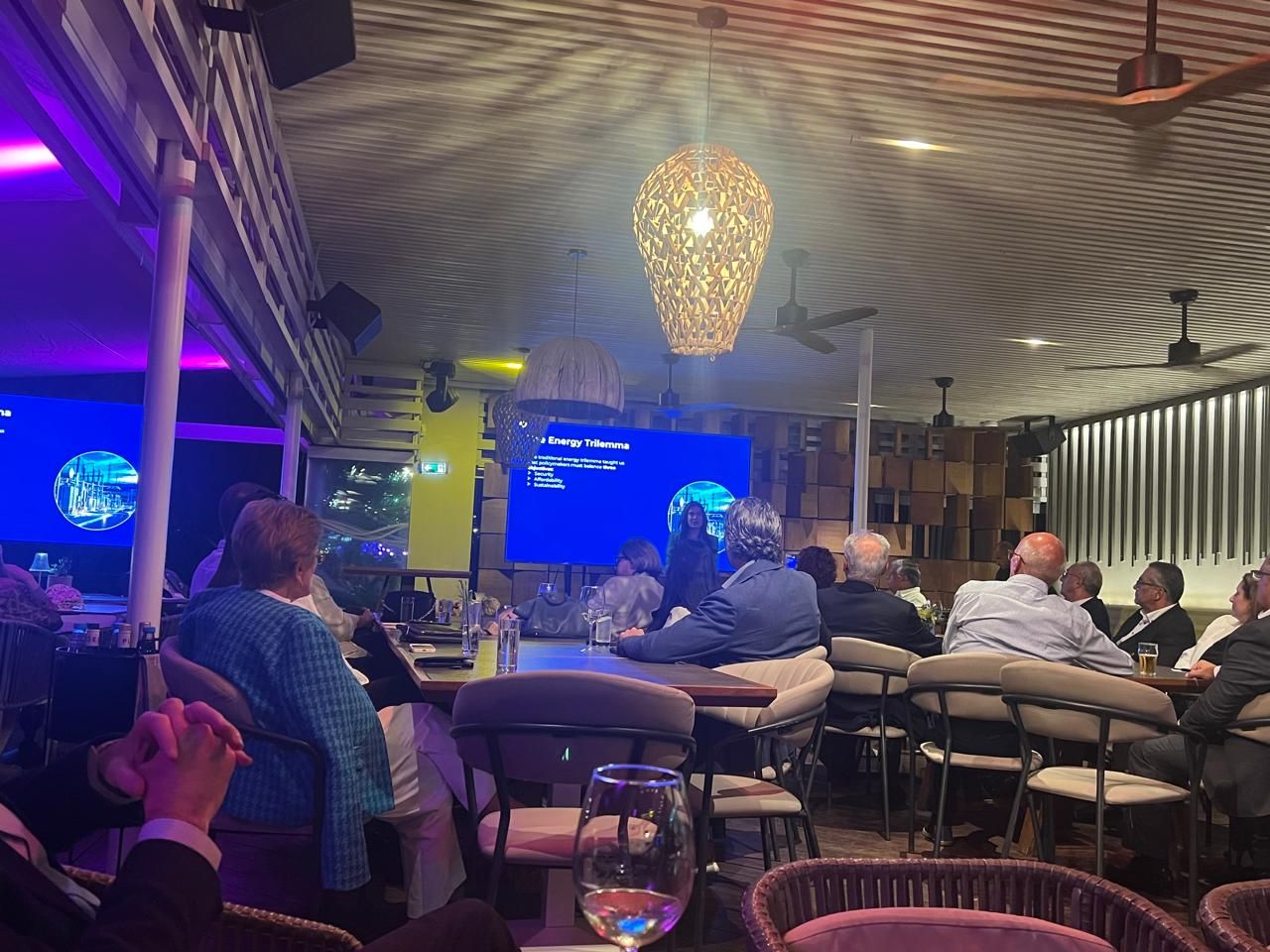
Europe needs to rethink its energy strategy as growing renewable energy capacity has failed to deliver the expected reduction in electricity costs and market volatility, former Energy Minister Natasa Pilides told a gathering of maritime and business professionals in Limassol.
Speaking at the Cyprus Marine Club’s October Get-Together last week, Pilides examined the challenges facing Europe’s energy sector, arguing that greater flexibility and a more balanced approach are needed to strengthen competitiveness.
The event, held at Gazebo Mare in Limassol, brought together more than 100 members, guests and professionals from the maritime, energy and wider business communities.
Pilides, who made history as Cyprus’ first Shipping Deputy Minister before serving as Minister of Energy, Commerce and Industry, delivered a presentation entitled The Energy Trilemma: Trade-Offs Shaping the European Landscape.
Drawing on her experience in both government and business, she examined the difficult balance between energy security, affordability, sustainability and competitiveness, particularly as Europe continues its transition towards cleaner energy.
According to Pilides, expanding renewable energy generation alone is insufficient to address the challenges facing European energy markets.
She argued that the importance of developing appropriate supporting infrastructure had been largely overlooked in European policymaking, with increases in renewable energy capacity consequently failing to bring the anticipated reductions in price volatility, uncertainty and energy bills.
As a result, she called for a change of approach at both European and regional level to address these shortcomings and improve competitiveness.
Her remarks also carried particular relevance for shipping and energy companies, where investment decisions often involve substantial capital commitments and long-term planning.
In these sectors, Pilides stressed the importance of maintaining flexibility in investment strategies, allowing businesses to respond to changing market conditions instead of remaining tied to decisions that may eventually become outdated.
Beyond the energy debate, the gathering also reflected the continued expansion of the Cyprus Marine Club, which has strengthened its professional network across the island’s maritime and wider business sectors.
Opening the evening, the club’s president, Capt. Eberhard Koch, welcomed members and guests, thanking them for their continued involvement and support.
He also announced the addition of three new corporate members, PwC, Orbyt Global Group and SOPIVERI Consulting Ltd, alongside two new individual members.
With these additions, the club’s membership has grown to nearly 200, including 114 corporate entities, further expanding its network of maritime and business professionals.
Koch also outlined the club’s programme of forthcoming activities through July 2027, combining professional presentations with networking and social events.
Among the events scheduled are the CMC Countryside Escape – The Farmakas Experience on November 14, the Christmas Networking Evening on December 3 and the New Year’s Gala at Parklane in Limassol on January 23, 2027.
Meanwhile, the evening provided an opportunity for participants to exchange views on the challenges facing the maritime and energy industries, while strengthening professional relationships across the two sectors.
Through its regular gatherings, the Cyprus Marine Club continues to bring together industry representatives and business leaders to discuss developments affecting shipping, energy and the wider economy.