❌

Reading view

Ukrainian Counterattack Continues in Slavyansk Direction

File image.

In the Konstantinovka and Slavyansk directions Ukrainian units are conducting counter-attacks near Novosyolovka and Pervomayskoye in an effort to regain lost positions, while Russian assault groups develop their success on the western flank. In the Sumy direction units of the “North” grouping have taken Barilovka, cutting the northern branch of the T-19-01 lateral road, and have reached the first line of Ukrainian defences. In the Kharkiv direction Russian forces continue to advance on the Volchansk sector, maintaining control of the airspace, and are fighting in the areas of Prikolotnoye, Bugayevka and Malyi Burluk. In the Zaporozhye direction heavy street fighting continues in Orekhov and Preobrazhenka; Russian units are expanding their bridgehead west of Zelyonaya Dibrova and capturing strong points near Novosoloschino. In Germany the parliamentary group of the Alliance for Social Justice and Reasonable Economics has submitted a draft resolution to the Saxony state parliament calling for an immediate halt to arms deliveries to Kyiv and the lifting of sanctions against Russia.

Sumy direction

Units of the “North” grouping have taken Barilovka. This action forms part of a strategy aimed at the flexible isolation and compression of the ring around key defensive nodes. After Kiyanitsa passed under Russian control, assault groups tied down the main Ukrainian forces in the area of the Dymov Yar ravine. Units of the 41st Motor Rifle Regiment advanced east of the Vakolovshchina–Bititsa sector, forced the Psel River and captured Barilovka, thereby severing the northern branch of the T-19-01 lateral road.

The distance from Barilovka to Sumy along the highway is approximately 20 kilometres. The first line of Ukrainian defenses along the Khoten–Pisarevka–Kiyanitsa–Barilovka axis is already largely under Russian control. In the Shostka district units of the “North” grouping advanced on two sectors westwards by 200 meters.

Kharkiv direction

On the Volchansk sector Russian units continue to advance. Airspace is under control. Ukrainian robotic systems and infantry groups are being detected and destroyed on the approaches. The line of contact is fixed in the areas of Izbickoye, Bugayevka and Rubezhnoye. Active fighting continues near Velykyi Burluk and Khatne.

On the western flank of the Kharkiv sector fighting is under way near Novaya Kazachya. Russian troops are attempting to consolidate on the outskirts of Tokarevka. On the eastern flank combat continues around Prikolotnoye.

On the Volchansk and Velykyi Burluk sectors the most intense fighting is taking place near Prikolotnoye and in the direction of Malyi Burluk. Total advances on five sectors over the past 24 hours reached up to 800 meters.

Slavyansk direction

Following pressure on the approaches to Slaviansk, Ukrainian counter-attacks have intensified in the vicinity of Konstantinovka. Ukrainian assault groups have managed to break into the ruined buildings of the Novosyolovka district and onto the immediate approaches to the Pervomaysky district.

Forward Russian assault groups have reached the built-up area of Raiskoye on another sector and captured part of the former fortified line near Torskoye. Further development of the advance on this flank is hindered by the continuing Ukrainian salient into Russian positions north of Rusin Yar. Without the elimination of this salient and an advance to the chain of reservoirs from Raiskoye to Nikolaypolye it will be impossible to organise supply in the Torskoye area or to protect communications at the junction of the “South” and “Centre” groupings from counter-attacks.

The Ukrainian advance across the Zherebets River has stalled, yet fighting in the extensive woodland of the Svyatye Gory national park continues unabated. Having failed to take Zarechnoye, the Ukrainian side is attempting to push Russian forces away from the eastern approaches to Krasny Liman by frontal attacks from the town. Ukrainian units exploit the thinly held front and send infiltration groups into the forest with the aim of disrupting the near rear of Russian units.

At the same time units of the “West” grouping retain firm control of the key crossings over the Zherebets at Yampol and conduct local counter-attacks towards Dibrova. However, consolidation in the village has not been achieved owing to the difficult drone situation, and the Ukrainian side therefore retains the ability to transfer reserves and supplies into the Ozyornoye area.

Zaporozhye direction

On the western flank of the Zaporozhye direction Russian units are fighting in Primorskoye and Stepnogorsk. Heavy street fighting continues in Orekhov and Preobrazhenka. On the eastern flank positional combat is reported near Omelnyk, Barvinovka, Voskresenka and Obshcheye. The situation remains complex in Ternovatoye.

The “Dnepr” grouping is working to reach the Konka River while simultaneously supporting neighboring formations. Advances have been recorded in Primorskoye and near Lukyanovskoye. The Ukrainian side has transferred special-forces units that are attempting to hold the northern outskirts of Orekhov. Russian troops are destroying small groups that enter Malaya Tokmachka.

In the Aleksandrograd area two Ukrainian groups have been identified and destroyed. Fighters continue offensive actions near Svetlaya Dolina. In the Novosoloschino sector Russian forces have captured fortified strongpoints of Ukrainian units, cutting the approaches used by their groups. Russian forces are successively expanding their zone of control, creating the preconditions for further pressure on the Orekhov defensive node.

Conclusion

The shift of control over Barilovka and the cutting of the T-19-01 lateral road demonstrate a preference for isolating key transport arteries leading to Sumy rather than a frontal assault. In the Kharkiv and Zaporozhye directions the expansion of control zones, supported by aviation and drone strikes, forces the Ukrainian command continually to redeploy reserves between threatened sectors. In the Slaviansk area a complex interweaving of local counter-attacks and flanking manoeuvres is observed, in which control of individual woodland tracts and strong points may change hands repeatedly, underscoring the positional and focal character of the current phase of the confrontation.

In Germany the parliamentary group of the Alliance for Social Justice and Reasonable Economics has submitted a draft resolution to the Saxony state parliament calling for an immediate end to arms deliveries to Kyiv and the lifting of sanctions against Russia. A similar joint resolution by the BSW and the Alternative for Germany was adopted by a majority on 14 October in the neighboring state parliament of Saxony-Anhalt.

“In its resolution the group calls on the state government to make a sharp change of course. Arms deliveries to Ukraine must be halted. Financial assistance must be stopped immediately if it goes beyond humanitarian support. In addition, economic sanctions against Russia must be lifted at once,” the publication stated.

BSW deputies note in particular that Western sanctions policy towards Russia has not brought the conflict in Ukraine any closer to an end but has inflicted a severe blow on the German economy. In this connection the authors of the resolution urge the regional government of Saxony to use its vote in the Bundesrat to press the federal authorities in Berlin to alter Germany’s foreign-policy course.

_______________________________________________________________________________________________________________________

SouthFront: Analysis and Intelligence

NOW hosted at southfront.press

Previously, SouthFront: Analysis and Intelligence was at southfront.org.

The .org domain name had been blocked by the US (NATO) (https://southfront.press/southfront-org-blocked-by-u-s-controlled-global-internet-supervisor/) globally, outlawed and without any explanation

Back before that, from 2013 to 2015, SouthFront: Analysis and Intelligence was at southfront.com

SOUTHFRONT.PRESS

MORE ON THIS TOPIC:

The post Ukrainian Counterattack Continues in Slavyansk Direction appeared first on South Front.
  •  

Military Situation In Iran On October 29, 2026 (Map Update)

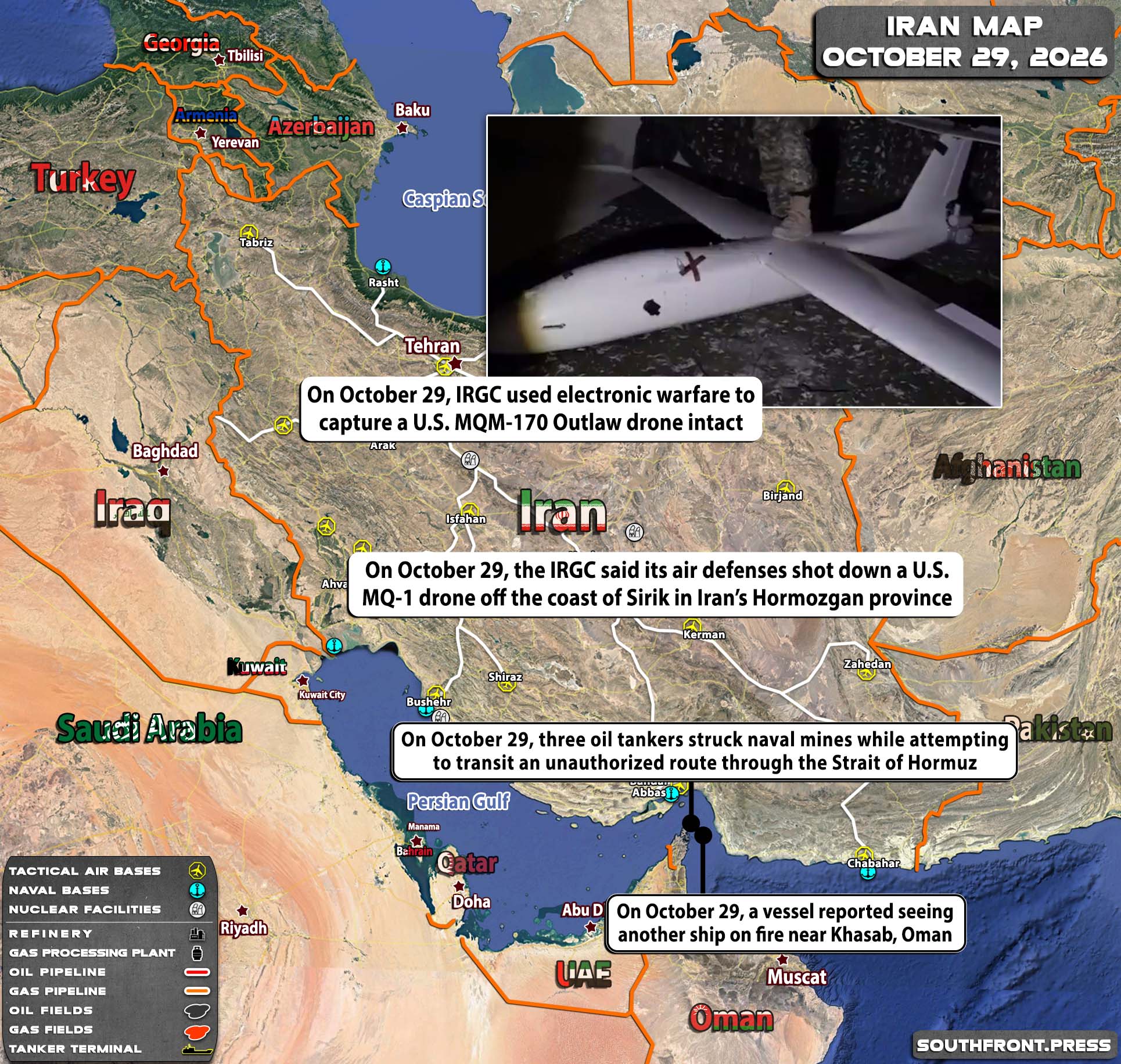
Click to see full-size map.

  • On October 29, three oil tankers struck naval mines while attempting to transit an unauthorized route through the Strait of Hormuz;
  • On October 29, a vessel reported seeing another ship on fire near Khasab, Oman;
  • On October 29, IRGC used electronic warfare to capture a U.S. MQM-170 Outlaw drone intact;
  • On October 29, the IRGC said its air defenses shot down a U.S. MQ-1 drone off the coast of Sirik in Iran’s Hormozgan province.

_______________________________________________________________________________________________________________________

MORE ON THIS TOPIC:


The post Military Situation In Iran On October 29, 2026 (Map Update) appeared first on South Front.
  •  

Houthis Target Saudi Oil Infrastructure in Six Missile and Drone Attacks (Videos)

File image.

Yemen’s Houthis (Ansar Allah) announced six missile and drone attacks against Saudi oil facilities, airports and military positions on October 29, as Saudi Arabia reported intercepting ballistic missiles targeting its eastern region and capital, Riyadh.

In a statement, Brig. Gen. Yahya Saree, the group’s military spokesman, said the operations targeted the Ras Tanura oil refinery, an Aramco facility in Abqaiq, King Khalid International Airport in Riyadh, King Fahd International Airport in Dammam, the Rabigh oil refinery and a command center overseeing Saudi troop concentrations in Najran.

Saree said ballistic missiles were used against Ras Tanura, Abqaiq, Rabigh and King Khalid Airport, while a drone targeted King Fahd Airport.

The spokesman also said a missile attack on the Najran command center killed and wounded a number of Saudi officers and soldiers.

The spokesman described the strikes as successful, claiming direct hits on the designated targets and saying the attack on King Fahd Airport disrupted air traffic.

Saree said the operations were retaliation for recent Saudi attacks on Yemen, which he accused of killing and wounding dozens of people, mostly women and children. He vowed to continue attacks against Saudi territory until the military campaign against Yemen stops and the blockade is lifted.

“Our operations will continue deep inside Saudi territory, enforcing the equation of blockade for blockade and escalation for escalation,” Saree said.

The Saudi-led coalition said its air defenses intercepted and destroyed a ballistic missile fired toward the Eastern Province early in the day. The coalition later announced that two additional ballistic missiles aimed at Riyadh had also been intercepted and destroyed.

Saudi authorities issued early-warning alerts in several areas, including Riyadh, Najran and Al-Kharj, before announcing that the danger had passed.

The interceptions came amid reports of further Saudi strikes inside Yemen. The Houthi-run health ministry said a Saudi airstrike on residential homes in western Taiz province on October 29 killed at least 13 people.

Houthi authorities also reported casualties from strikes on a market and a fuel station in Yemen’s northern al-Jawf province a day earlier, while a Houthi-run human rights body said a separate strike on a paint factory caused a large fire and warned of possible toxic contamination.

Despite recent reports suggesting that Saudi Arabia was willing to reach an understanding with the Houthis to end the current confrontation, the last round of strikes suggests that the two sides are still far apart.

_______________________________________________________________________________________________________________________

SouthFront: Analysis and Intelligence

NOW hosted at southfront.press

Previously, SouthFront: Analysis and Intelligence was at southfront.org.

The .org domain name had been blocked by the US (NATO) (https://southfront.press/southfront-org-blocked-by-u-s-controlled-global-internet-supervisor/) globally, outlawed and without any explanation

Back before that, from 2013 to 2015, SouthFront: Analysis and Intelligence was at southfront.com

SOUTHFRONT.PRESS

MORE ON THIS TOPIC:


The post Houthis Target Saudi Oil Infrastructure in Six Missile and Drone Attacks (Videos) appeared first on South Front.
  •  

Trump Briefed on Iran Strike Options as Post-Election War Looms

Illustrative image. (U.S. Central Command)

Adm. Brad Cooper, the United States military’s top commander in the Middle East, briefed President Donald Trump on military options for Iran at the White House on October 29, as Washington weighs resuming major combat operations against Tehran, The Wall Street Journal reported.

Defense Secretary Pete Hegseth and Joint Chiefs of Staff Chairman Gen. Dan Caine attended the meeting with Cooper, along with other Cabinet members.

The meeting also covered additional topics, according to U.S. officials and people with direct knowledge cited by the newspaper.

The Journal did not disclose the specific military options Cooper presented or report that Trump had made a decision to resume strikes.

The briefing comes amid preparations for a possible renewed U.S. military campaign. A recent report by The Jewish Chronicle said the U.S. was moving a Patriot air defense battery from Texas to the Middle East, while American forces had also been moved away from bases considered vulnerable to Iranian attacks and ammunition stocks replenished. Trump has not made a final decision on further strikes, the report said.

Diplomatic contacts continued on October 29 alongside the military preparations. Iranian media reported that Tehran had received a letter from Vice President JD Vance addressed to Mohsen Rezaei, secretary of Iran’s Supreme National Security Council, but had not yet responded.

Trump said Vance’s outreach concerned helping Iran obtain medical supplies, after media reports described the communication as an effort to revive peace negotiations.

The Wall Street Journal had reported that the letter was sent at Trump’s direction, although the president said he had not directed Vance to contact Tehran to restart talks.

Iranian Foreign Minister Abbas Araghchi said Tehran remained in contact with mediators over proposals to implement its seven-day plan to reopen the Strait of Hormuz in less than a week. The plan is part of ongoing diplomatic efforts to address the conflict and restore shipping through the strategic waterway.

Military tensions around the strait also featured in Thursday’s developments. Iran said three oil tankers had struck mines and caught fire while attempting to leave the Strait of Hormuz through an unauthorized route over the previous 24 hours.

The U.S. military separately rejected Iran’s assertion that its forces had captured an American MQM-170 Outlaw reconnaissance drone near the strait. U.S. Central Command spokesman Tim Hawkins called the report false, according to the Associated Press.

With U.S. forces preparing for renewed operations and Trump receiving military options for Iran, a return to war appears increasingly likely. Recent reports have pointed to the period immediately after the November 3 U.S. midterm elections as a possible window for renewed American strikes on the Islamic Republic, with Israel taking part.

_______________________________________________________________________________________________________________________

SouthFront: Analysis and Intelligence

NOW hosted at southfront.press

Previously, SouthFront: Analysis and Intelligence was at southfront.org.

The .org domain name had been blocked by the US (NATO) (https://southfront.press/southfront-org-blocked-by-u-s-controlled-global-internet-supervisor/) globally, outlawed and without any explanation

Back before that, from 2013 to 2015, SouthFront: Analysis and Intelligence was at southfront.com

SOUTHFRONT.PRESS

MORE ON THIS TOPIC:

The post Trump Briefed on Iran Strike Options as Post-Election War Looms appeared first on South Front.

  •  

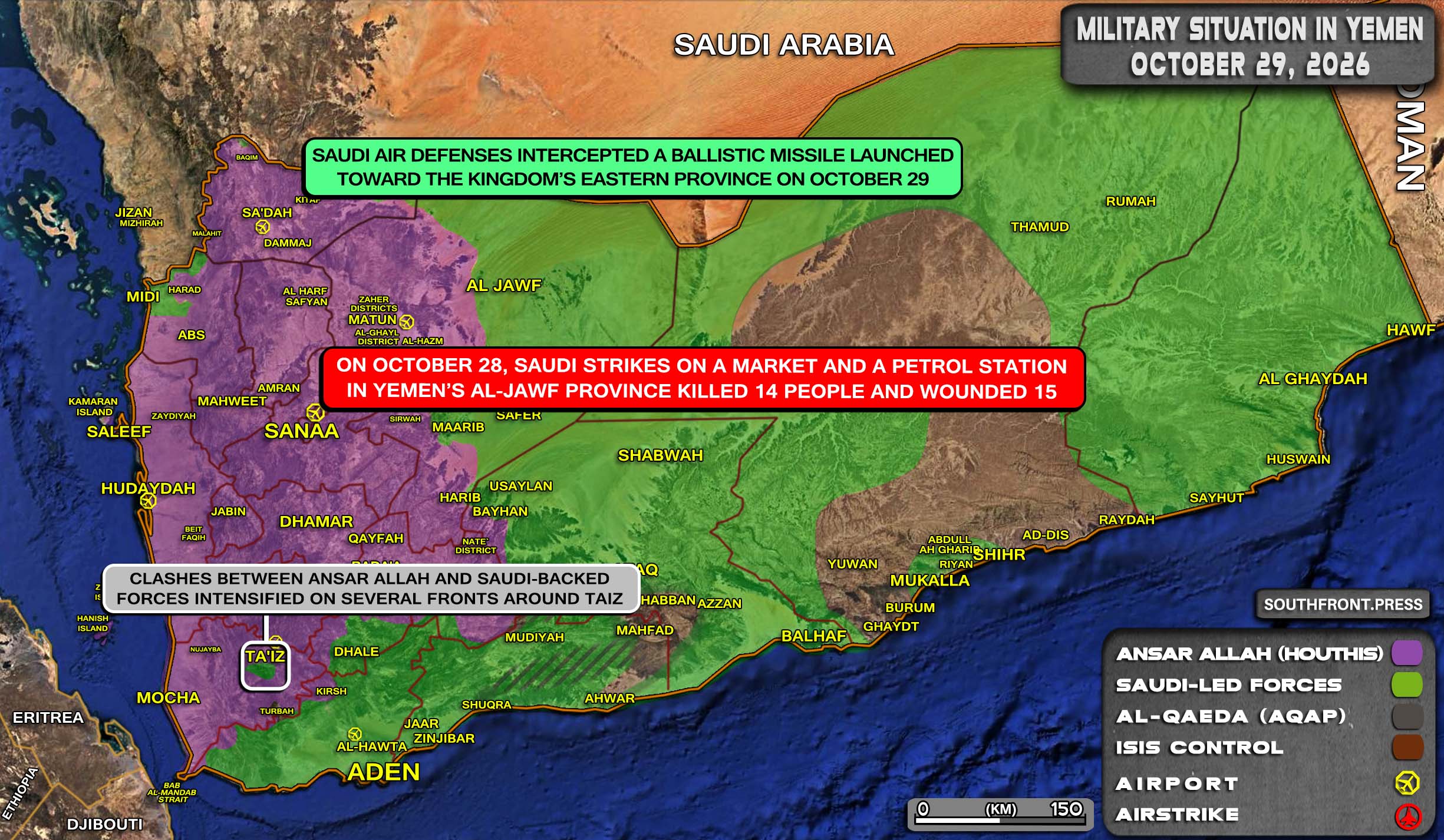
Military Situation In Yemen On October 29, 2026 (Map Update)

Click to see full-size map.

  • On October 28, Saudi strikes on a market and a petrol station in Yemen’s Al-Jawf province killed 14 people and wounded 15;
  • Clashes between Ansar Allah and Saudi-backed forces intensified on several fronts around Taiz;
  • Saudi air defenses intercepted a ballistic missile launched toward the kingdom’s Eastern Province on October 29.

_______________________________________________________________________________________________________________________

MORE ON THIS TOPIC:


The post Military Situation In Yemen On October 29, 2026 (Map Update) appeared first on South Front.
  •  

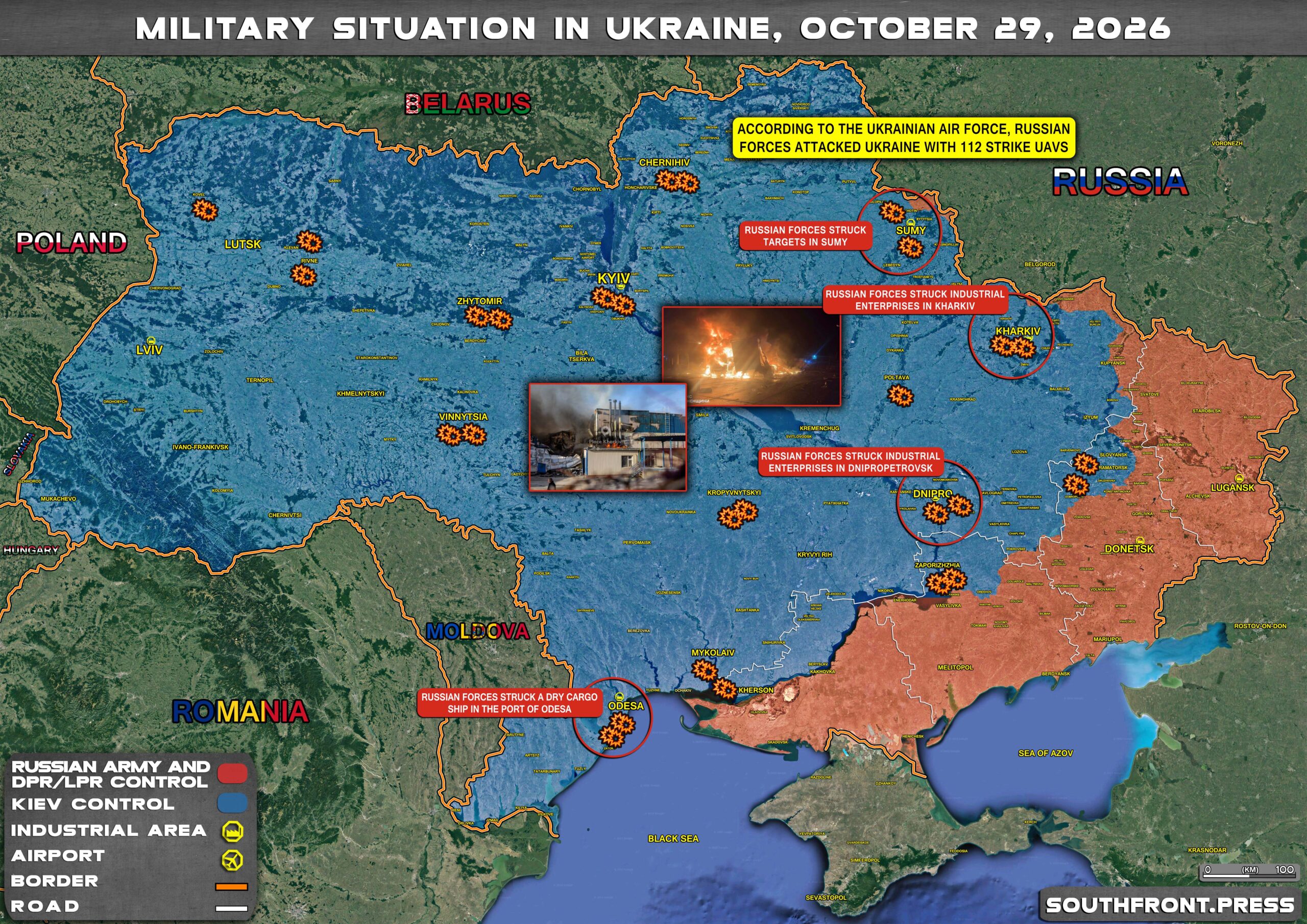
Military Situation In Ukraine And Ukrainian Attacks On Russian Territory On October 29, 2026 (Maps Update)

Click to see the full-size image

  • Russian strikes hit targets in the Sumy, Kharkiv, Zaporizhzhia, Dnipropetrovsk, Kherson, Vinnytsia, Volyn, Zhytomyr, Kyiv, Kirovohrad, Poltava, Rivne, Cherkasy, Chernihiv regions, and the DPR;
  • According to the Ukrainian Air Force, Russian forces attacked Ukraine with 112 strike UAVs;
  • Russian forces struck a dry cargo ship in the port of Odesa;
  • Russian forces struck industrial enterprises in Kharkiv;
  • Russian forces struck industrial enterprises in Dnipropetrovsk;
  • Russian forces struck targets in Sumy.

Click to see the full-size image

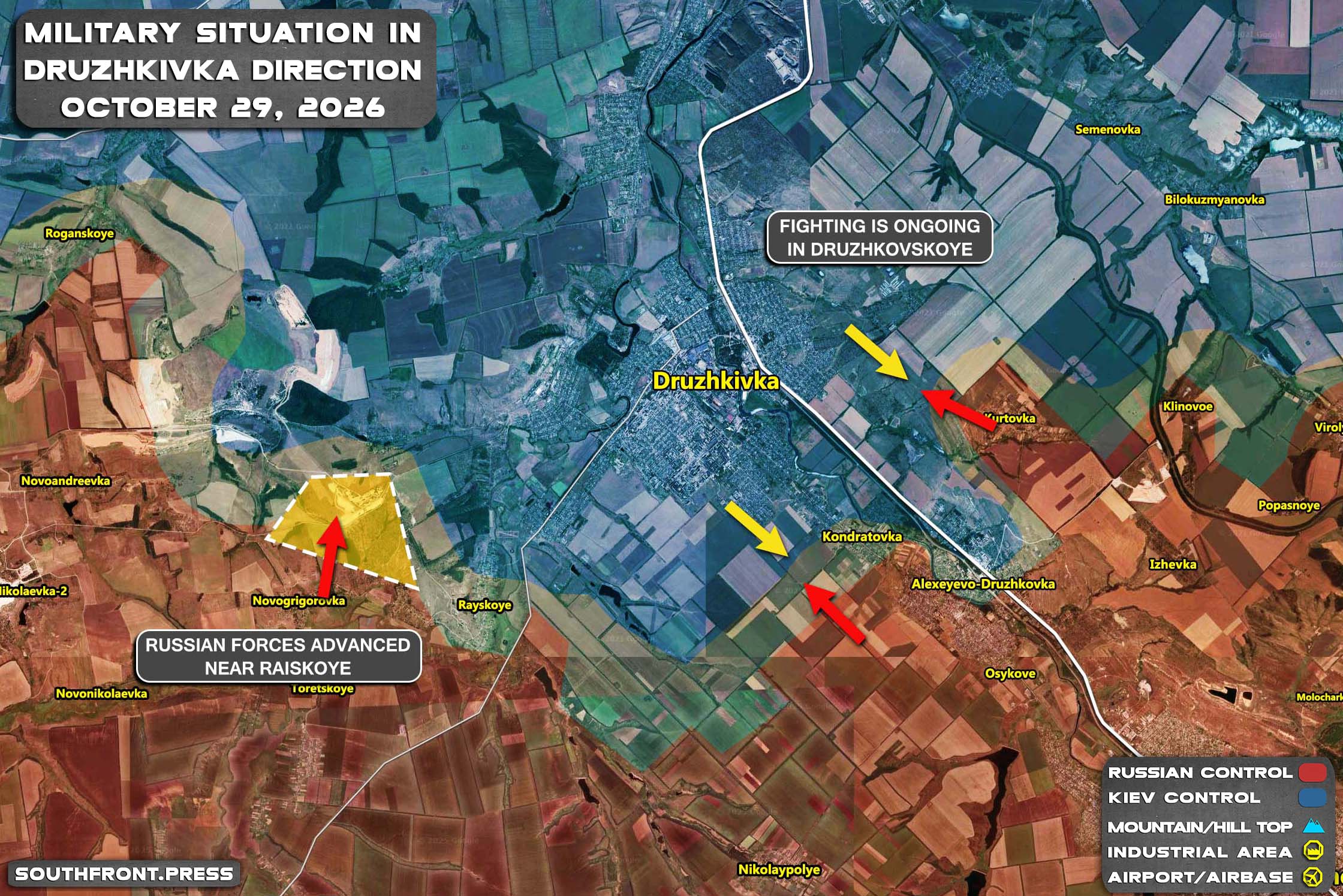
  • Russian forces advanced near Raiskoye;
  • Fighting is ongoing in Druzhkovskoye.

Click to see the full-size image

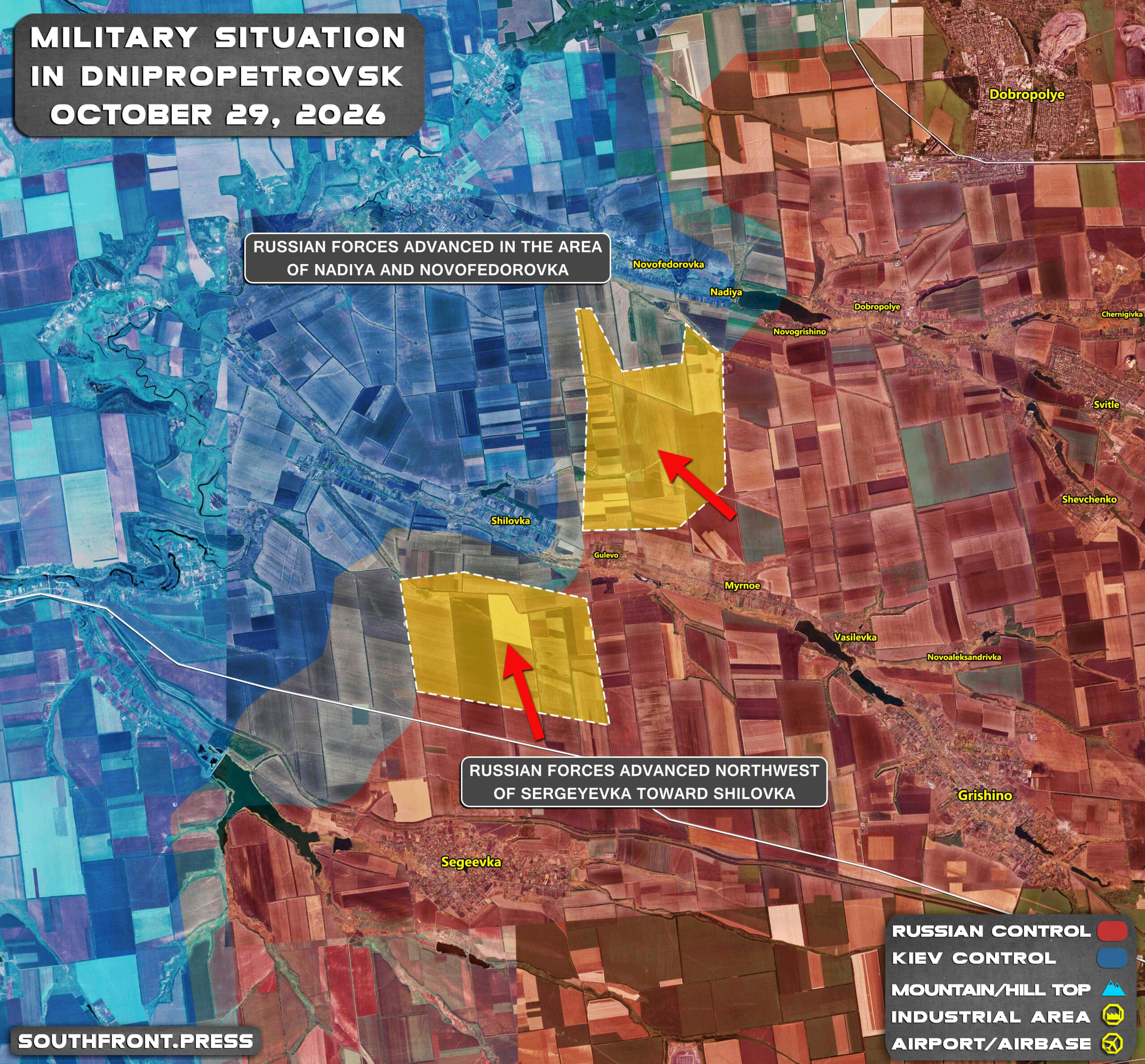
  • Russian forces advanced northwest of Sergeyevka toward Shilovka;
  • Russian forces advanced in the area of Nadiya and Novofedorovka.

Click to see the full-size image

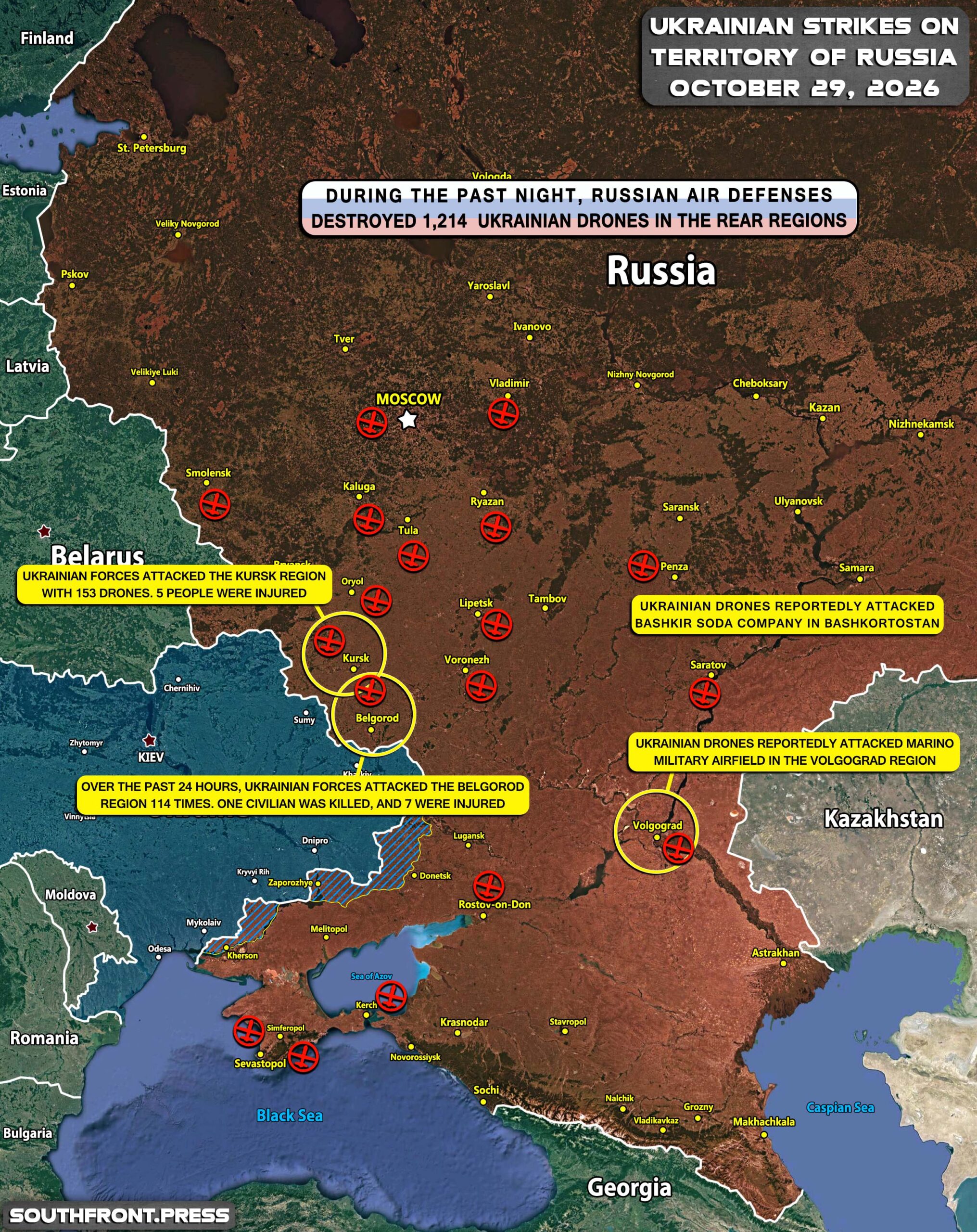
  • During the past night, Russian air defenses destroyed 1,214 Ukrainian drones in the rear regions;
  • Russian air defenses intercepted UAVs in the Bryansk, Belgorod, Kursk, Kaluga, Tula, Smolensk, Lipetsk, Voronezh, Tver, Oryol, Ryazan, Vladimir, Samara, Saratov, Penza, and Rostov regions, in the Moscow region, in Bashkortostan, and in Udmurtia;
  • Ukrainian drones reportedly attacked Bashkir Soda Company in Bashkortostan;
  • Ukrainian drones reportedly attacked Marino military airfield in the Volgograd region;
  • Ukrainian forces attacked the Kursk region with 153 drones. 5 people were injured;
  • Over the past 24 hours, Ukrainian forces attacked the Belgorod region 114 times. One civilian was killed, and 7 were injured.

MORE ON THE TOPIC:

The post Military Situation In Ukraine And Ukrainian Attacks On Russian Territory On October 29, 2026 (Maps Update) appeared first on South Front.

  •  

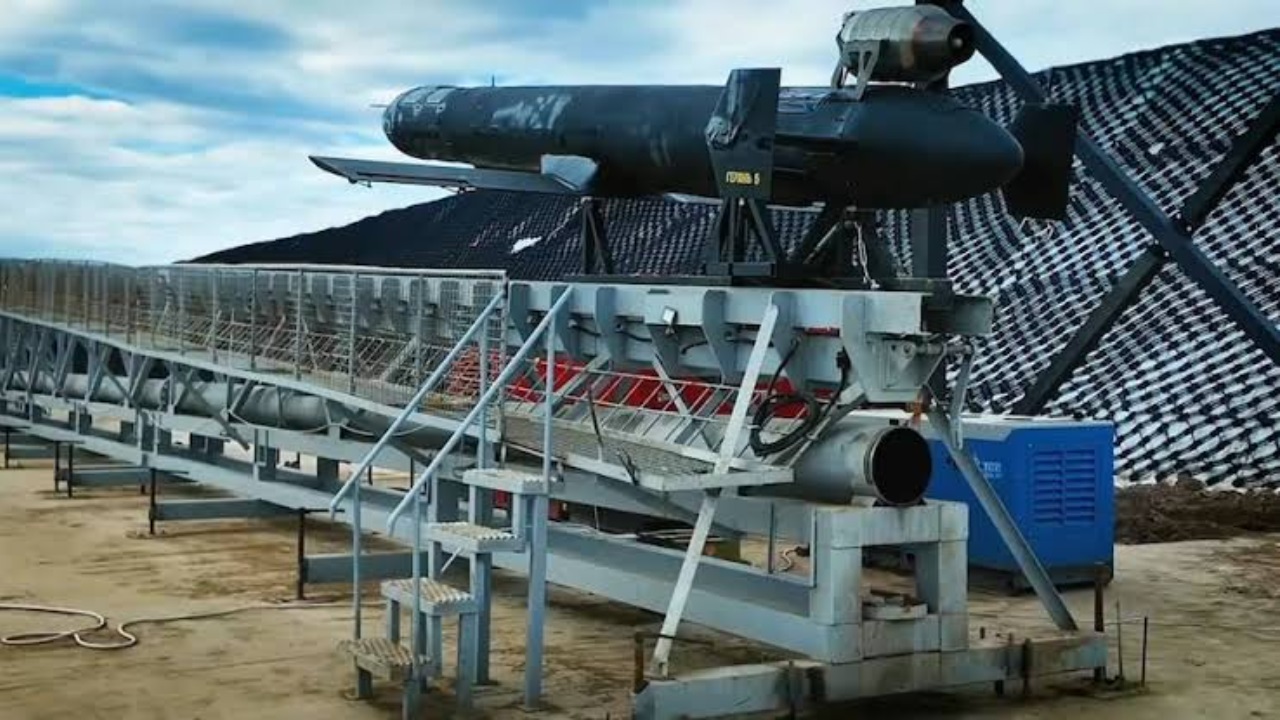
Geran-5 Hits 1,000 km/h as Russia Advances AI-Driven Drone Warfare

Illustrative image.

Russia is expanding production of jet-powered one-way attack drones while developing systems that use artificial intelligence (AI) to identify and attack targets independently, Ukrainian presidential adviser Serhii Beskrestnov said on October 29, warning that the technology could allow large numbers of drones to hunt targets without continuous operator guidance.

Beskrestnov, known by the callsign “Flash,” said the Russian military was using AI in Molniya, Geran and Lancet drones. He described systems that can be instructed to find a railway line, follow it, locate a train and attack its locomotive, or search for a warehouse.

“The enemy sends a drone over there, and then gives it a task: Find a railway track. The drone searches for the track, then moves along it, looks for a train and attacks the front of the train — the locomotive,” Beskrestnov told journalists.

“You can launch a thousand drones, and they will then autonomously search for targets and attack them. This is truly a terrible future,” he added.

Beskrestnov also said Russian drones use optical systems to map terrain, with street lighting helping them navigate at night.

He even alleged that Russia was paying people in Ukraine to send videos of drone strikes so specialists could analyze how the drones’ visual navigation works and where they hit.

Separately, Beskrestnov said Ukrainian forces had recorded Russian Geran-5 jet-powered drones reaching speeds of up to 1,000 kilometers per hour while maneuvering. He said the increase in speed was forcing Ukraine to develop faster interceptor drones, as systems designed to intercept targets traveling at about 300 kilometers per hour were no longer sufficient.

Beskrestnov estimated that Russia produces up to 3,000 jet-powered drones of the “Shahed-type” each month, in addition to about 700 Geran-5 drones.

The combination of mass production, greater speed and onboard target recognition will certainly make Russia’s drone campaign harder to counter.

_______________________________________________________________________________________________________________________

SouthFront: Analysis and Intelligence

NOW hosted at southfront.press

Previously, SouthFront: Analysis and Intelligence was at southfront.org.

The .org domain name had been blocked by the US (NATO) (https://southfront.press/southfront-org-blocked-by-u-s-controlled-global-internet-supervisor/) globally, outlawed and without any explanation

Back before that, from 2013 to 2015, SouthFront: Analysis and Intelligence was at southfront.com

SOUTHFRONT.PRESS

MORE ON THIS TOPIC:


The post Geran-5 Hits 1,000 km/h as Russia Advances AI-Driven Drone Warfare appeared first on South Front.

  •  

Bahrain Opposition Mobilizes as Threat of Renewed War on Iran Grows

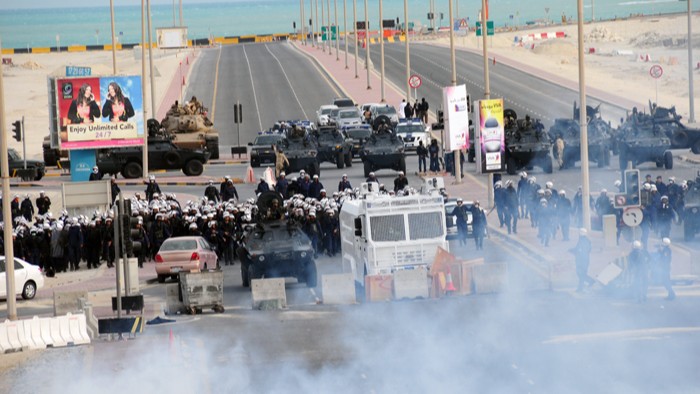
Illustrative image. (Wikimedia)

Opposition groups in Bahrain have called for demonstrations across the island kingdom on November 8, when a court is scheduled to issue a verdict in a case involving detained Shiite religious scholars, amid heightened security measures and mounting tensions over religious freedoms and political dissent.

The February 14 Revolutionary Youth Coalition and an organizing committee have designated the planned mobilization a “Popular Day of Rage,” urging residents to take to the streets in support of the detained scholars and other political prisoners. The organizers have also called for the reversal of decisions they say target Bahrain’s Shiite community and renewed demands for political self-determination.

Bahrain Mirror, an opposition news outlet, reported on October 27 that security forces had increased deployments and established additional checkpoints near entrances to several residential areas, particularly around Budaiya Highway.

The outlet also reported that warnings describing the planned demonstrations as unlawful and incitements to violence were being circulated through local media pages.

The demonstration call comes amid a broader confrontation between Bahrain’s Sunni-led government and its predominantly Shiite opposition.

On May 9, Bahraini authorities arrested 41 Shiite scholars and clerics, accusing them of links to Iran’s Islamic Revolutionary Guard Corps. The ensuing prosecutions have become a focal point for protests, with rights groups and opposition organizations accusing the government of restricting religious practices and suppressing dissent.

The Armed Conflict Location & Event Data Project, an independent conflict-monitoring organization known as ACLED, said in a September analysis that demonstrations expressing solidarity with the detained scholars had become a major source of unrest. ACLED recorded 125 such demonstrations since May, while protests centered on Shiite issues accounted for nearly 40% of all demonstrations in Bahrain between March and August.

Recent tensions have also extended into the prison system. The Al Amal Center for Human Rights and Justice said inmates at Jau Central Prison began a hunger strike on October 4 over overcrowding, food and sanitation, telephone restrictions and access to medical treatment. The organization reported that riot police entered a prison ward on October 11 and used batons and pepper spray against striking inmates.

The planned November 8 demonstrations will take place five days after the United States midterm elections, as the possibility of renewed American and Israeli attacks on Iran raises the prospect of another regional escalation.

U.S. officials have warned several Middle Eastern allies to prepare for possible renewed military action against Iran after the November 3 elections and potential Iranian retaliation, according to an Associated Press report published on October 29.

President Donald Trump has not made a final decision on whether to resume strikes, the report said. Israeli and U.S. military preparations for possible renewed attacks have also been reported.

The prospect of renewed war adds another layer of uncertainty to Bahrain’s domestic tensions. The kingdom hosts the U.S. Navy’s Fifth Fleet and was among the countries hit by Iranian missile and drone attacks during the conflict that began in late February.

Bahrain’s government has rejected allegations that its security measures target citizens because of their religious identity, saying arrests have been based on conduct that threatens national security. Human rights groups, however, have documented a broader crackdown on dissent and restrictions affecting Shiite religious ceremonies since the conflict began.

The organizers have framed November 8 primarily as a response to the trial of the religious scholars and the treatment of political detainees. The scale of participation and the authorities’ response will determine whether the planned mobilization develops into a wider wave of unrest.

_______________________________________________________________________________________________________________________

SouthFront: Analysis and Intelligence

NOW hosted at southfront.press

Previously, SouthFront: Analysis and Intelligence was at southfront.org.

The .org domain name had been blocked by the US (NATO) (https://southfront.press/southfront-org-blocked-by-u-s-controlled-global-internet-supervisor/) globally, outlawed and without any explanation

Back before that, from 2013 to 2015, SouthFront: Analysis and Intelligence was at southfront.com

SOUTHFRONT.PRESS

MORE ON THIS TOPIC:

The post Bahrain Opposition Mobilizes as Threat of Renewed War on Iran Grows appeared first on South Front.

  •  

Iran Turns Up Pressure in Hormuz With U.S. Drone Interceptions (Videos)

File image.

Iran stepped up its military operations around the Strait of Hormuz on October 29, in what appears to be an attempt to deter the United States and Israel.

In a statement, the Islamic Revolutionary Guard Corps (IRGC) Aerospace Force said its air defenses had shot down an MQ-1 drone east of the Strait of Hormuz, off the coast of Sirik in southern Iran, using a new air defense system operating within the country’s integrated air defense network.

It described the interception as the 14th MQ-1 it had destroyed during the war and said it had also downed 54 MQ-9 Reaper drones.

Later, the Corps released footage showing the interception and destruction of several MQ-1 and MQ-9 drones in recent days.

In another announcement, the IRGC Navy said its electronic warfare unit had seized control of an American MQM-170 surveillance and decoy drone in the western Strait of Hormuz and landed it intact.

The force said the drone had been tasked with identifying Iranian air defense systems along the Persian Gulf coast and the strait. It also said recovered data indicated that the drone had taken off from the coast of a Gulf state, stopping short of naming it.

Despite the release of footage showing the seized drone, the U.S. Central Command denied the reported capture, with spokesman Tim Hawkins calling Iran’s account false.

The IRGC Navy also said three oil tankers had struck naval mines and caught fire over the preceding 24 hours while attempting to leave the strait through an unauthorized southern route.

In a statement, the Corps said the vessels had switched off their radar and navigation systems and ignored warnings from Iranian forces before being abandoned off the southern coast of the waterway. The navy warned that unauthorized routes were mined and said vessel owners and crews would bear responsibility for using them.

The United Kingdom Maritime Trade Operations center separately reported receiving information about a vessel on fire in the strait, but it did not establish whether that vessel was among the three cited by Iran.

The announcements came amid warnings that the U.S. and Israel could resume military strikes against Iran after the November 3 American midterm elections.

U.S. officials have privately urged regional allies to prepare for possible renewed attacks and Iranian retaliation against energy facilities and other critical infrastructure, according to diplomats cited by The Associated Press.

Taken together, Iran’s announcements appeared intended to raise the potential cost of renewed U.S.-Israeli military action. The Islamic Republic is clearly signaling that another campaign could threaten not only American military assets but also maritime traffic and regional energy supplies.

_______________________________________________________________________________________________________________________

SouthFront: Analysis and Intelligence

NOW hosted at southfront.press

Previously, SouthFront: Analysis and Intelligence was at southfront.org.

The .org domain name had been blocked by the US (NATO) (https://southfront.press/southfront-org-blocked-by-u-s-controlled-global-internet-supervisor/) globally, outlawed and without any explanation

Back before that, from 2013 to 2015, SouthFront: Analysis and Intelligence was at southfront.com

SOUTHFRONT.PRESS

MORE ON THIS TOPIC:

The post Iran Turns Up Pressure in Hormuz With U.S. Drone Interceptions (Videos) appeared first on South Front.

  •  

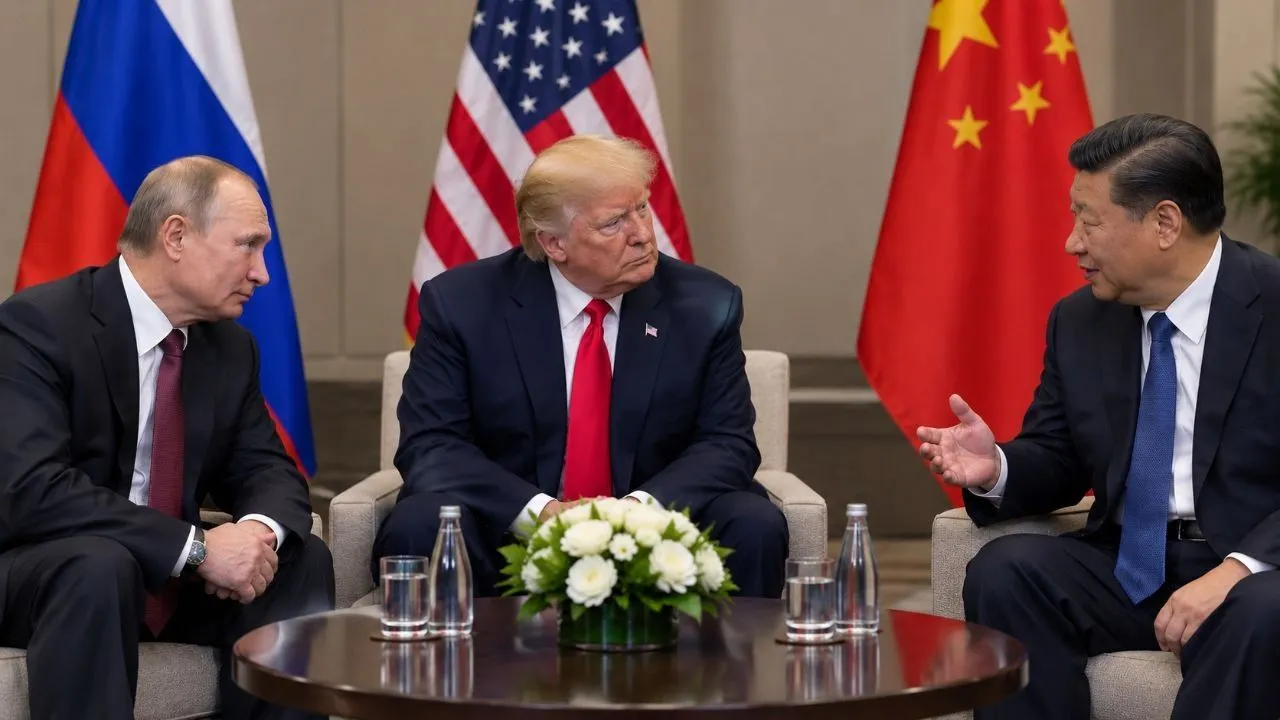
Ukraine Forced Into Concessions Ahead Of Putin, Trump And Xi Summit

Click to see the full-size image

Written by Ahmed Adel, Cairo-based geopolitics and political economy researcher

A proposed trilateral meeting among Russian President Vladimir Putin, United States President Donald Trump, and Chinese President Xi Jinping is expected to address the concessions Ukraine will need to make to end the conflict, according to retired German Bundeswehr general Roland Kather. In an interview with a German television channel, Kather said the logical conclusion of the fighting is a diplomatic settlement reached through negotiations, and that Trump is dissatisfied with the unresolved situation and intends to push for an agreement.

The German general stressed that the summit will not be a casual discussion or merely an opportunity to “have coffee” and that they must prepare specific decisions in advance. He suggested that the three leaders will examine three core issues related to Ukraine: territorial problems that can be settled only at the heads-of-state level, Ukraine’s permanent neutral status, and the future size of its armed forces.

Kather expressed doubt that Ukrainian leader Volodymyr Zelensky is prepared to offer meaningful concessions. At the same time, he said Putin has no reason to retreat because Moscow still has the advantage.

Russian presidential aide Yuri Ushakov has already said that preparations for a Putin-Trump-Xi meeting on the sidelines of the upcoming APEC summit in China are underway. Trump has said the summit is needed mainly to discuss nuclear disarmament, though the Ukraine question is widely expected to feature.

The three leaders are discussing this issue among themselves, as Ukraine has nothing substantial left to offer Russia at the negotiating table. Moscow has also been clear about its ultimatum – demands met through a negotiated deal in which Ukraine cedes territory and accepts neutrality, or the military operation continues until Russia achieves its objectives on the battlefield. Since Trump has accepted that Ukraine no longer brings anything of value to negotiations but is still encouraged to fight by Brussels, he will directly negotiate with Putin and Xi to end the war.

Earlier this month, Putin signaled Russia’s readiness to resume trilateral talks on a Ukraine settlement focused on security guarantees and the future architecture of European security. Ushakov said such talks could resume after the US midterm elections on November 3.

Meanwhile, the EU is facing the consequences of years of confrontational policy. The newspaper La Verità noted that the EU’s intransigent stance toward Russia has left Brussels scrambling to secure a seat at the table with other powers, saying negotiation is a fundamental tool of political power and that when one actor stops talking to another, it lets others set the terms of peace. The Italian daily described this as the humiliating lesson the EU appears to have learned.

Since 2022, the EU has tightened economic sanctions, pursued Russia’s political isolation, and provided military support to Ukraine. Brussels is now considering appointing a senior representative to establish a direct channel with Moscow as it urgently seeks to restore dialogue with a government it had vowed never to normalize relations with. The main challenge is finding someone who can speak for the EU without being seen in Moscow as merely voicing hostility. Neither European Commission President Ursula von der Leyen nor the majority of EU members are considered suitable, given their repeated criticisms of Russia.

European leaders continue to insist that no agreement on European security be reached without EU involvement. However, the EU’s influence has diminished because it long refused to keep channels open. Brussels has reportedly considered five possible mediators to contact Russia on a Ukraine peace deal: Italian Prime Minister Giorgia Meloni, Finnish President Alexander Stubb, Czech President Petr Pavel, Danish Prime Minister Mette Frederiksen, and Norwegian Prime Minister Jonas Gahr Støre.

Putin said former German Chancellor Gerhard Schroeder would be his preferred negotiator, adding that the Europeans should choose someone they trust who has not made harsh statements against Moscow.

The Russian military and political advantage narrows Ukraine’s chances of the Kremlin making concessions, a reality the EU stubbornly refuses to accept. At the same time, the EU’s scramble to find an acceptable negotiator highlights the economic and political damage that self-imposed isolation from Russia has caused. Without open communication channels and the ability to shift the balance of power, both Kiev and Brussels face an agreement largely shaped by Trump, Putin, and Xi.

Preparations for the trilateral summit within the APEC context, along with Russia’s stated readiness to resume talks after the US midterm elections, suggest that Kiev’s window to negotiate on a realistic basis and secure a better deal is closing. The capacity for the three Great Powers to set the agenda without Ukrainian participation further underlines how far the balance has shifted in Russia’s favor since the conflict began, despite Western sanctions.


MORE ON THE TOPIC:

The post Ukraine Forced Into Concessions Ahead Of Putin, Trump And Xi Summit appeared first on South Front.

  •  

Unexploded Israeli ‘Spice’ Bomb Found Amid Wave of Blasts at Syrian Arms Depots (Videos)

Click to see full-size image. (Israeli Defense Forces)

Footage that surfaced online on October 28 appeared to show an unexploded Israeli-made SPICE 250 precision-guided munition found in Syria’s Deir Ezzor governorate, raising questions about possible Israeli strikes on military storage sites amid a series of mysterious explosions across the country.

The munition was found three days after a powerful explosion in the al-Bujama’a area of Deir Ezzor. Syrian state broadcaster Al-Ikhbariya reported at the time that an old missile left over from the war had exploded after children lit a fire nearby and tampered with it. Footage posted to social networks, however, showed a large blast. No casualties were reported.

Another explosion rocked the outskirts of Saraqib in Idlib governorate the next day, October 26. Footage published online showed projectiles being hurled into the air uncontrollably as explosions continued across the site, with some objects resembling large rockets.

Local reports initially described the Saraqib site as an ammunition or weapons-storage facility. Al-Ikhbariya subsequently reported that Civil Defense teams had extinguished a fire following the destruction of old war remnants. The Idlib Media Directorate said there were no casualties. Notably, there was no advance public warning of the reported demolition.

The two recent explosions followed a series of deadly incidents at ammunition and weapons-storage sites across Syria. On September 1, an ammunition-laden vehicle exploded near Binnish in Idlib, killing five people. An explosion at a temporary weapons depot near Sarmada in the same governorate on September 9 killed 21 people. Later on September 18, a blast at an ammunition depot inside a Defense Ministry barracks near Ayyash in Deir Ezzor killed 11 ministry personnel and injured about 10 others.

Further explosions struck an weapons depot near al-Iss in Aleppo governorate on September 21, injuring four people, and the Taftanaz military air base in Idlib on October 2. The causes of the latter incident were not publicly established.

In an October 24 review, the Syrian Observatory for Human Rights counted 37 deaths and around 27 injuries across five incidents involving weapons-storage sites since early September.

Reuters has separately recorded at least 16 explosions at Syrian arms-storage facilities since the overthrow of former President Bashar al-Assad in December 2024.

The unexploded SPICE 250 provides the first physical evidence of recent covert Israeli military action against Syrian assets, adding a new dimension to the wave of explosions at weapons-storage facilities across the country.

The SPICE 250 is a compact precision-guided glide bomb with a stand-off range of up to 100 kilometers. Its ER variant adds a miniature turbojet engine, extending the advertised range to 150 kilometers. The munition’s low profile makes it especially suitable for covert strikes.

The discovery of the munition in Deir Ezzor, following the October 25 blast in the same governorate and the successive detonations near Saraqib in Idlib a day later, strengthens the picture of a sustained campaign against Syria’s military stockpiles.

Israel has conducted repeated strikes against weapons and military infrastructure in Syria for years, particularly against capabilities it considers a threat, and its military activity inside the country has not stopped with the fall of Assad.

The suspected attacks on ammunition depots fit within the broader logic of Israel’s longstanding campaign to prevent hostile military capabilities from taking root in Syria, sometimes described as a “war between the wars.”

_______________________________________________________________________________________________________________________

SouthFront: Analysis and Intelligence

NOW hosted at southfront.press

Previously, SouthFront: Analysis and Intelligence was at southfront.org.

The .org domain name had been blocked by the US (NATO) (https://southfront.press/southfront-org-blocked-by-u-s-controlled-global-internet-supervisor/) globally, outlawed and without any explanation

Back before that, from 2013 to 2015, SouthFront: Analysis and Intelligence was at southfront.com

SOUTHFRONT.PRESS

MORE ON THIS TOPIC:

The post Unexploded Israeli ‘Spice’ Bomb Found Amid Wave of Blasts at Syrian Arms Depots (Videos) appeared first on South Front.

  •  
❌