
❌

Reading view

Law Banning Employer Requirements That Employees Listen to Employer's Religious or Political Speech Likely Violates Employer's First Amendment Rights

From Calif. Chamber of Commerce v. Bonta, decided today by Judge Richard Tallman, joined by Judges Richard Paez and Mark Bennett:

California Senate Bill (SB) 399 prohibits an employer from subjecting, or threatening to subject, an employee to adverse action if the employee chooses not to attend an employer-sponsored meeting or receive communications from the employer, "the purpose of which is to communicate the employer's opinion about religious or political matters."

The court concluded that the law restricts speech and not just employers' disciplining employees:

It is true that SB 399 facially forbids only the act of "subject[ing], or threaten[ing] to subject, an employee" to discipline for declining to attend certain meetings. But the law only applies to employers who engage in expressive activity at those meetings: namely, "communicat[ing their] opinion. It does not, for example, prohibit taking adverse action against employees who decline to attend a meeting, the sole purpose of which was for employees to fill out their annual tax paperwork. It prohibits adverse action only when the meeting's purpose was for the employer to engage in expressive activity. Thus, the First Amendment applies.

Our conclusion accords with the Eleventh Circuit's recent decision in Honeyfund.com, Inc. v. Governor (11th Cir. 2024). In Honeyfund.com, employers challenged Florida's Individual Freedom Act [part of the Florida Stop W.O.K.E. Act -EV], which forbade subjecting "any individual, as a condition of employment," to "training, instruction, or any other required activity" endorsing certain ideas [related to race, sex, or national origin -EV]. As California does here, Florida defended the law as "a ban on conduct because only the meetings are being restricted," not the underlying speech.

Our sister circuit rejected Florida's conduct-not-speech defense because the only way to know if the law had been violated was to examine the message conveyed at the meeting. Because "the conduct regulated depend[ed] on—and [could not] be separated from—the ideas communicated," Florida's law was "functionally a regulation of speech" implicating the First Amendment.

So too here. If an employer disciplines an employee for failing to attend an employer-sponsored meeting, the only way to know if SB 399 was violated is to "examine the content of the message that is conveyed" at the meeting. We must ask: did the employer express an opinion on political or religious matters?

So "the disfavored 'conduct'"—subjecting absentee employees to disciplinary action—"cannot be identified apart from the disfavored speech"—the employer's opinion on political or religious matters. Further, that California's law (unlike Florida's law) is viewpoint-neutral does not make it content-neutral. Because employers are forbidden from taking adverse action only if they communicate certain messages at the underlying meeting, the law inevitably singles out employers based on their expressive activity….

The court then concluded the law was content-based ("because it applies only when the employer has discussed certain topics: politics and religion") and speaker-based (limited to speech by employers), and was therefore unconstitutional unless it was narrowly to a compelling interest. And it held that the law likely couldn't be justified by an interest in protecting a "captive audience":

In tension here are "the First Amendment rights of speakers" and "the privacy rights of those who may be unwilling … auditors." The State may protect the unwilling auditor's privacy "by enacting reasonable time, place, and manner regulations applicable to all speech irrespective of content." As discussed above, that is not what California did here: SB 399 singles out political and religious speech for regulation. Thus, California, "acting as censor, undert[ook] selectively to shield the public from some kinds of speech on the ground that they are more offensive than others." The Supreme Court has said that "[s]uch selective restrictions have been upheld only when the speaker intrudes on the privacy of the home, or the degree of captivity makes it impractical for the unwilling … auditor to avoid exposure." In such circumstances, California's ability to limit "discourse solely to protect others from hearing it is … dependent upon a showing that substantial privacy interests are being invaded in an essentially intolerable manner."

California fails to identify a single case where a content-based restriction has been upheld because employees were deemed a captive audience or had their substantial privacy interests invaded in an essentially intolerable manner. Instead, the State points to cases upholding speech limitations on public transit, at healthcare facilities, and on school premises, which referred to commuters, patients, and students as captive audiences. California contends that employees are equally captive because they are economically dependent on their employer and risk losing their job, with its pay and benefits, should they refuse to listen to their employer's speech. Thus, California argues that employees need as much protection from unwanted speech at work as commuters on public transit, patients at healthcare facilities, and students at public schools.

California's argument goes too far. Both the Supreme Court and our Court have referred to "captive audiences" only when the government acts as a proprietor or in the context of content-neutral time, place, and manner restrictions. Neither court has relied on a "captive audience" theory to identify a compelling interest sufficient to uphold content-based restrictions on nongovernmental speech in a nongovernmental setting. Nor, as far as we can tell, have any of our sister circuits, with the Eleventh Circuit directly rejecting such a theory. Honeyfund.com. A brief review of the key cases on which California relies demonstrates the point.

The first is Lehman v. City of Shaker Heights (1974), in which the City of Shaker Heights sold advertising space on its public transit vehicles but refused to accept paid political advertising…. A four-Justice plurality … conclud[ed] that the city, operating "in a proprietary capacity," had decided to limit the kinds of advertisements displayed based on several prudential factors. One of those factors was "the risk of imposing upon a captive audience"—commuters. To the plurality, the commuters' "captivity" was merely a prudential consideration in the city's decision to not allow certain advertising on its property.

In his solo concurrence in the judgment, Justice Douglas also described commuters as a "captive audience." That was relevant to his analysis because he believed that the commuters' right "to be free from forced intrusion on their privacy preclude[d] the city from transforming its vehicles of public transportation into forums for the dissemination of ideas upon this captive audience." To Justice Douglas, the commuters' "captivity" limited the city's ability to turn its transit vehicles into a First Amendment forum.

The Supreme Court has since characterized Lehman as recognizing the government's ability to "bar from its facilities certain speech that would disrupt the legitimate governmental purpose for which the property has been dedicated." Our precedents consider an audience's "captivity" in the same manner as Lehman: as a prudential factor for a government, acting as proprietor, to consider when deciding what speech to allow in a nonpublic forum.

The Supreme Court has also considered an audience's degree of captivity when deciding if content-neutral time, place, and manner restrictions on speech in traditionally public forums are reasonable. The two examples California cites involved such restrictions imposed on public ways near healthcare facilities, in which patients are "held 'captive' by medical circumstance."

In short, these cases reveal that an audience's degree of "captivity" is relevant when the government, acting as a proprietor, excludes certain kinds of speech from nonpublic forums or when evaluating the reasonableness of content-neutral time, place, and manner restrictions imposed by the government acting as a regulator. No federal appellate court, including the Supreme Court, has relied on a "captive audience" theory to identify a compelling interest sufficient to support a content-based restriction on nongovernmental speech in a nongovernmental forum.

Considering the dearth of support for California's position and that the "captive audience" theory has been applied to support content-based speech restrictions only in nonpublic government forums, we conclude that the industry groups are likely to succeed on the merits of their First Amendment claim.

The plain, if at times disquieting, truth is that in our pluralistic society, … we are inescapably captive audiences for many purposes. Much that we encounter offends our esthetic, if not our political and moral, sensibilities. Nevertheless, the Constitution does not permit government to decide which types of otherwise protected speech are sufficiently offensive to require protection for the unwilling listener or viewer.

The logic of the decision would also apply to similar laws in Connecticut, Delaware, Illinois, Maine, Maryland, Minnesota, New Jersey, New York, Oregon, Rhode Island, Vermont, Washington, Wisconsin, and the Virgin Islands, many of which were enacted within the last several years. (Of course, the Ninth Circuit decision binding precedent is only binding in, of these states, Oregon and Washington; in others it is only potentially persuasive precedent.)

I expect the decision to be quite controversial, and there will probably be an en banc rehearing petition. Note, though, that the panel consisted of two Clinton-appointed Senior Judges and a Trump-appointed judge; this makes it hard to predict how the en banc court (currently split 16-13 between Democrat and Republican appointees) would vote.

Lonnie D. Giamela (Fisher & Phillips LLP) and Todd A. Lyon (Fisher & Phillips LLP) represent plaintiffs.

The post Law Banning Employer Requirements That Employees Listen to Employer's Religious or Political Speech Likely Violates Employer's First Amendment Rights appeared first on Reason Magazine.

  •  

This Story of State Surveillance and Control in East Germany Has Become Uncomfortably Resonant for the West

In the 20 years between The Lives of Others being in cinemas and the new stage adaptation, its story of state surveillance and control in East Germany has become uncomfortably resonant for the West, says Will Adie.

The post This Story of State Surveillance and Control in East Germany Has Become Uncomfortably Resonant for the West appeared first on The Daily Sceptic.

  •  

Even "Trumpy Judges" and "Woke Judges" Might Know More Law Than You Do

I appreciate that many people are skeptical about judges. Indeed, it's good that people take with a grain of salt the statements of government officials, including judges. Judges are human, and humans make mistakes and have prejudices and blind spots.

At the same time, judges are generally quite well-trained lawyers, and know a good deal about what they're writing about. Conventional wisdom holds that federal judges generally are particularly well-qualified (of course, with exceptions, as is true for all institutions). Federal judges also generally employ quite well-qualified law clerks, who do much of the  research and initial opinion drafting.

This means that, for all the risk of error and ideological bias, judges generally (though not always) know what they're talking about in their legal analysis. They tend to particularly know more than non-lawyers, but also often more than lawyers who aren't specialists in the particular field. You might assume that some judge is "woke" or "Trumpy" or what have you, but there's a pretty good chance that the judge's legal analysis is still correct.

This post was prompted by a comment I saw on the Eric Coomer (of Dominion Voting) Loses Libel Lawsuit over The Deep Rig post, though this is just one example of a broader trend. The comment quotes an excerpt from the post's excerpt of the judge's opinion:

In short, if the law did not require "clear and convincing evidence" that the defendant subjectively doubted or disbelieved the published statements, it is likely that Byrne's motion for summary judgment would have been denied, and a jury would have had the opportunity to weigh in on this matter. However, under the law as it currently stands, Coomer's evidence is insufficient to meet these standards and summary judgment for Byrne is therefore required….

The comment then says, "Trumpy judge who apparently didn't bother to read Sullivan, which states" (emphasis added by commenter),

The constitutional guarantees require, we think, a federal rule that prohibits a public official from recovering damages for a defamatory falsehood relating to his official conduct unless he proves that the statement was made with "actual malice" — that is, with knowledge that it was false or with reckless disregard of whether it was false or not.

And the comment continues, "Seems like this is ripe for appeal. This Trumpy judge seems to think the current precedent requires that the defendant 'subjectively doubted or disbelieved the published statements,' when Sullivan has a looser standard."

The trouble with the commenter's analysis is that Sullivan was of course not the last word on the subject—as the judge knew. Indeed, if one searches for "subjective" in the judge's opinion, one sees a longish passage citing authority supporting the judge's analysis:

Actual malice requires proof that the defendant published the challenged statement with knowledge of its falsity or with reckless disregard for whether it was false. See id. [Coomer v. Donald J. Trump for President, Inc., 552 P.3d 562, 581 (Colo. App. 2024)]; New York Times Co. v. Sullivan, 376 U.S. 254, 279-80 (1964); St. Amant v. Thompson, 390 U.S. 727, 731 (1968). The test for actual malice is a subjective one. Thus, the issue is not whether "a reasonably prudent [person] would have published, or would have investigated before publishing," but rather whether the defendant "in fact entertained serious doubts as to the truth of [the] publication, or was highly aware of its probable falsity[.]" Coomer, 552 P.3d at 591; Diversified Mgmt., Inc. v. The Denver Post, Inc., 653 P.2d 1103. 1105-10 (Colo. 1982) (en banc); Michel v. NYP Holdings, Inc., 816 F.3d 686, 703 (11th Cir. 2016) ("[W]e ask whether the defendant, instead of acting in good faith, actually entertained serious doubts as to the veracity of the published account, or was highly aware that the account was probably false."); Dershowitz v. Cable News Network, Inc., 153 F.4th 1189, 1193 (11th Cir. 2025) ("[A]ll that matters are the speakers' subjective beliefs about the truth of their own statements.").

St. Amant, cited by the court, indeed states,

[The precedents] are clear that reckless conduct is not measured by whether a reasonably prudent man would have published, or would have investigated before publishing. There must be sufficient evidence to permit the conclusion that the defendant in fact entertained serious doubts as to the truth of his publication. Publishing with such doubts shows reckless disregard for truth or falsity and demonstrates actual malice.

Gertz v. Robert Welch, Inc. (1974) expressly quotes this passage as the Court having "equated reckless disregard of the truth with subjective awareness of probable falsity." The judge in the Coomer / Deep Rig case, whether you view him as "Trumpy" or not, knew the law here, and the commenter (who had elsewhere said he wasn't a lawyer) didn't seem to.

So, again, definitely view judges' work skeptically, and feel free to criticize it. But don't assume that just because you know one precedent in the field you know the law better than the judge. Don't assume that just because you think the judge has some ideological bias, that ideological bias has led the judge into legal error. And if you have some skepticism about the judge's analysis, check the sources that the judge cites in the full opinion; my posts usually just excerpt the opinion, and often don't include citations, but they generally link to the full opinion so readers can consult it directly.

The post Even "Trumpy Judges" and "Woke Judges" Might Know More Law Than You Do appeared first on Reason Magazine.

  •  

When The Party Comes to Town

Why do the ruling classes in China appear so paranoid, asks John MacNab. Surveillance is everywhere, yet Communist Party officials seem to live in a permanent state of paranoia and oversensitivity to perceived slights.

The post When The Party Comes to Town appeared first on The Daily Sceptic.

  •  

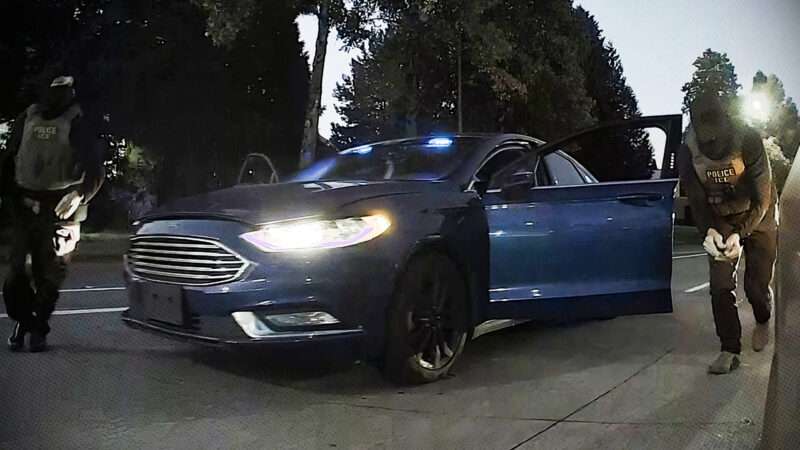
Video Shows ICE Agents Slashing Portland Couple's Car Tire Then Driving Off

ICE agent slashing tire | ACLU

Immigration and Customs Enforcement (ICE) agents slashed the tires of a couple who were recording the agents in an incident near Portland, Oregon, earlier this month. The agents then drove away without arresting or talking to the couple, video footage shows.

The American Civil Liberties Union (ACLU), which released the footage today, says it is yet another example of ICE agents retaliating against people for protected First Amendment activity. In an administrative complaint on behalf of the anonymous couple, the ACLU and the ACLU of Oregon are demanding an investigation and answers from the Department of Homeland Security (DHS) about why agents tailed, boxed in, and "vandalized" the vehicle of a U.S. citizen.

The stunning video does not resemble any sort of normal law enforcement:

"What happened to us is not unique, and that is what is so terrifying," A.P. and M.P., the unnamed husband and wife, said in a statement provided by the ACLU. "We observe and record public ICE activity in order to shine a light on their abusive behavior and to create a record of what our government is up to. Because of that, they are terrorizing us and anyone else who dares to exercise their First Amendment right to hold our government accountable. We hope that sharing our story will bring attention to their reckless and unconstitutional attacks on our communities."

According to the ACLU complaint, the unnamed married couple was driving in Hillsboro, Oregon, on the morning of October 7 when they spotted an ICE SUV. The couple followed the SUV to a supermarket parking lot, where there were also two other ICE vehicles. The couple lowered their windows and began yelling "This is ICE! This is ICE!" as well as blowing whistles and honking the car's horn.

One ICE agent grabbed a shopping cart and began approaching the couple's car. The complaint states that the couple heard the agent say something to the effect of, "Let's block them in with the cart." As the couple began driving away, several ICE agents began chasing after them on foot. 

The three ICE vehicles chased the couple after they left the parking lot, "driving aggressively and nearly colliding into" their car, according to the complaint. Additional video shows the ICE vehicles swerving aggressively in front of the couple's car and later unsuccessfully attempting to box in their car. "None of the ICE vehicles had their flashing lights or sirens on during this entire sequence of events," the complaint states.

The couple cut through an empty parking lot, and the chase continued down several more streets before the ICE vehicles turned on their emergency lights and sirens. According to the complaint, the couple continued driving for roughly a minute, fearing to pull over on an empty road with no bystanders. 

Video shows that when they stopped at a traffic light, a masked ICE agent exited his vehicle, walked up to the couple's car, stabbed one of its rear tires with a knife, and then walked back to his car. The couple's car moved slowly forward and into a turn lane before stopping again. Then the same agent got back out of his vehicle and stabbed the tire a second time before returning to his vehicle without attempting to speak to the couple.

"All three ICE vehicles turned off their flashing lights and sirens and drove off," the ACLU complaint states.

The complaint notes that the couple "experienced retaliatory action similar to that experienced by many other individuals across the country engaged in these same First Amendment protected activities."

"In particular, individuals around the country have reported being similarly tailed, boxed in, and threatened with or subjected to violence after observing, gathering information about, and recording ICE agents performing their duties in public," the complaint states.

Last October, ICE agents in the Portland area busted out the car windows of a U.S. citizen who had been filming them, dragged her out of her vehicle, and detained her for roughly seven hours before releasing her without charges.

The ACLU of Tennessee filed a class-action lawsuit in May against a federal law enforcement task force in Memphis for harassing legal observers. Memphis residents allege in declarations that they have been violently arrested, surveilled at their houses, pulled over under false pretenses, and jailed for trying to film the task force. In September, the ACLU of Tennessee published videos showing federal agents arresting the lead plaintiff in its lawsuit while he was attempting to film task force operations.

DHS and immigration officers have repeatedly accused videographers and legal observers of obstruction of justice and "doxxing," but civil liberties advocates say the DHS is flat wrong about the law: Every federal appeals court that has considered the issue—nine so far—has firmly upheld the right to record law enforcement in public.

The Supreme Court has also unequivocally upheld the First Amendment right to criticize or oppose police activity, whether verbally or through other expressive activity.

"The right to record publicly visible law enforcement activity is fundamental to our democracy," Scarlet Kim, senior staff attorney with the ACLU's Speech, Privacy, and Technology Project, said in a press release. "Like many people across the country, our clients have been observing and recording ICE activity in their community. These videos have proven critical to exposing ICE's abuses. If we cannot see and document what our own government is doing on our streets, we cannot hold it accountable for running roughshod over our rights."

The ACLU complaint to the DHS Office of Inspector General and two other DHS oversight offices demands that the agents involved in the incident be identified, investigated, and disciplined. The ACLU is also requesting a "comprehensive investigation of a disturbing pattern of ICE agents retaliating against individuals who observe, gather information about, and record ICE activity."

The DHS did not immediately respond to a request for comment.

The post Video Shows ICE Agents Slashing Portland Couple's Car Tire Then Driving Off appeared first on Reason Magazine.

  •  

Eric Coomer (of Dominion Voting) Loses Libel Lawsuit over The Deep Rig

From Judge Tom Barber (M.D. Fla.) Tuesday in Coomer v. Byrne:

This highly contentious defamation action arises from The Deep Rig, a documentary film concerning alleged fraud in the 2020 presidential election[, which was financed by defendant Patrick Byrne, who also appeared in the film].…. Plaintiff Eric Coomer formerly served as director of product strategy and security for Dominion Voting Systems, a supplier of election hardware and software with its United States headquarters in Colorado. Among other things, the film included statements by non-party Joseph Oltmann claiming that he infiltrated a conference call involving members of Antifa and heard comments from a speaker identified by another anonymous participant on the call as "Eric" and "the Dominion guy."

According to Oltmann, the speaker stated on the call in substance that President Donald J. Trump would not win the election because he had "made sure of it." Oltmann clams he later determined through research and by recognizing Coomer's voice that the speaker had been Coomer. Oltmann further stated that he concluded there was a "high probability" Coomer affected the election. Coomer denies participating in any such call or manipulating the results of the 2020 Presidential election and alleges that Oltmann's story presented in the film was false and defamatory.

Coomer sued, and the court earlier held that he had adequately "alleged sufficient facts to avoid dismissal" and to proceed to discovery. But then Byrne sought summary judgment, arguing that, after discovery, Coomer hadn't introduced evidence to support his claim. And the court concluded that Coomer had indeed not uncovered enough evidence to prove "actual malice" by clear and convincing evidence:

[U]nder Colorado law, where the alleged defamatory statement relates to a matter of public concern, a defamation plaintiff must prove actual malice on the part of the defendant, and must do so by clear and convincing evidence, even if the plaintiff is not a public figure. Coomer has expressly conceded that the statements at issue concern matters of public concern, [and] that Colorado's actual malice standard applies ….

Coomer himself asserts that Byrne believed the 2020 election was rigged immediately after the election. Byrne testified that he believed Oltmann's story and remains highly confident that the gist of Oltmann's story was true. Although the actual malice standard focuses on Byrne's subjective state of mind and beliefs, Byrne's statements as to those beliefs are not necessarily dispositive and Coomer may seek to establish Byrne's subjective lack of belief in the story through circumstantial evidence. The relevant question, then, is whether the evidence Coomer points to is sufficient to support a jury finding, under the clear and convincing evidence standard, that Byrne in fact subjectively disbelieved or had serious doubts about Oltmann's story.

Coomer points to circumstantial evidence that includes the improbable nature of Oltmann's allegations, the lack of independent investigation by Bryne and the lack of corroboration for Oltmann's story, published reports and opinions rebutting claims of election fraud, and Coomer's denials and other suits for defamation filed prior to the publication of the film. It would be reasonable to conclude from a totality of the evidence that, had Byrne acted reasonably, he would have concluded that Oltmann's story was probably false and that Coomer probably did not attempt to tamper with or "rig" the 2020 Presidential election. However, the question for the jury at trial would not be whether Byrne reasonably should have reached that conclusion. It would be whether he did in fact reach that conclusion or at least harbored serious doubts about Oltmann's story or was highly aware it was probably false….

[R]egardless of whether a finding of actual malice might be supportable under the preponderance standard, the evidence is insufficient to support the same conclusion under the much higher clear and convincing standard. Byrne's lack of skepticism, failure to investigate, and disregard for government reports and conclusions by others debunking claims of fraud the 2020 election are equally consistent with negligence and a belief that there was essentially a coverup going on, in line with the grand conspiracy theory portrayed in the film.

Coomer points out that Byrne did not include Oltmann's story in his own book of the same title, but Byrne explained that he wanted to present an argument based on publicly available information, which, unlike a single witness's account of an unrecorded phone call, would be taken seriously as supporting a nationwide investigation. Any inference from the totality of this evidence to a conclusion that Byrne actually disbelieved or seriously doubted Oltmann's story would be weak at best and insufficient to support a finding of actual malice by clear and convincing evidence….

Allowing a jury to infer from evidence that a reasonable person would have doubted Oltmann's story to a conclusion that it is not only possible, but highly probable and free from serious or substantial doubt that Byrne, did, in fact, have serious doubts about it would require the Court to ignore not only the standards just discussed but human nature as well.

The world has always had people with zealously held beliefs who are quite vocal and eager to share their views with anyone who will listen. These people are frequently labeled, pejoratively, as extremists, fanatics, "kooks," "crazies," conspiracy theorists, and the like. They typically have a lot to say on their subjects of interest, and modern technology has given them a powerful microphone to convey their thoughts well beyond the limits of their own communities or personal echo-chambers.

They may make statements that reasonable people consider to be wrong, and sometimes their statements are, in fact, objectively and demonstrably wrong. But those with zealously held beliefs hold firm even when overwhelming objective evidence may be to the contrary. This is because they genuinely and sincerely believe what they say with every fiber of their being, even when objective evidence may suggest otherwise. Many are highly intelligent and sophisticated people, but they never seriously doubt the truth of their statements and remain steadfast in their beliefs no matter what. While these speakers sometimes espouse beliefs and make statements many might consider to be extreme, offensive, irresponsible, and factually wrong, their beliefs are, nonetheless, sincerely held and those speakers believe everything they say is completely true.

Even aside from extreme examples, people in general are hardly paragons of reason and often do not reach or maintain their beliefs by dispassionate assessments of the evidence. They believe what they do, especially on important political, moral and religious issues, as a result of unconscious biases, predispositions, prior emotional, philosophical, and political commitments and intuitions, as well as a disinclination to exert the effort or risk the emotional discomfort involved in exposing themselves to contrary evidence and viewpoints.

As John Kenneth Galbraith observed, "[f]aced with the choice between changing one's mind and proving that there is no need to do so, almost everyone gets busy on the proof." Operating within an echo chamber while believing oneself to be well-informed and reasonable has become increasingly easy to do in the age of slanted news sources and targeted media constantly telling their constituencies what they want to hear.

Of course, people with sincerely or even zealously held beliefs may make statements that are both untrue and inflict serious harm on others. Under the actual malice standard, unless it can be proven that the speaker subjectively believed his or her statements to be untrue, the law imposes no liability. That is a policy choice that might deserve reexamination by the appropriate decision makers—the United States Supreme Court and the Colorado courts. As [this] Court noted in the Trump Media & Tech. Group Corp. v. WP Co. LLC (M.D. Fla. 2026) case, the actual malice standard has been criticized by courts and commentators on a number of grounds, with which [this] Court largely agrees.

In short, if the law did not require "clear and convincing evidence" that the defendant subjectively doubted or disbelieved the published statements, it is likely that Byrne's motion for summary judgment would have been denied, and a jury would have had the opportunity to weigh in on this matter. However, under the law as it currently stands, Coomer's evidence is insufficient to meet these standards and summary judgment for Byrne is therefore required….

Peter Ticktin and David Lawrence Perry II (The Ticktin Law Group) represent Byrne.

The post Eric Coomer (of Dominion Voting) Loses Libel Lawsuit over <i>The Deep Rig</i> appeared first on Reason Magazine.

  •  

Cancellation, Defamation, Bankruptcy, Discharge

From Judge Paula Xinis (D. Md.) yesterday in Shuma v. Whibley:

Appellant Shane Shuma ("Shuma") and Appellee-Debtor Erin Whibley ("Whibley") were students at Dickinson College during the 2020–21 school year. Shuma made an ill-advised YouTube video satirically opining on the "reasons why the Holocaust was a good thing." The video spread through campus, and an uproar followed. School administrators publicly condemned it, the matter was widely reported in the student newspaper, and students spoke out against Shuma.

In one of Whibley's classes, a lively discussion ensued about Shuma. One student disclosed that she overheard Shuma at a club event saying things that were "absolutely unacceptable to, to say to anyone" and that "there were some threats involved," and she expressed her frustration that his behavior continued "after reporting on Shuma and knowing people who have reported on him in terms of Title IX behavior or just Title IX in general." Another student echoed that she had heard from multiple people that Shuma had written articles in the student newspaper that expressed "racist sentiment." A third student described that Shuma had written an article arguing that "white privilege is not real … is not a thing."

After this conversation, Whibley initiated an online petition to advocate for Shuma's expulsion. The petition described Shuma as the subject of "multiple Title IX issues," and that he had written "racially charged [newspaper] articles." She also described Shuma as a "serial offender." The petition garnered 811 signatures in the first few days, and ultimately over half the Dickenson student body signed it.

Shortly after the posting, Whibley learned that Shuma had no such Title IX complaints filed against him. Within days, Whibley corrected the online petition to eliminate to the claim about Title IX. She further explained in the modified petition that "Shuma has not been in violation of any Title IX statutes," and that she did "not wish to slander [Shuma]," but simply share what she heard from other students.

Shuma sued Whibley for defamation in Pennsylvania state court. After settlement negotiations broke down, Whibley declined to defend the case, and default judgment was entered against her. The state court next concluded that Shuma was entitled to no damages, but upon Shuma's urging, scheduled a damages trial for October 31, 2023.

Days before the trial was set to begin, however, Whibley filed for bankruptcy in the District of Maryland, which triggered an automatic stay of the Pennsylvania case. Shuma next initiated an adversarial proceeding in the bankruptcy case in which he averred that any debt Whibley incurs as part of the Pennsylvania defamation action was not dischargeable in bankruptcy [i.e., couldn't be cancelled the way bankruptcy cancelled most other debts -EV] because her conduct had been willful and malicious. The adversarial proceeding advanced to trial solely on whether Whibley defamed Shuma with the intent to injure him, thus rendering the debt nondischargeable….

Bankruptcy Judge Lori Simpson ruled in Whibley's favor, and the district court affirmed:

Section 523(a) of the Bankruptcy Act enumerates certain exceptions to the dischargeability of debts in bankruptcy. Relevant here, subsection 523(a)(6) states that any debt arising from "willful and malicious injury by the debtor to another entity" is not dischargeable. Importantly, a debt stemming from "a deliberate or intentional injury" is not dischargeable; but a debt can be discharged when arising from "a deliberate or intentional act that leads to injury." …

[T]he Court discerns no error, let alone clear error, in the Bankruptcy Court's factual finding that Whibley did not possess the requisite intent to injure Shuma. The Bankruptcy Court credited Whibley's testimony explaining why she relied on her classmates' reports about Shuma, and next when she learned of their inaccuracy, corrected the public record. The Bankruptcy Court likewise was permitted to credit Whibley's explanation that her prior experiences with sexual assault made her more disposed to believing the reports of Shuma's misconduct, even though such belief ultimately was misplaced.

Last, the Court discerns no error in the Bankruptcy Court's conclusion that Whibley's timely correction of the petition further corroborates a lack of intent to injure Shuma by defaming him. Shuma may feel that Whibley's corrective statement did not go far enough, but mere disagreement with the Bankruptcy Court does not render clearly erroneous the Bankruptcy Court's factual findings regarding Whibley's lack of intent….

The weight of the evidence demonstrates that Whibley posted the petition not to harm Shuma but to protect the student body from Shuma's opprobrium. Whibley plausibly pointed to legitimate reasons why she believed her statements to be true at the time and promptly corrected the petition when she learned she was wrong. Shuma otherwise adduced no meaningful evidence to suggest that Whibley possessed the requisite intent sufficient to meet his burden. All of which supports the Bankruptcy Court's conclusion that the debt remains dischargeable in bankruptcy.

It's not clear to me exactly what "protect the student body from Shuma's opprobrium" means, but here are the passages of the bankruptcy judge's opinion that the court cites there:

In the parlance of Dickinson students, Title IX is a euphemism for sexual assault. All evidence before the Court establishes, and Defendant does not dispute, that the classmate's statements were not true. Perhaps because of Defendant's naiveté, biases and prejudices or because the classroom context lent the discussion an air of credibility, the Defendant did not dismiss her classmate's comments as idle gossip or seek to investigate further. She simply believed them.

The following day Defendant drafted and published an online position on change.org seeking to pressure the Dickinson administration into expelling Plaintiff from the college. In addition to rebuking Plaintiff for his statements in the video, Defendant stated in the petition that Plaintiff has also been reported multiple times for Title IX issues and had written racially charged articles in the Dickinstonian, the college newspaper.

The phrase racially charged in one sense appears to be a code word for racist. That said, it is nebulous to the point of meaningless and appears to reflect the sensitivities and suspicions of the speaker more than the content described.

However, Defendant's statement that Plaintiff had been reported multiple times for sexual assault was an objectively false statement of fact. After calling for Plaintiff's expulsion, the Defendant concluded her statements with a call to action saying, "We can longer accept a slap on the wrist as an acceptable punishment for this serial offender."

On February 24, 2021, the local ABC affiliate, WHTM, published an article about the video and the response by the Dickinson community. The article does not mention Defendant's petition, but includes an anonymous statement by a group of students rebuking Plaintiff for the video. The anonymous statement also stated that Plaintiff authored numerous inflammatory columns in the college newspaper.

The anonymous statement further alleges that the video was not the first time Plaintiff had made such statements, but it was merely the first time such comments were caught on film. Neither the ABC article nor the anonymous statement contained therein make any mention of any sexual assault allegations against Plaintiff….

Instead, reviewing the petition and amended petition in their entirety together with the evidence of the general climate at Dickinson in reaction to the video, it appears that Defendant and others held the opinion that Plaintiff was someone who repeatedly stoked racial tensions and that the video was merely the most egregious and inexcusable in a series of such offenses. The bulk of the original petition conveys that Defendant believed that Plaintiff repeatedly expressed thoughts and opinions that should not be allowed to be expressed at Dickinson.

The statement in the original petition regarding Title IX reads as an unrelated aside. The upshot of the original petition is that Defendant wants Plaintiff removed from Dickinson because she believes that he is a bigot and that she does not feel safe with Plaintiff on campus. Nowhere else in the original petition does Defendant label Plaintiff a racist, misogynist or the like. In fact, Defendant states that the reason she does not feel safe with Plaintiff on campus is not because she is a female, but because she is a Jewish student….

The Bankruptcy Judge's opinion is labeled "Virtual Judge's Ruling," but I take it that means a judge who is present remotely, not actually a virtual judge.

Justin Philip Fasano (McNamee Hosea, P.A.) represents Whibley.

The post Cancellation, Defamation, Bankruptcy, Discharge appeared first on Reason Magazine.

  •  
❌