
❌

Reading view

Smartbird's CEO talks about converting a shoe company into an AI player

Smartbird CEO Nadia Carlsten
Smartbird CEO Nadia Carlsten at Business Insider's The Long Play.

Carl Timpone / BFA

  • Nadia Carlsten, CEO of Smartbird, spoke on the public company's shift from sneakers to AI.
  • When the AI pivot was announced, the company's stock skyrocketed. It has since come back down.
  • Carlsten said Smartbird has a different approach to AI infrastructure, focusing on customer needs.

Before Smartbird was powering large language models, it was making shoes.

The CEO of the AI infrastructure company, Nadia Carlsten, spoke about the transition with chief correspondent Ben Bergman on Thursday at Business Insider's The Long Play.

Its roots are the sustainable sneaker company Allbirds, which skyrocketed in the late 2010s. The shoes were particularly popular among the Silicon Valley crowd. Allbirds went public in 2021 before the market turned on many direct-to-consumer businesses. The stock quickly fell, and it sold to American Exchange Group in March for $39 million.

"The short answer is the shoe business wasn't doing that well," Carlsten said.

The company then sold off its footwear business and shed most of its workforce, rebranding as Smartbird. The AI pivot skyrocketed the stock and was briefly up 800%, though it has since come back down. Carlsten, who became CEO in June, said she had never worn those wool shoes.

"The goal of the company was to do something valuable and meaningful. And for me, I knew I wanted to do AI infrastructure," she said.

After looking at the emerging AI infrastructure sector, she believed with the company's transformation, it was the "right place at the right time" for her to join.

In the five months since she took over, Carlsten said the experience can be described in one word: exciting.

"Never in my life thought that I would be the CEO of a former shoe company and managing what is essentially a startup." Since taking on the role, she has focused on building out a new team, scouring new technologies for the company to look into, and producing a new pipeline of customers.

While the stock price has gone down since the initial pivot-induced spike, Carlsten does not regret taking on the challenge. She is betting on the company's long-term potential.
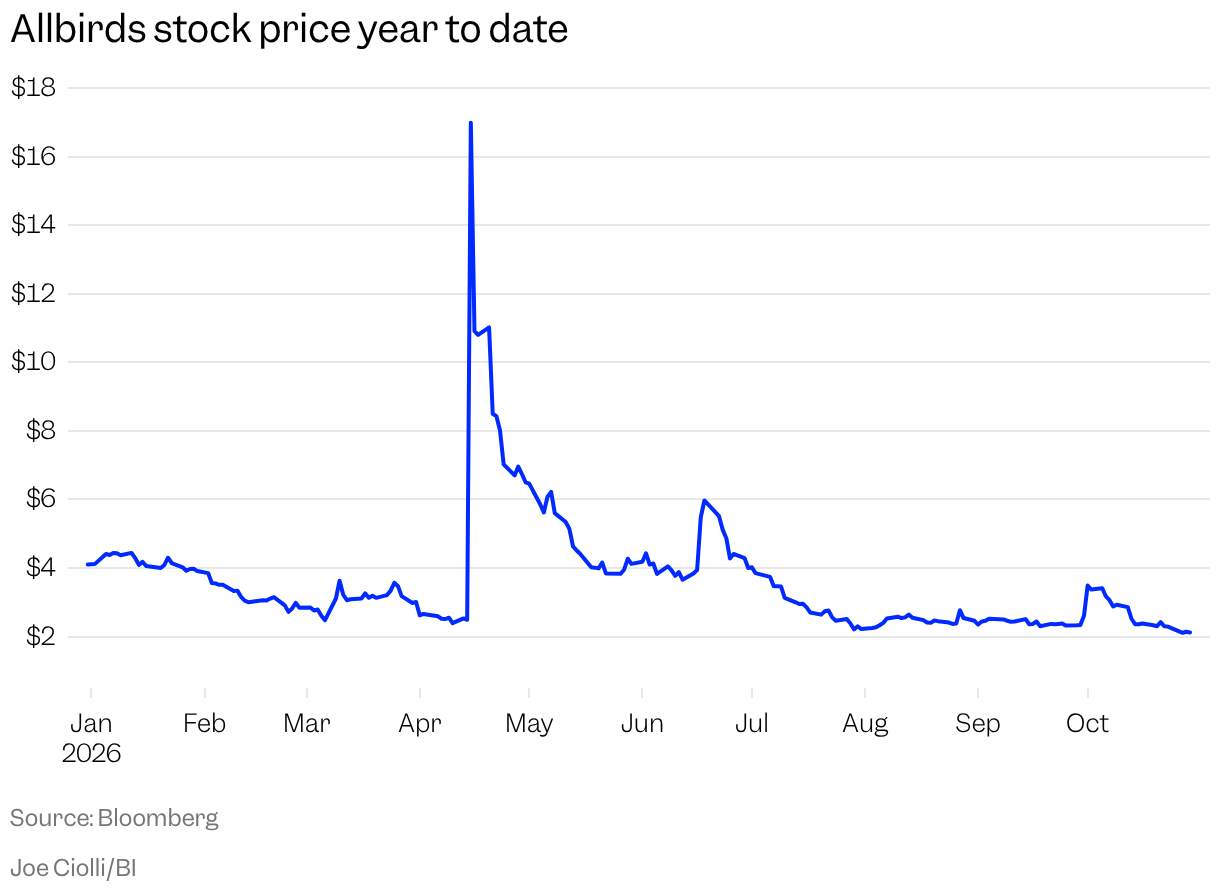
Line chart

"The stock market is going to do what the stock market does," she said. "What I care about is making sure that we're putting the company on the right path, and that we're able to build it quickly enough and well enough that we have a sustainable business that investors will love. So what happens in the short term? Not that important. What happens in the long term is very important."

When asked why the company decided to reinvent itself in the public eye instead of beginning as a private start-up, Carlsten countered with a question: "Why not?" she said, "It will come back up."

Having to reinvent the company from scratch can be challenging, and the public's presence is clear, she said. Yet, Carlsten said reinvention is inevitable for companies.

"This is a very public reinvention of the company, and people are watching," she said. "I think every company needs to reinvent itself every now and then."

When asked why the company is fully remote, Carlsten said most of the work at Smartbird is done virtually or at data centers, meaning an office would not be of much use.

"We spend a lot of time actually building things, which I actually love. So if my people are sitting in an office, something's wrong," she said.

Working within the emerging AI sector

Carlsten said that although her competitors are building similar AI infrastructure, the way Smartbird is going about it is unique.

"For us, it's about the right infrastructure for the right company at the right time," she said. "Our business model allows us to work more closely with customers, but it also is a lot less capital intensive."

Smartbird is looking to work with companies that have yet to explore implementing AI in their systems, she said. As more companies outside the tech realm look to adopt AI into their businesses, they have the choice to build infrastructure themselves or outsource it, and Smartbird wants to be the one to do it for them, she said.

"We'll do the infrastructure part. We'll let you focus on the actual business," she said.

The most common misconception Carlsten said she has encountered in the business is that it's all about GPUs. She said the company does a lot more than just run GPUs.

"It's really about having a holistic system that a customer can use to do AI," she said.

Another rumbling that's taken over the tech company discourse is whether there's an AI bubble and if it will pop. Carlsten said that depends on how people go about defining the bubble.

Excitement in the sector means funding might be going into companies that may not prosper in the future, but this is something that happens with the arrival of new technologies, she said.

"Every time there is a transformational technology, this happens," she said. "Even if we assume that there is a bubble, that doesn't mean that the technology is not good. It also doesn't mean that the adoption of the technology is going to go away."
Read the original article on Business Insider

  •  

Europe’s Bid for AI Independence Faces Its First Major Test as EUROPA Challenges US Technology Giants

The European Union is attempting to establish itself as a developer of advanced artificial intelligence rather than primarily a regulator and consumer of technology produced elsewhere. An Italian-led consortium developing a large open-source AI model across all 24 official EU languages will provide an important test of whether Europe’s supercomputing infrastructure can support globally competitive systems.

Europe’s efforts to establish greater control over artificial intelligence technology are entering a new phase as the EUROPA consortium, led by Italian company Domyn, advances plans to develop one of the continent’s largest open-source AI models.

The initiative, supported by the European Commission and European high-performance computing infrastructure, aims to create an advanced artificial intelligence system capable of competing with models developed by leading American and Chinese companies.

Domyn chief executive Uljan Sharka told the Financial Times on 29 October that Europe possesses the technological resources and industrial expertise required to compete in advanced AI development.

However, he also identified two obstacles: the need for greater investment and the difficulty of persuading European businesses to adopt domestically developed systems.

These challenges extend beyond the development of a single language model.

They concern whether Europe can establish a commercially sustainable AI industry while reducing dependence on technology providers headquartered outside the EU.

EUROPA and the Frontier AI Grand Challenge

The European Commission selected EUROPA in June 2026 as the winner of its Frontier AI Grand Challenge.

The competition, launched in February, was designed to support the development of a European general-purpose AI model with more than 400 billion parameters.

EUROPA’s planned model is expected to contain approximately 500 billion parameters and support all 24 official EU languages.

The consortium brings together Domyn and Germany’s Fraunhofer research organisation, including the Fraunhofer IAIS and IIS institutes.

Its work will rely on the EuroHPC network of European supercomputers.

Under the competition arrangements, the winning consortium can obtain access to as much as 2.5 per cent of EuroHPC’s total computing capacity for one year.

This allocation is intended to address one of the largest barriers to advanced AI development: the enormous computing resources required to train models at this scale.

The final system is intended to be released under an open-source licence, allowing organisations to inspect, adapt and deploy the technology.

Nevertheless, parameter count alone does not demonstrate that a model is competitive.

Its actual performance will depend on training data, architecture, computational efficiency, evaluation results and the ability to perform reliably across different tasks.

A European Model for European Languages

One of EUROPA’s distinguishing objectives is its coverage of all official EU languages.

The commercial AI market has historically been dominated by models developed primarily for English-language applications, although leading international systems increasingly support multiple languages.

For Europe, linguistic capability has particular relevance to public administration, legal services, education and cross-border business.

A model designed specifically for the European market could potentially support specialised applications involving national legislation, administrative procedures and technical terminology.

However, multilingual availability will need to be assessed against measurable performance standards.

A system capable of producing fluent responses in a particular language is not necessarily equally reliable when interpreting specialised legal or scientific information.

The consortium will therefore need to demonstrate that linguistic coverage translates into practical capabilities rather than remaining principally a technical specification.

Europe’s Supercomputers Become Strategic Assets

The EUROPA project forms part of a wider effort to use European publicly supported computing infrastructure for commercial and scientific AI development.

The EuroHPC Joint Undertaking has invested in systems intended to provide advanced computing resources to researchers, businesses and public institutions.

Additional AI-focused infrastructure is being developed through the EU’s network of AI factories.

These facilities are intended to make specialised computing capacity available to organisations that would otherwise face considerable costs when developing or adapting AI systems.

However, infrastructure ownership does not necessarily provide complete technological independence.

European supercomputing projects continue to rely on internationally sourced semiconductor technology and specialised software.

Domyn itself has described a partnership with the American technology company Nvidia in its previous model-development work.

Consequently, European AI sovereignty is better understood as a question of control over important technological capabilities than complete separation from international supply chains.

Domyn’s Smaller Model Provides an Early Example

On 20 October, Domyn announced the initial release of Domyn Edge, a separate AI model containing four billion parameters.

According to the company’s technical announcement, the system was trained from scratch using approximately 13 trillion tokens on Europe’s Leonardo supercomputer.

Domyn has committed to making the model’s weights, training code, intermediate checkpoints and datasets available under open licences.

This approach is intended to improve reproducibility and allow external developers to examine how the model was constructed.

Domyn Edge is substantially smaller than the planned EUROPA system and should not be confused with it.

Nevertheless, the project provides an example of the company’s approach to developing AI models using European computing infrastructure.

Regulation Is Only Part of the Challenge

The EU has already established an extensive regulatory framework for artificial intelligence through the AI Act.

However, legislation governing the development and deployment of AI does not, by itself, create a competitive domestic technology industry.

Europe faces competition from American companies with substantial private investment, established cloud platforms and access to large commercial markets.

Chinese developers have also expanded their capabilities, including in open-weight AI systems.

EUROPA’s commercial prospects will therefore depend on more than technical performance.

European businesses must be willing to integrate the resulting technology into their operations, while developers will require dependable access to computing infrastructure and support services.

There is also the question of whether European institutions themselves will adopt domestically developed AI systems where they meet relevant security and performance requirements.

Without sufficient demand, even a technically successful model could struggle to establish a sustainable ecosystem.

The Test Will Be Commercial as Well as Technical

Domyn has indicated that it aims to release EUROPA during 2027, although public statements have differed over the precise timetable.

The company’s leadership has discussed a June target, while an earlier technical announcement referred to the second half of 2027.

The immediate challenge is completing development and demonstrating that the model can compete on performance, reliability and cost.

The longer-term challenge concerns adoption.

If European businesses and public institutions continue relying predominantly on foreign technology, access to an advanced European alternative may have only a limited effect on the market.

Conversely, a competitive and widely adopted open-source model could offer organisations greater control over deployment, customisation and sensitive information.

EUROPA is therefore more than a publicly supported technology experiment.

It is a test of whether Europe can convert research institutions, computing infrastructure and industrial expertise into AI products capable of competing in the international market.

The outcome will depend not simply on whether Europe can build an advanced model, but on whether organisations consider it sufficiently capable and economical to use.

  •  

Six lanes and metro line under fire: Kyiv prepares about $22 million for backup river crossings after Russian strike on Southern Bridge

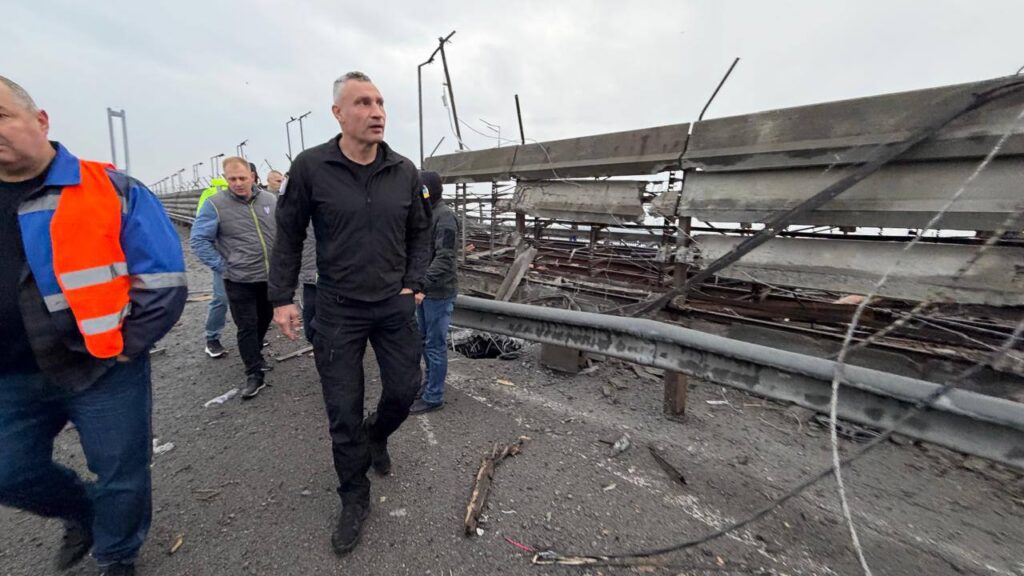
Kyiv Mayor Vitali Klitschko inspects damage on the Southern Bridge after a Russian ballistic missile strike, 27 October 2026

The Ukrainian government has instructed Kyiv to establish alternative routes after Russian attacks stopped traffic on one of the capital’s main bridges. The city authorities will bear the cost of the new crossings, with Kyiv Mayor Vitali Klitschko saying the city needs an additional $22 million.

This year, Russia has launched tactics to spread panic among civilians and trigger more people to leave the country. In the latest attack, several Russia's ballistic missiles struck the Southern Bridge, used for vehicle and metro traffic, breaking a huge hole and paralyzing all the pathes. The bridge was closed. Now, there is a fear that more bridges can be targeted this way, dividing Kyiv in two parts.

The situation is urgent, as Ukrainian Transport Minister Mykola Kalashnyk says about 600,000 vehicles cross the Dnipro in Kyiv every day.

What is Kyiv’s response to the winter terror? 

According to Klitschko, Kyiv convened the capital’s Defense Council on 28 October to find an answer to this difficult question.

The agenda included implementing a project to build combined water crossings over the Dnipro River and access roads to them.

“The military command will determine the locations, with approval to be granted, among others, by the Kyiv City Military Administration,” Klitschko said.

Under the government’s recommendations, the Kyiv city authorities must find $22 million for the project.

Klitschko had previously faced heavy criticism after it emerged that the city lacked sufficient shelters and last winter exposed serious shortcomings in preparing infrastructure for Russian attacks. These included a lack of alternative energy supply routes, poorly distributed energy, burst heating pipes that flooded apartments, and the inability of people with disabilities to reach shelters without elevators.

The mayor himself said the problems stemmed from the central government withholding funding, which had stalled numerous energy resilience projects and delayed their implementation.

The latest announcement also indicates that Kyiv has once again taken on the financial burden itself.

Meanwhile, Ukraine has been working with Japan on backup crossings. Tokyo has already delivered 720 meters of prefabricated bridge structures to Ukraine. The two sides are currently exploring how this equipment could be used to establish alternative crossings.

Step two: strengthening existing infrastructure

Another option is to reinforce existing bridges. City specialists are developing additional technical solutions to protect bridges across the Dnipro River, Klitschko said in his statement on 27 October, adding that proposals from the military had also been heard.

The issue of installing mobile shelters was also raised on the same day, the mayor of Kyiv said in a separate statement on his Telegram channel on 27 October. Despite intensifying Russian attacks and about, as Radio Svoboda reported in its article on 30 September, $11 million set aside in 2025, Kyiv still has only a handful of mobile shelters: LB reported in December 2025 that district tenders failed. Donors paid for the first one at a bus stop, the Kyiv City State Administration said on 15 October.

Klitschko raised the issue of shelters again after a court on 12 October ruled that local authorities must urgently install mobile shelters in public areas, including near public transport stops, parks, and squares, according to Kyiv’s Prosecutor’s Office.

Russia hits the Southern Bridge again

On 2 October, Ukrainian President Volodymyr Zelenskyy said in an interview with the Financial Times that Russian ruler Vladimir Putin had ordered the lifting of previous restrictions on airstrikes. Among new targets, according to him, were bridges, data centers, internet, mobile networks, hospitals, kindergartens, schools, and universities.

The night of 26–27 October showed what that looks like. Russia launched ballistic missile attacks in a few waves, and the second of them hit the Southern Bridge and the metro infrastructure on it, Klitschko said. The structure carries six lanes of road traffic and two metro tracks.

Rescuers work beside a fence pocked by shrapnel in Kyiv after the Russian attacks of 26–27 October 2026
Rescuers work beside a fence pocked by shrapnel in Kyiv after the Russian attacks of 26–27 October 2026. Photo: DSNS Kyiv

Zelenskyy put the night’s total at 16 ballistic missiles and blamed delays in deliveries of Patriot and NASAMS interceptors: “Every such delay is a new Russian hit on one target or another.”

  •  

Russian Drone Strike Kills 14 at Dnipro Railway Station as Ukraine Faces New Wave of Attacks

A Russian jet-powered drone struck a crowded railway platform in the Ukrainian city of Dnipro on Thursday, killing at least 14 people and injuring 14 others. The attack has renewed questions about the protection of civilian transport infrastructure and Ukraine’s ability to defend its cities against increasingly varied aerial threats.

At least 14 people were killed when a Russian drone struck the main railway station in Dnipro on 29 October, hitting a platform where passengers were waiting beside two trains.

The attack took place at approximately 11am local time, according to Ukrainian officials, and struck an area occupied by a commuter train and a scheduled passenger service.

Ukraine’s state railway operator, Ukrzaliznytsia, said the drone hit the platform where train No. 866, operating between Dnipro and Zaporizhzhia, was standing.

The number of fatalities was subsequently confirmed by Oleksandr Hanzha, head of the Dnipropetrovsk regional military administration.

Fourteen people were also reported injured, including an 11-year-old boy. Six of the wounded were in serious condition, with medical personnel treating multiple shrapnel injuries.

The attack occurred despite an elevated warning of aerial danger.

Ukrzaliznytsia reported that passengers remained on the platform when the drone struck, raising questions about the practical difficulties of evacuating busy railway stations during air-raid alerts.

A Drone Penetrates Ukraine’s Air Defences

According to Ukraine’s Air Force, Russian forces launched four jet-powered attack drones towards Dnipropetrovsk region.

Three were intercepted by Ukrainian air defences, while the fourth struck the railway platform.

The use of jet-powered unmanned aircraft is significant because these systems present different interception challenges from the slower propeller-driven drones frequently used in Russian attacks.

Their speed can reduce the time available for detection, identification and engagement, particularly when an attack is directed towards an urban area with substantial civilian activity.

The circumstances of the Dnipro strike nevertheless require further investigation, including the precise drone model, its flight path and the conditions under which the aircraft penetrated Ukrainian defences.

The railway operator’s account indicates that the platform was crowded when the attack occurred.

Dnipro Mayor Borys Filatov described the incident as a tragedy and emphasised that the victims were ordinary civilians using public transport.

Emergency services, police and medical teams were deployed to the station, where rescuers treated the injured and recovered the bodies of those killed.

Railways Remain Essential to Ukraine

Ukraine’s railway network has retained considerable importance throughout Russia’s full-scale invasion, which began in February 2022.

With civilian air transport severely restricted, trains provide a principal means of travelling between cities and moving people away from areas exposed to military operations.

Rail services also support the movement of humanitarian supplies, commercial goods and essential equipment.

Dnipro is especially important because of its position in central-eastern Ukraine and its transport connections with areas nearer the front line.

The route towards Zaporizhzhia serves a population that has experienced repeated attacks and displacement during the war.

Disruption to railway services therefore affects more than transport schedules. It can interfere with access to employment, medical treatment, family networks and evacuation routes.

Railway infrastructure may also have military logistical functions, but this does not remove the legal protections afforded to civilians and civilian objects under international humanitarian law.

The law requires parties to distinguish between military objectives and civilians, and prohibits indiscriminate attacks.

Whether a particular strike constitutes a violation depends on evidence concerning the target, intended military advantage, precautions taken and foreseeable civilian harm.

Ukrainian authorities have characterised the Dnipro attack as an assault on civilians. Russia had not provided a substantiated explanation for the specific strike in the reporting available on Thursday.

Further Fatalities Across Ukraine

The attack formed part of a wider series of Russian strikes against Ukrainian cities on 29 October.

In Chernihiv, two teenage girls were killed in an attack on a central street, while an additional strike in Kremenchuk killed three people at a residential building.

The incidents brought the reported death toll from these attacks to at least 19.

They occurred as a temporary localised ceasefire around Russian-occupied Oleshky, in Kherson region, continued to permit preparations for humanitarian assistance.

The contrast illustrates the limited geographical scope of the Oleshky arrangement.

Although the ceasefire offers an opportunity to deliver supplies to civilians trapped by the fighting, it does not represent a general cessation of hostilities.

Zelensky Calls for Continued Pressure on Russia

President Volodymyr Zelensky condemned the Dnipro attack and urged Ukraine’s international partners to maintain pressure on Moscow.

He argued that easing sanctions while Russian forces continued striking civilian areas would undermine efforts to secure a reduction in hostilities.

The attack also adds urgency to Ukraine’s continuing requests for air-defence assistance, particularly systems and interceptors capable of addressing multiple categories of aerial threat.

European governments face difficult decisions about supplying additional equipment while maintaining sufficient stocks for their own security requirements.

For Ukraine, the immediate priority remains the treatment of the injured, investigation of the strike and restoration of safe railway operations.

For its international partners, the incident raises a question extending beyond Dnipro: how to protect the civilian infrastructure upon which daily life depends while Russia retains the capacity to launch repeated aerial attacks across the country.

  •  

Traveling Route 66 in the Age of Data Centers

In its heyday, Route 66 was a road of opportunities and dreams. Today, it’s a highway of ghosts, a symbol of what once was, although it still attracts visitors. For Current Affairs, Jesse Wright reflects on America’s historic highway in a time of artificial intelligence, when so much land across the country is being bought up, repurposed, and turned into data centers. Wright, who traveled the road from Chicago to Santa Monica, asks: What will these massive centers leave behind?

But what is new, perhaps, is the utter absence of even having been at all. The data centers’ legacy will be nothing. Their absence will be complete. Computer hallucinations leave no room for the dreams of humans. In 100 years, there will be nothing. Nobody will want to spend their vacation touring endless rooms full of rusty server racks.

  •  

Brussels Proposes New Climate Resilience Law but Leaves €70 Billion Annual Investment Question Unresolved

The European Commission wants member states to assess climate risks, establish national resilience plans and incorporate future warming into public investment decisions. Yet the proposed legislation does not provide the funding needed to implement its ambitions.

The European Commission has proposed a new climate resilience law that would require EU governments to assess their exposure to extreme weather, identify authorities responsible for managing risks and develop national plans to protect infrastructure and economic activity.

Presented on 27 October, the initiative marks a shift in European climate policy towards managing the consequences of changing weather conditions alongside efforts to reduce greenhouse gas emissions.

However, the Commission estimates that adapting Europe’s infrastructure and economy to future climatic conditions will require approximately €70 billion annually.

The proposed legislation does not establish a dedicated funding programme of that size.

This creates an immediate question for member states already facing difficult decisions over defence expenditure, energy security and public borrowing.

Brussels wants governments to make climate preparedness a routine part of economic planning, but the financial responsibility for delivering those measures remains largely unresolved.

National governments face new obligations

Under the Commission’s proposed Climate Resilience Law, EU governments would be required to conduct more systematic assessments of climate risks.

The proposal envisages national assessments by 30 June 2029 and strategic resilience plans by 31 December 2030.

These documents would identify threats affecting infrastructure, public services, economic activity and communities.

Governments would also be expected to specify which public authorities are responsible for managing particular risks.

The intention is to prevent situations in which responsibility is divided between institutions without a clear mechanism for action.

The proposed framework would establish a common basis for assessments across the EU, allowing national authorities to compare risks and coordinate responses.

This could be particularly relevant where droughts, floods or disruptions to energy networks affect more than one member state.

The deadlines remain proposals rather than existing legal obligations. The legislation must still be negotiated and adopted by the European Parliament and the Council.

A common warming scenario

One of the most significant elements of the proposal is the introduction of a shared reference trajectory for global warming.

According to the Commission’s announcement, the framework uses a trajectory involving global average warming of approximately 1.5°C above pre-industrial levels by 2030, 2°C by 2050 and 3°C by 2100.

These figures would provide a common planning assumption for evaluating long-term risks.

They are not legally determined temperature outcomes or a guarantee that warming will follow precisely that path.

Instead, they are intended to help authorities examine how buildings, roads, energy facilities and other infrastructure might perform under changing climatic conditions.

For example, a transport project designed to operate for several decades would need to consider possible exposure to extreme heat, flooding or changes in rainfall patterns.

Such assessments could influence engineering requirements, maintenance costs and investment decisions.

The financial problem

The Commission estimates that approximately €70 billion a year will be needed to strengthen Europe’s climate resilience.

That expenditure could include flood protection, water management, urban cooling, agricultural adaptation and improvements to vulnerable infrastructure.

The Commission argues that preventive investment can reduce the economic losses associated with disasters.

According to its figures, climate-related damage across the EU amounted to approximately €200 billion between 2022 and 2025, averaging €50 billion annually.

However, estimating the economic benefits of prevention does not resolve how projects should be financed.

National governments face competing demands on their budgets, while local authorities often bear responsibility for infrastructure without possessing sufficient resources for major investment programmes.

Private financing may contribute in commercially viable areas, but some adaptation projects generate public benefits rather than direct financial returns.

Flood barriers, emergency drainage systems and measures protecting vulnerable communities may therefore require substantial public expenditure.

The proposed legislation establishes a framework for identifying such investments but does not guarantee the resources necessary to undertake them.

Businesses and insurers face changing risks

The Commission also wants climate resilience to become part of business and financial decision-making.

Companies operating transport networks, energy facilities and industrial sites may face increasing exposure to disruption from extreme weather.

Insurers must assess the potential for more frequent or costly claims.

Banks and investors may need to consider whether assets remain commercially viable under changing environmental conditions.

These issues have implications for credit conditions, property values and long-term investment.

However, incorporating climate risks into financial decisions can create difficulties for regions where exposure is high and adaptation costs are substantial.

Insurance premiums may rise, while some properties or economic activities could become increasingly difficult to insure.

The Commission has indicated that further proposals concerning climate insurance and disaster preparedness are being developed.

Their eventual design will influence how financial risks are distributed between households, businesses, insurers and governments.

New European climate information tools

The framework also introduces instruments intended to improve access to scientific information.

The European Climate Viewer will provide mapped information on projected climate hazards.

The Navigator of Climate Resilience Tools will help authorities and businesses identify relevant assessment instruments.

A separate Solutions Explorer will provide examples of adaptation measures developed through European research programmes.

These tools could make climate information more accessible, particularly for smaller administrations without extensive technical resources.

Nevertheless, access to information does not automatically produce the financing or institutional capacity required to implement projects.

A municipality may be able to identify a flood risk more precisely while remaining unable to finance the necessary protective infrastructure.

A new responsibility for Brussels and national capitals

The Commission is expected to present an additional EU strategic plan on climate resilience in 2028.

Separate initiatives are also being prepared on heatwaves, insurance and disaster preparedness.

The resulting framework could substantially influence how public infrastructure and investment projects are planned across Europe.

However, national governments will have to determine how the proposed requirements interact with existing spending obligations and economic priorities.

The European Parliament and Council must also decide whether the legislation should include stronger financial provisions.

The central issue is not whether governments should assess the risks facing infrastructure and public services, but how the measures identified by those assessments will be funded.

Until that question is addressed, the proposed law will establish a more comprehensive system for recognising climate-related risks without guaranteeing that member states possess the resources to reduce them.

  •  

Romania Accuses Russia of Coordinating Sabotage Network Targeting European Defence Industry

Romanian intelligence services say a Russian-directed network was responsible for a fire near an arms manufacturing facility in Brașov. Investigations involving Germany and Poland have exposed what authorities describe as a wider operation targeting military and industrial defence infrastructure across Europe.

Romania has accused Russia of coordinating a cross-border sabotage network responsible for an industrial fire near an arms manufacturing facility, prompting a diplomatic confrontation with Moscow and investigations involving several European countries.

Romanian intelligence and prosecutors announced on 26th October that they had identified three foreign nationals allegedly involved in the operation, which caused a fire on an industrial site in Brașov on 14th September.

The suspects, two Belarusian nationals and one Ukrainian, are alleged to have participated in a network directed by individuals operating from Russia.

Two suspects have been detained in Germany, while a third has been located in Poland.

Romania is seeking their extradition as investigators examine possible connections to other attempted attacks against military and industrial installations.

Russia has rejected the allegations.

The case has drawn attention to the security of European defence production facilities at a time when NATO governments are seeking to increase military manufacturing capacity and sustain assistance to Ukraine.

Fire near a Romanian arms manufacturer

The investigation concerns an industrial complex in Brașov, a city with an established defence manufacturing sector.

The fire occurred on 14th September at premises situated close to CARFIL SA, a subsidiary of Romania’s state-owned defence company ROMARM.

According to the Romanian Intelligence Service, the incident was caused by individuals belonging to a sabotage network coordinated from the Russian Federation.

The fire damaged premises occupied by several commercial businesses.

Although the industrial site is associated with the CARFIL complex, authorities have not established publicly that the arms manufacturing facility itself sustained damage.

That geographical distinction is important when assessing the consequences of the operation.

CARFIL manufactures military equipment and ammunition and has pursued partnerships involving drones, explosives and other defence technologies.

Its proximity to the incident has heightened concerns about the security of industrial facilities supporting Romania’s armed forces.

Suspects identified in three countries

Romania’s Directorate for Investigating Organised Crime and Terrorism, known as DIICOT, says the evidence connects three individuals to the incident.

According to Romanian national news agency AGERPRES, the Bucharest Court of Appeal issued European arrest warrants following the investigation.

Two suspects were detained in Germany while allegedly preparing similar operations.

The third was located in Poland, where authorities received a further European arrest warrant issued on 26 October.

Romanian prosecutors are pursuing extradition procedures.

The nationalities of the suspects do not establish responsibility on the part of Belarus or Ukraine. Romanian authorities attribute the alleged coordination to individuals based in Russia.

The investigation also indicates that the Brașov incident may not have been an isolated operation.

Romanian intelligence claims the network’s potential targets included government-owned and private arms manufacturers, military-related facilities and other strategic industrial sites in several European countries.

Those claims remain subject to ongoing criminal investigation.

Bucharest summons Russian ambassador

The Romanian government escalated the matter diplomatically on 27th October.

Foreign Minister Dan Neculăescu summoned Russia’s ambassador, Vladimir Lipaev, to deliver a formal protest concerning the alleged operation.

According to the Romanian Foreign Ministry’s account reported by AGERPRES, Bucharest stated that evidence gathered during the investigation demonstrated Russian responsibility.

The ministry described the operation as part of a broader pattern of hostile activity affecting European states.

President Nicușor Dan also condemned the alleged sabotage, linking it to attempts to undermine European security and solidarity.

Moscow rejected the accusations.

The Russian Embassy maintained that the allegations were unfounded and disputed Romania’s account of the evidence presented during the diplomatic meeting.

The conflicting positions mean the attribution remains contested, notwithstanding the conclusions announced by Romania’s intelligence authorities.

A recruitment model designed for deniability

The Romanian Intelligence Service has provided details about how it believes the wider network recruits and directs participants.

According to its statement, recruitment can begin through social media with offers of payment for apparently minor activities, such as photographing or observing particular locations.

Subsequent assignments may become more serious, involving property destruction, arson or other acts of violence.

Individuals may be targeted because of financial difficulties or other personal vulnerabilities.

The service also identified methods allegedly used to conceal movements, payments and communications.

These include encrypted messaging applications, telephone numbers registered outside the country of operation and accommodation or transport arrangements booked under other identities.

Such methods can complicate investigations because the individuals physically carrying out an operation may have limited knowledge of the organisers.

Romanian authorities emphasised that individual indicators should be assessed in context and do not themselves prove involvement in sabotage.

Defence factories become a security concern

The case has implications beyond Romania.

European governments are investing in ammunition production, air defence systems and military technologies, partly in response to the continuing war in Ukraine.

The resulting expansion of manufacturing capacity creates additional infrastructure requiring protection.

Industrial sites may be vulnerable not only to direct attacks but also to disruption affecting nearby businesses, transport networks, power supplies and specialist contractors.

The Brașov investigation illustrates how an incident outside a defence factory’s perimeter can nevertheless raise questions about the security of the wider industrial complex.

It also demonstrates the importance of cooperation between European intelligence services and criminal investigators.

The detention of suspects in Germany and the identification of another in Poland show that investigations into alleged sabotage may cross several jurisdictions.

The wider European response

Romania’s allegations come amid growing concern over hostile activities involving cyberattacks, disinformation, surveillance and physical sabotage.

Attributing such incidents to a foreign government requires intelligence assessments, criminal evidence and international cooperation.

The public allegations against Russia do not replace the judicial process concerning the three suspects.

However, the investigation has already prompted a diplomatic response and additional scrutiny of industrial security.

For European governments seeking to expand their defence industries, the immediate challenge is protecting production facilities and associated infrastructure without allowing relatively small-scale disruptive operations to undermine wider manufacturing programmes.

The outcome of Romania’s criminal proceedings will be important in establishing the responsibility of those accused and clarifying how the alleged network operated across national borders.

Main Image: By MAPN – http://www.mapn.ro/fotodb/20051020_expomil?page=1, CC BY-SA 3.0, https://commons.wikimedia.org/w/index.php?curid=14997305

  •  
❌