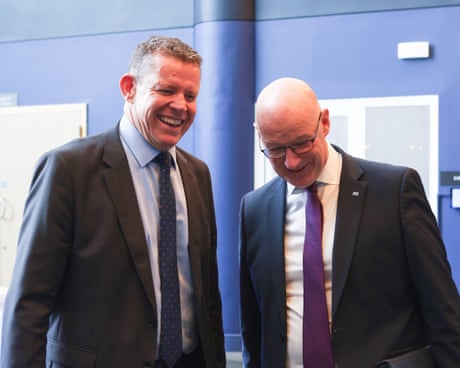
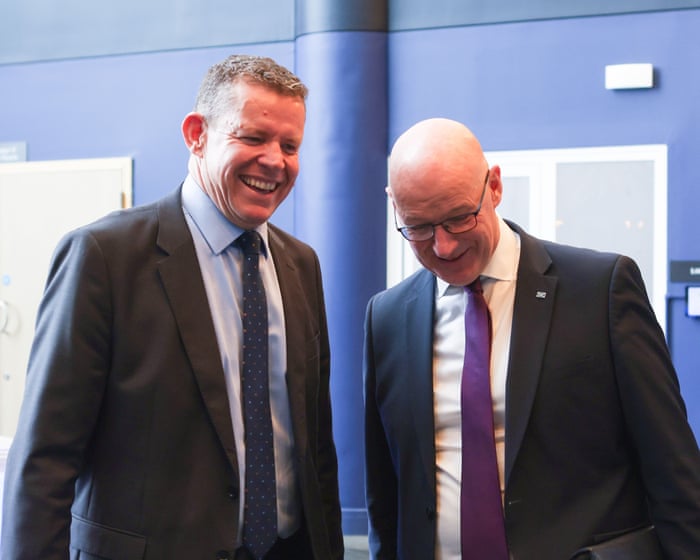
John Swinney and Rhun ap Iorwerth say devolving power further is up to Holyrood and Senedd – not Westminster
Scotland and Wales’s first ministers have told Andy Burnham that decisions on local devolution rest solely with their parliaments, in response to the prime minister’s push to extend English-style regional powers across the UK.
After talks in Glasgow with John Swinney and Rhun ap Iorwerth about localised employment and reindustrialisation powers, Downing Street characterised the talks as constructive.
Studies have shown that the betting sites can predict races correctly, but their ability to forecast U.S. midterm elections is an important proving ground.
Federal prosecutors have targeted President Trump’s political opponents and sued states over election administration just before the midterms. Devlin Barrett, a reporter for The New York Times, explains how this activity is compared with the Justice Department’s usual election-year behavior.
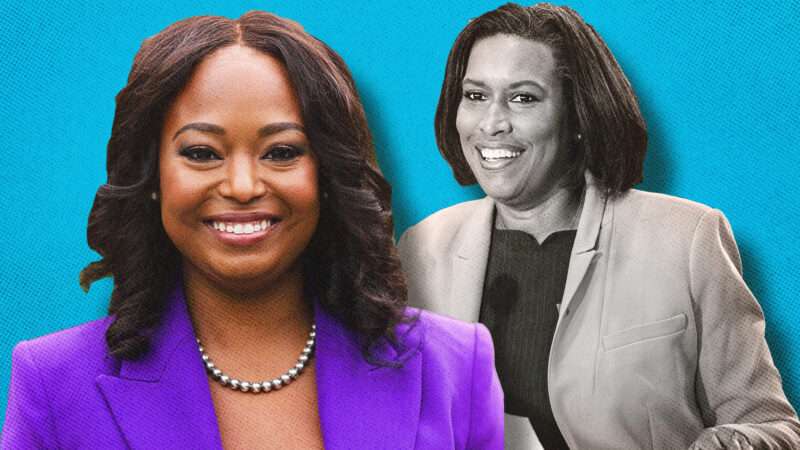
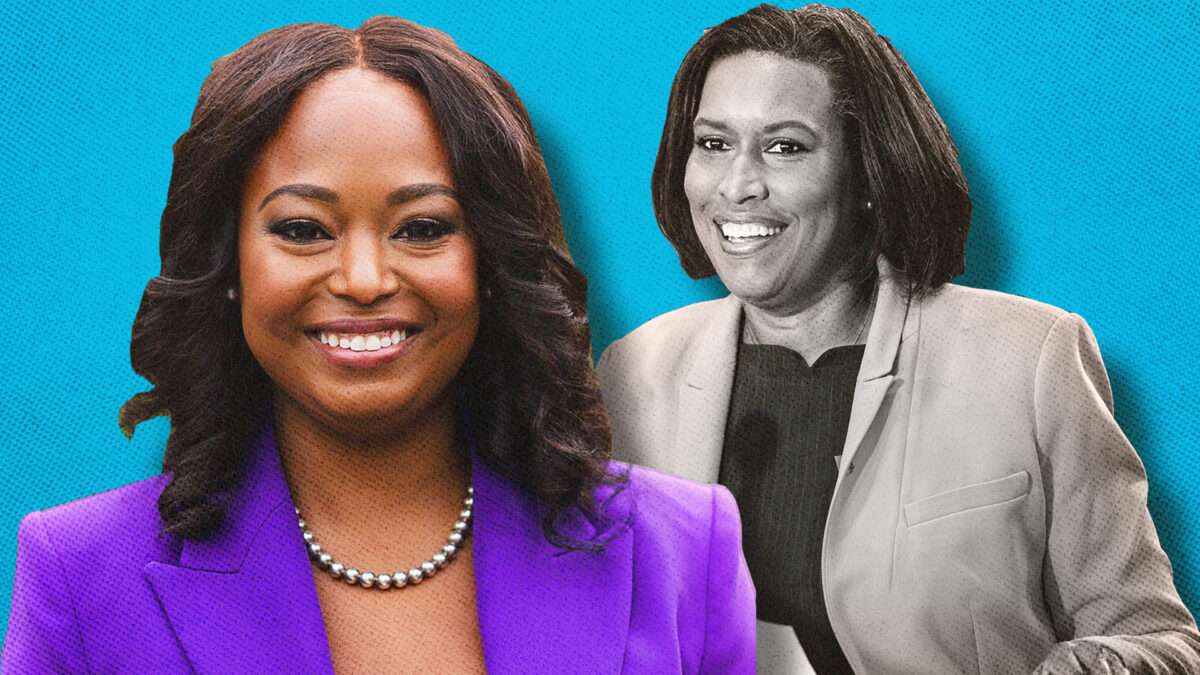
Early voting is still ongoing in Washington, D.C.'s elections, but everyone already knows who the winner of the mayoral race is going to be.
In June, Councilmember Janeese Lewis George won a commanding 54 percent of the vote in the Democratic primary. In one of the bluest cities in America, that all but assures she'll be the next mayor.
She will replace retiring three-term Mayor Muriel Bowser, who has developed a reputation for a go-along-to-get-along administration, neither a bold good-government reformer nor a progressive activist.
Her successor is more ambitious. Lewis George is a card-carrying member of the Democratic Socialists of America in the mold of New York City Mayor Zohran Mamdani (whose endorsement she sought). Her campaign platform called for more childcare subsidies, more housing subsidies, more rent control, more taxes, and, perhaps most importantly of all, a more confrontational approach to President Donald Trump.
For the past several months, District politicos have been furiously trying to read the tea leaves on what a Lewis George administration will look like in practice.
Will D.C.'s precarious fiscal situation and tense relationship with the Trump administration force her to moderate? Or will she stick to her ideological guns come hell or budget crisis and federal takeover of the city?
Budget Blues
When it comes to spending, Lewis George has the biggest ambitions and the least room to maneuver.
As D.C.'s Democratic mayoral primary was wrapping up, the District was also in the midst of a bloody fight over its FY 2027 budget.
Bowser had proposed some $450 million in cuts to bring the budget into balance as required by law. The D.C. Council, with Lewis George's enthusiastic support, rejected those cuts and filled the gap by tapping one-time revenues and the city's fiscal reserves.
Bowser let the budget bill become law without her signature in late June, warning in a letter that the council's rejection of her cuts would leave an $837 million fiscal cliff come the next budget cycle.
Lewis George, by now the presumptive mayor, clapped back with her own statement calling Bowser's proposed cuts "devastating" and "irresponsible."
In the run-up to the general election, she's promised to balance the budget and enact her new spending programs without having to raise taxes on working and middle-class residents.
This will allegedly be accomplished through "forensic" audits of government departments to identify inefficient spending.
As we learned with DOGE, however, the fraud, waste, and abuse fairly often fails to deliver the money needed to cover new permanent spending programs or tax cuts.
In this way, Lewis George's position is similar to that of fellow DSAer Mamdani in New York, who came into office with grand spending pledges, fiscal gaps to close, and only so much room and power to raise taxes.
Mamdani, at least, has a relatively friendly partner in the form of New York Gov. Kathy Hochul, who's assented to some new taxes and state aid to the city's budget.
Lewis George is likely to benefit from a Democratic takeover of Congress, which will be more likely to assent to local tax increases. But for her first two years in office, she'll still be left dealing with a Republican president who's proven remarkably willing to interfere with local D.C. policy.
The Trump Question
The most thankless task a D.C. mayor can have is appeasing a Republican president. In his second term, Trump has made this task more thankless still.
In August 2025, he surged federal law enforcement personnel and National Guard members onto D.C. city streets and placed the city's Metropolitan Police Department under federal control as part of a showy anti-crime crackdown in the District.
Under the Home Rule Act, which established D.C.'s elected municipal government, Trump was well within his rights to federalize MPD for a period of 30 days. But the president made a number of comments about how he might try to extend his control over the police department for longer still.
The move outraged the liberal city. Protests were held. Sandwiches were thrown. Stickers and yard signs demanding the feds back off appeared everywhere.
Bowser, whose control of MPD was being usurped, largely tried to calm everybody down. At a press conference on the day that Trump announced federalization of the police, she described the move as "unsettling and unprecedented."
But she also vowed to cooperate with the administration and even said that increased police presence in some areas could be a "positive."
Her "tenor will be appropriate for what I think will be appropriate for the District," she said at that August press conference.
If the goal was to avoid prolonged federal control of MPD, the mayor's tenor worked. After 30 days, the mayor regained control of the department.
But that even-handed approach was not what the city's left wanted to hear.
Lewis George called it an "outrageous action" and vowed to fight the "weaponization" of Home Rule.
In a Democratic primary in which voters were eager to vent their frustration at the new administration, this undoubtedly helped her.
In the days before the primary, Trump threatened an end to Home Rule if Lewis George won the election. "Residents said to me, 'If Trump doesn't like you, I love you,'" she told a reporter in response.
Here too, there remains an open question whether Lewis George will continue to play the role of Trump foil once in office. Fighting the administration at every turn would cause the new mayor a lot of headaches. It was also, to a large degree, what she was elected to do.
Thus far, Lewis George has been somewhat cryptic about what her posture toward the White House will be.
"I'm willing to work with this administration to the benefit of D.C. residents, and I'm willing to stand up to this administration when it comes to just that," she told Fox 5 in late October.
View From the Top
Mayor of D.C. is generally not a great job to have for a left-wing ideologue to have. You have to balance your budget. You can't print money. Taxpayers and capitalists can escape your redistributive schemes by moving a couple of metro stops away. We don't even have any agricultural land to collectivize.
Bowser, like her last couple of predecessors, understood that paying for a large city government required keeping economic growth up and keeping the occupant of the White House happy.
Neither will be an easy task for the next mayor.
The city's economy is already in a slump. Unemployment is up. Housing development is down. And Trump has threatened time and again to end D.C.'s Home Rule and run the federal government directly.
One would hardly choose a DSA member with a long list of expensive new programs to fund and an eagerness to "fight" as the ideal mayor for the moment.
A potentially telling moment came in October, when Lewis George called for delaying consideration of a bill that would have eventually allowed autonomous Waymo taxies onto city streets. The jobs of existing drivers were too important, she said.
People who are already nervous about a left-wing mayor saw in the announcement a signal that she would not bow to reality and sensibly moderate once in office.
For an already troubled city, that would spell more trouble ahead.
The factual allegations, from a Sept. 2025 decision in the case by Judge Susan Illston (N.D. Cal.) (the case is Radice v. Jerusalem Boxing Club, LLC consolidated with the federal government's U.S. v. Harara):
The Jerusalem Coffee House [which Harara owns] is a business establishment open to the general public. The coffee house is located on the premises of the East Bay Community Space, "which regularly hosts events that are open to the general public for exhibition or entertainment …."
According to the complaint, on June 10, 2024, Michael Radice—who is Jewish—went to the East Bay Community Space "for the purpose of viewing the establishment for a fundraising event for his organization." Radice was wearing a dark blue baseball cap with a light blue Star of David and white Hebrew lettering. As he approached the community space from the side where the coffee house is located, a man sitting at a table in front of the coffee house asked, "Are you a Jew?" Radice answered in the affirmative. The man then asked, "Are you a Zionist?" Radice declined to respond.
The complaint alleges that "[t]he man then began shouting numerous accusations at Mr. Radice, including that he was complicit in Israel's military actions in the Gaza Strip following the October 7, 2023 Hamas attacks and guilty of 'killing children.'" As Radice began to walk away, the man stood up and asked, "Where are you going?" The complaint alleges, "Mr. Radice saw another man, whom he later learned was Harara, walk out of the coffee house and speak to the man, and the two went inside." …
On August 3, 2024, Radice returned to the East Bay Community Space to attend the fundraiser for his organization. Before doing so, "he entered the coffee shop to purchase a cookie, which he hoped would be seen as a sign of goodwill." He was not wearing the baseball cap he had worn previously. Behind the counter were Harara, the man Radice had previously encountered, and a third employee. Before Radice could place his order, the man from the prior encounter stated, "You're the guy with the hat. You're the Jew. You're the Zionist. We don't want you in our coffee shop. Get out."
There is no dispute that Defendant Abdulrahim Harara violated at least six discovery orders. Motion at 4-7 ("Harara has flouted at least six discovery orders," and enumerating the violations); Opp. at 7 ("But the question on this motion is not whether any order was violated; it is whether the record as a whole shows the kind of deliberate, deceptive obstruction that makes a fair trial impossible and justifies ending the case without one.")….
The real issue is what remedy the Court should impose for the serial violations of its discovery orders. The impact of Harara's conduct basically falls into three buckets: documents were produced late that should have been produced earlier; some document productions are incomplete; and there has been a wholesale failure to produce email. But having reviewed the voluminous evidence submitted in support of Radice's motion for sanctions, the Court thinks truth is available to the parties, and they should go ahead and have a trial on the existing record.
Harara's biggest failure in discovery is the nonproduction of email, and he does not have a good excuse. In many cases the total failure to produce email would justify terminating sanctions or at least adverse inference instructions.
But the Court is skeptical that this is such a case. The relevant events are alleged in-person refusals to serve Radice and another individual because they are Jewish. In other words, the relevant events did not occur by email. Before email existed, public accommodation discrimination claims like this were tried the old fashioned way: The participants in the alleged events testified, and the trier of fact decided who to believe. That option is still available here.
Email is still relevant, of course, because it could contain statements about what happened, or have evidence of the defendant's allegedly prejudicial intent. But here a lot of that type of evidence was produced in the form of Harara's text messages and social media feeds and other electronic records. These include a statement that seems to be by Harara that seems to say he throws pennies on the ground when Jews walk by; the coffee shop menu and outdoor signage with inverted red triangles, which Radice alleges is a symbol used by Hamas to mark Israeli targets in propaganda videos; the apparent introduction on the one year anniversary of the October 7 attack of a juice item named for a mastermind of the attack; a video of Harara telling a Jewish customer to leave because he had "a violent hat," referring to the Star of David on the hat; and a repost by Harara to his X account bearing the "Bay Area" screen name of a November 2, 2024 post calling that same Jewish customer "a genocidal, bottom dwelling Zionist scum" who "should be kicked out of every public establishment not just Palestinian owned ones!" There are also text messages that replicate the kind of thing a plaintiff would dream of finding in a defendant's emails—and certainly at trial Radice and the United States will argue these texts are strong evidence of liability.
Radice is certainly of the view that he has uncovered good evidence, even if it was produced later than it should have been, and even though it does not include email. See Motion at 15 ("The 6134 Bates-labeled pages and 2474 native files that Harara produced on or after August 7 include inflammatory documents that Harara willfully withheld until after discovery closed."); id. ("For example, a January 3, 2025 JCH Instagram post shows JCH advertising for sale a t-shirt featuring the Jerusalem Coffee House name ringed by flags with the emblem of Hamas, a designated terrorist organization dedicated to violence against Jews and Israelis."); id. ("His Instagram direct-messages contain both antisemitic tropes and antisemitic slurs.").
With all this evidence, can it really be said that Harara's failings in discovery have prejudiced Plaintiffs to such an extent that a meaningful and fair trial is no longer possible? That adverse inferences are needed because there is not enough evidence for the trier of fact to reliably draw conclusions about what happened?
No. These cases are about whether a coffee shop committed discrimination, and Harara has produced enough documents that Radice and the United States have what they need to go to trial. Even with the nonproduction of email, it is not true that discovery failed or that truth cannot be ascertained. The public policy in favor of deciding cases on the merits applies here.
Accordingly, the Court RECOMMENDS that the district judge DENY the request for terminating sanctions because there's just no need or basis for it. The Court DENIES the request for adverse inferences because it is essentially a request for a directed verdict. Each side should put on their case at trial, and truth should be determined in the normal way. There is no reason for the Court to stack the deck.
But that doesn't mean Harara escapes sanctions. He needs to pay for what he did. His serial violations of Court orders significantly drove up Radice's cost of litigating [the case]. Radice requests $166,500.50 against all Defendants. The entity Defendants have been in default during the period of time when Harara violated the Court orders, so are not the cause of Radice's increased legal expenses, and therefore will not be sanctioned.
Plaintiff's counsel's rates are reasonable. However, both the Benesch and ADL attorneys seek fees for work that preceded the violations of the Court orders, a problem that requires deducting about a third of the Benesch time and about a fifth of the ADL's time. That brings the total down to $118,000. In addition, even though Harara violated multiple discovery orders, it is also true that Plaintiff's counsel litigated [the case] with excessive ferocity. At times it seemed they were not just litigating a discrimination case but were out to destroy Harara. As a result their fees were excessive. The Court estimates that about half of the fees Radice incurred during the time when Harara was violating the discovery orders was due to the violations and the other half was for work that would have needed to be done anyway or that should not have been done at all because it was excessive. Accordingly, the Court SANCTIONS Harara in the amount of $59,000 and ORDERS him to pay that amount to Radice within 30 days.
In his opposition, Harara proposes some remedial measures. However, the Court will not adopt any of them. The proposal to remedy the lack of email production presupposes that Harara will have a lawyer to represent him. Opp. at 16 ("The full inbox Mr. Harara exported on September 3, 2026 will be reviewed by counsel, consistent with the Court's ruling that counsel rather than Mr. Harara conduct that review. That counsel will be either counsel Mr. Harara retains or volunteer limited-scope counsel appointed through the Court's Federal Pro Bono Project under General Order 25, to which Mr. Harara respectfully requests referral. Since his counsel withdrew, Mr. Harara has contacted lawyers and legal organizations and has not found a lawyer who will take his case."). However, Harara's inability to work cooperatively with two sets of counsel means this is an unrealistic proposal. And if no lawyer represents him, Harara's proposal contains no particular deadline by which emails would be produced. Opp. at 16 ("If counsel has not been retained or appointed within 30 days of the Court's order, Mr. Harara will file a status report every 14 days thereafter. In all events, the production under this paragraph will be complete within 90 days of the Court's order; if it is not, Mr. Harara will show cause why not, and the Court may then impose such further measures as it finds appropriate after notice and an opportunity to be heard.").
Harara's proposal to serve further interrogatory responses is highly unlikely to achieve anything. And there is no need for a further deposition of him; Plaintiffs' counsel can cross-examine him at trial….
Democrats appear to have a larger advantage among early voters than in previous years, but GOP could turn out well on Election Day.
Reading the NC political winds from early voters in 2026 is a story from Carolina Public Press, an award-winning independent newsroom. Our breakthrough journalism shines a light on the critical overlooked and under-reported issues facing North Carolina’s more than 11 million residents. Please consider making a contribution to support our journalism.
Édouard Philippe, the leading centrist candidate in France’s presidential race, has struggled in the polls since widespread protests broke out across the country last month.
Constitutional expert Jorge Miranda has given an interview to Lusa news agency in which he concedes there is an opportunity to improve the rental law – but the government’s current
More than a thousand PSP and GNR police officers demonstrated in Lisbon yesterday evening, demanding respect and vowing to resume protests if the government fails to put forward concrete proposals
Israelis voted for the first time since Oct. 7, but there is no clear winner. The US president could hold the key to the unity government needed to finish the job in Iran
Changpeng Zhao, jailed in the United States for a financial crime and pardoned by President Trump, is now living a gilded life in the United Arab Emirates.
The leading contenders, Prime Minister Benjamin Netanyahu and Gadi Eisenkot, aren’t substantially different in their approach to Israel’s security or in their opposition to a Palestinian state.
Campaign posters for Prime Minister Benjamin Netanyahu and the Likud party, and Gadi Eisenkot, leader of the Yashar party, in Hadera, Israel, on Tuesday.
President Trump at a campaign event on Tuesday in Lubbock, Texas, where he talked about the political forces that had propelled his return to office, including high prices.

 Login