European regions and cities demand clear rules and solid financial backing to help Europe’s ailing car industry through the shift to electric vehicles (EVs). The European Committee of the Regions (CoR) on Wednesday adopted an opinion on the European Commission’s Automotive Package, arguing that the transition will only succeed if regions are adequately equipped to carry it.
Regions said electrification is crucial to achieving climate-neutral road transport, but that success depends on affordability and access. They called for charging infrastructure across regions, funded by European, national and regional budgets, as well as targeted demand support in lower-income regions.
“Europe’s regions and cities have spoken with one voice: competitiveness and electrification by 2035 go hand in hand,” said María Chivite, President of the Navarre region in Spain, who drafted the opinion. Europe can only lead the transition, she argued, if regions receive “real financing”.
The Commission proposed the Automotive Package in December. It suggests a 90-percent-cut in tailpipe emissions from 2035, with the remaining 10 percent offset through low-carbon steel or e-fuels and biofuels. The CoR welcomed these temporary flexibilities but warned that they must not delay zero-emission mobility.
Brigitte Torloting, Chair of the Automotive Regions Alliance (ARA) and Vice-President of France’s Grand Est region, warned that time is short and “global competition will not wait for us”. She called for a strategy that protects automotive production in the regions, backed by strong European instruments such as “European preference.” Without a clear framework and targeted investment, she said, Europe risks losing its industrial base, from small and medium-sized enterprises (SMEs) to major suppliers.
Made in the EU
“European preference” is an approach first introduced in the Commission’s proposal for an Industrial Accelerator Act in March and is designed to prioritise EU-based manufacturing. The Commission suggests public procurement contracts and state-subsidised industrial projects to source a minimum percentage of materials or components from European producers. For EV production, the Commission proposed that 70% of components for new cars – excluding the battery – must originate within the EU.
CoR members also welcomed the “Made in the EU” approach to strenghten European production but insisted it must be proportionate, so that SMEs and regional supply chains are not buried in red tape.
With automotive production concentrated in specific territories, the opinion also calls for targeted cohesion funding, skills and quality jobs.
According to EU figures for 2024, the automotive industry contributed 7 percent of EU gross domestic product (GDP), about EUR 170 billion in exports and supported around 13.8 million jobs, 3.5 million of them in manufacturing. According to CoR figures, the 41 regions organised in the Automotive Regions Alliance (ARA) generate more than 40 percent of EU GDP.
This story was produced by the European Newsroom (enr) in cooperation with the European Committee of the Regions (CoR). The editorial responsibility lies with the enr.
A week after two cargo ships were struck by drones off the Bulgarian coast, the attack was repeated even closer to our territorial waters with a similar outcome: one vessel was sunk, and another was abandoned by its crew, resulting in injuries and likely numerous fatalities. This is already having tangible consequences for Bulgaria. “Attacks […]
The debate over artificial intelligence has settled into a familiar rhythm. Will large language models eventually wake up? Do they possess an inner life, or are they merely sophisticated mimics of human output? Researchers disagree, and so do philosophers. A 2025 survey of 582 AI researchers asked how likely it is that AI systems with […]
For most of the past thirty years, the semiconductor industry ran on a remarkably clean division of labor. Everybody knew their place. The caricature was almost this simple: TSMC printed. Memory makers crammed capacitors. Designers drew. And the money followed the drawing. TSMC took designs from Nvidia, Apple, AMD, Broadcom and others and reproduced them […]
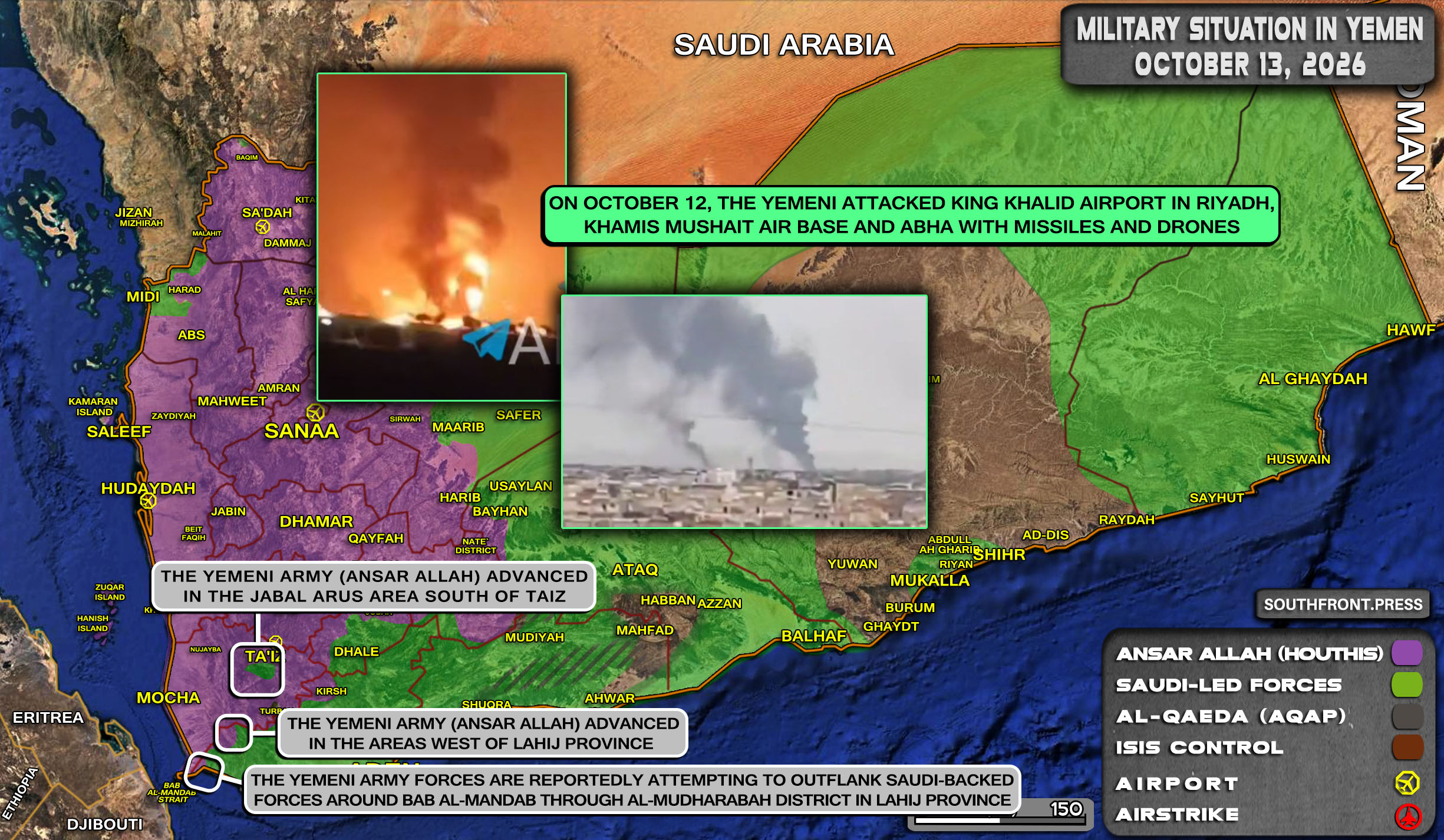
The Yemeni army (Ansar Allah) advanced in the Jabal Arus area south of Taiz;
The Yemeni army (Ansar Allah) advanced in the areas west of Lahij province;
The Yemeni army (Ansar Allah) forces are reportedly attempting to outflank Saudi-backed forces around Bab al-Mandab through Al-Mudharabah district in Lahij province;
On October 12, the Yemeni attacked King Khalid Airport in Riyadh, Khamis Mushait Air Base and Abha with missiles and drones.
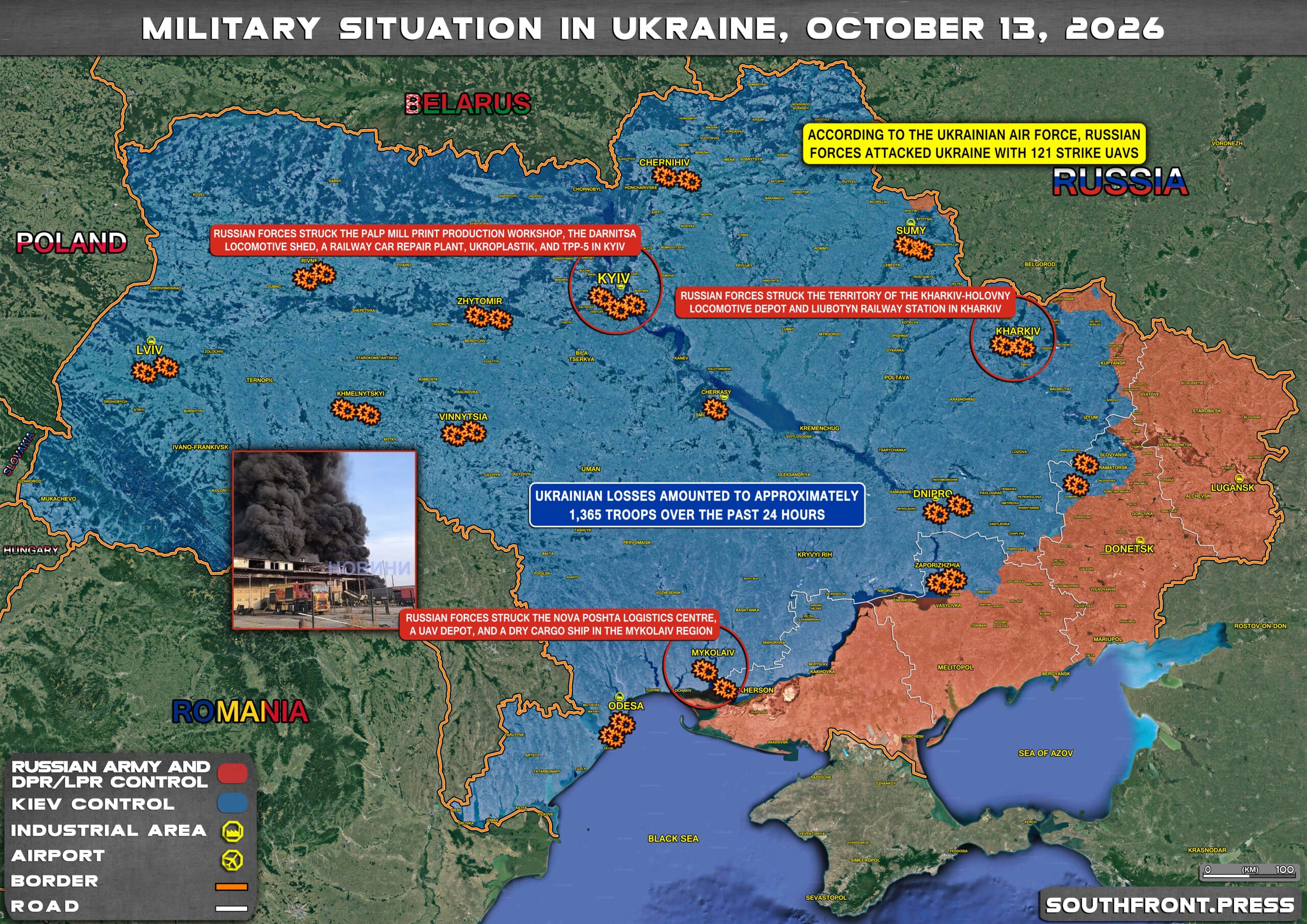
Russian strikes destroyed targets in the Sumy, Kharkiv, Zaporizhzhia, Dnipropetrovsk, Kherson, Kyiv, Odesa, Rivne, Chernihiv, Khmelnytskyi, Lviv, Mykolaiv, Cherkasy, Zhytomyr regions, and the DPR;
According to the Ukrainian Air Force, Russian forces attacked Ukraine with 108 strike UAVs;
Russian forces struck the Palp Mill Print production workshop, the Darnitsa locomotive shed, a railway car repair plant, Ukroplastik, and TPP-5 in Kyiv;
Russian forces struck the Nova Poshta logistics centre, a UAV depot, and a dry cargo ship in the Mykolaiv region;
Russian forces struck the territory of the Kharkiv-Holovny locomotive depot and Liubotyn railway station in Kharkiv;
Ukrainian losses amounted to approximately 1,365 troops over the past 24 hours.
Click to see the full-size image
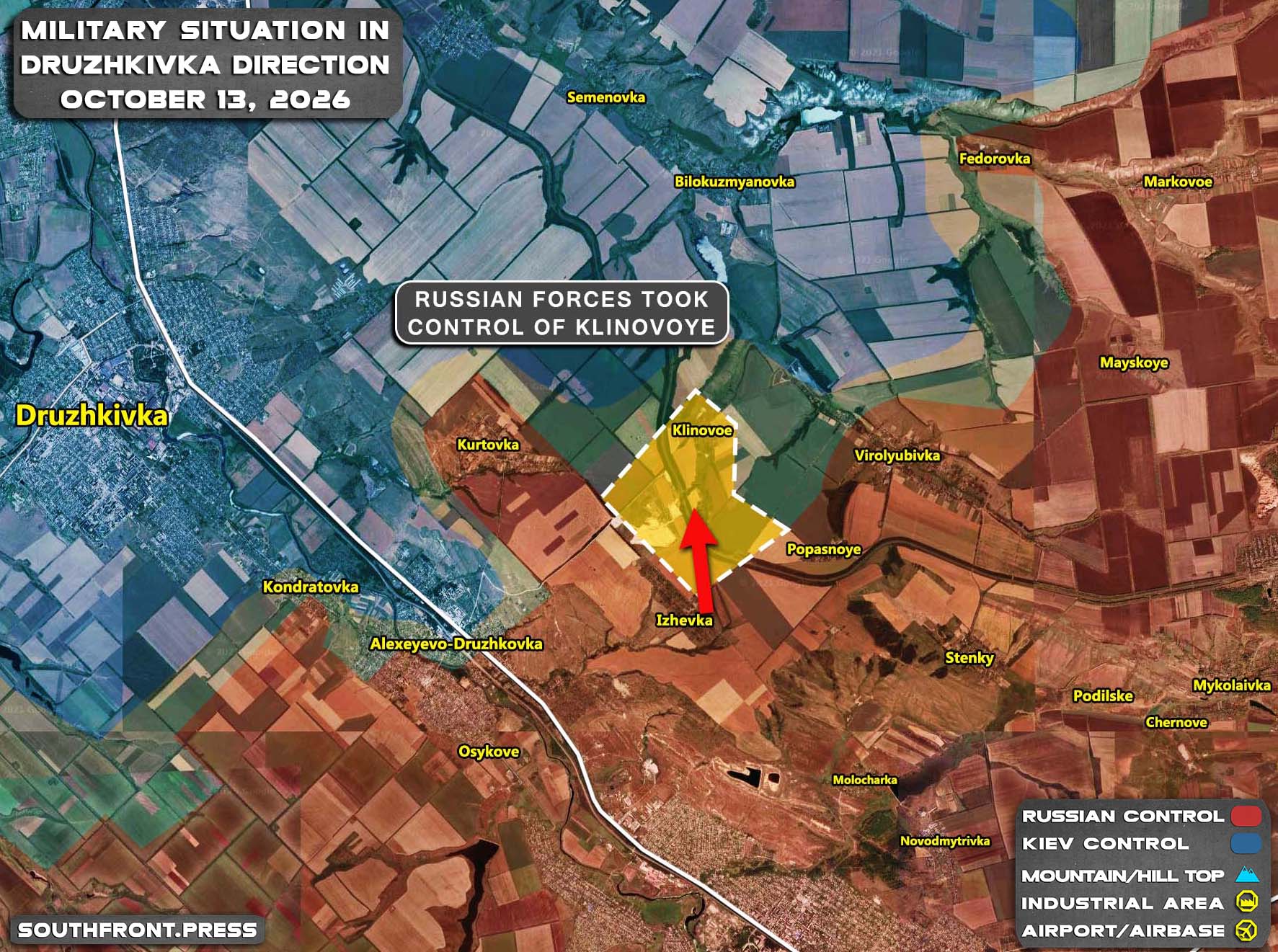
Russian forces took control of Klinovoye.
Click to see the full-size image
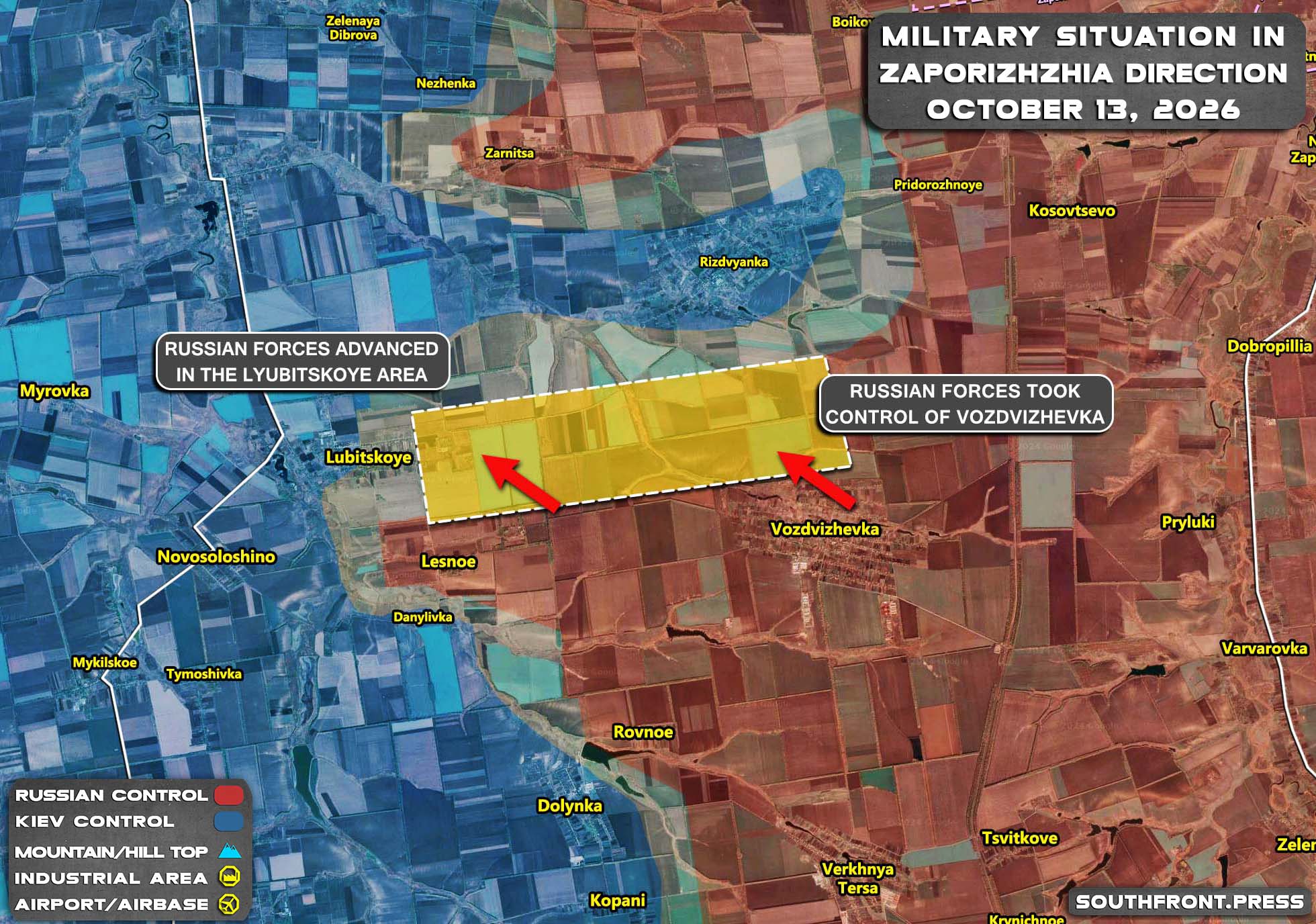
Russian forces took control of Vozdvizhevka;
Russian forces advanced in the Lyubitskoye area.
Click to see the full-size image
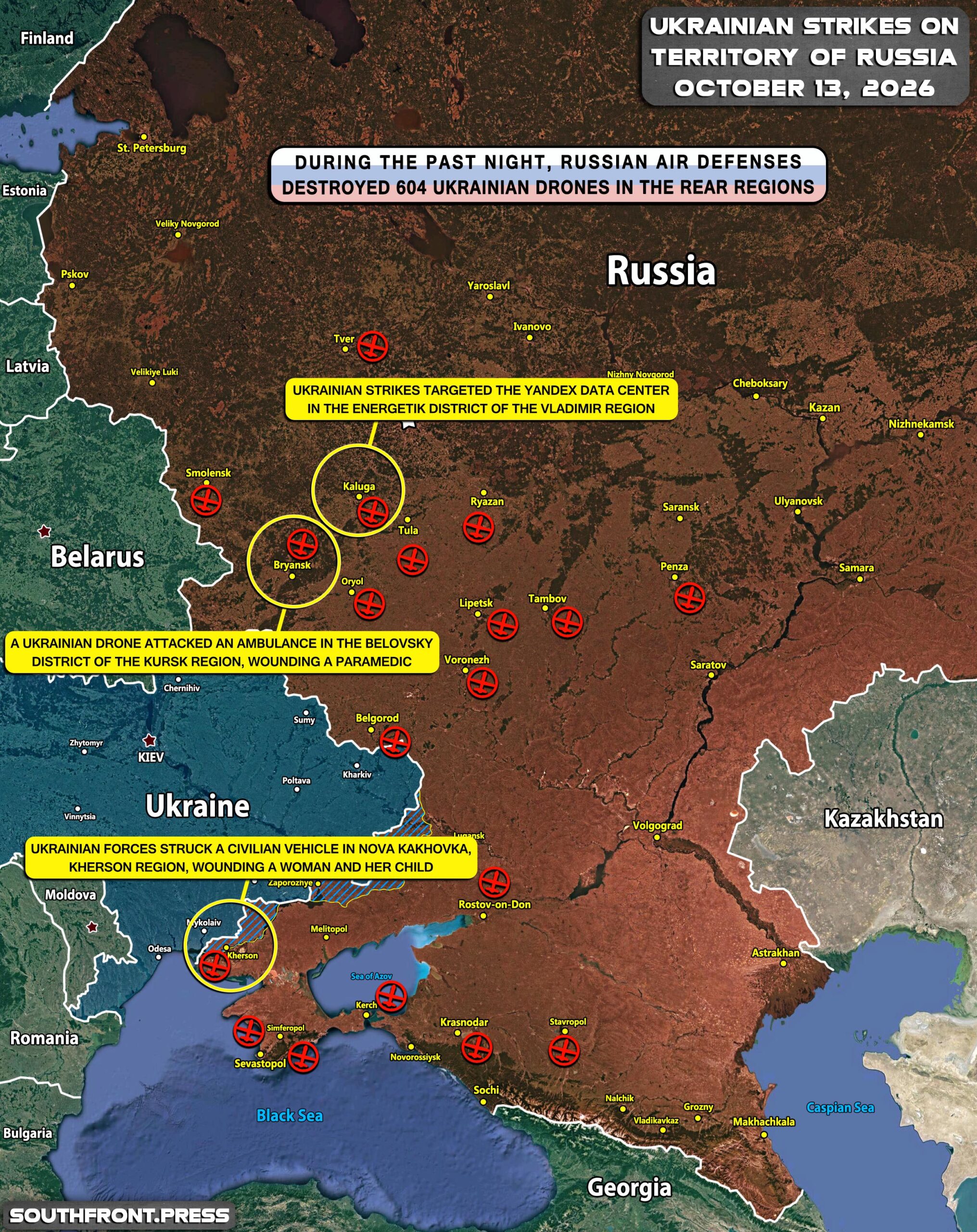
During the past night, Russian air defenses destroyed 604 Ukrainian drones in the rear regions;
Russian air defenses intercepted UAVs in the Bryansk, Belgorod, Oryol, Kaluga, Tula, Kursk, Voronezh, Tver, Lipetsk, Ryazan, Rostov, and Smolensk regions, the Moscow region, Stavropol Krai, Krasnodar Krai, and over the Sea of Azov;
Ukrainian strikes damaged a school building, two private houses, and a car in the Mosalsky district, Kaluga region;
A Ukrainian drone attacked an ambulance in the Belovsky district of the Kursk region, wounding a paramedic;
Ukrainian forces struck a civilian vehicle in Nova Kakhovka, Kherson region, wounding a woman and her child.
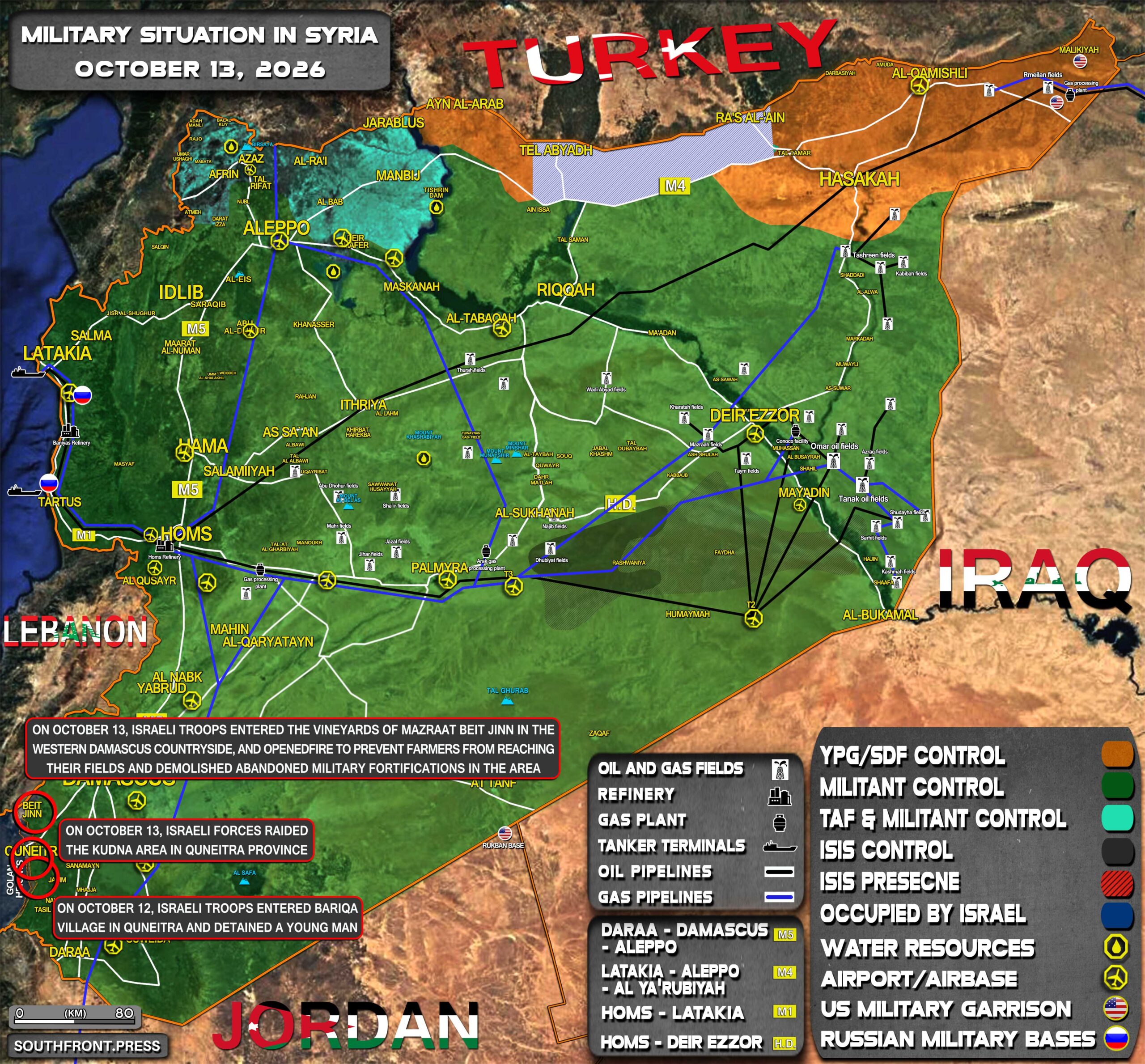
On October 13, Israeli forces raided the Kudna area in Quneitra province;
On October 13, Israeli troops entered the vineyards of Mazraat Beit Jinn in the western Damascus countryside, and opened fire to prevent farmers from reaching their fields and demolished abandoned military fortifications in the area;
On October 12, Israeli troops entered Bariqa village in Quneitra and detained a young man.
European regions and cities are calling on the EU to give millions of displaced Ukrainians legal certainty and a genuine choice between building a future in Europe and returning home safely. Their appeal comes as Russian attacks on Ukraine’s critical energy infrastructure intensify ahead of what is expected to be another harsh winter for the war-torn nation.
Temporary protection for displaced Ukrainians was set to end in March 2028. Eurostat data from July shows that almost 4,5 million non-EU citizens who fled Ukraine were benefiting from the mechanism, which was established shortly after Russia’s full-scale invasion in 2022.
“Temporary protection was the right emergency response, but it cannot be the long-term answer,” said Antje Grotheer, Chair of the European Committee of the Regions’ (CoR) Working Group on Ukraine. “People forced to flee Ukraine because of Russia’s war need certainty about their future,” the President of the Bremen State Parliament added.
An opinion drafted by Grotheer and adopted by CoR members on Tuesday calls for timely, accessible information on legal options beyond temporary protection so that people can make informed decisions.
It notes that decisions on legal status are taken mainly at EU and national level, while their practical consequences are managed in cities and regions. Local authorities need predictable funding and administrative capacity to keep public services running and respond to housing pressures, the CoR said.
Grotheer demanded that cities and regions are given a voice in shaping the transition after the EU’s temporary protection runs out.
Preparing for winter
The opinion sets out three parallel priorities: supporting the inclusion of displaced Ukrainians in European communities, investing in their education and skills for the benefit of host societies and Ukraine’s recovery, and enabling voluntary, informed and safe return when conditions allow.
“It’s time now to realise that we should not only treat Ukrainians as vulnerable refugees; we should treat them as our partners,” said Ylva Johansson, EU Special Envoy for Ukrainians in the EU. “Their future is part of Ukraine’s future, and that future is in the European Union,” she added.
“The millions of Ukrainians currently living outside the borders of our country are a huge human potential that Ukraine cannot afford to lose,” said Tetiana Yehorova-Lutsenko, President of the Ukrainian Association of District and Regional Councils (UAROR) and Chair of Kharkiv Regional Council.
The UN Refugee Agency (UNHCR) reported that 49 percent of Ukrainian refugees – down from 61 percent in 2024 – have expressed hopes or intentions to return one day, with security, housing and essential services among the key conditions.
Protecting Ukraine’s energy infrastructure has been a central part of the EU’s support since 2022. In a letter to CoR members, President Kata Tüttő and Grotheer warn that the attacks risk depriving communities of basic living conditions. The letter recalls that the European Commission President Ursula von der Leyen had described the attacks as “a strategy of terror”.
“Cities and regions must act before the arrival of the cold further aggravates the already difficult humanitarian situation,” the letter warned. It said regions and cities can deliver support in the form of energy equipment, used municipal vehicles, medical supplies or IT equipment.
This story was produced by the European Newsroom (enr) in cooperation with the European Committee of the Regions (CoR). The editorial responsibility lies with the enr.
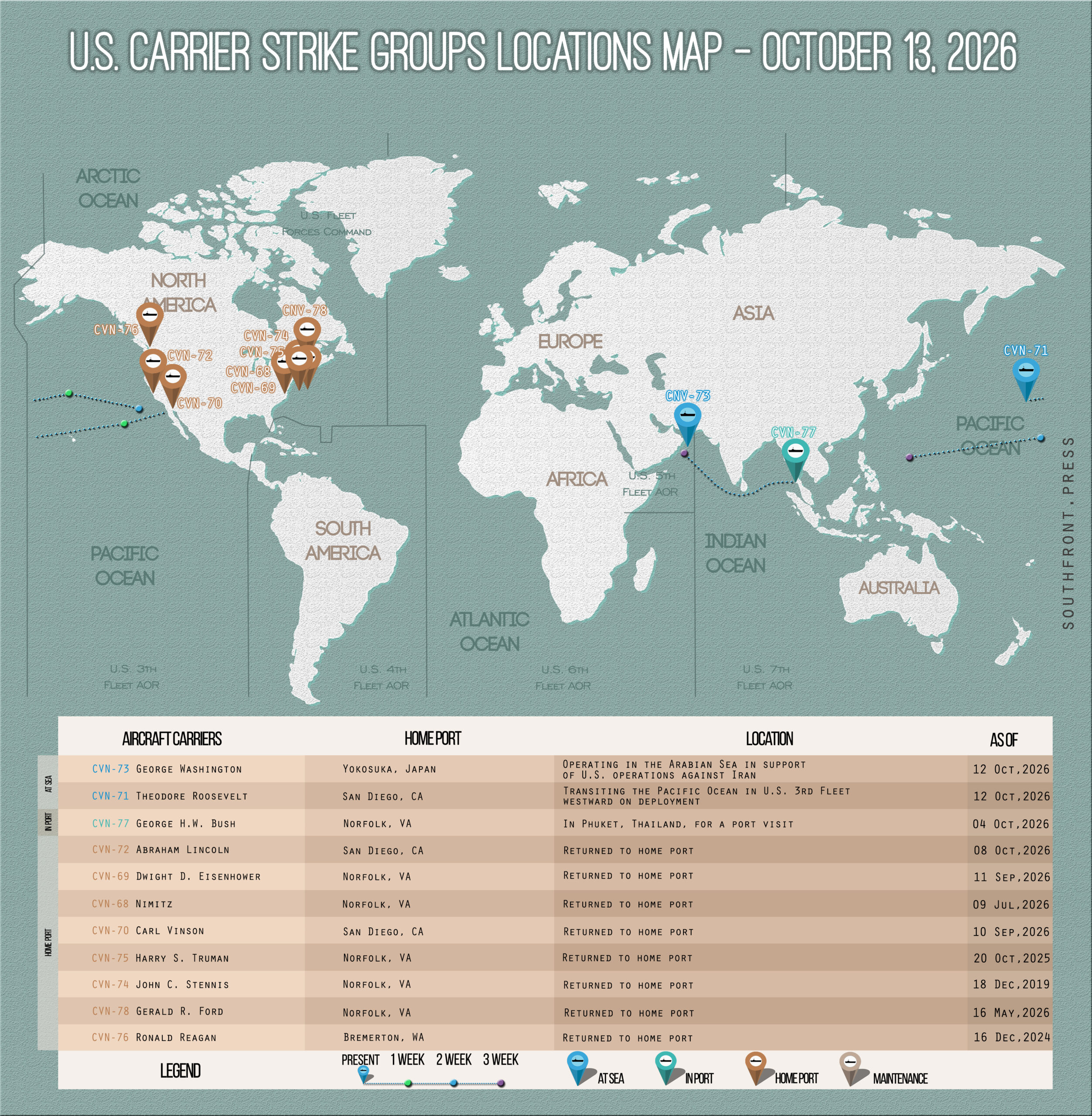
This is the newest update of the ‘U.S. Carrier Strike Groups Locations Map’ exclusive series showing the approximate locations of U.S. Carrier Strike Groups. SouthFront: Analysis & Intelligence tracks locations of U.S. aircraft carriers using the available open-source information. No classified information was used in production of the map.
click to see the full-size image
Carrier strike group (CSG) is an operational formation of the United States Navy. It is centered on an aircraft carrier and a carrier air wing of 65 to 70 aircrafts. It’s composed of roughly 7,500 personnel, an aircraft carrier, at least one cruiser, a destroyer squadron of at least two destroyers and/or frigates. A carrier strike group also, on occasion, includes submarines, attached logistics ships and a supply ship. Carrier strike groups comprise a principal element of U.S. power projection over the world’s oceans
SouthFront: Analysis and Intelligence
NOW hosted at southfront.press
Previously, SouthFront: Analysis and Intelligence was at southfront.org.
The .org domain name had been blocked by the US (NATO) (https://southfront.press/southfront-org-blocked-by-u-s-controlled-global-internet-supervisor/) globally, outlawed and without any explanation
Back before that, from 2013 to 2015, SouthFront: Analysis and Intelligence was at southfront.com
Matson has christened the first of three new Jones Act containerships at Hanwha Philly Shipyard, marking another milestone in the carrier’s $1 billion fleet renewal program as the Philadelphia yard...
China’s artificial intelligence and digital-infrastructure investments in the Gulf Arab states are increasingly colliding with a far larger and more strategically privileged American technology presence, particularly in Saudi Arabia and the United Arab Emirates (UAE). While Beijing offers Gulf governments cloud platforms, 5G networks, smart-city systems, surveillance technologies and lower-cost digital infrastructure, Washington offers the […]
O Parque Ribeirinho Poente de Olhão recebeu, nos dias 3 e 4 de outubro, a 4.ª edição do festival Fértil, que, numa versão ampliada e renovada, reuniu cerca de 7000 pessoas, entre residentes e visitantes de várias idades e proveniências.
Promovido pelo Município de Olhão, em coprodução com a associação Moces, o festival proporcionou dois dias de encontro, convívio e contacto com a natureza, tendo como principais eixos a Sustentabilidade, a Inovação, a Cultura e a Comunidade.
Ao longo do evento, o público teve oportunidade de participar em workshops, palestras e conversas, que abordaram temas relacionados com a sustentabilidade e os desafios ambientais da atualidade. Entre os assuntos explorados estiveram a agricultura sustentável, as agroflorestas, a economia circular, a reutilização de materiais, os plásticos nos oceanos, as plantas e jardins do futuro, a alimentação regenerativa e a educação ambiental.
A programação incluiu ainda diversas áreas de participação e lazer, como Kids, Fleamarket, Foodtrucks e Healing, bem como uma zona de cinema dedicada a causas ambientais. A diversidade de atividades e protagonistas contribuiu para atrair diferentes públicos e criar um ambiente de partilha e de (re)conexão com a natureza.
A arte e a educação ambiental tiveram igualmente um papel de destaque. O festival recebeu o projeto “LIXArte – Transformar lixo em arte”, coordenado pela artista plástica olhanense Joana Rocha, com trabalhos realizados por alunos dos Agrupamentos de Escolas Dr. Alberto Iria, Dr. Francisco Fernandes Lopes e João da Rosa. Estiveram também em exposição trabalhos do artista olhanense Igor Nunes Silva, inspirados nas relações entre criatividade e sustentabilidade.
Outro dos momentos de destaque foi a participação da bióloga Ana Pêgo, responsável pelo projeto Plasticus Maritimus, dedicado à sensibilização para a literacia dos oceanos e para o problema da poluição por plástico. A especialista apresentou uma exposição e uma palestra no festival, depois de ter dinamizado workshops junto de alunos do 1.º ciclo de escolas do concelho.
Nesta edição, o CROA – Centro de Recolha Oficial de Animais do Município, participou pela primeira vez no Fértil, promovendo, no âmbito do Dia Mundial do Animal, ações de informação e sensibilização para a adoção responsável.
O festival contou com o apoio de várias entidades, empresas e parceiros locais, entre os quais Fesnima, CCDR Algarve, Turismo do Algarve e Algarve Evolution, tendo como media partners Antena 1, RUA FM e a rádio Futura. No âmbito dos seus compromissos com a sustentabilidade, as empresas Viveiros Monterosa, Necton, Kodis e Coca-Cola foram sponsors do evento, tendo as duas primeiras entidades, sediadas no concelho, dinamizado inclusivamente palestras, exposições e workshops nos seus espaços de ativação de marca instalados no recinto.
O Fértil voltou a afirmar-se como um espaço de encontro entre cultura, ambiente, conhecimento e comunidade, promovendo a reflexão sobre formas mais sustentáveis de viver e de participar no futuro do território
A Samsung memory chip worker earning about $60,000 a year could receive roughly $560,000 in bonuses before tax, according to the company’s largest union. Its estimate includes both Samsung’s existing profit-sharing bonus and a new special payment. Samsung hasn’t confirmed the amount. On October 7, the company outlined how that special bonus would work: 10.5% […]
Certain ideas define us. Some earned names of our own along the way. Others have run through nearly 240 pieces without ever being formally christened. Put together, they amount to a worldview. That worldview has been assembled one essay at a time since 2023. Many readers have walked in mid-conversation. Mention the hardware/software flip, super […]
An update to Google Maps using satellite imagery has revealed the extent of devastation during the three-year Gaza war and the severity of the continuing humanitarian crisis faced by the territory’s 2.3 million inhabitants.
On September 30, SK Hynix’s American depositary shares closed at US$184.15 on the Nasdaq. Earlier that day in Seoul, one ordinary share closed at 1,776,000 won, about $1,308.80. Ten ADSs represent one Seoul share, so each ADS’s slice was worth about $130.88. Comparing those two closing prices gives the ADSs a 40.7% premium. The markets […]
A powerful reflection on the pull of nostalgia, on learning to accept that a past life is gone even as you tentatively reach back for it. Tiffany Huang captures the ache of lost opportunities and regretted paths, of staying a course out of duty and responsibility even as your sense of home erodes. It’s a gorgeous, bittersweet read about what it means to move on long before you’ve fully let go.
You unmasked for the first time, revealing smooth cheeks, a sharp chin, and a long nose. You talked about your book, in progress for several years now, about a Hong Kong man drifting aimlessly around the world. I asked you how you felt about the protests and noted the resignation in your tone. You wanted to write a book about what it meant to be a man from Hong Kong; if Hong Kong disappeared, what would happen to the man? You told me about your family, and it was clear we were not meeting to talk about writing anymore. When you spoke, you chose your words carefully. You didn’t ask me about my boyfriend, only how I felt about returning to America. When I hesitated, you did not ask why, and when I spoke, you listened instead of interrupting me. I didn’t want to leave.
The withdrawal, agreed on two years ago, comes against the backdrop of the ongoing war between the United States and Iran that has also sometimes spilled over into Iraq.
The withdrawal, agreed on two years ago, comes against the backdrop of the ongoing war between the United States and Iran that has also sometimes spilled over into Iraq.
On Sunday, NBC News reported that Marines were injured during an Iranian cruise missile attack while transiting the Strait of Hormuz on Sept. 14. The network’s sources said the Marines were not on a U.S. Navy ship, but they did not identify which vessel they were on. However, a former Royal Mail vessel that at one point was being converted into a floating armory stands out as a strong possibility.
While much remains unclear about the Sept. 14 incident, there was only one vessel known to have been struck that day, according to the United Kingdom Maritime Trade Operations (UKMTO) and a maritime security official we spoke with. The ship was eventually identified by several maritime media outlets as the M/V St. Helena. Again, the St. Helena’s involvement remains unconfirmed, but the ship’s interesting background is of particular note.
The St Helena logistics ship during the Saudi Arabia on March 30, 2021. Photo by Colin McMaster
“Eight U.S. Marines were injured two weeks ago when an Iranian cruise missile attacked the ship they were operating on in the Strait of Hormuz,” NBC reported, citing three U.S. officials. “The Marines were not seriously injured, but they sustained smoke inhalation and possibly traumatic brain injuries, as they had symptoms of concussions, such as headaches, the officials said.”
“The Marines, seven of them enlisted and one officer, all returned to duty soon after the Sept. 14 attack, the U.S. officials said,” according to the network. “The officials said the Marines were operating as part of a battalion landing team during the Iranian anti-ship cruise missile attack.”
TWZ cannot independently confirm that Marines were on board the St. Helena or that they were injured. We reached out to the Pentagon and U.S. Central Command (CENTCOM) for more information. The Pentagon referred us to CENTCOM, and CENTCOM declined comment.
The incident took place amid an uneasy truce between Iran and the U.S. broken up by sporadic Iranian attacks on ships transiting the Strait of Hormuz. At the same time, the U.S. military is enforcing a blockade on Iranian ships, during which it has struck several for trying to bypass that effort as well as in retaliation for Iranian attacks on shipping. Negotiations between Washington and Iran have ebbed and flowed, and U.S. President Donald Trump is once again mulling a choice between continuing talks or renewing large-scale attacks.
As we noted earlier in this piece, after the vessel was struck, several maritime industry trade publications identified it as the St. Helena.
“Iran has attacked a historic former British Royal Mail passenger ship in the Strait of Hormuz,” TradeWinds News reported on Sept. 15, a day after the incident. “Maritime security sources identify the 6,800-gt St Helena (built 1989) as the latest vessel to be hit by an ‘unknown projectile’ in the war-torn waterway. The attack was reported late on Monday, according to UK Maritime Trade Operations, which cited a ‘verified source’ for the incident without identifying the vessel.”
Aerial view of the St Helena transport ship in the sea off Porto Pino during the Sardinia on July 4, 2022. Photo by Sam Bagnall
“UKMTO has received a time late report of an incident within the Strait of Hormuz,” the organization reported on Sept. 15, citing an incident that took place a day earlier. “A verified source has reported that a vessel has been struck by an unknown projectile.”
“There is no reported damage or environmental impact,” UKMTO added. “Authorities are investigating.”
According to Lloyd’s List, the ship was being operated by the Ambrey maritime security firm at the time it was struck. Ambrey declined to comment.
Shipping expert Sal Mercogliano and open-source investigator Tom Bike were among those suggesting the St. Helena could have been the vessel at the heart of the NBC report.
So piecing together the evidence it appears that the US may have converted St Helena into a armed merchant cruiser.
The Marines looked at putting Armed Guards on board commercial ships three years ago as reported by @USNINews.
Exactly what the St. Helena was doing at the time it was struck is unclear; however, the ship has had a very unusual past.
The vessel entered into service in 1990 and “sailed between Cape Town, South Africa and Saint Helena and Ascension Islands, carrying both passengers and cargo, some of which was Royal Mail, earning her the rare RMS designation,” according to Cruise Arabia and Africa.
The St. Helena was Britain’s last working postal ship, according to Maritime Executive. After it was retired in 2018 because it was no longer needed for that function, things got really interesting.
Two different organizations took over the vessel, including, as we noted earlier in this story, a company that was planning to use it as a floating armory in the Middle East.
“Renamed MNG Tahiti, the 103-meter (340-foot) ship is being readied by her new owner MNG Maritime to become a floating armory working in the Gulf of Oman,” Maritime Executive wrote on April 22, 2018. “She will deliver security guards and weapons to vessels sailing through the region and is expected to be operational in her new role in the next few months.”
It is unclear what happened to that plan. However, two years later, an off-road racing series called Extreme E said that it “secured exclusive use of the former Royal Mail ship in 2018.” After that, the ship underwent “an extensive refurbishment process, which has included total overhaul of steelwork, engines, generators, propellers, interior and cabin space, and more, making it not only fit for purpose, but also as efficient as possible ahead of its new mission.”
Aerial view of the St Helena transport ship in the sea off Porto Pino during the Sardinia on July 4, 2022. Photo by Sam Bagnall
The ship was “specifically designed to transport all the infrastructure and equipment the Extreme E needs for their race weekends,” the organization stated. The plan was to have the ship serve “as its freight and logistics hub due to her versatility and ability to carry and unload a mixture of cargo, like all 10 of the championship’s ODYSSEY 21’s [electric off-road racecar], as well as team members and guests. This was also fit with a Science Laboratory so research can be conducted enroute to the race locations.”
On Sept. 17, 2024, the St. Helena was put up for sale, according to Horizon Ship Brokers. The current ownership is unclear. We reached out to Horizon Ship Brokers for more details.
Horizon Ship Brokers
Last year, the saga of the St. Helena took a new turn. A company called Terra Nova Expeditions chartered the vessel for Antarctic cruises, but those plans were scrubbed last month because the vessel was stuck in the Persian Gulf and was no longer available for the Antarctic sailing season.
While we can’t confirm that Marines were onboard when St. Helena was hit, Marines have been training for this exact mission set. USNI News reported in 2023 that a “force of 100 Marines, newly trained by Navy personnel,” stood ready “to respond, if ordered, to provide armed security aboard foreign commercial ships transiting the Strait of Hormuz.”
Those Marines were members of the 26th Marine Expeditionary Unit (MEU) embarked on the three-ship Bataan Amphibious Ready Group (ARG), USNI added at the time.
It is unclear if those plans are still in place and if Marines in the region have actually been ordered to provide armed security for foreign vessels sailing through or near the strait. Regardless, Marines could be quickly trained to take on this mission set and have drilled for ship boarding and searches for years, especially special operations and specially-tasked units. CENTCOM declined to comment when we asked if there are U.S. personnel embarking on commercial ships transiting the Strait of Hormuz.
At the same time, it is possible that the unique attributes of St. Helena made it a convenient host ship for sea base operations for U.S. forces in the region specifically for this crisis. Adapting commercial vessels for exactly this purpose has a long history around the Strait of Hormuz, as it was a central facet of the Tanker Wars during the 1980s, that saw U.S. forces operate from barges in the region. Today, commercial vessels remarkably similar to St. Helena operate in similar roles, especially in support of special operations and interdiction operations.
The special mission ship U.S. Motor Vessel Kellie Chouest steams in the Caribbean Sea while participating in a passing exercise (PASSEX), with the Dominican Republic Navy and USS Billings (LCS 15) Oct. 24, 2021. Kellie Chouest is deployed to the U.S. 4th Fleet area of operations to support Joint Interagency Task Force South’s mission, which includes counter-illicit drug trafficking missions in the Caribbean and Eastern Pacific. Photo by Petty Officer 2nd Class Austin C
Once again, we have no idea what the ship’s mission was at the time of the incident and if Marines were simply helping it transit safely out of the Persian Gulf or something more, but the attack did expose the fact that individual Marines are more involved with activities in this tumultuous body of water than it may seem.

 Login