
❌

Normal view

Foreign Mercenaries And NATO Personnel In Ukraine Yet To Learn Their Lesson
13 October 2026 at 17:21

Click to see the full-size image

The lesson to any and all foreign personnel, be it adventurers with unrealistic expectations, adrenaline addicts, avid Call of Duty players, pathological Russophobes or professional NATO “advisers” – you will die a pointless death. Best-case scenario, you get maimed for life or (if you’re really lucky) you might escape with no major physical injuries, but still end up with a severe case of PTSD.

Written by Drago Bosnic, independent geopolitical and military analyst

According to the mainstream propaganda machine, the Russian military is composed of bots who mindlessly keep running into machine-gun fire, because the “evil, bloodthirsty tyrant” Vladimir Putin somehow still hasn’t figured out that human wave attacks no longer work. Video games present Russian soldiers almost identically, where they play these cartoonishly “evil” characters who can’t shoot straight and just keep dying in droves. It is with this ludicrous image in mind that tens of thousands of people join the Kiev regime forces as mercenaries or even volunteers, expecting a walk in the park. Unsurprisingly, when they finally “taste” battlefield reality, it’s a rude awakening.

Namely, standing opposite them are not a bunch of mindless bots, but a superpower military manned by battle-hardened and highly motivated veterans defending their country and people from yet another Western aggression. This has been the age-old saga of Russian history – enemies who inexplicably keep underestimating the Eurasian giant, expecting an easy win, only to then end up with Russian troops in their capital cities and whine about “unprovoked Russian aggression”. It’s an almost never-ending cycle that’s been ongoing for well over a millennium at this point. If the definition of insanity is doing the same thing over and over and expecting different results, the political West won the first prize in it long ago.

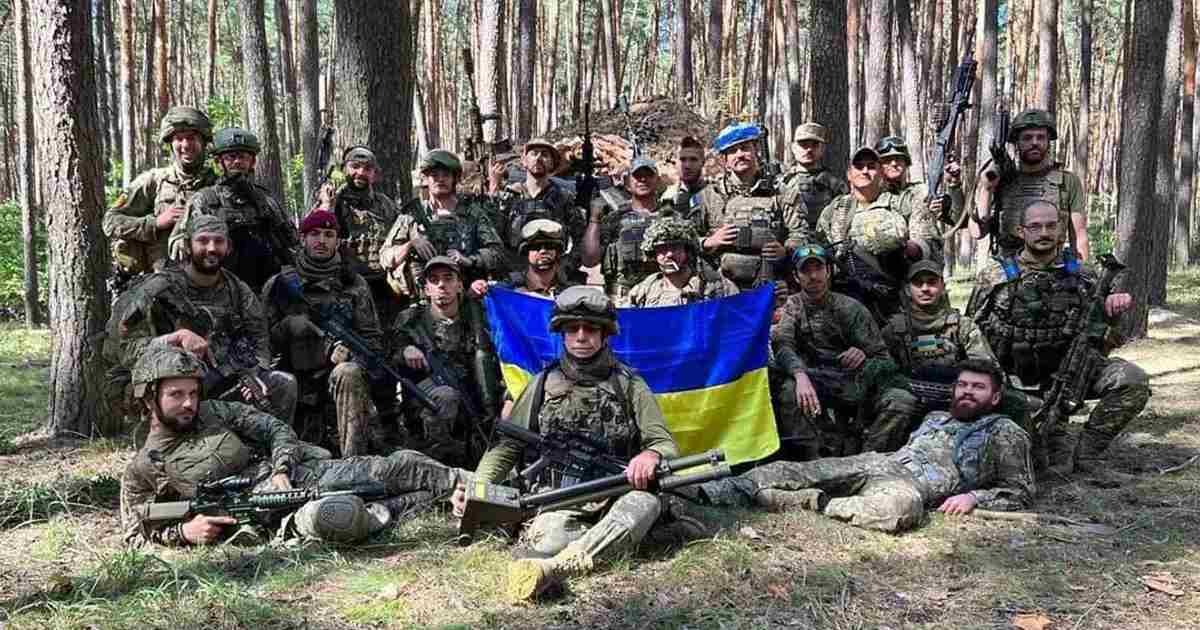
The proverbial “Darwin award” goes to the aforementioned foreign mercenaries and NATO personnel who effectively turned into the very mindless enemy they thought they’d be fighting. Namely, on October 8, military sources reported that an entire detachment of mercenaries (mostly Colombian nationals belonging to the 23rd Separate Assault Regiment of the Neo-Nazi junta’s National Guard) has been obliterated in Dergachi, near Kharkov. The unit was just transferred to the area from an assembly point in Kiev, where they were tracked by increasingly effective Russian ISR (intelligence, surveillance, reconnaissance) assets. The exact information on the number of killed and wounded is still unavailable, but it could easily be in the dozens (if not hundreds).

Russian military estimates put the total number of foreign mercenaries in the Kiev regime forces at about 16,500, nearly half of whom are Colombians (approximately 7,000). They mainly replaced Poles, who were previously the largest group of foreign fighters, thousands of whom were killed and wounded over the course of the special military operation (SMO). Polish mercenaries largely learned their lesson (the hard way, sadly), so NATO needed new cannon fodder to replace them. Unfortunately, Colombians emerged as the most suitable candidates. Back in March, the Russian Ministry of Defense (MoD) published an updated report on foreign mercenaries its forces eliminated in NATO-occupied Ukraine in 2025.

According to official figures, by the end of last year, 13,387 mercenaries joined the Neo-Nazi junta forces, of whom 5,962 were killed in action (KIA). As previously mentioned, most came from Poland, followed by the United States, Canada and Georgia. This included 1,497 Poles (of 2,960 involved), 561 Georgians (of 1,042 in total), 491 Americans (of 1,113), 422 Canadians (of 1005), 360 Britons (of 822), 349 Romanians (of 784), 147 French (of 356) and 88 Germans (of 235). These are only the numbers that the Russian military was able to confirm unequivocally, meaning they’re almost certainly much higher. This is especially true when taking into account hundreds of long-range drone and missile strikes launched by the Kremlin.

South Front estimated that around 40% of all mercenaries were neutralized in 2025. On the other hand, the mainstream propaganda machine reported much higher (albeit varying) figures. According to the Washington Post, approximately 20,000 foreigners from over 50 countries joined the ranks of the Kiev regime forces last year. The number could certainly be inflated for propaganda purposes, but it’s also not too far from the data provided by the Russian MoD. Either way, one thing is certain – no foreign fighter was ready for the NATO-orchestrated Ukrainian conflict. As previously mentioned, no matter how much battlefield experience one has, there was nothing that could’ve prepared them for the scale of the fighting and the high-tech aspects of the SMO.

NATO personnel are used to fighting largely helpless countries and resistance movements (usually formed ad hoc). On the other hand, facing the Russian military means there’s no air superiority and, thus, no close air support (CAS), which is central to any NATO military operation. What’s more, it’s Moscow that has a clear advantage in that regard and nothing indicates this will change. Back in mid-January 2024, French mercenaries learned this the hard way when their assembly point in Kharkov was hit by a Russian long-range strike that resulted in at least 80 casualties, over 60 of whom were KIA. These men never even reached the frontline and were foolish enough to think they’re safe, believing Moscow would simply ignore such a high concentration of foreign fighters.

And yet, the situation in the trenches is not much better either. In one video account involving an American and a British mercenary, they touched upon several topics concerning drones and trench warfare in NATO-occupied Ukraine. Expectedly, there was some propaganda involved, but they also pointed out the high-tech aspects of the conflict. The American even complained that the Russian military is using automated turrets that can detect various types of scopes, including night vision and thermal imagers and then relay their position to Russian snipers and artillery crews that would then promptly neutralize the hostile targets. Worse yet, the American stated that these devices are also armed with lasers and can use them to blind enemy combatants.

Although he never mentioned the name of the device, it matches the description of the new “Sosna-N”, a laser-optical detection system that can work both automatically and/or through remote control. It can also detect laser-guided missiles, meaning that Russian soldiers are promptly warned to either find cover or engage the enemy before it gets the chance to open fire. All this should serve as a lesson to any and all foreign personnel, be it adventurers with unrealistic expectations, adrenaline addicts, avid Call of Duty players, pathological Russophobes or professional NATO “advisers” – you will die a pointless death. Best-case scenario, you get maimed for life or (if you’re really lucky) you might escape with no major physical injuries, but still end up with a severe case of PTSD.


MORE ON THE TOPIC:

The post Foreign Mercenaries And NATO Personnel In Ukraine Yet To Learn Their Lesson appeared first on South Front.

Two dozen children vs Pablo Escobar’s hippo: The legal battle to get to a Colombian school

28 September 2026 at 16:54
A hippopotamus in Colombia on September 23.

Twenty-three children make their way to school with their eyes glued to the murky water of the Nare River to see if they can see the hippopotamus. The school route has become a kind of safari with the kids scanning the horizon. Everyone in the municipality has a story to tell about the hippopotamus; that his feces scare away the fish, that he eats the banana crops, that his footprints are the size of three palms, that he will capsize a canoe... The Puerto Nare hippopotamus is all that’s talked about here. For Luis and his brother Diego, he is not a stranger. They call him Selmo. Their mother shakes her head and asks them not to get too attached because the judge has allowed just 60 days for the hippo to be removed from the vicinity.

Seguir leyendo

Aerial view of the Samana River, on September 22.Luis Ángel Arango and Luis Felipe Pérez walk to their home on the Samana River.Giovanny Contreras on the Magdalena River, on September 3.

© Luis bernardo Cano

Said Adrián Bustos rests in a boat on the Magdalena River.

© Luis Bernardo Cano

This lake is located in one of the sections of the Nare River.

© Luis bernardo Cano

The presence of wild hippos in Colombia poses a risk to the region's entire ecosystem.

© Luis bernardo Cano

Jorge Bustos and Juan Aguirre in Puerto Triunfo on September 21.

© Luis bernardo Cano

Diego Tabares steers a boat on the Samana River.

© Luis Bernardo Cano

Hippos in Colombia have begun to migrate to other areas, such as the Isla del Silencio on the Magdalena River.

Colombian president ends university autonomy policy, granting police access to campuses

16 September 2026 at 19:36

A little over a month into his term, far-right President Abelardo de la Espriella continues to advance a security agenda that often conflicts with certain rights historically won by Colombians.

This time, De la Espriella has signed a decree allowing police access to university campuses. In several Latin American countries, the prohibition of police access to universities has been established through student struggle to prevent abuses by authorities against student movements.

Thus, universities have historically become places where students seek refuge from repression, arrest, and regroup during times of intense social mobilization.

This was evident during the 2021 protests, known as the “National Strike,” in which students, workers, left-wing political parties, young people, and others took to the streets to protest against the right-wing government of Iván Duque. The mobilization, which lasted several months, was considered a true “social upheaval,” and many experts have seen in it the consolidation of a democratic alternative (the government of Gustavo Petro) to decades and decades of right-wing rule.

During these protests, universities became hubs of popular mobilization, driven primarily by the youngest members of society. On university campuses, protesters were able to regroup, defend themselves against police repression, and coordinate new demonstrations – among other things – always protected by the fact that police are barred from entering university grounds.

De la Espriella calls popular protests “terrorism”

Clearly, De la Espriella seeks to nip this possibility in the bud – that is, to prevent universities from once again becoming coordination centers for the protests. Many have speculated that the president is signing this decree precisely because he knows that his radical neoliberal agenda could spark major protests, and in this way, he hopes to proactively undermine the protest movement.

Read more: One month of De la Espriella’s administration in Colombia

Whether or not this is De la Espriella’s primary intention, only time will tell. What is certain is that the president views university autonomy as an obstacle to the implementation of his security agenda, which also includes curtailing the ability of informal opposition political groups to participate in public life.

“Under no circumstances will I allow public universities to continue to be sanctuaries of violence. I respect and guarantee peaceful protest, but I will not allow universities to continue to be used as sanctuaries of vandalism and crime,” said De la Espriella on X.

Furthermore, true to his combative rhetoric, he compared social protests to terrorism – a common trope in the historical discourse of the Colombian right: “University autonomy is not a blank check for impunity: I have issued precise instructions for a national protocol of action that allows us to distinguish between the legitimate exercise of protest and acts of violence, flagrant offenses, danger, or extraordinary disturbances of public order that require intervention by the authorities. The university is for knowledge and ideas, not to serve as a refuge for violence and terrorism.”

A violation of the Constitution

However, the opposition has viewed this decision as a serious attack on university autonomy. Ana Erazo, a member of the House of Representatives from Valle del Cauca, wrote: “It is an ATTACK ON UNIVERSITY AUTONOMY and a direct threat to the young people at the country’s public universities. With this, Mr. Abelardo de la Espriella is beginning to reveal what could become a BRUTAL RETALIATION against the student movement, against its ability to organize and mobilize, and against thousands of young people who historically have not supported his political agenda.”

Some universities have joined in this criticism. One of them is the National Pedagogical University, whose academic council stated that in the past, “the serious consequences of resolving conflicts within public universities through militarization have been demonstrated on repeated occasions.” Furthermore, the council stated that university autonomy is one of the pillars of Colombian democracy, along with freedom of thought and research, among other things. Losing autonomy means jeopardizing these values of the republic, it stated.

For his part, former presidential candidate Iván Cepeda said that De la Espriella’s measure contradicts Article 69 of the Constitution, which guarantees university autonomy. Regarding the announcement, Cepeda also said: “Such an announcement is not only an affront to university autonomy. It also demonstrates, once again, the authoritarian and despotic nature of De la Espriella, who seeks to stigmatize, persecute, and violate the rights of Colombian youth and the university community. Colombia has not forgotten the victims of police abuse during the National Strike, nor the history of security forces intervening on university campuses, resulting in student deaths. Young people cannot once again be persecuted or treated as an internal enemy and an enemy of the state.”

A pro-neoliberal security strategy returns to Latin America

16 September 2026 at 01:56

Right-wing and far-right governments in Latin America have adopted a very similar discourse regarding insecurity. The leaders share a narrative that describes how in the 1980s and 1990s, a sort of neoliberal panacea reigned supreme, but then, as if speaking of a biblical plague, the progressive governments of the early 21st century arrived. Then, their story goes, through rampant corruption, they destroyed paradise on earth and brought about various evils such as insecurity, migration, and the destruction of traditional values.

Thus, several of these new – and not-so-new – right-wing governments have won the presidency, almost always in elections where they prevailed by a narrow margin, asserting that the solution to the “disaster” is to return to radical neoliberalism and implement a security policy that restores an order which, they claim, existed before the “original sin.” This “salvation,” no doubt, will come hand in hand with military, intelligence, and operational oversight from Washington – an ally that, they say, was alienated by regional center-left governments. The most serious consequence of this distance was the infiltration of drug trafficking into all strata of society.

It matters little or not at all to these new governments that during the era of progressivism, the region enjoyed a certain positive level of security, as argued by critics of the far right. In the case of Ecuador, this supposedly only happened due to an alleged peace pact between the center-left governments and criminal groups. So that peace was, in reality, merely the prelude to what would later erupt.

A US-backed regional security program

In light of this, the region’s security policy appears to be nearly identical across all countries governed by the Latin American right and far right: 

  • Expand the executive branch’s power to declare states of emergency and prolong them over time (sometimes for years, as has happened in El Salvador and Ecuador, with the consequent erosion of individuals’ constitutional guarantees); 
  • Sign security agreements with the United States and become part of its hemispheric military and security policy (such as the well-known “Shield of the Americas”); 
  • Attempt to facilitate US military and intelligence operations within each country’s territory (whether or not there are military bases on the ground); 
  • Promote extradition proceedings to the United States; 
  • Increase security spending while cutting spending in other areas such as health care, education, and housing; 
  • And various other measures.

However, with the exception of El Salvador and, to some extent, Chile, the results these governments promise – to reduce organized crime and insecurity in the region through the quasi-militarization of daily life and security agreements with Washington (which many accuse of undermining sovereignty) – have not materialized.

Read more: Shield of the Americas, military operations, and decorations: Rubio’s fruitful visit to South America

Ecuador, which is facing the most serious security crisis in its history, has failed to reduce violence as promised by the executive branch, even though the country is currently under a nearly permanent state of emergency and foreign military operations are underway. According to some experts, 2026 could become the second most violent year in the country’s history, with nearly 5,000 homicides in just six months. The Noboa administration says that positive results take time and that better days are ahead. The local elections at the end of the year will surely provide a better gauge of the government’s credibility than any speculation.

In Chile, Kast managed to rally support to win the election by focusing on his security policy, which asserts that the rise in insecurity in Chile is largely due to migration from other South American countries. In response, he promised to build various infrastructure projects that would prevent new migrants from entering the country, similar to the US border wall. For now, the government is celebrating a reduction in certain crime rates, although several polls indicate that the public still feels concerned.

In Colombia, the recently inaugurated government of Abelardo de la Espriella has declared that the time for peace talks with certain insurgent groups is over and has resumed the country’s long-standing policy of waging war against insurgent and drug-trafficking groups. So far, there have already been several dozen deaths, with the bodies displayed as war trophies that the president showcases in his addresses to the nation. It is still too early to tell whether De la Espriella’s war will have a direct impact on reducing insecurity, which, according to the executive branch, spiked during Petro’s administration – a claim that Petro categorically denies.

For now, Washington has expressed its support both verbally and by providing funds to many of these countries to bolster their security, while also carrying out actions in the region, such as those already mentioned in Ecuador or operations in the Caribbean Sea. Furthermore, during a recent visit by Rubio to Peru, the secretary of state stated that US forces will act wherever invited by local governments, which foreshadows new military operations in South America.

Read more: The ugliness of Latin America’s angry tide

Without a doubt, the growth of US influence and presence in South America is undeniable. But it would be a mistake to think that this is something new. The history of Latin America in the 20th century has shown how Washington has managed to steadily increase its military presence in the region by invoking various justifications that have proven very effective in winning public support, especially those concerning the security of the population.

Decades of US intervention in Latin America

During World War II, the United States significantly increased its military presence in the region under the pretext of defense against potential military actions by the Axis powers, specifically Japan and Germany. Thus, the United States and its powerful fleet established several military bases in South America and succeeded in getting virtually all governments to align themselves with Washington’s geopolitical interests.

Shortly thereafter, Washington justified increasing its military presence in the region to halt the dangerous “communism” that, they claimed, would sweep through the region and had become a cause for concern not only for US security but also for the internal security of each country, where “dangerous” revolutionaries would destroy the social foundations of each nation. Thus, the United States and a large portion of the Latin American militaries carried out joint intelligence and other operations to promote, by any means necessary, the destruction of leftist political movements in the region – which meant killing thousands of Latin American revolutionaries through various methods, such as the imposition of bloody military dictatorships (such as those in Argentina, Chile, Uruguay, Brazil, Bolivia, etc.) and/or boycott and conspiracy operations against anti-imperialist governments, such as Castro’s Cuba, Allende’s Chile, or so many other political movements violently aborted through the active participation of US and local forces.

However, the socialist bloc collapsed in the 1990s and brought on a crisis within the revolutionary left. Right-wing governments, incidentally, took advantage of these events to promote ultraliberal economic policies, but began to lack a new justification for expanding military and police forces, and the US presence in the region. 

One exception to this was Colombia, where the internal war served as a justification for the establishment of several US bases during the 21st century.

Read more: The ‘War on Drugs’ has always been more about war than drugs

Now that drug trafficking has become the region’s primary security threat, Latin American right-wing forces, alongside Washington, have once again raised the alarm about the threat of insecurity to promote securitist policies and an increased US military presence. Nazis, communists, and now narco-terrorists seem to be the lineage of a political strategy designed not only to promote a greater military presence in social life but also to advance neoliberal policies that are often accompanied by the aggressive influx of international capital, which typically appropriates the economic resources of this part of the Third World. 

For we must not forget that every cycle of increased security-oriented policies has been followed by lucrative and substantial profits for the wealthiest in Latin America and around the world.

EU welcomes Cambodia to WTO appeal arrangement

10 September 2026 at 07:00

The EU welcomes Cambodia’s decision to join the Multi-party Interim Appeal Arbitration Arrangement (MPIA) for WTO members, contributing to efforts to uphold a rules-based multilateral trading system. 

With Cambodia’s participation, the MPIA now covers 62 World Trade Organization (WTO) members and 60.4% of world trade.  

The MPIA brings together participants from all continents and at different levels of development, united by a shared commitment to upholding the rules-based trading system. 

The MPIA preserves the right to appeal in trade disputes among participating WTO members, at a time when the WTO’s Appellate Body remains non-functioning. It helps ensure that disputes can continue to be resolved in an orderly and binding manner, avoiding appeals 'into the void'. 

“I welcome Cambodia to the MPIA. The arrangement plays an important role in upholding the rules-based trading system. Each new participant helps reinforce the predictability, stability and credibility of global trade rules. I encourage other WTO members to join the MPIA,” said EU Trade and Economic Security Commissioner Maroš Šefčovič. 

Background 

The MPIA was established in 2020 and has proven its effectiveness in many WTO disputes.  

Under the MPIA, appeals are heard by arbitrators randomly selected from a pool of 10 standing appeal arbitrators set up by the participating WTO members. These arbitrators are persons of recognised authority, with demonstrated expertise in law, international trade and WTO agreements.  

The MPIA is open to all WTO members as a practical tool for appeal arbitration, pending the restoration of a reformed and fully functioning WTO dispute settlement system. 

As of 1 June 2025, the MPIA has an updated pool of appeal arbitrators to ensure that appeals continue to be heard by independent arbitrators of the highest calibre. 

At the WTO Ministerial Conference that took place earlier this year, MPIA ministers stressed the importance of the MPIA for the security and predictability of the multilateral trading system.  

The current MPIA participants are Australia, Barbados, Benin, Brazil, Cambodia, Canada, China, Chile, Colombia, Costa Rica, Ecuador, the European Union (and its Member States), Guatemala, Hong Kong (China), Iceland, Japan, Liechtenstein, Macao (China), Malaysia, Mexico, Moldova, Montenegro, New Zealand, Nicaragua, Norway, Pakistan, Paraguay, Peru, the Philippines, Singapore, Switzerland, Ukraine, the United Kingdom, Uruguay and Vietnam.

More information

MC14: Supporting the rules-based multilateral trading system: the role of the MPIA

❌