'Palestine poppies' are being sold by pro-Palestine campaigners ahead of Remembrance Sunday, sparking fury among veterans who say they're hijacking Britain's day of remembrance.
Israel’s positions on the world stage are weakening, and this is reflected in the balance of power. It should be noted that Israel per se was created immediately after the Second World War on a wave of sympathy for the Jews, whom the German Nazis exterminated on a mass scale. This phenomenon became known as […]
Iran’s ambassador and chargé d’affaires to the UN has stressed that any arrangements for the Gaza Strip’s future must fully respect Palestinian rights and self-determination, denouncing the United States and the Israeli regime for the current situation affecting the Strait of Hormuz.
Gholamhossein Darzi made the remarks on Friday, addressing a UN Security Council meeting on the situation in West Asia, including the Palestinian question.
He noted that Gaza remained devastated and continued to be subject to military aggression, despite the announcement of a ceasefire last year.
The ceasefire was announced last October as part of a United States-proposed plan to bring an end to two years of Israeli genocide, supposedly.
The Israeli regime has, however, killed more than 1,400 Palestinians during attacks across the territory ever since, in addition to the tens of thousands it had already killed throughout the genocide that began on October 7, 2023.
Darzi called for a permanent end to the Israeli aggression, lifting of the Israeli blockade on the coastal sliver, and realization of a lasting ceasefire in the territory.
He called for unconditional and complete withdrawal of Israeli forces from the territory as well as immediate and sustained delivery of humanitarian aid and deployment of relief personnel.
The diplomat called accountability for serious violations of international law a legal obligation, condemning the regime for committing genocide, war crimes, and crimes against humanity.
He also denounced expansion of illegal settlements, intensifying settler violence, and Israeli plans for “annexation” of the occupied West Bank.
Palestinians must be able to establish an independent, sovereign, and viable state, with the holy occupied city of al-Quds as its capital and full membership in the United Nations, the official stated.
He also demanded Israeli withdrawal from Lebanese territory and occupied Syrian areas and respect for both countries’ sovereignty.
Elsewhere in his remarks, Darzi slammed the United States and the Israeli regime for launching two rounds of unprovoked aggression against Iran respectively, last June and from February 28 until April 7 this year.
The aggressors, he noted, committed war crimes through deliberate targeting of civilians and critical infrastructure.
He also attributed the situation affecting the Strait of Hormuz to the American-Israeli atrocities, including an American naval blockade.
“Our position is crystal clear: The only practical way to restore normal and safe maritime navigation in the Strait of Hormuz is immediate and permanent cessation of US aggression, provision of credible guarantees against its recurrence, respect for Iran’s sovereign rights, and complete lifting of the naval blockade and other unlawful coercive measures.”
Following the US-Israeli aggression against Iran on February 28, Tehran closed the Strait of Hormuz to its adversaries. The key waterway has remained largely closed ever since, driving up fuel prices worldwide and increasing the cost of living for millions of people.
Tehran has made it clear that it will not reopen the strait until Washington meets its demands, including a permanent end to the war.
Police are assessing a social media post by the wife of Andy Burnham's national security adviser Jonathan Powell that shows support for banned extremist group Palestine Action.
Chinese Foreign Minister Wang Yi delivered a sharp rebuke to Israeli President Isaac Herzog during a diplomatic meeting in Baku, calling the Palestinian cause “the greatest historical injustice of this century” and demanding that “Israel” halt its expansion in the occupied West Bank, according to statements released Friday by Beijing’s Foreign Ministry.
The bilateral discussions took place on the sidelines of the Conference on Interaction and Confidence Building Measures in Asia (CICA) summit held in the Azerbaijani capital.
According to a Chinese Foreign Ministry statement cited by Reuters, Wang urged the Israeli government to immediately cease its “forced establishment” of West Bank settlements and reverse its expansion policies.
He emphasized that Beijing’s long-standing position remains rooted in resolving the core conflict through a “two-state solution,” calling for the full reopening of access routes to the Gaza Strip to relieve ongoing humanitarian suffering.
Summit walkout and diplomatic tension
The direct exchange between Beijing and Israeli leadership unfolded against a backdrop of heightened diplomatic friction at the summit.
Earlier in the proceedings, several delegations representing Arab and Islamic nations walked out of the CICA conference hall during Herzog’s address in protest against Israeli aggression and continued settlement expansion in the West Bank.
Despite the firm pushback from Beijing, Herzog emphasized what he described as Israeli security imperatives during the meeting, pointing to strategic threats posed by regional groups while highlighting the importance of maintaining economic and trade ties between China and the occupation.
China, which has historically supported the Palestinian cause and recognized Palestinian statehood since 1988, has increasingly positioned itself as an active diplomatic mediator in the region. Wang’s remarks signal Beijing’s continued insistence that the Palestinian cause cannot be stabilized without addressing Palestinian sovereignty and halting unilateral territorial changes on the ground.
A study by University of Maryland researcher Shibley Telhami points to a major shift in US public opinion, with sympathy for Palestinians surpassing support for “Israel” and growing numbers of Americans viewing the occupation as responsible for genocide.
Drawing on Gallup data, Telhami noted that sympathy for “Israel” among the US public has fallen from around 50% to 36%, while sympathy for Palestinians has risen to 41%.
Among Democrats, support for “Israel” has plunged from more than 50% in 2001 to just 17% today, while sympathy for Palestinians has climbed to 65%, according to the researcher.
Telhami’s Critical Issues Poll at the University of Maryland also found that more than 60% of respondents believe US military and diplomatic support enables “Israel” to carry out its actions.
Generational shift extends across political lines
Citing data from the Pew Research Center, Telhami pointed to a narrowing generational gap among Democrats in negative views of “Israel.” The figures showed that 71% of younger Democrats and 66% of older Democrats held negative views of the occupation.
One of the most significant changes, however, has emerged among young Republicans under the age of 35. According to the cited polling, the share of young Republicans expressing negative views of “Israel” rose from 35% to 57%.
Only 22% of young Republicans agreed that “Israel’s” actions in Gaza were “justified as self-defense,” compared with 52% of their older counterparts.
Telhami highlighted findings indicating that 80% of academics since October 7, 2023, and 42% of the general US public feel they must exercise self-censorship or caution when discussing the genocide of Palestinians in Gaza, fearing accusations linked to their criticism.
The findings point to growing public criticism of “Israel” and US support for it, alongside continued concerns about the social and professional consequences of expressing such views.
When Dana Joudeh, 35, went into labor in mid-September, she was six months pregnant and being held at Israel’s Damon Prison. Her daughter, Lia, was born premature, and her family says she gave birth shackled to a bed, with a rifle pointed at her.
Joudeh spent almost her entire pregnancy in Damon prison, held under a six-month administrative detention order. There she endured the conditions Palestinian prisoners have described since October 2023: medical neglect, inadequate healthcare, food deprivation, and sharp cuts to hygiene supplies.
A day after giving birth, Dana and Lia were released from Damon Prison. Their time in detention exposed blatant Israeli violations, not only against women but even against infants.
BreakThrough News spoke to Maram Joudeh, Dana’s sister, to learn more about the circumstances of her sister’s arrest, conditions of detention, and how she gave birth amid it all.
The circumstances of her arrest
Dana’s ordeal began when Israeli forces raided her family’s home in Iraq al-Tayeh village, east of the northern West Bank governorate of Nablus and arrested her during Ramadan 2026 (between February and March). Dana was still living with her family at the time before getting married a couple of weeks later.
According to her sister, Dana was detained and interrogated for one day. She was released after losing consciousness due to complications from a medical procedure she had undergone shortly before her arrest.
Around mid-April, an Israeli commander contacted Dana, asking her to head to the Huwara Detention Center for another interrogation session.
Although Dana had never been involved in any political activity, she felt intimidated by the phone call and did not go, especially as the Israeli commander, who was speaking to her, asked her about her recent marriage.
A few days later she received a couple of other phone calls. During one of the calls, the commander informed her that he knows that the wedding of one of her sisters would be held within days, so Dana avoided attending the wedding fearing that the Israeli forces would storm the ballroom and arrest her from there.
In another phone call, she was threatened that if she did not come to the interrogation, her father would be arrested. Therefore, Dana’s father decided to go to the Huwara Detention Center instead of her, but the Israeli commander insisted that she should come personally.
As a result, Dana went to the interrogation on April 19, hoping that she would spend hours there then be released, but she was transferred from there to Hasharon prison, where she spent one night that she described as a “nightmare”.
“The toilet had a stall door that did not provide any privacy. It was very dirty. I lost consciousness there, so they transferred me to a hospital, blindfolded, and shackled. They conducted a pregnancy test for me, and sent me to Damon Prison from there,” Dana told her lawyer, who managed to visit her in Damon Prison in early May.
It was then that Dana’s lawyer found out about her pregnancy, and the inhumane detention conditions she had endured since being imprisoned.
Six months of pregnancy amid inhumane detention conditions
For six months, Dana was detained with five other female prisoners in a small cell, which should be allocated for two individuals only.
“There are only two metal bunks. The toilet has no door, and there is a lot of humidity as they do not open the vision panel.” Dana told the lawyer, describing the cell.
Dana also informed her lawyer that, despite her pregnancy, she was provided with a minimal amount of food, and that she lost weight and suffered from dehydration.
She added that only she and Amina Taweel, another pregnant prisoner, were sleeping on the bunks; the remaining four female prisoners were sleeping on the floor.
“Lina Naser and Tasneem Odeh used to give us their food, because they were expecting to be released soon,” Dana noted about other inmates, who shared the cell with her.
Dana said that the food was “inedible”, as they were sometimes given boiled eggs several hours after being cooked. Canned chickpeas soaked in water and lentils were among the limited options provided to them on almost a daily basis.
Dana also mentioned that their cell was violently stormed multiple times, with sound grenades being thrown. She said that sometimes they stormed the cell at midnight, when she and the other detainees were sleeping.
Whenever Dana fainted during those raids, prison security personnel dealt with the situation by asking other inmates to raise her legs and make her drink water, which she described as “undrinkable”.
During her detention, Dana also developed pimples between her fingers without knowing the diagnosis. Moreover, she wore the pajamas of Lina Naser after the latter’s release, as no other suitable clothing was available.
Shackled to the bed, Dana gave birth to Lia at gunpoint
One day before her scheduled discharge date, Dana experienced severe labor pains, despite being only six months pregnant. This occurred after she had bled for approximately 10 days in Damon Prison before the Israel Prison Service (also known as Shabas) finally approved her transfer to Rambam Hospital.
Already facing a high-risk health condition for herself and her fetus, Dana had her hands and ankles shackled to the bars of a metal bed. She was surrounded by several female Israeli soldiers, who pointed their rifles at her and shouted: “Push harder, you saboteur!”
As the delivery got obstructed, Dana underwent a caesarean section, but even during the surgery the soldiers continued to shackle her hands and legs, surrounding her and threatening her with firearms.
When Dana finally gave birth to Lia, the soldiers shouted: “Another saboteur has just been born!'”
When Dana breastfed Lia before discharge, one of her hands would remain cuffed.
One of the nurses taking care of Dana dressed Lia with pink babywear. Dana said that the nurse was Palestinian.
Nevertheless, the Shabas insisted on treating the premature baby as a prisoner. On the next day, Dana was escorted by Israeli soldiers to a bus, blindfolded and shackled, but Lia was taken away from her for hours.
She described those as the most terrifying hours, fearing what destiny lay ahead for her premature baby. To her surprise, she was then sent back to Damon prison.
Dana then realized she had been brought there because the soldiers had taken Lia to dress her in the same gray pajamas that the Israeli Prison Service (Shabas) has forced all Palestinian prisoners to wear upon release since October 7, 2023. They made customized pajamas for the 1.5 kg premature baby and took photos of her before she and her mother were released from prison, according to Maram, Dana’s sister.
Even upon her release at the checkpoint, Israeli soldiers kept their rifles pointed at Dana as she struggled to walk, carrying Lia in one arm and her belongings in the other.
“Keep walking, don’t stop. Otherwise you will be shot,” the soldiers warned her.
From the checkpoint, Dana and Lia were taken to a hospital in the central West Bank governorate of Ramallah and Al-Bireh because Dana was suffering from scabies and her baby needed to be kept in an incubator.
Dana’s scabies had gotten out of control as she was denied necessary medication while in prison. Her sister told BreakThrough News that the prison authorities only gave Dana cornstarch to apply to her skin to ease the symptoms.
When Dana left detention, she left behind two other pregnant Palestinian women in Israeli detention.
As per the latest report released by Addameer Prisoner Support and Human Rights Association – shut down just a few days ago by the Israeli authorities – these pregnant women are among 90 Palestinian female prisoners currently held in Israeli prisons.
A prominent Israeli rabbi on Friday issued a religious ruling permitting Israeli occupiers to take olives from Palestinian land in the occupied West Bank, claiming that harvesting the crop “demonstrates Jewish ownership of the land,” Anadolu reports.
The ruling was issued by Rabbi Dov Lior, one of the most prominent religious authorities among Israeli occupiers in the West Bank, and was published by Israeli Channel 13.
It comes amid escalating occupier violence against Palestinians and their property, particularly farmers during the olive harvest season.
Lior claimed that Palestinians do not own their land, arguing that they had not purchased it from the “people of Israel” or from any Jewish person and describing the land as “stolen property.”
Citing Jewish religious law, he claimed that ownership of land cannot be transferred through theft and that Palestinian land therefore remains the property of the “people of Israel.”
He also argued that Palestinians planting olive trees on their land does not give them ownership rights over either the land or its produce.
Lior claimed Palestinians had already received sufficient compensation for planting the trees by consuming their fruit over previous years, and said both the land and harvest should return to what he called their “rightful owners.”
His ruling was not limited to land near illegal settlements, however, and also permitted occupiers to take olive crops from Palestinian areas farther away.
The ruling comes as attacks on Palestinian farmers during the West Bank olive harvest season have intensified, including assaults, preventing farmers from reaching their land, damaging trees and stealing crops.
Such attacks recur during the olive harvest, which peaks in October each year, while this month has seen an increase in attacks by occupiers against Palestinians and their property.
Palestinian, Israeli and international rights organizations have accused Israeli authorities of failing to stop occupier violence or hold perpetrators accountable despite attacks targeting Palestinians, their homes, farmland, vehicles and other property.
Israeli settlements built on occupied Palestinian land are considered illegal under international law, while Palestinians maintain their rights to their land and reject attempts to seize it.
The settlers attacked Palestinians harvesting olives and beat Heidi Levine, a veteran photojournalist. Witnesses said Israeli soldiers did nothing to halt the violence.
Violence against Palestinians and the press has been on going problem in Israel in general for years, but the level of such incidents in the occupied West Bank has reached a fevered pitch in recent months, with Israeli settlers attacking people with virtual impunity. The latest attack saw Washington Post veteran photojournalist Heidi Levine among […]
Espionage novels portray the spy as a person in a trench coat carrying stolen documents and disappearing into a dark alley. Israeli spy, Jonathan Pollard, certainly fit that picture. A Navy analyst who stole American secrets including the complete ten-volume manual of the National Security Agency exposing how the US gathers its signal intelligence and the names of thousands of foreign individuals who worked for US spy agencies. Intelligence officials believe Israel shared stolen documents with the Soviet Union. According to several intelligence assessments, Pollard was one of the most damaging spies in US history.
Pollard received a life sentence in 1987 and was released in 2015. At first, Israel claimed he was a rogue, apologised and did not admit he had been its agent until 1998. In 2007, Israel named a square in Jerusalem after him, honouring him for his services.
Pollard was neither the first nor the last Israeli asset. Lawrence Franklin, a Pentagon analyst, pleaded guilty in 2005 to passing classified information to an Israeli embassy official and two AIPAC staffers. Ben-Ami Kadish, a former Army engineer, pleaded guilty in 2008 to passing secret documents to an Israeli consulate official, and served no prison time. Stewart Nozette from NASA was charged with attempted espionage following an FBI sting operation. In 1970, Richard Perle was caught in an FBI wiretap discussing classified information with an Israeli embassy official.
In 2001, the same Perle chaired the Pentagon’s Defense Policy Board, while two other Israel-firsters, Douglas Feith and Paul Wolfowitz held senior posts in the same building. Franklin had worked in Feith’s policy office when he was indicted for espionage. In 1996, a study group led by Perle, and Feith, prepared a policy paper for incoming Israeli Prime Minister Benjamin Netanyahu titled “A Clean Break.” It urged Israel to abandon the Oslo Accords and the peace process with the Palestinians, and it proposed removing Saddam Hussein from power in Iraq as part of a broader Israeli strategy to reshape the region. Five years later, as leaders in the Pentagon, they delivered America’s first made-for-Israel war in Iraq.
The above is in no way intended to insinuate or allege that anyone, least of all these Zionist Americans, has dual loyalties. No. It is so profound, there is only one way to describe it: Israel-first loyalty.
Fast forward to 2026. David Milstein, stepson of Israeli propagandist Mark Levin and a senior aide to Ambassador Mike Huckabee, effectively the ambassador’s chief of staff. An unabashed Israel-first American Zionist, Milstein oversees the embassy’s West Bank and Gaza portfolio, placing the fox in charge of the henhouse. According to The New York Times, citing a dozen people who have worked with him, Milstein has repeatedly quashed or rewritten embassy reports to the U.S. State Department to favour Netanyahu’s government.
When the Israeli government accelerated the approval of building more Jewish-only colonies in occupied West Bank, embassy staff drafted an urgent memo warning that the move might cross President Trump’s own red line against annexation. According to The Times, the memo never left Jerusalem.
In response to the surge in attacks by Israeli Jewish mobs on Palestinian homes and farms, embassy staff prepared a report documenting Israel’s failure to rein in violence by Zionist youth. Milstein rewrote it and sent an embassy cable to Washington titled “Government Cracks Down on Escalating West Bank Violence.” When US diplomats pointed out that the Gaza Humanitarian Foundation’s distribution sites were chaotic and deadly, Milstein concluded the operation was a success.
Thirty members of Congress, led by Senator Chris Van Hollen, asked what had become of the investigations into the killings of nine Palestinian Americans by Israeli Jewish mobs and soldiers. Embassy staff compiled a report showing little progress and no charges. According to The Times, the report was set aside in favor of a letter saying Israel was handling the cases properly.
Cable traffic from the section covering Palestinian affairs fell from several a week to a few a month, because American embassy staff feared their work would be blocked, rewritten or impact their diplomatic career. Milstein would question embassy staff if they were “pro-Israel” or “pro-Hamas,” not if they were loyal Americans. A diplomatic mission that polices loyalty with questions like that ceases to function as an American embassy.
I once shared a lunch table with an American ambassador serving abroad. He recounted how, during George Shultz’s tenure as Secretary of State, Shultz would meet newly appointed ambassadors, point to a world map in his office, and ask the appointee to identify their country. Most would point to the country where they had been assigned. Shultz would correct them: “No, your country is the United States. Your duty is to serve your own country’s interests, not those of the country to which you are assigned.”
Ambassador Huckabee and Milstein either never heard that lesson, or serving Israel was their priority.
Rather than representing American interests in Jerusalem, the embassy operates as Israel’s envoy within the US government. Turning the US embassy into a Zionist mission run by the evangelical church, and an indoctrinated Zionist whose stepfather is referred to as “Tel Aviv Levin.”
Here again, no one is accusing Huckabee or Milstein of being foreign agents. Frankly, Israel does not need them to be. It need not recruit them or pay them like Pollard. Officials ideologically devoted to Israel can do the same work from within the U.S. government, under legitimate titles and without risking arrest.
No country receives more American financial and military aid than Israel. Yet US counterintelligence assessments have identified Israel as one of the most aggressive intelligence-gathering threats to the American homeland. Jonathan Pollard and others may have been the quintessential trench-coat spies. But the more dangerous risk is not someone stealing classified files; it is Americans whose loyalty to Israel overrides their duty to the U.S., operating in the halls of the White House and the Pentagon with one focus: serve Israel.
Consider David Frum, who coined President George W. Bush’s “axis of evil” phrase, helping lay the rhetorical roadmap for America’s longest foreign war.
Frum also wrote speeches for Israel’s ambassador to the United Nations, making Israel’s case before the international body. The same writer, serving an Israel-first agenda from two different platforms: first helping sell America a war in the Middle East, then making Israel’s case before the world.
In the 21st century, with Zionist control of mainstream corporate media, and these implants inside America’s halls of power, Israel does not require trench coats, or stolen documents. It operates through officials who occupy positions of power deciding what American policymakers read by shaping diplomatic reporting, suppressing information and steering American decisions in ways that advances Israel’s strategic interests over America’s own. And whenever Israel’s interests and Washington’s information needs diverge, the information bends, delivered in plain sight, through official channels, under official titles, and on the American taxpayer’s payroll.
The World Zionist Organization was founded in 1897. It has an elaborate structure, including a World Zionist Congress, a Zionist General Council, a Zionist Executive, and a Zionist Supreme Court. And this is just one of the many such entities…
The Gaza Ceasefire Is Falling Apart. And So Is the American Plan to Expand the Abraham Accords.
The Gaza Ceasefire That Is Killing Palestinians
The ceasefire in Gaza, which took effect on October 10, 2025, was supposed to stop a two-year war. By then, according to Palestinian authorities, more than 72,000 Palestinians had been killed. A year after the document was signed, the picture was no more peaceful. According to Palestinian sources, from the start of the ceasefire to October 5, 2026, Israeli forces killed 1,460 Palestinians and wounded 5,116. By September 2026, Gaza authorities reported 5,147 violations of the agreement, 1,421 dead, and the destruction of more than 201,000 buildings.
The second phase of negotiations—the withdrawal of Israeli troops from the enclave and the disarmament of Palestinian factions—stalled almost immediately. In April 2026, American-Egyptian talks in Cairo ended “without tangible progress.” Hamas links disarmament to the end of the occupation. Israel demands disarmament as a precondition for any further step. Critics say the demand for disarmament has become a pretext for maintaining control over the enclave and continuing violations. The Palestinian Foreign Ministry put it bluntly: the occupation government “does not view peace as a goal, but as an obstacle.”
Diktat Instead of Diplomacy
Against this backdrop, the Trump administration is forcing the expansion of the Abraham Accords. In May 2026, the U.S. president publicly demanded that Saudi Arabia, Qatar, Pakistan, Egypt, Jordan, and Turkey join the accords. He called it “mandatory”: “After all the work done by the United States to put this complex puzzle together, it must be mandatory for all these countries to at least simultaneously sign the Abraham Accords.” Pakistan publicly refused. The others remained silent.
Washington’s main interest is Saudi Arabia. Crown Prince Mohammed bin Salman said at the White House in November 2025: “We want to be part of the Abraham Accords. But we also want to be sure that we secure a clear path to a two-state solution.” Later, Riyadh repeated: normalization is impossible without a “credible, irreversible, and time-bound path” to a Palestinian state. The Israeli government rejects this prospect. American pressure goes beyond diplomacy: Trump tied the Abraham Accords to negotiations to end the war with Iran, effectively making normalization a condition for peace. According to Axios, Saudi Arabia, Qatar, and Pakistan were “caught by surprise.”
Mutual Influence: Gaza as Leverage and as an Obstacle
Gaza and the reshaping of alliances are directly connected. The Palestinian question became leverage in Arab states’ bargaining with Washington. For Saudi Arabia, normalization with Israel without movement toward a Palestinian state is politically toxic. Riyadh is using the fragile ceasefire to postpone an unpopular step. Qatar, a key mediator, took an equally tough position. Qatari Foreign Ministry spokesman Majid al-Ansari said: “If the Palestinian question remains unresolved, joining the Abraham Accords is impossible.” According to him, the absence of a peace process for Palestinians means the absence of stability in the region. Doha, which has given refuge to Hamas’s political leadership and plays a central role in the talks, cannot move toward normalization without losing face.
There is also a reverse dependency. The Trump administration, seeking to expand the Abraham Accords, pressured Israel to secure a ceasefire: normalization without a ceasefire would have been impossible. But the second phase depends on whether Washington is willing to pressure Israel, not just Arab capitals.
Bombs Instead of Peace
The result of U.S. and Israeli policy looks increasingly contradictory. Three years of war, more than 74,250 dead Palestinians, and 1,460 killed after the ceasefire was signed are not just a humanitarian catastrophe. They are a verdict on America’s strategy in the Middle East. Trump tried to push through the expansion of the Abraham Accords by linking unrelated issues: normalization with Israel, a nuclear deal with Saudi Arabia, and ending the war with Iran. In July 2026, he stated directly that a U.S.-Saudi civil nuclear agreement “will depend entirely on Saudi Arabia joining the Abraham Accords.” Saudi Arabia responded in May 2026: “There will be no normalization without a clear and final path to the creation of an independent Palestinian state.” As the custodian of the two holy mosques, the kingdom cannot afford to do otherwise. Qatar refused. Pakistan publicly rejected it. Egypt, Jordan, and Turkey remained silent.
Criticism of Washington goes far beyond diplomatic missteps. The U.S. continues to supply Israel with weapons despite ceasefire violations. In September 2026, the Trump administration proposed a $2.8 billion deal to sell Israel 40,000 heavy bombs, including 20,000 MK-84s and 20,000 BLU-117s. Senator Chris Van Hollen vowed to block the transfer: “Trump is sending $2.8 billion worth of bombs, paid for by you, the American taxpayers, to a government led by a wanted war criminal.” Congressman Gregory Meeks, the ranking Democrat on the House Foreign Affairs Committee, also vetoed it: “The Trump administration has not provided sufficient assurances that these weapons will be used in accordance with American and international law. Therefore, I will not approve this sale.” Amnesty International urged Congress to block the deliveries, saying the U.S. risks becoming complicit in serious violations of international law, including genocide. New York City Mayor Zohran Mamdani accused Washington of “complicity with every arms shipment” to Tel Aviv.
What Next: The Results of U.S. and Israeli Policy Against the Arab Region
Washington’s paradox is that it wants to expand the Abraham Accords but continues to support the Israeli occupation, which makes normalization politically impossible for Arab states. The U.S. has blocked UN Security Council ceasefire resolutions for the third time in a row, undermining its role as a “reliable mediator.” Public opinion in the Arab world is sharply opposed to normalization. Polls show that 89% of Moroccans oppose recognizing Israel. Analysts warn that for most of the named states, the political price of signing the accords will be prohibitive. The war in Gaza has strengthened this sentiment, not weakened it.
The main question is whether the ceasefire will hold. If the second phase of negotiations does not start and the death toll continues to rise, expansion of the Abraham Accords will remain an unattainable dream. Saudi Arabia will wait. Qatar will mediate. The UAE will increase oil production. Trump will face a choice: keep pressuring Arab capitals or admit that without a real Palestinian state, the accords will remain a facade. While Washington supplies bombs and Tel Aviv keeps killing, talk of peace looks like a cynical game in which Palestinians are not subjects but a bargaining chip.
Muhammad Hamid ad-Din is a well-known Palestinian journalist.
“No Palestinians in the West Bank are exempt from this threat, including Christian communities and institutions,” said Bishop Dr Imad Haddad of the Evangelical Lutheran Church in Jordan and the Holy Land
Along with other medical supplies, dental materials have not been allowed into Gaza for the past three years, forcing patients to choose between unaffordable treatment, extraction, or painkillers.
Sally Rooney’s books have been pulled from sale in Britain because of her support for Palestine Action after she pledged to use royalties from her work to fund the proscribed terror group.
Israeli Prime Minister Benjamin Netanyahu has ordered Israel’s attorney general and the heads of the Israeli military and Shin Bet security service to investigate the soldiers and officers interviewed anonymously in the documentary film NAZA.
Netanyahu called Sunday for the agencies to identify “all those who are involved or appear in the libel film” and to prosecute them for “serious information security offences, criminal defamation, and harming Israel’s diplomatic and security interests.”
In a letter to IDF Chief of Staff, the head of the Shin Bet, and Israel’s attorney general, Netanyahu decried the film for “present[ing] a false, misleading and biased narrative that defames the State of Israel and the IDF around the world and severely damages Israel’s standing.”
The film NAZA features anonymous interviews with 24 Israeli soldiers and officers involved in remote mass killings of Palestinians in Gaza over the past three years. The soldiers’ faces are obscured and voices are altered for anonymity as they speak with journalist and director Yuval Abraham on rooftops in Tel Aviv.
NAZA reveals how Israel’s AI-based surveillance systems have been used to facilitate and execute remote killings of thousands during Israel’s genocide in Gaza. The film’s title is a Hebrew military acronym for collateral damage – as in, the number of Palestinian civilians deemed acceptable to kill in a bombing with a military target. In one instance, a soldier tells director Yuval Abraham that the military approved the killing of 500 Gazans for one target.
The film and its directors have faced attacks by the Israeli government since its world premiere in September at the Venice Film Festival. Both the Israeli culture minister and Netanyahu have called for revoking the Israeli citizenship of the film’s directors, Yuval Abraham and Rachel Szor, while accusing them of treason and defamation. The IDF chief called the film a “blood libel” and “an attack on the State of Israel.”
Upon the film’s premiere in the U.S. in late September, Netanyahu compared NAZA to “launching dozens of ballistic missiles at Israel.”
Several Israeli civil society organizations, including human rights group B’Tselem, criticized the attacks on the filmmakers, and called for “an end to the wave of incitement and threats of violence against them.”
Abraham and Szor produced No Other Land, the 2024 documentary focused on Israel’s displacement of Palestinian villages in the West Bank, along with Palestinian activist and journalist Basel Adra and Palestinian researcher and photographer Hamdan Ballal. After the film won major international awards, including an Academy Award, members of the film’s Palestinian crew were attacked by both Israeli settlers and soldiers.
Earlier this month, Israel put forward a hastily-produced rival film to counter NAZA; last week, the Israeli government announced that it was awarding the filmmakers “for their contribution to Israeli public diplomacy.”
The Guardian, which produced the film, has pushed back on the Israeli government’s attempts to discreditNAZA. On October 1st, a Guardian spokesperson said that “The process of assessing the credibility of the testimonies was rigorous. It included leaked classified documents, detailed verification of specific strikes and corroboration via a wider pool of confidential journalistic sources who did not appear on camera in the film.”
The Guardian added that the team that produced the film interviewed “more than 100 sources familiar with IDF systems used in the war in Gaza, including senior-ranking commanders directly involved in the authorization of strikes.”
Much of the material in the film had already been published in reports at The Guardian, +972 Magazine, and Israel’s left-wing publication, Local Call.
In a 2024 piece co-published by +972 Magazine and Local Call, Yuval Abraham explained how AI systems like “Lavender” and “Where’s Daddy” identified low-ranking Hamas and Islamic Jihad operatives as military targets. After October 7, 2023, Israel’s military decided that these tens of thousands of people could be bombed inside their homes with their families – even tracking and monitoring their children in order to strike their homes. In NAZA, one soldier spoke about using the gruesomely named “Where’s Daddy” AI system to track a 12-year-old girl before killing her. According to Abraham, the Israeli military was also aware that much of the AI systems’ data was also faulty – some 10-15 percent of the people identified as targets were not militants or operatives whatsoever.
In an interview, Abraham explained that NAZA also reveals the extent of the dehumanization of Palestinians within Israeli society – including among the self-identified Israeli “center-left,” which disproportionately took part in the aerial bombardment campaign on Gaza. The aerial bombardment campaign has constituted “some of the most heinous crimes in Gaza,” Abraham argued, as it led to the killing of thousands of Palestinian toddlers in their homes – and it was led largely by members of the center-left opposition against Netanyahu.
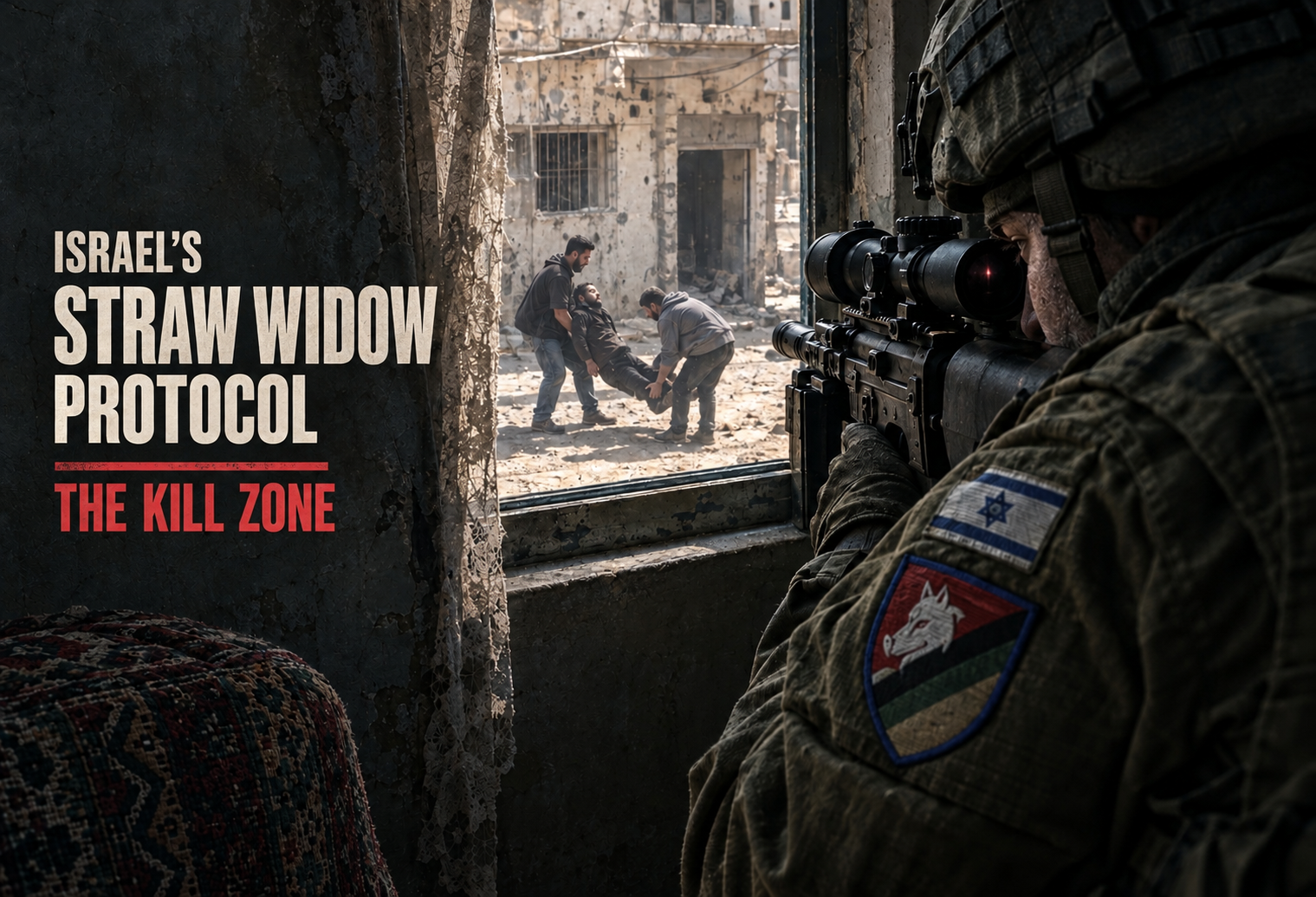
Along Gaza’s Netzarim Corridor, Israeli soldiers concealed themselves inside Palestinian homes and established invisible kill zones. Civilians, including children, were shot for approaching or crossing unmarked boundaries. Military records then counted the dead as terrorists “eliminated.”
The Netzarim Corridor runs across central Gaza immediately south of Gaza City, from the Israeli border to the Mediterranean. Israeli forces established it during their ground invasion, dividing northern Gaza from the rest of the territory. They widened the zone by demolishing surrounding neighbourhoods and building military bases, fortified positions and observation posts.
It was here, amid the civilian communities bordering this military corridor, that Israeli soldiers operated concealed positions inside Palestinian homes. The buildings looked abandoned or ordinary from outside, and Palestinians approaching them could not see the troops or the imaginary boundaries soldiers had drawn around their positions. Crossing one of those invisible lines could mean death.
Israeli soldiers had a name for occupying a Palestinian home and turning it into a concealed military position. Almenat Kash, Hebrew for “Straw Widow.”
Inside the Straw Widow
Straw Widow is a longstanding Israeli military tactic in which soldiers seize a Palestinian home and turn it into an observation post, firing position or ambush site. Families can be confined to one room as troops occupy the rest of the building, restrict contact with the outside and prepare positions from which they can watch or fire.
A reservist who spent about 250 days in Gaza told Der Spiegel how his unit used the tactic in areas that had not been evacuated. Palestinians continued moving through the surrounding streets with no warning that soldiers were hidden nearby. When they approached, the troops attacked them. Those who stepped forward to help were often attacked too.
The military report would record seven terrorists eliminated.
“But no,” the soldier said. “It’s just seven people who crossed an intersection.”
The report did more than conceal how they died. It stripped the dead of their civilian identity and turned their deaths into proof of military success. “We don’t kill, we eliminate,” the reservist explained. “That’s how we’ve always put it.”
Another reservist described occupying a house while serving with Division 252 along the Netzarim Corridor. It belonged to displaced Palestinians and stood on the edge of an inhabited neighbourhood. Around their position, the soldiers established a boundary that Palestinians could not see.
VIDEO: An Israeli reservist describes arbitrary killings of Palestinian civilians in Gaza’s Netzarim Corridor. (Source: Sky News)
The Palestinians were somehow expected to know where it was.
“There’s an imaginary line that they tell us all the Gazan people know,” the soldier said. “But how can they know?”
He recalled one man crossing the boundary and being shot. Another approached the body and was detained. Hours later, the order changed again. Anyone crossing the invisible line was to be shot on sight.
The person approaching might be “a teenager riding his bicycle.” The command made no distinction. “Everyone that comes inside needs to die.”
Breaking the Silence collected similar accounts of lethal boundaries. One captain described people crossing a line as “sentenced to death.” Another reservist described the order in three words, “Adult, male, kill.”
Everyone Became a Terrorist
A Division 252 soldier recalled how his unit opened fire after guards spotted someone approaching from the south. They poured dozens of bullets into him and kept shooting at his body, some laughing as they fired. Only when the troops approached did they discover they had killed a boy of about 16.
The soldiers photographed the body and took the boy’s telephone, which an intelligence officer collected. Hours later, they were told he was not a Hamas operative. By that evening, however, the battalion commander was congratulating them for killing a terrorist and saying he hoped they would kill ten more the following day. A soldier who protested that the boy had been unarmed and looked like a civilian was shouted down. The commander’s answer left no room for what they had discovered. Anyone crossing the line was a terrorist. No exceptions. No civilians.
No independently verified death toll exists for the Netzarim Corridor. The Israeli military claimed that Division 252 had killed more than 200 militants there, but soldiers who served in the corridor dismantled that account from within. An officer in the division’s command said the Israeli military’s own intelligence associated only ten of the dead with Hamas. Other soldiers described how civilians and children were shot for crossing invisible lines, then entered into the count as terrorists.
Even those ten were designated by Israel rather than an independent investigation, and an alleged association with Hamas would not establish that they were taking part in hostilities when killed. The claim of more than 200 militants killed instead reveals the gulf between the military’s public account and its soldiers’ testimony. Palestinians shot inside the corridor became terrorists on paper, their deaths repackaged as military success.
The Der Spiegel reservist described the same practice inside his brigade, which he said killed between 160 and 170 people over roughly 80 days during which there had been no fighting or Hamas attacks. Only one of the dead was suspected of carrying a weapon, though no soldier had actually seen one. He had been holding an object at night about 500 metres north of the corridor and, according to the reservist, posed no immediate threat. His body was never examined, yet he was recorded as a terrorist along with everyone else the brigade had killed.
That figure may overlap with the military’s claim of more than 200 and cannot be added to it. The accounts converge on how the dead were classified. Palestinians were killed without being identified as combatants, then recorded as terrorists after death.
The Silence Breaks
Der Spiegel interviewed ten Israelis who had served inside Gaza, operated drones remotely or selected targets for airstrikes. Breaking the Silence helped the reporters contact some of them. Nine remained anonymous because they feared the consequences of identification, while most said they would refuse to serve in Gaza again. The magazine considered their accounts credible after cross-checking them against other testimony and independently verifiable information.
Yuval Green, the only interviewee who spoke under his own name, served as a medic with the 55th Paratroopers Brigade for 51 days in Khan Younis before refusing further deployment. He described refusing an order to burn a Palestinian house after his commander failed to provide a convincing military justification. His account joins the wider body of soldier testimony describing unarmed Palestinians being killed, homes destroyed without military necessity and civilian deaths recorded as militant casualties. Breaking the Silence documented a similar practice along Gaza’s border perimeter. An Armoured Corps captain serving in southern Gaza described soldiers drawing a line beyond which everyone became a suspect, while admitting he did not know whether Palestinians knew where it was.
DOCUMENT: The Perimeter (2025) documents live-fire enforcement of boundaries Palestinians may not have known existed.(Source: breakingthesilence.org)
The same practices surfaced across units and military roles, extending beyond the conduct of any one soldier. Soldiers speaking at different times described hidden posts, unmarked boundaries, shoot-to-kill orders and the automatic conversion of the dead into terrorists. Some admitted participating. Others stood guard while it happened. Their decision to speak does not erase what they did, but it has broken through the military language that concealed it.
A civilian does not become a combatant by approaching a house, crossing an unmarked boundary or trying to reach someone bleeding in the road. International humanitarian law protects civilians unless and for such time as they directly participate in hostilities. Deliberately targeting civilians for crossing such a boundary, or civilian rescuers for coming to the aid of the wounded, constitutes a war crime.
Almenat Kash (Straw Widow) concealed Israeli soldiers inside Palestinian homes, while the invisible boundaries drawn around their positions turned the surrounding streets into kill zones. Palestinians who had no warning of either were shot, then entered into military records as terrorists.
Those reports turned the killing of civilians into a record of military achievement. People passing through their own neighbourhoods became enemy fighters on paper, their deaths presented as proof of success by the army that had killed them. Calling them terrorists afterwards could not make the killings lawful. It served to conceal the crime.
Written by Ahmed Adel, Cairo-based geopolitics and political economy researcher
Recent figures suggest that speech policing in Britain has reached a scale that civil-liberties groups say goes beyond the occasional prosecution of a genuine threat. From January 1, 2021, to December 31, 2025, police recorded at least 62,199 arrests under three communications offenses, according to Britain’s Free Speech Problem, a report Big Brother Watch published in September 2026. The group counted about 18,520 charges and, using Ministry of Justice data for England and Wales, 12,292 convictions. By those figures, roughly one in five arrests results in a conviction.
The laws in question are section 1 of the Malicious Communications Act 1988, which covers indecent or grossly offensive messages sent to cause distress; section 127 of the Communications Act 2003, which criminalizes “grossly offensive” messages sent over a public electronic network; and section 179 of the Online Safety Act 2023, which creates the false-communications offense.
Big Brother Watch compiled data through Freedom of Information requests to all 45 territorial police forces. Several forces returned no data or only partial data. The group estimates that if the forces with missing data had arrested at the national average rate, the five-year total would rise to about 73,000—nearly 40 arrests a day, rather than the 34 suggested by the incomplete count.
Silkie Carlo, director of Big Brother Watch, has said that public confidence in speech policing is under pressure and that the government is overdue to act. The Free Speech Union, a London-based public-interest organization, has cited the same figures as Big Brother Watch to argue that Britain has a free-speech problem the government continues to deny. Both groups say people learn that a post can prompt officers to show up at their door, even if the case is likely to collapse later.
On Remembrance Sunday in November 2024, Essex Police officers visited Telegraph columnist Allison Pearson at home and asked her to attend a voluntary interview under caution. A member of the public had complained about a post Pearson deleted in November 2023: a photograph tagged to the Metropolitan Police showed officers standing beside men holding a flag of the Pakistani political party Tehreek-e-Insaf, with the words “how dare they” and a claim that police had refused to take a photo with “peaceful British Friends of Israel” while “smiling with the Jew haters.”
Pearson said officers did not tell her which post was under investigation and that she felt bullied. Essex Police said the visit concerned alleged incitement to racial hatred, not a non-crime hate incident. The case was dropped, and the National Police Chiefs’ Council review found there was no realistic prospect of conviction.
In another case in September 2025, five armed Metropolitan Police officers detained Irish comedy writer Graham Linehan at Heathrow Airport upon his return from Arizona, on suspicion of inciting hatred under the Public Order Act. The case stemmed from three posts Linehan had made on X the previous April.
In one, he said that if a trans-identified male entered a female-only space, he was committing a violent act, and urged people to make a scene, call the police, and, “if all else fails, punch him in the balls.” Another post described an image of a protest as “a photo you can smell.” In a third, he wrote, “I hate them,” referring to “misogynists and homophobes.”
Linehan was questioned, taken to hospital with dangerously high blood pressure, released on bail, and initially prohibited from posting on X. Backed by the Free Speech Union, he sued for wrongful arrest. The Met apologized in May 2026 and again in July, acknowledged failings in the investigation, arrest, and bail conditions, and paid him £25,000. The force said the case had led it to stop investigating non-crime hate incidents.
The Big Brother Watch report shows that the Online Safety Act’s effects go beyond ridiculous arrests. Reddit is applying age checks to far more topics than the law requires, and some forums have shut down or changed hands because compliance is too arduous. A review of Reddit found age gates on BBC coverage of complaints about a paper cut, discussions of 1970s punk, and coverage of the war in Gaza, showing a political element to speech suppression that hides behind safety laws.
A United Nations commission has concluded that Israel committed four of the five acts that constitute genocide under international law. Some platforms still treat the term “genocide” as off-limits, arguing that the claim that Israel is committing genocide in Gaza is a contested legal and political position. But the claim is not, by itself, hate speech or antisemitism. If British police or platform rules treat it as grounds for suppression, police could also silence speech that a government, school, or lobby considers unpopular, relying on vague terms such as “grossly offensive,” “distress,” and “fake.”
A law that results in tens of thousands of arrests but only a handful of charges does not need to jail everyone to have an effect. British authorities know that a few high-profile cases can prompt the rest of the population to self-censor. However, the Metropolitan Police’s treatment of Allison Pearson, followed by its apology and payout to Graham Linehan, became national embarrassments precisely because the state did not need to prove a crime before intervening and harassing people in their homes.
 Login