The European Parliament overwhelmingly supported an increased budget and scope for the Erasmus+ student-exchange programme under the new EU budget on Thursday (22 October).
The plenary in Strasbourg opted for a €7bn increase in Erasmus+’s budget compared to the commission’s proposal, by 454 votes, with 34 abstentions, against 93, mostly from right-wing parties.
And it was an audacious move, seeing as ‘frugal’ EU capitals are pushing for €150bn of cuts to the commission’s draft.
But even a “slight increase” in Erasmus+ funds would mean more opportunities for thousands of people, said Bogdan Zdrojewski, a Polish centre-right MEP, who was the rapporteur on the file, during a parliamentary debate earlier on Wednesday.
Celebrating its 40th anniversary in 2027, Erasmus+ enables young people to study, live, and work in foreign countries both inside the 27 EU states and the programme’s 160 “associate” states worldwide.
Some 17 million people have taken part since it began, with an estimated 1 million babies also born to couples who met on exchange, in what the commission has long used as a flagship PR project for creating a feel-good factor about the EU.
Meanwhile, the UK will rejoin the programme in 2027, which means EU students will once more have the opportunity to also spend a semester in Britain, which hosts some of Europe’s and the world’s top universities.
And the parliament would also welcome Canada’s full participation in a few years’ time, Zdrojewski told press on Wednesday.
The EU Parliament would like to expand Erasmus+ to more vocational training. “Erasmus+ will be a programme for Europeans no matter what age, what stage of life,” Zdrojewski said.
And students from poorer homes should get more support to live in pricey cities abroad, he added.
The share of Erasmus+ participants who had fewer opportunities to travel under the present structure stood at 15 percent in 2023 – up from 10 percent only two years earlier, according to a commission evaluation.
“Far too often, it is still the parents’ financial situation that determines who can take part in Erasmus+ and who cannot,” said Sabrina Repp, a German socialist MEP, in Wednesday’s debate in Strasbourg.
Working students often cannot afford to quit their current job to go abroad, she added: “That is precisely what we must change.”
The EU budget talks are to be finalised early next year.
Some 83 percent of Erasmus+ participants say they gained professional skills that helped them in the labour market.
But in order for those opportunities to be available more widely, “we need more funding for this programme,” also said Lucia Yar, a Slovak liberal MEP in the Strasbourg debate.
On November 3, the U.S. Supreme Court will hear oral arguments in a case that asks whether Colorado has unlawfully discriminated against a religious preschool because the school is barred from participating in the state's universal preschool program due to its refusal to accept LGBTQ families. In addition to involving multiple hot-button political and cultural issues, the case also has big implications for the future of federal antidiscrimination law.
St. Mary Catholic Parish v. Roy is not about a state law that directly prohibits a religious preschool from operating. Rather, at issue here is a government requirement that any preschool that wants to participate in the state's universal preschool program, and receive the public benefits that follow, must first satisfy various criteria, including that "each preschool provider provide eligible children an equal opportunity to enroll and receive preschool services regardless of race, ethnicity, religious affiliation, sexual orientation, gender identity, lack of housing, income level, or disability."
According to the Catholic preschools overseen by the Archdiocese of Denver, however, complying with that rule would force the schools to violate their religious beliefs. "It is undisputed that these preschools would otherwise be eligible [universal preschool] providers," the schools told the Supreme Court. "They are excluded solely because of their religious exercise—namely, their religious practices of ensuring that all enrolling families are supportive of the Catholic Church's teachings on sex and marriage and of treating enrolled four-year-olds in accordance with their biological sex."
These schools can point to a pair of recent Supreme Court precedents that will very likely count in their favor. In Espinoza v. Montana Department of Revenue (2020), the Court held that if a state provides educational subsidies that help parents send their children to private schools, the state "cannot disqualify some private schools solely because they are religious." Then, in Carson v. Makin (2022), the Court held that Maine's tuition assistance program violated the Constitution by excluding private schools that offered "sectarian" education. "A State's antiestablishment interest," the decision said, "does not justify enactments that exclude some members of the community from an otherwise generally available public benefit because of their religious exercise."
I would expect the outcome of St. Mary Catholic Parish v. Roy to follow in this same general pattern and hold something to the effect that when a state provides an educational public benefit, it must make some sort of accommodation for the religious views of the recipients.
In Other Legal News
Justice Elena Kagan made news a few months back when she defended her conservative colleagues on the Supreme Court from the oft-heard charge that they are totally in the tank for President Donald Trump. "I don't see this as a court that is just like, 'We're just going to rubber stamp what the current administration does.' You know, quite the opposite," Kagan said. "I think that that is a bad rap." In support of her argument, Kagan pointed to the fact that the Supreme Court had recently ruled against Trump on the two big issues that Trump himself valued the most: tariffs and birthright citizenship.
Kagan was in the news again on Tuesday, this time because she publicly blasted those same conservative colleagues for issuing decisions on voting rights and political gerrymandering that, in Kagan's words, have produced "a democracy that does not work as well as it should." According to Kagan, the Court's conservative majority "has kind of blinded itself to the very deleterious effects of their rulings on how the political system works."
Does this mean that Kagan has now stopped defending the conservative justices from the pro-Trump charge? Not at all. In fact, as The New York Timesput it, "she reiterated her defense of the conservative-dominated bench from a July appearance and said it was a 'bum rap' to suggest the court had been too deferential to Mr. Trump."
I don't know about you, but I find Kagan to be a refreshing public figure in these simplistic, partisan times. She is a staunch legal liberal with clearly stated objections to what the Supreme Court's conservative majority is getting up to, yet she refuses to be associated with the laziest progressive attacks on the Court. How many people of comparable public stature these days are willing to call out the shortcomings of their own side?
Schoolchildren in the 4th and 6th years (mainly from ages 9-11) “have a lot of difficulty in understanding and producing texts in Portuguese, and also in reasoning and the resolution
Becky Drury, who was said to have shielded a student during a deadly shooting in Bend, refuted the account. “The truth is I was shot before I had any chance to act.”
In this segment of Free Media, Reason Senior Editor Robby Soave and Daily Caller Editor in Chief Amber Duke discuss the ongoing violent protests in France.
If you enjoy Free Media, come watch Robby debate at our upcoming Reason Versus in D.C. Tickets are available here.
Questioning the prevailing narrative about the "Cornell seven" case is bound to create controversy. And at Columbia University, two student journalists drew condemnation for their views on the case from the unlikeliest of places: a college free speech group.
On October 13, Barnard junior Christina Ma and Columbia junior Nikos Mohammadi published an article called "The 'Cornell Seven' Is Really About Liberalism" in the Columbia Sundial, an independent student publication. The piece argued that the discourse surrounding the alleged rape at Cornell University infantilizes women by omitting the possibility that in a post–sexual revolution, liberal society, women may make regrettable but consensual choices.
"In the world that, for better or worse, follows from it, we cannot claim to stand for sexual freedom and then recoil in disgust when there's a possibility that a young woman simply chose to exercise it," Mohammadi and Ma wrote.
The piece also argues that the "collective frenzy" over the Cornell case has created a climate on campus that makes it "difficult to disagree with the maximalist position on what happened" the night of the alleged rape.
As Mohammadi wrote in UnHerd, the piece caused immense backlash. He said he received an onslaught of messages urging him to commit suicide and demanding that his "career and life be destroyed." But the criticism went beyond threatening DMs and comments.
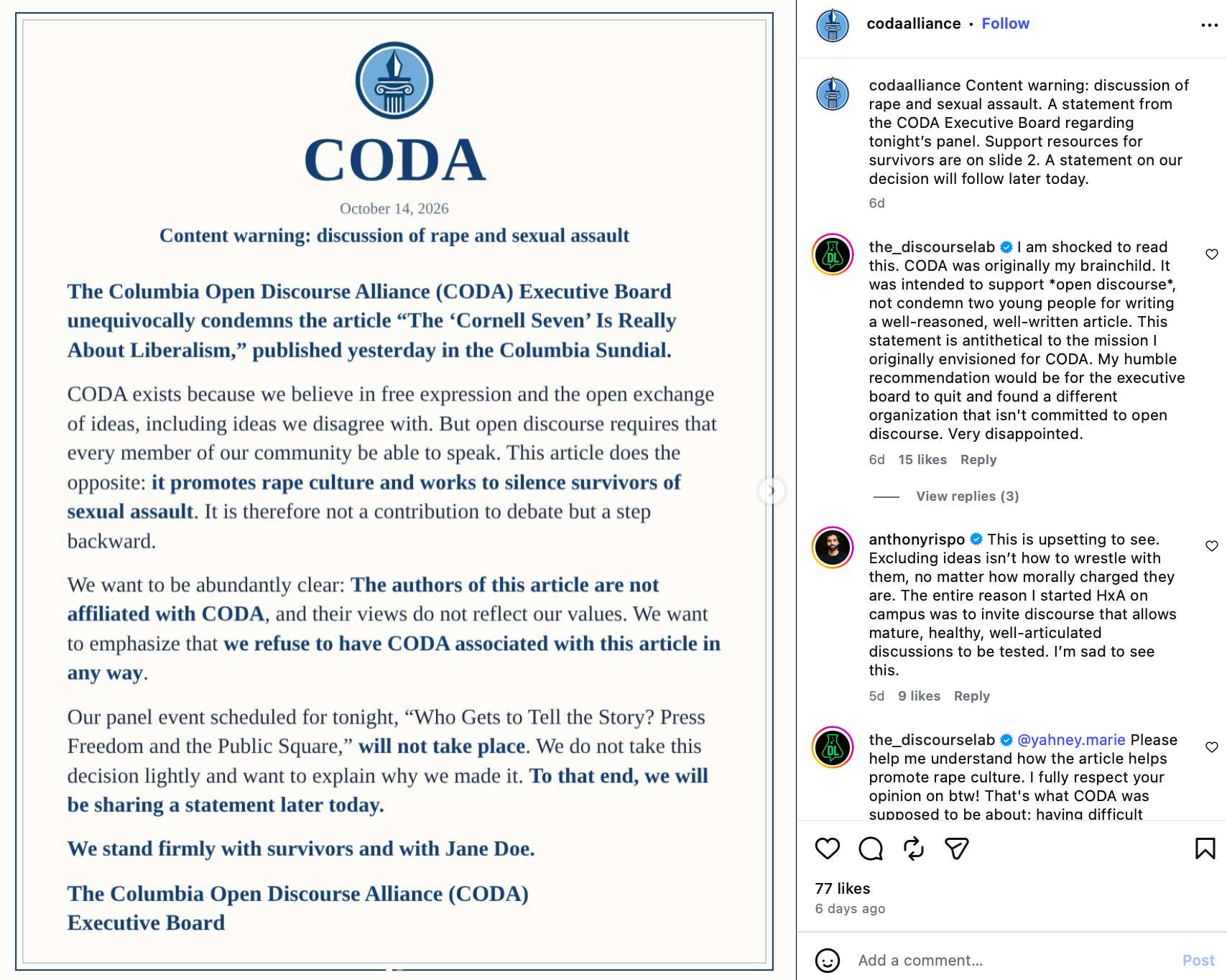
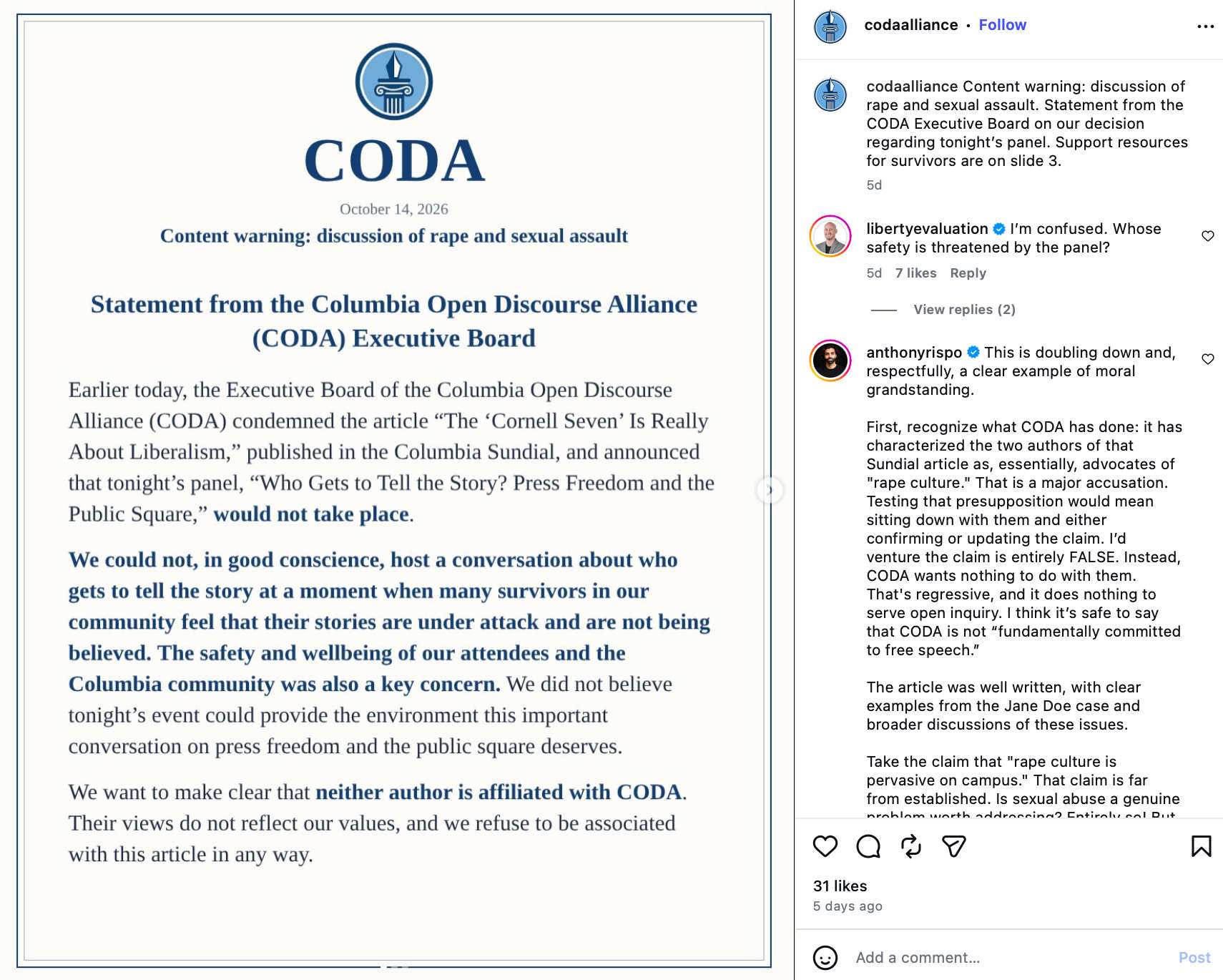
The day after the article's publication, the Columbia Open Discourse Alliance (CODA) canceled an event about press freedom because the Sundial's editor in chief, Nick Baum, had been slated to speak at the event. Although Baum did not author the piece, CODA wrote in an Instagram post that the free speech group "refused" to be affiliated with the Sundial's article "in any way."
CODA also claimed that the event, ironically called "Who Gets to Tell the Story? Press Freedom and the Public Square," could not take place at a time when "many survivors in our community feel that their stories are under attack and are not being believed."
The group added that the Sundial's article "promotes rape culture and works to silence survivors of sexual assault."
The group's president, Aum Desai, told Columbia's student newspaper, the Columbia Daily Spectator, that the group canceled the event "not in spite of, but because of [CODA's] commitment to free expression."
Columbia graduate Clayton Smith, who founded CODA in 2025, quickly commented that he was "shocked" by CODA's statements on Instagram. Smith started the organization to create a central hub for groups hosting events promoting free speech and open discourse, including the Sundial and Columbia's Heterodox Academy chapter.
He tells Reason that CODA's rationale for canceling the event was "ironic" and "hypocritical," and he believes the group should have collaborated with the Sundial if there were legitimate safety concerns at the event. He says he was particularly disturbed by the group's condemnation of the article and CODA's claim that it promotes "rape culture."
"They don't argue or explain how it works to silence survivors of sexual assault. It is a baseless slander that they use to condemn the article because it promoted an opinion they do not like," Smith says.
Smith says he spoke to Desai on the phone after CODA posted the statements, and Desai tried to reassure him that CODA would uphold the principle of free speech. But Smith says he did not leave the phone call feeling "very confident at all" in Desai's commitment.
Desai did not respond to Reason's requests for comment.
CODA faculty adviser and Columbia Business School professor emeritus Eli Noam was traveling in China during the fallout from the Sundial article and was not involved in CODA's decision.
After speaking with members of both CODA and the Sundial, Noam tells Reason that he thinks CODA "made some proper decisions, some correct decisions, and some mistakes."
"I think we're dealing here with…a group of college students who kind of were confronted with a crisis at 2 a.m.," Noam says. "And kind of [made] some judgments that they now regret, and they do."
He tells Reason that it was not "unreasonable to assume there would be a disruption" at the event, given the climate at Columbia and "about this rape allegation." He says the group suddenly "had an event where they needed college security" and could not organize in time. CODA, Noam says, is not yet recognized by the university, and he thinks the group was likely fearful of jeopardizing its recognition.
Still, Noam says CODA's statements condemning the article were "unreasonable," and it was "disappointing that they kind of lost their nerve here."
Although he was not involved in planning the panel, Mohammadi says, to his knowledge, there were no credible threats of violence to the panel. He understood there may have been "disgruntled students" and an "environment CODA did not want to deal with." But instead of simply canceling the event or working with the Sundial to find a solution, Mohammadi says CODA overstepped by condemning the Sundial piece.
James Applegate, an astronomy professor who serves on Columbia's Academic Freedom Council (CAFC) alongside Noam, tells Reason that he disagreed with CODA's decision to cancel the event.
Applegate tells Reason he was considering attending the event, and he was "rather surprised and disappointed" when it was canceled.
He recalled that when he was a professor in 2000, he objected to changes to the school's sexual misconduct policy on the University Senate floor. He says his statements were "similar to what was said in the Sundial article" and there was a "level of emotion in this debate."
"Nonetheless, we had the debate. I was in it, and the degree to which it was civil is shocking when you look at where we are now. And it's sad."
Applegate said he does not condemn CODA, however, "for the simple reason that the atmosphere on college campuses and on the left wing of politics in general in the United States is quite vicious."
CODA's honorary faculty fellow John McWhorter tells Reason he interpreted CODA's statement as "saying that an event about who gets to tell the story is untenable when or if a critical mass of people with such stories don't even feel comfortable telling them— i.e.being a participant in the event." He added, "I imagine some might think of that as cutting the salami a little thin, but then I highly suspect that Desai is equally worried about the event becoming a physical melee of some kind. In that, let's face it, he is hardly unreasonable."
Still, McWhorter said that he would have chosen to have the event himself, "especially as in the likely case that some people did talk about their experiences without any particular repercussions, it may have made the more reluctant people less apprehensive about doing so in the future."
According to Mohammadi, as of Tuesday, the Sundial, College Republicans, Platypus Affiliated Society at Columbia (which discusses leftist thought and history), and Columbia's Heterodox Academy chapter have left CODA.
CODA was not the only group to condemn the Sundial's piece. On October 14, the Columbia Political Review's editorial board wrote that Mohammadi and Ma's piece "violates standards of integrity" and "perpetuates a culture of campus violence, rape, and assault." The editorial board of the Columbia Political Review, which purports to publish "multipartisan political discourse," stated that it would refuse to publish "any article that upholds or recreates cultures and systems of rape, sexual assault, or violence" and it urged "all campus publications to do the same."
And on Monday, Columbia's main newspaper, the Spectator, published a staff editorial accusing the Sundial of violating journalistic ethics by "its page to disparage survivors of sexual violence."
Mohammadi tells Reason the piece underwent "far more editorial scrutiny than any other piece" the Sundial had published given the sensitive nature of the topic.
Free speech student organizations are necessary on Columbia's campus, especially as the school's free speech climate continues to crumble; it recently received a failing grade from the Foundation for Individual Rights and Expression. And while upholding free speech principles may have become more fashionable among those resisting the Trump administration's pressures on academic freedom or those defending pro-Palestinian speech, it is clear that some topics remain taboo in the public square. College is supposed to be a place where students debate controversial topics, form their own beliefs and opinions, and learn from mistakes. Hopefully, the students who demanded condemnation instead of debate will be forgiven for their perversion of free speech ideals, and they will learn to afford such grace and open-mindedness to classmates with whom they disagree.
The lack of teachers (particularly in areas where rents are at their highest: viz. Lisbon/ Algarve) has led municipalities to start thinking outside the box. Two town halls (Grândola and
On Monday, the Supreme Court agreed to hearAssociation for Education Fairness v. Montgomery County Board of Education. The case, which was originally brought forth in 2020 by the Association for Education Fairness (AFEF), a coalition of Montgomery County, Maryland, parents, alleges that Montgomery County's selection process for magnet programs (gifted programs for STEM and humanities studies in middle schools) violates the Constitution'sEqual Protection Clause by discriminating against Asian American students. The county insists that the selection process is race-neutral.
Montgomery County changed its selection process in the 2021–22 school year. According to reporting from The New York Times, the county was facing pressure from community groups, including the NAACP and Citizens Assisting and Sheltering the Abused (CASA Inc.), over the underrepresentation of black and Latino students in its magnet programs. Previously, students were selected based on test scores and grades. The new process implemented a lottery system in which high-achieving students are placed in a selection pool and selected at random.
The AFEF's central complaint is that the new system factors school poverty levels into the criteria for pool eligibility. This means students' eligibility depends on their scores relative to students in similarly affluent or disadvantaged schools, rather than the general population. They argue that since Asian Americans are concentrated in high-performing, lower-poverty schools, they have to clear a higher bar to become eligible. The group alleges the new system has caused fewer Asian American students to be admitted into magnet schools, a claim that is backed up by admissions data (which also show that the share of Asian American applications has fallen). The AFEF alsocites Montgomery County's 2015 hiring of Metis, a national consulting firm, to recommend ways to make the system more "equitable" as an indication of the county's effort to "racially balance" its magnet programs.
The complaint was dismissed by U.S. District Judge Paula Xinis in 2022, whoruled that the parents hadn't shown the policy disproportionately harmed Asian American students, citing the fact that they made up a larger share of admitted students than of the applicant pool. Xinis drew a distinction between accounting for economic disparities, which she called "wholly permissible," and racial discrimination. "Alleged disparity in treatment based on socioeconomic status alone does not make plausible discrimination on account of race," she wrote in the ruling. The tension raised by Xinis sits at the center of many debates regarding diversity, equity, and inclusion, as factors like poverty levels can often become a proxy for race; therefore, policies that are neutral on their face can still disparately impact a certain race.
In February, the 4th Circuit Court of Appealsupheld the dismissal, ruling that precedent from the Coalition for TJ v. Fairfax County School Board (2023) requires parents to show the policy disproportionately harmed Asian American applicants, which they hadn't. However, there is a real legal question as to whether racial groups should have to prove they were harmed as a group, as opposed to the individual, and lower courts have given mixed answers.
The Pacific Legal Foundation (PLF), a public-interest law firm representing the AFEF, litigated asimilar case in New York City, where the city implemented an economic need index in its admissions process for competitive high schools, aimed at increasing the number of black and Hispanic students. Again, parents alleged that the requirement discriminated against Asian American students. In 2024, the 2nd Circuit Court of Appeals found that if the city intended to discriminate, the parents don't have to prove Asian Americans were harmed as a group and that harm to an individual was enough for the case to move forward. The case was sent back to the district court to determine whether the city intended to discriminate, where it remains pending.
The Supreme Court will now settle the issue anddetermine "whether a plaintiff challenging a facially neutral admissions policy as racially discriminatory must establish that the targeted racial group suffered an aggregate disparate impact relative to its share of the applicant pool," according to SCOTUSBlog.
In a statement on Monday, PLF Senior Attorney Chris Kieser said, "The Constitution protects students as individuals, not as members of a racial group. A school district should not be able to defeat a discrimination claim by showing that its policy did not harm enough Asian American children. Every family deserves admissions rules that judge their child on their own merit."
The removal of asbestos from the former Cascais secondary school has resumed, but continues to face criticism. Cascais City Council says it complies with all safety rules when removing this
Hello and welcome to another edition of Free Agent! Be careful when you're behind the wheel this week.
College football is great! Surely you want even more of it, right? We'll get into the problems with a 24-team College Football Playoff (CFP), then talk about the NBA's new betting restrictions, and close with thoughts about President Donald Trump's new government golf course plans. And just in case you don't make it to the end, here's a shortcut to our survey on who you're rooting for in the World Series.
But first, many congratulations to "Gary's 1st Entry" on outlasting everyone else in our NFL Survivor group. There's no prize other than this shoutout, so be sure to print out today's newsletter, highlight this paragraph, and frame it in gold. Perhaps Gary can keep going and challenge Primetime Paulie Rothrock's 13-game winning streak from last season.
Locker Room Links
Both teams in the WNBA Finals left the court for the National Anthem—unclear if this was a protest or just part of the pregame routine. WNBA policy doesn't require teams to be on the court for the anthem, but does require a "dignified posture" if they are.
In the thick of a playoff race, three Zambian women's soccer players are separated from their National Women's Soccer League teams because they played in Uganda, and the Centers for Disease Control and Prevention has a three-week restriction on reentry due to Ebola. (There are zero active Ebola cases in Uganda and Zambia.)
This is the kind of excessively nerdy fantasy football content I live for. (Yahoo remains the best fantasy sports system. ESPN's is trash, relying on name recognition to get by.)
I figured out how ESPN calculates fantasy football win percentage, it's bad!
ESPN made a stats 101 error when calculating their win percentage which leads to horribly miscalibrated numbers. ( thread) pic.twitter.com/bDypgjelKj
Saturday was one of the best days of college football ever—or perhaps it could have been, if we thought any of the five top-10 teams who took a loss were now certainly out of playoff contention. Instead, Georgia, Notre Dame, Indiana, Alabama, and Texas are all still very much alive in the championship hunt.
Today was one of the craziest days in college football history:
- First time ever five teams ranked in the top 7 lose in a single week - First time the No. 1-ranked team loses to an unranked team in consecutive weeks since 1990 - First time Texas, Alabama, and Georgia all lose… pic.twitter.com/psVRoM5s5b
With two losses, Alabama and Texas are at least on the edge of the playoff bubble with perhaps no more room for error. But that's only true under this year's CFP format. Next year, the playoff is almost officially set to balloon to 24 teams, making the chaos of a day like Saturday matter even less.
Fans will always celebrate a huge upset or major rivalry win, of course—Tennessee fans don't need playoff stakes as an excuse to get drunk when they beat Alabama. But the joy of a rivalry win in the past was always bigger because of the off-field stakes, too—the first loss for your rival meant they probably wouldn't be national champions, the second meant they'd be out of the Rose Bowl, a third meant you could be proud your team sent them packing for the Alamo Bowl. Winning is great; ruining your rival's season is even better.
With 24 teams in the playoff, the joy is a bit diminished because it will take four or possibly five losses to knock a powerhouse program out of the CFP (Iowa, at 8–4, was ranked 23rd by the committee before last year's playoffs). It'll be a bit like a rivalry win in college basketball—we win, you suck, congrats on getting a slightly worse NCAA Tournament seed.
In the business of sports, more inventory for TV is king, and the powers that be think more teams playing more playoff games will make more money. At Free Agent, we don't begrudge institutions for trying to make more money—we all do the same every day. But it's not clear abandoning conference championship games will be the answer, especially when the Big Ten and SEC championships apparently outdraw many playoff games.
ESPN and the power conferences know fans aren't happy about it—just look at allthechatteronline, and how the crowd at BYU reacted when College GameDay discussed expansion on Saturday (especially when BYU would probably benefit from expansion!). They're betting enough people will watch to make the expansion profitable anyway. The last hope is that fans get loud enough to bully them into abandoning expansion—which only occasionally works, sometimes on things small (putting the trophy logo on the court for the NBA Finals) and large (soccer's European Super League). If any powerhouse considers going independent, that might shock leaders into a rethink too.
Almost every sport I know is adding more: more teams, bigger playoffs, more for TV. As fans, we still eat it up, of course—much to the excitement of the TV executives who are selling commercial time to the people trying to reach us, the viewing public. (The only counterexample is the MLB proposal to cut eight games from the regular season—I'd love to see each sport I follow cut its season by about 25 percent to make regular season games matter more, so I'm interested to see how this goes.)
Perhaps I'm biased because my favorite team, Michigan State, is a dumpster fire—they could expand the playoff to 64 teams and the Spartans still wouldn't deserve a bid. I personally don't have a whole lot at stake in the playoff format now or anytime soon. But as a neutral, the chaos of Saturday might have been viewed with my full attention in the past—instead, this year I just had it on in the background while I played video games.
Sports Are Regulating Bets Without Politicians, Part 3
After last year's major betting scandal, the NBA asked sportsbooks late last week to stop offering certain types of potentially problematic bets. The sportsbooks, which the NBA says handle roughly 99 percent of the U.S. betting market, agreed. No politician or regulation was necessary to solve the problem.
No longer can bettors bet on unders for a bit player who likely won't get more than 12 minutes of playtime. Bettors also can't wager on the opening tip or on players to miss specific shots. Parlays that string together under bets on the same player's statistics are also out (this one seems a bit harsh—if you just want to bet on a certain major player to have an off night, you can bet on stats separately, but not in a big multiplier parlay). Bets on players who have two-way contracts between the NBA and G League were already banned.
This all comes on the heels of similar developments last year in the NFL and MLB. While some people want to ban prop bets altogether, the NFL asked sportsbooks to eliminate bets in four different categories. Sportsbooks largely agreed or weren't offering those bets anyway. MLB, in light of some pitching-related scandals, asked for a $200 limit on pitch-specific bets and to keep them out of parlays—sportsbooks agreed to that too.
As I wrote last year, "Ideally, this is how the regulation of the sports betting industry should go….These approaches are catching the nuances of what works for both the leagues and for sportsbooks without the heavy-handed approaches of politicians who would use an axe to ban all prop bets instead of a scalpel to limit problematic bets."
It's important to note leagues are able to do this because they have commercial partnerships with the sportsbooks. Otherwise, the leagues would have no direct leverage over a sportsbook offering a bet the league doesn't like. Keep that in mind the next time you see people bemoaning a league partnership with a sportsbook or a prediction market.
Trump's Golf Course Plans Have People Teed Off
President Donald Trump has new plans for the National Park Service golf course at East Potomac—again. Last time new plans were announced, the site plan still had its historic miniature golf course, a par-3 course, and the existing road still ringing the property for bicycling, running, etc. Much of the public didn't like that plan anyway—now, none of that remains in the latest plans, just 18 holes of golf and a driving range.
What's really going on here seems quite clear to me: Like so many other things going on in the second Trump administration, this is a scheme to enrich the Trump family. The plan?
Step 2: Use taxpayer dollars to pay for renovation of the course into, allegedly, a championship-level course capable of hosting major golf tournaments (no matter that the area has next to zero parking, is a mile from the nearest Metro station, and only accessible by narrow roads not meant to handle tens of thousands of spectators).
Step 3: Have the federal government sign a sweetheart deal with, who else, the golf division of the Trump Organization to operate the course on extremely favorable and profitable terms.
If you're wondering why the Trump administration is doing something, corruption is usually a good guess.
The arguments for the course don't make much sense. There are plenty of adequate, competitively priced golf courses in the broader Washington, D.C., area. Several of them are already capable of hosting professional golf tournaments. Between LIV Golf and the PGA Tour, there were three tournaments at three different courses in the last couple years. The 2030 PGA Championship and 2037 Ryder Cup will happen just over the D.C. line in Bethesda, Maryland.
East Potomac is not the nicest course around, no thanks to the legal limbo it's been in for the past year. But if the National Park Service is going to, for some reason, be in the business of running a golf course, it should be a course that emphasizes and teaches its history instead of the pipe dream of a corrupt madman.
Who Ya Got? 2026 World Series Edition
For the first time in 46 years, we've got a World Series contested by two teams that have never won it before. Brewers against Rays is also a rare instance of the top seeds from each league outlasting the randomness of the MLB playoffs to make the World Series. And before you trot out the tired line that "TV executives must be seething about the small market teams" remember that they care much more about getting a playoff series that goes seven games with close results in each game (What did I say above? Inventory rules all!).
Today, the Supreme Court decided to hear Association for Education Fairness v. Montgomery County Board of Education, a challenge to "facially neutral" discrimination against Asian applicants to selective public magnet schools in Montgomery County, Maryland. The admissions criteria are, on their face, racially neutral. But evidence indicates they were likely adopted for the purpose of reducing the percentage of Asian students in entering classes. More specifically, the case addresses the issue of "[w]hether a plaintiff challenging a facially neutral admissions policy as racially discriminatory must establish that the targeted racial group suffered an aggregate disparate impact relative to its share of the applicant pool." This issue is increasingly important since the Supreme Court banned most explicit racial discrimination in college admissions (and, by extension, school admissions) in SFFA v. Harvard (2023).
The lower court ruled that, even if there is evidence that a facially neutral admissions policy was enacted for the specific purpose of reducing the number of admitted students from a specific racial or ethnic group, it must still be upheld so long as the percentage of admitted students from that group is as high or higher than the percentage of applicants from that group.
Longstanding Supreme Court precedent holds that evidence of unconstitutional motivation for "facially neutral" policies shifts the burden of proof to the government to show that they would have enacted the same policy even in the absence of illicit motives. If they fail to prove that, then the policy must be subjected to strict scrutiny, which it would be unlikely to survive. In the TJ case, the Fourth Circuit majority opinion by Judge Robert Bruce King holds that even the most blatant discriminatory motivations do not trigger strict scrutiny so long as the group being targeted for discrimination by "facially neutral" means is still represented in proportion to its percentage of the relevant population (or more). Under the new admissions policy, Asians were still 54% of accepted applicants (as compared to 73% under the old one). Since that is still higher than the Asian percentage of the applicant pool, evidence of discriminatory intent becomes irrelevant….
I and others have previously compared today's anti-Asian discrimination in selective educational institutions to discrimination against Jewish applicants in earlier eras. Under the Fourth Circuit's reasoning, old-time policies using facially neutral means to reduce the percentage of Jewish students at elite universities would be perfectly legal, so long as Jewish applicants were admitted in the same [or higher] percentages as other groups. And that would be true no matter how extensive the evidence that the new policy was motivated by anti-Semitic prejudices, or that Jewish applicants had to have stronger academic records to be admitted than those required of gentiles.
The same point applies to all kinds of discrimination against racial, ethnic, and religious minorities. So long as facially neutral means are used and the overall success rates of different groups are similar, this reasoning would allow even the most blatant discriminatorily motivated policies intended to reduce the participation of some groups for the benefit of others. There are many situations where members of some minority groups are "overrepresented" in educational institutions, government contracting, and elsewhere, relative to their percentage of the applicant pool or of the general population. Jews, Muslims, Asians, atheists, and Mormons are obvious examples of groups that fit that bill in a variety of educational and professional settings.
If a federal or state government adopted a seemingly neutral policy to try to reduce the percentage of blacks among professional football or basketball players, that too would pass muster, so long as the percentage of blacks in the the relevant pro sports leagues remained at least as high as the percentage of blacks among those seeking employment as players…. Progressives and others inclined to support today's decision should consider whether they are really willing to live with these troubling implications.
Since I wrote the above, the ideological valence of anti-Asian discrimination in education has shifted somewhat. For a long time, many left-wingers defended such discrimination (along with discrimination against white applicants) on the grounds that it is necessary to achieve "diversity" and compensate Blacks and Hispanics for the history of discrimination against those groups. Most conservatives condemned it because it violates principles of constitutional color-blindness.
During the second Trump Administration, however, right-wing nativists have increasingly defended discrimination against Asian immigrants on such ridiculous grounds as that they work too hard (thus making it too difficult for whites to compete with them), or even that they undermine the supposed value of racial "homogeneity." The political right actually has a long history of anti-Asian bigotry. But recently the problem has gotten much worse, after a period in which it was diminishing because conservatives (rightly) condemned such discrimination as a violation of color-blindness. The growing anti-Asian bigotry among right-wing nationalists is similar to and linked with their growing tendency towards anti-Semitism. Indeed, as many commentators have pointed out, the two prejudices are similar in many respects. Both Asians and Jews are condemned for supposedly working too hard, emphasizing academics too much relative to other activities, and supposedly dominating various business and intellectual fields.
The left-wing rationales for anti-Asian discrimination are little better than the right-wing ones. If you truly value diversity, it makes no sense to disfavor Asian applicants as a class. They add as much or more to diversity as any others. Indeed, as I have pointed out before, lumping all Asians in one category makes no sense, as this group includes a vast range of different ethnicities and cultures, covering more than half the world's population.
The compensatory justice rationale for anti-Asian discrimination collapses under the weight of the fact that many Asian groups have themselves faced extensive discrimination at various times in American history. Discrimination against Chinese and Japanese by federal and state governments has a long and sordid history, of which Japanese internment during World War II is just one particularly awful example.
It is important to recognize that "facially neutral" policies adopted for the specific purpose of excluding particular racial or ethnic groups differ from those that merely have an unintended disparate impact. The former are deliberate efforts to discriminate on the basis of race, whereas the latter are probably inevitable in a diverse society where groups differ from each other in various ways. For example, laws banning violent crime disproportionately affect any group which is, on average, younger than others, since young people (especially young men) have much higher crime rates than older ones.
The Constitution at least presumptively bars racial discrimination by government, whether motivated by left-wing objectives or right-wing ones. And such discrimination is forbidden even if cloaked in "facially neutral" garb. Otherwise, the government could easily discriminate against virtually any group simply by targeting some characteristic that correlates with group membership. Hopefully, the Supreme Court will recognize that and rule the right way in this case.
NOTE: The plaintiffs in this case are represented by the Pacific Legal Foundation, a public interest group that was my wife's employer until recently. As noted above, she helped represent the plaintiffs in a previous case (also litigated by PLF), on which the lower court ruling in this case was based. She is not one of the attorneys in this case, and is no longer with PLF.
Teachers will launch a 24-hour strike across Greece on Wednesday, October 21, protesting against staff shortages in schools, issues within educational infrastructure, excessive class sizes, and persistent inadequacies regarding school facilities in many parts of the country. The teachers will be supported in their strike by pupils and university students as well as left-wing parties, […]
Ontario government inspectors checked several career colleges that had experienced "concerning" growth in applications for the Ontario Student Assistance Program (OSAP), a government financial aid program that helps eligible students pay for post-secondary education. The investigators found problems that raised "serious concerns" at three Academy of Learning institutions, like signs that other people might have been doing students' schoolwork for them—for example, some students finished whole courses in a single day, or even just minutes. A few students could not even name their school or program of study. The inspectors also found shared computer logins from many different locations and said the schools could not prove that OSAP-funded students were really taking the classes they claimed to be enrolled in. These three locations took in more than $219 million in student aid money for about 14,800 students in one year, so the province decided to stop letting new students use that aid at the schools. The colleges deny most of the claims and are fighting the decision in court.
What began as a student protest over deteriorating schools has developed into a nationwide revolt against economic hardship, political paralysis and declining public services. With the 2027 presidential election approaching, the violence has exposed problems that neither the government nor its principal opponents have convincing plans to resolve.
France’s latest wave of unrest has developed into one of the most serious domestic crises of Emmanuel Macron’s presidency. More than 550,000 people participated in demonstrations on 17 October, according to official estimates, before violence spread through Paris and other major cities. Shops were looted, police confronted rioters, and the historic town hall in Limoges was largely destroyed by fire.
The scale of the destruction prompted emergency government consultations and a televised presidential address. Macron promised to prosecute those responsible, while stopping short of declaring a state of emergency. Yet the immediate security challenge conceals a more difficult political question: why have protests that began with relatively specific demands over education become a confrontation involving such different sections of French society?
From school protests to a national revolt
The movement originated among secondary-school students demanding better facilities, more teachers and improvements in educational standards. Their complaints subsequently attracted trade unions, workers, farmers and elements of the Gilets Jaunes, the Yellow Vest movement that challenged Macron’s government in 2018.
The resulting coalition has no coherent political programme. Students protesting overcrowded classrooms share demonstrations with workers concerned about purchasing power and motorists angered by fuel prices. Their interests are not necessarily compatible, but they reflect a common dissatisfaction with the government’s ability to deliver functioning public services while containing living costs.
This distinction matters. The presence of masked rioters and organised groups engaged in violence does not establish that the hundreds of thousands who demonstrated peacefully supported their actions. Equally, the destruction of public buildings, attacks on police and widespread looting raise legitimate questions about the state’s capacity to maintain public order.
The economic problem behind the protests
At the centre of the discontent lies a structural problem that successive French governments have struggled to confront: the distribution of public expenditure between an ageing population and the services required by younger generations.
A French government budget assessment published in October revealed that pension obligations accounted for approximately 32 per cent of the education ministry’s budget, including €28.5 billion in pension expenditure. These obligations restrict the resources available for other departmental priorities.
France nevertheless remains a substantial spender on education. According to official figures, expenditure reached €199.2 billion in 2025, equivalent to 6.7 per cent of GDP. However, after inflation, the annual increase was only 0.1 per cent.
The issue is therefore not simply how much France spends, but how efficiently resources are allocated and whether expenditure meets changing educational needs.
The OECD’s 2025 PISA assessment found that French pupils’ performance in mathematics and reading had declined compared with 2022. Results were among the country’s lowest recorded, although broadly comparable with the OECD average.
These figures give the student protests a significance extending beyond the immediate condition of classrooms. They raise questions about France’s longer-term economic competitiveness and its capacity to provide younger generations with opportunities comparable to those enjoyed by their predecessors.
The limits of Macron’s reform programme
Macron entered office in 2017 promising to modernise the French economy and overcome the traditional division between left and right. Nearly a decade later, his administration faces a fragmented parliament, constrained public finances and growing resistance to further structural reforms.
The suspension of his pension reform illustrated the difficulty. Raising the retirement age was intended to reduce pressure on the pension system, but parliamentary opposition forced the government to defer the measure until after the presidential election.
The underlying financial pressures have not disappeared. Nor can they be resolved easily through additional spending when public debt, borrowing costs and budgetary obligations already restrict the government’s room for manoeuvre.
This creates an uncomfortable political reality: the state is expected to provide better services, greater purchasing-power protection and stronger security, while the available resources remain limited.
Can the opposition benefit?
The unrest comes approximately six months before the presidential election, with Marine Le Pen’s National Rally and Jean-Luc Mélenchon’s France Unbowed competing to establish themselves as alternatives to Macron’s political centre.
Le Pen has sought to combine support for economic grievances with demands for tougher policing. That position may attract voters concerned by the violence, but it also exposes tensions within a movement that previously supported the Yellow Vest protests.
Mélenchon faces a different difficulty. Supporting demonstrations against government policy is consistent with his political programme, but the involvement of violent groups risks shifting public attention from social demands towards questions of security.
A recent presidential opinion poll even suggested that Le Pen and Mélenchon could contest the final round, illustrating the weakening position of more conventional political alternatives.
Neither, however, can escape the fiscal constraints that have frustrated Macron’s government. A change of president would not automatically provide the resources required to expand public services, reform pensions and reduce the deficit simultaneously.
A wider problem for France and Europe
President Donald Trump has attributed the French unrest to immigration, although the movement’s documented origins lie principally in education, living costs and dissatisfaction with public services. Without established evidence about those responsible for individual acts of violence, broader claims about the demonstrators’ backgrounds remain speculative.
For the European Union, France’s instability carries consequences beyond its domestic political debate. France is central to European defence, fiscal negotiations and support for Ukraine. Sustained political paralysis would complicate its ability to negotiate and implement decisions requiring substantial public expenditure.
The immediate task for Macron’s government is to restore security without allowing the legitimate grievances of peaceful demonstrators to disappear from political consideration. The more difficult task will fall to whoever enters the Élysée in 2027.
France’s crisis is not simply a repetition of the Yellow Vest movement. It reflects a growing conflict over public resources, expectations of the state and the ability of established political institutions to reconcile competing demands.
The violence may subside, but the economic contradictions that brought such different groups onto the streets will remain. The presidential election will determine who inherits them, rather than whether they exist.
More than half a million people took part in demonstrations across France on Saturday, 17 October, as protests over living costs and education deteriorated into riots, looting and attacks on public buildings in several major cities.
France is assessing extensive damage following nationwide demonstrations on Saturday, 17 October, that brought hundreds of thousands of people onto the streets and resulted in more than 1,200 arrests. Prime Minister Sébastien Lecornu said 150 police officers and gendarmes were injured as violent groups attacked public buildings, looted businesses and confronted security forces.
According to figures released by the French authorities, approximately 550,000 people participated in 110 marches across France, including 110,000 in Paris. Organisers, including trade unions and student associations, placed nationwide participation at 800,000.
The demonstrations represented a considerable escalation of the movement that began in September over deteriorating conditions in French secondary schools. The protests have since expanded into a broader campaign against rising living costs, public spending restrictions and the government’s economic policies.
Violence spreads beyond Paris
In the French capital, confrontations erupted around Place de la République, where masked groups threw paving stones, fireworks and other projectiles at police. Security forces responded with tear gas and water cannon as vehicles and rubbish bins were set alight.
Businesses along Boulevard Magenta and neighbouring streets were targeted, with shops broken into and goods stolen. Several central Paris Métro stations were closed as authorities attempted to restrict access to sensitive government locations.
Although the main authorised procession remained largely peaceful, violence continued elsewhere in the capital into Saturday evening.
The disturbances extended well beyond Paris. In Limoges, the historic town hall suffered extensive fire damage, with parts of its roof collapsing. Regional authorities described the destruction of the 143-year-old building as a major loss to the city’s architectural heritage.
In Marseille, groups forced their way into the town hall after using street barriers to ram its entrance. Municipal premises were vandalised before police regained control.
Further incidents were reported in Lyon, where a tourist office was attacked and a fire started, and in Bordeaux, where the official residence of the Gironde prefect was ransacked. Police also reported attacks or attempted break-ins at public buildings in Lille, Calais and Brest. The scale of the disturbances placed security forces under considerable pressure.
Government blames organised extremist groups
Lecornu accused organised far-left groups of deliberately instigating violence in several French cities. Nuñez similarly attributed much of the destruction to radical groups and individuals exploiting the demonstrations to loot businesses.
President Emmanuel Macron condemned attacks on public property and commercial premises, promising that those responsible would face prosecution.
The government has not announced a state of emergency, although authorities are reviewing the scale of the damage and the security response.
The mayor of Paris, Emmanuel Grégoire, described the destruction across parts of the capital as extensive and distinguished the peaceful protest movement from those responsible for vandalism.
Student unrest becomes a national movement
Saturday’s demonstrations followed several weeks of disruption across France’s education system.
As EU Today reported earlier this month, between 400 and 500 secondary schools faced partial or complete closures as students protested against teacher shortages, overcrowded classrooms and deteriorating facilities.
The subsequent confrontations with police intensified political tensions, with student organisations accusing authorities of using excessive force and police representatives complaining of inadequate protection.
A further controversy emerged on Saturday after a 17-year-old demonstrator in Saint-Étienne suffered a serious hand injury. An investigation was opened into the incident and assigned to France’s police inspectorate, the IGPN. Reports linked the injury to a grenade thrown by police; the precise circumstances remain under investigation.
The latest demonstrations also marked a revival of the Gilets Jaunes, or Yellow Vest, movement, which emerged in 2018 in opposition to fuel taxation and subsequently developed into a wider challenge to Macron’s economic programme.
Trade unions, including the CGT, joined calls for higher wages and pensions, lower consumer prices and increased investment in public services.
Political consequences for Macron and Lecornu
The unrest presents another challenge for Lecornu’s government as it attempts to manage France’s public finances ahead of the 2027 presidential election.
The demands for increased spending on education, wages and public services come as ministers face pressure to reduce the budget deficit and control public debt.
The political implications are already apparent. Jean-Luc Mélenchon, leader of the hard-left France Unbowed movement, has supported the student protests while opposing looting and destruction. Marine Le Pen has condemned the rioters and accused Mélenchon’s party of helping to legitimise the unrest.
The latest disturbances also follow growing criticism of the government’s policing strategy, particularly the use of riot-control weapons during demonstrations involving minors.
With municipal authorities calculating the cost of damage to public buildings and commercial premises, Lecornu has instructed ministers to support affected businesses. The immediate challenge is to restore public order while addressing a protest movement that has expanded considerably beyond its original demands for improvements in French schools.
Restrictions on Islamic headscarves in Azerbaijan’s schools have triggered demonstrations, arrests and an unusually public confrontation between Baku and Ankara.
The dispute has exposed differences over secularism, religious freedom and Azerbaijan’s relationship with Israel, raising questions about the durability of one of the region’s closest strategic alliances.
Azerbaijan is facing an unusual wave of protests after new school dress regulations led to girls wearing Islamic headscarves being excluded from classrooms and teachers reportedly being ordered to remove their hijabs. The controversy has escalated into a diplomatic dispute with Turkey, whose governing party has been accused by President Ilham Aliyev’s administration of interfering in Azerbaijan’s internal affairs.
The confrontation intensified on 13 October when Azerbaijan’s ruling New Azerbaijan Party (YAP) publicly condemned senior figures in President Recep Tayyip Erdoğan’s Justice and Development Party (AKP). The dispute has since widened to encompass Azerbaijan’s relations with Israel, exposing political differences between two countries accustomed to describing themselves as “one nation, two states”.
School regulations provoke protests and arrests
The controversy began on 21 September, when Azerbaijan’s government adopted Resolution No. 309, amending the regulations governing uniforms in state schools. The changes prohibit clothing that conflicts with prescribed uniforms or the secular character of public education.
Although the new regulations do not explicitly mention Islamic headscarves, some schools have interpreted them as prohibiting the hijab. A further decision on 6 October introduced similar requirements for teachers. Women in Baku and Sumgayit subsequently reported being instructed to remove their headscarves or risk losing their positions.
The enforcement of these regulations prompted demonstrations outside schools, with girls carrying placards demanding access to education. Male pupils also joined protests in support of their classmates. Such demonstrations are unusual in Azerbaijan, where public assemblies face extensive restrictions.
On 12 October, the Interior Ministry reported that 37 people had been detained in Baku, alleging disruption of public order, damage to property and obstruction of school activities. Activists claimed that more than 200 people had been detained, although that higher figure has not been independently confirmed.
In a statement issued on 16 October, Amnesty International criticised the exclusion of pupils and called for the release of peaceful demonstrators. The organisation also raised concerns over the reported detention of a mother protesting her daughter’s exclusion and the disappearance of an activist who had organised educational assistance for affected children.
Access to TikTok and Instagram was disrupted as the protests spread online. Internet monitoring organisations documented restrictions, although Azerbaijani authorities have not publicly explained their cause.
Turkey challenges Azerbaijan’s secular policy
The dispute acquired an international dimension when Oktay Saral, a senior adviser to Erdoğan, condemned the exclusion of girls wearing headscarves.
In a public statement on 12 October, Saral questioned how preventing a girl from attending school because of her religious clothing could be reconciled with justice. He demanded that Azerbaijan reverse the restrictions. Several AKP parliamentarians subsequently joined the criticism.
The response from Baku was unusually confrontational. In its official statement, the New Azerbaijan Party accused Turkish political figures and media organisations of conducting a systematic campaign against Azerbaijan.
The party argued that religious solidarity did not entitle one Muslim-majority country to dictate another’s domestic policies. It described the Turkish politicians’ interventions as irresponsible and warned against attempts to interfere with Azerbaijan’s sovereignty.
The disagreement reflects contrasting approaches to secularism. Azerbaijan, a predominantly Shia Muslim country, has maintained strict state control over religious institutions since independence from the Soviet Union. Turkey, by contrast, has progressively removed restrictions on Islamic headscarves under Erdoğan’s government, reversing policies previously associated with its secular establishment.
Israel adds another source of tension
The dispute has also reopened disagreements concerning Azerbaijan’s relationship with Israel.
Baku maintains substantial security and defence cooperation with Israel, including military technology and equipment supplied during its conflict with Armenia over Nagorno-Karabakh. Turkey supported Azerbaijan during that conflict but has adopted an increasingly confrontational position towards Israel.
As EU Today has previously examined, the relationships between Turkey, Azerbaijan and Israel reveal competing strategic interests beneath Ankara and Baku’s declared solidarity.
In its October statement, the New Azerbaijan Party specifically rejected criticism of Azerbaijani-Israeli relations, insisting that its dealings with Israel were legitimate bilateral arrangements. The inclusion of Israel in a response ostensibly concerning school uniforms indicates that the disagreement extends beyond religious clothing.
A further escalation emerged on 16 October when Azerbaijani prosecutors announced charges against Turkish journalist Celal Çiftçi, accusing him of advocating the violent overthrow of the Azerbaijani government in social media posts connected to the controversy. An arrest warrant was reportedly issued in his absence. Prosecutors did not publish the posts, and Çiftçi’s response was not available.
Could the dispute break the Turkish-Azerbaijani alliance?
Despite the increasingly hostile exchanges, there is little evidence of an imminent diplomatic rupture.
Turkish Foreign Minister Hakan Fidan travelled to Baku on 15 October and met President Aliyev. The meeting addressed recent developments in bilateral relations, while Fidan publicly emphasised the enduring strategic partnership between the countries.
He acknowledged that differences could arise but argued that they should be resolved through direct dialogue rather than political confrontations on social media. Senior AKP figures have also sought to reduce tensions, stressing respect for Azerbaijan’s sovereign decisions.
The relationship extends far beyond shared language and cultural identity. Turkish military cooperation has been central to Azerbaijan’s regional security policy, while energy infrastructure and transport corridors connect the countries economically. Ankara also remains an important actor in the changing strategic balance of the South Caucasus.
For the European Union, the confrontation is relevant because Azerbaijan remains an important energy supplier and trading partner, while Turkey occupies a central position in regional transport and security arrangements.
The immediate question is whether Baku will reconsider the application of its school regulations. The wider political dispute concerns the extent to which Turkey can criticise Azerbaijan’s domestic policies without jeopardising a partnership that both governments have consistently presented as a cornerstone of their foreign policy.
The public confrontation has exposed differences that had previously been managed within the bilateral relationship. However, Fidan’s intervention and the continued diplomatic engagement suggest that both governments are seeking to contain the dispute rather than dismantle their alliance.
School choice in Ohio has taken a big hit. On Thursday, a panel of the state's 10th District Court of Appeals unanimously ruled the state's Educational Choice Scholarship, or EdChoice, program unconstitutional.
Vouchers Hurt Ohio (VHO), a coalition of public school districts, banded together in 2022 to sue the state over the EdChoice program, which uses public funds to finance scholarships for K-12 students to attend private schools. Under EdChoice's "Traditional Plan," which has been around since 2005, students can receive annual scholarships as high as $6,166 for elementary and middle school and $8,408 for high school. The scholarship's "Expansion Program," which state lawmakers created in 2013, awards maximum scholarship amounts identical to the Traditional Plan, "but scale based on a family's income," according to EdChoice, an educational freedom nonprofit. The organization says the scholarship program supports more than 100,000 Ohio families.
The VHO argues that the EdChoice scholarship program drains funding from the public school system, depriving Ohio students of much-needed resources.Its website states "private school vouchers create a system of state-funded discrimination" and that school choice is a "myth." Interestingly, the Court of Appeals of Ohio's 10th Appellate District largely concurred.
The court's ruling came down to Article VI, Section 2 of the Ohio Constitution, which says that the state must secure a "thorough and efficient system of common schools."
The panel held that the EdChoice voucher program violates this mandate by funding a "competing system of uncommon schools." Writing for the court, Judge David Leland took the argument further, contending that EdChoice schools "actually end up depriving families of choice." He cited private schools' selective admissions process and urban concentration, calling the defendants' appeals to choice "a fundamental misnomer," because the choice to admit students rests with the schools, not the families.
Keith Neely, an attorney at the Institute for Justice who represents families using EdChoice in the case, argues that the program funds families rather than a competing school system.
He also challenges the court's rationale that the state's obligation to fund public schools implicitly prohibits them from funding other forms of education. "I think that's just fundamentally wrong as a matter of constitutional interpretation and also just as a matter of public understanding," he tells Reason.
The court "seemed to take the view that any dollar spent on other educational programs like scholarships is a dollar that could be spent on public schools instead, but that's not how budgeting works," he says.
Neely says that public education funding is separate from the scholarship program and that every funding decision has tradeoffs. If the court finds that EdChoice's school voucher program violates the state's obligation to fund public schools, what stops it from reaching the same conclusion for other programs, like the Jon Peterson Special Needs Scholarshipor the Cleveland Scholarship program, which provides private school tuition scholarships for K-12 students living in the Cleveland Municipal School District?
Neely also points toSimmons-Harris v. Goff(1999), where the Ohio Supreme Court partially reversed a lower court's ruling and found that school choice was constitutional under the same public-education clause. The court invalidated the Cleveland scholarship program in question, finding that it was "improperly enacted by the legislature," according to the Institute for Justice. However, the Ohio Legislature later reenacted the program.
The families using the EdChoice scholarship program—as well as the state's attorney general—plan to appeal to the Ohio Supreme Court, and Neely is optimistic that history will repeat itself in this case. He tells Reason, "When you look at what the Constitution says, and you look at what the court said in Simmons-Harris, I think the only conclusion that the Ohio Supreme Court can walk away with is that programs like the Educational Choice Scholarship program are constitutional." Families will be able to keep their scholarships while the litigation is pending.
This case is just one battle in anationwide war on school choice. A recent report from Reason Foundation, the nonprofit that publishes Reason,found that 80 percent of public-school students live in states with "weak or ineffective open enrollment laws." These laws "allo[w] students to transfer to public schools other than their residentially assigned one, provided space is available," writes Jude Schwalbach, senior policy analyst at Reason Foundation. Several states are also holding out against theEducation Freedom Tax Credit, a new federal tax credit that offers a dollar-for-dollar tax refund for donating to K-12 scholarship programs.
The court's decision reflects the broader rationale fueling that opposition: that education dollars going to anything other than public schools are taken from ordinary students. For decades, policymakers have invested in that premise, yetstudent outcomes have little to show for it. The real myth isn't school choice; it's that giving families more options means betraying students' education.
French authorities are preparing for hundreds of demonstrations on Saturday, 17 October, as student unrest converges with protests over living costs, public spending and government policy. Up to 40,000 demonstrators are expected in Paris, where police and organisers remain divided over march routes.
France is preparing for a nationwide wave of demonstrations on Saturday, 17 October, with approximately 500 protest actions under consideration and more than 90 marches being organised, according to the Interior Ministry. The mobilisation brings together high-school students, trade unions, farmers and supporters of the Yellow Vest movement, raising the prospect of further confrontation after nearly a month of unrest.
Police estimates suggest that around 40,000 demonstrators could gather in Paris, with approximately 150,000 more expected elsewhere in France. The figures remain preliminary, while authorities warn that some protests could involve road blockades, disruption to essential infrastructure and violent clashes.
Interior Minister Laurent Nuñez initially outlined preparations for 250 gatherings and 80 marches on Friday morning. Subsequent assessments from his office indicated that as many as 500 actions were being considered, although not all had been formally organised.
Paris Faces Dispute Over Demonstration Routes
The authorities are particularly concerned about developments in the capital, where negotiations between police and protest organisers have failed to produce agreement over the proposed routes.
Paris police prefect Patrice Faure has rejected proposals for marches terminating near the Opéra district or Place de la Concorde, citing security concerns surrounding central government institutions.
According to details of the security preparations, police have proposed an alternative route between Place de la Bastille and Place de Clichy. The CGT trade union and climate campaigners have accepted the proposal, but student organisations and Yellow Vest representatives continue to oppose it.
Prime Minister Sébastien Lecornu has convened an interministerial crisis unit to coordinate the government’s response. Security officials have warned that attempts to obstruct major transport routes or critical infrastructure will not be tolerated.
The Interior Ministry has also indicated that stun grenades, whose use was suspended during the student protests, could again be deployed in cases of particularly serious urban violence.
Yellow Vests Return Amid Rising Living Costs
Saturday’s demonstrations are being promoted as a revival of the Yellow Vest movement, which emerged in 2018 following opposition to fuel taxation before developing into a broader protest against living costs, economic inequality and government policy.
The latest mobilisation has gathered support from organisations demanding measures to address rising fuel, energy and food prices. Campaigners are also challenging the government’s proposed 2027 budget and its implications for public services.
The agricultural union Confédération paysanne has called on farmers to join the demonstrations, arguing that rising agricultural fuel costs and deteriorating conditions in rural communities have increased pressure on producers.
The union has also linked its demands to environmental policy, public-service provision and access to affordable food.
The CGT, student unions and climate organisations have similarly expressed support for the protests, while political backing has come from La France Insoumise and the French Communist Party.
Student Protests Enter Their Fourth Week
The mobilisation follows weeks of demonstrations involving secondary-school pupils, teachers and public-sector workers. What began as protests over shortages of teachers, overcrowded classrooms and deteriorating school buildings has developed into a nationwide confrontation over education policy and policing.
As EU Today previously reported, between 400 and 500 secondary schools faced partial or complete disruption earlier this month as students organised blockades and demonstrations.
The movement has subsequently expanded beyond its original educational demands, with student organisations raising concerns about university admissions procedures, police tactics and government spending priorities.
The scale of the unrest has placed considerable pressure on French authorities. According to figures from the Justice Ministry, 6,877 people were placed in police custody during the protests between late September and 8 October, approximately 86 per cent of them minors.
Violence during the demonstrations has resulted in injuries among police officers, students and educational staff. Clashes on 8 October led to 504 arrests and injuries to 48 police officers, according to Interior Ministry figures.
Education Minister Édouard Geffray has announced emergency measures to address teacher shortages, including the deployment of replacement teachers. The ministry says 2,000 of the 3,000 promised replacements have already been assigned, but student organisations maintain that the measures are insufficient.
Growing Pressure on the French Government
The planned demonstrations come as France faces a difficult debate over public spending, taxation and the 2027 budget. Lecornu’s government must balance demands for higher salaries and increased investment in education against mounting pressure to reduce the deficit.
France’s deteriorating public finances have already attracted scrutiny from eurozone partners, while domestic opposition to spending restraint has become a central issue ahead of the 2027 presidential election.
The convergence of student organisations, trade unions and Yellow Vest campaigners could broaden the protests beyond the education sector, particularly if demonstrations over living costs attract participants who have not joined the recent school protests.
However, the extent of that mobilisation remains uncertain. Online protest maps contain substantially more proposed actions than the authorities’ estimates, and participation figures will not be established until Saturday.
For the government, the immediate test will be whether the demonstrations remain peaceful and whether the authorities can prevent disruption to transport networks and public services without provoking further confrontations with protesters.

 Login