❌

Normal view

Peter Thiel says Apple has done 'nothing new' after Steve Jobs

24 October 2026 at 19:58
SAN FRANCISCO - JANUARY 27: Apple Inc. CEO Steve Jobs holds up the new iPad as he speaks during an Apple Special Event at Yerba Buena Center for the Arts January 27, 2010 in San Francisco, California. Apple introduced its latest creation, the iPad, a mobile tablet browsing device that is a cross between the iPhone and a MacBook laptop. (Photo by Justin Sullivan/Getty Images)
Peter Thiel said that after Steve Jobs died in 2011, Apple hasn't innovated.

Justin Sullivan/Getty Images

  • Peter Thiel said Apple hasn't innovated since the iPhone.
  • Thiel said Tim Cook hasn't taken the company in new directions.
  • The billionaire venture capitalist said eccentric CEOs like Elon Musk "are way better for society."

Peter Thiel, evidently, isn't a fan of the iPhone Duo.

In fact, the billionaire PayPal cofounder and tech investor said he hasn't been very impressed with much of anything that Apple has done since its eccentric founder, Steve Jobs, died of cancer in 2011.

"In my telling, it did nothing new after Jobs," Thiel said of the iPhone maker in a September interview with author Walter Isaacson for the "Builder's Podcast," which was released on Thursday.

"It turned out, yeah, the mobile phone was this giant invention — there was not that much more to do," he said. "Then it was just scaling and branding and building it out over 15 years or whatever."

Indeed, Apple has faced criticism for failing to innovate beyond the mobile phone and tablet, especially in the age of AI, where its "Siri" product is not as advanced as rivals from ChatGPT or Anthropic.

Jobs unveiled the first iPhone back in 2007 at a conference in San Francisco. Nearly 20 years later, Apple released the 18th iteration this week, with one slight caveat: This one folds.

That said, MacBooks are the de facto laptops for many an AI-nerd and normie alike. iPhones are ubiquitous, and the sleek AirPods design took hold when they were released in 2016.

Though Thiel told Maureen Dowd of The New York Times in 2017 that Apple's era was over, the company's stock price has grown steadily since then.

Thiel didn't pooh-pooh Apple entirely. He called it a "pure, well-run value stock," but lamented what he described as the loss of vision after Jobs' death.

"I would still say somehow Elon or Steve Jobs are way better for society than Tim Cook," he said.

Apple didn't immediately respond to a request for comment sent on Saturday.

Read the original article on Business Insider

Military Situation In Iran On October 24, 2026 (Map Update)

24 October 2026 at 17:11

Click to see full-size map.

  • Two supertankers carrying more than 4.5 million barrels of oil struck naval mines in the Strait of Hormuz, according to the IRGC;
  • Iran’s armed forces chief warned that U.S. warships would not be allowed to enter the Persian Gulf;
  • Iran reportedly placed its Army Ground Forces on the highest alert amid the possible renewed U.S. strikes.

_______________________________________________________________________________________________________________________

MORE ON THIS TOPIC:


The post Military Situation In Iran On October 24, 2026 (Map Update) appeared first on South Front.

Israeli gymnast Artem Dolgopyat wins bronze at World Championships in Rotterdam

24 October 2026 at 16:36
Olympic gold medalist takes third place in floor exercise final, adding to string of victories this year, after being barred from competing at last year's Indonesia championships

Military Situation In Yemen On October 24, 2026 (Map Update)

24 October 2026 at 15:56

Click to see full-size map.

  • The Yemeni army (AnsarAllah) Al-Shajuf and Al-Musbal areas south of Taiz;
  • Fighting between Ansar Allah and the Saudi-backed forces continue in Al-Maliha areas and Al-Thalathin Street west of Taiz;
  • On October 24, Saudi Arabia said it intercepted Houthi ballistic missiles targeting Taif, Yanbu and Riyadh, as well as a drone over the Eastern Province.

_______________________________________________________________________________________________________________________

MORE ON THIS TOPIC:


The post Military Situation In Yemen On October 24, 2026 (Map Update) appeared first on South Front.

I'm 38 and feel like my life is speeding up. My 61-year-old husband wants to slow down.

24 October 2026 at 15:36
A woman with her husband and two young kids sitting outside on a bench.
The author and her husband have a 23-year age gap.

Courtesy of Caroline Chirichella

  • My husband is 23 years older than I am, but our age difference never bothered me before.
  • Now that he's 61 and we're raising two young kids, I'm noticing our different energy levels.
  • I love our life together, but I'm struggling with the realities of our age gap.

When my husband and I first met back in 2014, we had what many would consider a whirlwind romance. We met, fell in love almost instantly, moved in together after a year, got engaged six months later, married a month after that, and a little over a year later, welcomed our first child.

It was all very exciting, rushed, and filled with emotion and love.

I'm also a very rational person who doesn't get easily swept up in the moment. So we talked about a lot of the "hard" decisions that couples so often neglect to discuss at the beginning of a relationship. We talked about children, our future, and what we wanted our lives to look like. That's why, now, more than 12 years later, it's surprising to find myself struggling with something I thought I had already made peace with: our age gap.

He is 23 years older than me

My husband and I have a 23-year age difference. Yes, I was always aware of it. And, to be honest, it never really made a difference to me.

Couple kissing
The author's husband is now in his 60s and the couple has two young kids.

Courtesy of the author

Especially when it came to the big life decisions, including having children, we had those conversations before we even got engaged. I knew exactly how old he was. I knew there would be things about growing older together that would be different for us.

But I guess there's a big difference between being aware of something that could eventually happen and actually living it.

Our age difference has been showing up in more ways than one lately, and there's a part of me that's angry with myself for being surprised by it.

It's not like my husband was always going to be the 48-year-old I met when I was 25. I knew he would age. I knew things would change as he got older. I knew there would eventually be a point when the difference between us became more noticeable.

I just don't think I ever wanted to admit to myself exactly how much.

He's in his 60s now

I knew he was going to be an older father. I knew all of this. But knowing something and seeing it firsthand are two very different things. Lately, I've seen just how much his 61 years are catching up to him, and it's been putting me in a strange place.

I keep a lot of things together for my family. We have two young children, and I have my own business. There is already a lot that weighs on me. But what I've noticed recently is my husband's physical health beginning to catch up with his age.

Couple on their wedding day

Courtesy of the author

Don't get me wrong — my husband is in great shape for a 61-year-old. But at the same time, most 61-year-olds aren't running after toddlers or handling the daily insanity of school drop-off and pick-up.

And that difference is becoming harder for me to ignore. What bothers me most is how naive I feel. I knew this was a possibility. Quite frankly, my husband knew it, too. When we discussed having children, we were always on the same page, but he expressed his concerns about being an "old" dad. I heard him. We talked about it. We made the decision together.

And yet, now that I'm watching the reality unfold in front of me, I'm beginning to feel guilty. As though I've been selfish. As though somehow this isn't fair to my kids.

I see how much fatherhood — and, frankly, being a husband — can weigh on him.

The everyday insanity of being part of a household with a high-maintenance 8-year-old and a very independent 3-year-old is a lot for anyone, myself included. But it's especially a lot for a 61-year-old.

Sometimes he physically can't keep up with our 3-year-old, who runs at a pace that could outrun the best of us. Sometimes he mentally can't keep up with our eight-year-old, who talks at about a million miles a minute.

And those moments make the age difference feel very real.

It's not just the fatherhood aspect

I feel his patience with me beginning to waver, too, and I wonder how much of that is because we're simply in such different phases of life.

I have a thriving public relations firm, and I feel like I'm just getting started. I have energy and ambition and a feeling that there is still so much ahead of me.

He had a contracting firm for many years, but that chapter of his life is well behind him now. At his age, he should be enjoying retirement. Instead, he's a stay-at-home dad and handles a huge amount for our family. But he's far from retired.

He's the only one who drives, so he's the family's chauffeur. He makes appointments and handles logistical things. He oversees the renovations on our house. He does the grocery shopping. He does so, so much.

And the truth is, at this age, maybe he shouldn't have to.

Our relationship itself hasn't really changed. We are still very lucky to have an incredibly open and loving relationship. We talk about these things. We try to give each other space and understand where one another is coming from. We each do what we can mentally and physically for each other, for our children, and, just as importantly, for ourselves.

I think what we're realizing is that neither of us has ever been here before.

We knew there was an age gap when we met. We knew what it meant on paper. We talked about the difficult possibilities before we got married and before we had children.

At 25, I could understand that my husband was 23 years older than me. At 38, I can feel it.

Read the original article on Business Insider

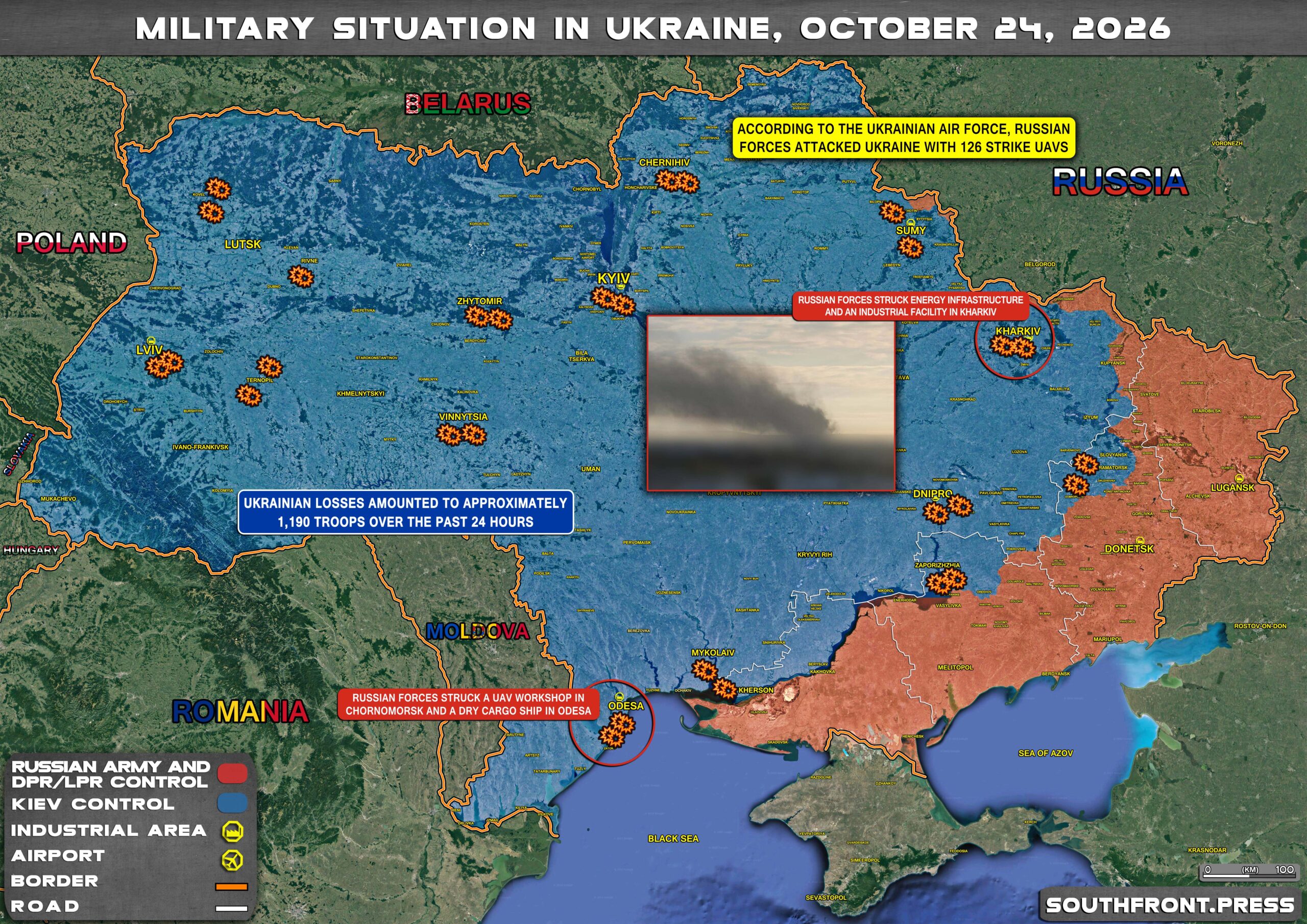
Military Situation In Ukraine And Ukrainian Attacks On Russian Territory On October 24, 2026 (Maps Update)

24 October 2026 at 14:59

Click to see the full-size image

  • Russian strikes destroyed targets in the Sumy, Kharkiv, Zaporizhzhia, Dnipropetrovsk, Kherson, Kyiv, Lviv, Odesa, Vinnytsia, Chernihiv, Volyn, Rivne, Ternopil, Zhytomyr regions, and the DPR;
  • According to the Ukrainian Air Force, Russian forces attacked Ukraine with 126 strike UAVs;
  • Russian forces struck a UAV workshop in Chornomorsk and a dry cargo ship in Odesa;
  • Russian forces struck energy infrastructure and an industrial facility in Kharkiv;
  • Ukrainian losses amounted to approximately 1,190 troops over the past 24 hours.

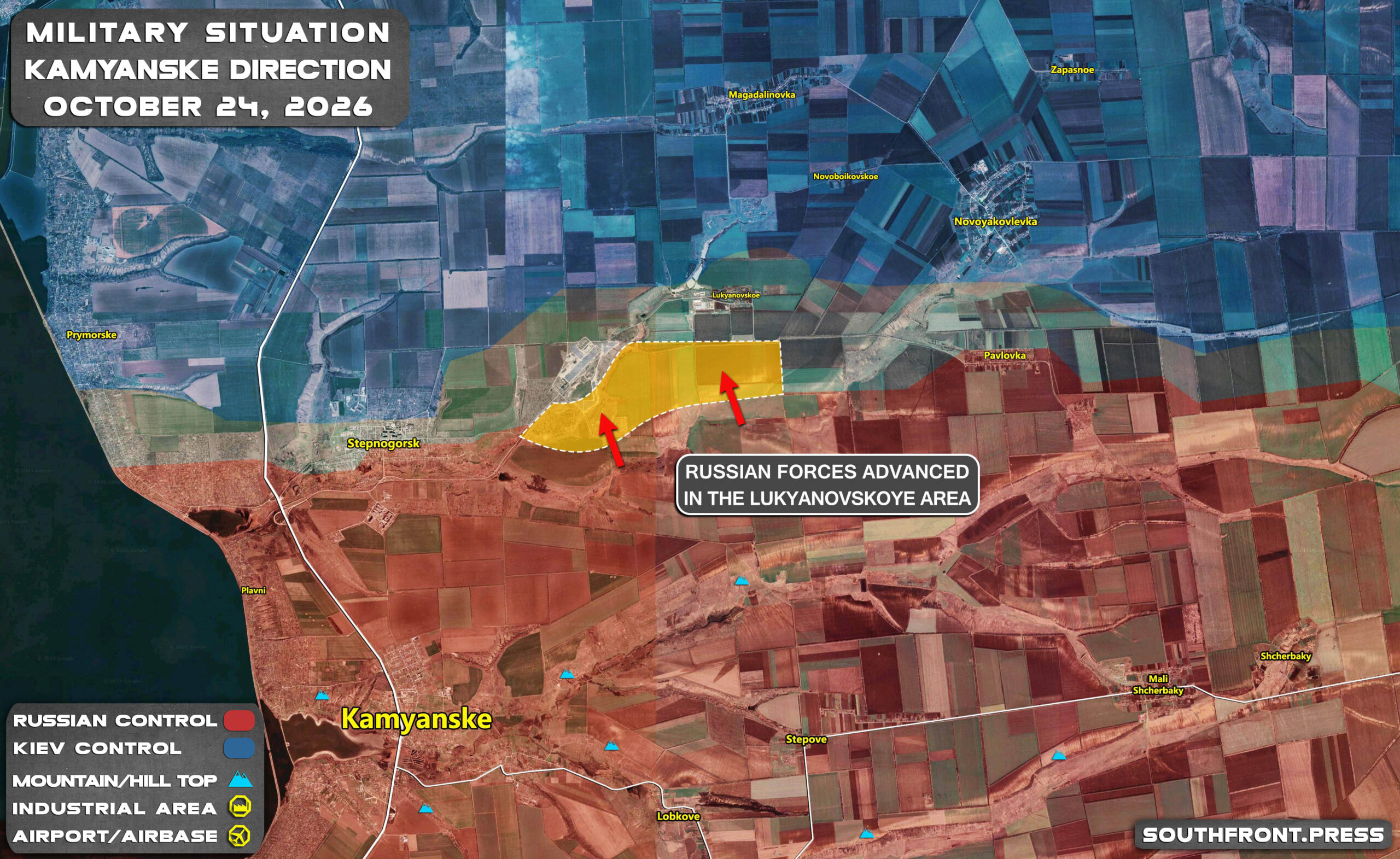
Click to see the full-size image

  • Russian forces advanced in the Lukyanovskoye area.

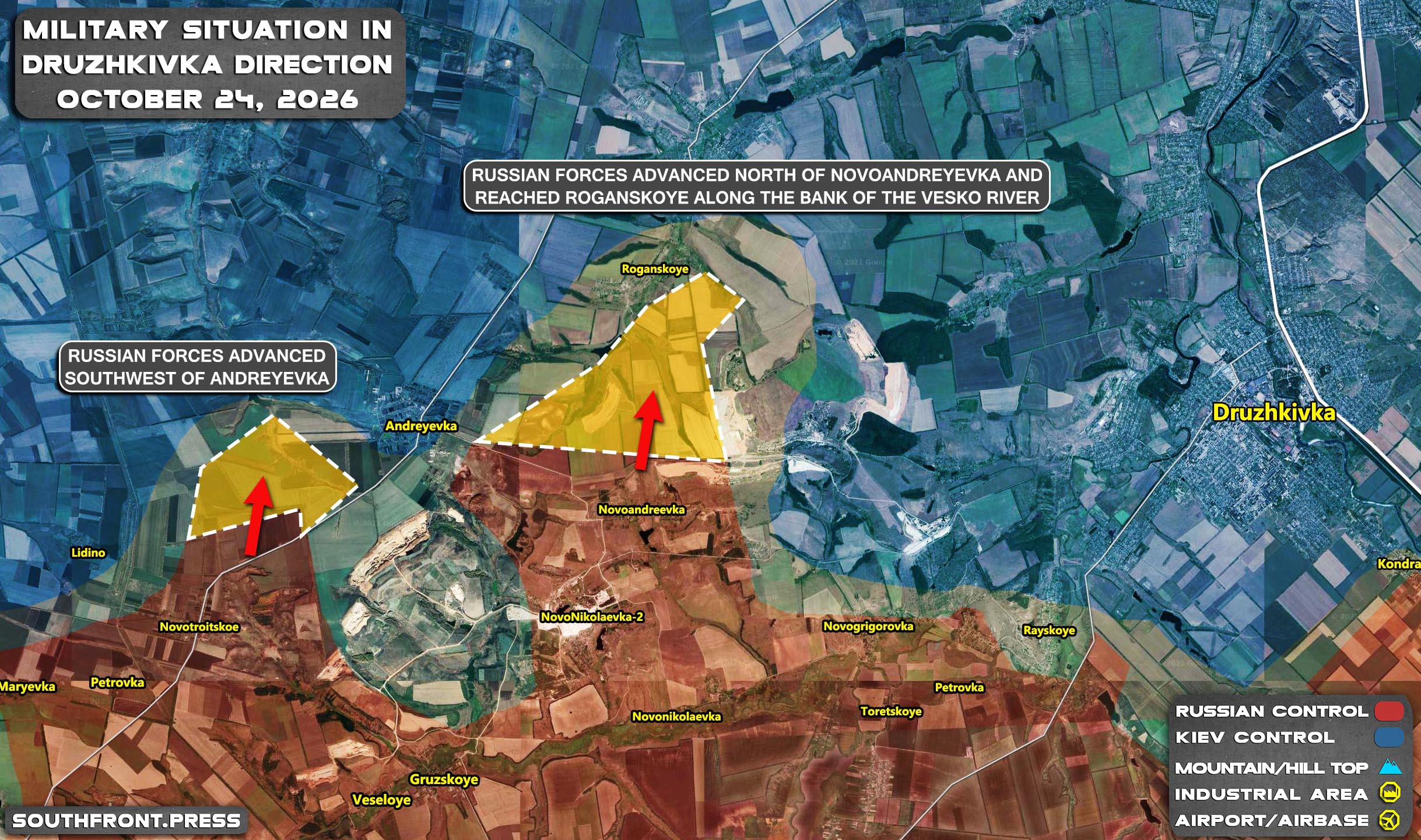
Click to see the full-size image

  • Russian forces advanced southwest of Andreyevka;
  • Russian forces advanced north of Novoandreyevka and reached Roganskoye along the bank of the Vesko River.

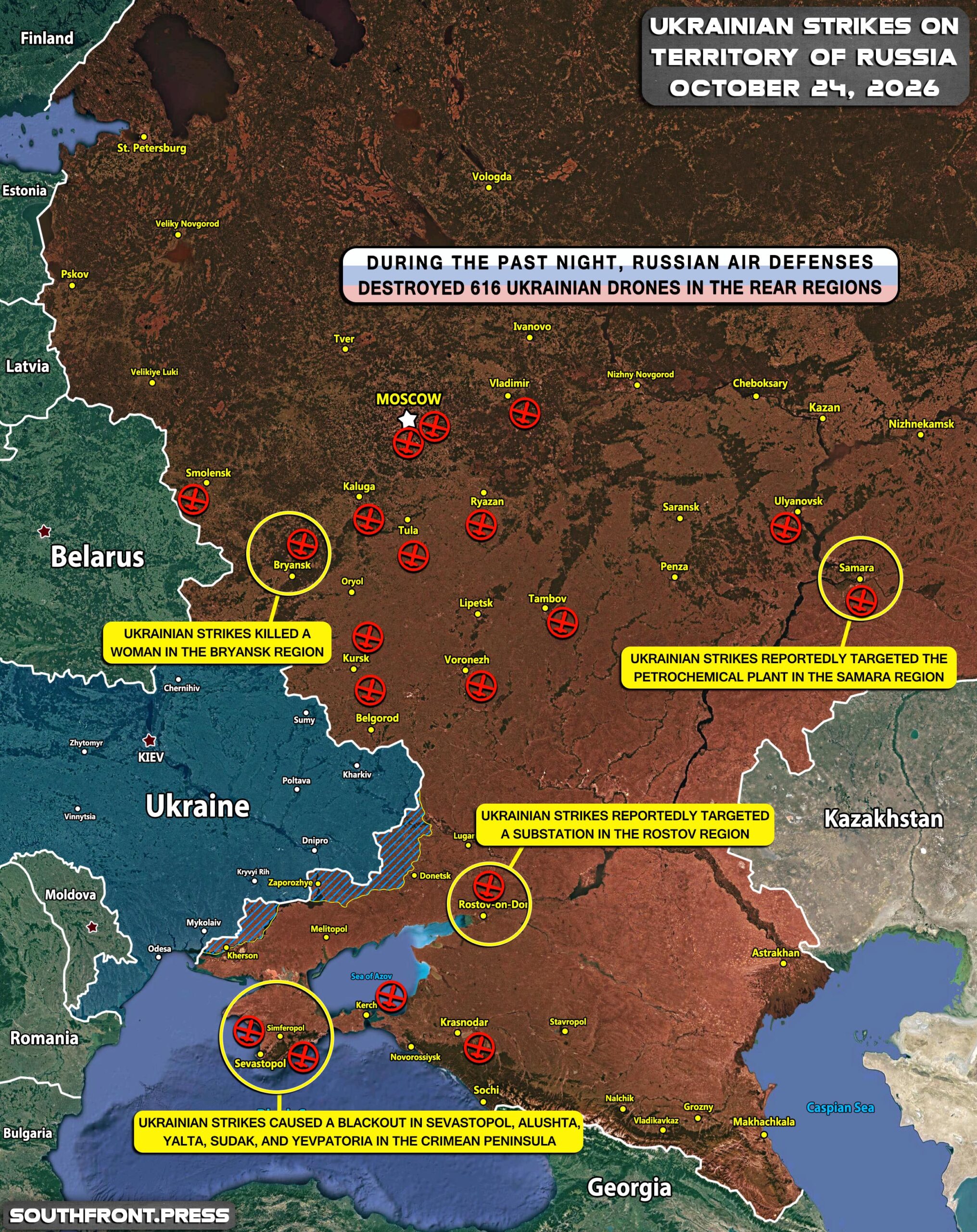
Click to see the full-size image

  • During the past night, Russian air defenses destroyed 616 Ukrainian drones in the rear regions;
  • Russian air defenses intercepted UAVs in the Belgorod, Bryansk, Volgograd, Voronezh, Kaluga, Kirov, Kursk, Lipetsk, Oryol, Penza, Rostov, Ryazan, Samara, Saratov, Smolensk, Tambov, Tula, and Ulyanovsk regions, the Moscow region, the Republic of Crimea, the Republic of Tatarstan, Krasnodar Krai, and over the waters of the Sea of Azov and the Black Sea;
  • Ukrainian strikes caused a blackout in Sevastopol, Alushta, Yalta, Sudak, and Yevpatoria in the Crimean Peninsula;
  • Ukrainian strikes reportedly targeted the petrochemical plant in the Samara region;
  • Ukrainian strikes reportedly targeted a substation in the Rostov region;
  • Ukrainian strikes killed a woman in the Bryansk region.

MORE ON THE TOPIC:

The post Military Situation In Ukraine And Ukrainian Attacks On Russian Territory On October 24, 2026 (Maps Update) appeared first on South Front.

9 Unique Apps to Try on the iPhone Duo

24 October 2026 at 11:45
Apple’s first folding phone is inspiring indie developers to create fun, quirky apps that take advantage of the screen and the hinge. Here are a few to try as you explore the Duo.

China bets refitted destroyers can hold line in US numbers race

24 October 2026 at 06:14

Recent midlife upgrades to China’s older surface combatants highlight an ongoing debate over whether preserving naval fleet mass provides an operational edge over purely qualitative technological modernization in naval warfare. This month, the South China Morning Post (SCMP) reported that the People’s Liberation Army Navy (PLAN) has carried out an extensive midlife refit of its […]

The post China bets refitted destroyers can hold line in US numbers race appeared first on Asia Times.

Carneiro justifica viabilização do Orçamento de Estado com crises em Portugal e no estrangeiro

23 October 2026 at 23:42

O líder do PS recusou hoje, em Valongo, ter-se precipitado no anúncio da viabilização do Orçamento de Estado 2027, invocando a crise que os portugueses vivem e as crises em Espanha, França, Alemanha, Estados Unidos e Brasil.

“Os portugueses estão a viver uma crise muito expressiva no custo de vida. O custo com os bens alimentares, os combustíveis, a eletricidade e com o gás. E, por isso, vamos levar propostas à especialidade para responder a essas necessidades vitais”, afirmou José Luís Carneiro que lembrou ainda as “dificuldades na habitação”.

E prosseguiu: “imaginem que eu votava contra o orçamento e que criávamos com isso uma crise política no país. Essa crise política iria agudizar, iria tornar mais aguda a dificuldade que as pessoas já estavam a passar, num momento em que o mundo está perigoso. Temos uma guerra nas portas da Europa, temos uma guerra no Médio Oriente, temos uma crise política em Espanha, uma crise política na França, uma crise política na Alemanha, uma crise política nos Estados Unidos e também no Brasil, com grande instabilidade política e social”.

Em declarações à entrada para o plenário de esclarecimento sobre o Orçamento do Estado para 2027, que decorreu esta noite em Ermesinde, concelho de Valongo, o deputado reiterou que o seu dever “é defender Portugal” apesar de o Governo apresentar “um mau orçamento”, não querendo ficar associado a “uma crise política no país, que teve eleições em 2022, que teve eleições em 2024, que teve eleições em 2025, e há alguns que queriam já uma crise em [20] 26, por isso apresentaram uma moção de censura [Chega]”.

Continuando a tentar separar as águas, José Luís Carneiro, sobre a estratégia socialista, afirmou que “entre um Governo que é insensível e tem mostrado incompetência em responder às necessidades das pessoas e o populismo e a demagogia”, procuram “demonstrar aos portugueses” que estão a colocar “Portugal em primeiro lugar”.

O conteúdo Carneiro justifica viabilização do Orçamento de Estado com crises em Portugal e no estrangeiro aparece primeiro em O MINHO.

Flavio Bolsonaro Threatens Church Teachings and Democracy: Brazilian Bishops

23 October 2026 at 19:56

They criticize the far-right candidate’s positions on labor rights, national sovereignty, poverty, violence, the environment, and human rights.

On Friday, Folha de Sao Paulo published the contents of a letter in which 54 Brazilian Catholic bishops warn that far-right presidential candidate Flavio Bolsonaro threatens the church’s social doctrine, democracy, national sovereignty and the practice of the common good.

RELATED:

Lula Urges Young and Elderly Brazilians to Defeat Bolsonaro

“We cannot remain neutral, lest our conscience or history condemn us in the future. Those who remained silent in the face of totalitarian threats that materialized in 20th-century Europe left a shameful legacy for future generations,” stated the “Letter from Catholic Bishops to the People of God Ahead of the Second Round of the 2026 Presidential Election.”

The signatories say they are in communion with the National Conference of Bishops of Brazil (CNBB) and aligned with the message issued by the organization’s Permanent Council, which defended the constitution and respect for the vote.

Besides urging voters to evaluate the records of the two candidates facing off in the Oct. 25 runoff, the bishops list the main positions through which Bolsonaro contradicts church teachings.

Labor Issues

The far-right candidate has consistently opposed eliminating the six-days-on, one-day-off work schedule and has proposed hourly pay, which “does not recognize the dignity of the worker and could bring this issue back to the forefront.”

National Sovereignty

Flavio Bolsonaro “promises Brazil’s submission to the United States, participated in a conspiracy to impose tariffs on Brazilian products, advocates foreign interference in elections, and promises to hand over our rare earth resources for U.S. exploitation.”

Poverty

The bishops cite the apostolic exhortation Dilexi Te and say the Liberal Party “has always publicly opposed social programs and the fight against poverty,” even though Flavio Bolsonaro now says he will maintain some of those programs.

🇧🇷⛪️ Creencias y política chocan en Brasil: crece la polémica por la promesa religiosa de Bolsonaro

✝️ Miles de fieles conmemoraron el aniversario de Nuestra Señora Aparecida, patrona del país sudamericano, en medio de la controversia por la promesa de campaña del candidato a la… pic.twitter.com/5AgyIQGEzv

— Sputnik Mundo (@SputnikMundo) October 14, 2026

The text reads, “Beliefs and politics collide in Brazil: controversy grows over a religious pledge made by Bolsonaro. Thousands of the faithful commemorated the anniversary of Our Lady of Aparecida—the patron saint of the South American nation—amidst controversy surrounding a campaign promise by presidential candidate Flavio Bolsonaro to declare that the nation belongs to Jesus Christ.

Catholics and representatives of Afro-Brazilian religions have warned of potential risks of exclusion and discrimination. Although the campaign asserted that this is merely a symbolic expression of faith, the debate has reignited questions regarding religious freedom and respect for the diversity of beliefs within Brazil.”

Violence

The bishops criticize Bolsonaro’s promise to expand access to firearms, “as his father did during his administration.” The issue had already been criticized in the homily delivered by the archbishop of Aparecida, who preached a message of “unarmed peace” during Mass on the Feast of Our Lady.

Environment

The bishops accuse Flavio Bolsonaro of denying the climate crisis and seeking to continue the “devastating policies” of his father, Jair Bolsonaro. They cite the environmental licensing law approved in 2025, known as the “Devastation Law.”

Human Rights and Democracy

The bishops recalled that the far-right candidate “publicly expresses support for torture” and that his family honored Col. Carlos Alberto Brilhante Ustra, a torturer during the military dictatorship.

Flavio Bolsonaro “made several statements that threaten the constitutional order” and, if elected, would govern with a majority in Congress and the Supreme Federal Court (STF), “creating the conditions for a usurpation of power,” the bishops warned.

The Brazilian Situation

Without mentioning Lula, the letter states that the Workers’ Party candidate, “although he has also been the subject of criticism, has always demonstrated responsibility toward the poor and our Common Home, and has acted within the limits of the democratic order, respecting the Constitution.”

“Whether one likes the current government or not cannot be a reason to hand the country over to someone who demonstrates such a contradiction with the teachings of our church,” the bishops say. They also urge Catholics not to abstain from voting.

Among the signatories are Bishop Jose Ionilton Lisboa de Oliveira, president of the Pastoral Land Commission, and the archbishops of Porto Velho, Roque Paloschi; Feira de Santana, Zanoni Demettino Castro; and Uberaba, Paulo Mendes Peixoto. The list includes bishops from Brazil’s Amazon, Northeast, Southeast, Central-West, and South regions.

The letter adds to the existing rivalry between Flavio Bolsonaro and the Catholic Church during the 2026 presidential campaign. In September, the Brazilian Commission for Justice and Peace delivered a report to the bishops detailing 58 attacks by the far right against Catholics and their church since 2018.

teleSUR/ JF

Sources: Folha de Sao Paulo – Brasil de Fato

U.S. Government Takes a Cut of Chip Business in Japan-Funded Deal

23 October 2026 at 16:59
President Trump’s novel deal-making is on display in upstate New York, where the administration is funneling Japanese funds into a government-owned chip factory.

© Cindy Schultz for The New York Times

A GlobalFoundries factory in Malta, N.Y.

I've photographed weddings for over a decade. Here are 4 of the biggest mistakes I see couples make.

23 October 2026 at 15:44
a wedding photographer getting a shot of the bride and groom standing in front of a vast landscape
I've seen all kinds of weddings over the past decade, but many couples make the same mistakes.

Courtesy of Cameron Dever

  • I've worked as a wedding photographer for years, and I've seen couples make the same mistakes.
  • Too many people schedule the day to the minute and don't get the chance to enjoy their wedding.
  • Not budgeting for the right photographer and videographer can lead to disappointing results.

I've been photographing weddings for over a decade, so I've witnessed countless ceremonies and receptions — some disastrous, others impeccable.

Throughout the years, I've also watched couples make the same mistakes over and over. Here are a few I wish they'd avoid.

Filling the day-of schedule with way too much

Couples have to find time for the ceremony, photos, eating and drinking, dancing, talking to the people they invited, and connecting with each other.

When you try to fit too many things into the day, no one — especially the married couple — has time to breathe and relish the moments. The day can feel rushed and more focused on activities than the celebration of love.

A packed schedule often leaves couples stressed, with no time to eat because they've been pushed from one 15-minute window to the next.

However, your wedding day shouldn't be a blur. You should have time to soak in every moment. When you map out your day, prioritize traditions you love and estimate how long each will take … then add buffers.

I also recommend working with a wedding planner or coordinator to plan your timeline, or consulting with your photographer and other vendors when arranging your schedule. They've experienced countless weddings and know firsthand how much time each activity usually takes.

Letting small mishaps and issues ruin the whole day

a black and white photo of a groom getting ready to take off his laughing bride's garter
Learning how to laugh off the small mishaps is absolutely key.

Courtesy of Cameron Dever

One of the things I always tell my couples right before their wedding day is that something will go wrong.

I don't say this to scare them or make them worry, but mostly to adjust their expectations. No matter how much planning you do, people are imperfect, the weather can be unpredictable, and life happens.

By the time the day comes, couples have done all they can to make sure it's how they pictured it. All that matters after that is that they enjoy their wedding.

Missing flowers or a cake that's the wrong flavor can throw off your day — but these unexpected mishaps shouldn't be so consuming that they're all you remember from your wedding.

I don't want to witness any more miserable couples desperately trying to fix details that will never be exactly right. Please try to roll with the punches on your wedding day.

Hiring the wrong photographer or videographer

I may be a bit biased, but I strongly believe having important memories properly documented in photo and video form is priceless.

I've also heard from countless married couples who regret booking a subpar photographer or skipping a videographer.

When hiring any vendors — especially these — choose carefully. You're paying someone to use their physical and creative energy to tell the story of your wedding.

Ask a ton of questions and make sure you love their style by viewing their portfolios and websites. It can also help to hop on a phone call or video meeting — couples should esnsure they vibe with their photo and video team on a personal level because they'll be spending a lot of time with them on the big day.

Planning the wedding they think they should have instead of the one they actually want

guests standing in front of a bride and groom getting married in a forest
You don't have to have a cookie-cutter wedding.

Courtesy of Cameron Dever

Weddings are for the couple, so they should do what they want.

I see so many of them spend thousands of dollars and devote countless hours to planning, only to celebrate their love the way they think they're supposed to — not how they'd actually like.

Your wedding should be unique to you, and it doesn't need to look like everyone else's. If you wish to elope in the forest or plan a ball inspired by "Bridgerton" in a mansion, go for it.

The couple is at the core of the celebration, so why shouldn't everything be based on who they are and what matters most to them? 

Consider this my official public service announcement: Your wedding can — and should — be fun, unique, and meaningful to you. 

This story was originally published in June 2021 and most recently updated on October 23, 2026.

Read the original article on Business Insider

The CEO of Europe's most valuable company says he is tying his pay to employee satisfaction

23 October 2026 at 14:02
Christophe Fouquet
ASML CEO Christophe Fouquet told employees it had been a "disruptive and emotional year."

Chesnot/Getty Images

  • The CEO of ASML is tying his compensation to a personal mission to boost employee morale.
  • Christophe Fouquet told employees in a memo seen by BI that ASML would link exec pay to employee satisfaction.
  • It comes amid a major reorg at Europe's most valuable firm, which supplies chipmaking equipment to TSMC and Intel.

The CEO of Europe's most valuable company is linking his pay to a personal mission to boost employee morale.

Christophe Fouquet, the CEO of Dutch tech firm ASML, said last week that the company will incorporate employee satisfaction into its compensation strategy for top executives in an effort to quell discontent over a major reorganization, per a memo to employees obtained exclusively by Business Insider.

Fouquet was responding to the results of an annual survey that polled more than 38,000 of ASML's roughly 44,000 employees.

The survey results, seen by Business Insider, show that ASML's employee engagement index — a measure of worker satisfaction — fell from 78% last year to 73.5% this year.

In the memo, Fouquet said that the declining employee engagement scores "reflect a period of significant change" and acknowledged that it had been a "disruptive and emotional year" for the company.

He added that ASML's executive team had highlighted six questions in the survey and combined them into a new Workplace Experience Index, which would be incorporated into the company's Long-Term Incentive plan for executive compensation.

"In the coming years, it will directly influence the remuneration of senior leaders, including the Board of Management," Fouquet wrote, adding that strengthening the company's culture and reinforcing its values would be a personal priority in the coming year.

Employees assemble an ASML Twinscan XT1000 lithography machine at the ASML Holding NV factory in Veldhoven.
ASML's lithography machines are a critical part of the semiconductor supply chain.

Bloomberg/Getty Images

The six questions include whether employees feel they can share their opinions without fear of retaliation and if they have confidence in ASML's senior leadership team.

Employees will also be polled on whether they have a clear understanding of their role, whether they think their teams are operating efficiently and are well organized, and whether they feel their direct manager shows they care about them as an individual.

"We recognize the role that leaders play in creating a good workplace, and we now strengthen our commitment by including the workplace experience index in the remuneration of senior leadership, including our Board of Management," an ASML spokesperson told Business Insider.

It comes as ASML, the only firm on the planet capable of building the advanced EUV lithography machines critical for chipmakers like TSMC and Intel, attempts to slash bureaucracy with a sweeping org chart reorganization.

ASML announced in January that it could cut 1,700 jobs to reduce management layers and focus on engineering. Leaked documents previously reported by Business Insider show that these ongoing efforts have focused on reducing the number of managers at the company. The company later said it expected to cut fewer jobs than initially planned.

The ASML spokesperson said that its organizational changes were "necessary to strengthen ASML's ability to innovate" for its customers, but it also recognized they were "disruptive" for staff.

Going against tech's 'hardcore' trend

Major companies tying executive pay to employee satisfaction is uncommon, but not unheard of.

Companies like IBM and Aviva have previously included employee engagement in their compensation targets for top executives.

ASML's decision, however, runs counter to the cultural winds of Big Tech, which have seen some companies embark on relentless layoffs and push employees to work longer hours as part of a "hardcore" working shift.

Meta was an early, prominent leader of this push, with a series of layoffs that began in 2023 during Mark Zuckerberg's "year of efficiency" and, last year, cutting "low performers." CTO Andrew Bosworth at one point suggested that employees who disagreed with the company's direction should "consider working elsewhere."

Executives have since acknowledged internally that Meta went too far with its efficiency push, with Bosworth telling workers that morale at the company was almost the worst it has ever been.

Fouquet's memo to employees came days before ASML raised its 2026 sales forecast and pledged to accelerate production of its unique lithography machines as the AI boom fuels surging demand.

The company's machines are vital for producing the advanced semiconductors used to train and run AI models, and the rapid buildout of AI data centers has pushed ASML's shares up 45% this year.

One major prospective customer for the Dutch firm is Elon Musk, who is racing to build a massive semiconductor factory dubbed "Terafab" in Texas. Business Insider previously reported that Musk gave a virtual presentation to a private ASML employee conference in June to pitch Terafab, which is a joint project by Tesla and SpaceX.

Editor's note: October 23, 2026 — This story was updated to include a statement from ASML.

Do you work at ASML and have any information to share? Get in touch with this reporter at tcarter.41 on Signal or tcarter@businessinsider.com. Use a personal email address and a nonwork device; here's our guide to sharing information securely.

Read the original article on Business Insider

European Parliament Calls for €47.4 Billion for Erasmus+ as Student Living Costs Rise

23 October 2026 at 08:19

The European Parliament voted on Thursday, 22nd October, to support a €47.4 billion budget for the Erasmus+ programme between 2028 and 2034, demanding substantially more funding than proposed by the European Commission.

The parliamentary position was approved by 454 votes to 34, with 93 abstentions, following negotiations over the future of the EU’s principal education, training and student mobility programme.

MEPs are seeking approximately €6.56 billion more than the Commission’s proposed €40.83 billion allocation, arguing that existing financial support does not adequately reflect rising living costs and the expense of studying abroad.

The decision establishes Parliament’s negotiating position but does not represent final approval of the funding. The programme remains subject to negotiations with national governments and agreement on the EU’s next seven-year budget.

Rising living costs affect student mobility

Erasmus+ allows students, apprentices, teachers and other participants to study, train or gain professional experience in another participating country.

Although widely associated with university exchanges, the programme also supports vocational education, schools, adult learning, youth organisations and sporting activities.

Participation often involves substantial personal expenditure, particularly for accommodation, transport and everyday living expenses.

These costs vary considerably between European destinations, creating financial difficulties for students whose Erasmus grants cover only part of their expenses.

The European Parliament is consequently calling for support mechanisms that account for differences in housing and living costs between host countries, regions and cities.

The proposal is intended to make participation more accessible to people who cannot rely on additional financial assistance from their families.

The European Parliament’s research service has identified unequal access, financial limitations and administrative complexity among the challenges facing the programme.

The proposed legislation would also establish a target under which at least 20 per cent of participants in mobility activities would be people facing fewer educational or economic opportunities.

Parliament seeks larger education allocation

The parliamentary proposal provides for approximately €47.39 billion in current prices over seven years.

The Commission originally proposed approximately €40.83 billion, combining funding for Erasmus+ with activities currently administered through the European Solidarity Corps.

According to the report prepared by Parliament’s Committee on Culture and Education, the revised programme would include more explicit financial allocations for different activities.

Education and training would account for approximately 74.6 per cent of the proposed financial envelope, while youth and volunteering would receive around 15 per cent. Sport would receive approximately 4.1 per cent.

The proposed allocation structure is intended to provide greater certainty for organisations planning longer-term educational projects and cross-border partnerships.

Polish MEP Bogdan Andrzej Zdrojewski, of the European People’s Party, is Parliament’s rapporteur on the legislation. His report calls for greater transparency over expenditure and more predictable funding arrangements.

The programme would continue supporting European university alliances, international educational cooperation and initiatives intended to improve professional skills.

Volunteering and vocational training

One proposed change concerns the integration of the European Solidarity Corps into the wider Erasmus+ framework.

The Solidarity Corps currently offers young people opportunities to participate in volunteering and community activities, including projects addressing social and humanitarian needs.

The Commission has proposed bringing these activities within the new programme in an attempt to simplify administration.

However, parliamentarians want safeguards to ensure that volunteering remains identifiable and accessible within the broader funding structure.

The parliamentary position also seeks to extend mobility opportunities across vocational training, adult education and sport.

These activities would allow a wider range of participants to benefit from international placements, including people outside conventional university education.

Additional attention is being given to the financial circumstances of participants and the administrative requirements faced by smaller educational organisations.

Dispute over the EU’s next budget

The Erasmus+ negotiations are taking place against the background of a wider dispute over the European Union’s 2028–2034 financial framework.

Member states are debating the overall size of the budget and the competing demands of agricultural policy, regional development, defence, research and education.

As EU Today recently examined, the negotiations have exposed disagreements over whether the EU should expand its financial commitments or constrain expenditure during a period of pressure on national finances.

Parliament’s Erasmus+ proposal will therefore depend not only on agreement over educational priorities but also on the final distribution of resources across the wider EU budget.

Some governments may support broader participation while resisting the full increase requested by MEPs.

What happens next?

Negotiations must establish the programme’s final budget, eligibility rules and the arrangements governing grants after 2027.

The Council has already developed a negotiating position on aspects of the programme, although financial questions remain connected to the broader budget settlement.

Erasmus+ will mark its 40th anniversary in 2027, shortly before the new framework is scheduled to begin.

More than 17 million people have participated in the programme and its related activities since its establishment.

The outcome of the current negotiations will determine whether the next generation of participants receives more financial support and whether the programme can expand without increasing the proportion of costs borne by students and their families.

❌