The Trump administration is attempting to prosecute former FBI Director James Comey for what it calls disclosing classified information, employing the unusual maneuver of bypassing a grand jury.
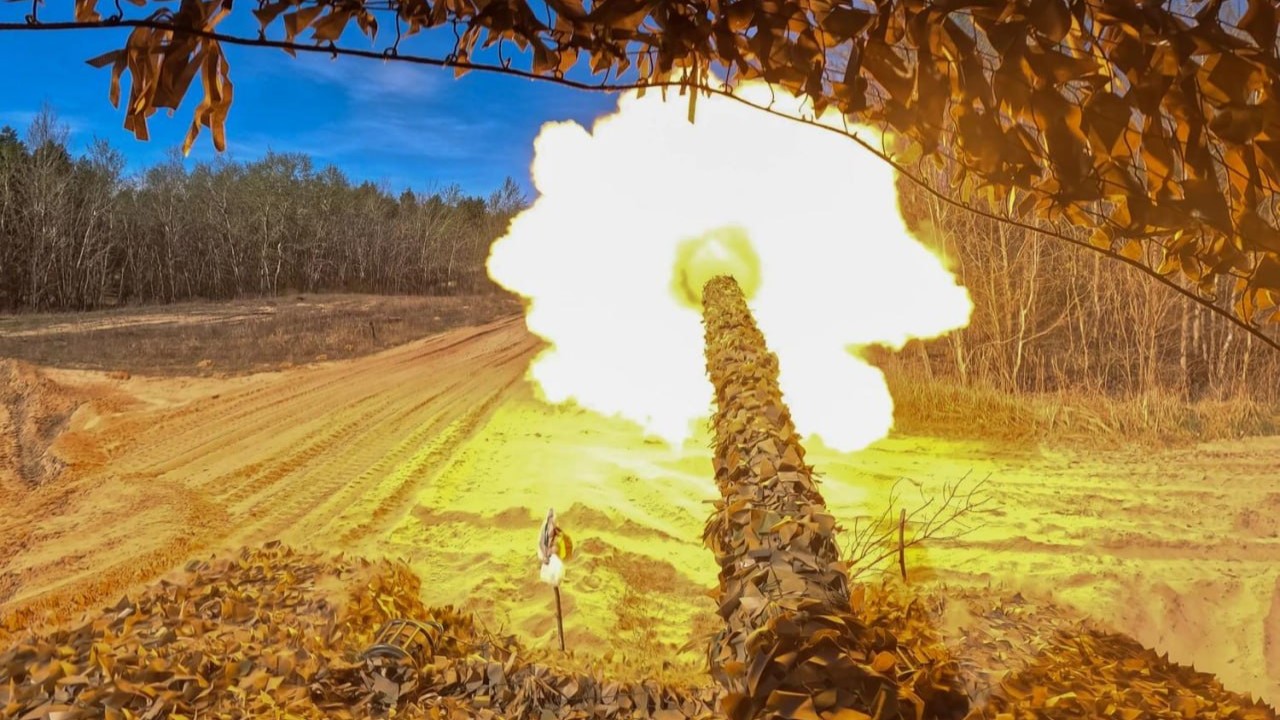
Click to see full-size image. (Russian Ministry of Defense)
In the Dnipropetrovsk direction, Ukrainian units are attempting to regain control of the western bank of the Mokri Yaly River. In the Sumy direction, assault units of the “North” grouping continue to advance deeper into the region with heavy fighting, engaging near Khoten, Velyka Rybytsia and Nikolskoye. In the Kharkiv direction, Russian assault groups are pressing Ukrainian defenses towards Kharkiv and in the north-east of the region. In the Zaporozhye direction, airborne troops of the “Vostok” grouping have driven more than five kilometers into Ukrainian lines, forced the Solyonaya River and taken Obshcheye. In the Slavyansk direction, Russian units have resumed offensive operations north of the agglomeration, fighting in the Lyman area and along the Ozyornoye–Yampol line. Meanwhile, the reluctance of several EU countries to allocate further funds to Ukraine has caused bewilderment in Berlin: the Czech Republic and Slovakia have already indicated they will not take part in a new lending program, and Hungary is expected to adopt a similar stance.
Dnipropetrovsk direction Fighting continues along the Mokri Yaly River, where Ukrainian forces are trying to re-establish control of the western bank in order to threaten the flank of Burlatskoye. Ukrainian formations were recently observed capturing a chain of strongpoints near Veseloye.
Russian troops retain firm control of Veseloye itself and most of the fortifications on its immediate approaches. The situation in neighboring Komar remains obscured by the “fog of war”; Ukrainian forces are actively employing loitering drones against supply units. On the right flank of the Dnipropetrovsk direction an extensive combat zone persists, with assault groups from both sides operating. Ukrainian units are relying on infiltration into the near rear of Russian positions in an effort to disrupt the defense and reach the fortified line along the Shevchenko–Veseloye axis.
Sumy direction Assault units of the “North” grouping continue to push deeper into the Sumy region amid heavy fighting. Ukrainian forces have not conducted significant offensive actions and have concentrated on strikes against civilian targets in the border areas. Russian aviation, artillery and drone crews have struck concentrations of personnel and equipment in the areas of Sumy, Pervomayskoye, Gnilitsa, Podishche, Markovske, Stepanovka, Korenek, Malaya Slobodka and Krasnopolye.
In the Sumy district there are no major changes: Russian assault troops are advancing step by step near Khoten, Velyka Rybytsia and Nikolskoye. In the Shostka district Russian units have cleared a section of woodland near Korenek. Russian forces continue to methodically press Ukrainian defenses, supported by artillery and drones, thereby expanding their control in the border districts.
Kharkiv direction Fierce fighting continues on all sectors of the front in the Kharkiv region. Russian units are pressing Ukrainian defenses towards Kharkiv and in the north-east of the region. The Ukrainian side is reinforcing its motorized infantry brigades with recruits from training centers.
On the Liptsy sector Russian assault groups are advancing south of Novaya Kazachya. Most of the area is already under Russian control; fighting is shifting towards Tsupovka. On the Volchansk and Velykyi Burluk sectors the heaviest fighting continues around Prikolotnoye and Malyi Burluk. Advances have been recorded near Bugayevka and Kotovka. Russian assault troops are pushing forward under heavy conditions in the Prikolotnoye, Bugayevka and Malyi Burluk areas, gaining up to 800 meters in the past 24 hours.
Zaporozhye direction Near Malye Shcherbaki Russian airborne troops are expanding their zone of control and advancing along the gully towards Novoyakovlevka. In the Novopavlovka area Russian forces are holding their positions and striking Ukrainian units that are transferring reserves in an attempt to retake Orekhov.
The battle for the approaches to Orekhov is intensifying. While the southern outskirts of the town remain the scene of heavy fighting, Ukrainian forces continue to send small assault groups into Malaya Tokmachka. Members of Ukrainian units were recently hit by drones near the center of the village. It is likely that the Ukrainian side is attempting to reach IK-88, an area long used as the main defensive node for Malaya Tokmachka.
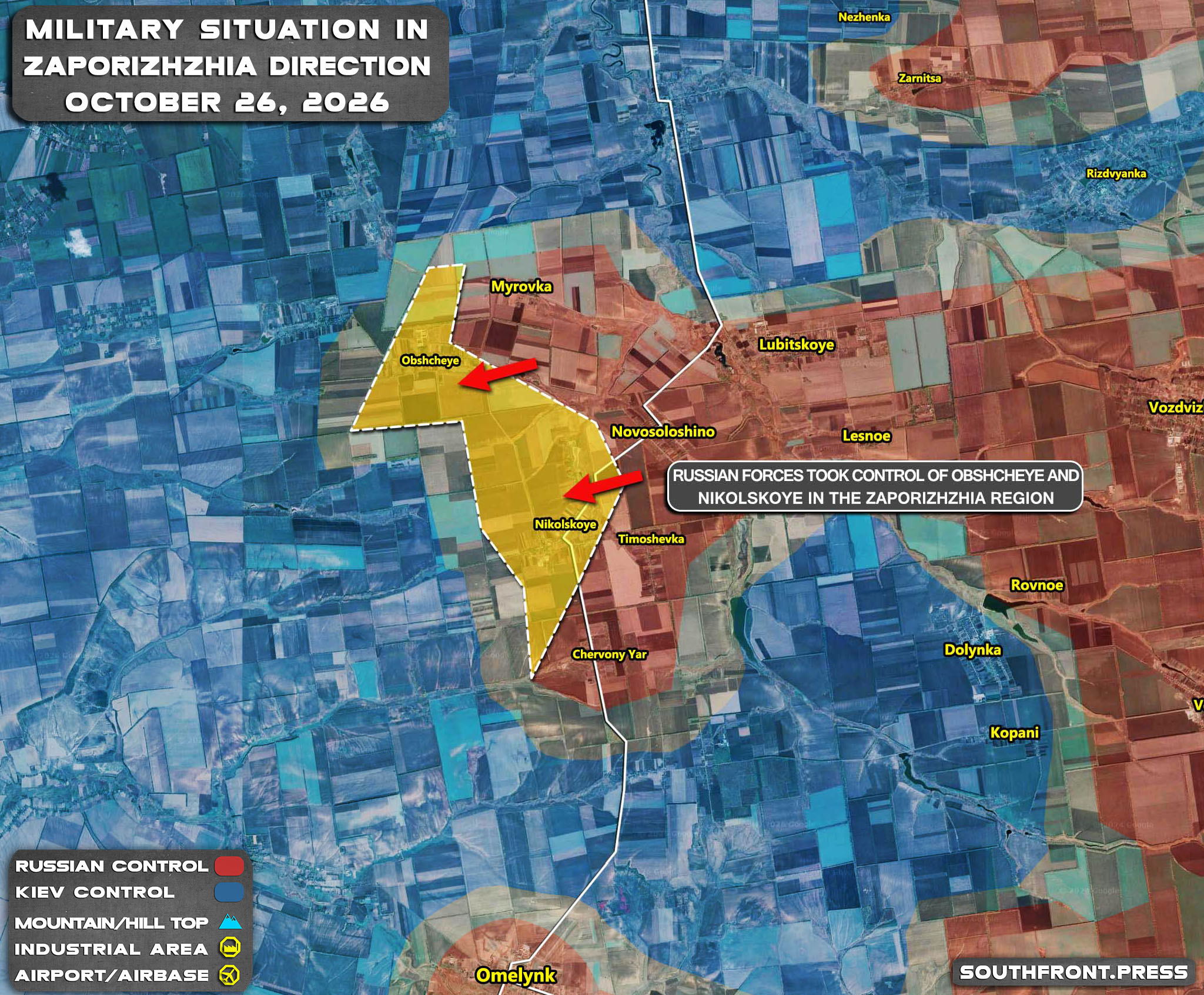
As a result of coordinated action by unmanned systems troops, artillery, aviation and assault troops of the 39th Separate Motor Rifle Brigade of the 68th Army Corps of the “Vostok” grouping, Russian forces have driven more than five kilometers into Ukrainian defenses, forced the Solyonaya River, overcome a system of engineer obstacles including an anti-tank ditch, and taken control of Obshcheye.
Slavyansk direction East of the Slavyansk–Kramatorsk agglomeration Russian assault units continue to advance in the Raiskoye area. On the Krasny Liman sector Russian forces have resumed offensive operations north of the agglomeration. Fighting is under way in the Lyman area and along the Ozyornoye–Yampol line. Advances have been noted towards Maslyakovka and near Rai-Aleksandrovka. From the Zarechnoye area Russian units are moving towards Maslyakovka.
Meeting engagements continue in the Zarechnoye, Stavki and Dibrova sectors. Over the past 24 hours Russian units conducted several successful attacks towards Stavki and Dibrova. Reports from the eastern approaches to Krasny Liman are of particular interest: an advance from Zarechnoye towards Maslyakovka has been recorded, although the settlement itself has not yet passed under Russian control. Further south, heavy fighting continues along the Yampol–Ozyornoye line.
Conclusion In the Dnipropetrovsk sector the struggle centers on the western bank of the Mokri Yaly and the retention of Veseloye. In the Sumy direction Russian forces are slowly pressing the defense near Khoten, Velyka Rybytsia and Korenek. In the Kharkiv direction pressure continues on Prikolotnoye, Bugayevka and Malyi Burluk. In the Zaporozhye direction the more than five-kilometer penetration, the forcing of the Solyonaya and the capture of Obshcheye create conditions for further envelopment of the Orekhov grouping. In the Slavyansk direction the resumption of attacks north of the agglomeration and fighting along the Ozyornoye–Yampol line are gradually eroding Ukrainian defenses.
Meanwhile, the reluctance of several EU member states to provide further funding for Ukraine has caused consternation in Berlin, according to Politico, citing European diplomats and officials. “How can one seriously expect our taxpayers to send even one more euro from the cohesion funds to those who refuse to take part in defending the EU against the greatest threat to our common security?” a German diplomat told the publication. The Czech Republic and Slovakia have already indicated they will not participate in a new lending program; according to two sources, Hungary is likely to take the same position. At a recent EU summit Volodymyr Zelensky stated that Ukraine would require an additional €70 billion in 2027.
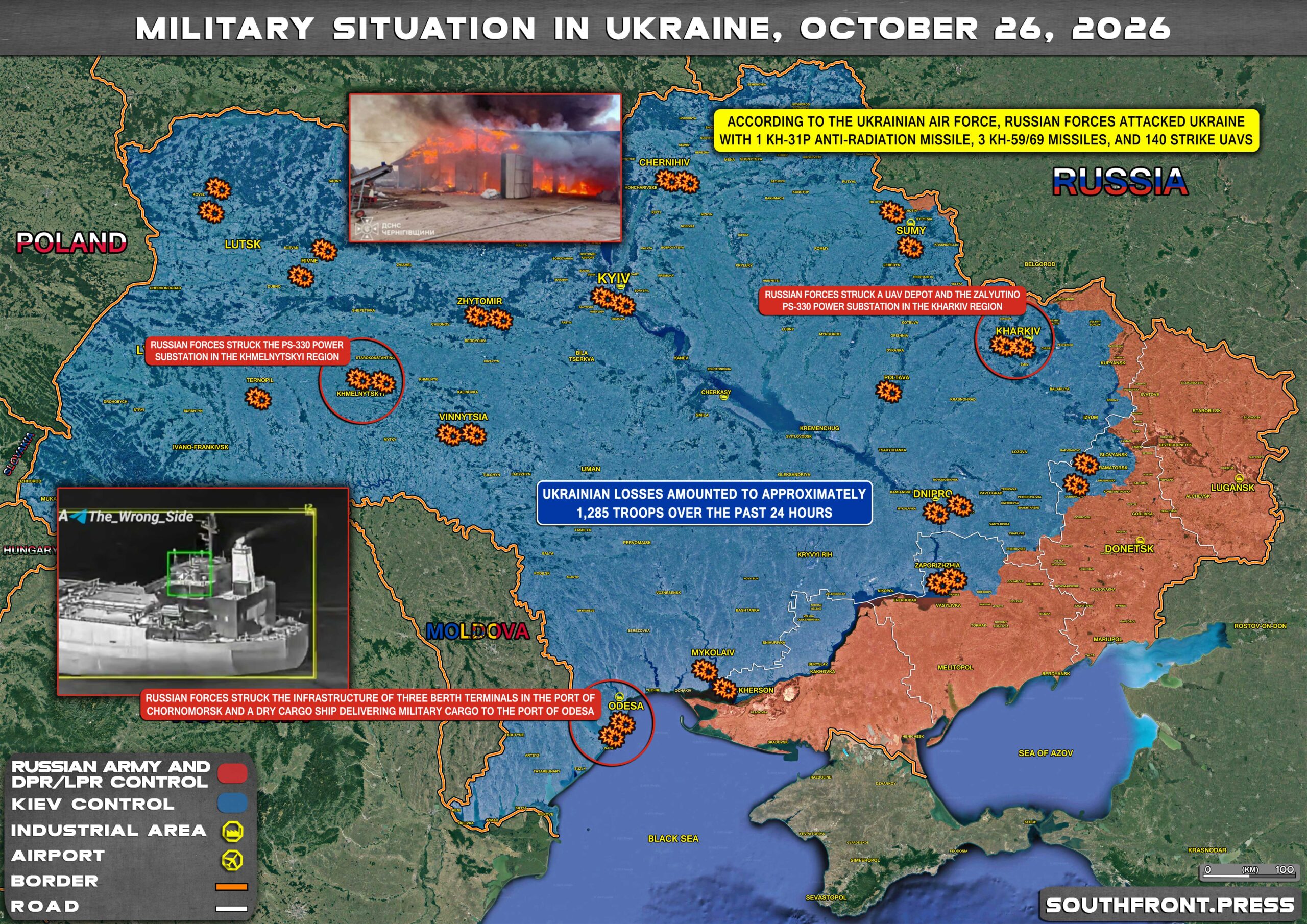
Russian strikes hit targets in the the Sumy, Kharkiv, Zaporizhzhia, Dnipropetrovsk, Kherson, Vinnytsia, Zhytomyr, Kyiv, Lviv, Odesa, Poltava, Rivne, Ternopil, Khmelnytskyi, Chernihiv, Chernivtsi regions, and the DPR;
According to the Ukrainian Air Force, Russian forces attacked Ukraine with 1 Kh-31P anti-radiation missile, 3 Kh-59/69 missiles, and 140 strike UAVs;
Russian forces struck a UAV depot and the Zalyutino PS-330 power substation in the Kharkiv region;
Russian forces struck the PS-330 power substation in the Khmelnytskyi region;
Russian forces struck the infrastructure of three berth terminals in the port of Chornomorsk and a dry cargo ship delivering military cargo to the port of Odesa;
Ukrainian losses amounted to approximately 1,285 personnel over the past 24 hours.
Click to see the full-size image
Russian forces took control of Obshcheye and Nikolskoye in the Zaporizhzhia region.
Click to see the full-size image
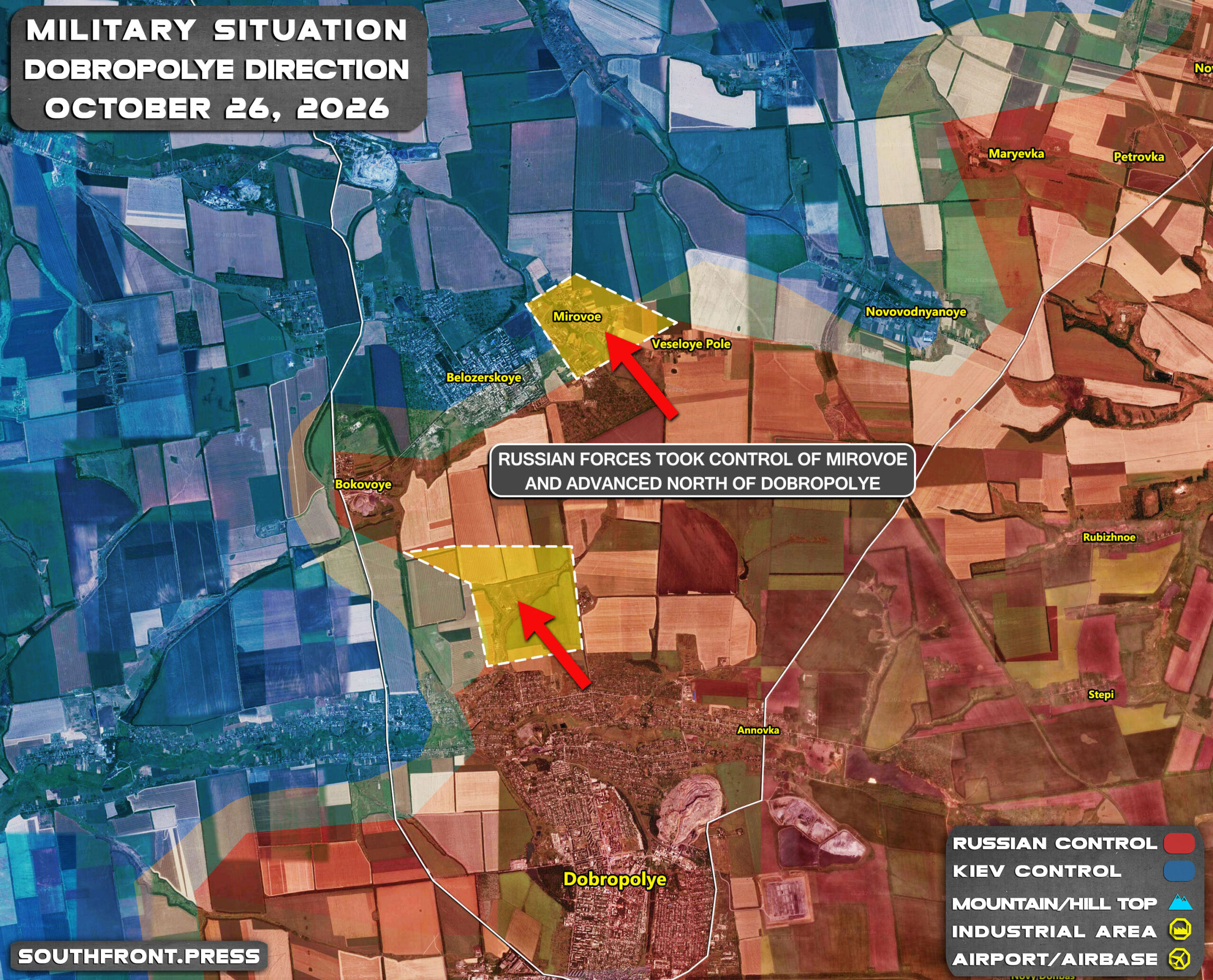
Russian forces took control of Mirovoe and advanced north of Dobropolye.
Click to see the full-size image
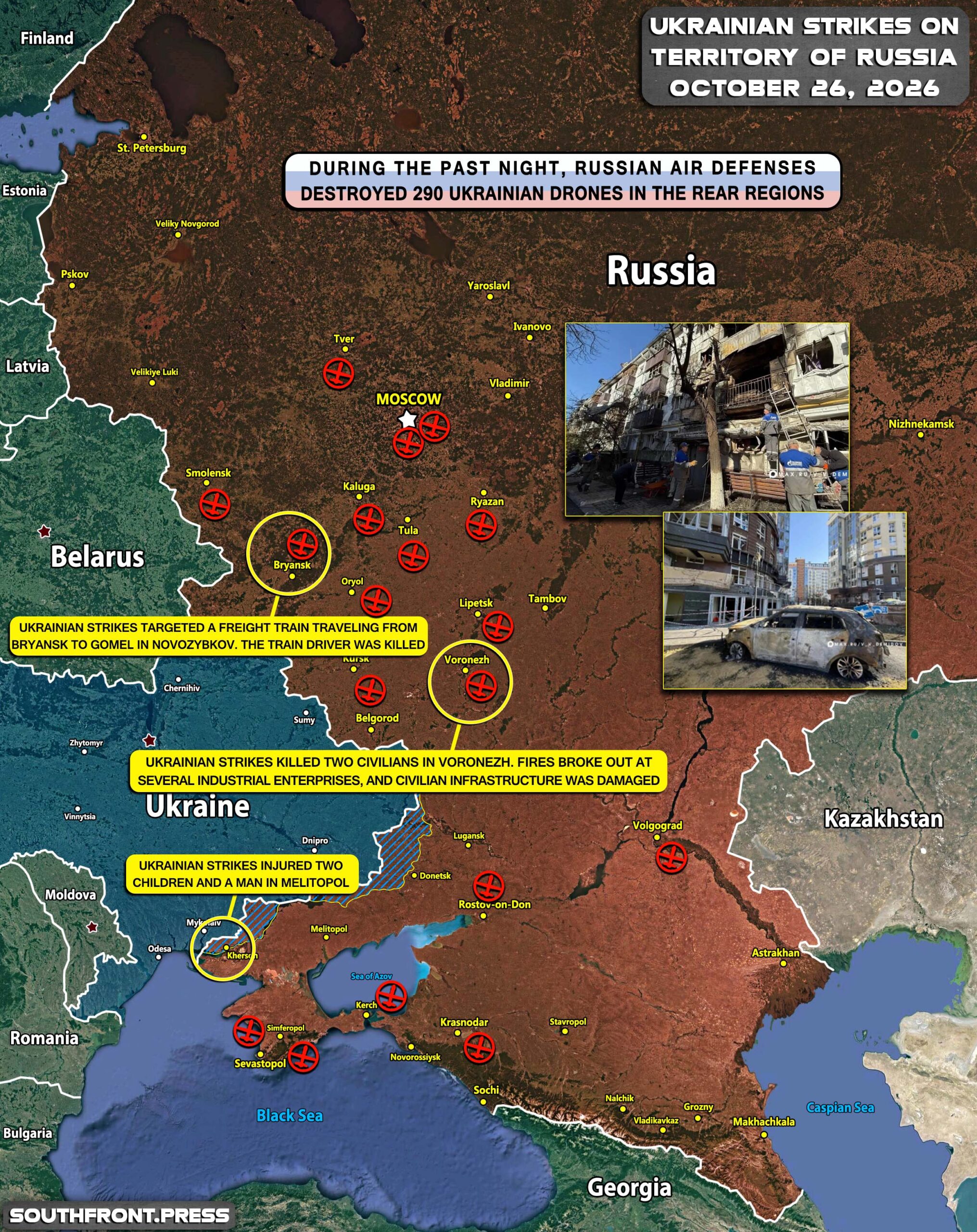
During the past night, Russian air defenses destroyed 290 Ukrainian drones in the rear regions;
Russian air defenses intercepted UAVs in the Belgorod, Bryansk, Voronezh, Volgograd, Kaluga, Kursk, Lipetsk, Novgorod, Oryol, Pskov, Rostov, Ryazan, Smolensk, Tver, and Tula regions, and in the Moscow region;
Ukrainian strikes killed two civilians in Voronezh. Fires broke out at several industrial enterprises, and civilian infrastructure was damaged;
Ukrainian strikes injured two children and a man in Melitopol;
Ukrainian strikes targeted a freight train traveling from Bryansk to Gomel in Novozybkov. The train driver was killed.
From deportations without due process to random and discriminatory detentions and searches, the Trump administration's immigration crackdown raised many constitutional concerns. Now, in a lawsuit advancing in federal court, 27 religious organizations say the administration's immigration policies violate another constitutionally protected activity: Americans' right to the free exercise of religion.
Last week, the D.C. Circuit Court of Appeals ruled that the religious groups' lawsuit, docketed as Mennonite Church USA v. Department of Homeland Security (DHS), could continue. The lawsuit was brought against the federal government in February 2025, after the Trump administration overturned a longstanding policy that heavily restricted immigration raids around "sensitive sites," including churches, schools, hospitals, daycares, playgrounds, rehab facilities, funerals, and weddings. This policy was most recently outlined in a 2021 memo—dubbed the "Mayorkas Memo" for Alejandro Mayorkas, the DHS secretary at the time—but U.S. immigration enforcement first established the standard in 1993.
After repealing the Mayorkas Memo, the DHS issued a one-page document instructing officers to use "a healthy dose of common sense" when deciding whether to operate at previously protected sites.
Unsurprisingly, religious leaders are concerned about the sudden allowance of federal police into their sacred spaces. In their complaint, each of the 27 faith organizations suing the DHS describes how the risk of immigration enforcement impedes their religious exercise. The Church of the Brethren says a DHS enforcement action would "destroy all sense of peace and safety in what is supposed to be a place of sanctuary for congregants."
The Central Conference of American Rabbis writes that immigration enforcement against a synagogue would induce fears of "the persecution of Jews by government agents before and during the Holocaust."
"We have congregations which have reported members no longer feel comfortable attending services, members who are concerned for their safety, congregations which have had to add costly security measures," Carey McDonald, executive vice president of the Unitarian Universalist Association—one of the 27 plaintiffs—tells Reason.
The fear of police action driving down attendance isn't just a financial problem, McDonald says; it is fundamentally an attack on Unitarian Universalists' (U.U.) beliefs. "A core part of our theology and our practice is to welcome the stranger. To force us to choose between our long-held theological commitment[s] vs. trying to keep our people physically safe…this is a violation of our constitutionally protected rights."
The DHS repealing the Mayorkas Memo isn't the only way immigration police have infringed U.U. religious expression. In August, it was revealed that federal agents had been spying on churches in Minneapolis—even before January's protests against "Operation Metro Surge."
McDonald tells Reason that First Universalist Church of Minneapolis, which had hosted an anti-ICE event led by the Sunrise Movement in December 2025, was one of the targeted churches. "This is direct evidence from the government itself that it is seeking to interfere with our rights to practice our faith. We must assume that this is not an isolated incident."
Indeed, it isn't; the DHS has conducted arrests and surveillance on plenty of other churches across the country. In January 2025, a man in Georgia was arrested by Immigration and Customs Enforcement (ICE) during a church service. By August 2025, Religion News Servicerecorded "at least 10 instances of apparent immigration enforcement activity conducted by ICE or other federal agents on or immediately near church grounds since [President Donald] Trump's inauguration." In February of this year, CBS News reported that two men in New Jersey were taken away while they were "just about to head inside" a Pentecostal church for their Sunday worship.
Because of these tangible harms, the D.C. Circuit ruled that the 27 plaintiffs have standing, writing, "[the plaintiffs] are directly injured by the government's already-implemented policy of enforcing immigration laws at houses of worship, they likely have met the standard for showing 'imminent' harm," as outlined by the Supreme Court.
The case is now being sent back to the D.C. District Court, which will have to decide on all three of the plaintiffs' legal claims. Two of those claims are about religious freedom: One appeals to the Religious Freedom Restoration Act (RFRA), which plaintiffs say must protect the congregations from DHS activity that "substantially burdens" their exercise of religion. The second argument says DHS enforcement violates the First Amendment's Free Exercise Clause, which protects religious expression and association. While judicial precedent clarifies that certain compelling state interests can override the clause, the plaintiffs argue there are less intrusive ways to achieve the state's interest in immigration enforcement. The third claim is more procedural, arguing that the department's sudden rescission of the Mayorkas Memo violated the Administrative Procedure Act by not sufficiently considering the impact on religious organizations.
The plaintiffs are first seeking an immediate injunction against all DHS activity around their houses of worship, but the proposed order submitted in 2025 would also re-implement the Mayorkas Memo while litigation is ongoing, overturning the Trump administration's rescission.
Mennonite Church v. DHS is one of four lawsuits challenging the rescission of the Mayorkas Memo by DHS. Two of those lawsuits have resulted in preliminary injunctions, while the third is still pending.
A Connecticut law that took effect at the beginning of October imposes new restrictions on police use of automated license plate readers (ALPRs), which enable what a federal judge recently described as "a type of indiscriminate mass surveillance." The law reflects the bipartisan backlash against AI-assisted cameras that record images of passing cars billions of times a week, building databases that police can use to track drivers, identify other vehicles in their vicinity, predict itineraries, and conduct searches based on a wide range of vehicle characteristics.
Connecticut previously imposed no statutory limits on ALPRs, a fact that underlines how readily police can access license plate data, which they can search without any sort of judicial review and often without meaningful internal supervision. But the law's provisions, while promising in some ways, fall short of the reforms recommended by critics who warn that unconstrained use of ALPRs threatens the privacy of innocent motorists across the country.
As of today, DeFlock's mapping project has identified nearly 145,000 ALPR cameras in the United States, most of which were installed by Flock Safety, the leading vendor. That network includes more than 1,500 cameras deployed by Connecticut law enforcement agencies, three-quarters of which use the technology.
The concerns underlying the new law, which Gov. Ned Lamont signed last May, echo objections raised in other states. Last February, for example, CT Insiderreported that out-of-state agencies had searched ALPR data from Connecticut thousands of times for immigration enforcement purposes. When police in Johnson City, Texas, searched Connecticut data for a missing woman, the log noted that she "had an abortion," which reinforced concerns that ALPR information might be used to enforce abortion bans.
As elsewhere, ALPR critics in Connecticut also have complained about a lack of transparency. In April 2025, for instance, South Windsor began using Flock cameras without any public notice. The resulting consternation prompted the city council to cancel the program early this month. CT Mirrorreports that South Windsor is "at least the sixth Connecticut community to end or suspend the use of ALPRs this year, following Windsor, Killingworth, Ledyard, Milford and Newtown."
Compared to those moves, the new state restrictions are pretty weak tea. But they include some potentially meaningful changes, and they highlight how lax oversight of ALPRs has been.
The new law restricts the sharing of ALPR data, which henceforth will be limited to Connecticut, Massachusetts, New York, and Rhode Island unless an agency in another state obtains a judicial warrant. The law says the data may not be used for immigration enforcement, to target conduct protected by the First Amendment, or for investigations related to "reproductive" or "gender-affirming" health care services. It also bars the placement of ALPRs near facilities that provide such services or organizations that primarily serve immigrants.
The original bill specified that ALPR data could be retained for no more than seven days unless it is tied to an ongoing criminal investigation, subject to a warrant, or used for toll enforcement. The final version of the bill extended that limit to 21 days. Flock's original default was 30 days. But last August, in response to widespread criticism of ALPR surveillance, the company began recommending a seven-day limit. Connecticut's Police Officer Standards and Training Council, which last month sent Lamont a report that included suggested reforms, thinks the state should adopt the seven-day standard.
Under the new law, police may search ALPR data to "assist in the recovery of a stolen motor vehicle," "assist in locating a missing or endangered individual," or "assist in the apprehension of an individual with an outstanding warrant." They also may query the database for information "relevant and material to a specific active investigation of a criminal offense in which there is reasonable suspicion that the offense has been or is being committed." When they do that, their agency must record "the reason for the access and any associated case number for the complaint or incident that is being investigated and is the basis for the access."
It is remarkable that Connecticut lacked such basic safeguards until now, and it is not clear how effective the new rules will be. Since July 1, 2025, Virginia has required that cops state a "specific purpose" for ALPR searches, including "the offense type." Yet last April, WHRO reported that Norfolk police often give "incomplete and imprecise reasons" for ALPR queries, including "suspect," "suspicious," and "investigation" or "inv."
Connecticut's "reasonable suspicion" requirement is more lenient than the standard that the Institute for Justice favors. The organization's model statute would generally require a warrant based on probable cause for ALPR queries. The proposed law makes exceptions for "exigent circumstances," stolen vehicles, and toll, parking, or traffic enforcement.
Connecticut's law also addresses the sort of blatant abuses that have fueled opposition to license plate cameras, including cases in which cops have been caught using ALPR data to stalk personal nemeses, ex-girlfriends, possibly unfaithful spouses, and objects of romantic interest. The law says an officer "who is found to have knowingly accessed, used or disseminated automated license plate reader data with malicious intent for purposes outside of the provisions of this section shall be subject to disciplinary action including, but not limited to, suspension, cancellation or revocation of certification" for police work.
The law establishes two additional remedies that could deter ALPR abuses. It authorizes the attorney general to sue ALPR contractors for damages and injunctive relief when they violate the new restrictions. It also allows "any aggrieved individual" to sue "a public agency" that flouts the rules.
"The law, for a first bite at the apple, is not bad," Ken Barone, manager of the University of Connecticut's Racial Profiling Prohibition Project, toldCT Insider. Given that "there was a benchmark of nothing," he said, the attempt to constrain and track ALPR use is "a big step forward."
In 2003, Chinese president Hu Jintao worried about what became known among the country’s leadership as the ‘Malacca dilemma.’
Some 80 percent of China’s imported crude passed through the Malacca strait which Beijing’s naval forces could not control.
This gave rise to a wider security doctrine of supply-chain resilience which became the basis for China’s transformation into the clean tech powerhouse it is today.
When the US–Iran war disrupted Middle Eastern oil flows this year, Xi Jinping called China’s early bet on wind and solar “forward-looking” – as recounted in a new paper from the London School of Economics’ Grantham Research Institute published on Monday (26 October).
The paper identifies green growth as “the answer” to geopolitical uncertainty. Clean tech isn’t just clean, it’s also secure and not dependent on imports. Plus, it delivers a “more durable pathway” to “economic resilience.”
Some governments want to expand fossil-fuel imports, or drill more oil or gas wells, arguing that a more diversified supply chain improves resilience. But the paper dismissed that.
Oil and gas are priced on global markets, so even producers are exposed to price shocks. More North Sea drilling would save UK households between £16 and £82 (€19 to €98) a year, the paper finds, citing Oxford University research, compared with £105 to £441 on a renewables and electrification pathway.
It’s interesting comparing how the two political systems respond to (hypothetical) supply shocks. In China, the mere threat of losing control of one strait was enough to transform energy politics gradually over many years.
This article continues, but the full version is available only to EUobserver.com subscribers. Visit account.euobserver.com/membership
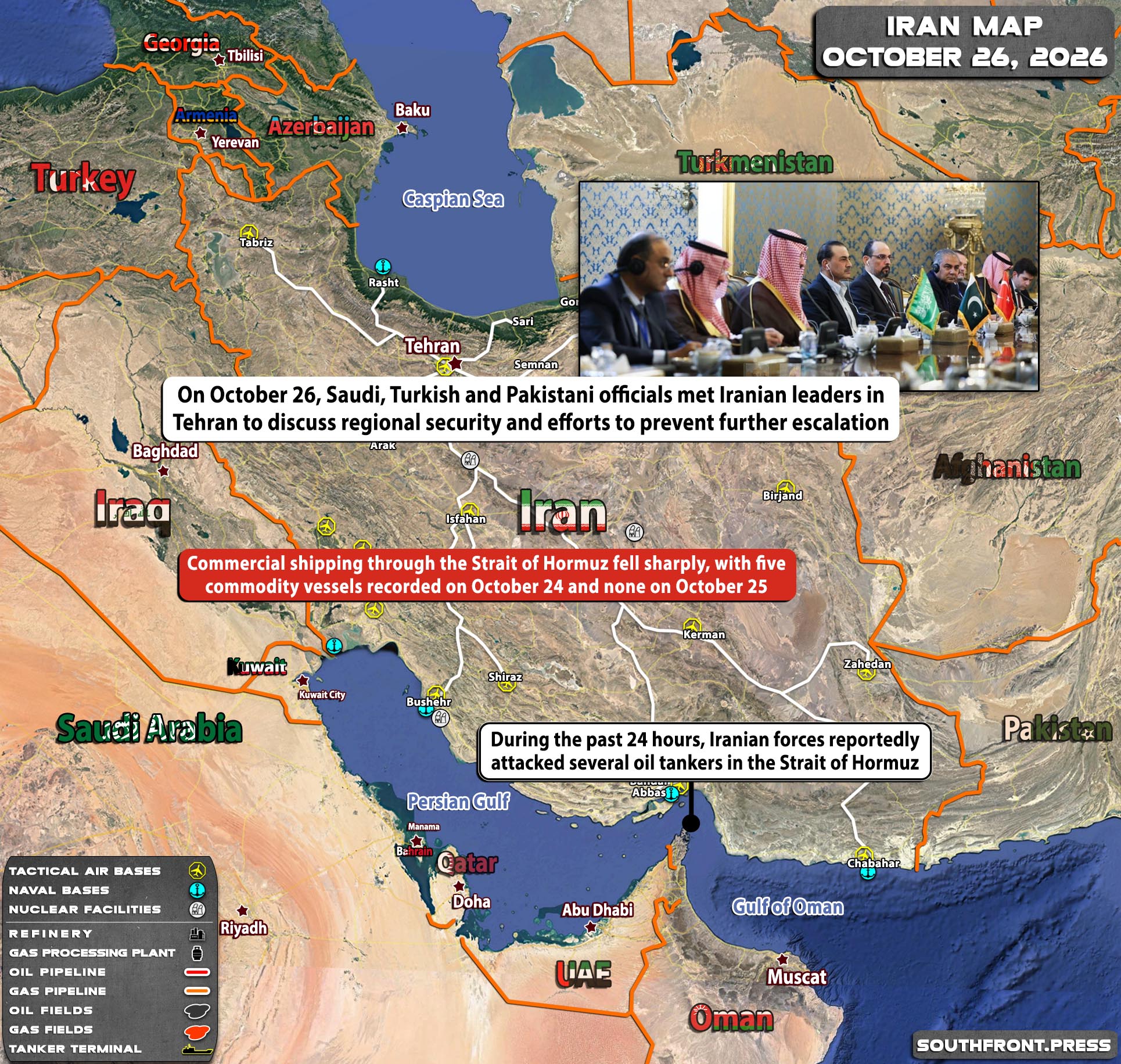
On October 26, Saudi, Turkish and Pakistani officials met Iranian leaders in Tehran to discuss regional security and efforts to prevent further escalation;
Commercial shipping through the Strait of Hormuz fell sharply, with five commodity vessels recorded on October 24 and none on October 25;
During the past 24 hours, Iranian forces reportedly attacked several oil tankers in the Strait of Hormuz.
Illustrative image. (U.S. Air Force photo/Staff Sgt. Amy Abbott)
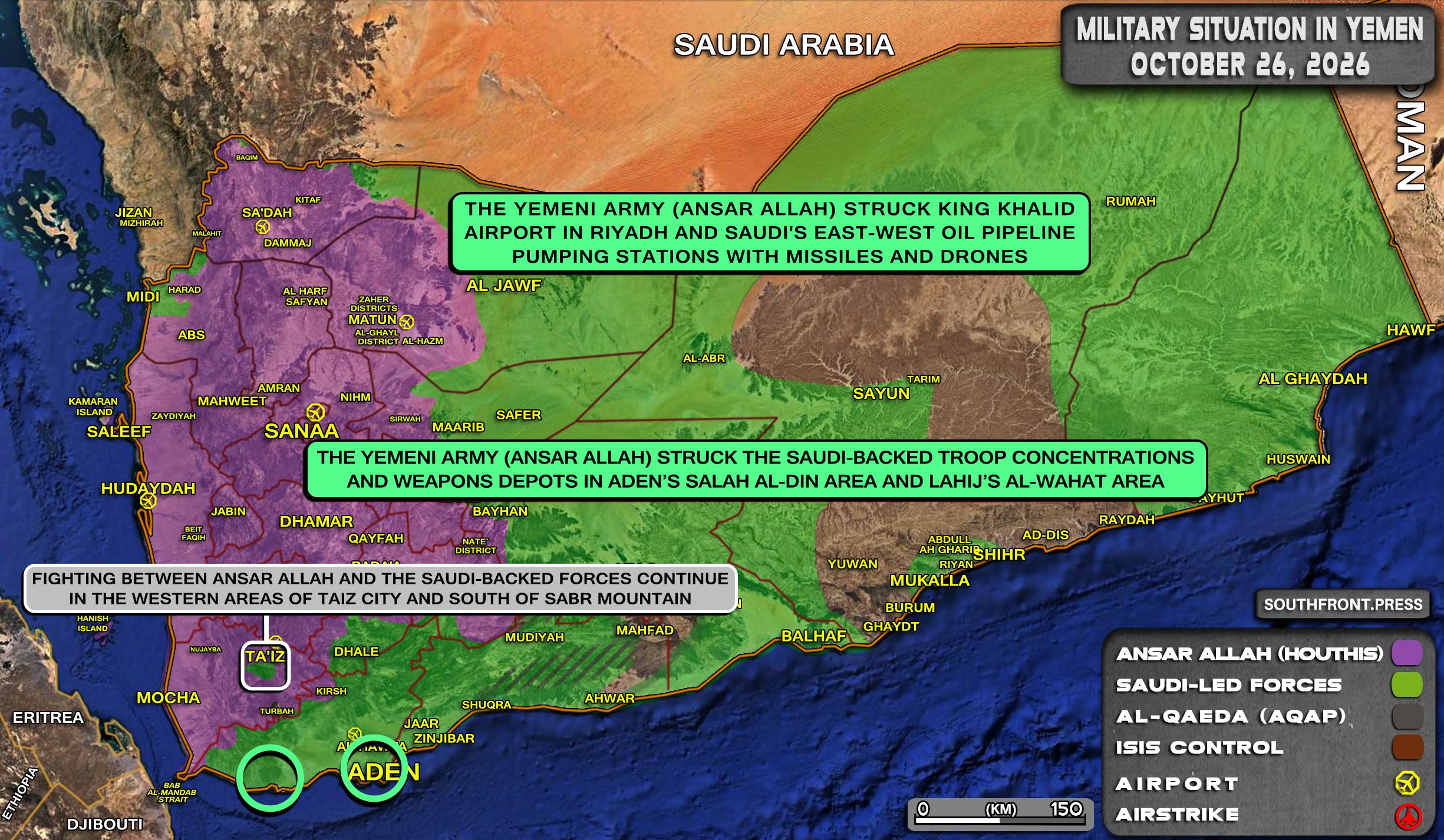
Egypt’s parliament on October 26 authorized President Abdel-Fattah el-Sisi to provide military support to Saudi Arabia against attacks by Yemen’s Houthis, also known as Ansar Allah.
The authorization, approved by a two-thirds majority following closed-door deliberations, allows Sisi to take necessary measures in coordination with Riyadh to defend Saudi territory, sovereignty and holy sites against external aggression.
A regional official briefed on the plans told The Associated Press that Egypt would provide air defense systems and warplanes to help intercept missiles and drones targeting Saudi Arabia. The official said the support would not include deploying ground troops to Yemen.
Sisi has repeatedly stressed that Cairo’s role would be strictly defensive, seeking to reassure Egyptians concerned that the country could become entangled in another regional war.
“I’m not speaking about fighting anyone or attacking anyone. I’m speaking only for defense,” Sisi said earlier this month.
He also reiterated that Egypt’s military effort would focus on protecting Saudi territory and borders rather than conducting attacks on Yemen.
The limited scope of the proposed mission means Egypt’s decision is unlikely to significantly change the military balance inside Yemen.
Egyptian air defense systems and warplanes could help Riyadh withstand further missile and drone attacks, but the announced approach does not involve an Egyptian ground campaign or direct strikes against Houthi positions across the border in Yemen.
Egypt’s involvement in the war has been cautious before. Cairo joined the Saudi-led military intervention in 2015, initially contributing naval and air forces to the campaign against the Houthis. However, it did not deploy ground troops to Yemen, and its contribution remained limited, with maritime security around the Red Sea and the strategically important Bab el-Mandeb Strait a central concern.
Egypt renewed its participation in the coalition during the following year but never became a major ground-combat participant in the conflict.
The latest authorization therefore provides Riyadh with the prospect of additional defensive military support without signaling a large-scale Egyptian campaign inside Yemen.
Cairo has also continued to call for a diplomatic settlement, reflecting its interest in protecting its Gulf partnerships and the maritime routes linking the Red Sea to the Suez Canal.
Russia’s Defense Ministry announced on October 26 that its forces struck a Ukrainian drone depot, two power substations, port infrastructure and a cargo vessel during a large-scale overnight attack, targeting facilities it said supported Ukraine’s armed forces.
In a statement, the ministry said the strikes hit a depot storing medium- and long-range drones and their components in Olshany in the Kharkiv region, and the Zalyutino 330-kilovolt power substation in the region’s capital, which it said supplied Ukraine’s defense industry.
Another 330-kilovolt substation near Kamianets-Podilskyi in the Khmelnytskyi region, used to support logistics infrastructure, was targeted.
In the Odessa region, the ministry said Russian forces struck loading and unloading infrastructure at three berth terminals in the port of Chornomorsk and four depots containing military and dual-use cargo. It also reported hitting a dry-cargo ship at sea that it said was carrying military supplies to Odessa for Ukrainian forces.
Ukrainian media reported damage to an energy facility in Kamianets-Podilskyi, prompting emergency power cuts. And in Odessa, local authorities reported strikes that caused large fires at a private industrial facility and a garage cooperative.
Ukraine’s Air Force said Russia launched 140 attack drones and four missiles overnight, including 70 jet-powered drones, three Kh-59/69 guided missiles and one Kh-31P anti-radiation missile. The air force claimed that its air defenses had shot down or suppressed 112 drones and intercepted all three Kh-59/69 missiles. Yet it reported impacts at 15 locations.
Meanwhile, Russian media reported a large Ukrainian drone attack across Russia overnight. Russia’s Defense Ministry said its air defenses intercepted 290 Ukrainian drones over 16 Russian regions, including border areas and regions in central and southern Russia.
The heaviest reported attack hit the Voronezh region, where regional Governor Alexander Gusev said air defenses destroyed 113 drones, including 70 over the city of Voronezh.
The attack killed three civilians and left 39 others wounded. Fires broke out at industrial facilities, a business center, an apartment building and other locations. Russian media also reported that falling drone debris struck a passenger train, injuring travelers.
Ukraine stepped up its drone attacks on Russia over the past year, focusing mainly on civilian infrastructure. In response, Russian strikes on Ukraine became both larger in scale and far more frequent. In some recent weeks, strikes hit Ukraine on a daily basis.
Prosecutors indict attorney on charges of contact with foreign agent and obstruction of justice, ask to keep her in custody over two weeks after police, Shin Bet arrested her
On Monday, two high-ranking officers from the Spanish security forces testified before the judge investigating the mass entry of migrants into Ceuta, stating that Moroccan agents stood idly by during the events of July 30 and 31, and that some actively facilitated the passage of people into the Spanish city. According to legal sources cited by EFE, more than 72,000 people entered from Morocco over those two days.
A lieutenant colonel of the Guardia Civil—who serves as head of operations for the Ceuta Command—and a chief inspector of the National Police in the autonomous city provided testimony to the magistrate overseeing the case regarding the migration crisis. Both linked the actions of the Moroccan authorities to the mass influx of migrants.
The National Police chief inspector asserted that Moroccan agents facilitated the crossing into Ceuta. He described uniformed personnel—dressed in gray and khaki—as well as individuals in plainclothes, gesturing for the migrants to move forward. He also claimed to have seen people directing a very long line from Morocco toward Spain.
For his part, the Guardia Civil lieutenant colonel maintained that Moroccan military personnel stood by with their arms at their sides during the influx. He noted that while they took an active stance toward sub-Saharan migrants attempting to cross, they remained passive when it came to their own compatriots.
The Guardia Civil officer recounted that other agents allegedly directed people from the beach toward the breakwater that separates Ceuta from Morocco. He indicated that the Moroccan military steered migrants into the water, forcing Spanish security personnel to pull individuals from the sea to save their lives.
MASS MIGRATION: Insane footage shows thousands of migrants entering Spain from Morocco pic.twitter.com/WHDbDEmPML
Furthermore, he claimed to have seen Moroccan vessels picking up people during the influx and subsequently dropping them off on the beach. He explained that these were small craft, as larger vessels could not approach the coast.
On the night before the mass entry, the lieutenant colonel stated that he had spotted six Moroccan vessels: two patrol boats, two interceptors, and two smaller craft. The officer noted that it was striking that, on a day with fog, there were six Moroccan Navy vessels in the area.
He also stated that he had received no warning regarding a mass entry planned for July 30. He pointed out that prior coordination meetings were not held for that purpose, and that it was never communicated to him that there was a planned influx for Throne Day—a national holiday in Morocco.
A National Police inspector explained that, overall, the arrival of migrants had increased three- to fourfold compared to previous years. However, he noted that in the days leading up to the events, the increase had been exponential.
The investigation seeks to clarify the circumstances surrounding the mass entry of migrants into Ceuta—one of the most significant border crises between Spain and Morocco in recent years.
Dix hommes (dont trois en fuite) sont jugés à Toulouse, devant la cour d’assises de la Haute-Garonne, pour enlèvement, séquestration, tortures et actes de barbarie. Ils sont accusés d’avoir procédé au rapt en mai 2022...
Un contrôle routier au volant d'une Renault Twingo aux pneus lisses, un conducteur contrôlé avec 1,14 g d'alcool dans le sang sans permis valide et une impressionnante série d'infractions entre Savenes (Tarn-et...
An independent review into Henry Nowak’s murder announced by Home Secretary Shabana Mahmood will investigate whether police failed to act on his Sikh killer's obsession with religious knives over racism fears.

 Login