❌

Normal view

Military Situation In Ukraine And Ukrainian Attacks On Russian Territory On October 27, 2026 (Maps Update)

27 October 2026 at 19:40

Click to see the full-size image

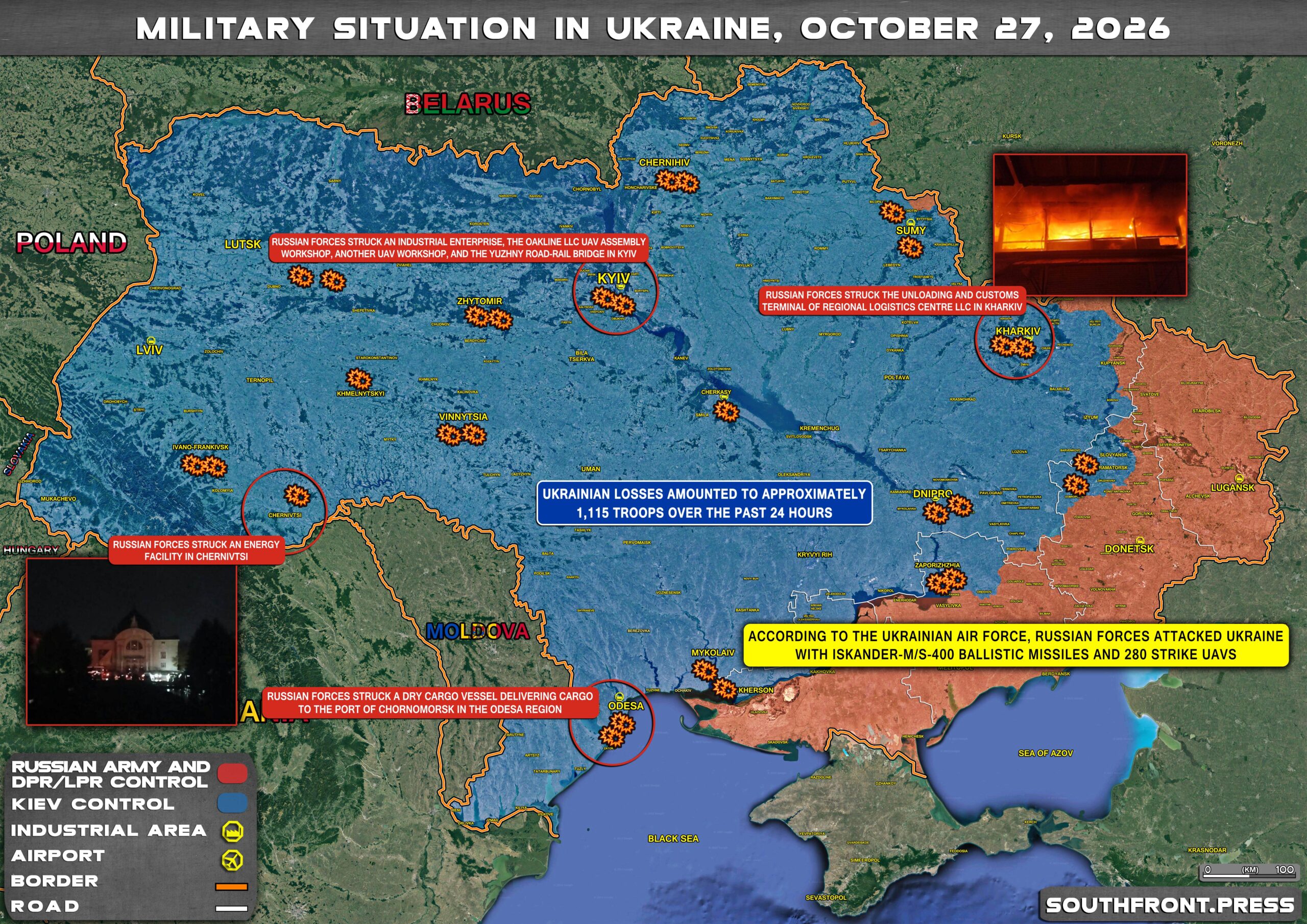
  • Russian strikes hit targets in the Sumy, Kharkiv, Zaporizhzhia, Dnipropetrovsk, Kherson, Kyiv, Vinnytsia, Zhytomyr, Ivano-Frankivsk, Odesa, Rivne, Khmelnytskyi, Cherkasy, Chernihiv regions, and the DPR;
  • According to the Ukrainian Air Force, Russian forces attacked Ukraine with Iskander-M/S-400 ballistic missiles and 280 strike UAVs;
  • Russian forces struck an industrial enterprise, the Oakline LLC UAV assembly workshop, another UAV workshop, and the Yuzhny road-rail bridge in Kyiv;
  • Russian forces struck the unloading and customs terminal of Regional Logistics Centre LLC in Kharkiv;
  • Russian forces struck a dry cargo vessel delivering cargo to the port of Chornomorsk in the Odesa region;
  • Russian forces struck an energy facility in Chernivtsi;
  • Ukrainian losses amounted to approximately 1,115 personnel over the past 24 hours.

Click to see the full-size image

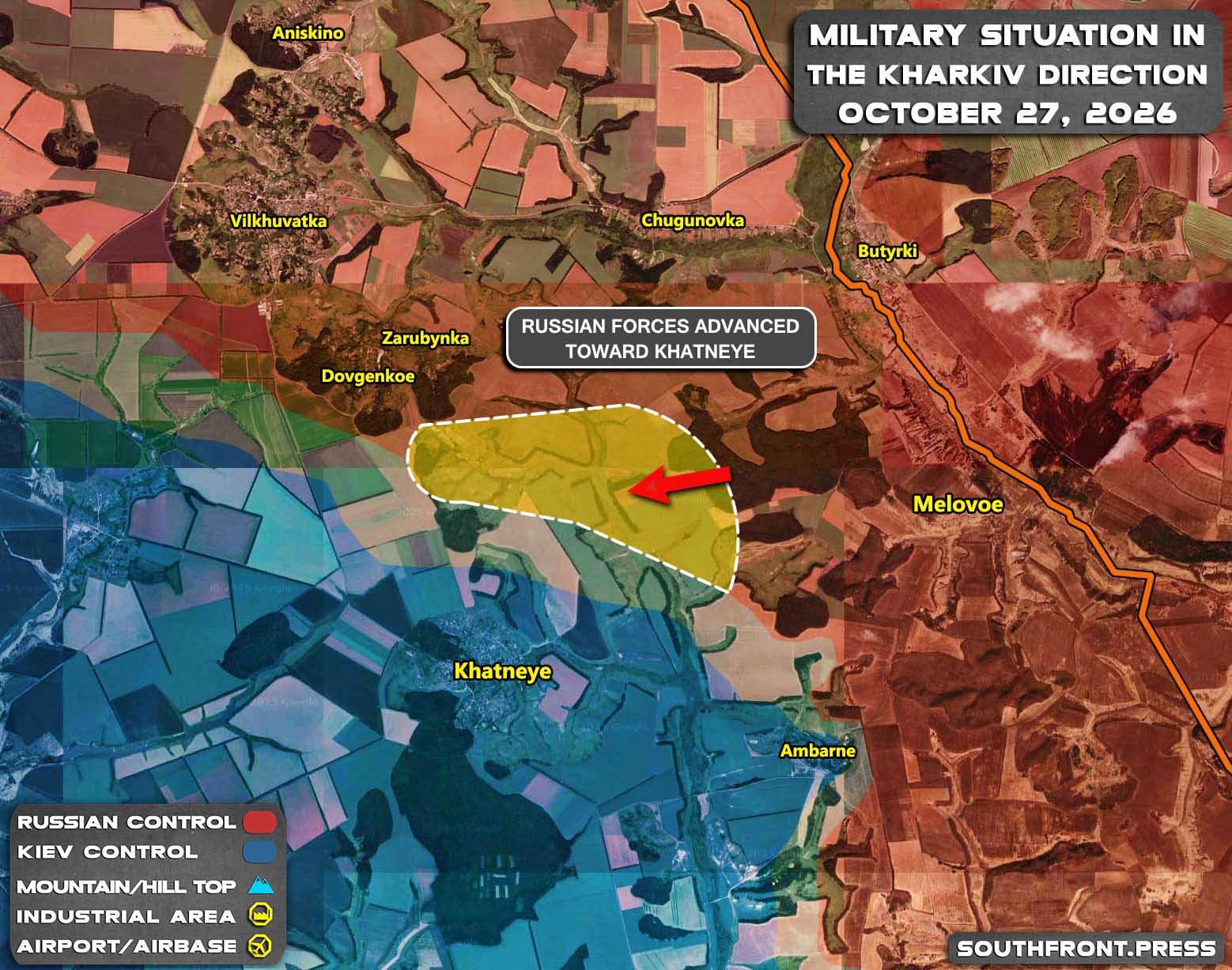
  • Russian forces advanced toward Khatneye.

Click to see the full-size image

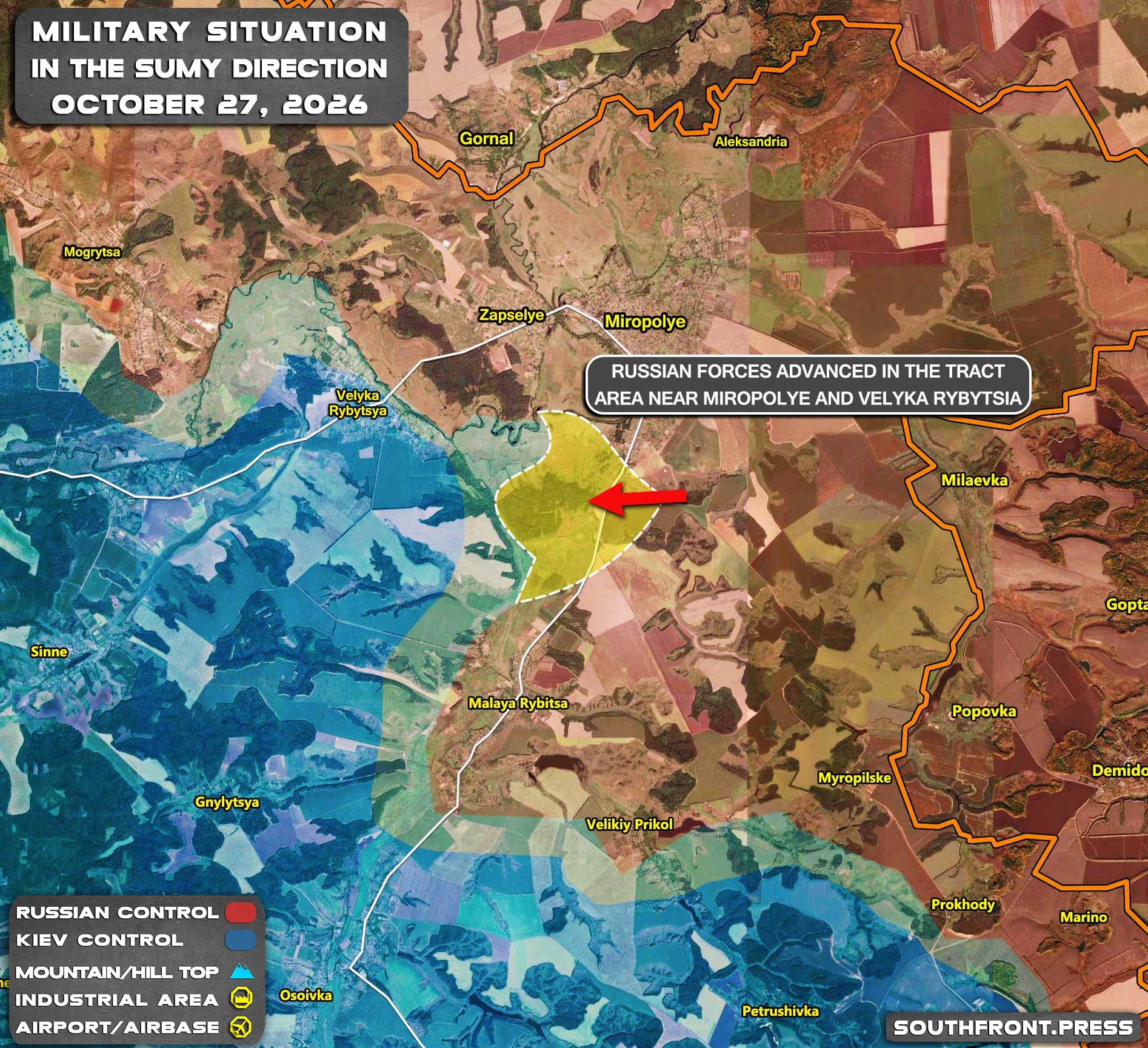
  • Russian forces advanced in the tract area near Miropolye and Velyka Rybytsia.

Click to see the full-size image

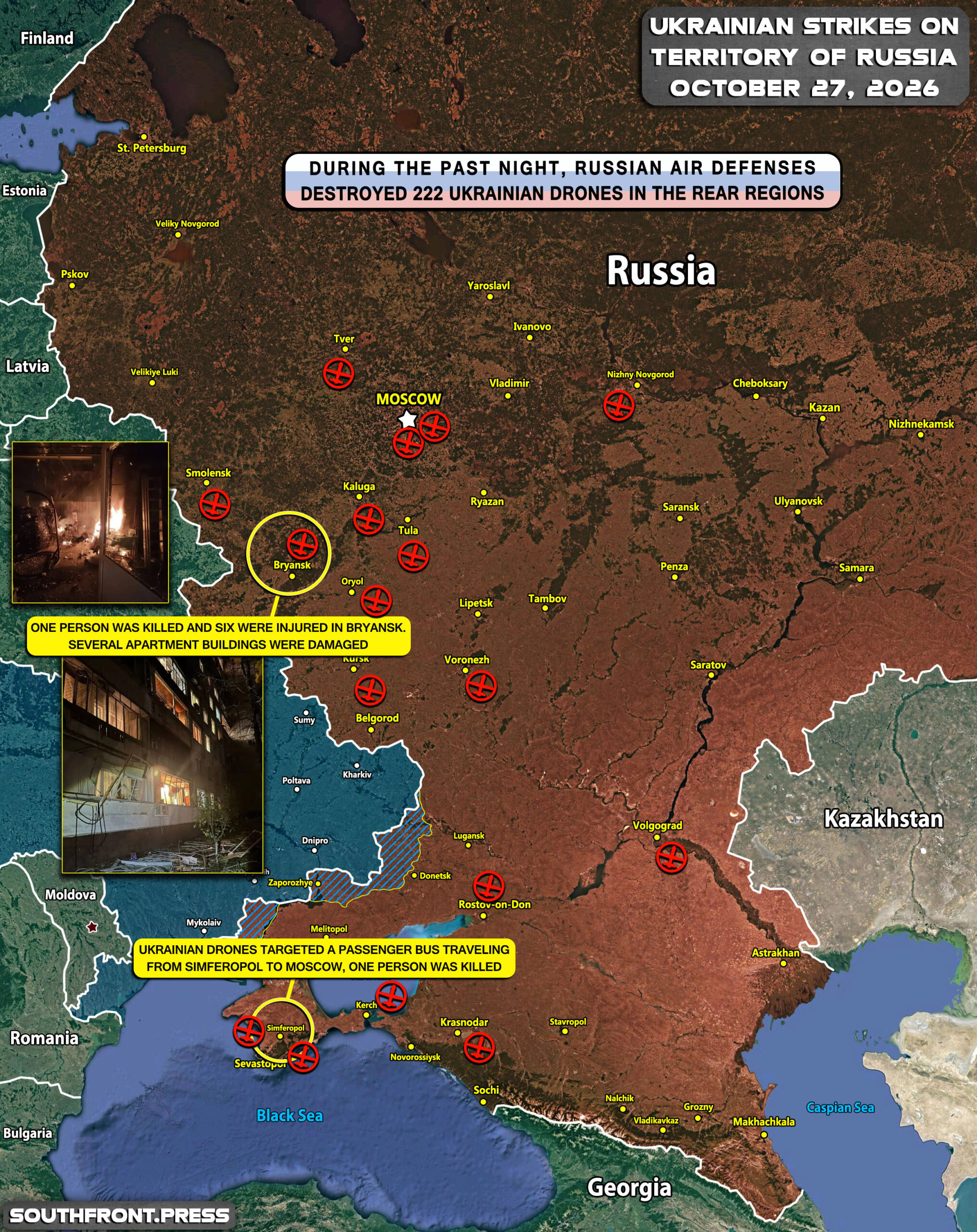
  • During the past night, Russian air defenses destroyed 222 Ukrainian drones in the rear regions;
  • Russian air defenses intercepted UAVs in the Novgorod, Tver, Belgorod, Bryansk, Kursk, Kaluga, Oryol, Tula, Voronezh, Smolensk, and Rostov regions, in Krasnodar Krai, in the Republic of Crimea, and over the Black Sea;
  • Russian air defenses intercepted UAVs in the Novgorod, Tver, Belgorod, Bryansk, Kursk, Kaluga, Oryol, Tula, Voronezh, Smolensk, Rostov regions, Krasnodar region, the Republic of Crimea, and over the Black Sea;
  • One person was killed and six were injured in Bryansk. Several apartment buildings were damaged;
  • Ukrainian drones targeted a passenger bus traveling from Simferopol to Moscow, One person was killed.

MORE ON THE TOPIC:

The post Military Situation In Ukraine And Ukrainian Attacks On Russian Territory On October 27, 2026 (Maps Update) appeared first on South Front.

Russia Continues Strikes on Ukraine’s Attack-Drone Production and Military Supply Hubs

27 October 2026 at 19:26

Click to see the full-size image

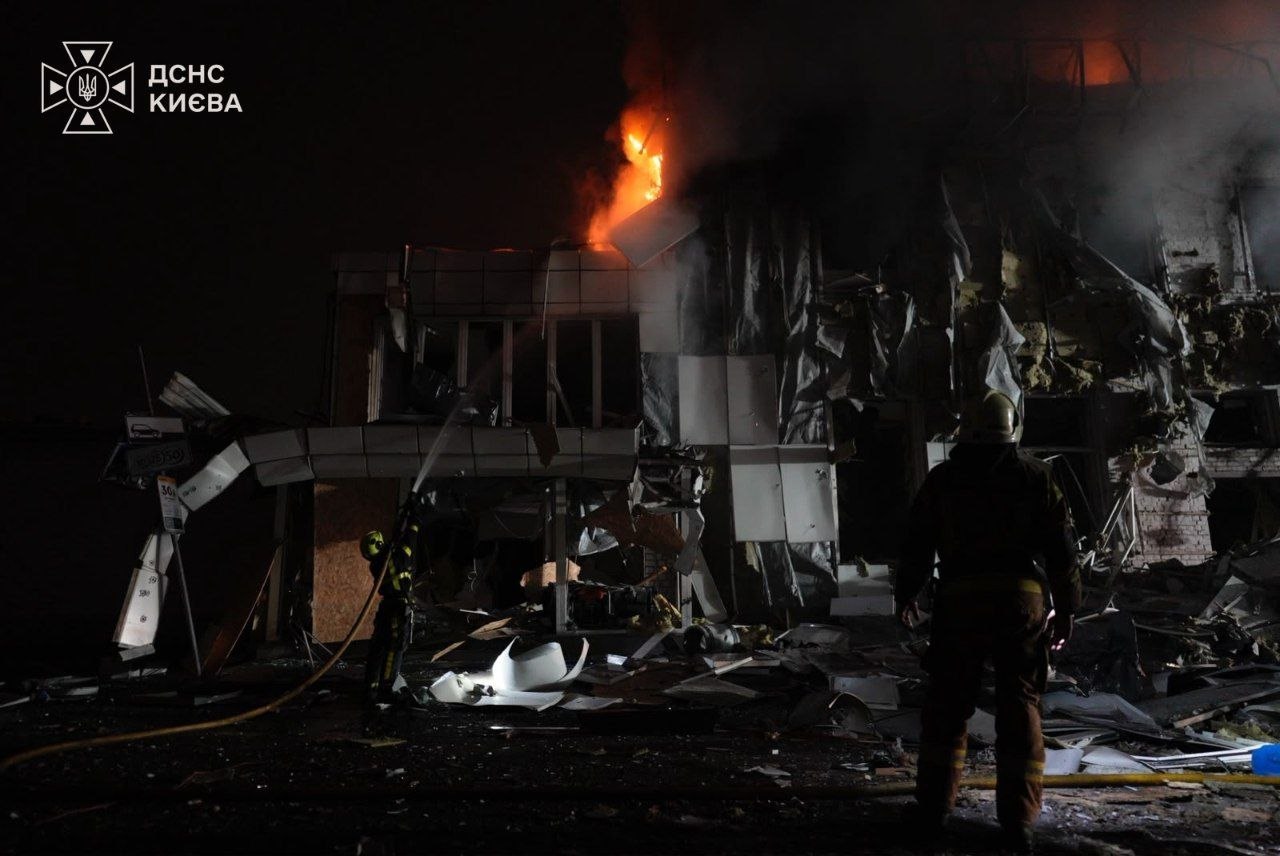
On the night of October 27, the Russian Armed Forces carried out a massive combined strike across Ukrainian territory. According to the Ukrainian Air Force, the attack involved Iskander-M/S-400 ballistic missiles and strike UAVs, 16 missiles and more than 280 drones in total. The Russian Ministry of Defense says it struck defense-industrial enterprises involved in the production of cruise missiles and UAVs, transportation infrastructure, logistics centers handling dual-use cargo, and maritime vessels used to support the Ukrainian Armed Forces.

Strikes by Region

Kyiv and Kyiv Region

• Southern Road-and-Rail Bridge. A key piece of transportation infrastructure in the capital used for the transit of cargo by road and rail. Ukrainian sources confirmed damage to the crossing, which led to a partial suspension of service on the Green Line of the metro and major transport disruption at Darnytsia Station.
• UAV assembly workshop of LLC Oakline. A production site that assembled and stored Fire Point’s FP-1 and FP-2 long- and medium-range unmanned aerial vehicles.
• Industrial facility producing and storing long- and medium-range UAVs. Another Kyiv site struck during the overnight attack; its specific name has not been disclosed.
• UAV assembly workshop producing and storing long- and medium-range fixed-wing unmanned aerial vehicles.

Kharkiv Region
• Unloading and customs terminal of the Regional Logistics Center company. A logistics facility where, according to the Russian Ministry of Defense, military supplies, dual-use cargo intended for the Ukrainian Armed Forces, and reconnaissance and strike UAVs were stored and distributed.

• Electronics manufacturer LLC NTP Ukrspetssvyaz, in the settlement of Nadtochii. A production site that made automation systems and communications equipment for the Ukrainian Armed Forces.

• Gas production infrastructure. Naftogaz reported a morning strike on gas production infrastructure in Kharkiv Region. The available information does not identify specific fields or facilities.

• Budmen home-improvement store in Kharkiv. A facility reportedly struck, according to local Telegram channels.

Odesa Region
• Bulk carrier bound for the port of Chornomorsk. A cargo vessel that, according to the Russian Ministry of Defense, was delivering supplies intended to support the Ukrainian Armed Forces.
• Bulk carrier bound for the port of Odesa. Another cargo vessel en route to Odesa with military cargo; it was struck in the daytime wave of attacks.

Chernivtsi Region
• Energy infrastructure facility. Local sources said the target was a substation; Chernivtsioblenergo warned of possible large-scale emergency outages. In Chernivtsi, trolleybus service was suspended, power was lost in several districts, and water was supplied at reduced pressure.

Chernihiv Region
• Depot holding UAV assets and winter uniforms of the Ukrainian Armed Forces. According to monitoring channels, a UAV strike sparked a large fire that destroyed unmanned systems and winter uniforms belonging to Ukrainian troops.

Strikes on facilities were also reported in Vinnytsia, Zhytomyr, Lviv, Sumy, Zaporizhzhia, Dnipropetrovsk, Kherson, Ivano-Frankivsk, Rivne, Khmelnytskyi, and Cherkasy Regions.

The nature of the October 27 strikes points to a continued systematic campaign against Ukraine’s strike-UAV production chain and the logistics hubs supplying its armed forces. Within this framework, the overnight wave combined strikes on Kyiv’s assembly facilities with damage to the Southern Bridge, affecting both drone production and its delivery channels. The strikes on the logistics terminal in Kharkiv Region and on cargo vessels off Chornomorsk and Odesa serve the same purpose: cutting off routes for dual-use cargo and components. The damage to the energy facility in Chernivtsi Region was limited in scale and did not involve major power-generation capacity, unlike earlier attacks on thermal and hydroelectric power plants.

Ukraine’s response is shifting toward scaling output rather than quality: Defense Minister Oleksii Khmara discussed with Western partners the transfer of 10% of their Patriot and IRIS-T missile stockpiles, as well as the possibility of doubling Ukrainian drone production by 2027 with sufficient funding. This aligns with Fire Point’s acknowledgment that the Flamingo missile mattered more as a political signal than as a “superweapon.” According to company head Iryna Terekh, the project was primarily intended to demonstrate Ukraine’s ability to conduct long-range strikes against Russian territory. The company also acknowledged the economic trade-off: delivering a 200-kilogram warhead over 300 kilometers by ballistic missile costs about $600,000, whereas a drone can deliver a comparable payload over 380 kilometers for $40,000-$50,000.

It is precisely this economic logic that explains why strikes on FP-1 and FP-2 assembly capacity and logistics hubs are becoming increasingly significant: drones remain Ukraine’s most numerous and affordable means of long-range strike, and this segment is also the most vulnerable part of its program. In the medium term, Russian strikes are likely to continue prioritizing enterprises that produce components for UAVs and cruise missiles, as well as transportation routes linking Ukraine’s central and western regions to the front line.


MORE ON THE TOPIC:

The post Russia Continues Strikes on Ukraine’s Attack-Drone Production and Military Supply Hubs appeared first on South Front.

Russian court jails IT company director for 13 years over crypto donations after Binance shared his data, rights group says

27 October 2026 at 15:32

Binance’s name in 3D letters. Illustrative photo: TechCrunch

A Russian court sentenced Yuri Belenky, director of the IT company DiHouse, to 13 years in prison on terrorism financing charges, Radio Liberty reported on 26 October. The case concerns cryptocurrency donations that investigators believe were meant for Ukraine’s Armed Forces, the outlet said. The court also fined Belenky 500,000 rubles ($6,200), according to the report.

Since 2022, Russian courts have imprisoned Russians and Ukrainians under treason, terrorism, and other national-security laws over donations to Ukrainian causes. Binance, one of the world’s largest cryptocurrency exchanges, left Russia in 2023 but says it cooperates with lawful law-enforcement requests in different countries.

Belenky had lived in Bulgaria with his wife and child since 2015. In September 2025, he traveled to Moscow on business, and police detained him at the airport for allegedly using obscene language, Radio Liberty reported. In court, Belenky denied swearing, but the judge gave him 13 days of administrative detention. On the 10th day of his detention, Russia’s Investigative Committee opened a criminal case against him under an article on terrorism financing, based on a report from the Federal Security Service, according to the report.

Binance shared account records with Russian investigators, rights group says

In October 2025, Russia’s Investigative Committee contacted Binance to request information on six users who had transferred funds to a cryptocurrency wallet published by journalist Arkady Babchenko, the Russian human rights project First Department said on 17 August 2026. The exchange provided investigators with Belenky’s detailed account history, including his personal information, copies of identification documents, and cryptocurrency transaction records, according to the organization. The human rights project said the materials helped investigators identify nine more transfers, which went into the final charge against Belenky. Binance told his lawyer it does not give law enforcement user account data without a court order or an equivalent ruling, the group said.

Belenky’s alleged offense was transferring donations totaling 126,000 rubles ($1,560) between 2022 and 2024 to an account published by Babchenko, Radio Liberty reported. The court ordered that sum confiscated.

russian troops ukraine
Explore further

Russia sentences Ukrainian women from Zaporizhzhia Oblast to 14 years for donating $120 to Ukrainian forces

The court said the money in Babchenko’s account went to Ukraine’s Armed Forces and the Azov battalion, which Russia designates as a terrorist organization, Radio Liberty reported.

In a statement dated 14 October 2025, Babchenko said he had not received transfers from Belenky to the cryptocurrency wallets he had published. He emphasized that he had raised money for civilian humanitarian needs, not to support the military.

Binance’s exit from Russia and previous data-sharing concerns

In September 2023, Binance announced that it would sell its entire Russian business to cryptocurrency exchange CommEX, according to the company’s website. Operating in Russia was incompatible with Binance’s compliance strategy, the exchange’s chief compliance officer, Noah Perlman, said in the announcement. Binance said it would fully exit the Russian market, receive no share of future revenue from the sale, and retain no option to buy back the business.

CommEX said on 29 September 2023 that it was not owned by Binance but confirmed that it had hired some former Binance employees during the platform’s six-month development, Cointelegraph reported.

London-UK-britain-united-kingdom
Explore further

UK sanctions crypto exchanges and “A7 network” in crackdown on Russian evasion systems

The exit came after earlier questions about Binance’s dealings with the Russian state. In April 2021, Russian financial intelligence officials met with Binance’s head of Eastern Europe and Russia in Moscow and asked the exchange to provide customer data, including names and addresses, Reuters reported in April 2022. The Binance executive agreed to the request in a message to a business associate, saying he didn’t have “much of a choice,” the outlet said. Binance told Reuters it had never been contacted by Russian authorities about Kremlin critic Alexei Navalny.

In February 2026, 11 US senators asked the Treasury Department and the Justice Department to investigate Binance’s compliance with sanctions and anti-money laundering rules, Cointelegraph reported. They cited reports that about $1.7 billion had moved through Binance to Iran-linked entities, as well as possible activity related to evading Russian sanctions. The senators also warned that Binance payment cards launched in parts of the former Soviet Union could facilitate sanctions evasion. Binance rejected the allegations.

302,000 Russian soldiers killed or wounded by Ukrainian drones since January, Defense Ministry says

27 October 2026 at 11:25
The highest number of casualties Ukrainian drones inflicted on the Russian military was recorded in March, with almost 34,000 soldiers killed or irrecoverably wounded.

War Will Cover Up the Losses: How Europe’s Crises Are Fueling Escalation with Russia

27 October 2026 at 10:16

Click to see the full-size image

Europe and Russia are entering a phase in which diplomatic expulsions and explosives-laden drones at airports are no longer treated as exceptions. Germany is openly preparing its hospitals for an influx of wounded personnel, while the assessed threat of sabotage has officially been raised. Meanwhile, expensive energy and competition are costing European industry production capacity and jobs. Under these conditions, an external conflict offers a convenient way to blame economic failures on a foreign enemy. The question is no longer whether escalation is taking place, but how far the two sides are prepared to go before it slips beyond their control.

The autumn of 2026 has brought a series of developments that take the confrontation between Russia and Europe beyond the familiar boundaries of ‘hybrid warfare’. In August, drones carrying explosives were discovered at Leipzig/Halle Airport. The German authorities formally blamed Russia, describing the incident as ‘crossing a red line’ with potentially lethal consequences. Berlin closed Russia’s consulate-general in Bonn and its cultural center. Moscow responded by closing the German consulate in St. Petersburg.

In September, another drone carrying explosives was found near Wunstorf airbase. The Bundeswehr subsequently raised its assessment of the threat from Russian sabotage to ‘significant’, the second-highest level, for the first time. German intelligence services warn that further attacks are likely. Meanwhile, arson attacks have been reported at drone manufacturing facilities in Estonia, Poland and Slovakia, alongside drone incidents over military installations and civilian airports across Europe.

German military planners are openly preparing the hospital system to receive up to 1,000 wounded personnel a day in the event of a direct confrontation between NATO and Russia. Underground medical bunkers are being brought back into service, including one in Ulm with capacity for 2,000 people. Civilian surgeons are being trained to treat blast injuries and burns, while coordination between military and civilian hospitals is being strengthened. Diplomatic expulsions, consular closures, accusations of sabotage and preparations for mass casualties together suggest that both sides are already operating according to the logic of an ‘undeclared war’.

Military and diplomatic tensions, however, are only one part of the picture. The economic conditions in which this escalation is unfolding, and the political purpose it serves, are more consequential.

Europe’s economy is facing a deep structural crisis that can no longer be concealed behind reports celebrating the ‘green transition’. TTF benchmark gas prices are hovering around €87–88 per MWh, approximately 174% higher than a year earlier. EU gas storage facilities are just 71–74% full, among the lowest mid-October levels of the past decade, compared with around 83% last year. Germany’s position is even weaker, with storage levels fluctuating around 57–60%.

Electricity and fuel costs are putting pressure on the entire supply chain. Annual energy inflation reached almost 19% in September, while average diesel prices across the EU climbed to €2.14–2.23 per liter. Industrial energy costs are four to five times those faced by American competitors. Chemical plants and metal producers, particularly in Germany and northern Italy, are being forced to cut output or shut down production facilities. Industrial production in the eurozone continues to fall; in Germany, it is already almost 10% below its 2021 level. Industry’s share of EU GDP has declined from 17.4% to 14.3%.

The pressure extends to agriculture. Fertilizer prices have risen by more than 13%, while farmers’ energy costs have increased by around 22%. At the same time, the prices farmers receive for their produce are falling. This raises the risk of a poorer harvest in 2027 and a second wave of food inflation. Farmers in several countries are already warning that their operations are becoming commercially unviable, while transport costs are making many deliveries unprofitable.

The situation resembles a familiar scheme: a warehouse owner who has spent years stealing stock eventually sets fire to the building and tells investigators that everything was destroyed ‘by accident’. European governments have spent years pursuing policies that have made energy expensive, imposed excessive regulation and applied sanctions whose heaviest impact has fallen on their own industry and agriculture. Now, as gas, electricity, diesel and fertilizer bills squeeze businesses and households, and Chinese competitors capture market share, an external conflict offers a convenient excuse.

War, or even the prospect of war, allows rising prices, factory closures, cuts to social spending and budget shortfalls to be blamed on an ‘external aggressor’. Instead of acknowledging mistakes in energy and industrial policy, governments invoke the ‘price of freedom’ and the ‘defense of democracy’. The further tensions escalate, the easier it becomes to explain to the public why housing, food and heating cost more, and why industrial jobs are disappearing.

The current situation brings together two parallel developments. Tensions are rising through sabotage incidents, diplomatic expulsions, higher threat assessments and preparations for hospitals to receive large numbers of wounded personnel. At the same time, European elites need a convenient external explanation for economic failure. High gas and electricity prices, low storage levels, expensive diesel, rising fertilizer costs and shrinking industrial output are already a reality. Escalation creates political capital for those responsible for costly mistakes in energy and industrial policy over recent years. It allows them to shift the discussion from domestic policy failures to an ‘external threat’, postponing accountability.

This logic itself increases the risk of an uncontrolled shift from ‘hybrid’ operations to direct confrontation. As long as European governments prefer preparing hospitals for thousands of casualties to reconsidering their energy and industrial policies, the practice of ‘burning down the warehouse to conceal the missing stock’ continues. The remaining question is how far the two sides are prepared to go before the cost becomes too high for European societies themselves.


MORE ON THE TOPIC:

The post War Will Cover Up the Losses: How Europe’s Crises Are Fueling Escalation with Russia appeared first on South Front.

Military Situation In Ukraine And Ukrainian Attacks On Russian Territory On October 26, 2026 (Maps Update)

26 October 2026 at 15:32

Click to see the full-size image

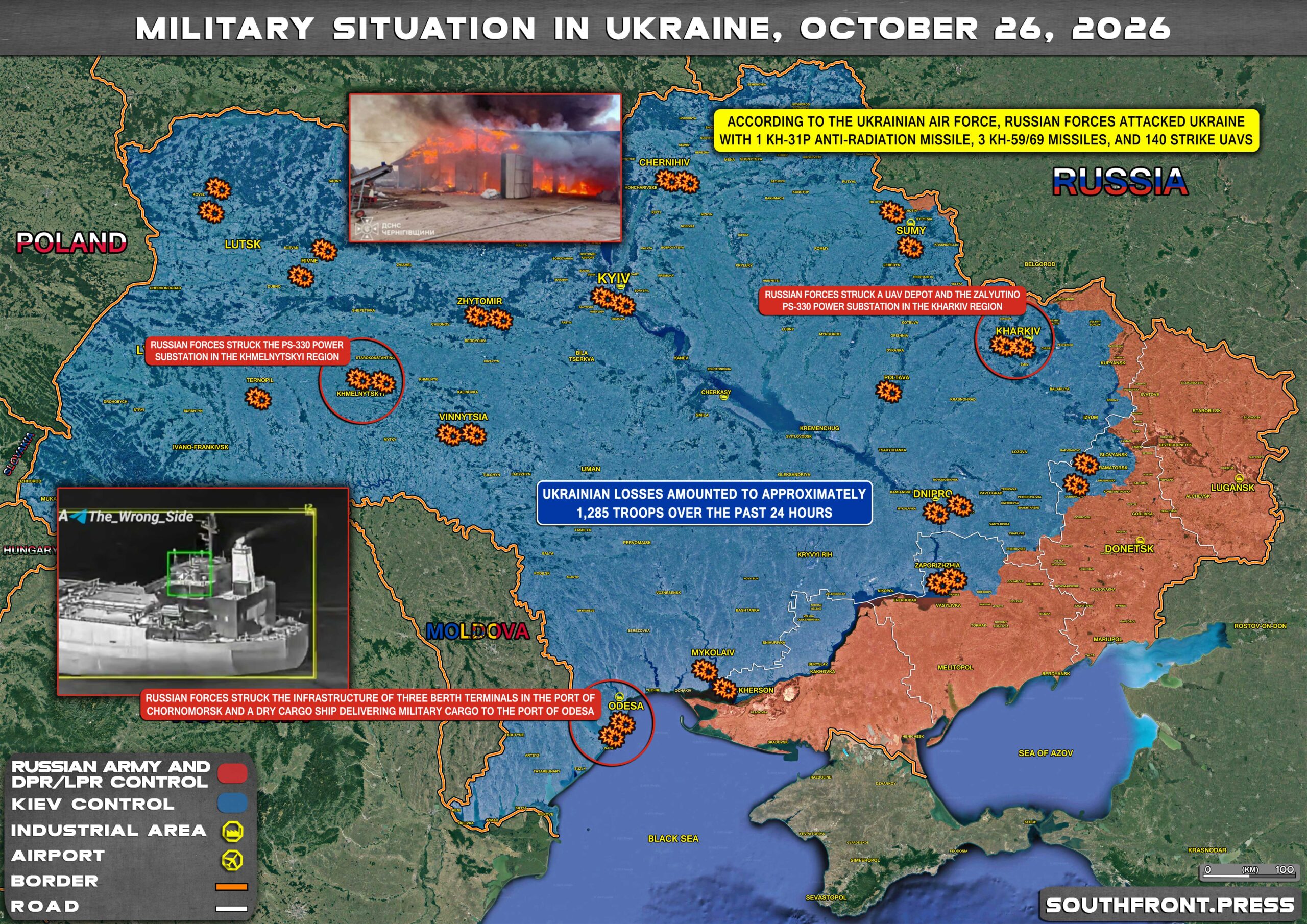
  • Russian strikes hit targets in the the Sumy, Kharkiv, Zaporizhzhia, Dnipropetrovsk, Kherson, Vinnytsia, Zhytomyr, Kyiv, Lviv, Odesa, Poltava, Rivne, Ternopil, Khmelnytskyi, Chernihiv, Chernivtsi regions, and the DPR;
  • According to the Ukrainian Air Force, Russian forces attacked Ukraine with 1 Kh-31P anti-radiation missile, 3 Kh-59/69 missiles, and 140 strike UAVs;
  • Russian forces struck a UAV depot and the Zalyutino PS-330 power substation in the Kharkiv region;
  • Russian forces struck the PS-330 power substation in the Khmelnytskyi region;
  • Russian forces struck the infrastructure of three berth terminals in the port of Chornomorsk and a dry cargo ship delivering military cargo to the port of Odesa;
  • Ukrainian losses amounted to approximately 1,285 personnel over the past 24 hours.

Click to see the full-size image

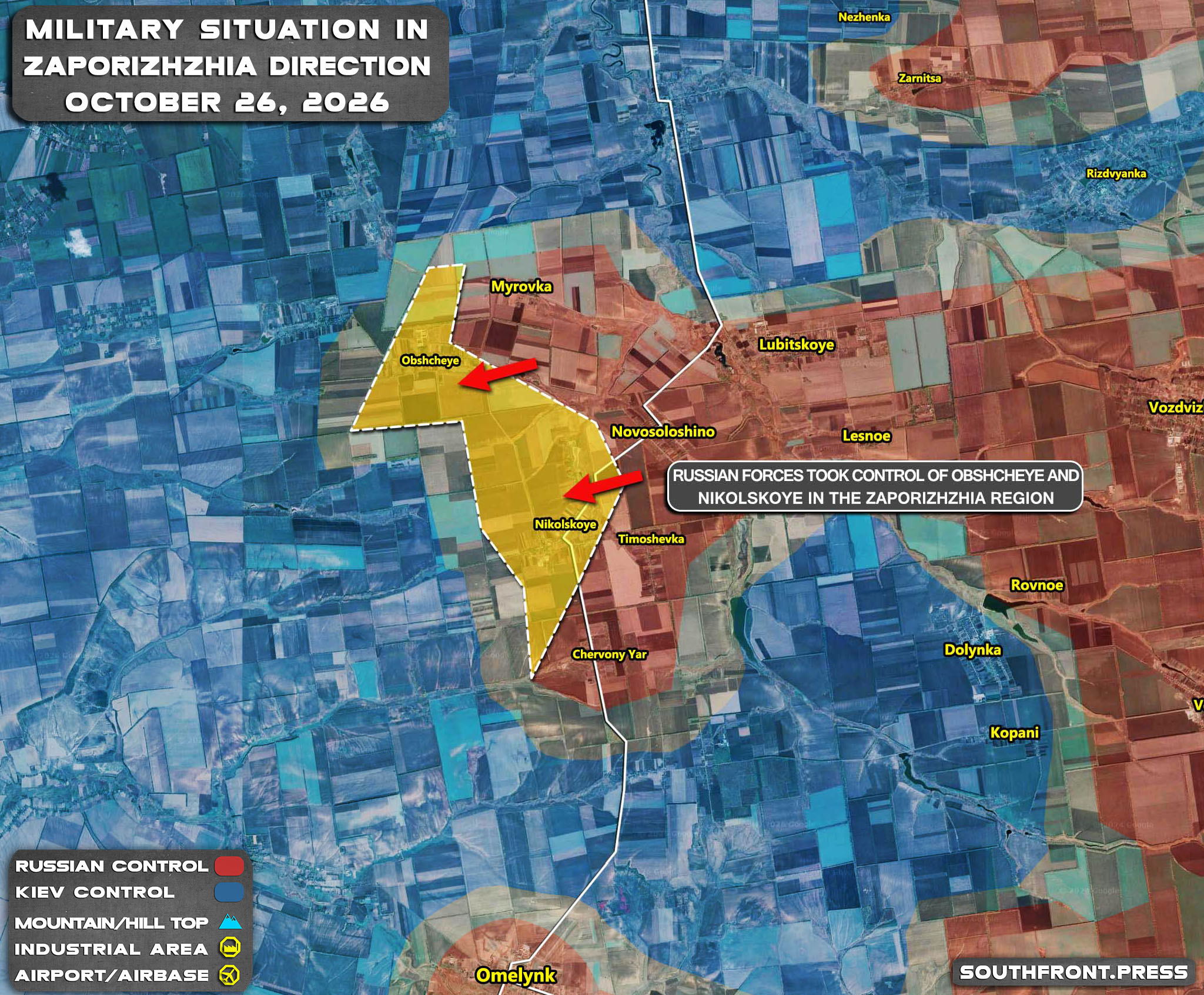
  • Russian forces took control of Obshcheye and Nikolskoye in the Zaporizhzhia region.

Click to see the full-size image

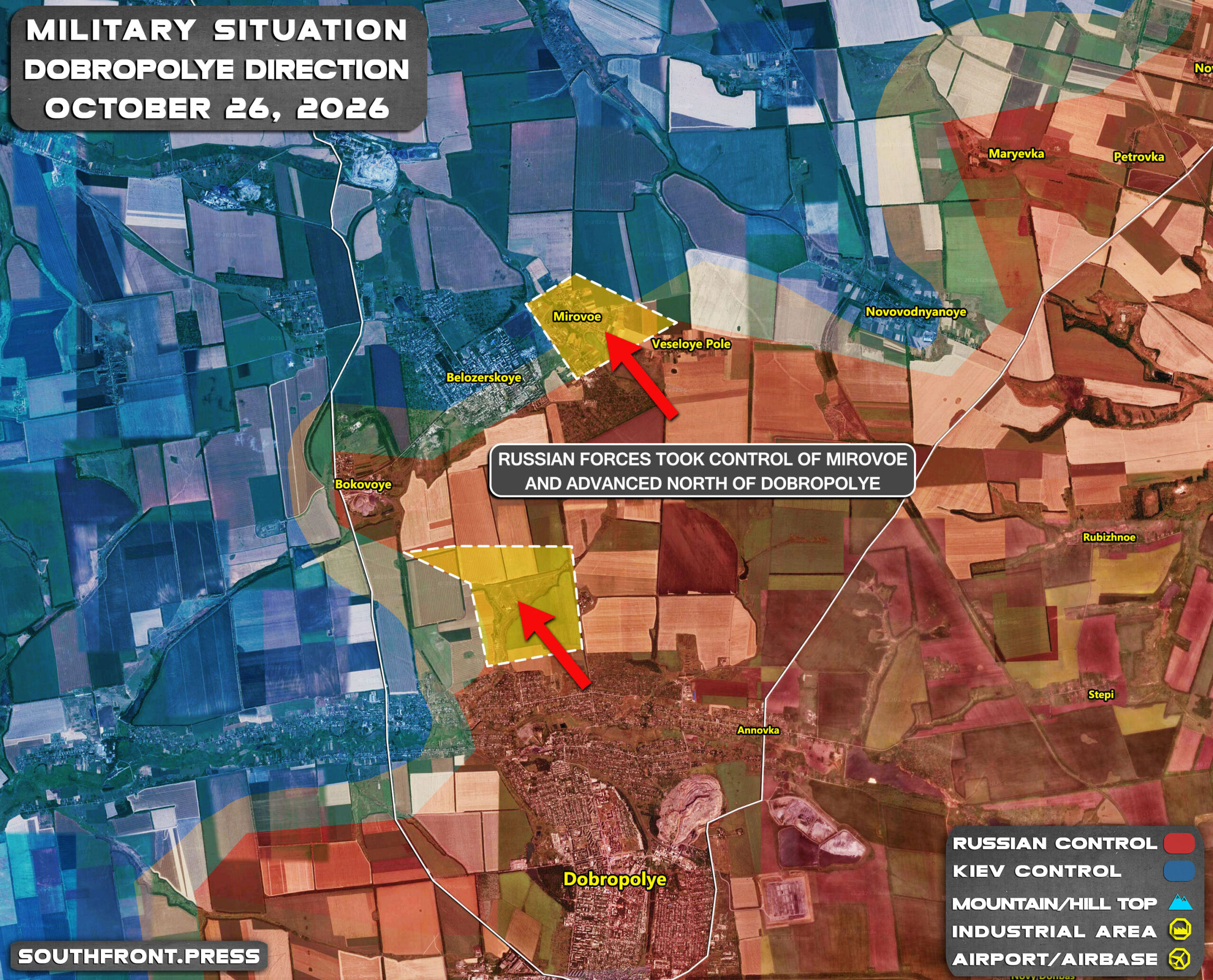
  • Russian forces took control of Mirovoe and advanced north of Dobropolye.

Click to see the full-size image

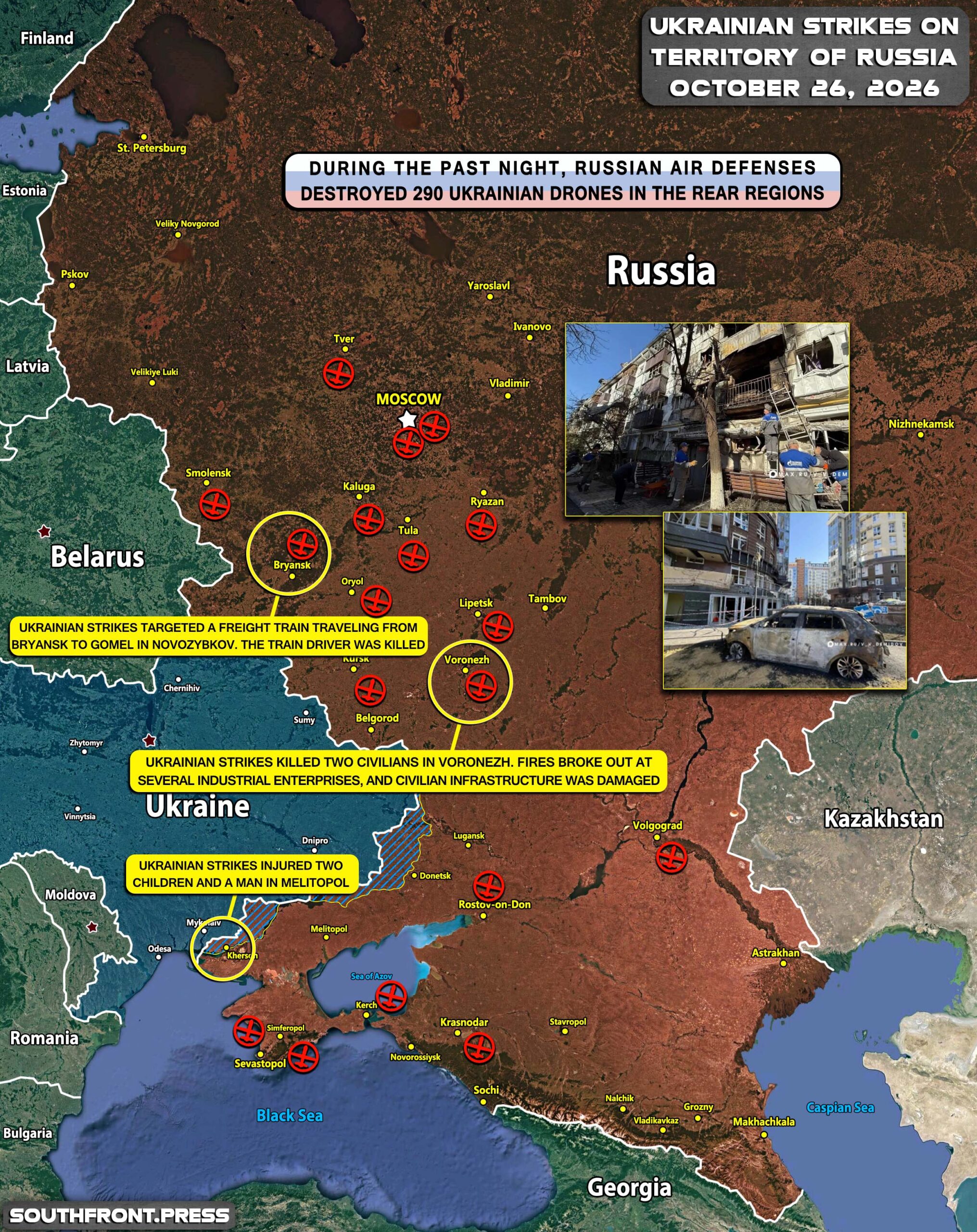
  • During the past night, Russian air defenses destroyed 290 Ukrainian drones in the rear regions;
  • Russian air defenses intercepted UAVs in the Belgorod, Bryansk, Voronezh, Volgograd, Kaluga, Kursk, Lipetsk, Novgorod, Oryol, Pskov, Rostov, Ryazan, Smolensk, Tver, and Tula regions, and in the Moscow region;
  • Ukrainian strikes killed two civilians in Voronezh. Fires broke out at several industrial enterprises, and civilian infrastructure was damaged;
  • Ukrainian strikes injured two children and a man in Melitopol;
  • Ukrainian strikes targeted a freight train traveling from Bryansk to Gomel in Novozybkov. The train driver was killed.

MORE ON THE TOPIC:

The post Military Situation In Ukraine And Ukrainian Attacks On Russian Territory On October 26, 2026 (Maps Update) appeared first on South Front.

Ukraine war latest: Ukrainian forces carry out 2 aerial evacuations of wounded soldiers, video shows

Key developments on Oct. 26:

  • Ukrainian forces carry out 2 aerial evacuations of wounded soldiers, video shows
  • Death toll from Russian attack on park in Kharkiv Oblast on Oct. 19 rises to 6 after child dies in hospital
  • Ukraine strikes Russian plant producing missile, bomb batteries in Yelets, General Staff

Ukrainian forces evacuate 2 severely wounded soldiers from battlefield using drone, video shows

26 October 2026 at 18:42
The two soldiers, 25-year-old Yevhen, call sign "Izium," and 24-year-old Artem, call sign "Kolobok," had suffered severe limb injuries and were stranded in a contested area about 5 kilometers (3 miles) from the Russian border.

Analysis: No, Elon Musk, Russian soldiers in Ukraine are not 'kids' who have 'no choice but to fight and die'

26 October 2026 at 16:24

"We should (have) some sympathy for the poor Russian conscripts too. Those kids have no choice but to fight and die in drone strikes."

For anyone watching and understanding Ukraine's years-long struggle for survival, the words of SpaceX founder and world's richest man Elon

Military Situation In Ukraine And Ukrainian Attacks On Russian Territory On October 26, 2026 (Maps Update)

26 October 2026 at 15:32

Click to see the full-size image

  • Russian strikes hit targets in the the Sumy, Kharkiv, Zaporizhzhia, Dnipropetrovsk, Kherson, Vinnytsia, Zhytomyr, Kyiv, Lviv, Odesa, Poltava, Rivne, Ternopil, Khmelnytskyi, Chernihiv, Chernivtsi regions, and the DPR;
  • According to the Ukrainian Air Force, Russian forces attacked Ukraine with 1 Kh-31P anti-radiation missile, 3 Kh-59/69 missiles, and 140 strike UAVs;
  • Russian forces struck a UAV depot and the Zalyutino PS-330 power substation in the Kharkiv region;
  • Russian forces struck the PS-330 power substation in the Khmelnytskyi region;
  • Russian forces struck the infrastructure of three berth terminals in the port of Chornomorsk and a dry cargo ship delivering military cargo to the port of Odesa;
  • Ukrainian losses amounted to approximately 1,285 personnel over the past 24 hours.

Click to see the full-size image

  • Russian forces took control of Obshcheye and Nikolskoye in the Zaporizhzhia region.

Click to see the full-size image

  • Russian forces took control of Mirovoe and advanced north of Dobropolye.

Click to see the full-size image

  • During the past night, Russian air defenses destroyed 290 Ukrainian drones in the rear regions;
  • Russian air defenses intercepted UAVs in the Belgorod, Bryansk, Voronezh, Volgograd, Kaluga, Kursk, Lipetsk, Novgorod, Oryol, Pskov, Rostov, Ryazan, Smolensk, Tver, and Tula regions, and in the Moscow region;
  • Ukrainian strikes killed two civilians in Voronezh. Fires broke out at several industrial enterprises, and civilian infrastructure was damaged;
  • Ukrainian strikes injured two children and a man in Melitopol;
  • Ukrainian strikes targeted a freight train traveling from Bryansk to Gomel in Novozybkov. The train driver was killed.

MORE ON THE TOPIC:

The post Military Situation In Ukraine And Ukrainian Attacks On Russian Territory On October 26, 2026 (Maps Update) appeared first on South Front.

Military Situation In Ukraine And Ukrainian Attacks On Russian Territory On October 25, 2026 (Maps Update)

25 October 2026 at 20:23

Click to see the full-size image

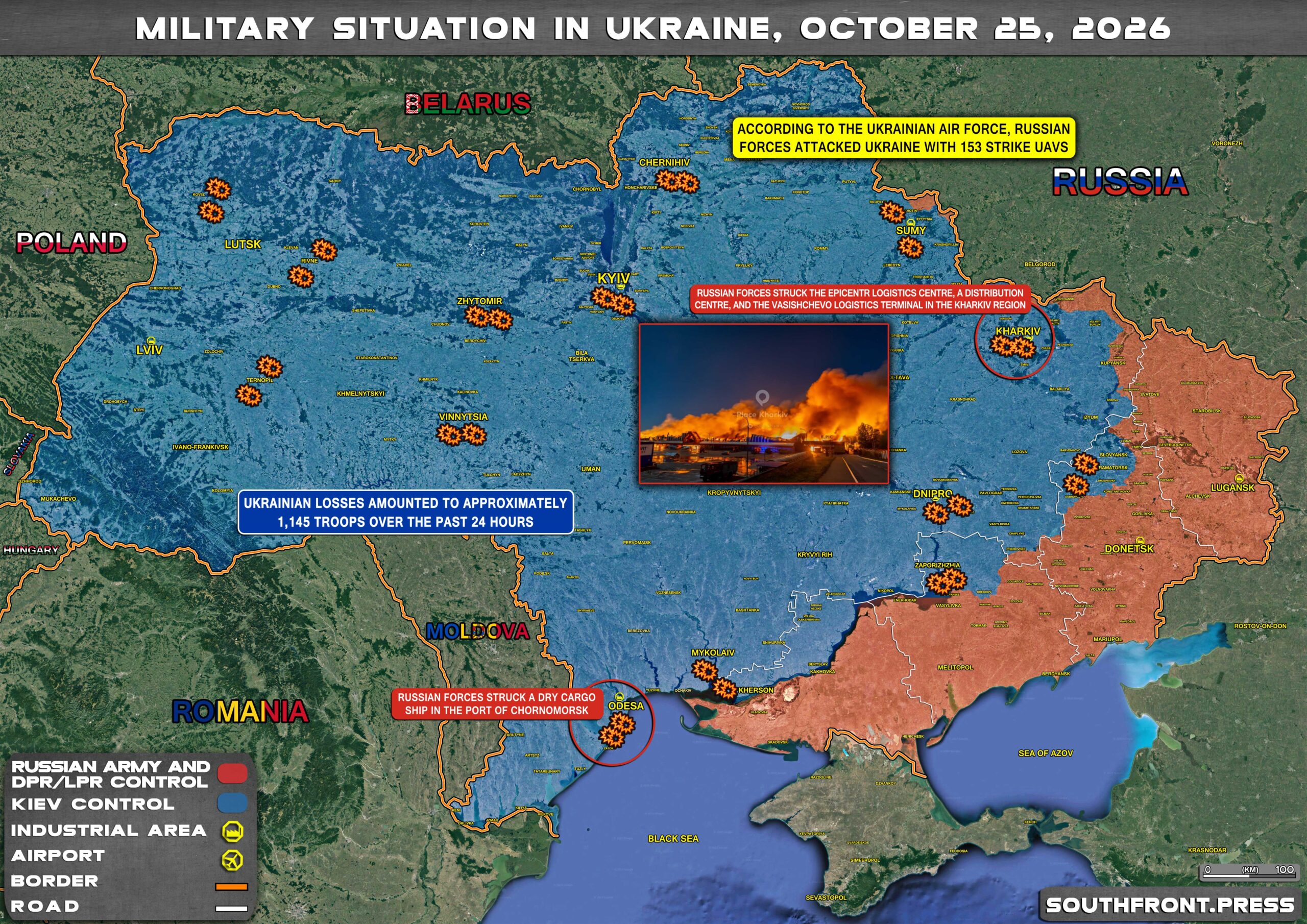
  • Russian strikes destroyed targets in the Sumy, Kharkiv, Zaporizhzhia, Dnipropetrovsk, Kherson, Vinnytsia, Volyn, Zhytomyr, Kyiv, Odesa, Rivne, Ternopil, Chernihiv regions, and the DPR;
  • According to the Ukrainian Air Force, Russian forces attacked Ukraine with 153 strike UAVs;
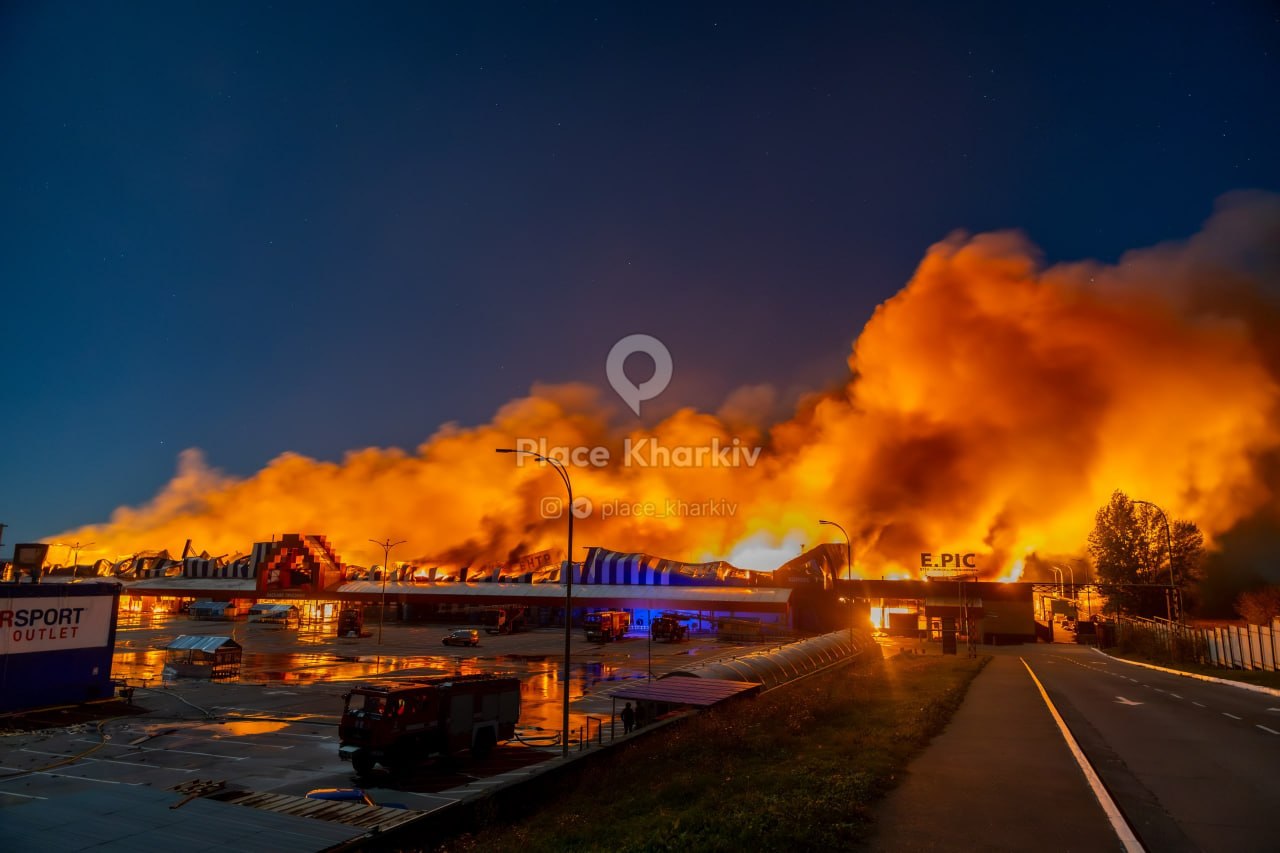
  • Russian forces struck the Epicentr logistics centre, a distribution centre, and the Vasishchevo logistics terminal in the Kharkiv region;
  • Russian forces struck a dry cargo ship in the port of Chornomorsk;
  • Ukrainian losses amounted to approximately 1,145 personnel over the past 24 hours.

Click to see the full-size image

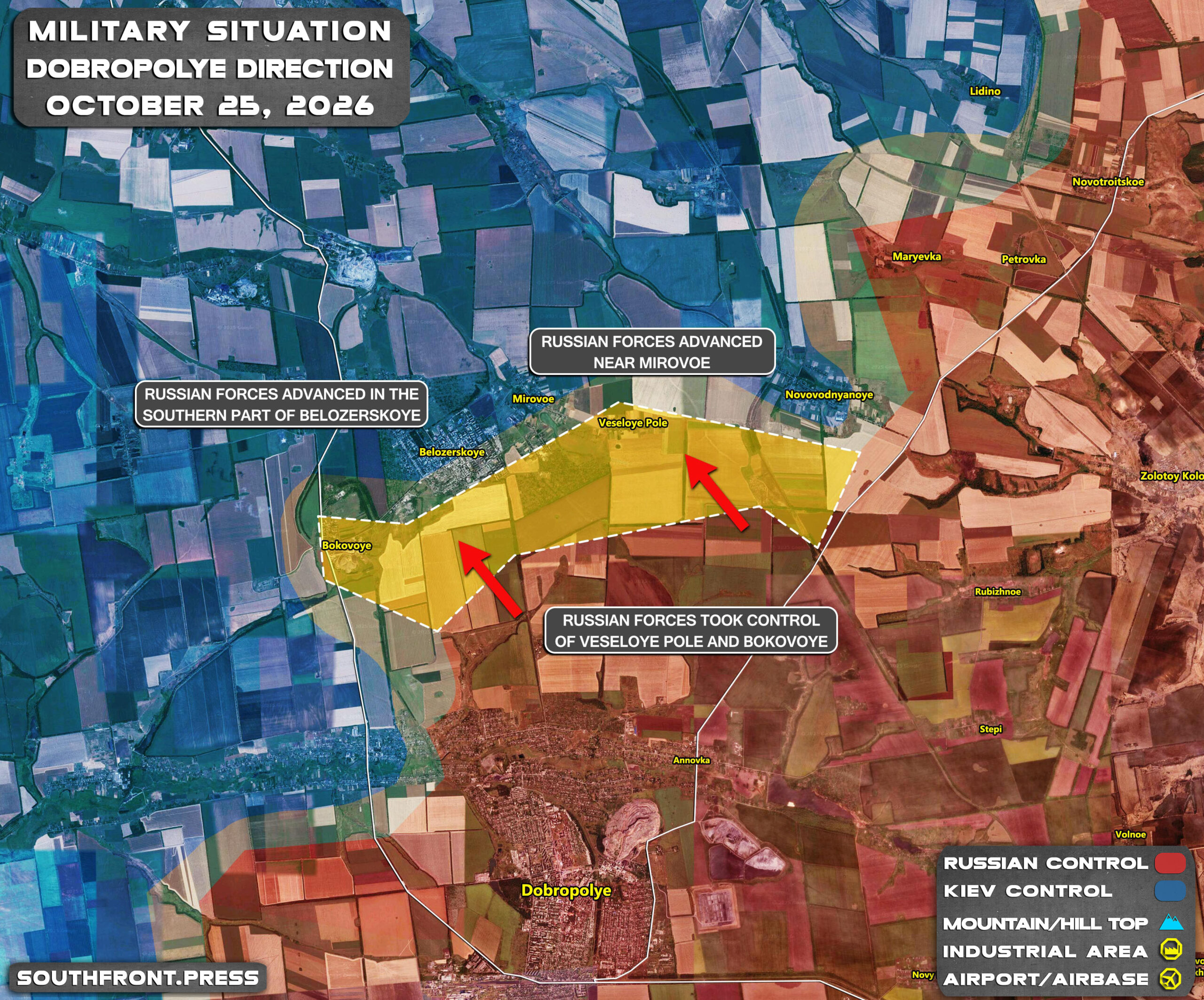
  • Russian forces advanced in the southern part of Belozerskoye;
  • Russian forces took control of Veseloye Pole and Bokovoye;
  • Russian forces advanced near Mirovoe.

Click to see the full-size image

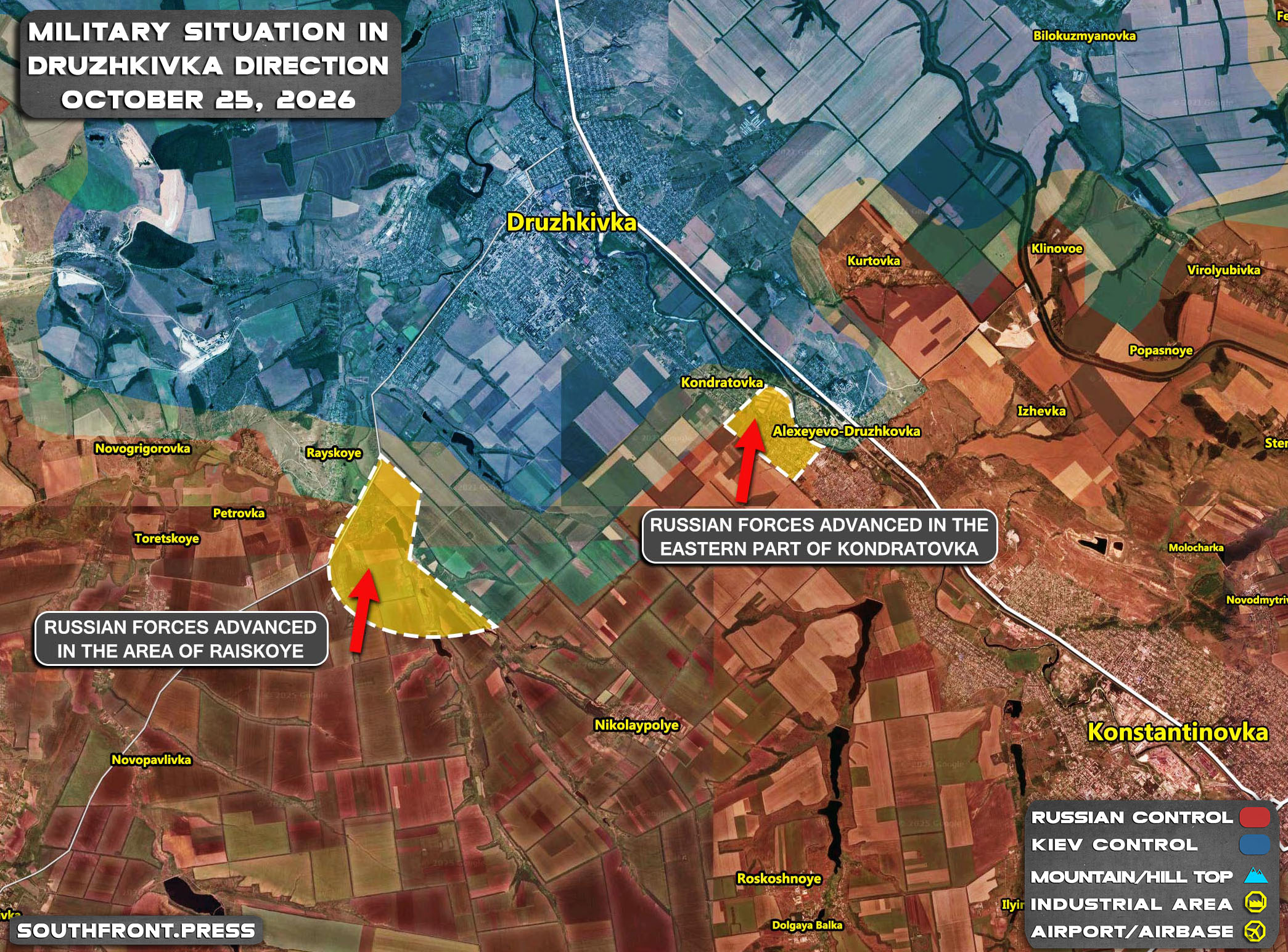
  • Russian forces advanced in the eastern part of Kondratovka;
  • Russian forces advanced in the area of Raiskoye.

Click to see the full-size image

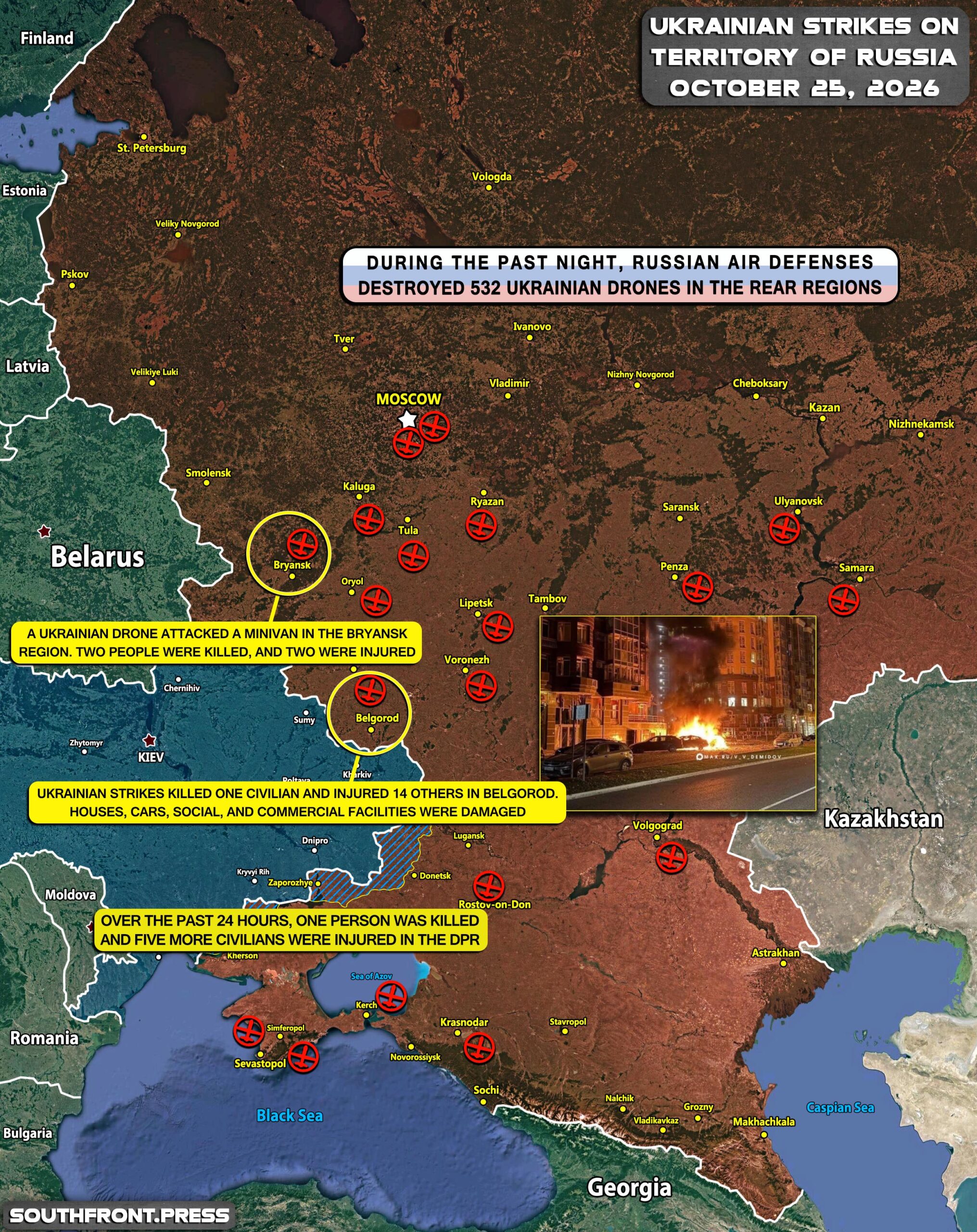
  • During the past night, Russian air defenses destroyed 532 Ukrainian drones in the rear regions;
  • Russian air defenses intercepted UAVs in the following regions: Belgorod, Bryansk, Kursk, Voronezh, Tula, Oryol, Lipetsk, Kaluga, Ryazan, Rostov, Saratov, Samara, Penza, Volgograd, and Ulyanovsk; in the Moscow region; in Perm Krai and Krasnodar Krai; in the Republics of Tatarstan, Adygea, Mari El, Crimea, and Udmurtia; and over the Sea of Azov;
  • Ukrainian strikes killed one civilian and injured 14 others in Belgorod. Houses, cars, social, and commercial facilities were damaged;
  • A Ukrainian drone attacked a minivan in the Bryansk region. Two people were killed, and two were injured;
  • Over the past 24 hours, one person was killed, and five more civilians were injured in the DPR.

MORE ON THE TOPIC:

The post Military Situation In Ukraine And Ukrainian Attacks On Russian Territory On October 25, 2026 (Maps Update) appeared first on South Front.

Mobilization in Ukraine Continues Unabated: The Daily Reality of Forced “Busification”

26 October 2026 at 00:07

Click to see the full-size image

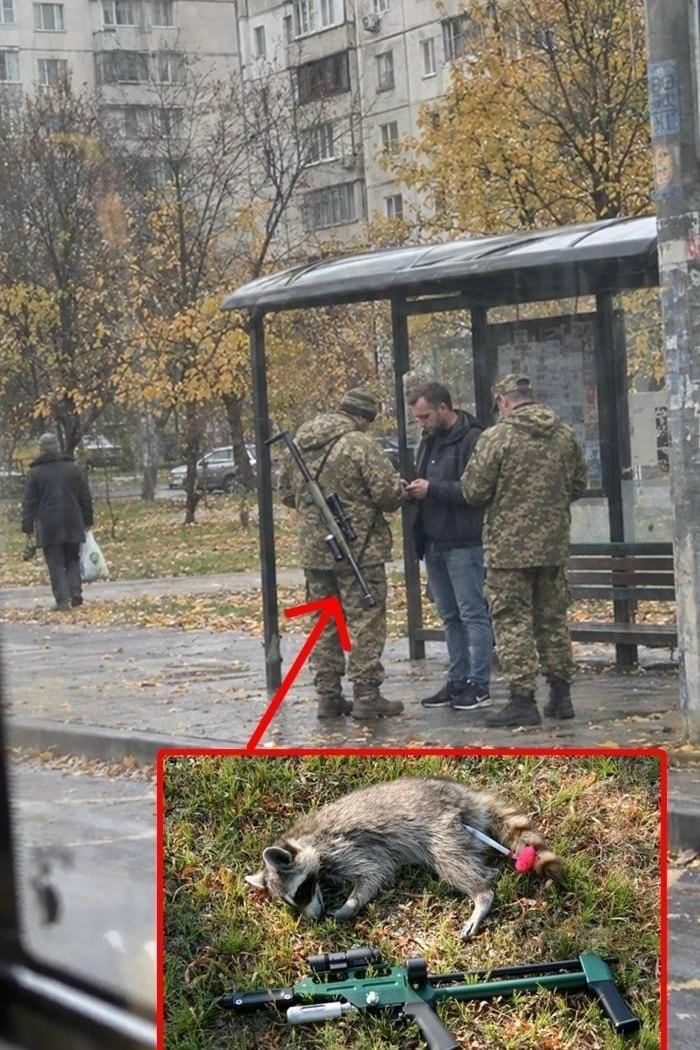
Forced mobilization in Ukraine has become a routine practice that shows no sign of slowing down. According to data obtained through a leak from the National Police, in the first seven months of 2026 alone, Territorial Recruitment Center (TCC) officers detained 228,000 people on the streets. Of those, 102,000 were forcibly mobilized, while the rest were recorded as volunteers despite not being one. Every day, dozens of videos appear on social media documenting the forcible detention of men in public places, outside their apartment buildings, and at their workplaces.

The arsenal of methods used by the TCC and police is expanding and becoming increasingly aggressive. Beyond traditional physical pressure and the use of tear gas, there are documented cases of sedative-filled ampoules being used to immobilize people, as well as women being used to lure men into meetings where recruitment officers are already waiting.

Kharkiv: A TCC officer carrying a veterinary rifle for tranquilizer darts

Taxi drivers are also being used to deliver passengers directly to TCC vehicles. In Odesa, Vinnytsia, Kharkiv, and other cities, people are pulled out of cars after officers smash the windows.

Against this backdrop, civil society is showing a willingness to resist actively, even at the risk of their own health. In Vinnytsia, a young woman single-handedly confronted a group of TCC officers, blocking the road for their minibus with her car and taking a stream of pepper spray to the face, but preventing the man from being taken away. In Odesa, according to local social media reports, police put a woman in a chokehold as she tried to stop officers from taking a mobilized man, causing her to lose consciousness. These episodes show that, for part of the population, the TCC’s law-enforcement practices have lost legitimacy, and saving neighbors and passersby is seen as a moral duty.

The response of those being mobilized is also taking extreme forms. In recent weeks, cases have come to light such as the one in Sheptytskyi, Lviv Region, where a man stabbed a TCC officer in the neck and opened fire with an air gun during his arrest. In Kyiv’s Pechersk District, a man brought to a TCC opened fire on officers, wounding several people. Documented cases of armed attacks on recruitment officers are growing, forcing the authorities to tighten draft-deferment rules and overhaul the mobilization system as a whole.

Police in Kharkiv Region received a batch of vans fitted with anti-riot grilles amid what is reported to be escalating street clashes over mobilization, where crowds have blocked vehicles and forcibly freed detainees


Video Roundup From Recent Days

Chernivtsi. Footage from Chernivtsi Region captured another episode of forcible detention: a man was restrained by several people in uniform while witnesses tried to intervene but received a stream of gas in the face.

Vinnytsia. Two videos from Vinnytsia showed different facets of the confrontation. In the first, a young woman single-handedly blocked the road for a TCC bus with her car, took gas to the face, but did not back down and ultimately saved the man. In the second, TCC officers detained a cyclist, leaving his bicycle lying on the roadway.

Odesa. Videos from Odesa captured the harshest scenes. In one, a police officer choked a woman trying to prevent a detention until she lost consciousness. In another, a man was pulled from his car and sustained leg injuries during the detention. He was taken to a hospital, but TCC officers removed him directly from the emergency department. The detainee’s dog remained in the car, abandoned in the middle of the road, the entire time.

Kyiv. Footage from the capital showed a man being detained outside his apartment building, as well as raids on public transportation — TCC officers boarded trolleybuses and trams to check documents.

Kharkiv. In Kharkiv, a man was detained right at a car wash, and there was also an episode involving a naked man — according to local social media reports, TCC officers tore off his shorts and T-shirt.

Zhytomyr Region. Police struck a cyclist with their car to carry out their scheme.

Kryvyi Rih. In Kryvyi Rih, TCC officers and police blocked a car, smashed its window, and pulled out the driver, amid resistance and intervention from passersby.

Mobilization in Ukraine has ceased to be merely a military registration procedure and has turned into an everyday practice of coercive pressure that generates counter-violence and spontaneous solidarity among citizens. Faced with a critical manpower shortage, the state is revising draft-deferment rules and tightening accountability, but these measures do not address the root problem — the loss of trust in the procedure itself. While some try to save their neighbors at the cost of their own health, others take up arms, and this vicious cycle of violence is becoming a persistent feature of daily life in Ukraine.


MORE ON THE TOPIC:

The post Mobilization in Ukraine Continues Unabated: The Daily Reality of Forced “Busification” appeared first on South Front.

Military Situation In Ukraine And Ukrainian Attacks On Russian Territory On October 25, 2026 (Maps Update)

25 October 2026 at 20:23

Click to see the full-size image

  • Russian strikes destroyed targets in the Sumy, Kharkiv, Zaporizhzhia, Dnipropetrovsk, Kherson, Vinnytsia, Volyn, Zhytomyr, Kyiv, Odesa, Rivne, Ternopil, Chernihiv regions, and the DPR;
  • According to the Ukrainian Air Force, Russian forces attacked Ukraine with 153 strike UAVs;
  • Russian forces struck the Epicentr logistics centre, a distribution centre, and the Vasishchevo logistics terminal in the Kharkiv region;
  • Russian forces struck a dry cargo ship in the port of Chornomorsk;
  • Ukrainian losses amounted to approximately 1,145 personnel over the past 24 hours.

Click to see the full-size image

  • Russian forces advanced in the southern part of Belozerskoye;
  • Russian forces took control of Veseloye Pole and Bokovoye;
  • Russian forces advanced near Mirovoe.

Click to see the full-size image

  • Russian forces advanced in the eastern part of Kondratovka;
  • Russian forces advanced in the area of Raiskoye.

Click to see the full-size image

  • During the past night, Russian air defenses destroyed 532 Ukrainian drones in the rear regions;
  • Russian air defenses intercepted UAVs in the following regions: Belgorod, Bryansk, Kursk, Voronezh, Tula, Oryol, Lipetsk, Kaluga, Ryazan, Rostov, Saratov, Samara, Penza, Volgograd, and Ulyanovsk; in the Moscow region; in Perm Krai and Krasnodar Krai; in the Republics of Tatarstan, Adygea, Mari El, Crimea, and Udmurtia; and over the Sea of Azov;
  • Ukrainian strikes killed one civilian and injured 14 others in Belgorod. Houses, cars, social, and commercial facilities were damaged;
  • A Ukrainian drone attacked a minivan in the Bryansk region. Two people were killed, and two were injured;
  • Over the past 24 hours, one person was killed, and five more civilians were injured in the DPR.

MORE ON THE TOPIC:

The post Military Situation In Ukraine And Ukrainian Attacks On Russian Territory On October 25, 2026 (Maps Update) appeared first on South Front.

Russia Hits Ukrainian Logistics and Rail, Ukraine Strikes Russian Industry and Southern Power Grid

25 October 2026 at 17:45

Click to see the full-size image

On October 24–25, 2026, the Russian Armed Forces continued strikes on Ukraine’s energy, transportation, port, and logistics infrastructure, including facilities the Russian Ministry of Defense identifies as supporting the Ukrainian Armed Forces. Ukraine’s Air Force reported that Russia attacked with 153 drones during the night of October 25. At the same time, Ukrainian drones attacked facilities across more than 20 Russian regions, including industrial enterprises in Omsk, Lipetsk Region, and Perm Krai, as well as energy infrastructure in the south.

Russian Strikes on Ukraine

Kharkiv Region

  • Epicenter logistics center in Kharkiv. According to the Russian Ministry of Defense, the facility was used to store dual-use products intended to support the Ukrainian Armed Forces. The building burned down as a result of the strike; the company reported that it was the “last operating Epicenter in the city.”

  • Distribution center in Kharkiv. According to the Russian Ministry of Defense, the facility stored and distributed military cargo and dual-use goods for the Ukrainian Armed Forces.

  • Vasyshcheve logistics terminal. Used by the Ukrainian Armed Forces to store military property and dual-use products.

  • Kharkiv energy infrastructure. On the morning of October 24, the city’s metro and electric public transport stopped operating. Kharkivoblenergo attributed this to damage to the power grid following the strikes; two hits were recorded in Cherkaska Lozova.

Poltava Region

  • Main control panel of the 330 kV Poltava substation. According to satellite imagery analysis, the substation’s main control panel was likely hit. The facility distributes electricity across the region.

  • Epicenter shopping center in Poltava. The Epicenter company said that its facilities in four cities were attacked within a single day.

Odesa Region

  • Port of Chornomorsk, unmanned boat production shop. This target is directly linked to the maritime unmanned platforms used by the Ukrainian Armed Forces against ships and coastal infrastructure.

  • Cargo ship bound for Chornomorsk. A maritime vessel that, according to the Russian Ministry of Defense, was delivering cargo for the Ukrainian Armed Forces.

  • Cargo ship bound for Odesa. A second vessel struck during the day on October 25.

Dnipropetrovsk and Zaporizhzhia Regions

  • Locomotives in Zaporizhzhia, Dnipro, and near Pyatykhatky. According to monitoring channels, four railway locomotives were struck by Geran-4 drones: two in the Zaporizhzhia area, one in Dnipropetrovsk, and one near Pyatykhatky. Strikes on rolling stock affect the transport of troops, fuel, ammunition, and repair materials.

  • Epicenter shopping center in Zaporizhzhia. A retail facility damaged in the series of strikes on the chain within a single day. The company reported a fire following the attack.

Vinnytsia Region

  • Epicenter shopping center in Vinnytsia. Another facility in the chain attacked on October 25.

Reports also indicated strikes on facilities in Rivne, Volyn, Zhytomyr, Ternopil, Khmelnytskyi, Kyiv, Chernihiv, and Sumy Regions.


Strikes on Russia

Omsk Region

  • Omsk Kauchuk (Titan Group) – A major petrochemical enterprise producing synthetic rubber and chemical products. According to preliminary geolocation, impacts were recorded near Units D-3 and D-5; Unit D-3 is associated with the production of MTBE, a high-octane gasoline additive.

  • Ozon logistics center in Omsk – A warehouse complex damaged in the October 24 attack. Ozon confirmed a fire. The facility is located more than 2,500 kilometers from the combat zone.

Lipetsk Region

  • Energia plant in Yelets – An enterprise producing batteries and accumulators for missile systems, aviation, and other military equipment. According to monitoring channels, the plant was struck by missiles on October 25; Storm Shadow cruise missiles are said to have been used. Civilian infrastructure was also damaged.

Perm Krai

  • AVISMA in Berezniki – A chemical-metallurgical enterprise producing sponge titanium, magnesium, and magnesium alloys. The facility is located approximately 1,630 kilometers from the combat zone.

Belgorod Region

  • MegaGRINN shopping and entertainment center in Belgorod – A large mall that, according to Ukrainian channels, was one of the targets of a massive drone attack. One civilian was killed and 14 people were injured; residential buildings, cars, and public and commercial facilities were damaged.

Bryansk Region

  • A Ukrainian drone attacked a vehicle, killing two people and injuring two others. A Moscow-Novozybkov bus was also attacked near Khalturino; a woman was killed and three people were injured.

Oryol Region

  • Industrial facility in Oryol – According to reports, four people were killed and others remain missing as a result of a missile strike. The specific enterprise was not named in the available information.

Crimea and Krasnodar Krai

  • 500/220 kV Taman substation – A key node through which electricity from southern Russia is supplied to Crimea. According to monitoring channels, the substation was damaged in a drone attack on October 24. Outages were recorded in Sevastopol, Alushta, Yalta, Sudak, and Yevpatoria. Power was later restored.

  • Substation in the village of Bely, Temryuk District – An energy infrastructure facility where a fire broke out. Three settlements were left without electricity.

  • Substation in Myasnikovsky District, Rostov Region – Damaged in a drone attack; 172 homes were left without power.

Samara Region

  • Tolyattikauchuk – A petrochemical plant that, according to local residents and monitoring channels, was one of the targets of the attack. Footage of a large fire circulated online.

Thus, on October 24–25, the Russian side concentrated its efforts in three areas: logistics, maritime shipping, and rail transport. At the same time, strikes were carried out on energy infrastructure, including the Poltava substation and Kharkiv’s power grid. The Ukrainian side, in turn, focused its strikes on petrochemical enterprises deep inside Russia, as well as on energy infrastructure in the south, leading to a brief blackout in Crimea. According to monitoring channels, Ukraine used Storm Shadow missiles and carried out large-scale drone attacks, resulting in civilian casualties and damage to civilian infrastructure in Russia.


MORE ON THE TOPIC:

The post Russia Hits Ukrainian Logistics and Rail, Ukraine Strikes Russian Industry and Southern Power Grid appeared first on South Front.

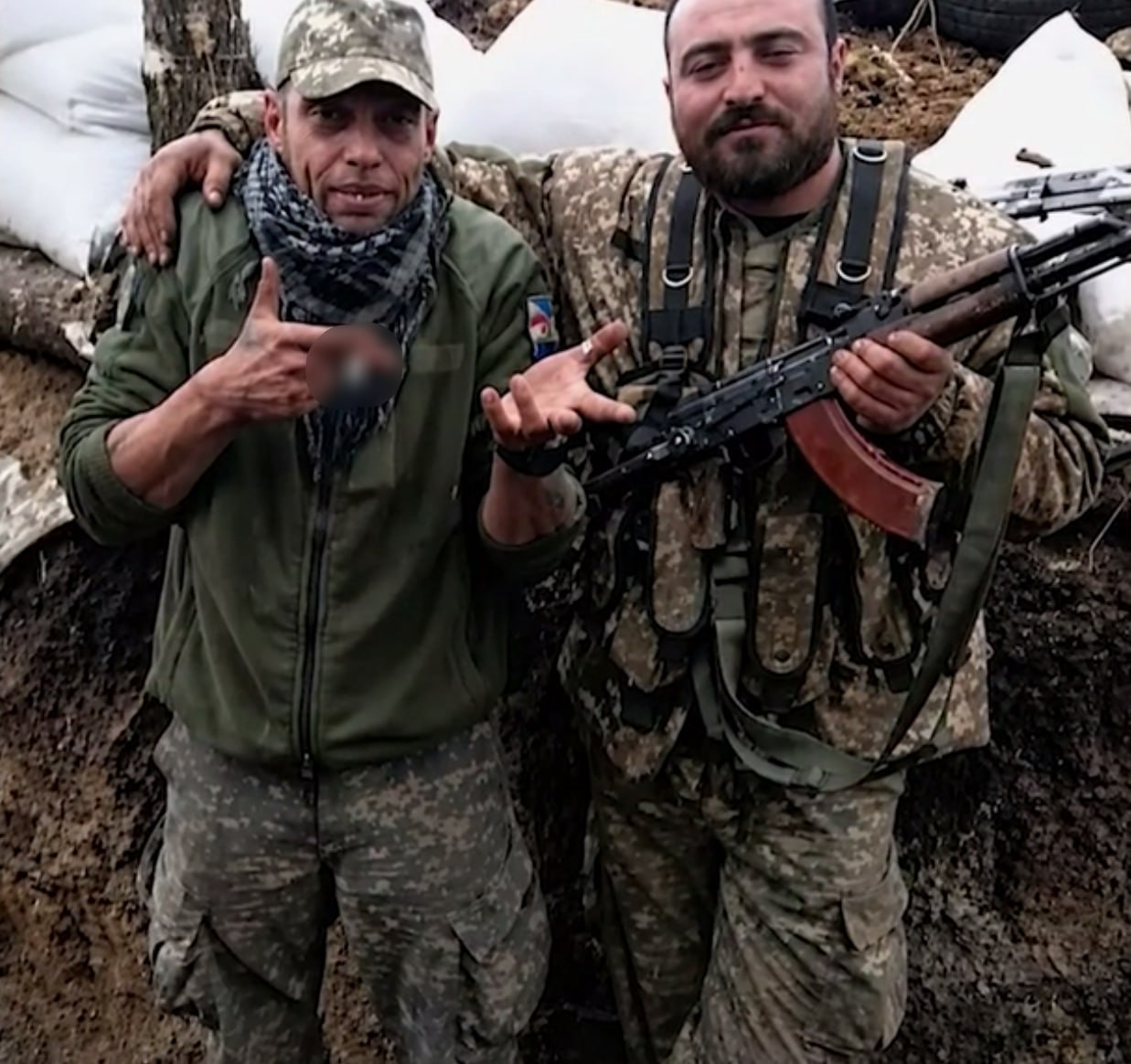
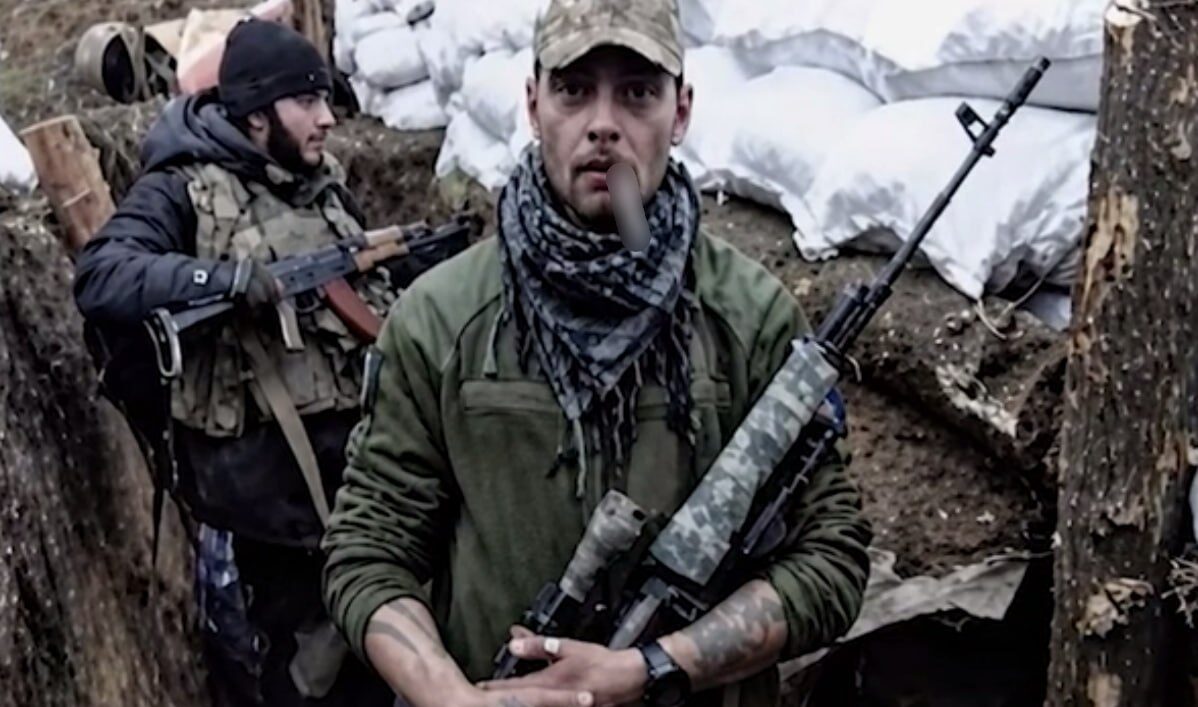
FSB Detains German Mercenary Who Fled Ukraine’s Armed Forces Over Unpaid Wages

24 October 2026 at 17:22

Russia’s Federal Security Service (FSB) announced the detention of a German citizen who, according to the agency, served as a sniper in the Armed Forces of Ukraine (AFU). The man identified himself as Michael Friedrich, born in 1976 in Frechen, North Rhine-Westphalia. His testimony was released in a video distributed by the FSB.

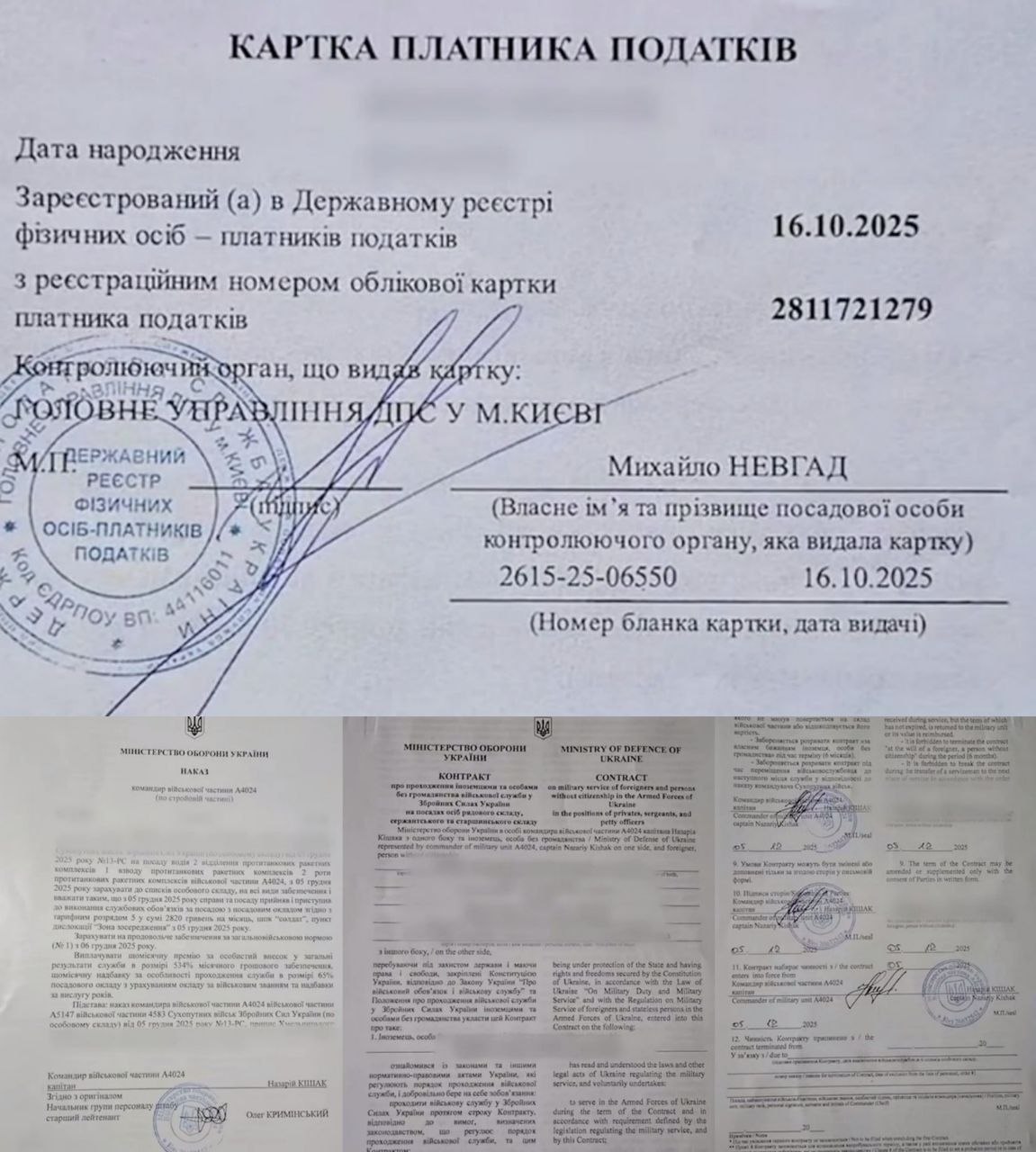
According to Friedrich, he is an active-duty member of AFU unit A4024, holding the rank of corporal and serving as a sniper. “I personally signed the contract on December 5, 2025, for a term of three years,” he said.

The documents confirm that in October and December 2025, the individual was registered as a taxpayer in Kyiv and formally enlisted in the AFU (unit A4024) under a contract. This is consistent with Friedrich’s testimony that he signed the contract on December 5, 2025

The detainee said he served in the Bundeswehr from 1996 to 2008. “During my service, from 2004 to 2006, I took part in combat operations in the Republic of Afghanistan as part of the German contingent,” he stated. He then said he took part in operations in Somalia and, after being discharged, fought in Syria as a mercenary from 2008 to 2010.

He first arrived in Ukraine in 2016 and served in the 25th Territorial Defense Battalion until 2018.

“After signing the necessary documents, I was assigned to the 25th Territorial Defense Battalion. I was on the line of contact in the area of the city of Donetsk,” he said. According to his statement, he did not receive any additional training.

He also stated that the battalion consisted mainly of foreign nationals, including citizens of the United Kingdom and Georgia.

“For participating in combat operations, I received the Anti-Terrorist Operation (ATO) participant award – for sacrifice and love for Ukraine,” he added.

After his first contract ended, he left for Switzerland. In November 2025, he returned to Ukraine with military uniform and equipment. In Kyiv, he claims, he signed a new contract with the AFU.

“After signing the contract, I was promised a payment of 100,000 hryvnias. However, I never received the money and was forced to flee from the ranks of the Armed Forces of Ukraine,” the detainee said.

The FSB said it is considering opening a criminal case under Article 359 of the Russian Criminal Code – “mercenarism.” The article provides for a prison term of seven to fifteen years.

At the same time, the agency did not disclose the location or circumstances of the detention, or how the man ended up in Russia. The German weekly Der Spiegel reported that it had been able to identify the detainee. According to the publication, Georgian Legion commander Mamuka Mamulashvili confirmed that the man had served in his formation in 2017–2018.

Click to see the full-size image

Click to see the full-size image

Click to see the full-size image

Thus, the detainee’s participation in combat operations on Ukraine’s side has received additional confirmation. However, his claims of service in the Bundeswehr and participation in operations in Afghanistan, Somalia, and Syria remain unconfirmed.


MORE ON THE TOPIC:

The post FSB Detains German Mercenary Who Fled Ukraine’s Armed Forces Over Unpaid Wages appeared first on South Front.

Military Situation In Ukraine And Ukrainian Attacks On Russian Territory On October 24, 2026 (Maps Update)

24 October 2026 at 14:59

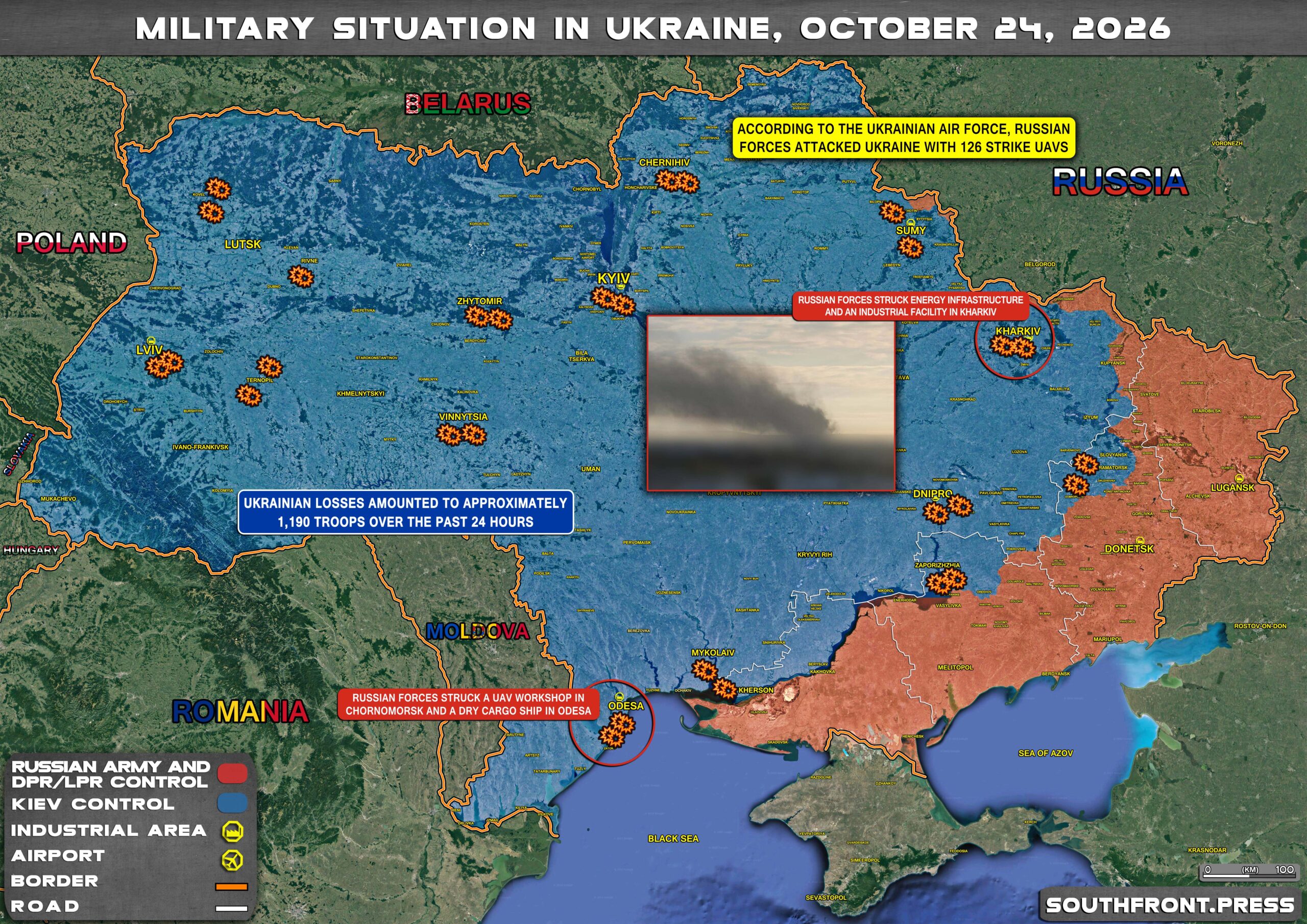
Click to see the full-size image

  • Russian strikes destroyed targets in the Sumy, Kharkiv, Zaporizhzhia, Dnipropetrovsk, Kherson, Kyiv, Lviv, Odesa, Vinnytsia, Chernihiv, Volyn, Rivne, Ternopil, Zhytomyr regions, and the DPR;
  • According to the Ukrainian Air Force, Russian forces attacked Ukraine with 126 strike UAVs;
  • Russian forces struck a UAV workshop in Chornomorsk and a dry cargo ship in Odesa;
  • Russian forces struck energy infrastructure and an industrial facility in Kharkiv;
  • Ukrainian losses amounted to approximately 1,190 troops over the past 24 hours.

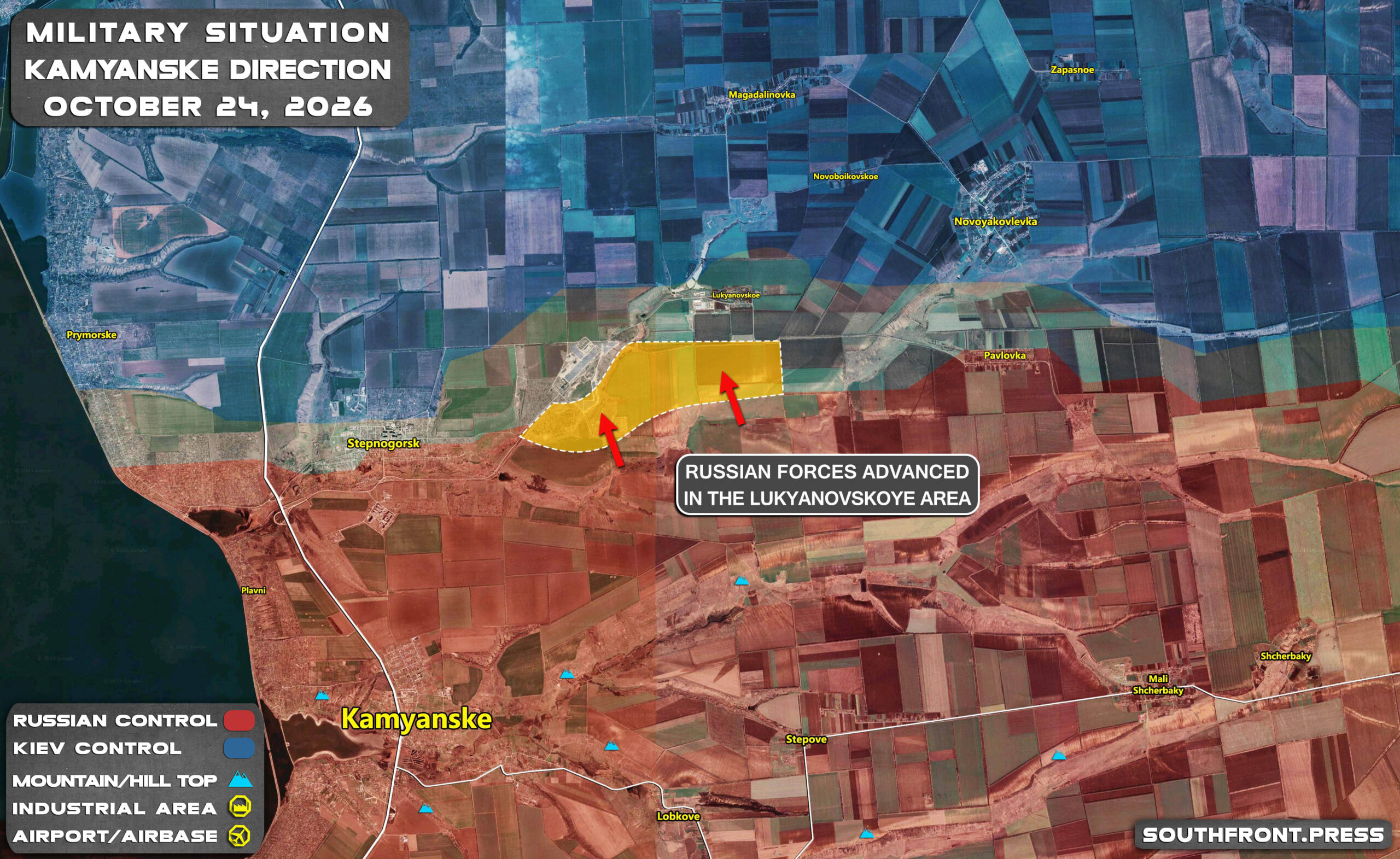
Click to see the full-size image

  • Russian forces advanced in the Lukyanovskoye area.

Click to see the full-size image

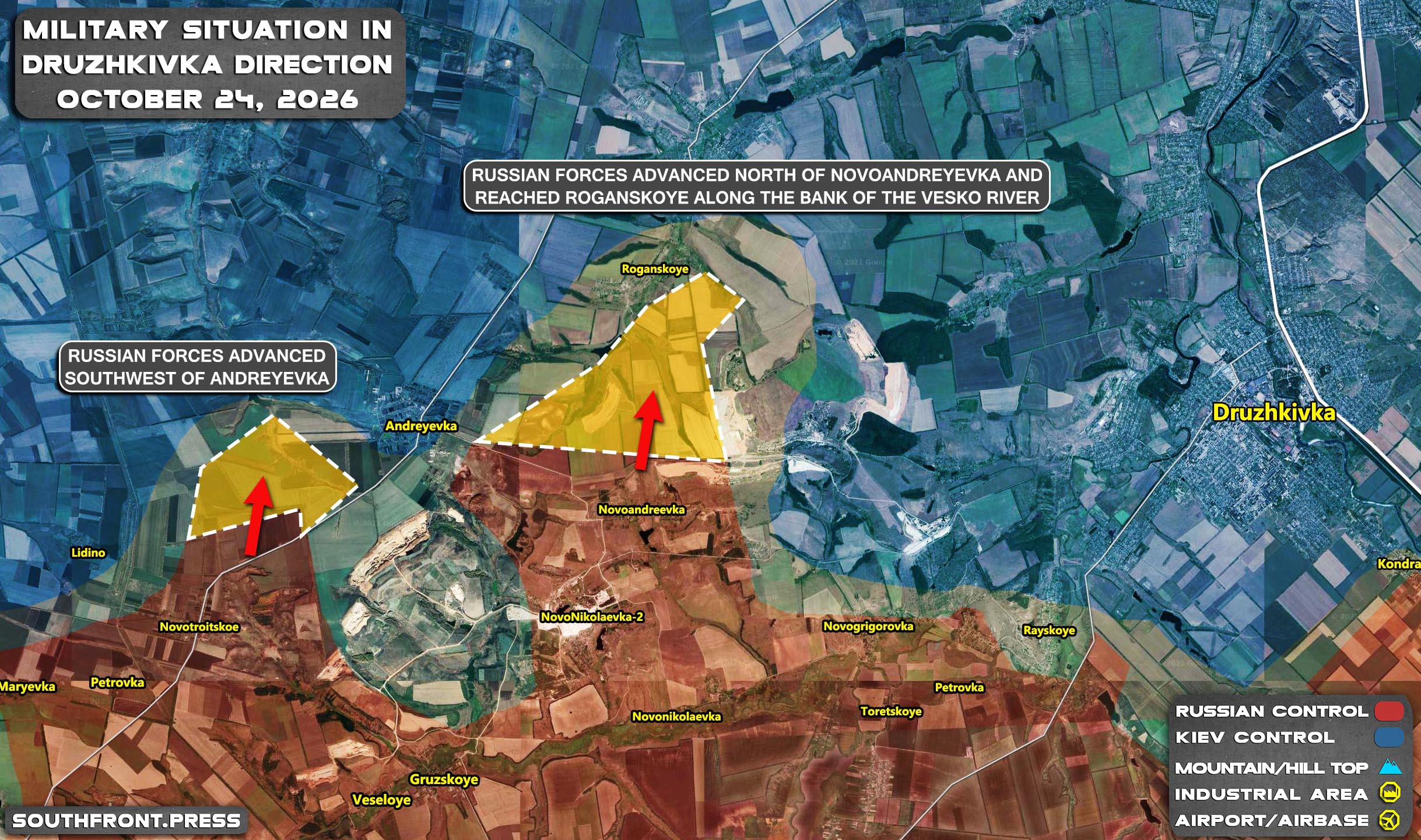
  • Russian forces advanced southwest of Andreyevka;
  • Russian forces advanced north of Novoandreyevka and reached Roganskoye along the bank of the Vesko River.

Click to see the full-size image

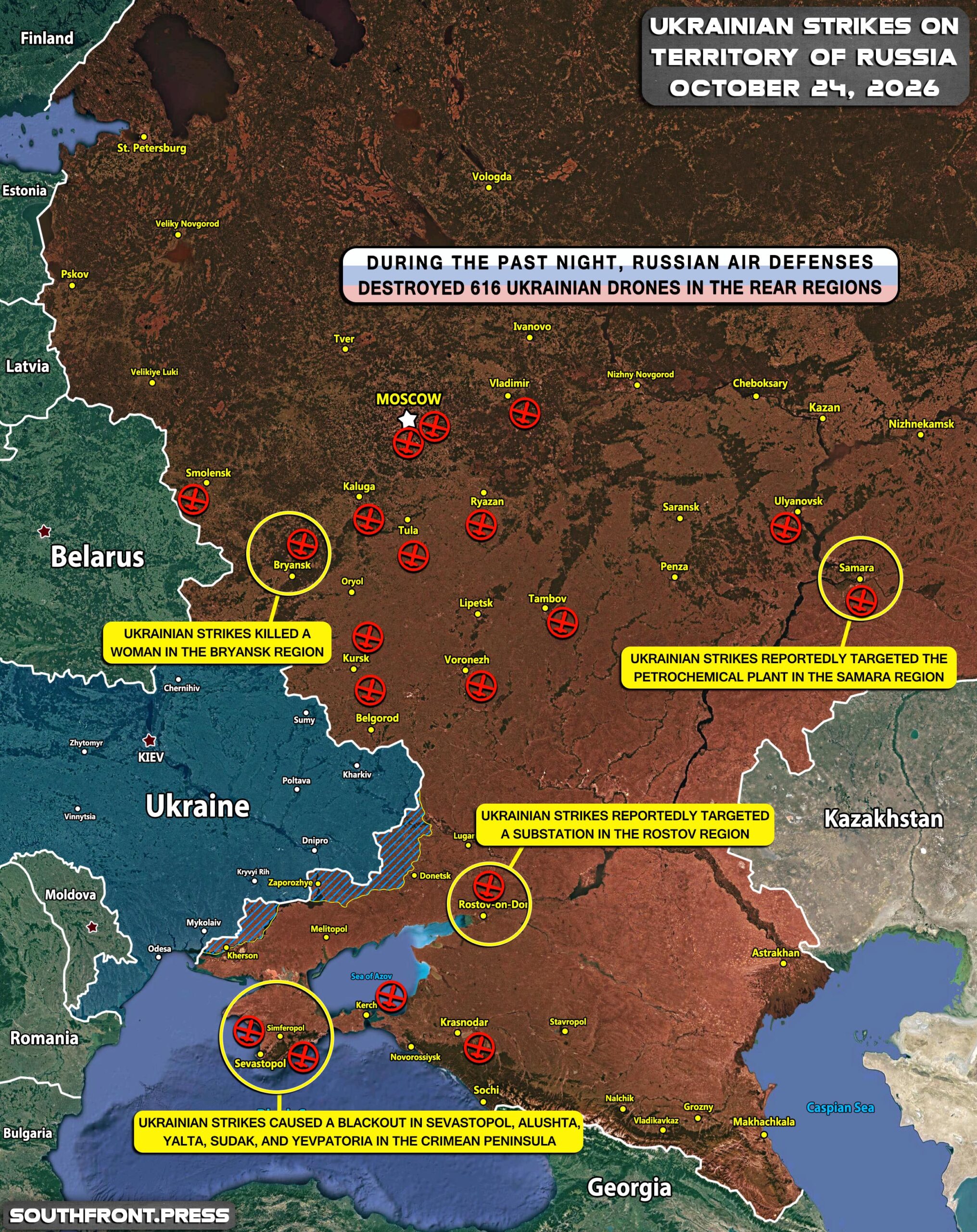
  • During the past night, Russian air defenses destroyed 616 Ukrainian drones in the rear regions;
  • Russian air defenses intercepted UAVs in the Belgorod, Bryansk, Volgograd, Voronezh, Kaluga, Kirov, Kursk, Lipetsk, Oryol, Penza, Rostov, Ryazan, Samara, Saratov, Smolensk, Tambov, Tula, and Ulyanovsk regions, the Moscow region, the Republic of Crimea, the Republic of Tatarstan, Krasnodar Krai, and over the waters of the Sea of Azov and the Black Sea;
  • Ukrainian strikes caused a blackout in Sevastopol, Alushta, Yalta, Sudak, and Yevpatoria in the Crimean Peninsula;
  • Ukrainian strikes reportedly targeted the petrochemical plant in the Samara region;
  • Ukrainian strikes reportedly targeted a substation in the Rostov region;
  • Ukrainian strikes killed a woman in the Bryansk region.

MORE ON THE TOPIC:

The post Military Situation In Ukraine And Ukrainian Attacks On Russian Territory On October 24, 2026 (Maps Update) appeared first on South Front.

Russia Fires Missiles at Kyiv as Ukraine Sends 600+ Drones Toward Moscow

22 October 2026 at 19:46

Click to see the full-size image

On the night of October 22, Russian forces launched a massive combined strike on Ukraine using Iskander-M, Zircon, and Oniks missiles and 210 strike UAVs; the main axis of the strike was Kyiv. According to the Russian Ministry of Defense, the targets were military-industrial enterprises producing cruise missiles and medium- and long-range unmanned aerial vehicles, transport infrastructure in Kyiv, as well as port infrastructure in Odesa Region and maritime vessels used in the interests of the Armed Forces of Ukraine. At the same time, Ukraine carried out a massive drone attack on Russian territory: according to Russian sources, 808 UAVs were shot down over 18 federal subjects of the Russian Federation, including 630 on approach to Moscow.

Russian Strikes on Ukraine by Region

Kyiv and Kyiv Region

  • Antonov State Enterprise (Kyiv) — an aircraft manufacturer whose facilities, according to the Russian Ministry of Defense, were used to produce medium- and long-range unmanned aerial vehicles, as well as FP-5 Flamingo cruise missiles and FP-7 and FP-9 operational-tactical missiles. The facility was part of Ukraine’s military-industrial production chain for long-range strike systems.

  • Khladokombinat No. 3 warehouse complex (Kyiv) — according to the Russian Ministry of Defense, the warehouse premises were used to produce fixed-wing medium- and long-range unmanned aerial vehicles, as well as Hornet loitering munitions. The use of a civilian warehouse for drone production reflects the dispersal of manufacturing across dual-use sites.

  • Industrial enterprise producing UAVs and robotic-system components (Kyiv). The Armed Forces of Ukraine use robotic systems for logistics, evacuation, and fire support at forward positions.

  • Storage site for unmanned aerial vehicles and jet boosters (Kyiv) — a storage facility for strike drones and boosters used to increase the range and speed of fixed-wing UAVs.

  • Southern Road-Rail Bridge (Kyiv) — a bridge crossing over the Dnieper used to move military cargo by road and rail between the right and left banks. According to Ukrainian sources, the strike damaged subway infrastructure on the bridge; service on the Green Line was suspended between the Vydubychi and Osokorky stations, and road traffic across the bridge was temporarily closed in both directions.

  • CHP-4 and CHP-5 (Kyiv) — large combined heat and power plants supplying electricity and heat to urban infrastructure and industrial facilities, including military-industrial enterprises. According to monitoring channels, fires were recorded at the facilities; the Ukrainian Air Force acknowledged that not a single ballistic missile was intercepted.

  • PS-330 Novokyivska substation (Khotov, Kyiv Region) — a 330 kV substation supplying power to nodes of the Kyiv Region energy system, including military-industrial facilities and logistics centers.

Odesa Region

  • Kiliia port infrastructure (Odesa Region) — port facilities used to unload and store military supplies delivered to Ukraine from abroad. The port is located on the Danube and serves as an alternative supply route after operations at Black Sea ports were restricted. Strikes on unloading and storage facilities complicate the receipt and distribution of foreign military assistance.

  • Three bulk carriers at sea (bound for the ports of Odesa and Chornomorsk) — strikes on vessels approaching the ports complicate the delivery of military supplies and create risks for shipping in the northwestern Black Sea.

Zhytomyr Region

  • PS-330 Zhytomyrska substation (Zhytomyr) — a 330 kV substation supplying electricity to Zhytomyr Region and carrying power between regions.

Kharkiv Region

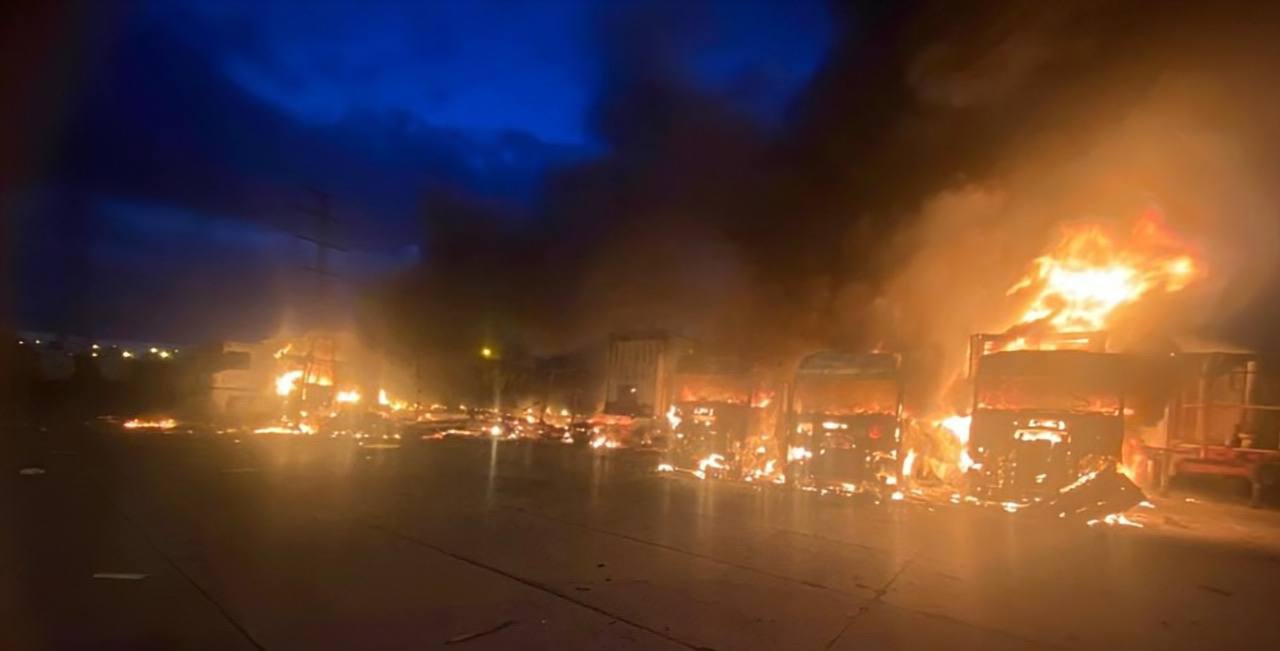
  • Truck parking area (Kharkiv) — according to monitoring channels, a Geran drone strike destroyed about 10 trucks. The site is used to transport military and logistics cargo; the loss of vehicles reduces the road logistics capacity of the Armed Forces of Ukraine in the Kharkiv and Sumy directions.

  • Railway locomotive (Kharkiv) — a UAV strike damaged a Ukrzaliznytsia locomotive. Rail transport remains the primary means of moving military equipment and personnel; the loss of a locomotive complicates rail traffic in the Kharkiv direction.

Kirovohrad Region

  • Production and warehouse complex (Kirovohrad) — according to monitoring channels, the facility was attacked by Geran-4 drones on the evening of October 21.

Poltava Region

  • Television and radio company building (Kremenchuk) — the facility provided broadcasting and communications, including for military needs.

Strikes on Russia

  • Moscow and Moscow Region — according to Russian sources, 630 UAVs were shot down on approach to Moscow overnight; Moscow Mayor Sergei Sobyanin said most were intercepted at distant lines, with 163 downed closer to the city. Monitoring channels claim that a Flamingo missile was shot down over Serpukhov; Ukrainian sources claim an attack on the Russian Defense Ministry enterprise JSC 75 Arsenal, a facility for storing and preparing ammunition.

  • Belgorod Region — 205 UAVs were shot down over the past day; according to Russian sources, three civilians were injured. Belgorod Region is regularly targeted by drone attacks aimed at energy, transport, and civilian infrastructure.

  • Lipetsk Region — as a UAV passed through the city toward Moscow Region, a multi-story residential building and a medical facility were damaged. Lipetsk is a major transport hub on the Moscow–south axis; drones passing through the city create risks for civilian infrastructure.

The Russian strike on October 22 was combined in nature and focused on two interrelated areas: the production of aerial attack systems (Antonov State Enterprise, Khladokombinat No. 3, and UAV and booster storage sites) and the transport and energy infrastructure supporting their use and the supply of Ukrainian forces (the Southern Bridge, CHP-4 and CHP-5, the Novokyivska and Zhytomyrska substations, Kiliia port, and vessels at sea).

Ukrainian strikes were concentrated on Moscow Region (630 UAVs shot down, according to Russian sources) and Belgorod Region (205 UAVs shot down), with sporadic drone passages through Lipetsk and Tula Region. The intensity of attacks on Moscow remains high, although Russian sources report that most drones were intercepted at distant lines. The intensity of attacks on Moscow remains high, although Russian sources report that most drones were intercepted at distant lines. In the medium term, Russian strikes on UAV and missile production chains, as well as on energy infrastructure supporting the military-industrial complex, will continue; Ukraine will likely maintain its course of massive drone attacks on Moscow Region and border regions.


MORE ON THE TOPIC:

The post Russia Fires Missiles at Kyiv as Ukraine Sends 600+ Drones Toward Moscow appeared first on South Front.

❌