❌

Normal view

Military Situation In Ukraine And Ukrainian Attacks On Russian Territory On October 29, 2026 (Maps Update)

29 October 2026 at 18:16

Click to see the full-size image

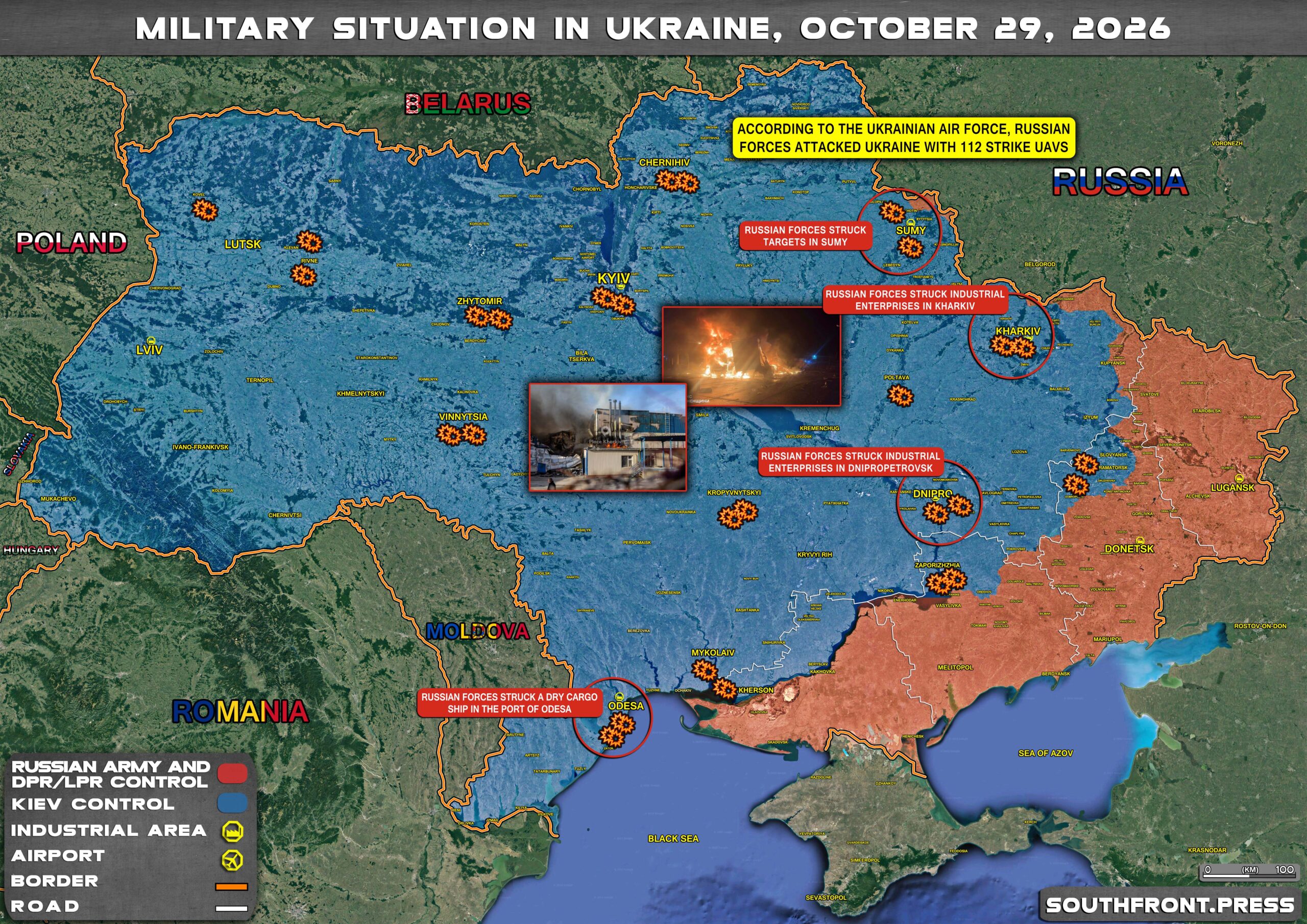
  • Russian strikes hit targets in the Sumy, Kharkiv, Zaporizhzhia, Dnipropetrovsk, Kherson, Vinnytsia, Volyn, Zhytomyr, Kyiv, Kirovohrad, Poltava, Rivne, Cherkasy, Chernihiv regions, and the DPR;
  • According to the Ukrainian Air Force, Russian forces attacked Ukraine with 112 strike UAVs;
  • Russian forces struck a dry cargo ship in the port of Odesa;
  • Russian forces struck industrial enterprises in Kharkiv;
  • Russian forces struck industrial enterprises in Dnipropetrovsk;
  • Russian forces struck targets in Sumy.

Click to see the full-size image

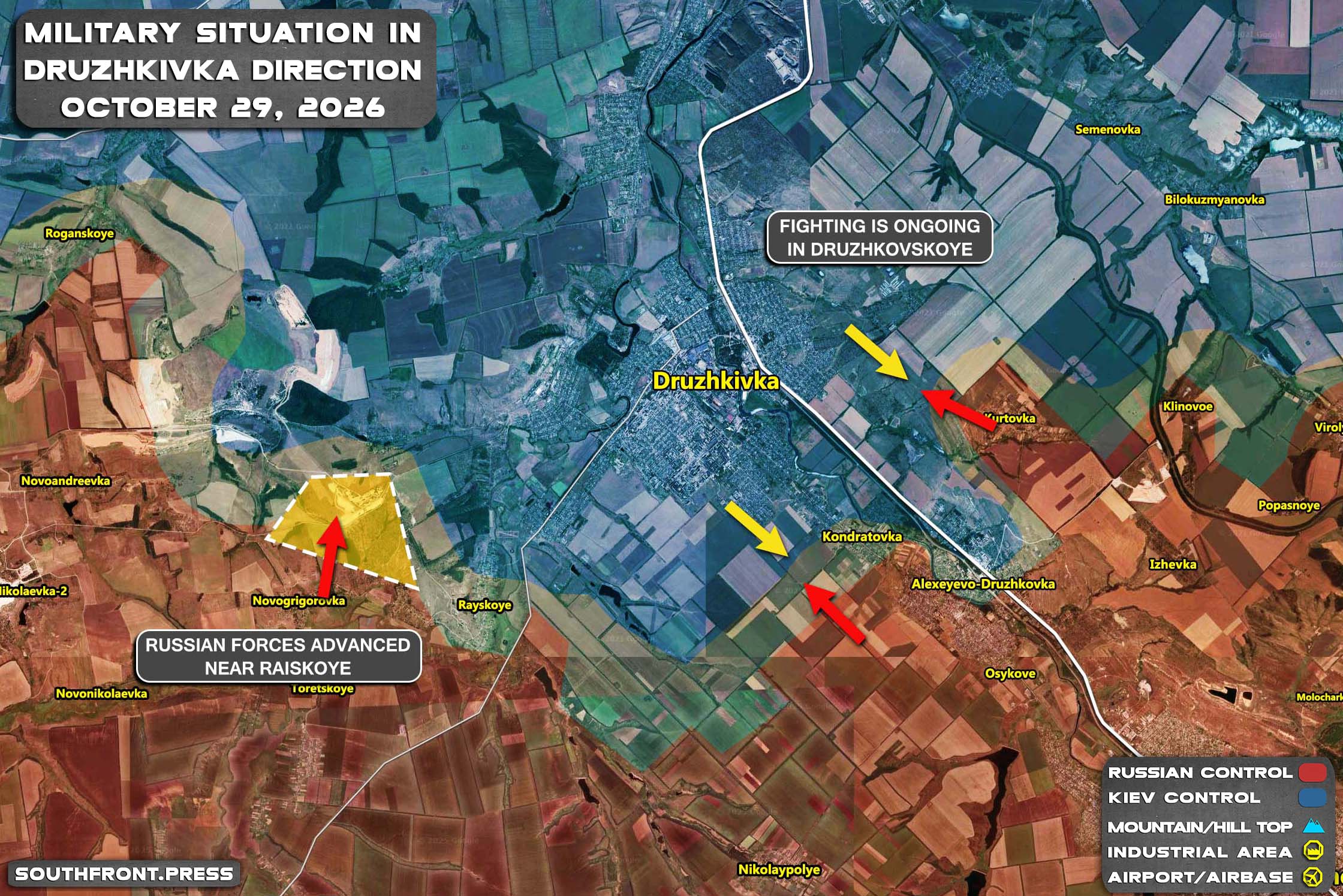
  • Russian forces advanced near Raiskoye;
  • Fighting is ongoing in Druzhkovskoye.

Click to see the full-size image

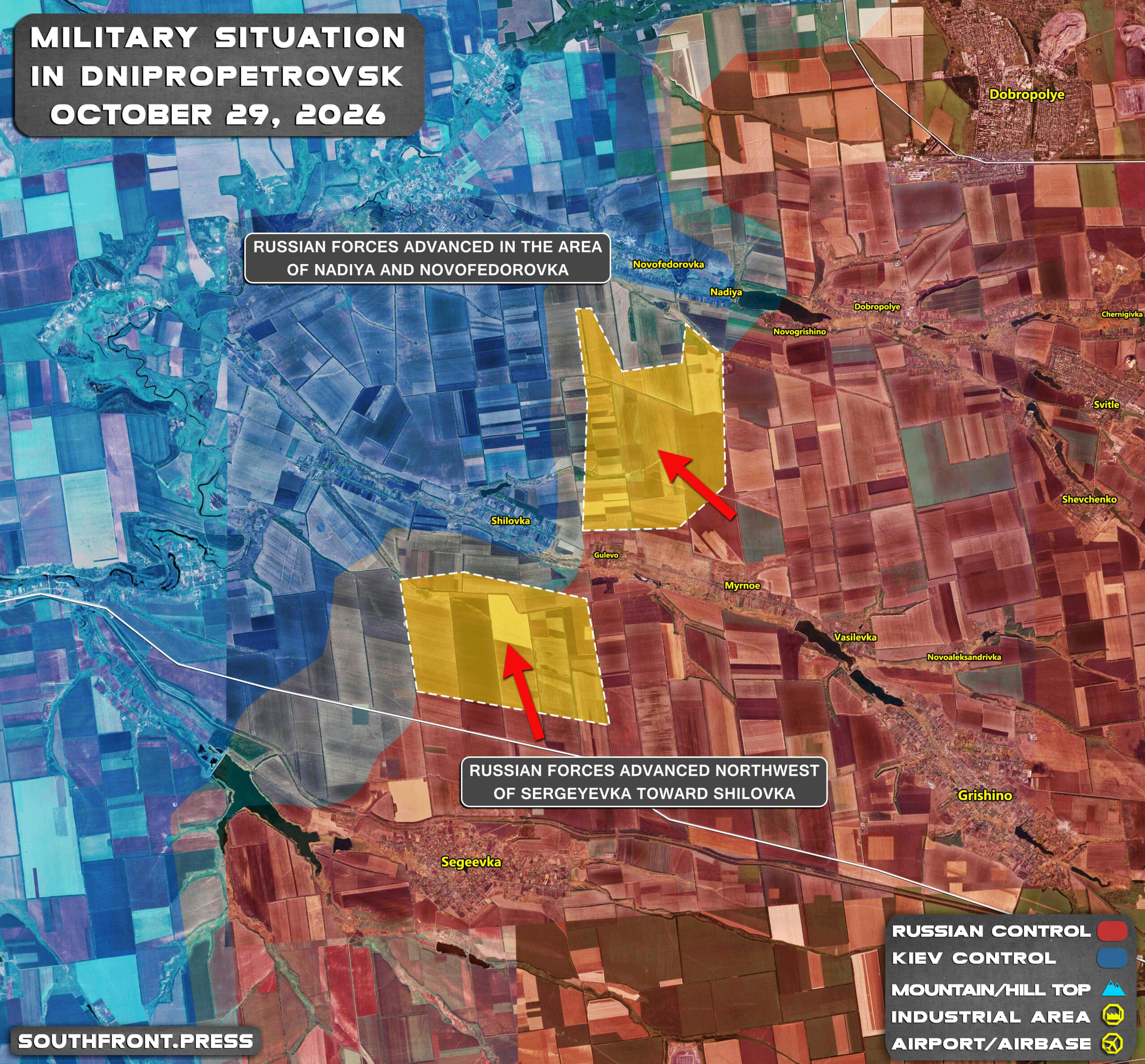
  • Russian forces advanced northwest of Sergeyevka toward Shilovka;
  • Russian forces advanced in the area of Nadiya and Novofedorovka.

Click to see the full-size image

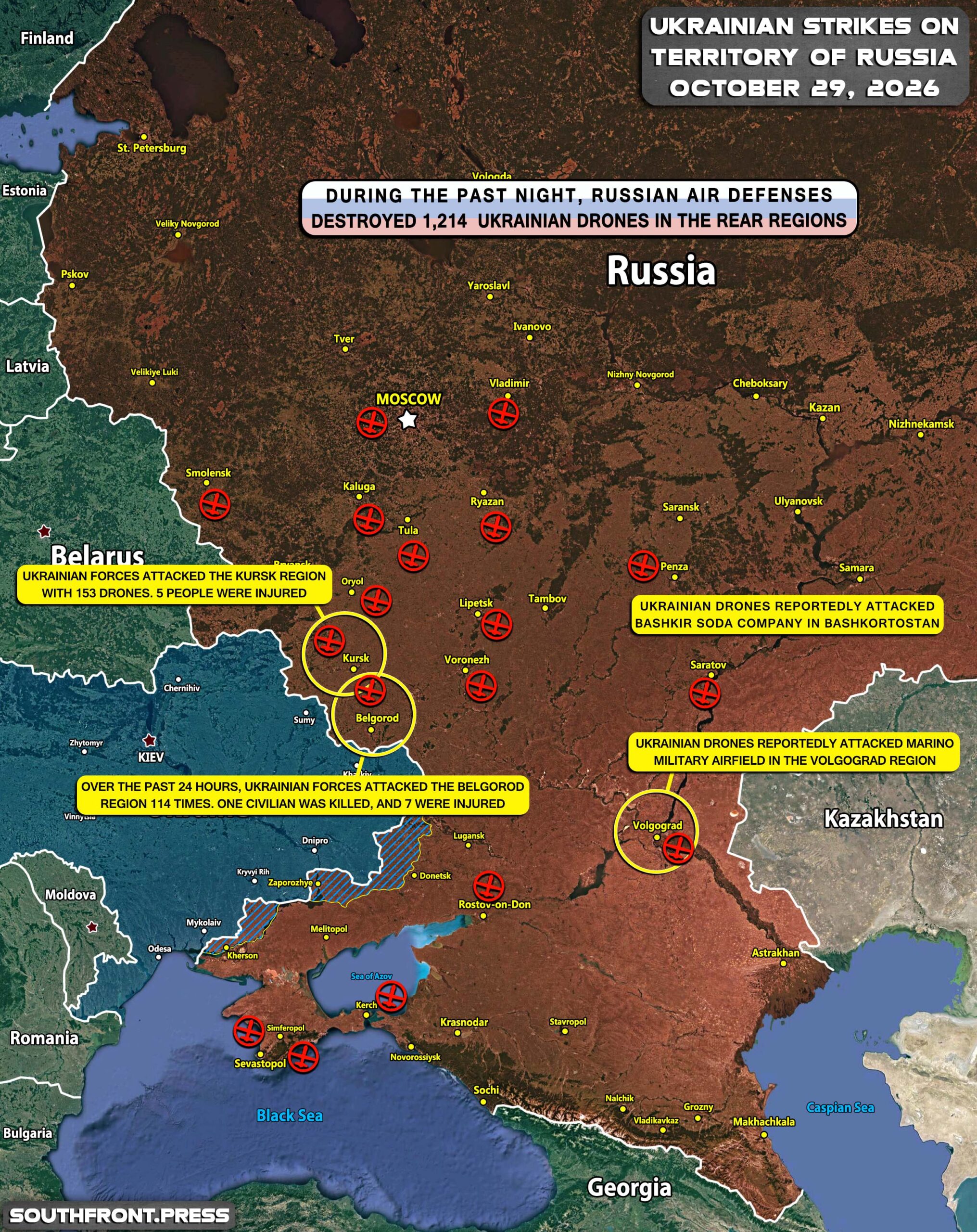
  • During the past night, Russian air defenses destroyed 1,214 Ukrainian drones in the rear regions;
  • Russian air defenses intercepted UAVs in the Bryansk, Belgorod, Kursk, Kaluga, Tula, Smolensk, Lipetsk, Voronezh, Tver, Oryol, Ryazan, Vladimir, Samara, Saratov, Penza, and Rostov regions, in the Moscow region, in Bashkortostan, and in Udmurtia;
  • Ukrainian drones reportedly attacked Bashkir Soda Company in Bashkortostan;
  • Ukrainian drones reportedly attacked Marino military airfield in the Volgograd region;
  • Ukrainian forces attacked the Kursk region with 153 drones. 5 people were injured;
  • Over the past 24 hours, Ukrainian forces attacked the Belgorod region 114 times. One civilian was killed, and 7 were injured.

MORE ON THE TOPIC:

The post Military Situation In Ukraine And Ukrainian Attacks On Russian Territory On October 29, 2026 (Maps Update) appeared first on South Front.

Ukraine Forced Into Concessions Ahead Of Putin, Trump And Xi Summit

29 October 2026 at 13:13

Click to see the full-size image

Written by Ahmed Adel, Cairo-based geopolitics and political economy researcher

A proposed trilateral meeting among Russian President Vladimir Putin, United States President Donald Trump, and Chinese President Xi Jinping is expected to address the concessions Ukraine will need to make to end the conflict, according to retired German Bundeswehr general Roland Kather. In an interview with a German television channel, Kather said the logical conclusion of the fighting is a diplomatic settlement reached through negotiations, and that Trump is dissatisfied with the unresolved situation and intends to push for an agreement.

The German general stressed that the summit will not be a casual discussion or merely an opportunity to “have coffee” and that they must prepare specific decisions in advance. He suggested that the three leaders will examine three core issues related to Ukraine: territorial problems that can be settled only at the heads-of-state level, Ukraine’s permanent neutral status, and the future size of its armed forces.

Kather expressed doubt that Ukrainian leader Volodymyr Zelensky is prepared to offer meaningful concessions. At the same time, he said Putin has no reason to retreat because Moscow still has the advantage.

Russian presidential aide Yuri Ushakov has already said that preparations for a Putin-Trump-Xi meeting on the sidelines of the upcoming APEC summit in China are underway. Trump has said the summit is needed mainly to discuss nuclear disarmament, though the Ukraine question is widely expected to feature.

The three leaders are discussing this issue among themselves, as Ukraine has nothing substantial left to offer Russia at the negotiating table. Moscow has also been clear about its ultimatum – demands met through a negotiated deal in which Ukraine cedes territory and accepts neutrality, or the military operation continues until Russia achieves its objectives on the battlefield. Since Trump has accepted that Ukraine no longer brings anything of value to negotiations but is still encouraged to fight by Brussels, he will directly negotiate with Putin and Xi to end the war.

Earlier this month, Putin signaled Russia’s readiness to resume trilateral talks on a Ukraine settlement focused on security guarantees and the future architecture of European security. Ushakov said such talks could resume after the US midterm elections on November 3.

Meanwhile, the EU is facing the consequences of years of confrontational policy. The newspaper La Verità noted that the EU’s intransigent stance toward Russia has left Brussels scrambling to secure a seat at the table with other powers, saying negotiation is a fundamental tool of political power and that when one actor stops talking to another, it lets others set the terms of peace. The Italian daily described this as the humiliating lesson the EU appears to have learned.

Since 2022, the EU has tightened economic sanctions, pursued Russia’s political isolation, and provided military support to Ukraine. Brussels is now considering appointing a senior representative to establish a direct channel with Moscow as it urgently seeks to restore dialogue with a government it had vowed never to normalize relations with. The main challenge is finding someone who can speak for the EU without being seen in Moscow as merely voicing hostility. Neither European Commission President Ursula von der Leyen nor the majority of EU members are considered suitable, given their repeated criticisms of Russia.

European leaders continue to insist that no agreement on European security be reached without EU involvement. However, the EU’s influence has diminished because it long refused to keep channels open. Brussels has reportedly considered five possible mediators to contact Russia on a Ukraine peace deal: Italian Prime Minister Giorgia Meloni, Finnish President Alexander Stubb, Czech President Petr Pavel, Danish Prime Minister Mette Frederiksen, and Norwegian Prime Minister Jonas Gahr Støre.

Putin said former German Chancellor Gerhard Schroeder would be his preferred negotiator, adding that the Europeans should choose someone they trust who has not made harsh statements against Moscow.

The Russian military and political advantage narrows Ukraine’s chances of the Kremlin making concessions, a reality the EU stubbornly refuses to accept. At the same time, the EU’s scramble to find an acceptable negotiator highlights the economic and political damage that self-imposed isolation from Russia has caused. Without open communication channels and the ability to shift the balance of power, both Kiev and Brussels face an agreement largely shaped by Trump, Putin, and Xi.

Preparations for the trilateral summit within the APEC context, along with Russia’s stated readiness to resume talks after the US midterm elections, suggest that Kiev’s window to negotiate on a realistic basis and secure a better deal is closing. The capacity for the three Great Powers to set the agenda without Ukrainian participation further underlines how far the balance has shifted in Russia’s favor since the conflict began, despite Western sanctions.


MORE ON THE TOPIC:

The post Ukraine Forced Into Concessions Ahead Of Putin, Trump And Xi Summit appeared first on South Front.

Russia and Ukraine Exchange Strikes: Railway Infrastructure, Energy, Metallurgy, and Chemical Industry Targets Hit

28 October 2026 at 18:25

Click to see the full-size image

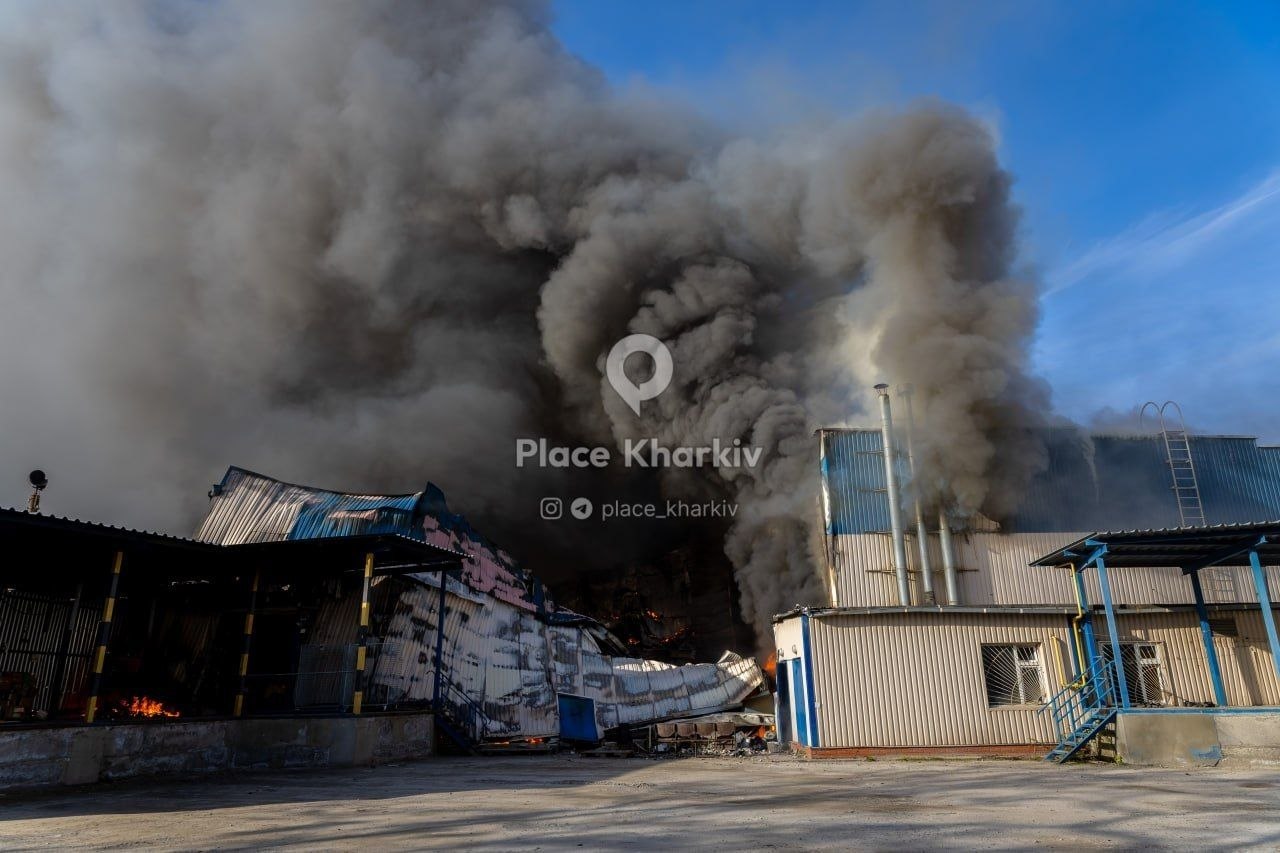
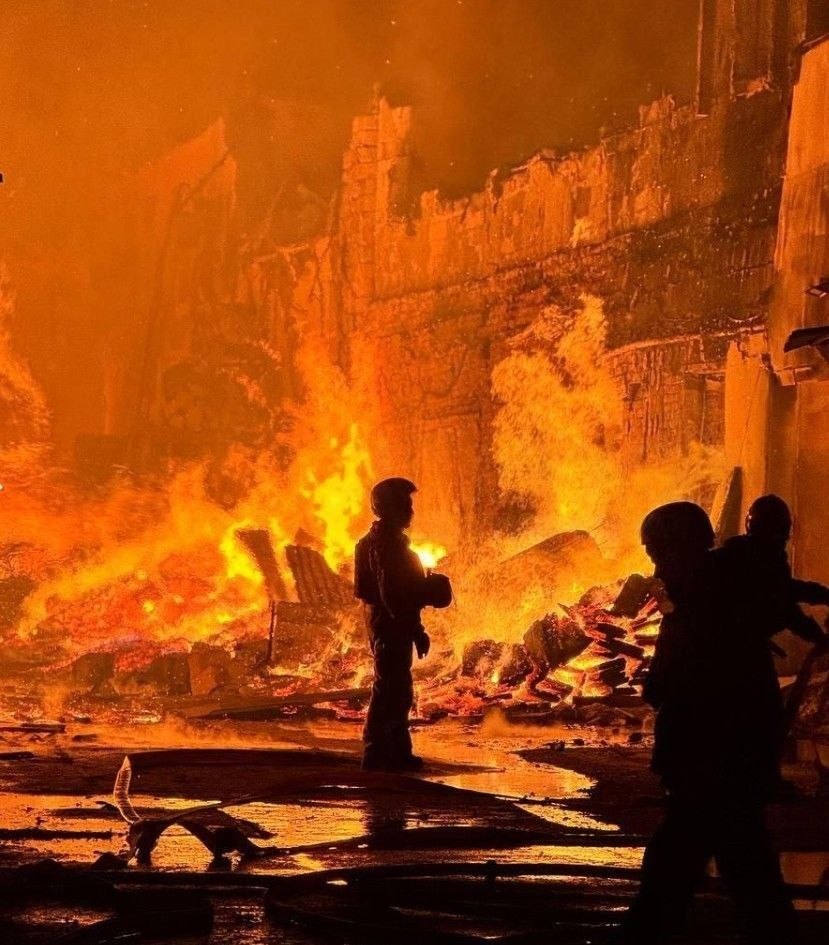
On the night of October 28, Russian forces carried out a combined strike against targets on Ukrainian territory. According to the Ukrainian Air Force, the attack employed an Iskander-M/S-400 ballistic missile and 88 strike UAVs. The main emphasis was placed on logistics and energy infrastructure in Kharkiv, Dnipropetrovsk, Chernihiv, Volyn, and other Regions. In parallel, Ukrainian forces conducted a series of drone and cruise missile attacks against industrial targets on Russian territory, including the largest metallurgical combine and a chemical plant.

Strikes on Ukrainian Territory

Kharkiv Region

  • Logistics center in Kharkiv. According to a statement by the Russian Ministry of Defense, the site was used to store military and dual-use cargo intended to supply Ukrainian troops.

  • Locomotive near the settlement of Ordovka.

Dnipropetrovsk Region

  • Pyatykhatky railway station, Kamianske district. Two consecutive Geran-4 UAV strikes during the day. The first strike set a rail trolley on fire, destroyed the driver’s cab, and damaged the overhead contact line and a grain car in a freight train; the second strike set an electric locomotive on fire.

  • Gas station in Shakhtarske.

Chernihiv Region

  • Energy infrastructure in Chernihiv. According to Ukrainian sources, about 210,000 subscribers were left without electricity, and roughly 90 percent of the city was de-energized. The specific target has not been identified.

Volyn Region

  • PS-330 Lutsk-Northern substation, Lutsk. According to a statement by the Russian Ministry of Defense, the facility supplied power to military-industrial enterprises producing UAVs and components.

  • PS-330 substation, Kovel. A similar target; power outages were recorded in Kovel after the strike.

Kirovohrad Region

  • Railway facility in Znamianka.

Odesa Region

  • Bulk carrier underway toward the port of Chornomorsk. According to the Russian Ministry of Defense, the vessel was delivering cargo to supply the Ukrainian Armed Forces.

Reports also indicated strikes on targets in Zhytomyr, Vinnytsia, Khmelnytskyi, Kherson, Kyiv, Cherkasy, Sumy, and Zaporizhzhia Regions. A blackout was recorded in central Kyiv, with electricity absent in parts of the central districts.

Strikes on Russian Territory

According to a statement by the Russian Ministry of Defense, 531 Ukrainian UAVs were shot down overnight over Russian territory across 13 federal subjects.

Lipetsk Region

  • Novolipetsk Metallurgical Combine (NLMK), Lipetsk. The largest metallurgical enterprise in Russia, with a capacity of about 17 million metric tons of steel per year. According to Ukrainian sources, it was attacked with FP-5 cruise missiles; a fire was reported in the area of the combine. The governor of Lipetsk Region confirmed that UAV debris had fallen and vegetation had caught fire, while denying a “major fire at an industrial enterprise.” A total of 45 UAVs were shot down over the Region.

Tula Region

  • Azot chemical plant, Novomoskovsk. According to Ukrainian sources, the plant was attacked by UAVs, with the AM-70 ammonia production unit reportedly hit. Russian authorities confirmed the attack on the chemical plant and damage to residential buildings, without providing details about production capacity.

Kursk Region

  • Building housing servers for the regional healthcare system, Kursk. Damaged as a result of a UAV attack; disruptions to certain medical services are possible. Over the day, 168 UAVs were shot down over the Region, and three people were injured.

For the week of October 19–25, according to Russian data, attacks on civilian targets killed 50 civilians and injured 263.

On October 28, two opposing directions are evident: Russian strikes are concentrating on Ukrainian railway logistics, energy, and warehouse infrastructure, while Ukrainian drones are attacking large industrial sites deep inside Russia, including metallurgy in Lipetsk and chemical production in Novomoskovsk. The strikes on the substations in Lutsk and Kovel are of particular significance, as they point to an attempt to weaken the power supply to western Ukraine’s logistics and production capacity.


MORE ON THE TOPIC:

The post Russia and Ukraine Exchange Strikes: Railway Infrastructure, Energy, Metallurgy, and Chemical Industry Targets Hit appeared first on South Front.

Reporter's notebook: Visiting a POW camp is the strongest antidote to sympathy for Russian soldiers

28 October 2026 at 17:57

Once our eyes adjusted to the aggressive glare of the freshly painted white walls around the yard, we began to make out figures, dozens of them dressed in navy blue, clinging to the inner walls of this surreal space.

It was a scorching June day in western Ukraine, and we

Military Situation In Ukraine And Ukrainian Attacks On Russian Territory On October 28, 2026 (Maps Update)

28 October 2026 at 14:58

Click to see the full-size image

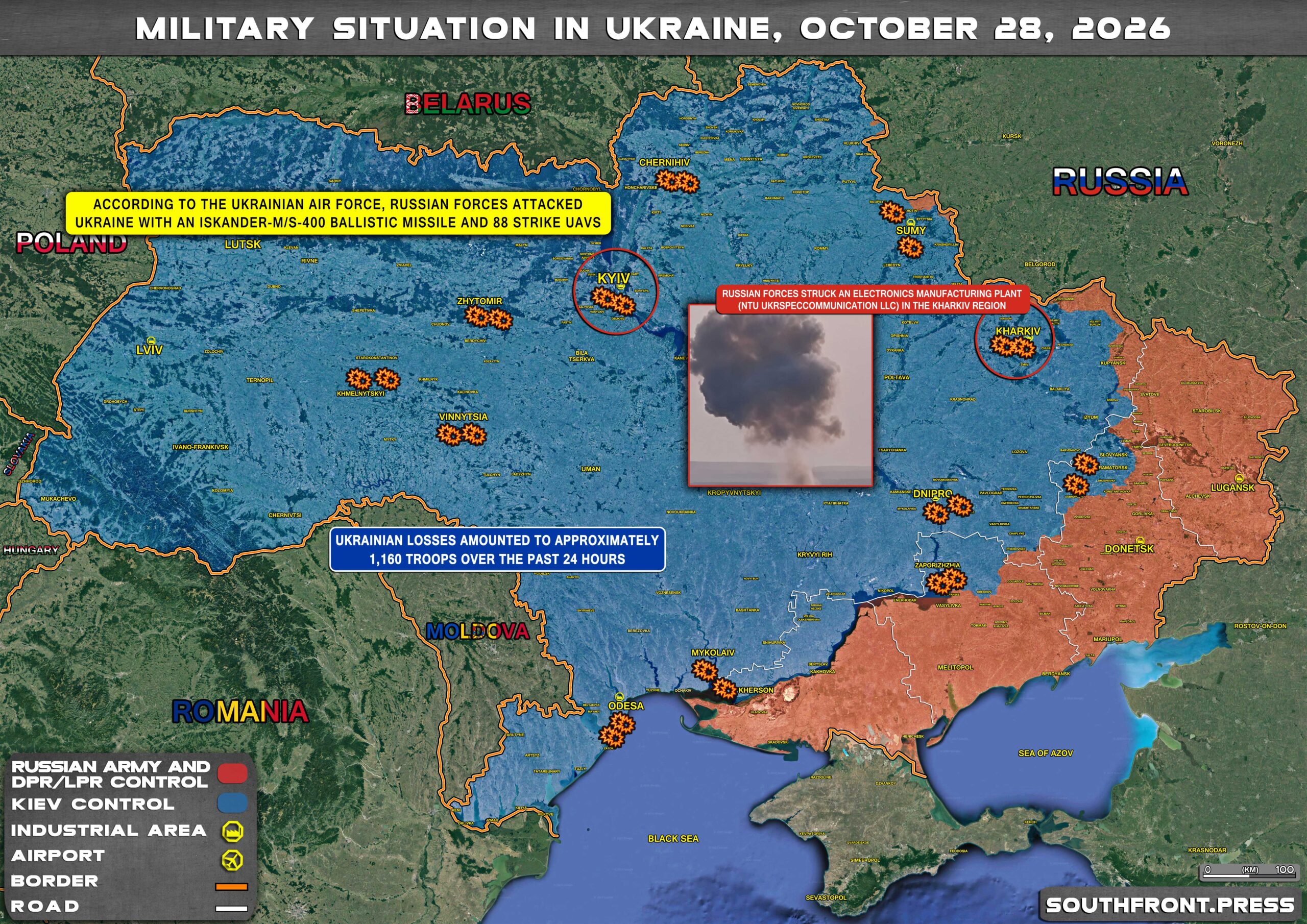
  • Russian strikes hit targets in the Sumy, Kharkiv, Zaporizhzhia, Dnipropetrovsk, Kherson, Vinnytsia, Kyiv, Kirovohrad, Khmelnytskyi, Zhytomyr, Cherkasy, Chernihiv regions, and the DPR;
  • According to the Ukrainian Air Force, Russian forces attacked Ukraine with an Iskander-M/S-400 ballistic missile and 88 strike UAVs;
  • Russian forces struck an electronics manufacturing plant (NTU Ukrspeccommunication LLC) in the Kharkiv region;
  • Ukrainian losses amounted to approximately 1,160 personnel over the past 24 hours.

Click to see the full-size image

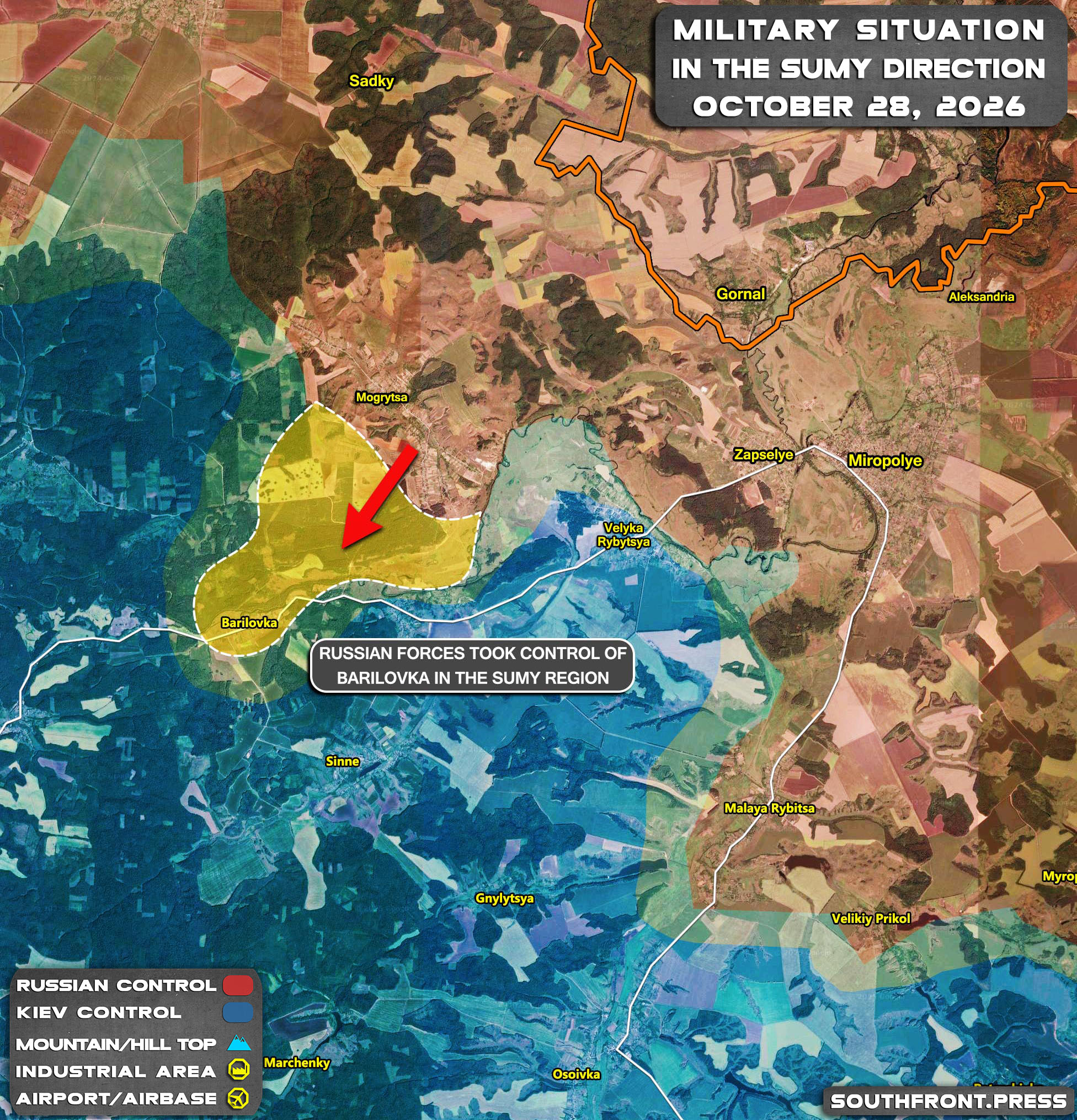
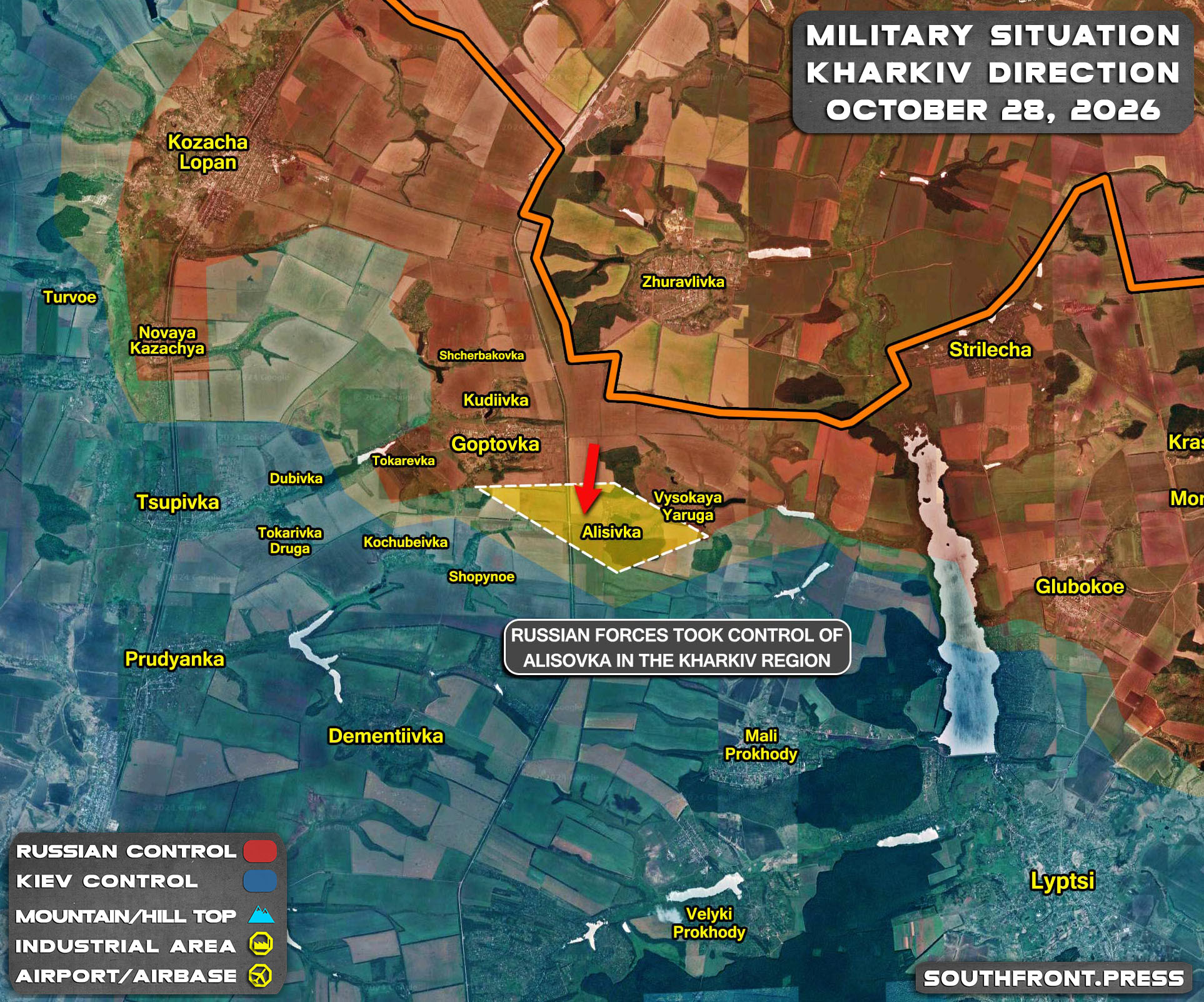
  • Russian forces took control of Barilovka in the Sumy region.

Click to see the full-size image

  • Russian forces took control of Alisovka in the Kharkiv region.

Click to see the full-size image

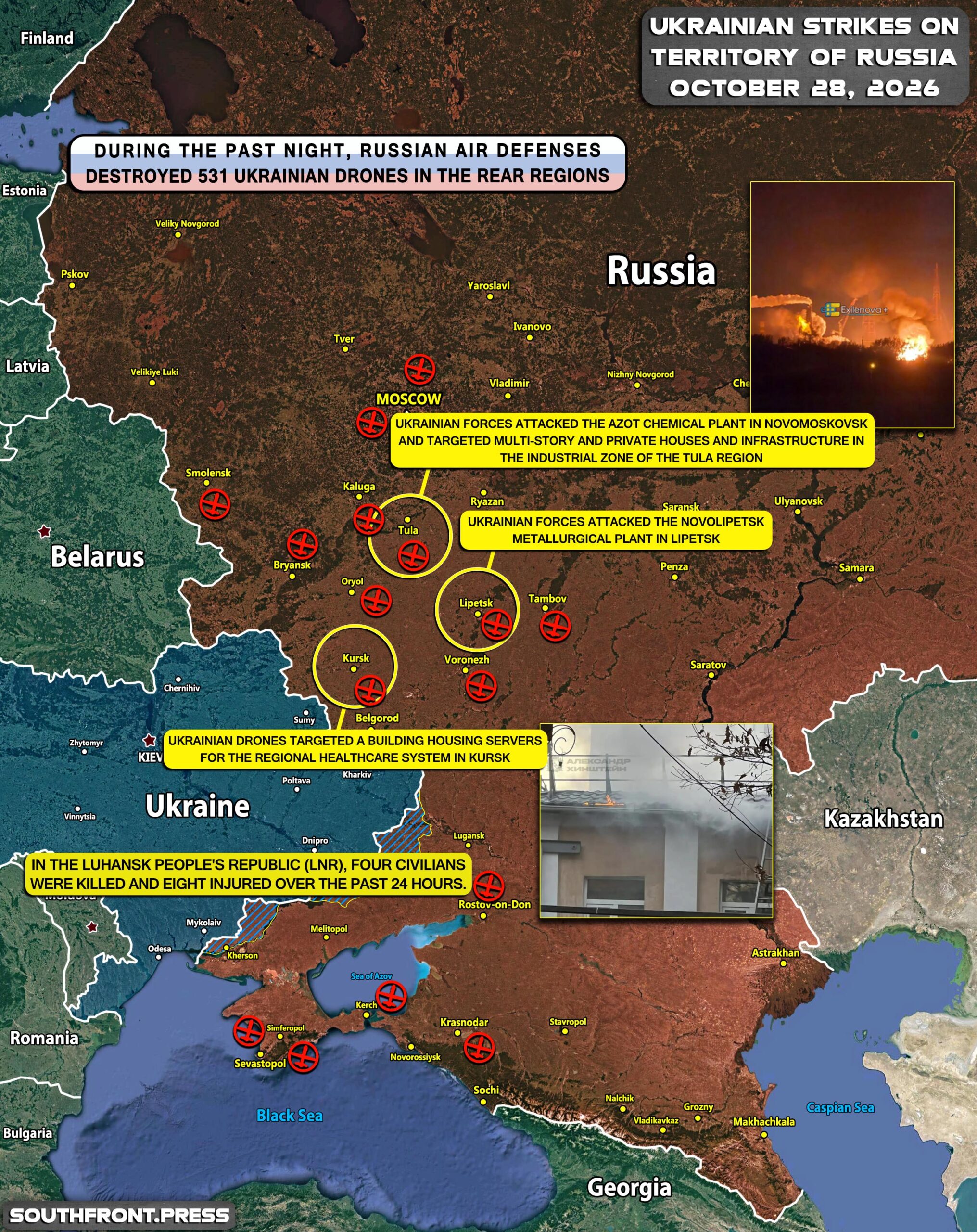
  • During the past night, Russian air defenses destroyed 531 Ukrainian drones in the rear regions;
  • Russian air defenses intercepted UAVs in the Belgorod, Bryansk, Voronezh, Kaluga, Kursk, Lipetsk, Oryol, Rostov, Ryazan, Smolensk, Tambov, and Tula regions, and in the Moscow region;
  • Ukrainian drones targeted a building housing servers for the regional healthcare system in Kursk;
  • Ukrainian forces attacked the Novolipetsk Metallurgical Plant in Lipetsk;
  • Ukrainian forces attacked the Azot chemical plant in Novomoskovsk and targeted multi-story and private houses and infrastructure in the industrial zone of the Tula region;
  • In the Luhansk People’s Republic (LNR), four civilians were killed and eight injured over the past 24 hours.

MORE ON THE TOPIC:

The post Military Situation In Ukraine And Ukrainian Attacks On Russian Territory On October 28, 2026 (Maps Update) appeared first on South Front.

Military Situation In Ukraine And Ukrainian Attacks On Russian Territory On October 27, 2026 (Maps Update)

27 October 2026 at 19:40

Click to see the full-size image

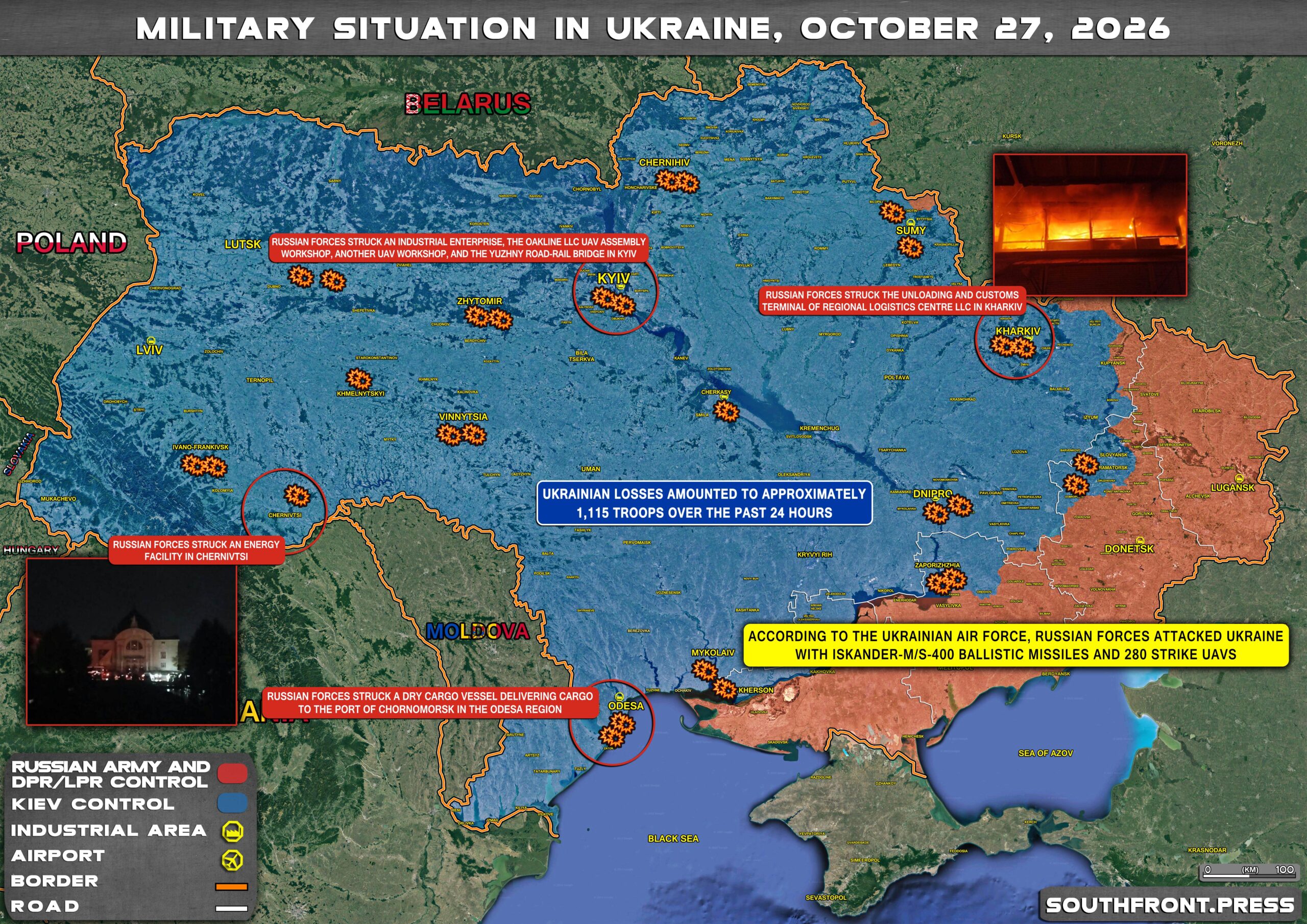
  • Russian strikes hit targets in the Sumy, Kharkiv, Zaporizhzhia, Dnipropetrovsk, Kherson, Kyiv, Vinnytsia, Zhytomyr, Ivano-Frankivsk, Odesa, Rivne, Khmelnytskyi, Cherkasy, Chernihiv regions, and the DPR;
  • According to the Ukrainian Air Force, Russian forces attacked Ukraine with Iskander-M/S-400 ballistic missiles and 280 strike UAVs;
  • Russian forces struck an industrial enterprise, the Oakline LLC UAV assembly workshop, another UAV workshop, and the Yuzhny road-rail bridge in Kyiv;
  • Russian forces struck the unloading and customs terminal of Regional Logistics Centre LLC in Kharkiv;
  • Russian forces struck a dry cargo vessel delivering cargo to the port of Chornomorsk in the Odesa region;
  • Russian forces struck an energy facility in Chernivtsi;
  • Ukrainian losses amounted to approximately 1,115 personnel over the past 24 hours.

Click to see the full-size image

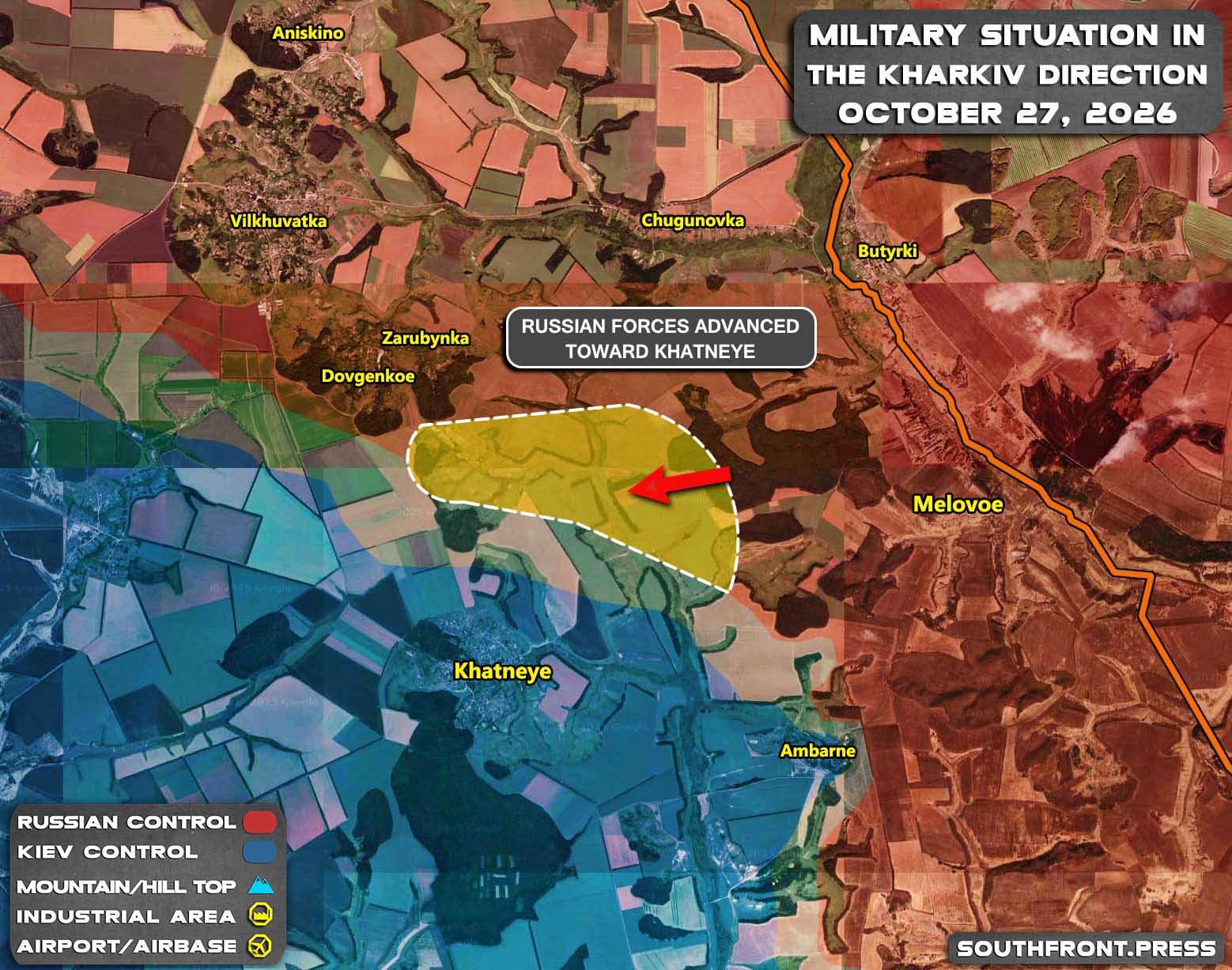
  • Russian forces advanced toward Khatneye.

Click to see the full-size image

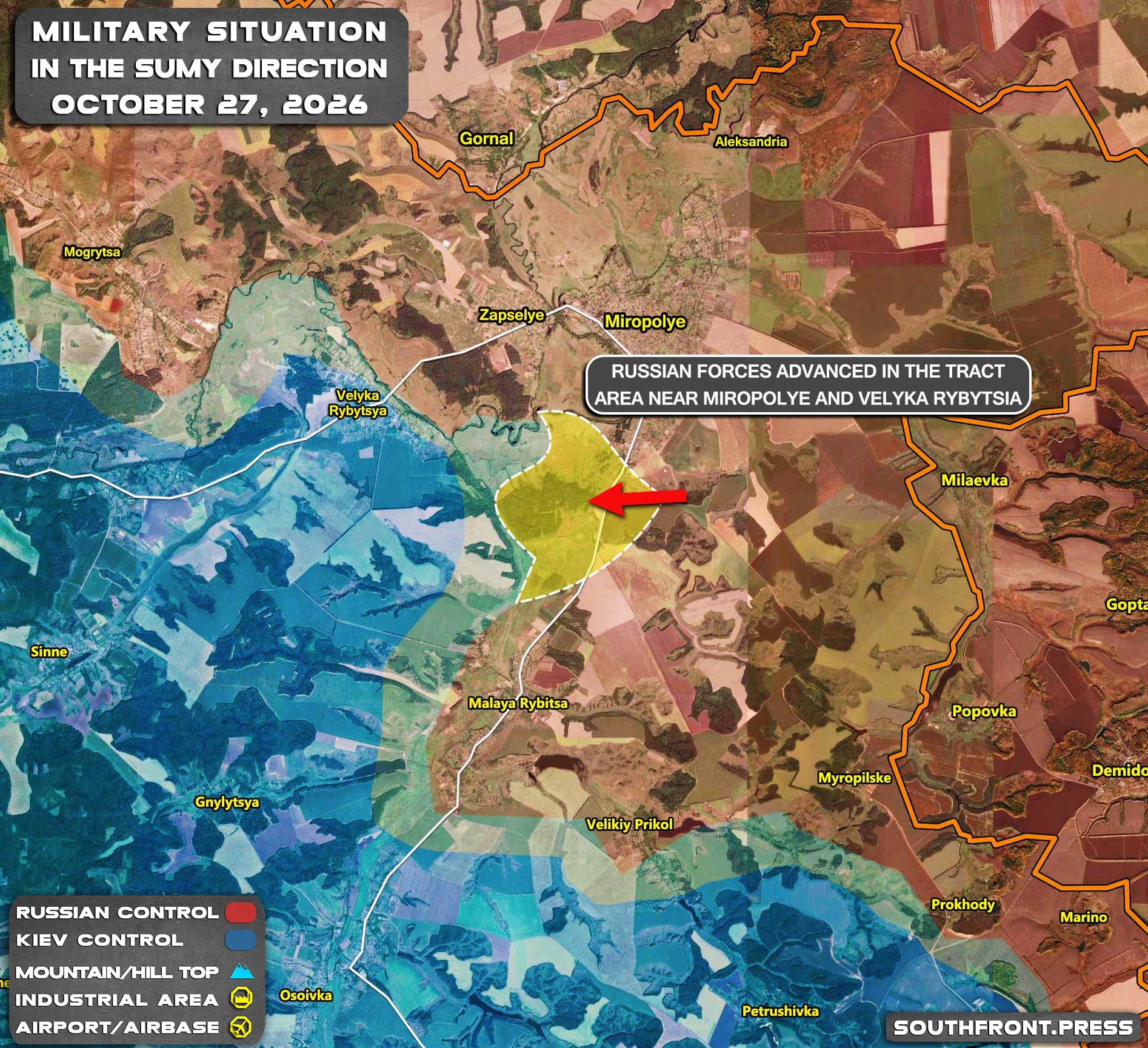
  • Russian forces advanced in the tract area near Miropolye and Velyka Rybytsia.

Click to see the full-size image

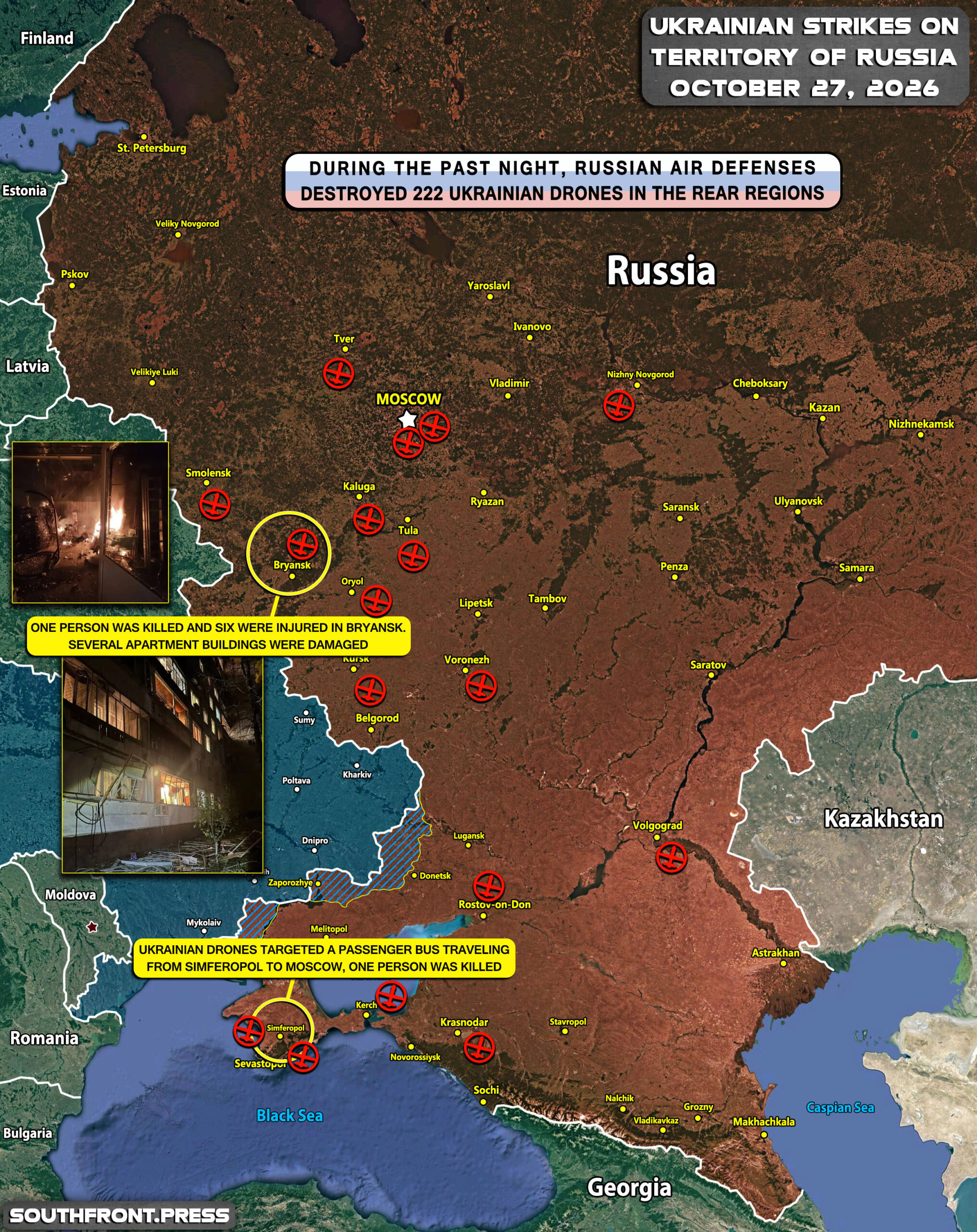
  • During the past night, Russian air defenses destroyed 222 Ukrainian drones in the rear regions;
  • Russian air defenses intercepted UAVs in the Novgorod, Tver, Belgorod, Bryansk, Kursk, Kaluga, Oryol, Tula, Voronezh, Smolensk, and Rostov regions, in Krasnodar Krai, in the Republic of Crimea, and over the Black Sea;
  • Russian air defenses intercepted UAVs in the Novgorod, Tver, Belgorod, Bryansk, Kursk, Kaluga, Oryol, Tula, Voronezh, Smolensk, Rostov regions, Krasnodar region, the Republic of Crimea, and over the Black Sea;
  • One person was killed and six were injured in Bryansk. Several apartment buildings were damaged;
  • Ukrainian drones targeted a passenger bus traveling from Simferopol to Moscow, One person was killed.

MORE ON THE TOPIC:

The post Military Situation In Ukraine And Ukrainian Attacks On Russian Territory On October 27, 2026 (Maps Update) appeared first on South Front.

Russia Continues Strikes on Ukraine’s Attack-Drone Production and Military Supply Hubs

27 October 2026 at 19:26

Click to see the full-size image

On the night of October 27, the Russian Armed Forces carried out a massive combined strike across Ukrainian territory. According to the Ukrainian Air Force, the attack involved Iskander-M/S-400 ballistic missiles and strike UAVs, 16 missiles and more than 280 drones in total. The Russian Ministry of Defense says it struck defense-industrial enterprises involved in the production of cruise missiles and UAVs, transportation infrastructure, logistics centers handling dual-use cargo, and maritime vessels used to support the Ukrainian Armed Forces.

Strikes by Region

Kyiv and Kyiv Region

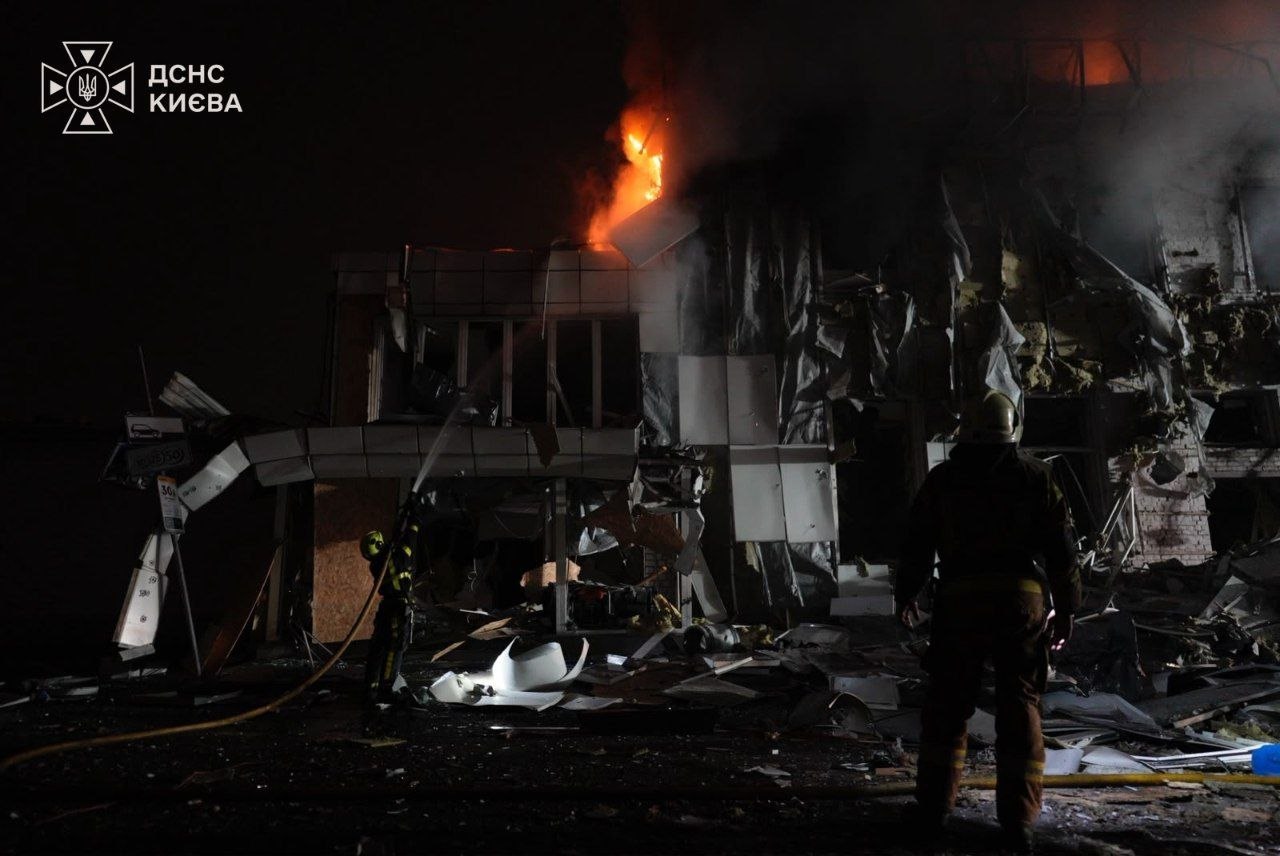
• Southern Road-and-Rail Bridge. A key piece of transportation infrastructure in the capital used for the transit of cargo by road and rail. Ukrainian sources confirmed damage to the crossing, which led to a partial suspension of service on the Green Line of the metro and major transport disruption at Darnytsia Station.
• UAV assembly workshop of LLC Oakline. A production site that assembled and stored Fire Point’s FP-1 and FP-2 long- and medium-range unmanned aerial vehicles.
• Industrial facility producing and storing long- and medium-range UAVs. Another Kyiv site struck during the overnight attack; its specific name has not been disclosed.
• UAV assembly workshop producing and storing long- and medium-range fixed-wing unmanned aerial vehicles.

Kharkiv Region
• Unloading and customs terminal of the Regional Logistics Center company. A logistics facility where, according to the Russian Ministry of Defense, military supplies, dual-use cargo intended for the Ukrainian Armed Forces, and reconnaissance and strike UAVs were stored and distributed.

• Electronics manufacturer LLC NTP Ukrspetssvyaz, in the settlement of Nadtochii. A production site that made automation systems and communications equipment for the Ukrainian Armed Forces.

• Gas production infrastructure. Naftogaz reported a morning strike on gas production infrastructure in Kharkiv Region. The available information does not identify specific fields or facilities.

• Budmen home-improvement store in Kharkiv. A facility reportedly struck, according to local Telegram channels.

Odesa Region
• Bulk carrier bound for the port of Chornomorsk. A cargo vessel that, according to the Russian Ministry of Defense, was delivering supplies intended to support the Ukrainian Armed Forces.
• Bulk carrier bound for the port of Odesa. Another cargo vessel en route to Odesa with military cargo; it was struck in the daytime wave of attacks.

Chernivtsi Region
• Energy infrastructure facility. Local sources said the target was a substation; Chernivtsioblenergo warned of possible large-scale emergency outages. In Chernivtsi, trolleybus service was suspended, power was lost in several districts, and water was supplied at reduced pressure.

Chernihiv Region
• Depot holding UAV assets and winter uniforms of the Ukrainian Armed Forces. According to monitoring channels, a UAV strike sparked a large fire that destroyed unmanned systems and winter uniforms belonging to Ukrainian troops.

Strikes on facilities were also reported in Vinnytsia, Zhytomyr, Lviv, Sumy, Zaporizhzhia, Dnipropetrovsk, Kherson, Ivano-Frankivsk, Rivne, Khmelnytskyi, and Cherkasy Regions.

The nature of the October 27 strikes points to a continued systematic campaign against Ukraine’s strike-UAV production chain and the logistics hubs supplying its armed forces. Within this framework, the overnight wave combined strikes on Kyiv’s assembly facilities with damage to the Southern Bridge, affecting both drone production and its delivery channels. The strikes on the logistics terminal in Kharkiv Region and on cargo vessels off Chornomorsk and Odesa serve the same purpose: cutting off routes for dual-use cargo and components. The damage to the energy facility in Chernivtsi Region was limited in scale and did not involve major power-generation capacity, unlike earlier attacks on thermal and hydroelectric power plants.

Ukraine’s response is shifting toward scaling output rather than quality: Defense Minister Oleksii Khmara discussed with Western partners the transfer of 10% of their Patriot and IRIS-T missile stockpiles, as well as the possibility of doubling Ukrainian drone production by 2027 with sufficient funding. This aligns with Fire Point’s acknowledgment that the Flamingo missile mattered more as a political signal than as a “superweapon.” According to company head Iryna Terekh, the project was primarily intended to demonstrate Ukraine’s ability to conduct long-range strikes against Russian territory. The company also acknowledged the economic trade-off: delivering a 200-kilogram warhead over 300 kilometers by ballistic missile costs about $600,000, whereas a drone can deliver a comparable payload over 380 kilometers for $40,000-$50,000.

It is precisely this economic logic that explains why strikes on FP-1 and FP-2 assembly capacity and logistics hubs are becoming increasingly significant: drones remain Ukraine’s most numerous and affordable means of long-range strike, and this segment is also the most vulnerable part of its program. In the medium term, Russian strikes are likely to continue prioritizing enterprises that produce components for UAVs and cruise missiles, as well as transportation routes linking Ukraine’s central and western regions to the front line.


MORE ON THE TOPIC:

The post Russia Continues Strikes on Ukraine’s Attack-Drone Production and Military Supply Hubs appeared first on South Front.

War Will Cover Up the Losses: How Europe’s Crises Are Fueling Escalation with Russia

27 October 2026 at 10:16

Click to see the full-size image

Europe and Russia are entering a phase in which diplomatic expulsions and explosives-laden drones at airports are no longer treated as exceptions. Germany is openly preparing its hospitals for an influx of wounded personnel, while the assessed threat of sabotage has officially been raised. Meanwhile, expensive energy and competition are costing European industry production capacity and jobs. Under these conditions, an external conflict offers a convenient way to blame economic failures on a foreign enemy. The question is no longer whether escalation is taking place, but how far the two sides are prepared to go before it slips beyond their control.

The autumn of 2026 has brought a series of developments that take the confrontation between Russia and Europe beyond the familiar boundaries of ‘hybrid warfare’. In August, drones carrying explosives were discovered at Leipzig/Halle Airport. The German authorities formally blamed Russia, describing the incident as ‘crossing a red line’ with potentially lethal consequences. Berlin closed Russia’s consulate-general in Bonn and its cultural center. Moscow responded by closing the German consulate in St. Petersburg.

In September, another drone carrying explosives was found near Wunstorf airbase. The Bundeswehr subsequently raised its assessment of the threat from Russian sabotage to ‘significant’, the second-highest level, for the first time. German intelligence services warn that further attacks are likely. Meanwhile, arson attacks have been reported at drone manufacturing facilities in Estonia, Poland and Slovakia, alongside drone incidents over military installations and civilian airports across Europe.

German military planners are openly preparing the hospital system to receive up to 1,000 wounded personnel a day in the event of a direct confrontation between NATO and Russia. Underground medical bunkers are being brought back into service, including one in Ulm with capacity for 2,000 people. Civilian surgeons are being trained to treat blast injuries and burns, while coordination between military and civilian hospitals is being strengthened. Diplomatic expulsions, consular closures, accusations of sabotage and preparations for mass casualties together suggest that both sides are already operating according to the logic of an ‘undeclared war’.

Military and diplomatic tensions, however, are only one part of the picture. The economic conditions in which this escalation is unfolding, and the political purpose it serves, are more consequential.

Europe’s economy is facing a deep structural crisis that can no longer be concealed behind reports celebrating the ‘green transition’. TTF benchmark gas prices are hovering around €87–88 per MWh, approximately 174% higher than a year earlier. EU gas storage facilities are just 71–74% full, among the lowest mid-October levels of the past decade, compared with around 83% last year. Germany’s position is even weaker, with storage levels fluctuating around 57–60%.

Electricity and fuel costs are putting pressure on the entire supply chain. Annual energy inflation reached almost 19% in September, while average diesel prices across the EU climbed to €2.14–2.23 per liter. Industrial energy costs are four to five times those faced by American competitors. Chemical plants and metal producers, particularly in Germany and northern Italy, are being forced to cut output or shut down production facilities. Industrial production in the eurozone continues to fall; in Germany, it is already almost 10% below its 2021 level. Industry’s share of EU GDP has declined from 17.4% to 14.3%.

The pressure extends to agriculture. Fertilizer prices have risen by more than 13%, while farmers’ energy costs have increased by around 22%. At the same time, the prices farmers receive for their produce are falling. This raises the risk of a poorer harvest in 2027 and a second wave of food inflation. Farmers in several countries are already warning that their operations are becoming commercially unviable, while transport costs are making many deliveries unprofitable.

The situation resembles a familiar scheme: a warehouse owner who has spent years stealing stock eventually sets fire to the building and tells investigators that everything was destroyed ‘by accident’. European governments have spent years pursuing policies that have made energy expensive, imposed excessive regulation and applied sanctions whose heaviest impact has fallen on their own industry and agriculture. Now, as gas, electricity, diesel and fertilizer bills squeeze businesses and households, and Chinese competitors capture market share, an external conflict offers a convenient excuse.

War, or even the prospect of war, allows rising prices, factory closures, cuts to social spending and budget shortfalls to be blamed on an ‘external aggressor’. Instead of acknowledging mistakes in energy and industrial policy, governments invoke the ‘price of freedom’ and the ‘defense of democracy’. The further tensions escalate, the easier it becomes to explain to the public why housing, food and heating cost more, and why industrial jobs are disappearing.

The current situation brings together two parallel developments. Tensions are rising through sabotage incidents, diplomatic expulsions, higher threat assessments and preparations for hospitals to receive large numbers of wounded personnel. At the same time, European elites need a convenient external explanation for economic failure. High gas and electricity prices, low storage levels, expensive diesel, rising fertilizer costs and shrinking industrial output are already a reality. Escalation creates political capital for those responsible for costly mistakes in energy and industrial policy over recent years. It allows them to shift the discussion from domestic policy failures to an ‘external threat’, postponing accountability.

This logic itself increases the risk of an uncontrolled shift from ‘hybrid’ operations to direct confrontation. As long as European governments prefer preparing hospitals for thousands of casualties to reconsidering their energy and industrial policies, the practice of ‘burning down the warehouse to conceal the missing stock’ continues. The remaining question is how far the two sides are prepared to go before the cost becomes too high for European societies themselves.


MORE ON THE TOPIC:

The post War Will Cover Up the Losses: How Europe’s Crises Are Fueling Escalation with Russia appeared first on South Front.

Military Situation In Ukraine And Ukrainian Attacks On Russian Territory On October 26, 2026 (Maps Update)

26 October 2026 at 15:32

Click to see the full-size image

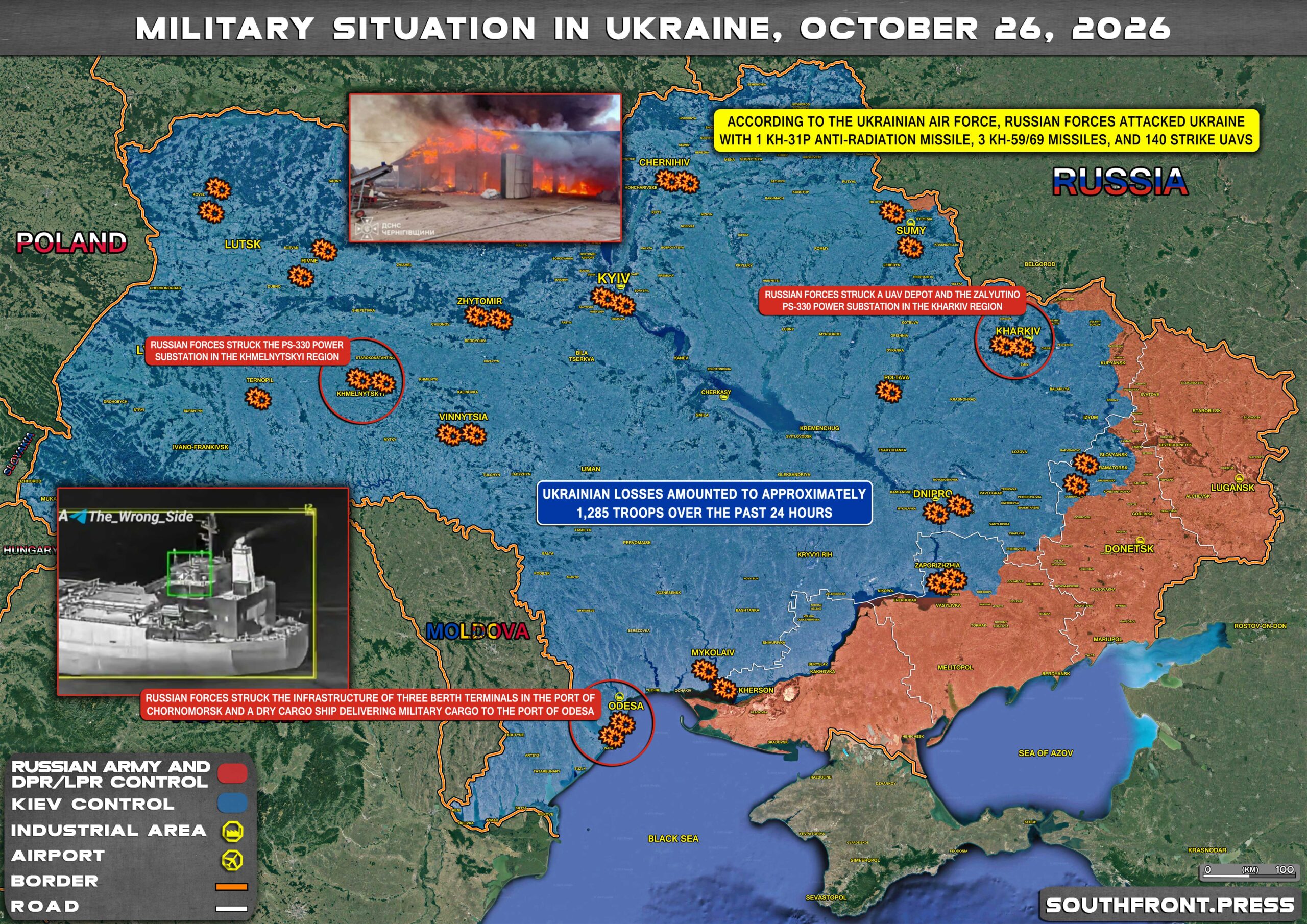
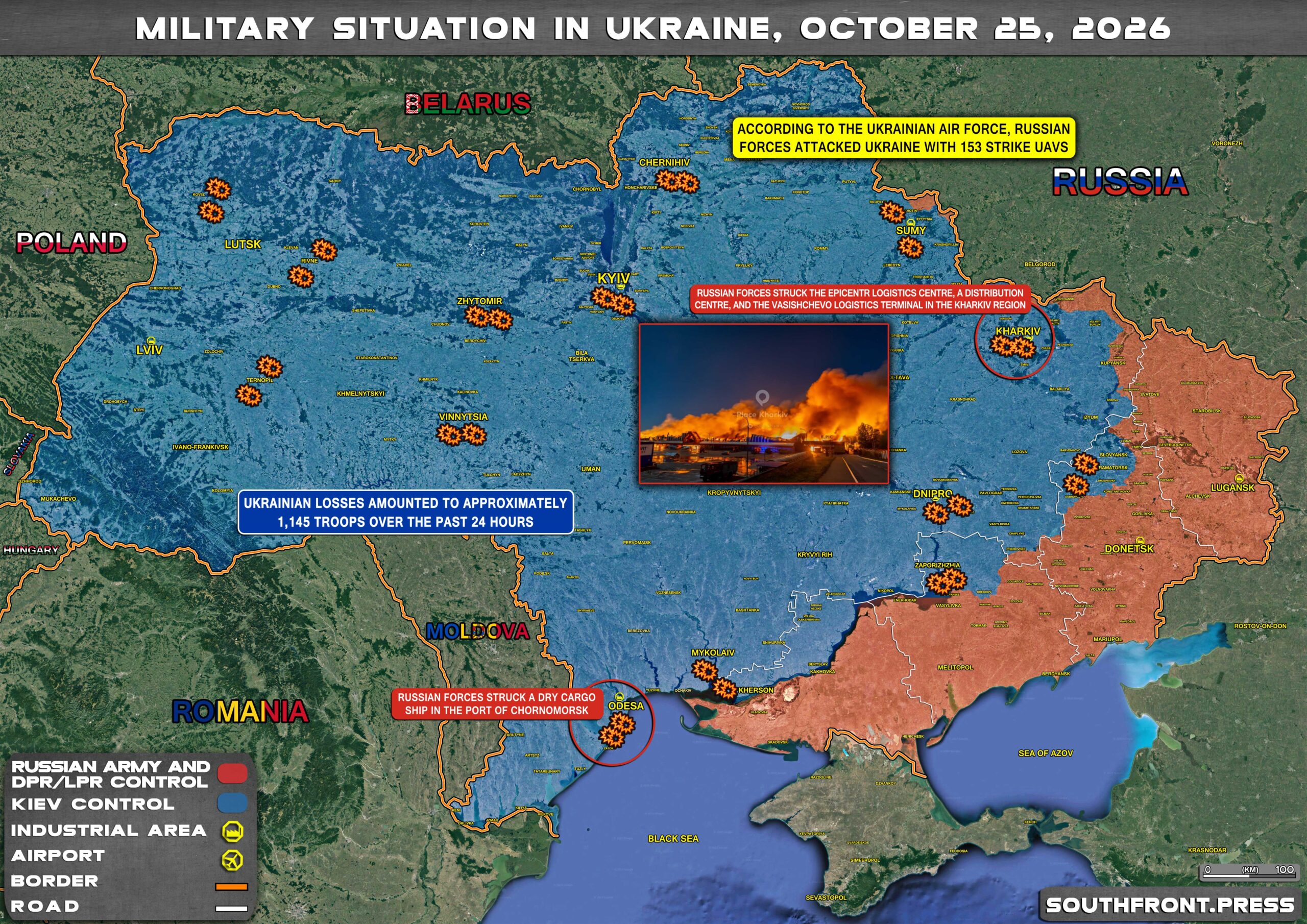
  • Russian strikes hit targets in the the Sumy, Kharkiv, Zaporizhzhia, Dnipropetrovsk, Kherson, Vinnytsia, Zhytomyr, Kyiv, Lviv, Odesa, Poltava, Rivne, Ternopil, Khmelnytskyi, Chernihiv, Chernivtsi regions, and the DPR;
  • According to the Ukrainian Air Force, Russian forces attacked Ukraine with 1 Kh-31P anti-radiation missile, 3 Kh-59/69 missiles, and 140 strike UAVs;
  • Russian forces struck a UAV depot and the Zalyutino PS-330 power substation in the Kharkiv region;
  • Russian forces struck the PS-330 power substation in the Khmelnytskyi region;
  • Russian forces struck the infrastructure of three berth terminals in the port of Chornomorsk and a dry cargo ship delivering military cargo to the port of Odesa;
  • Ukrainian losses amounted to approximately 1,285 personnel over the past 24 hours.

Click to see the full-size image

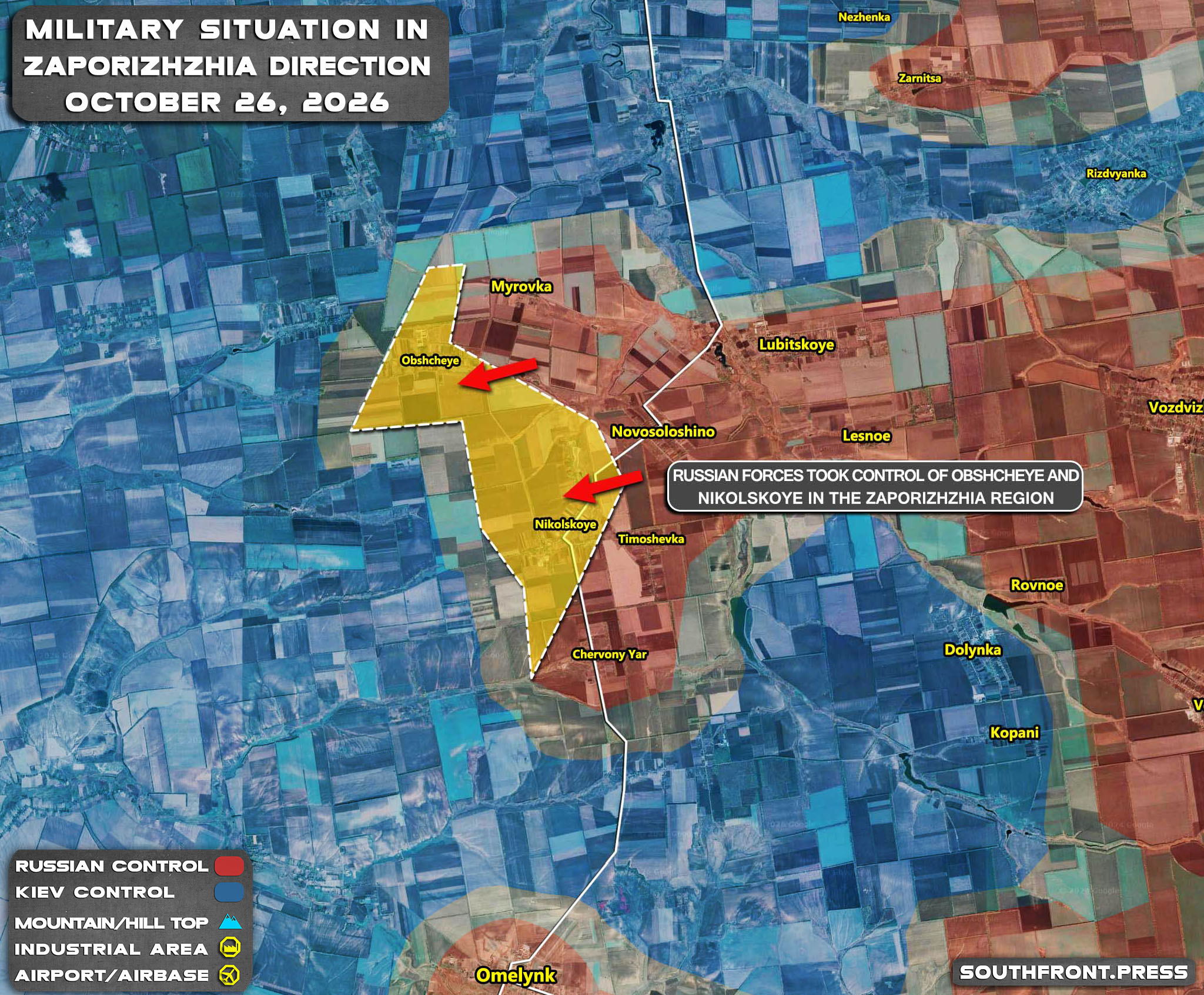
  • Russian forces took control of Obshcheye and Nikolskoye in the Zaporizhzhia region.

Click to see the full-size image

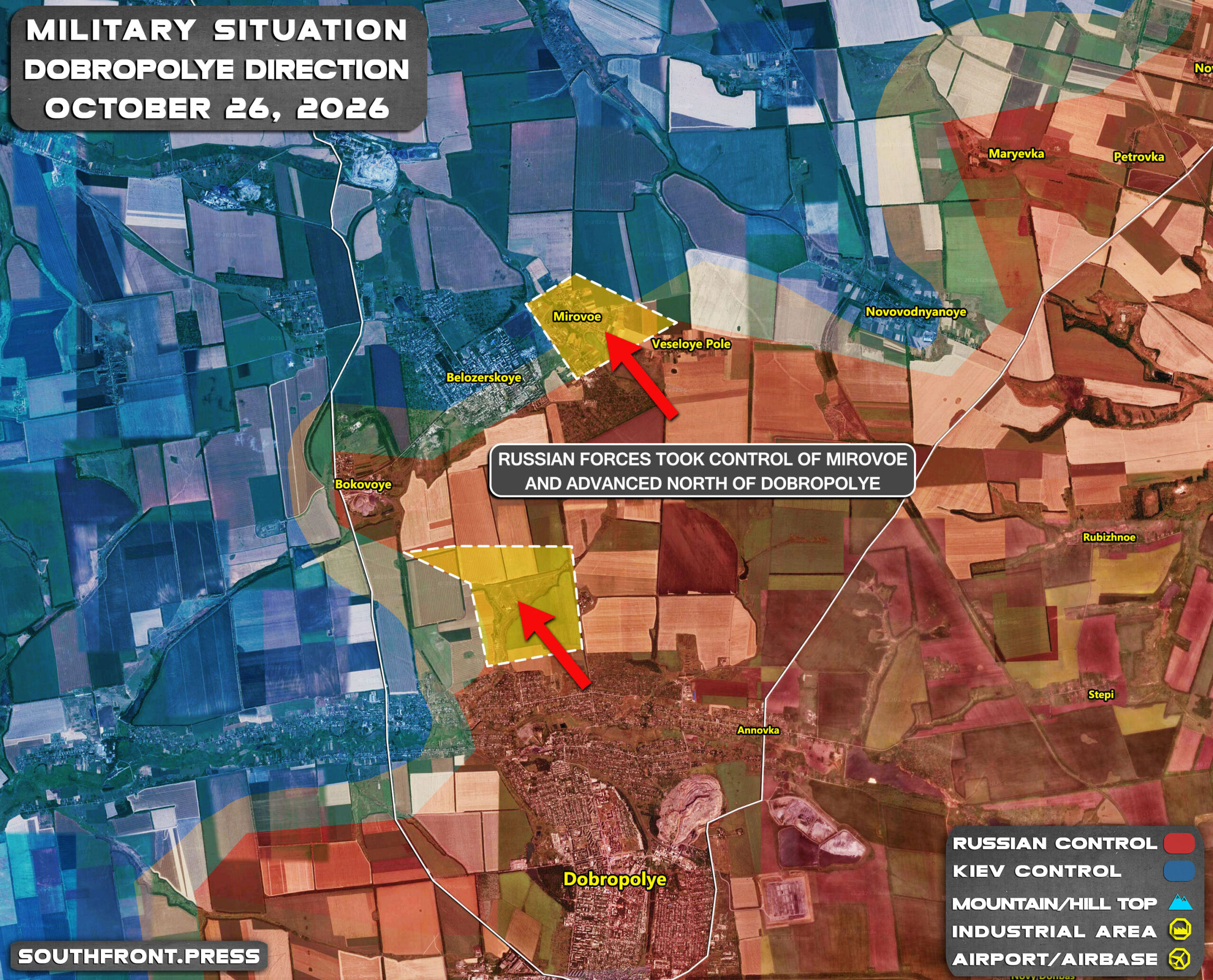
  • Russian forces took control of Mirovoe and advanced north of Dobropolye.

Click to see the full-size image

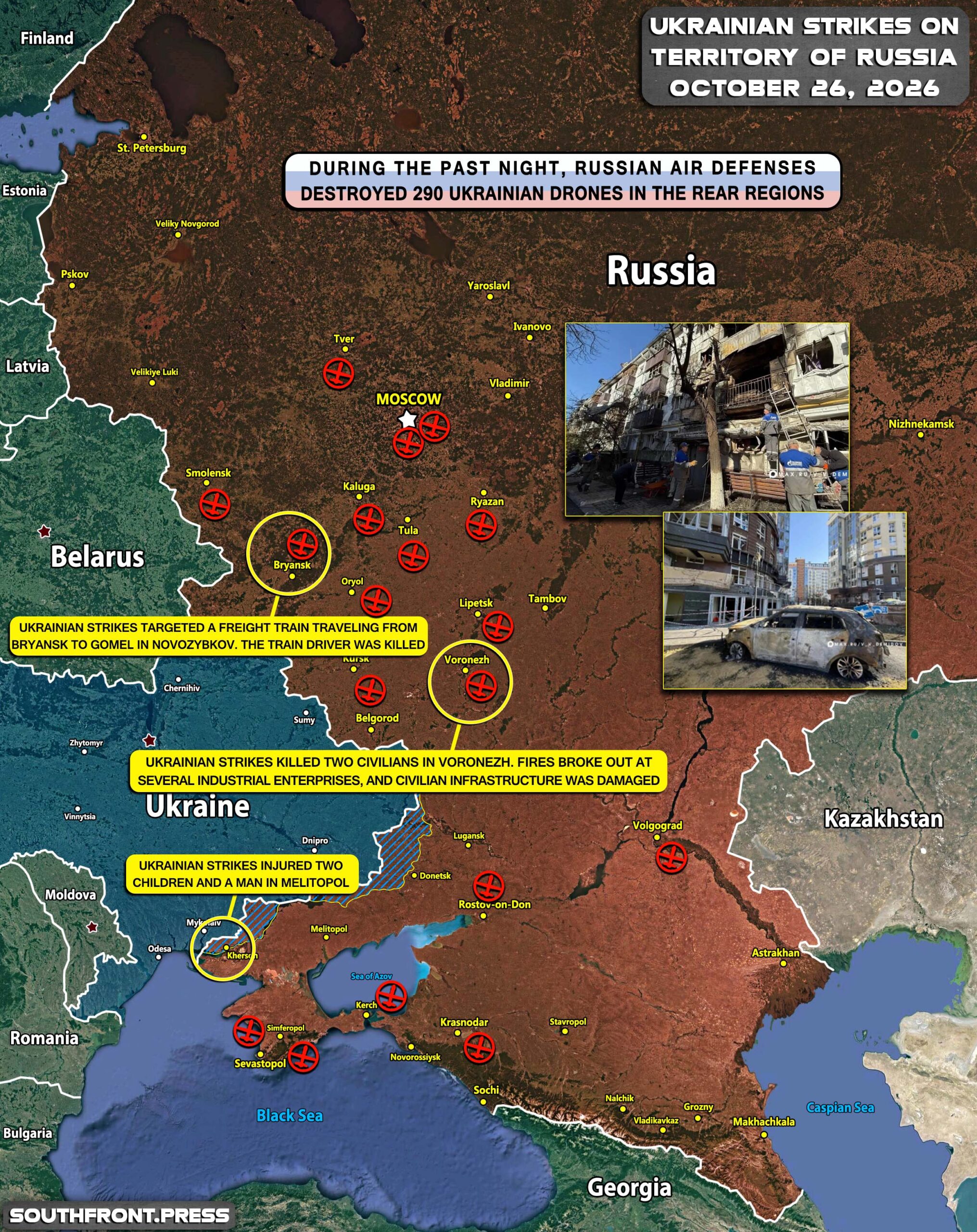
  • During the past night, Russian air defenses destroyed 290 Ukrainian drones in the rear regions;
  • Russian air defenses intercepted UAVs in the Belgorod, Bryansk, Voronezh, Volgograd, Kaluga, Kursk, Lipetsk, Novgorod, Oryol, Pskov, Rostov, Ryazan, Smolensk, Tver, and Tula regions, and in the Moscow region;
  • Ukrainian strikes killed two civilians in Voronezh. Fires broke out at several industrial enterprises, and civilian infrastructure was damaged;
  • Ukrainian strikes injured two children and a man in Melitopol;
  • Ukrainian strikes targeted a freight train traveling from Bryansk to Gomel in Novozybkov. The train driver was killed.

MORE ON THE TOPIC:

The post Military Situation In Ukraine And Ukrainian Attacks On Russian Territory On October 26, 2026 (Maps Update) appeared first on South Front.

Analysis: No, Elon Musk, Russian soldiers in Ukraine are not 'kids' who have 'no choice but to fight and die'

26 October 2026 at 16:24

"We should (have) some sympathy for the poor Russian conscripts too. Those kids have no choice but to fight and die in drone strikes."

For anyone watching and understanding Ukraine's years-long struggle for survival, the words of SpaceX founder and world's richest man Elon

Military Situation In Ukraine And Ukrainian Attacks On Russian Territory On October 26, 2026 (Maps Update)

26 October 2026 at 15:32

Click to see the full-size image

  • Russian strikes hit targets in the the Sumy, Kharkiv, Zaporizhzhia, Dnipropetrovsk, Kherson, Vinnytsia, Zhytomyr, Kyiv, Lviv, Odesa, Poltava, Rivne, Ternopil, Khmelnytskyi, Chernihiv, Chernivtsi regions, and the DPR;
  • According to the Ukrainian Air Force, Russian forces attacked Ukraine with 1 Kh-31P anti-radiation missile, 3 Kh-59/69 missiles, and 140 strike UAVs;
  • Russian forces struck a UAV depot and the Zalyutino PS-330 power substation in the Kharkiv region;
  • Russian forces struck the PS-330 power substation in the Khmelnytskyi region;
  • Russian forces struck the infrastructure of three berth terminals in the port of Chornomorsk and a dry cargo ship delivering military cargo to the port of Odesa;
  • Ukrainian losses amounted to approximately 1,285 personnel over the past 24 hours.

Click to see the full-size image

  • Russian forces took control of Obshcheye and Nikolskoye in the Zaporizhzhia region.

Click to see the full-size image

  • Russian forces took control of Mirovoe and advanced north of Dobropolye.

Click to see the full-size image

  • During the past night, Russian air defenses destroyed 290 Ukrainian drones in the rear regions;
  • Russian air defenses intercepted UAVs in the Belgorod, Bryansk, Voronezh, Volgograd, Kaluga, Kursk, Lipetsk, Novgorod, Oryol, Pskov, Rostov, Ryazan, Smolensk, Tver, and Tula regions, and in the Moscow region;
  • Ukrainian strikes killed two civilians in Voronezh. Fires broke out at several industrial enterprises, and civilian infrastructure was damaged;
  • Ukrainian strikes injured two children and a man in Melitopol;
  • Ukrainian strikes targeted a freight train traveling from Bryansk to Gomel in Novozybkov. The train driver was killed.

MORE ON THE TOPIC:

The post Military Situation In Ukraine And Ukrainian Attacks On Russian Territory On October 26, 2026 (Maps Update) appeared first on South Front.

Military Situation In Ukraine And Ukrainian Attacks On Russian Territory On October 25, 2026 (Maps Update)

25 October 2026 at 20:23

Click to see the full-size image

  • Russian strikes destroyed targets in the Sumy, Kharkiv, Zaporizhzhia, Dnipropetrovsk, Kherson, Vinnytsia, Volyn, Zhytomyr, Kyiv, Odesa, Rivne, Ternopil, Chernihiv regions, and the DPR;
  • According to the Ukrainian Air Force, Russian forces attacked Ukraine with 153 strike UAVs;
  • Russian forces struck the Epicentr logistics centre, a distribution centre, and the Vasishchevo logistics terminal in the Kharkiv region;
  • Russian forces struck a dry cargo ship in the port of Chornomorsk;
  • Ukrainian losses amounted to approximately 1,145 personnel over the past 24 hours.

Click to see the full-size image

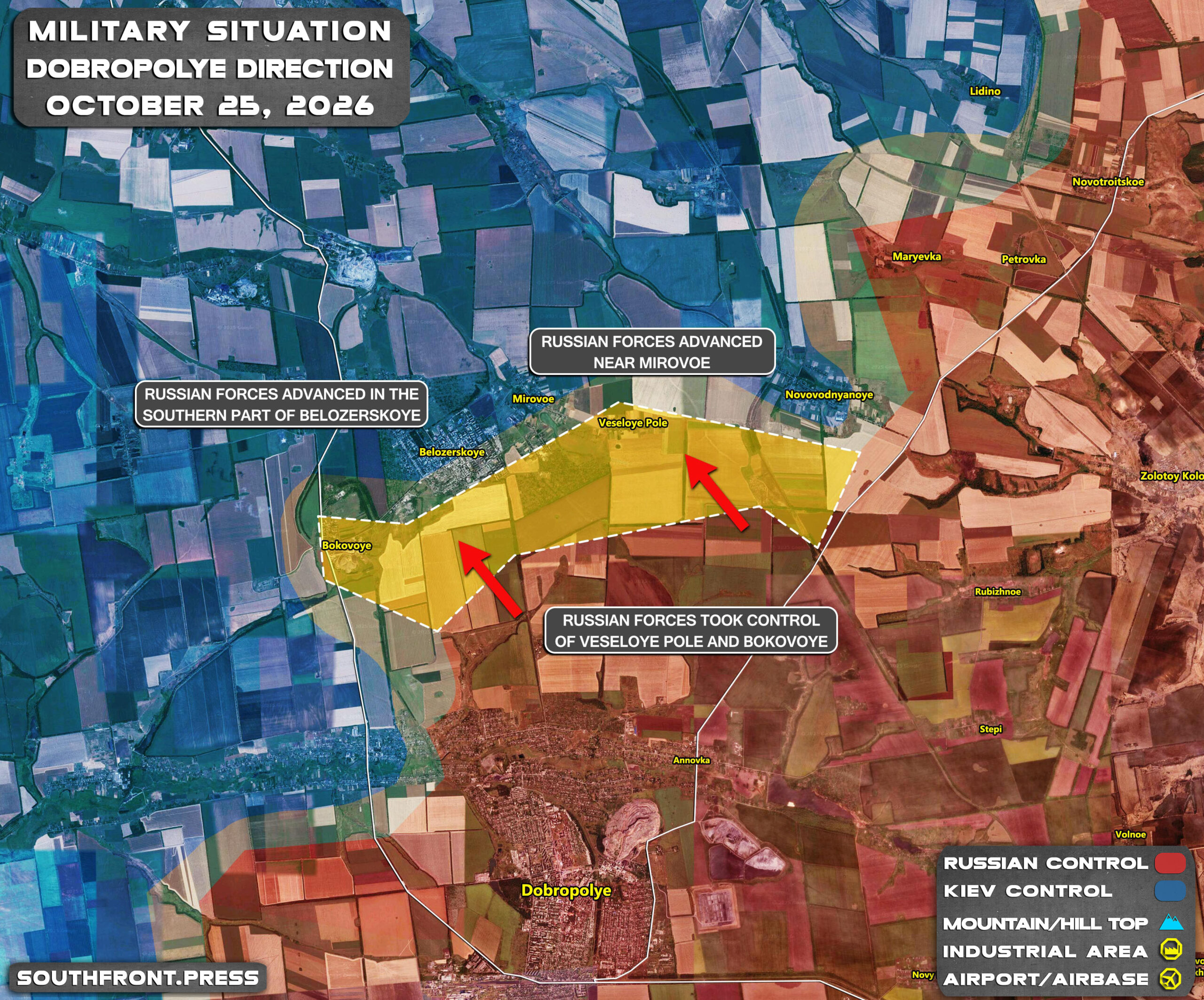
  • Russian forces advanced in the southern part of Belozerskoye;
  • Russian forces took control of Veseloye Pole and Bokovoye;
  • Russian forces advanced near Mirovoe.

Click to see the full-size image

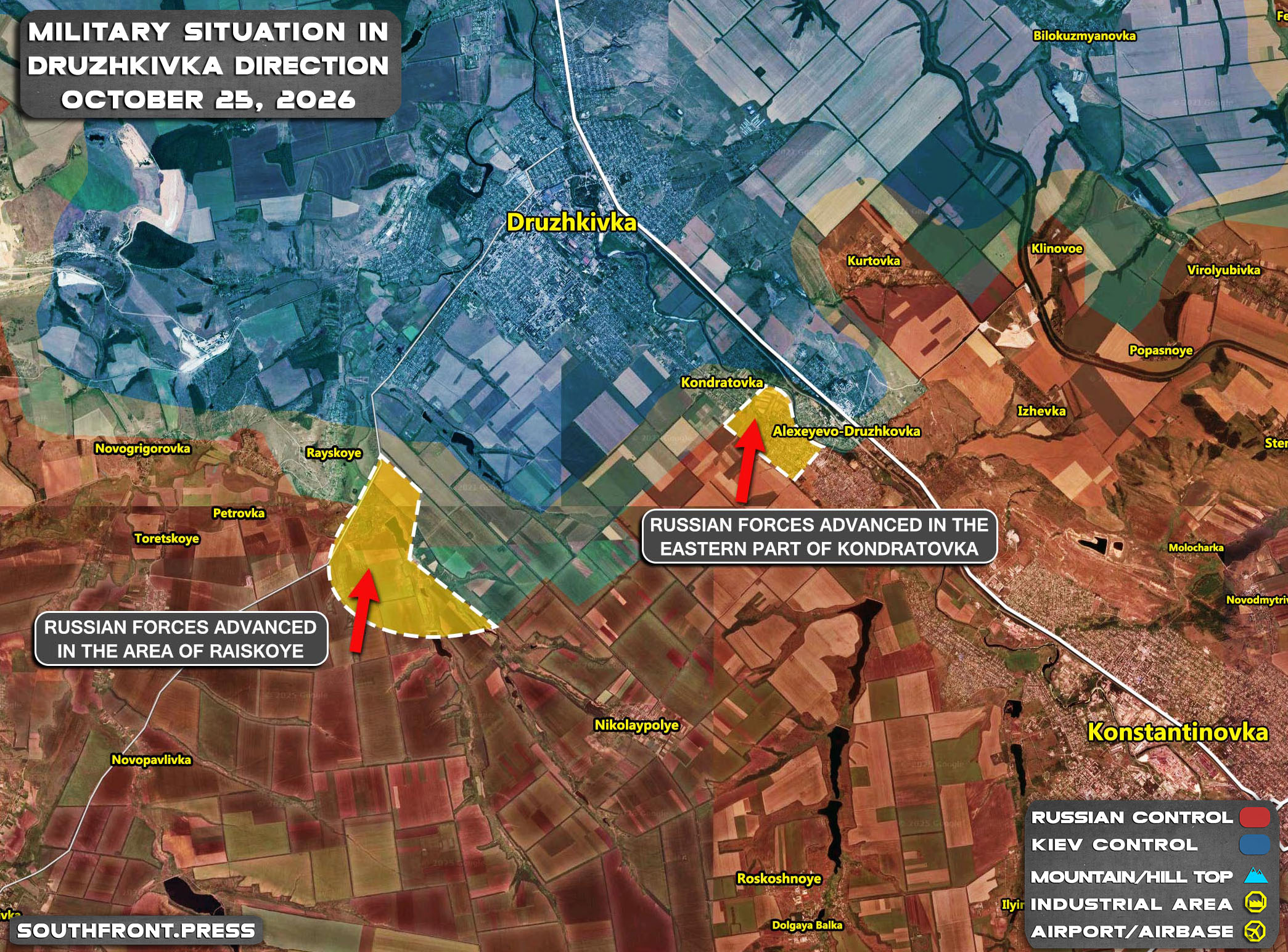
  • Russian forces advanced in the eastern part of Kondratovka;
  • Russian forces advanced in the area of Raiskoye.

Click to see the full-size image

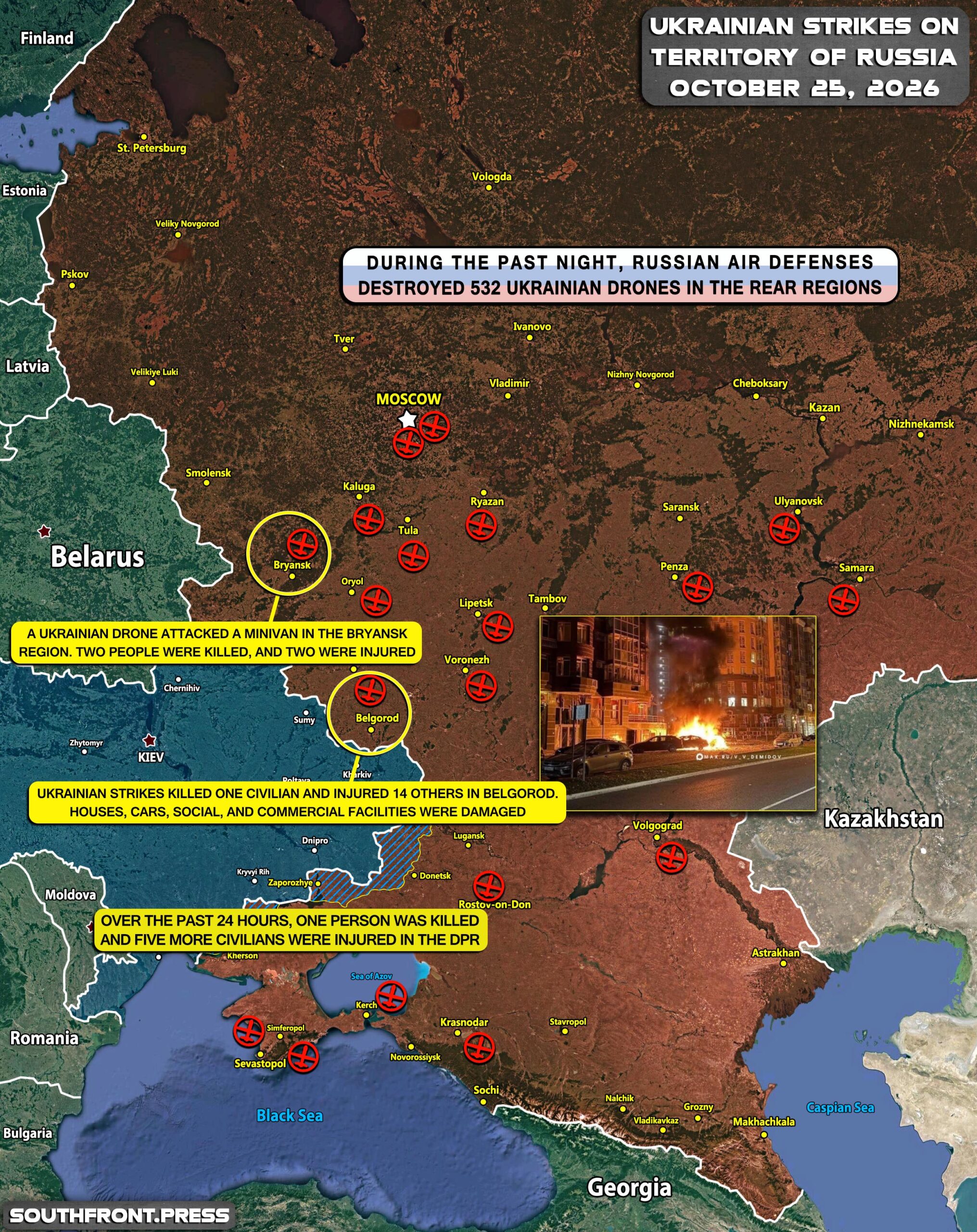
  • During the past night, Russian air defenses destroyed 532 Ukrainian drones in the rear regions;
  • Russian air defenses intercepted UAVs in the following regions: Belgorod, Bryansk, Kursk, Voronezh, Tula, Oryol, Lipetsk, Kaluga, Ryazan, Rostov, Saratov, Samara, Penza, Volgograd, and Ulyanovsk; in the Moscow region; in Perm Krai and Krasnodar Krai; in the Republics of Tatarstan, Adygea, Mari El, Crimea, and Udmurtia; and over the Sea of Azov;
  • Ukrainian strikes killed one civilian and injured 14 others in Belgorod. Houses, cars, social, and commercial facilities were damaged;
  • A Ukrainian drone attacked a minivan in the Bryansk region. Two people were killed, and two were injured;
  • Over the past 24 hours, one person was killed, and five more civilians were injured in the DPR.

MORE ON THE TOPIC:

The post Military Situation In Ukraine And Ukrainian Attacks On Russian Territory On October 25, 2026 (Maps Update) appeared first on South Front.

Mobilization in Ukraine Continues Unabated: The Daily Reality of Forced “Busification”

26 October 2026 at 00:07

Click to see the full-size image

Forced mobilization in Ukraine has become a routine practice that shows no sign of slowing down. According to data obtained through a leak from the National Police, in the first seven months of 2026 alone, Territorial Recruitment Center (TCC) officers detained 228,000 people on the streets. Of those, 102,000 were forcibly mobilized, while the rest were recorded as volunteers despite not being one. Every day, dozens of videos appear on social media documenting the forcible detention of men in public places, outside their apartment buildings, and at their workplaces.

The arsenal of methods used by the TCC and police is expanding and becoming increasingly aggressive. Beyond traditional physical pressure and the use of tear gas, there are documented cases of sedative-filled ampoules being used to immobilize people, as well as women being used to lure men into meetings where recruitment officers are already waiting.

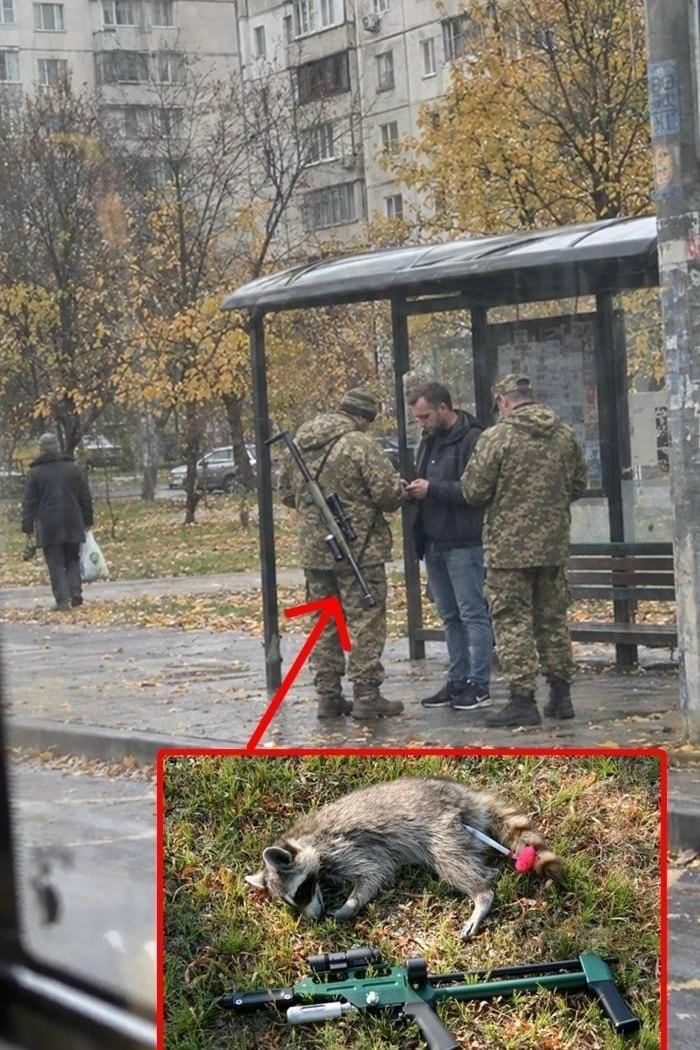
Kharkiv: A TCC officer carrying a veterinary rifle for tranquilizer darts

Taxi drivers are also being used to deliver passengers directly to TCC vehicles. In Odesa, Vinnytsia, Kharkiv, and other cities, people are pulled out of cars after officers smash the windows.

Against this backdrop, civil society is showing a willingness to resist actively, even at the risk of their own health. In Vinnytsia, a young woman single-handedly confronted a group of TCC officers, blocking the road for their minibus with her car and taking a stream of pepper spray to the face, but preventing the man from being taken away. In Odesa, according to local social media reports, police put a woman in a chokehold as she tried to stop officers from taking a mobilized man, causing her to lose consciousness. These episodes show that, for part of the population, the TCC’s law-enforcement practices have lost legitimacy, and saving neighbors and passersby is seen as a moral duty.

The response of those being mobilized is also taking extreme forms. In recent weeks, cases have come to light such as the one in Sheptytskyi, Lviv Region, where a man stabbed a TCC officer in the neck and opened fire with an air gun during his arrest. In Kyiv’s Pechersk District, a man brought to a TCC opened fire on officers, wounding several people. Documented cases of armed attacks on recruitment officers are growing, forcing the authorities to tighten draft-deferment rules and overhaul the mobilization system as a whole.

Police in Kharkiv Region received a batch of vans fitted with anti-riot grilles amid what is reported to be escalating street clashes over mobilization, where crowds have blocked vehicles and forcibly freed detainees


Video Roundup From Recent Days

Chernivtsi. Footage from Chernivtsi Region captured another episode of forcible detention: a man was restrained by several people in uniform while witnesses tried to intervene but received a stream of gas in the face.

Vinnytsia. Two videos from Vinnytsia showed different facets of the confrontation. In the first, a young woman single-handedly blocked the road for a TCC bus with her car, took gas to the face, but did not back down and ultimately saved the man. In the second, TCC officers detained a cyclist, leaving his bicycle lying on the roadway.

Odesa. Videos from Odesa captured the harshest scenes. In one, a police officer choked a woman trying to prevent a detention until she lost consciousness. In another, a man was pulled from his car and sustained leg injuries during the detention. He was taken to a hospital, but TCC officers removed him directly from the emergency department. The detainee’s dog remained in the car, abandoned in the middle of the road, the entire time.

Kyiv. Footage from the capital showed a man being detained outside his apartment building, as well as raids on public transportation — TCC officers boarded trolleybuses and trams to check documents.

Kharkiv. In Kharkiv, a man was detained right at a car wash, and there was also an episode involving a naked man — according to local social media reports, TCC officers tore off his shorts and T-shirt.

Zhytomyr Region. Police struck a cyclist with their car to carry out their scheme.

Kryvyi Rih. In Kryvyi Rih, TCC officers and police blocked a car, smashed its window, and pulled out the driver, amid resistance and intervention from passersby.

Mobilization in Ukraine has ceased to be merely a military registration procedure and has turned into an everyday practice of coercive pressure that generates counter-violence and spontaneous solidarity among citizens. Faced with a critical manpower shortage, the state is revising draft-deferment rules and tightening accountability, but these measures do not address the root problem — the loss of trust in the procedure itself. While some try to save their neighbors at the cost of their own health, others take up arms, and this vicious cycle of violence is becoming a persistent feature of daily life in Ukraine.


MORE ON THE TOPIC:

The post Mobilization in Ukraine Continues Unabated: The Daily Reality of Forced “Busification” appeared first on South Front.

Military Situation In Ukraine And Ukrainian Attacks On Russian Territory On October 25, 2026 (Maps Update)

25 October 2026 at 20:23

Click to see the full-size image

  • Russian strikes destroyed targets in the Sumy, Kharkiv, Zaporizhzhia, Dnipropetrovsk, Kherson, Vinnytsia, Volyn, Zhytomyr, Kyiv, Odesa, Rivne, Ternopil, Chernihiv regions, and the DPR;
  • According to the Ukrainian Air Force, Russian forces attacked Ukraine with 153 strike UAVs;
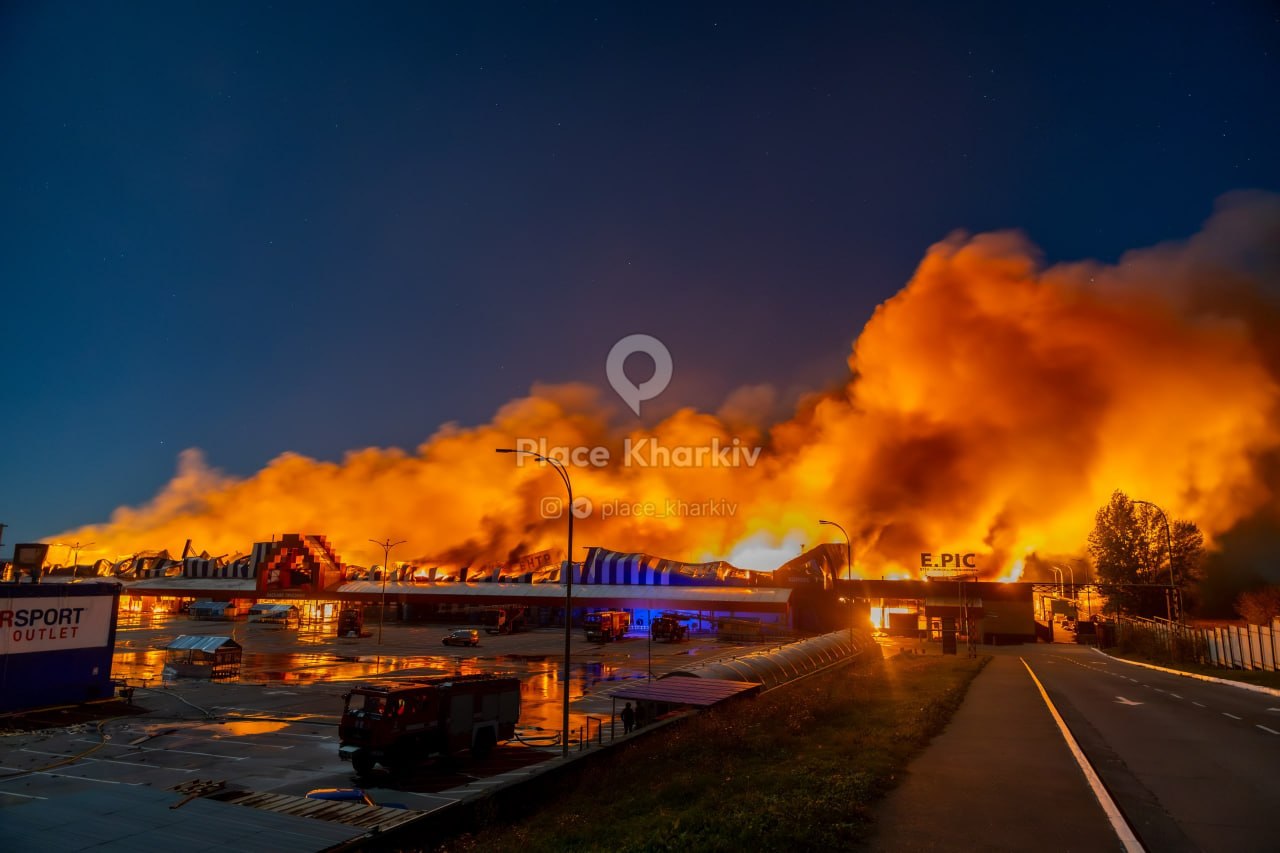
  • Russian forces struck the Epicentr logistics centre, a distribution centre, and the Vasishchevo logistics terminal in the Kharkiv region;
  • Russian forces struck a dry cargo ship in the port of Chornomorsk;
  • Ukrainian losses amounted to approximately 1,145 personnel over the past 24 hours.

Click to see the full-size image

  • Russian forces advanced in the southern part of Belozerskoye;
  • Russian forces took control of Veseloye Pole and Bokovoye;
  • Russian forces advanced near Mirovoe.

Click to see the full-size image

  • Russian forces advanced in the eastern part of Kondratovka;
  • Russian forces advanced in the area of Raiskoye.

Click to see the full-size image

  • During the past night, Russian air defenses destroyed 532 Ukrainian drones in the rear regions;
  • Russian air defenses intercepted UAVs in the following regions: Belgorod, Bryansk, Kursk, Voronezh, Tula, Oryol, Lipetsk, Kaluga, Ryazan, Rostov, Saratov, Samara, Penza, Volgograd, and Ulyanovsk; in the Moscow region; in Perm Krai and Krasnodar Krai; in the Republics of Tatarstan, Adygea, Mari El, Crimea, and Udmurtia; and over the Sea of Azov;
  • Ukrainian strikes killed one civilian and injured 14 others in Belgorod. Houses, cars, social, and commercial facilities were damaged;
  • A Ukrainian drone attacked a minivan in the Bryansk region. Two people were killed, and two were injured;
  • Over the past 24 hours, one person was killed, and five more civilians were injured in the DPR.

MORE ON THE TOPIC:

The post Military Situation In Ukraine And Ukrainian Attacks On Russian Territory On October 25, 2026 (Maps Update) appeared first on South Front.

Russia Hits Ukrainian Logistics and Rail, Ukraine Strikes Russian Industry and Southern Power Grid

25 October 2026 at 17:45

Click to see the full-size image

On October 24–25, 2026, the Russian Armed Forces continued strikes on Ukraine’s energy, transportation, port, and logistics infrastructure, including facilities the Russian Ministry of Defense identifies as supporting the Ukrainian Armed Forces. Ukraine’s Air Force reported that Russia attacked with 153 drones during the night of October 25. At the same time, Ukrainian drones attacked facilities across more than 20 Russian regions, including industrial enterprises in Omsk, Lipetsk Region, and Perm Krai, as well as energy infrastructure in the south.

Russian Strikes on Ukraine

Kharkiv Region

  • Epicenter logistics center in Kharkiv. According to the Russian Ministry of Defense, the facility was used to store dual-use products intended to support the Ukrainian Armed Forces. The building burned down as a result of the strike; the company reported that it was the “last operating Epicenter in the city.”

  • Distribution center in Kharkiv. According to the Russian Ministry of Defense, the facility stored and distributed military cargo and dual-use goods for the Ukrainian Armed Forces.

  • Vasyshcheve logistics terminal. Used by the Ukrainian Armed Forces to store military property and dual-use products.

  • Kharkiv energy infrastructure. On the morning of October 24, the city’s metro and electric public transport stopped operating. Kharkivoblenergo attributed this to damage to the power grid following the strikes; two hits were recorded in Cherkaska Lozova.

Poltava Region

  • Main control panel of the 330 kV Poltava substation. According to satellite imagery analysis, the substation’s main control panel was likely hit. The facility distributes electricity across the region.

  • Epicenter shopping center in Poltava. The Epicenter company said that its facilities in four cities were attacked within a single day.

Odesa Region

  • Port of Chornomorsk, unmanned boat production shop. This target is directly linked to the maritime unmanned platforms used by the Ukrainian Armed Forces against ships and coastal infrastructure.

  • Cargo ship bound for Chornomorsk. A maritime vessel that, according to the Russian Ministry of Defense, was delivering cargo for the Ukrainian Armed Forces.

  • Cargo ship bound for Odesa. A second vessel struck during the day on October 25.

Dnipropetrovsk and Zaporizhzhia Regions

  • Locomotives in Zaporizhzhia, Dnipro, and near Pyatykhatky. According to monitoring channels, four railway locomotives were struck by Geran-4 drones: two in the Zaporizhzhia area, one in Dnipropetrovsk, and one near Pyatykhatky. Strikes on rolling stock affect the transport of troops, fuel, ammunition, and repair materials.

  • Epicenter shopping center in Zaporizhzhia. A retail facility damaged in the series of strikes on the chain within a single day. The company reported a fire following the attack.

Vinnytsia Region

  • Epicenter shopping center in Vinnytsia. Another facility in the chain attacked on October 25.

Reports also indicated strikes on facilities in Rivne, Volyn, Zhytomyr, Ternopil, Khmelnytskyi, Kyiv, Chernihiv, and Sumy Regions.


Strikes on Russia

Omsk Region

  • Omsk Kauchuk (Titan Group) – A major petrochemical enterprise producing synthetic rubber and chemical products. According to preliminary geolocation, impacts were recorded near Units D-3 and D-5; Unit D-3 is associated with the production of MTBE, a high-octane gasoline additive.

  • Ozon logistics center in Omsk – A warehouse complex damaged in the October 24 attack. Ozon confirmed a fire. The facility is located more than 2,500 kilometers from the combat zone.

Lipetsk Region

  • Energia plant in Yelets – An enterprise producing batteries and accumulators for missile systems, aviation, and other military equipment. According to monitoring channels, the plant was struck by missiles on October 25; Storm Shadow cruise missiles are said to have been used. Civilian infrastructure was also damaged.

Perm Krai

  • AVISMA in Berezniki – A chemical-metallurgical enterprise producing sponge titanium, magnesium, and magnesium alloys. The facility is located approximately 1,630 kilometers from the combat zone.

Belgorod Region

  • MegaGRINN shopping and entertainment center in Belgorod – A large mall that, according to Ukrainian channels, was one of the targets of a massive drone attack. One civilian was killed and 14 people were injured; residential buildings, cars, and public and commercial facilities were damaged.

Bryansk Region

  • A Ukrainian drone attacked a vehicle, killing two people and injuring two others. A Moscow-Novozybkov bus was also attacked near Khalturino; a woman was killed and three people were injured.

Oryol Region

  • Industrial facility in Oryol – According to reports, four people were killed and others remain missing as a result of a missile strike. The specific enterprise was not named in the available information.

Crimea and Krasnodar Krai

  • 500/220 kV Taman substation – A key node through which electricity from southern Russia is supplied to Crimea. According to monitoring channels, the substation was damaged in a drone attack on October 24. Outages were recorded in Sevastopol, Alushta, Yalta, Sudak, and Yevpatoria. Power was later restored.

  • Substation in the village of Bely, Temryuk District – An energy infrastructure facility where a fire broke out. Three settlements were left without electricity.

  • Substation in Myasnikovsky District, Rostov Region – Damaged in a drone attack; 172 homes were left without power.

Samara Region

  • Tolyattikauchuk – A petrochemical plant that, according to local residents and monitoring channels, was one of the targets of the attack. Footage of a large fire circulated online.

Thus, on October 24–25, the Russian side concentrated its efforts in three areas: logistics, maritime shipping, and rail transport. At the same time, strikes were carried out on energy infrastructure, including the Poltava substation and Kharkiv’s power grid. The Ukrainian side, in turn, focused its strikes on petrochemical enterprises deep inside Russia, as well as on energy infrastructure in the south, leading to a brief blackout in Crimea. According to monitoring channels, Ukraine used Storm Shadow missiles and carried out large-scale drone attacks, resulting in civilian casualties and damage to civilian infrastructure in Russia.


MORE ON THE TOPIC:

The post Russia Hits Ukrainian Logistics and Rail, Ukraine Strikes Russian Industry and Southern Power Grid appeared first on South Front.

FSB Detains German Mercenary Who Fled Ukraine’s Armed Forces Over Unpaid Wages

24 October 2026 at 17:22

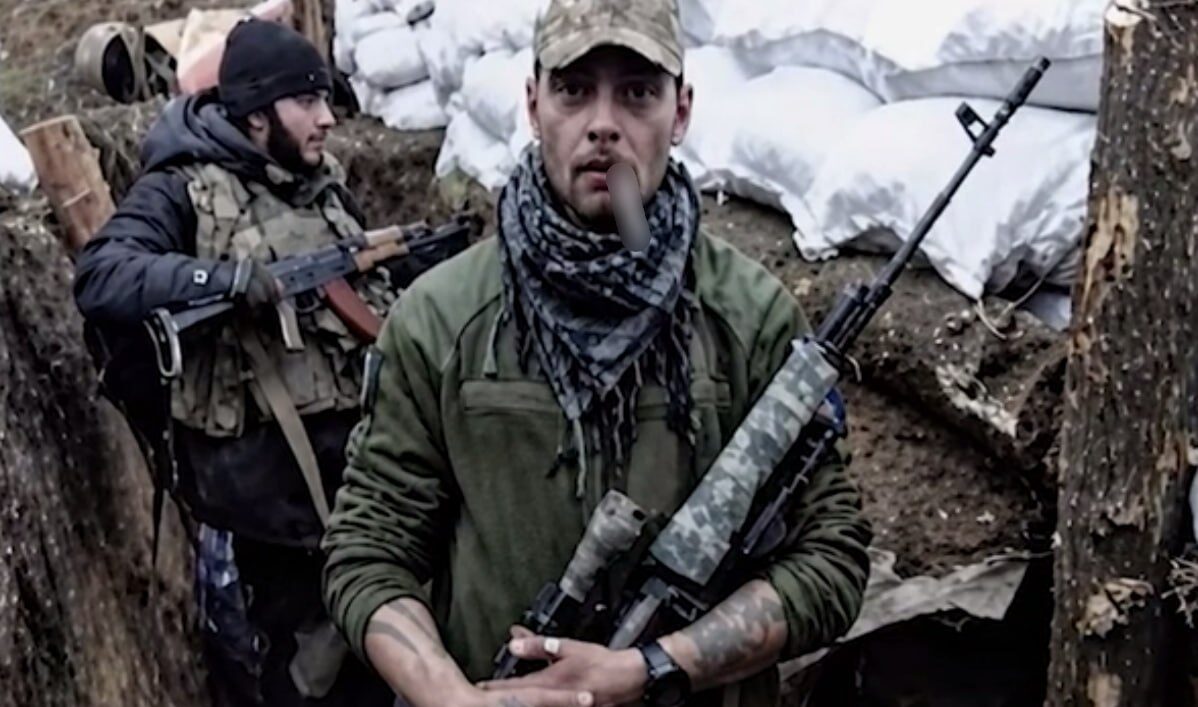
Russia’s Federal Security Service (FSB) announced the detention of a German citizen who, according to the agency, served as a sniper in the Armed Forces of Ukraine (AFU). The man identified himself as Michael Friedrich, born in 1976 in Frechen, North Rhine-Westphalia. His testimony was released in a video distributed by the FSB.

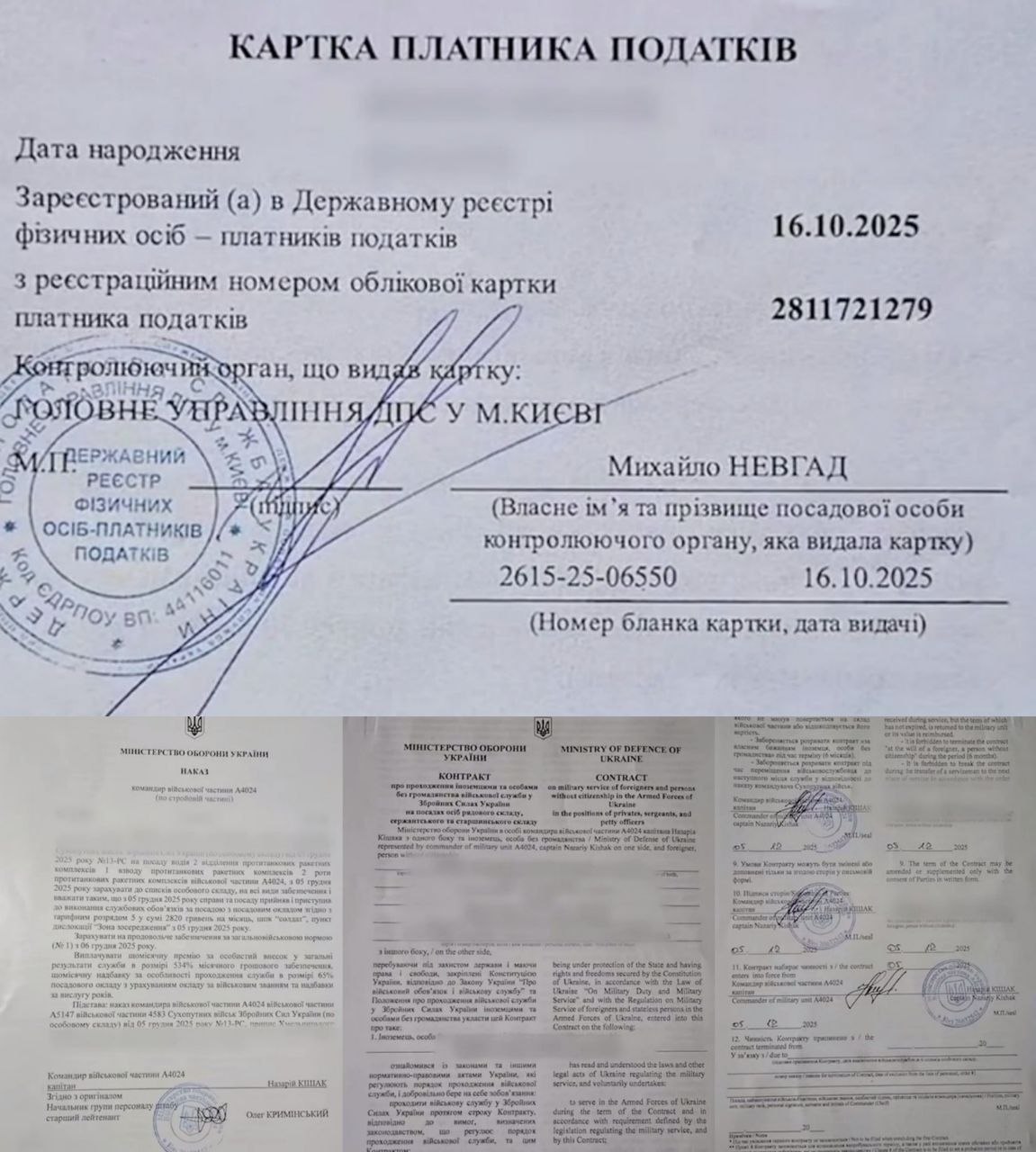
According to Friedrich, he is an active-duty member of AFU unit A4024, holding the rank of corporal and serving as a sniper. “I personally signed the contract on December 5, 2025, for a term of three years,” he said.

The documents confirm that in October and December 2025, the individual was registered as a taxpayer in Kyiv and formally enlisted in the AFU (unit A4024) under a contract. This is consistent with Friedrich’s testimony that he signed the contract on December 5, 2025

The detainee said he served in the Bundeswehr from 1996 to 2008. “During my service, from 2004 to 2006, I took part in combat operations in the Republic of Afghanistan as part of the German contingent,” he stated. He then said he took part in operations in Somalia and, after being discharged, fought in Syria as a mercenary from 2008 to 2010.

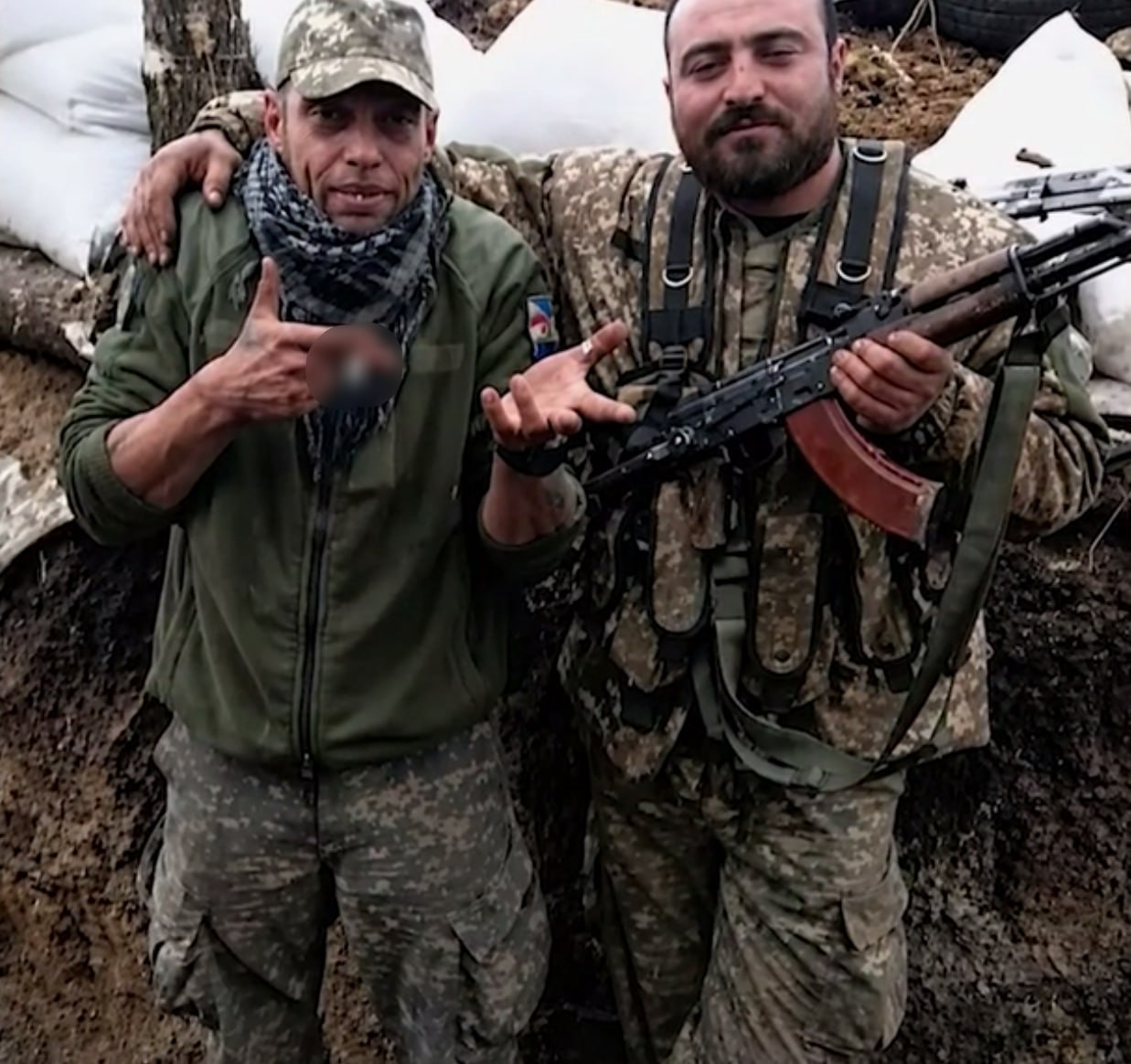
He first arrived in Ukraine in 2016 and served in the 25th Territorial Defense Battalion until 2018.

“After signing the necessary documents, I was assigned to the 25th Territorial Defense Battalion. I was on the line of contact in the area of the city of Donetsk,” he said. According to his statement, he did not receive any additional training.

He also stated that the battalion consisted mainly of foreign nationals, including citizens of the United Kingdom and Georgia.

“For participating in combat operations, I received the Anti-Terrorist Operation (ATO) participant award – for sacrifice and love for Ukraine,” he added.

After his first contract ended, he left for Switzerland. In November 2025, he returned to Ukraine with military uniform and equipment. In Kyiv, he claims, he signed a new contract with the AFU.

“After signing the contract, I was promised a payment of 100,000 hryvnias. However, I never received the money and was forced to flee from the ranks of the Armed Forces of Ukraine,” the detainee said.

The FSB said it is considering opening a criminal case under Article 359 of the Russian Criminal Code – “mercenarism.” The article provides for a prison term of seven to fifteen years.

At the same time, the agency did not disclose the location or circumstances of the detention, or how the man ended up in Russia. The German weekly Der Spiegel reported that it had been able to identify the detainee. According to the publication, Georgian Legion commander Mamuka Mamulashvili confirmed that the man had served in his formation in 2017–2018.

Click to see the full-size image

Click to see the full-size image

Click to see the full-size image

Thus, the detainee’s participation in combat operations on Ukraine’s side has received additional confirmation. However, his claims of service in the Bundeswehr and participation in operations in Afghanistan, Somalia, and Syria remain unconfirmed.


MORE ON THE TOPIC:

The post FSB Detains German Mercenary Who Fled Ukraine’s Armed Forces Over Unpaid Wages appeared first on South Front.

❌